FeatureDirect Primary Care: The Avant Garde Approach
FeatureIntregrating Your Healthcare
FeatureA Healthy Surprise
Top DocsCityview’s 2017 Top Doctors
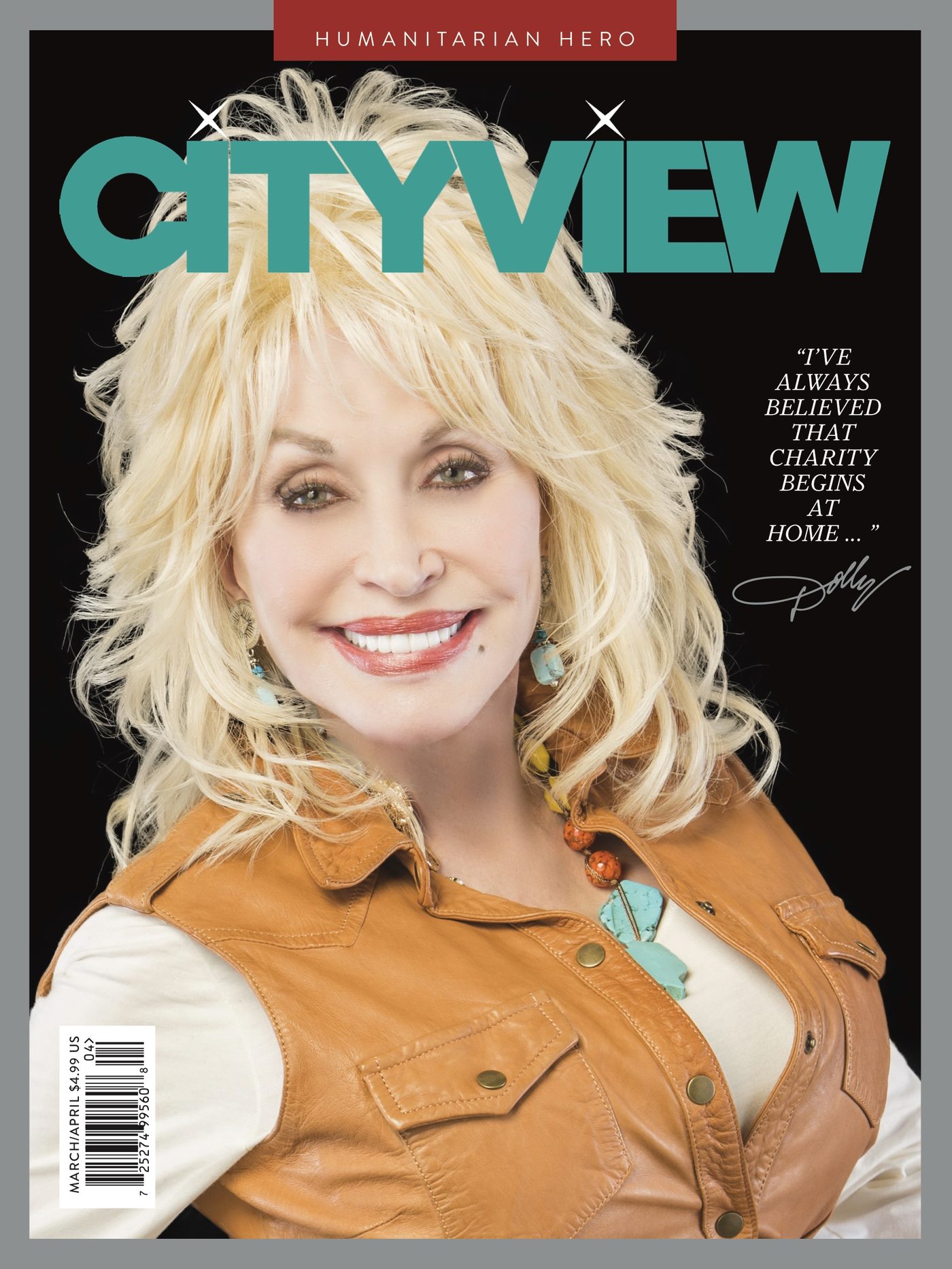
FeatureDolly Parton is a Humanitarian Hero
FeatureMy People Fund
FeatureAngelique Medow
FeatureBearing Each Others Burdens By: Jon Hersey
FeatureBob Pryor
FeatureBruce McCamish
FeatureEditor’s Note
FeatureFuture Medicine
FeatureGeorge Korda
FeatureHobe Brunson
FeatureJon Hersey
FeatureKaren Clark
FeatureLucky Number 13 By: Chrissy Keuper
FeatureOana Harrison
FeatureTrent Eades
Reading Settings
100%
Mar / Apr 2017
Swipe to read →
Vol. 33 · Issue 2 | March April 2017
The PublisherPublisher Note
Departments
Arts & CultureKelly Brown
DepartmentsTucked Away Treasure
Dining GuideDining Guide-Gastropubs
Features
JurisprudenceA Country Doctor
InsightsTake Charge
FeatureDirect Primary Care: The Avant Garde Approach
FeatureIntregrating Your Healthcare
FeatureA Healthy Surprise
Top DocsCityview’s 2017 Top Doctors
FeatureDolly Parton is a Humanitarian Hero
FeatureMy People Fund
FeatureAngelique Medow
FeatureBearing Each Others Burdens By: Jon Hersey
FeatureBob Pryor
FeatureBruce McCamish
FeatureEditor’s Note
FeatureFuture Medicine
FeatureGeorge Korda
FeatureHobe Brunson
FeatureJon Hersey
FeatureKaren Clark
FeatureLucky Number 13 By: Chrissy Keuper
FeatureOana Harrison
FeatureTrent Eades
→ Swipe to start reading
The PublisherMARCH APRIL 2017
Publisher Note
Story by Nathan Sparks
This issue we were presented with a once in a lifetime opportunity to publish something about an extraordinary event where an individual stepped up and simply cared, publicly, to such a degree that she inspired others to care in equal measure.
It is truly humbling to think of the level of how much Dolly Parton gives back—with tens of millions of books given to kids over the course of 20 years, she is literally responsible for a rise in the literacy level of children in the program around the world. Even before the fires, she had consistently demonstrated a truly charitable and humanitarian spirit, influenced by her humble beginnings and her father’s actions.
Usually, when we atCityviewsay someone is the best, we have allowed their peers or the public to choose them: readers vote on our Best of the Best, doctors choose our Top Docs; attorneys select our Top Attorneys, and diners pick our Top Chefs after tasting their creations. We as a magazine don’t often think of ourselves as having the right to bestow honor on our own, but we were so struck by the hugeness of her heart in taking on the My People Fund project that we feel compelled to tell the story in superlative terms. She is a Humanitarian Hero.
As we started this project, little did we realize what we would discover had happened behind the scenes. The more we learned, we went from astonished to overwhelmed with respect. After Keith interviewed Dolly, he was tasked with both setting up the interview historically and telling the story of what it really took to make it all happen. Dolly certainly gets credit for leading the charge, but just as much credit should go to the unsung heroes who faithfully followed along in this enormous endeavor.
As the piece was growing, I mentioned what we were doing to my friend Gary Wade, who writes our Jurisprudence column. Gary has known Dolly all of his life and has deep roots in Sevier County. Unbeknownst to me, Gary tossed aside the column he had already written to tell the story of another great humanitarian, a doctor who just happened to have brought Dolly into the world.
In 17 years of publishingCityview, I have never seen a story come together as magically as this one did. Again, we are humbled to present this astonishing story.
If you wish to support Dolly’s literacy efforts, donate to the Imagination Library atimaginationlibrary.com. If you’d like to support those affected by the fires, donate through Mountain Tough atmountaintough.org.
→ Swipe for Next Story
Arts & CultureMARCH APRIL 2017
Kelly Brown
Story by Jacob Rouser
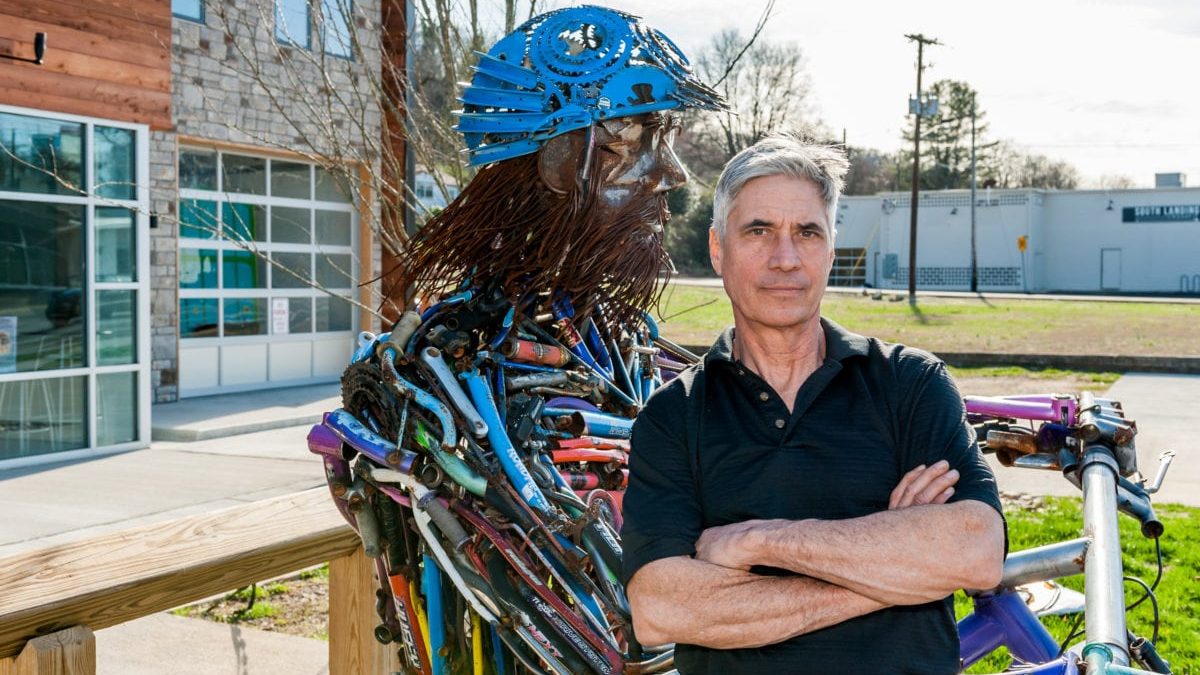
With a passionforshapingspaces and constructing stories, Kelly Brown of Bower Bird Sculptures is as connected to building with nature as his company’s namesake. Since childhood, he has used his hands to shape the world around him. For him, art “…has always been more than just actually looking at an object – there is some kind of interaction with it.”
His twigloos, for example, take an unwanted, invasive shrub, privet, and repurpose it into igloo shaped domes through which kids can run and play. These twigloos have appeared in various places around Knoxville, including Ijams Nature Center.
His love for repurposing materials is clear. To him, each piece guides his art, “this shape here and this color there…you’re making things with these parts and they’re speaking to you at the time.” Brown also created the Bicycle Arch at the entrance of the Greenway at the Outdoor Knoxville Adventure Center, the mountain biker sculpture for Alliance Brewing, and the winged boar that guards the still on top of Scruffy City Hall.
The boar isn’t the only sculpture that Brown will be bringing to life in Knoxville. He plans to start work on his own version of Rodin’s Thinker called The Digger. Having gathered old plows, shovels and pick axes, Brown hopes to echo Knoxville’s own story of breaking new ground and building something new.
Ambiance 4 Stars Service 5 Stars Food 5 Stars Presentation 5 Stars Price 4 Stars Total 23 Stars
The Citico’sreservation-only experience begins at the front gate of Lenoir City’s Windriver community. Thursday through Sunday, patrons are cleared at the guardhouse and directed to take a left turn and follow a winding road to a five-bedroom inn. The great room, now the dining room of Citico’s, was designed by Stephen Davis with tall ceilings and windows to take advantage of the views of Tellico Lake. The name Citico’s comes from the Cherokee village, alternately known as “Setaco” or “Sitiku,” that once sat on the shore of the Little Tennessee River.
Even though there are only a handful of tables, diners have plenty of privacy.
In the tradition of the great French restaurants, diners have the opportunity to discuss the menu with Executive Chef Robert Allen. “We value an intimate experience with our guests,” says Allen, who is happy to talk about the local suppliers and farms, like Eco Rich Farms in Greenback and Sweetwater Valley Farm, that enable him to use fresh seasonal foods.“When we moved here three years ago, I fell into a group of people in the foodie scene in Knoxville, so we work with our close friends.” Allen grew up the son of a chef in Austin, Texas, where he developed an eclectic background in food styles, studied at Austin’s Cordon Bleu Culinary Academy, and polished his craft in country clubs. From the moment diners enter the front door, they are greeted by the host, the wait staff, and even the director. The emphasis is on making sure patrons lack for nothing in their dining experience, including a recommendation for a fine wine to complement each course.
Each item is presented with Cordon Bleu elegance with the care for timing and placement. On our visit, the meal began with an amuse bouche of steak tartare, followed by an unforgettably presented three-foot-long Local and Artisan Cheese Tray ($24), including homemade spreads, pastrami,
and sausages, with bread from Tellico
Grains Bakery. A particular highlight are the pickled sunchokes. The nutty sweetness of sunchokes most immediately lends itself to soft purées and soups, but they’re more versatile than meets their knobby eyes, and Chef Allen uses them to great advantage here. The smoked blue cheese from Sequatchie Cove Creamery alone was worth the visit.
Among the starters, the Fried Brussels Sprouts ($14) are cooked with Benton’s bacon and sweet chili sauce. You can ask, but Chef Robert will not share his recipe. Citico’s House Salad ($9) features aquaponically grown EcoRich mixed greens that have a peppery, fresh taste. They are mixed with Benton’s Country Ham, pecans, Lima beans, pickled red onion, Sweet Water Valley white cheddar and dressed with Blueberry Balsamic Vinaigrette. The Baby Wedge Salad ($10) features iceberg lettuce, candied Benton’s bacon, house dried tomatoes and that heavenly smoked bleu cheese topped with bleu cheese vinaigrette.
Don’t miss the Creamy Acorn Squash and Green Apple Soup topped with sweet and spicy almonds (cup $6; bowl $9), with its memorable curry taste. Rabbit Ravioli ($14) is an original creation, stuffing house-made pasta with braised Tennessee rabbit & Ricotta cheese and served in brown butter with sweet potato and fresh sage.
Among the entrees, the Southern Chicken ($30) features a delectable semi-boneless chicken from Shelton Family Farms in Whittier, North Carolina, with Charleston gold rice, tomato jam bacon, green beans, and roasted apple glace. The Berkshire Pork Chop ($36) comes with butternut squash, broccolini, fried fingerling potatoes, and mustard seed sorghum BBQ.
The Tenderloin Filet ($48) features Dauphine potato, spinach timbale, truffle parsnip puree, and red wine demi-glace. Sea Scallops ($40) are tender and cooked to perfection, served with carrots, sunchokes, and Tennessee field peas.
There’s no question that the final check, especially adding in the wine, reflects a fine dining experience. In this realm, it is a good value.
→ Swipe for Next Story
Dining GuideMARCH APRIL 2017
Dining Guide-Gastropubs
Story by Karen Clark
For a relaxedbusinesslunch or dinner date out in the Old City, head to the Crown & Goose. Their gastropub ambiance is echoed in the pub’s authentic London cuisine. To get your meal started, tryThe Goose Boardsmall plate which includes a selection of regional cheeses and meats, preserves, nuts, mustard, and bread; or theDeviled Eggs, which are made with pastrami cured salmon, olives, pickles, and pimento cheese. For something more substantial, order the definitiveCrown & Goose Fish & Chips, paired with a Boddington’s Pub Ale. If you are torn over which main dish to choose, go for theBraised Pork Shank, served over Shelton Farms grits, winter freens, and kimchee. Their Sunday brunch is not to be missed; enjoy it in their beer garden as the weather warms.
If you’re a beer enthusiast and have been wanting to try an up-and-coming restaurant in town, look no further. Balter beers are brewed on location by co-founder Will Rutemeyer, with an extensive beer selection ranging from the richBear Blendcoffee oatmeal porter to the hop bombFirebelly IPA. Their beers pair incredibly well. To get things started, try the citrusyMaypoppale ale with theirFried Green Tomatoes, made with pimento cheese, tomato jelly, and sprouts. If you’re in the mood for a solid burger, get a crisp4th and Pilswith theBalter Burger, which comes with two 4 oz. patties, Sweetwater Valley Farm’s buttermilk cheddar, lettuce, tomato, onion, house pickle, and some black pepper mayonnaise. Feeling like you want to be active before you indulge?Bike to Balterfor $4 Balter drafts
Originating in Downtown Clarksville, TN, Blackhorse expanded to Knoxville in Western Hills. Tucked in between Bearden and Sequoyah Hills,Blackhorse Pubstrives to create a genuine pub atmosphere while serving gourmet pizzas, steaks, pasta, salad, and sandwiches—and they don’t have “brewery” in the title for no reason. Blackhorse’s handcrafted ales are brewed on site. If you’re headed to Blackhorse, try thePub Club, featuring toasted wheat berry bread with ham, smoked turkey, cheddar and Monterey jack cheese, bacon, lettuce, tomato, and honey mustard. Be sure to pair this with theBarnstormer Red Ale, a smooth traditional red ale made with Hallertau hops. Pairing equally well with the Barnstormer is theBlackhorse Combospecialty pizza, a traditional pie loaded with meat and veggies. And if you’re in the mood for something slightly sweet, get a pint of theirVanilla Cream Ale, an area favorite.
If you long to be immersed in Scottish culture but don’t want to sit on a plane for 12 hours, go to Boyd’s Jig and Reel in the Old City. Known for its live Scottish music and extensive whiskey selection, it’s the best spot for authentic tunes and grub. Not sure about which whiskey is best for you? Try theirHighlander Scotch Flight, which includes samples of Dalmore 12yr, Glenmorangie 10yr, Oban 14 yr, and Old Pulteney 12 yr. Dig into theSteak and Ale Pie: a grouping of beef, vegetables and traditional Scottish ale, topped with crispy puff pastry and baked to a golden-brown perfection. And for goodness sakes, don’t miss the traditionalScotch Egg, a boiled egg wrapped in sausage and fried up. Join Jig and Reel on Wednesdays at 7p.m. for the “Tennessee Shines” radio show, hosted by WDVX.
→ Swipe for Next Story
JurisprudenceMARCH APRIL 2017
A Country Doctor
By the deeds he does while livin’
In the December 1944 issue of Coronet magazine, Arthur Gladsone Keeney, who had served in the Office of War Information during World War II, published “Dr. Lifesaver,” featuring two men who, in different ways, changed the course of world history. The setting of Keeney’s story is in Scotland during the latter part of the 19th century.A poor Scottish farmer named Fleming, while plowing his fields, heard a cry for help. He dropped his tools, and ran in the direction of the screams. At a nearby bog, the farmer found a terrified boy struggling to free himself from drowning in the black muck. Risking his own safety, the farmer saved the boy from what would have been a slow and terrifying death and then sent him on his way. On the following day, an “elegantly dressed nobleman” drove his horse drawn carriage to the home of the farmer and introduced himself as the boy’s father.“I want to repay you,” he said.“You saved my son’s life.”The farmer declined the offer, “I cannot accept payment for doing what I considered my privilege and duty.”
At that moment, Fleming’s son, only a few years younger than the boy who had been saved, came to the door.“Is that your son?” the nobleman asked.“Yes,” the farmer proudly answered.“I’ll make you a proposition,” the nobleman said, “Let me provide him with a good education, and if the lad is anything like his father, he will make all of us proud.”
According to Keeney, the farmer’s son, with the financial support of the nobleman, later graduated as a doctor of medicine from St. Mary’s Hospital Medical School in London. In time, he became known throughout the world as Sir Alexander Fleming, who in 1928 discovered the miracle cure of the early 20th century—penicillin. During World War II, the nobleman’s son was stricken in North Africa with a deadly form of pneumonia. While on his way to England from Tehran, Iran after a strategy meeting with Franklin Roosevelt and Josef Stalin, the nobleman’s son was once again saved—this time by penicillin. The name of the nobleman, the story goes, was Lord Randolph Churchill. And the name of the son? Sir Winston Churchill.
If only Keeney’s tale, as charming as it is, were true: an act of kindness by a humble farmer to a grateful aristocratic nobleman who returns the favor. In consequence, countless lives are saved by a medical discovery and nations are preserved by exemplary international leadership during a time of war. Indeed, the Nobel Prize winning Alexander Fleming discovered penicillin in 1928, and the value of Churchill’s leadership during World War II cannot be overstated. Each earned Knighthood for his achievements. In truth, however, Fleming worked to pay his way through college, and Churchill, grievously ill, was treated with sulphanomide—mixed with a bit of whiskey or brandy. Penicillin was not yet available in that section of the world.
Another captivating story, having local interest, is based in fact. Over forty years ago a singer and songwriter penned a tune about a country doctor she so admired for treating her and her family in times of need—without any expectation of pay for his services.
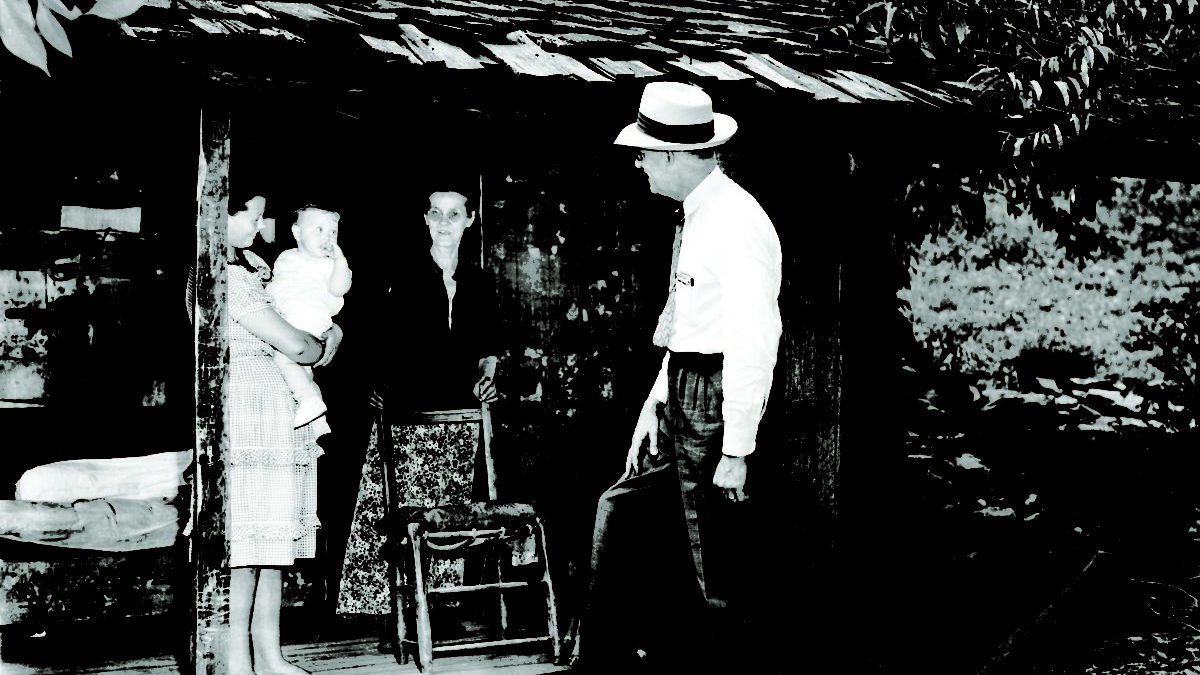
Born in Pennsylvania in 1891, Robert Folly Thomas entered the ministry after college graduation, serving as a missionary in Penang, Malaysia for three years. Upon his return, he borrowed $100 to marry Eva Spicer and then worked his way—digging potatoes—through medical school at Syracuse University. After graduation, Dr. Thomas was assigned to the Pittman Center Methodist Mission in Tennessee—then a day long ride by car from Newport, and two days by wagon from Sevierville. The mountain folks in the area, independent by nature, were suspicious of strangers and Dr. Thomas was no exception. For example, when he visited one of the rural schools to vaccinate the students against smallpox, one of the boys protested, “If I let you shoot me, Pa says he will whoop me good”... and “Pa” probably would have “whooped” the good doctor too! In time, however, Dr. Thomas earned the respect of those he served. As the only physician in these vast mountains, he traveled by jeep, by horseback, or on foot to communities such as Cosby, Jones Cove, Webb’s Creek, Richardson Cove, and Caton’s Chapel. He treated illnesses, delivered babies, and performed surgeries—almost always in the home of his patients. The level of poverty in the area had to be shocking to the young Thomas family, and compensation for medical care was infrequent—often in the form of chickens, eggs, produce, hogs, and, on one occasion, a whole cow. In addition to his daily duties as a physician, Dr. Thomas served on Sundays as pastor of the Pittman Center Circuit—establishing missions at Shields Mountain, Evans Chapel, and other remote communities.
On a cold, rainy day in January of 1946, Dr. Thomas traveled to the tiny mountain home of Lee and Avie Lee Parton on Locust Ridge, where he delivered a little girl named Dolly, the fourth of what eventually became a family of 12 children. The Partons paid with a bag of cornmeal....In a song released in 1973, Dolly paid tribute to “Dr. Robert F. Thomas”—a “mighty, mighty man [who] enriched the lives of everyone that ever knew him... a man the Lord must have appointed to live among us mountain folks in eastern Tennessee.”The chorus says more:
Dr. Thomas was a friend
A neighbor and a doctor
Though he seldom got a dime...
For all he had done
And I remember lots of times
We sent for Dr. Thomas...
But I don’t recall a time
He did not come
They say a man is judged
A judgment when he stands
Before the Lord
And I know heaven holds a place
For... Dr. Thomas
And I know that he’ll receive
His just reward
Dr. Thomas died on Good Friday, April 4, 1980, at the age of 88.Forced to officially retire by virtue of the Methodist mandatory retirement rule, Dr. Thomas continued to serve his profession. As chaplain at Sevier County’s only hospital, he continued his mission by preaching the Gospel at churches throughout the area and providing medical service when needed. By then a legendary figure in Sevier County, he is remembered for the broad smile upon his face, his stately countenance, and his dedication to provide spiritual comfort and medical care regardless of ability to pay. Hundreds of years before the birth of Christ, Hippocrates advised physicians: “Cure sometimes, treat often, comfort always.” Dr. Thomas met the challenge.
In 1973, the owners of the Goldrush Junction theme park in Pigeon Forge built a chapel in honor of Dr. Thomas for their Sunday Services. Ten years later, Dolly Parton became the chairwoman for the Dr. Robert F. Thomas Foundation, an organization which literally saved what was then known as the Sevier County Hospital. In 1986, what had been Goldrush Junction became Dollywood. The Thomas Chapel still holds Sunday Services. Today, the Thomas Foundation continues its mission to provide medical care, not only for the people of Sevier County but also for its millions of visitors, in the spectacular LeConte Medical Center in Sevierville. Dolly, of course, now has her own Foundation, and, when the late November wildfires in her Smokies finally subsided, the organization she created took center stage in relief efforts. Thus, this “mighty man” who 71 years agooffered heath care to Evie Lee Partonin her time of need, is remembered and rewarded by a celebrity singer and songwriter who has never forgotten the people of her Smoky Mountain home….And that is the truth.
Gary Wadeis the dean of the Duncan School of Law and former Chief Justice of the Tennessee Supreme Court.
→ Swipe for Next Story
InsightsMARCH APRIL 2017
Take Charge
Story by Robert Pryor, Sr.
As a litigation attorney, I have spent many hours over the last 30 years talking with clients about their failed medical treatments. Some tell very sad stories about life-changing injuries or death caused by medical carelessness. As I have listened to their complaints against the health care system, I have become acquainted with the various causes of many preventable harms and, in some select cases, have sued to recover justified damages. I have also learned about patient safety simply by getting older and going to more and more doctors and subjecting myself to more tests and medical procedures. In case you do not know it, we older folks spend a lot of time in doctors’ offices and hospitals. As a lawyer and a patient, I have learned a great deal about how to protect yourself from medical malpractice injury and keep yourself and your family safe when you enter medical danger zones like hospitals, clinics, and doctors’ offices.
First, I must say that Knoxville is blessed with many great doctors and some highly rated hospitals. The standards of care in the Knoxville metropolitan area are very high and, consequently, as patients, we have every right to expect the very best from our health care providers. The trick to survival is learning how to select the best doctors and create your own network of skilled and conscientious providers. Too many patients surrender themselves to their doctors’ care and just give up on close supervision of their medical problems and treatments. Like taking your car to the shop, too often we just turn it over to the one who is supposed to know what to do and we ask no questions nor attend to details. The biggest mistake we make as patients is lack of vigilance.
Find a Primary Care Physician
Search for and stick with a good and caring primary care physician. Pick a family practitioner or a doctor of internal medicine who could not only be your doctor, but your friend. Your PCP should be the hub in your medical network. If you are healthy, great; the PCP is maybe all you will need. But if you need treatment from a specialist, the PCP can connect you to the right person. Prudent referrals may be the key to the quality and safety of your care, and you cannot obtain a pass to move freely about the health care world without referrals from your PCP. You should shop around and pick the best PCP to serve as the centerpiece of your network. Look for a doctor with a good education, good solid training, experience, a caring attitude, and a willingness to take time to get to know you and understand all that is going on with you. I would give you the name of my PCP, but I don’t want you messing up my relationship. It has taken years to build my own network.
Remember, your PCP has many patients and you must make sure that you are remembered from appointment to appointment. I would recommend that you keep a medical diary on each visit and know what is expected of you and what will occur next in your treatment. Your PCP may forget to report your blood test or other testing result, but you won’t forget. I once saw a circumstance where a family doctor sent his patient for a cardiac treadmill test, but failed to give the patient the bad results. The patient died of a heart attack waiting on the results that were found after the funeral unread in the doctor’s file.
Become a Doctor’s Helper
A wise person once told me that a doctor was not smarter than me, he had just read different books. We can all educate ourselves about our medical problems and use that knowledge to improve our treatment. Medicine, like law, has become more specialized. The other day I asked a neck doctor about my pulse and he was reluctant to answer. While your primary care physician is a generalist, you will probably require the attention of a specialist or two or three. When you need a specialist, do your homework. Participate in the selection of the specialist and don’t just accept your PCP’s best friend. Search listings of top doctors and ask around to learn about the experience of others. Of course,ask your PCP for a recommendation.
A quick internet search of your diagnosis or problem may help lead you to the right specialist. With a little research, you can better understand what your specialist is talking about and you have an understanding about the questions you need to ask. Educate yourself for each appointment, but remember that sometimes doctors are uncomfortable with smart, informed patients, and that could be grounds to look for another specialist.
Communication
All the experts agree that the most common cause of medical mistakes is failure to communicate. Doctors’ offices and hospitals have many systems and most depend on good communication, but the only communication you can control is your communication with your doctor. Focus on your conversation with your doctor and your doctor’s staff to make sure other health care providers are acting consistent with your doctor’s wishes. For example, understand what tests you may be sent to have performed, and know why the test is being done, who will do it, how will it be performed, and when and how you will get the results. The person doing the test is just taking orders, and those orders may be wrong or misunderstood. To improve communication, I recommend you keep a typed list of current medications with dosages and present it at each appointment. Make sure you and your doctor are on the same page regarding all of your medications. I recall a case where the doctor failed to include the dosage on his prescription and the pharmacist filled the prescription for an adult dosage which proved dangerous when the patient was a child and the drug was a diuretic. This was a serious communication error between the pharmacy and the doctor that resulted in kidney damage.General TipsThe following quick tips may help make you a better and safer patient:
1.Work hard at being a good historian. Make sure your doctor understands the facts associated with your symptoms because the correct diagnosis requires areliable history.
2.Try to enjoy the long wait time in your doctor’s office by focusing on your care and not reading magazines. Check your research and review your factual history and list of questions for the doctor.
3.Use your physician’s patient portal to keep check of your care, the recorded entries of your doctor, and errors that need correcting.
4.Most medication errors involve being given the wrong medication by the pharmacy or being overdosed by a hospital nurse. Double check your medications before you take them and know the names of your medications and what they look like.
5.Try to avoid surgery. Sometimes patients are too quick to demand surgery and some surgeons can be too quick to agree to surgery. When surgery becomes necessary, do your research and know all of the risks to discuss with your doctor. Don’t just wait until the day of surgery and sign a surgery consent form immediately before the procedure.
6.Hospital falls are a major concern. Make sure all precautions are taken for you by trained personnel. Repositioning in bed and transfers in and out of bed can be dangerous and require specially trained assistance.
7. Don’t be ignored when you call for help in the hospital, but be pleasant and reasonable.
8.Question every major diagnosis until satisfied it is correct. It is not disrespectful to make sure you are not living with or dying from a misdiagnosis.
9.Nurses are required to be advocates for the patient. They are duty bound to be on your side versus doctors and other hospital employees.
10.Be your own best medical advocate. Ask questions about anything you don’t understand.
Be careful and get well.
Bob Pryoris one of the area’s foremost authorities on Medical Malpractice. When not actively defending his clients he is probably questioning his own doctor. If you have a Malpractice question contact his office at knoxvillelaw.com
A wise person once told me that a doctor was not smarter than me, he had just read different books.
→ Swipe for Next Story
FeatureMARCH APRIL 2017
Direct Primary Care: The Avant Garde Approach
Story by Jon Hersey
With Obamacare on its deathbed, even those who want it gone aren’t keen on killing it so fast. One of the law’s most outspoken critics, Lamar Alexander, has said “Obamacare should be repealed finally only when there are concrete, practicable reforms in place that give every American access to truly affordable health care.” He’s also said that the issue needs to be sent back to the states, implying it is government’s job to actually supply that health care, as opposed to just getting out of the way. He certainly wouldn’t be the only one stuck inside the healthcare box Obama built around Republicans over the last seven years. But for those who don’t forget so fast how government can hinder when it tries to help, there’s an appealing alternative to Obamacare replacement—and it’s already doing an extraordinary job.
Traditional Medicine
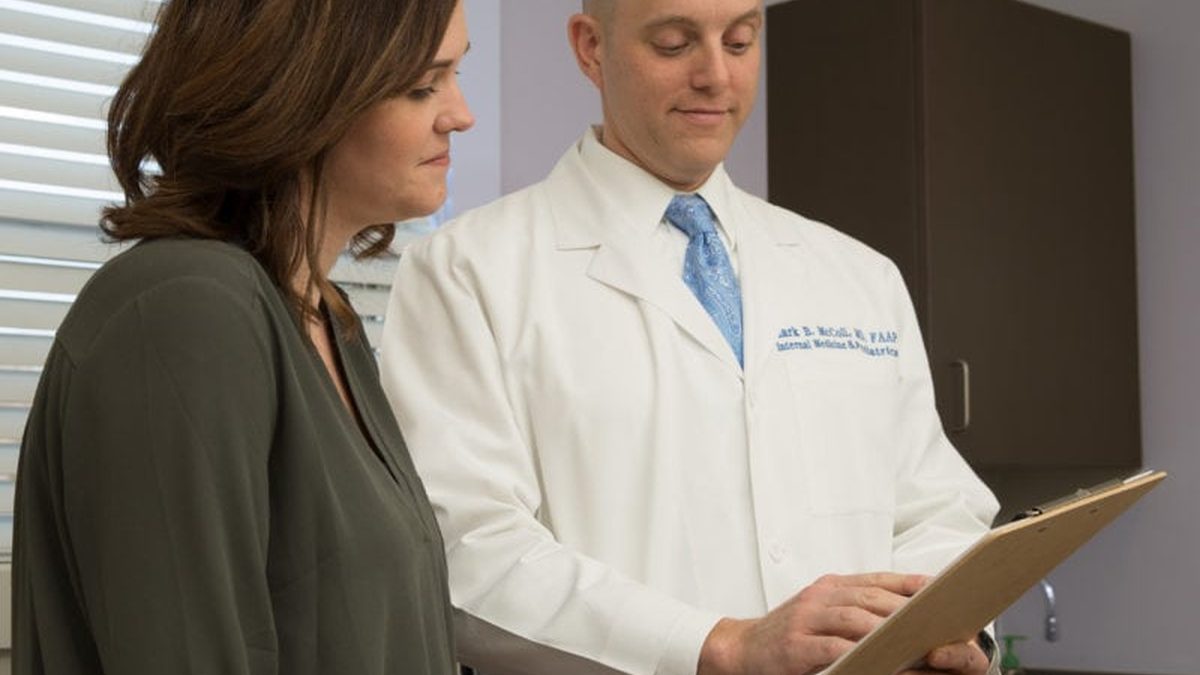
Dr. Mark B. McColl of Trinity Medical laughs when I refer to insurance-based healthcare as traditional medicine:
“No, traditional medicine is workingfor your patient. Insurance-based,fee-for-service stuff is the new kid on the block, even though it’s several decades old. It’s really sort of non-traditional.” He says, “Most of the world, for most of human history has not had a third-party-payer system, no matter who it was: whether it was a single-party government system or insurance corporations. It’s always been that the patient controls their healthcare decision-making by virtue of the fact that everybody in the system works for them, and they’re the pinnacle of it.”
Dr. McColl is talking about the ages-old practice of doctors working directly for patients without the overhead and complexity of a conglomerate between them; that’s Direct Primary Care (DPC). He converted from an insurance-based practice to DPC in 2016. At his office, patients pay $30, $60, or $90 a month, depending on their age. A $125 registration fee per person (up to a per family maximum of $300) covers the first month’s service. Those 22 and younger cost $30 per month, 23-64 cost $60 per month, and 65 and older cost $90 per month. The monthly payment covers 25 visits per year, same or next-day appointments, phone and email access to your primary care provider (PCP), and 24/7 access to Trinity’s on-call physicians. It also covers “just about anything that can be done in an exam room,” EKG and other diagnostics, and most routine blood work.
DPC vs. Concierge
Given what’s covered, it’s not surprising that many people confuse DPC with concierge medicine. But whereas concierge medicine was set up for the extremely wealthy to have more access to their doctors, the modern wave of DPC, unleashed in the 2000s, was actually intended for the uninsured and very poor. Yet, in just a little over a decade the direct competition created by DPCs has elevated them to the level of competing with concierge care. The difference? Concierge services still bill traditional insurance for most things—the monthly concierge fee is charged primarily for the unfettered access. That means that the incredible overhead saved by DPC is not saved by concierge care—which also makes concierge care a lot more expensive for patients than DPC.
The most common objection to DPC is actually a pretty logical one: it will exacerbate the shortage of primary care physicians.
If doctors can spend more quality time with fewer patients, make about the same amount or more money, and derive far more satisfaction from their work, then they will see fewer patients overall. Doctors paid by insurance companies take on an average panel size of over 2,000 patients whom they see an average of 1.6 times per year for about 20 minutes. DPC docs take on panel sizes of between 400 and 1,200 patients whom they see an average of 4 times per year for about 35 minutes.
Not Enough Doctors
The residency system is not pumping out enough doctors to see the aging baby boomers and the 20 million newly insured under the ACA. The Association of American Medical Colleges (AAMC) projects physician shortfalls of between 61,700 and 94,700 by 2025. That’s a big problem, and the assumption is that DPC can only exacerbate it—especially because the better quality of life for doctors could lure some away from specialties where the AAMC reports the biggest shortfalls will be. “However,” says Dr. Philip Eskew, JD, MBA:
“…this effective use of primary care decreases the burdens placed on the rest of the health care system and highlights the real problem: a physician maldistribution problem, with an overabundance of specialists. With the growth of DPC and a more effective use of primary care, the number of specialty referrals would fall and the gap between primary care and specialty physician compensation would eventually shrink, incentivizing more physicians to enter primary care.”
Qliance, a Seattle-based DPC outfit (until recently, backed by Jeff Bezos and Drew Carey among others) has released stats that seem to confirm Dr. Eskew’s claims. According to The Direct Primary Care Journal, their patients are hospitalized 60% less, have 14% fewer ER and specialist visits, and need 29% fewer advanced radiological tests, than patients with traditional insurance-based health care. They use about 58% more primary care visits but save about 19.6% per patient.
Dr. McColl says of his prior experience in insurance-based medicine. “When you’ve got to move through the day and you’ve got eight minutes to talk with the patient, you hand off to the specialists. You hand off to some of these advanced tests to try and get things done, because you’re trying to get it all in there.”
Many would welcome anything DPC can do to help correct the specialist to generalist ratio. Dr. John Geyman calls the current system “upside down health care,” saying:
“Up to the middle of the last century, most Americans could count on good access to generalist primary care physicians with the training and commitment to evaluate and treat their medical problems, whatever they might be. Those days are long gone. The ratio of generalist physicians to specialists in this country reversed from about 80:20 percent in 1930 to 20:80 percent in 1970.”
Turn Down the Volume
As has been noted quite frequently, general practitioners often make only about one fourth of what some specialists make, yet they rack up about the same amount in medical school debt, leading physicians to make up for lower payments with higher patient volume. This in turn has made insurance-based primary care, to some extent, into a screening session for specialists. McColl says:
“The era of pediatricians that I trained with gave chemotherapy. Because that’s what pediatricians did. They were experts in all things kids. Chemotherapy was part of it. I’m not at all advocating that we move away from specialists; the point is that when you have a smaller set of patients and you have the time and the ability to vest yourself, as an expert of medicine, in those patients, there’s a lot of things that you’re qualified to do that you don’t do now, because there’s not time to do it.”
Our options appear to be, 1. Stick with a fairly impersonal, in-and-out approach to primary care, and continue to expand the need for specialists; or 2. Spend more quality time on the front end with PCPs, thereby catching and preventing more of the health issues which would otherwise turn into problems requiring the time of very expensive specialists. Of course, we’ll continue to need specialists. But as more and more people choose DPC, we’re going to continue to need more primary care providers.
One interesting charge made by Dr. Edmund S. Weisbart is that because DPC is not insurance, there is little to no regulation to protect patient privacy. He says that because DPCs aren’t constrained by HIPAA or the ACA’s patient privacy protections, “there is little preventing DPCs from selling patient data to marketers. As the DPC model grows, the demand for this high-value data will undoubtedly drive increasingly irresistible financial offers.” But he fails to mention that every state has patient protection laws in place. In Tennessee, the law states, “The name and address and other identifying information shall not be sold for any purpose… Any violation of this section shall be an invasion of the patient’s right to privacy.” The law goes on to limit the disclosure of medical records, even those which have been de-identified, even after a patient has died. Aditionally, most DPCs are members of jointhewedge.com, an organization that requires of its members that no information whatsoever is released to third parties without patient permission.
Some claim that access is a sizeable problem for DPC. They have charged that DPC skews towards high-income areas and therefore doesn’t serve minorities and the poor. Unfortunately, those making this claim have not distinguished between concierge care, developed for the wealthy, and DPC. Dr. Eskew, who has begun a movement in support of DPC, has created a map, available on the DCP Frontier website, of all the DPC practices in the U.S. There are DPC practices in 47 states plus D.C. Given the original intent of at least some in DPC of serving the uninsured, it’s not surprising that there are DPC practices in rich, poor, rural, urban and suburban areas. But those who claim that access is limited also claim that frequent travelers will be poorly served because they’re locked into one provider. But with DPC they have direct access via phone and email to the doctor who knows them best.
Of course, DPC is not insurance—it’s healthcare. Those who have spent enormous amounts on insurance only realize when they go to the doctor that they haven’t yet purchased any health care yet. DPC is geared towards preventing systemic problems requiring more expensive medical care. But one could still be injured or become ill beyond the scope of DPC. Most people with DPC will still need and want to purchase insurance. Yet the insurance they have every incentive to buy is insurance in the more traditional sense. By design, insurance is for the unforeseeable, the unplanned. We don’t expect our car insurance to cover oil changes and gas, but accidents. Yet, we’ve been lured into a system in which we prepay higher prices to a middleman for something we already know we’re going to be buying. DPC has the ability to market-correct this wasteful practice.
Would pursuing more DPC mean the end of social safety nets? It may turn out that the safety nets are more local than national. Dr. McColl says, “If there were times when people couldn’t pay, and a basket of eggs was all they could offer, well, I like eggs. We’ll work it out. You know?” He continues, “I certainly would hope we come to a better solution. I’m fearful that we won’t. I’m fearful that we’ll move further down the road towards a socialized, single-payer system.” How will Trumpcare unfold? Hopefully, a businessman knows a moral and practical solution when he sees one. But for those less hopeful, now would be a good time to let Lamar and company know what you think.
When not investigating the future of healthcare in America,Jon Herseyspends time researching Objectivist philosophy.
→ Swipe for Next Story
FeatureMARCH APRIL 2017
Intregrating Your Healthcare
Story by Oana Harrison
While conventionalmedicine is often a life-saver, certain alternative medicines may be able to help prevent major health issues requiring medication or surgery, and thus improve your overall quality of life. However, with so many options available in both traditional and non-conventional medicine, it’s not always easy to make a good choice. When investigating alternative options, the wide variety of terms used to define and describe those alternatives can make things even more difficult.
An initial difference you might notice when searching for alternatives is between a standard MD and a Doctor of Osteopathic medicine (DO). Both MDs and DOs are similarly trained in conventional medicine. Both can prescribe medication, perform surgery, and practice in specialty areas. The most significant difference between an MD and a DO is that DOs receive specific training in Osteopathic Manipulative Treatment in the first two years of medical school. The approach they are taught is more hands-on, literally. DOs are trained to use their hands to diagnose and treat illness or injury, encouraging the body’s natural tendencies towards self-healing. The degree to which a DO differs from a standard MD in practice, however, is uncertain and must be determined by the patient.
In addition to the traditional medicine practiced by MDs and DOs, there are a variety of other practices often referred to as complementary and alternative medicine (CAM). This is a broad category that can include a range of practices, including various systems of healing (such as mega-vitamin therapy, homeopathy, chiropractic, tai-chi, naturopathy, Ayurveda, and faith healing) that are not included in the traditional curricula taught in medical schools of the United States. Many of us already use CAM when we take vitamins or nutritional supplements, or go for a massage. “Complementary medicine” is used to define practices used in addition to traditional medicine, while “alternative medicine” is used to describe practice used in place of conventional treatments.
An increasing number of local physicians of many backgrounds are drawing on both conventional medicine and CAM in a discipline known as integrative medicine, defined by the American Board of Integrative Medicine (a member board of the American Board of Physician Specialists) as “the practice of medicine that reaffirms the importance of the relationship between practitioner and patient, focuses on the whole person, is informed by evidence, and makes use of all appropriate therapeutic approaches, healthcare professionals and disciplines to achieve optimal health and healing.” We talked with a range of non-conventional medical professionals in Knoxville to get an insight into integrative options.
Woman doing intense core exercise on fitness mat. Muscular young woman doing workout at gym.
One option is to see a doctor who is open to the widest range of CAM therapies. “My practice is unique because I combine several treatment types, while most therapists just focus on one way of treating the health problem, like prescribing medications or using acupuncture. I have been trained extensively in both traditional and osteopathic treatments, so I try to apply the best combination for the particular patient and situation,” says Dr. Kristopher Goddard, founder of The Osteopathic Center, who categorizes his practice into three divisions: integrative medicine, regenerative injections, and cosmetic therapy. “I use nonsurgical and natural treatments along with lifestyle coaching to help fight illness and prevent disease,” says Dr. Goddard.
Central to Goddard’s integrative approach is osteopathic manipulation, a gentle and often a slower way of getting an adjustment as compared to a chiropractic adjustment.
“I will not crack the body. I use cranio-sacral therapy, myofascial release, and muscle energy—I use your own muscles to push your body back in place,” describes Dr. Goddard. He adds that he also looks at “... other factors preventing healing, such as nutrition, or lifestyle.”
The Osteopath Center also offers what it calls comprehensive health screening to determine basic body functionality, metabolic testing for cellular-level health, and heavy metal testing for toxicity evaluation. Once the evaluation is complete, there are several IV therapies available, such as ozone blood treatment, which has shown some promise in treating chronic diseases. Also available are regenerative injections, from the minimally invasive prolotherapy for minor injuries, to platelet rich plasma (PRP) for more moderate injuries, to stem cell injections for more severe issues. “For best results, I mix treatments, especially for severe injury and degenerative joint disease, where I combine PRP, amniotic and bone marrow cells,” concludes Dr. Goddard.
Another approach is to seek out a doctor with the background of a more conventional family physician. Dr. Tom Rogers, board certified in Integrative Medicine and founder of Knoxville’s Performance Medicine, says that integrative medicine combines “... the best of alternative medicine, of lifestyle medicine, and of modern medicine. It’s a blend of the best of all the disciplines. The doctor that’s in the best position to do that is the family doctor.”
Rogers has been a practicing family doctor for 30 years, and until around 10 years ago was a fairly traditional doctor. He now advocates preventive care and finding the root cause of a problem in order to take care of his patients. “I base my practice on four things: nutrition, exercise, sleep, and handling stress,” he explains. “If you focus on those and how the gut works—like somebody who is not digesting foods properly, you have to find out why and try to rebalance that gut because everything starts metabolically when that patient puts something in their mouth.” He notes that if you focus on the root causes of most diseases, it comes down to two things: food and stress. “If you don’t know how to deal with those two,” he says,“you’re going to be throwing pills at people all day long.”
Rogers’ change in approach came from dealing with two children with type 1 diabetes. He began concentrating on nutrition and hormones, leading him to explore connections between nutrition and brain function.“Brain chemistry starts in your gut,” he says. The neurotransmitters are actually made in the gut, not in the brain.” Such an assertion has the support of the scientific community. In a 2015 study published in the journal Cell, Elaine Hsiao, a research professor at Caltech, notes that an estimated 90 percent of serotonin, a neurotransmitter, is manufactured in the digestive tract. The study additionally found that “mice…with changes in their gut microbes exhibit altered behaviors.”
When the family physician practices integrative medicine, they look at the patient from a little different point of view, trying to teach them a better lifestyle, which includes a focus on diet and sleep.“My focus is on trying to prevent them from coming down with illnesses they didn’t need in the first place,” Rogers says. The focus is prevention rather than treatment oriented. “Modern medicine is more reactive; preventive medicine is more proactive.”
Dr. Rogers asserts that, “as a primary care doctor, really you have to have the ability and patience to listen to a patient, because if you listen to them and know what they’re saying you can usually figure it out.” Family doctors are trained in everything and can be incredibly helpful as you try to distinguish between effective and non-effective alternative treatments. If you’re not improving, the treatment isn’t effective.
A third CAM tactic to consider is the practice of chiropractic manipulation and acupuncture, which are two techniques used and accepted by the general population. Dr. David Shreve, Chiropractic Physician and Board Certified Acupuncturist, believes in the power of using multiple CAM treatments, in addition to personal coaching, to ensure his patients’ health. Having suffered shoulder injuries that required surgery, and having seen how chiropractic helped his dad’s chronic back illness, Dr. Shreve took his passion for helping people with their health to another level. After becoming an orthopedic surgeon, he expanded his knowledge to the areas of chiropractic, acupuncture, and nutrition.
“There is so much more you can do for your health besides taking a pill or having surgery,” said Dr. Shreve. “Many of my older patients who have developed peripheral neuropathy (numbness, burning, or tingling in their feet) are prescribed a drug like Lyrica. After I work with them, ninety percent of the patients get better by following our prescribed lifestyle changes; their balance improves and they are able to walk more. And being active is paramount to one’s health.”
Most regular doctors’ offices are busy and the doctors don’t have a lot of time to spend with each patient. However, as Dr. Shreve points out, “you have to spend time with the patients in order for them to trust you, and be convinced to take your advice to change their lifestyle.” That’s where his weekly New Patient Workshop comes in handy. The workshop ensures that he spends quality time with the patients, where they can be educated about their health and options available, ask questions, and build the trust necessary for long-term wellness. “My passion as a doctor has been to educate myself on the different ways to provide better health for my patients with fewer or no drugs at all. Also, I am dedicated to educating my patients on their own conditions and health, to make them understand how to truly be healthy, and empower them to make the correct decisions about their long-term health,” concludes Dr. Shreve.
The goal of most practitioners of integrative medicine is to get people off medication that they don’t need and get them back in control of their own health. The first thing they do is sit down and ask what you’re eating, what kind of stresses you’re under, and how active you are. Any treatment, from standard medical practice to controversial alternative therapy, comes after. And ultimately, how can you tell if a treatment is working? In short, if it helps you and you’re feeling better, great.
The main contributors to our long-term health and overall well-being, as we all have heard before, are diet, exercise, and living a healthy lifestyle. However, whenever these guidelines are not enough, we can rest assured that Knoxville provides a variety of options—from traditional to non-conventional medicine—ready to help us get back on track. Stay healthy!
Oana Harrisonis a senior writer forCityviewwho also teaches dance.
→ Swipe for Next Story
FeatureMARCH APRIL 2017
A Healthy Surprise
Story by Angelique Medow
I wanted to look like those wafting, caramel-skinned Chanel models wearing white swimsuits that crisscrossed over all the right places while I walked the beach with a light breeze breathing across my shoulders. This was not the dream of a Wisconsinite. In that “neck of the woods,” skin is a protected species. Although plentiful in the dairy land of ice cream, whole milk, deep-fried cheese curds, and beer, skin was rarely seen—as it would be frostbitten and fall off during the nearly 10 months of shiver-inducing temps. And very few women could wear a white near-bikini without being arrested and/or frightfully falling to pieces. Although I too had fit that bill—and was more than 20 pounds overweight as a teen—I refused to let my dream die. So I decided that the only way I’d be able to get my pasty-white, untoned body into my dream state was to do something different—something that no one else did.
My first experience with regular exercise was joining and working at the YMCA as a sophomore in high school. I couldn’t afford it, so I also took a job teaching swimming lessons to pay for my membership. In later years, I learned that the policy at the Y is to be flexible with pricing so that more people can enjoy the benefits of exercise in an ethical environment. Joining the Y was a supportive, growing experience for me, and helped me get on-track to a regular exercise routine, which has benefitted me in countless ways over the years. Just knowing that I had a place to exercise that was safe, comfortable, clean, well-managed, and family-oriented (no hulky guys looming over the ladies) gave me a sense of stability that meant even more than earning my new “beach bod.”
When I joined, I didn’t know why the Y was better than any of the other 24-hour-pump-it-up places, but I was in for a delightful surprise. Pretty and clean, the machines were always working and the people that worked there were kind—they nurtured the kind of agape love and supportive friendship that I had read about but not experienced. The three principles of the Y—healthy living, youth development, and social responsibility—were apparent through the various programs, and also the attitudes of the staff and members. And with people of all ages participating in activities together, I had the opportunity to talk, have fun and learn with children, older teenagers, parents, and elders. Here is an overview of what the Y has to offer:
Childrencan experience a wide variety of fun and development through programs like home-schooled PE classes, martial arts, soccer, and summer day camps.
Teenagerscan take classes to promote hobbies, community or spirituality, exercise on machines, lift weights, read in the periodicals library, or hang out in the video game room (where available). The Y is also part of project “Safe Place,” where teenagers can go to get help if they are experiencing trauma and abuse at home. Mentors are available for kids in foster care and custody situations—and also just for “regular kids” like you and me, who can benefit from being around mentors with good character.
College-aged and travelingmembers also receive the benefits of the 2,700 facilities located nationwide,other sites located in 119 countries worldwide, and five centers right here in Knoxville. Once a member, all of the Y’s facilities are available for use at no extra fee. And, should a member be traveling for an extended period where no Y is present, membership may be suspended and restarted upon return home, with no additional fees.
Parentscan count on the Y for safe childcare that includes fun activities and kind caregivers. With that peace of mind, exercise can become fun and refreshing “me time.” Parents can take a much-needed break from work to run the big, oval circuit on the upper deck overlooking the pool, swim laps, attend group cardio, participate in a class, lift free weights, or use a machine. Family dressing rooms allow for young children to remain in their parents’ care while changing.
Eldermembers enjoy more activities and programs than at any other gym in the nation. Providing as much community activity and camaraderie as it does exercise, the Y becomes more integrated in the emotional health and well-being of these members. Classes like Silver Sneakers low-impact aerobics, longevity programs, line dancing, and card games are some favorite activities!
Programs
The YMCA offers many and varied programs to support complete well-being of all its members,as highlighted below. Check your local Y for programs that interest you, or better yet, volunteer in any of the programs so you can give and receive!
Personal Trainingis available for all ages, is affordable—with hourly and package sessions like $31/hr for 24 sessions at Knoxville branches, is customizable to each person’s health and abilities, and is adaptable for recovery after medical procedures.
Pool time!In addition to regular lap-swimming, play-time, and swimming lessons, members can use the pool to heal after surgeries, receive cardiovascular exercise, and enjoy both low and high-impact aerobics classes. Professional swimming lessons are also available to people of all ages, as well as water safety training and swim stroke clinics to “brush up” on efficiency and technique.
Community Gardeningis one of the many mentoring programs that provide a fun and safe way for youth to learn—in this case, about soil, planting and growth, and enjoying the “fruits” of their labor!
After School Carepicks up children from school and brings them to the Y, where they can get help with homework and enjoy programs in nutrition, crafts, music, and dance, as well as benefit from unstructured play until their parents pick them up at 6:00 p.m. This service is provided at an additional fee of approximately $75-100 per week, with a discount for multiple children, and financial assistance is available.
Yoga, Pilatesand various aerobic activitieshave become more popular at the Y over the past decade. With both morning and evening classes at both low-impact and high-intensity levels, there is something for everyone.
Community programslike line dancing and card games like bridge and mahjong offer carefree ways to exercise hearts, minds, and smiles.
Longevity!These programs help members to prevent, manage and heal from Parkinson’s, Alzheimer’s, diabetes, heart disease, cancer, and other so-called “chronic” diseases—all within the supportive community atmosphere of a highly-trained staff leader guiding members insimilar situations.
Feesfor membership range from $50/month for single and $75/month for family memberships.
The Test of Time
2017 marks the 160th year that the YMCA has been serving communities like ours in the United States. Founded in London in 1844 by George Williams, the Y has proven that its holistic approach to well-being works. The Y’s logo is the third most recognized name and logo in the world. It gained an even wider acclaim in 1978, when the McBurney YMCA, established in 1869 and located in New York, New York, was featured by the Village People for their music video,titled “YMCA.” (If you moved your arms to the shapes as you read that, you know the tune.) Written to honor the programs that made the Young Man’s Christian Association famous and got men off the streets and into low-cost housing with a common purpose of Christian camaraderie, this smash hit recording is still heard at discos and around the world. I can attest to this, as I heard it played in a taxi in Malaysia in 2004.
My Progress
As for my personal progress at the Y since my teenage years, I lost thirty pounds, became a certified swim instructor and lifeguard and discovered the joys of physical discipline. Although I never did model for Chanel, I did don a crisscross swimsuit. And overall, these accolades increased my confidence and capability to do physical tasks, and to wear whatever I wanted—without worry. Currently, I enjoy being a member at the Davis YMCA on Northshore Drive. Miss Vicki trains my muscles three times a week to keep me beach-ready, and is showing me how to safely strengthen my knee after an injury. I exercise five days a week while enjoying the kind and supportive staff, the equipment, pool, and classes like yoga. Now that I am “all grown up” and working as a willpower guru, I help people enjoy life more through kind self-discipline. And the Y and my background with it take on a whole new meaning. I can give back to the world—just like the Y gave, and still gives, to me.
To read weekly, empowering articles by Angelique,LIKEWill You Guru-Angelique Medow on Facebook.
→ Swipe for Next Story
FeatureMARCH APRIL 2017
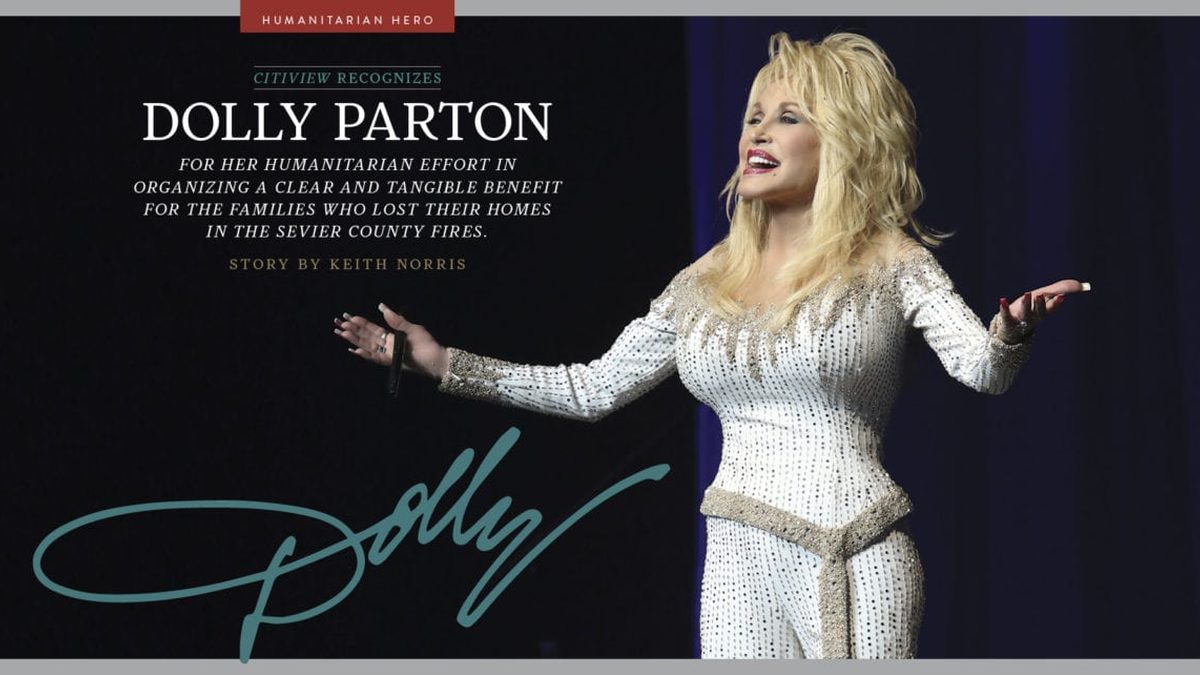
Dolly Parton is a Humanitarian Hero
Story by Keith Norris
AlthoughCityviewhas never before offered a person-of-the-year award, we feel compelled to recognize an exemplary act of human kindness by a fellow East Tennessean many of us feel we have known all our lives. If you ask around, folks will talk about two sides to Dolly: her ability to entertain and her giving spirit. Both of these qualities have been on display recently.
She just won her 8th Grammy award, for Best Country Duo/Group Performance, a recording of “Jolene” with the acapella group Pentatonix. She was nominated for her first Grammy in the same category for “Just Someone I Used to Know” with Porter Wagoner in 1970, at the height of her collaborations with the country music legend when her career really started taking off.
Of course, that entertainment career has gone on to eclipse singing and songwriting. She is known now as much for her acting career and her Sevier Country entertainment properties, particularly for her signature resort Dollywood. Side by side with her show business activities, she has grown her philanthropic endeavors. She has selflessly raised funds for many charities. Most important, though, is her Imagination Library, which began in 1995 by providing books to Sevier County children, and now mails over one million free books each month to children in the United States and around the world.
Over the course of its 20+ years, Dolly Parton’s Imagination Library has delivered over 80 million books to kids. Dolly credits her father’s habit of sharing with others as inspiration for the program. The story of “Daddy’s dinner bucket” is foundational to the efforts of the Imagination Library. Robert Lee Parton had a green lunch box he carried with him, and each day he would share some portion of what was in it with his children. He was unable to read and write, but he worked hard, and he shared the fruits of his labor. At a certain point, he gave the lunchbox away, but it found its way back to the family as a gift on the Christmas following his passing away in 2000. His name was scrawled onto the box, evidence that he’d learned to write his name.
You can follow a direct line of thought from that original spirit of generosity and literacy in the “Daddy’s dinner bucket” story to the organization at the heart of the Imagination Library: the Dollywood Foundation. The Foundation organized the My People Fund that has so helped the Sevier County community in its moment of need. In order to help out with the tragic results of the fires, Dolly didn’t need to create something from scratch. She simply needed to turn to what she’d spent her career developing as a result of those early lessons from her father.
When Dolly found herself in a unique position to raise millions, she did it by calling on those two parts—her ability to entertain and her ability to give—then went immediately back to work without pausing for praise. 100% of the monies given to the My People Fund went to families in need.
Establishing the My People Fund is absolutely in character for Dolly Parton. According to those she works most closely with, she always puts others first, has always worried about her family and her home, and has said for years that she takes the Smoky Mountains with her wherever she goes.
People associate Dolly with a kind of integrity that makes them want to take part. As Dollywood Foundation President David Dotson puts it, “people wanting to give money whether they’d ever been here or not said, ‘if this is Dolly Parton’s thing then that’s where my money is going because I have total confidence that it is going to be done correctly and with integrity’.”
Her reputation for integrity is well-earned; no matter how they first encounter Dolly, people like her, they like what she has to say, they like what she stands for, they love her story, and they admire her success. They seem to say, “I know if Dolly is behind it, it’s going to be right and it’s going to be good.”
In early February, Dolly was gracious enough to answer a few of our questions about the fires, her response to the tragedy, and what’s coming next for her.
Norris:What are you working on now? What’s on the horizon for Dolly Parton?
Parton:I am in L.A. working on movies with NBC and Warner Brothers. Me and my partner, Sam Haskell, hope to produce more TV shows. I am always writing songs—that’s my first love.
Norris:What new things can we expect to see in your Sevier County properties?
Parton:In Sevier County, we will continue to expand Dollywood with new shows and rides, as well as more resorts.
Norris:We were delighted by 2016’sPure & Simple. What’s next musically?
Parton:I’m not completely sure, but I have been working on a children’s album and a Christmas album.
Norris:The title song fromPure & Simplealmost equates simplicity and spirituality. What’s the relationship between the two for you?
Parton:It’s a complicated world, but I think God gives us our moral compass to simplify our decisions.
Norris:What is a favorite Smoky Mountain memory for you?
Parton:All of my childhood was special to me growing up in the Smokies. Probably my favorite was singing on the back porch with all my family. They all love to sing and laugh.
Norris:Why do people love to come to our part of the world?
Parton:Because it is a beautiful backdrop and there are just so many things a family can do to have fun together. Like my childhood and singing with my family, doing things together makes families feel closer.
Norris:What would you want to make certain the world knows about East Tennessee and the Smoky Mountains?
Parton:Right now, it is that we are all okay. The small percentage of the mountains that burned will grow back. The tourist things were not harmed. Things like my Dollywood, Pigeon Forge, The Aquarium, and Ober Gatlinburg are all open and operating. But most importantly, we are taking care of our people and doing whatever we can to help them on their road to recovery.
Norris:When you saw Sevier County and its people threatened by fire, what were your first thoughts?
Parton:My first thought and prayer were that all would be safe. Unfortunately, I guess I didn’t pray hard enough.
Norris:What moved you to create the “My People Fund”?
Parton:The “My People Fund” was created because I knew that those who lost their homes might not have insurance or money to just get by. That is, also, why we implemented the distribution of $1,000 per month before Christmas. Those people had an urgent need!
Norris:The “Smoky Mountains Rise” telethon was a huge success. How do you feel about the effort given by your fellow musicians?
Parton:I will always be grateful for my friends in the industry. The musicians, several companies and individuals jumped right in there with me. They are, also, “My People.”
Norris:As Sevier County rebuilds, what do you look forward to seeing?
Parton:Some of the properties that burned were older. While they are as important to their owners as the newer ones, I look for things that are built back to be even better.
Norris:Whom in your organization would you like to recognize who has gone above and beyond in responding to the fires?
Parton:I would, particularly, like to give credit to David Dotson, President of my Dollywood Foundation, and his staff. They organized the effort of collecting and paying out the money. Of course, my Nashville tour team, Danny Nozell, Kirt Webster, and Steve Summers, jumped in and organized the telethon. All of Dollywood Marketing folks played a big role, also. Pete Owens was a great coordinator.
Norris:Do you have a favorite trail or hike in the Smokies?
Parton:Can you imagine me taking a hike in these high heels? I wouldn’t make it 10 feet!
Norris:Do you have a favorite song to sing while out in the East Tennessee woods?
Parton:Any time I am even close to the mountains, I create a new song. I am at peace when I am there.
Norris:You recently celebrated your 50th wedding anniversary. Do you have any words of advice for a healthy relationship?
Parton:First off, I don’t give advice, but I know mine has lasted this long because I am gone most of the time! Ha!
Norris:What haven’t you done that you’d like to? What’s on Dolly’s bucket list?
Parton:I wake up every day dreaming a new dream and I guess I would add it to my bucket list. As I get older, I may focus more time to children. God never let me have kids of my own. I suspect for a reason. Now, all kids are mine.
Norris:We are forever in your debt for making our world more beautiful and our lives rich. What haven’t we asked that you’d like to address?
Parton:I think I would like to just say “thank you” to all the people of the area, who stepped up and helped each other in the area. It was a test of the real character of “My People”—and they passed in flying colors!
Keith Norrisis editor ofCityview.
While visiting with a friend the other evening, the conversation turned to one of the few topics you can start a conversation about with ease anywhere in East Tennessee: Dolly Parton. It turns out that in the 90’s, my friend had been working at Dixie Stampede, and Dolly would stop by during and after the show from time to time. The Stampede has a pre-show waiting room of sorts, called the Saloon, and he said she’d sometimes join the staff there at day’s end for a non-alcoholic beverage. He said what most people say about her, that “she is one of the nicest, sweetest people you’ll ever meet.” But he followed that with something that gets to the heart of how Dolly is seen in our community: “That laugh is her laugh,” my friend said. “You find out that is her. When I met her—she is as genuine as it comes.” Dolly Parton is genuine, she’s authentic, and people believe what she says. It’s no wonder she was able to move so many to give so much to those who suffered from the fires.
→ Swipe for Next Story
FeatureMARCH APRIL 2017
My People Fund
Story by Cityview
It isn’t something that happens by accident. Not many organizations could have pulled it off, and this one is centered right here in East Tennessee. Dolly Parton’s success with Dollywood and the Dollywood Foundation is no fluke. She has the vision, and she has gathered around her the right people to turn that vision into a reality as clear, far-reaching, and beautiful as the view from Clingman’s Dome on a clear day.
This heroic effort was pulled off by a remarkable group of people, inspired by Dolly, but led by her long-term associates who have been running her entertainment and philanthropic enterprises for years.
How It Started
It started with a shared vision, direct from Dolly Parton, that “we need to help the people who need the most help.”
According to Pete Owens, Director of Public Relations and Communications for Dollywood, “it would be one thing to write a check to an existing organization but it’s a whole other thing to try and create a mechanism in which money can be given to the people that need it directly into their hands. And that’s more of what she was looking to do rather than just write a check.”
When the Chimney Tops 2 Fire, as it is officially known, tore through Gatlinburg and surrounding areas of Sevier County on the night of Monday, November 28th, Dolly Parton and her team were watching. By 9:30 in the evening on Monday, Dollywood had evacuated its cabins and resort. They also had a team of people working to protect the resort, the theme park, and the water park. A group was already gathered that evening as an emergency response team and began speaking about recovery. On Tuesday, the group had preliminary conversations with Dolly, who in addition to touring, was in L.A. doingThe Voice.
On Wednesday, November 30th, things really got rolling. According to Owens, “we had a meeting that started at 11:30 on Wednesday morning and by 1:30 we had the My People Fund planned and how what we wanted to distribute the money had all been decided.”
It came together fast. Owens says, “…we are a pretty dynamic organization and the Dollywood Foundation is a well-established nonprofit and David Dotson, President of the Dollywood Foundation, has experience dealing with distributions like this.” Owens and Dotson are the primary movers in making it all work.
The My People Fund
The group that sat down on that Wednesday at 11:30 was composed of Owens; Dotson; Ted Miller, Business Manager and Partner of Dolly Parton Productions; Craig Ross, President of Dollywood; Amy Owenby, Vice President of Hospitality for Dollywood; and, of course, Dolly, who emphasized that she really wanted to be putting cash in people’s hands—$1,000 a month for six months.
It took the group a little under two hours to sketch out the fund and what the approach would be. It fell to Dotson to pull it off. Making things happen is one of his main jobs at the foundation. As he says, “it wasn’t unusual in the sense of stepping away from the normal box of my role as the President of the Dollywood Foundation, but it was unusual in the speed in which it needed to happen and also the enormity of the task.”
The pace quickened after the meeting. That evening was the premiere of Dolly’s NBC special,Christmas of Many Colors: Circle of Love. She was finishing up her tour but said, “Hey, I think I can get a video done and maybe NBC will air it at the top of the show at 9.” Several things had to happen during those seven hours between the end of the meeting and the Premiere ofColors. Parton had to shoot the video—you can see it on YouTube—and Dotson had to determine how they were going to raise and distribute the cash.
The text of Dolly’s video starts with a familiar phrase: “Hi, this is Dolly.” The 83-second video is a simple straight-on shot of Parton talking to the camera, calling attention to the disaster, recognizing the quality of the emergency response, and establishing a fund to give $1000 a month to “…all those families that have lost their homes in the fires until they get back up on their feet.” It ends by asking for prayers and inviting the viewers to “visit our Tennessee mountains and experience the Tennessee spirit.”
To get a website and donor function running, Dotson called in SD Professionals, led by Jacob Timmons, which maintains the database for the Imagination Library—interacting with thousands of affiliates and millions of kids. The company, which also handles DollyParton.com and the Foundation’s website, was well-suited to handle the nuts and bolts of the online operation. Timmons created the page and the donation mechanism.
Everything was up and running and the right people knew what was going on by 7:00 that evening. However, NBC didn’t air the video at the top of its 9:00 broadcast. Within a half hour, the team switched to a social strategy and put the video out on Dolly’s social media. “The next morning we woke up to a million dollars,” says Dotson.
There hadn’t yet been any talk of a telethon.
The Telethon
The following weekend, as Dolly was headed into the final week of herPure & Simpletour, the idea for a telethon began to come together. As Owens tells it, the notion “…started with a telephone call that Kirt Webster [Parton’s publicist] and I had. We had made the announcement on Wednesday after the fire about the My People fund, and the following Saturday, Kirt and I were on the phone and we started talking about opportunities to be able to raise some money for the fund to be able to help people out. Dolly’s said, ‘Let’s do a telethon, it’d be a great way for me to use my exposure to the world to see if we can get people to support the cause.’ So, Kirt and Danny Nozell [Parton’s producer and tour manager] and others got busy with everything from securing talent to setting up the phone bank.”
Many members of the team had produced television before, and Owens had produced local telethons, but he drew particularly on the experience of Scott Durand, who had led a national telethon when he worked at Great American Country. The basic details were ironed out over the weekend and in the week that followed. It was decided thatSmoky Mountains Rise: A Benefit for the My People Fundwould air on Tuesday, December 13, at 8 p.m. on an open feed, in partnership with Great American Country, Scripps, and iHeart Radio.
Owens’ team produced the telethon; meanwhile, Dotson’s team was still receiving funds coming in through the website and through the natural, organic exposure that kept building upon itself throughout the community, fueled a bit by ongoing news reports.
It was a challenging event to broadcast. “I think the amalgam that the telethon ended up being was an amazing blessing for all of us,” Owens says. “It was bigger than we thought it would be, certainly raised more money than we thought that it would, and just speaking from a television perspective, it was a really entertaining show. From a technical perspective, it was a really clean broadcast. Scott Durand put together a telethon dream team for us from various production companies in Nashville,” Owens notes. “They just created an amazing environment and professional environment for all that to happen.”
“It really was a magical thing. Everything fell into place the way it needed to fall into place to allow us to help these families. I think that it shows how big a heart that Dolly has and that her first thought was for her family and her people here in East Tennessee. It was all done for the right reasons. I’ve worked for her for almost seventeen years. She is an inspiring individual to work with and be around.”
Ultimately, the Telethon raised over nine million dollars.
After the Telethon:
Care More
After briefly celebrating the success of the millions raised by the telethon on the 13th, Dotson’s team got to work. The following day, they had to train volunteers to distribute funds to families in need. The Care More Assistance Center had been established at the LeConte Center of Pigeon Forge, which donated their facility. Says Dotson, “Jeff Conners and Sam Roberts, who work with me, and Carol Agee from Dollywood, we were the team. We called ourselves the Incident Command Team, just because we wanted a fancy, military sounding name for what we were doing.”
There were three unknowns Dotson’s group had been working to prepare for in the two weeks since the My People Fund had been established: the number of families they’d be aiding, how they would vet those families, and how they would distribute the money as quickly and efficiently as possible.
Their main criteria were that Dolly wanted to help those whose primary residences had been destroyed. The team worked with city and county officials in those two weeks to confirm the destruction of or degree of damage to a residence. When a map was ready, they were able to set dates and put a pre-application on the website. They received over nine hundred applications that first weekend.
Using the map, they were able to more or less pre-approve approximately 700 applicants. They also created a second group called a “Resolution Team,” where volunteers experienced in social service work and dealing with problems could help people who weren’t immediately approved. “We were trying to get to ‘yes’ with people,” says Dotson. They followed a philosophy of respect. As Dotson told his team, “we can create our own program in two weeks and our own operation, and we can create our own culture where we treat people with respect.”
The operation went incredibly smoothly considering that it was only 17 days from the day the fires descended into the city until the day of the first check distribution on December 15th. The speed at which the team could validate recipients and cut checks was remarkable. Dotson observes that those who had been operating in other kinds of relief or social services “…kept shaking their head and saying, ‘How in the world did y’all do this in two weeks? This is one of the most amazing things I have ever seen’.”
In those first four days in mid-December, they vetted, processed, and distributed checks to approximately 900 families. There will eventually be between 900 and 950 families assisted by the My People Fund. The team established six distributions, one at the end of each month from December through May, all at the Care More Assistance Center. Working with Citizens National Bank, the team was able to cut checks on the spot.
What’s Next
When asked about what’s happening in the immediate future, Dotson jokes, “I’m going into disaster response consulting.” Truthfully, though, the Dollywood Foundation is simply moving forward with its mission: concentrating on growing the Imagination Library program, which passed the million-kid mark in November.
In the spring, they will turn some of the Imagination Library books into 25 minute musicals and do a tour around the area, playing schools and Head Start centers and libraries. Then, over the summer, they will move the productions to a full stage, this year performingCoat of Many Colorsand an Imagination Library book calledPretend.
Dolly and her staff are going to keep doing what they do—making the lives of East Tennesseans better and giving us stories to tell one another when we’re talking about home.
The My People Fund has raised enough funds to fill Dolly’s commitment and are directing those who still wish to give to mountaintough.org.
Keith Norrisis editor ofCityview.
→ Swipe for Next Story
Top DocsMARCH APRIL 2017
Cityview’s 2017 Top Doctors
Story by Cityview
As we do each year,Cityviewhonors the outstanding men and women in our medical community whose dedication and skill have earned the respect of both their patients and their fellow doctors. Every year, we ask the area’s referring physicians to tell us whom they would choose if they, or a patient, or a loved one needed specialized care. This is not a popularity contest or a paid survey. Rather, these results, listed alphabetically, are the opinions of the practicing physicians on the front lines of the healthcare industry—the people who see new and unusual cases and situations every day that require specialized medical care. Of course, this is not to say that those not listed in our survey results are not also excellent physicians in their own right. This survey simply recognizes those who have the utmost regard of their colleagues and peers for their acumen and expertise.
Donald T. Ellenburg MD
Accepting Patients, No Referral Required, 40 yrs in Practice
Michael M. Miller MD
Accepting Patients, No Referral Required, 39 yrs in Practice
Robert M. Overholt MD
Accepting Patients, No Referral Required, 54 yrs in Practice
Tidence “Ty” L. Prince MD
Accepting Patients, No Referral Required, 14 yrs in Practice
Jeffrey L. Schlactus MD
Accepting Patients, No Referral Required, 31 yrs in Practice
Andrew M. Singer MD
Accepting Patients, No Referral Required, 19 yrs in Practice
Michael A. Springer MD
Accepting Patients, No Referral Required, 30 yrs in Practice
Joseph M. Wisniewski MD
Accepting Patients, No Referral Required, 20 yrs in Practice
Robert M. Craft MD
Not Accepting, No Referral Required, 26 yrs in Practice
Mitchell A. Dickson MD
Not Accepting, No Referral Required, 32 yrs in Practice
Jerry L. Epps MD
Not Accepting, No Referral Required, 35 yrs in Practice
Michael R. Flynn MD
Not Accepting, No Referral Required, 26 yrs in Practice
Oliver E. Hoig MD
Not Accepting, No Referral Required, 21 yrs in Practice
Robert B. Lembersky MD
Not Accepting, No Referral Required, 26 yrs in Practice
Edward C. Mobley MD
Not Accepting, No Referral Required, 24 yrs in Practice
Don R. Pearson Jr. MD
Not Accepting, No Referral Required, 38 yrs in Practice
John H. Acker MD
Not Accepting, No Referral Required, 33 yrs in Practice
Albert Robert Blacky MD
Accepting Patients, Referral Required, 32 yrs in Practice
Jerry J. Crook II MD
Accepting Patients, Referral Required, 12 yrs in Practice
Clint T. Doiron MD
Accepting Patients, Referral Required, 40 yrs in Practice
Malcolm T. Foster III MD
Accepting Patients, Referral Required, 26 yrs in Practice
Charles B. Treasure II MD
Accepting Patients, Referral Required, 31 yrs in Practice
James W. Cox Jr. MD
Accepting Patients, Referral Required, 28 yrs in Practice
Rashmi Ujaneppa
Hottigoudar MD
Accepting Patients, Referral Required, 13 yrs in Practice
William C. Lindsay MD
Accepting Patients, Referral Required, 33 yrs in Practice
Cardiology, Interventional
Malcolm T. Foster III MD
Accepting Patients, Referral Required, 26 yrs in Practice
Robert P. Martyn MD
Accepting Patients, No Referral Required, 27 yrs in Practice
Ayaz Rahman MD
Accepting Patients, No Referral Required, 11 yrs in Practice
Nicholas Xenopoulos MD
Accepting Patients, Referral Required, 32 yrs in Practice
I am text blo
Jeffrey M. Baerman MD
Accepting Patients, Referral Required, 35 yrs in Practice
Kyle Wiley McCoy MD
Accepting Patients, Referral Required, 27 yrs in Practice
Barry I. Michelson MD
Accepting Patients, Referral Required, 29 yrs in Practice
Charles B. Treasure II MD
Accepting Patients, Referral Required, 31 yrs in Practice
Paul R. Branca MD
Accepting Patients, Referral Required, 19 yrs in Practice
John Claiborne
Callison Jr. MD
Not Accepting, No Referral Required, 11 yrs in Practice
Jesse Thomas Doers MD
Not Accepting, Referral Required, 31 yrs in Practice
Ronald J. Estes MD
Accepting Patients, Referral Required, 31 yrs in Practice
Bruce L. Henschen MD
Accepting Patients, Referral Required, 32 yrs in Practice
Scott T. Luchsinger MD
Accepting Patients, Referral Required, 19 yrs in Practice
Accepting Patients, Referral Required, 34 yrs in Practice
Elise E. Schriver MD
Accepting Patients, Referral Required, 30 yrs in Practice
James Edward
Shamiyeh MD
Accepting Patients, Referral Required, 19 yrs in Practice
Elizabeth W. Anderson MD
Accepting Patients, No Referral Required, 18 yrs in Practice
Lawrence L. Bushkell MD
Accepting Patients, No Referral Required, 36 yrs in Practice
Carley Fowler MD
Accepting Patients, No Referral Required, 8 yrs in Practice
Kimberly K. Grande MD
Accepting Patients, No Referral Required, 16 yrs in Practice
Matthew C. Hanggi MD
Not Accepting, No Referral Required, 13 yrs in Practice
Sophia J. S. Hendrick MD
Accepting Patients, No Referral Required, 34 yrs in Practice
Cynthia H.Kang-Rotondo MD
Accepting Patients, No Referral Required, 31 yrs in Practice
Drew W. Miller MD
Accepting Patients, No Referral Required, 11 yrs in Practice
Meredith Taylor Overholt MD
Accepting Patients, No Referral Required, 24 yrs in Practice
Edward J. Primka III MD
Accepting Patients, No Referral Required, 25 yrs in Practice
Quyn Sherrod Rahman MD
Accepting Patients, No Referral Required, 10 yrs in Practice
Barry F. Cummings MD
Not Accepting, No Referral Required, 33 yrs in Practice
Reynald T. Simmons MD
Not Accepting, No Referral Required, 40 yrs in Practice
Fred “Kip” Wenger Jr. DO
Accepting Patients, No Referral Required, 20 yrs in Practice
Thomas W. Doty III MD
Accepting Patients, Referral Required, 32 yrs in Practice
William M. Law Jr. MD
Accepting Patients, Referral Required, 39 yrs in Practice
Daniel K. McCammon MD
Accepting Patients, Referral Required, 27 yrs in Practice
Gregory A. Moffitt MD
Accepting Patients, Referral Required, 23 yrs in Practice
Casey J. Page MD
Accepting Patients, Referral Required, 29 yrs in Practice
Amit C. Vora MD
Accepting Patients, Referral Required, 17 yrs in Practice
John B. Williams MD
Accepting Patients, Referral Required, 30 yrs in Practice
I am text block. Click edit button to change
Bruce N. Allsop MD
Accepting Patients, No Referral Required, 29 yrs in Practice
Raye-Anne Ayo MD
Accepting Patients, No Referral Required, 15 yrs in Practice
Ann S. Bevelhimer MD
Not Accepting, No Referral Required, 31 yrs in Practice
William L. Burkhart MD
Accepting Patients, No Referral Required, 34 yrs in Practice
Daniel L. Cox MD
Not Accepting, No Referral Required, 33 yrs in Practice
Rhea Wesley Dean MD
Accepting Patients, No Referral Required, 29 yrs in Practice
Shelly V. Durbin MD
Not Accepting, No Referral Required, 26 yrs in Practice
Rickey D. Manning MD
Accepting Patients, No Referral Required, 27 yrs in Practice
Randy T. Pardue MD
Accepting Patients, No Referral Required, 26 yrs in Practice
Amy Rebecca Rosine MD
Not Accepting, No Referral Required, 18 yrs in Practice
Amy Barger Stevens MD
Accepting Patients, Referral Required, 20 yrs in Practice
this text. Lorem ipsum dolor sit amet, consectetur adipiscing elit. Ut elit tellus, luctus nec ullamcorper mattis, pulvinar dapibus leo.
Mark D. Anderson MD
Accepting Patients, Referral Required, 30 yrs in Practice
Sarkis J. Chobanian MD
Accepting Patients, No Referral Required, 38 yrs in Practice
Meade Castleton
Edmunds III MD
Accepting Patients, No Referral Required, 27 yrs in Practice
Sangeeta Gulati MD
Accepting Patients, No Referral Required, 20 yrs in Practice
John M. Haydek MD
Accepting Patients, No Referral Required, 26 yrs in Practice
Carlos A. Rollhauser MD
Accepting Patients, No Referral Required, 20 yrs in Practice
Ramanujan Samavedy MD
Accepting Patients, No Referral Required, 22 yrs in Practice
John A. Stancher MD
Accepting Patients, No Referral Required, 35 yrs in Practice
Scott L. Wilhoite MD
Accepting Patients, No Referral Required, 30 yrs in Practice
Ilse J. Anderson MD
Accepting Patients, No Referral Required, 30 yrs in Practice
Carmen B. Lozzio MD
Accepting Patients, No Referral Required, 42 yrs in Practice
Geriatric Medicine
Monica Kim Crane MD
Not Accepting, No Referral Required, 16 yrs in Practice
Cynthia McClain
Pearman MD
Accepting Patients, No Referral Required, 28 yrs in Practice
Gynecologic Oncology
Kenneth Fleming Cofer MD
Accepting Patients, Referral Required, 21 yrs in Practice
Larry C. Kilgore MD
Accepting Patients, Referral Required, 35 yrs in Practice
Kristopher Kimball MD
Accepting Patients, Referral Required, 13 yrs in Practice
Tammy E. Baker MD
Accepting Patients, No Referral Required, 28 yrs in Practice
Robert F. Elder MD
Accepting Patients, No Referral Required, 32 yrs in Practice
Christine L. Gale MD
Accepting Patients, No Referral Required, 31 yrs in Practice
Antony J. Charles MD
Accepting Patients, Referral Required, 24 yrs in Practice
Yi Feng MD
Accepting Patients, Referral Required, 35 yrs in Practice
Hesamm E. Gharavi MD
Accepting Patients, Referral Required, 20 yrs in Practice
Richard Thomas
Grapski MD
Accepting Patients, Referral Required, 37 yrs in Practice
Wahid T. Hanna MD
Accepting Patients, Referral Required, 47 yrs in Practice
Daniel Mark Ibach MD
Accepting Patients, Referral Required, 23 yrs in Practice
Mitchell Dane Martin MD
Accepting Patients, Referral Required, 27 yrs in Practice
Timothy J. Panella MD
Accepting Patients, Referral Required, 32 yrs in Practice
Lynnette Osterlund MD
No Accepting Patients, Not Referral Required, 37 yrs in Practice
John F. Vannoy MD
Accepting Patients, No Referral Required, 29 yrs in Practice
David Wooten MD
Not Accepting, No Referral Required, 35 yrs in Practice
Christie Carringer MD
Accepting Patients, No Referral Required, 8 yrs in Practice
Michael Carringer MD
Accepting Patients, No Referral Required, 11 yrs in Practice
Leila K. Davis MD
Accepting Patients, No Referral Required, 24 yrs in Practice
JJ Janoyan DO
Accepting Patients, No Referral Required, 14 yrs in Practice
Dragos Mihail Munteanu MD
Accepting Patients, No Referral Required, 22 yrs in Practice
Mary Elizabeth Nelson
Accepting Patients, No Referral Required, 10 yrs in Practice
Charles Clinton Wilder MD
Accepting Patients, No Referral Required, 17 yrs in Practice
Dragos Mihail Munteanu MD
Accepting Patients, No Referral Required, 22 yrs in Practice
Louanne Zibas MD
Accepting Patients, No Referral Required, 24 yrs in Practice
Walter Michael Zibas MD
Accepting Patients, No Referral Required, 24 yrs in Practice
Vaughan Dabney Hall MD
Accepting Patients, No Referral Required, 34 yrs in Practice
Lindsey Harrell MD
Accepting Patients, No Referral Required, 23 yrs in Practice
Infectious Disease
John S. Adams MD
Not Accepting, Referral Required, 33 yrs in Practice
Jeffry T. King MD
Not Accepting, No Referral Required, 33 yrs in Practice
John Patrick Narro MD
Not Accepting, No Referral Required, 31 yrs in Practice
Mark Steven Rasnake MD
Not Accepting, No Referral Required, 17 yrs in Practice
Russell J. Smith MD
Not Accepting, No Referral Required, 31 yrs in Practice
Davis Allan Jr. MD
Not Accepting, No Referral Required, 40 yrs in Practice
Calvin M. Bard MD
Not Accepting, No Referral Required, 25 yrs in Practice
Amy E. Bentley MD
Not Accepting, No Referral Required, 21 yrs in Practice
Jeffrey Scott Boruff MD
Not Accepting, No Referral Required, 23 yrs in Practice
David C. Durbin MD
Not Accepting, No Referral Required, 25 yrs in Practice
Daniel S. Ely MD
Not Accepting, No Referral Required, 37 yrs in Practice
Courtney C. George MD
Not Accepting, No Referral Required, 22 yrs in Practice
Gerald L. Mancebo MD
Accepting Patients, No Referral Required, 38 yrs in Practice
Antonio L. Ramos MD
Accepting Patients, No Referral Required, 28 yrs in Practice
Mark D. Hennessy MD
Accepting Patients, Referral Required, 31 yrs in Practice
Bobby C. Howard MD
Not Accepting, Referral Required, 24 yrs in Practice
Periclis Roussis MD
Accepting Patients, Referral Required, 34 yrs in Practice
Craig V. Towers MD
Accepting Patients, Referral Required, 34 yrs in Practice
Lynlee Wolfe MD
Accepting Patients, Referral Required, 11 yrs in Practice
Mark E. Anderson MD
Accepting Patients, Referral Required, 33 yrs in Practice
John Q. Buchheit IV MD
Accepting Patients, Referral Required, 29 yrs in Practice
Tara M. Burnette MD
Accepting Patients, Referral Required, 34 yrs in Practice
Mark S. Gaylord MD
Accepting Patients, Referral Required, 38 yrs in Practice
Kendra Hendon MD
Accepting Patients, Referral Required, 20 yrs in Practice
James L. Ogrodowski MD
Accepting Patients, Referral Required, 30 yrs in Practice
Denise M. Rivers DO
Accepting Patients, Referral Required, 23 yrs in Practice
Urath Suresh MD
Accepting Patients, Referral Required, 27 yrs in Practice
Michelle L. Brewer MD
Accepting Patients, Referral Required, 31 yrs in Practice
John H. Dougherty Jr. MD
Accepting Patients, Referral Required, 44 yrs in Practice
Christopher A. Miller MD
Accepting Patients, Referral Required, 37 yrs in Practice
Stephen P. Rider MD
Accepting Patients, Referral Required, 16 yrs in Practice
Brian FrederickWiseman MD
Accepting Patients, Referral Required, 16 yrs in Practice
Sibyl Eisenmann Wray MD
Accepting Patients, Referral Required, 42 yrs in Practice
Leonard A. Brabson MD
Accepting Patients, No Referral Required, 44 yrs in Practice
Stephanie B. Cross MD
Accepting Patients, No Referral Required, 25 yrs in Practice
Robert F. Elder MD
Accepting Patients, No Referral Required, 32 yrs in Practice
Larry C. Kilgore MD
Accepting Patients, Referral Required, 35 yrs in Practice
Kenneth R. O’Kelley MD
Accepting Patients, No Referral Required, 30 yrs in Practice
Craig V. Towers MD
Accepting Patients, No Referral Required, 35 yrs in Practice
Nikki Beth Zite MD
Accepting Patients, No Referral Required, 17 yrs in Practice
Nicholas G. Anderson MD
Accepting Patients, Referral Required, 17 yrs in Practice
John T. Dawson MD
Accepting Patients, No Referral Required, 30 yrs in Practice
Stephen R. Franklin MD
Accepting Patients, No Referral Required, 35 yrs in Practice
Paul D. Froula MD
Accepting Patients, No Referral Required, 27 yrs in Practice
Herbert J. Glatt MD
Accepting Patients, No Referral Required, 32 yrs in Practice
David J. Harris Jr. MD
Accepting Patients, No Referral Required, 37 yrs in Practice
Leslie Leggett Baker MD
Accepting Patients, No Referral Required, 24 yrs in Practice
Michael John Belmont MD
Accepting Patients, No Referral Required, 22 yrs in Practice
Robert A. Crawley MD
Accepting Patients, No Referral Required, 42 yrs in Practice
Richard J. Depersio MD
Accepting Patients, No Referral Required, 41 yrs in Practice
David K. Gallegos MD
Accepting Patients, No Referral Required, 7 yrs in Practice
William D. Horton II MD
Accepting Patients, No Referral Required, 31 yrs in Practice
John Perry Little MD
Accepting Patients, No Referral Required, 22 yrs in Practice
Accepting Patients, No Referral Required, 25 yrs in Practice
Christopher JohnRathfoot MD
Accepting Patients, No Referral Required, 23 yrs in Practice
Allan Moris Rosenbaum MD
Accepting Patients, No Referral Required, 24 yrs in Practice
Michael Seals MD
Accepting Patients, No Referral Required, 28 yrs in Practice
David G. Sexton MD
Accepting Patients, No Referral Required, 35 yrs in Practice
Joe H. Browder MD
Accepting Patients, Referral Required, 32 yrs in Practice
James J. Choo MD
Accepting Patients, Referral Required, 13 yrs in Practice
Christopher L. Vinsant MD
Accepting Patients, Referral Required, 39 yrs in Practice
Lisa Diane Duncan MD
Not Accepting, No Referral Required, 16 yrs in Practice
Paul Eberts MD
Not Accepting, No Referral Required, 10 yrs in Practice
Alan D. Grindstaff MD
Not Accepting, No Referral Required, 22 yrs in Practice
Elizabeth W. Hubbard MD
Not Accepting, No Referral Required, 31 yrs in Practice
William Konomos MD
Not Accepting, No Referral Required, 23 yrs in Practice
Stuart E. Van Meter MD
Not Accepting, No Referral Required, 30 yrs in Practice
Laurentia Nodit MD
Not Accepting, No Referral Required, 23 yrs in Practice
Richard AnthonySances II MD
Not Accepting, No Referral Required, 23 yrs in Practice
Yvonne Andrea Bremer MD
Accepting Patients, Referral Required, 17 yrs in Practice
David M. Hurst MD
Accepting Patients, No Referral Required, 13 yrs in Practice
Michael R. Liske MD
Accepting Patients, Referral Required, 26 yrs in Practice
Kevin Carl Brinkmann MD
Not Accepting, No Referral Required, 16 yrs in Practice
Joe Childs MD
Not Accepting, No Referral Required, 34 yrs in Practice
Frankie Elizabeth Crain MD
Not Accepting, No Referral Required, 11 yrs in Practice
Matthew R. Hill MD
Not Accepting, No Referral Required, 24 yrs in Practice
Edward J. Primka III MD
Not Accepting, No Referral Required, 25 yrs in Practice
Lise Christensen MD
Not Accepting, No Referral Required, 32 yrs in Practice
Heather Gayle Edgley MD
Accepting Patients, No Referral Required, 24 yrs in Practice
Mary Palmer MD
Accepting Patients, No Referral Required, 31 yrs in Practice
Heather D Radu MD
Accepting Patients, No Referral Required, 15 yrs in Practice
Ryan Redman MD
Not Accepting, No Referral Required, 11 yrs in Practice
Kenneth D. Wicker MD
Not Accepting, No Referral Required, 29 yrs in Practice
David A. Nickels MD
Accepting Patients, Referral Required, 30 yrs in Practice
Carmen D. Tapiador MD
Accepting Patients, Referral Required, 23 yrs in Practice
Elizabeth A. Wirthwein MD
Accepting Patients, Referral Required, 20 yrs in Practice
Youhanna S. Al-Tawil MD
Accepting Patients, No Referral Required, 32 yrs in Practice
David DeVoid MD
Accepting Patients, No Referral Required, 28 yrs in Practice
Cory T. Strobel MD
Accepting Patients, No Referral Required, 43 yrs in Practice
Shahid A. Malik MD
Accepting Patients, Referral Required, 32 yrs in Practice
Ray C. Pais MD
Accepting Patients, Referral Required, 39 yrs in Practice
Susan Elizabeth Spiller MD
Accepting Patients, Referral Required, 20 yrs in Practice
Daniel Loris New MD
Accepting Patients, Referral Required, 27 yrs in Practice
Lori E. Patterson MD
Accepting Patients, Referral Required, 34 yrs in Practice
Jeanann P. Pardue MD
Not Accepting, No Referral Required, 29 yrs in Practice
Amit Patel MD
Not Accepting, No Referral Required, 15 yrs in Practice
Kristen Sheets MD
Not Accepting, No Referral Required, 15 yrs in Practice
Jennifer Gentry Savage MD
Accepting Patients, No Referral Required, 11 yrs in Practice
Gary N. Gitschlag MD
Accepting Patients, No Referral Required, 35 yrs in Practice
Allyson D. Schmitt MD
Accepting Patients, No Referral Required, 8 yrs in Practice
John Jay Crawford MD
Accepting Patients, No Referral Required, 22 yrs in Practice
Cameron J. Sears MD
Accepting Patients, No Referral Required, 28 yrs in Practice
Michael John Belmont MD
Accepting Patients, No Referral Required, 22 yrs in Practice
John Perry Little MD
Accepting Patients, No Referral Required, 22 yrs in Practice
Mark R. Ray MD
Accepting Patients, No Referral Required, 36 yrs in Practice
Nadine M. Trainer MD
Accepting Patients, No Referral Required, 35 yrs in Practice
Lee Ellen Naramore MD
Accepting Patients, Referral Required, 29 yrs in Practice
John B. Robertson Jr. MD
Accepting Patients, No Referral Required, 31 yrs in Practice
Safina S. Kureshi MD
Accepting Patients, No Referral Required, 17 yrs in Practice
John S. Rogers MD
Accepting Patients, No Referral Required, 37 yrs in Practice
Ehab K. Mansoor MD
Accepting Patients, No Referral Required, 22 yrs in Practice
Carlos A. Angel MD
Accepting Patients, Referral Required, 37 yrs in Practice
Eric Jensen MD
Accepting Patients, Referral Required, 22 yrs in Practice
Glaze W. Vaughan MD
Accepting Patients, Referral Required, 30 yrs in Practice
David J. Riden MD
Accepting Patients, No Referral Required, 27 yrs in Practice
Preston D. Smith MD
Accepting Patients, No Referral Required, 30 yrs in Practice
Gregory D. Blackmon MD
Not Accepting, No Referral Required, 21 yrs in Practice
Kurt F. Brandt MD
Accepting Patients, No Referral Required, 20 yrs in Practice
Richard A. Glover MD
Accepting Patients, No Referral Required, 26 yrs in Practice
Joseph N. Peeden Jr. MD
Accepting Patients, No Referral Required, 39 yrs in Practice
Kevin W. Bailey MD
Accepting Patients, No Referral Required, 31 yrs in Practice
Bruce B. Fry DO
Accepting Patients, No Referral Required, 15 yrs in Practice
Jeffrey S. Hecht MD
Not Accepting, Referral Required, 37 yrs in Practice
Ivan N. Cooper DPM
Accepting Patients, No Referral Required, 45 yrs in Practice
Robert C. Hancock DPM
Accepting Patients, No Referral Required, 22 yrs in Practice
David G. Sandberg DPM
Accepting Patients, No Referral Required, 22 yrs in Practice
Heather W. Sandberg DPM
Accepting Patients, No Referral Required, 22 yrs in Practice
Sharon R. Burnside MD
Not Accepting, No Referral Required, 25 yrs in Practice
Lane M. Cook MD
Accepting Patients, No Referral Required, 40 yrs in Practice
Wayne Corbet Curfman MD
Accepting Patients, No Referral Required, 42 yrs in Practice
Joseph J. Kennedy MD
Accepting Patients, No Referral Required, 30 yrs in Practice
John B. Robertson Jr. MD
Accepting Patients, No Referral Required, 31 yrs in Practice
Paul R. Branca MD
Accepting Patients, Referral Required, 19 yrs in Practice
John Callison Jr MD
Accepting Patients, Referral Required, 10 yrs in Practice
Ronald J. Estes MD
Accepting Patients, Referral Required, 31 yrs in Practice
Elise Schriver MD
Accepting Patients, Referral Required, 31 yrs in Practice
James Edward Shamiyeh MD
Accepting Patients, Referral Required, 19 yrs in Practice
Radiation Oncology
Robert J. Bertoli MD
Accepting Patients, Referral Required, 33 yrs in Practice
Srinivas Boppana MD
Accepting Patients, Referral Required, 18 yrs in Practice
Nilesh Shantilal Patel MD
Accepting Patients, Referral Required, 15 yrs in Practice
Judson R. Gash MD
Accepting Patients, Referral Required, 27 yrs in Practice
Peter Kvamme MD
Accepting Patients, Referral Required, 24 yrs in Practice
Sidney Charles Roberts III MD
Accepting Patients, Referral Required, 23 yrs in Practice
Kenneth A. Rule MD
Accepting Patients, Referral Required, 32 yrs in Practice
John D. Simmons MD
Accepting Patients, Referral Required, 33 yrs in Practice
Donna Kathryn Culhane MD
Accepting Patients, Referral Required, 25 yrs in Practice
Andrew M. Evancho MD
Accepting Patients, Referral Required, 31 yrs in Practice
John D. Simmons MD
Accepting Patients, Referral Required, 33 yrs in Practice
Laura Katherine Findeiss MD
Accepting Patients, Referral Required, 18 yrs in Practice
Christopher Stephens MD
Accepting Patients, Referral Required, 8 yrs in Practice
James L. Burns Jr. MD
Accepting Patients, Referral Required, 36 yrs in Practice
Robert J. Capps MD
Accepting Patients, Referral Required, 34 yrs in Practice
Kenny R. Sizemore MD
Accepting Patients, Referral Required, 31 yrs in Practice
Jay H. Warrick MD
Accepting Patients, Referral Required, 31 yrs in Practice
Rosanne S. Barker MD
Accepting Patients, No Referral Required, 31 yrs in Practice
Kevin M. Martinolich MD
Accepting Patients, No Referral Required, 25 yrs in Practice
Dewey YoungMcWhirter III MD
Accepting Patients, No Referral Required, 15 yrs in Practice
Phillip Lynn Nichols II MD
Accepting Patients, No Referral Required, 22 yrs in Practice
Christopher M. Nolte MD
Accepting Patients, No Referral Required, 13 yrs in Practice
James W. Baker MD 35
Accepting Patients, Referral Required, 35 yrs in Practice
Mark Casillas Jr MD
Accepting Patients, Referral Required, 10 yrs in Practice
Gregory P Midis MD
Accepting Patients, Referral Required, 30 yrs in Practice
Andrew Russ MD
Accepting Patients, Referral Required, 11 yrs in Practice
John L. Bell MD
Accepting Patients, No Referral Required, 37 yrs in Practice
Lytle Brown IV MD
Accepting Patients, Referral Required, 34 yrs in Practice
Brian H. Garber MD
Accepting Patients, Referral Required, 36 yrs in Practice
Keith D. Gray MD 18
Accepting Patients, Referral Required, 18 yrs in Practice
David J. Harrell MD
Accepting Patients, Referral Required, 25 yrs in Practice
James Michael Lewis MD
Accepting Patients, Referral Required, 17 yrs in Practice
Gregory J. Mancini MD
Accepting Patients, Referral Required, 17 yrs in Practice
Gregory P. Midis MD
Accepting Patients, Referral Required, 30 yrs in Practice
David H. Hauge MD
Accepting Patients, Referral Required, 31 yrs in Practice
James A. Killeffer MD
Accepting Patients, Referral Required, 20 yrs in Practice
Joel B. Ragland MD
Accepting Patients, Referral Required, 27 yrs in Practice
William E. Snyder Jr. MD
Accepting Patients, Referral Required, 21 yrs in Practice
Eric R. Carlson MD
Accepting Patients, Referral Required, 31 yrs in Practice
Jack E. Gotcher Jr. DMD
Accepting Patients, No Referral Required, 42 yrs in Practice
Surgery, Orthopedic
George R. Baddour Jr. MD
Accepting Patients, No Referral Required, 37 yrs in Practice
Russell A. Betcher MD
Accepting Patients, No Referral Required, 25 yrs in Practice
Robert E. Ivy MD
Accepting Patients, No Referral Required, 28 yrs in Practice
Paul H. Johnson MD
Accepting Patients, No Referral Required, 27 yrs in Practice
Gregory M. Mathien MD
Accepting Patients, No Referral Required, 31 yrs in Practice
Matthew C. Nadaud MD
Accepting Patients, No Referral Required, 17 yrs in Practice
Edwin E. Spencer Jr. MD
Accepting Patients, No Referral Required, 20 yrs in Practice
Freddie T. Barron MD
Not Accepting, No Referral Required, 41 yrs in Practice
Stephen M. Becker MD
Accepting Patients, No Referral Required, 20 yrs in Practice
Accepting Patients, No Referral Required, 22 yrs in Practice
Joseph T. Chun MD
Accepting Patients, No Referral Required, 32 yrs in Practice
Tom Gallaher MD
Accepting Patients, No Referral Required, 27 yrs in Practice
Jason Hall MD
Accepting Patients, No Referral Required, 15 yrs in Practice
Kathleen S. Herbig MD
Accepting Patients, No Referral Required, 12 yrs in Practice
Dean Kleto MD
Accepting Patients, No Referral Required, 37 yrs in Practice
Stephen M. Lazarus MD
Accepting Patients, No Referral Required, 36 yrs in Practice
Jay H. Lucas MD
Accepting Patients, No Referral Required, 17 yrs in Practice
David B. Reath MD
Accepting Patients, No Referral Required, 37 yrs in Practice
Steven J. Smith MD
Accepting Patients, No Referral Required, 34 yrs in Practice
Timothy Scott Wilson MD
Accepting Patients, No Referral Required, 27 yrs in Practice
Richard M. Briggs MD
Accepting Patients, Referral Required, 39 yrs in Practice
Raymond A. Dieter III MD
Accepting Patients, Referral Required, 25 yrs in Practice
Jeffrey E. Everett MD
Accepting Patients, Referral Required, 27 yrs in Practice
Thomas E. Gaines MD
Accepting Patients, Referral Required, 36 yrs in Practice
Michael L. Maggart MD
Accepting Patients, Referral Required, 37 yrs in Practice
John W. Mack Jr. MD
Accepting Patients, Referral Required, 45 yrs in Practice
Thomas R. Pollard MD
Accepting Patients, Referral Required, 27 yrs in Practice
William Walker MD
Accepting Patients, Referral Required, 35 yrs in Practice
Christopher S. Callicutt MD
Accepting Patients, No Referral Required, 20 yrs in Practice
Willard B. Campbell MD
Accepting Patients, No Referral Required, 28 yrs in Practice
Scott L. Stevens MD
Accepting Patients, No Referral Required, 33 yrs in Practice
Michael D. Kropilak MD
Accepting Patients, No Referral Required, 34 yrs in Practice
George Pliagas MD
Accepting Patients, No Referral Required, 33 yrs in Practice
Scott L. Stevens MD 33
Accepting Patients, No Referral Required, 33 yrs in Practice
Bryce C. Bowling MD
Accepting Patients, No Referral Required, 14 yrs in Practice
Robert F. Elder MD
Accepting Patients, No Referral Required, 32 yrs in Practice
Gregory L. Glover MD
Accepting Patients, No Referral Required, 33 yrs in Practice
Lee Congleton III MD
Accepting Patients, No Referral Required, 27 yrs in Practice
Paul A. Hatcher MD
Accepting Patients, No Referral Required, 33 yrs in Practice
Garrett Henry Lischer MD
Accepting Patients, No Referral Required, 17 yrs in Practice
Ryan Baird Pickens MD
Accepting Patients, No Referral Required, 14 yrs in Practice
Christopher E. Ramsey MD
Accepting Patients, No Referral Required, 20 yrs in Practice
Edward B. Tieng MD
Accepting Patients, No Referral Required, 22 yrs in Practice
William Bedford Waters MD
Accepting Patients, No Referral Required, 37 yrs in Practice
Wesley M. White MD
Accepting Patients, No Referral Required, 14 yrs in Practice
→ Swipe for Next Story
FeatureMARCH APRIL 2017
Bearing Each Others Burdens By: Jon Hersey
Story by Cityview
The exemption from the individual mandate granted to HCSMs as a religious alternative along with rapidly rising insurance prices are funneling more and more people into HCSMs. Before the ACA, there were roughly 200,000 HCSM members; today there are over 500,000. But the individual mandate’s days are numbered. Will it drag HCSM membership down with it? Some opposed to HCSMs may be happy to see this happen, but not happy about the cause: the death of the individual mandate. It seems the success of HCSMs largely depends on the lives they’ve touched over the last five to seven years.
HCSMs take their cue from the ages-old practice of Anabaptist Christians, particularly the Amish and Mennonites. As noted in one medical journal, “Amish commonly believe that commercial insurance plans undermine the religious duty of community accountability.” Even prior to securing exemption from Social Security and Medicare in 1965, they developed a system known as Amish Hospital Aid. Members pay $125 per person, or $250 per couple, which also covers all children under 18. If someone is injured and can’t pay their medical bills, they first turn to the alms of their local congregation. Depending on the situation, they may also organize an auction. “Occasional auctions of donated food, furniture, quilts, and livestock can raise as much as three hundred thousand dollars in one evening to help supplement alms and/or community collection coverage of healthcare bills.” But, if the injury is serious enough, and these means don’t cover the member’s care, they will contact their district treasurer with an estimate. It’s understood that members have the responsibility to pay the first 20% and that Amish Hospital Aid will cover the rest.
The broader Christian community has been developing a system like this since at least the 1980s. Today, the four biggest health care sharing ministries are Samaritan Ministries International (SMI), Christian Healthcare Ministries, Liberty HealthShare, and Christian Medi-Share. Liberty HealthShare claims that this broader Christian adoption came after an Ohio community banded together and paid all the medical expenses of a pastor involved in a serious accident. HCSMs also cite scripture, particularly Galatians 6:2, which says, “Bear one another’s burdens, and so fulfill the law of Christ.”Christian Healthcare Ministries sums up nicely the basic qualifications shared by all four HCSMs: “To be CHM members, participating adults must be Christians living by biblical principles, including abstaining from the use of tobacco and the illegal use of drugs (1 Corinthians 6:19-20), following biblical teaching on the use of alcohol, and attending group worship regularly if health permits.
(Hebrews 10:25).”
Although they share this basic Biblical foundation, the programs are unique in various ways. For instance, some have further, strict requirements, while others are bit more relaxed. For instance, SMI specifies that members must attend church three out of four weeks of the month, and their application requires their pastor’s verification. They must profess that God is the Father, the Son, and the Holy Ghost, that Jesus was resurrected and “now is seated in the heavens at the right hand of God,” and that “all people are born with a sinful nature” for which they must atone.
On the other end of spectrum, the Statement of Shared Beliefs required for membership in Liberty HealthShare emphasizes the concept of rights, stating, “We believe it is our fundamental right of conscience to direct our own healthcare, in consultation with physicians, family or other valued advisors, free from government dictates, restraints and oversight.” They don’t require a pastor’s verification or specify how often one must worship with others.
Samaritan also stands out in how it transfers money between members. Whereas the other HCSMs collect and redistribute money based on needs, SMI keeps a database of need and matches contributions to needs. They work on the premise that members pay their bills, and then request reimbursements from the program, so members get to use Health Savings Accounts and other pre-tax medical savings options. SMI then sends out a monthly newsletter to each member, requesting that they send money directly to another member in need. What seems at first glance like something of an inconvenience turns out to be one of their members most treasured features. As one man puts it in a video on the SMI website:
“It’s so much of a blessing to me to be able to know where my money is going every month…. It’s so much a blessing to me that I’m being told who to pray for. I’ve got prayer options as well as just the monetary needs being met. Every time we get the newsletter my wife will sit down with the children, and they pray for the prayer requests that are in there. That’s huge. It’s become part of the household. It’s not just well, here’s the insurance company, here’s the bill, here’s the check. There it goes. Samaritan Ministries is beyond that.”
And a member on the receiving end says, “I keep wanting to relive it. I don’t want to forget it…because it was such an awesome thing for my faith. I mean, I don’t want Pete to get sick again… But…, like I said before, my trust in God is so different now than it used to be.”
This personal touch is inspiring. But it’s also a particularly fitting example of objections to HCSMs more generally; they’re really bad at privacy. Considering that SMI covers things like bunions and hemorrhoids, it seems rife with possibilities for embarrassment as well. Yet, somewhat characteristically of HCSMs, their 44-page book of guidelines uses the word “privacy” only once: “Respect the Privacy of Other Members—While it is expected this information may be shared with family and prayer partners, please be sensitive: Do not post names or details on social media, blogs, or websites without permission, or in any other way misuse the information.”
Compounding the issue, members agree that any dispute “shall be settled by Biblically-based mediation and, if necessary, legally binding arbitration.” Aside from this, members agree not to sue. It’s also unclear whether HCSMs are bound by state privacy laws. For instance, in Tennessee, the Patient’s Privacy Protection Act is explicitly written to safeguard patients from having their physicians share their personal information.
However, those signing up for SMI know that their medical needs will be shared with other members. Most seem to believe that the value of the goodwill, prayers, and money shared between those of their faith far outweighs anything they stand to lose in lack of privacy. At the end of the day, members control what to keep private.
Another point of contention is the big one that the ACA targeted: pre-existing conditions. Molly Worthen, University of North Carolina history professor and New York Times contributor, says:
“The resemblance to apostolic Christianity is debatable: After all, Jesus’ healing ministry didn’t take pre-existing conditions into account, and the early church offered aid to nonbelievers. The real precursors are the mutual aid societies of the 19th and early 20th centuries. In their heyday, organizations like the Odd Fellows and the Loyal Order of Moose pooled fees to provide insurance for huge numbers of working-class Americans.”
This seems like a fair criticism. But it’s not inconsistent with the religious belief that God is the ultimate provider. SMI’s website says, “He is the only One Who has enough resources to meet every need. No human organization is large enough to do this—no company and no government. He gives some of His provision through human channels, but He is ultimately the only One we can trust.”
Of course, Worthen can and does still object that these “human channels” are too selective. “Cost-sharing ministries nurture one kind of community, but only by opting out of the broader obligations of society. To make the Affordable Care Act stick, and to make it work, means convincing more Americans that they are not just their brother’s keeper.”
But have anonymous government aid programs really helped people? Says Dr. Philip Eskew, “You can be your ‘brother’s keeper’ with your own time and money from across town because you actually know your brother. You can’t be your ‘brother’s keeper’ from DC with taxpayer dollars—this is a recipe for fraud.” Interestingly, the Amish have expressed similar sentiments: “‘The Amish community is not in favor of government hand-outs’, ‘Amish prefer to take care of their own’, ‘Obamacare requires too much government involvement’, ‘The less government the better’.” People in these groups seem to agree that giving to faceless bureaucratic agencies, which inevitably siphon off large portions of taxpayer money, is just not the best way to take care of people in need. Forced, anonymous giving lacks the accountability and caring that relationships provide. More than anything, objections to HCSMs highlight what makes them good.
If the individual mandate did anything good, it was to open up so great a number of people to insurance alternatives. When the individual mandate goes away, the force causing the manic growth in HCSM membership goes away too. Yet, those who have discovered a loving, caring community and a relatively cheap means of hedging against disaster are not likely to leave it behind. We can only hope that laws will open up enough to allow mutual aid societies for an increasing variety of backgrounds and beliefs.
Jon Herseystudies issues in moral philosophyat the University of Tennessee.
→ Swipe for Next Story
FeatureMARCH APRIL 2017
Angelique Medow
Story by Cityview
Sometimes what we want, what we need, and what’s best are in conflict. A noted author, Angelique tackles this and other topics that help to strengthen willpower and self-love. You can find her online on facebook and in seminars around the country. Her article posted on December 11th last year is a must read in our opinion and worth checking out every week for a new article. This month in Cityview she reflects on her experience as a young woman wanting to improve her life by joining the Y and learning the value of physical discipline while she takes us on a journey through all the YMCA has to offer.
→ Swipe for Next Story
FeatureMARCH APRIL 2017
Bob Pryor
Story by Cityview
Robert E. Pryor, Sr.
If you have a question about the history of Knoxville or an overlooked medical error, it’s likely that Bob Pryor can provide an answer. He’s a music enthusiast, entertainer, local attorney, and an East Tennessee institution with heaps of information to impart and volumes of stories to share. Pryor graduated from the University of Tennessee College of Law in 1969, and founded his firm, Pryor, Priest, and Harber in 1981. In his practice, Pryor has a wealth of experience in representing injured people—and he recently received the 2016 Tennessee Association for Justice’sLifetime Achievement Award. This month, he focuses in Pryorities on avoiding medical mistakes.
→ Swipe for Next Story
FeatureMARCH APRIL 2017
Bruce McCamish
Story by Cityview
Bruce McCamish—
Photography has always been a hobby for Bruce McCamish. when a social media craze boosted his hobby to a career, he took to an unconventional method of photography. If you see a guy roaming downtown Knoxville with a camera attached to the top of a 25’ pole, you’ve found him. In our Smoky Mountains feature, Bruce captures the devastation of and emotional response to the Chimneys 2 fire, both during the disaster and the immediate aftermath.
→ Swipe for Next Story
FeatureMARCH APRIL 2017
George Korda
Story by George Korda
George Korda—
While serving in Germany with the Army, George found himself in a helicopter above the Normandy D-Day beaches. Desiring better photo opportunities, he had the crew chief attach lines to his pistol belt so he could hang out the helicopter’s back door. “In hindsight,” he says, “it would have been wise to have worn a parachute.” Currently, he co-hosts local radio and TV shows and is a regular contributor in Cityview’sLocal Politics. InConversations, he sits down with business mogul and Commissioner of Economic and Community Development Randy Boyd.
→ Swipe for Next Story
FeatureMARCH APRIL 2017
Hobe Brunson
Story by Cityview
Hobe Brunson
From the shores of Parris Island to the sidelines of a Tennessee football game, Hobe has travelled around the world and photographed much of it, but his favorite place to take pictures is still the UT gridiron. He is a Marine Veteran, has 3 kids and 2 grandkids, and when he’s not busy hauling out his Nikon to a big game, he can usually be found watching sports. This month in our Veterans spotlight, Hobe captures courageous Clata Finn, the first woman to fly with the U.S. Air Force Military Air Transport Service. In this issue, you can also find his review of the Music City Bowl game.
→ Swipe for Next Story
FeatureMARCH APRIL 2017
Jon Hersey
Story by Cityview
Jon Hersey became interested in philosophy after readingAtlas Shruggedby Ayn Rand. He has traveled extensively with Old Crow Medicine Show as a stage manager and instrument technician, maintaining almost 20 different vintage instruments. He studies ethics and epistemology at the University of Tennessee, and his CoverTN insurance was cancelled by Obamacare, doubling his premiums and spurring him to look into the issue of healthcare reform in America. The one quote he would put on a billboard would be “Anyone who fights for the future, lives in it to
Jon Hersey became interested in philosophy after readingAtlas Shruggedby Ayn Rand. He has traveled extensively with Old Crow Medicine Show as a stage manager and instrument technician, maintaining almost 20 different vintage instruments. He studies ethics and epistemology at the University of Tennessee, and his CoverTN insurance was cancelled by Obamacare, doubling his premiums and spurring him to look into the issue of healthcare reform in America. The one quote he would put on a billboard would be “Anyone who fights for the future, lives in it today,” by Ayn Rand
→ Swipe for Next Story
FeatureMARCH APRIL 2017
Karen Clark
Story by Cityview
Karen Clark—
Karen Clark—
Karen gained her appreciation for timeless style as a buyer within the opulent walls of Brooks Brothers in New York, but today she can be found writing for Cityview about fabulous homes in Knoxville. When she isn’t covering the elegance of old-town Knoxville, she can be found at the Symphony or Orchestra. She examines a Sequoyah Hills “less is more” architectural style in this month’sEclectic Elegance.
→ Swipe for Next Story
FeatureMARCH APRIL 2017
Trent Eades
Story by Cityview
Trent Eades
A man for all seasons with interests ranging from humanist philosophy to science fiction, Trent took up a DSLR camera in 2013 and has been shooting like crazy ever since. He has been a student of ancient Greek, medieval romance, and the comics of R. Crumb. Currently, he is Associate Professor of English at Pellissippi State Community College, where he teaches early World and British Literature courses, amongst other subjects. He is at his most content when reading a novel in the peace of his back yard or enjoying the company of his wife, Annie. You can see some of his photographs in this issue’s Smokies Spotlight: “Tilting at Waterfalls.”
→ Swipe for Next Story
FeatureMARCH APRIL 2017
Editor’s Note
Story by Keith Norris
Hello. I’m new here, and since most of you reading this have been opening the pages of Cityview longer than I’ve been sitting in the editor’s chair, it is only fitting and proper that I introduce myself. If you already know me, it may be because I stood in front of a community college classroom for over 20 years, or perhaps because you saw me give a public lecture or sing about dragons or tell ridiculous stories on stage. I’ve lived in Knoxville since the late 1980’s and have worn a few hats. Or maybe our interaction has happened more recently and I’ve talked to you about hops and served you a beer or two. Regardless, it’s good either to see you again, or to meet you for the first time.
I’d like for us to spend some time thinking together—exercising our imaginations for the betterment of the place we call home.
Our current political and cultural environment is often defined by a flagrantly exercised group think disguised as individuality. You know what I mean: what our group says is all about being free independent thinkers while what their group says reflects their existence as little mindless robots. This happens over topics ranging from politics to peanut butter and it happens all the time.
In this landscape, my thoughts have been returning to “Self-Reliance,” an essay by Ralph Waldo Emerson. One of my favorite phrases from it is this: “for non-conformity, the world whips you with its displeasure.” I like it because it feels right on the money. When I first read it years ago, my assumption was that “the world” meant my sworn enemies, like that kid Stevie on the bus in elementary school who kept thwacking me on the back of the head with a ballpoint pen. But he wasn’t doing it for my non-conformity; he was doing it because he was a bully, and he could. There’s a difference.
No, the world Emerson is talking about is made up of the people who assume you’ll continue to think like they do—the folks you hang out with, or talk shop with, or work with, or go to school or church with. Those folks. It’s their displeasure Emerson is talking about. He knows what he’s talking about. Emerson had started out after college as a minister, but after addressing the graduating class of the Divinity School of Harvard, his alma mater, on the problems of a slavish devotion to religious doctrine, he wasn’t invited back for thirty years. He’s not trying to comfort you or give you advice on how to best cope with the displeasure of others; he’s saying that they will whip you when you don’t conform to what they expect of you. In fact, earning their displeasure is part of your job as a self-reliant person.
Self-reliance isn’t about being able to fix your own car or operate some phone app on the first try or survive in the woods for a week; no, for those things you need education and experience and money. Self-reliance is about being able to think as an independent person without immediately echoing the voices you hear around you every day. Self-reliance is not an expression of narcissistic self-interest; it’s not selfishness. Rather, it is establishing an aggressive habit of thinking critically for oneself, a habit that is sometimes difficult to teach and practice in this world.
When I was a young man of six or so, I saw my dad come home from a deacon’s meeting at our church. He looked exhausted and punch-drunk. As a child, my reaction was visceral: “Dad, what’s wrong?” I cried. “Sometimes, Keith,” he replied, “old ideas just need to pass on.” He’d been fighting with a world of entrenched ideas and getting whipped by its displeasure. But he wasn’t unhappy and he wasn’t beat. He was showing me self-reliance, convinced of the power of his imagination.
We are equally given the right to think, and to dream, and to grasp the world with our imaginations in new ways. But let us not confuse that with Googling for answers or immersing ourselves in entertainments. There is a joy one gets from watching or listening to whatever entertainment is available in this world of immediate gratification. But it is just that. Immediate, derivative, and over.
Read voraciously and ingest as much information as you can, but after that, take care to cultivate your own individual imagination. And then let’s talk. I’d love to hear from you. The interaction between the editorial voice of a publication and the reading public is an important and enduring stalwart of our democracy.
Write plenty and often.
→ Swipe for Next Story
FeatureMARCH APRIL 2017
Future Medicine
Story by Peter McCarville
There are, however, new developments that give promise of slowing the disease’s progress. A 2010 study by the Alzheimer’s Association categorizes two types of hypothetical treatments in dealing with the disease: one that delays onset and the other that slows its progression. The study notes that, if a breakthrough occurred that would significantly slow progress of the disease, within 35 years the number of people with severe Alzheimer’s would drop precipitously. Though it is too early to label it a breakthrough, one such developing treatment is the use of focused ultrasound to break down the plaque in the brain that contributes to the effects of Alzheimer’s.
What CurrentTreatments Address
Most leading forms of treatments rely on medication to enhance the activity of and/or prevent the breakdown of acetylcholine, which is an organic neurotransmitter found in the brain. Essentially, acetylcholine works to send messages from cells in your brain to other cells throughout your body. Alzheimer’s slows down acetylcholine activity until it comes to a complete stop. The use of cholinesterase inhibitors to slow the deterioration of acetylcholine has worked very well in the early stages of treatment, but is less effective in later stages. They have been proven to sharpen memory and improve language skills; however, side effects are an issue with these drugs, and include fatigue, vomiting, loss of appetite, and headaches. In later stages, other medications can be used to attempt regulation of other neurotransmitters. Neurons with amyloid plaques. Amyloid plaques accumulate outside neurons. Amyloid plaques are characteristic features of Alzheimer’s disease. They lead to a degeneration of the affected neurons, that are destroyed through the activity of microglia cells. The neurons are embedded in a network of astrozytes (darker cells).
A recent development in slowing the progression of Alzheimer’s effects is using antibodies to directly attack the sticky plaques of amyloid protein that build up around neurons. Once amyloids start growing, they are thought to slow down information processing and kill brain cells. A recent article in the journal Science points out that a number of scientists are now seeing deposits of tau protein as an additional or perhaps dominant cause of memory loss and dementia in Alzheimer’s patients. Due to the size of the antibody molecules and their inability to break the blood-brain barrier (BBB), which prevents large molecules from passing through the blood stream and into brain tissue, the therapeutic effectiveness of antibody drugs is currently limited. Combatting both amyloid and tau proteins with the use of antibody drugs has not yet been shown to be as efficient as using cholinesterase inhibitors to slow the progress of the disease early on, and other drugs like memantine to treat other cognitive functions in the disease’s later stages.
Focused Ultrasound
Research is underway for finding a noninvasive, more patient-friendly therapy for slowing down the progressionof Alzheimer’s. At Sunnybrook Hospital in Toronto, the use of focused ultrasound (FUS) has been used in treating brain tumors to temporarily open up the blood-brain barrier so that larger molecules can pass through and bring the treatment to the disease. FUS is a noninvasive procedure and is essentially nonsurgical; it works by the application of acoustic energy from over 1000 individual transducers onto distinct body targets. With the aid of microbubbles, low frequencies of acoustic energy open up the BBB for the larger molecules, such as the ones used in antibody drug treatment of Alzheimer’s. When used at a high frequency, the temperature of the part of the body on which the FUS is directed often rises dramatically, causing ablation of the target tissue. This damage does not occur at low frequencies, and the part of the body at which the frequencies are directed can be larger, allowing for the BBB to be opened and the brain injected with gadolinium contrast, which highlights the areas of the brain with amyloid and tau protein buildups. The ability to see where these deposits are occurring enhances the effectiveness of treatment. This method is currently being researched further at Sunnybrook Hospital to study the success of using FUS in delivering antibody drugs in the treatment of Alzheimer’s.
Researchers at the Queensland Brain Institute at the University of Queensland in Australia are also testing focused ultrasound’s benefits and effectiveness. In 2015, the Australian government granted them a $9 million grant to explore FUS technologies, and already they are making promising discoveries. The Queensland researchers used FUS to open the BBB in lab mice, causing microglial cells, which are used to eliminate waste, to clear out amyloid plaque buildup. The scientists were successful in fully restoring memory functions in 75% of the cases—without damaging any brain tissue. The BBB was opened for just a few hours, so, according to scientist Jürgen Götz, it quickly was restored to its protective role. Götz goes on to say that, “…our research was very exploratory and we really didn’t expect to see such a massive effect.” Their trials have now advanced to testing on sheep, and will then move on to human subjects sometime this year.
The potential for FUS is high for several reasons: it is seemingly more palatable for patients with Alzheimer’s due to its low side effects in comparison to other treatments; it can improve quality of life; and, perhaps most important as America renews its focus on the cost and delivery of public healthcare, it is likely to be much cheaper than current therapies. While the exact numbers are not yet known in this case, FUS has lowered costs in the treatment of other maladies. In a study of the cost and effectiveness of FUS for treating uterine fibroids—also called leiomyomas, non-cancerous growths on the uterus that spring up during a woman’s childbearing years—the Ontario Health Technology Advisory Committee suggested that annual savings of treatment could be as much as $4.15 million for Ontarians. It was also deemed a “cost-effective strategy” and a “safe and effective, noninvasive, uterine-preserving” option by the OHTAC. The benefits of a non-invasive, organ-preserving treatment should be obvious when considering crossing the blood-brain barrier. There are minimal latent, harmful effects associated with FUS, which is a massive benefit considering its effectiveness in slowing down the progression of Alzheimer’s.
Other Options
One other proposed treatment of Alzheimer’s that is gaining some recognition is telomere lengthening. A telomere is a sort of cap at the end of each chromosome that protects the chromosome from deterioration or fusion with other chromosomes. As a person ages, their telomeres wear down, resulting in their chromosomes being more susceptible to age related illnesses or conditions, such as Alzheimer’s. The idea of lengthening a diminished telomere would imply that the gene in the chromosome would reset and behave like a younger cell, and completely restore itself.
At the Spanish National Cancer Research Centre, a team of scientists led by Maria Blasco used the process of telomere lengthening on mice in two groups, divided by age. The first group was given the therapy at age one, the second at age two. Both groups’ lifespans were increased. The mice treated as one-year-olds lived longer by 24% on average,while the group of two-year-olds lived 13% longer. The therapy delayed the development of age related ailments in both groups, leading to an increase in lifespan. This was done by using the ribonucleoprotein (RNA) telomerase. Telomerase, however, is not available for humans as of now. There are currently two biotech projects that are gearing up for human subject research: Telocyte and BioViva. If successful, these projects could have major implications for Alzheimer’s treatment. That said—there is a downside to telomerase—it is mostly successful in preventing cells from aging when it is administered in the embryonic state, and usually only one time. If used over the course of a lifetime, adverse effects become a real risk. Additionally, scientists have called for further study in the relationship between telomere shortening and dementia.
The next few decades will see a massive number of Alzheimer’s cases for which the medical costs will be extraordinarily high. It makes sense then that many researchers are hard at work hammering out what will be the future of Alzheimer’s care. Current procedures help significantly, but still reduce quality of life, or are not always successful. Thankfully, the current trend is towards using methods like focused ultrasound to aid in the effectiveness of current treatments. It promises to improve the quality of life, have fewer side effects, increase lifespan, lower cost, and, most importantly, help re-establish some of what Alzheimer’s steals from its sufferers. Patients could begin to reclaim their lives. Other remedies that are currently in testing, such as telomerase, also have great if uncertain promise. So, as we enter the period where the second largest generation is beginning to reach old age, it is encouraging that so many advancements are being made. Perhaps we will soon find a cure, but, for now, focused ultrasound looks to be a step in a much-needed new direction.
→ Swipe for Next Story
FeatureMARCH APRIL 2017
Lucky Number 13 By: Chrissy Keuper
Story by Cityview
“I used to go on weekends and climb in through the window and pick the largest book there and take it home and read it over the weekend, and then on Sunday I would go and crawl through the window again and put the book back.”
Clata was born in Jamestown on 10 March 1930, the oldest of five children. She says her father had a hard time supporting all of them and that once they graduated from high school, the Alvin C. York Institute, they were on their own. “A lot of people from Fentress County went to Indiana to find work, ‘cause there was nothing to do… so a lot of people had to leave home.”
And at the age of 17 she did leave home, accompanying a cousin to Indiana. She started working to support herself on an assembly line at Goodyear for two years. “They couldn’t get any men. They were doing a lot of war work, for Korea, and we assembled tank tracks. We used power wrenches to bolt the separate parts of the treads together, then they were shipped out to wherever the tanks were made.”
Clata accepted a work/study scholarship to attend Bob Jones University in Greenville, South Carolina, and liked school, but says she found it restrictive. “I had been on my own and supported myself, living alone… it was hard to be a freshman with all the strict rules. You couldn’t go into town without an escort, and so on.” Clata was there for a year before she switched gears, moved to Detroit, and worked in an insurance office for another year. Then she ended up back in Indiana, unsure of what to do with her life, but she knew she needed to be able to support herself doing workthat she enjoyed:
“I didn’t seem to be going anywhere… so one day I read in the Sunday paper that the Air Force women had new uniforms. They didn’t have to wear the necktie anymore. So I said, ‘Maybe the Air Force.’ I just thought it might be interesting. I didn’t know any women who were in the service.”
Clata enlisted on her 22nd birthday, 1952, and attended basic training at Lackland Air Force Base in San Antonio, Texas. There were a lot of women in basic training, 50 in her group. “We were tested to see what career we should fit into. I didn’t want to be a clerk/typist, and I didn’t want to be a cook, and I didn’t want to work in supply. At that time, there were no women flying in the Air Force, neither enlisted nor officer.” Later that year, Dwight D. Eisenhower was elected US President. Congress changed the rule, and women were then allowed to crew on flights.
First Lady of the MATS
Clata was one of 10 women to attend “traffic school” across town at Kelly Air Force Base, studying “air traffic and passenger service and freight and mail and whatever was carried on the aircraft…. But once we finished, nobody wanted us. We all went up to headquarters and complained.” Finally, five women, including Clata, were sent to Brookley Air Force Base in Mobile, Alabama. She and her cohorts were juggled around the base into various positions until August of 1954, when Clata was ordered to Westover Air Force Base in Chicopee, Massachusetts, for her first flight with the U.S. Air Force Military Air Transport Service (MATS):
“There were 13 people on that crew: all men, and me. And mine was the 13th name on the crew list. And there were still men who believed that women on a ship is bad luck. And the tail number of the aircraft was 5413. And there were 13 of that particular plane, a large cargo plane,” she laughs. “We could carry 119 passengers or 96 GIs in full field packs. We carried an awful lot of registered mail.”
Clata’s first flight was to Gander, Newfoundland (where she saw the Aurora Borealis for the first time), then to the Azores, to Libya, to Morocco, back to the Azores, to Bermuda, and then home to the US. Sometimes, they would have time and permission to go explore; in some places, like Saudi Arabia, the crew wasn’t allowed to leave the base. She made weekly flights to Panama, Puerto Rico, and Ascension Island, and monthly flights to Brazil. Clata had various duties: setting up the aircraft, overseeing loading and unloading, filling out customs and agricultural declarations, and tending to passengers.
She was most often the only woman on board and she says there was occasionally an awkward atmosphere: “On the short flights, it didn’t really matter because it would just be an overnight. But when you had one that lasted ten days or two weeks, it made a big difference.” The spouses or girlfriends of male crew members were often skeptical that a mixed crew could act professionally, “but once we had proven that we could do our job, they were pretty good about it. I met some really nice people, crewed with some really nice people,” and most male crew members treated her as a comrade.
Flying the Line
Most of the time, Clata was “flying the line,” or making scheduled flights. She transferred back to Kelly AFB and began flying to California, Japan, and Midway and Wake Islands. The Pacific flights brought soldiers home from Korea: “Some of those GIs coming back from Korea, they were so happy to see a woman from the States…. That was a long trip,” she chuckles. “Twelve hours, they would chew your ear off. They wanted someone to listen to them.” Clata also volunteered to crew for special missions; one was a 1953 flight to Haiti, picking up Haitians with leprosy and transporting them to the leprosarium in Carville, Louisiana.
Once her three-year enlistment was up, she was discharged. “I went home for 90 days and decided I would just go back.” She re-enlisted in West Palm Beach, Florida, as an instructor in the traffic school there. She crewed flights ferrying U.S. Air Force bands to events around the country and attended an American Airlines training program in passenger service in Chicago. In 1956, she was promoted to Staff Sergeant and posted to Charleston Air Force Base, South Carolina. She began crewing flights to Europe, some of which returned with refugees of the Hungarian Revolution.
Civilian Life
She was soon promoted to group flight examiner and ordered to fly with every squadron on the base, checking their flights. But she wanted to get married to an officer, and she was the one who decided to leave the Air Force. She married First Lieutenant Gerald Finn in 1957 in Charleston. They’d fallen in love in West Palm Beach when he was a student at the traffic school when Clata taught there, though he wasn’t in her class.
“Gerry” was posted to Cape Canaveral, Florida, and then to Orly Field, Paris, France, for three years. Clata says she really enjoyed Paris, but it was hard to adjust to life as a civilian. “There’s something really exciting about going down to the flight line in the early morning when no one was around except just a few people who were getting ready to go somewhere, or at midnight. Instead of Military Air Transport Service, we called ourselves Midnight Air Transport Service because it was wheels up at midnight.”
Coming Home to Tennessee
Gerry left the Air Force in the early 1960s, accepting a job with Federal Express, and Clata came back to Tennessee—to Memphis. When the youngest of their three children
reached school age, Clata returned to school herself, earning a Master’s degree in Anthropology from the University of Memphis. “After travelling to all these different places, I thought I’d like to know more about the people and their background.” She worked for Shelby County government and taught several semesters of anthropology at the university. She and Gerry ended up in Crossville after he retired in 1994. “I have family in Jamestown, but I really didn’t want to go back to Jamestown…. I was gonna end up where I started, not that that’s such a bad thing, but it didn’t appeal to me at the time.” They were married for 56 years; Gerry died in 2013.
During her five years in the US Air Force, Clata logged 3229 hours, 45 minutes of flight time, but she was not able to learn to pilot. “I love to fly. If I had stayed in, if I had been in when women were allowed to fly, I would have. As a good friend of mine said after she left the service, ‘Sometimes I’d like to just get on an airplane and go,’ and that was the way I felt.” A photo shows Clata with the first plane she crewed, and the excitement on her face is obvious. She’s proud of her time in the US military and takes the thought of women in combat in stride. “I think that it should be strictly voluntary; other than that, I don’t have a problem with it. I, myself, wouldn’t want to do that, but I’ve known some women who could go out there and do whatever the men do.”
As one of the first women in the service, Clata saw an initially cold attitude toward women change over her time in the Air Force. “In the beginning, we were resented. Eventually, it was just a matter of course. After a time, we didn’t run into any objection at all.”
WhenChrissy’snot writing, she’s home with Mom, watching the birds, out with friends, or she has her nose in a book.
→ Swipe for Next Story
FeatureMARCH APRIL 2017
Oana Harrison
Story by Cityview
Oana Harrison —
Born in the beautiful city of Braşov, Romania, in the heart of Transilvania (yes, that is the correct spelling and garlic does make her sick), Oana made the skip over the “big pond” in 1997 to attend Berea College. Soon after joining the marketing work force in 2003, she dusted off her life-long interest in dancing and in short order became a national amateur champion. In this issue, you can find Oana choreographing a way to keep those new year’s health resolutions.