DepartmentsGov. Bill Haslam: Political Options, but the Air Is Thin
DepartmentsGov. Tim Burchett: a Possibility, Possibly
DepartmentsFood Labels: Reading between the Lies
DepartmentsYou’re Teaching Your Five-Year-Old How to Drive
DepartmentsTrail Running
DepartmentsLonesome Dove Western Bistro
DepartmentsMeat and Three
DepartmentsRustic Gentility
DepartmentsTapas and Small Plate Bistros
DepartmentsMicroaggressions
DepartmentsOld Crow Medicine Show
DepartmentsRules of the Road
DepartmentsUmphrey’s McGee
Features
FeatureJudges, Jackson, and the Cherokee
FeatureThe Secret Life of Moe Berg
InsightsAdventures in Grocery Shopping
TravelSymbols of Liberty
FeatureA Home for the Ages
FeatureAge Is What You Make It
FeatureTo Vape or Not to Vape
FeatureDiscus, Discus Everywhere
FeatureA Mission to Feed
FeatureGiving the Children a Voice
FeatureCarol Scott
FeatureCurtis Bates
FeatureDanny Wilhoit
FeatureFrank Aloise
FeatureJay Vopatek
FeatureKyle Russell
FeatureMark Davis
FeatureMatt Gallaher
FeatureAllan Benton
FeatureBreaking Bread
FeatureFreshwater Fashion
FeatureHidden in Plain Sight
FeatureHow to Look Within
FeatureMayor Madeline Rogero
FeatureOlde Time Organic
FeatureThe Backroads of the Smokies
FeatureWe All Have Willpower
Reading Settings
100%
May / June 2017
Swipe to read →
Vol. 33 · Issue 3 | May June 2017
The PublisherTeamwork
The PublisherWhat Do We Truly Need
Departments
DepartmentsCynthia Markert
DepartmentsDenise Stewart-Sanabria
DepartmentsGov. Bill Haslam: Political Options, but the Air Is Thin
DepartmentsGov. Tim Burchett: a Possibility, Possibly
DepartmentsFood Labels: Reading between the Lies
DepartmentsYou’re Teaching Your Five-Year-Old How to Drive
DepartmentsTrail Running
DepartmentsLonesome Dove Western Bistro
DepartmentsMeat and Three
DepartmentsRustic Gentility
DepartmentsTapas and Small Plate Bistros
DepartmentsMicroaggressions
DepartmentsOld Crow Medicine Show
DepartmentsRules of the Road
DepartmentsUmphrey’s McGee
Features
FeatureJudges, Jackson, and the Cherokee
FeatureThe Secret Life of Moe Berg
InsightsAdventures in Grocery Shopping
TravelSymbols of Liberty
FeatureA Home for the Ages
FeatureAge Is What You Make It
FeatureTo Vape or Not to Vape
FeatureDiscus, Discus Everywhere
FeatureA Mission to Feed
FeatureGiving the Children a Voice
FeatureCarol Scott
FeatureCurtis Bates
FeatureDanny Wilhoit
FeatureFrank Aloise
FeatureJay Vopatek
FeatureKyle Russell
FeatureMark Davis
FeatureMatt Gallaher
FeatureAllan Benton
FeatureBreaking Bread
FeatureFreshwater Fashion
FeatureHidden in Plain Sight
FeatureHow to Look Within
FeatureMayor Madeline Rogero
FeatureOlde Time Organic
FeatureThe Backroads of the Smokies
FeatureWe All Have Willpower
→ Swipe to start reading
The PublisherMAY JUNE 2017
Teamwork
Story by Nathan Sparks
Wow. What a difference a change in personal viewpoint can make. Sometimes, a series of events in life can offer a change in perspective. And, if you take that opportunity, if you embrace it whole-heartedly, it’s stunning how rapid, profound, and fundamental that change can be. With only a third of the year gone by, 2017 has overflown with blessings and with opportunities for exhilarating new endeavors.
To start with, 2017 heralded a changing of the guard in the editorial department. It is thrilling to find a kindred spirit and friend who desires to educate the public while maintaining a sense of joy. And who better to teach than someone who honed that skill in the classroom for years. In his position as editor, Keith Norris has an opportunity to speak with a voice no longer confined to the classroom.
The new year also brought to us office manager Reneé Adams, who has introduced not only a sense of order to the chaos of a media company, but also a familial quality to our environment. Her contributions are reflected in the comments of customers and the spirit of the staff as she deals with details ranging from subscriptions to the organization of major events like Top Chefs.
Nothing gives a father more pride that having his son join him in an endeavor. This year, my son Ethan has embraced a variety of roles atCityview, performing critical tasks in all departments.
You might have started to notice a difference in the styling of parts of the magazine. Earlier this year, award-winning designer Lori Pedrick agreed to join our team as art director. She designed the cover and “Humanitarian Hero” story on Dolly Parton for our March/April issue. But one of her real joys is in designing food stories, and in this issue, she gets a chance to show off in her styling of our Top Chefs event.
The arrival of Chelsie Hall and her skill at graphic design seemed a predestined inevitability. She had been advertising with us for a year, running a small website and graphic design business. We needed a senior level graphic designer, and when we learned that we both wanted to grow, it seemed as though fate had intervened.
As the year progresses, you can look forward to seeingchanges in the look and feel ofCityviewas Lori and Chelsiework their magic and completely redesign the magazine.
There are plenty of new things in the works. We’re excited to say that this year we will be featuring more stories focusedon Knoxville’s business owners. We’ve added two newdepartments, “Spirituality” and “Insights”; and, starting in July, we will present a charitable events calendar, both online and in print. We will continue to showcase high-quality photography, introducing a new, parting shot feature, where we close the magazine with a photograph we think fits the bill.
As my work atCityviewhas become more and more enjoyable, I decided to step out from behind the camera and participate in this issue’s fashion shoot, one that celebrates the wide variety of ways Knoxvillians dress for dinner. Expect to see this focus continue in the future, as we have committed to doing a fashion piece each issue for the coming year.
This year, Vice President Rhea Richardson will continue to grow our Sales and Marketing department as he employs his 40 years of experience in the advertising industry to bring new faces to the staff ofCityviewto join seasoned sales professional Doug Wylie. We plan to expand our opportunities for advertisers to connect with potential customers, both online and in print.
Our job is to serve both the reader and advertiser by delivering great content. It is our purpose to provide honest, ethical, and insightful journalism that is both informative and entertaining, as any good media should. In looking back over 17 years, I can take pride in the success we have had. It has been an honor to play a role in telling the stories of our community for the benefit of our readers.
Sometimes, though, as I got caught up in work, I’ve not always been able to maintain a good personal balance, and that has weighed on me. With all of the positive change happening around here, and having told others’ stories for so long, it seems like a good time to take a little space and tell part of my own. If you will please indulge me over the next few pages, I’d like to share some of my own experience, both positive and negative, in the hopes that it will inspire.
With deepest respect for all of you who choose to read our magazine or be part of our family of advertisers, Thank You.
—Nathan
→ Swipe for Next Story
The PublisherMAY JUNE 2017
What Do We Truly Need
Story by Nathan Sparks
During my time running andowning a whitewater rafting company, I had the opportunity to lease a beautiful piece of land at the base of Devil’s Looking Glass on the banks of the Nolichucky River. I was to meet the owner to discuss the location of our base camp building and to go over operation of some heavy equipment. Having arrived that day courtesy of an avocado green 1963 Plymouth Valiant, I certainly didn’t look like my vision of a successful man. The Valiant was a reliable car to ramble about in, but about the farthest thing from sporty or powerful. I yearned for one of those cool, four-wheel drive trucks. So, I told myself that I “needed” a new truck, because I would never be stuck, it would be great for hauling things, and it would make me more efficient. I had changed my own viewpoint, or PARAdigm, in a DYNAMIC way—by turning my emotional “want” for a new truck, into a “need.”
I call this mental ability to transform emotional “wants” into logical “needs,” Paradynamics. In this case, I had now built a “need” for a truck and transformed it into a goal to get one. What I did not know at the time was that to get the proper result from this ability, I would need to add positive thought, prayer, meditation, and actively listening to intuition. Did I really need that truck? No. Did I have the money to buy the truck? No. Was I willing to go into debt to achieve the instant gratification of owning something that I had not earned? Yes. Would this be bad for me? Yes, but I was blinded by the shiny thing. I thought, “But doesn’t almost everyone have a car loan?” Sure! But what may be right for others should not be a guidepost for me.
Paradynamics—the use of willpower to change your core paradigms—can change our lives for the better or for the worse. It can be used to improve our life and the lives of those around us, or it can destroy us. Unfortunately, I fell to the dark side before understanding how to appropriately use this tool. I could have avoided this by carefully listening to life’s lessons early on.
But on the banks of the Nolichucky, I was about to get one of those lessons. It would, however, be years before I really understood and learned my lesson.
Making my actions congruent with what was truly best for me was the furthest thing from my mind. At that moment, I was sitting in the shadow of a several hundred-foot-tall rock wall and listening to the sound of the water rushing over the rocks, thinking, “I am going to live on the banks of the river!”
Water has always been one of the things that defines me, and the more often I am on it or in it, the better I feel. Lying back onto the hood of my trusty Valiant, I relaxed and enjoyed the sunshine as I listened to the song of nature and dreamed of bright, shiny, four-wheel drive trucks.
Just then, a rickety-looking car turned off State Highway 81 and onto the gravel lane. I hoped that whoever this was wouldn’t take up too much of my time because Mr. Moss, the property owner, was due along at any moment.
The car was an Opal Cadet station wagon—a practical car, but not an inspiring or powerful one. My mother had owned one for years and had passed it along to me for a time. This one wasn’t in particularly good shape, and it stirred a considerable amount of dust as it came rattling to a halt on the gravel road.
An older gentleman stepped from the car and approached me. “Can I help you?” I remarked, indignant at being interrupted by something I deemed unimportant.
“Certainly, I am here to meet Nathan Sparks,” he said.
Stunned, I stammered, “You’re Mr. Moss?” Not sure exactly how to proceed, I chose to make small talk for a few minutes. But something was bugging me: that car just didn’t seem to fit the image of the man I had imagined. Mr. Moss was one of the town’s richest and most powerful people–and since I had just “paradynamically” rationalized that a good car equaled a good, powerful, and successful man, I could stand it no more. I asked, “Mr. Moss, with all of your money, you could drive any car you want. Why in the world would you pick that one?”
“Well son, I suppose you’re right,” he said. “I can afford any car I want to drive, but this one is paid for and it got me here safely. By not spending my money on fancy new cars, I have it available to buy nice pieces of land like this one. By owning this land, I can find folks like you that need to use it. It will produce income just by being here and will grow in value over time. It is a beautiful spot to come play in the river that will be here for me, and for my children and grandchildren. A new car, although nice, will not get me where I am going any better than this old one and will decrease in value every day I own it. I choose to ‘want’ things that will grow in value and bring me joy. Of course, if you want to spend your money on a new car that is your choice, just not in my opinion a good one.”
In the matter of a few words, Mr. Moss had given me a life lesson. But knowing isn’t the same as doing, and to know and not to do is not to truly know. For many years, all too often I found myself falling into the trap of valuing “wants” over “needs.” That led me to being trapped in work scenarios that took away from my time with God and family. By allowing my mind to act on those wants, I caused harm to those close to me. I am truly sorry and sincerely apologize to everyone who has ever encountered me in that state.
Most of my life has been about feeling good, at least temporarily—and seeing the world through the lens of immediate gratification. It seemed that if I had the nicest car, fanciest house, prettiest girl, fastest boat, and stylish clothes, then I would be successful man. I was repressing and denying my true feelings and ignoring my real needs by seeking to feel good in the moment. And when the excessive work and stress became overwhelming, I would rationalize that I had given enough for the day and call it “happy hour,” which truthfully is not very happy. With the help of alcohol, I would check out, withdrawing from those who loved me—focusing instead on my anger at why I was not getting out of life what I thought I truly deserved.
Addiction is not the answer to other addictions. I tried to rationalize and moderate my work addiction with alcohol in the evenings. When I couldn’t function well the next day, I developed an addiction to coffee. With no time to eat right or exercise, I became addicted to junk
food and slovenliness, rationalizing that I simply didn’t have time to take care of myself or my things. There was no time for self, no time for God, no listening to true intuition, no time to read and learn.
There was just the church of immediate gratification, and I was a devoted member. The harder I worked, the more stuff I gathered, and the fewer friends I had. The ensuing loneliness led me to create another addiction: false heroism. I wanted to be appreciated and would insert myself into situations where I was neither wanted nor needed, and force my solution onto the situation. No one appreciates that kind of hero, and they certainly don’t call on them when there is a real need. But, sitting on my Pyrrhic throne, I would console myself with the knowledge that I had saved the day and would wonder, “Where are all my loyal and appreciative followers?”
Life is not kind when we choose that course, and if that is the path you are on, please take a moment and reconsider. There is a better way. If you believe in God, pray; if you don’t, pray twice as much and spend some time meditating. Take the long view and the high road, considering first the consequences of actions before acting on them. Consider the words of Mr. Moss, who enjoyed doing good and building a lasting legacy for his family. He acted as an honorable and Godly man. Consequently, I never heard anyone speak of him with anything but kindness.
For the most part, far too many of us make decisions based on our emotions and then try to rationalize the decision with facts. “‘I want it’ so therefore ‘I need it’” is the wrong use of paradynamics. Instead, we could be in touch with and take care of our needs in healthy and honorable ways. What is really important is defining what those needs truly are.
Knowing begins with prayer and meditation, which can provide us with a well-founded “needs” list, if and when we are willing to truly listen. After learning my lesson, albeit the hard way, I took time to discover my true needs, and my priorities have certainly changed: God first, then my wife, then the rest of my family. While attending to these, I think of how important my health is to being absolutely and continuously available to those who truly need me. Everything else finds a way to sort itself out in the order that is best.
And my new motto is …
Live Valiantly!
→ Swipe for Next Story
DepartmentsMAY JUNE 2017
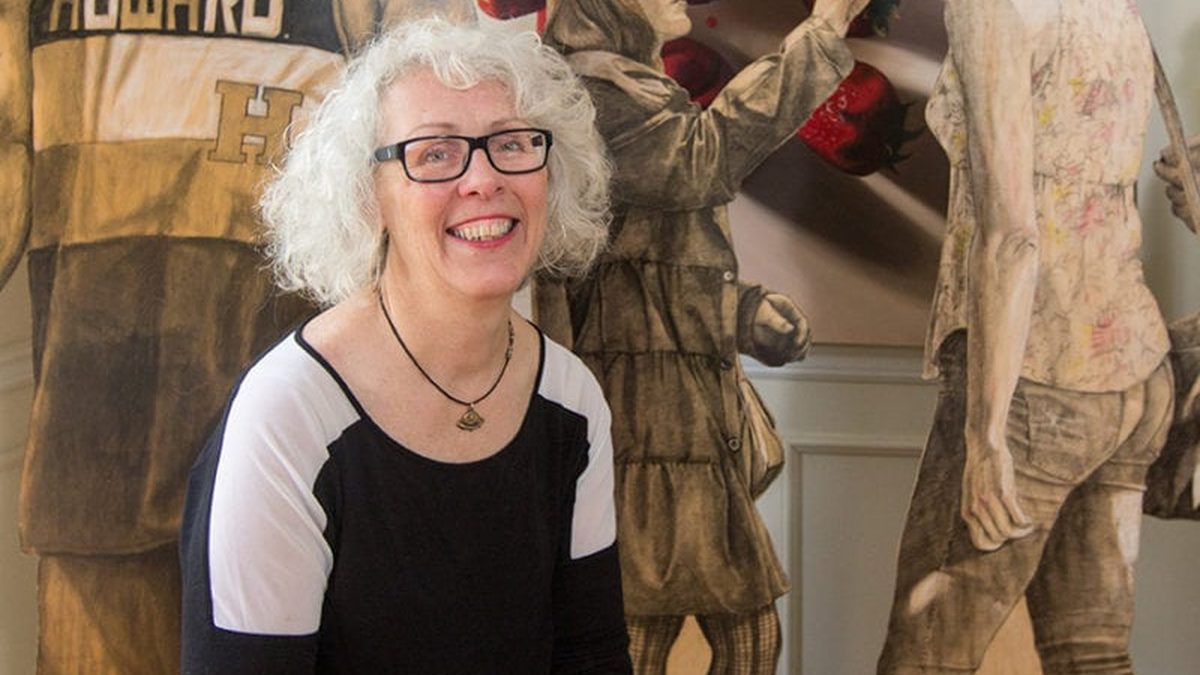
Cynthia Markert
Story by Jacob Rouser
For Cynthia Markert, art speaksto her as much as she speaks through art. Using mixed media on plywood, she creates intricate, flapper-style women who “draw out the creative impulses inside a human being as they are looking at the art.”
Cynthia explains that it is not the point for the women she depicts to be beautiful, but rather that they be challenging and engaging. Women from the 1890s to the 1930s are her inspiration; they challenged society’s notions and advanced the rights of women. She feels a “tenderness and female solidarity with them.”
Her discovery of plywood as a medium happened by chance when using a piece as a work surface. As she was working, “the drawings, the pastels and pencils would go off the paper and onto the wood.” She transitioned to working directly on plywood and has used it ever since. For her, the wood helps creates the women she depicts; she draws them out of the wood.
The work featured here was created during the Market Square renovation in 2003 when she was invited to do street art on a plywood construction tunnel. Now, some of those pieces are hanging and have come full circle to appear in one of the square’s renovated buildings: UnCorked.
Cynthia Markert’s work is featured around the US in cities such as San Francisco, Asheville, Charleston, New Orleans, and the D.C. area. Locally, you can see her work in Liz Beth & Co, Rala, UnCorked, or at cynthiamarkert.com
→ Swipe for Next Story
DepartmentsMAY JUNE 2017
Denise Stewart-Sanabria
Story by Jacob Rouser
Shaped by a childhood steeped in art, music, and photography, Denise Stewart-Sanabria creates art that captures humanity at its best and at its worst. Hailing from a small town in Massachusetts, Denise grew up with a family that encouraged a love of art. Having regularly visited art museums and attended a great school system, Denise felt destined for the world of art. “Since I was about 3 years old, I figured I was going to be an artist. It was as if it were an ingrained obsession.” “What I do is almost anthropological or sociological. Humans love to stare at other humans and figure them out and that’s basically what my work is about—even my food paintings are anthropological, behavioral explorations.” For her work, the essence of a good human is one that is completely unware of the photographer, which is why she seeks images of people staring at her work, creating an almost cyclical, self-referential expression of humans interacting with humans. In her latest series, Denise uses and creates toile wallpaper while exploring the narrative of humanity through food. One example juxtaposes the shepherd with modern processed food. This captures the false idea of the shepherd working happily in the field and the over-processed “ideal” food that we create.
→ Swipe for Next Story
DepartmentsMAY JUNE 2017
Gov. Bill Haslam: Political Options, but the Air Is Thin
Story by George Korda
Gov. Bill Haslamisn’t ruling out a U.S. Senate race somewhere down the political road.
He isn’t ruling one in, either. Yet. But if he wants to stay in elected office he doesn’t have many options. As with oxygen, the political options tend to thin the higher one goes.
Haslam has been a popular governor. Last May, Morning Consult, a non-partisan digital media and research company, pegged Haslam’s approval rating at 62 percent among registered voters it surveyed, just a one-point difference from 2015.
With a fortune estimated at $2 billion, Haslam—tabbed in Feb. 2015 by Forbes magazine as the “richest politician in America”—could be doing something other than dealing with the Tennessee General Assembly or potentially diving into Washington’s political swamp.
Nevertheless, he’s gone from Knoxville mayor to Tennessee governor. Realistically, he has only three political landing sites: (apart from an appointment to a senior federal position): U.S. senator, vice-president, or president.
If Bob Corker or Lamar Alexander step away from their U.S. Senate seats, Haslam is positioned.
He certainly has plusses, chief of which is his aforementioned fortune, particularly in a senate race. Haslam could self-fund a campaign. In politics money doesn’t talk: it yells, screams, jumps up and down, and can intimidate the stuffing out of a Thanksgiving turkey.
But if there’s one thing about which Haslam doesn’t like to talk, it’s money. One of his first acts after taking office in Jan. 2011 as governor was, as the Associated Press reported, disclosure-related: “NASHVILLE — Gov. Bill Haslam on Saturday signed an executive order that eliminates requirements for the governor and top aides to disclose how much they earn in outside income.”
Haslam’s argument is that essentially everyone knows he’s rich and to reveal too much about his finances would affect other members of the Haslam family. The governor’s father, Jim Haslam, founder of Pilot Corporation, is Knoxville’s biggest business and philanthropy name. The governor’s brother, Jimmy Haslam, is CEO of what is today Pilot Flying J, north America’s largest travel center and travel plaza operator, and owner of the NFL’s Cleveland Browns. The family doesn’t lack for discretionary income.
Haslam’s elections show that Tennessee voters aren’t grumpy about how rich he is or that he won’t share details. Therefore, money isn’t a harmful factor in a senate race.
But adhering to such a close-mouthed policy would make things messy were he to reach for one of the country’s two top jobs. The news media would pound the easygoing governor over his financial information, not to mention the fact that the family money is oil-related.
Prior to the 2016 election Haslam was talked about in some circles as a vice presidential or presidential candidate. His youngish looks, consistent popularity, substantial election victories, and Republican standing made him a natural to be talked about as a potential candidate.
In February 2013, Politico wrote on the “GOP star you’ve never heard of,” saying that “while attracting scant national attention and eschewing the camera-friendly approach of most up-and-coming Republican governors, Bill Haslam has amassed one of the most extensive conservative governing records in the country.”
Do other potential problems lurk for this somewhat quiet, potential political shooting star? Yes.
Haslam wanted a gas and diesel fuel tax increase. Tax increases aren’t generally a platform from which Republicans jump into bigger campaigns.
He pushed for Insure Tennessee, what many Tennessean Republicans saw as a state extension of Obamacare. Worse than pushing for it, he failed to get it passed, which means he irritated his base for no reason.
Following the release of a 2005 tape of President Donald Trump’s crude remarks about women, Haslam called on Trump to withdraw as Republican presidential candidate and allow Mike Pence to run in the top spot. Trump did not withdraw—and won. A percentage of his 61 percent support in Tennessee is likely to have long memories.
A rock-ribbed conservative with boatloads of cash could give Haslam a race for U.S. senator if Alexander or Corker depart. Term limits will in two years end Haslam’s gubernatorial career. A senate seat would keep him relevant for a possible 2024 national race.
Haslam has plusses, minuses, and options—even if the air in any direction is a bit thin.
→ Swipe for Next Story
DepartmentsMAY JUNE 2017
Gov. Tim Burchett: a Possibility, Possibly
Story by George Korda
The reaction among Republicans locally to those three words extends from, “Darn right,” to, “Can’t see it,” to the most important three words of all in a statewide campaign: “Where’s the money?”
Burchett, Knox County’s mayor, is term-limited out of office in 2018. What he’ll do next is a conversation starter among GOP faithful trying to deduce his future direction and whether they want to sign on to help, ride along, or forgo the trip.
To paraphrase a southern saying, there are two tall-hogs-at-the-political-trough possibilities for Burchett should he wish to stay in politics: governor or U.S. Congress.
Burchett has been a Tennessee state representative, a state senator, and, as Knox County Mayor, a chief executive officer. The combination of state legislative and mayoral experience, along with having won elections, separates him at this point from other announced Republican gubernatorial candidates, Knoxville businessman Randy Boyd and Williamson County businessman Bill Lee.
Burchett’s principal problem in considering a governor’s race is that he’s not a multi-millionaire. Or even a millionaire. Having a six-figure net worth or income isn’t written into the state’s Constitution as a requirement for statewide office; however, it has become a reality in recent years.
Tennessee’s last two governors, Phil Bredesen and Bill Haslam, were able, if necessary, to self-fund their campaigns. In fact, had Bredesen not put millions of his own dollars into his 2002 election victory, then-U.S. Rep. Van Hilleary might well have won that election. Hilleary lost to Bredesen by about 50,000 votes out of some 1.6 million cast.
Burchett’s past election victories offer a model by which he could win a governor’s race. His assets are that he speaks two languages fluently: Tennessean and East Tennessean, with the proper dialect. His aw-shucks way of speaking and his generally lighthearted and informal manner mean it’s possible for Burchett to be underestimated, particularly by the more genteel strata of political geology. On the other hand, it could be the point of separation that makes the difference.
The model by which Burchett could be a gubernatorial contender is based on his first election campaign. In 1994, he waged a fight in the primary against a longtime incumbent Republican state representative. He had no money, no political name recognition, and many gave him no chance. Nevertheless, he campaigned door-to-door with a determination that bordered on obsessiveness. He wore out several pairs of boots. At least one voter, who Burchett had visited several times, quipped, “Look, I’m planning to vote for you unless you come back again.”
That’s a model that could work for Burchett statewide. But duplicate that model in 95 counties and knock on the doors of 1.6 million voters or more? How?
The difference is Burchett’s differences. A neighborhood walk or two in each county, a speaking engagement that introduces him to voters, and TV commercials emphasizing his no-tax, make-sure-services-work message, would all show off his style of dealing with people. Before too long the “talk” gets right: “You know, this Burchett guy is good.” And momentum begins.
For that to happen Burchett needs two things: to organize and staff a statewide campaign and to find big-dollar backers who can raise a lot of money and who will bet on a dark horse in a crowded field. Money is the key. Bredesen spent nearly $12 million to win his first race for governor, Haslam almost $17 million in his initial campaign.
Burchett’s other option is to wait to see if 2nd District U.S. Rep. John Duncan, Jr. retires, or to run against Duncan in the 2018 primary. Burchett is certainly well known, but Duncan has for nearly 30 years worked the district indefatigably. He’s the congressional equivalent of Cheers: everybody knows his name, and he knows theirs. As a senior member of Congress he’s worked his way to a position of influence for his district. Burchett himself, in a nice way, has said you’d have to “dynamite” Duncan out of his seat.
Would Burchett leave the mayor’s office and wait for Duncan to retire? Possibly, if he were assured Duncan wanted to serve only one more term. That would save Republicans, particularly Knox County Republicans, from a choice few wish to make. Or waiting might not be an option.
The betting here is that unless well-heeled financial backers demonstrate to Burchett that they’ll provide the money he needs to make himself known to Tennessee voters and give him a legitimate chance to win, he’ll run for Congress even if his heart yearns for the state capital.
The only question is when.
→ Swipe for Next Story
DepartmentsMAY JUNE 2017
Food Labels: Reading between the Lies
Story by Bruce Fox
As an avid sportsman,I’ve always enjoyed eating the most natural of foods. Caught protein is better than bought protein, as the saying goes. When I catch a fish, I can be reasonably certain that what I’m getting is fresh, natural, and free of additives, as long as I’m aware of where and how I’m fishing. However, most of us don’t have the time to always be so sure of the source of our foods. Therefore, the labels on the foods we purchase, and the language that’s used on them, becomes increasingly important, especially since research shows that in the past decade, Americans’ appetite for “healthy” food, which is often characterized by labels such as “organic,” “gluten-free,” “GMO-free,” and “all-natural,” has increased significantly.
Data published by the Pew Research Center shows that 71 percent of Americans say that they have made purchasing decisions based on nutrition and ingredient labels, and four-in-10 Americans say that at least some of the food that they eat is organic. However, labels are generally designed to serve the companies and the products they’re selling rather than the individual consumer. Many Americans may be unaware of what food companies are legally allowed to say on labels, as well as what they’re allowed to withhold. This creates a situation where people may be making choices based on incomplete, inaccurate, or misleading labeling.
For example, the U.S. Food and Drug Administration does not currently require food manufacturers to declare whether or not their foods are genetically modified, or whether or not foods contain genetically modified ingredients. Some states, such as Vermont, do have laws requiring companies to make GMOs known, and most states have proposed laws. But it might shock the average consumer to learn that, according to the Center for Food Safety, 92 percent of corn and 94 percent of soybeans in the U.S. are genetically engineered, and that 75 percent of processed foods on supermarket shelves contain GMO ingredients.
Consider also the use of antibiotics in livestock, which may lead to antibiotic-resistant diseases. Again, the FDA does not require companies to declare whether or not antibiotics are used. For help deciphering the labeling, consider that if a package reads “certified humane” or “organic,” this means that there are no antibiotics used for growth or disease prevention. “Natural” and “all-natural” labels allow for antibiotic use, and even labels reading “grass-fed” or “pasture-raised” do not rule out the possibility.
The “organic” label itself is an issue. Many assume that if something is organic, it is coming from the highest quality source, isn’t produced or grown with pesticides or antibiotics, and is overall good for the body. Some good things to know about organic is that by federal law, GMOs cannot be used in foods with organic labeling, and that meat that is labeled organic cannot be fed GMO feed. Most synthetic pesticides are also prohibited, although natural pesticides are allowed.
Finally, consider that while the majority of ingredients must be declared on a food label, the FDA allows for companies to not include “trace” and “incidental” amounts of ingredients on their food labeling, unless these ingredients are major food allergens.
The food industry has been given leniency when it comes to labeling products. Doing your due diligence by understanding both the source of your food and how to interpret the labels on that food can help protect you and your family.
→ Swipe for Next Story
DepartmentsMAY JUNE 2017
You’re Teaching Your Five-Year-Old How to Drive
Story by Bruce Fox
At age 16, Ashley Johnsonwas on her way to big things. She made great grades in high school and had big plans for the future. She had a loving family and more friends than most of us can count. On May 10, Ashley died when her car crossed the center line and hit a truck head-on. Her story is one that is repeated ten times each day in our country.
How bad is it to look at your cell phone while driving? It only takes a moment, we think, but we are kidding ourselves. When drivers use a cell phone, decision making is impaired and braking times are delayed. A study by the Virginia Tech Transportation Institute found that drivers who texted were 23 times more at risk for a crash or near crash than “non-distracted drivers.”
Despite campaigns by cell phone providers to raise awareness of the dangers, we are not getting the message. In 2015, AT&T conducted a survey about cell phone usage while driving. The results indicate that 62% of us admit to keeping our phones within easy reach while driving. Texting is the top activity, but we use social media as well. 30% of Twitter users admit to tweeting while driving “all the time.” Those who admit it say that habit, a perception that they can do two things safely at once, and their fear of missing out are the primary reasons they tweet while driving. A new report from February, 2017 by the AAA Foundation for Traffic Safety found that 88% of young millennials admitted to at least one risky behavior behind the wheel in the past 30 days.
We see how our kids constantly and reflexively look at their cell phones. The fear of missing out is palpable, even at the dinner table as we try to get everybody off their phones and focused on a family conversation. Of course, as parents we have to admit that we do the same thing, right? We hear that little “ding” when we get a message, and it takes all the willpower in the world not to pick up the phone. What we may not know, however, is that to a great extent our kids learn that behavior from us.
As a general matter, children start learning from us as soon as they are born. Research conducted jointly at Temple University and the University of Washington has revealed that, from the outset, babies learn to imitate the movements and actions of their parents. Based on brain scans, a baby’s observation of adult activity produces a response in the sensorimotor cortex of the baby’s brain. This allows them to learn to copy behaviors as they mature physically.
We think that when our children reach 15 or 16, it is time for them to learn to drive. We’re wrong. Studies funded by AAA show that children start learning to drive at around five years of age by watching their parents. Children learn how to buckle their seatbelts by watching their parents do it—they learn how to change gears and what pedals to push. And by watching us, they learn to use their cell phones while driving.
There is a movement among some child development experts to start a formal program of teaching kids to drive as early as 12 years old as a way of countering bad habits they learn from their parents. While this might be a bit too much, the discussion is necessary because we are teaching our kids bad driving habits. The sooner we realize it, the sooner we will be able to start teaching and demonstrating good habits.
So, talk with your kids about texting and driving well before they start driving. Tell them about Ashley Johnson. More importantly, practice what you preach. Set a good example and do not text and drive. It is, after all, against the law. And your example may mean the difference between life and death.
→ Swipe for Next Story
DepartmentsMAY JUNE 2017
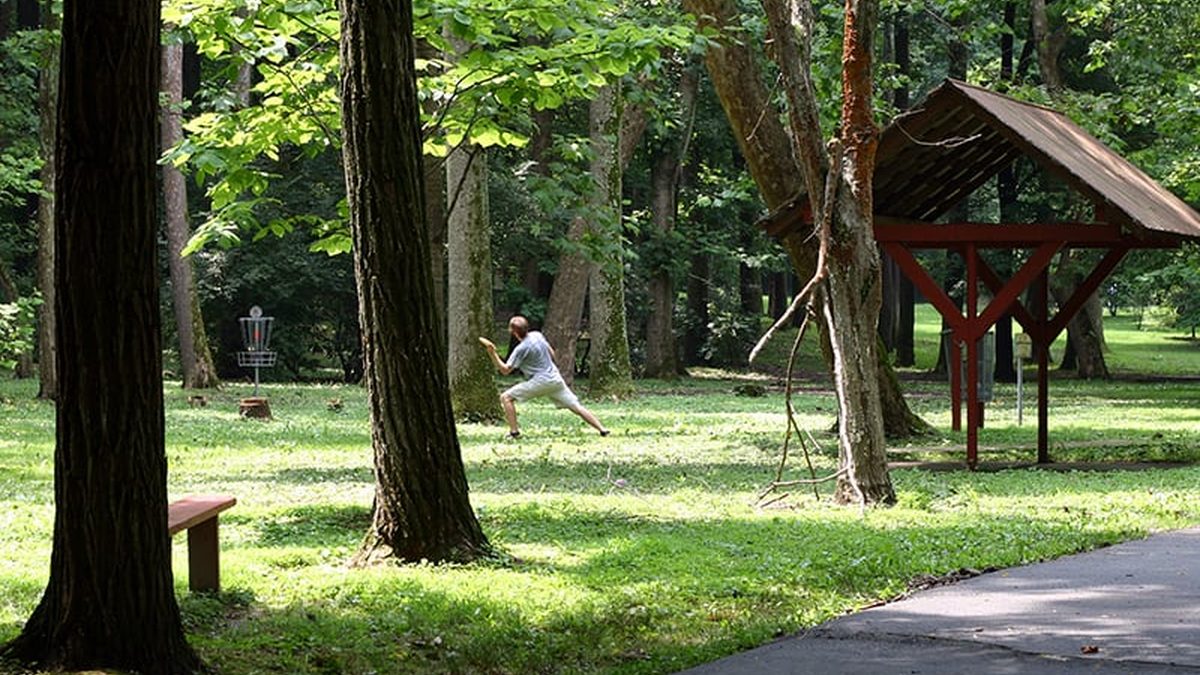
Trail Running
Story by Caitlin McLawhorn
Amongst a growing number of local breweries, attractions, and dog parks, the scruffy city of Knoxville is also nationally known for its running trails—complete with gorgeous scenery. Trail running allows people to connect and stay fit while taking advantage of the fact that, in addition to such close proximity to our beautiful mountains, Knoxville offers over 80 miles of off-road trails. “A lot of it is about the experience, taking everything in. It’s gorgeous to run through,” says Kristen Stratton, an avid trail runner. “People are realizing that it puts less stress on your joints, and the impact is lighter.” These are just a few of the reasons trail running is overtaking other types in popularity. Of course, the proper footwear is also important to avoid discomfort or risk of injury. David Black, Knoxville Track Club’s Interim Executive Director, recommends visiting a runner’s shop to get the best quality for your money and having shoes professionally fitted. As always, it’s important to stay hydrated, but carrying a bottle isn’t easy. You may prefer a lean backpack that carries water, such as a CamelBak. Black suggests taking advantage of the brisk mornings and early evenings, and of course, it’s a fantastic way to start or end your day. There are several trailheads close to downtown, making the sport very accessible. If you’re new to it, make sure to pick up a map, and start out with a partner. Apps like AllTrails and TrailLink allow you to check out reviews and download trail maps, so you can use them even if you lose service. And it’s nice to have a phone with a good camera, so you can share the beautiful views and awesome wildlife with friends and family. “It’s not difficult; it’s an adjustment,” adds Stratton. With all the trails and sights to experience, trail running is a signature way to get out and enjoy our scruffy city.
CONTACTSKnoxville Track Club 888-217-5635 knoxvilletrackclub@gmail.com A good resource to plug into for those looking to run around town. They host 12 trail races each year in and around Knoxville.
Moms Run This Towninfo@momsrunthistown.com A community group of women and moms doing light runs around town and popular 5ks.
Runners Market 865-588-1650 Wednesday: 5:30 pm. Social Run from Runner’s Market. Distance varies from 4-7 miles
Bearden Beer Market Fun Run 865-851-8922 Monday: 6:30 pm. Group fun run open to all levels of runners. Runners receive $1 off all pints.
Popular Running Trails in Knoxville
Third Creek Greenway3110 Sutherland Ave
Victor Ashe Park4901 Bradshaw Rd
Ijams Nature Center2915 Island Home Ave
Forks of the River3140 McClure Ln
Haw Ridge ParkTN-170 & Harbour Pointe Ln
Concord Park10960 Concord Park Dr
I.C. King Park3440 Alcoa Hwy
Norris Dam State Park125 Village Green Cir
Melton Hill Park3230 Williams Bend Rd
Gallaher Bend Greenway7620 Bull Bluff Rd
→ Swipe for Next Story
DepartmentsMAY JUNE 2017
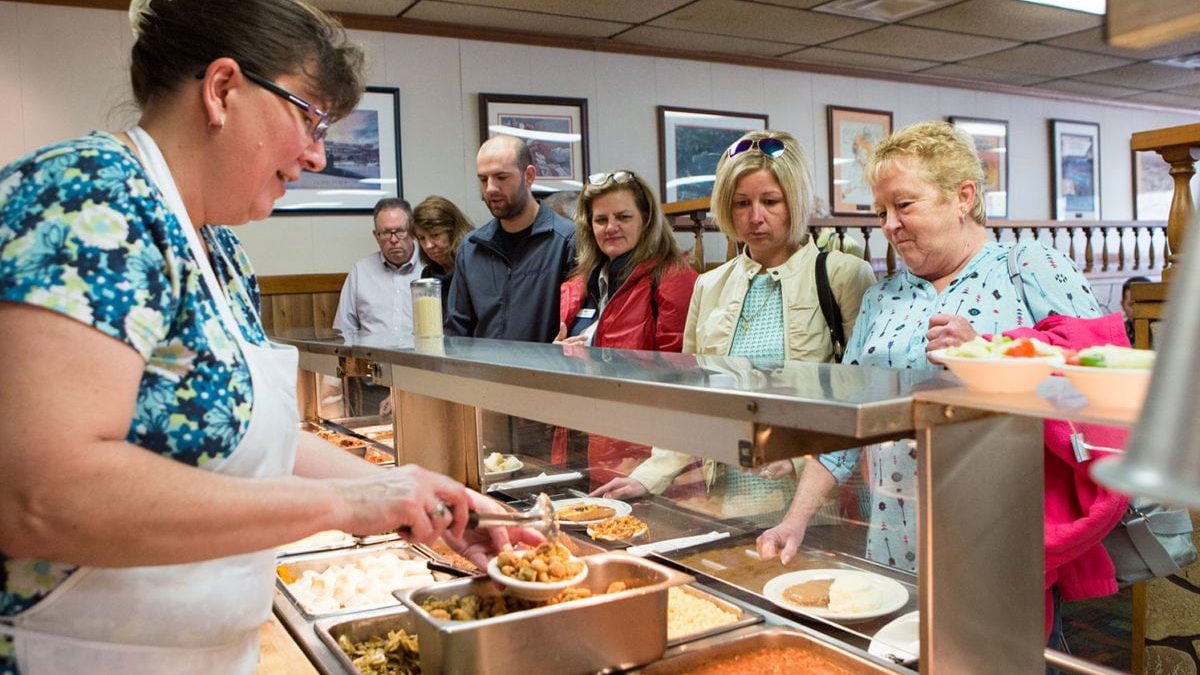
Meat and Three
Story by Jessica Focht
Craving some southern comfort food? If so, you’re in the right state—travel guide lore is that the concept has Nashville, TN roots. At a Meat and Three, the customer chooses from a daily selection of meat dishes, then pairs it with three sides from a list that can include anything from vegetables to puddings and breads. The selection changes daily, providing a wide-range of options. If you’re on a lunch break and need a quick bite to eat, head to one of these local restaurants for a meal that will remind you why the Volunteer State is known for its eats. With choices ranging from delectable fried chicken, to mouth-melting pulled pork, to hearty meatloaf, any of these Meat and Three spots will satisfy your urge for down-home cookin’. These are some of our favorites. We encourage you to visit them all.
Wright’s Cafeteria
“Home cooked meals with a smile”is Wright’s Cafeteria’s motto, and we can see why. With various choices of meats, fresh veggies, and homemade desserts, Wright’s works to guarantee customer satisfaction. Best thing about Wright’s abundant menu? —You can mix and match their food by trying a new combination each day. If you happen to be there on a Monday, we suggest keeping your meal classically southern and trying theirChicken & Dumplingswith sides of
Okra, Green Beans, and Mashed Potatoes.
5403 North Middlebrook Pike865-588-2040Mon-Fri: 11am-2pmThurs: 11am-2pm, 4:30-7:30pmSat & Sun: closedwrightscafeteria.samsbiz.com
Chandler’s Deli
Claiming that they have the best home cooking around, Chandler’s Deli promises customers that their southern meals are better than your granny’s. Chandler’s various selection will make your mouth water with dishes ranging fromPulled Pork SandwichtoFresh Flounder. And, as those in the know, know—theirFried Chickenis some of the best in town. If you happen to stroll in for their Thursday lunch special, try theSpaghettiwith sides ofSweet Potatoes, Fried Green Tomatoes,andPinto Beans.Looking for some sweet refreshment? Order Chandler’s
Looking for a local lunch spot where you can simultaneously pick up some fresh plants for your garden? Look no further! Situated at the corner of Middlebrook Pike and Old Cedar Bluff, Horn of Plenty is both a market and a restaurant serving classic Meat and Threes. We suggest stopping by for theFried Catfishlunch special on Fridays, accompanied with sides ofCream Corn, Broccoli Casserole,andRed Potato Salad.Can’t make it on Friday? Good news for you—on Wednesdays, Horn of Plenty is servingBaby Back Ribswith their special homemade BBQ sauce, with choices of sweet, hot, or vinegar based. They also sell seasonal plants, soils, and mulch.
If you love homemade comfort food, we consider this eatery to be Homestyle Heaven! With 10 different side items and a choice of three main dishes, Lunch House guarantees your satisfaction. Known for its cheery staff and prompt customer service, it is no shock to us that Lunch House is one of Knoxville’s favorite hidden gems. If you make it in for the Thursday special, we suggest trying theFried Chickenpaired withCucumber Salad,Cottage Cheese with Pineapple, andCole Slaw. If you get a sweet tooth after your meal, have a slice of Pecan Pie with a scoop of Vanilla Ice Cream on top.
Tucked away in a corner of downtown, this Knoxville breakfast favorite is known more than their coffee. Established over 30 years ago by Pete and Rita Natour, Pete’s Coffee Shop & Restaurant works to provide quality home cooked meals to their guests—and their extensive menu includes a Meat and Three option with daily specials. Pete’s also offers a vegetarian selection, such as the three-vegetable plate with a roll or corn muffin. If you are there on a Tuesday, order theMeatloafwith a side ofCandied Yams, Macaroni Salad, and Fried Okra. Craving something sweet after finishing your main dish? Try Pete’s homemadeCoconut Pie.
540 Union Avenue; (865)-523-2860Mon-Fri: 6:30am- 2:30pmSat: 7am-2pmSun: closedpetescoffeeshop.com
→ Swipe for Next Story
DepartmentsMAY JUNE 2017
Tapas and Small Plate Bistros
Story by Jessica Focht
As legend has it, Spain’s King Alfonso X, struck with a severe illness allowing him only to have food in small servings paired with wine, introduced tapas as small plates of food to accompany his meal. After his recovery, he made a decree stating that no wine should be served at inns unless it was served with food. You may not feel compelled by a 13th century royal decree, but if you’re searching for a good pairing, why not celebrate a long-standing tradition and seek out restaurants that offer tapas and other small plates to accompany your wine choice. This small plate phenomena is slowly growing in Knoxville. Here are some of our favorite local tapas spots.
Cru Bistro & Wine Bar
Looking for a date night spot or simply somewhere to catch up with a friend over an exceptional small plate? Cru Bistro and Wine Bar offers a warm ambiance to anyone who enters. The menu is designed for guests to experience a wide range of wine pairings. Not only does Cru have delicious food, but this one-of-a-kind bistro also offers over 70 different wines by the glass. Enjoy their tapas-style dishes such as theSeared Scallopsserved over basil cream corn. If that doesn’t strike you, try theirTenderloin Sliderswith sautéed mushrooms and Boursin cheese. Have a sweet tooth? Try the
Frozen Salted Caramel Mousse.
141 S Gay St, 37902; (865) 544-1491 Mon-Thurs: 11am-12am Fri-Sat: 11am-1am Sun: 10am-10pm crubistroandwinebar.comPhoto by Kellie Crye Ward
Water into Wine
Further west, we suggest swinging by Farragut’s Water into Wine and checking out their various tapas selections and cozy atmosphere. Choose from over 100 wines, but keep abreast of their offerings as the menu changes monthly. We suggest theCharcuterie Board: poached button mushrooms topped with onion relish, andouille sausage, pulled short rib beef, smokey boursin crostini, red dragon cheese, pickled vegetables and chefs seasonal fruit jam, relish or compote. For a more substantial dish, try theAhi Tuna Filets, served with sweet sriracha glaze base, sesame encrusted seared ahi tuna, all topped with an Asian relish. The bistro offers Live Jazz every Saturday from 7-10pm.
607 N Campbell Station Rd, 37934; (865) 392-1586 Sun-Mon: closed Tues-Thurs: 11am-11pm Fri-Sat: 11am-12am waterintowineknoxville.comPhoto by Kellie Crye Ward
The Brickyard
Found in a former antique store on Kingston Pike in the heart of Bearden, this more casual establishment takes its name from Bearden’s roots as a railway locale—the owners named their place after the original railway brickyard, which hosted a variety of restaurants and bars. The Brickyard features large windows facing the sidewalks of one of Knoxville’s hotspots and has a small outdoor dining section. Try the roasted garlicBruschetta, served with asiago, garlic oil, balsamic & fresh basil. For mores sustenance, go with theMidtown Pastrami Panini, served with grilled onions, dijon, fig jam, granny smith apples, and sharp cheddar.
Don’t let the name fool you, drinking isn’t the only thing that is encouraged at this local hotspot. Claiming to have the best wine list in town, Drink can guarantee a wide variety of wines to accommodate the most eclectic of tastes. Brought to you by and located right next to Bistro by the Tracks, this atmospheric bar serves delightful small plates in an intimate setting. We recommend theLamb Lollipops, served with spring greens, mint, and blood orange. If this doesn’t appeal, we suggest theReuben Toast, served with thousand island dressing, corn beef, sauerkraut, and gruyere cheese. 215 Brookview Centre Way, 37919; (865) 249-7544 Mon-Thurs: 5-11pm Fri-Sat: 5pm-1am Sun: closed drinkknoxville.comPhoto by Kellie Crye Ward
Old City Wine Bar
Located on Jackson Avenue in the heart of Knoxville’s historic downtown district, the Old City Wine Bar provides customers with a relaxing atmosphere. Serving 48 wines by the glass and over 150 bottles, this gathering spot encourages you to develop your wine palate. But don’t stop there—Old City Wine Bar also features an abundant, delicious small plate menu for you to accompany your selection. Try theSmoked Salmon Sandwich, served with baby spinach, table cheese, bacon, and fig preserves on ciabatta. If you’re feeling adventurous, try theStuffed Banana Pepperswhich come with whipped feta, balsamic reduction, and bacon crumbles.
108 W Jackson Ave, 37902; (865) 851-7676 Mon-Thurs: 4-11pm Fri-Sat: 4pm-12am Sun: closed oldcitywinebar.com
→ Swipe for Next Story
DepartmentsMAY JUNE 2017
Lonesome Dove Western Bistro
Story by N. Brooks Clark
Lonesome Doveoccupies therenovated Patrick Sullivan’s Saloon and its neighbor building,once known as Annie’s. The Texas connection starts there, in that onetime proprietor Annie DeLisle was once married to Cormac McCarthy, whose novelAll the Pretty Horseshas entered the same Texas literary pantheon as Larry McMurty’s classics fromThe Last Picture Showto, yes,Lonesome Dove. The restaurant echoes the Texas vibe of celebrity chef Tim Love’s restaurants in Ft. Worth and Austin. Chef de Cuisine Jesse Rossbach came from the Austin Lonesome Dove in 2016, having joined the LD family a year and a half before from Austin’s trendy North Italia Modern Cuisine and True Food Kitchen.
If you aren’t in a Texas state of mind when you walk in, a warm “Howdy” from the hostess gets you started. The saloon bar runs along the right side of the room. Behind it, a selection of spirits, arranged artistically to set off their different shapes and sizes, let you know that this is a place where a cowpoke can get a real drink. Like a western movie set, the balcony level of timber-frame beams runs down the left side of the saloon. Diners can look down on the bar or nestle beneath the balcony. The dining room that was once Annie’s features an open kitchen emanating the aroma of elk and venison on the grill. With twangy music, exposed brick walls, and stained-glass clerestory windows, it’s refined and funky at the same time. Overflow goes the second-floor Fulmer Dining Room— named for the coach; Tim Love is a proud UT alum. Groups can rent the top-floor Sullivan Room, once a bordello and still haunted by Clara the Ghost.
Servers take orders for all courses all at once, so the crew can orchestrate the arrival of different courses. “We take you on a journey,” says Rossbach. The tour guides are well informed and enthusiastic about their dishes, which they will split up for family-style sharing.
In his quest to create unique dishes, Rossbach says, “I’d like to feel that I make a difference.” The journey begins with Wild Game Fettine, paper-thin shaved roulades of wild pig, venison, quail or pheasant spit-roasted over open mesquite fire. First courses standouts include the satisfying crunch of Lobster Hushpuppies with parsley-cilantro salad ($15), wild-but-not-gamey pheasant meatballs with soy-cured egg dip ($15), and irresistible Elk/Foie Gras sliders with blueberry jam ($14). In the second course, don’t miss the spicy bowl of Texas Red beef chili with avocado corn salsa, cheddar, crema and crispy tortilla ($10), or fresh Acorn Squash soup with bacon, crème fraiche, and manchego ($10).
The dozen main courses change regularly, except for the signature Roasted Garlic-Stuffed Beef Tenderloin with salty, spicy, and crunchy Western Plaid Hash, grilled asparagus and Syrah demi-glace ($36 for 6 oz.; $42 for 9 oz.). Other steaks are available, cut by the ounce. The Rabbit Roulade with rabbit pork sausage, basil salad and black garlic ($36) is unique and tasty. The Duck Breast with duck foie gras sausage, corn puree, and pickled pear ($36) is subtle and savory. Elk Loin with Swiss chard, rare Hen of the Woods, salsify, and candied blackberries ($39) echo the tastiness of the elk sliders.
Notable sides include Crispy Cauliflower in a truffle fondue ($10), and Beet Home Fries with goat cheese and lemon ($8).
The journey is relaxing and full of surprises. The dishes are presented artfully and with occasional touches like shaved Margarita ice atop an amuse bouche.
The celebrity vibe comes with celebrity prices. There’s no getting around that a full culinary journey at Lonesome Dove is pricey. If you want the experience, try having just a first and second course and a side. These are memorable offerings, and the servings are generous.
→ Swipe for Next Story
DepartmentsMAY JUNE 2017
Rustic Gentility
Story by N. Brooks Clark
In 1932, a Presbyterian widow from Pittsburgh named Susan Wiley Cooper Walker, whose late husband had been Andrew Carnegie’s bookkeeper, moved south to be near her sister, the wife of the Maryville College chaplain. Inspired by the natural beauty of the area, Walker created Morningside, a 26-room home and gardens in the woods in a rear corner of the campus. After Walker died, Morningside served as the college president’s home, then an inn. In 1997, the Ruby Tuesday company bought it, added two buildings, and turned RT Lodge into a corporate retreat and wedding venue, with a pond and acres of trails, streams, and meadows.
The dining room at RT Lodge is open to the public Tuesdays through Saturdays.
The entry lobby has the feel of a classic hunting lodge, which continues upstairs in several intimate dining rooms with a total of just 15 tables. The china featuring pheasants and other game fowl complements the gentle elegance of the décor. The view of the pond is soothing. In all, it’s like going back in time.
As it was in old-time resort lodges, staff members from the manager to the waiters make guests feel that they have been waiting to make the evening special. The understated elegance continues through the meal, as dishes are presented with simplicity and a casual feel.
Executive Chef Trevor Stockton’s vision features southern dishes made with fresh ingredients in the manner of classic French kitchens. As he says of many items on the menu, “It’s a simple dish, but a lot goes into it.” Stockton grew up on his parents’ farm in Gainesborough, Tennessee, and trained at RT Lodge under Rick Mace and at Blackberry Farm. When strawberries are in season in South Carolina, for example, Stockton features them— pickled with 24-month aged ham ($12), in an elegant gazpacho ($9) with rhubarb and basil, or in a cucumber and strawberry salad ($8) with goat cheese, mint, and miner’s lettuce.
Stockton insists on using farro, rice, yellow grits, and corn meal from Anson Mills in South Carolina. This gives a special taste to the Gulf shrimp and yellow grits with Andouille sausage and green tomato ($14). He gets 24-month aged hams from the Amish in Kentucky and other pork from his parents’ and neighboring farms in Gainesborough that he dry cures in house. All this elevates his four-meat Charcuterie Board ($16) to a rare status, including lomo ham, copa, and a memorable foie gras au torchon. In a classic French technique, the duck liver is cleaned of veins and cured with sea salt, four-spice, and bourbon (for RT it’s Four Roses). The pate is run through cheesecloth to make it smooth and not crumbly, encased for three days in a towel (that’s the torchon), then gently poached and chilled again. At RT Lodge, it’s delicate, smooth, and creamy.
The main courses show what Stockton means by simple dishes with a lot going into them. The Anson Mills Farro ($20) is combined with hen-of-the-woods mushrooms and ramps. The Grilled Hanger Steak ($25) is set off by potato puree, broccoli, parmesan, and crispy farro. The Ashley Farms Chicken ($21) comes on Carolina Gold Risotto and mushrooms. A specialty of the house is Rib-Eye Steak for Two ($70), a 24 oz., 45-day wet-aged prime rib, roasted in cast iron and served with lodge steak sauce and béarnaise, and skillet fried potatoes with ramps and carrots.
With small plates between $8 and $16 and main courses averaging $25, RT Lodge is an excellent value for fine dining. Make sure to call for reservations. 981-9800.
→ Swipe for Next Story
DepartmentsMAY JUNE 2017
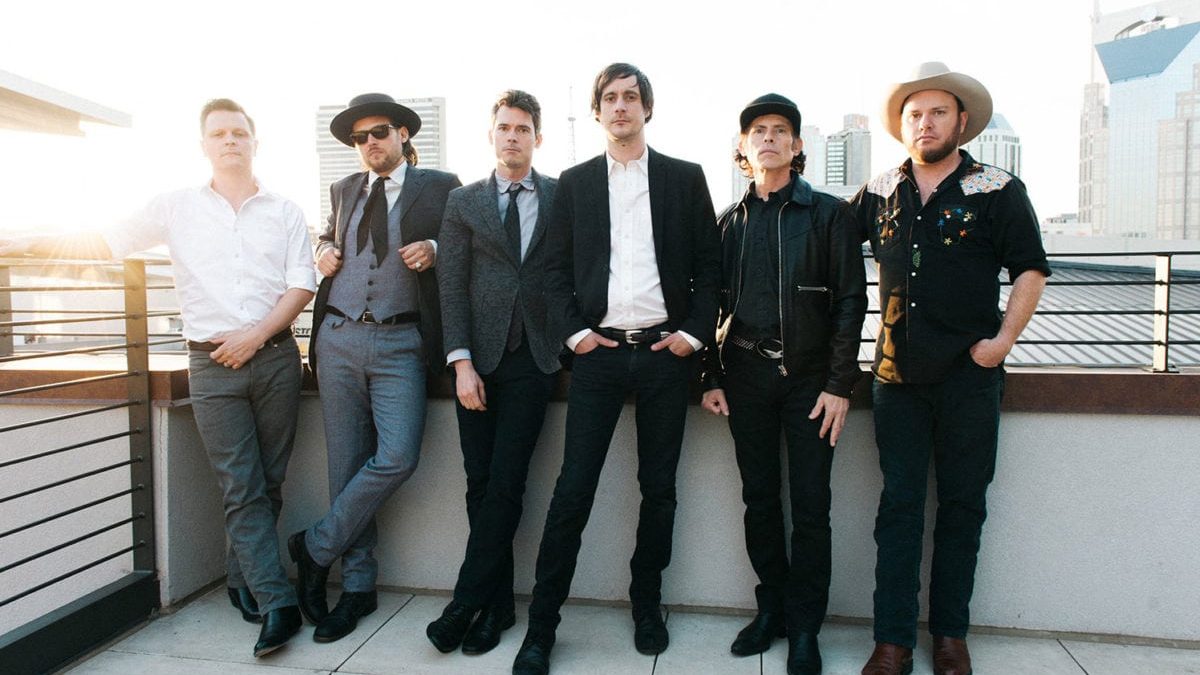
Old Crow Medicine Show
Story by Keith Norris
Old Crow Medicine Show digs deep into the roots of folk-country and Americana music, determined to keep these classic genres alive and vibrant. On April 28, the band released their track-for-track recreation of Bob Dylan’s seminalBlonde on Blondeand will play the entire album on the Old Crow Medicine Show Performing Blonde on Blonde tour, stopping at the Tennessee Theatre in May. Co-founder Critter Fuqua took the time to answer a few of our questions.
Cityview:We’ve heard you all were discovered by Doc Watson. What’s the story behind the band’s creation?
Critter Fuqua:Yeah, I suppose you could say we were discovered by Doc Watson. I think that was certainly the big turning point in the band’s odyssey. When his daughter walked him up to us on the corner of Cherry and King Street in Boone, NC, right in front of Boone Drug store, and he drank in our sound with those great big ears, he invited us then and there to play at MerleFest, and the rest, as they say, is history.
CV:What drew you to Tennessee in 2000 after living in Virginia and New York?
CF:We were each approached individually by Pepsi Bottling company. In the late 90’s and early 00’s, Pepsi was losing a key demographic, the bluegrass banjo player, and they needed us to rally the troops. We were formed in a secret bunker in Oak Ridge, TN. Literally formed together, like Voltron. We learned to eat, sleep, breathe, play music, and live together. When the time was right, we were surgically separated, and sent forth on our mission. Pepsi called it Operation Appalachian Fizz.
I’m kidding of course. Ketch and I grew up in Harrisonburg, VA. We ended up in the Finger Lakes region of New York in 1998, picking grapes and picking guitars when we met Willie and Ben, and Kevin Hayes came down from the blueberry fields of Maine. We trekked across North America, ending up in Nashville via Beech Mountain North Carolina. Several lineup changes and almost 20 years later, myself, Ketch, Kevin, Morgan, Cory and Chance are still live and kicking.
CV:Why did you choose to recreate Dylan’s Blonde on Blonde and perform it in concert?
CF:The Country Music Hall of Fame invited us to play Bob Dylan’s Blonde on Blonde live for two nights in honor of its 50th anniversary of being recorded in Nashville. We jumped on the chance like a hobo on a donut.
CV:What are the pleasures and challenges of busking?
CF:The most pleasing thing about busking is that we don’t have to do it for a living anymore.
→ Swipe for Next Story
DepartmentsMAY JUNE 2017
Umphrey’s McGee
Story by Cityview
If you’re strolling along Gay Street on a hot August Knoxville Sunday and get the jones to jam out to some live music, Chicago’s Umphrey’s McGee is your ticket. Known for their funky rhythms and vibrant light shows, and performing a wide range of genres, the band has been on the road annually for 17-plus years. Their most recent studio album,Zonkey, offers a mash-up of reworked tracks by various artists—from Phil Collins to Pink Floyd.
UM’s Keyboardist Joel Cummins was good enough to answer a few of our questions.
Cityview:What motivates you all to work this hard after 20 years together?Joel Cummins: To put things in a bit of perspective, Umphrey’s McGee played 162 shows in 2003, and in 2017 we’re going to play 86 or 87. So we’ve been able to cut way back on the frequency of shows, which has also increased the quality of what happens on a nightly basis. We’re very fortunate to be able to have control of that aspect of touring. Most of us are married and half the band has kids now. Having a more balanced schedule where we play 3-4 days in a row and then everyone goes home for a few days has kept our music fresh and given us good breaks mid-tour to see loved ones. I think our shows have been more consistent over the past couple of years since we’ve adopted that principle in how we approach touring. The last couple of studio sessions and albums we’ve sunk our teeth into have been incredibly different experiences, with theLondon Sessionsbeing recorded in just one day at Abbey Road Studio in London in 2015, to many days both together and apart in the studio forZonkey.
We put a significant amount of time in on the studio side of things these days, but it’s very different from playing live shows. We’re having more fun in the studio together than ever before. Most of us have enjoyed the experience for years, but these last sessions we’ve gotten Brendan to really loosen up and enjoy himself a bit more. Brendan, Jake, Ryan, and I played a little side show at a bar called A Live One in Chicago the night before we started recording this time around. And Brendan got a little loose that night, so that vibe carried over into the next day, and we were all in good spirits from the get go, simultaneously laughing at and with Brendan. Now having worked with Manny and Greg for many years, I think we’ve found a comfort zone in the studio where we’re being more productive than ever, while also lovin’ every minute of it, as Loverboy might say.
We’ve been working on our follow up album toZonkeysince early November, beforeZonkeyeven came out. We spent June to October of 2016 compiling as many ideas and songs as we could to put down. We have a huge back catalog of recorded half-ideas or demos with a good section or two, so sometimes it’s about finding the right piece to complete the puzzle and having as much material available as possible. We probably had 35-40 different ideas, some complete some not, that were brought to the table. We recorded almost 25 of them, though at least one or two of them are not very serious attempts at music—just us having fun in the studio together. Once we’ve arranged an idea, we’ll rehearse it in the studio and try to get the arrangement down as a band. The biggest trick is getting something new to feel like it’s a groove you’ve been playing for years; achieving that comfort level in a very short amount of time is a challenge. That’s our typical modus operandi and how we recorded new material this past November. The entire band plays a new composition together to get the vibe down. Usually, we start with Kris trying to nail his drum part and then go from there as far as stacking parts compositionally. It’s easy for any of us to re-record parts later, but if you can write your part and get a good take of it with Kris live, it’s going to have a more organic feel to it in the end.
Listening and interacting with the mixes as they develop has become such a crucial part of what we can accomplish creatively today. At this stage, we’re listening to a lot of music being considered for the album and making tweaks to those with co-producers and engineers Manny Sanchez and Greg Magers from IV Lab in Chicago, who have been working with the band for many years. The added aspect of having technology to send high-quality mixes and creative ideas to each other has also helped us better arrange and produce the songs. It’s an exciting time to be making music together, and I’m glad that creatively we are still pushing each other in 2017. But we’re always working on new music, and I think that is what has sustained the band for as long as we’ve been around. I’m heading to Jake’s studio in the backwoods of Michigan next week. We’ve created a ton of music there over the years; the space really has some magic about it. Jake is a very gifted audio and studio guy, and the sounds he’s achieving coming out of his recording studio stand on their own. CV:On your most recent album, you feature the mash-ups that have been a part of your Halloween shows for years. Where did the inspiration come from, and what’s your favorite?JC: The mashups started as us hearing Z Trip’s mashup of the Beatles’ “Come Together” and Nine Inch Nail’s “Closer.” We decided to cover it live one night and it sounded pretty good. The crowd loved it, too, so we figured why not try to write mashups of our own for an annual Halloween event? Nine years later, we have around 30 original mashups we’ve created. Some of them are humorous, some are more lyrically intertwined/related, and some are almost synchronistic in the way they work together. My favorite new one from the album is “Can’t Rock My Dream Face.” The Weeknd’s “I Can’t Feel My Face” and Michael Jackson “Rock With You” mesh together pretty seamlessly; that one’s easy to hear. But interjecting Fleetwood Mac’s “Dreams” into it is the one that really surprises you. I had a blast arranging that one and feel like it’s a good example of what the experience of having tried this for multiple years teaches you about what works and what doesn’t. Another Michael Jackson tune, “Thriller,” mashes impeccably well with Pink Floyd’s “Another Brick In the Wall.” That was the first mashup I tried my hand at back in 2008, and I feel like it almost wrote itself. The songs have eerie similarities. When we decided to create an album of mashups, we wanted to have the opportunity to get a recording of the ideaexactlyhow we wanted it, which was often hard to achieve in the live setting. To me, that was the most fun part: getting to dissect all of the different tones and parts from different pieces of music and then trying not only to replicate them but also to re-contextualize them. I think the mashup album caught a lot of people off guard in a good way. Fans and new listeners alike found things to like about this chapter of Umphrey’s McGee’s studio career. CV:You do lots of cover tunes. What’s pleasurable about performing them?JC: For me, the best covers we play serve one of two purposes: it’s either to set the mood and bring the crowd together with something that’s known by most, or to educate the audience on something they should know. Examples of each type of song would be The Who’s “Baba O’Riley,” Pink Floyd’s “In the Flesh/Another Brick In the Wall,” or Michael Jackson’s “Don’t Stop ‘Til You Get Enough.” Those are all kick ass, well-known songs to most of our fans and will always get the room going. The second group of covers would be something like Chick Corea and Al Dimeola’s “Señor Mouse,” Mark Knopfler’s “We’re Going to War,” or Genesis’ “Abacab.” These are all incredible and very different songs that we cover because they need to continue in the musical lexicon, and we think part of our job is to make sure the next generation knows who Genesis, King Crimson, and Donnie Hathaway are. One funny by-product of playing obscure covers is that if someone doesn’t know it live, they sometimes think it’s your new tune. So that’s a funny mistake in perception that can occasionally benefit us.
My favorite covers definitely change from month to month. I really enjoyed playing Sturgill Simpson’s “Call to Arms.” That song strikes a chord in this moment in time. On a lighter note, I’d say Herbie Hancock and the Headhunters’ “Hang Up Your Hang Ups” is always a fun, challenging instrumental that really gets the crowd dancing. CV:Everyone we’ve talked to says “see them live.” Why?JC: Umphrey’s McGee has a lot of unique composed material that people love. But seeing six musicians interact onstage, and bringing these pieces of music to life while splicing in sections of improvisation, lets our body of work breathe. 2300 shows later, there’s a certain familiarity with each other’s playing; the unique language we speak feels more effortless and natural than ever. There’s a human connection happening up there between the musicians, and there’s also a human connection happening between the musicians and the audience. These relationships have all developed over time for those who’ve invested the time. There can be a very special, impactful bond that can only be achieved and felt through music.
→ Swipe for Next Story
DepartmentsMAY JUNE 2017
Microaggressions
Story by Cityview
Dear Concerned in Karns,
Microaggressions are certainly a “thing,” most easily understood as stuff you say that makes people feel you’re denigrating them, even if you didn’t mean to. This appearsto happen mostly in college. TheKnoxonomist would argue, however, that they’re not so real as what you’re likely to encounter in life away from academia, especially when trying to explain to Mrs. Knoxonomist how one beer became an extended evening of touring Knoxville’s fine selection of breweries. In such cases, her aggressions are decidedly macro. When dealing with the social sciences, the Knoxonomist has a tendency to go on long rants, so he will try to be brief and relate a simple story in illustration.
A situation occurred recently when the Knoxonomist was, as is his custom in the early morning, minding his own business and observing human nature in line at a local bodega chain that has made its fortune selling milk, cigarettes, beer, donuts, and coffee to locals and commuters.
In front of the Knoxonomist was an assortment of folks on their way to work and school, including a young co-ed in her early twenties. She had an overgrown keychain, wallet, two power bars, and a 24 oz. cup of coffee mashed into her torso with her left hand, and was chatting into an iPhone held at chest level and arm’s length with her right. (The recipient of her chat was easily visible and audible to the rest of the 7:15 a.m., yet-to-be-caffeinated crowd.) As she reached a particularly animated part of her conversation, detailing the unique anguish of having to balance romantic anxieties with reading assignments, she raised the phone above eye level, cocked her head at an angle, and attempted to gesticulate in a rude manner with her left hand, all the while continuing to balance her possessions and purchases. The center would not hold, and the whole mass began a slow but inevitable forward progress toward the floor.
A fellow line-stander, who looked to be in construction or one of the trades, said “here, love, let me help you with that,” and offered his free hand in assistance. The Knoxonomist was impressed, his brain not yet having kicked into high gear enough to respond. But you would think time had stopped. The young woman gasped. Her friend on the other end of the line gasped. Her coffee pitched forward, soaking the pants of her would-be hero from the knee-down on its trip to the floor. The ensuing splash hit several others in attendance, including the Knoxonomist himself, who was grateful the hot liquid was several thousand degrees cooler than early 90’s, pre-lawsuit McDonald’s coffee.
“I’m not your love,” the young college girl spat out. “This is going on Microaggressions.com,” her online chat-mate said. The iPhone and its ongoing conversation was the one thing that had been preserved inhand, it seemed. Everything else was,well, all wet.
The Knoxonomistwelcomes your questions—although he will answer only those that interest him. Send your inquiries toTheKnoxonomist@cityviewmag.com, and include your name, address, and daytime phone.
Dear Knoxonomist: I keep hearing about “microaggressions,” and I’m worried that I might run into them—or worse, commit one without knowing it. Are they a real thing? What do you think about microaggressions? Cordelia — Karns, TN
→ Swipe for Next Story
DepartmentsMAY JUNE 2017
Rules of the Road
Story by Cityview
Dear Knoxonomist:
In Washington, DC, my hometown, the drivers are aggressive and awful. You have to sink to their level and act like a crazed maniac just to merge onto the beltway. When I moved to Knoxville, I thought things would be better. But when they’re not bolting down the road at 30 mph over the speed limit, they’re TOO polite, causing traffic jams by endlessly waiving each other into traffic! What gives?
—Larry, Concord
Dear Leisurely Larry,
While the Knoxonomist is sympathetic to your situation, he can’t help but point out that, given your location, a commute into Knoxville must take you on one of four roads: Northshore drive, I-40, Kingston Pike, or the racetrack that is Pellissippi Parkway. Driving during rush hour, any one of these is enough to give even the most I-95 hardened motorist waking nightmares. Leave early and find a few back roads. You’ll be the better for it.
As for the inherent politeness of a few well-meaning Knoxvillians, it can be understood as an unfailing desire to be perceived as polite—all the while muttering “bless your heart,” a well-bred version of the middle finger and an Appalachian insult if ever there was one. It’s what we say when four-letter words are inappropriate in company. The Knoxnomist’s aunt Ada used to say this to her neighbor Helen when she would careen down the gravel driveway, sending hot summer dust into her windows and spoiling the sausage gravy. “Well aren’t you in a hurry,” she’d say. “Bless your heart.”
The Knoxonomist is reminded of a curious Knoxville phenomenon: the desire of some motorists at 4-way stops to wave others on, as if not obeying a simple traffic law was somehow helpful. The other morning, he was at the intersection of Cross Park Drive and Park Village Road, right next to that recycling place in Cedar Bluff, when the crossroads became paralyzed by three drivers attempting to wave the driver to their left into traffic—a paralysis of politeness that nearly led to a crippling accident that would leave fenders bent, radiators leaking, and tempers flaring. To his shame, I’m afraid the Knoxonomist lifted a symbolic “bless your heart” in protest.
This happens at the entrance to malls and shopping centers as well, when drivers fail to note there is no stop sign for incoming traffic. This is meant to achieve a sensible traffic flow, as there are more motorists entering than leaving at any given time. But no, the Knoxville polite will come to a complete stop, backing up traffic to the stoplight at the entrance and causing a traffic jam, simply for the pleasure of being mannerly. This is particularly problematic during the holiday season, when Ada and her husband Billy are out on their yearly visit to the West Town Mall. Billy isn’t a patient driver, and he’s likely to sacrifice the paint on his F-350 dually to make a point.
In the future, the Knoxonomist encourages you to be proactive in your driving. Behave normally by the rules of the road, get up to speed when merging, exit the interstate behind those who are entering, and others will be edified by your conscientious behavior. And when you witness the problematically polite, learn to say “bless your heart.”
The Knoxonomistwelcomes your questions—although he will answer only those that interest him. Send your inquiries toTheKnoxonomist@cityviewmag.com, and include your name, address, and daytime phone.
→ Swipe for Next Story
FeatureMAY JUNE 2017
Judges, Jackson, and the Cherokee
Story by Gary Wade
In 1787 and 1788, Alexander Hamilton,James Madison, and John Jay, using the pseudonym Publius, authored a total of 85 editorials promoting the adoption of a United States Constitution—what came to be known asThe Federalist. Hamilton, who is believed to have written 51 of the essays and who joined with Madison on three others, forcefully advocated for an “independent judiciary,” with the hope that lifetime terms, conditioned only upon good behavior, would insulate judges from the political pressures of the executive and legislative branches of government. “Federalist #78,” far and away the most often quoted by the United States Supreme Court, describes the ideal judiciary as the “least dangerous” branch, having “no influence over either the sword or the purse…It may truly be said to have neither FORCE nor WILL but merely judgement…”
Of course, Hamilton’s recommendations were incorporated in the 1789 United States Constitution. In consequence, federal judges have always received lifetime appointments, based upon the theory that the judiciary should not be beholden to either the Congress or the President in the application of the law. The states chose different paths. For example, when Tennessee adopted its constitution in 1796, the legislature was granted the power to create courts and appoint judges as needed. Andrew Jackson was one of three appointed to serve on what was called the Superior Court, then the highest in the state. Beginning in 1798, he served in that capacity for six years. Our state supreme court, elected for eight year terms, did not come into being as our third branch of government until Tennesseans ratified the 1834 Constitution. By then Jackson was the President.
In the 1803 case of Marbury v. Madison, perhaps the most important opinion in the history of the judiciary, Chief Justice John Marshall wrote that the Supreme Court held the exclusive power of judicial review. That is, as a means of checks and balances among the three branches of government, the high court had the final authority to interpret legislation and decide whether an enactment by the Congress violated the terms of the United States Constitution. Today, that understanding of the role of the federal courts has become universal. During Jackson’s early years as president, however, that was not necessarily so.
In the 1820s, the State of Georgia began to claim jurisdiction over Cherokee territory, passing laws designed to remove the tribe from its lands in the northern portion of the state. Sworn into office in 1829, President Jackson supported Georgia’s efforts. By 1831, however, the Cherokee had filed suit, challenging the Georgia laws as in conflict with its treaty with the United States. Describing the Cherokee Nation as a “domestic dependent nation,” the Supreme Court dodged the treaty question because the tribe did not qualify as “foreign.”
A minister from Vermont by the name of Samuel Worcester refused to allow the issue to go unresolved. After being assigned as a missionary to a post on Cherokee lands, he established residency in the capital city, New Echota. Worcester not only preached the words of the “Good Book” to the Cherokee but advised them of their treaty rights in their territory. Recognizing that Worcester and other missionaries had become obstructions to its goal of evacuating all tribes, Georgia enacted laws requiring a license for white persons to reside on Cherokee land. Worcester, who had no state-issued license, was arrested, convicted, and sentenced to four years. Instead of accepting a pardon offered after his trial, he appealed to the Supreme Court. In Worcester v. Georgia, Marshall, then in his 30th year on the Court, addressed the treaty issue head-on. In the majority opinion, he wrote that Native American Nations were sovereign with natural rights to their lands. Because the United States Constitution had granted Congress the exclusive power to enter treaties with other nations, the Court reversed Worcester’s conviction, holding that the Georgia licensing laws could not be enforced. President Jackson, who had two years earlier convinced the Congress to pass the Indian Removal Act, was not pleased. In response to the decision, Jackson was quoted as having said, “John Marshall has made his decision; now let him enforce it.” Although those may not have been Jackson’s exact words, they clearly reflected his position. Absent a presidential willingness to enforce the ruling, the Court’s opinion meant nothing. Some say Jackson quietly persuaded the Georgia governor to set Worcester free. Regardless of whether he actually intervened, a pardon ensued, resolving the question of his incarceration. So the Marshall Court never had to issue an order requiring compliance, thereby avoiding a constitutional crisis. Georgia, however, was emboldened by Jackson’s lack of direct intervention. Using the Georgia controversy as leverage, Jackson persuaded the Cherokees to submit to the terms of the 1835 Treaty of New Echota, ceding their lands for $5,000,000. Congress approved the new treaty by a single vote, thereby paving the way for their removal to the west.
Kentucky Senator Henry Clay was especially critical of the President’s refusal to act: “The consequences of the…decision of the Supreme Court must be very great. If…the President refuses to enforce it, there is virtual dissolution of the union.” Clay did not stand alone in his criticism of Jackson. Tennessee’s Davy Crockett, initially an ally in Jackson’s new Democratic Party, had lost support by opposing Jackson’s efforts to eliminate the Bank of the United States. Elected for a third term as a Whig, Crockett complained bitterly about the removal of the Cherokees from their tribal lands and, perhaps in consequence, lost his congressional seat in 1835. Fearing that Vice President Martin Van Buren, if elected as the next President, would continue the Indian removal policy, Crockett vowed to leave the country: “I will never live under [Jackson’s] kingdom,” he stated. “Before I will submit to his government, I will go to the wildes of Texas…Our happy days…are near at an end when a few is to transfer the many.” His departure was fatal. Crockett died at the Alamo on March 6, 1836. Nine months later, Van Buren, with Jackson’s considerable support, was elected President. On his watch, some 16,000 tribal members were moved into Indian Territory—modern day Oklahoma. Plagued by rain, snow, disease, and starvation, an estimated 4,000 Native American perished–along their Trail of Tears.
The Oconaluftee Cherokee, who lived in the Smoky Mountains on lands owned by William Holland Thomas, were not subject to removal. Thomas, who had been adopted by Chief Drowning Bear, had the trust not only of the tribe but also of the United States military and, later, Jackson’s protégée, James K. Polk. Thanks in part to the Cherokee prophet, Tsali, who has been immortalized in the outdoor dramaUnto These Hills,Thomas was able to negotiate a treaty establishing the Eastern Band of the Cherokee Nation, located within the Qualla Boundary of Western North Carolina. Thomas later became the only white man to serve as the tribal chief.
→ Swipe for Next Story
FeatureMAY JUNE 2017
The Secret Life of Moe Berg
Story by Gary Wade
In 1903, the American andNational Leagues united to form Major League Baseball (“MLB”). By agreement among the team owners, player contracts included a “reserve clause,” binding players to the same team throughout their careers—unless they were traded or released. In 1914, a separate group of owners established the Federal League and offered higher salaries to its players without the “reserve clause.” Struggling for survival, owners in the Federal League sued MLB, contending that the clause in the contracts binding the MLB players to one team throughout their careers violated the Sherman Antitrust Act by limiting competition for their services. MLB offered a settlement which satisfied all but the owner of the Baltimore Terrapins. The Terrapins persisted in their claims all the
way to the United States Supreme Court. In 1922, legendary Justice Oliver Wendell Holmes, Jr. wrote for the majority, ruling against the Terrapins and giving deference to our “national pastime,” holding that “personal effort not related to production, is not a subject of commerce, and, therefore, not a violation of the Antitrust Act.”
The reserve clause has survived two subsequent challenges. In 1950, pitcher George Toolson filed suit against the talent
laden NY Yankees who had reassigned him to the minor leagues rather than allowing him to sign with another team. Applying the doctrine of stare decisis, a principle of law encouraging consistency in decision making, the Court ruled against Toolson on the basis that Congress, since the Federal League opinion, had chosen not to amend the antitrust law by extending its provisions to baseball players. Toolson, who spent sixteen years in the minors, not only lost his case but never played in a major-league game.
The second suit involved the St. Louis Cardinals’ star center fielder Curt Flood, who in late 1969 had been traded to the Philadelphia Phillies. Baseball Commissioner Bowie Kuhn upheld the trade. Flood sued the Commissioner, asking the Court to overrule its earlier decisions. He also lost on appeal. Even though the Supreme Court has over the years applied the antitrust laws to other sports, such as professional boxing, the National Football League, and the National Basketball Association, baseball is technically protected to this very day. The majority opinion inFlood v. Kuhnwas written by Justice Harry Blackmun, who, incidentally, authored the landmark decision inRoe v. Wadeone year later. Section I of the Flood opinion, an introduction titled “The Game,” paid tribute to the rich history of America’s game, laying the groundwork for the decision by the Court. Blackmun even made reference to the poem “Casey at the Bat” and the famous double play refrain “Tinker to Evers to Chance.” Finally, he named a total of eighty-three players, managers, and owners, all prominent in the early years of the sport and almost all of whom were long ago enshrined in Cooperstown’s Baseball Hall of Fame.
One of the players included on the Blackmun list raised more than a few eyebrows. Even the most knowledgeable fans did not recognize the name Moe Berg—a weak hitting, backup catcher for his entire major league career. His statistics were unimpressive. Between 1923 and 1939, Berg played with five different teams, compiling a lifetime batting average of only.243. He was thirty before he hit his first home run. In 1933, his Washington Senators won the American League Pennant. Berg sat on the bench and watched throughout the five-game World Series. Nevertheless, in the following spring, Berg was included among a team of All-Stars, including the likes of Babe Ruth, Lou Gehrig, Lefty Gomez, and Jimmie Foxx, on an exhibition tour against the Japanese all-star teams. Berg had graduated from Princeton with a major in modern languages, and later earned a degree from the Columbia Law School. He was included because he spoke Japanese—and at least six other languages. Parenthetically, when asked by a reporter whether he knew that Berg spoke a number of foreign languages, a teammate answered, “Yeah, I know, and he can’t hit in any one of them.”
During the players’ tour of Japan, Berg traveled to a Tokyo hospital on the pretext of visiting the daughter of the American Ambassador. Berg found his way to the roof of the hospital, one of the city’s tallest buildings, and surreptitiously used his movie camera to film the entire city and its harbor, including its military and industrial facilities.
Some seven years later, after the attack on Pearl Harbor, Berg retired from baseball and joined the war effort. He presented his films to intelligence officers in the United States military. Then Air Force Colonel (and later General) Jimmy Doolittle used the footage to plan his spectacular raid on Tokyo—glamorized in books and movies since 1943. Within a year, Berg had joined the Office of Strategic Services, the predecessor of the Central Intelligence Agency. At the age of forty-one and with the code name “Remus,” he parachuted into Nazi occupied territory in Europe. His mission, in part, was to determine how close the Germans were to developing the atomic bomb. Berg, armed with a pistol and in possession of a suicide pill in case he was captured, arranged to attend a lecture in neutral Switzerland, by Nobel prize winning Nazi physicist Werner Heisenberg. His directions were to kill Heisenberg if he was assisting in the development of a nuclear bomb. After the lecture, he spoke with Heisenberg and learned that the Germans were nowhere near completing plans for the bomb. Heisenberg was spared. Berg’s findings ultimately reached the desk of President Roosevelt. In a conversation with the CIA Director, FDR remarked: “Give my regards to the catcher.”
After the war ended, Berg was awarded the Medal of Freedom, our country’s highest award for a civilian in war time. Because he would have been required to identify himself as a spy, he declined the honor. Although Berg’s contract with the CIA was not renewed in 1954, he chose not to apply for a teaching position, and, even though licensed, never practiced law. Until his death in 1972, he was jobless. A lifelong bachelor, he lived with relatives for the rest of his life. He died at the age of 70 at a hospital in New Jersey. His final words were to his attending nurse: “How did the Mets do today?”
Postscript
Berg had once appeared on a radio quiz show, “Information, Please.” He was so impressive that then Baseball Commissioner Kennesaw Mountain Landis remarked, “In just thirty minutes, Berg did more for baseball than I’ve done the entire time I’ve been commissioner.” In 1966, he was inducted into the National Jewish Sports Hall of Fame. Today, Berg’s baseball card is on display at the headquarters of the Central Intelligence Agency. His Medal of Honor is in Cooperstown. In 1994, Nicholas Dawidoff wrote a biography, the “Catcher Was a Spy,” finding that some of Berg’s exploits, while essentially true, had been embellished. ESPN was kinder, featuring Berg in its “30 for 30” series in 2015. Last year, it was announced that Paul Rudd, who stars in the Marvel Cinematic Universe as Ant Man, will portray Berg in a biopic currently in production—perhaps serving to justify Justice Blackmun’s inclusion of this obscure catcher as among baseball’s immortals.
→ Swipe for Next Story
InsightsMAY JUNE 2017
Adventures in Grocery Shopping
Story by Robert Pryor, Sr.
A few years ago, my wife, Norma, underwent total knee replacement surgery, and that’s when my intimate relationship with grocery stores really started. Today, I still do much of the grocery shopping and have actually enjoyed planning meals and cooking for the first time in my life. When I’m not practicing law, you might find me with my iPad, wandering the aisles of Kroger, Ingles, The Fresh Market, or Publix in pursuit of the ingredients for some new recipe—usually involving beans, chicken, or pasta (sometimes all three together).
For me, it all started with Byerly’s Grocery at 726 Chickamauga Avenue. Mr. Byerly sold groceries on credit and he delivered. That was a simpler time when the grocery delivery boy would just open the back door and put everything away. My family, of course, had its own delivery boy: me. I would ride my bike to Mr. Byerly’s and a small bell on the door would ring when I went in. He had a long wooden pole with a pincher on top to grab cans and cartons off the high shelves. Sometimes, he would let me use the “pincher pole.” Shelves of groceries covered the walls all the way up to the ceiling, and in the middle of the narrow room was an enclosed counter where he checked your purchase. He had a large, elaborate ledger with metal pages that he flipped to find my father’s account. Oh yes, he had jars of candy and Double Bubble Gum. The licorice was long, black, and twisted. Once I overdosed on it.
When I stayed with my grandparents in South Knoxville, I spent a lot of time at Smoky Mountain Market on Chapman Highway and ate tons of hot dogs. Cold bottled drinks buried in ice were stored in coolers lined up out front–the only place to buy Grapette. Few groceries, but great eats. Although it has been closed many years, I can still taste those fabulous hot dogs.
Knoxville was sprinkled with small grocery stores in those days. Clyde Rainwater Grocery on Holston Drive at Ault Street and Bus Reagan’s Market on Central at Springdale are examples. One of my first trials was one where I represented a man who operated a rolling store in Blount County. The man had an old school bus customized into a grocery store and drove from house to house out in the country. A speeder sideswiped the bus, causing a lot of damage. Independent grocery men are almost a thing of the past. That’s why Butler & Bailey in Rocky Hill is such a treasure.
Like any dutiful husband and father, over the last 52 years of marriage I have done my share of picking up things at the grocery store on my way home from the office. But it was not until the knee surgery that I ever considered myself a professional grocery shopper and observer. First, it’s important to understand what I consider to be a grocery store. It must sell food, almost exclusively. No furniture, no clothing, and no automotive parts and supplies. If I can buy a pork roast and have my oil changed in the same building, it’s not a grocery store. I once checked out of a new Kroger Superstore and the cashier asked me if I found everything okay, and I told her I had a little trouble finding dog food, but “finally found it between car batteries and ladies underwear.” I was happy to see the Superstore finally drop home and office furniture in favor of clothing and housewares. Now I just try to avoid that whole end of the building.
Speaking of cashiers, what about the ones who try to guess about your lifestyle based upon the products you are buying. “Looks like somebody is going to have a party,” or “What are we celebrating?” in response to my bottle of champagne and two ribeye steaks. Once I learned everything I would ever want to know and more about rhubarb pie because the lady in front of me had bought out all the rhubarb and pie filling.
Unlike most shoppers, I try not to get into a hurry at the grocery store. I take my time and learn about the various products I did not know were available. To me, Whole Foods is like Disney World and costs the same. I spend way too much time with the cheese lady, but I make up for it by buying tons of cheeses that I know nothing about. Once I tried to catalog the names of cheeses that I liked so I could buy them again, only to find out that they were no longer available on my next trip to the store. I’m afraid that cheese, like wine, is a subject that is too complex and involved for me to learn. I bet 90% of people buying cheese don’t have any idea what they are buying. They look, and perhaps smell, and then cross their fingers and take something home. When I buy a cheese that is awful and everyone agrees, I simply act like I love it and know all about its history.
The best thing to happen in groceries stores in my lifetime is the olive bar. I can’t resist and always fill the largest available container with olives stuffed with everything. Green olives, black olives, pickled peppers, pimentos, and mushrooms–I load it up. At home, I will eat a couple of olives while I unpack the groceries, and then a month later Norma will throw the whole thing out. She does a lot of throwing out. She thinks “best if sold by” means to get rid of it immediately, while I prefer to hold onto things a little longer.
If the olive bar is the best thing that’s happened in grocery shopping, the worst thing is self-checkout. I once got tricked into checking myself out and it was a disaster. I felt like a new employee who had started work without any training, and then the machine starting talking to me and telling me to do stuff. At the end, I felt like asking for an employee discount. I also have a great fear of being rejected in the 15-item express lane. Even though I feel I am buying very little, I do not know how to count. Is a carton of cokes one item or six items? How do you count two onions or a package containing four rolls of toilet paper? I avoid the express lane for fear of being chastised by the cashier and stared at by the other customers with only milk and bread.
When Norma could walk again, she went with me on short trips to the market with the hope that it would prove therapeutic. I had discovered Ingles during her convalescence and I took her there and let her out in front. I parked the car and tried to catch up. For a moment I thought I had lost her and then I saw her in the produce department walking away from me pushing a buggy. As I drew closer, I noticed a man walking with her. First, I mistook him for a friend of ours. He had neat gray hair, but had on very short and tight shorts like boys wore in the sixties. As she turned to introduce me to her new friend, he had disappeared at the mention of “my husband.” I asked her about her “boyfriend,” and she explained that he had approached seeking help selecting the right type of apples to use in an apple cake he was going to bake. This guy disappeared like Houdini when I walked up, and I explained to her that “Any guy who can bake an apple cake knows what kind of apples to use.” Apparently, grocery stores can be a good place to meet people.
In Publix one day, Norma and I were shopping in produce using a single buggy, and she asked me if I would go over and pick out a good cantaloupe. Even though I knew nothing about selecting cantaloupes, I faced a bin of stacked melons that all looked the same to me. I asked a nearby produce man with an apron if he knew how to pick a good cantaloupe and he instructed me to pick up two melons. “Now, which is the heaviest?” he asked. “The right one,” I replied. “Now, put down the lightest and pick up another.” After several tries, I had the heaviest cantaloupe in the bin, and he congratulated me on selecting the best. I explained to the man that this was really good information to have because I suspected most women don’t know how to pick a cantaloupe. “Now I will come in everyday and hang around the cantaloupes until some lady asks me how to pick one–good way to pick up a nice lady,” I told the produce man. We both laughed and I returned the prize melon to Norma who was now two aisles over. Later, in frozen foods, Norma and I approached the man in the apron and he and I winked at each other as we passed without speaking.
I hope this report on grocery shopping is helpful to you. Next time you go to the market, if you have problems, look for me around the cheese counter or the olive bar.
→ Swipe for Next Story
TravelMAY JUNE 2017
Symbols of Liberty
Story by Jon Hersey
Long before Liberty’s beautywould be known to the world, William the Conqueror broke the Saxons in the Battle of Hastings in 1066 and ordered the building of the Tower of London. As she showed me around the iconic London landmark, the tower’s first ever female Beefeater Guard noted the little green where Henry VIII had wives and other high profile personages executed. But the majority of the tower’s victims were led down the cobblestone path, past the inn, out the gate, and up to Tower Hill where they would be killed publicly. As they passed the inn, an empathetic innkeeper brought the condemned man a beer, a custom colloquialized as “one more for the road.” Supposedly, one prisoner refused this customary drink, was led to the hill and was executed just moments before a letter pardoning him arrived at the tower.
Just a few days earlier, before we’d flown to London, my wife and I visited Faneuil Hall and walked the southern portion of the Freedom Trail in Boston. Marked by a red brick line that cuts through the city, the trail features the Old State House, a window from which one can look down at the street where, in 1770, five Americans were shot and killed by a group of nine red coats. Samuel Adams and the Sons of Liberty, who dubbed it the “Boston Massacre,” would meet a tenth of a mile away at the Old South Meeting House on December 16th, 1773. Adams would say, “This meeting can do nothing more to save the country,” signaling the Sons of Liberty to march down to Griffin’s Wharf and dump 340 crates of East India Company tea into the Boston Harbor before it could be unloaded and incur a tax for the colony.
It was not until we left England and reached an exhibit on the Kingdom of the Scots at the National Museum of Scotland that I again felt my hair stand up as it did within those American monuments. In harsh calligraphy on the museum walls was written The Declaration of Arbroath, crafted to declare Scottish independence in 1320: “As long as only one hundred of us remain alive, we will never on any conditions be brought under English rule. For we fight not for glory, nor riches, nor honors, but for Freedom alone, which no good man gives up except with his life.” Scotland would go on to give up its political sovereignty in 1707. Yet the freedoms of commerce this afforded soon allowed Scots to assume a dominant role in world culture for a century.
At Trinity College in Dublin a few days later, I read the proclamation that, “Standing on that fundamental right and again asserting it in arms in the face of the world, we hereby proclaim the Irish Republic as a Sovereign Independent State, and we pledge our lives and the lives of our comrades in arms to the cause of its freedom.” Ireland’s own 1916 Easter Rising was hereby ignited and she fought for and gained her independence in 1922.
The stories and symbols of freedom arise from more than one nation, and neither they nor the swamp from which they arose and into which they could again be plunged be forgotten. Never should we let down our guard to would-be unenlightened conquerors. Though each July we celebrate our own independence, we ought to think about John Wilkes’ remarks in the British Parliament in 1775: “I speak sir as a firm friend to England and America, but still more to universal liberty and the rights of all mankind.”
→ Swipe for Next Story
FeatureMAY JUNE 2017
A Home for the Ages
Story by Jon Hersey
As technologies shrink the world, and economies of scale bring more possibilities into the reach of more people, many are finding that, instead of moving into an assisted living facility, they’re perfectly capable of adapting their existing home to their needs in advanced age. There are those who are even building handicap-accessible homes earlier in life. Among them, some are certainly thinking about their own future, while others are thinking about the future of the housing market.
“A lot of middle-aged couples are planning ahead, and wisely so,” says Stephen Davis. If you’re younger, it’s easy enough to design a home without ever considering what it would be like to grow old there. Davis, the owner of a home design firm based in Knoxville (Stephen Davis Home Design), started out with projects in Tellico Village where he developed many of the practices he still uses today. “If your home is roomy, you’re going to widen your market to older, retired couples that are planning for every possibility. You’re increasing your market,” says Davis. Or, as he puts it, “It’s really just common sense.”
Although there are plenty of things you can do to modify a home for aging in place, the end result is likely to be more livable if you’re looking ahead and designing a home to spend the rest of your life in. Fortunately, most builders agree that this doesn’t require you to compromise on your style—unless, of course, you’re partial to really tight spaces. For instance, 3 ft. doorways are nice for anyone, not just for people in wheelchairs; the same goes for no-threshold entryways.
However, there are some things you’ll want to be acutely aware of if you’re simply going to modify home plans that haven’t been specifically designed for aging in place. In order to cater to the larger dimensions popularly in demand for kitchens, dining rooms, entertainment rooms, and bedrooms, many of these generic designs reduce the size of hallways and doorways. The result is a house that would need significant modifications to accommodate someone who is wheelchair bound.
There are many such particulars to pay attention to when designing for the long term. For instance, standard dimensions for first-floor bathrooms are often too tight to fit a wheelchair. Here, as in so many places, a little bit of foresight goes a long way. You might also consider a zero-entry shower. Even if you’re still younger, you might enjoy having a sit-down bench and height-adjustable shower head. A raised dishwasher can take stress off your back, maybe even helping to prevent some of the strain that could cause you to later require such a thing. And anyone could benefit from easy, push-button style light switches.
“One thing I always present to a couple, especially if they’re nearing retirement age, is an elevator or a future elevator,” says Davis. He’s been surprised by the number of requests he gets for single-level homes over 3,000 sq. ft. Many people assume that if they no longer want to negotiate a staircase, their only option is a single-level home. But, because of the large footprint, these are typically far more expensive to build. “The elevator is relatively inexpensive. You can put a nice elevator in for two or three levels for $22,000-$25,000.” Davis believes that building a multi-story house with an elevator is almost always going to be less expensive than building a sprawling, single-level home. “You save that $25,000 and so much more,” he says.
Nor do you even have to commit to installing the elevator. If you’re planning ahead, you can put in walk-in closets, one above the other, on each floor of the house. Instead of the costly nightmare that is trying to put an elevator in a home never designed for one, it’s a straightforward process to convert these closets into an elevator shaft should you ever need it. When the Time Comes
Although you’re likely to be better off if you’ve planned ahead, many necessary modifications can’t be foreseen and can only be implemented as accommodations to specific needs. For instance, you might need roll-under sinks if you or your loved one becomes wheelchair bound. However, giving up the cabinet space when choosing an initial design might not make sense. Other options exist for those having to make accommodations. For example, an option helpful to those who are wheelchair bound is a motorized sink. One seller, RehabMart.com, offers a kit for a little under $2,000 that enables conversion of your existing sink. This allows you to raise or lower your sink by pressing a button—without having to sacrifice the look you’ve chosen. The Future of Aging in Place
“Old men have their powers of mind unimpaired, when they do not suspend their usual pursuits and their habits of industry.”— Cicero
Whoever says that new technologies are for the young hasn’t grasped the incredible benefits to be reaped by those whose mobility has been impaired. In fact, these are the people who stand to benefit the most from the arrival of such things as the automated home. HVAC, lighting, blinds, and even cooking devices can now be controlled remotely from a smartphone or tablet. Apple’s Home app bridges different makes and models of devices and allows a homeowner to control many connected devices with their voice. Users can also create “scenes” which allow them to preset things such as lighting, temperature, fan speed, and even humidity level based on the time of day or a voice command. Smart plugs allow a user to turn on or off any connected device from a phone or tablet. Various sensors allow you to have your lights turn on when the front door opens, fans turn on when the temperature gets a bit too warm, and lamps turn on or off based on ambient light levels in your home or when no motion is detected for a long period of time.
To keep you from having to fumble around for keys, Smart Locks can auto-lock behind you and auto-unlock as you approach. The August Lock replaces only the interior side of your deadbolt so that you can keep the door hardware you have. Their site boasts that with their lock, “You are the keymaster.” To friends, family, and visitors, you can assign digital keys that are valid for as little as a few minutes, or in perpetuity. You can grant specific people access at specific times on chosen dates. It’s easy to let in the friendly neighbor dropping off groceries or the care provider coming to help with medications or provide homemaker services. Doorbell cams even allow you to see and speak to whoever is at the door and, with your connected lock, you can easily unlock the door from anywhere in your home. For the less mobile, the smart home is, well, smart. Financing Your Future-Proofed Home
Those who qualify for Medicare and require the level of care typically provided in a nursing home also qualify for the TennCare CHOICES Program. Not only can you use Medicare dollars to pay a neighbor or certain family members to be your caretaker, but you can also use program benefits to help pay for minor home modifications, such as ramps, a walk-in tub, grabbers, and the widening of doors.
Medicare will also help pay for durable medical equipment that can be shown to be medically necessary and will withstand repeated use. For instance, if your doctor says that you need a hydraulic lift to help a caretaker hoist you out of bed, Medicare may cover up to 80% of it. However, you’ll want to do your homework before buying one, as reimbursements are heavily regulated.
For the very poor (those earning less than 50% of the median income) who are over 62 years old, living in a rural area (20,000 or fewer residents in the metro area), and unable to secure private loans, a USDA Rural Housing Home Repair Loan or Grant may be an option. Grants up to $7,500 and loans up to $20,000 are available to help with “repair or remodeling to make homes accessible and useable for handicapped or disabled persons.” However, they can’t be used to “purchase or install equipment (range, refrigerator, etc).”
Veterans and surviving spouses can also get loans for purchasing or modifying a home through the VA’s Home Loan Guaranty Services. What Home Really Means
“The consciousness of a well-spent life and a memory rich in good deeds afford supreme happiness.”— Cicero
Life is always liable to throw us curve balls. We ought to do all we can to prepare. Yet, though it’s nice to build an island on which one can be totally self-sufficient, it’s important to keep in mind that this only goes so far in building a home. So, in planning for the long-term, don’t forget to cultivate the most fruitful plants of all: meaningful relationships built on mutual respect. And make sure to share many laughs in the home you’ve built. It will keep you young.
→ Swipe for Next Story
FeatureMAY JUNE 2017
Age Is What You Make It
Story by K. Diahn Oakley
There is a bubble of baby boomers now approaching their senior years just as the trajectory of our nation’s health care policy seems to be getting more confusing by the day. And reports tell us that we’re in for a massive shortage of general practice doctors. Yet, amid clouds of crisis, boomers appear to be thriving; they’re living longer, working longer, making (and spending) more money, staying active, and keeping up with the Joneses.
In Knoxville, the 50+ age group makes a $17.7 billion contribution to the economy, according to AARP. That share is a higher proportion than younger and more numerous groups.
Studies suggest that targeting brand-loyal Boomers is twice as effective as targeting slippery Millennials. Yet, only 5 percent of ad dollars are directed at this group.
But
before you buy shares of Depends and denture cream, look at the new definition of “old.” It’s smart, active, empowered,andbeautiful. Fashion, luxury cars, and even new technologies are ready to help older people, with the most disposable income, redefine aging.
The largest consumer of Apple devices in terms of spending is a 65-year-old man (or older), as reported by CNN. New technologies locate your lost car, give you big phone buttons and zoom-in screens, track your pills and nutrition, and make Facebook easy. And automated, voice activated homes with smart locks, smart thermostats, motion-activated lights, etc., makelifeeasy for the less mobile.
A Message of Hope and Empowerment/Successful Aging Brings New Services
Picture an assisted living facility packed with people of mixed ages, all eager to hear a geriatric medicine specialist talk about dementia and Alzheimer’s. Dr. Monica Crane came to deliver a message of hope. She glows with passion and excitement. “If you’ve survived long enough to get a neurological disease, congratulations. You’ve already aged successfully.” Dementia and Alzheimer’s are on the national radar because we now survive the heart attacks and strokes that used to kill us first. As Dr. Monica Crane, the founder of Genesis Brain Health Institute, notes, “Everybody who has a brain is at risk.”
Genesis, a Knoxville-based practice focused on preventative maintenance of the brain, offers patients full-featured medical assessments, plus guidance on diet, exercise, stress management, and “brain utilization.” As the saying goes, if you don’t use it, you lose it. And as your brain is, well, quite important, it’s no wonder many boomers are considering such services a good investment.
The Healthcare Sherpa
Pat Collins, owner of Maryville-based business Empowering Health Options, is part of a fledgling field across the country. Pat has become a Sherpa of sorts, guiding others along the paths of healthcare to keep them from getting lost along the way. She became a professional advocate after a career as a pharmacist and caring for her mother whose kidney failure may have been a result of the painkiller, Vioxx.
In America, there are some 250 private patient advocates who help their clients navigate the medical system. They recommend treatment and diagnostic options, find answers to unsolved health mysteries, and provide guidance for caregivers.
Patient advocates—such as Pat—help patients find the right specialists, provide guidance on which are the right tests, and help find ways for your treatment to be covered by insurance. They can also make nutrition recommendations and help find ways to manage chronic pain. And because such specialists are paid by the patient, their incentives are aligned. Whereas the approach of a doctor or hospital is likely to be effected by what insurance companies will reimburse, patient advocates have no such ties.
What’s Hot in Successful Aging: The Lifestyle Prescription for Wellness
These are some best practices that can benefit anyone, especially baby boomers:
The Diet:A Mediterranean diet includes fruits, vegetables, fish, and whole grains. Try extra virgin olive oil and salt on a mixed green salad, or gently heat some kale in a stir-fry pan as a side for breakfast, lunch, or dinner. And, as inflammation is now known to play a role in a broad range of aging ailments (including arthritis and Alzheimer’s), an anti-inflammation diet may be your key to longevity. You’ll want at least 25 grams of fiber a day. Consider kicking off your morning with a cup of unsweetened oatmeal topped with some nuts and bananas or berries. Blueberries are especially high in antioxidants, another agent in the fight against an aging brain. Incorporate onions, okra, and eggplant into other meals to keep up your fiber intake.
Vitamins &Supplements:Try to eat fish (three servings a week) instead of just taking fish oil—fish has a wider range of nutrients than oil. Vitamin D and magnesium deficiencies are prevalent in the aging, and these nutrients play a key role in overall health. As it’s hard to get enough D through food alone, make sure your supplement has plenty.
The Exercise Program:Exercise for balance, strength and flexibility. Yoga is an excellent way to stay limber, and it’s also an opportunity to stay social on a regular basis. Weight training is also great, but know your limits and use a trainer or partner, particularly if you want to test and push yourself.
Brain Training:Now is your opportunity to read all the classic, landmark texts of Western civilization! Want a bigger challenge? Pick up a new language, and then put a dent in the great literature of other nations. Looking for something a bit more modern? Many computer stores offer free workshops where you can learn how to take full advantage of their devices and applications. Wherever your purpose and passion lies, it’s a good idea to keep a schedule, even after retirement.
Smoking and Drinking:We now know that alcohol can play a part in Alzheimer’s because of its role in inflammation. That said, a glass of wine a day is an oft-prescribed dose of health and happiness.
Sleep Deeply:Lack of deep sleep makes chronic pain worse and prevents the healing processes that occurs in REM sleep. If you’ve got sleep apnea, use your CPAP, and if you’re not sure if you have it, now is a good time to get tested.
Sleeping Pills, Allergy Medicines, and Pain Killers: Chronic pain is a vicious cycle. Pain killers can disrupt deep sleep, which is essential to all types of healing. Also, some allergy medicines are now linked to dementia. Seriously consider any alternatives you may have.
Stay Hydrated: Of course, drink lots of liquids, especially water, for a healthy mind and body.
Natural Cures and Alternatives:Believe it or not, some essential oils that are used in aromatherapy cross the blood brain barrier, allowing them to make a therapeutic difference. When researching your possibilities, it’s a good idea to consider the growing scientific consensus around non-prescription pill options.
One tenet of successful aging is to find purpose in your life. Through that purpose, your brain stays engaged, you’re socializing with others, and you’re happier. As a group, boomers plan to keep working, with half postponing retirement past 66, and 10 percent who say they will never retire, according to Gallup. Working past retirement age may be an economic necessity for some, but they may actually get more from doing so than they realize.
As boomers become caregivers for their parents, they see their own future. The growing demand has led to many new caregiver solutions and elder care options. Thus, they have the opportunity get educated on the options they may soon require for themselves.
It’s Never Too Late to Age Successfully
Dr. Crane’s message is a motivational one. “Age is meaningless. Genetics are not an inevitable outcome. Our paths are relatively similar up to certain point. The paths diverge at 65. That’s when your past catches up with you. There are things in your control that you can fix. It’s never too late to start.” She speaks of an 80-year-old patient who recently started road races and is bringing home trophies because she is the only one in her age group. “I want to see her have more competition.”
Be old. Get happy.
→ Swipe for Next Story
FeatureMAY JUNE 2017
To Vape or Not to Vape
Story by Peter McCarville
The last decade has seena significant rise in the use of electronic cigarettes, also known as e-cigarettes or “vapes,” but there are still many questions relating to what they are and what the difference in practical effect is between them and traditional cigarettes. Vaping shops have popped up all over the country, and Knoxville itself has seen many new businesses develop both in the city and surrounding areas. The influx of these shops causes us to wonder about the health advantages or disadvantages of electronic cigarettes, which are often advertised as smokeless and advantageous to those trying to quit smoking tobacco. The absence of smoke, or at least the re-naming of smoke to “vapor,” creates something of a gray area in terms of what the legal and social rules are for electronic cigarettes. Conversely, there are strict regulations on traditional cigarettes in regards to where and when you can smoke them. Regardless of the assertions of the vaping industry, the health benefits of vapor over tobacco are still murky at best. Additionally, there have been alarming stories circulating in the news about exploding vapes, which gives rise to questions regarding the fundamental safety of these devices. So, with a culture of vaping on the rise, what exactly is all of this stuff, and what is the difference for the consumer between lighting up a Marlboro and turning on an e-cig? Health
Vaping is inhaling and exhaling the vapor produced by any electronic cigarette, with heated and vaporized fluid substituting for the smoke that results from burning tobacco. Electronic cigarettes came into the picture in 2003—not much is known about the long-term effects of using them. This lack of information has led many consumers to make their own assumptions about the supposed health benefits of vaping, since users are not inhaling the same carcinogenic and dangerous chemicals found in conventional cigarettes. Numerous smokers have been making the leap from cigarettes to electronic cigarettes in the last fourteen years in hopes of getting at least a partial benefit from quitting smoking. With many different types of vaping products available to the public, each could have potentially different health effects.
Dr. William P. Powers, a pulmonologist at UT Medical Center, stresses that “although vaping is a small victory in terms of quitting tobacco, there is still much that is unknown about it.” These unknowns raise many concerns for Powers, and he “would much rather see people using conventional nicotine replacements” such as nicotine patches or gums. His biggest issue is the lack of long-term data to support the idea that vaping is in any way healthier than smoking cigarettes, especially considering that not that long ago cigarettes were thought to be healthy themselves. “Vaporizers use the combustion of heavy metals, which can be carcinogenic in itself,” and “the juices vary from box to box, making it difficult to know what you’re inhaling.”
The material consumed in a vaporizer, known in the industry as vape juice, is made up of four main ingredients: Propylene Glycol (PG), Vegetable Glycerin (VG), flavoring distilled in water, and nicotine (though the addictive chemical may be omitted in certain juices). PG and VG turn to vapor when heated; they provide both flavor and mouth/throat sensations, depending on the amounts of each used in a particular juice. For example, PG provides a harsher feeling in the throat comparable to that of regular cigarettes; it also carries flavor in a more effective manner than VG. PG also gives off less smoke and thus produces a smaller cloud of vapor when combusted; therefore, juices with higher concentrations of PG are suggested for use in public places. VG gives a smoother throat-feel, concentrating sensation in the mouth, but does not transmit flavor as well. Juices with higher concentrations of VG produce denser clouds of vapor when combusted. A style of vaping called “cloud chasing,” where the user tries to create the densest smoke cloud possible, has been popularized by smokers who prefer VG. Cloud chasing competitions are growing in popularity in vape culture.
Since PG and VG are the two most significant components of vape juice, it is important to know what they are and if they are harmful. A study by the British Industrial Biological Research Association gave 60 lab rats daily doses of Propylene Glycol for two years, with research finding no effect on mortality or carcinogenic potential. It should be noted, however, that these tests were done by feeding rather than forcing the inhalation of smoke from the superheated material, as occurs in the process of vaping. Similar tests have been done on rats using Vegetable Glycerin yielding the same results, but again without testing the effects of inhalation. For ingestion, the FDA has deemed both ingredients as generally safe, an assertion that can be misleading to the consumer of e-cigarettes. It does not necessarily mean that inhaling the vapor from combusted PG and VG is without long-term effects. Therefore, it is unknown whether vaping is significantly safer than smoking cigarettes. And, while the FDA has said that PG and VG are at least somewhat safe, it should be noted that e-cigs are not currently regulated by the FDA. Most evidence of their safety is anecdotal, as electronic cigarettes have not been around long enough for the scientific community and public to ascertain what potential dangers thesedevices can introduce with lifelong use. The harmfulness of secondhand vapor is unknown, and, because vapes are currently unregulated, the labeling of actual nicotine concentration in the vapors could be much higher than what is printed. Law
Since the use of vapes is a relatively new phenomenon, the legality of certain practices remains a little foggy: because they are not regulated as tobacco products, their use does not generally follow the same rules as cigarettes. As recently as 2015, some states did not have laws banning their sale to minors, and there is no current legislation to subject the sale of vape products to taxation, a practice which has been proven in the past to hinder tobacco use in both adults and minors. Whereas the legal regulation of indoor smoking has long been established, the legality of indoor vaping is also something of an unknown quantity. Many states do have regulations on whether or not you can vape indoors, but Tennessee (along with Nebraska, Rhode Island, and Nevada) is one of only four states that have no guidelines whatsoever on the topic.
Much of the legal attention to vaping in the state has been focused on deterring use among minors, one of Dr. Powers’ other concerns. “Using flavors that are fruity or like candy can appeal to children, which can lead them towards smoking tobacco,” he says. A study done by the Centers for Disease Control and Prevention concluded that 29 percent of high school students have used e-cigarette products, and also reported that vaping doubles the chances of users smoking cigarettes. Underage smoking is something the Knox County Health Department has been specifically trying to address. Their 2014-2015 Community Health Assessment centered on lowering the rate of every type of smoking within the region, especially for pregnant women and children. A great deal of concern has generated about minors using electronic cigarettes due to the fact that the rate of use among middle and high schoolers tripled from 2013 to 2014.The Variety of Products and the Future of Vaping
The vaping experience can be a varied on, depending on what style of vaporizer you use and the type of juice you burn. Consumer choice is based on several different factors including flavor, mouth and throat-feel, and concentration or presence of nicotine. Vape pens are the most common device, and usually resemble traditional cigarettes in shape, though they may more closely mimic the look of an actual writing instrument. They use concentrates, which are waxes and oils, and cater to a wide variety of tastes with candy, soft drink, and tobacco flavors available. Concentrates are known for clogging up vape pens, however, which requires significant maintenance. Vape pens can also use e-liquid, though it comes in canisters proprietary to the maker of the pen.
Another type of vaporizer is the portable vape. These are slightly larger than vape pens and are not as easily concealed, but they also have a significant advantage. They are highly customizable in terms construction of the vaporizing device, type of juice, and size of the canister containing the liquid. One can order custom vaping “rigs,” but this gives the product a significantly higher price tag. Many experienced users, however, consider it worth it to pay more for greater functionality. As one might expect, there are significant style and aesthetic choices to be made when putting together a custom vape rig.
Neither type of e-cigarette offers unique health benefits, and their overall value as substitutes for tobacco cigarettes remains to be seen. It would appear that people are able to stop smoking cigarettes when vaping, though to what degree and how long a term is unknown. Knowing whether or not switching from the inhalation of combusted tobacco to the inhalation of combusted liquid makes a difference to one’s health will depend on future research on long term effects. For now, it does not seem safe to say there is a definitive difference or tangible benefit. Indeed, it would seem prudent to note that regardless of the specifics or the sexy language, vaping is still the practice of inhaling smoke.
→ Swipe for Next Story
FeatureMAY JUNE 2017
Discus, Discus Everywhere
Story by Jonathan Nicolosi
Disc golf.It seems ubiquitous in Knoxville these days, but how long has it been around, and where did it originate? If you Google it, you’ll most likely come up with Saskatchewan, Canada in 1926. Fast forward approximately 50 years to the modern game as we know it, and that is when it started gaining momentum with the public and formed a professional association.
Most of those I interviewed started playing around the same time I did. “I first started playing disc golf, or as we called it back then, Frisbee golf, around 22 years ago,” says Steve Foster of Knoxville. “I was driving down Northshore with my friend and we saw the basket for hole number seven from the road. We found the rule sign and decided to give it a try,” says Foster.
Mark McKinney, who resides in Farragut, was slightly ahead of the curve. “I was introduced to the game in 1989 when I was a freshman at Middle Tennessee State University,” Mark states. “It was a great way to blow off steam, and being a poor college student, the cost was right. We would play almost daily at Cedars of Lebanon State Park or Seven Oaks in Nashville.”
The main draws of disc golf are the low startup costs, the excitement of the sport, and the freedom associated with the game. Foster recalls, “I bought my first three discs from Pluto Sports when it was underneath Walgreens on Cumberland Avenue; they were three for $20.” As to what happened after that, Foster continues, “What got me into the game so quickly and so deeply was the sheer fun of throwing a Frisbee and watching it fly. I played for 46 days straight. This was before I had a wife and kids.”
The transition to a family-friendly game is another theme common with the now middle-aged players: the ability to take the kids out to the park and play, teach, and enjoy time with them. McKinney says, “I recently introduced my son and daughter to the game and they absolutely love it. We try to make it out a couple of times a month.” Their favorite local course is Anchor Park in Farragut, also known as Admiral Farragut Park. Foster just won the Master’s division at a sanctioned PDGA event, The Spring Fling, a few weeks ago in Morristown. He reinforces the idea that disc golf is for all ages and abilities: “The sport has grown up a lot and has transformed from a much more casual game into a straight-up sport. I enjoy both aspects of the game and lean more towards casual play as I get older and try to get my kids involved. It is a great game for people of all ages and abilities, and it’s mostly free if you can avoid collecting discs like an obsessed person.”
So if you don’t get obsessed with disc collection, you may find yourself at a local course having a blast with friends sometime soon—with very little spent on overall cost. It’s for family and friends at any level of ability, and all courses listed are free; though you might find yourself playing behind a pro. If so, ask for tips from our very open and friendly community of disc golf enthusiasts.
Disc Golf Venues around Knoxville:Admiral Farragut ParkVictor Ashe ParkMornigside ParkHardin Valley Campus of Pellissippi StateClaytons Disc Golf CourseInskip ParkTommy Schumpert Park
Inside a home in a neighborhood in East Tennessee a single mother struggles to make ends meet while trying to feed her children. Seniors in an affordable housing complex sit in their apartments feeling the financial strain of having to choose between medicine or food. A set of parents shop for what they can at a corner store because they live miles from the fresh food in a grocery store.
Food insecurity comes in many forms, and while the number of food insecure homes in the United States has trended down in the last few years, according to the USDA’s Economic Research Service, the issue is far from gone.
Nearly 15.8 million households in the country were food insecure at some point during 2015, meaning that they had limited access to “nutritionally adequate and safe foods,” those which meet the USDA guidelines. And while many organizations are working diligently to address this need, one organization has pioneered innovative solutions to meet the region’s food access challenges: Second Harvest Food Bank of East Tennessee. The Mission
Second Harvest opened its doors 35 years ago, hoping to lead the East Tennessee community in the fight to end hunger. The organization distributes more than 18 million pounds of food and other products annually to more than 500 partner agencies within their 18-county service area, an area that, according to Feeding America’s Map the Meal Gap Project, is home to roughly 184,000 people lacking access to food.
“The hunger issue in east Tennessee is very different and deep,” says Elaine Streno, Executive Director of Second Harvest. “How do we solve that? All of society has to get involved.”
Between running six distinct feeding programs, providing educational programming for partners, and managing an 80,000 square foot warehouse in Sevier County, Streno and her team of 38 have their work cut out for them. However, it’s labor that all those working and volunteering for the organization know is making an impact.A Strong Community Partner
Second Harvest’s roots rest in Food Sourcing, a program through which nonprofit agencies are able to purchase food at bulk and heavily discounted rates. The food has been donated to the food bank by grocery stores, restaurants, distributors and other outlets. Pallets come to the organization’s facility for redistribution and with the help of volunteers are quickly broken down and disseminated out to the 18 counties.
Nearly 200 agencies place orders throughout the year, such as Knoxville-based Ladies of Charity, a nonprofit agency providing emergency assistance to anyone who walks through their doors seeking help Monday through Friday. The assistance can take the form of clothing, utility bill relief, medicine, rent, infant supplies, and of course, food.
“It’s been a long term relationship with Second Harvest,” says Susan Unbehaun, Executive Director of Ladies of Charity. “However, in the last two years we’ve really been building the strengths between the two nonprofits.”
Today, Second Harvest provides 90 percent of the food Ladies of Charity delivers to its constituents in their typical three-day food packages. Everything is purchased by the pound by the agency and is loaded up from Second Harvest’s warehouse into a 14-foot box truck to head back to the pantry.
“Maybe you just got laid off or something critical happened to you. Life happens to people and that’s what we’re here for,” Unbehaun says. “[Our partnership] really makes a difference in how much we can supply in food.”
Ladies of Charity orders from Second Harvest once a week, but their purchased product from the food bank is supplemented by what Second Harvest provides them free of charge every other week through their Food Rescue program.
The Food Rescue program began in 1992 as the team at Second Harvest recognized food in good condition being wasted in the community. Through the program, Second Harvest gathers prepared and perishable foods from restaurants, grocery stores and other local sources that might otherwise be tossed and instead distributes it to communities.
“We are able to take as much as we need of that, and that’s just free food getting delivered to us to share,” Unbehaun says. “That is an unbelievable community support effort so that grocery stores and restaurants aren’t throwing it away and so the people we serve get a selection that they don’t normally have in their regular food package. It’s a real treat.”The Innovation of Feeding
As the Food Rescue program celebrated nearly a decade of service, Streno found herself at a Feeding America Conference listening to fellow food banks talk shop about their weekend child feeding programs. “They were started because children were going home on Friday nights and not getting food on the weekends,” she says.
She worked diligently with her team to implement the Food for Kids program, partnering with public schools in the 18 counties to discreetly provide backpacks filled with healthy, easily prepared foods to children identified as at risk of hunger. Roughly 11,000 children participate in this program annually.
Robin Rolland, Director at Compassion Ministries, serving local communities through a host of service programs, says the program opened the eyes of her community in Farragut to the fact that there are many children they hadn’t realized are in need.
“We have 149 kids a week in the two schools we serve, and Second Harvest said absolutely, we can make this happen,” Rolland says. “They brought us food, and we packaged it. Then once a week we dropped them off at the two schools. It’s our community responsibility to take care of them.”
Three days’ notice is all Second Harvest requires to fulfill a need for a community looking to feed hungry children. Taking the Warehouse on the Road
While much of the organization’s work involves partnering with pantries to feed their constituents, not everyone who falls in the hunger gap has access to a pantry. This conundrum led to the development of the Mobile Pantry program. Through this innovative program, Second Harvest sells truck loads at low cost to agencies, who then take them to food deserts and outlying counties in order to feed the hungry. The organizations bring the trucks to the community parking lots and allow constituents to select the food they need.
Ten times a year, Rolland and her team of volunteers partner with Second Harvest to bring trailer loads of food to communities in the Appalachian Mountains. They paper the schools with flyers and arrive on a designated day with a freezer truck, box truck, and a trailer filled to the brim with food and other products, such as school supplies and even makeup. Volunteers spend an entire day setting up a school gymnasium like a grocery store to provide an easy space for families to stretch their budgets.
“We don’t have to turn anyone away. We give $200 to $250 worth of food to each person or family, and we can only do that because Second Harvest walks beside us,” she says.
“When we go into a community with Second Harvest, we’re taking in staple stuff, good foods that have a long shelf life where people are going to be able to eat better and eat healthier. It’s an encouragement to them that somebody out there really cares, that there’s an organization out there reaching out trying to help people up in the mountains.”
The concept has been wildly successful and so Second Harvest began what they call the Rural Route, a similar type of program wherein Second Harvest delivers food to nonprofit organizations that lack the necessary funding or equipment to travel to the food bank. Senior Outreach
The organization’s newest program is the Senior Outreach Program. It was started just a few years ago, prompted by concerns about grandparents raising their grandchildren while dealing with the rising cost of healthcare. Second Harvest now collaborates with senior feeding agencies to help on the weekends, as many programs typically only provide assistance during the week.
Volunteers of America Mid-State, which runs Knoxville-Based Maud Booth Gardens—an apartment complex offering affordable housing to seniors—coordinates with Second Harvest twice a month to help residents stretch their food budget. “It’s a wonderful opportunity,” says Jennifer Conway, Service Coordinator for Volunteers of America Mid-State. “It’s not only meeting our residents’ needs for food security–which so many seniors struggle with–but it gives our seniors an opportunity to volunteer.”
On a typical Tuesday distribution day, volunteers unload the truck, set up tables, and unpack products. And when it’s time for the residents to come in, they draw numbers for the order in which they are allowed to shop. “We do it totally random so there’s equity for everyone,” Conway says.
There’s no cost to the agency, and there’s no cost to the residents to participate. “It would be a struggle to provide a duplicate service for our seniors,” Conway says. “I know that they depend on it so desperately at times just to make their budgets stretch…. This partnership is invaluable.”Feeling Close to Home
The people Streno serves on a daily basis tend to bring back memories. She grew up one of four children in what she calls “a chaotic childhood.” She moved 23 times before she turned 18, and there were many times where she recalls the church, along with extended family, helping her family to make ends meet. And yet while her childhood was anything but easy, the impact this help had on her life made her feel that she had a mission to carry it on.
“It gave me the incentive in my mind that if I ever could give back, I wanted to,” she says.
And that’s what brought her to Second Harvest. Today, 23 years later, she still loves her work and continues to seek innovative solutions to the region’s food access challenges.
“I’m trying to make an impact on even just one person, not just me, but our whole staff,” she says. “We’re trying to change what people have to deal with.”
Conway has watched the impact this organization has had on the seniors she serves and to her it’s making the impact that the community needs. “You go all over the Knoxville area and the outlying areas and Second Harvest is there, touching lives way beyond our little microcosm of what we do,” she says. “It’s a real lifeline to our community.”
Every year, thousands of children in the United States fall victim to abuse or neglect.
In 2015 alone, that number was estimated to be roughly 683,000, according to a report published earlier this year by the Children’s Bureau of the U.S. Department of Health and Human Services.
Sadly, the Volunteer State is not exempt from this statistic. Nearly 11,400 children were found to be neglected or abused in Tennessee in 2015, a number that rose almost 23 percent in four years.
While the statistics are staggering, one organization in East Tennessee is ensuring that those children are being given a voice. Enter Court Appointed Special Advocates of East Tennessee.
A National Voice
Court Appointed Special Advocates, or CASA as many know it, was created to address this growing struggle. The National CASA Association traces its roots back to the late 1970s in Washington state where a juvenile court judge thought that volunteers could be the voice for abused and neglected children inside court walls. Today, the association includes a network of 1,000 local and regional chapters in 49 states.
Not ten years after the national organization was created, local Judge Carey Garrett established CASA of East Tennessee, believing that the organization could aid the juvenile court system in gathering information critical to the safety of the children within it.
“We have a very specific niche of what we’re working on,” says Britney Sink, current Executive Director of CASA of East Tennessee. “We’re always trying to push hard for increased community awareness. We’re here to serve the children.”
Becoming an Advocate
At the heart of CASA of East Tennessee is a network of 52 dedicated volunteers, the key word beingdedicated. Preparation to become a child advocate involves more than 30 hours of training, but not before an extensive application process, interview, and background check. Additionally, Potential volunteers are required to provide four references with their application. “We understand it’s a process,” Sink says, “but we have to be careful about what we’re doing.”
Above all, the interview becomes the most telling part of the application process, as potential volunteers discuss their motivations for wanting to participate. Staff take this opportunity to go in-depth on what it really means to be an advocate.
“The person has to be committed,” Sink says. “It does take a good deal of time and effort to do this. It’s not something where you come once a week or once a month and help and then you’re done. But it’s clear for people, once they become a volunteer, that they are making a tremendous impact on these kids.”
Just ask Marcia Bailey. Britney Sink and Marcia Bailey
Bailey has been a CASA volunteer for the last three-and-a-half years. As a mother of three, former instructor for the Bradley Method of childbirth, and someone who spent time working in law enforcement, the safety and stability of youth are critically important to her.
“I was fortunate to be in a very stable, functional family growing up,” she says, “but I’ve had periods of times in my life where I’ve gotten glimpses of dysfunction and trouble and other issues that affect families, in particular children.”
After being introduced to the organization by an out-of-state friend and taking time to make sure the moment was right to begin such a commitment, Bailey applied, relishing the opportunity to make a difference.
Once she completed her training, she, like all other advocates, was sworn in by Knox County Juvenile Court Judge Tim Irwin as an officer of the court.
“We swear them in to give them authority to investigate,” Irwin says. “It also ties in to confidentiality standards. We want our kids up here to have a good level of confidentiality where their records and behaviors are protected from outside scrutiny. By law, it’s not the public’s business.”
He sees CASA’s work as a “vital tool” to the juvenile court system: “It is absolutely one of the most potent weapons that we have to make lives better for children in Knox County.” And it’s that attitude that makes Bailey feel her work is making the difference she hopes for.
“Judge Irwin and his magistrates take our work seriously,” she says. “They count on us.”
Called to Serve
When Irwin hears a case where he perceives he may not be getting all of the details, he will call upon CASA. Allegations may have been made of abandonment, abuse, or neglect. A child may have been removed from the home already by Child Protective Services because they’ve been determined to be at risk of harm. There may be a case where a parent leaves and takes the kids, but the other parent wants them back. A grandparent may be petitioning to have a child taken from an unfit home and become their guardian. Or parents may be asking to get their child out of foster care and back home.
“Some of them are straightforward,” Sink says, “but there are cases where something doesn’t quite add up or there’s some sort of complication where they need someone to check up on it.”
One of two CASA staff based at juvenile court are delivered an appointment letter, to which they look into their pool of volunteers to lock in an advocate. Once a volunteer is appointed, they work diligently to figure out what’s going on in that child’s life.
The variables are endless when it comes to the cases CASAs are involved in. Sometimes there is an entire team of professionals involved in the case, and other times CASAs are the only people appointed. They may be assigned to one child or to a sibling group.
When appointed to a case, advocates learn everything they can about the children involved. They meet monthly in a safe space to ensure that the children are doing alright. The location of this safe space is unique to each case, but all are locations where the children do not feel pressure to talk a certain way because of someone who might be in the room, Sink says. For many children, that safe space is at school, at lunch in the cafeteria or in an after-school program.
Meeting inside a home is often vital to get a clear picture, though, especially if a CASA is working on a case where someone is petitioning to be a custodian for a child. Volunteers are allowed to go into a home to determine whether it is the safest possible environment for the child.
But the work is more than just meetings.
“It’s a big important part,” Bailey says, “but it may involve going to schools and gathering info, checking in with other agencies, interviewing family members not living in the home.”
Advocates speak with and gather records from parents, grandparents, custodians, teachers, and therapists. They even look up school records to get a snapshot of the child’s performance in academics. This is why Sink calls CASAs the “fact finders of the court.”
All of this work seems to have an impact on those watching from the courtroom, people like Alison Starnes-Anglea, a contract staff attorney for the State of Tennessee Department of Human Services. Starnes-Angles has spent a lot of time in juvenile court watching CASAs work. She was stirred by their preparedness, awareness, and “true understanding of the needs of the children.”
“The volunteers are always ready. They know everything a person in their role should know,” she says. “It’s a stressful place, but they are always very professional and prepared and you can just feel how engaged they are with the child, the family and other providers.”
Starnes-Anglea was so moved by their work that she joined the organization’s Board of Directors four years ago. Today, she serves as the board’s president.
The Final Report
CASAs can work for weeks, even months, on one single case. They typically do one at a time. Bailey, who was named Volunteer of the Year this year by CASA, now takes on two cases at a time. She has had cases last roughly a year-and-a-half from start to finish and others that last only a couple of weeks.
Everything an advocate finds during that time is put into a comprehensive report for the court, which includes recommendations for next steps.
“It’s a compilation of documentation about the life of the child, including how the child is doing in school, how the child is medically, and psychological records for the child or parents,” Irwin says. “It includes a look inside the cupboards to make sure there is enough food. Is the home clean? What activities is the child involved in? What are their stressors? The report sort of gives us a head start when we come to court.”
None of the information found by an advocate is shared among parties prior to the court hearing. During that time, everyone involved in the case receives the report and the advocate attends the hearing in case the judge has any questions.
“We’re not there to judge anybody,” Sink says.
Every case is different, but recommendations could be made for the child to continue going to therapy, for a mom to attend a parenting class, or for someone close to the child to attend an anger management class or seek alcohol or drug treatment.
“They weigh that report really heavily,” Bailey says. “We do have an opportunity to make a difference with all the other agencies, to work together and make better situations and, hopefully, break the cycle of abuse.”
A Backbone of Support
An organization is only as strong as its foundation and many involved with CASA rave about its staff and the work they do to support these advocates. For Bailey, her gratitude comes from the support staff provided to volunteers, whether helping them with a report or accompanying them on a home visit. For Irwin, his appreciation is for the fact that the support staff provides a solid foundation so the work can continue.
“They are a small staff with a small budget, but this staff is empowered by the work of these good people who come in, are not compensated, and take on the struggles of these children,” he says.
CASA of East Tennessee runs on an annual $160,000 budget. Funding comes from grants, county funding as a defined services provider, United Way, the state, and the Tennessee Commission on Youth. Two fundraisers a year –the Red Shoe Gala in February and one small event in the summer—round out its financial needs, but the organization is constantly looking to expand its donor pool to keep this important work going and growing.
“CASA couldn’t be described with any other word than ‘vital’ for the children of Knox County” Starnes-Anglea says. “There’s no other role like it.”
—
Rebecca Whalen lives and works in New York, where she enjoys life as a new mom and practices yoga as her exercise of choice for both body and mind.
→ Swipe for Next Story
FeatureMAY JUNE 2017
Carol Scott
2nd Place Entrée:
Story by Cityview
Crispy Asian Pork Belly, with vanilla-scented celeriac, parsnip purée and Asian slaw.
2nd Place Dessert:
Chocolate Chip Bread Pudding, with vanilla crème anglaise and a spiced rum sauce.
For Carol Scott, the performative aspect of cooking is one of the things that got her into the industry. “I think I started to love this business watching the Food Network,” she says. “I got into it with Emeril Lagasse and his ‘BAM!’” Though she’s comfortable with and experienced at competition, she doesn’t see Top Chefs that way: “being able to work side-by-side with some of the other best chefs in the city doesn’t feel like a competition; it felt like a really cool fundraiser I got to be a part of. It’s one of the most enjoyable times I have had in years.”
Favorite Food to Eat:“Buffalo chicken wings with some macaroni and cheese and a cold beer. That is the perfect meal.”
Favorite Food to Prepare:“Gnocchi. It’s so very rarely done right. It’s one of my favorite things—kind of like a potato dumpling, like a cross between mashed potatoes and pasta. I make it all kinds of different ways. If you do it right, it’s fantastic.”
→ Swipe for Next Story
FeatureMAY JUNE 2017
Curtis Bates
3rd Place Entrée:
Story by Cityview
Farm-raised Rabbit wrapped in Applewood bacon over parmesan risotto, with caramelized fennel root infused in fennel oil.
Dessert:
Bacardi Rum Baba, with vanilla bean whipped cream and fresh, mint-infused syrup.
Curtis Bates started out in the industry at the age of fifteen, working at a Mexican restaurant called Garcia’s. “I think that really benefitted me because back then I really, really worked; I wanted to move on up, and I wanted to be better.” His mentor is Thomas Keller, who owns The French Laundry in Napa Valley; like Bates, Keller has no culinary degree. “He started out as a dishwasher, now he’s like one of the top chefs in the world.”
As for his work with other chefs in Top Chefs, as a previous winner Bates is a firm believer in encouraging the competition to be “as good as me, if not better.” He wants to push everyone to take it to another level.
Favorite Food to Eat:“Fresh avocado, rice, black beans—wrap it up like a burrito and there you go. It gives you energy. It’s freaking awesome.”
Favorite Food to Prepare:“It’s weird because I’ll be driving at 5:30 in the morning and something will pop into my head and I’ll say ‘let’s try that.’ Then I’ll go home and text my sous chef, Mikey, and say ‘hey, remind me about bananas tomorrow.’ That’s what I do.”
→ Swipe for Next Story
FeatureMAY JUNE 2017
Danny Wilhoit
Entrée:
Story by Cityview
Pork Two Ways, with gumbo and traditional potato salad.
Dessert:
Guava Turnover, with cream cheese ice cream and guava sorbet.
Danny Wilhoit grew up on a farm in Campbell County, where at an early age family members were required to be in the gardens and working with animals. “When I was younger,” he says, “I hated the aspect of all that work, but it instilled in me a deeper love of food.” In the past year, Wilhoit has taken advantage of his roots by highlighting Appalachian and Tennessee Valley area food.
He finds the Top Chefs competition exciting, an opportunity both to show off and participate in an event that promotes companionship and camaraderie amongst the competition.
Favorite Food to Eat:“One of our salads. It’s just fresh pea salad with a cream dressing, and what I like about it is that it’s super bright and very crunchy. You’re getting peas and beans that are in season at the peak of their beauty, and with the enzymatic process we’re using for the dressing, you get an almost fermented flavor profile.”
Favorite Food to Prepare:“Though baking pastry isn’t really my realm of things, getting to do any sort of sweet confection or pastry item is fun for me—everyone loves pastries and sweet stuff. I get the fulfillment that comes from giving that to someone else.”
→ Swipe for Next Story
FeatureMAY JUNE 2017
Frank Aloise
Entrée:
Story by Cityview
Braciolini di Manzo, con Couscous di Cavolfiore: Braised stuff beef rolls, with roasted cauliflower couscous.
Dessert:
Orange and White Cassata Cake, with blood orange gastrique and cardamom-dusted pistachios.
For Frank Aloise, it all started when he was a young boy, growing up in a large Italian-Sicilian family where food was the center of the family experience. “I was the eight-year-old kid who loved going shopping with his mother, and helping prepare food for family events, he says.” Those roots show up in the variety of ingredients available on the menu at Cappuccino’s.
Aloise celebrates the choices available at Top Chefs, and emphasizes what that says about the food experiences available in Knoxville. “The more choices you have, the better,” he says. “You get to try a little bit of everything.”
Favorite Food to Eat:“Pizza. It’s gotta be thin crust; it’s gotta be light and crusty; the marinara sauce on it has to be great. That’s my go-to food.”
Favorite Food to Prepare:“I’m a big chicken guy. Twice a week, I make my family a roasted chicken with sweet potatoes, red onion, garlic, extra virgin olive oil, and fresh herbs. Sometimes we add peppers; sometimes we add olives. It’s what we call Sicilian-style chicken. I really enjoy preparing that because my children love it, and anyone coming over for dinner enjoys it as well.”
→ Swipe for Next Story
FeatureMAY JUNE 2017
Jay Vopatek
Entrée:
Story by Chelsie Hall
Slow Roasted Pork Pernil, with plantain, mojo sauce, pineapple sesame salsa, and cilantro. Caribbean BBQ sweet potato chips.
Dessert:
Tres Leches Cake, with whipped cream and raspberry sauce.
Jay Vopatek started cooking out of necessity. It was one of the only jobs he could get when he was younger, and it grew into a passion that required self-education he pursued with a purpose. He says, “I was picking up extra jobs at restaurants, basically working for free so I could learn more.” As his skills improved, so did his opportunities, leading him to his current position at Sunspot.
Vopatek finds that Knoxville is at a point where it’s growing culturally. With an abundance of new restaurants and new chefs, he says, “a lot of the flavors are becoming more exciting, and people are becoming more adventurous with their eating habits.”
Favorite Food to Eat:“Coming out of the cold weather going into the warm, I’d have to say Pho, which is Vietnamese noodle soup.
Favorite Food to Prepare:“Anything I can learn better or more about. I love cooking Thanksgiving dinner. Just make sure the whole family’s happy and having a good time. I like to change it up and be adventurous.”
→ Swipe for Next Story
FeatureMAY JUNE 2017
Kyle Russell
1st Place Entrée:
Story by Cityview
Lavender Seared Yellowfin Tuna with fire-roasted brussels, edamame aioli, and hemp seed.
1st Place Dessert:
Reeve honey pistachio and pomegranate Panna Cotta with bee pollen and milk crumbles.
Kyle Russell’s background in science and art, the two degrees he earned in college, forms the foundation for his approach to crafting fine food. He worked at restaurants in town while in school, and while working at Connor’s “realized food was my real calling.” His school-work wasn’t for naught, however. “I find that I incorporate those into my work,” he says. “The science side of it is experimenting, and mixing up different things, and trying out new things. The artistic side is in making the dish look pleasing to the eye.”
Top Chefs was Russell’s first experience at a competition on this scale. “It was pretty overwhelming,” he notes. One of the great things about Knoxville, he says, is the availability of good local produce, meat, and seafood. He’s going to be in the running for Top Chef for the foreseeable future. “I don’t plan on leaving,” he says.
Favorite Food to Eat:“My favorite to cook is just a good steak. I love a good ribeye, but I’m a pan searing kind of guy, I’d rather pan sear my steak than actually grill it.”
Favorite Food to Prepare:“I like sautéing stuff, so anything like pork marsala or ahi tuna. That’s one of my favorite things to make because it looks great.”
→ Swipe for Next Story
FeatureMAY JUNE 2017
Mark Davis
Entrée:
Story by Cityview
Milk Braised Pork over sage parmesan polenta, with sautéed romaine and a pine nut gremolata.
Tie-3rd Place Dessert:
English Sticky Toffee Pudding.
Mark Davis got his start in the field while at college in North Carolina: serving, bartending, and cooking at various casual dining restaurants. In the early 90’s, he started full-time as a cook at Grady’s. That experience was formative, developing the culinary interests he has today.
Davis enjoys the Top Chefs competition, noting that “it’s always fun to meet people who have kind of given their life to a certain degree to preparing food.” Davis revels in the evolution of taste in Knoxville cuisine: “There is in my opinion an improvement in the style and types of foods that Knoxvillians are willing to try now. We’ve evolved from meat and potatoes to trying many different types of dishes in different settings.”
Favorite Food to Eat:“Trying new pasta dishes is one of my favorite things to do. Any city that I go to that has a Little Italy or a well-known Italian place, I’ll always try it just to experience real, authentic Italian.”
Favorite Food to Prepare:“I enjoy working with red meat. It could be short ribs, it could different cuts of red meat that are new and exciting, it could be developing sauces that go with various cuts, or it could be different seasonings or rubs. I’m usually doing that because it’s always a fan favorite.”
→ Swipe for Next Story
FeatureMAY JUNE 2017
Matt Gallaher
Entrée:
Story by Cityview
Cavatelli alla Bolognese: “little hollows” pasta with Ragú Bolognese of Mitchell Farm beef, Strauss veal, and Heritage Farm pork, with San Marzano tomatoes and pecorino Romano.
Tie-3rd Place Dessert:
Butterscotch Budino: creamy butterscotch pudding with salted caramel, candied pine nuts, and whipped cream.
When Matt Gallaher was 9 years old, his mom started a catering company, and he helped out. That company, he says, “grew into two restaurants, and so by the time I was 12, I was actually working on salary.” He got a degree in chemical engineering from UT, but decided that cooking was his pursuit. He worked for a catering firm before immersing himself in cooking and fine dining at Blackberry Farm.
For Gallaher, cooking is “about taking care of people and hospitality and connecting with people and not trying to outdo somebody.” He’s brought that hospitality to town, returning after five years cooking for the governor in Nashville and on the road cooking for bands. He sees Knoxville as a small, very close community that is adventurous and willing to try new things. “When we run an octopus special here, we sell out every time,” he says. “If I can sell out of octopus in Knoxville, I know that we’ve arrived as a foodie town.”
Favorite Food to Eat:“My grandmother’s fried chicken. Comfort food is the best food. I’ve had the opportunity to cook high end, multi-course meals, but home cooking is always what I gravitate toward.”
Favorite Food to Prepare:“In a nutshell, fresh fish. Anytime I can get my hands on something that’s super-fresh and treat it delicately, I think that’s my favorite.”
→ Swipe for Next Story
FeatureMAY JUNE 2017
Allan Benton
Story by Keith Norris
The phrase you hear Allan Benton use again and again to describe his product is “world-class.” That’s not self-aggrandizement; it’s aspirational. He uses it when talking about everything from the quality of the hogs he purchases to the excellence of his employees.
Over the years, some things have changed: he’s gotten better at making hams and smoking bacon. He’s improved his recipes and refined his technique and constantly sought out the best pork he could get his hands on. What hasn’t changed is the spirit of the place and the character of Allan Benton.
Though he had been quietly perfecting his product for 30 years and was already on the menu at Blackberry Farm, Allan Benton made his debut on fine dining’s national stage in 2003 when he was invited to the 6th annual Southern Foodways Symposium, held in Oxford, MS. That year, the theme was “The Appalachian South,” and country ham was featured. After Benton had accepted the invitation, he found out he was supposed to cook. He nearly backed out. But they settled on preparing ham and biscuits, went to the event, and had a line of foodies, including more than a few chefs, backed up at their table all night. From there, the popularity of his hams and bacon spread all over the world.
Keith Norris:Did you change the way you make or cure your product once you started becoming popular with different chefs?
Allan Benton:When I got ready to go down to the Symposium, I’d never done a country ham tasting before. The Southern Foodways Alliance—if you’re into food, there is no better. It’s an incredible crowd, the best group I’ve ever been around in my life. I was going to take 18 to 22-month stuff down there. I had three employees at the time and none of them liked the older stuff that I made.
KN:Why not?
AB:They like that young, mild stuff. I told them “well, I think this is what country ham is supposed to be, and this is what I’m going to take down there,” and they said, “you can take it but they won’t eat it.” I said, “if they don’t eat it, then they can go hungry.” My wife Sharon and I had sliced up 40-something pounds of ham into prosciutto, and we had sliced a bunch to pan-fry. All night long chefs kept coming up to me and asking me if I could sell them that product. Well, I thought about it on my drive back to Madisonville from Oxford, and thought, “I’ve been giving this stuff away all these years.”
KN:Why do you say you were giving it away?
AB:I was selling it in Pigeon Forge and Gatlinburg for virtually the same price that people who cure these hams for 90 days were selling theirs. It wasn’t a business model that worked.
KN:And you changed the model after you returned?
AB:I came back and I called a team meeting of my three employees and told them were going to increase production by 500 percent. This one fellow said, “you’re going to put us out of business.” And I said, “well, we may go out of business, but we’re going to go out in style. I’m going to make it the way I think it ought to be. I think there’s a market for these fine dining restaurants, and if we can crack that, we’ll be ok.”
KN:Was this before or after you started a relationship with Blackberry Farm?
AB:I started the relationship with Blackberry Farm when they first opened that thing.
KN:You were telling me on the phone that when you first heard about Blackberry Farm in Walland, you weren’t thinking of some grand place.
AB:I knew there was nothing in Walland, and I honestly thought it was a probably single wide trailer with a porch shedded off the front of it. I thought, “It’s got to be a greasy spoon of some kind.” I’ve actually shared that thought with the Beall family, and we all get amused when we look back. They were the first restaurant to ever put our name on a menu and now restaurants all over the country do that. We’ve never asked anybody to do that. A lot of times, I’ve thought about it. I think if they knew what a hole-in-a-wall place their product was coming out of they’d probably scratch the name off of the menu. But we’ve been very fortunate that they do that.
KN:Did you start out at this location?
AB:No, when we started out, there was an old fellow over between Madisonville and Sweetwater on old Highway 68, and his name was Albert Hicks. Albert started this business almost by accident in 1947, and he was curing his product in a building behind his house. He ran that till 1973. I had been working as a guidance counselor at the old Vonore High School up the road. I enjoyed the work; I just knew I couldn’t ever make a living. I quit my job and heard this fellow had quit making country hams. I talked him into leasing me that building in his back yard, and that’s where I started, about ten miles away. I built this building in 1978 and moved over here to where we are now. If you walked through it, you’ll realize how piecemeal it is; it’s been added onto a few times.
KN:What was your background in working with pork?
AB:We always killed hogs. We rode up to my grandparent’s place in Virginia every Thanksgiving. We got up there on Wednesday nights, and we killed hogs on Thanksgiving Day. That was the traditional mountain way of doing things. We butchered the pigs and spent Thursday, Friday, and Saturday working up all that meat for both sides of the family: canning the sausage in fruit jars, putting the hams and bacon in cure, and it was country living at its best. That was the lifestyle.
KN:And that lifestyle became the basis of your business?
AB:Yes. Then I got into it. Before I put the first meat in cure, I was riding to universities all over the south, trying to learn more about what I was doing because I wanted to do it really well. I soon figured out that we had all the expertise that I needed 35 miles up the road at UT. Every time I hit a rough spot in those early years, just to be able to call one of those professors and say “this is what I’m doing, and I think I’m on the right track, am I?” To hear them say “yes, you are,” or “no, you’re not” was priceless.
KN:One of the things I’ve heard praised is the consistency of your product. Is that because you maintain the same process, employ the same people, use the same pigs?
AB:As you suspect, the answer is a combination of those. You have to start out with good pork. That’s key. But then every stage of the process has to be consistent. We have to hire employees that are committed to helping us make a world-class product. Our business works only if you hire good people. It can’t be done almost right; it has to be done exactly right, every step of the process.
KN:How does that process work for your country hams?
AB:We bring the fresh hams in and rub a mixture of salt, brown sugar, and black and red pepper on them. We salt them in curing bins, leave them about a week to ten days, and come back and work more cure into them. Then we stack them up in the curing bins and they’ll stay there close to two months. It’s part science, and it’s part art. We won’t touch them again until we take them out of cure and hang them shank down. The old timers used to say that helps them to drain well. In reality it makes no difference—except it does help shape the ham up prettier.
KN:And that’s as much a part of it as anything else?
AB:Our philosophy, in this business, is anything that can make our hams or our bacon better, no matter how expensive the process, is worth doing because quality is everything for us. We’re trying our best to make hams that are equal in quality to what our European cousins are doing.
KN:Where do we head after curing?
AB:When they come out of cure, they go into another cooler, trying to emulate mother nature. When we killed our hogs in November, it was still cold and they had until spring to get used to that temperature change and dry out. It’s a drying process, a little bit akin to how they dry tobacco after you cut it from the field. We’re letting these hams lose moisture so that when they come out of that cooler into that heated space, they’ll keep without refrigeration.
KN:At what point do we introduce the smoking process?
AB:Typically, the hams can be smoked at any point along the way after they come out of equalization. For the bacon, it’s usually the very last process. Once we have the bacon dried out, we’re going to stick it in the smoker for three days of intense smoke. You can’t even see the meat, it’s so smoky in there. If you don’t like smoke, you’re not going to like our smoked bacon.
KN:Can you outline the Benton’s Bacon process for us?
AB:We put the bacon bellies in cure for ten days stacked in a rack. We take them out, wash them, and hang them on a rack and keep them under refrigeration for ten more days. Then we age it at room temperature for ten days to dry it out good, then three days of intense smoke in the smokehouse.
KN:Have you changed this aging process as you’ve learned more over the years?
AB:When I first started, I didn’t age that many hams to 24 months, but now I have more and more chefs who like the 18 to 24-month stuff. We’re so lucky that they use it; they use it in ingenious ways.
KN:What’s the most interesting way that you’ve seen Benton’s ham or Benton’s bacon used?
AB:We’ve seen all kinds of things, like the Benton’s Old Fashioned at the little bar in New York, PDT. It’s their signature drink.
KN:And what’s your favorite way of using Benton’s bacon?
AB:After all the exotic ways I’ve seen the product used, I think most east Tennesseans can relate what I’m getting ready to tell you. One of my favorites ways to use this bacon is to get a ripe tomato in summertime and a jar of JFG Mayonnaise (lots of those Duke’s fans out there will hang me for saying that). Give me a bacon, lettuce, and tomato sandwich made with smoked bacon and a ripe tomato from the garden and that’s about as good as it gets.
KN:How do you like your product best?
AB:As I’ve gotten older, I can’t eat this stuff every day, so I try to, as we say in East Tennessee, save up for certain times of the year. Right now, it’s time to go to the mountains and get ramps. I’m going to take some unsmoked bacon, some country ham, and fry all that and cook the ramps in the mountains. That’s one of my favorite ways to use the product. I just had my little 5-year-old granddaughter come down yesterday and help grandpa sow a lettuce bed. I love to have the killed lettuce: the wilted lettuce and onions with the hot grease and a little vinegar and sugar in the spring of the year. For me, that’s as much of a delicacy as foie gras or caviar. It’s an incredible treat.
KN:We’ve talked about the process, but what about the pig itself and how you choose what pork to use.
AB:On a trip to New York, I got to serve on a panel with some other culinary heavyweights, one of whom wrote about an exploit of his across Europe to find the perfect ham. That was an epiphany moment for me. I had always known that my pork was not as good as what my grandparents in Virginia had made. I came back from that trip bent on finding better pork. It’s been a passion ever since.
KN:And you’ve pursued it?
AB:We got into the game very early; we started buying all of the heritage pork we could get, pasture-raised. We try to find antibiotic-free pork. Old breeds of pigs, primarily. They have a little bit more intermuscular fat and marble than the regular pork. You know, you can’t make something good if you don’t start out with something good.
KN:Do you try to source from Tennessee, or do you have to go outside the region?
AB:Unfortunately, with the demise of the meat packing houses here in the south, there are very few hogs raised in Tennessee, now. One of my best sources is a broker in, of all places, Brooklyn, NY. He put together about 500 or more small farmers scattered over two or three states in the Midwest that raise these old breeds of hogs on pasture, no antibiotics. There’s lots of farmers out there now who are trying to raise the kind of pigs we’re looking for, and finding this pork is always a challenge. Now, it’s become a greater challenge because great chefs all over the country are competing with us for that same pork we’re chasing.
[At this point, Benton allows us to sample some 24-month, thin-sliced Benton’s prosciutto.]
KN:Do you see yourself continuing to expand?
AB:You know, we’ve expanded continually ever since we’ve been in business, so I’m not sure what the answer to that is. We’ve never had a goal of making a lot of ham; we really just want to make a world-class product. I’ll tell you something that I’m proud of. I was selling to places in Chicago and New Orleans, and other places, the West Coast. But I didn’t dream there was a market in my home state. I just thought all of us hillbillies grew up eating this stuff, and honestly, when I figured out that there was a market in state, I’ve never been prouder of anything. If these folks like it, it must be good.
[He pauses.]
But you like that 24-month stuff?
KN:I LOVE that 24-month stuff.
Keith Norris is editor of Cityview.
→ Swipe for Next Story
FeatureMAY JUNE 2017
Mayor Madeline Rogero
Story by George Korda
George Korda: If your tenure as mayor ended today, what would you look back on with the greatest level of satisfaction? Madeline Rogero: I think our improvements to sustainability in the city and our community would be one; the massive private investment that we’ve helped capitalize in our public investment would be another; our focus on trying to reduce violence and create greater opportunities, particularly for young men and boys of color, would be a third. Those would be my top three.
K: Now, there are callers to my radio show who say the Rogero administration is the Obama administration come to local government. What would you say in response? R: I’d say, “Thank you for the compliment.” I think that President Obama stood for a lot of the same things that I stand for: to address issues related to climate, to address the most vulnerable in our community, and to create more jobs that work with the private sector. We saw a lot of progress during the Obama years, so I would take that as a compliment.
K: To what degree does concern with the Obama agenda among Knoxville residents affect you? R: My agenda is in sync with people in this community. I had no opposition when I ran for reelection.
K: Since you raised the issue about election, voter turnout in open seat mayoral elections has declined precipitously. If this trend continues, how do you see it affecting the city of Knoxville? R: We encourage people to vote. Both when Bill Haslam and I ran and Mark Padgett and I ran, we had pretty aggressive campaigns that reached out to a lot of people. In a non-mayor’s race, the turnout is not that high, so we’re actually being very proactive to encourage people to get out and vote.
K: Encouraging people to vote is a great thing, but if an increasingly small number of people care about who leads the city, what does it portend for the future of the city? R: To reach out to people as mayor, we have a very inclusive public participation process for every new initiative that we present and for our actions as city government. We try to get people more involved. The best thing we can do as candidates and as elected officials is to encourage the people to understand when the elections are held, and to help make sure people understand what it is we’re working on. We do that through social media, through public meetings, and through interviews like this.
K: What’s the cost right now and the prognosis going forward of the city pension? R: We still have an unfunded pension liability as most cities do; ours is very manageable. We fully fund not only our current year obligation but the actuarially proposed payments for the liability. Of course, one of the first things I did as mayor was to embark on a process to reform our pension plan. Mayor Madeline Rogero
K: Between debt and the pension plan, how does this affect your ability to make big budget decisions? R: We have the highest bond rating that the city has ever had—we’ve maintained that during my administration. We have a substantial fund balance, we are very well managed, and we are in a good financial position right now. We are about one hundred and sixty million dollars in debt, of which one hundred and five is the convention center. I’m sure you know that the convention center debt is paid through the special sales tax and the hotel motel taxes. There’s enough other revenue from certain targeted funds to pay for that debt. The next big decision to make is how to fund about a one-hundred and sixty-million-dollar new arena. We are working right now with some consultants to determine how in fact we can do that through some bond issuance, some capital fund balance, and projected new revenues coming in from development around the colosseum.
K: If that happens, is that the Rogero legacy project? R: Well that would be one, I guess.
K: After mayor, what do you see as your political future? R: I don’t know that I have a political future or that I want a political future after mayor. I am a city planner; I love what I do. I don’t have plans to run for another office. Whenever you’re in office, people assume that you’re always looking for that next position. I’m not looking for that.
K: Have you thought about or has anyone approached you about running for County Mayor? R: I have been approached by people for several different positions, but like I said, I want to finish the job that I’m in now. I will probably take a nice long vacation and then decide what I want to do next.
K: Tax increment financing was once a tool seldom used for major projects, and now it seems like it’s used on a great many of them, for almost every project of substance that comes along downtown. What’s been the transition to tax increment financing, and how does it help the city? R: Tax increment financing is one tool in our redevelopment tool box. When you look at the redevelopment of downtown, it closely tracks those tools that have been utilized both by previous administrations and by mine, so really what tax increment financing does is work as a gap filler when private equity and bank loans don’t reach the cost in terms of either an extensive renovation of an old building that is very difficult to bring up to today’s standards, or of a surface lot downtown where we require structure parking. We actually turn down projects that we don’t think warrant the numbers or are not of value to our downtown.
K: If you could remove any single thing that would help a mayor today do things for downtown in the city, would you take away the convention center, or would you leave it in place? R: Today, I’d leave it in place. It’s actually doing pretty well these days, and we have great contractors. Hotels downtown are coming back, which is helping the convention center. As the economy is coming back, with good management of the facilities, and with all of the other amenities that Knoxville has to offer, we’re becoming a more attractive place for conventions, for tourism. In fact, Knox County has reached the one-billion-dollar mark in conventions and tourism for the first time. I think that the convention center is an asset at this time.
K: What do you think has been your most controversial decision as mayor? R: I don’t know; you tell me.
K: Based on what I heard in the aftermath, it was the decision to extend same-sex benefits to city employees without a council vote.
R: I think they are domestic partner benefits, so that impacts both same-sex and opposite-sex couples that have long term financial relationships. Interestingly, that has had very little push back from anyone, truly. No one ever mentions that. I think if we had taken it to council, they would’ve supported it, but I didn’t have to. It was legally an administrative decision. I made it, and there has been very little push back from that.
K: That’s the one that I hear about the most. What do you think is the most controversial decision? R: As you know, having been in the city government, there are some things that people support and some things that they don’t. I guess that’s the challenge in being in this position. Different decisions we’ve made, like pension reform, are controversial at the time. Some people thought we should do away with it; others thought it shouldn’t be changed at all.
K: This is a two-part question: On what areas do you work best with County Government, and where do you have a difference of opinion? R: We work very well on most issues, actually. Obviously, we have different responsibilities, but Mayor Burchett and I communicate almost daily. As we prepare our budget, our finance people are in touch with his so we know what they’re doing, where it is that we are both going to contribute, and that we are in sync. On a number of issues, we are coordinating on a regular basis. George Korda
K: I want to talk for a minute about immigrants coming to Knoxville. You said you want to be a welcoming city. How welcoming do you think Knoxville ought to be to someone who has broken the law to come here? R: Well, I guess you could ask the businesses who are employing them, who are depending on them for their labor. That’s the reason why people come here. They are here because there are jobs, and they send that money home to help take care of their families. A lot of young people are coming here because of the violence in their countries. The reality is that our economy is doing very well because there’s a lot of extra labor here. I think the idea that we shouldn’t be welcoming because somebody broke the law to get here is sort of the biggest lie in our country right now. Now if somebody comes in here illegally or not and they are violent criminals, we want them out of here. But somebody who is coming here to make a better life for themselves, a safer place for their children, and in fact are contributing to our economy—yes, I’m going to be as welcoming as I can.
K: If somebody says, “Mayor, I read what you said about illegal immigrants coming to the city of Knoxville. I don’t want people here who are breaking American law by being here.” I’m asking you, does that make that individual intolerant or bigoted? R: No. I disagree with them on the issue.
K: A good deal of city funding is coming through passed-down exemptions. But those aren’t being used much, anymore. As budgets increase and purchases become more expensive, you’ve got a finite geographic area with a relatively stable population. It would seem you only have sales tax and property taxes to fund city government. Long term, without some other means of revenue, is that a viable place for the city to be? R: It’s true. For years, as the core of the community and wealth left downtown, previous mayors went after it through annexation. What the city has to do now, and what we have in fact been doing for a number of years, is reinvesting, rebuilding from the core out instead of chasing the wealth. I remember, when I worked for Mayor Haslam, we talked about two of our greatest opportunities for redevelopment and new growth in the city: along the south waterfront and along the I-275 corridor. That’s what we’ve been focusing on. That’s why we put major investment along Cumberland Avenue. That seventeen million dollars of investment has now brought in over two-hundred-and-ten million of private investment. You’re seeing businesses coming in and investing in all of those corridors: Magnolia, Broadway, Central, Sevier Avenue, and Cumberland. We’re reinvesting strategically with public dollars, then we’re seeing maximum private investment come in.
K: Cumberland is interesting. It was crowded when it was four lanes, and now it’s going to two lanes. To what degree do you sympathize or empathize with people who are concerned about their businesses, just on the basis that there’s simply going to be fewer lanes of traffic people can use? R: We care very much what the property owners and businesses think. That’s why we’ve engaged them from the very beginning in the planning process. The Cumberland Avenue Merchants Association is very active. They support the efforts. Not everybody agrees with everything, so I’m sure there are some who are still unhappy, but by and large, I am confident that the majority of the merchants and property owners have been supportive and are supportive because they work with us on a daily basis to make it a successful project. Yes, in the past there were four lanes, two in each direction. It was very dysfunctional because there was no turn lane, and it was not safe for pedestrians. The idea is to make this a more pedestrian-friendly environment and to encourage people to come down to the strip and support the restaurants and stores who bring new developments. I think you will see traffic will slow down a bit, but not much because it was dysfunctional before. This is changing the function of Cumberland Avenue. I think it’s going to be a much more attractive—a more functional and a different type of environment, one that will serve the university, the students, and all of those folks that are now living and will be living along Cumberland Avenue.
K: Are you in effect creating or wanting to create a variation of Market Square along Cumberland, only with traffic? R: I don’t know if Cumberland Avenue is the same as the square because cars will be there, but the whole purpose is to be pedestrian oriented—a place for tens of thousands to go for food, recreation, and entertainment. Just as they do with the Old City and downtown.
K: The City County Building garage has been cut off from public use now for fourteen or fifteen years, and the rationale for closing it was security. At the same time, government employees get a real break on what they pay to park in that garage. I have never believed, despite the studies, that this decision had anything to do with security. Otherwise, you wouldn’t have opened it up on weekends to make money by parking cars in there for football games and special events. Do you have any thoughts, plans, or ideas about returning that garage to public use? R: That started after 9/11 for security purposes because you have your courts and judges there. I agree that it’s unfortunate that there is not closer parking for the general public. When the court system, the sheriff’s department, and the police department look at it, their recommendation is that it should continue to be sealed off when the employees are there. The reason why it’s allowed on the weekends is that there is no city staff there, and the courts aren’t open.
K: What are some of the things you are working on right now? R: What we’ve done over the last five-and-a-half years is work on a number of different topics. One is economic development. We work closely with the private sector, with the business community, and with the Knoxville-Oak Ridge Innovation Valley, to recruit and expand businesses. We have the Knoxville Entrepreneur Center and multiple activities throughout the year to encourage entrepreneurship and provide entrepreneurs the support they need. There’s the whole Knox Makers community that’s just built a new headquarters in the basement of the East Tennessee Technology Access center. We are seeing some economic development results, like Magnum Venus Products, which just announced a big expansion. The House of Thaller is doing so well with their food products that they’re opening up a new facility in Knoxville just for hummus production. We have focused on sustainability, with goals to reduce our greenhouse gas emissions by twenty percent from our 2005 levels. We’re about to change out our street lights; about 30,000 street lights will be retrofitted to more efficient LED lights. We are also promoting a lot of green development: in our city parks for example, like Suttree Landing. Additionally, we have focused on the quality of our greenways. Under Mayor Ashe, many of these wonderful greenways were created; now we want to connect them so you can seamlessly ride throughout our city. When I was running, there were some business people who told me that it was hard to do business with the city. Therefore, we opened an business support office to help those who don’t understand the rules and regulations. We’re about to move many of our departments that deal with development, like the fire marshal, engineering, permits and inspections, to the same floor next to MPC so you have one spot to get all of the services that you need. We hope to simplify this process for developers and for the public who use those services. One of the biggest things we are embarking upon now is to rewrite the zoning code. As development has changed, and as culture has changed, our city council has found a lot of the zoning code outdated. We have embarked on a major public process, to review those zoning ordinances. Those are just some of the things we’ve been working on. Thanks for asking.
K: Thank you, and thank you for coming by.
→ Swipe for Next Story
FeatureMAY JUNE 2017
How to Look Within
Story by Angelique Medow
In today’s era of personalgrowth junkies, the saying “look within” is as common as “yoga” and “meditation.” But how can we start looking for something we’ve never seen? In today’s article, we’ll explore the five personal gates we can open in order to clearly look and learn about ourselves, then share tips on easy ways to introspection.
To Look Is to Learn
In working with people to increase their willpower and overcome addictions, I’ve walked with people through their scariest, and darkest”places within. In doing so, much learning has been done about why people behave the way they do. Even the oddest behaviors are actually quite premeditated (although often we are not consciously aware of this.) Once we know “why” we do as we do, we can do something about it and change if we choose. This is a very empowering possibility.
Two Necessities
Before we begin our look within, there are two things we need. First, we must be free of drink, drugs, and distraction. Possibly easier said than done. Unless led by a spiritual healer, and we are one of the few people who would take a medicinal herb with the pure intent to learn, there is no other way to look within but to be clean. Why? Because all that other nonsense dulls our vision. Think about it; when we’re “checked out,” none of our senses are keen. How could we expect to see, speak, think, or feel clearly? Second, we have to be willing. We need to believe that it’s possible to know and understand ourselves, and that no matter what we find, it will be OK.
Let’s Take a Look
How do we do it? Let’s open the five gates.
The First Gate
Judgement. Like a house of mirrors, nothing deflects our ability to look within like judgment. Sure, we might have our reasons for judging ourselves. Maybe we did something that we know we shouldn’t have. In the desire to avoid believing that we are bad and wrong when we know that we have behaved in bad and wrong ways, we judge and distance our good and right self from our bad and wrong self. We might even make a nickname for the bad and wrong part of us, like Mr. Hyde or The Devil, claiming that the bad and wrong part isn’t part of us at all. When we abandon the judged part of us in this way, we abandon our ability to heal it. And then we’ve left the door to our hearts and minds wide open to be filled with every form of addiction, distraction, and pain. So open the gate and judge not.
The Second Gate
Meanness. Nobody likes mean people. We avoid them and hide from them. The same goes for the way we treat ourselves. If the good and right part of us calls the bad and wrong part of us mean names, like “stupid,” “fat,” “ugly,” “worthless,” and so forth, then the bad part will feel hurt, angry, rebel and hide. It is very difficult to get to know anyone who is hurt, angry, rebellious, and hiding their truth. By choosing to be kind to all of our self as we learn more about ourselves, we keep communication open and pleasant with both parts of ourselves and we can learn more. So open the mean gate and be kind.
The Third Gate
Stubbornness. Instead of being stubborn and refusing or resisting to look, we can be curious. Think about how curious we were to get to know that special someone that we’d fallen in love with. Are we willing to become that curious about ourselves? We really are quite fascinating, so open the stubborn gate and be curious.
The Fourth Gate
Blindness. Instead of choosing not to look, for fear of what we might find, we can observe. We can watch how we think and feel. Like a three-year-old, we can ask ourselves, “why?” and observe our reactions.
The Fifth Gate
Deafness. Instead of refusing to hear out of fear, we can listen. Time and again, it is my clients who choose to listen—to intuitive guidance, and to their thoughts, feelings and senses. They have the willpower to kick addictions and be their most successful selves. On the other hand, those who refuse to listen, and instead choose to check out through drugs, alcohol, denial, distraction, and work, suffer the immense pain of addiction and then share that pain with everyone who becomes near and/or dear to them.
Why Bother?
When it requires us to open so many gates to really look within, people have asked me, “why bother?” The simplest and most direct answer is to learn, to enjoy life more, and to bypass painful repeat scenarios (like the movieGroundhog Day). By looking within, we can go without addiction, drama and wrong-doing.
The Easy Way
The easy way to look within is to simply choose to unconditionally be kind, curious, and observant, and to listen. We can treat our whole self like a friend, one that we truly want to know, understand, and care for, for the rest of our lives. When we can do this for ourselves and others, we will truly live in fascination and awe of the intricacy and simplicity by which we are made.
Make It Fun
What we find within can also be quite entertaining. Haven’t you ever wondered, “Why do I do that?’ or “What is my favorite color?” and why? Or, “Why do I always go for the same type of guy or always eat cheeseburgers and hummus on Sundays?” Who knows? YOU do! Have fun exploring.
I encourage you to start or continue your journey within and share with us what you learn, so we may grow in strength and willpower together.
Always with love,
Angelique
For more information on empowerment and willpower, LIKE The Will You Guru page!facebook.com/willyouguru/
→ Swipe for Next Story
FeatureMAY JUNE 2017
We All Have Willpower
Story by Angelique Medow
Although we may see ourmany “mistakes” and believe that we are one of the “few and not-so-proud” who were born without willpower, it’s simply not true. As an expert in empowerment, I have watched as clients have gone from depression and addiction to vitality and success—and it all began by acknowledging the power they already had. Today, we’ll explore where to find this willpower and how to use it wisely.
Proof positive
Willpower is within each of us. It is the greatest of our innate abilities and inalienable rights. By observing life, we can see this truth. When we were conceived, we received the “gift” of POWER that gave us life. We also received the “gift” of power to do with life as we WILL. That is willpower. With this willpower, we are able to truly experience the rest of our inalienable rights: life (not just be alive—but truly LIVE), liberty (or slavery), and the pursuit of happiness (or suffering).
So where can we find it?
In my lifetime’s work—encouraging people to discover and hone their willpower—it pains me to see how few people know where to find their power, much less how to apply it to make life joyful. When people first speak with me about their “failing,” “weak,” and “nonexistent” willpower, I attempt to counteract their misperception by sharing with them an empowering congratulations. It sounds something like this:
“Congratulations [Mrs. I just ate an entire bag of Cheetos and have convinced myself that I have no willpower]! I have good news. We are now absolutely positive that your willpower is, in fact, working! It willed you to eat those Cheetos! Now, let’s get to know the part of you that believes that those little, orange cruchies are a way to make you happy. Let’s find out what you’re really searching for.”
It’s everywhere we act
Every time we act, we are applying our willpower. Every time. Not just when we DON’T eat the Cheetos, but also when we DO. Our willpower can be seen EVERYWHERE we look. Just take a look at life—are there areas that are mostly seamless, smooth, and without major strife? Chances are, those are the areas on which we have focused our willpower. By focused, I mean—we wholeheartedly (in every way), want exactly that thing. There is no part of us that wants something else. If, on the other hand, there is an area of our life where there is suffering and strife, more than likely we are suffering from being torn in two opposing directions by our willpower. For example, if part of us wants to be married and part of us wants to be a gigolo, both parts have the ability to apply willpower to “win” what they want. Unfortunately, this ultimately and often leads to the failure of both parts—the part that wants marriage and the part that wants to giggle-ohh.
How can we focus and use our willpower wisely?
To focus our power, we can simply get clear about exactly what we want. To stick with the example of our intimate relationship, do we really want to keep the marriage? Do we really want it to end? Do we really want to have a marriage and another partner? What do we really want—what is the end goal here? If we’re not just playing around to play, there really is a goal or hope in our heart—whether it’s our personal goal or the goal of following “God/Life’s will or what’s BEST” for us.
To be successful at anything, it’s vital that we take the time to get to know this goal and apply all of our willpower to that end. Maybe our goal isn’t to have an affair … maybe it’s to have a better marriage! Although that may be as frightening as it is hopeful, once we know that, we can make sure that every decision we make supports that fact, and we can learn to be a better mate. We can take time to do the activities that nurture our best health and happiness. We can listen and care for the needs of our spouse. We can explore new ways to grow together and discover mutual passions. If we are whole-heartedly, 100% focused on making choices to support our goal, we are using our willpower wisely. To learn more about discovering what you want and applying your willpower to that end, visit:www.facebook.com/willyouguru/posts/596442623878344
Why bother?
We can live this life in any way we choose. We can scatter our willpower around, diffusing our energy and succeeding at marriage for a week and then failing. Succeeding at diets and then failing. Succeeding at work and then failing. And ultimately, feeling like failures. OR, we can take the deep dive and explore the beauty of what we want so we can focus our willpower to simply succeed.
Will You?
I challenge/encourage you. Are youwilling to choose a goal and make sure all of your decisions match that goal? It could be as simple as always having a clean countertop, or simply being enlightened. Please share your thoughts and feelings so we may grow in strength and willpower together.
Always with love,Angelique
Angelique conducts seminars for adults and children and offers weekly articles on Facebook, covering topics such as empowerment, willpower, getting comfortable with nature, intuition, improving health and being joyful. For more information visitwillyou.guruor LIKEThe Will You Guru page!
→ Swipe for Next Story
FeatureMAY JUNE 2017
Freshwater Fashion
Story by Hannah LaPrise
Ever since Coco Chanel unveiled her classic Breton striped shirt, the stylishly-inclined have been clamoring for comfortable yet fashionable ways to add a sense of aquatic adventure to their summer wardrobes. Summer is the perfect time for a chic staycation, spending a day relaxing on the water in looks for the lake sourced from local shops around Knoxville.
Nine lakes surround the metropolitan area, and chances are that some weekend soon you might find yourself planning a day of leisurely boating–or tagging along on a friend’s boat. But how to dress for such an event? Gone are the days of copycat sailor outfits and Dixie cup hats. Instead, today’s boat-wear reconciles style and functionality. Stay cool in the Tennessee sun while looking your best, in outfits that can transition from boating to however you choose to enjoy Knoxville’s summertime nightlife after your day on the water.
Floppy hats and white-soled shoes in hand, theCityviewstaff set out at 6 a.m. to meet our models who had been perfectly styled by Susan Bordeau. The team watched in awe as consummate senior photographer Bryan Allen leapt onto narrow beams and dangled off docks, coming within inches of tumbling into the lake in an effort to get the perfect shot. The results speak for themselves. Aquaknox Marine was kind enough to allow us use of two of their boats at the Fox Road Marina. Our captains were generous in ferrying us around the marina, not for a weekend’s boating adventure but on a slow chase of the illusive light needed for beautiful portraits. Hopefully, we have assembled looks that will inspire your wardrobe for the sunny days ahead.
→ Swipe for Next Story
FeatureMAY JUNE 2017
Breaking Bread
Story by Keith Norris
Food can be a transformative thing. It can engage all of the senses, sometimes to the point where they overlap and you experience a kind of foodie synesthesia, where you become certain that a food tastes bright green, or that a bowl of gumbo smells of jazz.
I adore food, the whole experience of it: growing or shopping for ingredients, messing about in the kitchen, and especially eating. The eating was particularly good this year at Top Chefs, where our guest stars cooked up a cornucopia of food styles representing traditions from the world over. That’s the kind of food experience I love best, when one culture crashes into another and something magic happens. It doesn’t have to be fusion; it can simply be a person experiencing the food of a different place for the first time.
When I was a young man living in Lexington, KY, my mother volunteered in an English as a Second Language program associated with a local church. She got to know a first-generation middle-eastern woman whose name has become part of my own story of falling in love with food. Her name was Jaleeleh Natour, and she made the best squash I had ever tasted. My parents raised vegetables and mom had taken some in with her to the ESL program. Ms. Natour had answered that generosity with a pan full of yellow squash, stuffed with meat and rice and smothered in a spiced tomato sauce that tasted so new and good to my developing senses that I found it hard to want anything else. It was like the desire I felt for my first adult love: I wanted THAT, and I wanted it all the time.
The dish is called coosa mehshee, or cousa mahshi, depending on how you want to transliterate the Arabic. It’s one entry in a broad category of mahshi, which can, to my understanding, include any stuffed vegetable. From experience over the years, I’ve come to learn that cousa mahshi is one of those dishes where, if you come from that part of the world, everybody’s grandmother has a recipe. I’ve had versions made by families of Jordanian, Lebanese, Syrian, and Egyptian origin. When I was a teacher, I told the story of Jaleeleh Natour from time-to-time, and on more than one occasion got a pan full of the family recipe. That dish changed me, and it changed how I saw the world and the different people I share it with.
One of my students, after a trip to her family’s native country, brought me back a squash corer from Jordan. I now make my own mahshi. Sometimes it gets pretty southern, like this past weekend, when I made it with a little smoked bacon given to me by Allan Benton, with whom I recently had an engaging and wide-ranging discussion you can read in this issue’s “Conversations.” Eating his 24-month country-ham prosciutto is an ethereal experience.
As I was working on this issue ofCityview, I called the Natour family, who owns a restaurant in Manassas, VA. Turns out they have some cousins in Knoxville who run a little place you might know called Pete’s, which you can see featured in our “Dining Guide.” Food: it’s a transformative, human, special thing that can help us get to know one another.
Hope to see you out and about enjoying Knoxville’s innovative cuisine scene!
→ Swipe for Next Story
FeatureMAY JUNE 2017
Olde Time Organic
Story by Caitlin McLawhorn
We all want to get thebest nutrition for our money. In the midst of great hype over “eating clean,” however, it’s not really clear how. We see labels touting claims like organic, local, clean, and antibiotic-free. How do we navigate the sea of labels and claims made by food producers to ensure we get the best value?
It is difficult, if not impossible to nail down standards for many of these claims. Elizabeth Hall is an RDN, LDN, Corporate/Retail Registered Dietitian at Food City. Her role is to be a resource for nutrition and health for customers, store communities, and associates. As a Registered Dietitian, one of Hall’s primary goals is to translate science to the public and help dispel myths of “fad” diets that are often popularized in modern society.
When asked about clean produce, meat, or dairy, Hall makes a startling point. “‘Clean’ is a new term that has gained popularity in the media and therefore in the American public as well,” Hall says. “The term itself has no recognized definition in food science and is not regulated by the FDA (Food and Drug Administration).” “Clean” means different things to different people.
“Some food manufacturers view ‘cleaning up the label’ as replacing artificial ingredients with more natural ingredients and shortening their ingredient list,” Hall explains. “Unfortunately, the FDA does not provide a specific definition for ‘natural’ either.”
However, “organic” food production and labelling is regulated by the United States Department of Agriculture. Organic produce is grown without the use of pesticides, synthetic fertilizers, GMOs, and other harsh chemicals. Organic dairy and meats are produced without added antibiotics and added growth hormones. Before a piece of produce, meat, or dairy can be sold as organic, the farm or business must go through five rigorous steps to become USDA certified. First, the farm or business selects a USDA-accredited certifying agent, submits the standard application and fees, and adopts organic practices. The agent reviews the application, and then an on-site evaluation is conducted. After passing, every producer is audited yearly to ensure integrity to the standards. The result of this process? An organic label meant to take the guess work out of avoiding chemicals and fillers.
Though their prices are higher than average, specialty food stores, such as WholeFoods and Earthfare, stock a wide variety of organic food. If you’re only looking for a few high-quality organic items, check out Kroger or Food City, which is known for sourcing its produce locally.
Another thing to note before you venture out to the land of organics: they are not all equally organic. Organic foods come in three grades: 100%, 95%, and 70% organic, the last of which cannot use the USDA Organic seal but instead uses the phrase, “made with organic ingredients.”
Many people prioritize other considerations over a USDA seal though. Manjit Bhatti, self-styled “cow guru” at Cruze Farms, suggests that “you will always stand the best chance of getting the highest quality food if you either grow it yourself or get it from somebody you feel you know.” And Hall reminds us that, whether they choose organic or not, everyone needs a variety of food groups in the right amounts. She encourages doing the bulk of your shopping from the perimeter of the grocery store while keeping an eye on eating less sodium, fat, and sugar. “Buying foods in their whole form and doing most of the preparation yourself helps you to control what all you put in it, which can help to lower those more harmful nutrients, such as sodium,” she suggests.
And as you’d suspect, the fresher food you can get, the better. The decision between frozen or fresh berries for your smoothie, for instance, is not about which packs more nutrients, but about which contains less preservatives—another reason to choose the farmers’ market over the canned or frozen food aisle. Sure, canned foods are extremely convenient, and it’s a good idea to keep some on hand, just in case. But packing your meals with preservatives, sodium, oil, and brine on a regular basis is not such a good idea. You want to look for “sodium free” or “low sodium” on the label, as the added sodium can deplete nutritional value. You also want to look for vegetables and fruits canned in water, not oil or fruit juice, to cut back on added fats and sugars. Hold poultry, meat, and fish to the same standard.
On the other hand, there are rare instances where canned foods can be the better option. Hall says, “the canning process increases some of the valuable nutrients found in some foods. For example, when tomatoes are canned, the lycopene content increases. Lycopene is the antioxidant found in tomatoes that helps to fight free radicals and chronic disease.” Canned tuna can be another good bet if you wish to eliminate the risk of mercury poisoning sometimes encountered with fresh ahi tuna steaks.
When it comes to protein, don’t forget beans, nuts, and lean meats like fish or shellfish. Hall provides an easy rule of thumb: “The average serving of meat is about the size of a deck of cards.” That’s much smaller than our average portions here in the U.S. Of course, all the effort you put into sourcing the right proteins won’t matter if you’re going to cook them in loads of butter and oil. Thankfully, grilling season is once again upon us. But, for the cooler nights, get your baking or broiling game on.
To bring out the best in your newly purchased fresh food, it isn’t necessary to load it with fat for flavor. Line a pan with foil or parchment paper, or smoke or sear your meat to keep the flavor in. Generously season your poultry with garlic and herbs like rosemary and tarragon to accentuate its natural flavors. There’s no need to baste with heavy, oil-rich and sodium-laden sauces. Lighter marinades that focus on a lemon juice or vinegar base can work to accentuate flavor rather than mask it. And they work great as a toss for fresh veggies as well.
One practice you may not want your grocery dollars to promote is the use of antibiotics in animals that are part of the food supply. Why? Hall explains, “There are some instances where producers add antibiotics to feed or drinking water to help chickens gain more weight with less food. This creates a potentially dangerous situation because the more we use these drugs, the more infectious organisms become resistant to them, making antibiotics less effective when used for medical purposes.” If you’re sensitive to this issue, look for the “Raised without antibiotics” label when buying meat.
By contrast, “no growth hormones” stamped on packages of chicken is marketing, pure and simple. Though many are wary of the alternative, law dictates that no chickens can be injected with growth hormones in the United States. “Natural” is another unregulated term, but in common parlance it means that the food contains no artificial colors, preservatives, or flavors.
For dairy, Hall recommends choosing low-fat dairy, 1%, or skim, adding that dairy milk provides calcium and vitamin D, which are important for bone and mental health. Some believe that the FDA’s milk regulations are strict enough that you can essentially purchase any gallon of milk in the country without being worried that it will contain synthetic growth hormones, conventional pesticides, or ionizing radiation.
When labels get confusing one great strategy is to go directly to the source: farmers, that is. Thankfully, Knoxville provides plenty of farmers’ markets. When you go to farmers’ markets, you can often get to know people who understand exactly what has gone into each and every piece of food. You can ask what fertilizer was used, or if pesticides were used on the crop or in the feed. Many local farms also source to restaurants and grocery stores. Not only can you get firsthand information, but you can put your money back into the local economy.
Tennessee farmer and owner of Mauro Seed Company Dave Mauro takes the idea of knowing about the food you’re eating to its natural conclusion. Mauro is on a mission to encourage people to grow their own food, even if they are a beginner starting with a single seed packet and a small plot of ground. He finds that most people think of gardening as intimidating at first, and he can see why. But does he think this should stop them? Absolutely not. “There’s so much written about gardening that it’s almost overwhelming. The best way to start is get a pack of seeds, put them in the ground, and see what happens. Grow a pack of something this year— just do it. That’s the best way to learn and get in the game of how to garden. A lot of it is learning from your own experience.”
Mauro also extols the abundant benefits one may experience while gardening. Not only does it come with obvious health benefits, such as the elimination of pesticides, but Mauro notes that gardening can benefit you financially and spiritually as well. Ultimately, Mauro thinks the most best food you can eat is the food you know from seed to table. “The safest, best way to know what’s in your food is to grow it yourself,” he advises.
Another interesting way to purchase seasonal foods locally is to work through Community Supported Agriculture (CSA). CSAs are typically subscription services where an individual purchases a membership which guarantees a box of produce and other farm products over the course of the growing season. To find your best source of local food, see our list of farmer’s markets, CSAs, and other local sources on the following page.
Navigating the clean food frenzy doesn’t require a PhD. And though it may take a little more time to seek out a farmers’ market or a little more money to shop in the organic section, thinking about what you put in your body may do much to sustain it. After all, you are what you eat.
Locally and Regionally Sourced Produce, Meat, and Dairy
Cruze Farm is a family dairy in Knoxville. They produce non-BGH dairy products including milk, buttermilk, and chocolate milk. Available in local markets and food co-ops.Visit their website.
At 12740 Kingston Pike at Renaissance Center, 9 a.m.-noon, Saturdays.
In the Grove Center Shopping Center, Oak Ridge, 2 p.m. Mondays and Fridays.
At 705 E. Parkway in Alamo Steakhouse parking lot, 8-11:30 a.m. Saturdays. Visit their website.
Located at the Greene County Fairgrounds, 8 a.m.-1 p.m. Saturdays, and 3 p.m. Wednesdays. Visit their website.
5908 Lyons View Pike, Fridays 3-6 p.m.
Local Harvest is a directory of over 30,000 CSAs, farms, farmers’ markets, grocery stores, and restaurants that feature locally sourced food. They feature CSAs in the Knoxville area. View the directory.
Located at Jackson Square at Georgia Avenue, 8 a.m.-noon Saturdays and 3-6 p.m. Wednesdays.
Located at First Baptist Church of Seymour, 11621 Chapman Highway, 7-11 a.m. Saturdays.
In the UT Gardens, 2431 Joe Johnson Drive, 4-7 p.m. Wednesdays.
→ Swipe for Next Story
FeatureMAY JUNE 2017
Hidden in Plain Sight
Story by Hannah Overton
The Great Smoky Mountains are not exactly a secret part of America’s natural beauty. They boast the nation’s most-visited national park, which continues to attract an increasing number of visitors each year. It isn’t hard to see why young and old alike fall in love with not just the mountains themselves, but with the culture of East Tennessee and what it has to offer.
I am so fortunate to have grown up with Sevier County and The Great Smoky Mountains in my backyard. As a child, I was thrilled whenever my parents told me we were going to the Smokies because it was a destination without an itinerary. In Sevier County, you aren’t limited to the boundaries of one theme park or resort destination—you are in the driver’s seat for a day or weeks’ long vacation of endless possibility.
While visitors to Sevier County every year may dream of destinations that include visiting Dollywood, camping in Cades Cove, or climbing Mt. LeConte, it would take a person a lifetime to know all its other riches. Take it from someone who has spent over two decades exploring Sevier County and these Great Smoky Mountains: the best option may not be the first you see advertised on a billboard, but it might be just around the corner. Allow Cityview to take you on a journey into Sevier County and the Great Smoky Mountains to discover some of its treasures hidden in plain sight.
Pigeon Forge is Nirvana for go-kart enthusiasts. In fact, there are so many different options it could be difficult narrowing the choice down to one. But we have a favorite.The Trackin Pigeon Forge offers multiple tracks and enough other activities to last hours. The Wild Woody is one of their claims to fame. This classic wooden track is a fun series of spirals, underpasses, and bridges that can bewilder a driver the first time around, but by the time you finish your first turn around the track, you’ll know your way and feel ready for a second circuit. The best way to enjoy the Wild Woody is to blast full-speed ahead and enjoy a little friendly competition with your fellow drivers. As long as the breeze is in your hair and there’s a smile on your face, you’re doing it right. The Track offers single and double occupant karts, and there are also karts available for smaller children to enjoy. The fun doesn’t stop at go-karts though. They also offer mini-golf, bumper boats, bumper cars, and a kids-only area, amongst other activities. There’s something for both the most advanced thrill seekers and the little tykes just starting on their own adventures.
Just a short distance down the road from The Track is one of the very best locations that Sevier County has to offer:The Apple Barn. All I have to do is think of The Apple Barn and I automatically smell cinnamon apples, caramel, and freshly baked pastries. As long as I can remember, my family and I have been regular customers of this fine establishment. When my grandparents would visit from out of town, it was a tradition to drive to Pigeon Forge and partake of The Apple Barn’s delights. Our personal favorites were the freshly baked apple fritters and their home-pressed cider. Traveling there today still provides the same sensations and beautiful memories. In our opinion, The Apple Barn is a must-stop for the Sevier County visitor. After you have had your fill of all things apple from the Apple Barn, you can walk next door to The Applewood Farmhouse Restaurant or The Applewood Farmhouse Grill. Both options have served their apple fritters and apple butter to the community of Pigeon Forge natives and visitors for over 20 years. Their Southern-comfort menu (don’t miss the fried chicken) will tempt you settle in for a meal and plan a return visit. Some of the first trees they planted in the 70’s still grow on site. The Apple Barn has proven itself a tradition that continues, generation to generation.
The Great Smoky Mountains are known for offering plenty of options for outdoor enthusiasts. But maybe you’ve experienced our trails and are ready for a different way to traverse the terrain. Ever had the desire to climb into a giant inflatable bubble and tumble down a hill?The Outdoor Gravity Parkin Pigeon Forge is a tradition straight from the “adventure capital of the world”: New Zealand. You begin your own adventure by diving into an OGO—an 11-foot in diameter, transparent sphere. You can choose between a few different courses, but be prepared to get wet. When you hop into your OGO, you’ll also be hopping into ten gallons of water that allow you to slip ‘n’ slide all the way down. And don’t be surprised if you feel yourself running over a little bump at the bottom. The Outdoor Gravity Park allows guests to lay flat on their stomachs and experience an OGO rolling over them as it completes its downhill journey. When Cityview went to check it out, we were told to go wherever we wanted. “Just don’t get hit,” owner Chris Roberts joked, before explaining the rollover practice. We climbed all over the hill and watched multiple OGOs zip past, filled with shrieks of laughter from old and young alike. To top it off, they have GoPro cameras hooked up to each OGO to make sure you cannot escape the joy of laughing at yourself while you play in a human-sized hamster ball.
The tale of infamous moonshine-bootlegger Popcorn Sutton put the corn liquor industry of Tennessee on the map. People found the story intriguing, and before East Tennessee knew it, moonshine was regulated and sold in stores. If you are traveling to Gatlinburg, you will see advertisements boasting the many distilleries in the area. But one of them, pardon us, outshines the rest. Half a dozen different distilleries claim to have the original and best recipe, but we are particularly impressed bySugarlands Distilling Company. Their motto is “Stories in Every Jar,” which is what attracted us to them in the first place. Sugarlands has a strong connection to the traditions of native East Tennessee moonshiners. They built their still to not only look like the traditional moonshine still, but also to distill the liquor through the same intensive process. The result is a moonshine that narrates the traditions of East Tennessee. You can enjoy samples of their many varieties at their distillery in Gatlinburg. The tour of their distillery is worth a visitor’s time. What better place to learn the story of shine? They go into fascinating detail about why their moonshine tastes so unique and outshines. With the delicious liquor, colorful history, and various flavor options, Sugarlands has become a staple of the East Tennessee experience.
If you ever though you needed a vacation from the wonderful world of Disney, where would you stay? Well, in the 1960s, if you asked the man himself, Walt Disney would tell you that he escaped toBuckhorn Innin Gatlinburg for month-at-a-stretch vacations. He loved his time at this beautiful bed and breakfast so much that every year until his death he sent a Christmas present to the owners of Buckhorn. This bed and breakfast has been keeping the art of slowing down and enjoying the beauty of the mountains alive since 1938. Shortly after Great Smoky Mountains National Park was established, Douglas and Audrey Bebb opened the inn near Gatlinburg with the hope of capitalizing on new tourist business in East Tennessee. Today, over 75 years later, Buckhorn is run by John and Lee Mellor, but the philosophy of the place still attracts the best of the best. Buckhorn’s tagline is “gem from the past in the heart of the Smokies,” and truer words cannot be said. Buckhorn sits on 30 acres of land with a beautiful view into the heart of the Smokies. Guests have been describing Buckhorn as peaceful and serene for as long as it has been open. If you’re looking for a true taste of the philosophy of East Tennessee and the Smokies, look no further than the natural wonder and beauty of Buckhorn Inn.
Highway 411 in Sevier County may not look much like a vacation destination, but it boasts one place you absolutely cannot pass up if you travel that way. Do you like delicious, made-from-scratch, no-shame, piled-high burgers with all the fixins’? ThenChubby’s Deliis the place to visit. Clyde and Carolyn Williamson opened the doors of Chubby’s in 2013, but their dedication to fun, delicious, and filling fresh food hearkens back to decades passed. You won’t find frozen fast food burgers at Chubby’s; you’ll find a freshly made patty, hand-crafted by the smiling faces of folks who truly care. Chubby’s is located inside New Center Market & Grill, and when we visited the place was packed to the seams. Almost every table was filled with happy diners, not to mention the long line of customers waiting to put in an order. Chubby’s is a family business and a staple of the community. In just four years, they have earned consistent five-star reviews, gaining particular recognition for “famous Chubby burger,” which boasts not only a hamburger patty, but also BBQ pork, onion rings and cheddar cheese. And while Chubby’s can deliver on all of your traditional lunchtime favorites, they also have a stellar breakfast menu, featuring biscuits and gravy. They’re only open for breakfast and lunch, and are closed on Sundays, but it’s worth scheduling a visit to see Clyde and Carolyn when you plan your visit to Sevier County. You’ll leave Chubby’s with a full belly and new friends.
Sevier County is one of the most colorful corners of this beautiful planet. From the mountain trails to the bustling strips of tourist attractions, it has something to offer every visitor. It is far too big a place to experience everything in your first trip, but these destinations are a place to start. Whether you choose to discover the gems we’ve recommended, or you venture on your own personalized journey, we hope Sevier County feels just as much like home to you as it does to us. You may come a visitor, but you might just leave feeling like family.
→ Swipe for Next Story
FeatureMAY JUNE 2017
The Backroads of the Smokies
Story by Hannah Overton
A large part of East Tennessee culture can be attributed to the beauty and intrigue of the Great Smoky Mountains National Park. No matter how much time one has spent taking in the mountain air and colorful vistas, there are always more destinations to explore. Highways and interstates will often point you in the direction of a tried and true route that is heavily populated and prone to cause traffic jams. However, some of the best roads in the Smoky Mountains are the ones less traveled.Cityviewhas compiled some of our favorite back roads to share with you. Some of our choices may cut traffic time in the more populated areas, but others allow time to slow down so you can truly appreciate all that our Great Smoky Mountains have to offer. Whether you are an East Tennessee local or find yourself visiting, take a moment or two to explore the roads less traveled.
Lamar Alexander Parkwayis one of the best routes into the Great Smoky Mountains, and while it may not be a “back road,” as you get close to the park you will begin to see the curls of bluish mist that give the legendary Smokies their name. One of the area’s most charming local entertainments can be found along the way.Parkway Drive-Inis one of the few surviving drive-in theaters in this neck of the woods. During the warmer months of the year, they show two or three movies every Friday, Saturday and Sunday. The first film always starts at dusk and tends to be family-friendly, while the film, or films, that follow are meant for a more mature audience. At the drive-in, you can set up a comfy seat in the bed of a truck or bring along camping to chairs to sit in, tune your radio to the station Parkway provides and enjoy two or more movies. To find out more information about pricing, featured films and accommodations, visitwww.parkwaydrivein.com.
Cades Cove is a short drive from Lamar Alexander Parkway. This corner of the park boasts some of the most beautiful slices of nature that East Tennessee has to offer. If you find yourself enjoying the joys of Cades Cove, a bonus adventure can be found onRich Mountain Road—an alternative route out of Cades Cove and back into Townsend. This road is one-way, primitive, and mostly untouched. If you are a lover of mountains and biking, this is the road for you. Wildlife, abandoned buildings, streams, and breathtaking vistas are in abundance on this road; you’ll find some gorgeous views and plenty of tranquility.
The Cades Cove side of the mountains is the definition of tranquility no matter where you are.Little River Roadstarts off at Cades Cove and winds slowly and peacefully through the mountains and turns intoFighting Creek Gap Roadtowards the backside of Gatlinburg. This is the perfect road to travel for fall colors, while you’re likely to spot some wildlife during the warmer months. There are also picturesque trails to enjoy.The Sinksis a short trail to a beautiful waterfall—an excellent view for the photographer in your family. The Sugarlands Visitor Center is just down the way; it boasts short trails to some of the area’s most beautiful spots and has an expansive natural history exhibit for guests to enjoy. Fighting Creek Gap Road can then also be taken into Gatlinburg where you can enjoy some of the more marketed pastimes of the Smoky Mountains: shopping, moonshine, mini-golf, fudge, pancakes, and so much more.
Another option at the backdoor of Gatlinburg is theRoaring Fork Motor Trail. This trail is a loop road, six-miles long with plenty of waterfalls, trails, views, and wildlife to take in. If hiking is a hobby, we recommend getting out of your car long enough to trek downTrillium Gap Trail, located off of Roaring Fork.Grotto Fallson Trillium Gap Trail is a rare treat. Not only is it a beautiful falls, it is a waterfall you can physically stand behind and watch as it pours into a pool. Roaring Fork itself was heavily damaged by the fires last November but nature has worked hard to rebuild the beauty it provides. While you are still likely to see some evidence of fire damage, it should not be enough to keep you from visiting this gorgeous spot. We definitely recommend setting aside two or three hours to enjoy Roaring Fork. Pack a picnic, take the family, enjoy good company in the great outdoors from the comfort of your car, or appreciate the thrill of a fun hike.
Speaking of good picnics, you should not miss a journey downWears Valley Road, which connects Townsend and Pigeon Forge. This little gem of a road, sandwiched in between the busy, exciting Pigeon Forge and the peaceful, slow-paced Townsend, holds some of the best options the Smokies has to offer. A perfect picnic spot isMetcalf Bottoms, where you will find picnic tables, a pavilion, and a large creek made perfectly for the kids to play in. Metcalf Bottoms is tucked off to the side in the middle of the forest, but if you travel down Wears Valley a bit further, you will come across craft shops, antique shops, and country stores. There are multiple cabin rentals along the road that boast brilliant views of the surrounding mountains and valleys. Renting a cluster of cabins is a grand idea for the next family reunion or large gathering. This spot is particularly popular for small weddings and elopements. However, even if you do not stray off of Wears Valley Road, the views found from the drive alone are worth checking out.
Much like Wears Valley Road,River Divide Roadoffers many rental properties for a visit to the mountains of East Tennessee. One end of River Divide puts you close to Chapman Highway, a well-travelled route from Knoxville to Sevierville. The road itself is a long winding route toward Pigeon Forge that serves as a way of avoiding Sevierville. If you would like to enjoy some of the attractions Pigeon Forge, Gatlinburg, and Sevierville have to offer but do not want to stay in a hotel on any of the main strips of these destinations, renting a cabin off of a backroad like River Divide is a perfect option. You can enjoy peace, privacy, and nature without giving up convenient access to the kind of fun that the surrounding spots have to offer. River Divide is a gorgeous spot to stay for a visit, or travel as a beautiful route into the Smokies.
Maybe your desire for a backroad is to merely avoid some of the traffic often associated with Pigeon Forge? From car shows to parades, there are many reasons to find yourself in bumper to bumper traffic throughout the year. One road can be the secret to avoiding that headache.Teaster Laneruns parallel to the main strip running through Pigeon Forge. It provides a back-door access to a lot of the main attractions on the east side of the road. You can cut traffic time significantly if you use Teaster Lane entrances to destination entertainments. The Christmas Place Inn, The Track, The Old Mill, and so many other popular destinations can be reached by taking this road. Even if your destination lies on the other side of the main strip, there are plenty of traffic lights you can use to zip across the parkway to reach the other side.
Traveling off of the beaten path is one of the best adventures in the Great Smoky Mountains. Interesting journeys and unknown treasures are constantly waiting to be uncovered. The biggest tip to keep in mind if you crave this kind of discovery? Do your research. Sometimes, the primitive nature of these roads, severe weather, construction, seasonal changes, or crowded events might alter access to backroads. They vary in size and quality of road or trail. Some may be limited to all-terrain vehicles; some may be one-way through dense forest. When actually in the mountains, one of the best things to keep in mind when you want to explore backroads is to go into your adventure with a flexible agenda. You never know what spot you might discover to sit and enjoy for a while. And if you find backroads to cut traffic time, use that time to discover even more attractions and entertainment options during your visit. You, like all of us atCityview, may find yourself addicted to the kinds of adventures a backroad can provide.