During the short drive, however, the unexpected happened: what began as a simple rash turned into full-blown anaphylaxis. My airway began to constrict, and my eyes were swelling shut. I made it to Dr. Nowlin’s office only to find it closed. I collapsed back into the drivers seat and passed out. Upon regaining consciousness, I saw that the door to the doctor’s office was open. I struggled to my feet, entered the office, and stumbled up to the receptionist. While I think I remarked on my need to see the doctor, my passing out again most likely got her attention.
As I fell, my point of view shifted and I had an out-of body experience and looked down upon myself as people rushed about wildly, while nurses carried me to a room where they laid me on a exam table. The doctor yelled something followed by the exclamation “Stat!” He drew something into a syringe and shortly after injecting it into me I was no longer looking down but rather looking up. My near-death experience had been averted by the quick action of a trained professional. Doctor Nowlin had saved my life.
For forty three years, I lived with the notion that this allergy was incurable. But after consulting with Dr. Marek Pienkowski, I find that there is in fact a treatment to desensitize my body to Salicylates—the active ingredient in aspirin—eliminating my fear of accidentally ingesting something that could kill me. I had no idea this procedure even existed until I met him.
We are blessed here in East Tennessee with an abundance of medical talent, yet many of us choose not to seek proper treatment for our ailments. Instead, we often unwittingly fall prey to unfounded, un-researched claims of people who suffer, in my opinion, from a problem known as the Dunning-Kruger effect, which basically says that the dumber you are, the more sure you are that you are actually smart. And aggressive stupidity will almost always dismiss reason.
Unfounded medical claims often pop up on social media, and you are unlikely to find well-researched facts on Facebook. Remember, if it seems too good to be true, most likely it’s not true. Use the internet to research and familiarize yourself with the basics of your problem, then go out and seek the opinions of one of the many medical experts that live here among us. In this issue, we celebrate our top medical doctors as selected by their peers. We hope you join us in the celebration and find this list useful as you make your own medical choices.
→ Swipe for Next Story
The PublisherMARCH APRIL 2018
Taking Offense
Story by Nathan Sparks
Like all kids, we formed into groups— innocent childhood gangs—that would come together for a football or baseball game but then quickly disperse. The rules were pretty clear about what was allowed, where you could and could not go. My parents did not know there were places I dared not go. Ride down the wrong street and you might get a tomato chucked at you by the “cool kids.” For the most part, though, the play was relatively innocent and, looking back, mostly humorous.
Several years later, things stopped being so funny. Down the street was a steep bank leading to a creek below. It was so steep that you could slide all the way down, a bone-jarring, dirt-spewing, 15-second adventure that we repeated time and again.
One day, after a successful slide, I looked up to the top of the hill to see one of the cool kids—the one who seemed to dislike me the most. I waved and called to him to come down, but instead he launched a football-sized rock down the slope. Stunned and in disbelief, I was unable to dodge, and it struck me in the stomach, knocking me off my feet. I lay there in the dirt sobbing. Violence had entered my life. I was stinking mad, but I was also afraid.
I limped on home and went to my room. I did not tell my mom or dad what had happened. Why? I was too afraid. Was this somehow my fault? Would I be grounded if they knew? My Dad would most certainly have confronted the cool boy’s parents. As I wrestled with all of these new emotions, I also experienced another—a desire for vengeance and the assurance that this would never happen again.
To be sure of this, my friends and I built forts in which to hide from the bullies. Carefully built of impregnable pine straw piled a daunting three feet tall, those walls would keep me and my real friends safe. We armed ourselves with baseball bats and golf clubs against potential intruders. We were kids guarding ourselves against the childhood aggression of other kids.
Though we were momentarily hurt and offended, we didn’t make it into a federal case or respond by doing anything really foolish. Those forts may not have been a really effective defense, but they sure were an imaginative response to the hurt and offense other kids could dish out.
What we didn’t have then was the opportunity to air our grievances on text or social media, or to imagine committing violence in first-person shooter games. We didn’t have cell phones and iPads. What wedidhave, when we came home hurt and angry, was the opportunity to play or talk or read books—we interacted with each other. We played checkers or Monopoly with the family, which helped form connections rather than fuel our anger. To me, human interaction is key. Would my brother or I have turned out the same if, after those episodes of childhood violence, we had come home to YouTube and violent video games?
We had access to bigger rocks, but we didn’t throw them. We owned guns, but those didn’t make us violent. The fact is, by the time I was in high school, almost everyone I hung out with had a rifle or shotgun in their car just in case we got the chance to do some plinking or go hunting before or after school. We didn’t go after bullies with guns; we had grown up learning to build forts. Our response wasn’t learned in the exclusionary world of electronic media but in the interactive world of childhood play.
Today’s problems are rooted in theunfiltered information that we allow to be put into our young people’s minds. Perhaps no one under 21 should be allow to own a cell phone or a video game, though this would probably create more problems that it might solve. Children need to be taught the meaning and value of living an ethical life—not from the morally relativistic viewpoint of video games and social media, but from a more altruistic point of view.
I would love to see more young people put down their cell phones, turn off the video games, and just talk with each other. I would like to see them sharing life experience. We have to take the time to make sure that future generations have a chance to learn from interaction and experience, and thus make this world a better place.
→ Swipe for Next Story
Arts & CultureMARCH APRIL 2018
Laura Goff
Story by Carolyn Evans
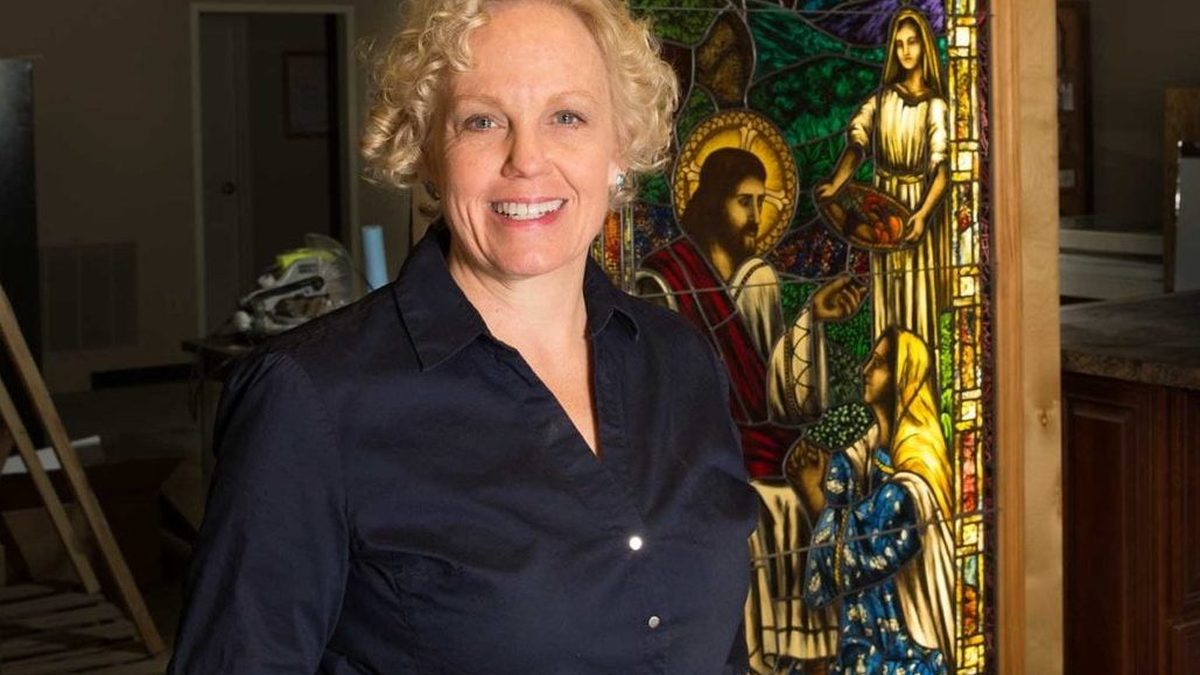
After graduating from UT, she set off for a six-month backpacking trip across Europe.
“I was an art history major and English minor. I had no plan,” she laughs. “I always wanted to be an artist, but my parents always said you need a real degree.”
As she made her way across Europe, she found inspiration in Marc Chagall’s stained glass church windows in Nice, France.
“I had gone out to explore the world and I fell in love with stained glass. I was amazed at what they did over there. It was so different from what they did here.”
Back in Knoxville, she had another realization. She knew she wanted to become a stained-glass artist.
Goff is attentive to detail and makes sure that each window is made precisely. She notes that her windows are designed to last a hundred years.
“As I look at the radiant beams of colored light,” she says, “I’m reminded of the power of the Holy Spirit. Like the light streaming through the windows, faith is intangible, yet utterly transformative. I try to express my faith in this same way — not with language, but through my life and art.”.
Laura Goff received a distinguished service award from the Stained Glass Association of America and recently had a four-page feature in “The Stained Glass Quarterly.” Her gallery is located at 519 Lovell Road, Suite 306.
→ Swipe for Next Story
PoliticsMARCH APRIL 2018
Big Brother
Story by George Korda
It seems an easy call to demand officials “do something” about bullying: it’s ugly, brutal, and immoral. More difficult is drawing the line between appropriate steps to stop dangerous bullying versus descending into a quasi-Orwellian world of trying to subjectively codify virtually every student interaction.
Union County middle-schooler Keaton Jones became a momentary star on the state and national anti-bullying stage when a video went viral of him tearfully talking about bullying at his school. “Why do they bully? What’s the point of it?” he asks on the video.“They make fun of my nose, call me ugly, say I have no friends….”
Athletes and celebrities met with Keaton or took to Twitter with encouraging tweets. Union County Schools Director Jimmy Carter said bullying was not tolerated and that administrators must provide an academic environment that’s “safe, civil and supportive.”
Just about everyone has a personal bullying experience. One vividly in my memory occurred at Walled Lake Junior High School in Michigan. A new kid, I horsed around one day in shop class with two guys I thought were friendly. They weren’t.
They harassed me constantly. One day, while changing classes, they followed me, pushing me, calling me names, and laughing.I was a smallish stranger in a strange school: outnumbered, and scared.
I went to see the vice principal. From his outer office I could hear him talking – loudly – to a student: “When I was a year older than you I was in a foxhole in Korea!”
My complaint suddenly seeming pathetic, I left. The next day, in the lunchroom, the two started again. I stood up and shoved one of them.“OK,” I said. “Here. Now.”
‘“After school,” he replied. I pushed him again, repeating, “Here. Now.” On my right, his somewhat overweight friend moved toward me. I looked at him and said, “Hold on, fatty. Your turn’s coming.” I turned back to the other boy.
We didn’t fight and neither of them bothered me again.
I recall being a little proud that I’d stood up to them. Together they could have pounded me into oatmeal. But they backed off. Not all bullies do, adding to the calls for someone in authority to “do something.”
In the march to zero tolerance for bullying, school system policies increasingly employ catch-all language to try to enforce safe environments and avoid lawsuits.
For example, Knox County’s anti-bullying policy against harassment, intimidation or bullying says – rightly – that prohibited behavior includes physical harm to a student or property and knowingly placing a student in reasonable fear of harm to themselves or property.
The policy’s next three points can be problematic: “Causing emotional distress to a student or students; or “Creating a hostile educational environment; or “If the act takes place off school property or outside of a school-sponsored activity, it is directed specifically at a student or students and has the effect of creating a hostile educational environment or otherwise creating a substantial disruption to the education environment or learning process.”
The breathtaking expanse of interpersonal on and off-campus situations the policy covers demands that Big Brother must be always watching. School employees are told to be on the lookout for signs of…anything suspicious. A series of investigative and administrative steps follows a complaint.
Defining “emotional distress” and a “hostile environment” is the challenge. For example, I have asked at various times in various forums if it’s bullying for a student to say “I think homosexuality is wrong” to a student who says he or she is gay.
A number of people have said, yes, that is indeed bullying. Therefore, if a non-believing student says to a religious student, “I think you have a screw loose,” can they claim emotional distress? Does that constitute creating a hostile educational environment?
Think it can’t happen? Who would have thought that the diversity and inclusion movement would result in such a broad swath of what people are told they mustn’t say.
True bullying is serious. Some kids can be vicious. But also a problem are well-meaning or self-protective policies and surveillance that can wrongly accuse or identify a child as a bully, or put school officials in positions in which they shouldn’t be placed.
For every action there’s the possibility of overreaction, and we’re seeing it unfold, a little more, every day.
→ Swipe for Next Story
InsightsMARCH APRIL 2018
Profit at Any Cost?
Story by Bruce Fox
There is no question we need prescription medication. When our health is on the line, shouldn’t it be ok for companies that protect that health to make a healthy profit?
But are these companies actually protecting our health, or leveraging our health for the sake of selling unsafe drugs? Consider the following examples:
The maker of the antidepressant Paxil was required to pay out $3 billion in fines for illegally persuading doctors to prescribe the drug to children and teenagers in spite of evidence that it was ineffective and could trigger suicidal thoughts in adolescents.
Two manufacturers of low testosterone therapy are facing thousands of lawsuits over false claims.
These are just two of the claims being made against Big Pharma.
Drug companies, however, always hide behind the discretion of doctors. We’ve all seen commercials for prescription drugs end with the phrase,“Ask your doctor if [drug name] is right for you.” And we all want trust and believe our doctors.
The problem is that drug companies are working overtime to influence our doctors in any way they can. Big Pharma spends about $4 billion a year in direct marketing, like commercials. It spends six times that, about $24 billion, marketing directly to doctors.
Such access allows drug representatives to deliver something even more influential to doctors. Drug companies compensate physicians who participate in their studies. Big Pharma hand picks the doctors who participate, designs the drug trials themselves, and often fails to report unfavorable results.
Many of the drugs being tested are simply a tweak on a drug Big Pharma can no longer market for huge profits. After 20 years, a drug patent expires, allowing other companies to sell a generic version for much cheaper. The response from Big Pharma is to tweak the drug’s chemical makeup just enough to gain a new patent.
Big Pharma is also spending large amounts of money influencing the standards of medical practice, redefining being ill as needing medicine.
Many feel the propensity to medicate is the driving force behind the ongoing opiate epidemic. Costing hundreds of thousands of lives at this point, the crisis began with the development of newer, more addictive painkillers, the sale of which went through the roof as the companies found a new profit center.
The good news is that our civil justice system is alive and well, holding Big Pharma to account for its profit-mongering practices. Law enforcement and local governments, whose resources have been stretched to the limit dealing with the opiate crisis, are bringing claims against Big Pharma for its role in the crisis. The goal, of course, is to deter such actions in the future by making it too expensive to continue to operate that way. The battle is joined!
→ Swipe for Next Story
DepartmentsMARCH APRIL 2018
Wildflowers in the Smokies
Story by Emily Stevens
Ashort drive from Knoxville, the Smoky Mountains boasts one of the most beautiful and natural wildflower displays in the Eastern United States. Unsure of which trails to wander? Join the annual Spring Wildflower Pilgrimage in Great Smoky Mountains National Park on April 24-28.The event features hikes and walks of various lengths led by naturalists and professionals. For more information, visitwildflowerpilgrimage.org.
→ Swipe for Next Story
DepartmentsMARCH APRIL 2018
Rocky Mountain High
Story by N. Brooks Clark
The interior marries mountain rustic with industrial design. The oversized square bar sits beneath a spectacular chandelier; wide steps lead down into the main dining room. The dining area contains both tables and “half barrel” booths which break up the open space and provide good noise control. Large plate-glass windows allow diners to see the large tanks and barrels aging some two dozen craft beers created by brewmaster Alex Violette and head brewer Chris Meadows.Elkmont offers a wide variety of craft beers brewed on site.
Violette, a Karns High grad, majored in biochemistry at Maryville College, and started brewing beer in his garage as an artistic outlet. He studied under Marty Velles at the Smoky Mountain Brewery, then decided, “If I’m going to pursue craft brewing, I need to go to Boulder.” There he got a job managing a bakery. He met Bethany Lovato, a bartender at Upslope Brewery. “He would bring all the pastries and trade them for beer,” she laughs. They started dating and together opened a second Upslope location. In 2014 came the opportunity to open the first American craft brewery in Vietnam.
After their daughter Evelyn was born two years ago, Alex and Bethany decided to return to the U.S. Alex’s hometown near the mountains and family was a logical choice. Co-founder Ryan Davenport is the chef. “We wanted the atmosphere of having something for everyone,” says Bethany, “but where you might also try something new.”
Elkmont is a large space that fills up on most nights. Our waitress, Aleta, was attentive and knowledgeable about the beer selection and different dishes.
Menu items are served in the no-nonsense style of a ski resort, in sturdy bowls and dishes.
The robust Charcuterie board ($22) includes three house-cured meats— andouille sausage, hot pork shoulders, and smoked prosciutto — paired with gorgonzola and gouda. Small plates include Boudin Balls ($10), five sausage balls of ground pork, jasmine rice and vegetables, rolled in bread crumbs ad served with beer mustard. The duck wings ($12) were an amusing variation on the brewpub staple.
The Forager’s stew ($9) is an outstanding combination of regional vegetables, mushrooms, and herbs in a savory vegetable broth. The salads ($12) are a strong point of the menu, named after beloved Smoky Mountain destinations. Rainbow Falls features smoked salmon, fresh cucumber, roasted cherry tomatoes, lemon and ginger vinaigrette, baby mixed greens and wasabi yogurt. Abrams Falls offers sweet and spicy roasted tofu, medjool dates, roasted cherry tomato, edamame, toasted sunflower seeds, baby field greens, dressed with fresh mint, basil, and balsamic vinegar reduction. Our favorite was the Cades Cove–a generous portion of duck confit, gorgonzola cheese, apple, radish, baby arugula, toasted almond, and sherry vinaigrette.
If you’re in the mood for a classic, the Elkmont burger ($12) is a six oz. Bear Creek Farm beef, served with waffle fries, side salad, seasonal soup, or seasonal vegetables. The BLT gets a gouda upgrade ($10) and uses house-cured bacon, light tomato, field greens, smoked gouda, Tuscan vinaigrette and herb mayo on a hoagie roll. A tasty vegetarian option is the Northern Bean and Herb Salad Wrap ($10) of chickpeas, red onions, spiced almonds, edamame, and fresh herbs.
Our Surf and Turf ($22), the 4 oz. filet mignon arrived tender and juicy, cooked to perfection, and the large freshwater prawns with quinoa made a subtle side note.
Price: The prices are reasonable and a good value.
For more information visitelkmontexchange.comor emailinfo@elkmontexchange.com.
→ Swipe for Next Story
Dining GuideMARCH APRIL 2018
Eating East
Jackie’s Dream
Story by Bill Foster
After a career that started as a cashier at Buddy’s Barbecue, Jackie Griffin opened her eponymous restaurant two years ago to rave reviews. Everything is prepared from scratch and is as fresh as possible (“No cans” is one of Jackie’s mottoes). “This food,” says Jackie, “is exactly the food you’d get at my grandmothers house when the preacher came over for Sunday dinner.” From hot chicken, based on the best fried chicken in town, to oxtail on Sundays, meatloaf, ribs, catfish (try it hot) and one of the most underrated burgers in town, you are never going to leave Jackie’s Dream less than completely stuffed.
Cardin’s Drive-In opened on Asheville Highway in 1959 and it seems as if nothing has changed since that day. Still a family run affair, Cardin’s provides carhop service (complete with window trays) until 11 PM most nights. With atmosphere left over from the 1960s and prices that match, Cardin’s offers excellent burgers, hot dogs, shakes, and ice cream as well as a complete breakfast menu.
On the surface, Habaneros on Asheville Highway is a Mexican restaurant exactly like twenty others in the area with its kitschy décor and jumbo margaritas. However, the huge lunch-time crowds and wait times on Friday and Saturday nights tell another story. Only open for six years, Habaneros offers all the standard fajitas, burritos, nachos, and other Mexican staples, but fresh and cooked a notch above most of your standard fare and with generous portions and friendly, efficient service—making this a great choice for families with kids or large groups.
Opening this past summer in a former Mexican restaurant at the corner of Jefferson and Cherry Street, LaFetta’s has quickly made a mark. They offer the usual fried chicken, ribs, meat loaf, and smothered chicken with an array of sides including mac and cheese, yams, fried green tomatoes and collard greens. However, it’s the daily specials including chicken gizzards, neck bones, ham hocks, and chicken and waffles that really shine. LaFettas also has a special late night menu Friday and Saturday 11PM till 4AM.
Established in 1988, Philippine Connection has quietly been one of the better bang-for-the-buck eateries in the Magnolia corridor ever since, serving fresh, completely handmade Filipino specialties. The tiny yellow and red hut has seating for half a dozen people, but it’s mostly known as a take-out location. Call ahead for thin, crispy lumpia, excellent Adobo, pancit, and lumi noodles, as well as a selection of other dishes including chop suey and chicken wings.
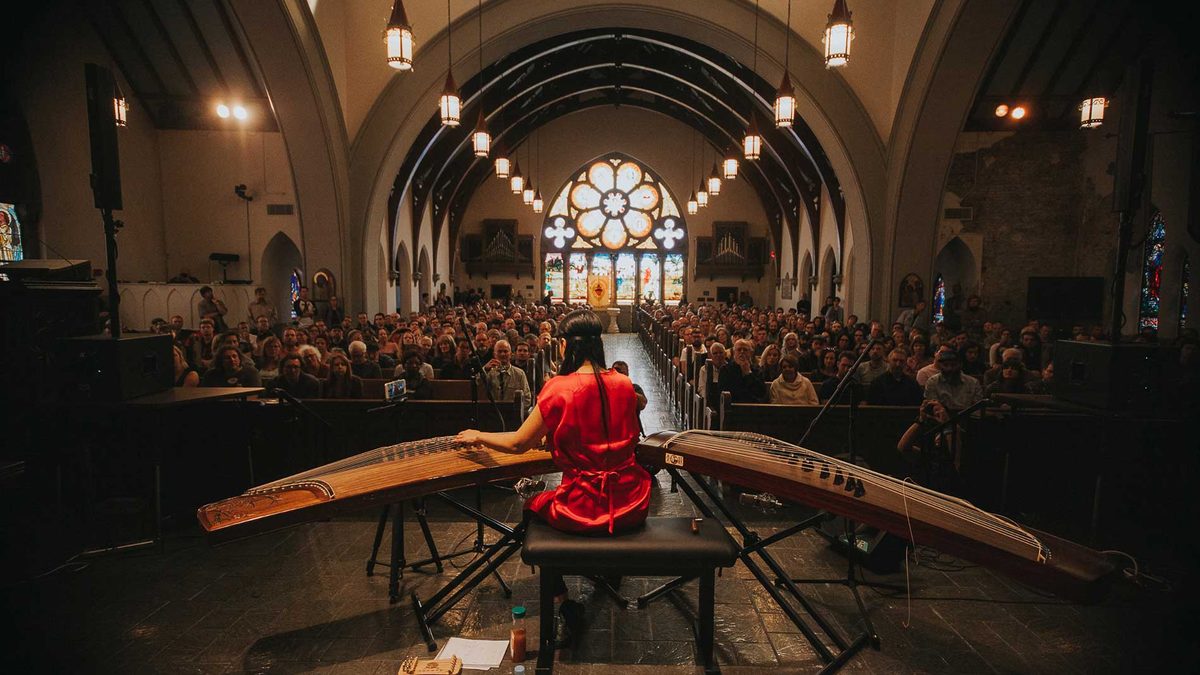
Keith Norris: What was the genesis of Big Ears?Ashley Capps:The first Big Ears, in 2009, grew out of a collaborative brainstorming session. I had just returned from an amazing weekend on the southern coast of Norway, at a beautiful little festival called Punkt, and I was inspired. So I assembled a small group of friends – Jason Boardman (from the Pilot Light), Chris Molinski (who was then at the KMA), Steve Greene, my colleague at AC, and my assistant at the time, Laura Sohn – all of whom I knew to have curious spirits and aesthetic sensibilities. We started sharing ideas and enthusiasm, and Big Ears was born. It happened fast. We spent an afternoon or two imagining what it might be and then we just did it. Maya Buiser – Photo by Cora Wagoner
On a personal level, the ideas behind Big Ears have been a passion and interest for as long as I can remember: There’s a strong love and appreciation for music, of course, but there’s also an endless curiosity about everything it touches, about its impact and influence and inspiration on our world – from the spiritual and the religious to the social, political, and economic, to the deeply personal and private. Music can bring us together in celebration or separate us into tribes. My interest is in the ideas, the shared experiences, the connections and influences and how they can be traced, not only across musical genres and art forms but across history as well as different cultures and social classes. Philosophically, at least, that’s at the heart of Big Ears.
Was it planned from the beginning to include such a wide range of musical genres and crossover with other art forms?Deerhoof – Photo by Andrew Gresham
Yes. There was the central idea of bringing together different genres of music, along with different art forms, and exploring the connections, influences, and sensibilities that they might share. It can be a fascinating lens through which to explore the world, new ideas, different cultures. It’s fun and fascinating to discover and follow these paths, to discover new ones, and to see where they might lead.
There’s the social component too: bringing together different audiences that might otherwise seldom meet. Even where there’s a rich exchange of ideas and information among composers, musicians, and artists themselves, the audiences sometimes seem unnecessarily segregated and compartmentalized. We like mixing it up a bit, hoping to inspire the curiosity to explore some new things and to share one’s passions and interests with others.
Did you anticipate both the critical and popular success of Big Ears?
I thought it was an idea worth exploring, or we wouldn’t have launched it in the first place. But I would never have imagined just how strongly the idea would resonate with others. The response from so many people from all over the world – audiences, artists, and writers alike – has been very humbling and inspiring. It has become an amazing thing to be a part of, and a remarkable opportunity too. But for me at least, there’s also now a responsibility to ride this wave and see what the festival can become. That’s very exciting – and somewhat daunting at the same time.
What’s new this year that we should look for?
For me, each year builds upon the last. There’s so much great music during the weekend – over 100 concerts and every one of them was booked for a reason – in our beautiful historic theaters, churches, and other venues throughout our downtown. There’s a stronger jazz component than ever this year, along with someMusica Elettronica Viva – Photo by Andrew Gresham
incredible contemporary classical and opera performances, and of course rock, folk, electronica… This year, the celebration of our own regional culture – the traditional Appalachian music and bluegrass – is certainly bigger than ever before. There’ll be a “fiddler’s convention” with over 3 dozen amazing fiddlers from the region, along with square dancing on Market Square, busking on the streets, jam sessions, and more. Much of this will open to the public of course. There’s a great film program and all sorts of other activities as well.
It’s my feeling, however, that the best way to experience a festival is just to go all in. Most everyone starts out with a plan – that list of “must see” shows – but many soon discover that the truly exciting festival experience starts to happen once your plans tend to fall to the wayside, when you start meeting new people, walking into a theater or club not knowing for sure what to expect, and finding yourself completely captivated by an artist you’ve never heard of before. Those unanticipated experiences often end up being the unforgettable highlight of your weekend. Many people tell me that this is what Big Ears is really all about for them. Xylouris White – Photo by Andrew Gresham
To what degree has Big Ears put Knoxville on the cutting-edge-of-music map?
Knoxville’s a great setting for the festival. Initially, having Big Ears in Knoxville was a bit confusing – certainly a surprise for many people – but once someone visits the city, they get it. We have beautiful, world-class venues in a wonderful downtown that has a rich, vibrant, historic character and a very human scale. We now have excellent restaurants, great bars and shops, and increasingly fine hotels. And everything is within easy walking distance of everything else. Our visitors tend to fall in love with Knoxville during their stay.
During this time, Big Ears has become one of the most highly anticipated cultural events in the world. In my mind, you cannot separate that success from the character of the city. Everything comes together to create an incomparable experience: the great venues, the walkability of the city, the fine restaurants all help to enhance the character of the festival.
Beyond that, I tend to see Tennessee as having been on the cutting-edge-of-music map for the past century or longer. From the Carter Family in Bristol – and all of those mountain music traditions; flowing down through Knoxville with Flatt & Scruggs, Chet Atkins, Dolly Parton and those live radio shows broadcasting from Gay Street; crossing over to and from Nashville and the Grand Ole Opry. Then you’ve got all of that jazz and blues coming up the Mississippi from New Orleans and through the delta to Memphis, with the electric blues of Howlin’ Wolf, B. B. King, then Sun Records and Stax / Volt and Elvis and Carl Perkins and Booker T and Isaac Hayes and Al Green. We’ve been the birthplace of the popular music that revolutionized the world. For decades. And we still are. Dakha Brakha – Photo by Andrew Gresham
What are the rewards of putting on the festival?
Oh, gosh, there are so many. Being able to work with many of the world’s most extraordinary and influential musicians and artists, people whose music has had a powerful impact on my own life; presenting their work to new audiences, and being able to do it in my hometown, in the region of the country that I love, while collaborating with so many friends, colleagues, and cultural leaders in our community as well as all over the world…that’s like a dream for me. I feel very lucky.
Where do you see the festival going and growing?
The challenge now is to continue to build a strong, sustainable organization so that we can fully make this opportunity all that it can be. We became a non-profit in late 2016, and we’re working with leaders in our community to create the foundation needed to achieve the potential that Big Ears offers. I believe that the transformative power of art and culture has a vital and dynamic role in building successful, prosperous communities. Big Ears offers us a rare opportunity, and my goal is to build the team that can nurture it and help it grow.
→ Swipe for Next Story
DepartmentsMARCH APRIL 2018
Daffodil Dana
Story by Cityview
Dear Daffodil Dana:
It’s uncertain whether that many flowers need to exist, but many of us are certainly glad they do. The source of your distress cannot simply be the proliferation of beauty on what had been a dull stretch of roadway. That’s a grim way of viewing life. Perhaps you find them distracting?
Frankly, the Knoxonomist looks forward to the orgy of spring flowers on the Parkway—it makes motoring down an increasingly well-traveled and commercially populated road more appealing, at least during late February and most of March.
While it’s understandable that such an immense display of flora could be initially seen as distracting, the Knoxonomist celebrates this as part of the poetry of East Tennessee. Having awoken from the slumber of a short, gray, rainy, and chilling winter, the first splashes of color illuminate the landscape. It is both a celebration of spring and a promise of things to come.
And while the road itself is a racetrack, the Knoxonomist doubts that any floral rubbernecking would make things worse. Indeed, the bounty of blooming bulbs, extending into the millions along the Parkway, keeps the driver from having to turn his head to see this or that part of the garden of delights. It is constantly before him.
The true problem appears to be those who stop and smell the jonquils—or, more pointedly, who stop to photograph themselves and their friends and families alongside the blooms. The median and shoulders of the road are not made for sightseeing. It is unsafe and illegal to get out of the car there and shoot the scene. Find a side-road or a place where you can get good and beyond the shoulder and take your pictures there.
And still, there are rules: don’t run over the flowers; don’t pick the flowers; don’t mow the flowers.
When Maria Compere of Knoxville first began the planting nearly 30 years ago, the Knoxonomist was living near campus and focused on his studies and certain extra-curricular activities. Since he and the family moved to where they’d travel the Parkway regularly, however, their lives have been enhanced and enriched by the beauty.
“Every square inch” might not need a daffodil, but our spirits wouldn’t be the worse for it.
Have a question you’d like the Knoxonomist’s perspective on? Send them toTheKnoxonomist@cityviewmag.com.
Dear Knoxonomist: Whenever I take an early spring drive from Rockwood to Oak Ridge, I am overwhelmed by the daffodils on Pellissippi Parkway. Daffodils always complement redbuds and dogwoods. But I think it’s gotten a little out of hand. Does every square inch of roadside from Topside to Solway really need a daffodil? — Dana Rockford, TN
→ Swipe for Next Story
JurisprudenceMARCH APRIL 2018
A Preacher’s Tale
Story by Gary Wade
After ordering breakfast at a local restaurant, the couple waited for their meal, hoping to enjoy a few private moments together. When they noticed a distinguished-looking, white-haired gentleman moving from table to table, visiting with the guests, the professor leaned over and whispered to his wife, “We came here to get away from the crowds. I hope he doesn’t come over.” But sure enough, the man soon stopped at their table.
“Where are you folks from?” he asked in a friendly voice.
“Oklahoma,” they answered.
“Great to have you here in Tennessee,” the stranger said. “What do you do for a living?”
“I teach at a seminary,” he replied.
“Oh, so you teach preachers how to preach, do you? Well, I’ve got a really great story for you.” And with that, the gentleman pulled up a chair and sat down.
At that point, the professor silently groaned and thought to himself, “Great. Just what I need... another preacher story!”
Pointing out a window, the man continued. “See that mountain over there? Not far from the base of that mountain an unwed mother gave birth to a son. At age six, the mother had such a difficult time, she placed the boy in an orphanage. He had a hard life in his early years because just about every place he went, people asked the same question:’Young man, who’s your daddy?’ At school, the boy often hid from his fellow students during recess, and almost always sat alone while having lunch. Because ‘the question’ caused so much pain, he avoided going into local shops. Although he attended church regularly, he always arrived late and stepped out early. When he was about 12 years old, a new minister at his church gave the sermon. The benediction happened so fast that the boy got caught in the aisle and had to walk out with everyone else. When he reached the exit, the new minister, not knowing anything about the young man, put his hand on his shoulder and asked, ‘Son, who is your daddy?’
“When some members of the congregation heard the question, they became deathly quiet, knowing that the young man was embarrassed. By the sheepish looks on the faces of those within earshot, the minister realized his mistake and, using discernment that only the Holy Spirit could provide, quickly recovered…‘Wait a minute! I see the family resemblance. You are a child of God.’ With that he placed his hand on the shoulder of the young man and said, ‘Boy, you’ve got a great inheritance. Go and claim it.’
“That young man was never the same again,” the stranger continued. Whenever anybody asked him, ‘Who’s your daddy,’ he’d answer, ‘I’m a Child of God.’ Isn’t that a great story?”
The professor, by then genuinely interested, responded, “It really is!”
As the older man walked away, he remarked, “You know, if that new preacher hadn’t told me that I was one of God’s children, I probably never would have amounted to anything!”
The professor, deeply moved by the experience, called his waitress over and asked, “Do you know who that man is?”
The waitress smiled. “Everybody around here knows that man. He lives just down the road. That’s Ben Hooper, the former governor of Tennessee!”
With that the sermon ends.
This oft-told story, circulated for years on the internet, is an embellishment of an actual encounter during the early 1950s between Dr. Craddock and Ben Hooper that occurred at what was then the Black Bear Restaurant in Cosby, Tennessee. Ben Hooper, a Newport Republican, was governor of Tennessee from 1911 to 1915. Born in 1870, Bennie Walter Wade was born to Sarah Wade, the daughter of an Italian immigrant. His birth father, Dr. L.W. Hooper, refused to marry Sarah because of his engagement to another woman. Thus, Sarah’s father provided the much-needed financial support for Bennie. When her father died, however, Sarah was forced to place her boy in St. John’s Orphanage in Knoxville. Dr. Hooper and Mrs. Hooper, who were childless, learned of this development a year later.
They adopted Bennie, then age nine, gave him the Hooper name, and returned him to Newport. Unlike the version in the Craddock sermon, young Ben Hooper, when challenged about his heritage, defended his honor with his fists. Of his status, the adult Ben Hooper wrote, “Instead of my supposed handicap generating an inferiority complex, it motivated a spirit of ambition and determination that furnished the impetus to carry me over many a hill in my young days. I began to understand that sensible people might appraise a man on his character and attainments rather than upon the accident of birth….”
Ben Hooper was baptized at age 15 in Newport, graduated from Carson Newman in Jefferson City in 1890, became a lawyer, and served in the House of Representatives. He was a captain in the Spanish-American War before being elected governor. As a staunch Baptist throughout his life, he ran on a prohibition platform. After two terms as governor, Hooper served as chairman of National Railroad Labor Board and later served as a land purchasing agent for the Great Smoky Mountain National Park. He died in 1957. The Governor’s autobiography,The Unwanted Boy,was published by University of Tennessee Press in 1963. Governor Hooper’s grandson, Ben Walter Hooper, II, who practiced law in Newport and represented his region in the Tennessee Senate, was elected Circuit Judge in the 4th Judicial District in 1993. After the governor died, Judge Hooper occasionally met with Dr. Craddock to discuss his chance meeting with the governor. Judge Hooper retired in 2017 and lives in the Carson Springs community, not far from his grandfather’s homeplace.
Dr. Craddock, who was born in Humboldt, Tennessee, married Nellie Dungan, and graduated from Johnson Bible College in 1950. Later called a “preaching giant” for his folksy sermons, narrative style, and use of humor, he was an ordained minister in the Christian Church and the director of the Craddock Center, a non-profit service organization in rural Appalachia. During his career, he served as Director of Preaching and New Testament in the School of Theology at Emory University in Atlanta. Because Craddock authored numerous books and articles during his career,Newsweekranked him among America’s greatest ministers. In 2015, he died at the age of 86 at his home in Blue Ridge, Georgia, an Appalachian community bordering on the southeastern boundary of Tennessee.
→ Swipe for Next Story
InsightsMARCH APRIL 2018
The Fine Art of Jury Tampering
Story by Robert Pryor, Sr.
As a lawyer, I am most disappointed by the fact that nobody talks about poor ole Amendment 7, which preserves our right to a jury trial in civil cases. Everybody takes for granted that there is a right to a jury trial in a criminal case given in the 6th Amendment, but the right to a jury in a civil case just seems to be ignored when truth and justice are discussed. I guess the guarantee to have your case decided by a jury is not as glamorous or as exciting a topic as carrying guns to work or into ball games or public parks. Alleged abuses by the media, including “fake news,” make it fun to criticize the messenger when we disagree with the message, but find yourself trying to recover damages for a life-changing injury or death, and you will be searching for a jury of neighbors to make sure your trial is fair and not influenced by anything other than the facts of the case.
Well, I hate to tell you this, but for several years now Amendment 7, protecting your right to a jury trial in a civil case, has been disappearing from right under your nose, and control over jury decisions is being assumed or extinguished by politicians for the benefit of special interests.
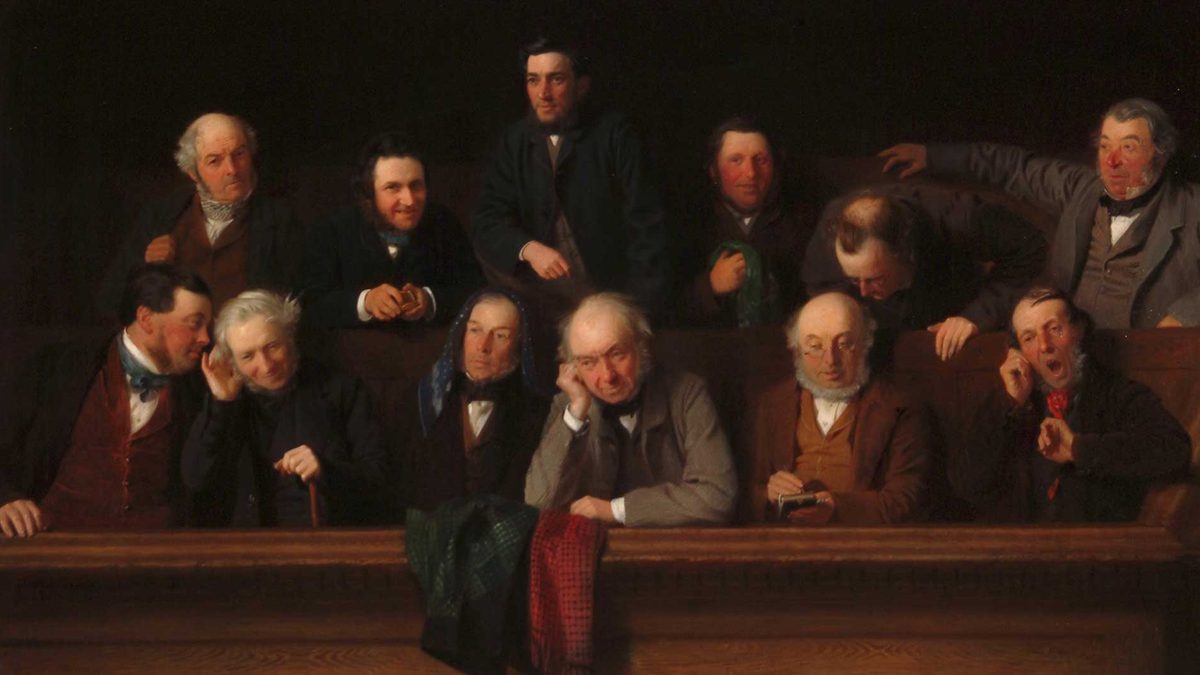
So what’s the big deal anyway about the right to a jury trial? A jury of twelve citizens is considered America’s greatest engine for truth. A jury is democracy in its purest form and serves as the voice of the people in solving individual disputes. Since the beginning of our nation, a jury trial has served as the hallmark for truth and justice. What could be more fair and honest than a jury of twelve people assembled to hear all the facts and vote according to the law as refereed by a wise judge?
Acting in its role as the representative of the public, the jury decides what facts are true, applies the law to those facts, decides the winner and loser of the case based upon the true facts, and, as the conscience of the community, decides fair damages if appropriate under all the circumstances of the case. In 1796, our Tennessee constitution adopted and expanded on the well-established right to a jury determination of facts and damages in civil cases by declaring the right to be “inviolate,” or untouchable and free from violation.
Every day in Tennessee, juries across the state consider the facts of damage suits and decide if negligence or wrongdoing was the cause of minor or life-changing personal injury or death. Conscientious citizens work to follow the law and award fair damages—when legally warranted and relying on American values. Sometimes, low or no damages are appropriate, and sometimes only substantial sums will fairly compensate for substantial loss. But what you may not understand, and what these juries are never told, is that their damage verdicts will not be valid or legally imposed by the court if too large a sum in non-economic damage is awarded, regardless of its justification. After the jury leaves the courthouse, Tennessee law now requires the judge to ignore the jury’s decision and reduce non-economic damages to a sum set in advance by the legislature. Many regard this as unconstitutional jury tampering.
A client of our firm was involved in an auto collision in 2014, and we were unable to negotiate a settlement of his case with the insurance company of the guilty driver. Junior was traveling west on a four-lane highway on his motorcycle when he was struck by a left-turning eastbound car. The car turned directly into Junior’s bike and left leg, resulting in an immediate, traumatic amputation. Junior suffered greatly as a result of the defendant’s illegal left turn, but since his injuries were primarily limited to the amputation of his left leg, his medical bills were relatively low. At trial, Junior’s damages had to be explained to the jury. Junior and his doctors all testified how his life had been changed by his injury. It turns out that phantom pain is real and disabling. His daily routine was affected and his recreational life virtually destroyed. He struggled on the witness stand as he explained his limitations, emotional problems, impairments, and the grief he experienced by such a painful and horrifying loss. The jury awarded Junior and his wife $2,190,000. But, after the jury went home, the judge required the defendant only pay $92,000 in medical expenses plus $750,000 for non-economic losses. Junior’s recovery was drastically reduced, saving the guilty driver $1,348,000. The guilty party saved more than Junior actually recovered. Sounds a lot like tampering with the jury to me. How did the jury secretly lose its power to control its own verdict?
In his first term, Governor Bill Haslam pushed the cornerstone of his pro-business agenda in what became the Tennessee Civil Justice Act of 2011. The law sets in advance the maximum recovery for pain, suffering, disfigurement, physical disability, emotional distress and impairment, mental anguish, humiliation, damage to reputation, and a spouse’s loss of society and companionship. According to one trial judge, injured citizens are deprived of a jury trial when their damage decisions are thrown out under the 2011 law. Although the constitutionally of the law will eventually be decided by the Tennessee Supreme Court, for the moment, negligent and reckless individuals and businesses are relieved from paying for all the damage they cause, and juries’ verdicts are being ignored without their knowledge if over $750,000 in non-economic damages are awarded against any defendant.
No question, a free and unencumbered jury poses a threat to careless and irresponsible people and businesses. That’s the way it is supposed to be because of our basic belief that those at fault should pay for the damage they cause. According to Governor Haslam, the limitation on jury damage awards was specifically passed to “make our state more desirable to business.” That is, in the interest of being “business friendly,” your constitutional right has been severely limited. Tennessee law has turned its back on its more seriously injured and vulnerable citizens and perhaps has revoked constitutionally protected recoveries of the most disabling elements of human suffering. The insurance companies, truckers, manufacturers, doctors, hospitals, and other big business win, and the disabled lose again.
Now, if you think that the legislative branch taking control over jury awards for the disabled is offensive, just consider what is happening in the field of long-term health care. Nursing homes and inpatient rehabilitation centers are increasingly using binding arbitration agreements to avoid patient court suits and jury trials altogether. An arbitrator is a person hired to act as both the judge and jury and decides all issues, including damages, rendering final and non-appealable decisions. If you have entered a long-term health care facility lately, perhaps for post-surgery inpatient rehab, or if you have assisted a relative enter a nursing home for long-term care, you no doubt have been asked to sign a binding arbitration agreement. The effect of the agreement is to waive the constitutional right to a trial and a jury in the event the employees of the facility commit malpractice by perhaps giving you the medication of the patient across the hall or by dropping you in the floor re-fracturing your hip.
Prior to 2017, an Obama era regulation protected patients from mandatory binding arbitration agreements in long-term health care facilities. A long-term care facility could not require a patient to surrender his or her right to a trial in court or a 7th Amendment jury. However, President Trump, through the Center for Medicare and Medicaid Services, seeks to rescind the Obama protection and make forced arbitration the industry standard. In what has been called by Public Citizen president Rob Weissman “a heartless and vile act,” long-term care facilities are once again demanding all patients surrender their right to a jury trial as a condition of admission. Beyond tampering with the jury, long-term care facilities have been authorized to avoid responsibility for their wrongs and careless practices by compelling patients to give up their constitutional rights when they check into the facility. Many regard an arbitrator a poor substitute for a twelve-person jury and a fair-minded and impartial judge. My advice would be to avoid binding arbitration agreements or any other device that causes you to surrender your 7th Amendment right to a full and complete recovery of damages to be determined by a jury.
→ Swipe for Next Story
TravelMARCH APRIL 2018
Downtown
Story by Keith Norris
A wig shop sometimes seemed the only thing open on a boarded-up Gay Street, and the Old City was barely hanging on, with a couple of anchor restaurants, a costume shop, and a series of come-and-go eateries, bakeries, and clubs (where you could see very good music). Now, though, downtown Knoxville has become a destination, both for those visiting East Tennessee and for those of us who live around here. As a long-time local, I decided to give a weekend downtown a try, parking my car and going it on foot until I left on Sunday. As I walked, I was both whisked to the past and stunned by the present—and in love with the city all over again.
At 5:30 on a chill Friday in mid January, I arrived at The Tennessean, a “personal luxury hotel” located on Henley St, right next to the Knoxville Convention Center and Sunsphere. I was a little worried about how I’d come across to the staff. I’ve been a student, a teacher, a bartender, a writer, an editor, a photographer—I’m not a luxury guy by any means. My idea of dressing up is to tuck in my shirt.The Brockefellers – Photo by Bill Foster
But my fears were for naught. The folks at The Tennessean make it clear that the luxury istheirresponsibility. It is a fantastic place to stay and a great staging point for visiting the finest Knoxville’s downtown has to offer. If you stay there, and you should, lose no time hiding in your room, though it will be comfortable beyond expectation—with rugs evoking the Tennessee river and, above the headboard, historical topographic maps of the river as it winds its way through the city. The Drawing Room, something between a bar and a lounge, is an elegant yet comfortable place. It is worth spending an hour of your downtown time there. Don’t miss their Smoked Old-Fashioned, a drink with just the right tang and a hint of smoke.
Although the hotel provided a personalized suggested itinerary for my weekend (excellent for the out-of-town visitor), I chose to wander and see where my feet took me. I know the bones of downtown—I would stumble on anything new as I wandered my way through it.
My own engagement with the city has almost always included music, including great performances at the World’s Fair site over the years— an early 90s Santana concert comes to mind. And at Sundown in the City in Market Square—Bela Fleck’s 2004 performance was particularly memorable. At other venues over the years, I saw many bands,including a wild evening with Brave Combo, where the audience followed the band out of doors to dance down the streets of the Old City. These were events that acclimated us to coming downtown—forming the core of the crowds you find here now.
Currently, you can find some fine local music. On the last Sunday of each month, I often visit Barley’s to see The Brockefellers, a versatile band that can play almost anything, including theGame of Thronestheme song, as a surf tune. I’ve seen them do a Black Sabbath tribute on Halloween and welcome a little guest guitar from Hector Qirko, who played on the Knoxville scene for over 30 years. If you go, you’ll dance.Wilco at the Tennessee Theatre – Photo by Bill Foster
And of course, acts from across the country take the stage at a host of venues small and large: the renovated Tennessee and Bijou theaters, Scruffy City Hall, the Mill and Mine. John Prine will be at the Tennessee in October. Not a show to miss.
Knoxville has grown a downtown that is very human, alive with the realized possibility of a promise I couldn’t quite see years and years ago as I stood on a Market Square that had a stream running straight through it, quite nearly forested with trees and lined with aging storefronts. The Mercury Lounge was one that was open at the time. In the fall of 1990, I won a Halloween best-costume contest there as Prometheus—the costume a package of frozen liver duct-taped to my side. Now, in roughly the same spot where I rescued a fellow party-goer from the chilly October stream, I can stare straight at Preservation Pub, a much more comfortable bar and venue. It’s new, but not.Busking Downtown – Photo by Trent Eades
I was distressed when I heard of plans to tear up that version of Market Square. I am an incurable romantic and get attached to places as they are. By the mid aughts, however, those with greater vision than I crafted a space better than the one before, and now you can wander from restaurant to shop to performance space without leaving the square. And you can hear music every time you step outside—the place is bustling with buskers playing tunes old and new.
In the early 2000s, I was a part-time caterer during the renovation of the 100 block of Gay Street. My favorite moment was jumping the fence to get into the re-construction site of the Emporium so that we could have the dessert portion of a progressive dinner there. It was still dirty and sawdusty: full of moldy history and a frenzied revitalization on pause for our party. The space now hosts the Arts & Culture Alliance, which is a sponsor of First Friday, when you can join the throng of people walking the sidewalks in search of the best art Knoxville has to offer. Go. You will not regret it.Market Square during Dogwood Arts Festival – Photo by Bill Foster
On the evening of my first night out, I wandered past a few of the higher-end restaurants, like JC Holdway and Knox Mason. They looked warm and inviting but were a little too crowded for my mood. I had reservations for a top-tier restaurant the following night at Emilia, so I decided instead to sit with a notebook at Blue Coast Grill, which which has some excellent offerings with chef Curtis Bates at the helm.
Later in the evening, on the sidewalk in front ofthe Lonesome Dove restaurant on the corner of Jackson and Central in the Old City, I found myself gazing across the street at a fondue place that once housed Ella Guru’s, where I saw Richard Thompson play a fantastic acoustic set. In a later incarnation of the place, I performed slam poetry. One particular evening, I watched a woman plant a fork in the table in front of a drunk, misogynistic loudmouth who was disparaging a poet on stage.
The poetry scene is a little more refined now, but the generations of poets know one another well. It is another example of a vibrant connection between the old and the new in our downtown.
When it first started livening up, you could only find a few places to eat, like Market Square’s Tomato Head, which a friend referred to in the mid-90s as “Toys R’ Us East” because families with young children often ate there when visiting downtown. Now the expanded restaurant is full of people of all ages, including some of those kids all grown up, eating weekend brunch.Gay Street during the Rossini Festival – Photo by Bill Foster
It’s a chilly January, but there is promise in the air. I know what’s coming: festivals like Dogwood Arts, Big Ears, Rossini; the opening of the Farmer’s Market; the hustle of the weekend as more events are held out of doors and the patios of Gay Street, Market Square, and the Old City come to life.
Yes, you can still find the gritty if you look, but to those nostalgic for the bare bones feel of the past, I’ll say this: thousands of our people come here now, many of them are employed here, and some of them are extremely inventive. In the Old City, in a building that once housed a comic book shop, Pretentious Glass and Beer Co. pours a great rye double IPA. You can wander back through a patio and enter the glassworks to watch craftsmen and women shape both the glassware that holds your beer and the art for sale out front. This kind of artistry alive in my town, within walking distance of my hotel, simply thrills me. When I moved here, it wasn’t yet a dream.
Knoxville is both an Appalachian doorstep and a destination in itself. Regardless of the change, of whatever X-factor marks the latest trend in this increasingly celebrated city, Knoxville remains Knoxville, and its individuality thrives.
As my head hits the pillow in The Tennessean, I realize that I have fallen for a few cities: Nashville, Asheville, Richmond, Chicago—but Knoxville above all. And as with the great love of my life, my ability to fall in love with anew city has passed. I don’t have room for replacements. Photo by Bill Foster
→ Swipe for Next Story
FeatureMARCH APRIL 2018
In Hospitals We Trust
Story by Peter McCarville
Hospitals in the United States receive the trust of its citizens because these institutions are often our only hope in a medical emergency or crisis. What about Knoxville area hospitals in particular, though? Are we in good hands when it comes to the quality of care we receive from our local institutions? The answer is complex. There are three major players in the Knoxville area: Tennova, Covenant, and UT Medical Center. Each represents a conglomerate of East Tennessee hospitals. Tennova includes Physicians Regional, Jefferson Memorial, Lakeway, and more. Covenant comprises Fort Sanders Regional, Parkwest, Methodist Medical Center, Roane, and others. And of course UT Medical includes all centers associated with the university. However, hospitals within each of these groups can vary quite a bit in terms of ratings. In fact, on most lists ranking hospitals nationwide, the ones in our region are seldom included, and those that have been included in the past have since fallen off.UT Medical Center
The 100 Top Hospitals and Everest Award studies, produced by Watson Health, release a list each year of the top one hundred facilities based on a variety of criteria. First and foremost, the overall organizational performance of each hospital is scrutinized, as well as their long-term rates of improvement. They are also judged on a much broader scale on their patient care satisfaction, operational efficiency, and financial stability. Their ratings are based on risk-adjusted mortality and complications indexes, average 30-day mortality rate, average 30-day readmission rate, in-patient expenses per discharge, and Medicare funds spent per beneficiary. It should also be stated that hospitals do not apply for inclusion on the top 100 list. It is a fully independent study. Each hospital on the list scores highly based on the above criteria. The institutions that make the list each year have lower patient mortality rates in relation to the severity of patient predicament, have fewer complications with treatment and thus lower rates of readmission, and also provide timely emergency care that sends patients home sooner and at lower cost. So it may come as a shock that none of the hospitals in the area have made this list in six years, and none in Knox County have made the list in over a decade.
This is only one organization’s ratings, however. There are many others that put out similar ratings and lists such as Leapfrog, Healthgrades, and U.S. News and World Report. The latter ranks the top hospitals in the state, placing UT Medical Center at number two in the state, which is the top rating of any hospital in the area, although it is not ranked nationally in any specialty. Most of its ratings for individual procedures are at least average, with high performance ratings in care for COPD, heart failure, and hip and knee replacement, amongst others. Other hospitals in the area, such as Blount Memorial Hospital, Fort Loudon Medical Center, and Physicians Medical, vary in rating. Ratings can be misleading, however. Suppose a hospital’s rating for abdominal aortic aneurysm repair is set at “below average,” with an average thirty day survival rating. This rating can be misleading because the amount of patients admitted for this particular condition might be low, while readmissions could be below average.
So what exactly is keeping these hospitals from overcoming some of their lower ratings and making the Top 100 and other lists? There are a host of reasons. Tennova North
In response to questions about their various ratings, Russell Mariott, a representative for Tennova says, “Since our founding in 1930, Tennova has placed the highest priority on delivering high quality, compassionate care. That commitment remains as strong today as ever, and we continuously evaluate the care we deliver to meet the high standards of national accrediting agencies.” And, in regards to the largest generation ever entering into their later years, Mariott added, “Many of the recognitions our hospitals hold are in areas that treat aging populations, like cancer and joint replacement, which will become increasingly important as more individuals in the Baby Boom generation require these services.” Tennova, it would seem, recognizes the importance of certain rankings, and it would appear that the hospital system is trying to consciously shape its image as it prepares for the future.
They are not alone in this push to refine their public perception. The Covenant hospital system is also trying to gain, and maintain, the trust of the communities they serve in the area. Mark Browne, the Senior Vice President and Chief Medical Officer for Covenant, comments that he is taking these rankings seriously, saying, “we are continually monitoring and analyzing our member hospitals’ performance, safety and patient outcomes. Information about our hospitals’ performance is publicly available through many different resources, and we’re pleased when our member hospitals receive high rankings from outside organizations, as they are one indicator of the quality care we are providing to our communities.” However, Browne stopped just short of giving any of these rankings total validation, saying, “Organizations that rank hospitals also may compile data from multiple healthcare analytics firms, some of which charge hospitals a fee to be part of their database and use the recognition for promotional purposes,” although the organizations used in this article explicitly do not require any such fees. Instead of using national rankings, he said, Covenant uses their own system to track over 1,000 quality measures that give them key insight on what needs improvement, and gives an idea on how to fix their issues.
It is true that there seems to be a ways to go for area hospitals, but this article does not seek to discredit or disparage any institution or organization listed. Emergency situations are best left to professionals, and all hospitals, regardless of reputation or scores, are in theory and hopefully in practice trying to help each patient to the best of their ability. It is not as if these places simply do not care about people. Many other accolades are handed to our area hospitals that are not quite as prestigious, but do matter. Covenant, for example, was ranked thirty-eighth in a Forbes’ list of America’s best employers—a list that ranks five hundred of the nation’s top employee friendly companies. So, while it is important for our community to recognize flaws in these institutions and push them to get better, it is also important to recognize the improvements that they have already made. Knoxville and its surrounding areas do need a hospital to step up and make the top 100 list, though. Because, as it stands now, none of the hospitals in the area are close. With an increasingly aging population, as well as growth in population in the area overall, where we stand with at least the perception of quality of hospital care is falling short of where we should be.
→ Swipe for Next Story
FeatureMARCH APRIL 2018
Life Transitions
Story by K. Diahn Oakley
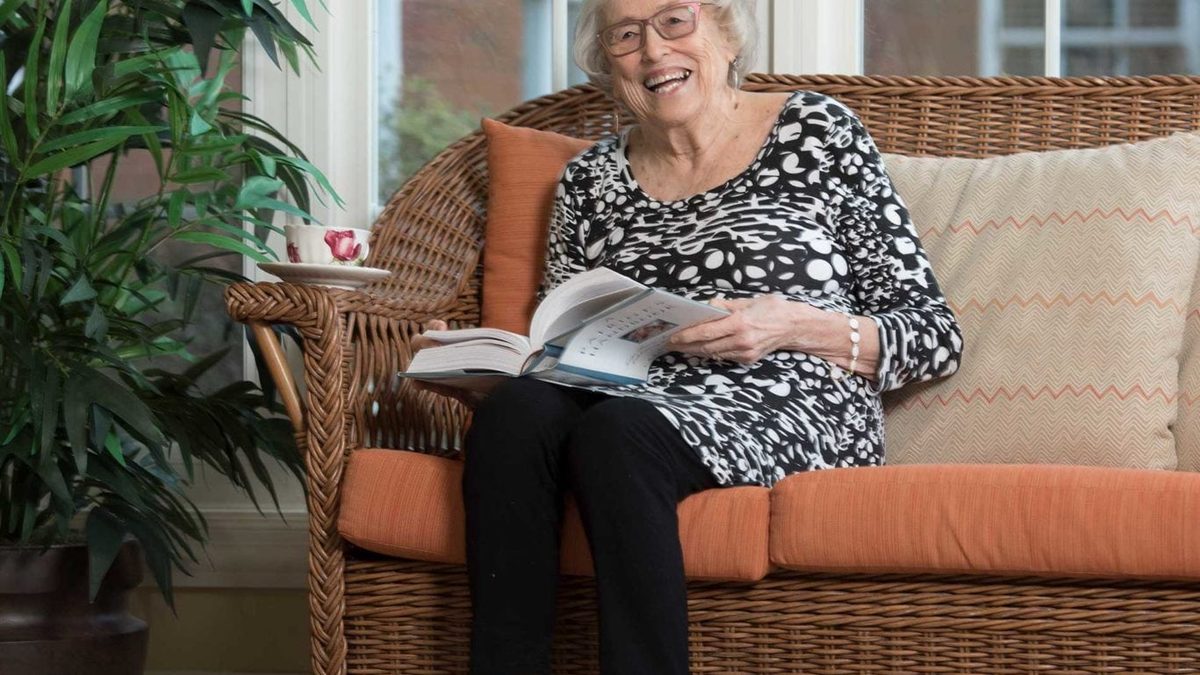
Neysa Peterson looks up at me with sparkling eyes, smiles, and nods. She replies, “Oh, yes. I felt that, too, when I met you.” It was the last question I asked Neysa during our interview. She generously shares her story while listening intently to yours.
The 82-year-old assisted living resident draws upon her experience in the art and science of caregiving she learned as an RN, healthcare administrator, family therapist, Hospice program coordinator, and co-author of a book on compassion. Her gifts are fully realized in the environment at NHC Farragut. There is flexibility in meeting needs and an openness to improvement through the Residents Council she helped initiate. Her experience has culminated at the facility, where she continues to make a difference as an advocate, finding ways to bring more joy to the daily lives of those in assisted living.
69% of caregivers for patients of dementia pass away before the patient. But Neysa has outlived the statistics and survived her husband’s battle with dementia. When she later had a spinal stroke, she prevailed upon doubtful doctors that surgery was beneficial for a 76-year-old woman. When assisted living regulations initially excluded her based upon certain guidelines, she persisted and reapplied. This is her third assisted living facility in Knoxville, and was accepted as an individual who was anything but average.
Neysa was in nursing school in Chicago when she met her husband Jim, who was at Great Lakes Naval Training Center. They had what she describes as the “temporary insanity of infatuation.” They took time apart to pray and think about their future—whether she would follow her calling as a nurse in the mission field or follow her heart with a husband and dovetail her career with his. That path led them to the University of Vermont, where he became head of the new counseling education department. Neysa got her master’s in counseling so they could share their vocation, counseling couples as a team and establishing a family education center.
After Jim retired, they were driving with out-of-town guests. He asked Neysa, “Is this where we turn?” His sister-in-law said, “All these years here and you don’t know where to turn?” It was the first warning bell. Neysa produces a photo of Jim with one of their daughters. “You can sort of see it in his eyes in the picture.” Tests confirmed he had early onset dementia. Their commitment and shared background in counseling allowed them to pass an ultimate test of love.
Neysa became the voice in the wilderness for her husband through his nine years of dementia. “Dementia is so misunderstood. They’re not slowly dying; they are having difficulty relating.” She describes it as being in a foreign country where others don’t understand your language or customs. One day, as the snow covered their neighborhood and the empty street, he looked to her and asked, “Where are the livers?” She thought about “livers,” and realized that he was speaking of neighbors he would normally see driving down the street where they “lived.” She found that there are ways to communicate with loved ones who are living in this strange land of dementia.
“When I started that journey with my husband, I thought my background in nursing would help me. But it was my counseling experience that made the difference.” He seemed to remember their daughters, but when one of them was visiting, he told her, “Don’t eat here. The food’s terrible.” Neysa started taking him out to lunch. Once as they were returning from an outing, he refused to leave with her. He said he had to wait for “the man” who was the driver. She produced her car keys, and he was satisfied that she was “the man.”
Once, when he wandered outside, she thought about triggering the alert bracelet to find him. Instead, she found him resting in a neighbor’s yard and asked, “You want to go for a McDonald’s hamburger?” When they visited Florida as Vermont snowbirds, he would go walking, as if looking for home. She followed in the golf cart, offered him a ride, and asked him to tell her about his home. “He never identified the place where we lived for 40 years as his home.” When he returned to his birthplace in South Dakota, the “home” he knew in his mind had since changed. He said his home was gone.
“I am sure that on some level he did remember me. I could tell when I would lie down with him that he wanted to hold hands.” When he became lucid again, two weeks before he passed, he said, “You’ve been a wonderful wife. Thank you for what you’ve done all these years.” He did remember her and their love. “He appreciated me even when he couldn’t tell me.” She adds, “Your spouse is still your spouse.” Even when they are lost and you become the caregiver.
She recalls the health crisis that led her to be at NHC. “I was lying down watching TV when I had this sensation like a belt tightening. “I thought I’d better call the Emergency Department.” She called and lay back down to wait. By the time help arrived, she was paralyzed from the chest down. Initially, it was misdiagnosed as her heart. A CT scan revealed the bleed, a stroke of the spinal cord.
“My kids, in essence, rescued me.” Her daughter told surgeons, “If you’re questioning the benefit of the surgery, you don’t know my mom. Try it.” They debulked the hemorrhage to remove the clot and relieve pressure on the spine. She woke up wiggling her toes. “After I woke up paralyzed, I thought, ‘Well, this is interesting’.” But she wasn’t afraid. “Fear is destructive, anxiety takes your energy, and worry gets in the way of trusting the Lord.”
Recently, she was contacted by the hospice program that she helped initiate in Vermont as they celebrate their founders and pioneers. Some of her volunteers have had 25-year-tenures, while others make it less than a year on average. That alone speaks volumes about the rewards of working with hospice care. She describes her years with hospice as strengthening and gratifying. It is about forming a relationship with a person and families on a profound level, being entrusted with a sacred moment, and witnessing the mysteries and miracles of the human spirit.
She speaks of the wonders we may not understand: a loved one speaking to someone you can’t see, the person waiting to pass away until they’re alone to avoid hurting you, the unexplained presence of a lost loved one through an angelic or personal symbol, such as the mysterious appearance of a beautiful bird. “My husband Jim loved to play golf.” She was surprised to find a stray golf ball lying at the base of his monument.
“You learn how thin the line is between here and there.” She has seen that thin line personally, although she doesn’t recall it. Her daughter recently told her that when she was waking up from surgery, she said, “They sent me back. My time wasn’t done yet, that I had more to do.”
Through these past years, she says, “I have grown, learning what’s important, and I have more awareness of blessings.” It’s the same advice she’s given to residents. “I hear their problems, then help them recognize their blessings. She encourages people to pursue the things they still want to do. For Neysa, it’s going back to Vermont one more time.
When your life changes, look around you. People may appear in your path who will be sign posts to point you in the right direction or to calm you by listening and understanding. They may be family or strangers, your caregivers and nurses, or a resident in assisted living.
There are angels among us and within us. Neysa has been that person, aware and compassionate, drawing people to her who have lost their way, including myself.
The morning that I was preparing to meet Neysa to learn about aging and caregiving options, my husband suffered a severe injury outside of our home. We sat on the stairs waiting in agony and disbelief. I called Neysa to reschedule. Her voice on the phone calmed and strengthened me so that I could do the same for my husband.
When I met her, she handed me a booklet, Five Wishes, which is a resource for people planning future care in the event of a health crisis. Neysa taught workshops on the Five Wishes. The night before surgery, my husband broaches that scary topic no one wants to discuss. I reach into my notebook and pull out the “Five Wishes”. Other friends have since requested it in these few days. Neysa suggests she could hold another workshop.
After our interview, I left enlightened, returning to my husband at the hospital. A beautiful white feather appeared in my path. I picked it up and recite the saying, “When a feather appears, angels are near.” It reminded me of the conversation with Neysa.
My husband has since become Neysa’s new neighbor at NHC Farragut in the rehabilitation facility next door. Neysa says she isn’t clear on the message of what more she had to do, why she was sent back. But it seems clear to those whom she has met along the path of assisted living.
→ Swipe for Next Story
FeatureMARCH APRIL 2018
Madness!
Bubbles can be slippery.
Story by Al Lesar
The University of Tennessee men’s basketball team found out just how treacherous the footing can be last season. An NCAA Tournament “bubble” team by midseason, the Vols slid all the way out of the 64-team field – and any postseason action, for that matter – thanks to a late collapse.
This year, with the postseason close enough that the Vols can taste it, the Tennessee men are projected as a solid participant, anywhere between a No. 3 and No. 5 seed by the “experts” who make a living doing that sort of prognostication.
The Lady Vols are in a completely different situation. Fifteen straight wins to start the season sealed Tennessee’s spot in the NCAA Tournament.
The magic number for the Lady Vols now is 16. What they have to do is locate themselves among the country’s top 16 seeds to earn a host role for the first two rounds of the competition. The NCAA will likely be cheering for UT to reach that level, since tournament attendance in Knoxville is usually among the best in the country.
Unlike the men’s tournament, the women’s NCAA Tournament should really have just 32 teams. The competition level drops off significantly in the second half of the field. There aren’t many upsets in that first round of play, but Title IX will keep the size of the fields equal.
Gaining Maturity
All season, Tennessee men’s coach Rick Barnes has been fixated on his team’s lack of maturity. For good reason. The Vols have just one senior on their roster (James Daniel III, a guard who comes off the bench) and have eight who are in their first or second year in the program.
That’s why Barnes has been adamant about making sure his young guys develop good habits and commit them to memory. That’s the quickest way toward the consistency for which he’s searching.
“Effort is a choice. …The things you can control: Your mental focus; your physical focus,” Barnes says. “The details are so important. That’s a choice. That’s the kind of consistency we’re talking about.
“You develop that through day-to-day winning habits. It’s hard. It’s really hard. That’s why there are so many teams that aren’t consistent. It’s really hard to play this game the right way every time, at the level that coaches always want guys to play.
“It has to be a mindset. There are certain things you have to fight through that are non-negotiable. Hard work is a talent. It’s not a given. People watch the game and think everybody works hard. I don’t think that’s true. It’s something you have to work at to get that consistency mentally and physically. That’s where we need to improve as much as anybody.”
The Vols have found a leader in 6-foot-7 sophomore forward Grant Williams. The versatile big man, who has a soft touch inside, has bought into Barnes’ vision.
“We can compete with anyone in the country, especially when we’re playing the way we’re supposed to,” Williams said. “When we take care of the ball and do our job, we can compete with anyone.”
What makes it work is that there are so many interchangeable pieces. Tennessee routinely goes eight deep with double-digit minutes played. That depth is what Barnes hopes will avoid the slide (3-6 to end the regular season; the Vols finished 16-16) that brought an early end to last year.
“You hope they know [how to avoid a collapse like last year],” Barnes said. “We’ve got some guys who have been through it. We’ve learned. We can grow from it. We hope they realize that this is the [time] when things get separated.”
Rough Patch
After starting with that long win streak, the Lady Vols stumbled through a stretch in which they lost four of six games. Three of those setbacks were to ranked teams: Mississippi State, Texas A&M and Notre Dame. The fourth was hard to explain, a bitter disappointment against a very mediocre LSU.
Those bumps in the road fueled criticism of head coach Holly Warlick. Six years into her run at the Tennessee helm, Warlick is still trying to coach her way out of the massive shadow cast by Lady Vols icon Pat Summitt.
On Feb. 1, the Tennessee women stopped the bleeding and set up a stretch drive to the postseason by getting a measure of revenge on Texas A&M with a 15-point win over the Aggies. Afterward, A&M coach Gary Blair, one of the game’s elder statesmen, implored the Knoxville media to give Warlick a break.
Holly appreciated the gesture.
“People get a little chirpy,” she said. “I’ve been doing this a long time. I love what I do. There are going to be games where people think I don’t know what’s going on. I don’t want to get used to [the criticism], but it motivates me a little bit.
“The only time I get upset is when [the critics] involve these [players] and they attack these kids. They’re kids. … They’re just trying to win; they’re trying to do better. They love this program. They’re trying to do everything they can to maintain this tradition.”
The Lady Vols’ star-studded freshmen – Evina Westbrook, Rennia Davis and Anastasia Hayes – have been good, but when it comes to crunch time, seniors Mercedes Russell (6-foot-6 post) and Jaime Nared (6-2 wing) are the go-to players.
This season, Tennessee is on solid ground and looking forward to a special ride come March.
→ Swipe for Next Story
Top DocsMARCH APRIL 2018
Top Docs 2018
Story by Cityview
Cityviewis proud to honor the men and women in our medical community whose dedication and skill have earned the respect of both their patients and peers. Every year, we ask the area’s referring physicians to tell us whom they would choose if they, or a patient, or a loved one needed care. This is not a popularity contest or a paid survey. Rather, these results are the opinions of practicing physicians on the front lines of the healthcare industry. Of course, this is not to say that those not listed in our survey results are not also excellent physicians in their own right. This survey simply recognizes those who have the utmost regard of their colleagues and peers.
Allergy & Immunology
Jane R. Conley MD Accepting Patients No Referral Required 24 yrs in Practice
Donald T. Ellenburg MD Accepting Patients No Referral Required 41 yrs in Practice
Michael M. Miller MD Accepting Patients No Referral Required 40 yrs in Practice
Robert M. Overholt MD Accepting Patients No Referral Required 55 yrs in Practice
Marek Pienkowski MD Accepting Patients No Referral Required 34 yrs in Practice
Tidence “Ty” L. Prince MD Accepting Patients No Referral Required 15 yrs in Practice
Jeffrey L. Schlactus MD Accepting Patients No Referral Required 32 yrs in Practice
Andrew M. Singer MD Accepting Patients No Referral Required 20 yrs in Practice
Michael A. Springer MD Accepting Patients No Referral Required 31 yrs in Practice
Joseph M. Wisniewski MD Accepting Patients No Referral Required 21 yrs in Practice
Anesthesiology
Robert M. Craft MD Accepting Patients No Referral Required 27 yrs in Practice
Mitchell A. Dickson MD Not Accepting No Referral Required 33 yrs in Practice
Jerry L. Epps MD Not Accepting No Referral Required 36 yrs in Practice
Michael R. Flynn MD Accepting Patients No Referral Required 27 yrs in Practice
Oliver E. Hoig MD Accepting Patients No Referral Required 22 yrs in Practice
Robert B. Lembersky MD Accepting Patients No Referral Required 27 yrs in Practice
Edward C. Mobley MD Accepting Patients No Referral Required 25 yrs in Practice
Jeffery Ollis MD Accepting Patients No Referral Required 8 yrs in Practice
Don R. Pearson Jr. MD Accepting Patients No Referral Required 39 yrs in Practice
Cardiology Electrophysiology
James W. Cox Jr. MD Accepting Patients Referral Required 29 yrs in Practice
Rashmi Ujaneppa Hottigoudar MD Accepting Patients Referral Required 14 yrs in Practice
William C. Lindsay MD Accepting Patients Referral Required 34 yrs in Practice
Cardiology, Interventional
Malcolm T. Foster MD Accepting Patients No Referral Required 27 yrs in Practice
Robert P. Martyn MD Accepting Patients Referral Required 28 yrs in Practice
Ayaz Rahman MD Accepting Patients Referral Required 12 yrs in Practice
Nicholas Xenopoulos MD Accepting Patients Referral Required 33 yrs in Practice
Cardiovascular Disease
Jeffrey M. Baerman MD Accepting Patients Referral Required 36 yrs in Practice
Kyle Wiley McCoy MD Accepting Patients Referral Required 28 yrs in Practice
Barry I. Michelson MD Accepting Patients Referral Required 30 yrs in Practice
Charles B. Treasure II MD Accepting Patients Referral Required 32 yrs in Practice
Critical Care
Paul R. Branca MD Accepting Patients Referral Required 20 yrs in Practice
John Claiborne Callison Jr. MD Accepting Patients Referral Required 12 yrs in Practice
Jesse Thomas Doers MD Not Accepting Referral Required 32 yrs in Practice
Ronald J. Estes MD Accepting Patients Referral Required 32 yrs in Practice
Bruce L. Henschen MD Accepting Patients Referral Required 33 yrs in Practice
Scott T. Luchsinger MD Accepting Patients Referral Required 20 yrs in Practice
J. Martin Prince MD Accepting Patients Referral Required 35 yrs in Practice
Elise E. Schriver MD Accepting Patients Referral Required 31 yrs in Practice
James Edward Shamiyeh MD Accepting Patients Referral Required 20 yrs in Practice
Dentistry
Reid R. Crumpton DDS Accepting Patients No Referral Required 27 yrs in Practice
G. Drew Osborn DDS Accepting Patients No Referral Required 21 yrs in Practice
Dermatology
Elizabeth W. Anderson MD Accepting Patients No Referral Required 19 yrs in Practice
Carley Fowler MD Accepting Patients No Referral Required 9 yrs in Practice
Kimberly K. Grande MD Accepting Patients No Referral Required 17 yrs in Practice
Matthew C. Hanggi MD Not Accepting Referral Required 14 yrs in Practice
Sophia J.S. Hendrick MD Accepting Patients No Referral Required 35 yrs in Practice
Cynthia H. Kang-Rotondo MD Accepting Patients No Referral Required 32 yrs in Practice
Drew W. Miller MD Accepting Patients No Referral Required 12 yrs in Practice
Meredith Taylor Overholt MD Accepting Patients No Referral Required 25 yrs in Practice
Edward J. Primka III MD Accepting Patients No Referral Required 26 yrs in Practice
Quyn Sherrod Rahman MD Accepting Patients No Referral Required 11 yrs in Practice
Emergency Medicine
Barry F. Cummings MD Not Accepting No Referral Required 34 yrs in Practice
Reynald T. Simmons MD Not Accepting No Referral Required 41 yrs in Practice
Fred “Kip” Wenger Jr. DO Not Accepting No Referral Required 21 yrs in Practice
Endocrinology
Thomas W. Doty III MD Accepting Patients Referral Required 33 yrs in Practice
William M. Law Jr. MD Accepting Patients Referral Required 40 yrs in Practice
Daniel K. McCammon MD Accepting Patients Referral Required 28 yrs in Practice
Gregory A. Moffitt MD Accepting Patients Referral Required 24 yrs in Practice
Casey J. Page MD Accepting Patients Referral Required 30 yrs in Practice
Amit C. Vora MD Accepting Patients Referral Required 18 yrs in Practice
John B. Williams MD Accepting Patients Referral Required 31 yrs in Practice
Family Practice
Bruce N. Allsop MD Accepting Patients No Referral Required 30 yrs in Practice
Raye-Anne Ayo MD Accepting Patients No Referral Required 16 yrs in Practice
Ann S. Bevelhimer MD Not Accepting No Referral Required 32 yrs in Practice
William L. Burkhart MD Accepting Patients No Referral Required 35 yrs in Practice
Daniel L. Cox MD Not Accepting No Referral Required 34 yrs in Practice
Rhea Wesley Dean MD Not Accepting No Referral Required 30 yrs in Practice
Shelly V. Durbin MD Not Accepting No Referral Required 27 yrs in Practice
Rickey D. Manning MD Accepting Patients No Referral Required 28 yrs in Practice
Randy T. Pardue MD Accepting Patients No Referral Required 27 yrs in Practice
Amy Rebecca Rosine MD Not Accepting No Referral Required 19 yrs in Practice
Amy Barger Stevens MD Accepting Patients Referral Required 21 yrs in Practice
Gastroenterology
Mark D. Anderson MD Accepting Patients Referral Required 31 yrs in Practice
Sarkis J. Chobanian MD Accepting Patients No Referral Required 39 yrs in Practice
Sangeeta Gulati MD Accepting Patients No Referral Required 21 yrs in Practice
Meade Castleton Edmunds III MD Accepting Patients No Referral Required 28 yrs in Practice
John M. Haydek MD Accepting Patients No Referral Required 27 yrs in Practice
Carlos A. Rollhauser MD Accepting Patients No Referral Required 21 yrs in Practice
Ramanujan Samavedy MD Accepting Patients No Referral Required 23 yrs in Practice
John A. Stancher MD Accepting Patients No Referral Required 36 yrs in Practice
Scott L. Wilhoite MD Accepting Patients No Referral Required 31 yrs in Practice
Genetics
Ilse J. Anderson MD Accepting Patients Referral Required 31 yrs in Practice
Carmen B. Lozzio MD Accepting Patients No Referral Required 43 yrs in Practice
Geriatric Medicine
Monica Kim Crane MD Accepting Patients No Referral Required 17 yrs in Practice
Cynthia McClain Pearman MD Accepting Patients No Referral Required 29 yrs in Practice
Gynecologic Oncology
Kenneth Fleming Cofer MD Accepting Patients Referral Required 22 yrs in Practice
Larry C. Kilgore MD Accepting Patients Referral Required 36 yrs in Practice
Kristopher Kimball MD Accepting Patients Referral Required 14 yrs in Practice
Gynecology
Tammy E. Baker MD Accepting Patients No Referral Required 29 yrs in Practice
Robert F. Elder MD Accepting Patients No Referral Required 33 yrs in Practice
Christine L. Gale MD Accepting Patients No Referral Required 32 yrs in Practice
Hematology/Oncology
Antony J. Charles MD Accepting Patients Referral Required 25 yrs in Practice
Yi Feng MD Accepting Patients No Referral Required 36 yrs in Practice
Hesamm E. Gharavi MD Accepting Patients Referral Required 21 yrs in Practice
Richard Thomas Grapski MD Accepting Patients Referral Required 38 yrs in Practice
Allan M. Grossman MD Accepting Patients Referral Required 38 yrs in Practice
Wahid T. Hanna MD Accepting Patients Referral Required 48 yrs in Practice
Daniel Mark Ibach MD Accepting Patients Referral Required 24 yrs in Practice
Mitchell Dane Martin MD Accepting Patients Referral Required 28 yrs in Practice
Timothy J. Panella MD Accepting Patients Referral Required 33 yrs in Practice
Hospice/Palliative Care
Lynnette Osterlund MD Accepting Patients No Referral Required 38 yrs in Practice
Cynthia McClain Pearman MD Accepting Patients No Referral Required 29 yrs in Practice
John F. Vannoy MD Accepting Patients No Referral Required 30 yrs in Practice
Hospitalist
Christie Carringer MD Accepting Patients No Referral Required 9 yrs in Practice
Michael Carringer MD Accepting Patients No Referral Required 12 yrs in Practice
Leila K. Davis MD Accepting Patients No Referral Required 25 yrs in Practice
JJ Janoyan DO Accepting Patients No Referral Required 15 yrs in Practice
Dragos Mihail Munteanu MD Accepting Patients No Referral Required 23 yrs in Practice
Mary Elizabeth Nelson Accepting Patients No Referral Required 11 yrs in Practice
Charles Clinton Wilder MD Accepting Patients No Referral Required 18 yrs in Practice
Walter Michael Zibas Accepting Patients No Referral Required 25 yrs in Practice
Hospitalist-Family Medicine
Flavius Dragila MD Accepting Patients No Referral Required 16 yrs in Practice
Hospitalist – Internal Medicine
Dragos M. Munteanu MD Accepting Patients No Referral Required 23 yrs in Practice
Charles C. Wilder MD Accepting Patients No Referral Required 18 yrs in Practice
Sommer D. Williams MD Accepting Patients No Referral Required 15 yrs in Practice
Lou Anne Zibas MD Accepting Patients No Referral Required 25 yrs in Practice
Walter Michael Zibas MD Accepting Patients No Referral Required 25 yrs in Practice
Hyperbaric Medicine
Vaughan Dabney Hall MD Accepting Patients Referral Required 35 yrs in Practice
Lindsey Harrell MD Accepting Patients Referral Required 24 yrs in Practice
Infectious Disease
John S. Adams MD Not Accepting No Referral Required 34 yrs in Practice
Ernest B. Kemp MD Not Accepting No Referral Required 23 yrs in Practice
Jeffry T. King MD Not Accepting No Referral Required 34 yrs in Practice
John Patrick Narro MD Not Accepting No Referral Required 32 yrs in Practice
Mark Steven Rasnake MD Not Accepting No Referral Required 18 yrs in Practice
Russell J. Smith MD Not Accepting No Referral Required 32 yrs in Practice
Internal Medicine
J. Davis Allan Jr. MD Accepting Patients No Referral Required 41 yrs in Practice
Amy E. Bentley MD Not Accepting No Referral Required 22 yrs in Practice
Jeffrey Scott Boruff MD Not Accepting No Referral Required 24 yrs in Practice
David C. Durbin MD Not Accepting No Referral Required 26 yrs in Practice
Daniel S. Ely MD Accepting Patients No Referral Required 38 yrs in Practice
Courtney C. George MD Not Accepting No Referral Required 23 yrs in Practice
Gerald L. Mancebo MD Accepting Patients No Referral Required 39 yrs in Practice
Antonio L. Ramos MD Accepting Patients No Referral Required 29 yrs in Practice
Maternal & Fetal Medicine
Mark D. Hennessy MD Accepting Patients Referral Required 32 yrs in Practice
Bobby C. Howard MD Accepting Patients Referral Required 25 yrs in Practice
Periclis Roussis MD Accepting Patients Referral Required 35 yrs in Practice
Gary W. Stephens DO Accepting Patients Referral Required 32 yrs in Practice
Craig V. Towers MD Accepting Patients Referral Required 35 yrs in Practice
Lynlee Wolfe MD Accepting Patients Referral Required 12 yrs in Practice
Neonatology
Mark E. Anderson MD Accepting Patients Referral Required 34 yrs in Practice
John Q. Buchheit IV MD Accepting Patients Referral Required 30 yrs in Practice
Tara M. Burnette MD Accepting Patients Referral Required 35 yrs in Practice
Mark S. Gaylord MD Accepting Patients Referral Required 39 yrs in Practice
James D. Smith Jr. MD Accepting Patients Referral Required 41 yrs in Practice
Nephrology
Kendra Hendon MD Accepting Patients Referral Required 21 yrs in Practice
G. Edward Newman MD Accepting Patients Referral Required 24 yrs in Practice
James L. Ogrodowski MD Accepting Patients Referral Required 31 yrs in Practice
Denise M. Rivers DO Accepting Patients No Referral Required 24 yrs in Practice
Urath Suresh MD Accepting Patients No Referral Required 28 yrs in Practice
Neurology
Michelle L. Brewer MD Accepting Patients Referral Required 32 yrs in Practice
Christopher A. Miller MD Accepting Patients Referral Required 38 yrs in Practice
Stephen P. Rider MD Accepting Patients Referral Required 17 yrs in Practice
Randall G. Trudell MD Accepting Patients Referral Required 33 yrs in Practice
Brian Frederick Wiseman MD Accepting Patients Referral Required 17 yrs in Practice
Sibyl Eisenmann Wray MD Accepting Patients Referral Required 43 yrs in Practice
John H. Acker MD Not Accepting Referral Required 34 yrs in Practice
Albert Robert Blacky MD Accepting Patients Referral Required 33 yrs in Practice
Jerry J. Crook II MD Accepting Patients Referral Required 13 yrs in Practice
Clint T. Doiron MD Accepting Patients Referral Required 41 yrs in Practice
Malcolm T. Foster III MD Accepting Patients Referral Required 27 yrs in Practice
Charles B. Treasure II MD Accepting Patients Referral Required 32 yrs in Practice
Julia G. Arana MD Not Accepting No Referral Required 21 yrs in Practice
Deann R. Holbrook MD Not Accepting No Referral Required 18 yrs in Practice
Joni Oberlin MD Not Accepting No Referral Required 14 yrs in Practice
Jeanann P. Pardue MD Not Accepting No Referral Required 30 yrs in Practice
Amit Patel MD Not Accepting No Referral Required 16 yrs in Practice
Kristen Sheets MD Not Accepting No Referral Required 16 yrs in Practice
Daniel L. New MD Accepting Patients Referral Required 28 yrs in Practice
Lori E. Patterson MD Accepting Patients Referral Required 35 yrs in Practice
Shahid A. Malik MD Accepting Patients Referral Required 33 yrs in Practice
Ray C. Pais MD Accepting Patients Referral Required 40 yrs in Practice
Susan Elizabeth Spiller MD Accepting Patients Referral Required 21 yrs in Practice
Youhanna S. Al-Tawil MD Accepting Patients No Referral Required 33 yrs in Practice
Cory T. Strobel MD Accepting Patients No Referral Required 44 yrs in Practice
David DeVoid MD Accepting Patients No Referral Required 29 yrs in Practice
James Kerrigan MD Accepting Patients Referral Required 25 yrs in Practice
David A. Nickels MD Accepting Patients Referral Required 31 yrs in Practice
Carmen D. Tapiador MD Accepting Patients Referral Required 24 yrs in Practice
Elizabeth A. Wirthwein MD Accepting Patients Referral Required 21 yrs in Practice
Lise Christensen MD Not Accepting No Referral Required 33 yrs in Practice
Heather Gayle Edgley MD Not Accepting No Referral Required 25 yrs in Practice
Mary Palmer MD Accepting Patients No Referral Required 32 yrs in Practice
Heather D. Radu MD Not Accepting No Referral Required 16 yrs in Practice
Ryan Redman MD Not Accepting No Referral Required 12 yrs in Practice
Kenneth D. Wicker MD Not Accepting No Referral Required 30 yrs in Practice
Edward J. Primka III MD Accepting Patients No Referral Required 26 yrs in Practice
Kevin Carl Brinkmann MD Not Accepting No Referral Required 17 yrs in Practice
Joe Childs MD Not Accepting No Referral Required 35 yrs in Practice
Frankie Elizabeth Crain MD Not Accepting No Referral Required 12 yrs in Practice
Matthew R. Hill MD Not Accepting No Referral Required 25 yrs in Practice
Yvonne A. Bremer MD Accepting Patients No Referral Required 18 yrs in Practice
David M. Hurst MD Accepting Patients No Referral Required 14 yrs in Practice
Michael R. Liske MD Accepting Patients No Referral Required 27 yrs in Practice
Lisa Diane Duncan MD Not Accepting No Referral Required 17 yrs in Practice
Paul Eberts MD Not Accepting No Referral Required 11 yrs in Practice
Alan D. Grindstaff MD Not Accepting No Referral Required 23 yrs in Practice
Elizabeth W. Hubbard MD Not Accepting No Referral Required 32 yrs in Practice
William Konomos MD Not Accepting No Referral Required 24 yrs in Practice
Stuart E. Van Meter MD Not Accepting No Referral Required 31 yrs in Practice
Laurentia Nodit MD Not Accepting No Referral Required 24 yrs in Practice
Richard Anthony Sances II MD Not Accepting No Referral Required 24 yrs in Practice
Joe H. Browder MD Accepting Patients Referral Required 33 yrs in Practice
James J. Choo MD Accepting Patients Referral Required 14 yrs in Practice
Christopher L. Vinsant MD Accepting Patients Referral Required 40 yrs in Practice
Mark L. Nelson MD Accepting Patients Referral Required 34 yrs in Practice
Leslie Leggett Baker MD Accepting Patients No Referral Required 25 yrs in Practice
Michael John Belmont MD Accepting Patients No Referral Required 23 yrs in Practice
Robert A. Crawley MD Accepting Patients No Referral Required 43 yrs in Practice
Richard J. Depersio MD Accepting Patients No Referral Required 42 yrs in Practice
David K. Gallegos MD Accepting Patients No Referral Required 8 yrs in Practice
William D. Horton II MD Accepting Patients No Referral Required 32 yrs in Practice
John Perry Little MD Accepting Patients No Referral Required 23 yrs in Practice
William H. Merwin Jr. Accepting Patients Referral Required 28 yrs in Practice
S. Mark Overholt MD Accepting Patients Referral Required 26 yrs in Practice
Christopher John Rathfoot MD Accepting Patients No Referral Required 24 yrs in Practice
Allan Morris Rosenbaum MD Accepting Patients No Referral Required 25 yrs in Practice
Michael Seals MD Accepting Patients Referral Required 29 yrs in Practice
David G. Sexton MD Accepting Patients Referral Required 36 yrs in Practice
Nicholas G. Anderson MD Accepting Patients Referral Required 18 yrs in Practice
John T. Dawson MD Accepting Patients Referral Required 31 yrs in Practice
Stephen R. Franklin MD Accepting Patients Referral Required 36 yrs in Practice
Paul D. Froula MD Accepting Patients No Referral Required 28 yrs in Practice
Gary N. Gitschlag MD Accepting Patients No Referral Required 36 yrs in Practice
Herbert J. Glatt MD Accepting Patients No Referral Required 33 yrs in Practice
Joseph Googe MD Accepting Patients Referral Required 39 yrs in Practice
David J. Harris Jr. MD Accepting Patients No Referral Required 38 yrs in Practice
Leonard A. Brabson MD Accepting Patients Referral Required 45 yrs in Practice
Stephanie B. Cross MD Accepting Patients Referral Required 26 yrs in Practice
Robert F. Elder MD Accepting Patients No Referral Required 33 yrs in Practice
Kenneth R. O’Kelley MD Accepting Patients No Referral Required 31 yrs in Practice
Larry C. Kilgore MD Accepting Patients No Referral Required 36 yrs in Practice
Craig V. Towers MD Accepting Patients Referral Required 36 yrs in Practice
Nikki Beth Zite MD Not Accepting Referral Required 18 yrs in Practice
Jennifer Gentry Savage MD Accepting Patients Referral Required 12 yrs in Practice
Gary N. Gitschlag MD Accepting Patients No Referral Required 36 yrs in Practice
Allyson D. Schmitt MD Accepting Patients No Referral Required 9 yrs in Practice
John Jay Crawford MD Accepting Patients No Referral Required 23 yrs in Practice
Cameron J. Sears MD Accepting Patients No Referral Required 29 yrs in Practice
Michael J. Belmont MD Accepting Patients No Referral Required 23 yrs in Practice
John P. Little MD Accepting Patients No Referral Required 23 yrs in Practice
Mark R. Ray MD Accepting Patients No Referral Required 37 yrs in Practice
Nadine M. Trainer MD Accepting Patients Referral Required 36 yrs in Practice
Lee Ellen Naramore MD Accepting Patients Referral Required 30 yrs in Practice
John B. Robertson JR. MD Accepting Patients No Referral Required 32 yrs in Practice
Safina S. Kureshi MD Accepting Patients No Referral Required 18 yrs in Practice
John S. Rogers MD Accepting Patients No Referral Required 38 yrs in Practice
Ehab K. Mansoor MD Accepting Patients No Referral Required 23 yrs in Practice
Carlos A. Angel MD Accepting Patients Referral Required 38 yrs in Practice
Eric Jensen MD Accepting Patients Referral Required 23 yrs in Practice
W. Glaze Vaughan MD Accepting Patients Referral Required 31 yrs in Practice
David J. Riden MD Accepting Patients Referral Required 28 yrs in Practice
Preston D. Smith MD Accepting Patients No Referral Required 31 yrs in Practice
Gregory D. Blackmon MD Accepting Patients No Referral Required 22 yrs in Practice
Abigail W. Blackmon MD Not Accepting No Referral Required 20 yrs in Practice
Kurt F. Brandt MD Accepting Patients No Referral Required 21 yrs in Practice
Richard A. Glover MD Accepting Patients Referral Required 27 yrs in Practice
Joseph N. Peeden Jr. MD Accepting Patients No Referral Required 40 yrs in Practice
William Kevin Bailey MDAccepting Patients No Referral Required 32 yrs in Practice
Lisa Ann Bellner MD Accepting Patients Referral Required 17 yrs in Practice
Michael C. Craig MD Accepting Patients Referral Required 17 yrs in Practice
Mary E. Dillon MD Accepting Patients Referral Required 15 yrs in Practice
Bruce B. Fry DO Accepting Patients Referral Required 16 yrs in Practice
Jeffrey S. Hecht MD Not Accepting Referral Required 38 yrs in Practice
Elmer G. Pinzon MD Accepting Patients No Referral Required 17 yrs in Practice
Robert C. Hancock DPM Accepting Patients No Referral Required 23 yrs in Practice
Heather W. Sandberg DPM Accepting Patients No Referral Required 23 yrs in Practice
David G. Sandberg DPM Accepting Patients No Referral Required 23 yrs in Practice
Sharon R. Burnside MD Accepting Patients No Referral Required 26 yrs in Practice
Lane M. Cook MD Accepting Patients No Referral Required 41 yrs in Practice
Wayne Corbet Curfman MD Accepting Patients No Referral Required 43 yrs in Practice Semi Retired
James J. Kennedy MD Accepting Patients No Referral Required 31 yrs in Practice
John B. Robertson Jr. MD Accepting Patients No Referral Required 32 yrs in Practice
Paul R. Branca MD Accepting Patients Referral Required 20 yrs in Practice
John Callison Jr. MD Accepting Patients Referral Required 11 yrs in Practice
Elise Schriver MD Accepting Patients Referral Required 32 yrs in Practice
James Edward Shamiyeh MD Not Accepting No Referral Required 20 yrs in Practice
Robert J. Bertoli MD Accepting Patients Referral Required 34 yrs in Practice
Srinivas Boppana MD Accepting Patients Referral Required 19 yrs in Practice
Daniel M. Green MD Accepting Patients Referral Required 29 yrs in Practice
Nilesh Shantilal Patel MD Accepting Patients Referral Required 16 yrs in Practice
Judson R. Gash MD Accepting Patients Referral Required 28 yrs in Practice
Peter Kvamme MD Accepting Patients Referral Required 25 yrs in Practice
Sidney Charles Roberts III MD Not Accepting No Referral Required 24 yrs in Practice
Kenneth A. Rule MD Accepting Patients Referral Required 33 yrs in Practice
John D. Simmons MD Accepting Patients Referral Required 34 yrs in Practice
Donna Kathryn Culhane MDAccepting Patients Referral Required 26 yrs in Practice
Andrew M. Evancho MD Accepting Patients Referral Required 32 yrs in Practice
JohD. Simmons MD Accepting Patients Referral Required 34 yrs in Practice
Laura Katherine Findeiss MD Accepting Patients Referral Required 19 yrs in Practice
Christopher Stephens MD Accepting Patients Referral Required 9 yrs in Practice
Britton K. Woodward MD Accepting Patients Referral Required 21 yrs in Practice
James L. Burns Jr. MD Accepting Patients Referral Required 37 yrs in Practice
Robert J. Capps MD Accepting Patients Referral Required 35 yrs in Practice
Kenny R. Sizemore MD Accepting Patients Referral Required 32 yrs in Practice
Jay H. Warrick MD Accepting Patients Referral Required 32 yrs in Practice
Rosanne S. Barker MD Accepting Patients No Referral Required 32 yrs in Practice
Kevin M. Martinolich MD Accepting Patients No Referral Required 26 yrs in Practice
Dewey Young McWhirter MD Accepting Patients No Referral Required 16 yrs in Practice
Phillip Lynn Nichols II MD Accepting Patients Referral Required 23 yrs in Practice
Christopher M. Nolte MD Accepting Patients No Referral Required 14 yrs in Practice
James W. Baker MDAccepting Patients Referral Required 36 yrs in Practice
Mark A. Casillas Jr. MD Accepting Patients Referral Required 11 yrs in Practice
Gregory P. Midis MD Accepting Patients Referral Required 31 yrs in Practice
Andrew J. Russ MD Accepting Patients Referral Required 12 yrs in Practice
John L. Bell MDAccepting Patients Referral Required 38 yrs in Practice
Lytle Brown IV MD Accepting Patients Referral Required 35 yrs in Practice
Brian H. Garber MD Accepting Patients Referral Required 37 yrs in Practice
Keith D. Gray MD Accepting Patients Referral Required 19 yrs in Practice
David J. Harrell MD Accepting Patients Referral Required 26 yrs in Practice
James Michael Lewis MD Accepting Patients Referral Required 18 yrs in Practice
J. Mancini MD Accepting Patients Referral Required 18 yrs in Practice
Gregory P. Midis MD Accepting Patients Referral Required 31 yrs in Practice
David H. Hauge MD Accepting Patients Referral Required 32 yrs in Practice
James A. Killeffer MD Accepting Patients Referral Required 21 yrs in Practice
Joshua A. Miller MD Accepting Patients Referral Required 13 yrs in Practice
Joel B. Ragland MD Accepting Patients Referral Required 28 yrs in Practice
William E. Snyder Jr. MD Accepting Patients Referral Required 22 yrs in Practice
Eric R. Carlson MD Accepting Patients Referral Required 32 yrs in Practice
Theodore A. George DDS Accepting Patients Referral Required 31 yrs in Practice
Jack E. Gotcher Jr. DMD Accepting Patients No Referral Required 43 yrs in Practice
Michael D. Wooten DDS Accepting Patients Referral Required 36 yrs in Practice
George R. Baddour Jr. MD Accepting Patients Referral Required 38 yrs in Practice
Russell A. Betcher MD Accepting Patients No Referral Required 26 yrs in Practice
Robert E. Ivy MD Accepting Patients No Referral Required 29 yrs in Practice
Paul H. Johnson MD Accepting Patients No Referral Required 28 yrs in Practice
Gregory M. Mathien MD Accepting Patients No Referral Required 32 yrs in Practice
Matthew C. Nadaud MD Accepting Patients No Referral Required 18 yrs in Practice
Edwin E. Spencer Jr. MD Accepting Patients No Referral Required 21 yrs in Practice
Freddie T. Barron MD Not Accepting No Referral Required 42 yrs in Practice Semi Retired
Stephen M. Becker MD Accepting Patients No Referral Required 21 yrs in Practice
E. Edward Breazeale Jr. MD Accepting Patients No Referral Required 23 yrs in Practice
Joseph T. Chun Accepting Patients No Referral Required 33 yrs in Practice
Tom Gallaher MD Accepting Patients No Referral Required 28 yrs in Practice
Jason Hall MD Accepting Patients No Referral Required 16 yrs in Practice
Kathleen S. Herbig MD Accepting Patients No Referral Required 13 yrs in Practice
Dean Kleto MD Accepting Patients No Referral Required 38 yrs in Practice
Stephen M. Lazarus MD Accepting Patients No Referral Required 37 yrs in Practice
Jay H. Lucas MD Accepting Patients No Referral Required 18 yrs in Practice
David B. Reath MD Accepting Patients No Referral Required 38 yrs in Practice
Steven J. Smith MD Accepting Patients No Referral Required 35 yrs in Practice
Timothy Scott Wilson MD Accepting Patients No Referral Required 28 yrs in Practice
Richard M. Briggs MD Not Accepting No Referral Required 40 yrs in Practice Semi Retired
Raymond A. Dieter III MD Accepting Patients Referral Required 26 yrs in Practice
Thomas E. Gaines MD Accepting Patients Referral Required 37 yrs in Practice
John W. Mack Jr. MD Not Accepting No Referral Required 46 yrs in Practice
Michael L. Maggart MD Accepting Patients Referral Required 38 yrs in Practice
Thomas R. Pollard MD Accepting Patients Referral Required 28 yrs in Practice
William Walker MD Accepting Patients No Referral Required 36 yrs in Practice
Christopher S. Callicutt MD Accepting Patients Referral Required 21 yrs in Practice
Willard B. Campbell MD Accepting Patients Referral Required 29 yrs in Practice
Michael D. Kropilak MD Accepting Patients Referral Required 35 yrs in Practice
George Pliagas MD Accepting Patients Referral Required 34 yrs in Practice
Scott L. Stevens MD Accepting Patients Referral Required 34 yrs in Practice
Robert F. Elder MD Accepting Patients No Referral Required 33 yrs in Practice
C. Bryce Bowling MD Accepting Patients No Referral Required 15 yrs in Practice
Gregory L. Glover MD Accepting Patients No Referral Required 34 yrs in Practice
Lee Congleton III MD Accepting Patients Referral Required 28 yrs in Practice
Paul A. Hatcher MD Accepting Patients Referral Required 34 yrs in Practice
Garrett Henry Lischer MD Accepting Patients No Referral Required 18 yrs in Practice
Ryan Baird Pickens MD Accepting Patients No Referral Required 15 yrs in Practice
Christopher E. Ramsey MD Accepting Patients Referral Required 21 yrs in Practice
Edward B. Tieng MD Accepting Patients Referral Required 23 yrs in Practice
William Bedford Waters MD Accepting Patients No Referral Required 38 yrs in Practice
Wesley M. White MD Accepting Patients No Referral Required 15 yrs in Practice
John D. Carroll MD Accepting Patients No Referral Required 14 yrs in Practice
Jay Hammett Jr. MD Accepting Patients No Referral Required 34 yrs in Practice
Robin A. Huskey MD Accepting Patients No Referral Required 12 yrs in Practice
John Sanabria MD Accepting Patients No Referral Required 22 yrs in Practice
→ Swipe for Next Story
Non-ProfitMARCH APRIL 2018
Mission Docs
Story by Rebecca Whalen
To some there is nothing unique about this situation. Just a woman lost in concentration on her phone, waiting for her flight to begin boarding. And while this is indeed just another normal trip for the Powell-based pediatrician, it is far from normal to others, for she is about to head to a place much different than Knoxville, a place plagued by natural disasters where roughly 62 percent of the population fall below the international poverty line. It’s a place lacking critical access to medical care. And it’s a place she’s going for the 30th time to simply help.
Blackmon is heading to Haiti, the first of four eight-day trips she will make this year.
Beginning the Mission
Blackmon has been a pediatrician in eastern Tennessee for the last two decades. By day she runs her practice with her husband, Greg, and by night she puts on her mom cap to six girls, ages 12 to 23. “Ending up in pediatrics more than anything was kind of a divine intervention,” she says of her role. “I love children.”
A challenging personal experience in 2004 left Blackmon and her husband in awe of how their community chipped in to support them throughout the trying process. The summer after, Hurricane Katrina hit and just a few days after the levees broke, Greg headed down to New Orleans, spending a week at the triage center. The next week, Blackmon made her way down.
This was the start of her medical mission journey.
Over the course of the mid 2000s, Blackmon and her husband made trip after trip to places in need of assistance, first Costa Rica and then Haiti: a place, she says, is unlike any other she’s experienced.
“Haiti is a place who commands a response, and either she gets under your skin or she doesn’t,” Blackmon explains. “She got under our skin and when she calls, we just have to answer.” The Blackmons would eventually adopt two Haitian girls after beginning their work in the country. It has become part of their life in so many ways.
Working with a small Knoxville-based group called Harvest Field Ministries, Blackmon and her husband serve the people of Les Anglais, Haiti. “When we started, we decided we wanted to pour efforts into one community rather than spreading efforts out, hoping the trickle down would eventually lead to good things,” she says, adding that she has been doing quarterly 7-to 10-day medical mission trips there since 2011. “It’s a huge commitment for my family, but it’s worth it. It’s just what I have to do.”
This idea is one often missed when people hear about medical missions: it’s a serious commitment on so many levels for the physicians who embark on them with regularity. For Blackmon, she feels lucky to have a significant other to not only hold down the fort at home, but also hold down the family practice in her absence.
But she is grateful to have the opportunity to serve, and the stories she tells remind her how much she takes away from these experiences, too. “In 2014 in Les Anglais, a sick three-week-old baby came in to the clinic with a 103-degree temperature. We threw everything we had at her, fed her through a syringe for five days and did everything we could,” she says. “I thought for sure upon leaving that she wouldn’t make it, but now she is an almost four-year-old; she’s healthy and walks around with little pink bows in her hair.”
Blackmon keeps photos of this growing tot on her phone to share.
“Ultimately for me, it’s about being relational and loving people as Christ would love people,” she says. “It’s not about proselytizing. My mission is about loving others.”
Called to Serve
Blackmon’s story is one of hundreds in eastern Tennessee. Pediatricians, nurses, physicians assistants, general surgeons, dentists, gynecologists, and so many others are making these medical mission trips year after year on their own dime in the hope their skill sets will simply help others who are suffering.
As a fourth-year resident in medical school, John Little, now a pediatric otolaryngologist in Knoxville, joined a local church on a mission trip to Haiti, his first introduction to this type of service. “It probably set the stage for me searching out other medical experiences. I was handing out Tylenol, but honestly I would have been better as a plumber there. We take for granted in this country turning on a water faucet.”
Eager to lend his skills as a surgeon, Little set his sights on Mexico. However, after all of the planning had been done, he had to put the brakes on the project because drug war violence and the H1N1 virus were spreading making the trip too dangerous. It wasn’t long after that he was connected with Health Talents International, a church-affiliated medical mission group supporting locations in Guatemala and Nicaragua.
Clinica Ezell, where Little began lending his talents, rests about 144km west of Guatemala City. Today, the Clinica Ezell facility encompasses three surgical suites, a 50-bed ward, pharmacy, lab, dental clinic and exam rooms. “It’s a great place for me to plug in and do what I do,” he says. “And it’s so refreshing because it’s just pure medicine. No government intervention. No insurance company. No money being exchanged. Families show up; you tell them what you need to do. They just smile and say, ‘Thank You.’ Can you imagine the trust?”
The routine items he works on can be anything from tubes to tonsils, but in each trip Little finds himself doing many specialized surgeries for ears, airway reconstruction, tracheotomies, head and neck oncology, and much more. “You finish the week and you’re tired and exhausted doing really big surgeries all week long from dawn to dusk, but it’s the greatest feeling from start to finish.”
And while he spends his time there for week-long trips to pack in as many appointments as possible for those in need, just like Blackmon, the work doesn’t stop when he arrives back in the United States.
After returning from a trip one year, Little was contacted by a pediatrician in town engaged in a mission in Belize. “They had a patient with a tumor on her face the size of a small watermelon; picture a 65-pound girl with a 10-pound tumor,” he recalls. He was driven to help, but knew she needed to be in an academic center with an entire team of medical professionals involved in order to do it right. “I tried to call all these places and I got a lot of sympathy, but just no acceptance.”
He kept pushing to find the answer. And it eventually came during a chat with some of the residents at the hospital. Little received the name of a new plastic surgeon in town. “I told her all about (the patient). She was quiet and then said she needed to think on it,” he says. “But she called me back and said, ‘We can do it.’ We started pulling a team together here. They had the patient in an operating room in Belize getting ready to go to sleep, when I called them and told them we could do it.”
They pulled the girl out of the operating room and put her on a plane to Knoxville. After all the work was done, the dedicated team of doctors gave this girl another year of tumor-free, pain-free life before she passed away.
“You just do all you can.”
Just Another Day in the Life of a Doctor
It’s odd to use the term “just” when talking about anything these physicians do. But many physicians doing medical missions will use it repeatedly. It’s refreshing and humbling to speak to them. While many of us are planning vacations or doing our bit of service here or there in our neighborhoods, these global community members are planning their next medical missions overseas for no other reason than to help. They aren’t “just” helping, though. They are creating vital positive change in the lives of hundreds of patients lacking regular access to medical care.
Since 2005, Dr. Robert Elder, a Knoxville urogynecologist who is certified in pelvic reconstructive surgery, has gone on 11 trips to Guatemala with Health Talents International. Just as with Blackmon and Little, one of the most rewarding aspects of his role in these missions is the opportunity to build relationships, first and foremost, with the patients he sees. “I’ve had patients that I’ve operated on come back and bring their sister or mother, and then I’ve operated on them,” he says.
He is also building lasting relationships with the doctors he works with each year. “We see a lot of excellent work together when I go. Sometimes we come across problems we have to work out together to take care of them because a lot of times people are so neglected,” he says. “It’s a team effort. There are 50 to 55 of us from all over the country at a time. And folks tend to come the same week every year, so you reunite with people you’ve worked with.”
But the relationship building goes one step further—one very large and important step further. Each year Elder heads on his medical mission, he brings with him a University of Tennessee medical resident. He has even brought his daughters, one a physical therapist, the other a physician’s assistant. Little has brought his family with him as well to support the clinic, his two sons in pre-med schooling and his daughter with an interest in healthcare. Blackmon’s entire world is supporting Haiti and is constantly developing relationships with individuals who have an interest in helping. And the organizations supporting these doctors, such as Health Talents International and Harvest Field Ministries, are even putting students in the communities being served through medical programs and providing them with training to better empower their neighborhoods.
These medical professionals from eastern Tennessee are helping to grow the next generation of humanitarian physicians, a critical step in ensuring that these medical missions continue to provide services for decades to come.
“Our day to day jobs are about service,” Little says. “A significant majority of people in medicine have a calling and that calling is to serve through healing. Medical missions are just an extension of that.”
Readers interested in learning more about either of the organizations mentioned here can visit harvestfieldhaiti.org or healthtalents.org. No medical background is required to begin volunteering.
→ Swipe for Next Story
FeatureMARCH APRIL 2018
Pete DeBusk
Story by Gary Wade
Gary Wade: Pete, where is Lee County, Virginia?Pete DeBusk: Lee County Virginia is the farthest county west in the state of Virginia. You’ve got Tennessee on one side and Kentucky on the other.
W: Times were tough in those days. How did you and your family make a living during those years?D: You cannot really make a living farming, so my father got a job in Harlan, Kentucky with a construction company that worked on coal tipples. We moved to Harlan when I was four or five.
W: And you moved around a little bit while you were in school, did you not?D: I was in 13 schools before I got out of high school, ending up in Rose Hill at Thomas Walker High School.
W: So Lincoln Memorial University was not too far away.D: 17 and a half miles.
W: And you enrolled in Lincoln Memorial University in Harrogate, Tennessee.D: Right
W: What was your course of study?D: Biology. I thought I wanted to be a veterinarian.
W: You played both baseball and basketball in college, but basketball was your major sport. You were not only a leading scorer at LMU but a leading rebounder for the team.D: I had a good career in a small pond. I left after my junior year, when I took the boards and went to the University of Georgia for veterinary medicine school.
W: After a year and a half in Athens in vet school, you decided to go in a different direction with your career.D: Yes I did. I thought I would like human medicine better. I was flat broke and I had gotten married in the meantime. I thought I’d work a little while, then go to medical school.
W: What kind of work did you do during that time?D: I took a job with a pharmaceutical, and it paid well.
W: How long were you with that company?D: Four years.
W: But you never made it to medical school, however.D: I didn’t want to take a PCAT.
W: By then you were married, and I suspect you were talking about starting a family.D: We had Brian when I was 25. The president of the company left to start a new company in California, and he asked me to become the Mid-Atlantic regional manager, so I took the job. Then they had some financial problems, and a big drug company eventually came in and bought them out. I was out of a job. I thought instead that I’d go on my own as an independent manufacturer’s rep. Pete Debusk and Gary Wade – Photo by Bryan Allen
W: What was the name of your company when you started?D: The first company I started with was Stat Medical. Of course, it eventually became DeRoyal Industries. I started by representing other manufacturers, and, having done well with that, I began to get ideas of what I could do myself. And I said if I’m gonna do this, I’m not staying in Roanoke; I’m going home to Knoxville.
W: Knoxville has always been special to you.D: It really has.
W: How many years did it take for Stat Medical to evolve into DeRoyal Industries?D: I started Stat in 1973. I started DeRoyal Industires in 1976 or 77.
W: And what did DeRoyal do and how did it grow?D: I went into different fields in medicine and medical devices, building divisions of Deroyal like orthopedics, surgical items, and skincare items. But finally it got to the point where I started buying little companies. And I think to date we have bought 34 companies and rolled them into DeRoyal.
W: It’s been fascinating for you to tell me about how you became an inventor of sorts. Basically this was through sales and talking with doctors and hospital administrators.D: Really, with nurses a great deal.
W: You listened to what they wanted.D: Absolutely.
W: Based on those conversations, you started trying to satisfy your customers with new products. Is that the secret of the success of Deroyal industries over the years?D: Yes it is. You’ve got to know enough about the industry and know the direction it is going. Therein lies the opportunity.
W: At some point you became so successful in DeRoyal that you decided to come back to your roots there in the Harrogate area, where Kentucky, Virginia, and Tennessee come together as one. What brought you back to Lincoln Memorial University?D: Gary Burchett, one of the guys I had played ball against in high school and went to college with, was president of the university, and he asked me to be on the board.
W: How big was the school in those years? What was its mission and what courses of study did it offer?D: It was a typical liberal arts college, with a little over a thousand students. What happened is that the chairman of the board got hit by a car and killed, and I had given LMU some money to try to help out….
W: They probably needed it at the time.D: I guess it was always a problem keeping the doors open, financially. And they asked me to chair the board.
W: What year was this?D: It was 2002 or 2003 when I became chairman of the board. I was used to being successful, so if I was going to do be chairman, I wanted to really change the school.
W: Your chief financial officer says that you bet the farm on the medical school. Is that a fair statement?D: We had a little endowment, and it turned out we had to put up about $22 million dollars. That’s about what our endowment was. I thought “well, goodbye endowment! Let’s roll the dice. Let’s make this thing go.” We got got the school started.
W: You’re talking about the DeBusk College of Medicine now, aren’t you?D: Yes, the DeBusk College of Osteopathic Medicine.
W: By this time, I bet you were spending as much or more time with the university as you were with DeRoyal.D: I was. Brian was picking it up. It was a success, a super success. There’s so many kids all through these mountains who could never get into medical school, and here was a medical school in the mountains. We get 6,000 applications a year for the 243 spots available.
W: Is it fair to say that your medical school is on par with the top medical schools in the state?D: We’re way better. I’ve lived up there for the last 15 years traveling back and forth and rebuilding LMU. I think we’ve just about got the grass polished. We’re by far the largest medical school in the state of Tennessee.
W: Is the facility designed to take care of the demand that you have?D: We’ve maxed out in Harrogate, but as you know we decided to add an additional site to LMU’s medical school in West Knoxville.
W: Talk about that property and how you came to purchase it for the school.D: We knew we needed an additional site because there’s lots of applications and a tremendous shortage of primary care doctors in the Appalachians. We found some property: 17 acres and 170,000 square feet of building. We were trying to shoot for a class of fall of 2019. We were doing quite well with it when an unusual situation developed. The storms and hurricanes wiped a couple of island medical schools that Ross Medical School owned. One of their board members knew quite a bit about LMU and he knew that we were rebuilding this facility. He called our attorney and asked if we would be able to place their medical students.
W: So they’re a medical school wiped out by a hurricane, and they are looking for a place for their 1,000+ students to continue their education.D: Yes. We thought, “can we kick it in high gear and build this thing out enough in three or four months in order to start taking these students?” We decided we would do it. Pete Debusk – Photo by Bryan Allen
W: You welcomed all of those students to Knoxville Tennessee in early January, and they now have a place to finish their medical school careers.D: True, but you don’t do this without the city’s help. We called Mayor Rogero and she bought in. I’ll never forget that because it could not have happened otherwise. We worked day and night, and last week we opened up and 1100 kids made it here. They will be here for a period of approximately a year.
W: Some of the people associated with LMU call you not only the board chair but also the general contractor. What have you learned about construction during the last 20 years?D: I grew up that way and learned my way around the building trade. At LMU, we don’t waste money. We’re very conscientious of quality and cost. We always said we wanted to be a little Duke. We are run differently from state universities. We’re run like a business. Performance means everything. Quality means everything.
W: Does being a private school offer some advantages to you over our public universities?D: Absolutely. We do not have tenure; we are based on performance. When you’re dean of a college at LMU, you have financial responsibilities because we do activity-based accounting. We look at how well you perform. We’re interested in the students getting a good education and graduating.
W: You have a solid faculty as well at all of your schools who work on contract, rather than on a tenured basis. Has that worked out well for your faculty and administration?D: Really well. You’ve got to hire the right people and you can’t retire on the job at LMU.
W: Coming from Lee County have you viewed yourself basically as underdog all of your life. Is that part of the driving force inside of you?D: I think I can win, and I think whoever I’m playing against is the underdog. I don’t go down easy.
W: Looking back on your career you have had a number of huge challenges and many people would be satisfied with just one. What is in the future?D: We’ll continue our growth, especially in health science. We would like to be equivalent to a good ivy league school and have about 6500-7000 students.
W: You were at an event in Knoxville this past year where your mother stole the show. Can you talk about your mother and what she’s meant to you?D: The kids and I have talked about how to keep a mind like she does at the age of 95. She worked me to death as a boy. They say I’m a whole lot like her, and I’ve got a child too who works all the time. I guess it’s just something in the genes: we’re aggressive, and we work hard.
W: I’ve known you for twenty years, and I don’t see any decline on your part at all. Do have big plans for the future?D: I would like to get a little more done before I leave this life. I’ve always said about the people of Appalachia that you can feed them, and keep them alive, and do these things, but the only way you really ever help someone is to give them an education to where they can exist in today’s society and contribute to mankind.
W: Well, if you’ve got your mother’s genes you’ve got another 20 years.
→ Swipe for Next Story
FeatureMARCH APRIL 2018
Do Away With Debt Weight
Story by Angelique Medow
Of course, banks will only take money as payment for our loans. However, as an expert in willpower, with clients who are now debt-free, I urge us to not give money too much credit. There is a more enjoyable, spiritual method to earn money, one without stress. Warning: there will be no spreadsheets, budgets or penny-pinching.
The easiest, most enjoyable and effective way to pay off financial debt has nothing to do with money. As a matter of fact, as my clients agree, when they chose to focus on budget and money as a way to manage and work off their debt, they were the most unhappy! Instead, I suggest an eye-opening, heart-opening change in perspective, which will increase the value of both our life account and bank account.
Invest Yourself Wisely
Instead of seeing our most valuable asset as money, and what we use to pay for stuff, let’s realize that our most valuable asset is life and its energy within us. If we aren’t alive, we can’t do anything, much less pay our bills. Since our life energy is more valuable than money, what will we choose to do with it?
How we choose to invest our energy is the best prediction of our financial future. Do we invest in activities that are worthy or wasteful? Do we donate our energetic, waking hours to smoke, drink, gossip, television, illegal activities, or other unhealthy indulgences? Or do we invest our energetic capital in healthy, productive activities? I am not suggesting that we work 24 hours a day so that we become rich—quite the opposite. Richness comes in a variety of shapes: rich health, spirituality, relationships, wisdom, awareness, and finances.
As we focus and choose to consciously and wisely invest our energy in health and joy, we make deposits into our good life account, and our financial accounts will grow in tow. Think about your own life: how much money do you spend per week on things that are unhealthy or not growing you in a good direction? How much time do you spend with people who are draining and leave you feeling “spent?” If you invested in your health instead, could that money be put toward debt or that time be put toward joy?
Every Second Counts
When we invest our life energy (also known as “energetic dollars”) in health and joy, we show Life that we are grateful, appreciative, and want more of these things. By simply choosing health and joy, Life will provide us with dividends of health and joy. For example, if we invest in healthy eating, Life may provide us with dividends of healthy bodies, sleep, wakefulness and offspring. And, if we invest our energetic dollars in work that we love, which also brings us joy, Life will bring us more of that joyful work that we love—and the dollars that come with it. As you can see, by making choices in health and joy, we are making direct deposits into our personal worth and receiving dividends in dollars—and in life!
Will You?
I challenge and encourage you. How can you invest more of yourself in health and joy?
Always with love, Angelique
→ Swipe for Next Story
FeatureMARCH APRIL 2018
Magical Thinking
Story by Keith Norris
But we humans are given to wishful thinking and taking long shots. The odds for winning the lottery are so infinitesimal as to be statistically indistinguishable from zero chance of winning. There is as much scientific basis for thinking a rabbit’s foot will help you out as for believing that a four-leaf clover is lucky. This is magical thinking.
Belief is different. Belief involves faith: as scripture tells us, it is the evidence of things not seen. Belief allows us to see the presence of a God who answers prayer and provides guidance in everyday life.
However, when belief is willfully or naively mistaken for science, we rely on magical thinking without regard for empirical evidence and/or use of the scientific method, which requires that you know how a theory can be disproven in order to consider it viable. For example, if I want to assert that a purple pen helps me to write with fewer grammatical errors, I could perform a study that disguises pen color (a blind study) while writing a series of paragraphs. If pen color doesn’t matter in the blind study, then my notion of the power of purple pens is magical thinking—belief posing as science.
If I know that the pen is purple, however, it could well have an effect on my writing. In a study published in Scientific American, Piercaro Valdesolo notes that “‘Magical thinking’ … [is] the belief that an object, action or circumstance not logically related to a course of events can influence its outcome.” So superstitions that people think bring them good luck, like the kind of things you see worn by players or coaches or fans at football games, won’t work unless the wearer is aware of them and believes the supposed effects are true. Scientific fact has nothing to do with it.
The power of suggestion creates this bridge between belief and magical thinking, and while it’s relatively harmless to believe in a good luck tie, when applied to larger ideas and decisions, like how to respond to climate change or what medical decisions to make, magical thinking can be wildly harmful.
Magical thinking is often based upon a logical fallacy known as false causality, the idea that because event B happens after event A, B is caused by A. This is rarely true except in those situations where cause and effect are scientifically established.
This extends to the practice of medicine and its “alternatives.” Most modern medical practices rely on scientifically provable, objective results. Alternative medicine includes a host of practices, some of them sound—like certain kinds of vitamin therapy. Other alternatives are suspect or nonsensical because of their reliance on false causality and another fallacy: confirmation bias, wherein what is supposed to be true is believed to be true because someone wants it to be true.
One example of this is Oscillococcinum, a product marketed to relieve cold and flu symptoms. Its active ingredient is freeze-dried duck’s liver and heart that have been repeatedly diluted to a concentration of 1 part duck organs in 10400 parts water. There is a scientific limit to the dilution that can be made without losing the original substance altogether: roughly 1 in 1024. No hint of duck survives in 10 in 100400. Homeopathic medicine, upon which this is based, suggests that something like a spiritual essence or cosmic imprint of the original material survives, and thus, somehow, works: magical thinking.
At the very least, magical thinking can create ethical, interpersonal, financial, and medical problems.
At its worst, it can have mortal consequences.
→ Swipe for Next Story
FeatureMARCH APRIL 2018
The Joy of Cooking Together
Story by Keith Norris
I had three guests coming for dinner, and I wanted to impress everyone with my mad skills. I started the dishes well ahead of time in preparation for a 6:30 arrival. That time passed: the first guest didn’t arrived until 7:30, by which time most of the food had become mush. When the other guests didn’t arrive until 8:15, all was to my mind ruined.
Yes, my guests exhibited some gauche behavior in arriving late, but it was a group of graduate students in the arts—what did I expect? The anxiety, it turns out, was on me.
When I was in my 20’s and had people over to my house for dinner, I thought of it as a performance—I worked like crazy all day and would try to whip off the apron just as the guests entered and present them with everything made and ready to go. Appetizers and drinks already out, food set up in stages in the kitchen so everything would be perfect. I would jump up from a chair or from the table every so often to go back in the kitchen and take the roast out or start the Brussels sprouts or assemble the dessert.
If guests were late, it made me crazy. If something went awry, it made me anxious. If I got behind, it made me fret. I rarely let people in the kitchen. It took me awhile to figure out that a relaxing experience where guests get involved is a much better way to approach the experience.
Any more, I bring people into it. When they arrive, I haven’t finished cooking; I haven’t put together the appetizers; there are some things I haven’t chopped. I bring my guests into the kitchen and those who feel like it jump in and help; those who don’t stand around, drink a beer, and offer running commentary. It’s a happy, communal experience that uses food as a vehicle for human connection.
People enjoy the food more when they have a hand in it. It may seem counterintuitive to the idea of hosting, but who wants to come in and just be served? There might be some folks like that, but I’m not sure I want them over for dinner. I’ve found that people want to have something to do with putting a meal together, even if what they do is simply stand in the kitchen and fetch a utensil or potholder on occasion.
If they get involved, they enjoy it so much more because they can say “hey, look what I did. I made this!” We have fun, we laugh and enjoy each others’ company—from the very moment the guests arrive.
→ Swipe for Next Story
FeatureMARCH APRIL 2018
Security in an Insecure World
Story by Jon Hersey
The next five minutes felt like days as I learned in bits and pieces from Mike’s half of the conversation that a back window at their house had been pried out. Winter air was pouring in. Passports and financial documents that had been locked up now shivered with the breeze where they lay on floor. A safe had been dragged from the office to the kitchen and the door so thoroughly abused that it had finally given up my mom’s jewelry and a significant amount of cash.
My parents scrambled to pack to their stuff so they could drive back to New Hampshire immediately. I felt something in me descending. But simultaneously an uncontrollable ferocity that I had never felt before arose. This is how I remember Christmas Eve of 2016.
My dad, who was once a Marine, has, as far as I know, always slept with a gun beside the bed. He seems somewhat unfazed.
But my mom will never feel safe in that house again. They will soon be putting it on the market. Although they did find their cat, it’s been over a year, and the thieves that robbed them have yet to be caught—so far as we know. It’s true that should these sorry excuses for human beings return, they will trip a dozen alarms. And they will do so in front of many cameras: cameras with feeds backing up to two synced servers in other states. Yet my parents’ experience of driving nineteen hours to return to a ravaged shell of a home on Christmas day changed something in them.
Before they had set out to visit me in Knoxville, they stopped at the police station in our sleepy town and requested that the sheriff send out regular patrols, and the sheriff readily agreed to do so—not much happens there. In addition to my sister, they had two other people coming to the house in shifts to turn lights on and off, take in the mail, and generally give the impression that the house was occupied.
In the world in which my parents grew up, these techniques likely would have deterred any would-be robber. But security has changed faster than many people’s conceptions of it. My parents paid a steep price learning that security in today’s world is multifaceted. I hope you’ll never experience this and that you’ll prepare on all fronts.
Yet, many won’t. Even some I’ve told this story to, who nod along and show genuine empathy, also go on to tell me that their neighborhoods are safe. They don’t even have to lock their front doors when they go to bed at night. In their minds, any unexpected visitor likely needs to borrow a cup of sugar to make some sweet tea. In the land of southern hospitality, it’s easy to chalk up my parents’ experience as indicative of the cultural differences between the northern and southern United States. Not so.
According to statistics from NeighborhoodScout.com, Knoxville residents are three times more likely to fall victim of a property-related crime than those in the city center closest to my parents’ home (Concord, NH). Granted, Knoxville has come a long way since the early 2000s, statistics from U.S. News from 2014 (the last year for which their statistics are available) still show Knoxville’s crime rate to be higher than the national average. And on a scale where 100 indicates the most dangerous places to live, BestPlaces.net gives Knoxville a 79. The site also reports that 31 is the national average, painting Knoxville as quite dangerous. Thankfully, these numbers fall off outside of the city of Knoxville and become much closer to the national averages. Property-related crimes in the suburbs earn Knoxville a rating of 47.9, the national average being 38.1. And violent crimes in the suburbs get a rating of 40.1, while the national average is 31.1. NeighborhoodScout.com also puts Knoxville’s averages in a more concrete, graspable form. “My chances of becoming a victim of a violent crime,” the site reports are, “1 in 107.” But the odds shoot up to 1 in 16 when considering your chances of being a victim of property-related crime.
One of the things that these numbers can’t tell us is who is a likely target for any given type of crime. When it comes to being targeted, we’re not all equal. It’s a good idea to assess your risk levels, which are sure to be different for different types of crime. For instance, a young female living on the University of Tennessee campus is likely to have a much higher level of risk for violent crime than for burglary. And this may be even higher than for others in her demographic if she works the night shift at a bar and regularly walks home alone. On the other hand, a stout, middle-aged male may be an unlikely target for a violent crime. Yet if he regularly leaves a MacBook Pro in his car’s back seat, his risk level for burglary is quite high. So the first thing to consider is your risk level for various crimes.
Most people underestimate risk, which is what my parents did. While you may think your route is well-lit and that plenty of people are typically out while you walk home, you’re merely gambling. And while you may think your income, your house, your car, or your computer are only of modest value, those who are willing to steal likely have a different opinion. This is the perspective you should attempt to adopt when considering how criminals might size you up.
Something you might not consider but that criminals will is your profession, and this is typically easy enough for them to discover. Even if you’re not wealthy, a job that connects you with a lot of important or wealthy people could heighten your risk. How valuable might your digital rolodex be to someone? And if you’re a lawyer, a banker or investor, or something of a public figure, your risk level goes up.
Moreover, while your house, your car, and your job present fairly static indicators to potential criminals, your digital life may give them a fluid picture that allows them to precisely plan an attack. We rarely consider how interconnected our digital and physical lives are. But today’s criminals can and will make use of any information you make public. For instance, thinking it was reasonably safe, my mom had posted pictures of all of us in a cabin in Gatlinburg a few days before Christmas. These pictures clearly told someone that whatever the normal level of risk was, it was now dramatically lower.
Pause a moment and consider all the times you might have sent a similar message to the world. Scary, right?
On the flip side, however, this also means that you have a substantial ability to shape the way criminals see you. For instance, you can wait until you get back from that vacation to share where you went and how great it was. And in the meantime, you can still utilize a more private channel such as text messaging to share life events with those you want to keep in the loop. Consider whether you want everyone or just a few select people to know where you are, or that you just got a gorgeous vintage guitar or a priceless work of art.
While sharing less can reduce your perceived value as a potential target, a complementary strategy is to increase the perceived risk of targeting you. If you’re into jiujitsu or kickboxing, it doesn’t hurt to let the world know it. On the same premise, if you go through the trouble and expense of installing a security system, make sure to put up the appropriate signage. Letting the world know you’re willing and able to defend yourself can eliminate the need to ever have to.
This is a principle that young women in particular should keep in mind—especially those living on or near a college campus. The Jeanne Clery Act of 1990 requires universities to disclose crime statistics, and the picture these numbers paint at the University of Tennessee is telling. The number of reported rapes has risen over the last three years. If you’re a young woman, think about how you would respond to an unwanted sexual advance. Have firm and unambiguous words at the ready, as well as a physical deterrent to back those words up, such as pepper spray—and know how to use it. Simply having it on a keychain or buried in a purse does no good. And take a course in self-defense if you can.
If you’re a homeowner, consider a security system, but definitely do your research. A computer scientist who formerly worked at Oak Ridge National Lab has demonstrated that the alarms of many residential security systems can be suppressed with very cheap, very basic equipment.
While maintaining your security is multifaceted, it is also manageable. And you can start by considering your level of risk, managing how attackers perceive you, and preparing yourself and your property for potential threats. I’ll delve into greater detail about the specific applications of each of these ideas in forthcoming issues. In the meantime, don’t be a victim.
This is the first in a series of six articles over the coming year that will deal with matters of property, personal, and digital security.
→ Swipe for Next Story
FeatureMARCH APRIL 2018
Shooting for Success
Story by Corey Singletary
Jerzy has been practicing physical therapy since 1983 after attending the Academy of Physical Education in Warsaw. Applicants were required to pass an exam of physical challenges before being able to take written exams in math and the hard sciences. This kind of background gives Jerzy a perspective combining first-hand experience with medical knowledge in order to treat physical injuries.
Jerzy was inspired to continue his education after Elzbieta suffered a serious injury. She underwent a form of physical therapy unfamiliar to him, allowing her to avoid surgery. He completed his graduate degree from the school of Integrative Manual Therapy in 2006. Jerzy views being a physical therapist as a two-way process between him and his patients:
“Working with one patient at a time I developed perceptions in my hands allowing me to feel the fascial rhythms in the human body. Ibecame able to understand and learn about my clients’ complex problems and help them solve them. The gift of my hands became a significant learning tool to learn about the reality that I live in. I am grateful to my teachers who helped me on my path.”
Despite being married to a champion archer for 33 years, Jerzy took up archery only six years ago. He has won multiple medals in the sport, including the gold in the National Senior Games in 2015 and 2017; he also set a new record in the Tennessee Senior Games in 2016. He received the gold pin from the Adult Archery Achievement Program for his high score in the 2016 National Outdoor Championship. He is currently the only person in his archery club to have achieved it. Jerzy credits his achievements to his wife.
Archery has been Elzbieta Tworek’s passion since childhood, and she describes it as “love at first sight.”A childhood fascination with American Indians drew her interest toward the bow and arrow, leading her to eventually join a local archery club. She would go on to become the national champion in her age group a year later, earning a place on both the 1980 and 1984 Polish Olympic archery teams. Unfortunately, she was not able to compete in either due to an injury in 1980, and a political boycott led by the Soviet Union in 1984. When asked what has caused her to pursue archery for over 40 years, Elzbieta responds:
“Because I love it! I like the process, that process that is the practice and the process that is the competition.”
The Tworeks decided to settle in the Hardin Valley area of Knoxville in 1997. They believed that there would be substantial career opportunities for Elzbieta in Knoxville, and their thinking proved to be correct. Elzbieta would spend the next 14 years developing the curriculum for archery at Pellissippi State, one of her proudest achievements. She has also taught physical education and developed summer camps for children. For Elzbieta, part of archery’s appeal is in it’s simplicity and instant gratification:
“You hit or not, yes? When you’re hitting and you see that you’re hitting, you are happy. You don’t have to wait for judges to tell you how wonderful you are jumping…Here you are alone with your equipment, with your bow, in front of the target and it’s about you. It’s about you, what you learn, how you can deal with your emotions, with your thoughts, and how you organize your thoughts on different levels.”
More recently Elzbieta has established her own archery club where she is training a new generation of archers. Being an educator goes hand in hand with her competitive nature, providing the opportunity for being a role model to her students. Elzbieta has led her students to achieve high rankings in national and state level competitions, bringing home multiple gold, silver, and bronze medals.
“I want to teach, and I want to compete. Competing is for being a role model…And I also like competing…I just love sharing this. And this is what I want to do.”
The Tworek’s story reads similarly to the Old West tales that fascinated Elzbieta as a child. They pulled up stakes and headed west to an unfamiliar place in search of a different life. Their presence in Knoxville has resulted in positive change for their patients and students, and their hope is to continue what they began 34 years ago.
→ Swipe for Next Story
VeteranMARCH APRIL 2018
Soldier, Doctor, Senator
Story by Chrissy Keuper
“Nashville’s is awful, it’s growing so fast. Middle Tennessee is one of the fastest growing parts of the country.” Richard is a Tennessee State Senator, elected in 2014. He lives in west Knoxville but spends most of his week in Nashville when the legislature is in session. When it’s not, he heads up the cardio-thoracic surgery program at Mercy Medical Center St. Mary’s in north Knoxville. He mentions the traffic in west Knoxville and a once-intended plan for an Interstate 75 bypass and the once-discussed toll roads that would have helped fund it. “Think…West Knoxville, without all that traffic coming through.” Richard has thought about it a lot. He goes on about the trucking industry and the gas tax. Senator Briggs with His Father
He was born on December 7, 1952, in West Point, Kentucky, a tiny town founded in the 1780s by his ancestor James Young (it has no connection to the military college). West Point sits on the banks of the Ohio River, in the shadow of Fort Knox. Richard’s father and one of his two younger brothers still live there. His father was in the US Army and Richard had always known he wanted to follow in those footsteps. “Where we grew up in Kentucky, our town was almost completely surrounded by Fort Knox, so we always had exposure [to the military]. All my friends’ fathers had served in World War Two, my dad had, too, and I wanted to be like my dad. He was in the infantry, wounded in France and Germany… we’d hear their stories.” He also knew he wanted to be a doctor. “Our town was tiny and very blue-collar. We went to high school in Elizabethtown and it always seemed like the doctors’ kids, the lawyers’ kids, and the well-to-do business-owners’ kids had a lot of advantages and I don’t mean just economic advantages…, so people started saying, ‘What do you want to do?’ And I started saying, ‘I want to be a doctor.’”
His desires for some of those advantages coalesced when he spent his senior year of high school in Chamonix, France, with the family of a retired French army colonel. “I still call him ‘my French father’. He had been an absolute war hero with the Resistance in World War Two… he had marched down the Champs-Élysées with Charles de Gaulle and was the director of an aluminum company [Pechiney SA]. We lived in the Alps. It let me, as my parents said, learn some manners; it let me learn how to deal with the upper classes. There was no television in the house; we had formal dinners every night and after dinner; we would sit for at least an hour and talk about literature or poetry or music every night. It was a good experience.” Richard says this exposure aided his military career: he was bilingual in English and French and had an interest in language; he’d spent time away from home, and he’d had experience in more formal settings. “For a little boy from Kentucky, it was quite an achievement.”
Doctor in Action among Soldiers
After high school, Richard began his B.S. in mathematics at Transylvania University, got married in 1973, and graduated in the spring of 1974. He was then commissioned as a second lieutenant in the US Army and spent the summer in California, attending Officer Basic training. “It’s not regular boot camp, but they still yell at you some.” He would spend the next 38 years splitting his time between learning and practicing medicine in the US—and as a battlefield physician and soldier, abroad. The Army sent him to medical school at the University of Kentucky in the autumn of 1974, calling him into active duty when school was out of session, so that even in medical school, Richard spent time on bases in Korea, California, Hawaii, and Texas. In May, 1978, he began a five-year general surgery residency at Brooke Army Medical Center in San Antonio and stayed on for a two-year specialty residency in cardio-thoracic surgery. “Heart surgery, lung surgery….That’s why when they sent me into a war zone, I could operate on the abdomen; I had been a general surgeon before that.”
In 1989, Richard had left active duty for a bit to practice medicine full time in Louisville, Kentucky. “We were doing the Jarvik artificial heart transplants… Bob (Robert Jarvik) was up there, too, on a National Institutes of Health grant.” But he’d remained in the Army Reserves and was called up in the beginnings of the Gulf War in November, 1990. “I was put in the 807th MASH (Mobile Army Surgical Hospital), and we were attached to the 1st Armored Division.” Richard earned a Bronze Star on that tour: he helped wrestle hand grenades away from an injured Iraqi who’d been brought in for treatment. Iraq, 2006
The Gulf War continued into 1992 and Richard took a position as a physician and surgeon at the University of Tennessee Medical Center. He deployed again in 1993 to Alexandria, Egypt, supporting operations in Somalia. He was promoted to full colonel, returned to his practice, and was deployed again in 1997 to South America for operations in Ecuador and Colombia. “There was a lot of narco-terrorism going on then. We went down in support of a small Special Forces unit that was assisting the Ecuadorian and Colombian armies and marines, trying to hunt down narco-terrorists in Colombia.” He then joined a private practice in heart surgery. In 2004, he was sent to Bagram Airfield, Afghanistan, where he was senior trauma surgeon. He would play the same role at a combat support hospital in Baghdad in 2005 and 2006 and treated ABC journalist Bob Woodruff after Woodruff received a Traumatic Brain Injury from a roadside bomb. “Baghdad was a bad tour. It’s that way in all wars, but this just got particularly bad. We do lose people, the medical units, anytime you’ve got an asymmetric battlefield, like we had in Iraq, where there is no front line, doctors and nurses killed… it was the same thing in Afghanistan.”
Richard himself was injured in Baghdad when an IED explosion rocked the convoy in which he was a passenger. “I hadn’t been there very long. I was in the vehicle right behind it and the only thing I had was an eardrum rupture. But the guys in the vehicle in front of us…. It killed the passenger and the driver lost an arm. And he kept on going, until he lost so much blood that he finally went up on the sidewalk and turned over.” His combat experience and his practice of medicine always worked in tandem. “A surgeon that has done combat tours—we have more experience in trauma than just about anyone in the country, particularly in Afghanistan and Iraq. Iraq really was intense.
They’d blow up a car bomb down in a market, 150 dead, and they’d bring 250 people in all at once, and that was a couple times a week, plus what was going on in the regular military operations. Most of the advances in trauma and surgical care come from our wars.”
He’s often asked to give presentations about these medical advances. “One of the slides is about medical advances between World War Two and Desert Storm. We’ve made more medical advances between Desert Storm and the War on Terror than we did between World War Two and Desert Storm. In World War Two, one in three soldiers died. In Desert Storm, one in five. Now we’re around one in twelve, one in thirteen. To me, that’s really, really amazing.” In both medicine and the military, Richard hasn’t been far from the action, and he says it’s not difficult to reconcile the “do no harm” aspect of his medical oath. When people are trying to kill you—when you’re fighting for your life—it’s hard for us to imagine here. When you’re in a remote area of Afghanistan and there’s going to be a winner and there’s going to be a loser, there’s no policeman to call, there’s no one else to call, you’re either going to live or die. It’s that raw.”
The Difference Between an Old Colonel and a Young ColonelIn Baghdad
Richard doesn’t miss combat situations, but he found it very hard to leave the military for good, finally retiring from the Army in 2012. “Part of why I always liked the military was that I wanted to be out with the boys. I didn’t want to be based at Walter Reed; I wanted to be out with the combat support groups and MASH hospitals. You really develop a good relationship, where everyone’s depending on everyone else. The problem was I was becoming so much older than everyone else. I’d been a full colonel since 1995 and I was one of the senior colonels in Iraq. There’d be a group [of surgeons] in the evening, watching a movie on a laptop or something, and I’d walk in and they’d all jump up…. ‘No, no—sit down.’ ‘Yes, Sir!’ ‘No, you can relax, you can call me by my first name.’ ‘Yes, Sir!’” He laughs. “It just really got on my nerves. And their music in the operating room really drove me nuts. It just got to be too much of an age gap; I couldn’t be one of the boys anymore. There’s a saying in the Army that there’s a bigger difference between an old colonel and a young colonel than there is between a lieutenant and a young colonel. I had become the old colonel. It was time.”
He continued to focus on medicine and took the position at Mercy Medical, but he next turned part of his attention to politics. In 2007, following a Tennessee Supreme Court decision to uphold term limits in county government, Knoxville politics made national headlines. On January 31st of that year, the Knox County Commission held a special public meeting to fill the posts of those who would be out of office as a result of those term limits. During the well-attended meeting, commission members repeatedly shouted at one another, called frequent recesses in order to hold private conversations, and ultimately appointed friends and family members, violating Tennessee’s Open Meetings Act. The day lives in infamy as “Black Wednesday” and continues to reverberate in local politics today. Public outrage, several lawsuits, and a major grass-roots movement dedicated to the reform of local government led to the clearing of those appointments. It took a while for the dust to settle (and some would argue that the air hasn’t yet cleared), but when it did, the appointments were filled legally and Richard took one of the seats. He wanted to be a part of the reform. “They were outstanding citizens,” he says of his fellow appointees. “Some of the finest public servants the county’s ever had.”
Richard won the next election and kept his seat on the commission for a six-year term. He decided he wouldn’t run again for a commission seat and that he was going to focus on medicine full-time, but that didn’t last and he ran for the District 7 seat in the Tennessee State Senate. “Again, I wasn’t running for something, I felt like I was running against something. [Then state senator] Stacey Campfield was just a national embarrassment. I thought, ‘Somebody has got to do something.’ It just got under my skin.” Richard enjoys his time in the senate. He likes researching the issues and the constitutional law involved. He’s concerned about state infrastructure. He worries about access to healthcare in Tennessee’s rural areas. and he wants to expand Medicaid for those who can’t afford health insurance. He’s working on legislation concerning the licensing of legitimate pain clinics and the funding of opiates on the street by organized crime. “We’ve got a big problem. It’s really, really hard to fix this problem, and I think it’s going to take a long time.” If there’s a politician with the experience to work on the problem, it’s Richard Briggs.