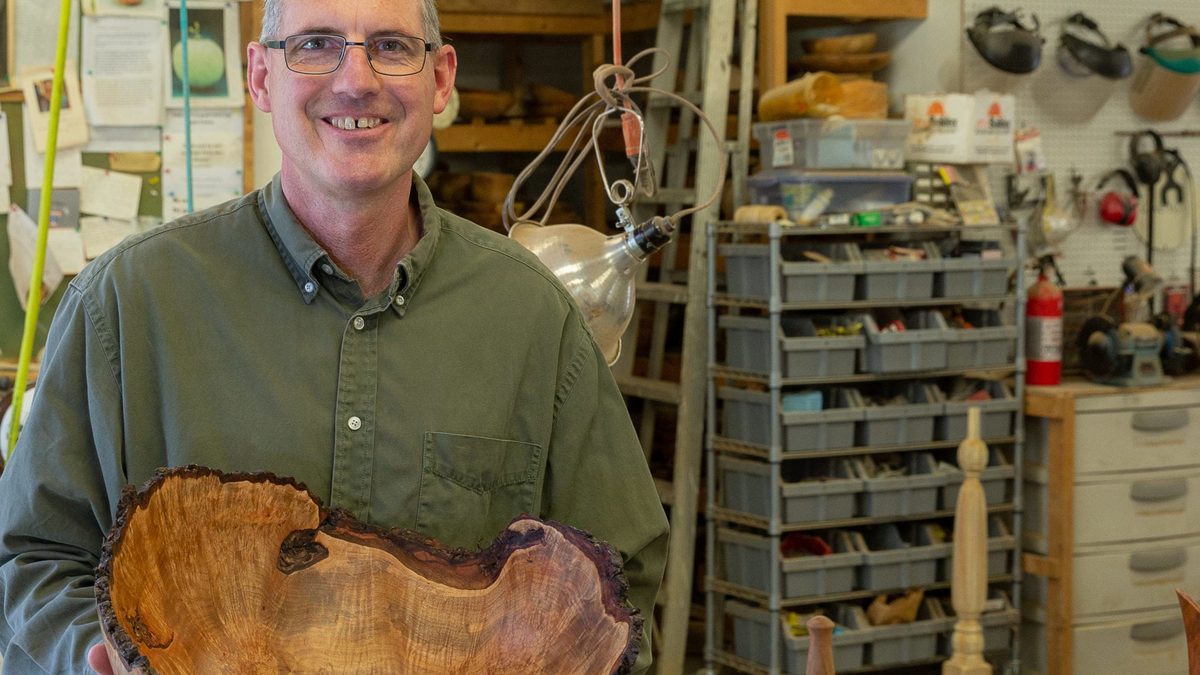
For every artist, there is a defining moment when a hobby moves to a passion—for Gordon Fowler that moment has continued to resonate with him. Starting as a stay-at-home dad who put together birdhouses in his free time, Fowler has grown his craft of wood turning into a full-time profession.
With an interest in building small pieces of furniture, Fowler took a class at Arrowmont School of Arts and Crafts. There he met a friend of the family who was taking a class in wood turning and loaned him a spare lathe. Fowler returned to Arrowmont in 2000 and took his first woodturning class, and has continued to hone his skills. “I fell in love with the tool. Being able to take a junk piece of wood and turn it into something beautiful piece is just so cool.”
Fowler sources all his wood from Knoxville and surrounding communities. He is able to collect wood that is destined to be waste or firewood and turn it into something beautiful.
Presently he is working on a large pitcher and goblet series with an exploration of the theme of water and its life-giving aspects, alongside an exploration of symbolism of the circle. You can see his work at his studio at the Art Market Gallery, and you can also find him at the Harding Art Show in Nashville in May, the Annual Foothills Craft Guild Show, and Artsclamation.
As TWPD begins to speak his last words, a few people slip out the back, either not wanting to witness the spirit-crushing scene or desiring not to be associated with the event and to get out before others commit their attendance to memory.
As the words come, slowly, tinged with forced enthusiasm or sincere melancholy, the comments go on either for as little time as possible or for as long as TWPD can keep a clammy grip on the spotlight.
And that’s what it’s like at an election night “victory” party for the candidate and the assembled supporters when Election Day goes south. A quote often attributed to President John F. Kennedy (mainly because he used it in a news conference) sums up the varied reactions: “Victory has a hundred fathers and defeat is an orphan.”
Frankly, defeat has even fewer people on its side.
An example, from NBC News, Nov. 9, 2018, “Shock and Sadness Among Some Clinton Supporters”: “As the numbers came in on Election Night, supporters of Hillary Clinton appeared stunned — some with tears in their eyes, others looking devastated as they left early from events that they hoped would be celebrations.”
At the winning campaign’s party as the outcome is announced everyone is high-fiving; smiling; or congratulating each other for their role in the victory. If they had no role they make one up, unofficially. People don’t want to leave, and others belatedly arrive to share in the moment.
For local candidates, the upcoming dates of jubilation or despair are the May 1 county primary; the Aug. 2 county general election and state and federal primaries; and Nov. 6 state and federal general election.
The above-described campaign-night scenes will replay itself multiple times on each of those dates. Elections mark an ultimate demarcation between success and failure. The finality of the ballot box means that winners are in and losers are out, with all the privileges and humiliations, respectively, appertaining thereto.
Losers often get beaten up, figuratively speaking, by some of the people at their dashed “victory” parties. While many are gracious and caring, there’s a lot of venting. Much of the anger flows from people who’d been anxious to tell the candidate (regardless of how minimal or infrequent their contact), “You did what I said you should do and it worked,” or “I was out there working hard for you and I knew you’d win.”
That translates more accurately into, “I’m not saying you owe me something for helping you win, but, you owe me something for helping you win.”
For the losing supporters the frustration is like that of the 100,000-plus football coaches in Neyland Stadium after a Vols loss: the campaign was mismanaged; the message was wrong; the campaign manager was clueless; they spent money on the wrong things; the ads were terrible; and who thought that campaign theme was a good idea, anyway?
And election night is just the start.
A most difficult thing losing candidates encounter is discovering that within the space of a few hours they’re now thought of much like yesterday’s mayonnaise-and-ketchup-stained hamburger wrapper – soiled and of no real use.
The invitations to events stop arriving. News media requests for interviews, comments, and to appear on radio or TV talk shows dry up like a drop of water in the desert. Groups that begged and pleaded for time on the TWPD’s calendar for speaking engagements now hope he won’t call saying his “schedule has been freed-up.”
While family, true friends, and genuine supporters stick by TWPD, others encounteringhim on the street or at events wonder how long before they can escape. This is for two reasons: they don’t comfortably know how to say to someone the equivalent of, “I hear you died, but you fought hard right up until your last breath, so that’s good,” or because they don’t want the winner or anyone associated with the winner to see them and think they wanted a different outcome.
What turns this around? Time. It takes time for TWPD to not feel as if every person he passes isn’t whispering and pointing. They aren’t. Most people are oblivious. Life goes on.
The other is if he runs again and is seen to have a credible chance at winning. In such cases it’ll soon come about that “old friends” will stop him to say, “Here’s what I think you should do…”
With any luck the next go-round will be someone else playing the part of TWPD.
→ Swipe for Next Story
InsightsMAY JUNE 2018
Food Safety
Story by Bruce Fox
In 1906, Upton Sinclair publishedThe Jungle, a book that showed the dirty underbelly of the meatpacking industry in Chicago at the turn of the 20th Century. The book catalogs in gory detail the deplorable and unsanitary conditions of the meatpacking houses. The public outcry galvanized a movement to clean up the industry and led President Theodore Roosevelt to push for the passage of the Pure Food & Drug Act of 1906.
When I learned that this issue ofCityviewwas going to be focused on food, I had two divergent thoughts pop into my head. First, I am an unapologetic “foodie.”I don’t just love to eat good food.I love to prepare it, talk about, and most of all, share it with friends and family.
Of course, the lawyer part of me started to think about things I have learned and cases I have handled over the years dealing with food safety issues and representing people who have been injured by foodborne illnesses. How are we doing with keeping our food safe to eat?
Certainly, we have come a long way since the days ofThe Jungle.The pressure from litigation and regulation has made all of us much safer. This progress toward a safe food supply chain has been hard fought, however, and has been slower than necessary. One problem I see is the division of responsibilities among federal regulators, and how they go about investigating and assessing risk. The U.S. Department of Agriculture (USDA) regulates the production and sale of all meat except fish. The Food and Drug Administration (FDA) regulates fish, fruits, vegetables, and some processed foods.
The FDA designates as adulterated any food with bacteria or virus that can cause illness, and will take action whether someone has gotten sick or not. The USDA, on the other hand, will not order a recall until an illness is traced back to a particular product. The FDA will not identify where a product went. It will simply name the producer and that is it. That is a hole in the system that allows product to remain in the market even after it has been recalled.
In 2011, Congress passed, and President Obama signed into law the Food Safety Modernization Act. This legislation was long overdue and is focused on prevention before food even becomes infected. Of course, the civil justice system continues to provide pressure through the litigation process for continuing progress toward overall food safety.
Perhaps the most difficult part of handling a claim for someone who has gotten sick is establishing the connection between the illness and the product that was consumed. There is a general misconception that when somebody gets ill, they should look at the last thing they ate. That is not always the case,
In the end, it really is much safer to eat these days than it was even just a couple of decades ago, not to mention whenThe Junglewas published. While we have work to do to make us all safer, there is no reason for that to get in the way of enjoying good food with friends and family. It certainly won’t get in my way, because that is one of my favorite things in the world.
→ Swipe for Next Story
DepartmentsMAY JUNE 2018
East Tennessee Whitewater
Story by Emily Stevens
Some of the best whitewater in the country is right here in East Tennessee. Indeed, four great rivers for whitewater adventures are easy day trips from Knoxville. The Pigeon River near Gatlinburg and Pigeon Forge; The Ocoee River east of Cleveland, (site of the 1996 Olympic whitewater course); the Watauga River near Elizabethton; and the Nantahala River just across the border in North Carolina.
High time for whitewater is May through September. Whether your jam is kayaking, canoeing, rafting, or tubing, the region has you covered. Prepare for adventure, and prepare to get wet.
Patrons enter and order at the cash register up front. “Our storefront feels approachable,” says Hamblin, “and that’s what we wanted.” To the left is a long corridor lined with a banquette, two-person square wooden tables, and armless white spoked chairs. With an eye to the families in the area, Farmacy is kid friendly, and service is quick—for those dining in and those taking out.
In the farm theme, servers wear crisp black and white gingham checked shirts. “Farmacy is where you go when you’re not feeling like getting dressed up,” says Hamblin.
Specialty items are presented artfully on white no-frills china. Desserts like Roasted Banana Pudding ($4) come in a shaped glass and Peanut Butter Pie ($4) in a mini Bell Jar. “We’re simple but playful,” says Hamblin. Photo by Jimmy Chiarella
“Comfort food brings memories back to you,” says Hamblin. “You don’t eat with strangers. You eat with friends. Familiar smells create nostalgia that brings the good-heart feelings. We do familiar dishes with a twist.”
The Good Greens salad ($8.95) is finely chopped kale with tomatoes, parmesan and whole-grain croutons in a homemade lemon parmesan Caesar dressing. The Vitality Bowl ($13.5) mixes corn, black beans, sweet potato, avocado, tomato, feta, radish, red onion, sprouts, grilled chicken, and a fried egg—all on a bed of arugula.
For a starter, the Stack ($7.95) piles fried green tomatoes with artichoke pesto, marinara, goat cheese and fresh basil.
For the best French Dip around, try the Good Ole Boy ($11.95) of braised brisket, sweet onions, melted white cheddar with horseradish cream, and au jus.
Among the main dishes, Shrimp and Grits ($14.95) presents creamy smoked gouda Shelton Farms grits, Creole red sausage gravy, blackened shrimp, and pickled green tomatoes. The grilled Salmon ($14.95) comes with a maple-pecan glaze over browned butter green beans. The Pepper Crusted Beef Brisket ($13.95) is slow cooked for 12 hours until it is fork tender and rich in flavor. It is served over smashed red potatoes with a side of tomato jam.
Rounding out the comfort food, daily specials ($10) include Meatloaf on Wednesdays and Chicken Pot Pie with a creamy white wine gravy on Fridays. The smashed red bliss potatoes ($3) get their creamy texture from lots of butter and a bit of sour cream. Photo by Jimmy Chiarella
For the full comfort food experience, don’t pass up the Strawberry Cream Cake ($4.50) filled with cream cheese buttercream; the roasted Banana Pudding ($4), finished with whip, homemade salted caramel sauce, and homemade short bread; or the Nutella Layer Cake ($5) of dark chocolate cake filled with Nutella buttercream and topped with ganache.
Farmacy is priced for families. With daily specials at $10, main dishes between $11.95 and $14.95, and the desserts between $4 and $5, the total bill is merciful.
Farmacy offers a lavish brunch menu, including light and airy New Orleans beignets, on weekends until 3 p.m. Note that Farmacy does not take reservations.
→ Swipe for Next Story
Dining GuideMAY JUNE 2018
Lakeside Dining
Lakeside Tavern
Story by Emily Stevens
Previously a winner of Cityview’s “Best of the Best,” Lakeside Tavern offers a gorgeous patio view of the water year round. Don’t let the rustic stone and wood decor and cozy fireplace fool you, the menu features elegant items such as Scallops Pomodori and Mediterranean Pasta.
Maryville Pike hosts the original location of Sweet P’s Soul House, the success of which inspired Sweet P’s Dive in downtown Knoxville. Known for having some of the best barbeque in the area, the Soul House also brings guests a taste of local music with their Songwriters in the Soul series. In addition to the barbecue on their menu, there are daily specials that range from nachos and quesadillas to smoked andouille sausage and burgers.
3725 Maryville Pike; 865-247-7748 Closed Monday Tuesday – Thursday 11am–8pm Friday–Saturday 11am–9pm Sunday 12am–7pm sweetpbbq.com Photo by Keith Norris
Calhoun’s at the Marina
This location of the Calhoun’s franchise is unlike its sister restaurants. Calhoun’s at the Marina, located in Lenoir City, features dockside dining just above Fort Loudon Dam. There is indoor and outdoor seating with nightly entertainment. The menu has items familiar to the patrons of other Calhoun’s locations—such as chicken wings, barbeque, and their specialty prime rib. In addition, the lakefront location has a specific Tiki Hut menu for expediting service during the busy season.
The Blue Heron Restaurant at Tellico Village Yacht Club
The Blue Heron Restaurant is located in a private lakefront community but is open to the public; the restaurant also hosts private events. In business for 30 years, the club and restaurant is surrounded by beautiful lake and mountain views. It offers an elegant yet affordable dining experience. The kitchen offers fresh seafood plates such as pan-seared salmon and a catch of the day, as well as rich entrees like veal osso buco and filet mignon.
100 Sequoyah Road, Loudon; 865-458-4363 Closed Sundays and Mondays Tuesday–Saturday, Bar opens at 4 pm, Dinner 5–9 pm TellicoVillageYachtClub.com
Lakehouse Grill
Tucked away on the side of Tellico lake at Sequoyah Landing, the Lakehouse Grill is a popular spot amongst boaters, especially in the summertime. Patrons can hop off for a quick bite of fish tacos, pork nachos, or their signature Lakehouse Burger and wash it down with a cold one. Lakehouse Grill offers the perfect lunch spot, with a combination of excellent pub food, a beautiful view of the lake, and a nice summer breeze. Don’t forget to get the kids a little Ben & Jerry’s to end the meal. You could do that for yourself, too.
The city began its Tuesday Jazz Series in 2012. In 2013, a Variety Series began on Thursdays through the end of June, with Shakespeare in the Square taking over for the remainder of the summer.
As the city’s Director of Special Events Judith Holtz notes, “It’s so much fun to watch families going through the square and kids dancing and singing. It adds another element of ambience to the square.”
2018 ScheduleMay 8Knoxville Youth Saxophone EnsembleMay 10Symphony on the SquareMay 15Knoxville Jazz Youth Orchestra and Knoxville Jazz OrchestraMay 22Jazz by Marble City 5May 24The Ville BandMay 29Jazz by Marble City 5May 31Frontier BandJune 5Jazz by Marble City 5June 7Ensemble Swing TimeJune 12Jazz by Marble City 5June 14Square on the SquareJune 19Jazz by Marble City 5June 21Josh CottrellJune 26Jazz by Marble City 5June 28Bary Jolly Pirates on the Patio (Jimmy Buffett Tribute Band)JULY 4Festival on the Fourth
→ Swipe for Next Story
DepartmentsMAY JUNE 2018
Cellphone Celia
Story by Cityview
Dear Cellphone Celia:
Much as beauty is in the eye of the beholder, the smartness of smartphones is in the mind of the user. “Smart” implies some decision-making ability. It might be able to recognize your thumbprint or face, and it can show you where a restaurant is, and it can even give you some pretty unreliable reviews. But it can’t tell you if it’s a place to take your cousin Shelly, the one from Scranton with the bizarre diet.
No, Celia, smartphones aren’t smart. They aren’t even in the same county as smart. As you walk about our fair city, make sure to watch for the distinction between the engaged faces of those looking up and talking to real people, and the lowered foreheads of the electronically distracted, their faces glowing with the shiny but simpleminded digital landscape.
It isn’t as though we haven’t noticed what the things are doing to us. There are now apps to get you to stop playing with your phone. Seriously, you can moderate your phone usage with your phone. Does this sound like something for an enlightened people in a democracy?
In the early 2000’s, for the first time the Knoxonomist used a cell phone as a way to locate someone he was meeting at Sundown in the City. It seemed remarkably effective: simply wait for the phone call and get info on where to meet. Trouble is, it required the Knoxonomist to be carrying the thing and have the ringer on. Today’s phones demand even more attention. To meet up with a friend these days, the likelihood is that you won’t get a phone call but rather a text, perhaps with a map attached. Or a social media message showing you precisely where the other person is. This requires that you pay attention to the device lest you miss out on a potential face-to-face human interaction. Let that irony sink in.
When the Knoxonomist was a younger man, in the era before cellphones, he and his friends would make plans to meet at a certain time and place. It wasn’t difficult. It required communication and planning: two fine skills that remain helpful in day-to-day life.
The risk of course, is in continuing to see the phone as smart by buying into the hype. The smartphone is only smart if we give ourselves permission to see it that way. We could begin by calling them what they are. They are tools. When we imbue them with manufactured “smarts,” they become little more than attention-craving pet rocks.
Does the Knoxonomist have a smartphone? Of course he does. Does he allow any app access when he isn’t specifically using it? No. Does he regularly profess his intentions to return to a flip phone? Yes. He also has a post-it note taped over the camera on his laptop.
The Knoxonomist welcomes your questions—although he will answer only those that interest him. Send your inquiries to TheKnoxonomist@cityviewmag.com, and include your name, address, and daytime phone.
Dear Knoxonomist: Are smartphones smart? — Celia Powell, TN
→ Swipe for Next Story
InsightsMAY JUNE 2018
It’s Not Tennis
Story by Robert Pryor, Sr.
Ijust made my annual purchase ofGolfandGolf Digestmagazines. Every spring, I buy golfing magazines to look at the latest golf clubs and equipment. This is the time of year to dream about the great golfer I should have been.
The thought of new golf clubs is exciting to every golfer, even though there is very little or no difference between new clubs and the ones I have been using for several years. As a kid I used to play at Whittle Springs Golf Course. I would knock the ball all over the place with some old wooden shaft clubs I found in the basement of my childhood home. In fact, I’ve done the same thing throughout my life—just knock the ball around trying to find something that works. I’ve never had a lesson, and believe me, you can tell. When my sons were old enough to show a genuine interest in the game, I sent them to Golf Digest’s school to learn how to play the game correctly from experienced teachers. That’s a luxury I never had.
Now, just because I am writing an article about golf, you shouldn’t get the idea that I’m a good golfer because I’m not. For many years, my handicap has been about 18, which means that I get a free stroke on every hole. I’ve played with some really good golfers over the years, and by using my handicap I’ve been able to be somewhat competitive. I admit that I gamble on golf games, and I’ve won some but mainly lost a lot of money over the years. When I lose, my policy is to pay cash immediately when the round is over, and in that way I can assure myself that my conspirators will play with me again. In fact, on occasion they have picked me up for a game or sent a taxi cab or limousine.
I’ve never been able to understand how professional golfers can walk up and hit the ball so confidently in front of thousands of people. When I play golf, I do not want anyone watching. I once played in a golf tournament at Holston Hills Country Club, and they gave a nice prize to the person who hit the ball closest to the hole from a distance of about 160 yards. I qualified for the shootout, along with six others, and the thing was staged on the 9th hole with hundreds of people sitting on the bank behind the green to cheer us on. I had never been so nervous in my life trying to hit the ball expertly in front of so many experienced golfers. We got three chances and my first shot was shanked off to the right toward the hot dog stand. You can imagine the laughter and the jokes when my ball hit the tin roof of the turn shack and made a loud thunder-like sound. I managed to hit a third shot fairly close to the hole and almost won the prize. That was probably the high mark of my golfing career.
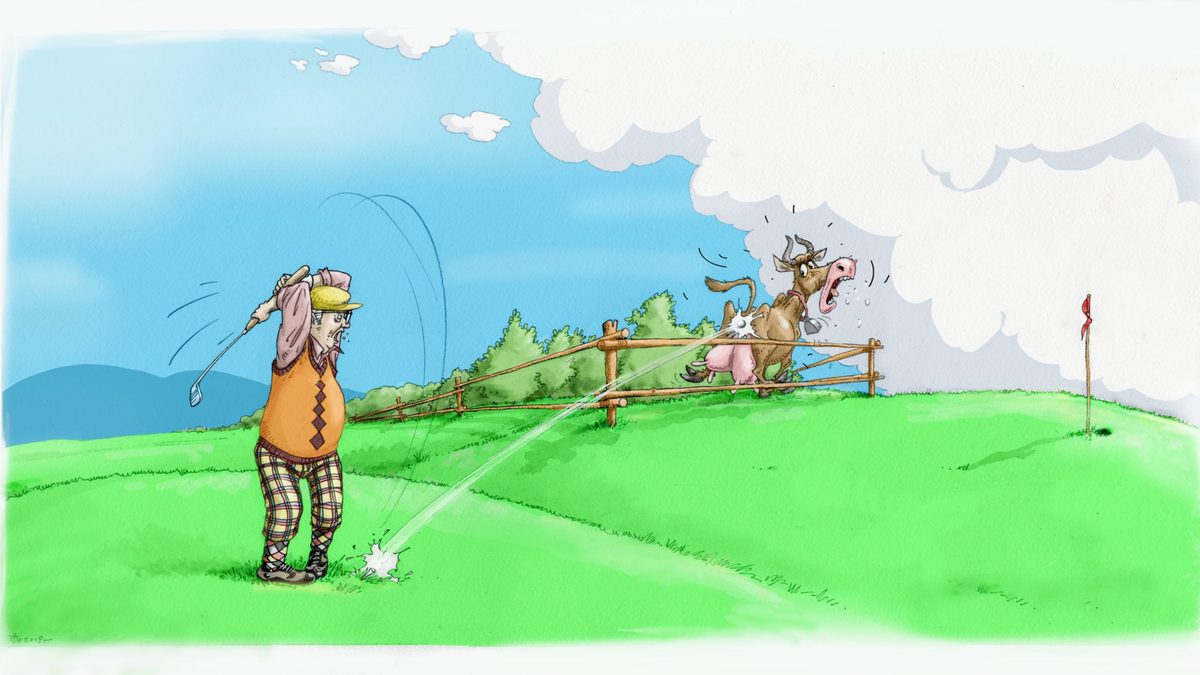
In fact, I’ve hit a lot of unintended things with my golf ball over the years. Once, in Maryville, I was trying to take a shortcut across the corner of a cow pasture and hit a cow in the butt. I’ve hit a bird, a tractor, a glass window, a grist mill, and lots of lakes, ponds, and trees. I hold what is surely a world’s record by hitting all three playing partners in my foursome—with one shot.
My wife, Norma, plays very little golf, but several years ago she made a hole-in-one while we vacationed in Florida with another couple. Our friends arranged a round on a prestigious course, and on a par 3 hole she hit a blind shot to a hidden green. Norma was shocked when she found her ball in the hole, and she now has a trophy from the course that certifies that she made the hole-in-one. I got nothing but the bill for the greens fees. I’ve never made a hole-in-one, and I’ve played a hundred times more golf than Norma. From time to time, she reminds me of her golfing superiority.
The greatest thing about golf is it’s not tennis. Tennis would be an awful sport to play because you have to walk and run a lot, and every court looks the same. The exciting thing about golf is traveling around to different beautiful courses. There is nothing more fun than a good golf trip with your closest friends. In October 1995, my regular golfing crew of about 20 decided to spend four days in Florida, playing golf and eating fish. Unfortunately, two days before the trip, Hurricane Opal struck the Florida Panhandle, causing massive damage to everything, including the golf courses we intended to play. I quickly changed the trip by secretly altering our airline tickets to Little Rock, Arkansas, which was one of the few places in the southeast that was not experiencing massive rain and floods caused by the hurricane. When we flew out the next day, no one knew our final destination. I arranged for rental cars and hotel accommodations at the Arlington Hotel in Hot Springs. I thought the spa and hot baths might help me to play 36 holes a day. The best golf course in Hot Springs was a very exclusive private course not available to the public. Just the kind of course I thought we deserved. When I called the golf pro at the course, he informed me that it would be impossible for us to play since we were not members. Finally, knowing Bill Clinton (then our president) was from Hot Springs, I asked the club pro if President Clinton had ever played his course. He confirmed that the president had played the course, and I asked if he was a member. Finding that he was not a member, I asked whether, if he called for tee times, would the president be allowed to play? “Of course,” said the pro. Whereupon I advised that the president was out of the country and would not be able to play golf that weekend and asked if we could have his tee times. The pro laughed and finally relented, and we actually played the course twice and had a great time.
That trip to Hot Springs resulted in an annual “Mystery Trip” where only the planner knew our golfing destination. We went by bus and by air and traveled to many mystery destinations. Golf at its best.
As a teenager, I regularly slipped onto the Deane Hill Country Club course, trying to learn how to play. To avoid being caught and charged with trespassing, I would only play the six holes on the north side of the ridge; those holes became my specialty. I would take two or three clubs and try to complete those holes without getting caught and thrown off the property. What little skill I have I honed on those six holes, and as an adult I played Deane Hill several times but never felt comfortable on the other twelve holes.
I have played golf with some great guys over the years, and we’ve shared some memorable experiences. Once, a friend was lining up a putt on an elevated green in Hilton Head and as he squatted and scooted back to better visualize the contour of the green he fell off backwards and down 15 feet into a deep sand trap. A woman walking her dog nearby saw the calamity and turned away to keep from laughing. Although embarrassed, my friend made the putt.
On another occasion, my friend Johnny Comer hit his tee shot, which he felt hit a tree and kicked down into the fairway. There was a dog nearby and when they stopped their carts to hit their second shots his ball was nowhere to be found. Finally, his ball was located about five feet out of bounds and he claimed that the dog had picked his ball up and carried it out of bounds and that he was entitled to drop it back where he observed it fall in the fairway. His opponents disputed his ruling and vehemently disputed the dog story. Finally, to prove his point, Johnny picked up his ball and showed his opponents how it was wet and smelled like dog breath. He lost the argument and had to go back to the tee and hit another shot.
One of my long-time golfing friends fancies himself kind of a “nature boy” and regularly wanders off on an adventure and forgets to focus on his golf game. Once, he returned from the woods being chased by an alligator. Do you have any idea how fast an alligator can run?
I’ve always thought it would be nice to be a hero and perhaps save somebody’s life. In one golf match I finally got my chance. My friend, Ed Dulin, hit his tee shot just inches from a scummy pond. The area looked snaky to me as Ed removed his shoes and socks and rolled up his pants to try to position himself in the pond to hit the ball. I remarked that he should look out for water moccasins. Suddenly, he screamed and jumped out of the water claiming that he had been bitten by a snake. Although I saw no snake, I could believe it and quickly dropped to the ground to suck the poison out of his toe. As his toe neared by mouth, he hollered, “Wait, wait, I might have just stepped on a stick.” So much for sucking out poison and becoming a hero—Ed decided to just pick up and go on to the next hole.
Those are a few of my recollections from a lifetime of fun playing golf. Now, if you don’t mind, I’m going back to my golf magazines to try to find a new driver.
→ Swipe for Next Story
TravelMAY JUNE 2018
Hunting for the Balance
Story by Al Lesar
Though Fox, a 66-year-old attorney in Clinton, embraces a passion for hunting, he strikes an intricate balance between the pursuit of game and a deep-seated desire for preservation. His grandfather taught him to hunt and fish; he also imparted a genuine love and respect for nature.
During his formative years, Fox developed a conscientious passion for outdoor sport, developing a deep understanding of and respect for the animals he hunts. “I hunt and fish because I love the outdoors,” Fox explains. “I love to interact with nature. When I hunt, I want to understand the habits of the animals. I want to know what their life cycle is like. I enjoy the challenge of the hunt.”
Fox is a longtime member of, and sits on the board of directors of the Tennessee Wildlife Federation, thepolitical arm of the Tennessee Wildlife Resources Association. He knows the right levers to push and conversations to have when it comes time to confront an issue. “Our job is to preserve and protect,” says Fox. “We want to foster and encourage the next generation to have a positive impact on the outdoors. I bring perspective to the group. I’m dedicated to preserving access.”
Bucket List
When Fox is off the clock and billable hours, he’s likely to be off the grid, too.
He’s hunted in nearly every part of the United States, and even has had opportunities with friends in Mexico. But he never had a chance at the “big game.” That is, until a health scare sent him to evaluate his “bucket list.” Mary Jane, his wife of 20 years, asked Bruce what he’s always wanted to do.
It didn’t take long for him to answer.
“I’ve always wanted to hunt Africa,” he says. No problem. Last May, Bruce and Mary Jane, who accompanied Bruce every step of the way but never picked up one of the big game rifles, were booked for an 18-day excursion to southeast Zimbabwe that included eight days of hunting and four days of photo safari.
This wasn’t a “line ‘em up and shoot ‘em” expedition. This was an organized and regimented hunt. There were rules. There were expectations. There was imminent danger. There was also a large measure of responsibility.
Current Headlines
Before leaving for the trip, Fox was given a list of animals he was allowed to hunt. He could choose his prey. Wildebeest, impala, kudu and wild buffalo were among the offerings. Elephant and rhinoceros were strictly forbidden.
This launched Fox into a discussion of recent White House edicts that have softened the regulations allowing tusks and other trophies to be shipped into the U.S. “Easing those rules encourages poachers,” he notes. “Poachers are what upset the balance. When you’re there, you realize that hunters contribute to the conservancy of animals. There is a reason for everything that’s done.”
The Dallas Safari Club has been active on social media trying to get the word out about the influence that organized safaris have in trying to solve the problems caused by poachers. Poachers will try to trap the large animals, wait until they die, then harvest the valuable parts. When safari workers see a trapped animal, it is released. Fox says that anyone caught poaching for meat will be arrested. Anyone caught poaching for the tusks will be shot on sight. They’ve taken to using drones to track the poachers.
When a safari hunter kills an animal, the meat is taken to a nearby village to be distributed as food. When the safari trucks roll in, the village comes to life.
“Five-Star Life”
This was nowhere near the normal hunting expedition. Fox says it was closer to a “five-star tent experience.” Tents were large and situated on cement slabs with running water. No cots, but rather comfy beds. At the end of each day, hunters were met with warm, moist towels and cocktails.
They were accompanied by a crew of 10—an executive chef, a tracker, a scout, a driver, a professional hunter, and others with a variety of jobs—that made sure Bruce and Mary Jane had a pampered experience. May, the end of Zimbabwe’s fall and start of winter, was the perfect time to go: a temperate climate with no rain and few insects.
“We’d be in the camp and there would be monkeys and orangutans all over in the trees,” Bruce says. “At night, if you left your tent, you had to be with an armed escort. The tents were triple-layered and zipped shut. No animal was going to get in. There was an electric fence on the perimeter to keep the elephants out. We heard lions and leopards walking through the camp all night. This was way more sophisticated that we ever dreamed it would be.”
There was an area with the purpose of lounging during the day. Afternoon naps were available, if desired. Therewas a designated dining area, with all the amenities. Dinners, which often included animals that were recently killed, were gourmet caliber. “Mary Jane said she was going to write a country song when we got home,” he says with a laugh. “‘We’re a two-star couple leading a five-star life’.”
One evening, they were being driven back to camp when firelight appeared on the horizon. There was talk of poachers and a ripple of excitement and fear passed through the group. But no, their hosts had set up an evening of dining al fresco, safari style: away from camp on the edge of the wild.
“Black Death”
Bruce says the most intriguing and exhausting challenge of the trip was the chase of the wild buffalo.
“Ian, our professional hunter, said the wild buffalo are called ‘black death’ for a reason,” Bruce notes. “If you track them, they will be angered. They will come at you.” In the herd of wild buffalo, the older, non-breeding bulls are exiled to the perimeter. That bachelor group was going to be the target of the hunt.
Fox was outfitted with a.375 Holland & Holland Magnum medium-bore rifle. This was a heavy-duty weapon. “It packed a pretty good wallop,” he says. He adds that he and his professional hunter had to take turns “sighting” the rifle because repeated shots exhausted them both.
The group was on foot for a good portion of the 2½ hours—covering between five and six miles—that went into tracking the buffalo splinter group. One large animal broke away and was selected as the target of the hunt. There were times, because of the thick brush, that no one in the group was able to see beyond ten feet ahead of them. That made it dangerous because the buffalo, when it knows it is being stalked, has a tendency to circle back and surprise its predator from behind.
In this case, that sort of ambush came to fruition. “Our scout suddenly and quietly dropped down to a crouch,” Bruce says. “Ian, the professional hunter, knew what that meant. He calmly and quietly said, ‘Step forward and put your gun in the V [a rifle support], he’s coming. You’ll want to shoot him in the shoulder’.”
Fox says he knew the gravity of the situation. If he shot and missed, the buffalo would charge and the group would be at risk. “I saw him drop his head and I squeezed the trigger,” he relates. “It was such an intense moment. I heard the noise of the gun, but I never felt (the wallop).”
Fox notes that he heard some grunts as the animal ran off, then a loud shriek. He later learned that this is called the “death bellow.” They located the 2,500 lb. animal as it lay dead.
Next Time
There was a time, before the trip, when Bruce would call this a “once in a lifetime opportunity.” His friends who had made a similar trip just laughed.
“They told me that I’d be back,” Fox says. “I didn’t understand them until I experienced it. Once that happened, I had to do it again.” His journey for September, 2019, is already booked and paid for.
It wasn’t just the skins and horns that will keep him coming back. It’s the lesson that, while going through this terrific experience, he’s helping play a role in the overall animal conservancy that’s being challenged in Zimbabwe and other parts of Africa.
“The hunting dollars go to cover the scout teams that are in place to protect the rhinos and the elephants Every ounce of meat that’s taken is eaten by the people in the villages. I saw the reality of the situation firsthand. I understand the struggles that they’re having and the reasons they’re working so hard to enforce the laws there.”
At the same time, he also allowed himself to be a bit selfish. “That experience reinvigorated and excited me,” he says as he thumbs through many photos on his tablet. “Just looking at it again gets me excited. So many memories come rushing back. I just love re-living it.”
A bucket list has room for quite an encore.
→ Swipe for Next Story
FeatureMAY JUNE 2018
On the Trail Again
Story by Emily Stevens
As the weather warms up, it’s hard to make excusesfor not getting up off the couch and getting outdoors. Personally, I’ve explored the Smoky Mountains and other Tennessee State Parks, but I often neglect the local trails just a few minutes down the road. The mountain trails have a special place in my heart, but they are a day trip away. Fortunately, Knox County has beautiful trails that are easily accessible. Ijams Nature Center—as well as other greenways, urban parks, and county parks—offer trails of varying lengths and difficulties. Getting outside has never been easier—you don’t even have to groan about following the driver in front of you who is lollygagging through Cades Cove.
In addition to easy trail access, one of the best aspects of hiking and walking in Knox County is that it doesn’t require any fancy, expensive equipment beyond a good pair of shoes. Experts like Rosemary Marshall, East Tennessee Chapter Representative of Tennessee Trails Association, and Kathryn King, Vice President of East Tennessee Wanderers, recommend visitinglocal outfitters such as REI and River Sports Outfitters to be fitted for hiking/walking shoes. Having the proper footwear is important for preventing blisters and foot discomfort. These outfitters will determine the best options for you based on your outdoor activity.
Hikers and walkers will also need sun protection during certain hours. King recommends starting around 9 or 10 a.m. “[It’s] early enough to get moving before the heat of the day, but not so early that you’ll need a nap when you get home.” She also recommends investing in trekking poles for hikers because the poles relieve stress on the knees.
For a beginner, trail information and maps can be quite overwhelming. There are many great resources out there such as the Tennessee Trails Association, Foothill Striders, and the East Tennessee Wanderers. These organizations are a great place to start and offer group hikes several times a month.
Marshall has been actively hiking in the area for 25 years. When discussing trails with a prospective hiker, she begins by describing some of the most popular Knoxville hikes, such as Ijams Nature Center and House Mountain.
“Trails vary in length, elevation gains and descents, historical content, and many more factors,” she says. “No two trails are the same.”
Ijams Nature Center
In the 1960s, several Knoxville organizations worked to turn the 300-acre property into Ijams Nature Center. Containing 12 miles of trails, a local nature center, and seasonal paddling rentals, Ijams is a popular spot for walkers and hikers. It’s family and dog friendly, with trails winding around the Tennessee River and Meads Quarry Lake. The trails are moderate to easy and the Boardwalk Trail is highly recommend by staffers.“In the summer, the sunflowers to the adjacent Forks of the River Wildlife Management Center are a must see,” King says.
House Mountain
Located about 30 minutes from downtown Knoxville, the trail to the top of House Mountain is heavily wooded and features unique rock outcroppings. In total, there are 5.8 miles of trails, but the two trails to the peak are each about one mile in length and are of moderate difficulty. As the highest peak in Knox County, the crest offers panoramic views of the Cumberland and Smoky Mountains and downtown Knoxville.
Urban Greenways
In 2016, Knoxville’s Parks and Recreation Office implemented a four-year plan for connecting the greenways and urban parks in Knoxville, making them inclusive and accessible. This plan is known as “Knoxville’s Urban Wilderness 4-Year Implementation Plan” and is aimed to encourage citizens to get outdoors. One of the popular current greenways recommended by Marshall is the Victor Ashe Greenway. Located in northwest Knoxville, this greenway connects several others and offers 1.5 miles of unpaved trails, which are popular with cross-country runners and dog owners.
In total, Knoxville currently has 112.9 miles of paved greenway and natural trails. On the city website (knoxvilletn.gov), you will find a complete trail index and can view a 360-degree virtual tour of local greenways, parks, and trails using Google Trekker Street View.
Getting involved with groups like the Tennessee Trails Association and East Tennessee Wanderers is a great way to establish a physical routine and get to know the community. Once you’re comfortable with the area, wandering on your own can be very enjoyable. In addition to hiking and walking, many people enjoy combining the activity with other hobbies such as photography, birding, and tree and plant identification.
So get out there and enjoy the trails Knox County has to offer! Your body and spirit will thank you.
SaveSave
→ Swipe for Next Story
FeatureMAY JUNE 2018
To Will or to Trust
Story by Carolyn Evans
Sometimes making legal plans can feel like that, with law seeming to evolve as quickly as taste in interior design. Just as oatmeal-colored sofas have edged out red ones, it feels like trusts are becoming popular while wills have become passé.
Is that the truth of the matter, though? Are trusts simply in vogue, or is there more to it than that? Before investing in one or the other, it’s best to know the difference.
The Difference between a Will and a Trust
“A trust and the other documents that go with it specify who is important in your life and lay out financial, health and legal plans for the rest of your adult life,” says Knoxville attorney Anne McKinney with McKinney & Tillman, P.C. “If you’re in a car wreck and are seriously injured and have scratched your eye, who’s going to know who your eye doctor is or that you pay your utility bill by automatic draft?”
“Trusts are private,” she adds. “A will can end up in public, hashed out in your county probate court and open for anyone to look at. If you wanted to, you could go to the probate court and read all the wills that have been filed.”
Knoxville attorney Phil Bryce says that being uninformed when it comes to legal matters can be devastating.
“Wills are so out of date,” Bryce says, “but people keep using them because they don’t know any better. They’ve heard of wills, but are unfamiliar with trusts. I ask people if they have their affairs in order and they say, ‘Yeah. I’ve got a will.’ You don’t have your affairs in order if you only have a will.
Knoxville attorney Bailey Schiermeyer of Elder Law of East Tennessee describes a trust as an instruction book for how to manage your property during your life, at incapacity, and after your death.
“A will only manages your property after your death,” she says. “It doesn’t give you any protection if you develop Alzheimer’s disease or have a stroke. If I have dementia, I want to know I’ll have a roof over my head.”
In addition to ensuring privacy, trusts also help you preserve control over your property, Schiermeyer says. “People work really hard to build up their wealth for their golden years. A trust is a great way to maintain control over your financial affairs … even if you aren’t able to speak for yourself.”
Avoiding Probate
Bryce, McKinney, and Schiermeyer all agree that one of the central issues with trusts is avoiding probate court, where estates are hashed out in public.
“At your death, your trustee is responsible for gathering assets and distributing them according to your wishes,” McKinney says. “This can be done privately without a court proceeding. We do a lot of revocable living trusts as a means to avoid the probate process completely.”
In Knox County that’s the Knox County Probate Court,” McKinney says. “The court will want to know if you have a will, if your bills have been paid and if your assets have been distributed according to your will. The reason people want to avoid probate is they don’t like their relatives going into court and filing the will and paying court costs and maybe hiring an attorney. They don’t like the idea of the court handling their private affairs. They also don’t like the hurry up and wait. It can cost more money than using a trust.
“The problem I see when people become disabled is they pick people to handle their affairs who aren’t suited for it,” McKinney says. “They pick people who don’t get along with their children or have a drug problem or don’t understand how to carry it out. You have to pick someone who files their taxes on time. You have to pick someone who is responsible and takes the job seriously.
“If you have someone in your family who really, really, really wants to be the executor, pick someone else. Oftentimes, when you have a family member who says, ‘I want to be the executor,’ that’s a red flag. Serving as executor involves may rules and forms and can be very difficult. Only a crazy person would want this job. If your children don’t get along, don’t pick either of them to be the executor,” she advises. “Pick someone else. If they don’t get along while you’re living, they really won’t get along after you’re gone.”
Bryce says people shouldn’t be misled by the offer of an inexpensive will.
“You might go cheap and get a will, but that will end up costing you more because you go through probate. A will is insufficient. You match it up to a revocable living trust and there is no comparison. “I can do a revocable living trust cheaper than I can do a will and probate,” he says.
“Tennessee has been voted one of the top three states for asset protection where you can protect your assets from creditors,” adding that Tennessee does not have gift or inheritance taxes and the federal government doesn’t tax estates less than $11.2 million.
“At the very end we put in a ‘trust protector,’ who can put in a new executor in case the executor dies. The trust protector is commonly me or someone in our firm—or it can be your brother. Its somebody you can trust who can make good decisions. That’s a big deal that most people don’t have.”
When to Create a Trust
“We usually see people start doing trust planning in their ‘50s when they start thinking about retirement,” Schiermeyer says. “I do customized work. The first thing I do is learn about the people across the table from me and what their goals are before I ever ask about their assets.”
She said the costs depends on how many factors are involved, including whether the couple owns a business or is planning for long-term care for each other or children.
In regard to protecting elders from avoidable planning pitfalls, Schiermeyer says there are a few things she’d like to should from the rooftops.
“A lot of people want to do DIY planning and I get why that is appealing,” she notes. “I define DIY planning as either drafting your own legal documents — usually with the help of the Internet or gifting assets to children in lieu of creating a trust. I don’t recommend DIY planning for numerous reasons, the first being that it opens you up to so many unnecessary risks and problems.
“The most tragic example of DIY planning gone wrong is when elders transfer their home to their child without consulting a qualified attorney. This type of transfer could create negative tax consequences, prevent the parent from receiving needed Medicaid benefits, or make the property vulnerable to the child’s creditors. Even worse, we probably get four to five calls a year from people who have deeded their home to a child who’s now trying to evict them from their own property.
“In terms of bank accounts,” she says, “I encourage everyone to confirm that they have beneficiaries designated on their financial accounts, not adding their children as joint owners on the accounts. Ensuring your accounts have beneficiaries named is a great way to avoid probate, whereas if the child listed as a joint owner on your bank account is sued, files for divorce or bankruptcy, your property including your bank account, can be at risk. Don’t put yourself in those risky situations. Your golden years aren’t for taking on new risks. It’s the time to minimize risks and enjoy yourself.”
“Waiting too long to do things applies to everything done in this game,” he says. “When you’re responsible for people, when you have children or a spouse, that’s when you have to have a plan. It’s all about giving what you have to whom you want the way you want that doesn’t spoil them. I’ve always said when I was 21, if you’d given me a good deal of money, I’d have bought a Porsche and married a Las Vegas show girl and they’d both been gone in three years.”
Bryce estimates that about 90 percent of people do not have the legal documents they need.
“Seriously, people don’t pay attention if it’s not right in their face,” he notes. “If all of asudden they contracted cancer, they’d get right on it and create a trust. Usually death is instantaneous and it’s too late, and then people fight over things. Death should be a loving event, not a fighting event.”
→ Swipe for Next Story
Non-ProfitMAY JUNE 2018
Chefs Collaborative
Story by Rebecca Whalen
There is a network in the United States of food professionals and chefs looking to advance their understanding of food. It’s 40,000 people strong, a number that has grown substantially since the network’s inception in the early 90s.
“By cultivating our national community, we foster connections, facilitate educational experiences, amplify inspirational stories across the U.S., and share resources,” says the network’s leader.
And while this work has a national foundation, a much more local footprint is forming. It’s a powerful one, too, rooted in the fight for equity in the food system, understanding that chefs and food professionals play a critical role in that fight.
This is Chef’s Collaborative. And this is their Knoxville story.
David’s Story
David Thomasson was born into a restaurant world. It was a time before the tourist boom had really hit his small hometown in southern Florida, a time when everything in his mother’s restaurant was made from scratch and, as he says, “Florida was still an agriculture state.” It feels whimsical to hear him talk about it.
Born into a coastal town, Thomasson spent time every week heading to the market for his family’s restaurant. By age 14, he was practically running the kitchen, stopping in during his lunch hour to make sure things were running smoothly. “That was my beginning with food.”
Fast forward through his life and you will see a very powerful relationship with food emerging. He spent ample time working in kitchens until he graduated with his first college degree from the University of Florida. And while he worked for the next 40 years advancing in a bio-conservation and environmental science career, most recently in the eastern Tennessee region, he returned to school somewhere along the way to earn a second degree in Physical Geography and a graduate degree in Cultural Geography, focusing in on what he calls “the cultural side of agricultural systems in the Caribbean.”
By day he was an environmental scientist, but by night his connection with food seemed to be growing. “All along the way, food has been on the tip of my tongue and brain one way or another,” he says.
When retirement began approaching, Thomasson was ready to take the next step into the culinary industry. He started catering and cooking—first with beer reps in the region to get a taste of the local industry. But when a throat cancer diagnosis caused a need for his diet to change, so too did his relationship with food.
Radiation took out his saliva glands; he needed to approach what he ate differently. “The natural change for me was to focus on foods that were moist,” he says. “At the same time, I was trying to design in my brain how to make a future living from food.”
The design eventually did come. And the result was the idea for a crêpe food cart.
“I went to Washington, D.C. and watched a man make crêpes at a farmers market for three days. With that, I started moving into the chefs livelihood and orientation.”
The Birth of a Local
It was around the time Thomasson was getting his cart together that he learned about a national organization called Chefs Collaborative. Founded in 1993 by a group of visionary chefs, the organization works to inspire, educate, and celebrate chefs and food professionals building a better food system.
“[These chefs] recognized the impact of food choices on our collective personal health, the vitality of cultures, and the integrity of the global environment,” says Holly Haddad, national Executive Director of Chefs Collaborative. “They recognized that chefs and food professionals are powerful change agents, and that their choices have the power to transform much more than just food.”
The organization seemed to be more than just celebrating chefs. It was rooted in supporting a strong, healthy and equitable food system. And it was this very idea that spoke so deeply to Thomasson. “I said, ‘Wow. This is what I’ve fought for my whole life from an environmental component: clean water, clean air, diversity’.” He immediately contacted Haddad about setting up a chapter—or “local” as the organization calls it—in the Knoxville region.
It wasn’t as simple as he hoped because Thomasson wasn’t technically a local chef at the time, but he became one shortly after when his food cart design came to fruition: Farm-to-Griddle Crêpes. “Today, I do street foods from all over the world, from tacos and Vietnamese food, to sandwiches and crêpes, even Mayan and Mexican food,” he says. And with everything he serves, he educates his customers on the food. “I advocate for everything that Chefs Collaborative believes in.”
With Thomasson at the helm, the Knoxville Local was officially formed, and while it is still in its infancy, Thomasson’s commitment seems to already have made an impact on the national network. “We are so impressed by the energy and dedication of our Knoxville Local group,” Haddad says. “It is a very collaborative community, and Dave is a strong champion of bringing people and businesses together.”
Those Who Do, Teach
Thomasson’s role as chef seems to come second to his role as educator. It’s one he speaks so vivaciously about. Within a matter of minutes of speaking with him, you are immersed in knowledge on the role chefs play in the sustainable food movement of today, on supporting the local farming and fishing economy, on human rights issues in the Asian seafood system, on the use of antibiotics on farm animals, on how the community in Florida he grew up in has lost all but one of its fishing docks. One might be overwhelmed with the topics covered, but not when you hear his passion for his work.
“My goal is to educate as I work through my kitchen, as I meet daily with the community,” he says. “I want to facilitate opportunities for chefs and the larger culinary community here to attend workshops, meal days, cookouts, social celebrations of food.”
So how does all of this education fit in to the Chefs Collaborative mission? Haddad sees it quite clearly, “A Local leader is a powerful manifestation of our core principles, and strong leaders are pivotal in elevating the food work of all our members. They provide the guidance and leadership to come together and form a community working to change menus and change lives.”
Change menus and change lives. That was really the concept behind the Knoxville Noodle Bowl series.
Thomasson came up with the idea a few years back to hold a noodle bowl festival as a fundraiser for a local nonprofit. This was before he started the Knoxville Local. Chefs from various restaurants would come together to put their own twist on the noodle bowl, and attendees would go station to station to taste the unique cuisine. The event was such a hit, that Thomasson brought it back the following year, planning for it to then become a series to raise money for Chefs Collaborative.
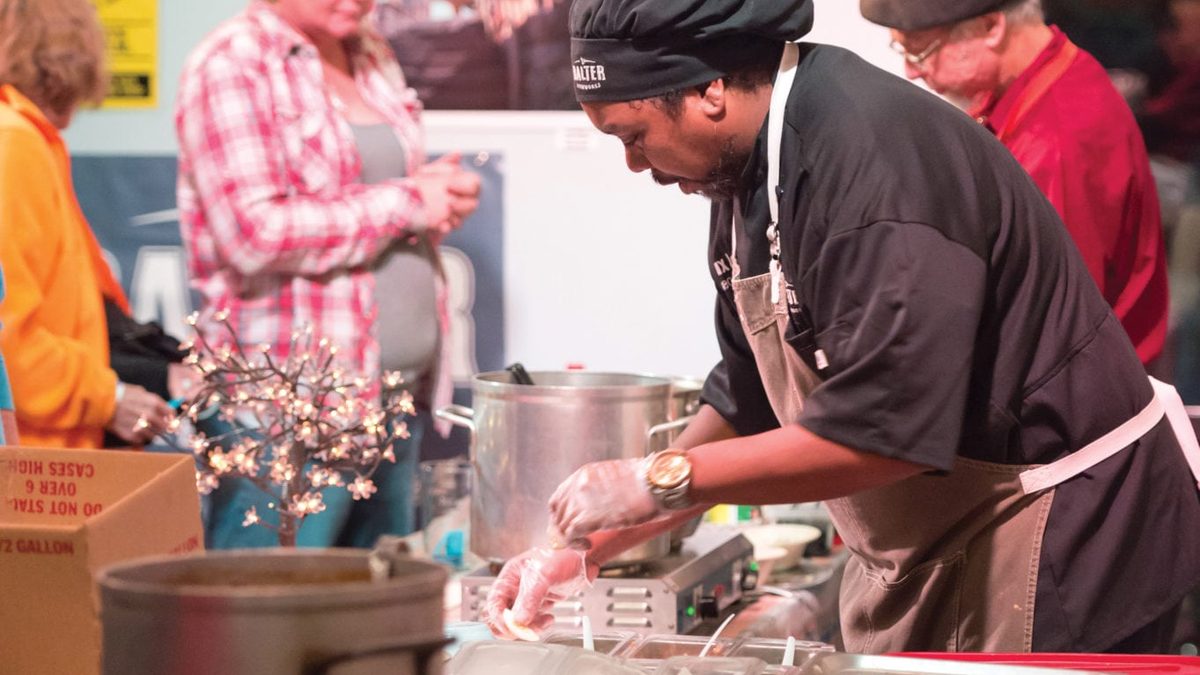
In the fall of 2017, the Noodle Bowl Festival, held at Hexagon Brewing, featured Thomasson, Chef Hux Jones of Balter Beer Works in Knoxville, and Chef Clark Barlowe of The Heirloom restaurant in Charlotte, N.C. (Barlowe heads up the Chefs Collaborative chapter in his own region.)
Jones met Thomasson after moving to the Knoxville region just two short years ago. Half Filipino, half African American, and raised in Japan for a good chunk of his life, Jones knew he could bring his unique background into the food he was cooking to create dialogue amongst his customers. “My role here is to open peoples’ eyes,” Jones says. “I am all about hard work, collaborating with people, local farmers and local businesses.”
Jones was ready to meet chefs in the local industry, and after meeting Thomasson at Hexagon, he joined Chefs Collaborative, got involved in the festival and is now finding new ways to make lasting culinary connections in the region and beyond.
More to Come
Events such as the Noodle Bowl Festival happen at Locals throughout the country. And the funds raised at these events go on to support the Chefs Collaborative’s national scholarship and education programs which provide member chefs and food professionals with professional development opportunities to learn about critical issues facing the food system. The funding additionally supports scholarships to the organization’s annual national Chef Summit.
While the Local here in eastern Tennessee is still in its infancy, it has taken off and Thomasson has big plans on the horizon for encouraging more culinary community collaboration. Workshops, breakdowns at cafes on closed days, picnic dinners to illuminate key food shed issues, these are all concepts Thomasson is hoping will come to fruition in the coming years.
“My goal is to have more and more chefs involved in education and being educated on the sustainable and delicious approaches to food,” he says. “I work around the clock to educate myself about being a chef.”
While there is no date set yet for the next noodle bowl festival, Thomasson says readers can contact him directly to get involved or simply remain on the email list for updates on what the organization is focusing on throughout the year. Visit chefscollaborative.org for more.
→ Swipe for Next Story
Top ChefsMAY JUNE 2018
Top Chefs
Story by Cityview
Nearly 300 guests braved a chilly, rainy evening in late March to arrive for the 11th annual Top Chefs event. The wine was flowing, the food was prepared to perfection, and silky jazz from the Larry Vincent Trio filled the venue. For the diners’ pleasure and ultimate judgement, eight of Knoxville’s finest chefs had each prepared an entreé and dessert. As the evening progressed, acclaimed artist Robert Tino completed a painting that was featured in a live auction, with proceeds going to Second Harvest Food Bank.
Curtis Bates
BLUE COAST GRILL & BAR
What brought you downtown to Blue Coast?Passion for food. I like a challenge, and downtown is a huge challenge compared to West Knoxville, where I worked for 18 years. I was out fishing when my friend Jorge put my name in a hat and they called and asked if I wanted to come in for an interview.
Have you always liked to cook?Oh god yes. Since I was little.
What was your reason for going professional?I really loved the mindset of learning new techniques and what you could do and how you could make food not only taste good, but look good. A chef I knew when I was 19 or 20 said I had a knack for it, so I went with it.
What advice would you give an aspiring chef?Never forget where you came from. I started out as a dishwasher, and I’m not better than anyone else. When I come in, I put my shoes on the same way as everyone else.
What’s the one piece of equipment every cook should have?A spatula.
What’s your guilty pleasure?Sugar cookies.
Where would you like to go out to eat?French Laundry in Napa Valley.
Deron Little
SEASONS INNOVATIVE BAR & GRILLE
What is your background?I started in Yakima, Washington at 15, then traveled all over the country working for hotels and country clubs. I came to Knoxville to open Gettysview Country club, and 24 years later, I now own Seasons and Kitchen 919.
Have you always liked to cook?My mom put that love and passion in my heart, as did a master chef I worked for when I was 15. He was one of only 18 master chefs in the world, and it was such a blessing to work for him.
What advice would you give an aspiring chef?You really have to get involved in the American Culinary Federation, the professional organization for chefs here in the U.S. You can get certified, which exemplifies a level of professionalism.
What’s the one tool every cook should have?I’ve been asked this, and I say it’s your heart. It’s not a knife, not a spoon—but you have to have heart. It’s your passion, and you’ve got to love people.
What’s your guilty pleasure?I love ice cream.
Where do you like to out to eat?That’s a hard one. I like Connor’s. It’s a good, approachable restaurant.
Jeff Carter
SUNSPOT
What is your background?I’ve been working for Randy Burleson for about three years. I’ve been at Bistro by the Tracks and Crown and Goose. I came to Sunspot to help revamp the menu and get back to what Sunspot was known for.
What have you always liked to cook?I love doing braised items. Stews, gumbos, a lot of seafood. Braising and stewing has been a passion.
What was your reason for going professional?It definitely wasn’t the hours. But I have a passion for cooking, and cooking at home fills some of that passion, but the fast pace and the environment of professional restaurants and kitchens just appealed to me.
What advice would you give an aspiring chef?Find an incredible restaurant with a talented chef and learn from them, work with them.
What’s the one piece of equipment every cook should have?It’s gotta be a knife.
What’s your guilty pleasure?French fries. Salty food.
Where do you go out to eat?I don’t really have a favorite, but if I went for a particular cuisine, it would be Mexican. If I don’t know where to go eat, I always find a good Mexican restaurant.
Anthony Ploof
THE TENNESSEAN
What’s your background?I went to culinary school at the CIA and spent most of my time in New England. I had an opportunity to move south and have been learning as much as I can about the culture and cuisine ever since—and I absolutely love it.
Have you always enjoyed cooking?Ever since I was a kid. My dad cooked in the army, so that’s where I got my interest.
What was your reason for going professional?I get to play around with techniques such as smoking and curing, and make beautiful, eye-catching, artistic plates. It’s something different every day.
What would your advice be to an aspiring chef?Find what your passion is, and keep following that. You’re going to be working long hours, and you’re going to be tired. But as long as you love what you’re doing, the rest is going to follow.
What one piece of equipment do you think every cook should have?A sharp knife.
What’s your guilty pleasure?Cheese, in every shape and form.
Where do you go out to eat?Going to J.C. Holdway was a great experience; that’s one of my top favorites.
Charles Boyd
HILTON KNOXVILLE
What led to your position at the Hilton?My wife’s family is from here. When I arrived, Iworked for a company managing restaurants on offshore oil rigs. When I tired of that, I decided to get back into hotels.
What inspired you to cook?My grandparents had a housekeeper named Miss May, who was the best southern cook I had ever met. My brother and I hung out with her and I learned to cook that way. I ended up going to a French culinary school because I had cooked my whole life.
What was your reason for going professional?I worked at a mom and pop Mexican restaurant starting at age 15. I got my first taste of fine dining at a private club. I put myself through college by cooking. After college, I went to culinary school and have been doing it ever since.
What essential tool do you think every cook should have?Patience.
What’s your guilty pleasure?Nathan’s hot dogs.
Where do you go out to eat?In New Orleans, I love K-Pauls. I also love the mom and pop places, like Huntsville’s Big Bob Gibson’s BBQ, where white barbecue sauce was invented.
Danny Wilhoit
BISTRO BY THE TRACKS
What brought you to Bistro by the Tracks?Being born in Knoxville, I had a desire to come back to my roots. I grew up working in gardens and dealing with animals. Every year, my family had a tradition of harvesting and processing the vegetables we were going to use and that were going to feed us for the rest of the year.
Have you always liked to cook?Being around food all of my life led me to a love of food.
What was your reason for going professional?I wanted to make money from my love of food.
What advice would you give an aspiring chef?Practice as much as possible. When you think you’ve done it as good as you can, do it again. At the restaurant, we work together to learn from mistakes and move forward. If you can do that, you can become a chef.
What’s the one piece of equipment every cook should have?A sharp knife. Other than that, a good stainless pan and a stock pot.
What’s your guilty pleasure?Peanut butter.
Where do you like to out to eat?Everywhere I can. I seek out lesser known, hole-in-the-wall places.
Michael Gallostra
CLUB LECONTE
What is your background as a chef?Having grown up in South Florida,I developed a deep appreciation for Carribean food. I began my culinary career there in the mid-90’s.
InMiami, there are a lot of country clubs, and Iworked as a line cook in many of them. From there, I went to school at Johnson and Wales University and started my lifelong journey to becoming an Executive Chef, the position I now hold at Club Le Conte.
What inspired you to cook?As long as I can remember I have loved to cook. I just love the feeling you get after a really good meal. That made going pro a really easy thing for me to do.
What one piece of kitchen advice would you give?Attention to detail is everything. Stay focused!
What essential tool do you think every cook should have?I would say the dishwasher is the best piece of equipment in the kitchen.
What’s your guilty pleasure?Brownies.
Where do you go out to eat?Nama’s, because I love sushi!
Steven Manolopoulos
MERELLI’S ITALIAN CUISINE
What is your background as a chef?Having grown up in South Florida,I developed a deep appreciation for Carribean food. I began my culinary career there in the mid-90’s.
InMiami, there are a lot of country clubs, and Iworked as a line cook in many of them. From there, I went to school at Johnson and Wales University and started my lifelong journey to becoming an Executive Chef, the position I now hold at Club Le Conte.
What inspired you to cook?As long as I can remember I have loved to cook. I just love the feeling you get after a really good meal. That made going pro a really easy thing for me to do.
What one piece of kitchen advice would you give?Attention to detail is everything. Stay focused!
What essential tool do you think every cook should have?I would say the dishwasher is the best piece of equipment in the kitchen.
What’s your guilty pleasure?Brownies.
Where do you go out to eat?Nama’s, because I love sushi!
→ Swipe for Next Story
FeatureMAY JUNE 2018
Chef and Teacher John Alunni
Story by Keith Norris
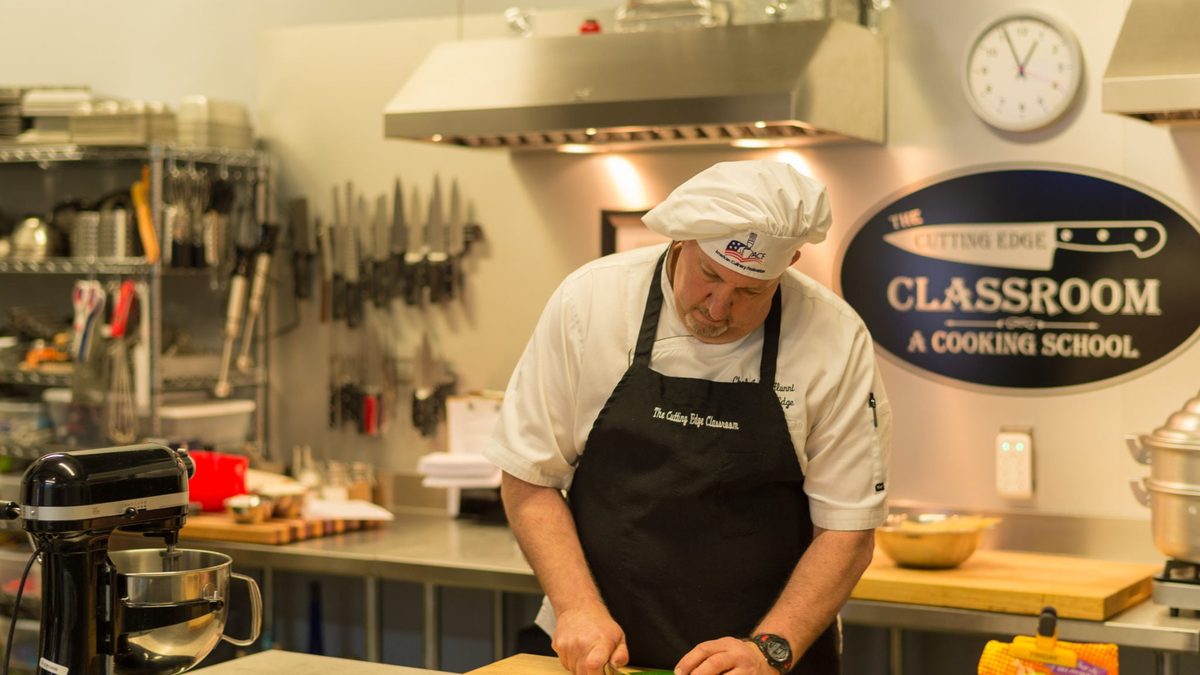
One of the basic truths of cooking in the early 21st century is that folks don’t learn it at home as much as they used to. This is foremost in Chef John Alunni’s mind as he guides The Cutting Edge Classroom cooking school in its goal to educate East Tennessee in culinary skills and introduce fun into the kitchen. Teaching was something he embraced later in life, after years as a professional chef. But he found that he loves being able to share with other people what he’s learned throughout the years. Alunni evangelizes cooking as an expression of the playful creativity fundamental to human experience.
How long have you been a chef?
For about 37 years. I started out in the military and worked my way up to restaurants and resorts. Then I got a hospitality degree and went to work as an executive chef. I got out of the kitchen for a while to come open an Earthfare in Knoxville. After a year, I decided to get into teaching culinary, which I was doing at UT until I opened this business. Photo by Keith Norris
Do you teach students how to follow recipes?
Recipes are a guide. I try to teach them to understand that a recipe is like following a map. We try to teach them enough technique and enough skill that they can prepare things without having a recipe in front of them, where they have to read it step-by-step. Especially with kids. I like them to experiment and to use their brains, and a little bit of their imagination. I think that doesn’t get enough exercise sometimes....
What precipitated your move into education?
As you get up in the years as a chef, you’ve got a lot of knowledge, but your body might not be ready for the 12-14 hour days. When I first started teaching, I did it for the easier schedule. Then I found it to be my love.
You appeal to a wide range of students with a range of classes.
We offered services first to kids. Their palates aren’t expanded beyond short order and fast food. Then we decided to try it with adults who want to up their game. Team-building is one of our many private classes. We had the whole Ice Bears team in for a burger challenge team-building event right after we first opened. We have a family that comes in and takes classes with us. We have a bachelorette party coming up.
What’s a good first step for someone who hasn’t spent much time in the kitchen?
Take a basic class or two, no matter where that is. Get an idea what it is you need to learn first. You have to know what you want to learn.
“You don’t have to be an artist, but imagination is one of the keys to cooking.”
→ Swipe for Next Story
FeatureMAY JUNE 2018
Trust Me
Story by Angelique Medow
One of the more shocking realizations my clients make is when they realize that they may actually have the exact traits they criticize in others. In this case, if we don’t trust others, chances are we don’t trust ourselves.
When we don’t trust ourselves to create and maintain a peaceful, respectful, honest environment, we may crave drama and busyness. This may distract and entertain us, and excuse us to act out of anxiety, anger, fear, and blame. As an old saying goes, “Drama soothes small-minded souls.”Need proof? Do we know anyone who makes excuses or “can’t help” being unaccountable (untrustworthy) due to drama?
When we can’t trust ourself, it is difficult to trust anyone. We may feel torn with the fear, pain, and drain of letting ourselves and others down. Maybe we said that we wouldn’t, but did. Maybe we criticize ourselves and think things like, “I screwed up again,” “life never gets better,” and “people are better off without me.”These thoughts and feelings drive us to withdrawal, isolation and symptoms such as anxiety, depression and the desire to escape life.
When we stop choosing drama and excuses and instead, make honest, healthy, and joy-filled choices, we begin to trust that we can and will take good care of ourselves.
How would it feel if we knew we could trust ourselves when we said, “No: I won’t eat that box of donuts,” “Yes: I drink one glass of wine a week,” “No: I won’t check Facebook at work” or “No: I won’t covet my neighbor’s stuff”? When my clients make their “no” mean no, and “yes” mean yes, they say they feel reassured, more peaceful, less stressed, and more capable of a “good life.”
We all have a weak area or two and could learn to trust ourselves more. To start building more trust with ourselves and with others, consider taking these steps:Accept that even though life may have always been a certain way, we needn’t be doomed to repeats. Allow ourselves to suspend judgment about our situation and ourselves. Instead of criticizing, give ourselves space to feel hope. Courageously pursue what’s best for deep health and self-worth. Ask within, “what is my deeper need here?” Listen to the answer. Ask within, “what healthy ways would fulfill the need?” Follow through. Do it and/or plan it immediately. Make sure to not allow untrustworthy behavior to continue—address it immediately. Either respectfully insist that the situation change, or exit the situation as quickly and kindly as possible.
Stress less, trust more. Will You?
Always with Love, Angelique
→ Swipe for Next Story
FeatureMAY JUNE 2018
Security
Story by Jon Hersey
The obvious place to start when considering your security is with your physical property. This might be your apartment or home. It might also include your business or the church or other community organization you volunteer at. Wherever you spend your time, a proactive posture toward security can be beneficial to you, family, neighbors, co-workers, and friends. And given the potential harms you can avoid, the time and expense of foresight is relatively minimal.
The first thing my parents did after their home was robbed while they were visiting me for Christmas was to install a security system. Although parsing through the numerous manufacturers, models, and features may at first seem daunting and undoable, the options—as with any appliance—fall into a few categories. Understanding the basics about these categories will make choosing a system as easy as buying a new washer and dryer. However, as with such appliances, I’d recommend leaving the heavy lifting—the installation and optimization—up to the pros.
Apples versus Oranges
If you’re like me, then you may tend to get a little hung up on the details: so much so that when you finally step back, you realize you’ve been comparing apples to oranges. A ten-thousand-foot view is a far better place to start.
Scott Brockamp—a security professional and owner of HIS Security in Knoxville—says that when you zoom way out on all the options, the most fundamental and important difference is whether a system is self-monitored or professionally monitored. This is crucial. The differences between these two are not like the differences between an automatic and a manual transmission. They are like the differences between a car and a bicycle.
How so? Professionally monitored systems employ security professionals—actual people—to respond to tripped alarms and other triggers. When an alarm is triggered, they know about it. And they can quickly assess the situation and, if necessary, dispatch police, fire, and/or emergency medical care. In short, the professionally monitored security system is a direct link between you and first responders, which maximizes safety.
On the other hand, self-monitored systems will alert, well…you. In essence, they are “self-awareness” tools. A tripped alarm or motion sensor will not result in someone checking in on you. Instead, it will typically result in a very loud alarm and likely a phone notification alerting you to check in onyou. In short, such systems are basically insular.
Nowadays, many offerings in the low-priced, off-the-shelf range are for self-awareness only. For instance, offerings from Canary—marketed as “total home security and intelligence”—do not offer professional monitoring. Don’t be confused by the fact that they enable users to pay a monthly fee to store and access videos, which are recorded whenever the system detects motion. This is great for checking on pets or ensuring that maintenance people aren’t messing with your stuff. The 90 decibel alarm is also very loud. However, the fact that product testimonials highlight trivialities such as how “sexy” it is should make you reflect on what it is you’re really getting.
Some self-awareness systems—Nest, for instance—are beginning to incorporate optional professional monitoring. This makes it a decent step-up option. If you’re young and broke, but you want something that can grow with you and which enables you to add professional monitoring when, say, you have your first kid, then this sort of hybrid may be your best choice. Security Consultant Fitting Camera To House Wall
Power and Connections
In security, as in politics, power and connections matter.
Just like any appliance, security systems run on AC power. Of course, that doesn’t help you much if the power goes out, or if someone intentionally turns it off. Not every system includes a battery backup, and not every battery backup will run for the same amount of time. Moreover, is the battery replaceable or built in? Will the system alert you when the battery needs to be replaced? These are some of the most important things to consider when choosing a system.
Unsurprisingly, battery backups and even battery-level monitoring are more or less standard features for professionally monitored systems. Scott at HIS Security even replaces customer batteries free of charge. And also unsurprisingly, many of the least expensive DIY, self-install options offer no battery backup option at all.
Along with power, you’ll want to consider how your system connects to the outside world. That is, does it connect via WiFi, cellular network, a hybrid of the two, or is it hardwired? As with computers, hardwired systems are quickly becoming obsolete. Why? Any jerk with wire cutters can inflict vital damage. Although this should set off the alarm inside the house, it will cut off further communication between the system and the outside world. So most new installs tend to incorporate wireless technology.
Among wireless systems, WiFi-only systems are the weakest contender. For such systems to be of any use in a power outage, you’d need a battery backup not only for your security system, but also for your modem and wireless router. As you might imagine, cellular-based systems communicate directly with a cellular network, avoiding this pitfall. Hybrid systems are—in some respects—the best. Such systems will connect to whichever network is fastest, but will fall back on the other if need be. However, this is only really important if you plan to go beyond the basics.
Beyond the Basics
Integrated systems now go far beyond the standard alarm, giving you more information and control than could be expected from the home of the Jetsons. Want to be instantly connected via video chat with the person ringing the doorbell? That’s possible. Want to unlock the door remotely or give them a code to unlock it themselves with an expiration date and time that you specify? You can do that too.
Although these touches are cool and incredibly convenient, automated safety mechanisms are even more powerful and important. Take the ADT Pulse system, for instance. If the fire alarm goes off, the fire department will be immediately notified. Better yet, integrations with the Pulse allow you to automatically unlock doors and even turn off the HVAC to prevent circulating smoke.
Some systems, such as those offered by Alarm.com, integrate the full sweep of smart home amenities, allowing you to manage a host of automated devices including locks, lights, cameras, HVAC, and your garage door. You can even integrate motion sensors that will snap a photo when triggered and moisture sensors that will alert to check for leaks.
When exploring these options, it’s important to get clear on the full scope of everything you need and everything you might want a year or two down the road. The ideal is to stick with one manufacturer and hopefully one app interface. Patching together systems is not just inconvenient. It drastically limits the number of operations that you can automate. For instance, a motion sensor and a smart light bulb from the same manufacturer can be set up so that the light turns on when it detects motion say, in your kitchen. But mixing manufacturers makes such integrations cumbersome or impossible. Sure, there are apps such as IFTT (if-this-than-that) that allow you to integrate components from various makers. But these are open-sourced; anyone can write the code and post it for all users to take advantage of—or to be taken advantage of by using it.
So why is a hybrid (WiFi + cellular) connection best for use with these more advanced systems? In East Tennessee, cellular connection can be spotty. If you want to check out your front door camera, for instance, you’ll want to stream video over whichever network connection happens to be strongest. For some, that’s WiFi, not cellular.
What About My Valuables?
Maybe you’ve got a valuable work of art, a vintage guitar amp, a priceless family possession, or the largest flatscreen in town. If you do, you might want to know if someone moves—or removes—it.
Some security systems enable you to incorporate small wireless pucks that can detect motion. You can also purchase standalone GPS trackers to attach to such valuables. Nowadays, many of the options are optimized for use on a keyring, but what’s to stop you from using it elsewhere?
With this lay of the land, you should be a lot more prepared to select the best option for your needs. That said, you’ll still be bombarded by a wealth of minutia to consider. What should you do if you’re confused? Scott at HIS says, “Don’t be afraid to reach out to local experts and ask questions. I hear people all the time say, ‘Well we didn’t want to call and ask you because we weren’t going to buy from you.’ Part of our philosophy is that we want to help educate.” It never hurts to ask, right?
→ Swipe for Next Story
FeatureMAY JUNE 2018
Vino Veritas
Story by Hannah Overton
Blue Goose Vineyards is a small slice of Appalachian heaven. Not far off of the main streets of Maryville, TN, sitting on a hill behind a quiet residential area, is a farm complete with vineyard and livestock. The tasting room itself has the traditional high bar and a small shop filled with wine-inspired gifts. Blue Goose is a family business, with wines either made made entirely from grapes grown on their farm, or with grapes from other Tennessee vineyards.
Their Foothills Kiss muscadine wine is the real deal. Growing up, I frequently visited my grandfather in south Georgia. He owned land with chickens, grew a vegetable garden, and most importantly, tended his own muscadine vine. Every muscadine wine I’ve ever tried tastes like it came straight from concentrate compared to the fruit itself. But the folks at Blue Goose get it right. The flavor of their Foothills Kiss is true to the fruit and the sweetness isn’t overpowering.
As far as their other wines, Vinny’s Special Red appeals to the red wine lover in me; but one of the biggest surprises I had awaiting me at Blue Goose was their fruit wines. Both of their fruit wines, their Blackberry Blue and Rosie’s Raspberry, are good choices to take home when you pay them a visit.
The grounds of the farm at Blue Goose is home to several cattle and a donkey. They aren’t shy in the slightest, and are always ready for a photo with visitors.
I walked away from Blue Goose Vineyards feeling a true connection to the corner of Appalachia that I call home. There you have the unique opportunity to see the idea of farm-to-table living in action. Their fully functioning farm and vineyard echoes a simpler time when you ate and drank what you grew. With their friendly livestock and homegrown wine, Blue Goose Vineyards is an experience the whole family can enjoy.
Spout Springs Estate is a hidden gem in the middle of Grainger County. A friend recommended it to my fiancé and me when we first started looking for a wedding venue. You exit the interstate onto Rutledge Pike and drive until you think you must have missed your turn. You wind down curvy back roads and past abandoned buildings and old junk yards until you now know you must be lost. But then you see a welcoming sign telling you there’s a winery around the bend. The iron gate that greets you at the entrance is akin to a manor you might find in the English countryside. The winery itself sits at the top of a high hill overlooking a 360° view of some of the most gorgeous valleys and distant mountain views I have ever seen in East Tennessee— and this is coming from a local, born and raised. When my fiancé and I went to visit, we didn’t exactly know what to expect, but as soon as we saw the view, we knew we wanted to begin our married lives together with that as the backdrop.
Spout Springs Estate is more than just a winery on top of a pretty hill. It’s a life-changing experience. Owners and winemakers Chuck and Alice take great pride in their wines. Alice and I had exchanged plenty of emails to schedule our visit, and when we walked up to the big house, she ran out of the door and gave me a huge hug. At Spout Springs Estate you aren’t just a visitor or a client, you’re family.
If their hospitality wasn’t enough reason for you to visit, their wine should seal the deal. Each sip you try in their tasting room brings you more into their corner of the world, and each bottle you buy is a work of art. Chuck talks about the flavors in his blends as if they were colors gracing a canvas. They have many options: dry red, dry white, semi-sweet, and sweet. Some are more traditional, like Cabernet Sauvignon—a must if you’re even remotely a Cab fan. Others are custom takes on classic blends, like their Smoky Mountain Rose and Magnolia. The grapes these wines are made from grow right on their property, and their wines have even won regional awards.
A personal favorite of mine is their Scarlet. This sweeter red blend is named after the rescue border collie that lives on the property. I’m inclined to love the wine simply because it’s named after a dog, but much more than just the name makes this wine something special. The sweetness of the wine itself is balanced well with their practice of aging it in Appalachian Oak. This gives it just enough spice to please my palate that usually prefers a dry red.
After you finish a tasting, buy a glass—or a bottle—of whatever you like best and take in the sweeping views while enjoying their wine-barrel fire pit. You’re certain to meet Scarlet the border collie and have countless good conversations during your time there. Much to the joy of my fiancé and myself, Chuck and Alice rent Spout Springs Estate out as a wedding venue on the weekends in the warmer months of the year. In their words, they like to make wine and make people happy, and from their award-winning wine to the amount of weddings they host each year, I would say they’re doing a good job of living up to that philosophy.
The Winery at Seven Springs Farm is tucked away in Union County. To get there, you have to drive through winding roads in the hills and pass quaint communities that echo the setting of The Waltons. When I first visited, they were having a full-blown party with a food truck, a live band, and a crowd of wine enthusiasts. If the weather had been pleasant I might have expected this kind of reception on any given weekend at a local winery, but the rain was pouring down and a thick chill was in the air. The gloomy day in no way interfered with the winery’s weekend plans, though.
One of the first things you’ll notice about their tasting room is that it isn’t just a tasting room. They sell vegetables, meats, cheeses, milk, and many other odds and ends. They are a fully operating farm and sell their own products at the Farmer’s Market in town every weekend during the warmer months, but also collaborate with other local farms such as Sweetwater Valley Farm—we all know how well wine and cheese pair together—and Sunrise Dairy out of Crossville, TN. They even hire a local artist to create the artwork featured on each of their wine labels.
Seven Springs Farm has 14 wines to taste, several of which are estate wines made from grapes growing on 60 of their 400 acre, family-run farm in Union County. Their estate wines include their Farmhouse White, Rooster Red, Vineyard Blush, and Pink Bubbly—one of the wines Seven Springs is most proud of. It recently won awards for Fruit of the Year, Wine of the Year, and Sparkling Wine of the Year in Tennessee. It has one of the best blush flavors I’ve ever experienced in a wine, and the same exciting thrill found in a good bottle of champagne.
A special treat that Seven Springs had set up in their tasting room is a frozen wine option. There are two different options: Margarita made from their James’s Peach wine, and Blueberry Pomegranate made from their Royal Blue wine. I couldn’t decide between the two, and that’s when I found out they were happy to swirl the flavors. Even on a cool and chilly day I was still able to enjoy this frozen treat, so I can only imagine how refreshing it could be on a summer day.
The general air about the property at Seven Springs was one of excitement on the day I was there. I knew no one, but the staff still chatted with us about their wine and everything the farm has to offer like they had known us our entire lives. The winery often hosts special events throughout the month, including options like Girl Scout Cookie pairings and trivia nights. Their emphasis on community collaboration breathes life into Union County. Needless to say, they offer a full-bodied, social, and lively East Tennessee experience for any wine lover.
Visiting wineries in East Tennessee is easily one of the most relaxing activities I’ve found in my adult life. These establishments combine my passion for wine with the East Tennessee home that I love. They involve beautiful drives through the countryside with views of the mountains, and I never know who I’m going to meet or what kind of conversations I’m going to have. Each of the wines I’ve tried is an experience all its own. Sometimes it reminds me of pleasant childhood memories spent in the heat of a Georgia summer. Other times it sparkles in my mouth like a kiss after midnight on New Year’s. But there is one thing that’s true every single time: East Tennessee wineries are about more than producing wine or making money—they’re about a community and a lifestyle. Each winery I visited mentioned at least once the importance of enjoying the simple things in life: happiness in love, treasuring family, and always reminding oneself of one’s roots. All necessary reminders in this busy life that what is simple pairs perfectly with a glass of East Tennessee wine in hand.
→ Swipe for Next Story
VeteranMAY JUNE 2018
Wounded Warriors
Story by Chrissy Keuper
Terry’s company office bears the hallmarks of a busy person who knows how to unwind: Working papers on the desk; photographs and awards carefully placed; a giant rack of elk antlers on the wall. He’s the owner of Real-Time Construction in Knoxville and spends his weekdays working on various construction projects. Hotels, churches, homes… You name it: He’s worked on it. “We’re pretty flexible,” he says. Terry Lewis and his wife, Jane, grew up together in Southern Illinois. They met in grammar school, remained friends throughout their young lives, and have been married for 46 years. They married right before Terry left for Japan, during the Vietnam War.
He joined the US Air Force in 1971, during the draft. “The civil service person lived directly across the street from me.” He smiles. “My class had 100 males graduating. My draft number was 18, so I knew I’d be drafted, it might as well have been number one, so I went ahead and signed up, rather than waiting. I knew I could get a tool belt rather than a gun.” Terry boot-camped at Lackland AFB in Texas and trained at Chanute AFB in Illinois. After he and Jane got married in April, 1972, he was sent to war base camp at Beale AFB in California for deployment to Kadena AFB on Okinawa, Japan.
The hostilities in Vietnam and most of Southeast Asia were in full swing when Terry arrived on Okinawa. “I had a tool bag. I was on the ground working seven days a week, 12 hours a day. They were flying bombing missions over Hanoi and the Ho Chi Minh Trail and we were working on the re-fuelers. The tankers were stationed at Kadena. I was doing heating, air conditioning, and pressurization, which is called Environmental Systems.” Terry remained at Kadena until he was out of the Air Force in 1973 and he’s glad he never saw combat. “I did my job. When you look at the big picture, you’re protecting America and it’s more than one person, it’s more than a guy with a gun. Somebody has to keep the planes flying, keep the boats floating, feed the troops… Everybody’s got a job to do. I don’t regret not seeing combat at all.”
Terry brought his newfound mechanical skills and an expertise in organization home to Illinois. He and Jane moved in with family for a couple of months while he worked in plumbing, heating, and air conditioning. “I got a lot of training and I got a molding of my personalities, I guess you could say. I was taught line-item authority; you answer to the next person in authority and you do what they tell you to do or there are serious repercussions. You know they cut off everyone’s hair, so that everyone’s alike. They take away who you are and then they give it back to you, in a different way.” Though the training he’d received on base didn’t directly apply to residential HVAC work, Terry’s organizational skills, experience in a chain of command, and respect for authority lent themselves to the serious work ethic required to run a business. A small general contractor gave Terry an opportunity to play various roles on construction projects and to learn anything he could about construction. “I’ve done just about everything you can do in this industry.”
Those are the weekdays. The Lewis weekends are another story entirely.
A Special Place in the Mountains
“I like to ride dirt bikes. We moved down here because of dirt bikes.” Terry learned to ride in the Air Force. “In Illinois, it’s farmland, it’s flat. You can go fast for a long way, but there’s no challenge to it.” In 1978, he came to Tennessee to visit an Air Force buddy who lived here and they biked in Campbell County, at what is now Royal Blue ATV Resort. That trip changed the direction of Terry and Jane’s lives. “The riding was so spectacular and so big and endless, it was extremely challenging. I thought, ‘This is what I want to do.’” He made four or five trips back to Campbell County until 1980, when he and Jane and their two children moved to East Tennessee, permanently.
They wanted to buy a piece of land where they could camp and ride, and Terry says he was just looking through the paper one morning in 1993 when he came upon an ad for what sounded like the perfect spot. “For sale by owner. I called him up. He told me to go look at it. I paid him some go-see money. I got some partners together and we bought it and we still own it, after all these years. There’s three of us, now. There were five.” He and Jane own 750 acres of mountainous land, adjacent to the North Cumberland WMA and OHV Riding Area and they spend their weekends in their farmhouse; Terry doesn’t ride his dirt bike anymore, but he still spends lots of time out on the land. “When you go out our back gate, you have 150 thousand acres of public land. You can go out and camp, ride dirt bikes, go turkey hunting, go deer hunting… public land. It’s really nice, mountainous, scenic, remote, all the things that we enjoy.”
And they like to share this beautiful, private spot with others. Often. The events that they sponsor include hundreds of people who all come out to enjoy the outdoors and to take part or to support someone who’s taking part in the event. An example is the JAKES (Juniors Acquiring Knowledge, Ethics, and Sportsmanship) program started by the
National Wild Turkey Federation. Jakes are juvenile turkeys and the NWTF sponsors outreach events all over the US for young people. Terry is Vice President of the Pine Mountain Longbeards Chapter of the NWTF and the President of the Campbell Outdoor Recreation Association; it’s a natural fit for these events to take place on the property that he and Jane love to share. “Sometimes, we take kids turkey hunting. On JAKES Day, we take 225 kids fishing, sometimes more. Youths, from seven to sixteen [years of age]; we’ve been doing this eight, nine years? I don’t even know how long. We target kids who are disadvantaged: they may have a mom and no dad; they may have families that are not financially in a position to take their kids to do things.”
Terry hand-picks the guides who accompany the children around the property on the hunt. “They show up at four o’clock in the morning, we feed them, we pair them up with the guide that I’ve selected for them, we put them in a Polaris Ranger, we take them up on the mountain and put them in a blind with the adult who controls the firearm and the calls and the decoys. Last year, we had 12 kids and most of them had never been out in the woods before.” This year was the first year that the young people taking part in the event were able to stay the night on the property, along with family and friends. Terry has had cabins built and there are other camping areas and a bunkhouse, as well.
Another event is the award-winning, annual Wounded Warrior Ultimate Turkey Hunt (in its 14th iteration, this year), held on Terry’s property and a neighboring property belonging to Ron Cunningham. This experience is open to wounded veterans from Fort Campbell and all over East Tennessee and other disabled hunters of all ages. “We take 26 at a time, we split them up: Half are at Ron’s place, half are at ours. Most of them are wounded veterans, but the gap between the number of veterans and the full 26 is made up of disabled hunters, mostly kids. A lot of these guys are in wheelchairs: some have no arms, no legs. We do a meet-and-greet on Friday night, a fish-fry, we have music and fellowship, and nobody pays anything for the weekend because we get sponsors to support the events.” Sponsors include private donations and sponsorships, as well as help from the NWTF, the Rocky Mountain Elk Foundation, and the Tennessee Wildlife Resources Agency, to name but a few.
“By ten or eleven o’clock Friday night, most everybody’s in bed, because guess what? In about four hours, 0-early-thirty’s gonna happen to you.” About a hundred people participate in the hunt over the weekend, which include hunters, guides, and an all-important support staff of volunteers. “We’ve had people who had to be catheterized, in the field. All different afflictions, we’re ready for anything.” The logistics of an event like this cannot be overanalyzed and Terry takes that duty on, himself. “There’s a lot of thought that goes into teaming up the right guide with the right hunter. It takes the right kind of guide to spend the day with a guy who talks real loud instead of being calm in the blind and the guide might also have to help him go pee. There’s serious strategy that goes into who goes with
who and where they go and how hard is it to get that guy in his 400-pound power chair 700 feet up the mountain? It’s pretty complicated.” The end results remain the same, year after year: they put the wheelchair in the bed of the ranger, they get everyone mobilized, and they head out on the turkey hunt.
Lots of guides and volunteers return every year. “There’s a pretty large demand to be a guide, because it’s a pretty emotional event. There’s a lot of people who are adamant to be a guide; they want to give back.” Over the years, a diverse group of people have served as guides (Jared Effler, Tennessee District Attorney General for Campbell, Claiborne, Fentress, Scott, and Union counties is among a number of repeat guides) and Terry says he gets “a feel for their level of calmness and maturity”; after an event, he pretty much knows who will be coming back the next year. Terry says it’s a very nurturing environment and more people attend every year. “We’re blessed. I’m gonna knock on wood, here. It’s a joint effort among five major conservation organizations. It’s special.”
“Hunters are conservationists.”
Terry and Jane have both won numerous awards for the fundraisers and events they hold on their land, for their work in bringing elk to Tennessee, and in habitat enhancement projects, like the Hatfield Knob Elk Viewing Area. Elk were reintroduced to that part of Tennessee in 2000; Terry volunteered on trips transporting elk from Kentucky. As part of that reintroduction, Terry and Jane oversaw a project with the TWRA to clear an area of the North Cumberland Wildlife Management Area for a meadow, to plant crops for the wildlife, and to build a viewing tower. The tower on Hatfield Knob, built in 2005, stands at the heart of a 670,000-acre elk restoration zone that includes the NCWMA and is legendary among wildlife observers as a premium spot for viewing elk in Tennessee.
Terry loves working in conservation and he enjoys being around those who feel the same about the projects involved in that effort, such as Turkey Hunters Care and Hunters for the Hungry. Those organizations provide food boxes at the end of the year for people in the area who are going without meals. He and Jane are focused on and committed to sharing their love of the outdoors and to giving others part of what they have built in their lives. “Why would you not?”