Departments“I have recently received a subpoena filed by my neighbor summoning me to court for my dog running loose. I am concerned they will take my dog and do God knows what…” —Dennis
Features
JurisprudenceGood Deeds
InsightsJust Jokin’
FeatureFace the solution
FeatureAn Exercise in Practical Living
FeatureCurb appeal
Non-ProfitThe Institute at Tremont
Top Attorneys2020 Top Attorneys
FeatureBill Regas
VeteranProblem Solver
FeatureThe Storyteller
Reading Settings
100%
July / Aug 2020
Swipe to read →
Vol. 36 · Issue 4 | July August 2020
The PublisherFrom the publisher
Departments
Arts & CultureBuilding Joy
DepartmentsNew challenges
PoliticsThe Law and ICE
InsightsCoping with COVID
DepartmentsHitting the Road in Droves
DepartmentsNeighborhood Spirit
Dining GuideFresh-baked goodness
Departments‘Fur’-ever friends
Departments“I have recently received a subpoena filed by my neighbor summoning me to court for my dog running loose. I am concerned they will take my dog and do God knows what…” —Dennis
Features
JurisprudenceGood Deeds
InsightsJust Jokin’
FeatureFace the solution
FeatureAn Exercise in Practical Living
FeatureCurb appeal
Non-ProfitThe Institute at Tremont
Top Attorneys2020 Top Attorneys
FeatureBill Regas
VeteranProblem Solver
FeatureThe Storyteller
→ Swipe to start reading
The PublisherJULY AUGUST 2020
From the publisher
Story by Nathan Sparks
I am standing next to a large riding arena on a farm in Blaine. The melodic putter of a tractor as it passes back and forth, softening the arena for the evening’s event, is a pleasant reminder of why I love the East Tennessee country. The man approaching me has the build of someone who works the land, his eyes shadowed under the brim of his white Stetson.
The man extends his hand and without a second thought I take it, returning the firm grip with one equally as firm. “How are you today, Nathan?” The distinctive Southern twang is a comfort to my ears. At the moment, concerns about social distancing and viruses and face masks are far away. All that matters is a friendly conversation, the tranquility around us, the scents that come with being outside.
I am at home in East Tennessee. These are my people, and I am proud to live here. Their connection to the outdoors and to what it means to work the land is something to be admired, and I feel blessed to be a part of that.
My friends who are life coaches and counselors say depression and addiction are on the rise. I can’t help but wonder what people do all day that brings on such a sense of despair. If they are sitting in front of the television or computer screen and listening to the constant chatter of how the world is about to end, well, that would depress anyone. So if that’s you, then it is time for a change.
Most people don’t live on a farm like the one in Blaine, but almost everyone has enough space for a garden. And even 30 minutes in the garden caring for your plants is awesome therapy. There is something special about tending living things, even if they’re green and don’t have fur. And it seems like the more you love on them the bigger and better they grow, and that’s probably true for just about everything we choose to love.
The Bible says “Faith is the substance of things hoped for and the evidence of things not seen.” The garden’s a great metaphor for that. We plant seeds and seedlings and imagine flowers and vegetables. As we move through this pandemic, I lean on the message the garden relays and have faith that through it all we will grow too.
→ Swipe for Next Story
Arts & CultureJULY AUGUST 2020
Building Joy
Knoxville furniture maker mixes modern vibe with traditional techniques
Story by Susan Alexander
You know when you walk past your very favorite painting, and you smile? That’s how Alex Jaynes wants his customers to feel about his furniture.
“The function of the piece is extremely important, but I do see it as art,” he says. “I want people to get a sense of pleasure and emotion from what I’ve made. A dining room table is a big piece and a big investment. It’s something you’ll have your whole life. I want it to bring joy to the people who own it.”
Jayneshas been building custom furniture for homeowners and restaurants in the Knoxville area for two and a half years. With a degree in industrial design, Jaynes previously did design work in Boston and, prior to that, worked for NASA in Huntsville, Ala. He said the work he did there influences his woodworking today.
“My work at NASA was all about the interaction between technicians and the machinery. I studied how people actually do things, how they interact with their space. And I incorporate that same thought process into the furniture I design.”
Jaynes shares work space with other woodworkers and craftspeople atAble Tradein the Jackson Terminal Building in the Old City. Each one leases space and equipment usage from Spencer Ratlilff, whose woodworking company is called Old North Designs.
Jaynes calls his work “modern furniture thoughtfully made.”
“I like clean simple lines,” he says. “I use traditional joinery techniques so they’re put together in a way that lasts. There’s a handmade vibe to all my pieces.”
→ Swipe for Next Story
DepartmentsJULY AUGUST 2020
New challenges
Cultural organizations strategize for a different future
Story by Chris Freeman
“Baptism by fire” is a phrase I’ve heard a few times too many during the course of the COVID-19 pandemic. I started as general manager at Flying Anvil Theatre in February. On March 16th, we made the official decision to suspend operations. Since then, we’ve been working from home — plotting, strategizing, and trying to move forward. We’re still creating even though our patrons have stopped entering our doors. The struggle is real.
Like many other local cultural organizations, we’ve had a lot on our minds. How do we stay relevant? Is there work to be done? When is the right time to open? Should we create? How do we survive?
Those questions have both consumed our souls and forced us to innovate. All of our past knowledge about who our audiences are, what they want, and how we interact has changed. Flying Anvil, along with organizations like Ijams Nature Center and The East Tennessee History Center, have taken to online platforms to bring content to our community. We’re engaging our audiences where they now work and socialize, and we hope to find some new members in the process.
Our cultural organizations remain as important as they were before. Along with local businesses and the Knoxvillians who support them, they are the heart and soul of this scruffy little city. We love our festivals, marketplaces, events, and assorted gatherings on Market Square. It’s easy to feel disconnected without them; I know I do.
I also know that as organizations reopen, we’ll be doing our best to keep you safe. We’ll have new measures in place, and we’ll communicate them to you.
But here’s the thing: cultural organizations are going to work differently now. There’s too much uncertainty, too much ‘newness’ around. Everyone’s lives are fundamentally different, and we must be able to respond. Agility is king, and we can’t operate like we were pre-pandemic, it simply won’t work.
It’s almost like we’ve all been baptized by fire. We were planning for a future we thought we knew, but, instead, we’re finding new ways of tackling new situations. No one asked for it, but I think we’ll all come out stronger in the end.
→ Swipe for Next Story
PoliticsJULY AUGUST 2020
The Law and ICE
Spangler protects citizens, enforces law by renewing agreement
Story by George Korda
Some months ago, I was in a social media conversation with a then-city government official on the topic of illegal immigration. Liberal politically, he complained about President Donald Trump’s efforts to close the southern border to people illegally entering the U.S.
His points included, generally speaking, that people coming here against American law are looking for a better life.
On that basis, I asked him which local laws people can break with his similar approval if the person is looking for a better life?
I didn’t get an answer: He broke off the conversation.
A similar dynamic swirls around Knox County Sheriff Tom Spangler’s decision, made known in May 2020, to renew the county’s 287(g) program agreement with U.S. Immigrations and Customs Enforcement (ICE).
ICE describes the program, in part, as a “force multiplier in the identification, arrest, and service of warrants and detainers of incarcerated (emphasis added) foreign-born individuals with criminal charges or convictions.” Under 287(g), the sheriff’s department checks the individual’s immigration status; if the person is in the U.S. illegally, ICE can issue a detainer. An immigration judge ultimately makes the decision concerning deportation.
Sheriff Spangler is adamant that no one is arrested solely for being in the country illegally; ICE is contacted only when someone is arrested for another crime.
Opponents of 287(g) maintain that breaking the law to come to the U.S. doesn’t merit people being reported to ICE if, once here, they’re subsequently arrested for breaking another law.
For example, the website of the Allies of Knoxville’s Immigrant Neighbors (AKIN) says the group “believes that 287(g) and other forms of police-ICE collaboration threaten the well-being of our community. The vast majority of immigrants held in the Knox County Jail were arrested on nonviolent misdemeanor offenses. Because of 287(g), these misdemeanor offenses may result in major immigration consequences for immigrant residents of our community.”
That’s a long way around the barn, as we say in Tennessee, to say that people who break immigration law might face immigration-related legal consequences if they’re arrested on other charges. Furthermore, the reality is that once here, some immigrants commit crimes, from traffic violations to murder. A small number? Yes, but it happens.
U.S. immigration law sets out on first offense fines, imprisonment up to six months, or both, for any alien who attempts entry into the U.S. at a time or place other than designated by immigration officers, eludes examination or inspection, or provides false information.
It’s a tough sell for many Americans to line up behind the idea that someone who broke the law to come into the country shouldn’t be held accountable for doing so if they’re arrested for another crime. If an American is stopped for a traffic violation, no arrest takes place; however, the officer will check to see if there are outstanding warrants on the driver. If the person says, “But I don’t agree with that law,” it’s unlikely the officer’s response will be, “In that case, move along, nothing to see here.”
It’s understandable why people in impoverished countries would want to come to the U.S. If the choice is between doing better for their families vs. running the risk of capture, many Americans would be swimming, digging, running, or pole-vaulting over the border. But that doesn’t make it legal.
Politically, it’s a tough sell to motivate a majority of citizens to accept “looking for a better life” as a reason why the sheriff’s department shouldn’t be in contact with ICE. Neither are the arguments that most people here illegally are working, paying taxes, doing the jobs Americans don’t want to do, etc.
From a public perception standpoint, Spangler may be doing too much explaining. A simple statement that he’s doing this to better protect the citizens of Knox County, and that obeying the law applies to everyone, citizens and aliens alike, is probably all he needs to say.
Americans appear to compartmentalize these issues. They generally feel compassion for people looking for a better life. Nevertheless, they also don’t agree with people breaking the law, particularly if they’re here illegally and arrested for another crime.
If someone wants to run against Spangler on this issue, the chance of them achieving a better life as sheriff is non-existent.
→ Swipe for Next Story
InsightsJULY AUGUST 2020
Coping with COVID
Pandemic’s far-reaching effects will linger over many aspects of life
Story by Bruce Fox
There is no question about the importance of social interaction. Many people who are doing their best to follow the safety guidelines surrounding COVID-19 are finding themselves shut away from those who are an important part of life. My wife Mary Jane and I have been blessed with a rich social life and have a tight group of friends with whom we gather once a week. Since the start of the pandemic we have not been able to meet at restaurants and for a time we didn’t meet at all. We have recently been able to sit on the patio and maintain distance so we can have some contact—and it has helped. The same applies to the office where we have adhered to the guidelines.
When it came time for everyone at the office to weigh in on working from home or not it was unanimous—come back to the office. In many businesses much will be lost if contact is only via phone or internet. There is an important aspect to the connection you get in face-to-face meetings. But there are concerns among employers about liability, and I think if an employee contracted the virus at work there may be a worker’s compensation claim.
In my mind the bigger question relates to the temporary closing of so many businesses. There are certainly constitutional issues and the question of whether the governor and elected officials really have the authority to force businesses to close. I also wonder about the possible penalties for those who choose to ignore the guidelines. Some businesses like small restaurants may never recover, and I suspect there will be lawsuits. Even though the federal government did try to help with loans.
As hospitals grappled with COVID-19, many people were unable to receive medical treatment for emergent conditions such as heart disease or cancer. Many are likely to suffer earlier deaths due to lack of medical care, and there is little that can be done about that. Long term this will have a large impact on our society. And it’s not over because people fear going into waiting rooms where they cannot appropriately space. Medical professionals are doing their best to have safe practices.
And access to the legal system has also crawled to a halt, especially for jury trials where it is difficult or impossible to seat 12 people in an appropriately distanced manner. We are definitely experiencing the snowball that turns into an avalanche as it rockets down the mountain. Both locally and worldwide this pandemic will certainly have long term negative effects on society. What we can all do is respect the safety guidelines and wear our masks.
→ Swipe for Next Story
DepartmentsJULY AUGUST 2020
Hitting the Road in Droves
Story by Susan Alexander
From Connecticut to California, RV dealerships are seeing an increase in both sales and rentals as the coronavirus keeps us apart. The same holds true in Tennessee.
Leland Waggoner, owner of Chilhowee RV Center, has seen an uptick in sales since the governor lifted stay-at-home orders in the spring. “March and April are traditionally the start of our busy season,” he said. “So it may just be pent-up demand.”=
Certainly he thinks safety concerns are leading people toward RVs. “You have the safety of your own little cocoon —your own bed, your own bathroom and kitchen. People think it’s a safer way to travel. They don’t want to get on airplanes, and they’re hesitant to stay in hotels.”
Nationally, a lot of recent purchasers or renters are new to driving RVs. Nick Wright, owner of Unlimited RV in Jefferson City, which rents travel trailers and motor homes, says about 86 percent of their customers are new drivers. A special license is not required. Among the challenges they might encounter: Driving too fast. Wind speeds and traffic going by can have huge effects that you don’t feel in a regular vehicle; leaving awnings up in windy weather can damage or destroy them; and miscalculating clearance. You don’t want to turn it into a convertible at the first underpass.
Traveling in an RV doesn’t necessarily mean you’ll spend less than you would on other forms of travel. Purchasing a vehicle can easily run into six figures, rentals generally cost between $100 and $300 a night, and gasoline and campground costs increase the expenses even more. So don’t expect to save money on an RV trip.
RV users encourage rookies to have a written checklist of tasks that must be accomplished when getting to a campsite or leaving it. This guarantees you don’t miss an important step and do them in the correct order.
A final concern might be finding a place to stay. States have different schedules for reopening campgrounds. Before you go, make sure you can stop.
→ Swipe for Next Story
DepartmentsJULY AUGUST 2020
Neighborhood Spirit
Cazzy’s Corner Grill brings a lively take on classic American cuisine to Northshore Town Center
Story by N. Brooks Clark
Before the pandemic shutdown, Cazzy’s didn’t do much take-out. Rather, it made its name on relaxed business lunches, as an after-work watering hole, and as a comfortable hangout for Northshore Elementary School families. (It was named for the original owner’s daughter.)
But in the weeks when the dining room was closed, “We had crazy to-go business,” says Kitchen Manager Annie Fletcher. “It’s what’s kept us alive.” Something about the thought of the Bison Burger with Tillamook cheese, sautéed onions, garlic aioli, tomato, arugula and broccoli crowns (to name just one popular dish) kept patrons phoning in their orders. Now that the dining room is open again, Cazzy’s is finding, as we all are, a new normal. We know that many of our readers are looking for places to dine where management has made every effort to keep customers safe, and Cazzy’s does an excellent job.
With its leafy perch on the corner of Northshore Drive amid the quaint shopfronts of Thunderhead Road, Cazzy’s makes great use of its wraparound patio area. Behind plate glass windows, the L-shaped dining and bar area is small enough to feel intimate but spacious enough to give a sense of openness. We were happy to dine outside on a nice late spring afternoon and remarked how perfect this is for an after-work drink and appetizer as well as a full meal.
Among the starters and salads, patrons can’t resist the house-recipe orange hummus topped with fried chickpeas, with scrumptious flatbread and a tzatziki Greek cucumber yogurt sauce with just the right amount of dill. It comes with a fresh and crunchy assortment of veggies perfect for dipping. Other favorites are the Unique Mushrooms in beer batter with a creamy horseradish sauce and a jumbo lump Crab Dip with flatbread.
Cazzy’s is wonderful for a group of friends, as everyone will find something to their taste. There are burgers and chops for the carnivores, chicken and fish for the lighter side, and a robust selection of pastas, salads, and veggies for the folks on a plant-based diet. All are prepared with care and a flair for the “5th flavor” that distinguishes a great chef.
A perfect roast chicken is often used as the measure of a chef, and Fletcher’s Rotisserie chicken with demi-glace is a classically prepared dish. Pair it with some “frites” and you’d swear you’re in Paris. Another classic is the Chicken Piccata—served with just the right amount of lemon, briny capers and savory artichokes. Seafood dishes like the Cajun Etouffee of blackened cod and crawfish atop beans and rice, the Blackened Codfish Sandwich, and the Fish and Chips in Fanatic Brewing’s Red Ale beer batter reflect Chef Annie’s 10 years at Chesapeake’s, when she moved up from server to chef. “I cut down a lot of fish,” she says with a smile. “With our Cajun flavors, we are bold.” There is just the right amount of heat to allow the flavors of the cod to shine through.
Fletcher grew up all over the country, including two stays in Hawaii—both her parents were in the Navy. Fletcher was recruited to play shortstop/second baseman for the Lady Vols in the pre-Megan Abbott era. “We got good right after I was done,” she says, angling the corner of her mouth in a half McKayla Mulroney.
With her wry wit, trademark newsboy cap and glasses, Fletcher resembles a wiry Tina Fey and brings that spirit to her kitchen and staff: “We’re all about casual dining.” Graduating from UT with a bachelor of fine arts in drawing, she waited tables at Patrick Sullivan’s Saloon before joining Chesapeake’s, playing for women’s traveling softball teams for eight of those years. She joined the Cazzy’s team of General Manager Aaron Smith and Owner Rob Goebel three years ago.
“Everything is fresh,” says Fletcher, seafood, meat, and vegetables. Many diners like to start with a Mediterranean Bowl of quinoa, spinach, avocado slices, red onion, tomato, olive, goat cheese, and cucumber. The freshness comes through in the Chimichurri Pork Tenderloin. It’s 10 ounces of achingly tender grilled pork with tangy herbed new potato salad and arugula. In the chimichurri sauce, the cilantro, parsley, and oregano are enhanced by sherry vinegar and red wine vinegar. The Shrimp and Grits—with andouille sausage, mushrooms, onion, tomato, sherry cream sauce, and super-creamy pimento cheese grits—ranks among the best in our area.
Make sure to cap your visit with the Panna Cotta, a generous dome of honey-flavored sweet-cream set in a pomegranate sauce with pistachio bits, milk crumbles, and whipped cream.
With starters averaging $11 and house specialties between $17 and $25, with a center cut filet at $34, Cazzy’s fulfills the promise of a neighborhood restaurant that families can enjoy on a reasonable budget.
→ Swipe for Next Story
Dining GuideJULY AUGUST 2020
Fresh-baked goodness
Local bakeries tempt us with an array of breads and desserts
Story by Susan Alexander
You’ll know you’ve arrived at one of these diet-busting establishments before you ever enter the premises. The fragrances of sugar and cinnamon, of butter and yeast will greet you before you open the door.
Though several local businesses specialize in producing one particular baked product — pies or cakes or donuts, for instance — these bakeries offer a variety of goods to choose from, both sweet and savory.
Loosen your belt and imagine inhaling the tempting scents and the tasty treats at these local bakeries.
Old Mill Bread Company
The Old Mill Bread Company on Cedar Bluff makes a wide array of loaves ranging from cranberry nut to jalapeño cheddar. You’ll also find cookies, brownies, muffins, pies and more. “Old Mill bakes the best Heidelberg rye bread on the planet,” according to one customer.
432 N Cedar Bluff Rd | (865) 470-7342
Everything Iced Bakery
Everything Iced makes cakes and cupcakes, cookies, brownies, fudge, scones, pies and other pastries at its on Middlebrook Pike. The bakery specializes in custom han 100 cake flavors from which to choose.
5306 N Middlebrook Pike | (865) 200-5935
Free ReignBakery
Baked-goods lovers with food allergies can indulge freely at Free Reign Bakery in Powell, where its products are always free of what the owner calls the Big 8 allergens. “I love having a good place to take my girls for treats,” says one mom.
3531 W Emory Rd | (865) 947-4440
MagpiesBakery
Magpies Bakery in Happy Holler has been making pies, cheesecakes, cookies, cupcakes and more since 1992; they add king cakes at Mardi Gras, pumpkin pie in the fall and other specialties throughout the year. The bakery also is known for its beautiful, customized wedding cakes.
846 N Central St | (865) 673-0471
Mama C’s GF Goodies
Mama C’s Gluten Free Goodies in South Knoxville also offers dairy-free, vegan, paleo and keto options. Says one fan: “My son and I are gluten intolerant, and this cake amazed us.”
7355 Chapman Hwy | (865) 851-7578
Paysan Bread & Bagels
Paysan Bread sells sourdough breads, bagels, pastries, quiches, sandwiches and more at its location in Happy Holler. One fan said: “La baguette et la Cannelé de Bordeaux tastes like my childhood in France, where we would walk along the Seine to pick up fresh bread at the open air market.”
804 Tyson St | (865) 394-9840
Benefit Your Life Bakery & Cafe
Benefit Your Life Bakery & Cafe in Farragut offers a variety of gluten-free baked goods, as well as dairy-free, nut-free, paleo and vegan. Their selections include scones, cupcakes, cinnamon rolls, donuts, quiches and smoothies. “The biscuits are indistinguishable from those made with wheat flour,” brags a fan.
10420 Kingston Pike | (865) 288-3193
Rita’s Bakery
Rita’s Bakery is a family-owned shop in Fountain City that’s been turning out sweets ranging from its famous thumbprint cookies to custom cakes, pies, petit fours, brownies, breads and cheesecakes since 1993. Customers praise the eclairs, strawberry cream cheese pastries, cinnamon rolls and white sliced bread. “I will be a forever customer,” said one loyal baked goods lover.
3023 Tazewell Pike | (865) 688-5484
VG’s Bakery
VG’s Bakery in Farragut offers artisan breads, cakes and cookies, pastries and pies. Its kolaches (pronounced koh-lah-cheese), savory Polish-style pastries filled with jalapeno pimiento cheese or bacon cream cheese chive, are one of its specialties, as are its fruit-filled hand pies. Don’t leave without some of their giant and delectable cookies either. “This is the best-kept secret in Knoxville,” said one customer. “We will return!”
11552 Kingston Pike | (865) 671-8077
Village Bakery
The Village Bakery in South Knoxville may be best known for its custom cakes and cupcakes, but its menu extends to breads, cookies, pies and pastries as well. Customers brag about its thumbprint cookies, petit fours, caramel walnut fudge and very reasonable prices.”Everything is great, but be sure to grab a couple dozen thumbprint cookies,” said a cookie monster.
6202 Chapman Hwy | (865) 577-9616
→ Swipe for Next Story
DepartmentsJULY AUGUST 2020
“I have recently received a subpoena filed by my neighbor summoning me to court for my dog running loose. I am concerned they will take my dog and do God knows what…” —Dennis
Story by Susan Alexander
Dear Dennis,
The Knoxonomist can relate to your fear of the legal system. To the outsider the system certainly seems rigged in favor of the lawyers, and without one you are most certainly, well, going to learn a lesson the hard way. So, in a moment the Knoxonomist will opine, as the lawyers say, on how you should proceed, but first he sees need for a historical account.
‘Long about when he was 12 years old, the Knoxonomist recalls a police car arriving in the driveway. The young officer stutteringly apologized for having to deliver what he seemed to think was a ridiculous subpoena for our appearance in court. The charge was “Dog at Large”. The Knoxonomist wasn’t sure exactly what that meant but it struck fear into his heart for the safety of his furry canine friend.
The Knoxonomist would have to admit that the Irish Setter was a little on the goofy side, deriving pleasure from carrying home anything from a neighbor’s house: sheets, shoes, golf clubs, and, on this particular occasion, about 36 freshly purchased flowers. The family attorney was called in, and we prepared our defense.
The day in court came soon and the 30-odd cases before us, all for public intoxication, were all found guilty. The Knoxonomist’s heart sank. The only word this judge knew was guilty. And then there we were, my little brother testifying of his love of the dog and its need to run and exercise. Then the neighbor lady took the stand—with a notebook. She had been making notes of every day and event and, as her testimony reached its climax, she stated that our dog even chased her cat!
Things took a wild turn at that moment. The judge had had all he could take. THE COURT WILL ACKNOWLEDGE THAT DOGS CHASE CATS, he roared. And furthermore, he said, I have heard all of this that I care to endure. This case is dismissed, and I want you people to settle this amongst yourselves as I do not want to see you back in here—ever!
The Knoxonomist will never forget the sound of that gavel ringing out the finality of the verdict. The neighbor’s son jumped up and questioned the judge’s decision and was asked to leave or be held in contempt. The family attorney suggested we head out quickly and, well, the rest of the story is too racy for this venue but the Knoxonomist will be at his regular bar soon and he can fill you in on the rest of the story over a cold one.
The Knoxonomist learned that day that if it can happen in a courtroom, it will. The Knoxonomist recommends getting a good, experienced lawyer. One who is street smart and well-liked by the judge and then fight for your furry friend. The Knoxonomist also recommends calling a good fence contractor and avoiding this problem in the future.
The Knoxonomist welcomes your questions—Send your inquiries toTheKnoxonomist@cityviewmag.com.
→ Swipe for Next Story
DepartmentsJULY AUGUST 2020
‘Fur’-ever friends
It’s always a great time to adopt a shelter animal
Story by Cityview
We may not be that happy about extra time at home, but our pets are! My two Great Pyrenees dogs, Bear and Lola, couldn’t believe their good fortune as coronavirus changed my work schedule.
Although our pets have gotten to spend more time with us than usual, many newly adopted shelter pets are experiencing being a part of a family for the first time. Across the country, shelters and rescue organizations reported increased adoptions as more people stayed home and stayed safe.
As long as you can commit to taking care of your newly adopted pet for the long term and understand the care and even financial commitment required, it is always a perfect time to adopt a pet.
The adoption process starts with picking out the appropriate pet and continues long into the first few weeks of pet parenthood. Staying at home with him will help your new pet adjust better than any other factor. Being home allows you to have the time and patience needed to alleviate her natural anxieties about change.
Furthermore, being needed by your pet and having the unconditional love of a pet when we are social distancing goes a long way to helping us through this crisis. Christine Martin, one of my clients, says Zoey, her Pomeranian, “gives unconditional love all the time, as you know I would be lost without her.”
It’s not too late to find a best friend of your own. There are still many shelter pets waiting to be found.
→ Swipe for Next Story
JurisprudenceJULY AUGUST 2020
Good Deeds
Story by Gary Wade
On a winter day in 1966, a teenage driver was, to use his own words, “tom-catting around” in a remote area of Illinois. When a blizzard suddenly struck, he plowed into a snowbank and was unable to move his vehicle. No other cars passed by for over an hour. When conditions got worse, he was convinced he would freeze to death. Fortunately, a truck driver happened along and stopped to check on the stranded vehicle. This good samaritan used a chain to pull the disabled car back into the roadway. The trucker stood by until the young man could start his car and drive to safety. When Thomas Weller, the grateful teenage driver, asked how he could pay back his benefactor, the trucker answered, “just pass on the favor.”
As an adult, Weller became a mechanic and moved to a job in California, resolving all the while to pass along to others the good deed that he believed had saved his life. While maintaining full-time work, he began to drive the San Diego freeways every day, looking for motorists who needed help. For almost 50 years, he patrolled in a 1955 Ford station wagon he called “Beulah,” which bore a remarkable resemblance to the 1959 Cadillac “Ectomobile” driven by actors Bill Murray and Dan Aykroyd in the movie “Ghostbusters.” Beulah had just enough space for Weller to maintain all the tools and supplies necessary for emergency roadside car repair. Over the years, Weller made over 5,000 stops to change tires, supply gasoline, cool down overheated radiators, and, when all else failed, provide transportation for stranded motorists. After each stop, he handed out a card that said—“assisting you has been my pleasure. Pass on the favor by helping someone in distress.” Weller’s courtesies became widely known in a 1996 TV episode of “On the Road.” The show’s original host, Charles Kurault, dubbed Weller the “San Diego Highway Man!”—a nickname that stuck.
Later, in an interview on National Public Radio, Weller recalled one particularly anxious moment. After observing an old van stopped on the side of a roadway, he encountered a large, bearded, intimidating man covered with tattoos—and “really scary looking,” he recalled—step outside of the van. After learning that the man did not have a spare tire, Weller nervously provided one of a few he always kept inside his vintage vehicle. After changing the tire, he handed the man his “pass on the favor” card and began to walk away. He was terrified when he felt the man’s hand on his shoulder. As he turned, he saw that this hulk of a man had tears in his eyes. “No one has ever done anything like this for me before,” he explained. “You’ve changed my life.”
The front page of the Los Angeles Times told of Weller’s generosity in a 2008 article. His good deeds continued to elevate his celebrity status. A while later, however, a freeway accident of his own damaged Beulah almost beyond repair. Perfect strangers began a “Go Fund Me” campaign that netted over $10,000, enough to cover all repair costs. By 2015, Beulah had been driven over 600,000 miles. Weller told of its deteriorating condition in an AM radio talk show. Within minutes, a mechanic called in to offer to rebuild the vehicle for free. Another newspaper headline told the story: “He Helped Us Now We Help Him.”
Steve Hartman, who succeeded Kurault on television’s “On the Road,” featured Weller in one of the more recent weekly episodes. As the camera followed his daily patrol, Weller stopped to assist a stranded motorist only to find that someone else had already helped change a flat tire for a female driver. When Weller, still on camera, thanked the man for stopping to help, the good samaritan explained, “Someone helped my wife four months ago when she was stranded on this very freeway, and when she got home, she handed me a card that said, ‘Pass on the Favor.’ That’s what I’m doing today.” In the final scene of the show, Hartman asked why Weller had continued with his roadside crusade into his retirement years. “Well,” he answered, “you really help yourself when you help others.”
In 2017, Weller suffered a stroke, causing partial paralysis to his left side. “I’m done, as the San Diego Highwayman,” he confessed. “I can’t in good conscience put others at risk by being at less than full capacity on the road.” While no longer patrolling the main arteries, he has vowed never to pass by a motorist in need of help.
The good news for the legal profession is that lawyers do not have to install a spark plug or change a tire to help a client. While ours is a service profession, no heavy lifting is required. The preface to the Rules of Professional Conduct provides ethical guidance for the performance of our duties: Lawyers, experts in the law, practice their “learned art in service to clients... as a part of a calling to promote justice and public good.” In this profession, we help ourselves by helping others…Thomas Weller would have been a fine lawyer.
→ Swipe for Next Story
InsightsJULY AUGUST 2020
Just Jokin’
Attorneys share laughs amid lawsuits
Story by Robert Pryor, Sr.
I rarely accept public speaking engagements. I used to speak to a lot of civic clubs, lawyer groups, and as an invited guest to address students at the UT College of Law, but I discontinued that practice a few years ago when I got into a little trouble with a West Knoxville garden club. The program director called to ask me if I would speak about a lawsuit I was handling that involved a lot of sexual issues. Apparently, the ladies wanted to hear more about “sex and the law.” When my wife asked about my subject, I was a little uncomfortable telling her about it so I simply explained that I would speak on “sailing.” We had recently taken two sailing lessons on our Florida vacation.
Well, the program went great and the ladies were amused to learn more about the law and matters of sex. All was well until one day my wife ran into one of the garden club members at Kroger. “Oh, Bob spoke to our garden club and made such an informative talk,” said the garden club lady. “Well,” my wife replied, “I don’t see how it could have been very informative. He doesn’t know anything about it. He only tried it twice. The first time he threw up. And the second time he lost his hat.”
That’s an old story I’ve enjoyed telling for years and only one of my cache of tales collected over many years of rubbing shoulders with some of the best legal jokesters anywhere. Knoxville has long been fertile ground for lawyers with big personalities and tall tales to tell. There have been many great storytellers in the Knoxville and area bar associations over the years. The late, great Joe Yancey comes to mind. Judge Houston Goddard of Maryville was a captivating teller of tall tales as was the “Terror of Tellico Plains,” Ray H. Jenkins. Here are a few stories that have survived the decades.
Erby Jenkins was the long-time law partner of Ray H. Jenkins, although they were not related. Erby used to tell the story of going with Ray to Roane County to try a small collection claim on behalf of an insurance company. The defendant did not show up and Ray and Erby sat for about an hour with the judge shooting the bull and waiting for the defendant to possibly arrive and answer the case. After an hour passed, the judge declared Ray and Erby the winners of the $263 claim by default and they retired to a local tavern where they over-consumed before returning to Knoxville. On the way out of Kingston on the return trip, Ray, the driver, was pulled over by the county sheriff. Ray was well known throughout East Tennessee, and the sheriff recognized him immediately, asking what he was doing in the county. “Oh,” Ray stated,“Erby and I have been down in court today trying a big case. It was one of the biggest cases we’ve ever had, and we’ve been celebrating our victory before returning home to Knoxville.” The sheriff was impressed, and Ray asked, “What’d you stop us for, Sheriff?” “Ray, I’ve stopped you for drinking,” the sheriff replied. “Sounds like a man after my own heart, Sheriff,” responded Ray, “Let’s get started.”
Ray Jenkins liked to meet new clients in the firm’s large library instead of his rather small personal office. One time he quoted a fee to an accused thief and the guy protested the amount of the fee and said, “Why, I could go to law school and learn how to win my case on my own for that kind of money.” Ray responded, “Yes, but do you see all of these law books? Well, they contain the one case that will win your trial in court, and I know which book that case is in and the page number.”
Joseph Yancey was a hail fellow well met. He could regularly be seen around the Knox County Courthouse going from lawyer gathering to gathering telling jokes and causing a general uproar. He loved visiting with the judges in their offices and exchanging law stories and jokes. I never saw Joe without a joke, and we exchanged them regularly. I was honored to speak at his funeral and declare that I had always given him credit when I told his jokes, but now that he was gone they belonged to me.
Joe was an excellent trial lawyer and tried many jury cases over his career. His partners recently reminded me that when Joe got backed into a corner and was pronouncing a point of law on which he had no case authority he would always cite the “Taborowski case.” His partners would chuckle because there was no such case, but it sounded authoritative when Joe would cite it in court. Citing this nonexistent case got him out of many hassles.
It was Joe who told me about the defendant charged with drunkenness and setting his bed on fire. At trial, he was asked how he would plead, and his lawyer announced that he pled guilty and not guilty. The judge asked for an explanation, and the lawyer said, “He pleads guilty to coming home drunk, but claims that the bed was on fire when he got in it.”
Judge Houston Goddard was a popular Maryville attorney for many years before becoming a member of the Tennessee Court of Appeals. He was a great storyteller and a beloved member of the Blount County Bar Association. He told me one time about Roscoe Turner of Dawson County, Georgia, who was on trial for cutting another man’s timber. The first witness for the prosecution was the landowner, Mr. Summerhill. The witness was asked to explain what occurred on the evening in question, and he said, “Me and my wife was settin’ on the front porch when I heard the crack of an axe off in the woods. I turned to my wife and I said…” Whereupon there was an objection from the defense lawyer to a self-serving declaration which would constitute inadmissible hearsay. The objection was sustained, and the lawyer turned to the witness and said, “Now, tell us what occurred.” “Well, me and my wife was settin’ on the porch, and I heard the crack of an axe off in the woods, and I turned to my wife and I said…” A second objection. The lawyer said to the witness, “Now, you can’t tell us what you said to your wife, but just tell what you know.” “Well, me and my wife was settin’ on the front porch, and I heard the crack of an axe off in the woods, and I said to myself…that’s that SOB Roscoe Turner cuttin’ my trees.”
A lawyer said he represented a client charged with a crime against nature. The other lawyer said, “How will you plead?” He said, “Not guilty – it wasn’t against his nature.”
According to Judge Goddard, a juror sitting on a criminal case liked to have a five o’clock drink. The trial went on and the jury was recessed to consider their verdict at about five o’clock. In the jury room, the juror announced, “I don’t think they’ve got enough evidence, let’s turn him loose.” The other jurors protested whereupon the juror said, “Okay, let’s hang him.”
Years ago, Lacy West was the premier insurance defense lawyer in the Tri-Cities area. Lacy was quite a character and was once asked to defend a commercial airline after the plane crashed near Bristol, killing several passengers. It was a big case and Lacy was under a lot of pressure to win for the airline. After he lost the case, he was called by the president of the airline and asked what happened, whereupon Lacy said, “Well, your negligent pilot flew your defective plane into the side of the mountain and the jury found out about it.”
Finally, a wife under adultery charges in a divorce case was cross-examined by her husband’s attorney. “Did you sleep with a Mr. Taylor in New York City?” The witness replied, “I refuse to answer that question.” “Well, did you sleep with a Mr. Taylor in Chicago?” “I refuse to answer that question.” The lawyer continued, “Well, did you sleep with a Mr. Taylor in Miami?” “NO!”
Some believe the secret to being a successful courtroom advocate is to be a good storyteller, and East Tennessee has a long tradition of lawyer storytellers. Joe Yancey, Judge Houston Goddard, Ray H. Jenkins, and Lacy West were just a few of the great courtroom communicators from this area.
→ Swipe for Next Story
FeatureJULY AUGUST 2020
Face the solution
Story by Nathan Sparks
Iam usually up early, around 5 a.m., when the world is still quiet. It allows for some time to meditate and wonder about things. On this particular morning, I picked up a book and read for a few minutes until I came to a passage that made me wonder why I was feeling lonely and maybe even a little sad.
The feeling brought with it some realization of my always-present and intense need to share what I have learned. And the way that seems most enjoyable to me is by telling stories and then relating them to the present situation. I crave that look in someone’s eyes when they really get and appreciate my message; I can just feel it when the connection happens. In today’s socially distanced world, the difficulty of finding someone willing to come face to face, who wants to listen and in turn share their own story is far more difficult. Thus my dilemma.
I often wonder why people choose to struggle when the answers they need are right in front of them. Such is too often our plight because we are too wrapped up in ourselves to look around. So, as I thought about my situation, I realized just how blessed I am to have this venue, and how thankful I am for you taking the time to read and view our website. My challenge is to continue to learn and improve my writing and online storytelling process. The very concept of my journey is to lift myself up to new levels and share that process in hopes that you will join me on the journey. And the objective here is to not let this unprecedented change in the world upset our progress toward being the best we can be.
I have often said, we teach best what we most need, and perhaps struggle hardest, to learn. The answers to all of my questions are always right in front of me, yet often they seem to escape me. Why? I hate the thought of failing so badly that often I get too wrapped up in trying to beat a problem into submission instead of simply asking for help. I feel trapped in the cycle, afraid to look at alternate solutions. Could it be true that we create our own problems that only we can solve, thus becoming our own hero? Or that we are so busy trying to figure out our response that we fail to really listen? There is certainly room for some serious introspection here.
The word addicted, when applied to most people, results in responses of anger or denial. Regardless of their situation people will argue they are not out of control, while the very nature of their response belies the truth. As I examined myself, it became clear that to some degree we are all addicted to our routines and when forced to change we often rebel with negative behavior.
To admit that we need to change means that we must admit that our behavioral pattern is flawed, and none of us wants to admit that, especially out loud. And that is why so many people in need of help will never seek it out. The very idea of that kind of admission is so repugnant they can’t even conceive of how to begin to change. Why that is seems simple—no one wants to be labeled as “crazy,” and only crazy people have to seek counseling. That’s what we believe, regardless of the truth. It certainly doesn’t make sense. Just as we go to the dentist for a toothache, we should be just as quick to seek help when we get out of sorts mentally. I have many friends who are counselors or life coaches, and they all report an increase in their clients suffering from depression and poor life choices. They’re overeating, drinking to excess, avoiding exercise, all due to the interruption of their social process. And their mental health professionals are all diligently trying their best to help.
What I would guide you to avoid in a counselor or coach is someone who continually points you to revisit your problems and doesn’t offer guidance towards a positive solution. My emphasis there is continually. Certainly we may need to have our issues pointed out to us, but whatever happened in the past, however horrific that was, is exactly that, the past. We must take from that the lesson it was meant to give us and move forward as best we can. For those choosing to define themselves as stronger for the experience, I applaud you. For those who haven’t, don’t give up. There is always hope.
I have found much healing in the concept of balance. Many years ago I listened to a presentation by Skip Ross. His story was so filled with great information that it truly changed my life. First, there was the concept of balance in six areas of life: business, home, social, physical, mental, and spiritual. Ignore any one of these areas, he said, and life would be exponentially more difficult. Throughout the last 30 years or so that seems to ring true; every time I ignore one of the essential areas of life I just don’t operate at 100%.
Now, in the midst of a pandemic, many if not all of us find that at least some of these areas of our lives have been forcefully changed. If your work was classified as non-essential and your business shut down, you’ve been forced to stay home, stripped of social interaction, unable to go to the gym, without fellowship at church and depressed by all of these changes.
Sometimes in situations like this it seems like we are stuck. We are the ox hooked up to the proverbial honey wagon of our life, and when we perceive our lives as nothing more than a load of poop, then we are off-mission. That is why it is so important that we take time each and every day to be grateful for what we have and for who we are.
So perhaps we need a formula to help us get back on track. Again, Skip Ross offered a solution, the formula for dynamic living: DL=(GGE+PS)xPSI. This is how it goes: Dynamic Living is equal to your God Given Equipment plus the Principles of Success times your Positive Self Image. In order to lift ourselves out of this virus funk, we need to follow a formula that makes our lives fulfilling and valuable. We are all essential, regardless of how the politicians have classified our work.
Taking care of your God-given equipment is essential. Your body and mind are your tools in this life to achieve your goals. I am not going to get into this here because we all know when we are living a healthy lifestyle.
What are the principles of success? First, give and you shall receive, simple as that, and the more you give the more you receive. Second, exclude unnecessary things from your life. By getting rid of what you don’t want, you will make room for what you do want. Third is the principle of creation: focus on and really decide what you do want in your life and eliminate any ambiguity. Fourth, visualize the outcome of your desire. The universe can only give you what you want if you are crystal clear. Fifth, command it into existence. Not only do you need to know and have a clear picture in your mind, you have to speak it clearly. Sixth, do it now, don’t hesitate or make excuses, take action. Seventh, be clear about your faith in the process. Doubting what is happening is like living in a cloud; the path is obscured by your lack of faith. Eighth, be totally enthusiastic, put 1000 percent into everything you do. Ninth, have self-discipline. Do it when it needs to be done, whether you want to or not. Last, be tenaciously persistent. Have an attitude of I will no matter what.
I would encourage you start with some positive affirmations about yourself and life. It can be as simple as saying ‘today I am going to be my very best at everything I do.’ Most life coaches would agree this is one of the fundamentals of success. But don’t stop there. Make a list of all six areas of life and set out something you will do that day to help keep them balanced. And ask for guidance in whatever way works best for you. I personally choose to pray after meditating. I find meditation helps open my ability to receive the information I need for that day. When you start making good choices and picturing your life as positive, great things will start to happen.
There is no question that we all have problems of one sort or the other, but we are never given a problem without the opportunity to glean from it the gift that we really need. In fact, I believe we draw to us the very problems we have because we need the gift that solving them offers. The important thing is how we choose to approach the solution. We as a society have many common problems but most people choose to ignore them as the solutions are too inconvenient to bother with. We can watch a documentary about how plastic is killing our oceans and then fail to recycle, because the problem is not visible in our immediate world and the solution is not convenient. Shame on all of us who simply and arrogantly choose to ignore how our actions affect the planet.
And that leads us back to our current situation, the Covid-19 viral pandemic. There is no question that we are deep in the weeds on this one and it is nowhere near over. From top to bottom our leadership has left much to be desired in how this has been handled. Virtually none of our politicians have the knowledge or experience to deal with a health crisis of this magnitude and, for God’s sake, what has happened to common sense? I have heard so many say they are not willing to wear a mask, that they are not afraid. And for the record, I don’t believe most masks offer much protection for the wearer against any virus unless they are properly fitted n-95 medical grade masks, and even then the skeptic in me questions their effectiveness. What they do accomplish is to limit the spread if you are a carrier, and there are people who are asymptomatic walking around spreading the virus unknowingly. Being considerate of someone other than yourself is never a bad idea.
For me this situation has changed so much. It has given us time to think about how we can change ourselves. Almost everyone I know has restructured their life due to the virus in one way or another. That also applies to most of the businesses I am in contact with. We as a society are reforming our lives, moving away from what was and accepting what is the new normal. Hopefully as part of that reformation, we can all be a little less self-absorbed and take more accountability for the value of our freedoms. We need reform in many areas, including our political system, and that will take all of us finding the time to care about the wellness of our society as a whole.
→ Swipe for Next Story
FeatureJULY AUGUST 2020
An Exercise in Practical Living
Story by Karen Clark
As avid triathletes in their years in the DC area, Jay and Mary Gregorius searched for a place to build a retirement home in a climate where they could work out most months of the year. “We wanted a community where there were activities,” says Jay, “maybe a lake, maybe golf, close to a mid-sized city with the vibrance of a college community.”
They began looking in the sunny and arid climate of California, where Mary grew up, and in Arizona, where she went to college. But Jay, who grew up a Redskins fan in suburban Maryland, wanted a little more greenery. They investigated locations in Florida where Jay’s family lives, but that didn’t quite fit either.
When Jay suggested Tennessee, Mary thought it was worth a look. “I’m the financial person in the family,” she says. “We liked the fact that there is no state income tax.” They visited areas around Nashville. It was way too big a city, says Mary. When they came to Rarity Bay on Tellico Lake, they knew they’d found what they were looking for. “The people were incredibly nice,” says Mary. “Just tremendous,” echoes Jay.
They bought a property in the summer of 2015 on a sloping lot one street up from the lakeshore but affording a view of both the lake and the Smokies in the distance. “I might have chosen a lot closer to the lake,” says Mary. “But Jay really loves the mountain views.”
They worked with Providence Builders of Tennessee. “The original facade of the house is mirrored off the front elevation of an Arthur Rutenberg home I once saw in South Carolina,” says Mary. “I brought a photo to the meeting with the builder, and we just went from there. We started with practical things. I wanted the master bedroom on the same side as the garage because I wanted the laundry room to be near the master and come off the garage. One of the words Jay uses to describe me is practical. Logical and practical.”
In all, the build took a little over a year without any real hiccups. “We learned quite a bit during our build,” says Mary. That’s where having a builder with the right level of experience is so important. Master builders like Providence can foresee problems and act in advance to make sure they are eliminated. In this situation there is no substitute for experience.
A Welcoming Entryway
The house nestles in the rolling landscape and presents a wide and welcoming entrance with curved wooden doors and a wide stone porch. Stacked stone and stucco complement the timber-framed entrance.
Entering into a wide foyer, to the left is an open, airy study with a pocket door to a full guest bath with a glassed-in shower. “This could work as a bedroom,” says Mary, who does part-time work from her worktable that can be adjusted up and down for height and at an angle like a drafting table.
Past the study and bathroom door is an efficient built-in bar about the size of a closet with a wine rack, hanging glasses, and wide fridge perfect for offering guests a libation as they enter the main living area. The bar is decorated in tile of varying shades of greige—a blend of beige and gray—used throughout the home. This addition of gray to beige creates a richer color, one that can work in both cool and warm color schemes, which Mary has combined with stone and wood to soften the effect. “I call this traditional with a rustic/industrial tone,” she laughs. “I lean traditional. The industrial lights tone down my traditional.”
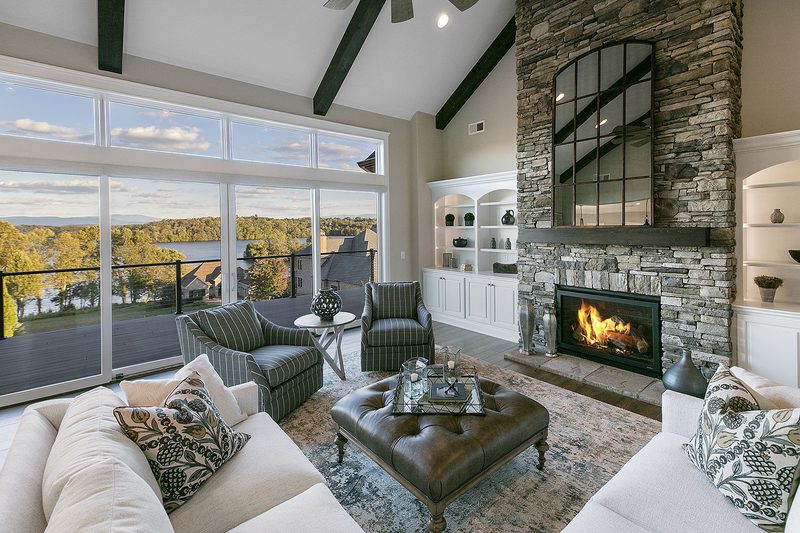
The wide foyer leads directly onto a spacious, open main living area, with the kitchen on the left and great room on the right, with bright window views of the lake and mountains under a high peaked ceiling of timber-frame boxed beams. The floor plan includes almost no hallways, providing more square footage of livable space, virtually all with full views.
A Practical Kitchen
The kitchen features a double-stack white quartz island from Smoky Mountain Tops with ingenious industrial metal and wooden stools along one side that would look perfectly at home in a 19th century factory. Here they bring a fresh element of both practicality and quirkiness to the kitchen. The backsplash tiles feature the distinctive gray, white, and griege polished brick.
Creamy white cabinets from Standard Kitchen and Bath are interspersed with appliances from Plaza Electronics. Both Jay and Mary like to cook, and the layout proves plenty of counter space and working areas. Features like the microwave drawer keep the look uncluttered.
Since they were designing for their retirement, Jay and Mary wanted their home to feel casual, comfortable, and functional. “We love to entertain,” says Mary. “But we built this house for us.” Instead of a formal dining room, they use a circular table in a five-sided breakfast nook directly off the kitchen that is bright with the morning sun, with plantation shutters if they are needed. “I’m not a curtain person,” explains Mary.
The great room focuses on a large stacked-stone fireplace with a box beam mantel flanked by custom white shelves. “This great room is where we live,” says Mary, “so we chose deep, memory-foam sofas and swivel chairs so that we can turn to see the view.”
The vision for the house is for the primary living space to be upstairs with a guest area downstairs with a self-contained lower-level kitchen and its own outdoor patio.
Master Suite
With no hallway between the great room and the master suite, a door separates the two areas, ensuring a feeling of privacy. The suite has one doorway to the practically placed laundry room, which has another doorway leading to the three-car (that is, two-car and two-Jet Ski) garage and a third to the great room. Old-fashioned barn-style sliding doors on the closets add a rustic feel to a short hallway to the bedroom area.
With a beautiful lake and mountain view behind plantation shutters, the master bedroom has a 10-foot tray ceiling and a door to the second-floor deck as well as a wide and comfortable chaise lounge. “That’s my reading spot,” Mary says.
The wide master bath has what Jay and Mary laughingly call their “drive through” shower. This double-entrance shower sits behind a white soaking tub. The tub filler is installed in a piece of antique beam Mary found in Jacksonville, Florida. Mary was delighted with Cella Design’s tile work. “They were incredibly helpful in helping us choose colors and designs and their work was meticulous,” she says. Ferguson’s provided the bath fixtures throughout the house.
Downstairs Guest Area and Workout Room
Wide stained-oak stairs take you down to the guest suite and outdoor area. Jay and Mary’s idea was that the main floor would be theirs, while guests—parents, children, and grandchildren—could have privacy in this area. The living area has some furniture they brought from their home in the DC area, a fireplace, and small kitchen area with a refrigerator where guests can make coffee and prepare small meals. More custom bookcases flank the fireplace. Two bedrooms are located at either end of this area. Doors lead out to the lower deck with an outdoor kitchen, firepit, and hot tub. This area is enhanced by thoughtful landscaping.
The full bath off the main area provides a handy place to shower off after coming in from outside, while one of the bedrooms has an en suite bath. Mary and Jay are looking forward to a visit from their son’s family and their six-month-old grandson this summer.
A large workout area opens off the living space with a proper gym floor, large television, dumbbells, and stationary bikes. The walls feature two impressive displays of marathon and triathlon medals that Jay and Mary have accumulated. This space is generously proportioned and open. The workout room originally had doors, but they came off when Mary and Jay realized that the doors blocked their lake view on the other side of the living room and made them feel boxed in while they worked out. “We realized that we wouldn’t be working out when we had guests, “she says, “So why not leave it open and airy?”
Practical Advice
Although Mary worked with an interior decorator for a short amount of time, she found that her vision for the home evolved over time. After having lived in different places during her career, she had a good idea of what she wanted. “Do what works for you,” she advises.
→ Swipe for Next Story
FeatureJULY AUGUST 2020
Curb appeal
Story by Rebecca Whalen
First impressions are everything. And when it comes to buying a home, a place that will ultimately become your sanctuary, those first impressions are especially critical.
“If you don’t ‘see’ a house, it’s not as valuable,” says Lucas Haun, a leading realtor in the Knoxville region. “It needs to be one of the houses that stands out on your street.”
You know the home with curb appeal that Haun is talking about. It’s the one with the well-maintained landscaping and lawn, unique paint colors, one-of-a-kind light fixtures, a stand-out front door and pressure-washed driveway. And it’s because of this pristine attention to detail that the house gets noticed.
The outside of a home speaks volumes to what’s inside and tells a very real story of the life a home has lived. “Curb appeal,” Haun says, “is the single most important thing somebody can focus on before putting their house on the market.”
So, we’ve done the work for you and sat down with Cityview’s Best of the Best winners, Lucas Haun of Keller Williams Realty and Dale Madden of Earthadelic Landscape and Construction, to fill you in on some of the region’s trendiest curb appeal ideas to consider for your home this summer.
Intentional Landscaping
Beautiful landscaping compliments the beauty of a home and sets the stage for what’s inside.“There’s a trend back toward the modern style that compliments a home’s architecture,” Madden says. The emphasis is on landscape architecture for the home, as opposed to large landscaping beds and gardens. “It’s more about what the home needs, not drawing the eye to the yard.” Simplicity in landscaping ends up being more connected and repetitive, rather than disconnected from the home with all different colors.
Neat and Linear Designs
Clean lines with shrubs and ground cover present a simple landscaping design that doesn’t overwhelm the beauty of a home.Madden suggests focusing on elements of contrasting textures and foliage colors, not necessarily a lot of flowers and blooms. This draws the eye to the foliage and texture of the plants and doesn’t overtake the home itself. Linear bed lines are becoming more popular, as well. “The bigger picture is having beautiful landscaping that is fresh and neatly trimmed that will be forever with a house,” Haun says.
Minimizing Maintenance
Buyers are looking for ways to maintain the intentional landscaping in the most efficient way possible.Madden says he’s seeing more homeowners using decorative aggregates in lieu of mulch. If you can do it one time and have an edge restraint with perfectly straight lines that are strict and not trailing, that’s the ideal. And if you can landscape with drought resistant plants and dwarf species of shrubs then this will help minimize maintenance and watering needs. Add night lighting, and the home will be a showstopper, no matter the hour.
Stained Garage Doors
High-end garage doors with the look of natural materials really call out the home.Many homeowners are updating their garage doors from simple painted ones to stained, wooden doors, or carriage style doors. “They are not the cheapest options, but there are cheaper options that look like that,” Haun says, “and if the garage is on the front or side, that is important for curb appeal.” Pair that with a pressure-washed driveway and it will surely make an impact.
Front Door Fixes
Couple your stained garage door with an update to your entranceway.“This is an easy thing that makes a good first impression,” Haun says. Standard six panel builder front doors can be swapped for a more interesting door that speaks directly to your unique home. “It sets the tone for the rest of the property and goes hand in hand with you garage doors, if your garage doors are visible.” Stained wooden doors with glass can be fairly inexpensive and are more popular in the region, but if a modern flair is more your style, opt for a metal door with glass.
Updating Gutters
Subtle details make all the difference to spruce up the beauty of a home.While gutters might not be the first thing you think about when making updates to your home’s curb appeal, Haun says switching up your gutter game can be a game changer. Whether they are bronze or copper, depending on the home, people now pay attention to it, whereas years ago homeowners stuck to the basics. “All of those little details add up,”Haun says.
Reimagining the Walkway
Call out the path into your home by making eye-catching changes to material.There was a point where stamped concrete was all the rage, and it still is in many places, but if you want to set your home apart from the rest, reimagine your walkway. “Stone or brick always are more attractive now than the standard concrete,” Haun says. Paver walkways are the preference now and will call attention to the other outside elements you’ve already updated.
Mixing Mediums
Keep the classics but couple them with something a little more unique.“Stone accents tend to be the leading trend right now,” Haun says. Brick and stone together can be a unique combination. Other options are to add stained wooden beams or cedar shake accents or siding. These can create the unique changes to the home that give it a fresh look and draw passers-by eyes.
Airy Colors
Give your home a facelift with a fresh coat of paint.“When I first started, everyone wanted tan or khaki interior and sometimes exterior, and now you see lighter colors,” Haun says. Creams, grays and whites are trending now, along with brass, but dark colors are making their way out. Painting brick these lighter colors is also trending, making for some pretty dramatic changes to brick-based homes.
With these trending updates, homeowners will be ready this summer to get those homes on the market. “The key to gaining curb appeal is to architecturally differentiate the property from others nearby it, mainly on the exterior,” Madden says. “People are attracted to and want to invest in property tha at is well-maintained at a level above par for the neighborhood and that possesses an architectural setting distinguishable from other homes.”
Curb appeal is what sells homes, and after months during which families spent more time than ever at home, buyers want to see their sanctuary when house-hunting. And professionals like Madden and Haun are seeing firsthand that shift. “I think COVID has made people think a little more about their outdoor space,” Haun says, adding that aside from the front of homes getting a facelift, homeowners are also putting in pools and updating their outdoor living areas.
Madden has seen the same thing. “Everyone is wanting their home to become ‘the place to be’ and therefore we are seeing a greater demand for enhancing the home environment,” he says. “This often translates into improvement projects, inside and out.” And whether that means giving a fresh coat of paint or reimagining the landscaping, improving its curb appeal will give your home the boost it needs to sell, and give you the chance to thoroughly enjoy it before it does.
→ Swipe for Next Story
Non-ProfitJULY AUGUST 2020
The Institute at Tremont
Story by Hannah Overton
The Great Smoky Mountains National Park in our backyard isn’t something to take for granted. Its landmarks and vistas challenge and inspire us. One such landmark is the Great Smoky Mountains Institute at Tremont, a nonprofit which hosts environmental education programs for children and adults. Though COVID-19 has dealt a blow to its programming and budget, the institute’s vision for its future will challenge others to think about their impact on the world.
Tremont’s History
The known history of this beautiful section of the Smokies stretches back almost 200 years. The land was settled by Will and Nancy Walker in 1859 and saw several transformations through the years. Tremont was officially established as a logging town in 1926, and then a mere eight years later, the Great Smoky Mountains National Park was born.
In the early 1960s, a Job Corps center became a part of Tremont. It was an effort on President Johnson’s part to teach young men vocational skills, similar to the Civilian Conservation Corps that existed in the 1930s. The men that participated in the program lived in buildings throughout the Tremont area, and when funding for the program was cut, the buildings were abandoned.
In 1969, Maryville College, in partnership with the National Park Service, opened the Tremont Environmental Education Center—a place where young adults could receive an education on the earth and natural resources, from the earth itself. While the name has changed slightly over years, its mission hasn’t changed.
Tremont’s Mission
The Institute at Tremont’s official mission is to deliver experiential learning for youth, educators, and adults through programs that promote self-discovery, critical thinking, and effective teaching and leadership. This is something that President and CEO Catey McClary addresses every day.
“Many people think of environmental education centers as a place to learn how to identify trees. We do that, but we’re not in the business of teaching about nature,” says McClary. “We’re all about helping people discover their curiosity about nature. It’s about the connection to nature that’s different for each individual. As long as that connection is there, we believe we’re doing important work.”
McClary’s first experience with Tremont was in the sixth grade on a school field trip. That visit to the Institute shaped her dreams, lifelong understanding of the environment and her role in it. After graduating from Appalachian State University with a degree in ecology and environmental biology, she spent 13 years with a nonprofit camp in North Carolina, initially as a counselor and eventually as its CFO. When she heard about the open position at Tremont, she knew it was meant to be. “I get to work with people who go outside and teach people to discover and be curious about nature,” says McClary.
Threats and Challenges
However, this year has posed the same challenges and threats for Tremont’s educational programs that the rest of the world has faced. The institute relies on its public programs and support to continue to provide programming. Perhaps the programs Tremont is best known for are its school programs for kids of all ages. These programs were cancelled this past spring due to COVID-19, and schools are beginning to cancel scheduled visits for next year as well. But according to McClary, the staff at Tremont don’t intend for this setback to slow them down or destroy the institute.
“What we need now more than ever is for people to understand that we are more than a summer camp. We are more than a field trip for students,” says McClary. “Our programs provide students with an opportunity to grow outside together. We hear time and time again about how our programs provide social and emotional learning, how they build critical thinking, how they improve classroom dynamics and build teacher confidence. We need the support of communities to advocate for this type of learning, to share with their school administrators their desire for this type of learning.”
How to Support the Institute
Despite having cancelled their student programs for the summer and fall, families can still access the wonder of the Institute at Tremont itself. Whether you go on a solo hike, or bring family and friends, the Institute’s blog provides fun ideas and resources for making the most of an educational experience in the Smokies. Plan a visit, hike the trails, bring a picnic lunch, and remember why the Institute at Tremont does what it does. The institute also is still hosting several programs and courses for educators and adults throughout the fall.
Teachers are on the frontlines of educating future generations, and the educators who bring their classes to the institute are near and dear to Tremont’s mission and future. Tremont’s Teacher Escape Weekends are an opportunity for educators to network and learn about new or upcoming programs Tremont may have for their students. Teachers have the opportunity to interact with naturalists and learn new ways to teach children about appreciating and exploring all that nature has to offer.
Another option for supporting and staying involved with the institute is through its Southern Appalachian Naturalist Certification Program (SANCP) for adults. This class series is based on the fundamentals of understanding and appreciating the nature that surrounds us. Some of the topics covered are naturalist skills, plants, birds, and ecology. Completing all of the courses in the program provides the participant with a non-credit Southern Appalachian Naturalist Certificate from the University of Tennessee.
A more involved option for nature enthusiasts is Tremont’s Road Scholar trips. This program involves a Sunday to Friday stay at the Institute, daily hikes that range from 5-13 miles, nighttime stories about Appalachia and the Great Smoky Mountains around the fire, and fellowship with other hikers and Tremont staff members.
Most courses and events that are being offered require a registration fee, which goes right back to supporting the Institute at Tremont and its mission to ignite curiosity for nature in people of all ages.
Despite their ongoing programming, McClary says that “the risks the virus has presented our organization has been extremely hard to mitigate. Since March we’ve not received any program income, and we anticipate long-lasting impacts… As such, we’ve made recent cutbacks to our staff to help us bridge the gap in program income. However, we recognize that at a time when our programs are out of reach for so many, they are needed now more than ever before. The respite time spent outdoors is critical for our health — mentally, physically, socially, and emotionally.”
Looking Ahead
Long before the COVID-19 setback. the Tremont board purchased 194 acres of land in Townsend for a second campus. The vision is to build an environmental center that generates, rather than consumes, both water and energy. It will rely on local materials and include an education component to help people understand how they can be better environmental stewards within their own communities. The campus will provide programs for school use but also adult programs and corporate opportunities that employ experiential learning, provent to improve both competency and retention for participants. The capital campaign is still in its early stages, McClary says, and COVID has certainly set it back. But the big and bold vision has not changed. “It won’t be the easy thing to do,” she says. “But it’s the right thing to do.”
→ Swipe for Next Story
Top AttorneysJULY AUGUST 2020
2020 Top Attorneys
Story by Cityview
When you’ve got a problem with your health — a heart issue or an eye problem or an ache that keeps you off your favorite hiking trail — you seek out a doctor who knows his — or her — stuff. There’s no point in seeing someone you don’t have confidence in. The same goes for attorneys. When you find yourself with a legal issue — whether it be a car collision or a divorce or the need to put your financial and end-of-life plans in place for your descendants — you want to work with a person who is an expert in that particular field.
That’s where this issue of Cityview can help.
Once a year, the magazine asks members of the Knoxville Bar Association for their input on the attorneys in East Tennessee who are tops in their field of expertise. Attorneys are asked who they would refer a friend or family member to if they needed legal assistance. We’ve listed those top finishers by their areas of practice in the pages that follow.
Of course, this is just one way to determine the best legal professionals in the area. Though their colleagues are a good way to assess the area’s legal expertise, anyone in need of legal help should schedule a consultation first to make sure the attorney is a good fit for the situation.
One of the area’s best-known and well-loved attorneys is Robert Pryor, who has also been aCityviewcontributor for many years. We thought we’d kick off this Top Attorneys section witha tribute to him written by his sonand associate, attorney Robbie Pryor.
Administrative Law
John T. Batson Jr.Watson, Roach, Batson, & Lauderback
J. William ColeyHodges, Doughty & Carson, PLLC
Wade V. DaviesRitchie, Dillard, Davies & Johnson P.C.
Taylor D. ForresterLong, Ragsdale & Waters
Warren L. GoochKramer Rayson
Donald D. HowellFrantz, McConnell & Seymour
Luke P. IhnenLondon & Amburn
Michael S. KelleyKennerly, Montgomery & Finley
B. Chase KiblerHodges, Doughty & Carson, PLLC
Jason H. LongLondon & Amburn
Mary Elizabeth MaddoxFrantz, McConnell & Seymour
John E. OwingsOwings, Wilson & Coleman
Timothy A. PriestPryor, Priest, Harber, Floyd & Coffey
H. Stephen GillmanPryor, Priest, Harber, Floyd & Coffey
Lisa J. HallHodges, Doughty & Carson, PLLC
Mandy M. HancockBanks & Jones
John K. HarberPryor, Priest, Harber, Floyd & Coffey
Lyndsey L. LeeHodges, Doughty & Carson, PLLC
Melody S. LuhnNorton & Luhn
Elizabeth K. B. MeadowsHerbert, Meadows & Wall
Laura E. MetcalfLaura Metcalf Attorney at Law
Katheryn Murray OgleMcDonald, Levy & Taylor
William A. Mynatt Jr.Lewis, Thomason, King, Krieg & Waldrop
Suzanne N. PriceBunstine, Watson & Becker
Adam M. PriestPryor, Priest, Harber, Floyd & Coffey
Vanessa SamanoSamano Law
Sarah Y. SheppeardLewis, Thomason, King, Krieg & Waldrop
C. Scott TaylorBernstein, Stair & McAdams
David L. ValoneValone Law
Federal Court Practice
Beecher A. Bartlett Jr.Kramer Rayson
W. Kyle CarpenterWoolf, McClane, Bright, Allen & Carpenter
Donald D. HowellFrantz, McConnell & Seymour
Gregory P. IsaacsThe Isaacs Law Firm
Reggie E. KeatonFrantz, McConnell & Seymour
E. Jerome MelsonGentry, Tipton & McLemore
Brandon L. MorrowKramer Rayson
James E. WagnerFrantz, McConnell & Seymour
Health Care Law
W. Dale AmburnLondon & Amburn
J. Nicholas Arning Jr.Woolf, McClane, Bright, Allen & Carpenter
Heidi A. BarcusLondon & Amburn
Mark A. CastleberryLewis, Thomason, King, Krieg & Waldrop
Patti T. CottenLondon & Amburn
Shannon Coleman EgleKramer Rayson
Warren L. GoochKramer Rayson
Ian P. HennesseyLondon & Amburn
James H. LondonLondon & Amburn
Dennis R. McClaneWoolf, McClane, Bright, Allen & Carpenter
Edward “Ted” G. White IIHodges, Doughty & Carson, PLLC
Immigration and Naturalization
Melissa B. CarrascoEgerton, McAfee, Armistead & Davis, PC
Timothy Patrick Coode Esq.Tim Coode Law
Marcos M. GarzaThe Garza Law Firm
Anita PatelLaw Offices of Anita Patel
Charles M. TorresTorres Law Firm PLLC
Kate E. TuckerKramer Rayson
Income Tax/IRS Resolutions
Dale C. AllenWoolf, McClane, Bright, Allen & Carpenter
Philip J. BrycePhilip J. Bryce Law
J. Eric ButlerLewis, Thomason, King, Krieg & Waldrop
Kevin A. DeanFrantz, McConnell & Seymour
Shannon Coleman EgleKramer Rayson
Mack A. GentryGentry, Tipton & McLemore
Kati Sanford GoodnerLewis, Thomason, King, Krieg & Waldrop
Richard S. MatlockWoolf, McClane, Bright, Allen & Carpenter
Kevin N. PerkeyWoolf, McClane, Bright, Allen & Carpenter
Marshall H. PetersonKennerly, Montgomery & Finley
O. E. Schow IVWoolf, McClane, Bright, Allen & Carpenter
Leslie L. ShieldsKramer Rayson
Insurance Law
Heidi A. BarcusLondon & Amburn
Beecher A. Bartlett Jr.Kramer Rayson
Luis C. BustamanteWoolf, McClane, Bright, Allen & Carpenter
Toby R. CarpenterKennerly, Montgomery & Finley
Robert A. CrawfordKramer Rayson
Debra L. FultonFrantz, McConnell & Seymour
Matthew A. GrossmanFrantz, McConnell & Seymour
Donald D. HowellFrantz, McConnell & Seymour
John T. (Tom) JohnsonKramer Rayson
Beverly D. NelmsFrantz, McConnell & Seymour
Intellectual Property/ Trademarks
Richard W. Barnes Jr.Luedeka Neely Group, P.C.
Jonathan M. BlanchardPitts & Lake, P.C.
Michael J. BradfordLuedeka Neely Group, P.C.
Paul A. ForsythPitts & Lake, P.C.
Robert O. FoxLuedeka Neely Group, P.C.
Zack R. GardnerKennerly, Montgomery & Finley
Jacob G. HortonPitts & Lake, P.C.
Thomas L. JonesPitts & Lake, P.C.
Andrew C. LakePitts & Lake, P.C.
William E. MasonKennerly, Montgomery & Finley
Andrew S. NeelyLuedeka Neely Group, P.C.
Bob PittsPitts & Lake, P.C.
John T. WinemillerMerchant & Gould, P.C.
Juvenile Defense
Benjamin T. BarnettThe Barnett Firm
Tasha C. BlakneyEldridge and Blakney
Donald A. BoschThe Bosch Law Firm
David M. EldridgeEldridge and Blakney
Marcos M. GarzaThe Garza Law Firm
Mandy M. HancockBanks & Jones
Gregory P. IsaacsThe Isaacs Law Firm
T. Scott JonesBanks & Jones
Laura E. MetcalfLaura Metcalf Attorney at Law
Katheryn Murray OgleMcDonald, Levy & Taylor
Vanessa SamanoSamano Law
Michael J. StanuszekStanuszek Law Group PLLC
Labor & Employment Law—Employee
Heather G. AndersonBernstein, Stair & McAdams
Beecher A. Bartlett Jr.Kramer Rayson
Robert L. BowmanKramer Rayson
David BurkhalterBurkhalter Law
James N. Gore Jr.Kennerly, Montgomery & Finley
J. Chadwick HatmakerWoolf, McClane, Bright, Allen & Carpenter
Michael S. KelleyKennerly, Montgomery & Finley
John M. LawhornFrantz, McConnell & Seymour
Mary Elizabeth MaddoxFrantz, McConnell & Seymour
Brandon L. MorrowKramer Rayson
Labor & Employment Law—Employer
Betsy J. BeckKramer Rayson
Robert L. BowmanKramer Rayson
J. Keith CoatesWoolf, McClane, Bright, Allen & Carpenter
Danny P. DyerGentry, Tipton & McLemore
Caitlyn L. ElamLewis, Thomason, King, Krieg & Waldrop
J. Chadwick HatmakerWoolf, McClane, Bright, Allen & Carpenter
Janet S. HayesLewis, Thomason, King, Krieg & Waldrop
Kaitlyn E HutchersonWoolf, McClane, Bright, Allen & Carpenter
John M. LawhornFrantz, McConnell & Seymour
Chris W. McCartyLewis, Thomason, King, Krieg & Waldrop
Brandon L. MorrowKramer Rayson
Edward G. PhillipsKramer Rayson
John E. WintersKramer Rayson
Mediation/Arbitration
Sarah C. EasterMcKellar & Easter, Attorneys at Law
Robert H. GreenKennerly, Montgomery & Finley
John K. HarberPryor, Priest, Harber, Floyd & Coffey
Paul D. Hogan Jr.Hogan & Hogan
Dana C. HollowayHolloway Law & Mediation Center PLLC
Reggie E. KeatonFrantz, McConnell & Seymour
W. Morris KizerGentry, Tipton & McLemore
James H. LondonLondon & Amburn
Laura E. MetcalfLaura Metcalf Attorney at Law
Sarah Y. SheppeardLewis, Thomason, King, Krieg & Waldrop
C. Scott TaylorBernstein, Stair & McAdams
William D. Vines IIIButler, Vines & Babb
Medical Malpractice—Defense
Heidi A. BarcusLondon & Amburn
Mark A. CastleberryLewis, Thomason, King, Krieg & Waldrop
Stephen C. DavesO’Neil, Parker & Williamson
J. Spencer FairLondon & Amburn
James H. LondonLondon & Amburn
Jason H. LongLondon & Amburn
T Mitchell PanterLewis, Thomason, King, Krieg & Waldrop
Kelly S. StreetLondon & Amburn
Edward “Ted” G. White IIHodges, Doughty & Carson, PLLC
Medical Malpractice—Plaintiff
Luis C. BustamanteWoolf, McClane, Bright, Allen & Carpenter
Christopher T. CainLacy, Price & Wagner, PC
M. Christopher CoffeyPryor, Priest, Harber, Floyd & Coffey
Sidney W. GilreathGilreath & Associates
J. Tucker Montgomery MD, JDMontgomery Law Firm
Weldon E. PattersonButler, Vines & Babb
Timothy A. PriestPryor, Priest, Harber, Floyd & Coffey
Robbie E. Pryor Jr.Pryor, Priest, Harber, Floyd & Coffey
Robert E. Pryor Sr.Pryor, Priest, Harber, Floyd & Coffey
Thomas S. Scott Jr.Scott & Cain, PLLC
William D. Vines IIIButler, Vines & Babb
Nursing Home Liability—Defense
Heidi A. BarcusLondon & Amburn
Mark A. CastleberryLewis, Thomason, King, Krieg & Waldrop
J. Spencer FairLondon & Amburn
Rachel Park HurtArnett, Draper & Hagood
Wayne A. KlineHodges, Doughty & Carson, PLLC
James H. LondonLondon & Amburn
Jason H. LongLondon & Amburn
Mary Elizabeth MaddoxFrantz, McConnell & Seymour
Kelly S. StreetLondon & Amburn
Nursing Home Liability—Plaintiff
M. Christopher CoffeyPryor, Priest, Harber, Floyd & Coffey
Mark E. FloydPryor, Priest, Harber, Floyd & Coffey
Bruce D. FoxFox Willis Burnette, PLLC
Ronald C. KoksalButler, Vines & Babb
Marty McDonaldMcDonald, Levy & Taylor
Katheryn Murray OgleMcDonald, Levy & Taylor
Adam M. PriestPryor, Priest, Harber, Floyd & Coffey
Robbie E. Pryor Jr.Pryor, Priest, Harber, Floyd & Coffey
Robert E. Pryor Sr.Pryor, Priest, Harber, Floyd & Coffey
Wayne A. RitchieRitchie, Dillard, Davies & Johnson P.C.
William D. Vines IIIButler, Vines & Babb
Patent Law
Richard W. Barnes Jr.Luedeka Neely Group, P.C.
Jonathan M. BlanchardPitts & Lake, P.C.
Michael J. BradfordLuedeka Neely Group, P.C.
Paul A. ForsythPitts & Lake, P.C.
Robert O. FoxLuedeka Neely Group, P.C.
Jacob G. HortonPitts & Lake, P.C.
Thomas L. JonesPitts & Lake, P.C.
Andrew C. LakePitts & Lake, P.C.
Andrew S. NeelyLuedeka Neely Group, P.C.
Wade R. OrrLuedeka Neely Group, P.C.
Bob PittsPitts & Lake, P.C.
Personal Injury—Auto Accident—Defense
Toby R. CarpenterKennerly, Montgomery & Finley
Robert A. CrawfordKramer Rayson
Donald D. HowellFrantz, McConnell & Seymour
John T. (Tom) JohnsonKramer Rayson
Benjamin W. JonesLewis, Thomason, King, Krieg & Waldrop
Beverly D. NelmsFrantz, McConnell & Seymour
Adam F. RustLewis, Thomason, King, Krieg & Waldrop
Samuel W. RutherfordKennerly, Montgomery & Finley
Mikel A. ToweLewis, Thomason, King, Krieg & Waldrop
Glenn R. WalterLewis, Thomason, King, Krieg & Waldrop
Personal Injury—Auto Accidents—Plaintiff
Beecher A. Bartlett Jr.Kramer Rayson
Luis C. BustamanteWoolf, McClane, Bright, Allen & Carpenter
Bruce D. FoxFox Willis Burnette, PLLC
Marcos M. GarzaThe Garza Law Firm
T. Scott JonesBanks & Jones
Jason E. LeggKennerly, Montgomery & Finley
Farrell A. LevyMcDonald, Levy & Taylor
Benjamin C. MullinsFrantz, McConnell & Seymour
Adam M. PriestPryor, Priest, Harber, Floyd & Coffey
Timothy A. PriestPryor, Priest, Harber, Floyd & Coffey
Robbie E. Pryor Jr.Pryor, Priest, Harber, Floyd & Coffey
Robert E. Pryor Sr.Pryor, Priest, Harber, Floyd & Coffey
Thomas S. Scott Jr.Scott & Cain, PLLC
Personal Injury—General—Plaintiff
Beecher A. Bartlett Jr.Kramer Rayson
Luis C. BustamanteWoolf, McClane, Bright, Allen & Carpenter
Gregory F. ColemanGreg Coleman Law, P.C.
Bruce D. FoxFox Willis Burnette, PLLC
Gregory P. IsaacsThe Isaacs Law Firm
John T. (Tom) JohnsonKramer Rayson
T. Scott JonesBanks & Jones
Jason E. LeggKennerly, Montgomery & Finley
Farrell A. LevyMcDonald, Levy & Taylor
E. Jerome MelsonGentry, Tipton & McLemore
Weldon E. PattersonButler, Vines & Babb
Adam M. PriestPryor, Priest, Harber, Floyd & Coffey
Timothy A. PriestPryor, Priest, Harber, Floyd & Coffey
Robbie E. Pryor Jr.Pryor, Priest, Harber, Floyd & Coffey
Robert E. Pryor Sr.Pryor, Priest, Harber, Floyd & Coffey
Thomas S. Scott Jr.Scott & Cain, PLLC
Keith D. StewartKeith D Stewart Attorney at Law
William D. Vines IIIButler, Vines & Babb
James C. WrightButler, Vines & Babb
Personal Injury—Motorcycle Accident—Defense
Edward U. BabbButler, Vines & Babb
Toby R. CarpenterKennerly, Montgomery & Finley
David A. ChapmanLewis, Thomason, King, Krieg & Waldrop
Robert A. CrawfordKramer Rayson
Donald D. HowellFrantz, McConnell & Seymour
Benjamin W. JonesLewis, Thomason, King, Krieg & Waldrop
Beverly D. NelmsFrantz, McConnell & Seymour
Mikel A. ToweLewis, Thomason, King, Krieg & Waldrop
Glenn R. WalterLewis, Thomason, King, Krieg & Waldrop
Personal Injury—Motorcycle Accident—Plaintiff
Christopher W. BeaversBanks & Jones
Christopher T. CainLacy, Price & Wagner, PC
Toby R. CarpenterKennerly, Montgomery & Finley
Gregory F. ColemanGreg Coleman Law, P.C.
Bruce D. FoxFox Willis Burnette, PLLC
Marcos M. GarzaThe Garza Law Firm
Mandy M. HancockBanks & Jones
Albert J. HarbHodges, Doughty & Carson, PLLC
T. Scott JonesBanks & Jones
Farrell A. LevyMcDonald, Levy & Taylor
Weldon E. PattersonButler, Vines & Babb
Adam M. PriestPryor, Priest, Harber, Floyd & Coffey
Product Liability—Defense
Hugh B. Bright Jr.Woolf, McClane, Bright, Allen & Carpenter
W. Kyle CarpenterWoolf, McClane, Bright, Allen & Carpenter
Robert A. CrawfordKramer Rayson
Howard E. JarvisWoolf, McClane, Bright, Allen & Carpenter
John T. (Tom) JohnsonKramer Rayson
Reggie E. KeatonFrantz, McConnell & Seymour
Jason E. LeggKennerly, Montgomery & Finley
M. Denise MoretzWoolf, McClane, Bright, Allen & Carpenter
Beverly D. NelmsFrantz, McConnell & Seymour
James C. WrightButler, Vines & Babb
Product Liability—Plaintiff
Luis C. BustamanteWoolf, McClane, Bright, Allen & Carpenter
Toby R. CarpenterKennerly, Montgomery & Finley
T. Scott JonesBanks & Jones
Jason E. LeggKennerly, Montgomery & Finley
Farrell A. LevyMcDonald, Levy & Taylor
Weldon E. PattersonButler, Vines & Babb
Adam M. PriestPryor, Priest, Harber, Floyd & Coffey
Timothy A. PriestPryor, Priest, Harber, Floyd & Coffey
Robbie E. Pryor Jr.Pryor, Priest, Harber, Floyd & Coffey
Robert E. Pryor Sr.Pryor, Priest, Harber, Floyd & Coffey
Robert L. VanceWoolf, McClane, Bright, Allen & Carpenter
James C. WrightButler, Vines & Babb
Professional Malpractice—Defense
Edward U. BabbButler, Vines & Babb
Heidi A. BarcusLondon & Amburn
Stephen C. DavesO’Neil, Parker & Williamson
David A. DraperLewis, Thomason, King, Krieg & Waldrop
J. Spencer FairLondon & Amburn
Lawrence F. GiordanoLewis, Thomason, King, Krieg & Waldrop
James H. LondonLondon & Amburn
Jason H. LongLondon & Amburn
Kelly S. StreetLondon & Amburn
Dwight E. TarwaterPaine, Tarwater & Bickers, LLP
Glenn R. WalterLewis, Thomason, King, Krieg & Waldrop
Edward “Ted” G. White IIHodges, Doughty & Carson, PLLC
W. Paul WhittLewis, Thomason, King, Krieg & Waldrop
Professional Malpractice—Plaintiff
Christopher T. CainLacy, Price & Wagner, PC
Mark E. FloydPryor, Priest, Harber, Floyd & Coffey
John K. HarberPryor, Priest, Harber, Floyd & Coffey
Ronald C. KoksalButler, Vines & Babb
J. Tucker Montgomery MD, JDMontgomery Law Firm
Weldon E. PattersonButler, Vines & Babb
Timothy A. PriestPryor, Priest, Harber, Floyd & Coffey
Robert E. Pryor Sr.Pryor, Priest, Harber, Floyd & Coffey
Thomas S. Scott Jr.Scott & Cain, PLLC
Real Estate Finance & Development
Robyn Jarvis AskewLewis, Thomason, King, Krieg & Waldrop
Matthew A. GrossmanFrantz, McConnell & Seymour
Richard S. MatlockWoolf, McClane, Bright, Allen & Carpenter
Dennis R. McClaneWoolf, McClane, Bright, Allen & Carpenter
Timothy M. McLemoreGentry, Tipton & McLemore
Greg D. MeadowsGentry, Tipton & McLemore
Daniel J. MooreWoolf, McClane, Bright, Allen & Carpenter
Jonathan H. PeytonKennerly, Montgomery & Finley
Dennis B. RagsdaleLong, Ragsdale & Waters
Securities—Defense
Kyle Andrew BaisleyLong, Ragsdale & Waters
W. Michael BaisleyLong, Ragsdale & Waters
David Wilson LongLong, Ragsdale & Waters
Jack H. McCall, Jr.Tennessee Valley Authority
Lee A. PopkinLong, Ragsdale & Waters
Garrett P. SwartwoodLong, Ragsdale & Waters
Securities—Plaintiff
Kyle Andrew BaisleyLong, Ragsdale & Waters
W. Michael BaisleyLong, Ragsdale & Waters
Ronald C. KoksalButler, Vines & Babb
Jack H. McCall, Jr.Tennessee Valley Authority
Garrett P. SwartwoodLong, Ragsdale & Waters
Social Security Disability Law
Edwin A. AndersonKenneth Miller & Associates
Clifford C. CruzeClifford C. Cruze
John P. DreiserLaw Offices of Tony Farmer and John Dreiser
Garry W. FerrarisLaw Office of Garry Ferraris
Marcos M. GarzaThe Garza Law Firm
Carolyn Levy GilliamMcDonald, Levy & Taylor
Haley M HenryThe Garza Law Firm
Lawrence P. LeibowitzLeibowitz Law Firm, PLLC
Mary Elizabeth MaddoxFrantz, McConnell & Seymour
Kenneth A. MillerKenneth Miller & Associates
J. Cort SikesWykoff and Sikes
John A. WillisFox, Willis, Burnette, PLLC
Wayne D. WykoffWykoff and Sikes
Taxation
Dale C. AllenWoolf, McClane, Bright, Allen & Carpenter
Philip J. BrycePhilip J. Bryce
J. Eric ButlerLewis, Thomason, King, Krieg & Waldrop
Mack A. GentryGentry, Tipton & McLemore
Kati Sanford GoodnerLewis, Thomason, King, Krieg & Waldrop
Wayne R. KramerKramer Rayson
Richard S. MatlockWoolf, McClane, Bright, Allen & Carpenter
Kevin N. PerkeyWoolf, McClane, Bright, Allen & Carpenter
Marshall H. PetersonKennerly, Montgomery & Finley
Lee A. PopkinLong, Ragsdale & Waters
Joel D. RoettgerGentry, Tipton & McLemore
O. E. Schow IVWoolf, McClane, Bright, Allen & Carpenter
Wills/Probate
Dale C. AllenWoolf, McClane, Bright, Allen & Carpenter
Andrea C. AndersonLewis, Thomason, King, Krieg & Waldrop
Philip J. BrycePhilip J. Bryce
Kevin A. DeanFrantz, McConnell & Seymour
Charles M. FinnKramer Rayson
Wayne R. KramerKramer Rayson
Richard S. MatlockWoolf, McClane, Bright, Allen & Carpenter
Kevin N. PerkeyWoolf, McClane, Bright, Allen & Carpenter
Marshall H. PetersonKennerly, Montgomery & Finley
Joel D. RoettgerGentry, Tipton & McLemore
O. E. Schow IVWoolf, McClane, Bright, Allen & Carpenter
Richard T. Scrugham Jr.Frantz, McConnell & Seymour
Worker’s Compensation—Defense
Edward U. BabbButler, Vines & Babb
Leslie F. BishopLewis, Thomason, King, Krieg & Waldrop
R. Kim BurnetteArnett, Draper & Haygood
Debra L. FultonFrantz, McConnell & Seymour
J. Ford LittleWoolf, McClane, Bright, Allen & Carpenter
Mary Elizabeth MaddoxFrantz, McConnell & Seymour
Beverly D. NelmsFrantz, McConnell & Seymour
Lynn C. PetersonLewis, Thomason, King, Krieg & Waldrop
Samuel W. RutherfordKennerly, Montgomery & Finley
Tyler D. SmithLewis, Thomason, King, Krieg & Waldrop
Robert L. VanceWoolf, McClane, Bright, Allen & Carpenter
Shelly L. WilsonOwings, Wilson & Coleman
Workers’ Compensation—Plaintiff
Christopher W. BeaversBanks & Jones
Tasha C. BlakneyEldridge and Blakney
John P. DreiserLaw Offices of Tony Farmer and John Dreiser
J. Anthony FarmerLaw Offices of Tony Farmer and John Dreiser
Bruce D. FoxFox Willis Burnette, PLLC
Marcos M. GarzaThe Garza Law Firm
T. Scott JonesBanks & Jones
Jason E. LeggKennerly, Montgomery & Finley
Farrell A. LevyMcDonald, Levy & Taylor
Mary Elizabeth MaddoxFrantz, McConnell & Seymour
Beverly D. NelmsFrantz, McConnell & Seymour
Samuel W. RutherfordKennerly, Montgomery & Finley
James E. WagnerFrantz, McConnell & Seymour
John A. WillisFox Willis Burnette, PLLC
Wrongful Death—Defense
Heidi A. BarcusLondon & Amburn
Beecher A. Bartlett Jr.Kramer Rayson
Hugh B. Bright Jr.Woolf, McClane, Bright, Allen & Carpenter
Toby R. CarpenterKennerly, Montgomery & Finley
W. Kyle CarpenterWoolf, McClane, Bright, Allen & Carpenter
David A. ChapmanLewis, Thomason, King, Krieg & Waldrop
Robert A. CrawfordKramer Rayson
John T. (Tom) JohnsonKramer Rayson
Benjamin W. JonesLewis, Thomason, King, Krieg & Waldrop
Wrongful Death—Plaintiff
Beecher A. Bartlett Jr.Kramer Rayson
Luis C. BustamanteWoolf, McClane, Bright, Allen & Carpenter
Bruce D. FoxFox Willis Burnette, PLLC
Jason E. LeggKennerly, Montgomery & Finley
Timothy A. PriestPryor, Priest, Harber, Floyd & Coffey
Robert E. Pryor Sr.Pryor, Priest, Harber, Floyd & Coffey
Thomas S. Scott Jr.Scott & Cain, PLLC
William D. Vines IIIButler, Vines & Babb
→ Swipe for Next Story
FeatureJULY AUGUST 2020
Bill Regas
Story by Susan Alexander
For decades, when a Knoxville resident was planning a special occasion, odds were the venue would be a longtime dining establishment on Gay Street: Regas Restaurant.
Time has passed and change has occurred since then, and Regas is now a fond memory as the destination of choice for parties and reunions, power lunches and after-work drinks, for big juicy steaks and red velvet cake. And nobody’s memory is more full of happy days of hospitality than Bill Regas’s.
Regas, now 91, reflected on his 50+-year career recently while recovering at NHC Healthcare from a fall. He was a young man fresh out of the Army when he and his sister, Frankie, took over running his family’s restaurant in 1953. His dad. Frank Regas, and uncle George had started it in 1919 and ushered it through its first 30-some years. Bill took over as general manager when his father died in 1953.
Back in the 1940s and ‘50s, he recalled, “people would get a job, and if it was a good job, they’d keep it for a lifetime. So we had a lot of professional servers and cooks who stayed with us.” One who didn’t — David Thomas — started working at the restaurant with Bill and went on to found the Wendy’s fast food chain.
It was Bill who made Regas the gathering place it became. And he was fighting some tough odds when he did.
Downtown Knoxville was on a downturn following World War II as Knoxvillians left it for the suburbs. Regas recalls how deserted the town was after West Town Mall opened.
He also had the challenge of evolving the restaurant from a diner into a celebration destination. “We ran an ad in the newspaper every Wednesday that said ‘for an evening to remember,’” he said. “That was the type of atmosphere we were developing. And it worked pretty well for 30 or 40 years.
“We had a great cake baker, Bobbie Wynn. She’d make red velvet cakes, German chocolate cakes. She was a master.
“We had a lot of entertainers who would come in to perform at the Tennessee Theatre in those days,” he said. “Liberace came into town about every five years or so, and he’d come for dinner. He liked the red velvet cake. He’d have two slices.”
Regas served as president of the Tennessee Restaurant Association and later the National Restaurant Association and said he learned a lot from his years there.
But when asked how he wants to be remembered, his answer moves much closer to home.
“The best is when your grandchildren say ‘that’s my papi’ in a proud way,” he said.
→ Swipe for Next Story
FeatureJULY AUGUST 2020
The Storyteller
Story by Cityview
He pushed play on the recorder. The speaker on the old cassette player revealed the voice of my father, Bob Pryor, in his early 30s, hosting a roast of the great Ray H. Jenkins. The laughter, the voices and stories of the old lawyers, the great storytellers, rose into the air. It was the early’70s.
Early in his career, my father put himself in the path of the great lawyers of his time—not just locally, but on a national level. He listened. Listening is a very important trait. He learned the skills of telling stories. My father’s monthly articles in this publication are nothing but a masterful retelling of stories from his limitless bin.
For 50-plus years I have sometimes been the subject of, sometimes a bystander in, or a witness to many of these delicious items he keeps in his story repertoire. I have also been a dedicated and enthusiastic connoisseur. I collect his relics in my own bin. That is my duty. Bob Pryor has made friends and acquired admirers telling stories. He has made a living telling stories.
Though there are a great many writers of stories, and some who do it rather well, there are very few people who know how to tell a story. Telling one effectively takes confidence, an engaging manner, a knowledge of one’s audience and the most important element of all—magic. You can listen and acquire all the skill you want, but the last element is God-given.
When one’s father is a man of substance, his children discover that only by observation. A man of substance doesn’t tell his children that he is one. My father didn’t have to tell me. I simply watched others’ reactions to him. Even at a very young age, people would approach me to tell me things like “Your father is a great trial lawyer.” Words like “best” and “greatest” were often offered.
I didn’t know what that meant exactly. I didn’t know what made him good, perhaps better than another. I remember my mom getting a call from him about a verdict or settlement. This was only important to me because my mother, as I understood it, could buy us shoes when this call came. She wasn’t good at hiding financial stress. So, as children, my two younger siblings and I equated a verdict with relief of my mother’s burden.
However, as a boy comes to manhood he notices a great many things, including when an audience is captivated by his father. Whether passing a table in a restaurant, or strolling along the street, he would make a point of offering a funny story to anyone he recognized. He always hit the mark. Then I saw him try a case before a jury, and I understood the importance of story and its power when told the right way.
The best trial lawyers are trusted by their audience, the jury. They not only must believe him/her, but they must also be engaged to the point they are unanimously aligned in support of the movant. This is no easy task. Many people think that if they are hurt by someone’s negligence it is an open-and-shut case. A client needs the best communicator, the best advocate for their case. They need a storyteller. The better my father got at telling their stories, the less financial burden was on my mother and he began to emerge into who he has become.
He is now 77 years old. He has all the awards — the Lifetime Achievement from the Tennessee Trial Lawyers, the Governors Award from the Knoxville Bar Association and severalCityviewGolden Gavels, recognizing his leadership in a given area of expertise. He has shared his skill and methods with countless lawyers while teaching seminars and a class at the University of Tennessee College of Law. All of it goes back to storytelling.
No matter how many times I’ve heard the story, or even if I realize his audience has heard it, I never stop or interrupt him from the telling a story. This is because I love to see the joy he receives in the telling. He has felt ill before, been injured or preoccupied. Yet, given the chance, the smile comes to his face, the one I see more and more in the mirror, and the story flows along with laughter from both my father and his audience.
The older stories get better with age. The newer ones still somehow carry the weight of nostalgia in the telling. He tells stories of and about the great lawyers of our town—Ray H. Jenkins, Zane Daniel, Joe Yancey, to name a few. Through those stories these men and their lives live on. Their stories sure do. In a eulogy for Joe Yancey, my father said that the stories the man told now belonged to him, and he would tell them as if they were his. This gets to the heart of what Sue Monk Kidd wrote about the power and importance of story.
He still comes to the office. He works hard and enjoys the game. I have practiced with him for 26 years and have had an office next to his for 15. Naturally, if your father is Mickey Mantle, you want to play baseball. As his hearing fades a bit, his voice is louder, and I can hear the stories being told on the phone and in the halls. This job has its benefits.
I have always been the fortunate one, the child of a magician, and working with him has been one of the great honors of my life. I will never tire of his stories or his voice. Unlike so many who take one story in, I am his continuous audience, starting with the first stories he told me as a child. On nights he’d get home from work, and my mother was spent from mothering, he would come in and pick up my stuffed animals and go to work—it was the Woody Woodpecker show and imaginary vaudevillian escapades of my stuffed rabbit, Bunny Scratchit.
I’ll always hear his voice. I have been taught the sorcery and given the spells, but I’m perfectly comfortable and happy to declare him the best there ever was or will be.
“Stories have to be told or they die, and when they die, we can’t remember who we are or why we’re here.” Sue Monk Kidd
→ Swipe for Next Story
VeteranJULY AUGUST 2020
Problem Solver
Story by Dan Fleser
Michael Laverdure’s journey through life really accelerated with his first car, a 1975 Dodge Dart. But he found the direction he needed from his service in the U.S. Air Force.
Laverdure was 17 years old and living in Florida, where his father, Richard, was stationed at MacDill Air Force Base in Tampa. His recently purchased auto needed some brake work, but the mechanic who looked it over cautioned him about the guy in the front office. “He’s going to try to sell you parts you don’t need,” he said.
Rather than fork over money needlessly, Laverdure spent $5 an hour to rent a bay at MacDill’s hobby shop. He checked out a manual at the library and, with some guidance from a presiding mechanic, did the brake work himself.
During the ensuing 23 years, Laverdure graduated high school and went to a technical school outside of Tampa. He began working in auto shops and continued after moving to Knoxville. He then got a degree from the University of Tennessee and followed in his father’s slipstream, serving eight years of active duty in the Air Force as an aircraft maintenance officer.
Laverdure’s tour of duty included two years (2014-15) at Incirlik Air Force Base in Adana, Turkey, where he was 60 miles from the Syrian border and the hornets’ nest of a civil war there that helped fuel the rise of the terrorist group ISIS.
At the outset, Laverdure’s wife and children were there with him. While precautions were necessary, the daily routine revolved around shared vigilance more than anything else.
“The Turkish people are very friendly and they don’t like ISIS either,” he said. “We all watched out for each other.”
The situation eventually intensified, and the base was put on lockdown. Laverdure’s family left early, ostensibly for a family wedding, and didn’t return. Two weeks after he left, a coup d’etat was attempted in Turkey.
From there, Laverdure went to Luke (Ariz.) Air Force Base. Conditions were more tranquil, and the experience was useful in a different manner. He got a crash course in problem-solving while maintaining F-16 and F-35 aircraft for training purposes.
“I had the oldest fighters in the fleet … with the lowest priority for parts and money and trying to figure out how to keep these planes flying on a very aggressive flying schedule,” he said.
Laverdure essentially was working with an arm and a leg tied behind his back. He didn’t have a problem with motivation, however.
“I loved the challenge,” he said.
What he was doing then correlates to what he’s doing now growing a business. In August of 2018, he bought an AAMCO transmission and total car care shop that’s tucked between Schaad Road and Clinton Highway. He attached “Knuckle Busters” to the name to attract attention and mounted an air dancer on the roof to catch the eye of passing motorists.
But mostly he’s recalling his previous experiences and setting the course of his business on his belief that “there’s plenty of honest money out there to be made.”
He intends to be a guy in the office that you can trust.
“My vision is I want to be the best,” he said. “Instead of differentiating myself on price, I want to do it on quality work and customer service that goes back to the Air Force core values.”
Along with repairing vehicles, Laverdure also had to fix his shop when he took ownership. Business was down as well, which amplified the anxiety created by the initial capital investment. Along with his own money, friends of his wife had invested. The total outlay was more than the $300,000 estimate given regarding start-up costs. The sum of the situation amounted to a lot of sleepless nights.
“It’s terrifying,” Laverdure said.
His military experience helped him put everything in an unusually proper perspective.
“At least no one is shooting at me,” he said. “I don’t have to worry about missiles coming at me. Might lose some money but nobody is going to die.”
Laverdure was born in Massachusetts, where his father’s French-Canadian ancestors settled. He’s lived all over the United States and abroad because of his military background.
He came to Knoxville in 2001 when his father moved to the city after retiring. He met his wife, Rachel, here and laughingly recalled how the relationship survived one of their first dates, when he locked his keys in the car after going to Litton’s for dinner.
For him, going to lunch was a different experience entirely, illuminating rather than embarrassing. When attending classes at UT, he sometimes wore his cadet uniform. He remembered more than once having his midday meal bought for him without his knowledge.
“There’s a huge support system here for veterans,” he said. “It’s unique because you don’t have a big base.”
Owen Ragland, a retired Air Force Colonel, was the commander of the university’s ROTC program when Laverdure was a student. He’s also past president of the East Tennessee Military Affairs Council, a non-profit organization founded in 1990 to encourage and support military activities in the area. The ETMAC, which works in cooperation with the Knoxville Chamber, is a valuable resource for someone like Laverdure.
“He was a hard worker and he had a goal, you could just tell,” Ragland said. “He’s exactly what I think embodies a veteran coming back into the community.”
While Laverdure offers discounts to veterans, everyone gets the benefit of his service core values, which emphasize integrity, service before self and excellence in everything. He devotes Monday mornings to calling every customer from the previous week to make sure they’re satisfied.
“I’ve saved a few customers that way,” he said.
The shop had reached the point where a week’s worth of business equated to the first month’s volume. Then came the coronavirus pandemic and its gut punch. Although business has bounced back, he conceded, “In business, one bad week can take you two months to recover. We had a few bad weeks.”
The reaction that Laverdure values most is in the reviews on the shop’s website. Customer Christine Fredette submitted a comment four months ago.
“They definitely build business relationships with their customer,” she wrote. “I’ve had my own business for +25 years and I can count on my hands how many different businesses I have been to throughout the years that have this type of quality.”
Laverdure and his crew think enough of Fredette to give her a handwritten thank you note every time she’s had work done there.
“As corny as some people might think that is, it’s a big deal,” she said.
Such feedback is gratifying. It’s bound to help Laverdure sleep well at night.