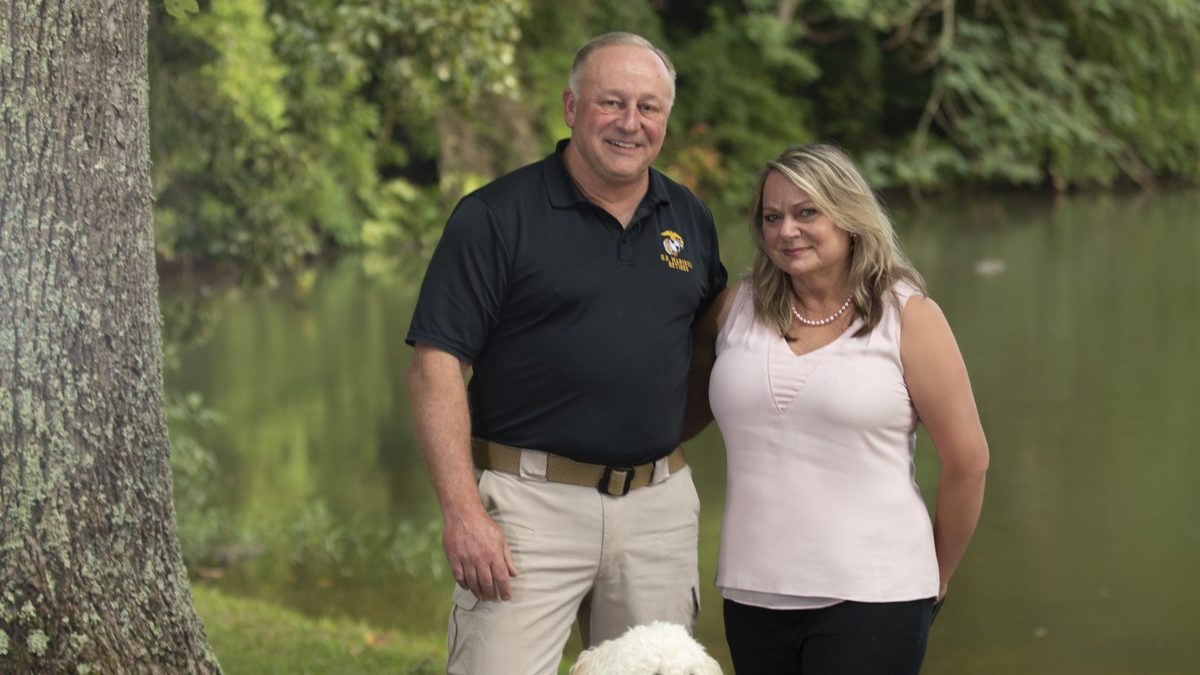
There was a time when the term ‘flip house’ didn’t exist. Like back in the day when I was in the business of buying and selling homes that for the most part had been foreclosed on. The goal was—and still is—to buy a property at a bargain, increase its value with the right repairs and updates and then sell it again quickly. Today it’s become the thing to do. Back then it wasn’t necessarily shrouded in coolness. As we focus on real estate in this issue I had occasion to revisit some of those memories.
One particular day I purchased several houses at the same real estate auction. The previous owner had the reputation of being a wheeler-dealer so I was prepared to secure the houses as quickly as possible. Unfortunately, on this day I wouldn’t be quite quick enough. Arriving at the one of the duplexes I’d just purchased, I found a man on the roof with a plumbing snake going down a vent pipe. Inquiring as to what he was doing, he told me that the property owner had agreed to rent in exchange for labor. A quick call to Stormin’ Norman Jackson, my attorney, confirmed that I indeed had inherited a squatter. It took over six months to coax that nice squatter out of my house; in fact, I had to pay him to leave. Cash for keys and the reality that we can have squatters in modern day times amazed me. Now with the possibility of federal government mandating no evictions, you could have a long haul to get control back of your own rental property.
On another occasion I was looking at a property to purchase and the former owner was still in residence and not excited about leaving. They invited me in to look around. Upon entering I asked what was living in the large terrarium. Our pet boa constrictor, replied the owner. How large is the snake (as if that mattered)? About 10 feet, he replied. And where is the snake? (The terrarium was vacant at the time of my visit.) Oh he’s around here somewhere….That was enough for me. Someone else could have this prize.
Or there was the time in Loudon County I purchased three little houses right in a row—two duplexes and a single family not even 150 feet from the railroad tracks. Upon requesting to have it added to my property insurance policy the agent congratulated me on purchasing the Loudon County Brothel—well, he used a much more colorful term. The girls were all long gone when I took title but it made for a great laugh anyway.
I learned a lot of lessons buying and selling those old houses. Sometimes it was dirty work but it really wasn’t all that hard. It taught me a lot about real estate and construction and home remodeling priorities.
Today with the ever-present house flipping shows on TV, many more people are thinking they’ll flip houses and make a mint. With the right combination of good credit, know-how and patience, it’s possible—though I’d question the mint part. If you’re willing to learn and get dirty and buy wisely, investing in real estate remains one of the surest investments of all time.
When it comes to real estate always remember location is key and never fall in love with the house, fall in love with the deal and you will always have successful real estate investments.
→ Swipe for Next Story
Arts & CultureSEPTEMBER OCTOBER 2020
Strong Alley
Story by Marc Anthony
A basic walking tour of downtown Knoxville is usually through Market Square to Gay Street, maybe skirting Krutch Park and, for the truly adventurous, down South Gay Street to the old Regas restaurant plaza and Knoxville Station. But you’ve probably walked right past one of the most eclectic and interesting spots in Knoxville, just off the square and situated behind the historic Miller’s Building.
Strong Alley, long known for its graffiti and seediness, has become the most photographed spot in downtown, according to photo-sharing social medium Instagram. Between Union and Wall Avenues, this menagerie of bold strokes and abstract street art draws curious eyes and wayward strollers. Businesses, as part of the Artist Alley Revamp, have allowed artists to adorn the aging brick with their colorful and personal masterpieces. Any Google search of Strong Alley will reveal that many of these pieces of art may be here today and gone tomorrow.
Strong Alley’s most famous creation, the 12-foot Dolly Parton mural, was defaced in April and was quickly repaired by local artist Megan Lingerfelt. It has drawn added attention to the alley as curious onlookers snap pictures and selfies.
→ Swipe for Next Story
DepartmentsSEPTEMBER OCTOBER 2020
Hang Tough
Story by David Butler
I’m grateful for this opportunity to write about the future of museums and cultural institutions in the age of COVID-19. Of course, I speak from my narrow perch as executive director of the Knoxville Museum of Art, but I’m in touch with colleagues around the country and consume everything I can about how the cultural sector is coping with the pandemic. I spend a lot of time thinking about how the KMA, a private not-for-profit organization dependent on broad community support and a diverse revenue stream, can successfully navigate a constantly shifting and increasingly unfamiliar landscape. Spoiler alert: I have not quite sorted things out.
Like everyone else you know, at the KMA we are groping our way through, with little certainty about what might happen tomorrow, much less in six weeks or a year. This is a moment when any organization needs to be secure about its values, and its value: we need to understand who we are and why what we do matters. The KMA, thankfully, was able to reopen on July 1, on a restricted basis, with lots of safety protocols, and we were overjoyed to welcome people back. We were also fortunate to be able to extend through late October a groundbreaking exhibition documenting the lifelong relationship between Knoxville native Beauford Delaney and writer and civil rights activist James Baldwin.Beauford Delaney and James Baldwin: Through the Unusual Doorrepresents the best expression of the KMA’s commitment to the art and artists of East Tennessee, and resonates powerfully at this troubled and hopeful moment.
Even though the museum’s doors are open again, we’re expecting a tough year. At least one-fourth of the KMA’s annual revenue is based on gathering big groups of people, but the fundraising events and building rentals won’t be happening for a while. We can’t do much in the way of in-person programming for now, but have greatly increased our digital footprint to reach people via other channels. Our major donors have held steady, and hundreds of members have maintained or increased their giving, which is deeply gratifying.
I am optimistic for the arts organizations that have helped make Knoxville the vibrant city it is. I know Knoxville will hang in there with us, and we will emerge from the current situation smarter, more responsive, and better attuned to the needs of our audiences. When times are hard, you find out who your friends are, and the cultural sector in Knoxville has many, many friends.
→ Swipe for Next Story
PoliticsSEPTEMBER OCTOBER 2020
Who’s in charge?
Story by George Korda
The county mayor is responsible for the operations of Knox County government—unless a health emergency prioritizes the ideas of a group of unelected individuals responsible only to themselves for their decisions.
Is it hard to follow who’s in charge around here? You bet.
There are four ways government at any level often approaches a difficult situation: “Here’s a problem; we need to do something about the problem; here’s something we can do; let’s do this!”
The salient question surrounding county governments in the maelstrom that is the coronavirus (COVID-19) pandemic is this one: Who’s in charge of making “let’s do this” decisions? Is it the peoples’ elected representatives or the largely-unelected Knox County Board of Health? The answer is that it isn’t the elected representatives of the people.
Existing state law was formulated to give direction on who is responsible for doing what during public health emergencies. It took COVID-19 to reveal the unintended effects.
As COVID-19 spread across the world, local residents were like everyone else in the country, jerked around like a yo-yo on a bureaucratic string. By August, Knoxville, Knox County, and the entire country had seen orders from every level of government on masks and closures to try to stem COVID-19.
Knox is one of six Tennessee counties with its own health board. The nine-member board is made up of ex-officio members Dr. Martha Buchanan, director of the Knox County Health Department; Knox County Mayor Glenn Jacobs; and Schools Superintendent Bob Thomas. Six representatives of the medical field, including a veterinarian, are selected by their associations, nominated and confirmed by county commission.
The health board website says, “We are a division of Knox County Government under the supervision of Knox County Mayor Glenn Jacobs. The Knox County Board of Health was established to serve an advisory role.”
Advisory? In the pandemic, they’re not advising elected officials about what they could do; instead, they’re telling them what to do.
One example: On July 1, the health board passed a face mask mandate, requiring mask use in Knox County. Jacobs voted against the mandate. As he explained on social media, “I worry that one-size-fits-all mandates such as this set a terrible precedent for government overreach, are difficult to enforce, can cause conflict between the authorities and the public when enforced, and, as written, this order places enforcement responsibilities on private businesses.”
But in an emergency, state law enables the non-elected health board to move from an advisory to an executive role, rendering elected officials powerless—unless, of course, they agree with the health board.
“If it’s a business, they can shut it down. They can make people wear masks. They can make anybody do anything if they say it’s being done for the health and safety of the county,” one official said.
Knox County Republican State Rep. Jason Zachary attempted to get a bill passed in the last General Assembly session that would give county mayors the authority to make final decisions for the counties they run; however, according to the June 18 Farragut Press, it was derailed in the state Senate, a prime derailer being Knox County Republican State Sen. Richard Briggs, a physician.
Mayor Jacobs can fire Dr. Buchanan; however, that’s fraught with obvious political consequences; furthermore, from that moment forward Jacobs would be blamed for every bit of bad local COVID-19 news.
The board itself is beyond his reach: nominated and confirmed by county commission, board members can be removed for cause. That, too, is unlikely.
Knox County is in uncharted territory. In this case, it’s dealing with a law rife with unintended consequences concerning health department authority. The Knox County Board of Health can overrule or ignore the decisions, advice, or demands of elected representatives, and it’s accountable to no one but itself, regardless of how controversial, effective or onerous its decisions.
Meanwhile, it’s the citizens who wrestle with the consequences.
→ Swipe for Next Story
InsightsSEPTEMBER OCTOBER 2020
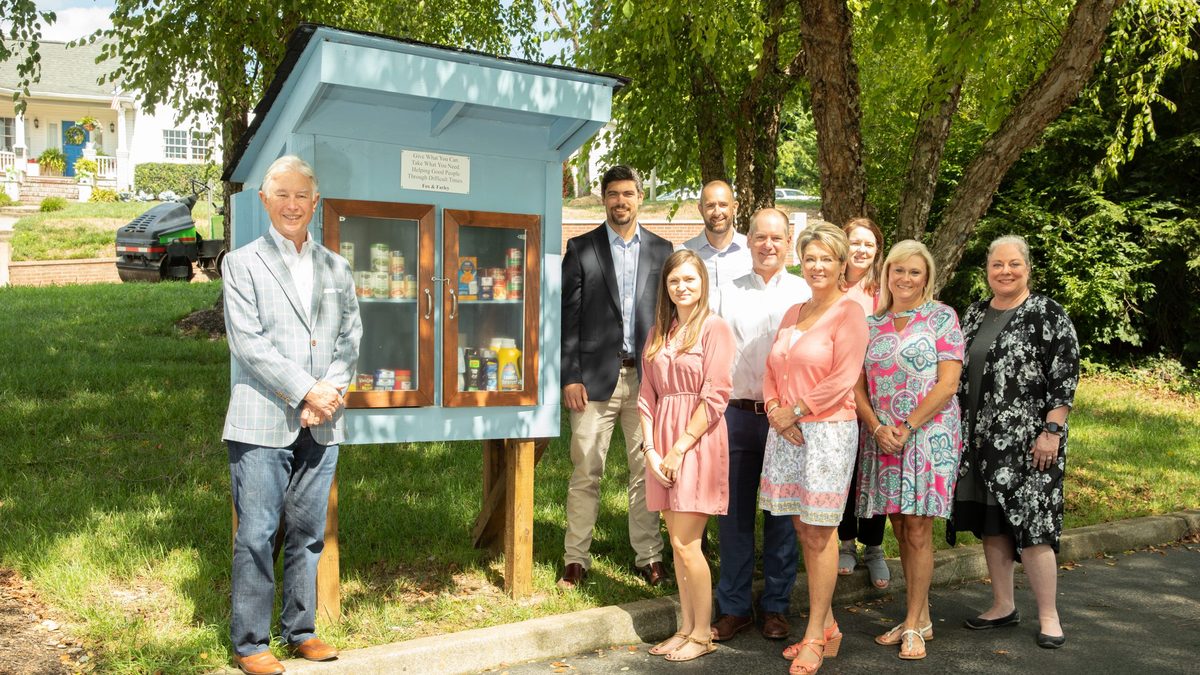
Blessing Boxes
Give what you can — take what you need
Story by Bruce Fox
One cold day in January I called a meeting to see what our law firm could do for the community in the coming year. Over my 40+ years in business I have learned that one of the most important responsibilities of a community-based business is how we choose to give back.
The idea of a blessing box became the center of the discussion as Tina explained that her dad had built one for their church. We agreed to give it a try. Materials were purchased and the office parking lot became our shop. None of us are carpenters, but the box was completed and installed! Now for the real test.
We filled it up with nonperishable food and personal hygiene items, which are free for the taking. I expected to find it empty quickly, but it seemed like every day there would be more food and supplies in the box!! We soon discovered that teachers from Clinton Elementary and Middle Schools were making sure there were ample items for those in need.
Then COVID hit… and everything changed. The needs of the community drastically increased. The Norwood Elementary School principal called asking if we would build a box for his school. Tina’s dad volunteered to help build the boxes. The second box was completed and I delivered it the following week. What an uplifting experience! I was truly humbled that day at how the simplest of gestures can make such a difference.
The word was out and the following week two additional requests came from school principals. I do my best to never say no, and construction was commissioned on several more boxes. At this point we have 17 in the community with requests for several more. All of them seem to be a huge success.
We have partnered with local churches near the schools to help keep them filled, and each box has a sign that says “Give what you can, take what you need,” and good people are doing just that! I have met with Elaine Streno, the director of Second Harvest Food Bank, and with their agreement to help with supplies, the sky is the limit.
We are committed to building Blessing Boxes as long as there is a need and schools and churches keep requesting them. The true blessing has been to us, knowing that we are living up to our firm’s motto “Helping Good People Through Difficult Times.” If you would like to participate and sponsor one of the boxes please give us a call at 865-457-6440.
→ Swipe for Next Story
DepartmentsSEPTEMBER OCTOBER 2020
History and horticulture
Story by Susan Alexander
Harold Duckett’s love of gardening is rooted in history and culture.
That’s why he growsAcanthus spinosa,the plant that inspired the design of ancient Greek capital columns.
A kiwi vine, which provides shade over his garden arbor, came from New Zealand. A poet’s laurel shrub first came to America from Japan with Knoxville nursery owner David Howell in the 1700s.
His 14 koi, who eat out of his hand, also come from Japan. That’s where Duckett and his wife Beverly attended the All Japan Koi Show and fell in love with the species. “They’re like floating jewelry,” he said. “I got fascinated by them and came home and dug a pond.”
“Gardens are microcosms of almost everything we want to think about,” he said. “That just fascinates me. Our clothing comes from plants. Our food, the non-meat products, are plants. I’m not so much interested in a beautiful garden, all sorts of blooming plants. It’s more the awareness of social and political and world event histories that connect to the garden that fascinates me.”
Duckett, a retired architect and master gardener, and his wife, the self-described chief weeder, purchased their home in the Whittle Springs area 45 years ago. Their nearly one-acre lot has changed and grown and changed again as they’ve added and moved garden spaces and built an outdoor dining area and garden shed, complete with roofed front porch.
“A garden is a process,” he said, echoing what all devoted gardeners know. “It’s not a product.
“My family’s always been gardeners. When I was a kid I went to the garden every evening with my dad and hoed the okra and corn and beans and squash, and we’d sit in the middle of the garden and slice that stuff up and eat it. It just gets in your blood. I have Cherokee heritage also, and the earth has always been sacred to native Americans, and I think some of that captured my interest. And the other part about gardening is it’s a change from dealing with people all day. To be able to come home and wipe away all the frustrations and cantankerousness can make a big difference.”
Duckett encourages people planning a garden to put it where they want to be. “I drive by places and they’ll have a fountain in the front by the driveway, but they get out of their car and go in the kitchen door, so it’s strictly for the neighbors to look at, and they get none of the pleasure of the sound of water. So I think it’s important to put the garden where you are. Make it occupiable. Make it something you can enjoy.”
→ Swipe for Next Story
DepartmentsSEPTEMBER OCTOBER 2020
Steaks & Style
Story by N. Brooks Clark
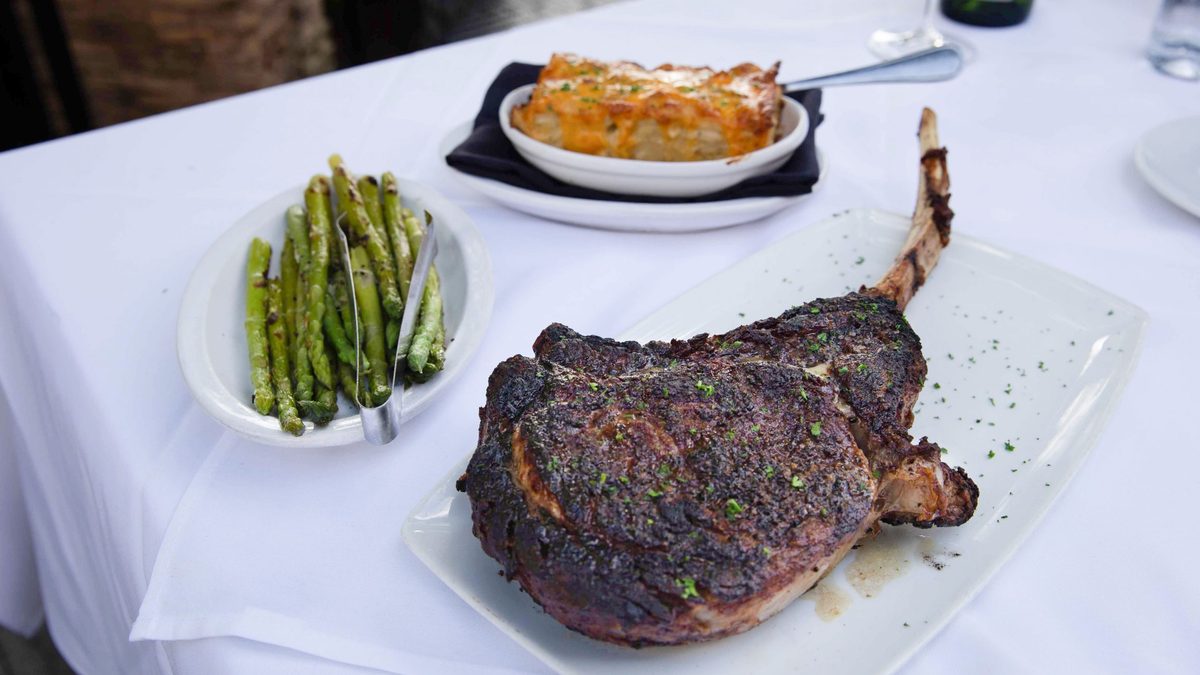
The Prime Tomahawk specialty cut makes a bold statement when it appears at your table. Where other steakhouses may offer prime rib cuts with the bone in, this one comes with 16 inches of rib protruding from a juicy 35-ounce, inch-and-a-half-thick cut, making it resemble a tomahawk (hence the name). Cooked medium rare, it sated three carnivorous diners and later made a canine at home wonder what he had done right.
Fleming’s Prime Steakhouse & Wine Bar makes no bones about its ambition to be the go-to spot in a crowded field of high-end steakhouses, featuring the finest prime midwestern corn-fed beef and fresh seafood with service that is both gracious and indulgent. Fleming’s is also proud to tantalize palates with 100 premium wines served by the glass.
Many diners posting online reviews said they picked Fleming’s for a big anniversary or birthday celebration, and most describe the private atmosphere of dark wooden booths and red leather benches as suitably luxurious for the occasion. The patio is pleasant and spacious for COVID-conscious patrons. Lately Fleming’s is also doing a significant curbside carryout business.
Those same reviewers praised the enthusiastic staff. For us, Justin, doubling as bartender and waiter, provided mouth-watering details about all the offerings.
In the new era of creative cuisine, Chef Partner Andrew Hearndon adds flourishes that give an unexpected zing to dishes like the starter Burrata with Prosciutto, which features a scrumptious goose-egg-sized orb of poached mozzarella with charred Campari tomatoes, prosciutto, wild arugala, and toasted garlic crostini.
The Beef Carpaccio features paper-thin, melt-in-your-mouth beef slices with sourdough toast coated in parmesan cheese, alongside spinach, basil, hard-boiled egg, red onions, caper-creole mustard sauce, and capers that will make you think you’ve never had capers before.
Like the Tomahawk and other classic cuts, Fleming’s’ wedge (really a half-head of iceberg) arrives with a sense of the dramatic, oozing with blue cheese dressing (of course) and crumbles, balsamic glaze, red onion, Campari tomatoes, and bacon. Fleming’s Salad is a similar treat for the eyes and palate, with sweet and spicy walnuts, tomatoes, dried cranberries, red onion with lemon balsamic vinaigrette.
For a double dose of presentation flair, look to the menu section entitled “Over the Top,” and try the Truffle-Poached Lobster, served with béarnaise sauce and caviar. Piscatorians also rave over the Barbeque Scottish Salmon Fillet with mushrooms and barbeque glaze, the Miso-Glazed Chilean Sea Bass, and the Alaskan King Crab Legs.
Fleming’s is especially proud of its sides, headlined by its unique Fleming’s Potatoes, in which au gratin potatoes are blended with creamy cheddar and Monterey Jack cheeses, leeks, and jalapenos and presented as a loaf. This, like the North Atlantic Lobster Mac and Cheese, could be a meal in itself.
Our table split two irresistible desserts—a three-layer carrot cake with homemade cream-cheese frosting drizzled with a caramel rum sauce; and a Belgian dark chocolate lava cake served with a dollop of vanilla ice cream, classic Tuiles sugar wafers, and pistachio nuts.
Fleming’s makes no bones about pricing its top-end offerings at the top end of the market, but it can be argued that the experience is worth the price.
→ Swipe for Next Story
Dining GuideSEPTEMBER OCTOBER 2020
Traveling by Food Truck
Sample the world’s flavors at Knox-area mobile eateries
Story by Susan Alexander
We’ve all been there: You want Mexican; he wants Asian. You want Hibachi; she wants crepes. With Knoxville’s fleet of food trucks offering international flavors, you can have the best of both culinary worlds. Here are some options you’ll find around town; check their websites or Facebook pages for their upcoming locations.
Chef Aaron’s Creations
A taste of the islands can be found in the fresh pineapple pico in Aaron’s Island Nachos or Pineapple Shrimp Tacos. facebook chefaaronscreations
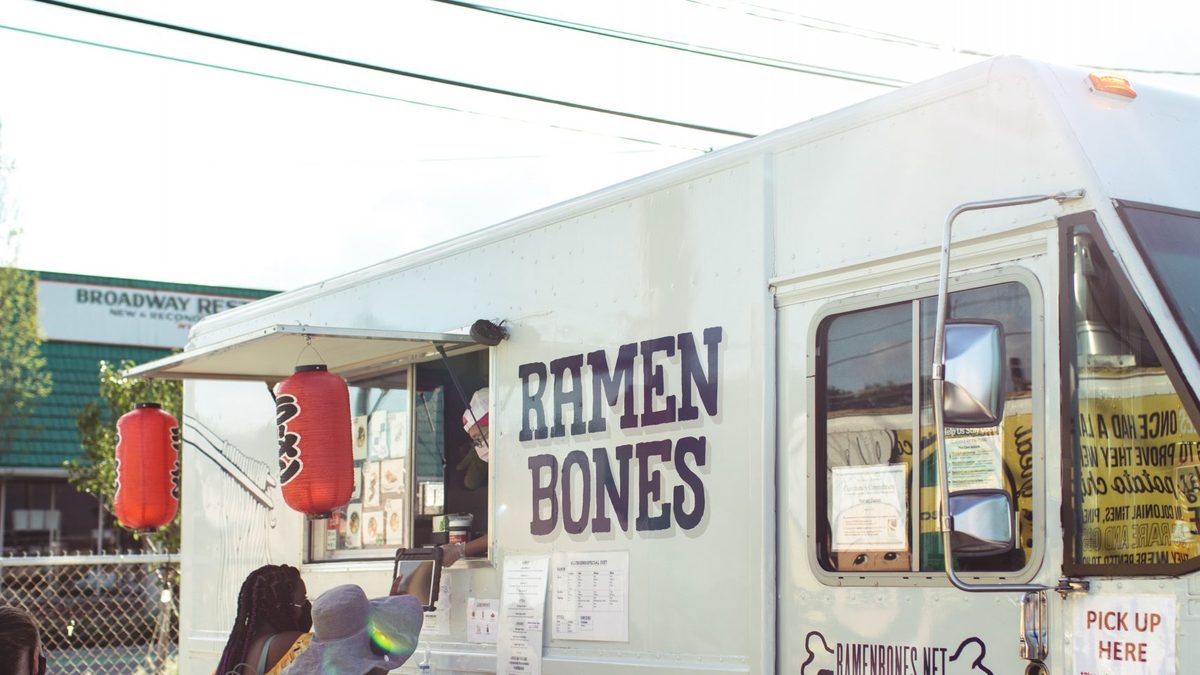
Ramen Bones
Slurp ramen with the folks at this Japanese food truck that specializes in flavorful ramen noodle soups, gyoza (dumplings) and onigiri (seaweed-wrapped rice balls). ramenbones.net
Kazoku Hibachi Express
Did someone say shrimp sauce? This Japanese Hibachi experience will hit the spot.
facebook kazokuhibachiexpressCJs Tacos
CJ’s pan-fried corn tortillas can be filled with a variety of flavors from Korean BBQ Pork, Buffalo Chicken, and Asian Fusion. cjstacos.com
Good Golly Tamale
This gem makes their tamales with non-GMO corn masa, locally sourced free-range meats and local produce when available. goodgollytamale.com
Knox Wurst
This four-man crew makes their German-style sausages, toppings, and sauces from scratch, creating some of the tastiest brats imaginable.
This mobile creperie features sweet, savory and vegetarian crepes built on Southern cuisine with a French flair. Check their Facebook page for locations.
facebook Farm-to-Griddle-Crepes-379697042064392
Taqueria la Herradura
This family-owned business is serving up authentic Mexican food. Try their barbacoa and carne asada tacos. facebook LaHerraduraFoodTruck 2625 N. Broadway
Penne For Your Thoughts
Enjoy Italian-American fusion food with creative takes on familiar classics, including meat grinders and penne pasta with alfredo sauce.
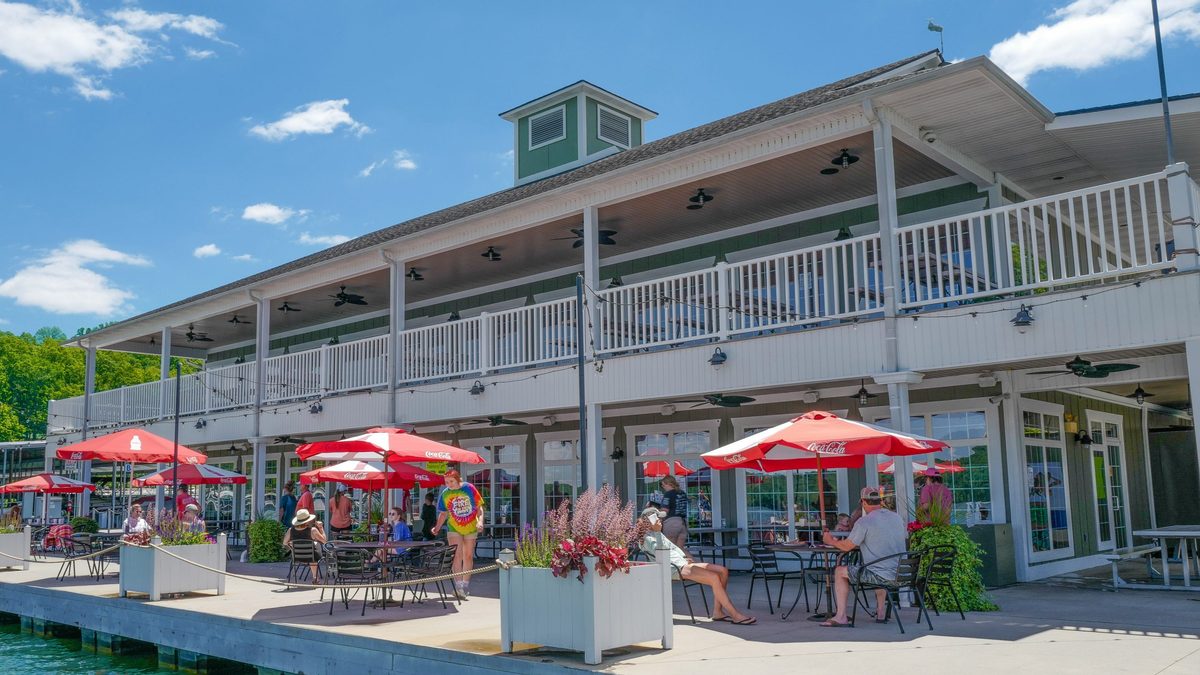
Is there a better time to enjoy dining al fresco? Yes, it keeps us safer than being indoors during the current pandemic. But COVID concerns aside, in September and October the temperatures slide back into a comfortable range, the skies deepen to a vivid autumn azure and the earliest of turning leaves develop a golden tinge. Marinas, like the one pictured here at Sequoyah Marina on Norris Lake, serve up stunning waterscapes to enjoy with your burgers, but lots of restaurants in Knoxville and surrounds also offer pleasing outdoor options. Here are some of our favorites. Email yours to info@cityviewmag.com and we’ll add them to the list online.
Schulz Brau Brewing Co., 126 Bernard Ave, Knoxville 37917
Stock & Barrel, 35 Market Square, Knoxville 37902
Sweet P’s Downtown Dive, 410 W Jackson Ave Knoxville 37902
→ Swipe for Next Story
DepartmentsSEPTEMBER OCTOBER 2020
The Knoxonomist
Story by Cityview
Dear Scott,
The Knoxonomist remembers his first snipe hunt as if it were yesterday. As a Boy Scout the Knoxonomist learned many things about the wilds of East Tennessee and the rites of passage sometimes required to be a full-fledged scout.
The Knoxonomist’s first hunt was on a damp cold cloudy night, and the other scouts insisted the Knoxonomist would be the best darn snipe hunter ever. They also said that, like you, I would have be masked as to not disclose the location of the critter’s lair to those not properly initiated.
The Knoxonomist recalls walking for some time before the mask was removed and then being given a burlap sack to catch the snipe. The other scouts would go about with flashlights and scare the snipe towards the sack. The Knoxonomist was instructed on how to hold the bag and told to be absolutely still. The other scouts cawed and clucked and ran about in the woods, and often the Knoxonomist would hear the others call out ‘here comes one’, and then he could hear the sounds of laughter and wondered what about this strange little snipe was so darn funny.
It was then that the Knoxonomist realized exactly what was happening. The Knoxonomist yelled ‘I got one, I got one’ and the other boys, not understanding, came running to see exactly what the Knoxonomist had managed to get into the bag. Just as they were almost to the clearing the Knoxonomist screamed ‘Look out, it’s a bear!’ The sudden change startled the others. One wet his pants and another ran into a tree limb, knocking himself out. All the while the Knoxonomist was belly laughing. A good prank can be funny but one that backfires is hilarious.
The kind of snipe hunt you were part of was nothing more than an elaborate prank to see how you would respond. The real snipe is an elusive bird that flies in a zig zag manner, making it difficult to shoot; thus arose the term sniper for those who were able to successfully bag the prey.
The Knoxonomist, being quite the marksman himself, has from time to time resorted to bagging a few of the little fellows to avoid coming home empty handed from a good duck hunt for fear the missus would think he wasn’t hunting at all.
The Knoxonomist recommends playing along and letting them have their laugh, all the while waiting for your opportunity to repay the debt. Snipe-on and keep an eye out for those wild bears.
The Knoxonomist welcomes your questions—Send your inquiries toTheKnoxonomist@cityviewmag.com.
→ Swipe for Next Story
DepartmentsSEPTEMBER OCTOBER 2020
Irritating Allergies
Story by Cityview
Oh my! It’s allergy season again for Rugby, my toy poodle. It manifests as incessant licking of his paws, and I find saliva pools on furniture and bedding. My wife finds it quite disgusting. And Rugby can do nothing wrong in her opinion.
On the other hand, I’m a veterinarian so it is assumed that I like this kind of thing. I wake up often, however, with the sounds of chewing and scratching from this little ball of fur. More importantly, imagine how Rugby feels. Unlike us humans who typically show hay fever symptoms with congestion, sneezing, breathing issues and itchy eyes, allergies in dogs are primarily expressed in the skin. This means that if Rugby is allergic to grass pollen, then he licks his feet, scratches his sides and rubs his face. In fact, it doesn’t really matter whether he breathes in the pollen or comes into contact with it, same result.
Avoidance is ideal; however, Rugby’s personal powder room is the great outdoors and there is no avoiding grass. Fortunately, there are lots of exciting new allergy medications for dogs, and they work! Rugby takes a little pill every day with peanut butter. In fact, he reminds us to give it to him by body slamming the pantry door every afternoon.
If your dog is licking his or her feet incessantly, ask your veterinarian about what you can do. Your furball will thank you for it, and everyone will sleep much better.
→ Swipe for Next Story
JurisprudenceSEPTEMBER OCTOBER 2020
Only a Pawn
Civil rights history lesson enforces tragedy of racism
Story by Gary Wade
Medgar Evers, born on July 2, 1925, in Decatur, Mississippi, grew up on a small farm, attended a segregated school, and earned a high school diploma. At 18, he enlisted in the U.S. Army, fought in the Battle of Normandy in World War II, and received an honorable discharge at the rank of sergeant. Evers then graduated from what is now Alcorn State University and, after the 1954 landmark decision in Brown v. Board of Education ordering the desegregation of schools, applied to attend to the University of Mississippi College of Law. Because of the color of his skin, he was denied admission. Evers married Myrlie Beasley and fathered three children.
In 1920, Byron de la Beckwith was born in Colusa, California. Five years later, his father, who served as postmaster, died of pneumonia. His mother, Susan, then moved to Greenwood, Mississippi, to be closer to her family. Beckwith was 12 when she died of cancer. Called “De La,” Beckwith lived with relatives for a time, joined the Marines in 1942, and served as a machine gunner in the Battle of Guadalcanal. Injured in a subsequent battle, Beckwith was honorably discharged in 1945. He married and had one son before the couple divorced.
The unanimous Supreme Court decision in Brown altered the course of both lives. Evers, who had previously helped stage boycotts of gas stations which refused to allow their African-American customers use of their restrooms, became the NAACP’s first field secretary in Mississippi. In that capacity, he led voter registration efforts, organized new NAACP chapters, and attempted to integrate public schools, parks, and beaches. In contrast, Beckwith, a salesman, became a member of the Ku Klux Klan. In the aftermath of Brown, he joined the White Citizen’s Council, an organization designed to preserve the Jim Crow era in the South—resisting integration and working to exclude blacks from holding political office. The membership implemented a variety of economic strategies, such as denying loans and credit to African-Americans, boycotting their businesses, and “encouraging” employers to fire them from their jobs.
Evers’ leadership in the civil rights movement made him the target of white supremacists. As a part of his job, he conducted interviews with African-Americans who had been intimidated by the White Citizen’s Council and had collected affidavits documenting the Council’s racist activities. Further, he investigated the 1955 lynching of Chicago teenager Emmett Till in Mississippi and supported Clyde Kennard, who had been denied admission to Southern Mississippi University and was later falsely charged, convicted, and sentenced to serve seven years in the notoriously violent Parchman Penitentiary.
On May 28, 1963, someone threw a Molotov cocktail into the carport of Evers’ residence in Jackson. Ten days later, he was almost run down by a vehicle as he walked out of his NAACP office. During this time, the FBI and the local police, fearing further acts of violence, regularly escorted Evers from his office to his home. On June 11, 1963, when President Kennedy was to deliver a major address on civil rights, Evers asked his wife to be sure to watch the telecast. He hugged and kissed his family and then drove to his office to meet with NAACP lawyers. Shortly after midnight, one of the children heard the familiar sound of Evers’ car and shouted, “Here’s Daddy!” After hearing a “horrible blast,” Myrlie ran to the front door to find that her husband had been shot in the back. Even though the bullet passed through his ribs and lung and penetrated a window of his residence, Evers was able to stagger some 30 feet to the door. As the children screamed for their “Daddy,” Myrlie heard another shot and dropped to her knees.
By then, neighbors had come to the scene. Two individuals placed Evers in a station wagon, and drove him to an all-white Jackson hospital. Initially denied admission, Evers was accepted for treatment when the staff learned of his identity. Fifty minutes later, he died. In death he had become the first African-American to be afforded medical care at the facility.
Five thousand people marched in unison to Evers’ funeral service. The Rev. Martin Luther King Jr. and other civil rights activists led the procession. One week after the assassination, Evers was buried with full military honors at Arlington National Cemetery. A crowd of 3,000 attended the service.
On June 21, 1963, police arrested Beckwith on a charge of first degree murder. Two weeks later, folk singer and civil rights advocate Pete Seeger invited Bob Dylan to sing “Only a Pawn in Their Game” at a voter registration rally in Greenwood, where Beckwith lived at the time of the murder.
District Attorney General Bill Waller, who eight years later was elected governor, prosecuted the case. The proof at trial established that Evers had been shot by an Enfield 1917 rifle found near the scene—a.30-06 caliber weapon used by American forces in World War I. The telescope on the rifle bore Beckwith’s fingerprint. A farmer testified that he had traded the rifle to Beckwith in 1960. A shop owner testified that he sold Beckwith a scope for a rifle a month before the murder. Witnesses saw Beckwith’s distinctive car in the Evers’ neighborhood on the night of the shooting. Some reported seeing a man meeting Beckwith’s description in the vicinity. At his arrest, police photographed a half-moon scar above his right eye, suggesting the wound had been caused by a recoil from the rifle shot. Despite this evidence, an all-white jury failed to reach a verdict. A second trial two months later, again with an all-white jury, ended in a mistrial. It is likely that jurors saw Governor Russ Barnett, a notorious segregationist, shake hands with Beckwith in the courtroom before their deliberations. The White Citizen’s Council paid the legal fees.
In 1967, Beckwith ran for lieutenant governor, finishing fifth among six candidates. Six years later, police at a roadblock in New Orleans found a bomb in his vehicle, purportedly intended for the home of a leader of the B’nai B’rith Anti-Defamation League. Prior to his imprisonment, Beckwith was ordained in Knoxville by a minister at the Temple Memorial Baptist Church. While serving his sentence, Beckwith refused treatment from an African-American woman; a guard overheard him claim that if he “could get rid of” Evers, he could do so with the “no account” nurse’s aide. Paroled in 1980, Beckwith moved to Signal Mountain, Tennessee.
In the late 1980s, when reports by a Jackson newspaper pointed out improprieties in the jury selections of the first two trials, the District Attorney in Jackson sought and received an order of extradition from the Tennessee governor. When Beckwith was placed under arrest, he fought the order in Hamilton County. The trial judge denied him relief, the Court of Criminal Appeals in Knoxville affirmed, and our Supreme Court declined review. In his third Mississippi trial, former Klansman Delmar Dennis of Sevierville testified that Beckwith had often bragged about shooting Evers at Klan rallies. A jury of eight African-Americans and four Caucasians returned a guilty verdict. Beckwith, while serving a life sentence, died at the age of 80 on January 21, 2001, almost 38 years after the murder.
In his 1963 song, “Only a Pawn in Their Game,” Dylan had praised the life and legacy of Medgar Evers and forecast the inglorious fate of his assassin.
Beckwith was buried at the Chattanooga Memorial Park. A small stone marks the spot.
→ Swipe for Next Story
InsightsSEPTEMBER OCTOBER 2020
Old Friends
Sweet friendships refresh the soul. —Proverbs 27:9
Story by Robert Pryor, Sr.
Both men were slow exiting my car. For the first time, my two friends looked like old men. Chubby, the shorter of the two, shuffled to the door, while Wayne appeared weak and off balance. I knew Wayne had neuropathy in his feet and legs and had fallen several times lately, and I reached for his arm to help him out of the back seat. Lunch at Louis Drive-In on Old Broadway sounded like a good idea, but I was beginning to wonder if I’d taken on a bit too much that summer day in 2018.
There we were, three close friends arriving for lunch at one of our tried-and-true haunts. Over the years, I’d witnessed this scene many times — old men arriving for lunch. We were now the old men.
Time stands still at Louis. The same carpet, same old tables and chairs, and, best of all, the same garlic and pizza smell greeted us. After we were seated at the first available table, things began to improve.
I had wanted this to be a memorable occasion. I wanted to hear our old stories once again. I believe in the healing power of laughter. Laughter was needed, and laughter is what I got.
Chubby has been my friend since 1962 and now was suffering some kind of blood disorder which went undescribed except to assure me that it was not leukemia. Wayne, on the other hand, had several bad things going on, including kidneys, nerves, and occasionally memory problems. I first met Wayne when he opposed me as an insurance claims adjuster around 1973. My client had parked her gray Ford near her place of business and when she returned in the afternoon her car was painted green -windows and all. Wayne’s insured was a painting contractor on a nearby bridge, and the over spray had settled on my client’s car. Of course, Wayne argued that the car looked better painted green. He was even so bold as to insist the value of the car had been increased by the event. We were forever friends from that moment. These two men of character grew extremely close not only to me, but to my wife and children and to each other. Friends for life.
We were so accustomed to each other, the three of us thought and acted the same as we had in our youth. Time had been good to our relationship, but not so good to our bodies and our health. Wayne was always involved in the insurance industry, first as an adjuster and later as the owner of his own agency. Chubby had been a salesman, part-time politician, and, in his later years, a court bailiff.
Our stories had weathered the test of time and, in many ways, gotten better. Details of a good story get richer when artistic license is freely exercised. As Chubby pushed his mashed potatoes around with his fork, he told us once again the story of how he and fellow rowdies Eddie Oglesby and Carl Smithers slipped in the back of the Exhibition Center at Chilhowee Park to avoid paying to watch the Golden Gloves boxing matches. Chubby grew up on East Fifth Avenue and knew his way around Chilhowee Park and all of its unsecured doors. Once inside, Chubby, of course, demanded ringside seats and asked to talk with “Ace” (Miller), the long-time boxing trainer and director of the Golden Gloves. It was then they learned that the Golden Gloves were being held elsewhere and they had broken into the Friday night wrestling matches. That story was typical Chubby and always funny.
Wayne laughed and recalled the time he was refereeing a recreational league basketball game at Chilhowee Park when Chubby entered the game as a substitute player. While Chubby was an “All-South” All Star football player at East High School, he never played much basketball, and when he grabbed a long rebound, he tucked the ball under his right arm and took off running to the other end without dribbling. Wayne said he bent double laughing trying to blow the whistle for traveling.
Wayne grew up in Mascot and played all sports at Carter High School. You need to understand these two knew everybody east of Gay Street by the time they reached 18 years of age, and then as senior citizens knew practically everybody in Knox County. It’s possible you knew them from their membership in area civic clubs or their years of support for the Emerald Youth Foundation, the Boys and Girls Clubs, and Vol football and basketball. Both were charter members of Tennessee Troupe N’ Travel and both were great athletes.
I reminded Chubby of his annual football road trips to non-Tennessee games with a group of close men friends in Blount County. I think it was the year they went to the Army vs. Navy game that the waitress in a restaurant was taking orders around the table and with each entree asked, “Do you want soup or salad?” When Chubby’s turn came, he asked the waitress, “Just exactly how big is that super salad?”
Wayne loved Hardee’s for breakfast and when we traveled together on vacations, to ballgames, or to play golf he always insisted on starting his mornings with biscuits and gravy from the nearest Hardee’s. Once, near Columbia, South Carolina, en route with our wives to Myrtle Beach, I protested. “Why don’t we skip Hardee’s this morning and get some real biscuits and gravy from a mom-and-pop cafe where the locals eat.” Wayne relented and we soon found ourselves driving through downtown Florence, South Carolina, when I spotted the Palmetto Grill surrounded by pickup trucks with South Carolina tags. “That’s it,” I directed, and sure enough Pop was flipping eggs and pancakes at the grill while Mom seated us with a pot of coffee in her hand. It was then that Wayne advised that we had traveled all the way from Tennessee for her biscuits and gravy. Mom then replied, “Honey, we don’t have no biscuits and gravy here. Didn’t y’all ever hear of Hardee’s where you’re from?” I knew then I had a story for a lifetime.
To entertain in a talent show, Chubby once tried to sing and dance to the song “I’ve Got a Brand New Pair of Roller Skates, You’ve Got a Brand New Key.” The problem was he wore a tutu skirt and a pair of roller skates as a costume, and every time he would get into the song, he would fall down. Amazingly, he won first prize just for falling. Chubby was a natural entertainer and loved to imitate Marlon Brando inThe Godfather. He would stuff his jaws with Kleenex and bought a tuxedo to wear when performing his routine. Once in Atlanta with a large group of Tennessee fans for a Georgia football game, Chubby caused an uproar and the hotel sent policemen to make arrests for loud noise. When the cops arrived and entered the suite, Chubby never broke with character and continued with his impression to everyone’s delight. No arrests were made, and, in fact, the cops joined us in watching the rest of Chubby’s show.
Wayne loved to sing gospel songs and he and his wife, Ann, could harmonize like pros. When seated next to the Red Hat Ladies Club once in the back room of a restaurant in Prattville, Alabama, we sang along with the ladies as they opened their program with the song “Do Lord.” After the song, they complimented Wayne and Ann’s singing and asked what we were doing in Alabama. I intervened to explain that we were a traveling gospel quartet and traveled the Southland singing in churches and for civic clubs. Of course, they invited us to sing and we performed a rousing version of “Build Me a Cabin in the Corner of Gloryland,” only to be rewarded with a standing ovation. We laughed about that performance for years.
On and on it went. The stories flowed and blood pressures leveled, and the familiar feelings of youth and good cheer crept into our veins. For two hours or more, each of us drifted closer to whole. Talk of our ailments was in the rearview mirror as we laughed all the way home. It was a great day that I will never forget as it reminds me how important it is to take time to enjoy laughing with old friends.
John “Chubby” Watts died December 7, 2018, and his life stood testament to all things good in family, friendship, and love.
Wayne W. Mowery died July 19, 2020, and is remembered as a devoted family man and thoughtful friend to hundreds throughout Knoxville and East Tennessee.
→ Swipe for Next Story
FeatureSEPTEMBER OCTOBER 2020
Structure Matters
Intentional strategy leads to success in a changed world
Story by Nathan Sparks
As human beings we naturally dislike change. Perhaps we abhor it so much that we find ways to make the change fail. That way we can say we tried and it just didn’t work. It is often easier to admit defeat than it is to plow on to success. Success takes more than a willingness to work hard; it takes clear vision, awe-inspiring skill and prodigious tenacity.
The journey can be filled with unexpected challenges, like the COVID-19 virus, that derail even the best-laid plans. This spring saw our youngsters challenged with distance learning programs that were haphazardly thrown together, supervised by teachers with inadequate preparation. The result was disastrous in many cases. I thought I would start with a look into that world from the perspective of my 13-year-old son and how social distancing and home-based schooling had affected him.
Troupe is entering eighth grade this fall at a private Christian academy in Southern California. As it was with many schools, the need to develop a distance learning program was thrust on them with almost no notice. The resulting program left much to be desired. Troupe didn’t do so well during that last part of the school year and that made me wonder what went wrong from his viewpoint. What was the biggest failure of the program in his opinion? How did the teachers respond to the experience and how did they deal with behavioral issues? From those answers I hoped to not only help him but also learn for myself from the mistakes that had been made.
Here’s what Troupe thought:Teachers were simply unable to control the behavior of the students during class. Some students played music, which led to many playing music at the same time, and the teachers wouldn’t mute them. So it was a real distraction. It seemed like every day at some point I would get a real zinger of a headache. Therewere times that I asked and others asked to record thesession but the teachers often said no. And as for discipline,what are they going to say, stay in your room? We werealready quarantined, so it was a disaster all around. I think I would like distance learning if it improves, and I hope it will be better this fall. Last year it was really hard to focus, and I tried to take a break and sit outside and talk to friends, but talking to friends isn’t as fun on the phone. Having justmoved to the area it is impossible to make new friendswithout some face-to-face time. Hopefully it will all be over soon because this is not a lot of fun.
I spent some time thinking about his responses. It’s not surprising that some people would not want to be recorded but it is something that we are all going to have to come to terms with, and soon. Remote learning also creates a very difficult situation for the supervising parent who has a full-time job. The parent can’t sit and watch every move the child makes; after all, they have their own work and the responsibility to pay the bills. My conclusion is that every class should be recorded and posted online so that the parent can more adequately help the child with homework and understand what is really happening in the class session. I realize now that there is far more that I can do to help the distance learning process, but also there is much we need to do to help the teachers to be successful. There are groups of parents who are coming together to hire their own part-time teachers to assist in the homebound education process, and that will be super helpful and give the parents and kids a break from each other.
What about physical development? I spoke with Devon Driscoll at D1 Sports for some ideas. “We offer some options for kids to do some distance training and even have small groups that have hired us to do independent physical education instruction for an hour three times a week,” he said. Having worked out at D1 I know that Devin and his team will find a way for these kids to be successful. It’s something to discuss with Troupe as he begins another school year in another state.
Thinking about the adjustments he’s had to make led me to ponder the many pandemic-related changes to my own routines. I’ve been grousing about having to work from home and not being able to visit my customers as much as I would like to. Poor me. I was resisting change and trying to find an excuse to make my failure acceptable, and that was depressing me and affecting my performance. This is simply not acceptable. I had to find what exactly was the source of my distaste for this new paradigm.
For one thing, like so many others, I didn’t have to get dressed for business anymore, because no one could see me unless I was on a zoom call. And then just my shirt was visible. What I hadn’t realized is that I missed the routine of preparing myself for work because it makes me feel good and gets me mentally prepared to be in the game. The person I most needed to please with my preparation was myself. I had lost sight of that.
I made a commitment to dress just as I would have if I were going to see customers. Dressing for success is an important part of a professional daily strategy. It shows the people you are calling on that you care about yourself but, more than that, it sets a precedent that you are ready for work. I have always admired someone who dresses well right down to a properly shined pair of shoes. I realized that caring for my appearance applied whether someone else could see me or not. It affected how I felt about me, and, if the opportunity came for a video call, I would be ready.
And then I started to look at my new home workspace, and that didn’t bring me any joy either. It was far too casual. So I decided to make some changes to make my space look better for when I electronically invited people into my home-office world.
I have been on many video calls where poor lighting and sound made the person I was speaking with look and sound horrible. Trite as it may seem, it feels like they didn’t care enough to properly prepare for our meeting. As a professional photographer/videographer I knew better. Recently I was making a decision about some software and the salesperson wanted to have a video call to preview the product. I was sold and wanted to speak face-to-face with her to finish up the deal. She made it clear that wasn’t going to happen. I knew she was not properly prepared. I realized I too had been guilty of going to digital meetings unprepared. You just can’t wait till the middle of the day to dress and prepare.
Finally, it was time to get back on a time-management routine. It is easy to work past or through lunch, or have breakfast at my desk, or end up pounding away at the keyboard way past quitting time. In this business there is always something to do, and mid-afternoon can easily stretch into late evening, leaving no time for a walk or a workout.
It wasn’t just social separation but also the lack of separation of the parts of my life that led to my dissatisfaction. When it all started to run together I had less to look forward to. Was I working at home or living at work?
I had seen the difference in others in lots of my recent calls. So I reviewed my appointment calendar and made some notes on each video call. What was my reaction to the way the person dressed, and to the environment they were broadcasting from? As expected, the people who demonstrated preparation for our online meeting were easier to do business with, just as the well-dressed salesperson has a better chance to close the deal.
But all of that just addresses the work aspect of my life, and, as I have said before, life is a balance of business, home, social, physical, mental, and spiritual aspects. With business back on track, how could I better balance the equation? It was time to reconnect. For people who strictly adhere to the social distancing mandate that could be a challenge, especially come winter. The backyard fire pit may see a surge in popularity as folks look for a way to socialize while keeping some distance.
I have a pretty clear idea of what I want out of life and how to get the job done. But thanks to Troupe, I realized it was time to make it happen every day. I wish all of our students a successful school year and encourage them to have the tenacity to see it through.
→ Swipe for Next Story
FeatureSEPTEMBER OCTOBER 2020
Bright Idea
Feinbaum family relishes light, open spaces in new Sequoyah Hills home
Story by Mary Leidig
“Our new house is our forever home. It will take a nuclear bomb to get me out of here,” says Sequoyah Hills homeowner Melissa Feinbaum.
Melissa and Ron Feinbaum bought a 1945 white “catalog house” on a hill in Sequoyah Hills in 2017. Catalog houses were mail-order homes sold mostly during the early 20th century and were essentially do-it-yourself homebuilding kits. Soon the couple began to reimagine a brand-new white house taking its place.
“We wanted an open concept and a house with lots of big windows and natural light,” said Melissa from the great room of the couple’s newly built home.
“The original house had a good life, and there were some interesting building materials such as redwood shakes, shipped from California and painted white,” she said. “I wanted to honor it when we had the house torn down.” The couple donated some of the original interior fittings to Knox Heritage and kept the garden shed that was on the property.
Melissa had remembered seeing the house on the hill on Kenesaw Avenue years before and loved the spot. “It was a wonderful area, and of course we love Sequoyah Hills. We love its diversity, the community and being near downtown Knoxville. This neighborhood is just so special,” she said.
Melissa’s father Marvin Miller, former owner of Schriver’s men’s and women’s store on Gay Street, grew up on the Sequoyah Hills boulevard. She remembers picnics there while visiting her grandfather, Samuel Miller, who bought Schriver’s in the 1950s. Her father Marvin would take over the family business and operate the iconic store until 1993 when the family closed it.
“We grew up in the store. I can remember the fun of running up and down the 1912 antique store elevator,” says the Knoxville native. The memories of Schriver’s bring a lot of joy, and she loves hearing about customers’ experiences.
Ron Feinbaum, a native Virginian, is a consultant with BoldSquare, a Knoxville-based global communications firm. He came to Knoxville in 2000 from Cincinnati, accepting an opportunity with Scripps Interactive and continuing his career at HGTV for more than 20 years.
Melissa owns her own business—Miller Feinbaum Recruiting. Their daughter Rachael, 12, is a student at Webb School of Knoxville where she is a member of the tennis team and enjoys riding horses.
The Feinbaum household also includes two dogs, Comet and Gidget, and two horses they board at a farm in Maryville.
The family lived in the original house for a short time. The house had a darker interior, and they knew they wanted a house full of natural light and an open concept design with special gathering spaces for family and friends.
“Living in the original white house was really a complete change for us, having lived before in Jefferson Park on Lake Loudoun in a 6,500-square-foot house.”
The new design concept meant tearing down the original house, looking through many rough drafts of drawings with architect and designer Jonathan Miller, and figuring out what would work. “Once the original house was removed, we started from scratch,” says the Feinbaum’s builder, Rob Purvis.
By 2018, the couple broke ground on what would be their third home together as a family and their “forever house.”
“With the site being sloped and narrow, we were really pleased with how well the house and the outdoor spaces were oriented and landscaped, still giving the family a level of privacy,” he said. Purvis says his greatest satisfaction with the project is how well the house flows, and how well the interior layout relates to the outside spaces and amenities of the home.
Purvis remembers enjoying a very good working relationship with the Feinbaums and Jonathan Miller’s design team. “Their excitement for the new home and everyone’s ability to communicate with each other allowed for a really nice finished product.”
So why does this new house already feel like home?
“It’s the peace that we feel when we are here. And it’s the livability of our home that comes from the ability to design your own home and work with an architect like Jonathan Miller and with a builder like Rob Purvis,” says Melissa. “Jonathan asked all the right questions to create and build a house that we call our home. We created and recreated until Jonathan got exactly what we wanted. It just feels like home, and I do believe that is what should happen when you create something so personal.”
Miller helped Melissa and Ron envision their living spaces with large windows and high ceilings with beams in their spacious kitchen and great room.
One can stand in the middle of the first floor of the 4,750-square-foot-home and experience a nearly 365-degree outdoor view. “There’s not a space in this home that isn’t flooded with light,” says Melissa.
The new two-story, white-framed home is designed to fill with guests or enjoy a cozy evening in what Melissa calls the “Keeping Room”—a cheery space with lots of natural light, of course. It’s a favorite with the family for reading, eating in and movie nights.
On the second floor is a large guest suite and a high-functioning, multipurpose space for home workouts, games and home theatre.
From the couple’s special Jewish marriage contract—a “Ketubah”—to an original Italian painting from their travels, the home’s walls are lined with many styles of art. All meaningful, says Melissa.
The intimate backyard space includes a pool, ping pong table and a covered patio with a wood-burning fireplace that the family began enjoying soon after moving into the house last Halloween. It’s a great spot to wrap up in layers on cool nights.
Ron, Melissa and Rachael each has a favorite spot in the house. Ron loves the outdoor patio, and Melissa chooses a sunny, peaceful spot in their master suite. “I’m seeing all kinds of birds outside our bedroom window I’ve never seen before, like red-bellied and redheaded woodpeckers. It’s kind of a thrill.”
And Rachael? “My room is my favorite place in the whole house,” she says.
And while everyone has a favorite spot, the kitchen is the heart of this home. The kitchen is designed so that everybody can move easily around appliances and countertops while preparing a “yummy meal and pouring a nice glass of wine.”
This is a family that cooks. Even Rachel has come to love cooking and prepares a meal for “Mom and Dad on occasion.” She also creates treats for her friends. She and her neighbor Camille leave personally prepared treats on each other’s doorsteps.
“It’s a precious way for these friends to create deliciousness during this nutty COVID insanity,” says Melissa.
Friedman’s Appliances has been the Feinbaum’s choice vendor for three different updates. They always have the latest appliances and provide terrific service when necessary. Exact Tile and Standard Kitchen were also terrific choices for the couple.
“I can’t say enough positive things about working with all these vendors.”
From their long front porch that sits high on a hill, Ron and Melissa enjoy the view and think about what kind of furniture will eventually work there for the family–- perhaps starting with a swing. “Right now, we find ourselves out here a lot, just sitting on the porch steps looking out over the neighborhood,” she says. “It’s also where we’re cutting hair during the coronavirus,” she adds, laughing.
COVID-19 has changed everything since moving in.
Melissa has a special message for people struggling with the challenges of living during a pandemic. “Having found out in 2015 that I have multiple sclerosis, I say to anyone who has it—find that place of healing right now during this time.”
Melissa serves as member of the Mid South Board of Trustees of the National Multiple Sclerosis Society and says that one week after her diagnosis, “I knew I had to put one foot in front of me and go forward.” She’s still doing that today, leading an active life. Along with great medicine and a loving family, her horses are especially healing for her.
Quarantine during the coronavirus has affected this family’s expectations in their new forever home. Though they’ve been unable to entertain the way they’d like, they’re finding enjoyment and inspiration from the outdoors, including their pool and ever-changing perennial plantings.
“We’ve not had a big housewarming yet, and we’re looking forward to it,” she says, smiling.
Their desire for peaceful places throughout the house matters even more right now when people are spending more time at home.
The Feinbaums are doing it with style and comfort and love for the nature that surrounds them.
→ Swipe for Next Story
FeatureSEPTEMBER OCTOBER 2020
Outdoor Living
Story by Rebecca Whalen
It’s no secret that the year 2020 has proven to be far from what we expected. Onsite schooling was cut short. Forms of homeschooling became the new norm. Home offices stopped collecting dust. And families as a whole have spent more time in the home in the last five months than they likely have in years. But with all that time at home comes the desire to update, freshen, and enliven the living space. “People were home, not working, and had extra time to get home projects done,” says Mandy Newman of Northshore Nursery, “which included working in their yards.”
Pools made their way into neighborhoods. Decks got upgrades. Outdoor cooking spaces became more than just the grill and a cooler. And across the country, the phrase “backyard oasis” took on a whole new meaning. “Because of COVID, people are staying home more and want that ‘resort’ feel when they step into their backyard,” Newman says. So Cityview sat down with some of the region’s industry leaders to bring you the best of what’s trending in outdoor upgrades, so that you can go into fall creating your own oasis.
Spark joy with multi-seasonal landscaping. Newman and her team at Northshore Nursery specialize in the natural upgrades and this year are seeing customers gravitate toward landscaping that they’ll be able to enjoy all throughout the year. “They want plants and trees that bloom at different times of the year, so there is always something pretty to look at in the landscape,” she says. Which means if you invested in this kind of backyard upgrade during the summer, you are in for a treat in the fall. And even if you haven’t, there’s still time to get there.
Upgrade the grill to an all-out kitchen. There’s nothing quite like preparing your meal outside without needing to go inside endless times for platters, fixings, ice to freshen up your drink, or to clean the serving dishes. That’s why the outdoor kitchen has made such an appearance this year. “Having all these amenities in one area brings the indoors out,” says Dale Madden of Earthadelic Landscape and Construction. Outdoor kitchens can include large countertops, sinks, pot boilers, refrigerators, ice makers, and of course the grill. Add in seating, such as a traditional table and chair set if you have the space or multifunctional seat walls, and you never have to leave. “It’s all about being able to prepare a meal and enjoy a meal all in the same setting.”
Take the living room outside. Similar to the kitchen, down time outside couldn’t be more popular, which is why so many continue to invest in their outdoor living spaces. Fire pits continue to be well-liked, but there has been a shift this year to outdoor chimneys and living rooms. There’s an architectural interest in chimneys, being able to hang an outdoor television above the fireplace, the focal point on which to center the rest of the space. “Covered space is the ideal so you can enjoy it in any type of weather,” Madden says. “Folks are wanting to use these areas not only in the summer, but in three seasons, and, if they can, four seasons.” And even if you can’t splurge on the most expensive of fireplaces, infrared heaters continue to be a great added go-to.
Bring the magic of the water home. Homeowners can move their living space outside and can bring it to the next level with water features, making the backyard truly an oasis. “People aren’t traveling and they look out their window and say, ‘It’s a shame we don’t have the magic here,’” says John Adams of Modern Design Aquascaping. “Everything gravitates to the sight and sound of moving water. That’s the magic.” Recreational and natural swimming ponds with materials sourced from the Smokies or riverbeds in Eastern Tennessee can bring that magic. Or take a slightly different route and opt for the smaller, more accessible pools without deep ends that are trending now.
Invest in quality outdoor lighting. As the summer winds down, the days will get shorter, but the desire to utilize that outdoor space won’t end. Ensuring you can still see and use your space will be critical. “Customers say they like coming home from work in the fall and winter to a well-lit home,” says Heath Myrick of Lighthouse Outdoor Lighting of Knoxville. “It looks fantastic and feels safer.” Above all, it extends a property’s usability and helps homeowners enjoy their investments. And while LED technology is nothing new, it can add an efficient touch to the lighting design. Work can be done to ensure the lighting apparatus remains hidden, but the light emitted creates a worthwhile ambiance.
Other aspects of outdoor living to consider include creating shade and adding warmth. Arbors and covered patios turn scorching hot spaces into restful retreats to use on the hottest of days. Conversely, outdoor fireplaces and firepits provide cozy warmth when the temperatures start to drop. Just add a blanket to curl up in and make your outdoor space enjoyable year-round.
Is it possible to vacation in your backyard and not feel like you’re still in quarantine? It just might be. The upgrades and attention to detail are what will make or break the oasis feel. The trends are helpful to know because they mean the process of creation is being perfected by the minute, but the biggest piece of advice we received from these industry leaders is to not skip the details: the colorful pillows, the pots full of flowers, the mulch in the garden beds.
Think ahead to not just how this space will impact your 2020, but how it will function years from now. “It needs to be a one-time investment with all things considered,” Madden says.
But let’s face it, this fall is when your efforts will pay off. It will be a competition amongst friends and family to see who has the best backyard setup to watch the big game. And if you can cook an entire meal, entertain, relax, and never miss a first-down, then you might just come out the victor. Even if it’s just you who is benefitting.
→ Swipe for Next Story
Non-ProfitSEPTEMBER OCTOBER 2020
Goodwill Industries Knoxville
Nonprofit trains workers for jobs while encouraging recycling
Story by Hannah Overton
Everyone has had an experience with Goodwill Industries. Whether you have donated items after spring cleaning or searched for secondhand treasures at one of their many retail locations, it’s safe to say it’s a well-known organization. However, Goodwill Industries’ mission goes far beyond being a popular thrift shop or a convenient place to donate gently used items. Goodwill Industries is a force of positive change for our community.
Its History
Goodwill Industries was founded by Methodist minister Edgar Helms in Boston, Massachusetts, in 1902. Helms’s congregation was made up of diverse members of the community, including immigrants and individuals with disabilities who had difficulty finding work. Helms went to his church’s wealthier members and requested donations of used items. He then trained his congregants in need of jobs how to mend the used items, which were then sold, and the proceeds were given back to the individuals who repaired them. Out of this small initiative, the international organization we now recognize as Goodwill Industries was born, and they serve a similar mission and vision today.
Goodwill Industries Knoxville was founded in 1971 to continue the organization’s efforts to train and equip disadvantaged members of the community with the skills to thrive. Since then Goodwill Industries Knoxville has grown its reach and impact through 29 different retail locations and five employment training centers and rehabilitation centers in the 15 counties that they serve in East Tennessee.
Impact on the Community
While they may not hire people to repair used items like Rev. Helms did, Goodwill Industries Knoxville still creates an impact through their training and certification programs. The beneficiaries of these programs live with disabilities or other barriers that make it difficult to get a job or to advance a career.
These programs often provide practical skills based on what the individual wants to do, helping them move up in their chosen career paths. Sometimes these lessons focus on how to be a responsible employee, and other times they can be more specific training programs, such as its six-and-a-half week Certified Nurses Assistant (CNA) Training, Participants can come into the program with a high school diploma and finish by taking their state exam to become a CNA. If they pass the exam, participants could make $13-14 an hour.
Liz Nother, president & CEO of Goodwill Industries Knoxville, says the CNA program is “a pretty life-changing jump for someone. And also it’s really a spring forward to further your education. Some people choose to go on and advance their career at that point.” She says that Goodwill Industries Knoxville’s programs are always changing to fit the world’s needs. “We need to make sure that the services we’re providing are actually going to help people gain the employment that they’re looking for,” Nother said.
Some of the other programs Goodwill Industries Knoxville offers are: Google IT Support Professional Certificate; GoodTech Customer Service Core & Technical Training; and Good Jobs. Great Careers.
Of course, most of these programs prepare participants for job placement with outside employers, but Goodwill Industries Knoxville also provides jobs within their own organization through their Commercial Services Division. These opportunities can include janitorial positions, light assembly, packing and shipping, and other opportunities. The skills that employees learn in these positions help them move on to advanced opportunities for further training and to further their careers.
Poppin’ Tags & Sustainability
As millennials and Gen-Zers have become regular consumers in society, the world has seen a terrific increase in interest in a sustainable lifestyle. Thrift shopping rose as a trend when Macklemore & Ryan Lewis’ bop “Thrift Shop” soared to the top of the charts in 2012, but it’s an activity that’s proven to hang around for the long haul. Thrifting goes beyond the desire to wear your granddad’s clothes or furnish your home with inexpensive furniture. For many it’s an active choice to create less waste by purchasing second-hand clothing and household goods rather than buying new items.
Thrifting as a fun form of sustainability makes sense. It’s a way of putting items that are no longer wanted back in circulation so someone who could use them can buy them. Fewer items are left in landfills and instead are purchased and used. Sustainability is one of the core values of Goodwill Industries. Nother says the staff jokes that “we’re really the original recycler. We’ve been reusing gently used items for over 100 years.” While they haven’t always measured the direct impact of sustainability in Goodwill Industries’ history, they have in more recent years.
In 2019, Goodwill Industries International diverted over 4 billion pounds of unwanted items from landfills. Goodwill Industries Knoxville alone diverted over 18 million pounds of items from landfills. Even when the nonprofit can’t use particular items, they try everything within their ability to recycle the goods. “We want to divert as much as we can from the landfill,” says Nother.
Getting Involved
Goodwill Industries Knoxville is always looking for people who want to help further their mission and vision in our community. Nother says that the biggest ways people can contribute is by donating used items and shopping in their stores. There are other options as well. If you work for a business that needs to be professionally cleaned, Goodwill Industries Knoxville offers a commercial cleaning service with competitive quotes. They also offer light assembly and packing and shipping services. All of these services provide jobs to members of their basic job skills trainings, giving them the experience they need to move on in their career with more advanced training.
Usually Goodwill Industries Knoxville hosts multiple events throughout the year, including an annual fashion show, golf tournaments and an awards breakfast. Due to COVID-19, all of them have been cancelled for this year. Nother hopes they will be back on track in 2021 with their fundraisers and events. Interested volunteers can contact the organization through their website to sign up.
One of the easiest and most impactful ways someone can contribute to Goodwill Industries Knoxville is by becoming an advocate. This means simply spreading the news about what Goodwill Industries does for those in need, and correcting any misconceptions about Goodwill and why they exist. It’s important for the community to know the organization’s goal is create responsible employees in the community, to create jobs, and to train up contributing members of the community.
For information about Goodwill Industries Knoxville, their retail locations, and their training programs, visit their website atwww.gwiktn.org.
→ Swipe for Next Story
FeatureSEPTEMBER OCTOBER 2020
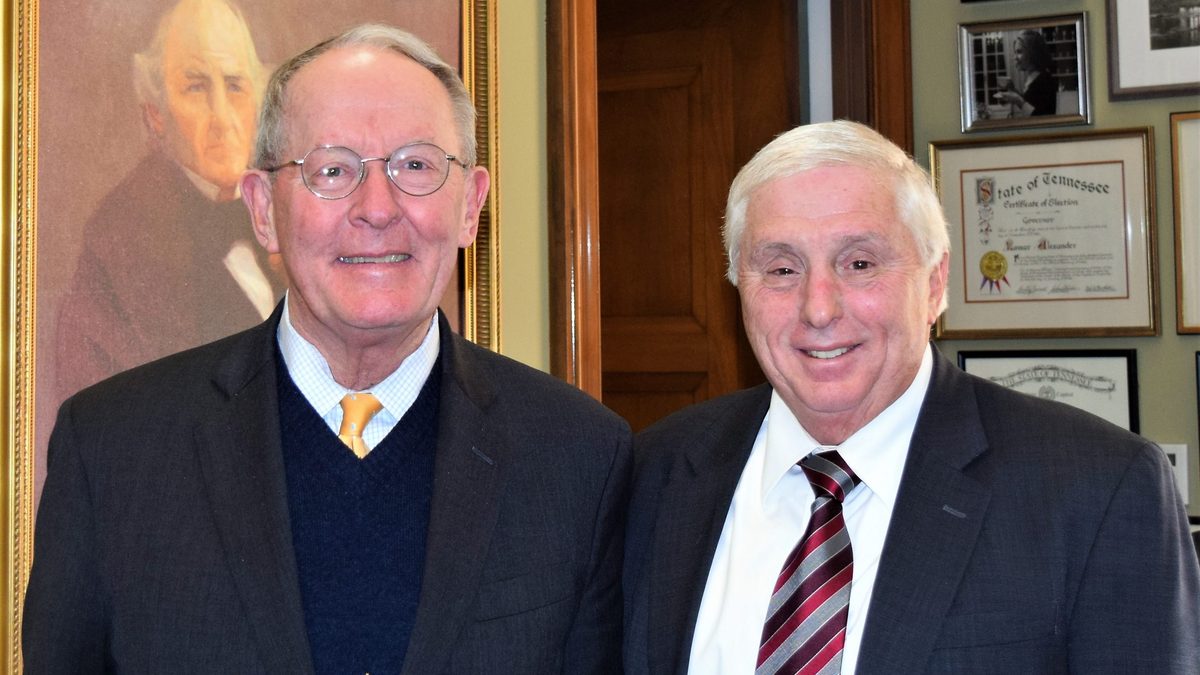
Lamar Alexander
Senator looks back at career as he prepares to exit the stage
Story by George Korda
In 1978, Lamar Alexander started walking across the state toward the Tennessee governor’s office. In 2020, he will walk out of the U.S. Capitol, retiring from the U.S. Senate.
That trail between those two events has seen him hold four of the state and country’s most powerful and influential positions: Tennessee governor, University of Tennessee president, U.S. Secretary of Education, and U.S. Senator.
His Senate service began in 2003, a departure from his CEO experience running Tennessee, a university, and a cabinet-level U.S. government department. It’s a public service record that few have matched, and perhaps few ever will.
Alexander reflects on what was accomplished during those years in the roles that most impacted Tennessee.
“Being a good governor is most of the time like Moses pointing with his staff and saying, ‘Let’s go this way,’ while the Senate is more like being a parade organizer,” Alexander says. “I was Republican Conference chairman three times by my fifth year: It was too political. I wanted to spend my time on issues I care about.
“It gave me a chance to work on the two most sweeping bills, fixing No Child Left Behind (through the Every Student Succeeds Act, ESSA), which affects 100,000 schools and 50 million children; and the 21st Century Cures legislation, which speeds up lifesaving cures for a variety of diseases, from cancer to Alzheimer’s to flu, and is very helpful in research on COVID-19 today.”
ESSA took from the federal government the authority to force states to meet federal requirements or adopt Common Core. Instead, it became a state decision.
Another Senate high point for Alexander was the Great American Outdoors Act, which permanently funds the Land and Water Conservation Fund. The Sierra Club called it “one of the most important conservation bills in a generation.” Said Alexander, “That (legislation) is closest to my heart.”
He’s also proud of fixing songwriter royalties so they can be paid fairly; “five record years of funding for science and laboratories,” and infrastructure legislation that he said will result in the Chickamauga Lock’s completion.
“I’d tell (Senate) colleagues that it’s hard to get here, it’s hard to stay here, and while we’re here we ought to do what we can for the good of the country,” Alexander said.
Alexander served as UT president from 1988-1991, before President George H.W. Bush asked him to become U.S. Secretary of Education. Higher education moves somewhat like a glacier, slowly and almost imperceptibly; nevertheless, progress at UT was made, he says.
“I tried to do as president what I did as governor (who serves as UT Board of Trustees chairman): set it on the path to increase its academic excellence, achieve higher admission standards, more recruitment of outstanding faculty.”
Creating a close relationship between UT’s science programs and Oak Ridge and ORNL is something that he says Tennessee governors and UT presidents have continued because it was important to “recognize ORNL as a massive asset.”
A source of satisfaction from his gubernatorial years was success at raising family incomes, a large component of which was recruiting the auto industry to Tennessee. “By the mid-‘80s (Tennessee) had the fastest-growing family incomes, a direct result from having no auto jobs to having 1,000 suppliers in the state and three big manufacturers: Nissan, Saturn, and later, VW.”
His Better Schools legislative initiative (“We became the first state to pay teachers more for teaching well”) and road improvements are big on his list, but Alexander says Tennessee Homecoming’86, a statewide celebration of Tennessee’s heritage, may be the biggest.
“Homecoming’86 helped hundreds of communities focus on themselves and focus on their strengths,” he says.
When he was recruiting the Saturn plant to Tennessee, he hosted a group of executives. He asked Charlie McCoy (“the world’s greatest harmonica player”) to play for them.
“A lady said to me that she was so embarrassed, that ‘All these fine people are here, why not give them Chopin?”
“I said, why would we give them average Chopin when we have the finest harmonica player in the world? We got comfortable with ourselves during the 1980s.”
As he walks off the national stage, what’s next?
“I haven’t thought about it much; it’s kind of like turning a page in a very good chapter in a very good book: you don’t know what’s in the next chapter, but it should be pretty good. Looking back over the time Tennesseans enabled me to be governor and senator, I’m very grateful.”
→ Swipe for Next Story
FeatureSEPTEMBER OCTOBER 2020
Do It For the Chicks
Rowing is a non-impact sport that you can enjoy your whole life
Story by Karen Clark
Several years ago, I had the opportunity to row a “double” with Olympic silver medalist Tom Kiefer. I was relatively new to the sport; needless to say, I was intimidated and nervous. As we got into the boat and strapped in our feet, Tom turned around and said, “I hope you’ll be patient with me. I’m still working on my stroke.” That consistent pursuit of the perfect stroke is one of the things that makes rowing such a satisfying sport.
Some people think that you have to have rowed in college to continue to enjoy it, but many people come to rowing as adults. I began rowing in my 40s. I didn’t really like running and my knees were starting to complain. I worked out with a trainer at the YMCA who was a former collegiate rower. He looked at me and said, “Have you ever tried rowing? Let’s get on the rowing machine. It’s the best aerobic workout around and there’s no impact.” Fifteen minutes later, I was exhausted, a little nauseous, and completely hooked.
Rowing is a full-body sport that will get you in the best shape of your life. Power in rowing is generated by the large muscles in your legs and glutes, your core is fully engaged throughout the movement, and the lats and arms “finish” the stroke. “Erging” (on a rowing machine) burns more calories than running, since all muscle groups are engaged.
Teamwork and Camaraderie
A major theme in the bookThe Boys in the Boatis the camaraderie and the feeling of teamwork when a crew achieves “swing” (all rowers moving in perfect unison). We’ve all been in business meetings where we’ve heard about teamwork and how important it is that every member do his or her part. In an eight-person rowing shell, this is literally the case. Unless everyone is rowing at exactly the same rate, with the same power, the boat doesn’t go forward. And each seat has a specific job: From setting the cadence (the stroke seat), to providing the power (the middle seats, or engine room), to keeping it all together (the bow seat), everyone is essential to moving the shell across the water.
There is nothing more thrilling than feeling the shell pop up on top of the water, hearing the bubbles underneath the shell as you and your crew move the boat along faster and faster, gaining on the competition as you go. Eight-person crews can generate a tremendous amount of power and speed: the Stanford men’s eight pulled a water skier for 54 seconds.
One memory that still makes me laugh is from a race in California called the San Diego Crew Classic. Our crew of eight women and our coxswain were racing in this 2,000-meter sprint, which is twice the distance of the standard masters’ race, so it’s challenging. Moreover, it’s held in Mission Bay, where the stiff breezes and waves from the ocean make it difficult. Crews that compete in this race must be physically and mentally tough.
Our crew trained for almost a year, doing longer and longer distances in adverse conditions. Our coach waited till just the moment after midnight to make the entry so that we could get a good lane, furthest away from the stiff ocean breezes. We felt good about our chances.
As we lined up with the other crews for our event, we looked at the crew to our left and noticed the women looked familiar. We quickly realized we were racing against the 1980 US Women’s Olympic team. We grinned to each other and said well, we know they’ll beat us but let’s make them work for it. Everyone in the boat laughed, and there was a great feeling of excitement. In what other sport can you sit at the starting blocks knowing that you are going to lose, and also knowing that you’re going to have a heck of a good time anyway?
We rowed the race and we did make them work for it and they did beat us, of course. We pulled our shell onto the beach and saw two little boys. One of the women in our crew had her sons there; they were 8 and 10 years old. There were tears rolling down their little faces. They said, “Mommy, Mommy, you lost!” My friend Kristine looked at them with a smile and said, “That’s okay, boys, you win some, you lose some. They were a really great crew.” The 8-year-old looked up at her and said, “But Mommy, you lost by a lot.”
How it works
There are some basics to understand in any sport. Rowing with two oars, one in each hand, is called sculling. Sculling boats are built for one, two, or four rowers. We’ve all seen the commercials that show a single sculler peacefully rowing under a bridge.
Rowing with one oar is called sweep rowing. Sweep boats are built for two, four, or eight rowers. We’re most familiar with the cartoons of the eight-man shell and the coxswain in the stern shouting “Stroke! Stroke Stroke!” Today’s coxes don’t use megaphones; the shells are rigged with speakers.
How to get started
There are two rowing clubs in the area, the Knoxville Rowing Association (knoxrowing.com) and Oak Ridge Rowing Association (orra.org). Both offer learn-to-row classes. Right now, COVID-19 means that classes are being taught in single sculling boats. This is, in fact, a very good way to learn good rowing technique, as your body movements give you immediate feedback and help you learn to “set,” or balance the boat.
At the FISA World Masters Championship in New Jersey, I was riding the shuttle bus to the rowing venue for practice. I sat next to a man who looked like he was about 85 or 86 years old. He had on his rowing gear and was clearly headed to the race course as I was.
I said, “It’s so wonderful that you are still rowing!” He looked at me with a twinkle in his eye and he winked and said, “I do it for the women.” We both laughed, and it was a great day.
This man rowed his single down the race course on a race day and everyone standing on the bank of the lake applauded him all the way down.
Later that night at the hotel, I walked past the bar and that same man was at the bar surrounded by women who were all patting him and teasing him and buying him drinks. I said, “You weren’t kidding, were you?” He grinned from ear to ear and said, “I told you. I do it for the chicks.”
→ Swipe for Next Story
BusinessSEPTEMBER OCTOBER 2020
Distinctive Style
Local makers add custom touches to any living space
Story by Susan Alexander
Putting a home together in a way that’s personal and interesting requires more than a trip to a big-box store. Though that may be a good place to start, its merchandise can’t convey your interests, your past, your heritage, or where you live. Those aspects of your living space come from things passed down or gathered because they bring back memories or express an interest or, to borrow Marie Kondo’s lingo, because they spark joy.
One path to adding those personal touches is by accessing East Tennessee’s makers. A relatively new term in Knoxville’s vernacular, makers are the people who craft and build and create, everything from personalized wood signs to custom cabinetry. There are hundreds of makers in the area, and Knoxville has received nationwide recognition for being a place where makers gather. The city was designated The Maker City about four years ago by the folks at Etsy, the online place for makers. So they ought to know.
Following is a small sample of the makers available to make your home your own. But there are others you’ll want to know as well. And the best place to find them is atthemakercity.org. A project of the Knoxville Entrepreneur Center, the website includes a directory of local makers. Decorative signs: Following crafty footsteps
You won’t find Holly White’s hand-painted signs in big box stores. The messages she stencils on wood tend to be very specific to her customers.
They might record the name of a newborn along with his height, weight and birthdate. They might duplicate Aunt Wilma’s Mexican Style Cornbread recipe. Or mark the date of a house purchase.
White was a high school teacher for eight years before the birth of her daughter in 2014. After taking a year off, she started looking for something to do. She made her first sign based on a tutorial she found on Pinterest, and it wasn’t long before her friends encouraged her to sell on Facebook. Hollywood in Knoxville was born. She also has operated an Etsy shop,etsy.com/shop/HollywoodInKnoxville, for the past two and a half years.
White uses latex paint and a variety of stains on her wooden signs, which are mostly made from birch. She learns as she goes: “A lot of what I’ve done is trial and error.”
Now with two young children, White is a third-generation crafter. Her mother and grandmother were seamstresses, and, while she didn’t inherit the sewing gene, she believes she’s following in their footsteps. “I feel like I’m doing what they would want me to do.”Woodworking: From boxes to a book
Daniel Clay got his start in woodworking learning to build boats in coastal Maine.
Though he had no prior experience, he was accepted for an apprenticeship at the boat shop and moved from Atlanta to complete it. Upon his return he got into video production, and woodworking became his weekend hobby. Limited by the size of his apartment, he began building wooden Shaker boxes, and Saturday Box Company was born.
About four years ago some personal connections brought him to Knoxville and eventually he met the tradesmen with whom he now shares workspace at Able Trade, a shop located in the Old City. He sells his original designs online athttps://saturdayboxcompany.com/and also does custom work ranging from coffee tables to screen doors.
“I have a patchwork sense of style and design,” he said. “I like solid-wood construction and traditional joinery, but I like modern design too. I like the minimalist mid-century modern look and I have an affinity for Japanese design. And Shaker furniture shares a lot of the same aesthetic.”
Clay also has learned — and now teaches — chip carving, a decorative art with roots in Scandinavia. An article he wrote forFine Woodworkingmagazine led to a contract with a Nashville publisher to write a book about chip carving. He expects it to be out sometime next year. Quilting: Traditional craft goes modern
At the moment Melissa Everett is making tons of face masks, she says, but her favorite thing to make is quilts.
She took up the craft after the birth of her son in 2012. Having left her career in food service, she needed an outlet for her creativity and taught herself to quilt. As time went by, her art evolved, and she started designing her fabrics, painting or dyeing them to use in her work.
“I wanted more of my own voice in the quilts,” she said. “I would spend hours looking at fabrics by other designers, and I wanted something more specific. I wanted to do my own thing.”
Everett is a member of the Knoxville chapter of the Modern Quilt Guild and likes the bold, graphic aesthetic that it represents. “A lot of people say it has a mid-century modern look.”
She accepts commissions on quilts using the color palettes her customers prefer. She also makes hand-dyed or painted napkins and tea towels.
Her work goes by MNE Textiles and is sold locally at Mid-Mod Collective and 214 Magnolia. She also sells on her website—melissaneverett.com.Custom cabinetry: Practical designs for cooks
Dan Duncan was a wandering Volkswagen mechanic in the 1970s — “When I got down to $10 in my pocket I’d look for work,” he said — when a friend of a friend in Spokane, Wash., offered to get him started in woodworking. “I’d done some as a kid and thought I’d love to do it again.”
That start evolved into a successful career as a cabinetmaker in Knoxville, where he came to help his sister with some home repairs. He opened his own shop here in 1982 and initially made roll-top desks and then moved into furniture and custom cabinetry. His one-man business is now located behind his home in North Knox County. His website ishttp://danielfduncan.com/.
“I design mostly kitchen cabinets working with the customers, who are usually people who like to cook, so it’s got to be practical first,” he said. “Most of my stuff is traditional, and I use the wood the customer wants, sometimes cherry, sometimes maple; it goes in waves.”
Duncan says his work is a pleasure because of the customers he meets. He’s enjoyed being a tradesman and thinks more young people should get involved. “There are fewer people doing this kind of work; you can get a job in the trades paying well.”
An avid cyclist, Duncan regularly rides 50 miles around East Tennessee on weekends. His last long-distance trip was from Knoxville to Niagara Falls and then Syracuse in 2018. “I don’t have anything planned while this pandemic is going on, but maybe sometime soon.”
→ Swipe for Next Story
VeteranSEPTEMBER OCTOBER 2020
Learning Leadership
Marine Corps training stays with Y-12’s chief of protective forces
Story by Mary Leidig
Christopher Seals has never quite gotten the sound of John Wayne’s voice out of his head.
The iconic actor made such an impression on the 18-year-old Hawkins County native that he found himself in the local U.S. Army recruiting office right after high school graduation in 1979.
“I wanted to be a Green Beret. I wanted the challenge,” said Seals, a nearly 22-year U.S. Marine Corps veteran and chief of protective forces at Y-12 Security Complex in Oak Ridge. But when Seals told the Army recruiter he wanted to be a “Beret,” the recruiter had another idea: choose something technical like a military occupational specialty.
“I wanted to experience far-off lands and adventure,” said Seals.
Next stop was the U.S. Marine Corps recruiting office.
“I had seenSands of Iwo Jimawith John Wayne. Lots of heroic actions, and then there were the Americans raising the flag,” Seals said.
“When you’re 18 you think you’re bullet-proof.”
By September 1979, he was on his way to boot camp in Parris Island, S.C. Seals saw a lot of recruits at Parris Island buckle and go home.
“It was rough. But I was a 150-pound skinny dude, so I was in pretty good shape. I stayed and made it through training, and was excited in 1980 when I got to go to communications school for radio operators in California.
“I thought I’d hit the jackpot.”
From there, Seals received orders for Okinawa, Japan. He saw Thailand, South Korea, the Philippines and mainland Japan.
“Seeing more of the world helped me realize just how lucky I was as an American,” he said.
When he transferred in 1981 to Camp Lejeune, N.C., Seals soon made private 1st class and advanced to sergeant. By 1986, he was staff sergeant. When he headed back to Parris Island in 1995, he was 1st sergeant.
Leadership duties also came early for Seals. In 1984, he became a drill instructor for new recruits at Parris Island. “It was a very tough school, and I was only 23 years old, training people and seeing them transform from civilian life to military,” Seals said. He often worked 100 hours a week.
In 1983 for the first time in his life, Seals lost buddies from his unit in the bombing of Beirut. He had been slated to go to Beirut but received other orders to Parris Island.
“I remember it to this day, watching the names come across the television screen,” he said. “It was my first time to know anyone who died in combat.”
By 1990, Seals had served during Desert Shield and Desert Storm as part of the 4th Marine Expeditionary Brigade.
“The welcome we got at Camp Lejeune after Desert Storm in 1990 was unbelievable,” Seals remembers. “That kind of welcome is something that means so much to our troops forever. It always will.”
In 1992, he became part of the 2nd Air-Naval Gunfire Liaison Company. Located at Camp Lejeune, ANGLICO is a special observational unit and one of the few in the Marine Corps in which members get to attend jump school. During his five years with ANGLICO, Seals earned his American, British and Canadian jump wings.
“It was a big deal and a bit of a thrill to be able to do this.”
ANGLICO’S primary mission is providing support to units who are fighting adjacent to the Marines. Part of the mission was working with the Army 82nd Airborne, a rapid deployment parachute assault division, and the 75th Rangers, an elite special operations force. As specialized forward observers, members would call in ground support such as artillery, mortars, rotary and fixed-wing air support, and naval gunfire.
“We worked with many NATO countries –- Turkey, Germany, UK –- any ally that fought alongside the Marines could get our support.”
By 1999, after nearly 22 years at Parris Island, Seals retired as 1st sergeant, serving his last two years in the Knoxville Reserve Unit.
“I had been taking my daughter Catherine to so many places. She was 11 when I retired and was used to moving around, but getting to come to East Tennessee was great for both of us.”
As 1st sergeant at the Knoxville Reserve Unit, Seals was the senior enlisted advisor to the commander. He also took care of funeral details and casualty or “death” calls.
“If a Marine on active duty gets killed, it was my job to contact the family. This is such an important part of our work,” he said. “We always notify the next of kin in person, and we stay with them for as long as they want you there.”
“No casualty call is ever the same,” Seals said, quietly.
And if recruits became suicidal or wanted to hurt themselves, Seals was in charge of attending to this, talking with them and ultimately sending the recruit home if needed.
Seals went straight from military retirement to Y-12 in 2001, starting a new career as a security police officer.
Then came the attacks of Sept. 11.
“Before 9/11 we carried revolvers. After 9/11 hit, everything in security changed. Support poured in,” he said.
Officers went from carrying standard rifles to machine guns. Grenades and cutting-edge weapons became standard equipment, and the number of officers increased. Seals was selected as lieutenant and then promoted to captain.
In 2012, an unprecedented event shook the nuclear storage facility.
“We had a breach by a nun,” said Seals.
In July 2012, an 82-year-old Catholic nun named Megan Rice and two fellow anti-nuclear activists broke into Y-12, one of the U.S. government’s most secure facilities. They were convicted in 2014 of sabotaging the plant. All three were members of the Plowshares movement of Christian pacifists.
The security breach drew worldwide attention, and fallout from the break-in was swift. In addition to increasing patrols, several staff changes occurred in the security department. Seals was selected as the new chief of protective forces and quickly worked to help raise morale and performance.
“Even though nothing was ever at risk from that breach, the pride factor was low,” he said.
Eighteen months after the breach, Protective Services’ several hundred employees achieved a paradigm shift under Seals’ leadership. He raised the game.
“We changed the way we trained and improved our mindset for what we had to do here,” he said. “We got back to the basics. We trained and trained and trained. And we got better and better and better.”
Today, security at Y-12 is top rated. Under Seals, the department has “aced” DOE-arranged Enterprise Assessment inspections, in-depth audits of facilities nationwide, completed every few years.
“This improvement happened because of the people around me. I feel so good about being a part of this and where we have all come as a team.”
Seals says he is fortunate to have an excellent pool of diverse applicants. Y-12 has supported hiring elite men and women specialists from Navy Seals, Army Rangers, Army Special Forces, Airforce Security Police, Marine Reconnaissance and other military units.
Today, Seals and his wife, Julie, live in Harriman on the Emory River. Seals describes his military career with U.S. Marine Corps as invaluable in his journey to becoming who he is today.
Perhaps most of all, the Marines provided him the place to learn leadership—literally from day one.
“From the minute you get into the Marines you get drilled on leadership. So much of my training has stayed in my head all these years, and I use it today,” said Seals. “Like understanding that indecision is decision.”
And Seals still hears the voice of John Wayne in his head now and then.
“My dog is named Duke,” he says, smiling. “I watch John Wayne every chance I get.”