We all have people that we admire or look to when we need inspiration. These are people that come into our lives and leave an indelible mark on who we are, at our deepest level. And more often than not, they are unlikely aware of the influence they have had on you. I believe that the radiant forces of good in the universe bring you exactly what you need, at the very moment in which it can influence your growth the most. Based on that belief, I live my life and base my decisions on how I feel about the person or the situation, and always with a lens of “what is best.” Experience has taught me that abiding intuition can reveal opportunities of abundance beyond belief, but ignore it, even for a brief moment, and a door may close forever.
There is an abundance of freedom that comes from choosing this path, a great opening to experiences that most people will never know, but also a certainty that not everything in life is perfect. Balance is an essential part of everything—nature, relationships, finances, self-fulfillment, and faith—so in choosing this path I know that with every rose will come some thorns.
I first met Eric Creed when he was running a marble and granite company. I was always amazed when we would sit and talk; a consummate conversationalist, his range of knowledge was exceptional. Eric held a juris doctorate, but had chosen not to be a practicing attorney; he preferred the business world where his days could be filled with the joy of helping people who were not already in crisis. A unique series of difficult and emotional events in my own life led me to realize Eric was there for a reason, and my intuition told me to offer him the editorial helm ofCityview.
Eric proposed a story to debunk the concept of Global Warming. I wasn’t very knowledgeable on the subject, and although I knew it was a potential powder-keg, I let him run with the idea; it felt right. In a fashion in which I have seen few others work, he systematically uncovered fact after fact that wasn’t being told to the public by the mainstream media. NASA reports saying that the planet was actually cooling, bevies of scientists that were publicly speaking against the concept, and lastly that the opening footage from the Nobel Prize winning documentary by Al Gore,An Inconvenient Truth, was fake. In fact, it was computer-generated imagery from the movieThe Day After Tomorrow. It was the beginning of the perfect storm, well at least a storm of controversy.
We themed it the “green issue” and now well-known artist, Michael Watson, created the outfit for our own mother nature: a corset covered in leaves. The combination of that outfit and the flowers we wove into model Melanie Howe’s hair made for a stunning image. Then Art Director Shayne Ivy came up with the cover line, Blue is the New Green. The depth of the article, and the accuracy of the research caught the attention of national talk radio media, and Eric was interviewed multiple times on national shows. Our internet traffic went off the charts from thousands of hits per month to millions.
Eric wasn’t at the helm for long; a dream job offer led him westward to ultimately make a mark in the oil and gas leasing industry. It seemed like that no matter what Eric set his mind to, he was destined to be successful. We kept in touch, and when I learned he loved to sail it seemed fitting to invite him on a trip with my boys and best friend, Jimmy Chiarella, to sail for a week around the islands near St. Martin. The memories from that trip are wonderful: the delight of sailing, Eric taking his turn at the helm, cocktails shared at countless island tiki bars. It was on that trip that I got to really know the man Eric really was, and I was even more impressed.
So when I received a message from a mutual friend asking if I knew what had happened to Eric, I was heartbroken. What could have happened to my friend? It had only been days before that we had emailed talking about a book he wanted to write, and I suggested another that we should co-author. I was looking forward to the conversations and thinking, maybe, we should put together a sailing trip where we could discuss the details.
Why hadn’t I taken the time to call immediately when he reached out? Eric’s depression—of which I was unaware—had reached a level he could no longer tolerate, and I have been told he took his own life. The loss is devastating for all who had the good fortune to know him. This is not the first time suicide has taken from me someone I loved and left me with that vision each and every time I think of them.
If the pandemic has taught us anything, it’s that our relationships matter and we need to all make sure we take time to invest in them. You never know when a small act of kindness bestowed upon a friend might save their life. When your intuition says you should call, then set aside whatever else you have to do for a few moments and heed the flow of the universe, that is what is needed. I am so sorry that when that intuitive moment came, instead of calling Eric, I selfishly rationalized I was too busy that day. I’ll never know if it would have made a difference, but I do know it could not have hurt.
The world lost a great man, a son lost a father, and I lost a friend. I wish you well my friend, but I wish you had chosen a different path to leave.
→ Swipe for Next Story
Arts & CultureJULY AUGUST 2021
Falling in Love with Clay
Tina Curry sees the world anew through hand-built animal sculptures
Story by Rebecca Whalen
It was 27 years ago when Tina Curry fell in love with sculpting. Then a graphic designer at Oak Ridge Laboratory, Curry’s job required her creativity, and yet she was on the hunt for something more.
After signing up for a pottery class and realizing she could do hand-built pottery, a light bulb went off. “At that point I fell in love with it. I could just look and see things all around me that just needed to be made into clay.”
Curry dove in to sculpting. She joined the Foothills Craft Guild, finding herself exposed to artists making livings doing what they loved. Curry, still at the lab, continued doing art as a hobby. “What I found I didn’t have is what most people think of as a ‘body of work,’” she says.
Soon enough she found her style and subject matter. And her body of work organically followed: “You’re not purposefully trying to get to that point, but at some point, it happens, and you trust more in your style and have more confidence in what you’re doing.”
Her later introduction into the Southern Highlands Craft Guild helped her see that sculpting was no longer just her hobby. “I felt like I had arrived at a point that I was looked at by my peers in the same profession as a true artist,” she says. As a featured artist for one of the guild’s shows that following year, Curry celebrated as she watched every piece of her art sell. “It changed a lot of things for me in my art career.” Clients began reaching out yearly, collecting her work. She was approached by new clients, galleries, and art shows to be involved.
While she hadn’t planned to retire for a few more years, Curry retired from the lab in 2018 to pursue sculpting full time, adding bronze to her repertoire not long after. “As an artist, I think you’re always striving for that next level of excellence in yourself,” she says.
This last year pushed Curry into a new phase of sculpting, creating the “specialty pieces” that she always dreamed of, she says. “The things that I’ve created since then are some of my best work.” Her work has been commissioned by the Knoxville Zoo as well as the Calgary Zoo in Alberta, Canada. A goal-oriented individual, Curry says she is always ready to create something new.
→ Swipe for Next Story
MusicJULY AUGUST 2021
All Day, Every Day
Travis Wyrick turned a childhood obsession into a life-long dream
Story by Chris Blue
For Knoxville producer, Travis Wyrick, everyday seems like a dream. Wyrick’s life in music began when he was 13. Inspired by the then new MTV channel, he spent hours every day “obsessing” over learning the guitar. “I destroyed a lot of needles and vinyl trying to learn all of these riffs and Led Zeppelin songs, and anything I could get my hands on,” he says. “I’d listen to it and try to figure it out.”
When Wyrick finally connected with a fellow guitarist in high school, the two hit it off, creating the band Sage in the process. The band remained intact for the next 14 years. Wyrick’s life as a producer, however, was unfolding at the same time. At age 15, he bought a four-track tape recorder and began recording songs he had written to bring to his band. “I learned a lot about production and engineering and how not to record,” he says with a laugh.
After recording his band’s first two albums, upgrading his system along the way, it was his unique recording sound that called others to reach out. “Bands would come to me, holding that CD and going, ‘Will you record my band for me?’,” he recalls. “I’d say, ‘No. That’s not what I do. I’m a guitar player.’” But when he finally jumped in, he fell in love with working with other artists. “It was like pandora’s box was opening.”
Fast forward to today, and Wyrick, who owns Lakeside Studios, has a host of memorable moments, awards, and artists to look back on, including well-known names like Disciple, P.O.D., and Dolly Parton. And while the last year has proved challenging for many due to COVID-19, Wyrick says, “It’s been one of the busiest years I’ve had in the last decade.”
Working with artists creates an energy, he says of the work, one that consistently fills the room with nerves and excitement. But for Wyrick, producing continues to be just as exciting as the day he picked up that first guitar: “I can’t believe that I make music for a living all day, every day.”
→ Swipe for Next Story
PoliticsJULY AUGUST 2021
Reading with Proficiency
Story by George Korda
The key to a child’s successful reading journey rests with the parents
Perhaps a lesson in how to help kids learn to read can be applied from my father’s method of inducing me to learn the multiplication table.
In second grade, I dragged my feet about learning the multiplication table through 9×9. After testing, school officials were skipping me from third to fourth grade, and my father wanted the multiplication table memorized. However, like Henry Higgins’sMy Fair Ladyopinion about women, I was equally as willing for a dentist to be drilling than to ever let this table into my life.
After a few frustrating days working with me, my dad typed the table on an index card. “Go to your room. Don’t come out until you know this.” My entreaties, pleas, requests were ignored. If I faltered, back into my room I went. But I learned the table. The next day in school, I felt as if I’d conquered something, even if against my will.
If your kids can’t read well, and you’re seeking a reason, please choose one: flawed teaching approaches, curriculum emphasizing student self-esteem over student achievement, lack of parental involvement, too much teaching to testing, not enough teacher-parent cooperation, expectations that teachers will teach reading. Or perhaps look at your own face in the mirror?
The reason isn’t there? Pick another. Chances are good there’s a dust-gathering study on yet another bureaucratic shelf to justify your position. None are fixing the problem: too many children can’t read well. There’s a cost, in dollars and lives, to this failure to motivate, encourage, or compel kids to learn to read well.
Knox County, the state of Tennessee, and the U.S., are disgorging annually from schools an army of teenagers who are unfit and unprepared to be successful either in college or the modern economy. Many of these young people face the real possibility that their economic futures will depend on how much they’ll be supported by American taxpayers. For all the political and societal attestations of devotion to education—and despite the seemingly endless series of local and state education improvement projects meant to lift student reading ability—the grade, based on standard test scoring, is ‘F’.
Why aren’t student reading levels higher than the disappointing-to-dismal statistics of grade level reading proficiency? The answer is possibly far simpler than an academic dissertation: They’re not interested; there are things more fun to do.
Typical scapegoats are school superintendents, administrators, teachers, parents, politicians, educational theoreticians, educational technicians, or someone else conveniently nearby on whom to place blame. The most recent culprit, COVID-19, has forced remote learning with teachers physically separated from the kids they’re teaching.
But sub-par reading levels have been reality since before COVID-19. On January 2, 2019, a year prior to the pandemic, an NPR article on the reading struggles of American kids said, “According to the National Assessment of Educational Progress (NAEP), 32 percent of fourth-graders and 24 percent of eighth-graders aren’t reading at a basic level. Fewer than 40 percent are proficient or advanced.”
In Tennessee, as around the country, new administrations have a plan for schools. Gubernatorially, dating back to the mid-1980s, some of the principal—but not only—initiatives: Gov. Lamar Alexander’s Better Schools Program; Gov. Ned McWherter’s Basic Education Program; Gov. Don Sundquist and “investing” in teachers with scholarships, mentors, and merit pay; Gov. Phil Bredesen’s pre-K emphasis; Gov. Bill Haslam’s “free” community college; and Gov. Bill Lee’s school voucher program.
Nevertheless, in reading, the 1998 NAEP National Report Card showed Tennessee fourth-graders scoring 212 out of 500; in 2019, the score was 219. These dreary results are consistent with many other states. What to do? Lowering standards or eliminating testing are answers, then everyone can feel good without changing anything.
If improvement is sincerely desired, teachers can’t do this alone. Parents know what to do, and, if willing, can figure out ways to make reading fun, incentivize their kids, challenge them, and deal with frustration when the kids push back.
Sometimes, it might require sending a child to his or her room and saying don’t come out until you’ve read this and can explain it to me. In the moment, the child might not like it; the next day in school, however, knowing more than they did the day before, they’ll feel as if they’re conquering something, in this case, challenges in their life ahead. Even if it’s against their will
→ Swipe for Next Story
InsightsJULY AUGUST 2021
The Gift of Time
Caring for an aging parent puts life into perspective
Story by Bruce Fox
I have suddenly come to the realization that I am part of an aging population. I turn 70 this year and frequently ask my lovely wife, Mary Jane, if she is sure that I’m not going to be 60. She responds every time with the same answer, “You are going to be 70. So quit asking and learn to live with it.”
I have been blessed in that I have had both of my parents until this past Thanksgiving week when my dad passed at age 91. He and my mother lived independently until he became ill just before the holiday.
I have two younger brothers, and we had no idea how difficult it would become to care for our mom in her home with dad gone. I don’t think any of us knew or understood how much our dad did to take care of her until he was no longer here. We were able, at first, to have a caregiver stay with mom during the day; however, it quickly became apparent that she needed 24-hour care and supervision. Fortunately, my nephew and his wife needed temporary housing when the shortage of construction materials delayed completion of their new home. It was a blessing to have Jake and Taylor there with her.
Mom was struggling physically and mentally, though, and in no time needed more care than we could provide. She fell multiple times during the night, ultimately suffering an injury that required a short hospital stay. Before long, we were faced with a challenging realization: it was no longer safe for mom to be in her home.
With limited options in front of us, we found an opening in an assisted living facility close to where mom and dad lived. If she couldn’t be home, at least she could be in the same community she was accustomed to. She is slowly adapting to the new environment and making new friends. However, she still asks about going home. It is heartbreaking, though I know it is the best option for her right now.
I’ve been there for others during times when they were handling how to care for their aging parents. And yet I never fully understood the emotional journey it would be until I was on that very journey myself. Watching someone you love and have looked up to experience a process of decline, turning the tables on who cares for who, is not for the faint of heart.
While I knew some semblance of this day would come at some point in my life, it still feels like it hit me like a ton of bricks. And I must admit that watching my mom and all that she has gone through since November has taught me some valuable lessons, the most important of which is to honor the gift of time. My moms story, one we will all go through in some way in our lifetime, reminds us all to make the most of every moment, if not for ourselves then for the people who raised us and who eventually will look to us to care for them.
→ Swipe for Next Story
DepartmentsJULY AUGUST 2021
Céad Míle Fáilte
Finn’s Restaurant & Tavern makes diners feel at home—even with the ghost
Story by N. Brooks Clark
With his light green eyes, close-cropped red hair and tall, trim frame, owner Jon Ferrie of Finn’s Restaurant & Tavern could fit easily into a Colin Farrell/Ralph Fiennes movie, though Ferrie would be the good guy who takes care of everybody, keeps the other guys from quarreling, and makes everything better with a hearty meal of, say, Irish Cottage Pie or Corned Beef and Cabbage.
With an Irish twinkle in his eye, Ferrie creates the vibe at Finn’s that makes people want to relax and stay awhile. “People have stressful lives,” he explains. “They like to have a place where you can go after work and not have worries. We’re not quick in and quick out. I want people to enjoy themselves. People come in and spend at least an hour and a half at dinner, then go into the tavern for a bit of music and finish the evening. A dining table is a sacred place.” Ferrie’s cooks and servers are fully on board with this mission: “I tell my staff, ‘I want your personality to shine.’ They are all individuals.”
Get started with a Wing of Kerry—a pound of jumbo baked-and-deep-fried Buffalo chicken wings with Guinness BBQ/Spicy Asian/Parmesan Ranch dry rub, and let the sweet aromas of lamb, onions, creamy potatoes, peas, and spices whet your appetite. A Guinness with its hint of roasted unmalted barley would not go amiss here.
Many remember the Baker Peters House, which has stood since 1840 on the corner of Kingston Pike and Peters Road, as a jazz club. But since late 2018, the first thing diners see at the top of the stairs are the words Céad Míle Fáilte painted on the wall. They mean “a hundred thousand welcomes” in Irish Gaelic. The house’s first owner, physician James Harvey Baker, was shot in June 1863 by Union troops through a bedroom door that is still displayed in the dentist’s office downstairs. Baker haunts the place, but in a friendly way, says Ferrie.
Baker may have his ghostly eye on the wedge salads as they come from the kitchen. “They look like ice cream sundaes,” says Ferrie, and the homemade ranch dressing, blue cheese crumbles, heirloom grape tomatoes, diced Apple Wood bacon, and balsamic reduction make them extra special. So, if you feel a cold chill around your neck, you might offer the late doctor a crunchy bite.
Ferrie, a native of Ireland, ran restaurants in tony spots like Montauk, Long Island, and Palm Beach, Florida, before his Irish Times restaurant became a Turkey Creek landmark in 2007. He and his wife, Rachel, took a liking to the Baker Peters House on a night out a few years ago. “It was our love for the preservation of history,” says Ferrie, who saw that it would be perfect for his concept of a warm, welcoming, family establishment. When the property came open, he jumped on it.
“It feels like a home,” says Chef Jason McCormick. Its different rooms have different personalities, including the Abner room downstairs. Abner, Baker’s son, was killed after the Civil War following an altercation with a Union soldier in downtown Knoxville. His portrait sits on the mantel, looking out over the large table that seats board meetings or wedding parties.
It’s hard to resist the potato-crusted Salmon Leap with a citrus butter sauce and mango chutney and served with fresh vegetables and mashed potatoes. “The Irish and their potatoes,” chuckles Ferrie. The Fish ‘n’ Chips are, as Winston Churchill described them, “good companions.” Fish and chips were two of the foods not subject to rationing during the Second World War. (The government feared that the dish was so embedded in the nation’s culture that any limit would damage morale.) Finn’s achieves the perfect balance of a thick, puffy crust with crispness followed by a touch of chewiness. The boneless pork chop is brined for 36 hours to impart a flavorful, juicy tenderness. The Baker’s Burger uses a mixture of brisket and short rib that takes it from standard pub fare to beautifully rich, beefy flavor and moistness.
Desserts include Traditional Irish Bread Pudding and Guinness Chocolate Mousse. “It’s a true Irish experience,” says Ferrie, “reflecting a culture well-known for its food and ambiance.”
Though Finn’s is not open for lunch during the week, it offers a Sunday brunch from 11 a.m. to 3 p.m., all the more in demand with the return of in-person church attendance. Be sure to drop by for a chippy and a chin wag with your mates.
→ Swipe for Next Story
Dining GuideJULY AUGUST 2021
Old City Eats
Historic downtown character enhances a flavorful Knoxville experience
Story by Marc Anthony
Knoxville’s historic Old City has become a walkable foodie tour, where cultures and cuisines collide to bring a variety of tastes sure to please all palates. I’ve walked through Old City many times, but never have I committed to sampling the breadth of the cuisine for myself; until now that is. From tamales and empanadas to pizza and hot dogs, I’ve asked servers to recommend their favorite dishes at some Old City favorites, and I can tell you first hand, downtown revitalization has all of Knoxville licking its lips.
Good Golly Tamale
I have to admit that every tamale I had ever eaten up until I stepped into Good Golly Tamale had come out of a truck or an Old El Paso can. I’ve been too content with burritos, tacos, and chimichangas to branch out to tamales at Latin American restaurants. But there’s a place on Central Street where you don’t really have much choice. And trust me, you won’t want one either. Juniper, my server, selected the Chicken Tinga from the chalkboard, telling me this was the owner’s daily eat. Well, I thought, if he likes it, then it will be good enough for me. But “good enough” doesn’t even scratch the surface. I’ve heard others mention texture when explaining why they won’t eat something. For me, texture is a non-issue. Yet, the pure density and bite of the husk-wrapped corn tamale made me understand how important texture can be to a meal. It was rich and satisfying, sweet and spicy, laden with black beans, pickled cabbage, and rice, and was a complete mouthful with every bite. And even though it was smothered with all those ingredients, the tamale itself stood out like a champ. Thanks, Juniper!
Is there a taste associated with ambiance? When something is classic, like the rustic Barley’s Taproom, you’re right to believe there is. Barley’s pizza had a taste that transported me elsewhere. I’m not exactly sure where, but it was definitely a place where pizza is not delivered in a box in 30 minutes or less. I let Kaya, my server, choose what I would eat, and she did Barley’s proud: one half classic American, one half Caribbean jerk. I wondered if she was hinting at something! The red sauce of the American half was pure tomato bliss. Fresh ingredients make a pizza sing and the spicy meats and melted cheese atop the crispy baked crust were symphonic. I ate it in record time. To hear a chef refer to a bite of food as aromatic always confused me, but now I understand. The spinach, artichoke hearts, and onions on the Caribbean jerk slice joined together with the chicken creating quite an experience. I could hear the steel drums with every bite. Nice work, Kaya!
Hot dogs have always been my thing. I can eat them plain, cut up into mac and cheese, with mayonnaise (yes), smothered in chili, Chicago style; it doesn’t matter. And we won’t get into whether the hot dog is a sandwich or a taco. Because it’s a taco. Moving on. The menu board at Curious Dog is monolithic; there’s not a sandwich or hot dog in existence that’s not on it. Behind the counter, Angie couldn’t settle on just one, so Todd made me three favorites. The Cuban dog was straight from Havana, grilled ham and Swiss with a pickle, white sauce, and jalapeño mustard. The Greek Dog had me wishing I was from Mykonos, with its tzatziki, feta, black olive pesto, chopped fries, tomatoes, onions, cukes, white sauce, and herb olive oil. And the grilled turkey, Swiss, bacon, and coleslaw on the Johnny Knoxville was saucier than he is, with not just barbecue, but white and jalapeño sauces, too. I wondered if I would have to hurtle down Jackson Avenue in a shopping cart after I ate it. (I didn’t.) The sandwich’s jalapeño cornbread had me CLAPPing my hands. Look it up! Thanks for the hospitality, Angie and Todd.
Let’s rename Southern Grit right now to Southern Comfort. In a homey, open space on Central Street, server and manager, Jacob, nestled me right in and told me it was time to eat. And boy, did I eat. Within minutes, I was comforted with a steaming and saucy Bag O’ Shrimp with garlic butter sauce, along with pimento-cheese-smothered and honey-drizzled Fried Green Tomatoes. I may never visit Dollywood’s Front Porch again. Fried chicken has fallen down the list of things on a menu I’ll order. I told Jacob that, and he said, “May I comfort you further with the best fried chicken you’ve ever had?” He wasn’t wrong. Not too breaded, not too dry, this southern-style thigh and hot-spiced leg made up a zesty and satisfying entree. Hush puppies with cinnamon honey butter made me weep with joy later as I ate them. Oh, and a word of advice: if you don’t try the Brussels slaw, may you never have comfort in your life again. Jacob, thank you for holding me close.
Is there a name more synonymous with barbecue than Sweet P’s in Knoxville? It’s probably the most famous dive in East Tennessee. Oh, that’s not an insult. More than the quintessential hole in the wall, this is an order at the counter, grab a plastic fork and knife, seat yourselves kind of dive. And I dove right in. While there are no traditional servers coming to your table, I didn’t need any suggestions on what to order at Sweet P’s. It was only going to be the Brisket Burrito, and I wasn’t going to chance not getting it. I couldn’t tell you one thing about how to smoke brisket, what a smoke ring in the meat means, or how the char makes or breaks the brisket. I can just tell you what tastes good. I love a place that doesn’t skimp on the ingredients and this burrito was loaded with slabs of brisket, pintos, slaw, cheddar, and sauce, just like when it almost kicked the pork butt of Adam Richman onMan v. Food.
Brunch. Thank you, food gods for finding a way to combine breakfast and lunch in such an appetizing way. OliBea, just a smidge outside the Old City across Summit Hill on Central Street, has the perfect brunch combination of sweet and savory. Owner and Chef Jeffrey DeAlejandro crammed my table full of snacks and entrees. I pre-gamed with a Hen-Hoc Butcher Shop pastrami sandwich with chow-chow and chihuahua cheese which rivaled any New York delicatessen. I followed that with lemon pancakes—that made my mouth water for all the right reasons—and a barbecue chicken empanada with habañero pineapple salsa and a poached egg on top that was perfectly crispy and “brunchy”. OliBea is named for two of Chef Jeff’s children and by the end of this meal, I wanted him to adopt me.
The Great Smoky Mountains Hot Air Balloon Festival is back
Story by Rebecca Whalen
The colors are vibrant. One by one they rise and fall as the sun sets behind the mountains. It’s a vision that elicits feelings of freedom and adventure, feelings that will be welcomed in excess this summer as the Great Smoky Mountains Hot Air Balloon Festival returns to Townsend.
The festival, put on by the Townsend/Cades Cove Gateway Alliance (TCGA), will include 12 balloons brought from owners from across the country. Nearly 10,000 people will attend and sign up to take tethered rides on the balloons while enjoying local food truck fare, artisan goods, children’s entertainment, and live music. Proceeds from the event will benefit the TCGA and its work to promote tourism in the area.
“Dear Knoxonomist, My neighbor is threatening to sue me saying she slipped and fell after stepping in dog poo she believes to be from my dog. What should I do?” — Roger
Story by Cityview
Dear Roger,
The Knoxonomist is exceptionally fond of his canine companions and is known to embellish stories that involve his late hounds. Fondly does he recall those crisp autumn adventures of his youth accompanied by his faithful furry friends. His snazzed up 20-inch bicycle with the black and white banana seat, high handlebars, and playing cards clipped into the spokes, would be joined by Sean, the Irish Setter, who would reconn backyards, pausing only to signal we should check things out.
One particular day, I found myself staring at what looked like a giant upside down baking pan in one of the backyards. Sean circled it endlessly, eventually chasing the rabbits underneath that bolted toward a nearby thicket. Our attention remained on the steel pan, which could be imagined upright as a small boat capable of holding four boys. With great fervor, the Knoxonomist convinced his closet conspirators to challenge the mighty rapids below the owner’s yard. Surely once completed, none would question their neighborhood dominance.
As it turned out, the rapids on today’s scale would be a class three or “moderately difficult” and neither the Knoxonomist nor his compatriots were up to the task. The boat sank and everyone headed home only to find they had been caught by the stay-at-home mom next door. At home, there was a mighty ass-whoopin’ executed by the Knoxonomist’s father, and the Knoxonomist was made to work off the tub’s cost which took the better part of the summer. Thanks, Sean.
Bo Regard, the family’s English pointer—and world-class bird dog, according to the Knoxonomist’s father—caused the biggest stinks in our home. He was ill-suited for neighborhood jaunts, always sneering at us as we left, and he showed his indignation by where he left his stool: always on top of a neighbor’s plant or shrub. They would exit their house only to see his gift prominently atop their prized landscape, a bloom with a fragrance like no other.
The Knoxonomist was once brought to court with his family for the offense of Dog at Large. Back in the day, unless the offending hound was caught in the act, there was no way to prove it. But thanks to Tom Boyd—the father of Knoxville’s Randy Boyd, mastermind of the underground electronic dog corral—there is now DNA testing for animal poo called Poo Prints. The service enables FIPS (formerly important people usually running community associations) to hold neighborhood dogs accountable for their feculence.
In a time where people are offended by almost anything, this enables those who have been pooped on to raise the bar—or in this case the shovel—inside the courtroom, causing this to be some expensive excrement. It may be time to eat a little crow, so to speak, and beg forgiveness of your neighbor. Offer to help with yard projects that the injury has left them unable to complete, and if you can’t control the family pooch, then it might be time to move to the country where your pooch can defecate in peace.
The Knoxonomist welcomes your questions—Send your inquiries toTheKnoxonomist@cityviewmag.com.
→ Swipe for Next Story
DepartmentsJULY AUGUST 2021
Out on the Trail
Make the most of outdoor time with your dog by planning well
Story by Cityview
Living in East Tennessee at the foot of the Great Smoky Mountains and the Cumberland Plateau, it’s easy to find space outdoors where you can spend a good amount of time throughout the year. Let’s face it; trails are everywhere. And out on the trail is the perfect place to bond with your dog. But before you head out, here are some tips to remember as you prep your gear and get ready for your adventure.
If you’re heading to the national park, keep in mind that while dogs can be in the campgrounds, in picnic areas, and along the road (leashed, of course), they are not allowed in the park except on two trails: the Oconaluftee River Trail and the Gatlinburg Trail. Fortunately there are plenty of outdoor zones where you can bring your dog, such as the Big South Fork National River and Recreational Area and the national forests.
While you may be tempted to give your dog some freedom while hiking, it’s important to remember to keep your dog on a leash—and not just because it’s the law. If you encounter wildlife, be it a bear or a timber rattler, your dog will often try to protect you. You will have better control over the situation if he or she is well in hand.
And remember to come prepared for not only yourself, but your pet when hiking. Bring a dog bowl and water just in case you do not encounter a water source. Collapsable water bowls are easy to find and can often clip to a backpack for easy carrying. Furthermore, be sure to have your dog on some prescription strength flea and tick prevention. Ticks carry a variety of nasty diseases.
Key vaccines to be up to date on—aside from the basic ones—include ones for Leptospirosis, Lyme disease, and Influenza; often dogs meet from far away places on the trail. Rabies on the Tennessee side of the Appalachian Trail is primarily hosted by skunks whereas on the North Carolina side, raccoons are the more common host. So stay vigilant.
Be prepared to observe some interesting behaviors as your dog gets back to nature. The last hike I went on with my dog Marley, he buried his food every time I tried to feed him and did not eat for three days.
→ Swipe for Next Story
JurisprudenceJULY AUGUST 2021
The Jury
Story by Gary Wade
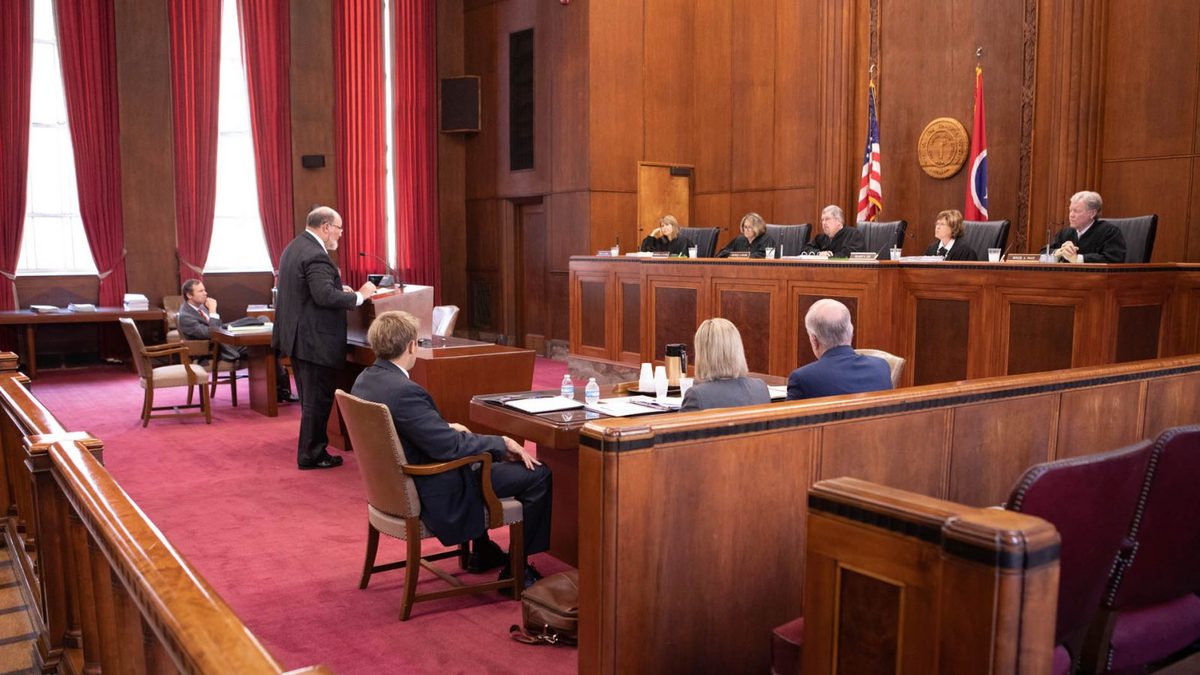
In the 16th century, Shakespeare found that a trial within his plays added drama to his story lines. TheMerchant of Venice,Hamlet, andA Winter’s Tale, the last involving a question of constitutional proportions, serve as examples.The Last JurorandThe Runaway Jury, legal thrillers by popular author John Grisham, illustrate the role of the jury system in American jurisprudence. In contrast, federal and state courts of appeal rarely involve the theater of literature or even the tension of a real trial by jury, but their rulings can have far-reaching impacts, whether for the public good or, in a recent Tennessee decision, the not so good. As envisioned by Federalist Paper No.78, an essay by Alexander Hamilton which served as a model for the creation of our judicial branch of government, the courts should have “no influence over the sword”, as does the President, “or the purse”, which is the power of the legislature; “it may be truly said to have neither FORCE nor WILL, but merely judgment.” The mark of judicial excellence, of course, lies in the exercise of that judgment.
Rulings at the supreme court or the intermediate court of appeals level, products of either elected or appointed judges with different backgrounds, experiences, and political affiliations, are frequently split decisions governed by majority vote. A 2020 opinion in Tennessee, McClay v. Airport Management Services, LLC, stands as a case in point.
The dispute in McClay focused on a Tennessee law limiting monetary recovery in personal injury cases. Primarily in response to the business and healthcare communities’ support and influence for tort reform, the Tennessee General Assembly passed the Civil Justice Act of 2011. This law, for the first time, limited “non-economic” damages, such as the loss of physical or mental health or pain and suffering from injury to $750,000, regardless of severity. The law included an exception in “catastrophic” instances, which the Act limited to $1,000,000.
Shortly after the passage of this law, Jodi McClay, who was injured in a retail outlet operated by Airport Management Services in Nashville, filed a suit based in negligence in federal court. While seriously hurt, her injury did not qualify as catastrophic. A jury awarded her $930,000 in non-economic damages, an amount in excess of the new limit. Before approving the verdict, federal Judge Eli Richardson, obligated to follow state law, formally asked our state supreme court to determine the constitutionality of the $750,000 ceiling. In 2020, a year many of us would like to forget, our high court, by a 3-2 margin, found that the 2011 Act did not violate our state constitution, and the jury’s assessment of non-economic damages could be capped by our legislature. In consequence, Judge Richardson reduced the jury’s finding by $180,000.
Both our federal and state constitutions underscore the significance of the jury system. First, the United States Constitution, adopted in 1789, includes this unforgettable language in its preamble: “We the people…, in order to…establish justice…, do ordain and establish this Constitution…” At the same time, our Founding Fathers, in order to gain the requisite support from its 13 states, promised a Bill of Rights for every individual, which became effective 1791, comprising the first 10 amendments to the Federal Constitution. The Seventh Amendment guarantees that “in suits at common law where the value in controversy exceeds 20 dollars, the right of trial by jury shall be preserved….” Synonyms include “safeguard”, “conserve”, and “protect”.
The Tennessee Constitution, from the 1796 grant of statehood and its various amendments since, all based upon proper vote of the people, has consistently declared that “the right to trial by jury shall remain inviolate”—this last word being generally defined as “pure”, “pristine”, and “unharmed.” In the McClay case, this provision governed. So long as a provision in our state constitution is not in conflict with the federal constitution, the language of our state is controlling. This explains Judge Richardson’s request for an authoritative ruling by the Tennessee Supreme Court on the propriety of a legislative cap on an award of damages.
From a historical perspective, the right to jury precedes even the Magna Carta, which serves as a model for the individual rights in the federal and state constitutions in this country. This “Great Charter,” declares that the King of England, as the sovereign power, is subject to the rule of law and that the people, while also subject to the law, are guaranteed certain individual liberties, among them the right to trial by jury. In America, which embraced the English tradition, the role of the jury in a civil case differs from that in criminal prosecutions. It is the Sixth Amendment, not the Seventh, that guarantees the right to a jury on criminal charges except for “petty” offenses, which is defined as one involving no more than six months in jail. A “fair and impartial jury of peers” is paramount, however, not only in criminal trials, but also civil trials.
Opinions of jury trials differ. While the right serves as the hallmark of American jurisprudence, other countries often either limit or do away with juries. Although not perfect, some say, no better alternative to our nation’s jury entitlement yet exists. Much has been said and written by proponents on the subject. James Madison, the Father of the Constitution, described “trial by jury as one of the best securities to the rights of the people, ought to remain inviolate”—perhaps the source of the language in the Tennessee Constitution. Thomas Jefferson considered trial by jury as the best “anchor ever imagined by man by which government can be held to the principles of the constitution.” The first Chief Justice of the U.S. Supreme Court, John Jay, wrote that “the jury has the right to judge the law as well as the facts in the controversies before the courts.” Later Winston Churchill observed that “12 honest jurors serve as the safeguard from the arbitrary provisions of the law.” Similarly, British Lord of Appeal and legal philosopher, Patrick Devlin, believed that trial by jury served as the “lamp that shows that freedom lives.” Finally, the vision of the American Board of Trial Advocates, an organization made up of both defense and plaintiff attorneys in civil cases, is “equal justice for all in a vibrant and civil democracy,” and the best means to do so, it asserts, is to “preserve the Seventh Amendment right to civil jury trials for future generations.”
In fairness, the American jury system is not without critics. Humorist Mark Twain wrote that the jury requirement “puts a bar on intelligence and honesty and a premium upon ignorance, stupidity, and perjury.” Tongue in cheek, he maintained that the fair and impartial component is invariably “marked by the difficulty of finding 12 people who don’t know anything and can’t read.” No lesser being that Robert Frost defined a jury as one “consisting of 12 people chosen to decide who has the better lawyer.” Even comedian Norm Crosby has weighed in on the subject: “Justice is in the hands of people who weren’t smart enough to get out of jury duty.” There are elements of truth is each of these views, but our better selves should honor the plain language of the constitution.
Although the 2011 Act by our legislature may have been a well-intended effort to appease the business community, the better course would have been to refrain from intrusion—not only on the enumerated rights of the people but also on the traditional role of the judicial branch. By way of explanation on the later point, trial judges in this state function as a 13th juror in cases of this nature, free to set aside or reduce unwarranted verdicts—safeguards from those rare instances of “runaway” jury award of damages. With respect, the rationale of our supreme court majority upholding the statutory cap in McClay is difficult to understand given the clarity of the words in the state constitution. The late Justice Antonin Scalia, often controversial in his use of rhetoric but a literalist in constitutional and statutory interpretation, issued this advisory well before his death some five years ago: “As long as judges tinker with the constitution ‘to do what the people want’,” or in the McClay instance what the legislature or business wants, “instead of what the document commands, politicians who pick and confirm…judges will naturally want only those who agree with them politically.” The dissenting judges in that important 2020 Tennessee case would have ruled, and rightly so, that the Act of 2011, as it purports to arbitrarily limit certain damage claims, “usurps the jury’s constitutionally protected function of determining damages…unrelated to the facts and circumstances of the claim.”
For the last 225 years, the Tennessee Constitution has commanded that the right to jury, as well as the extent of its responsibilities under the law, “shall remain inviolate.” Plain words. For those who would favor restricting the right to jury under our constitution, there is a remedy. It can be difficult. Our founders meant for it to be. It is called an “amendment.”
→ Swipe for Next Story
InsightsJULY AUGUST 2021
Growing Up Knoxville
Sights, sounds, and smells bring back memories of the early days in the Marble City
Story by Robert Pryor, Sr.
I spent my childhood and early teen years growing up in North Knoxville. Life was simple, and pleasures came easy in those long ago days.
My grandmother and grandfather moved nearby, and I had other relatives just blocks away. The church, grocery store, and the elementary school formed the center of my neighborhood world all along Chickamauga Avenue. Lincoln Park, Arlington, Whittle Springs, and Fountain City made up my stomping grounds, and I formed many grand memories there.
As a boy, I spent many days and nights with my Aunt Bennie and Uncle Roscoe a block from my home. They had no children and made great babysitters. Aunt Bennie had a heavy black rotary dial telephone that made a loud clicking sound as you dialed. And to my excitement, she had a party line. I would often quietly lift the receiver from its cradle and listen to other people’s conversations. Other days I entertained myself with her only encyclopedia volume. It was all about animals and full of colored drawings of fish, birds, mammals, insects, and, my favorite, reptiles.
Uncle Roscoe kept the coal stove in the living room going strong in the fall and winter and stoked it each morning at about 5:00 a.m., rattling around with a poker. He got up early because he worked for the Southern Railway and walked to Coster Shops every day. (If you aren’t familiar with its location, you drive over it going north on I-275 between Oldham Avenue and Heiskell Avenue.) I can remember when the circus train came to town it would unload the elephants and other animals at Coster Shops and proceed in a circus parade down North Central Avenue.
Uncle Roscoe liked to drink whiskey, but Aunt Bennie would not permit it in her house. They told me that Uncle Roscoe would bury half-pint bottles of whiskey in his small front yard and crawl around on his knees from whiskey bottle to whiskey bottle cutting the yard with scissors. Late in life, Uncle Roscoe became an artist, painting large, colorful but amateurish American folk art of trains, mountains, church houses, and out-of-scale people picking berries or playing games on the farm. I’d love to have one of those paintings today.
Downtown Lincoln Park was across Chickamauga Avenue from the elementary school and consisted of a White Store, Cluff’s Barbershop, and Bailes and Workman Drugstore. There was always a group of teenage boys gathered outside the drugstore, calling themselves the “drugstore cowboys.” It was pretty much the same gang that played basketball every day in the Lincoln Park schoolyard. Jerry and Johnny McCoy, as well as my cousin, Jack Pryor, were among the regulars circa 1952. All of these boys attended the new Fulton High School.
When I attended Lincoln Park School, it was always a big day when we heard the “yo-yo boys” were across the street at the drugstore. As soon as the school bell rang, we would race across the street to see the boys from Duncan Yo-Yo Company. They were there to promote the purchase of yo-yo’s, and no matter how many I owned, I would go in and buy another just to get them to carve my initials or a palm tree on its side. They would put on demonstrations and teach us tricks like “around the world,” “walk the dog,” and “rock the baby.” That was big excitement on Chickamauga Avenue.
I never had a paper route, but my older brother, Jim, did. I was made to serve as his assistant. The worst part of working a paper route was delivering the Sunday morning News Sentinel. I can remember getting up at 5:00 a.m. in the cold, foggy darkness of winter Sunday mornings, sitting and rolling newspapers into logs, and delivering them along Hiawassee and Watauga avenues. Our transportation was my brother’s J.C. Higgins bicycle. He pedaled and steered, as I sat on the frame side-saddle between Jimmy and the handlebars, grunting for him as he pedaled the two of us uphill. We had a bootlegger on the route, and Jimmy made me collect from him. I would walk up to his porch like I was drunk hoping he would relate to me and maybe pay his newspaper bill.
Inside my childhood home, I can remember the hardwood floor in the small dining room. It had a black stain in the shape of a cat—body, head, legs, feet, and a long tail—where a cat died and decomposed leaving a permanent blemish. My mother always said that the cat got in the house and died during construction, but I insisted to visitors that a witch had lived in the house before us, and the cat accidentally drank a poisonous potion. To my mother’s horror, I would pull back the rug and show the cat to everyone who came to visit. I personally handled all dining room tours at our house.
Our two bedroom, one bath home had an elevated screened-in front porch. The front steps were high and large and descended down to the sidewalk leading to the street. I played a lot on that porch in the spring and summers. That’s where I kept my collection of Superman comic books and the collectible items I retrieved from cereal boxes.
One day, I felt I should inform my mother that I had polio. (In the early 1950’s, there was a polio epidemic and all parents were frightened for the health of their children.) My mother rushed me to our doctor’s office to confirm that my leg weakness was polio as I had diagnosed. It turned out the doctor said my legs were just “stove up” from jumping off the front steps of our house.
As I got older, I began to ride that J.C. Higgins bike exploring my surroundings throughout North Knoxville. I actually had a bike of my own by then, but I refused to ride it. It was a Donald Duck bicycle, and it embarrassed me. It was blue and yellow, and Donald’s head was mounted in the center of the handlebars, his eyes serving as headlights. I preferred my brother’s old J. C. Higgins, especially after I removed the front fender to make it look faster. I would have removed the rear fender, but needed its support bar to attach clothespins holding a piece of cardboard to rub the spokes, making it sound like a motorcycle. I always carried extra cardboard and clothespins in case my “motor” fell off.
In the summer, I rode through Arlington to Broadway and out Walker Boulevard to Whittle Springs swimming pool where I would spend the day swimming and listening to the jukebox at the concession stand. “Sh’Boom” blasted from the Rock-Ola, and the hotdogs had thin chili. Later, the big attraction turned out to be the girls on towels around the swimming pool.
The #2 Lincoln Park KTL bus picked up and dropped off in front of Aunt Bennie’s house, so going to downtown Knoxville was easy, even for a 10-year-old boy. I took the bus one day to Gay Street to see the big time westernShane, starring Alan Ladd, at the Tennessee Theatre. To prepare for the occasion, I bought three Krystal hamburgers across the street and smuggled them into the theater. There was a good crowd for a mid-week show, but the movie started with no introduction which did not make a lot of sense to me. Years later, I discovered that I had entered during the intermission and only saw the second half. To this day, I have never seen that first half.
In my early teens, I thought I would look good as a blonde. Alone at home, I put Marchand’s Golden Hair Wash on my head and admired how great it looked with my Whittle Springs tan. My parents apparently missed the greatness of my new look and told me that I looked like those yellow baby chicks that Mayo’s on Market Square displayed every Easter. By nightfall, I was close to normal on my hair color. Another lesson learned.
So many things trigger Knoxville memories for me today. The fragrance of the Tennessee Valley Fair overtakes me sometimes when I smell outdoor deep fried cooking. Remember those church booth pinto beans and cornbread? Although I haven’t been to the fair in years, those memories come flooding back every year when I see it advertised. I can’t see a Friday night high school football game without remembering those Fulton football games against East or Rule at the Evans-Collins Field. How about a fountain coke at Arlington Drugstore, or a trip to the Alcoa swimming pool? There is a certain bell tone that takes me back to the horse-drawn Kay’s Ice Cream cart.
These are just some of the highlights of my childhood. I never missed a Santa Claus Parade or a dip dog at Nan Denton’s. You are pure Knoxville if you remember the Market House and the smell of Turner’s fish stall inside or remember Cas Walker and Digger O’Dell. You’re getting pretty old if you shopped at Miller’s Department Store on Gay Street and Sears on North Central. My family did our shopping simply by driving down Gay Street and back home around Sears without ever getting out of the car or spending one dime.
Looking back on it all, Knoxville was a great place to grow up. It has never seemed “scruffy” to me. I called a business in town one day and the receptionist was apparently trying to decide whether to place me on hold and asked, “Are you local?” “Yes,” I replied. “The farthest north I’ve ever been is Morristown and the farthest south is Lenoir City. I joined the Air Force to see the world, and they stationed me at McGhee Tyson Airbase.” You can’t get more local than that.
→ Swipe for Next Story
FeatureJULY AUGUST 2021
The Palomino House
Tennessee and California connect to create a dream home with a mid-century modern feel
Story by Mary Leidig
It was 2013 when award-winning California architect Robert Nebolon placed one of his mid-century home designs onhouseplans.com. The plans lived virtually for a year as just a dream. But in 2014 Nebolon received an email that would turn his plans to reality right here in East Tennessee.
When Anne and Scott Wilkerson saw Nebolon’s house plans online from their Knoxville home, they knew they wanted to work across nearly 2,500 miles with the architect. The two are East Tennessee-born and have worked many years for HGTV in Knoxville: Anne as Director of Brand Marketing Operations, and Scott as Digital Workflow Engineering Manager.
After previously living in a 1980s home near Dutchtown Road in Knoxville, then renovating a west Knoxville home in 2008 which they later sold after the Great Recession, the Wilkersons were ready for a change. Neither house came close to the mid-century modern design “that we had a feel for,” Anne says. “What turned us on about mid-century is its cozy warmer feel.”
The couple found a lot in Concord Hills, “a neighborhood we had wanted to live in,” Anne says, and began planning. And luckily, there were no extensive architectural restrictions for new homes.
A Dream Home
When the couple came across Nebolon’s “Palomino House” online, they loved what they saw: the 1950s Eichler-inspired plans showed them what a mid-century modern home would look like today. Nebolon, who founded Robert Nebolon Architects in 1994 in the San Francisco Bay area, explains the style: “A new Eichler-inspired house where you move some rooms around and modify here and there—well, it’s like taking a’66 Mustang and adding AC and putting it on a modern road. It’s not retro. It’s timeless.”
Joseph Eichler was not an architect or designer, but rather a developer who found himself inspired by Frank Lloyd Wright. Eichler was a 20th century post-war American real estate developer who became known for creating distinctive residential subdivisions of mid-century-modern-style tract housing. He built a company that from the 1950s through the mid-1960s made more than 11,000 affordable houses in Northern California.
Eichler hired local modernist architects to design homes that were different from traditional architecture. Unlike their counterparts, his mid-century homes boasted open spaces, glass facades, and a feeling of freedom in what felt like larger, uncluttered spaces. These homes brought nature inside.
Anne describes the feel: “These homes fit into the landscape. With the amount of light from so much glass built into the design, you feel like you’re sitting in the outdoors.”
With an adoration for Nebolon’s Eichler-inspired designs, the Wilkersons reached out, ready to buy the plans, and a long-distance relationship began.
Excited to work with the couple, Nebolon redrew his plans to accommodate a basement, home theatre, gym, and offices, making up a 3,800-square-foot home. It required more site planning as he figured out how to work around their new property’s slope. However, Google maps helped as he worked on the plans, and email and texting were added bonuses. “Great communication made this project go smoothly,” he says.
Nebolon prides himself on bringing a “sense of stability” to the process with his clients, ensuring couples, like the Wilkersons, can count on him; if there is ever an issue, he ensures it will be handled well. “I’m always here to answer questions.”
Those statements couldn’t prove more true as he leaped into working with clients miles away in Tennessee. “It’s a leap of faith to hire an architect, so you want the homeowners to have faith in the work, and it’s especially true working long distance.”
Meanwhile, the couple searched for their builder—someone who also shared their vision in making these plans come to life.
They found that in Knoxville builder Matt Noss.
A Little Weird and Wacky
Raised in Australia, Noss—who founded Matt Noss Construction in Knoxville in 2004—is undaunted by design challenges. He says so with his bold brand statement on his website: “Lakeside, mountainside, anywhere is possible.”
Noss is committed to bringing the best value for his clients. “I think an important aspect for me to share is that a lot of my homes don’t have high-end budgets,” he says. “I work hard to find creative ways to help people realize their goals and dreams. I go the extra mile.”
Having never built what he calls a “Knox-box” house, Noss was a perfect fit for the Wilkersons.
“We wanted a builder who shared our dream,” Scott says. “Matt had grown up around these types of homes, and he had built a lot of post and beam homes in the Gatlinburg area.” They were off to a great start.
Noss was particularly excited to start in to such a bold new project. “I’m always trying to do a little something unique, and this was my first mid-century home,” he says. “I get a kick out of new and different projects. I’m kind of weird and wacky in that way.”
And he is no stranger to a challenging job—even if it means working with an architect completely across the country. In fact, he welcomed it. “Robert Nebolon took the design under his wing and developed the site plan, making the project go so smoothly,” Noss says.
Shifting a California design to Tennessee did require some alterations. The house would see changes in finishing materials, different wood species in Tennessee from those in California, building codes, as well as homeowner preferences. But Noss was enlivened by the challenge.
“I love that figuring-out part of working with homeowners’ ideas and when their minds change,” he says. “What suits one person doesn’t another, so I like to adapt. I want to go with peoples’ vision.”
Nebolon’s drawings were completed for California codes, so Noss deciphered them for Tennessee. But in Nebolon’s mind, he knew a house drawn to California codes could withstand nearly anything.
“We got on really well,” says Noss, of his time working with Nebolon. And the admiration was mutual. “Matt Noss understood how the house was to be built before we started,” Nebolon says.
Thirty-five Days of Freezing Weather
There were challenges. The house plan was essentially created for flat land in California, but would now be altered for the hills of East Tennessee. So the first challenge to tackle was positioning the house on a nearly one-acre, sloped site.
“We wanted to center the home and also wanted some usable flat land on this very slanted lot. So we built a 50-foot-long retaining wall to do this,” Scott says.
The wall enabled the homeowners to have some land for a grill and patio and—yes, a stunning waterfall.
Then there was the weather. The build began in November 2014; the couple moved in by fall the following year. Scott recalls the frigid winter during construction, which he noted onknoxvillemodern.com, the construction journal he created to chronicle the process.
“When it was time to pour the footers and the foundation in early 2015, we had 35 days of freezing weather, putting a delay in the build schedule,” Scott says. “It was one of the coldest winters here ever.”
Never Tested Like This
One big goal for this home was to be energy efficient for the 21st century. That meant foam insulation throughout the walls and roof, a high-efficiency variable speed HVAC system, and high-efficiency glass for those walls of windows that surround the home.
“We don’t even turn on lights in the day with all this natural light and skylights in many rooms,” Anne says.
For greater insulation, the homeowners chose Knoxville-based Clinton Glass for their double-paned UV-coated, gas-filled windows. “Our heating and cooling are a modest cost,” Scott says. “In the 1960s, there would have been space heaters in these homes. A new mid-century home enabled us to build in efficiency.”
It paid off. The team that conducted the blower door test shared that they had “never tested a house like this,” commenting on its impressive test results.
Blower door tests help determine how air-tight a home is. A blower door is a powerful fan that mounts into the frame of an exterior door. The fan pulls air out of the house, lowering the air pressure inside. The higher outside air pressure then flows in through all unsealed cracks and openings. “This is one tight home,” Noss says.
A Well-Tailored Suit
With such a strong house design came strongly designed finishings right down to the aqua colored “modbox”—a modern mailbox perched out front of the house—and Nebolon praises Anne and Scott for choosing wonderful colors and finishings. The light fixtures came from a maker on Etsy. Tile walls surround their living room. White-washed knotty pine line the vaulted ceilings.
This home is full of texture and special touches. There is warm cork flooring throughout the home that Noss finds particularly unique. Anne and Scott and their son easily interact throughout the space, reflecting the openness of this three-bedroom, two-and-a-half bath home.
Anne wanted to add another dimension to the kitchen by cutting the tiles and designing a pattern for the backsplash. “I bought three colors of the tile at Tile Sensations on Sutherland Avenue.” She cut the tile and laid them out, making the design custom and giving the backsplash more interest. “I think it came out great and makes the kitchen unique.”
A Verona range with double ovens, built-in microwave, and coffee maker allowed the couple to keep countertops for meal prep.
Then there is the Rinnai tankless water heater, which makes long showers possible—something this family enjoys.
The interior palette includes colors of the woods, like bark, adding aqua as an accent. It all fits in with nature’s hues.
The couple chose fiber cement siding, an unusual choice that can come in different patterns and colors. Calling the exterior crisp, Nebolon proudly describes it as “looking like a well-tailored suit.”
All the site preparation of placing the house correctly on the lot was time well spent, allowing for decks around the house and a patio.
His Only House East of the Mississippi
Nebolon never thought he would see the Wilkersons’ home so soon after it was built. And if it hadn’t been for winning HGTV’s “Fresh Faces of Design” award in 2015 for another project, he might not have. Nebolon came to Knoxville to accept the national award, and of course, made a stop to see his dream turned reality.
“When you drive up to Farragut to the subdivision, there is the house. It sits up on a knoll like a little temple. It sits there so calmly, with great repose. It stands out in the neighborhood,” he says. “It’s my only house design built east of the Mississippi.”
New Journeys Ahead
If you asked someone after the build about the home, they might tell you it is a restored old mid-century home, but in fact this one is modern and new. Palomino has been Anne and Scott Wilkerson’s dream home, and to think they found it on the internet.
Today, the couple and their 11-year-old son, Liam, begin another journey, moving to Colorado for exciting professional opportunities and a new life together.
The couple is looking for a mid-century house in Denver, Anne says. “We know that one is there for us.”
→ Swipe for Next Story
FeatureJULY AUGUST 2021
Finding Community
Restoration House provides support and kinship for single moms
Story by Rebecca Whalen
It was the summer of 2005 and a small group of adults from an East Tennessee church sat together indulging in an ice breaker. “If you could do anything with no boundaries, what would you do?” the group was asked. One by one participants shared their dreams. Eventually it was time for the final person in the group, Mandy Watson, to share: “I would buy a piece of property, adopt a bunch of kids, and run a ministry for single moms out of my home.”
No one was more surprised to hear this dream than Mandy’s husband, Daniel, who sat beside her. After all, the two had their dream jobs—she a teacher, he on staff at a church—and they had just purchased their first home and adopted their first child. With a picket fence and golden retriever in the yard, they were happy with their lives. But after Mandy verbalized her dream, she couldn’t let it go, and Daniel, though surprised to hear it that night, couldn’t let it go either.
As the couple headed to church the next morning, they spotted a “For Sale” sign on the lot directly behind their home that they hadn’t seen before. It included roughly three-and-a-half to four acres of land and three homes. “By the time church was over, I was like, ‘Daniel, I think we need to talk about something,’” Mandy recalls. “That Sunday we looked at the property on our own, and by Friday we had a contract.”
Two months later, they purchased the property and began planning. “It wasn’t anything more than this mom-pop family thing that we were going to do,” Mandy says. But with a growing family, a new property, and a vision, they spent the next two years in research and development, identifying the services and gaps that existed in Knoxville for lower income single mothers.
The research continued as they identified organizations across the country succeeding in similar work. And with a hope to make an impact in their community, they married the best of what the organizations were doing and launched The Restoration House of East Tennessee in 2007, ready to support single moms.
Today, Daniel leads the organization as executive director. Mandy remains heavily engaged as somewhat of a visionary consultant, helping everywhere from top down leadership to working with the children. They still live right at the campus, too, so the staff, mothers, and work remain part of their everyday lives. “We’ve always lived in the context of the work,” Daniel says.
This work hits close to home for the Watsons. The two came from “both sides of the single mother coin,” Daniel says. Married, divorced, and remarried six times beginning when she was 15, Daniel’s mother was constantly on the move. “We had a lot of chaos in our home,” he says. “We moved at least once a year, every year, so growing up we had no sense of place.” Mandy’s parents divorced when she was young, though her father remained involved. While her mother stayed single for the next two decades, Mandy and her family had a community of support. “[She grew up] in that kind of place where people tend to take care of one another,” Daniel says.
Both were loved by their mothers, but what separated their experiences was that Mandy’s family had the support to succeed. This aspect became the foundation on which Restoration House was built. “We weren’t designed to live life alone,” Daniel says. We were designed to live life in the context of community…It’s really about journeyingwithfamilies.”
The organization approaches work with families from the perspective of four key relationships: with the self, with other people, with the things you steward (such as time, money, possessions, or talents), and—for those who choose—with God. “Each family’s in a very different place in those relationships, and we don’t presume to know where they’re at or where they’re trying to go in those relationships,” Daniel says, so they meet moms where they are and journey from there.
The organization supports the growth of the four relationships through three programmatic sectors: supportive housing, ally teams, and family advocacy. Daniel says the housing piece is the most regulated of what they do, but it’s important to “help create the environment for change.” When families apply, they can live in one of the 28 homes in the organization’s “Village” for up to three years. Some may pay as little as $50 for their housing, but they always have “skin in the game,” Daniel says. This reciprocity is one of the organization’s core values.
In addition to housing, the organization provides social and emotional support through ally teams. “What we believe is that the way you leverage knowledge and skill is through human relationship,” Daniel says. Communal elements of the village, such as walking trails, playgrounds, and gardens, also foster connection.
The organization’s work in family advocacy then helps moms develop knowledge, new skills, and important connections in the greater community.
Twenty community partners help in this realm. The partnership with Harmony Family Center, for example, allows Daniel and his team to weave therapy into a family’s time at the Village, helping them overcome past trauma. The YMCA provides free memberships. Car dealers in the region help families access transportation at reasonable prices. And Emerald Youth Foundation is right on site providing youth development work, as 50 of the 80 people living in the village right now are children.
Roughly 75 percent of the mothers end up going back to school while in the program, and there are even scholarship funds they can apply to. The organization additionally works with families to set up “max savings accounts” or “individual development accounts” where the families save money of their own that is matched by the Restoration House and its community of supporters. “Economic poverty is not just lack of income; it’s lack of asset,” Daniel says. “We want to help families gain assets that increase in value.”
For smaller financial strains during their stay, such as needing help paying for a couple months of car insurance while the mother secures a job, the women can apply to the Family Assistance Fund. “Families can access up to $450 per year in small dollar amounts that help them overcome short term financial barriers to long term financial gain,” Daniel says.
Some of the mothers also have the opportunity to purchase a vehicle while in the program. Vehicles that are donated to the organization are fixed up, inspected, then sold to a family at a rate they can afford. The money then goes back into fixing other donated vehicles that will eventually make their way to moms. “So then the families are just investing back in one another,” Daniel says.
Chasity Johnson entered the program in 2012. With a new baby, Johnson was in search of stable housing. She also had other children she was working to regain custody of. “I just thought that they would be a resource and another set of eyes in regards to my situation,” she says, “…but it was an even better situation than that.”
At Restoration House, her children could come to visit and she could raise her newest. “It just helped take the strain off as I was trying to do everything, especially not having a huge support system,” she says. Johnson had already been taking college classes, but she eventually ending up in LPN school while there. “I always wanted to be in healthcare,” she says. “I was a CNA for nine years. So it was something that I enjoy, helping people.”
Her Restoration House family advocate eased her stress a little bit more by helping her navigate the legal process of regaining custody of her children. And having an ally team ready to help, whether it was in dropping off a meal or babysitting, made the journey easier. Amidst all of this were classes on budgeting and parenting, as well as group therapy sessions where she learned important coping skills.
Johnson stayed in the program for roughly two-and-a-half years, leaving after she finished school. “I felt like I was ready,” she says. “I had graduated LPN school. I was working, so I felt like I was financially stable.” Today, Johnson continues work as an LPN. Her oldest child now is 22. And her connection to the Restoration House remains.
Johnson is just one example of the women that the Restoration House team walks alongside each year. And there is a sense of empowerment that comes to mind when hearing about how the organization approaches how it supports them. The focus is on helping single moms “mitigate barriers,” Daniel says.
Each year, with a staff of 10—but a partner team of many—the organization walks with 22 families at any one time, helping them regain their footing as they journey on the road to stability. And for the Watsons, it’s been like watching a dream unfold.
“It’s kind of overwhelming and humbling,” Mandy says of how far the organization has come. “But it also gives me hope for what’s next. That if something that started small like this can grow, then what is even more possible from here?”
To learn more about ways to become involved with The Restoration House of East Tennessee, readers can visitwww.therestorationhouse.net.
→ Swipe for Next Story
FeatureJULY AUGUST 2021
The Living Labatory
The University of Tennessee Gardens provides knowledge, growth, and serenity for all who enter
Story by Rebecca Whalen
It’s a Thursday morning in April in Knoxville and inside the University of Tennessee Gardens, volunteers, interns, professors, and gardens staff are already hard at work. They weed and tend to beds, enjoying their time outdoors and the mental respite it provides. The entire scene is lighthearted and carefree; it has the potential to make any visitor feel at peace as they roam the 10 acres.
James Newburn is part of this early morning crew. Newburn is the director of the gardens, but his journey with this important community space began in 1993, just about 10 years after the gardens opened at the university. Newburn worked at the gardens as a student intern while pursuing his bachelor’s in ornamental horticulture. He became the greenhouse manager after graduation, later receiving his masters in plant science with a concentration in public horticulture. He’s a living example of how impactful the gardens can be for students, “That’s where student internships can turn into career-shaping activities,” he says. “I got two degrees and never left.”
The gardens serve three purposes for the university. “It primarily functions as a living laboratory for the three missions that a land grant university like UT has,” Newburn explains. “And that’s research, teaching, and outreach.”
Some may recall the gardens being called the “Trial Garden” in the early years, Newburn recalls. At the time, the team there evaluated new plants that were not yet on the market, helping breeders understand if and how they could grow certain varieties in the mid-south region of East Tennessee.
That portion of the work continues today. In fact, right now you can see a massive display of hibiscus on the property, a breeding program started by a UT professor. “He’s looking at seeing if he can breed better, longer-blooming, strong-stemmed hibiscus for the commercial market,” Newburn says. “That’s the type of research that we do down here.”
In addition, the gardens serve as learning space for students. “If you’re a plant science student or a landscape architecture student or even an art student or education student, we use the garden as the laboratory for the university.” Students and professors from across the university’s disciplines take advantage of the gardens’ 10 acres. Newburn likens the space to a museum: it contains living collections. And much like a museum, the gardens are filled with art, created by members of the university—and greater—community.
Right now, visitors to the garden can view the latest community art project, a program started four years back in collaboration with professional and amateur artists. Each year, gardens staff provide interested artists with a blank slate of an item—this year a birdhouse—and the artists embellish them in whatever way they desire. If you walk through the gardens right now, you will see 53 birdhouses, decorated in various forms with artist names attached. “It will be in the garden through September,” Newburn says. “And at the end of the show, we have auctions, and people can come and participate…and get to take a piece of the artwork home with them.”
Hard-packed gravel walkways make their way throughout the gardens, and not just to view the public art. Aside from being a space for research and teaching, the gardens are open to the public all throughout the year to enjoy. “We try to have some of the newer varieties available on display that we plant and grow, that keep our collections vibrant,” Newburn says. And if something doesn’t perform well, they take it out and suggest to visitors that the variety might not be a good fit for East Tennessee. Even the public elements provide teachable moments.
The UT Gardens are home to a host of unique sub-gardens that it seems you’d only find at an education-based space. A family rose garden with roughly 130 varieties of roses is on site for viewing and enjoyment. An extensive hosta garden, with more than 500 varieties of the plant, is also on site paired with plants such as Japanese maples, hydrangea, and azaleas. There is a monarch butterfly way station garden—installed just last year—that provides food and respite as the monarchs migrate. There is an iris garden, even a children’s garden. “We just have this variety of horticultural displays available to the public to come and enjoy and learn more,” Newburn says.
There are tours, summer camps, homeschool programs, and more. The garden also boasts a therapeutic horticulture program, which has developed programming that the staff then takes out to assisted living facilities and other people unable to get to the garden. “We bring horticulture to them,” Newburn says, adding that the work they do with individuals through this program helps improve concentration and dexterity.
With a staff of eight, it’s hard to imagine all of these gardens being cared for so easily. But Newburn and his team are joined by interns and roughly 150 volunteers a year who work alongside them.
Knoxville native Holly Jones is part of the small staff and, like Newburn, has a history with the UT Gardens. After moving to Washington state from Tennessee, Jones found herself on an all-female landscaping crew in her early 20s, working at private residences off the coast of Seattle. But she longed to be in public horticulture. She moved back to Tennessee and entered UT with this focus in mind, eventually becoming a student intern at the UT Gardens. After graduation, Jones worked in various states in the horticulture realm until moving back to Tennessee once again in 2011. “When I came back, the garden had expanded and…they had this beautiful new edible garden with raised beds,” Jones says. After running into the then director, Jones was hired part-time to run the Demonstration (or Kitchen) Garden.
Today she wears a myriad of other hats for the gardens, though the demonstration garden is her sweet spot. Covering just a quarter of an acre, this demonstration space showcases for visitors all that is possible in a home residential garden. Education comes to life once again.“If you’re with a guide, there will be an opportunity to actually taste some of the produce that’s in season,” Jones says. Visitors can smell the herbs, learn about companion planting while seeing possible combinations of plants, and get up close and personal with the compost pile. Most of the plants in this garden are labeled, so if a variety is disease-free and thriving, residents can see how to make that happen.
Perennial food plants, such as berries and vines, that come back year after year are included in this space, along with some of the less common items such as hardy kiwi, kiwi berries (about the size of a large grape that look and taste like a kiwi), goumi berries, persimmons and figs. Visitors will find plants planted in-ground, in large containers, within raised beds (55 to be exact), even in straw bales. “It’s a way for people to just come, look, inspect, and hopefully be inspired,” Jones says, adding that she’s converted nearly every inch of the kitchen garden to usable growing space.
Aside from helping residents understand how to better tend to their own gardens, the demonstration garden carries with it an additionally important role: “It’s turned into a charity garden so now we grow food that supplies 11 area food banks,” Jones says. Working through a UT Institute of Agriculture service project called Grow More, Give More, the food grown in the garden is then passed off to the Society of St. Andrew in Knoxville which then brings it to local organizations who provide food to those in need.
Whether you’re looking to be inspired or simply there for a quiet stroll, the UT Gardens is full of life and learning. The gardens are open seven days a week, from sunrise to sunset. Admission is free to all. Learn more atutgardens.tennessee.edu.
→ Swipe for Next Story
FeatureJULY AUGUST 2021
A Class Act
Steadfast determination and clear vision have placed Greg Coleman on the world stage
Story by Nathan Sparks
Cityviewfirst learned of Greg Coleman in 2009 when we covered the case of Amanda Satterfield versus The Aluminum Company of America. We were so intrigued as to whether they had a duty of care that extended beyond their employees when it came to asbestos exposure. That landed the story on our cover.
We interviewed Amanda’s father, who was employed by the company. In the course of his regular duties, he was exposed to airborne asbestos without the benefit of protective clothing or equipment. He, like the other employees, relied on the company’s management to keep them safe from dangerous substances. He was unknowingly bringing home the very contaminate that would contribute to his daughter’s death by Mesothelioma.
Reading the case files, it wasn’t difficult to imagine most lawyers throwing in the towel at several points during this case. Alcoa had a virtually unlimited legal budget; Coleman, on the other hand, had but a single associate. That is the first thing we came to understand about Coleman, his tireless sense of tenacity and determination, even in a David and Goliath scenario.
His unwavering conviction paid off. The Tennessee Supreme Court upheld the case just as we were coming to press. This landmark ruling would become one of the most cited cases both in Tennessee and across the nation. Coleman had made legal history.
Around the same time, Coleman was representing Gary West versus East Tennessee Pioneer Oil. Coleman’s client was seriously injured in a head on collision by a drunk driver heading south on the northbound side of a four-lane highway. The intoxicated driver had no insurance coverage and Coleman’s client only minimal uninsured motorist coverage. Something seemed amiss to Coleman. He looked past the surface facts and began to investigate.
The at-fault driver had stopped at a convenience store before the accident. The driver was so intoxicated that he had to be helped to the bathroom. Unable to pump his own gas, an attendant assisted before sending him on his way. Coleman acquired the vehicle and had it forensically evaluated to determine if, in fact, the gasoline sold and pumped by the attendant had delivered the car to the scene of the accident. The vehicle was found to have had enough gas to travel 1.82 miles before refueling; the accident occurred 2.8 miles from the store.
There was a clear lack of prudence on the part of the attendant in selling and pumping the fuel, and a further lack in not reporting the driver to the authorities. Despite this evidence, the local trial court issued a summary judgment in favor of Pioneer Oil.
The initial non-favorable decision was not enough to lessen Coleman’s determination; the case was reversed on appeal and upheld all the way to the Tennessee Supreme Court. Once again, Coleman had made legal history.
Coleman’s lifelong dream of helping those in need was coming to fruition. This desire for something more, feeling unwilling to accept anything less than what he felt was right, would lead Coleman down a unique career path. His creative approach to injury lawsuits would win verdicts that would help redefine the legal landscape.
Setting the Stage
Coleman grew up in Ducktown, Tennessee, later moving to Blue Ridge, Georgia. He attended Jacksonville State University in Alabama on a music scholarship for trombone. “Music has always been a huge part of my life,” he says, “but career wise I always knew I wanted to help people, and I thought becoming a lawyer would give me the tools to really make a difference.”
Coleman took advantage of every opportunity that he felt would help get him there, even theater. And although most people are not aware, Coleman is known to strap on his Elvis Whites and bellow out some impressive notes. But despite his light-hearted personality on stage, there is something more to this performance angle. “I grew up always loving to perform,” he says. “It helped teach me a lot of great things about how to effectively communicate in front of people…If you make a mistake while you’re in the middle of a line on stage then you might not get a large applause—on the other hand, if you make a mistake in a cross examination of a witness or in a closing statement you could fail your client—in either case you’ve got to be able to recover on the spot. Live performance has helped hone my skills for the courtroom.”
During his time studying law at the University of Tennessee’s College of Law, he dove full force into becoming a civil trial lawyer. “I knew that my love of reading and speaking lent itself to this type of law practice. I found that I enjoyed being in front of people that I wanted to be in the courtroom and not stuck in an office somewhere,” he says. He set his law school schedule around the National Trial Moot Court team, worked in the Legal Clinic there, and participated in other professional extracurriculars that he felt valuable to his future career. “As I studied other famous lawyers, it seemed that all the real action was in the courtroom, and that is where I wanted to be, what I wanted to become, a true trial lawyer.”
And it paid off. He graduated law school in 1989 with an invitation to join the Knoxville-based Jenkins and Jenkins firm, where he found immediate mentors in partners Paul Dunn and Jim MacDonald. “I immediately started taking depositions and trying cases shortly after getting out of law school, which was a blessing,” Coleman says, “but the firm’s practice was mostly on the defense side. I was representing companies at the time.”
Fighting Injustice
For any who are familiar with Coleman’s work, his start might surprise you. When he moved to the plaintiff side of practice he found his rhythm. Coleman was becoming well-known on the national stage for his creative and somewhat unorthodox approach to complex personal injury cases. He continued this hard-hitting work as a single-plaintiff lawyer, raising the bar, so to speak, for himself and his associates. But similar to his jump from defending companies to representing individuals, Coleman saw an opportunity to help more people by finding casework that involved hundreds, even thousands, of clients in class action matters.
His early start helping companies face and solve their problems built the foundation for his practice in plaintiff’s civil law. As he talks about his path, Coleman stresses his faith as an important aspect in that turning point. “I prayed about it, and I just felt a clear call in my mind to do what I am doing now. The thought of helping more people compelled me to undertake these cases,” he
says. “I had seen the positive impact creative representation has in individual cases and wanted to bring that to class action or mass tort lawsuits.
“For me, both as a lawyer and a person, the reason I pursue this work is clear: the little guy doesn’t stand a fighting chance against these big corporations, and I wanted to make the playing field fair for everyone. Every person, regardless of who they are or what they have, deserves to get a fair shake and for me that means competent and well-funded legal representation. I have committed my career to fighting for the average person to ensure everyone that I represent gets to be heard.”
Taking on AK Steel Corporation on behalf of nearly 3,000 retirees and their spouses, inMerkner v. AK Steel,to ensure they receive the health care benefits they were owed, was transformational to his practice. Coleman was part of a team who won $178.6 million in an ERISA (Employee Retirement Income Security Act) class action suit. “I still hear from some of those folks today, thanking me for ensuring their medical benefits were intact.”
Coleman’s firm became involved in the case involving Jacobs Engineering and the Tennessee Valley Authority. The great ash spill of 2008 dumped more than a billion gallons of coal ash slurry into the Emory River and, to date, is believed to be responsible for more than 80 deaths. Workers employed by Jacobs were allegedly not provided or allowed to use protective equipment while involved in the remediation. This case is ongoing.
International Impact
As of this writing, Coleman’s firm has been involved in more than 250 class action lawsuits. They first tackle these cases here in the United States, then look globally to see where that work can be put to good use elsewhere. It’s a challenging type of law practice that requires precise teamwork. Not only must he and his team often learn the nuances of foreign law, but they must also keep every client apprised of the progress.
Coleman comments, “You’ve got to be able to adapt to situations that a moment before might have never occurred to you.” And that kind of sixth sense is needed when facing international corporations which employ literal armies of legal counsel.
Coleman’s team is knee deep in proceedings on emissions cases with Volkswagen and similar companies. These cases have been settled here in the United States, but remain in litigation in other countries across Europe. “These companies have not settled in locations that make up their largest market share, which is their own backyard,” Coleman says, adding that the natural progression would be to settle in the smaller markets first. “We are now filing or have filed in the UK, Amsterdam, Lisbon, Portugal, and—we hope—in Munich, Germany.”
Earlier this year, Coleman joined together with three other powerhouse attorneys—Marc Grossman, Dan Bryson, and Glenn Phillips—all of whom were working globally in the class action and mass tort realm. “When we would get together, it seemed like we were working on the same types of cases, and we had very similar philosophies,” Coleman says. “It seemed logical that if we joined forces we would really be able to become a global force, not only for change, but for the good of our fellow man.”
And so they did, forming the firm Coleman is a part of today: Milberg, Coleman, Bryson, Phillips, Grossman, PLLC. Which makes Knoxville home to one of the most prestigious law firms in the world.
→ Swipe for Next Story
FeatureJULY AUGUST 2021
A Problem Staring Us In The Face
Reading at grade level is a critical piece of development for every child.
Story by Glenn Jacobs
As a child growing up in rural Missouri, one of my favorite pastimes was escaping into a Louis L’Amour pulp western. As I grew a little older, I discoveredA Wrinkle in Timeby Madeleine L’Engle, and then the works of J.R.R. Tolkien.The Lord of the Ringsremains my favorite novel to this day. These tales of high plains heroes, time travelers, and hobbits battling the forces of darkness adorned my childhood and cultivated my imagination, giving me something to look forward to when farm life seemed mundane.
My parents instilled a love of reading into me virtually from birth. Those L’Amour books were hand-me-downs from my dad. Although my mom displayed no such affinity for westerns, she, too, always had her nose buried in a book or a magazine.
In the myopic worldview of my childhood, I thought that was what every home was like. Of course, that wasn’t the case then and certainly isn’t today. When I was a kid, reading was my entertainment. We had only three channels on TV, video games were still in their infancy, and the internet wasn’t a thing yet. Nowadays, most of us have almost infinite entertainment choices at our fingertips. And life seems so much busier. For many families, two working parents is the norm. The days of quiet reading time seem downright quaint.
But there is a price to pay for the diminished importance modern society places on reading.
According to the most recent First Steps report from the Tennessee Department of Education, a third of Tennessee’s third graders read proficiently. The report shows a similar story for children that participated in the optional grade 2 TNReady assessment, developed by Tennessee educators: only 33 percent of the second graders tested got 80 percent or more items correct in the reading comprehension portion of the assessment. Why are these such alarming statistics? Because third grade reading proficiency is an important metric in forecasting future academic success, including the probability of graduating from high school.
For instance, a long-term study by the Annie E. Casey Foundation discovered that students who were not reading proficiently by the end of third grade were four times more likely to drop out of school, and 88 percent of students who failed to graduate from high school had difficulties reading in grade three. According to the report, the reason that third grade is so critical is because it is the last grade in which the focus for most children is on learning to read. After that, they must read to learn.
Obviously, this situation is a tragedy, not only for the students struggling to read, but also for society as a whole. These kids are not developing one of the primary tools needed to succeed in life. Far from ever reaching their full potential, as adults they face a greater risk of negative outcomes—such as incarceration and substance misuse issues. We will never know what could have been, what brilliant things these young people (given the proper tools) could have created.
On a local level, we depend on a highly educated workforce to compete with other communities in the global marketplace for good jobs. On a national level, we know that a democracy’s survival is based on having a well-educated population. These are the future voters that will, in part, select the leaders of our country some day, and without these critical skills, we run the risk of becoming non-competitive and seeing the electing of poor leaders.
Fortunately, improving early childhood literacy rates has become a priority of many Tennesseans, including policymakers and non-profits. The United Way of Greater Knoxville has long supported organizations in the region that make school readiness—reading included—a priority in their programming. Nonprofits such as the Children’s Center of Knoxville, Soar Youth Ministries, and Emerald Youth Foundation continue to provide important education-based programming for students.
And of course, who could forget Dolly Parton and her Imagination Library. The program works with local libraries and organizations across the world—like the Governor’s Early Literacy Foundation—to ensure that children receive a free book every month from birth to 5-years-old regardless of income. The Knox County Public Library has partnered with Imagination Library for about 15 years, boasting one of the highest per capita registration rates of any urban county in the program.
The Knox County Public Library is also home to a program that I am particularly proud of: Read City USA.
Read City USA is a collaborative program in which our community pools its reading hours to meet challenging goals. My administration launched the program in 2019 with the initial goal of reaching the moon from Knoxville—approximately 250,000 miles or, in Read City USA terms, 250,000 community reading hours. Our community smashed that goal, as we did the following year when we accumulated 500,000 hours. This year, our goal is to read one million hours on the Tails and Tales reading expedition.
The idea for Read City USA came to me after reading about Oklahoma City’s “This City is Going On a Diet” initiative. Started by Mayor Mick Cornett in 2008, the residents of Oklahoma City shed a combined one million pounds over four years. Along the way, Oklahoma City incorporated public initiatives aimed at improving community health. Driven by a common purpose, the people of Oklahoma City transformed themselves and their city.
Participating in the program is simple. You go towww.ReadCityUSA.comand download the Beanstack Tracker app on your smartphone. Then register your account using a Knox County Library card and begin logging your reading hours. Your time is automatically added to the Read City USA running total.
The work of Read City USA, the Imagination Library, and other literacy initiatives is transformational, as is the work of our library, where the staff works diligently to offer personal service to help parents find appropriate books and resources for their kids. But there is still more work to be done.
That is why this summer, the Knox County Public Library is operating a summer adventure program called the Hidden Picture Challenge. The program is designed to keep kids from losing academic gains over the summer months through enrichment activities, programs, and literary quests. Challenges range from writing a letter to a favorite author to researching their family history. And of course, reading.
In addition, we are working to launch Kids Trivia, a program where I will join with other local leaders to suggest books for our kindergarten through third grade friends and then invite families to trivia nights that will focus on the theme and details of the book. Keep an eye onwww.knoxlib.orgfor details on this front.
We also continue to ensure the county’s students—particularly in the kindergarten through third grade range—have physical library cards, something typically only possibly when a student is brought to the library by their parents to fill out the paperwork. We actively work with schools to allow students to do this from their classrooms.
Literacy is a skill honed by constant use and immersion. Reading to your children is not only a great way to spend time with them, it is also vitally important to their cognitive development and their future success.
By bringing the joy of reading to life for young people, we not only foster a love of reading, but also secure future economic opportunities for these youngsters by ensuring that east Tennessee fields a quality workforce that meets the increasingly rigorous standards of the global economy. After all, literacy isn’t just a student issue; it’s an economic one.
While we’ve made some great strides, we simply cannot take our eye off the ball. Reading with a child on a consistent basis seems like an easy enough thing to do, but demands on family time and daily stresses are real and difficult. We will need to continually examine the obstacles and find ways to make early childhood fertile for learning, imagination, and development. Much like the adventures of Frodo in Tolkien’sThe Lord of the Rings, our community’s journey to tackling literacy head on will not be without its obstacles, but in working together this is a challenge I strongly believe we can meet.
Thanks to my parents and their love of reading, my journey took me from the fictional worlds of L’Amour and Tolkien to traveling the globe and experiencing a life I never thought possible for someone like me.
So, please, take advantage of these wonderful programs and read with your kids. It’s good for all of us.
→ Swipe for Next Story
FeatureJULY AUGUST 2021
So Sue Me
How savvy people, just like you, use trusts to safeguard assets against potential lawsuits & creditors
Story by Matthew McGarry
If you’re like most people, you’ve probably not given much thought to concepts like estate planning, establishing trusts, or asset management. Don’t worry, though; you’re not alone. Recent studies have shown that nearly half of all Americans have not done any type of future financial planning such as preparing legal documents such as wills, healthcare powers of attorney, living trusts, and financial powers of attorney. Tools such as trusts are not only effective ways to plan for how your assets are managed and distributed after you’re gone, but also helpful tools to keep the wealth that you’ve worked so hard to acquire.
Admittedly, the idea of establishing a trust can be a bit daunting. Luckily, there are experts—a few of whom you’ll hear from here—who can guide you along the right path, and hopefully, help you better understand why having a plan is so important.
Will or Trust?
For purposes of our discussion, we’d like you to meet Bob. Bob is a Tennessean in his mid-thirties who is married to Jennifer. Together, the couple has two young children. Bob works outside of the home, while Jennifer is a stay-at-home mom. Bob has had a pretty good run career wise, and as a result, he and his family have been able to afford a nice home, a couple of cars, a cabin in the mountains, a decent-size sailboat, and a membership in the local pool and tennis club. Between his IRA and stock holdings, he has been able to—so far—set aside a mid-five-figure fund for college tuitions and retirement.
Bob’s been talking about estate planning for quite some time, but has put it off thinking it’s not going to be a need for years to come. Now, with two young kids, he feels it’s time to put pen to paper and properly prepare for both his present and their future. “Without a will or trust, without the proper plans in place, the assets that you’d hoped would pass quickly and easily to your heirs may pass neither quickly nor easily,” says Sonny Schow, an attorney with Woolf McClane. “I have seen far too many instances where young parents did not make plans. Those who are left behind, sometimes young children, are faced not only with a gut-wrenching loss, but an uncertain financial future, as well.”
In Bob’s case, if he were to pass on while his children were young, a trust would save them from lengthy—and costly—court proceedings. “With a trust, there is no need for court involvement and the assets can be transferred expeditiously,” says Stephen Gillman of Pryor, Priest, and Harber. “Since there is no such benefit with a will, a will can leave the fate of the minors in the hands of the court.”
Bob opts for a will rather than a trust, as it seems the simpler option. After all, trusts take more time and money to create. And yet what Bob doesn’t know is that of the two, trusts offer benefits that a will simply does not.
“Trusts are important for a multitude of reasons,” says Carolyn Levy Gilliam, attorney at McDonald, Levy, and Taylor, “as they can protect an individual’s assets and reduce attorney’s fees after their death.” Gilliam says that some of the most important times to consider a trust are when a beneficiary is a minor, is disabled or on Medicaid, or struggles with issues rendering them unable to make responsible resource decisions. The trust enables a person to gift without concern of it being mismanaged or causing a beneficiary to no longer qualify for health insurance and Medicaid services, says Gilliam.
In most instances, wherever there is a will, there is probate, the process by which the courts decide how assets are to be distributed. “Here in Tennessee,” says Gillman, “we can take advantage of what’s called ‘simplified probate’ where the regular, lengthier probate can be eliminated. This comes into play if the property…is $50,000 or less. Otherwise, probate proceedings can cost up to 10 percent of an estate, and probating a will can take, in some instances, not just months but years.”
Gilliam references an additional benefit: “If an individual owns land in more than one state, it becomes much more cost efficient to have a trust versus a Last Will and Testament, as it prevents the need to open probate in more than one state.”
It’s important to note that the probate process is a public one. All information about a deceased person’s assets, liabilities, and beneficiaries, are public. So if you avoid probate, you keep your family matters private.
How a Trust Works
As Bob learns more, he establishes a trust. At its most basic level, a trust is simply an agreement between a trustor and a trustee. In the example of Bob, he becomes the trustor. His trustee is a third party who Bob “entrusts” to hold his assets on behalf of his beneficiaries.
Bob chooses his best friend, Ted. The goal of the trust is to lay out how to transfer Bob’s assets to Ted, who then agrees to accept, manage, and protect them, administer them according to Bob’s instructions, and distribute the income and principal to his children.
Ted isn’t an attorney or a CPA, and he doesn’t need to be. A trustee is simply a party that is expected to act with reasonable care in administering the trust. “The role of the trustee can be as simple as writing an annual check to a beneficiary, or as complex as determining the needs of a beneficiary with a disability while managing multiple real properties for the benefit of said beneficiary,” Gilliam says. “The most important thing for an individual creating a trust to remember is that selection of the trustee is a key component of establishment.”
So Ted’s job is to manage Bob’s assets and oversee their distribution to his children, in accordance with the terms set forth by Bob in the trust agreement. In essence, the trustee need only be a reliable, reasonable person who the trustor, well, trusts.
“One will want to select a trustee that has good business acumen,” Gilliam says, “and is able to make decisions that are in the best interest of the beneficiary.
The trustee could be a family member or a friend, but it could also be an institution such as a bank or trust company. “An individual trustee may not be somebody who is as sophisticated in handling investments as an institutional trustee,” says Jackson Kramer of Kramer Rayson, who adds that while you may lose a little of the personal touch, in some cases that outside management can be advantageous. “The larger the trust is, the more money that’s involved, the more different types of investments that are involved, it generally is better suited for an institutional type trustee.”
These institutions can also provide continuity that an individual, perhaps, cannot. And sometimes it can be more efficient for trust assets to be managed by an objective entity, rather than a relative or friend where relationships and emotions can sometimes complicate matters.
That’s not to say there aren’t possible challenges. “Often times an institutional trustee has a minimum size or a minimum fee requirement to handle a trust like that so you need to make sure the trust is of a size where it makes sense to pay that fee,” Kramer says. “You don’t want to diminish the trust assets by paying fees that are more than what the trust can generate.” So if your trust is a modest one, a friend or family member might be your go-to.
Funded or Unfunded
Trusts can be set up at any point in a person’s life. A funded trust is one into which the trustor has placed assets during their lifetime. The more valuable an asset, the more it would cost to probate. When Bob establishes his trust, these are some of the assets he might choose to place in it: his home and any real estate holdings, stocks and bond, precious metals, works of art, antiques, and collections of value such as art or coins.
An unfunded trust consists of the trust agreement, but no funding. “One of the things that you need to be mindful of is…that you transfer your assets because if you don’t you’re still going to have to probate the assets that are not apart of that,” Kramer says.
If Bob were to pass away with an unfunded trust, the best-case scenario is that he had something called a “pour-over will” directing that any assets in the estate be placed into the trust. As long as no one challenges the estate, a probate judge will allow assets to be transferred to the trust and things should proceed normally from there.
However, if there is no will, getting assets into the trust can be very difficult, if not impossible. “When a trust remains unfunded at death,” explains Schow, “assets and property will not be distributed following the trust guidelines. Instead, the assets will be subject to probate, which it’s always best to avoid due to time and cost.”
Another unfunded trust downside? Any assets held outside the trust may not be passed to the intended beneficiaries since they do not fall under the control of the trust. The short of it is this: it’s important to properly fund a trust once established.
The Living Trust
Trusts aren’t just about what happens to your property when you pass on. Trusts can also be advantageous while you’re still here, too. The living trust, also known as an “inter-vivos” trust, is a legal agreement in which all of your assets are placed in trust for your use and benefit during your lifetime.
When Bob establishes a living trust, and places all of his assets within it, he can choose to establish a revocable living trust or an irrevocable one. As the term implies, a revocable living trust can be changed or terminated by the trustee during their lifetime, and as odd as it sounds, Bob can actually name himself as the trustee. He maintains complete control of his assets. He and Jennifer can sell their home and buy another, cash out and purchase stock, buy and sell cars, and more. Everything technically remains as part of his estate, though, so they are still subject to estate taxes. Bob can name Ted as his successor trustee, so if Bob passes with the trust still in existence, Ted automatically becomes the trustee.
While Bob didn’t choose an irrevocable living trust, it’s a good option for many. This type of trust is one that cannot be changed or amended once established. An irrevocable living trust can be advantageous, especially
when it comes to tax planning. “Tax laws, and with them, the amount of tax paid on the settlement of your estate, can change,” says attorney Philip Bryce of Bryce Law Offices.
Each administration takes a different stance on estate tax. Bryce points out that under current law, up to $11.7 million is exempt from being taxed. “Should a new administration decide to lower that exemption to $3.5 million, which is a very real possibility,” says Bryce, “that change would bring about a tax loss of several million dollars. My recommendation to anyone who might be affected is to establish an irrevocable living trust before year’s end in order to prepare for such an eventuality.”
Asset Protection Trusts
Living trusts can be a great way for high net worth individuals to protect their assets during their lifetimes, especially if they establish an asset protection trust. These trusts are irrevocable, which again, means that once an asset goes into this type of trust, it cannot be changed.
A domestic asset-protection trust (DAPT) is one in which the trustor is also named the beneficiary, which grants that individual access to the trust funds. In the case of Bob, Bob would be named the beneficiary of his own trust. The trust can include a wide variety of assets such as cash, securities, limited liability companies, business assets such as inventory and equipment, real estate, and recreational assets such as aircraft and boats.
“If properly structured, a DAPT could protect Bob’s assets from a creditor in the event that one should try to satisfy some judgment against him,” Bryce says, adding that there are other benefits including state income tax savings when the trust originates in a no-income-tax state, such as Tennessee.
There are also Tennessee Investment Services Trusts (TIST), a little-known asset protection option that came with the passage of the Tennessee Investment Services Act in 2007. “Very few people take advantage of a TIST, which is unfortunate since it can, in certain instances, be a real life saver,” Bryce says. “Say, for instance that you, or a family member, are involved in a car accident where a party is injured, and that party takes you to court seeking monetary reparations. As long as the trust has been established properly and all of the conditions met, the funds you’ve put into your TIST cannot be touched.”
Bryce admits, though, that establishing an asset protection trust is rare. “People don’t generally think of trusts as beneficial in one’s lifetime. Nor do they think of them as a means to protect one’s assets,” he says. “Truth is, they do both.”
Time and Money Well Spent
Bryce hits the nail on the head when he says that trusts, though not the go-to option for many, can be beneficial for individuals, especially while they are still here. They aren’t just things to think about for when you’re gone.
“Everybody’s situation is unique and everybody faces different facts and different considerations and has different things they want to accomplish,” Kramer says. “It’s not a one size fits all kind of thing. What you’re going to have to do is sit down, look at your situation, and decide what is the best vehicle to help you accomplish your goals.”
So how do you start doing that? While there are online companies that tout a quick and inexpensive trust establishment process, our experts warn against these. “Don’t do this online,” says Gillman. “There are a number of important questions that need to be asked when establishing a trust, probably the most important of which is this: Do you need a trust?”
Some people could really benefit from having one. Others, that’s just not the case. However, because trusts are extremely nuanced documents, your best bet is to do your homework and consult with an expert. Hopefully, our experts here have given you some concepts to think about.
“Do your research, learn what you can, and make an informed decision,” Gillman says. “The time you spend will be time well spent.”
→ Swipe for Next Story
FeatureJULY AUGUST 2021
Artisan Jewelers
Inspiration shines as artists bring beauty and character to custom jewelry
Story by Susan Alexander
One shapes silver and brass. Another relishes the richness of high-karat gold. And a third creates titanium-electrifying colors. But for all their differences, Brigid Oesterling, Jessica Weiss, and Jyl Walker share a common goal: to create one-of-a-kind pieces of jewelry that satisfy their own creativity and please their customers.
The three Knoxville women arrived at jewelry making along different paths and found inspiration from a variety of sources: nature, travel, ancient cultures, craft schools, a jeweler father. They sell differently, too: online, at craft shows and markets, from a local storefront. But from all their work shines beauty, satisfaction, and imagination.
These Knoxville jewelers represent just a small sample of the range of styles available from local makers. More can be found online at The Maker City’s website,www.themakercity.org, or that of the Foothills Craft Guild,www.foothillscraftguild.net. As craft markets return, many jewelers will be displaying their work there as well.Jyl Walker| Electrifying color
Titanium and Argentium sound like materials the Man of Steel might use. But it’s Knoxville jeweler Jyl Walker who bends and shapes those precious metals to create one-of-a-kind necklaces, bracelets, and earrings.
The naturally creative Walker started years ago making designs with flowers. Then she took up beading, creating necklaces and earrings. Over time, her desire to use better materials grew, and she challenged herself to learn new techniques and create pieces that borrow their essence from nature.
“My father was a fine jeweler in Michigan and was always interested in learning new things and growing his business that way, so I guess I got that from him,” she says. “I used to shop for jewelry and couldn’t find what tickled my fancy. So I decided to make it.”
Working from her home, Walker melts and shapes titanium, using an anodizer to change its color. “I use positive and negative clamps on the titanium and turn the dial up to produce color,” she says. “As the electricity current goes up, the color changes. I love the clean look of something that’s colored all the way through. It doesn’t tarnish, it doesn’t come off, and it’s hypoallergenic.”
Argentium, a tarnish-resistant sterling silver, and pearls often complement her work.
Walker is a member of the Foothills Craft Guild and exhibits in its shows. She also creates custom pieces. “We’re so unique as individuals; I think our jewelry should be the same,” she says. She also sells from her website,jyl-walker-jewelry-designs.square.site.Jessica Weiss| An ancient aesthetic
Jessica Weiss suspects she may have been Egyptian in a former life. The local jeweler with a West Knoxville storefront loves to work with high karat gold—18 and 22 karat—for its rich color and organic feel. “Most Americans are accustomed to 14 karat gold, but not so in other parts of the world. I’m inspired by ancient jewelry,” she says. “My pieces have a rough edge to them. Sometimes I mix the gold with silver, but nothing is too ornate.”
A fine arts major with a degree from the University of Tennessee, Weiss came out of school anxious about how she’d earn a living. Her parents didn’t share her concern; instead, they encouraged her to take a class at Penland School of Crafts in North Carolina. She took one in jewelry making, then another, and fell in love.
For half a dozen years or so she ran a shop that sold her work along with that of other local makers, but the 2009 recession closed it. A few years later she opened Jessica Weiss Jewelry and Studio on Kingston Pike. She’s been at that location for eight years, sharing the space with her friends Rosebud and Petunia, her rescue pit bulls.
During the COVID-19 shutdown, Weiss realized how important our dogs are to us and created a line of heavy-duty brass, jewelry-inspired dog tags, donating a portion of the sales to Young-Williams Animal Center. From there she developed a line of gold and silver necklaces for their owners that complement the dog tags.
Weiss makes a lot of custom jewelry and also attends shows and markets around the country. You can find her work at her storefront (she recommends calling before you arrive) and online atwww.jessicaweissjewelry.com.Brigid KO| Returning to travel
Before 2020, Brigid Oesterling ran a regular circuit to art events and shows—Nashville, Asheville, Chicago, and Atlanta—to sell her brass and silver pieces. Jewelry making was her full-time gig. Though COVID-19 required her to take on some freelance work, she hopes she’ll soon return to her routine of traveling and selling along the way.
A New England native, Oesterling moved to East Tennessee in 2005. An artist who’s worked in a number of media, she gravitated to jewelry because of her own love for it and a desire to work with metal. She received a grant from Arrowmont School of Arts and Crafts and perfected her craft.
Selling under the name of Brigid KO (her middle and last initials), Oesterling incorporates natural semi-precious stones—opal, turquoise, and quartz, to name a few—into her designs. “I use a torch and hand tools to manipulate the metals,” she says. “I like to make one-of-a-kind designs; I don’t mass-produce anything.”
East Tennessee’s mountains and lakes inspire Oesterling; she travels as often as she can and recently took a four-night canoe and camping trip on the New River in Virginia. “I love to travel, and I’ve been lucky enough to have been many places around the world.” she says. “There is still so much more to see and so many different cultures to explore.” Both her love of the outdoors and other cultures influence her work.
Brigid KO pieces are available locally at the 214 Magnolia gallery, the Knoxville Museum of Art gift shop, on Instagram, and online atwww.brigidko.com.
→ Swipe for Next Story
FeatureJULY AUGUST 2021
Shooting For Character
William Blount’s sporting clays program fosters respect and drive in East Tennessee’s youth
Story by Nathan Sparks
It’s a fall day in September. The sun is warm on my face. The cut cornstalks break underfoot as I walk with my dad and his friends through the cornfield recently cut for silage. Dad is carrying his 20-gauge Browning Over and Under; Uncle Bob and friend Johnny are all walking side by side, semi-automatics in hand. I am slightly behind, my trusty single shot bb gun at the ready. I hang on to every word they say as if they somehow hold the secret formula for transformation from boy to man.
I admire my dad and his friends, trying constantly to emulate them. Summoning my courage, I ask, “Dad, when will I get a shotgun?” All three stop and turn. My interruption had caused an awkward moment, but the three simply chuckle, and my dad says, “Be patient, son. Your time will come soon enough”.
It seems like it takes forever, but the day finally comes. He suggests we go for some shooting practice, and when he pulls out that Stevens 410 Side by Side, I am stoked. It is a thing of beauty. I imagine he probably got into trouble with my mom for spending so much on it. But I am grateful, and my excitement matches my gratitude. We head off to a large field where Dad produces a funny-looking, spring-loaded tool with what looks like two fingers at the end. It is a wooden-handle automatic hand trap clay pigeon thrower. He spends the afternoon—and several boxes of shells—teaching me how to shoot skeet in preparation for the fall hunts.
The sound of Troupe’s car door shutting pulls me back to present. I hadn’t even realized how lost in memory I had become as we arrive at the Smoky Mountain Gun Club in Louisville. As we walk inside, facility manager Keith Reeves takes a moment to review the range rules. We head out to the five-stand with an instructor, and I am a proud father as I watch my son take his first shots at moving targets. Several boxes of shells and a lot of fun later, we are ready to call it a day.
I wanted to ask Keith if he knew of any school programs in the area. My friend, Bruce Fox, now the chairman of the Tennessee Wildlife Federation, had told me that the youth sporting clays programs in our region are some of the best in the country. Keith is quick to confirm. Blount County has two such programs, and one of them practices at this club. One of the kids is even a national champion.
The next time I arrive, I am there to meet Ashley Sellers, a three-time national champion and a member of the William Blount Shooting Team. Ashley looks like most teenage high school girls, sweet and friendly, easy to talk to. But when she slides the shells into that Beretta Silver Pigeon and snaps the breech shut, there is a certain intensity that suddenly appears, as if out of nowhere.
“PULL!” she calls out. Seconds later, two clay pigeons are shattered mid-flight, one after the other. I can’t help but be impressed by her shooting. She makes her way from station to station and rarely misses.
I speak to several of the kids that day, and they all seem to be a little more squared away than the average teenager, much more conversational, not an iPhone in sight. It feels like I am stepping back to the days of my own youth, where you paid attention to what you were being taught and respect for your elders was not merely a suggestion, but a necessity. It’s refreshing.
I introduce myself to Bill Huskey, a multi-decade team coach, and Ashley’s father Jeremy Sellers, also an assistant coach. The level of parental support on this team is heartening. Bill has me laughing in no time with his colorful anecdotes of the past and photos of hunts where the game was plentiful. Jeremy is just as enthusiastic, but with the watchful eye of a father, hopeful for his daughter’s continued success.
I am so impressed with what I see at the range that as I get in the car, I call Bruce immediately and ask if he will accompany me to my interview with William Blount’s head coach, Jim Hartman.
When the interview day arrives, I am sitting on the tail end of my Suburban when Hartman pulls in. He steps out of his truck and glances at me; I know with that glance he is sizing me up. He speaks to the other coaches then turns to me, reaching out his hand and smiling. Bruce arrives, and we find a shady spot to talk.
I am unsure what prompts the remark, but Bruce leans over to me and says, “Don’t tell him what I do.” I decide to embellish a bit and tell Jim that Bruce is a professional dog handler.
He perks up: “He is a professional dog handler, really? For AKC (American Kennel Club)?”
“I’ve run a bunch of AKC hunt tests and field trials. Yeah,” Bruce replies.
“Do you know a Ken Campbell at Lucky Seven down in Monroe County?” Jim asks.
“We run a lot of dogs together over the years, Ken and I, but things have changed…..”
Well, I am going to leave it at that, but suffice it to say I sit silent for at least 15 minutes while the two of them compare notes on a variety of subjects.
My desire with this discussion is to drill down and understand exactly how this man has built the largest and most successful sporting clays team in Tennessee. Bruce’s level of understanding of the sport makes him the perfect companion for the discussion.
I find out that Jim never actually planned on being the coach. His child was one of the first seven students the year the program started; he became an assistant coach by happenstance. When the head coach had to move, they talked Jim in to taking over the program. When he relays that this is the “most rewarding thing I have ever done,” I really pay close attention.
“It starts with the idea that this is not about winning,” Jim tells us. “This is not about producing champions.” The purpose of the program is to give kids exposure, give them a chance to compete. And while saying it’s not about producing champions might not exactly line up with a program known for, well, producing champions, it’s an important distinction in Jim’s approach to coaching, and one I greatly admire.
“If you want your kid to learn firearm safety, if they want to have a chance to participate in the sport, if they want to learn to hunt, we’re going to make that available to them,” he tells parents at the start of each year.
“If you want them to learn to have fun and get along with other children, build self-confidence, improve their scores in school, take on personal responsibility, those life traits that make you successful after you leave primary education, then this might be for your child.” That’s exactly the kind of program I sought when my sons were younger.
It took Jim a few years to really get the program rolling. At the start, it cost about $2,500 a year for a student to participate, a price Jim was aware would be inaccessible to many interested families.
“A lot of these parents can’t afford that. That’s what I heard the first year. So we spent the second and third years figuring out how to make this free to these kids. And we’ve done that.”
Jim and his team have approached fundraising in a variety of ways, but by now they’ve got it down to a science. And it has resulted in students needing to only pay a fraction of the actual cost to run the program. “These kids pay $50 to the state to register, and they don’t spend another nickel for the rest of the year.” The program provides the practice ammunition and entry fees to their competitions. In addition, they are able to award five to six college scholarships each year.
This focus on secondary education is one Jim seems particularly proud of, and for good reason. “There are several colleges across the United States that have programs where they’ll offer full scholarships to these kids,” he explains. Each year, Jim and his team are able to help one or two students obtain full scholarships at one of the participating colleges, such as Texas A&M, East Tennessee State University, and Bethel University.
“We don’t aim to produce championship-level athletes. We’re producing people. I’ve seen more young adults succeed than I would have ever imagined. I’ve sent one to team USA. I’ve got an international champion. This team (produced) a three-time national champion. This team does very well at the regional and state competitions,” he says. “Every year, we’ve got a pistol shotgun team that’s won every state championship that touches the state of Tennessee to the point they can’t compete out of state anymore. They don’t want them up there because these kids from Tennessee go to Kentucky and go to Georgia and go to South Carolina and they win their state meet.”
I am almost speechless. Sitting here is a real-life hero. I am both humbled and awed. I can’t help but think that if the world had more people like Jim Hartman, then the world would have more well-adjusted kids like Ashley Sellers.
Everyone needs involved parents and mentors. Jim Hartman has been a mentor to countless youth, all of whom, I am sure, carry his and the other coaches’ lessons with them throughout their lives. I left with a high regard for a man, his fellow coaches, and a program that I didn’t know existed a few months ago. This common-sense-approach to learning outside the classroom has improved these students’ lives, and that is the very kind of program that we need more of for our youth.
→ Swipe for Next Story
FeatureJULY AUGUST 2021
The Call of the Mountains
Mountaineer John Quillen shares tales of climbing the world’s 8,000-meter peaks
Story by Marc Anthony
We stand at the foot of the Schoolhouse Gap Trail in the Great Smoky Mountains National Park, and I look to John Quillen and say, “Can you handle this or do I need to get the oxygen tank out of the truck?” His bemused look was one of,I’ve been to the top of Everest and this trail has the word Schoolhouse in it. I’ll be fine.
John Quillen is from Morristown. He is an adolescent drug counselor in Knoxville, an everyday guy, 54 years old, a typical ‘80s kid. He got in the same trouble we all did growing up, “playing Tarzan in the woods and getting poison ivy in unspeakable places,” he says. “Always that kid going out into the woods and not coming back at supper time.” His first drives as a 16-year-old were into the Smoky Mountains to car camp. John is unassuming, quiet, and soft spoken.
John has flirted with death and dismemberment while climbing three of the 14 8,000-meter peaks around the world. For the Americans in the audience, that’s 26,000 feet; your last airline flight was just a little bit higher than that. And these 8,000-meter peaks are in something called the “Death Zone,” elevations where there isn’t sufficient oxygen to sustain human life. Helicopters can’t fly there because the air is so thin. But John? John spent almost an hour atop Everest with only his Sherpa, when the average stay at the summit is just long enough to get your picture taken. He has almost lost body parts while climbing these 8,000-meter peaks because the oxygen is so low, the temperatures even lower.
“Being from Tennessee, we’ve all had the experience of walking in the woods on a cold, snowy day and having our fingers get cold at low elevation,” he says. “When you walk, it warms up [but] the higher you go, the more viscous the blood gets, which means less blood flow, which means you are killing the cells at the end of your fingers and toes. And for me, that was about seven or eight fingers and five or six toes”. When he returned from Everest, John spent 10 different days in a hyperbaric oxygen chamber at UT to save them.
I’m going to be honest. Everything I have watched and read about Mount Everest has been about tragic events and the dead bodies scattered across the landscape; it pervades my thoughts about extreme altitude mountain climbing. As a matter of fact, just days after my hike and interview with John, two Everest climbers died. I have always been curious as to why someone would be willing to put their life on the line for a hobby.
“When you step foot on any peak or climb any rock, it’s not about death; it’s just about the allure of the mountains and the call of the mountains,” John says. “For me, it’s just being in an outdoor space and the view.”
Long-distance runners achieve something called a runner’s high. Mountaineers like John describe the experience of sitting atop the world in a different way, equating it to something more profound: “They opened the velvet gate to heaven and I got to step in for a few minutes.” After hearing this sort of explanation, I think maybe I’ll consider it. Maybe.
Let’s get back to the frostbite thing. Mountaineers are often faced with this bizarre decision while on some of their expeditions. They arrive at a point of their ascent where they have to decide whether to continue up the mountain and return home with possibly fewer extremities, or turn around and head for the safety of base camp, extremities intact. John’s been there, and even in the short time we’ve spent talking, it’s pretty clear which choice he’s more apt to make.
“On Everest in 2018, I was at a decision point on my ascent where I knew my foot was already frostbitten, and this was with oxygen and with pretty good weather for Everest, only 20 below zero. That’s not bad,” he says. “But I had to kind of make that decision of [whether I was] going to push on knowing that my toe is going to be frostbitten again or turn around. [So I] pushed on.”
It takes a lot to get to the summit. Months of physical conditioning, in fact. But when a mountaineer arrives, it’s a time-stopping experience. And from the way John talks, it seems to be that way no matter how many mountains you’ve climbed.
“My ascent was so atypical in so many ways,” he says of Everest. “I spent 45 minutes on the Everest summit; no one ever does that. No one ever gets that opportunity. And my summit photos are me and my Sherpa, no one else was on the summit. Well, there’s a reason for that. It has to do with my age and how late I was getting to the summit. Everyone had summited two or three hours before I did. So I had the whole peak to myself for 45 minutes.”
It’s the classic tortoise and hare: “It pays to be the old man.” He tells me later: “When I saw the true summit, I thought there’s nothing that’s going to keep me from the summit. I can’t describe to you any kind of pain whatsoever until the descent.”
Right. The descent. The treacherous journey back down to safety, and one that is just as dangerous as the journey up. It’s the point where John says “all your senses kind of re-enter your body and you realize, okay, you better get it together because this is where it’s going to go bad, if it goes bad”.
John knows bad. He’s been a part of a disaster that almost took the life of a Sherpa, the Tibetan natives that are regarded as elite mountaineers and local geographical experts that guide climbers to the top of Everest.
“We were ascending the Lhotse face, which is the steepest 45-degree ice wall part, not the most dangerous, just the steepest part of Everest, and a rock came down and hit two Sherpa,” he says. Sherpa don’t wear helmets, he continues telling me. They wear a strap across their forehead to offset the “gigantic refrigerator-size loads” they carry up the mountain. Staring at the man’s skull, cracked wide open, John had no choice but to get involved. “I’m not a medical person. I’m not a blood and guts person. And sitting there, looking at somebody with their brains, literally, right there wasn’t my cup of tea, but we had to bandage him up.”
Later he tells me about his expedition in Pakistan, on Broad Peak in the Karakoram Mountain Range, another 8,000-meter peak. “It was a crap show from the very beginning,” he says, “…we were [rappelling] down from camp three to camp two and [my partner] missed a clip and fell a hundred feet.” John couldn’t see what truly happened until he got down to his friend, whose leg was a mangled mess. “We were two days from base camp. We were on vertical slopes. It was getting late in the day, and I was going into panic mode because I just did not know what to do with him. There was no-one there by this time…nobody around.”
“I had to splint his leg and then I had to put him in a sleeping pad and lower him hand by hand for hours on a fixed rope while I was clipped in, without me coming off the fixed rope,” he says. He finally got to a point where he could call for help, on one of the most vertical points, and a team came and helped him get his friend to base camp. “I was real worried. We didn’t get him out of there for five days, but he survived it. But three of my teammates did not.”
John’s teammates, mountaineers who had helped get John’s friend to safety, went a different route on their ascents and got lost. “While we were getting home, I’m getting news about my three teammates getting lost on the mountain.” John says there was no word from the trio for days. “Eventually we lost all contact with them and they were never heard from again. It was the biggest attempted rescue on Broad Peak…You asked me earlier if I ever thought I’d give it up? I definitely took the next year out.”
The legendary mountaineer George Mallory is famously quoted as replying to the question, “Why did you want to climb Mount Everest?” with a winking, “Because it’s there.” Over the last few decades, Everest has become what some refer to as a “commercial climb”, as anyone with $50,000 can jump in the conga line and head up with a guide. But what some don’t realize about climbing high peaks is that taking your selfie at the summit of some of the highest points on Earth might also include daring rescues and the possibility of leaving some of your crew behind to die on the mountain. It’s a risk not easily taken, but one understood by mountaineers, like John.
Throughout the interview, I become more focused on the physical price you pay to climb to a point on Earth where flora and fauna don’t exist. Laid back John Quillen will always guide the conversation back to the positive aspects of why he climbs Denali, Rainier and other peaks I’ve never heard of and need him to spell when he says them.
“The freedom of being on a remote peak…it’s thinking you’re one of the few people to ever set foot on a certain piece of ground,” he says. “I mean there’s something to that, that gets into our pioneer spirit.”
When John’s head isn’t literally in the clouds, he spends a lot of time hiking and protecting the Great Smoky Mountains, working with and battling against the Park Service for your rights to access all parts of the park for free.
“I go to the Himalayas, I paid $11,000 to climb Mount Everest. I don’t mind that; I don’t live there. I’d like to see that go back into the local economy,” he says. “But I don’t feel like we need to make mountains so [financially] prohibitive, especially here, where it’s going to price the single mom out of taking her kids into the backcountry having to pay $24 a night to sleep on the ground. This park needs to be open.”
If you want to walk all 800-plus miles of the trails in the park, John can help. “I’m on the support crew for trail finishers. People are trying to get their ‘Maps’, which means they are trying to finish them all. I’ll sherpa their stuff into campsites because you need refreshments after a long hike. Plus, it’s a good workout hauling stuff uphill.”
John Quillen can often be found climbing the Crag at Ijams Nature Center, and he’s a story teller.
Look for the quiet guy.
Ask him about Mount Everest and have a seat.
→ Swipe for Next Story
VeteranJULY AUGUST 2021
Into the Fray and Back Again
Schyular Branum experienced the horrors of war in Afghanistan but kept on serving
Story by Phil Newman
The dates and details are seared into the soldier’s memory, and they roll off his tongue as easily as what he ate this morning for breakfast…
August 18, 2005:The afternoon he heard a boom a half-mile down a riverbed, coughed through a dust storm to reach a wreckage, and helped comfort U.S. Army 1st Lt. Laura Walker as she drew her final breaths.
March 12, 2006:The early evening a sudden click on the road in the Pech River Valley lifted and twisted his convoy’s lead Humvee, killing four of his brothers-in-arms and ushering in the most harrowing night of his life.
September 3, 2007:Labor Day, back home, when weeping overcame him as fireworks began to pop at Knoxville’s Boomsday celebration, and he realized he needed help.
July 22, 2010:The morning he gazed up at Rainbow Falls in the Great Smoky Mountains wondering if the thunderous cascade could cleanse him of the horrors of war.
September 17, 2016:A softly overcast afternoon where he said “I will” to a beautiful bride, while uncertain whether she would be able to cope with the fallout from his war memories.
July 2, 2020:The day his dad—a once painfully absent but now redemptively present father—suddenly passed from this world.
July 2, 2021:Yes, the same date, but a year later, the day the soldier’s first child, a daughter, is due, a poignant symmetry that he can’t quite wrap his head around.
And then there is the serene, blue-sky day when his journey to battle began in earnest: September 11, 2001.
On that epoch-making morning, Eddie Schyular Branum—who goes by his middle name, pronounced SKY-ler—sat in the student center at East Tennessee State University, aghast as somber news anchors spoke of jet planes toppling Manhattan’s Twin Towers, piercing the Pentagon, and plummeting into a Pennsylvania field.
At 4 p.m. that day, Branum walked into a U.S. Army office. “I want to fight,” the 18-year-old freshman said. The recruiter replied, “I have just the job for you.”
“They had hit us, and I knew I wanted to do my part,” recalls Branum, now seated in the neat upstairs office of his home on a Halls cul-de-sac, not quite halfway between Knoxville and the Maynardville/Big Ridge community where he was reared mostly by his beloved grandparents, Mamaw Mildred and Papaw Bill.
Several times during a 90-minute conversation, Branum expresses surprise that anyone would care about his service. “I don’t have much of a story,” he shrugs—but then he calmly, humbly unspools harrowing tale after tale of his battles between 2002 and 2012, during three deployments to Afghanistan, and of the struggles that have continued while haunted by PTSD, survivor’s guilt, and bouts of anxiety.
Branum was military-minded from an early age. He knew his Papaw had served as a U.S. Navy corpsman. “I was obsessed with Rambo movies—still love’em.” A standout linebacker in football, the 2001 Halls High graduate attracted college attention but lost his focus. “I got a girlfriend and, well…I didn’t live up to my potential,” he says.
As a freshman at ETSU, Branum tended to favor parties over classrooms. When the towers fell, he leapt at the chance to serve. The recruiter “made it sound like an awesome job” to become a 12B combat engineer, “but he failed to mention you would be walking roads looking for IEDs [improvised explosive devices]” to disable. “IEDs became a big thing” in the Afghan fighting that began with the U.S. invasion of the Taliban-led nation in late 2001, Branum says.
After basic training at Fort Leonard Wood in the Missouri Ozarks, he was assigned to the army’s 10th Mountain (light infantry) Division at Fort Drum, New York. There he forged bonds of friendship that carried into combat and beyond. “When you’re over there, you’re actually not fighting for yourself. You’re fighting for your brother next to you. And you hope he has the same mentality.”
His first deployment to Afghanistan, 2002-04, was relatively routine. “It wasn’t the Wild Wild West; there was a lot of down time.” Working out of a combat outpost, his unit looked for mines, escorted infantry convoys, cleared the way for transports and officers. “We had our conflicts, but I didn’t lose anybody I was super close with. We did our mission, and we returned home.”
It wasn’t enough. Branum wanted to keep serving, so he re-upped and joined Company A of the 391st Engineer Battalion at Walter H. Lee U.S. Army Reserve Center in Asheville, North Carolina. After training at Fort Bragg, Branum’s reserve unit was deployed to Afghanistan in April 2005. He spent his 22nd birthday, April 12, at Bagram Air Base in Parwan Province. His job was the same, but the technology had advanced from mostly visual identification to operating a vehicle called a Buffalo, with a 30-foot robotic arm, claw, mounted camera, and sensors to dispose of IEDs.
Even so, this deployment proved more deadly. U.S. casualties had more than doubled, from 82 in 2003-04 to 181 in 2005-06. Two seminal dates stand out for Branum. The first is August 18, 2005, when 1st Lt. Walker and Sgt. Robert G. Davis were killed after a roadside bomb detonated near their vehicle a half-mile from where Branum had just seen them depart a base.
“We were the route-clearing package that day, but [the colonel] was in a hurry to get back to Kandahar,” and the riverbed had not yet been cleared, Branum says. “When we got there, Lt. Walker was still in the back of the Humvee. She was calm. She was talking to us, but she was white. The Medivac came in” but could not save her. “That was the first death I had seen like that, up close. It was shocking.”
The second is March 12, 2006. Leading to it, his reserve unit “had been in our scuffles but had come out unscathed,” he says. “We felt untouchable in a way.” They were in the Korangal Valley, a hotly contested, six-mile swath formed by the Pech River in Kunar Province, home to a series of U.S. military bases.
“I had been to every region of Afghanistan and survived,” Branum says. “This was a typical day. We probably were a little complacent. We were going home the next month. We made it up the valley. On the way back, we weren’t clearing. I heard a clap ahead. It was a fertilizer bomb, ammonium nitrate and diesel fuel, buried two or three feet. It hit dead center of the lead Humvee. It literally lifted and twisted it into two pieces. The rest is kind of a blur, trying to comprehend what had just happened.”
Branum was the turret gunner in the second vehicle, right behind the one that was hit and destroyed; he saw it all unfold. He jumped out of his vehicle and ran to fellow soldier, Staff Sgt. Joseph Ray, but he was already gone. Ray and two other soldiers—Sgt. Kevin “Big Ache” Akins and Sgt. Anton Hiett—were killed instantly. A fourth, Spc. Joshua Hill, survived for several hours that night—the unit was under fire, so a Medivac could not reach them—before succumbing to his wounds.
Branum pauses. “I really haven’t talked about March 12 in a while,” he says, looking toward the floor, where his cat is playfully pawing the straps of a backpack. He breathes a soft sigh and continues:
“Staff Sgt. Ray was thrown maybe 50 feet. He had one pinhole in the back of his neck, where shrapnel went in. Sgt. Akins was driving, pinned underneath the vehicle. Gone instantly. Sgt. Hiett, that was his first mission with us. He was impaled.
“They came in and hit us and hit us. We couldn’t get reinforcements. We were pinned down, sitting there with our dead buddies. Before Spc. Hill passed, he was talking to us just like you and me. He had a sense of calm. Then he kind of went to sleep. It seemed like that night lasted days. It got eerily quiet. We finally got pulled out. I don’t remember anything between that and being back at our base.
“Certain things trigger memories. Smells. There was a tree there. If I see a tree like that, it takes me back. The crazy thing about Afghanistan, it’s not all desert. In the north and east, it’s the most beautiful place you’ll ever see—but also the deadliest.”
Branum made it home. He received a Bronze Star and a Purple Heart, among other accolades. Back in East Tennessee, painful memories began to take a toll: Watching friends blown up. Firing on enemy combatants who could have included civilians. Chasing an enemy “trigger man” into a cave, firing in the dark, and hearing the air hiss out of his chest like a flat tire. “All of that will haunt you,” Branum says.
Still, “my mentality was I was fine. This ain’t gonna affect me.” Until Boomsday 2007, when the fireworks sounded like a machine gun. “When they went off, I broke down right in the middle of everyone. It was the first time I had a panic attack. I haven’t seen fireworks since. I knew something wasn’t right.”
He began having nightmares and flashbacks. He thought of his friends who had been killed. They were husbands. They had children. Why had he been spared?
To cope, he opted for self-therapy and hiking, walking some 900 miles in the Smokies, solo, over several years. “They say that war will turn a young man old. You leave a part of you over there. I wanted the peace and quiet. It was the opposite of war.”
Friends and family thought Branum was improving, but that was his “poker face,” he says. Inside he remained distraught. In 2010, despite protests from some loved ones, he enlisted in the Army National Guard and was sent to Afghanistan for a third deployment, 2011-12.
At this point, his voice grows quiet, his gaze steely: “I went back because I had no intention of coming home.” He wasn’t planning to take his own life; he just figured the odds would catch up with him, and he was resigned to dying in battle. “I was hard-core struggling mentally.” He also wanted to help protect parents and spouses so they could return home to their families.
But this time, the horrors he had experienced earlier eluded Branum. He made it home safely and would be honorably discharged in January of 2014 as a sergeant.
Life continued to unfold as it often does, a blend of joys and sorrows. He started formal counseling to work toward healing. He reconciled with his father, drummer Eddie Branum. “I started confiding in him. He wasn’t a good dad growing up, but he was an awesome dad as an adult. We had a unique bond. I did a lot with him.”
He met, dated, and married (in 2016) his wife Shawnee, a nurse. His precious Mamaw passed away. His career took off. Between his second and third deployments, Branum had trained to become a phlebotomist at East Tennessee Children’s Hospital, which led to a career in that field with LabCorp and a management role. “LabCorp has been great; they kept my job open for two years” when he went back to Afghanistan.
He began what he calls his “memorial arm,” a landscape of tattoos bearing the names of his fellow reservists who lost their lives on March 12. “They were my buddies.”
Branum’s dreams and flashbacks have lessened. “The thoughts stay there. I’m learning to control them.” Now and then, Shawnee awakens to find him having a nightmare. “She’ll tap me to wake up,” he says.
Last July 2, when his father died suddenly, Branum was hit hard. It’s still difficult to talk about. In October, he came home to find Shawnee smiling extra widely. He opened a cooler she had bought to find “two little baby moccasins and a pregnancy test. I was excited. I cried. The one person I wanted to call I couldn’t,” he says of his dad.
At their first obstetrician appointment, the doctor mentioned the due date: July 2—the date his father had passed in 2020. “I was like: you’re kidding?” Branum says. “It still hits me; I can’t believe it.”
Despite all of the challenges he faced and the painful memories he carries, Branum says, “I have no regrets about joining the military. It was by far the best decision I made. It grew me up. If I could do it all over again, I’d do it. I’m proud to be an American.”