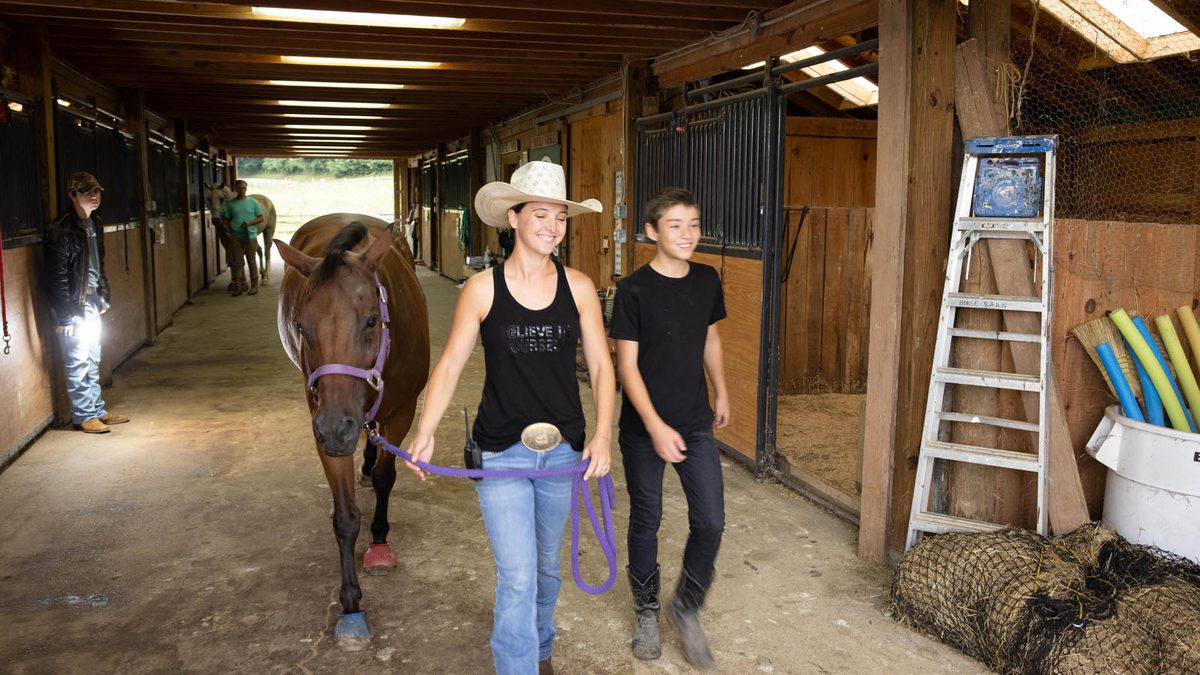
Turning down the gravel lane that led past my cousins’ house on to my Grandma’s home always led to some sort of adventure. It was a small dirt farm in East Tennessee just outside of Blountville. Cousins Tim and Doug Cross were, in my eyes, fearless, and every time I think of those trips I remember how the three of us would collect buckets of ripe apples from the large orchard that had once helped feed 11 children and carry them a short distance to the top of the hog lot. As we would approach the fence, my cousins would begin to call out loudly, “Suey-suey-suey, pig-pig-pig!” And as sure as dust on a dry gravel road, the hogs would come running. We would dump the apples over the fence and the hogs would go wild, gorging themselves on the sweet treat.
The hog lot was on the side of a hill, and we were at the very top corner, farthest away from where a small creek ran through and the hogs created a large mud hole to wallow in to escape the heat. Distracted by the apples, the hogs wouldn’t notice Doug and Tim jumping the fence and simultaneously leaping onto the backs of the two biggest and meanest hogs, grabbing their ears for support. Their docile demeanor instantly changed to rage. The race was on! With my cousins hanging on for dear life, they would race down the hill toward the mud hole. There was a little catch to winning the race: they would have to jump off the charging swine before the mud hole or risk being caught with a 500-pound hog on top of them. The winner was the one who waited the longest to jump off. It was an exhilarating sight.
Later in the day, my Uncle Harry would return home with the bed of his truck filled with the large barrels he had collected from local school cafeterias. Back in the day before everything was disposable, the children’s plates were washed, but not before the excess food was scraped off through a hole in the stainless counter into a barrel and saved. Farmers would go to the school and pick up the full barrels of “slop” to feed their hogs. Uncle Harry would back up to the lot, and as he poured the barrels into a chute that led into the hog trough, he would sing the same song to the hogs: “Suey-suey-suey, pig-pig-pig!” The hogs would squeal with delight as they literally pigged out on the free food. I have heard hogs are very intelligent, but these ones, I don’t believe, had any idea they were just being fattened up for slaughter.
The other kind of East Tennessee hog is the wild boar. They are smart, hard working foragers that earn every morsel they are able to root from the forest floor. They are lean and mean, warriors in their own fight for survival. Challenge one, and you will find out quickly what I mean by warriors. They are part of a finely tuned machine that we call nature.
A properly run democracy is also a finely tuned machine. To be effective, the citizens must be well-educated, ethical members of a society that values hard work and self-sufficiency as part of what gives us proper self esteem. They must be willing to work together to support each other and have the willingness to ostracize those who violate the unwritten ethical canons. This system has worked well in America for hundreds of years, until now.
When we allow others to lay down their responsibility to be productive members of society, the system fails. The pandemic has certainly taken its toll on everyone in one way or another, and early government programs to provide aid to small business and increased benefits for unemployed workers were unquestionably necessary. However, that moment has passed, and the continued intrusion of our government has created a pandemic of another sort as they metaphorically continue to slop the hogs by continuing to provide support to those that could be gainfully employed.
Here in Knoxville, you are hard-pressed to find a business that doesn’t have a “For Hire” sign on the door. And the disparity between what businesses want or can afford to pay is widening to what workers think is a fair wage in our post-pandemic world. The fact remains that so long as the slop is in the trough it will be difficult to convince the worker to return to the workforce.
→ Swipe for Next Story
Arts & CultureSEPTEMBER OCTOBER 2021
Creating with Colored Pencil
Lauren Kline brings realism to pet portraits
Story by Rebecca Whalen
Lauren Kline speaks softly as she describes the gentle strokes she takes while creating her portraits. Instead of wondering if the facial expression is just right or the hair is styled exactly the way her subject will desire, she wonders if the shade of pencil is just right for the fur and if the eyes—which she always draws first—bring the depth and personality to the works she creates. “People say you can see the soul in the eyes,” she says. Once the eyes are drawn—with an added level of saturation and detail—the rest of the portrait just seems to follow.
Kline, a Maryville resident, creates pet portraits. While she wasn’t new to the art world, she began drawing with colored pencils in early 2019. Photography was her original interest, and although she pursued it as a career, Kline realized she enjoyed it more as a hobby. So she picked up a set of higher quality colored pencils and paper and began investing her time in learning how to create realistic drawings of animals.
Kline eventually realized her talent could reach further, and she began drawing portraits of family pets. And as she continued to hone her craft, clients began connecting with fervor, eager to have portraits of their four-legged friends created for their home or as gifts, many to remember animals who have passed. Each portrait is unique in its own way, Kline says, capturing the essence of the animal whose owner commissioned it.
What once took her two months to create now takes her a week, giving her an opportunity to share her gift more often with others. “It makes me feel like I’m helping [them] fill their hearts,” she says. “They love seeing their pets.”
Kline recently started a web series helping others learn more about drawing animals with colored pencil. She is actively working on a full course offering for interested artists. You can see more of Kline’s work atwww.laurenklineart.com.
→ Swipe for Next Story
MusicSEPTEMBER OCTOBER 2021
The Best of Bluegrass
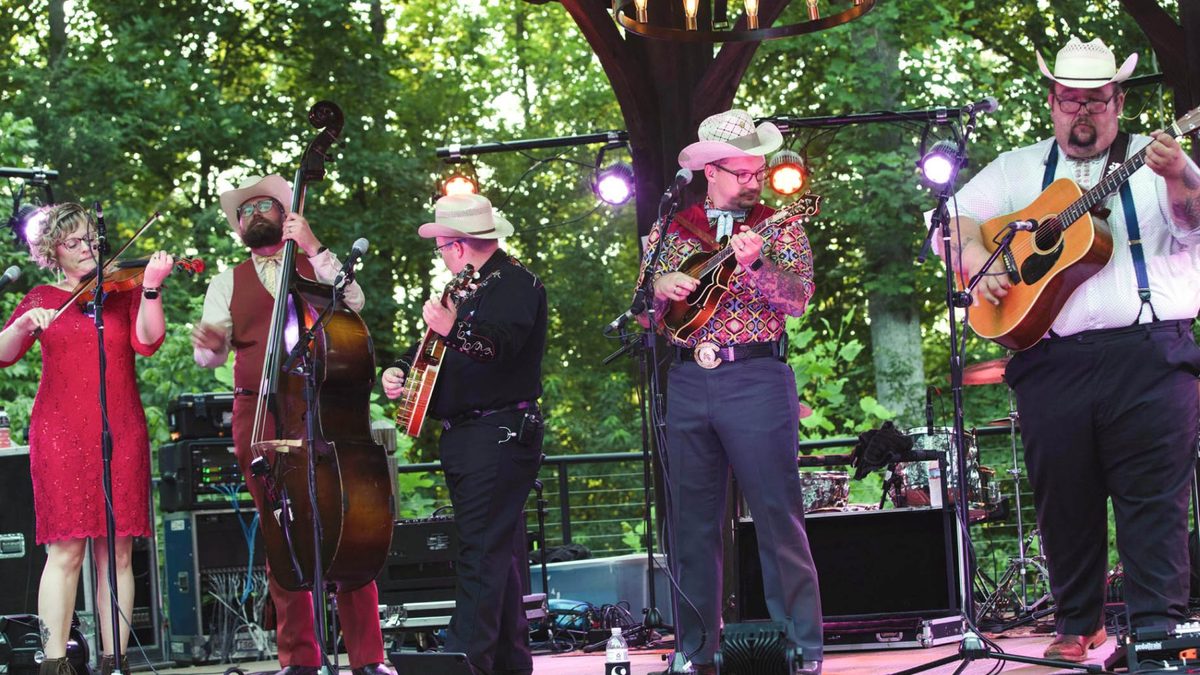
The Po’ Ramblin’ Boys went from house band to Grammy-nominated celebrities
Story by Chris Blue
The Po’ Ramblin’ Boys’ humble beginnings in Sevierville turned into a fast-track path to success. I took some time with CJ Lewandowski, the band’s founder, to learn more about some of the band’s standout moments.
Chris Blue: So how does a band form inside a moonshine distillery?
CJ Lewandowski: I was filling in for some of the bands that rotated through (Ole Smoky Moonshine in Sevierville). The entertainment director asked if I would be interested in putting together a band to take up the other location. So I called my friends. (We) had known each other several years before that. The whole intent was just to be a house band at the distillery. It just happened, and it worked.
CB: Where was the first show outside of the distillery?
CL: Our first official show was in Canada. We did a whole weekend at the Shady Grove Bluegrass Festival. Then we got on a plane and went to Europe for two weeks.
CB: You played at the Grand Ole Opry a handful of years later. How did it feel to play on that legendary stage?
CL: You know, that’s a historic place. Everywhere we looked, we saw somebody we knew, and that really meant a lot because those people have followed us since the beginning. They got to see us accomplish something incredible. We did a 15 minute segment and were one of the last acts of the night. We got a standing ovation.
CB: Was that the biggest moment for the band?
CL: We all came off the Opry stage and said, ‘This is it. This is our pinnacle moment. Nothing can get bigger than this.’ But three or four weeks later, we get a call to say that we were nominated for a Grammy for Best Bluegrass Album. I immediately sent a message to everybody else, and no one could believe it. We didn’t really believe it until we were on the red carpet.
To learn more about the Po’ Ramblin’ Boys and to check the tour schedule, visitwww.theporamblinboys.com.
→ Swipe for Next Story
PoliticsSEPTEMBER OCTOBER 2021
(Tax) Power to the people?
A local look at America’s most hated tax
Story by George Korda
Of all taxes, Americans hate the property tax the most. The property tax’s unpopularity—and knowing that in Knoxville it takes only five of nine members of city council to increase it—helps to explain why a citizen-driven move was attempted in Knoxville to Cap the Tax.
For whatever reason—lack of organization, lack of interest, whatever—the effort failed. But will it stay failed?
To summarize Americans’ feelings toward the property tax, consistent over time, here’s a portion of a 2017 Newsweek article that appeared first in the private investment and financial website,The Motley Fool: “About a decade ago, pollsters at Gallup, CNN, and USA TODAY sought to find out what was the most-hated tax. Many undoubtedly expected that the federal income tax would be the winner of this dubious distinction, given all the time that people spend on their returns. Yet by a more than 2-to-1 margin, property tax topped income tax as the most hated, with more than 40 percent of those surveyed picking it above the numerous other tax choices available.”
Taxpayers are up on being down about property taxes because for most property owners, after years of blood, sweat, toil, and tears to pay off their homes or businesses, failing to pay property taxes means the home or business can be wrested by the taxman.
The counter-argument is that property taxes pay for essential services: police and fire departments, code enforcement, road paving and sidewalks, and other services taxpayers want and expect from city government. And it’s not as if costs are decreasing.
Taxpayers are between the rock of property taxes and the hard place of services a city needs. There have been two Knoxville property tax increases in recent years. At the rate of $100 of assessed property value, taxes went up 35 cents in 2004, under Mayor Bill Haslam, and 34 cents, in 2014, under Mayor Madeline Rogero. There were not many citizen complaints in either case, property tax defenders say. But that may also speak to a feeling of citizen powerlessness.
If a person or business can’t pay its bills, they can’t decide they want more money and just get it from someone else. Their options come with personal and business difficulties, or even dangers. Cutting costs may not be enough. A price increase may drive customers away. What then? An individual can try to get a better job, or a second job, but neither is guaranteed. Government is different, and taxpayers know the difference between them and government when it comes to making sacrifices.
The Knoxville Cap the Tax Petition Drive sought to change things. The slogan: “Cap the Tax: You Pay, You Say.” The petition drive needed 7,427 valid signatures to put the Cap the Tax ordinance on the ballot. If successful, the proposed ordinance would have capped city property taxes at $2.46 per $100 of assessed property value. Any change would have had to be voter-approved.
The motivator, as explained in a WATE-TV story: “Erik Wiatr, a petition organizer and local realtor, hopes to secure more than 4,700 additional signatures by July 28. ‘Anytime the property tax goes up, that has a direct impact on the monthly payment for homeowners,’ Wiatr said. He fears what happened in Nashville in 2020, when property owners were faced with a 34 percent increase in property taxes, could happen here.”
Government officials consider efforts to cap or limit authority over property taxes as appealing as vampires eyeing a forest of wooden stakes. When faced with cutting budgets or raising taxes, government officials much prefer the latter. It keeps government employees and their families (a bloc of certain voters) happier, doesn’t affect services or pet projects, and avoids the always-painful task of deciding who, what, and where to cut.
The petition drive was unsuccessful, garnering just under 4,000 signatures of the 7,427 needed. Opponents of Cap the Tax will be heartened by this result, perhaps believing that city voters are disinterested in a property tax limitation.
Cap the Tax is another way of saying Power to the People. But do the people care enough to engage?
→ Swipe for Next Story
InsightsSEPTEMBER OCTOBER 2021
The Journey
New beginnings and final goodbyes remind us to be present
Story by Bruce Fox
I had an experience this summer that forced me to look at the cycle of life fairly holistically. It was our annual Fox family vacation at the lake house with our six adult children and 13 grandchildren. Nine days of swimming, puzzles, pickle ball, storytelling, and a whole lot of eating and laughing. It’s a week I look forward to each year.
This year’s vacation felt different, however. Same faces, same location, same intention. And yet, some significant moments occurred during the trip: the week began with the baptism of our granddaughter and ended with the long-delayed burial and funeral for my dad, who passed away the day before Thanksgiving last year. There was both joy as we looked at the possibilities for this new life and sadness and closure for a life well-lived.
As I reflect on the week, and the joyous and challenging moments it entailed, I can’t help but give thought to the cycle of life we all go through, the roller coaster of emotions we endure as we navigate our relationships, careers, successes, failures, new beginnings, and eventual goodbyes. We work so hard to reach a destination in each of these arenas, and yet all too often miss the beauty of the journey it took to get there. As we said goodbye to my dad, I was reminded that when our time to leave eventually arrives, it won’t be the farewell people will remember or the accolades we received, but rather the memories made and experiences undergone along the way.
We all make this voyage. And while it looks different for each of us, we have to remember to heed the call to smell every flower, enjoy every moment, and be grateful for the blessings we are given. It is the journey that defines us, not the end. While every day is an opportunity to share our hopes and dreams, it is also an opportunity to enjoy the present moment and be thankful for the life we are able to live.
→ Swipe for Next Story
DepartmentsSEPTEMBER OCTOBER 2021
Black Mountain
A mystical peak that offers hiking for all levels
Story by John Quillen
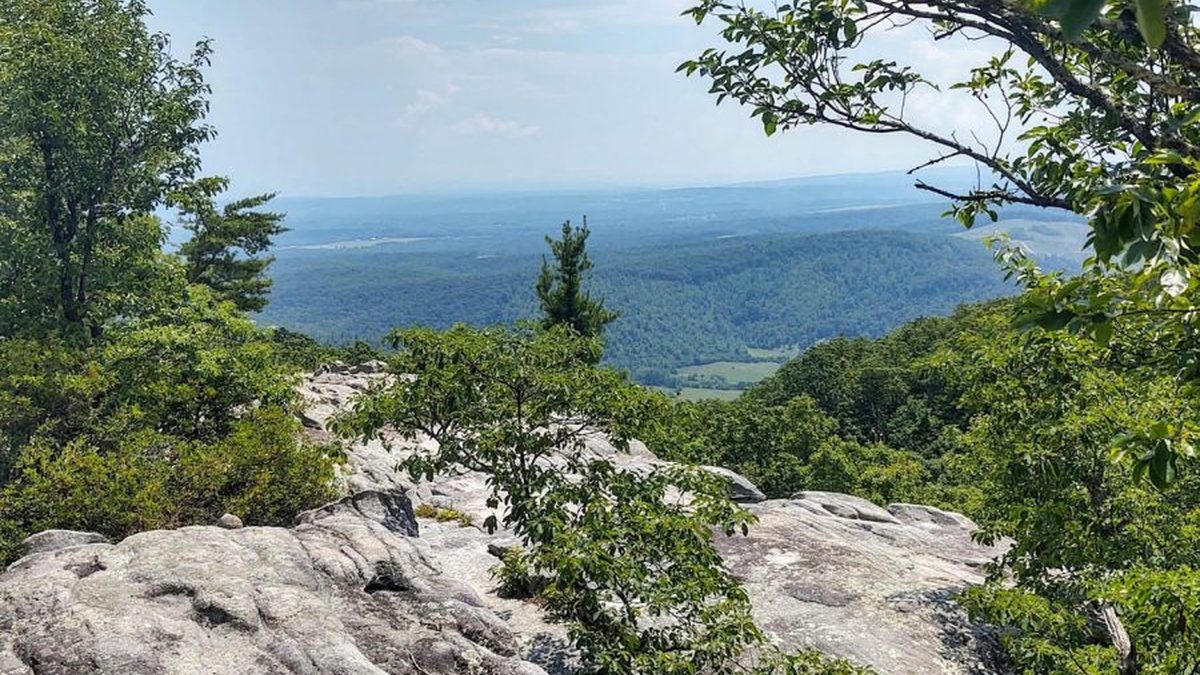
An hour west of Knoxville rises a place lost in the folds of geographic time. Lightly boot-kissed paths disappear maze-like, labyrinthine, into thinning air. Sandstone spires jut randomly about as if to intentionally obscure their cartographic lineage. It would be the home of elves and wood sprites, dared we believe in such. I am bounding between boulders, running my fingers longingly through textured creases in ways naught but a climber would. We are taking on but a small dose, one portion of this long trail that allures us deeper into an adult playground.
Drifting through this rock garden atop Crab Orchard, few know of our own Black Mountain. It is a rooftop bar where we sip enchantment and bid farewell to Tennessee’s eastern hills as they melt permanently into an endless plateau. It makes for good long views, 20 miles at times, from her sweeping overlooks. My shoes grind acorns deeper into The Cumberland Trail, each step connecting, appreciating the work done by this organization to cobble and hew these 300 miles over many decades.
Mindlessly lost in a Tolkien fantasy, I glide past an unusually yellow creature. Its tail full of rattles suggests there is plenty of wild left on this mystic mountain summit. Unconcerned with me, I tread past it more gingerly through waving fern and galax. Water bubbles from an adjacent spring with a sweetness only accounted for by the layers it must have squeezed to rise here. Deep jungle cackles denote the unmistakable taunting of pileated woodpecker and raven sailing untouched through stands of beech and elm.
I’ll return many other days to hang in a harness tugging at iron flake on an arete known simply as the “Party Hawaiian Wall”. I’ll blister my blisters, pull ticks by the half dozen and forget to turn around and grab a well-earned view while topping out on an overhang called “Elvis Never Wore Lycra”, expertly bolted by volunteers with the East Tennessee Climbers Coalition in conjunction with the Tennessee State Parks. It’s the best rock in our part of the state; the first place I ever squeezed into ballet shoes with sticky rubber soles some 30 odd years ago.
But this day is just for walking, dreaming, wildflower counting. This day belongs to us gnomes.
→ Swipe for Next Story
DepartmentsSEPTEMBER OCTOBER 2021
Chasing Waterfalls
Follow the path to a Tennessee state of mind
Story by Rebecca Whalen
Why is it that we feel so good while listening to the sound of rushing water? Ongoing studies are trying to understand the science behind it. What we do know is that being in the presence of nature makes us feel good. Add water to that natural space and it seems many of our bodies react even more positively. Here in East Tennessee, we are fortunate to have countless waterways and waterfalls to enjoy, such as this one, Bald River Falls. You can access them in Tennessee’s state parks, within the Great Smoky Mountains National Park, even along walking trails close to home. So the next time you need a few moments of peace, head to a trail with a waterfall, close your eyes, and let nature set the mood.
→ Swipe for Next Story
DepartmentsSEPTEMBER OCTOBER 2021
Sim Por Favor
At Brazeiros, fine dining meets a Brazilian tradition of generous offerings of carne
Story by N. Brooks Clark
If you get movie star treatment from owner Vilmar Zenzen at Brazeiros in Bearden, it’s because he’s had practice. After he launched a churrascaria-style Brazilian steakhouse in Beverly Hills, Zenzen’s regulars included Brad Pitt, Janet Jackson, Jennifer Lopez, Leonardo DiCaprio and the star’s then-girlfriend Gisele Bündchen. Like Bündchen, Zenzen is a Brazilian of German ancestry from the southern state of Rio Grande do Sul, where gauchos in bombachas (cowboys in loose-fitting black knickers secured with wide leather belts) roam the Pampas, and churrasco cuisine (roughly, Portuguese for barbecue) got its start.
Zenzen grew up on a Rio Grande do Sul farm and started washing dishes at a São Paulo steakhouse at 17. He worked his way up in a family business and was dispatched to start churrascarias in Dallas, Houston, Atlanta, and Beverly Hills. Zenzen and his wife, Renata, moved to Knoxville and opened Brazeiros 11 years ago. “Our goal is to offer the same level of service as we did in L.A.,” he says.
During the pandemic slow times, Zenzen remodeled Brazeiros, adding a glassed-in wine cellar displaying an assortment—including selections from Chile and Argentina—that has won Wine Spectator’s award of excellence for nine years in a row. The interior has a surprisingly elegant and intimate feel, warmed by a raised stone fireplace and folk-style Marcela Lopes paintings on cowhide depicting gauchos herding ponies or enjoying glasses of wine at a family table. A private room with a long 40-seat table is perfect for rehearsal dinners or business dinners.
Because everything about Brazeiros is so polished and elegant, and because it comes from such a strong cultural tradition of churrascaria, patrons might assume it is part of a chain, but it is not. The Zenzens own one other location, in Louisville, Kentucky, but the vision and execution of Brazeiros is all their own.
Meals begin with a generous salad bar that includes items such as fresh asparagus, beets, peppers, artichoke hearts, salmon, salami, fresh mozzarella, and hearts of palm. For the main courses, in the churrascaria tradition, waiters in gaucho attire carve generous selections of meats rodízio-style from large skewers onto diners’ plates. Diners turn a small paper circle to the green side, with the words “Yes, please” and “Sim, por favor,” or the red, with the words “No, thank you” and “Não, obrigado.” “When it’s green, they bring the meat,” says Zenzen. “When it’s red, they leave you alone.”
The menu offers varying levels of hearty dining. The Full Experience features 15 different cuts of meat: beef—the prized picanha, or top sirloin, filet mignon, bottom sirloin, ribeye, and short ribs; leg of lamb and lamb chops; chicken—legs, breast in bacon, teriyaki; pork—ribs, chops, and sausage; and smoked sausage. “That’s the juiciest piece of sausage I’ve ever had,” said one of our dinner companions.
The Varietal Experience offers nine of those cuts. Non-comsumidores de carne can order chicken and salad, or the salad bar alone. A skewer of shrimp or an eight-ounce seared salmon can be added. Side dishes include crispy polenta, caramelized bananas, garlic mashed potatoes, grilled pineapple, and cheese bread. “It’s all about choices, options, and the experience you want to have,” says Zenzen.
The experience should include a Caipirinha—lime, strawberry, pineapple, or tropical—the national drink of Brazil made with fresh fruit, sugar, and a special rum, cachaça, that is lightly distilled from the sugar cane.
And, as hard as it is, leave room for Brazilian Flan, as creamy and tasty as any in town, Crème Brûlée, or a Papaya Cream, made of papaya fruit and vanilla ice cream blended with black currant liqueur.
→ Swipe for Next Story
Dining GuideSEPTEMBER OCTOBER 2021
Coffee Shops
Locally grown shops prove java and ambiance go hand in hand
Story by Marc Anthony
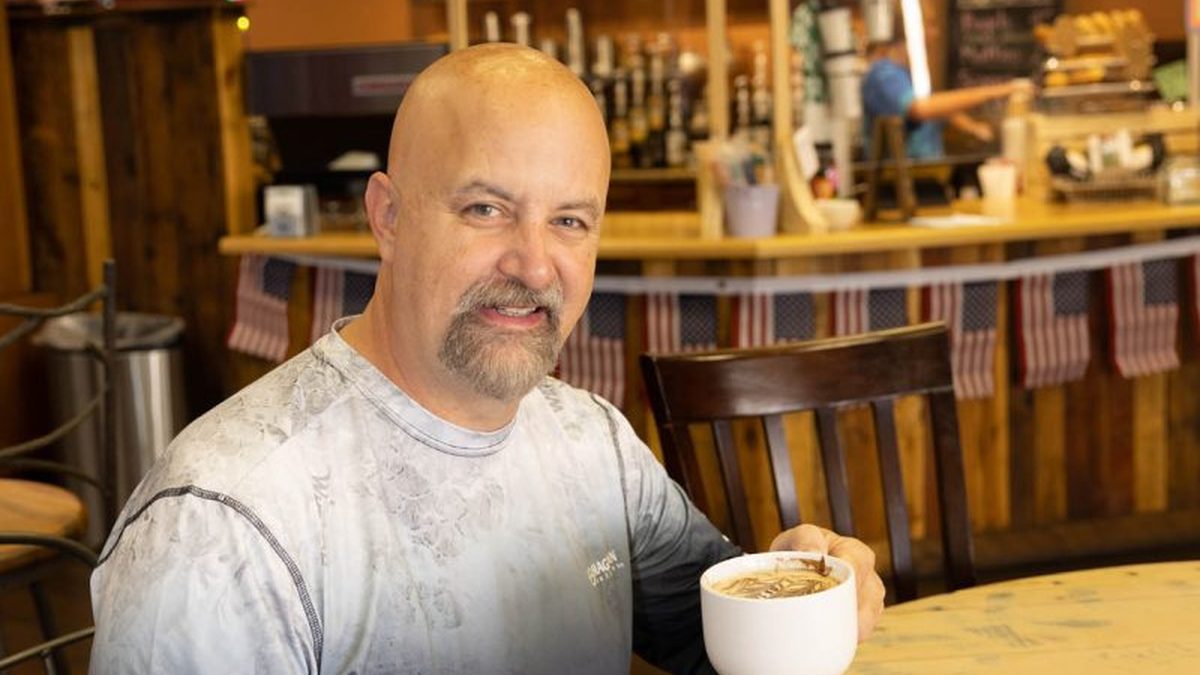
Coffee is in an era called the Third Wave. Mass-produced and nationwide coffee chains were so Second Wave. Production origins and methods that are fair and sustainable pervade this third wave, and Knoxville’s coffee culture is booming with shops serving up everything from Brazilian and Ethiopian blends to single source and locally grown and roasted. I hung out at six coffee shops around town, sipping espresso, drip, pour over, and everything in between. I’m no connoisseur, but just like you, I want a little ambiance and a good cup of coffee. And that’s exactly what I got.
Awaken Coffee
In maybe one of the most aesthetically pleasing of all the small coffee shops in and around Knoxville, Awaken defines coffeehouse ambiance with light colored wood and exposed, turn-of-the-century brick walls. You can even climb the stairs to an odd little loft that hovers over the coffee makers’ heads providing a voyeuristic look at the customers below. Chloe the barista drew a beautiful espresso shot that filled my mouth with a zesty and robust coffee that was, yes, an awakening! One of the few, if not the only, place in town, where you can get a burrito and cup of coffee, Awaken Coffee has settled in and comforts us with ambiance seeping from its pores.
Old City 125 W. Jackson Avenue (865) 951-0427
Southern Grace Coffee Co.
If you want to feel like you’re sitting on your own front porch sipping a cup of java, welcome to Southern Grace which is literally on the front porch of a 1920’s craftsman style home. I happened to stop in on a day they were closed. Owner Tosha Wilhelmson said she was just stopping in to pick up some paperwork, saw a customer on the porch wanting coffee, and popped in to make him one. More than an hour later, Tosha was still making coffees for customers trickling in. She is living her mission of providing good community and fellowship over Peruvian, Mexico Chiapas, and Guatemalan coffee. Delicious!
Why are cups always empty at The Empty Cup? Because as people pour in for cups of sumptuous coffee and tasty nibbles, they know that their dollars will pour back out to local families in the form of adoption grants. Adoption is the mission here, and the mission statement—“Pour it forward”—is an attitude we should all have. Overstuffed couches and chairs spread across the floor, inviting you to come in and taste an artistically created cafe latte with drizzled chocolate. I had never tasted Ethiopian Sidamo coffee before, but it was rich, smooth, and full-bodied. Stop in for the coffee, stay for the message.
Owner Leticia Fernandes road-tripped across the country before she decided to settle and set up shop near campus. A perfectionist, Leticia wouldn’t let me photograph the first espresso she drew from her gleaming machine, as the “crema” wasn’t as outstanding and photogenic as she liked. Therefore, I got to drink two, and as a lover of Brazilian coffee, I wasn’t complaining. Capybara Coffee deals in Brazilian specialty coffee, and that’s it. Harvested in small batches from small farms, the shots went down like silk with no assistance from frothed milk or sweetener; the truest test of a coffee. Test passed!
Situated in the historic Regas Square in Knoxville, Vienna Coffee’s pop-in, pop-out location is the kind of place where downtown workers might stop to grab a quick breakfast bite and a delicious organic Sumatran espresso. Barista Luke’s deft hand poured some steamy and frothy milk into a large latte cup creating one of the prettiest coffees I had on my tour. I don’t sweeten espresso and the complex flavors of this full-bodied-and-dark-roasted Indonesian coffee came right through. The coffee is roasted right in Maryville at the Vienna Coffee headquarters. The company is the supplier for many restaurants and grocery stores throughout Knoxville.
No. Dark. Roast. Why would you char the flavor out of a bean? My velvety Cortado at Honeybee Coffee came with an education from my barista about how much of a coffee’s essence is lost in the roasting process. Coffee from Honduras and Papua New Guinea are available (and lightly roasted) at Honeybee’s locations. Owner Norris Hill is a strong advocate of using a single farm for all their coffee beans, creating a more personal and conscious relationship with growers. Fair trade coffee helps developing nations with more fair pricing for the coffee they harvest and sell. Honeybee is proudly Fair Trade Certified—and down right delectable.
On August 21, 1971, Sandra Sue Franklin and I declared our marriage vows. So, this year qualifies as our Golden Anniversary—50 years. In the last decade, most of our mornings together have been reading the newspaper and watching the news over coffee, usually Maxwell House, brewed by Mr. Coffee in a matter of minutes. That is apparently not unusual, given that Americans drink 400 million cups a day, and 79 percent of those are prepared at home. The thought of coffee and its role in our lives reminds me of two loosely related stories. I will try to connect the dots.
Although Sandy and I were friends in high school, we did not date until the fall of 1968, my junior year at the University of Tennessee. One night we went to see a movie,The Graduate, which had been released only a few months before. I have always been a baseball fan (almost three years later, Sandy had to endure a radio broadcast of Braves vs. Cardinals as I drove to Atlanta on our wedding night), and so I was intrigued by the reference to a retired baseball player in “Mrs. Robinson”, the movie’s theme song. The lyrics resonate with me to this day: “Where have you gone Joe DiMaggio? A nation turns its lonely eyes to you…What’s that you say, Mrs. Robinson? Joltin’ Joe has left and gone away. Hey, hey, hey.” We liked the movie and loved the song.
Although I am not quite old enough to have followed DiMaggio as a player, his legendary career earned election to baseball’s Hall of Fame. As a center fielder for the New York Yankees from 1936 to 1951—less three years in the military during World War II—he won three Most Valuable Player awards, celebrated nine World Series championships, was named an All-Star every year he played, and, of course, got base hits in 56 straight games, a major league record that has stood for the last 80 years. Sportswriters and fans in his day admired him for his dignified manner, both on and off the field. I do recall his highly publicized marriage to Marilyn Monroe in 1954. Although the marriage did not last, DiMaggio remained devoted to her throughout the remainder of her life and, ultimately, his own.
During the early 1970s, well after DiMaggio’s heyday, a man by the name of Vincent Marotta invented one of the first automatic drip coffee machines which he called Mr. Coffee. In order to make his invention known nationally, he believed that he needed a celebrity spokesperson. A former professional athlete himself, Marotta had always been a fan of DiMaggio. He flew to San Francisco and invited him to lunch. The two Italian-Americans clicked and, without agents or lawyers, made a handshake deal. With Joe’s public image and the power of television, the brand skyrocketed for in-home use. Joe, the star baseball player, became “Mr. Coffee” to a new generation.
In the meantime, Bill Holt, of Sevierville, married young and worked as a mechanic for Knoxville Motor Company before he decided to finish college and enroll in law school at UT. A musician, he also played guitar and sang in a rock band to supplement his income. I had always admired Bill for his talent and work ethic. His mother, who worked at my father’s store, kept me apprised of his progress, and I always attended his band performances when I could catch a ride. Ten years older than me, Bill was in his last quarter at the school when I was in my first. After passing the bar, he joined the Hailey, Waters, and Jarvis firm and moved wife Pat and their three boys back home. A year or so later he set out as a sole practitioner.
By then, Sandy and I had married, and she took a teaching job in Pigeon Forge. With a year to go at UT, I began to work part time for Bob Ogle’s firm in Sevierville, writing briefs and researching land titles for the princely sum of $3.50 per hour. Bill saw me in the Register of Deeds Office one Saturday morning (the courthouse was open until noon in those days) and asked me to search a title for his client, a chore many lawyers preferred to avoid. I agreed, completed the task, and met him at his office a week later. He paid me his full fee of $50, an astronomical sum for a newlywed struggling to make ends meet on Sandy’s teaching salary. While we talked, he offered a cup of coffee. I declined, explaining that I had not yet developed a taste. “That will change,” he responded, “when you get into this business full-time.”
Bill, a fine and respected lawyer, later distinguished himself as a Circuit Judge. And for some reason, I always remembered his comment about coffee. Sure enough, within a year or two, I began to start each morning at the Ogle firm with a cup of instant java, mostly to get the energy boost from the caffeine I needed for what became a demanding law practice. Before long, I was up to two a day. To put that in perspective, surveys indicate that 64 percent of American coffee drinkers consume an average of 3.1 cups per day. Bill was a prophet. Eventually, I replaced the instant brew at the office with DiMaggio’s Mr. Coffee, convinced, as I am today, that coffee and the legal profession go hand in hand.
Returning to the role ofThe Graduatefilm in this story, Paul Simon, the singer who wrote “Mrs. Robinson”, and DiMaggio met at a New York restaurant well after the release of the song. “What I don’t understand,” the former ballplayer posed, “is why you asked where I’ve gone. I haven’t gone anywhere. I just did a Mr. Coffee commercial.” “I didn’t mean those lines literally,” Simon replied, “I thought of you as an American hero, and genuine heroes are in short supply.” Shortly after DiMaggio died in 1999, Simon performed the song live at Yankee Stadium. He eulogized the man who popularized the Mr. Coffee brand with Baby Boomers like me: “We grieve for Joe DiMaggio and mourn the loss of his grace and dignity, his fierce sense of privacy, his fidelity to the memory of his wife Marilyn, and the power of his silence.”
Often, as I take my first sip of the Mr. Coffee brew each morning, I think of my friend Bill who, like DiMaggio, always conducted himself with grace and dignity as both a lawyer and a judge. On the morning of our noteworthy anniversary, I will propose to my bride a toast to Bill and Joltin’ Joe with “a cuppa joe.”
→ Swipe for Next Story
InsightsSEPTEMBER OCTOBER 2021
A Storied Tradition
Untold memories from former Vols gear us up for a new season with a new coach
Story by Robert Pryor, Sr.
In the eyes of many, the last decade of mismanagement and a succession of bad coaching hires have tarnished the Tennessee football tradition. The fan base is naturally disappointed about the long drought of big wins and national relevance. However, we still have a tradition of producing great teams and winning championships, and we have the stories to prove it. Here are a few of those stories in a salute to Coach Josh Heupel as he tries to make his mark on our football heritage.
If you believe in the tradition of Tennessee football, then you must know that the General Robert Neyland era was primarily responsible for that tradition and that Herky Payne was right smack dab in the middle of it. Herky played in the glory days of Tennessee football and was a major contributor to the 1951 National Championship. When looking for a good story about the Big Orange, there was no better person to turn to than Herky unless it might be Tim Priest or Bud Ford. I spent time with each of these VFL’ers in an attempt to learn their favorite personal recollections and stories about the Tennessee football journey that brings us to this new beginning.
A few months before his death, I had lunch with Herky Payne. At age 91, he was well fit, alert, and quite humorous. I asked him about General Neyland and what most can agree was the heyday of Tennessee football. However great our tradition might be, Harold “Herky” Payne was witness to it. He came from Pensacola High School to play for the General in 1948 and immediately established himself as a grinding type of power running back. He was a favorite of the General and always sat next to him on the bench so he could quickly be sent into the game to replace the first string tailback and Heisman candidate, Hank Lauricella, when guaranteed short yardage was needed. Herky explained that the General was a well-organized man and a strong but fair disciplinarian. Players were actually assigned seats on the bench and were expected to stay there during the game. Herky was always in his place, and when Lauricella moved the team near the goal line, Herky was sent in to power run the last two or three yards for a touchdown. In 1951, Tennessee was the National Champion, and Herky scored 14 touchdowns that year coming off the bench and became the team’s and the SEC’s leading scorer.
Herky loved to talk about General Neyland’s simple approach to offense and recalled a game where the Volunteers were not able to move the ball to the dismay of the fans. Repeatedly being stopped with runs off tackle, the crowd shouted their displeasure. Suddenly, in an inexplicable moment of silence, a lone fan cried out, “Hey, General, why don’t you run your other play.” There was laughter in the stands and a few snickers along the bench, but all players were biting their lips to keep from laughing.
At first, Herky seemed hesitant to tell me the next story, but I was pushing for untold humorous events that he had held private. He said General Neyland had been presented a new Cadillac automobile prior to the 1950 season, and early in the much-anticipated campaign the team traveled to Starkville, Mississippi, for their first conference game of the year against Mississippi State. The Vols lost 7-0, to a lesser team, a totally unexpected result. Herky told that after the game the team was seated quietly on the bus next to the stadium waiting to depart for Knoxville. Herky, as usual, was seated on the front seat next to the General when a drunk Vol fan stepped up into the bus all decked out in an orange shirt and crooked orange cap. The drunk looked straight at Neyland and pointed his finger at the General’s nose and said, “We should have never given you that damn Cadillac, you SOB.” An offended player lunged at the drunk, but the General stopped him and said, “Leave him alone, the man is right. They should have never given me that Cadillac...I didn’t deserve it.”
Tim Priest has been a player and longtime close observer of Tennessee football and our ups and downs on the tradition scale. Tim played for the Vols between 1967 and 1970 and served as team captain of the 1970 team. He was the colorful color analyst for the Vol Network from 1999 to 2021 and has been involved in the Vol program for over five decades.
Tim was recruited from Huntingdon High School to play quarterback at UT. He was recruited along with Joe Thompson from Savannah, Tennessee, and Bobby Scott from Rossville, Georgia, all to play as freshmen quarterbacks. Tim tells the story of his first day of practice at UT. He says the first time he saw Bobby Scott throw a pass, he and Joe went to their coach and asked to be reclassified. That’s how Tim came to hold the school record for career interceptions (18) as a cornerback and hold the career record of 305 interception return yards until a guy named Eric Berry came along. Since Thompson couldn’t tackle, he switched from quarterback to wide receiver where he was a top talent in the SEC in receptions, receiving yards, and receiving touchdowns. Funny how things work out.
Tim recalls that in 1967 P. W. “Bear” Underwood was hired by Doug Dickey to coach linebackers. “Bear” was a big, heavy man and played guard at Southern Mississippi in the mid-1950’s. One day during practice, “Bear” was having difficulty teaching a young linebacker how to play the position and fight off a charging offensive guard. Finally, in disgust, he stopped practice and pulled the linebacker out of position and assumed his place to demonstrate the technique. The practice stopped and the players gathered round as “Bear” instructed the guard to charge full speed and try to block him. “But, Coach,” the young guard said, “I have full pads on.” “I don’t care,” replied the coach, “Now, give me your best—now FIRE OUT!” The guard rushed forward and knocked the rotund coach six feet flat on his back. The team groaned, then fell silent. The dazed coach raised his head and said to the linebacker, “See, son, you’ve screwed this position up so bad nobody can play it.”
Harris D. “Bud” Ford is the historian of the UT Athletic Department after serving in Sports Information and Media Relations for the program for over 45 years. Bud is a member of the Greater Knoxville Sports Hall of Fame, the Tennessee Sports Writers Hall of Fame, and the College Sports Information Directors of America Hall of Fame. This well-recognized hall of famer has spent his entire adult life in support of Tennessee athletics from a front row seat.
In the summer of 2019, about a year before his death, Coach Johnny Majors wanted to go to Lynchburg, Tennessee, to pick up some football memorabilia he had stored there, and Bud agreed to drive him. Along with Barry Rice, the Vol videographer, Bud drove the coach to Lynchburg. As they prepared to return to Knoxville, Coach Majors asked Bud if he would mind driving over to Huntland, a few miles away, so he could once again see his old high school stadium where his father coached and he played as a teenager.
In route to Huntland, Coach Majors directed Bud to take a shortcut, and a 20-minute drive turned into an hour drive. When it was obvious that they were lost, Coach Majors told Bud to take a right, but in Bud’s best judgment he took a left, causing Coach Majors to fall silent in the back seat. They eventually found the stadium and Majors spoke not a word and pouted all the way back to Knoxville. When Bud pulled up in front of the Majors’ home, he knew the coach was mad that he had ignored his directions during the “shortcut.” Without saying a word, Majors got out of the car and started walking to the house, then suddenly turned and walked back to the car and a smiling Majors said, “Bud, we’d been home 30 minutes earlier if you had turned right when I told you to.”
Not only is Bud a reservoir of tall tales from his own experiences behind the Athletic Department orange curtain, he has inherited the many recollections of Gus Manning and Haywood Harris, both trailblazers in the sports information business. Bud loves the story about Lindsey Nelson advocating for a statewide radio broadcast of the football games. Nelson was one of the first play-by-play radio announcers for the Tennessee games, but only on local Knoxville radio, and he worked under the exclusive direction of General Neyland.
One day in 1949, Nelson took his idea to the General emphasizing that a statewide network would allow the games to be heard from Bristol to Memphis. The General was interested in the cost of going statewide, and Nelson reassured him that it would be no more than $1,500. “Lindsey, do you know how many ice cream flavors Howard Johnson’s has?” the General asked. Nelson replied, “Twenty-eight, I believe, Coach.” After the General explained that the number one flavor was vanilla, he said, “Lindsey, that’s how I want my games broadcast, vanilla.” As they discussed the possible name for the statewide network, Nelson suggested “the Volunteer Network,” but the General said, “No, that won’t work—let’s name it the Vol Network—the Vol Network it will be.”
That was the first use of the term “Vol” associated with Tennessee athletics, and the broadcasts that followed were anything but vanilla in the hands of John Ward and Bill Anderson followed by Bob Kesling and Tim Priest.
I hope you enjoyed the stories. Now, let’s play ball. GO VOLS!
We have been flying on this last leg for roughly two hours heading to Oshkosh, Wisconsin, for the Experimental Aircraft Association’s AirVenture 2021 Air Show. Arrival at Oshkosh is not for the faint of heart, and for a few short days it will be the busiest airspace in the United States. Aircrafts converge at a point southwest of the airport and form a line, all at 1,800 feet and about one mile apart. The controllers call your plane by color and type and ask you to rock your wings to acknowledge. At moments it can be exciting.
The controller sends us to a downwind leg for runway 27 where we get our first glimpse of the seemingly endless rows of airplanes with tents pitched under their wings. Planes are landing three at a time on the same runway by using a system of dots painted on the runway. The controller calls, “277 Papa green dot,” and shortly we are down and taxiing in the grass along the runway, headed to the vintage camping area where there will be a total of 1,420 airplanes built before 1970.
Non-aviators are often amazed at the age of planes; ours is a 1955 Beechcraft Bonanza. The maintenance is so stringent on these planes that they last an incredibly long time. Here they are plentiful and the stories found in the camps around them are, too. The lineman moves us into position and signals for engine shutdown. We are in the middle of the lane, surrounded by all sorts of vintage planes. No sooner than the propeller stops and we climb out for a much-needed stretch, are we greeted by a group of people known as the Moraine Glue Angels. Early planes often have wooden ribs, hence the “glue”.
Compliments on our plane and offers to help set up camp abound. Brad, a cheerful fellow, offers Troupe a soda and me a beer. In no time, we are set up and Brad is back with offers to join them for dinner. I find out later that this group has been coming to AirVenture for years; they fly in days before the show begins so they can camp together and enjoy the camaraderie.
AirVenture has several different parts. The air show includes seven days of aerobatic performances by pilots from all over the country. Every type of airplane imaginable is present, from early general aviation to the most advanced military planes of today. Instruction and lectures are available on every aspect of aviation and home building imaginable, and then there are the vendors. If it can be used in an airplane, you can find it at Oshkosh.
Troupe has his sights set on viewing the vintage military planes, and I am hoping to see Knoxville’s own Wes Stowers and his “Ain’t Misbehaving” P-51 Mustang. We find Wes and score a ride for Troupe in this marvelous warbird for the next morning. Having ridden with Wes before, I know Troupe is in for a thrill. What a joy for me to see his enthusiasm and excitement for what I know will be the ride of a lifetime. Afterwards, we visit just about every WWII plane imaginable, and Troupe amazes me with his depth of knowledge on each and every one.
There is nothing quite like AirVenture. Even a brief rain shower or two is unable to dampen the experience. We simply take shelter under the wing-tip of our Bonanza, brewing coffee as drips of rain fall from the wing into my cup.
Writing this, I am relishing in the moments spent among the planes at AirVenture, with the new friends we met and the familiar faces we recognized while there. I hope to be able to join my new friends, the Moraine Glue Angels, as well as see my fellow pilots from Knoxville at next year’s event.
→ Swipe for Next Story
FeatureSEPTEMBER OCTOBER 2021
Fix & Flip
Buying and Selling in a Changing Real Estate Market
Story by Mary Leidig
Suppose you are the handy sort and have done a little remodeling. You have a friend who flipped a house and made $50,000 in profit. Sounds like easy money. So you start searching for a home to buy and fix up with visions of spending your profit on that new boat you’ve been eyeing. But before you file your flight plan and put down cash out of your home equity line to purchase that fixer-upper, it might be wise to consider all that goes into flipping a home, and then determine if it’s the right fit for you.
The national and regional housing market has taken off since early 2020, dramatically changing the way some real estate professionals sell a home. That rings true for those who are house flipping, a type of real estate investment in which a person purchases a property not to use, but rather to sell for profit. I called 30-year veteran house flipper and investor Chuck Ward to find out how to tackle this line of investment, both now and in the future. And at the top of his list of advice? Be honest, do your homework, and keep following vital, time-tested practices. Let’s dive in.
What it Takes to Flip Houses
Ward came into this line of work while “remodeling a past home of my own and thought house flipping would be a great way to make some extra money,” he says. A Knoxville native who owns Chuck Ward Real Estate Investments, Ward has flipped more than a whopping 1,500 houses in the Knoxville area since beginning in this profession, and continues to thrive in this environment. People come to him often, seeking guidance on flipping homes or “wholesale real estate investing,” as the business is sometimes called.
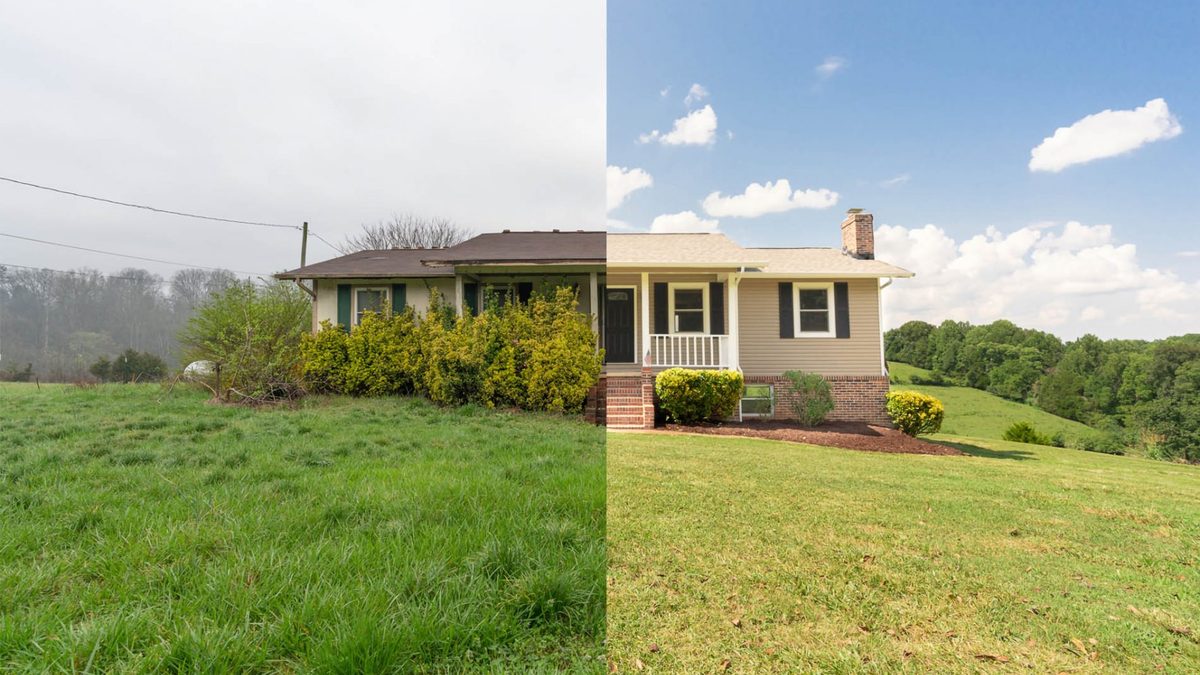
However, this is anything but simple work. “In this work, you’ve got something every day to deal with. Remodeling and flipping are always a lot of work, and I’m fortunate to have a great team,” says Ward. “I like it because it’s challenging, and after giving a project so much love, you see an old, dilapidated house turn into a beautiful place to live.”
Although this can definitely be a profitable business, this is not a get-rich-quick scenario. So, what are the steps to becoming a successful house flipper? Ward’s answer is quick and firm: do your homework, and be ready to buy when the opportunity arises.
An outgoing, friendly personality works best in house flipping. “Whether you’re flipping houses or selling Tupperware, being able to negotiate and talk with people is necessary,” Ward says.
Loving the Deal, and Sticking to Your Budget
First and foremost fall in love with the deal, not the house. Create a budget of what it will cost to make the repairs necessary to maximize the sale price, and see if you can generate enough profit to take the risk. Yes, there is risk in any real estate investment. Ward says to make sure you “have available the money to buy a property through a loan or bank credit letter,” adding that it’s essential to ensure you also have the down payment to close on the property you’re looking to buy.
Many people access existing cash or lines of credit to purchase without the benefit of the guidance of a title company. There is no question that title insurance should be acquired prior to or contemporaneously with the purchase to avoid previous liens, claims, or disputes.
As eager as you might be to get into a home and start flipping, Ward warns against several temptations that can arise this early in the process, including skipping a home inspection and overpaying for a property. “I’ve overpaid for a few properties by mistake,” he says. “And if there’s a foundation, roof issue, or any other problem, a home inspection will show that.”
Once you eventually purchase the home, you will start the renovations it needs in order to sell. Ward recommends putting in the time, but being smart about how you go about it. It’s best not to get emotionally attached. “Because you’ll lose money,” he says. And at all costs, stick to your budget. “You can’t get that back,” Ward warns. “Stay within your budget—based on the current value of the house you’re remodeling.”
Plan, Plan, Plan
Just because you can do it yourself doesn’t always mean you should, especially if you’re new to this business. Seek advice from professionals, and put together your list of people and contractors who can help you in all areas of home renovation. Everyone has heard the old adage “location, location, location” when it comes to business. Well, when it comes to speculative real estate investing, planning is key.
If the home needs any walls moved or structural work, you should consider consulting an architect or home designer before beginning demolition. Buying a few hours of their time could save you thousands later.
Most would agree that there are some key factors that contribute to a successful sale and since that is the objective you should plan accordingly. You never get a second chance to make a first impression and the same goes for your house. You can keep it simple, but it needs to look inviting. Aside from fresh paint, consider replacing windows. According to Alyce Greitzer of Home Choice Windows and Doors, “New windows not only add to the beauty of the home, they increase the energy efficiency.”
The kitchen and bathrooms get quite a bit of attention from prospective home buyers. Since most people spend the majority of their time in the kitchen—and it is most often the most expensive to remodel—that’s a good place to start. Cabinet shops offer a variety of contractor-grade cabinets that can make an attractive space while also keeping you on budget. It helps if your cabinet dealer has a full shop to do minor customization, “Adding little touches like crown molding or light rails can make a simple cabinet look polished without drastically increasing the cost,” says Dick Coffey of Dixie Kitchen.
Most likely you will also need to replace the appliances. “Stainless steel appliances give any kitchen a fresh new look, and they seem to have a timeless appeal,” says Mark Patterson of Patterson’s Appliances. And don’t shy away from reaching for the granite counter-tops. These can give that feel of elegance and sophistication you want in the home’s kitchen, but they don’t always have to cost a ton. You can often find remnant deals at local shops if you hit the shop at the right time.
When it comes to the bathroom, there is no question that a professional will be worth the money, especially if your flip requires tile-work of some kind.
Navigating the Current Sellers Market
For Ward, business in the middle of a pandemic has been good, though it’s not been without its changes. Instead of flipping 30 or more houses in one year like he typically might, Ward wants to complete 8 or 10 this year. He is working on three projects now and has recently looked at several more properties.
“That’s almost one a month, and they are bringing more money than ever,” he says. “I knew the market was going to heat up because the inventory was getting lower and lower. People were having a hard time renting and buying a home in Knoxville, Sevierville, and Maryville.”
But what about for the first-time house flipper? Is now the time to get started? Ward’s advice is to sit tight. “This is not a great time to try this business as a new house flipper,” he says. “Wait until the market cools a little bit. Inventory is low right now, prices are high, and building materials are expensive.”
So while now might not be the time to start your flip, it’s certainly a good time to start preparing. That also includes identifying what it will take to sell the house once you’ve completed repairs. According to Peyton Cherry at Keller Williams Signature Properties, you should compile accurate information about the floor-plan and consider having the house staged for photos. “Staging really amplifies all the hard work you have done to make the home shine,” he says, adding “and if you’re not experienced in sales I recommend hiring a competent realtor to assist. By listing the property, you make it available to all realtors through the Multiple Listing System.”
Many people in the house-flipping business sell without the assistance of a licensed realtor, as you are not required to have one to sell your property, but utilizing the knowledge from a real estate professional would ensure that all the rules are followed and should lessen any potential liability post-sale. Ultimately, though, the choice is yours.
Pulling it all together
Remodeling a house and making it new again is the most fun part of the business, Ward says. It is a big process and there is a ton of competition, but if you’re willing to put in the work, do it right, and stay honest with potential buyers, there’s no telling where you might end up in this field.
You might remain a hobby house-flipper doing the occasional house on the side, or you might end up like Ward and turn your newfound love of flipping houses into a thriving business.
→ Swipe for Next Story
FeatureSEPTEMBER OCTOBER 2021
The Perfect Storm
A look at the conditions that made the Knoxville housing market leap to new levels
Story by Matthew McGarry
Laura Slyman has been playing the real estate game for the last 22 years. A second-generation real estate agent who swore she’d never get into the family business, Slyman—who owns Slyman Real Estate—works around the clock to get buyers and sellers into contracts. But the last 18 months have been different. “It’s completely different,” she says.
One of her last weekends in July, Slyman had 44 offers on a property in Maryville. “I almost lost my mind,” she says. “I mean it was a lot. I had 86 showings on that property in a weekend, which is 172 text messages just for showing appointments, not to mention the texts from agents asking on offers.” The property listed at $235,000; it sold $85,000 over listing price for cash. “They waived the inspection, and they waived the appraisal. And it was not my highest price offer, but it was the best terms for the seller.” The house was on the market for four days.
Yes, you heard correctly. Four days. Something not atypical of the housing market right now. Very recently, a good friend of mine sold his home “as is” in three days, well above the asking price. No inspection, no repairs. Within days of the sale, they purchased a home in Florida—and a new truck. He hadn’t even planned to put the house on the market.
To say the last year and a half has been one we will never forget would be an understatement. We scoured the grocery store shelves for toilet paper, stockpiled drinking water, hand sanitizer and face masks, filled any available portable receptacle with gasoline, and among much other craziness, prayed hard. Amidst all of this, we wondered if the stock market would plummet and whether we would be faced with the greatest depression of our time if none of us could work. There was so much uncertainty.
Many businesses failed due to the chaos of the year. However, certain industries flourished to our astonishment. Such is true of the real estate industry. Mortgage rates were at historic lows while home prices reached historic highs, conditions which created an almost “perfect storm” scenario. But with it came a housing market devoid of inventory, and while sellers were reaping the benefits of inflated listings, buyers were seeing themselves in a home-buying process unlike the norm. Let’s take a look at these stormy conditions, and glance at the plausible forecast for what’s ahead.
More Buyers Than Homes
Many areas of life shifted during the pandemic, but none more than where people spent the majority of their time. COVID-19 drove a transformation from office work and in-school learning to virtual employment and web-based classrooms. Everyone knows at least someone who stopped commuting to an office in a major city. With no need for expensive homes in expensive cities—and in some cases with more disposable income due to lack of eating out and so much time at home—families fled tight spaces and high prices for more space, a higher quality of life, and a lower cost of living.
Couple this with the 72 million millennials across the US now ready to settle down and purchase their first home, and you have yourself an unprecedented number of motivated buyers. It’s the simple law of supply and demand. The East Tennessee real estate market became a busy one.
“One thing driving our market—well, a piece of it—is the people moving here from bigger cities,” says Lucas Haun, a broker with Keller Williams Signature. A real estate broker of more than 16 years in the Knoxville market, Haun believes people have been fleeing their cities due to undesirable political climates and violence, along with the ability to work remotely. Knoxville also carries with it the opportunity to gain the biggest bang for your buck.
“We have always been so affordable and everyone knows that but us, so I think that secret has gotten out,” Slyman says. “Our property taxes are so low, we have no income tax, it’s an easy place to live, our school ratings are high, our crime rate is low.”
Tennessee ranks 36 in the country for property taxes, according to Census data synthesized by the Tax Foundation. To compare, New Jersey’s average property tax (paid as a percentage of owner-occupied housing value) is 2.1 percent; Tennessee’s is.63 percent. That’s quite a leap when you consider what you can do with those extra dollars.
Slyman worked with a Virginia-based client recently whose taxes on their vehicles were 10 times more than what a Knoxville resident might pay on their home. “I honestly don’t know how people make it compared to what you could do here for the money…So if they come here and supposedly overpay by $50,000, what does that really matter to them? They’ve gained so much in the move.”
A Different Kind of Transaction
According to a migration trend study by U-Haul, Tennessee ranked No. 1 in inbound one-way moves in 2020. Over his last 16 years, Haun says, he’s seen a “well insulated” market here in Knoxville. With manufacturing facilities, hospitals, the university, government agencies and large corporations forming a stable job market, there hasn’t been any “massive market swings” in terms of real estate. “The last couple of years,” Haun says, “have been different.”
What concerns Haun, however, is the movement toward a new and different—but not necessarily better—kind of real estate transaction, the most interesting of which is purchasing a home “sight unseen”. According to research by Redfin, a national real estate firm, 63 percent of people who bought a home in 2020 made an offer on a property without ever having seen it in person. “In hot markets like ours, buyers feel compelled to make offers in minutes or hours, not days,” Haun says. “Buyers are looking to avoid expensive travel and bidding wars.”
Real estate agents, like Slyman and Haun, work with many out-of-state clients to purchase Tennessee homes, but the way it has played out has been different. “In the past, if I had worked with you for a weekend and I had looked at 22 houses with you, I’ve got a pretty good indication of what you’re looking for,” Slyman says. “Right now, I may have never met you, and I’m showing you through my phone what the house looks like.” And while some buyers are using the inspection period as additional time to fly in and see the home, half of the time, Slyman says, they aren’t even looking. “They’re just making an offer, and that’s where they’re going to live.”
But it’s a worrisome idea to the real estate agents working with them. “While coming to the table with a legitimate offer in a timely fashion is certainly the ideal,” Haun says, “there are a number of potentially undesirable outcomes for both seller and buyer in a remote buying transaction.”
For starters, nothing takes the place of a personal visit to the property and a professionally executed home inspection. When these are set aside for the sake of expediency, and the pressure of multiple offers is added into the mix, things can go wrong. Offers can fall through causing a loss in crucial time on the market. Defects in the home that require expensive repair can be discovered later. Earnest money can be lost. In short, remote buying can be risky business.
Historically low interest rates
For those ready to buy, they’ve lucked out because 2021 started off just as 2020 ended: with record low mortgage rates. And quite simply, the lower interest rates go, the lower the cost to obtain a mortgage. This makes it easier to buy a home which then creates a higher demand for real estate, which again pushes prices up. So, is it really “easier” to buy a home when rates are low? In theory, yes.
As the US economy works to get back on its feet, rates are expected to stay low, although with the specter of rising inflation on the horizon, experts do see a potential rise in rates. Even with a slight rise toward the latter part of 2021, however, experts believe that they will certainly remain favorable compared to historical averages. With 30-year fixed rates dipping below 2.7 percent in 2020, even a steep increase of 1 percent would leave rates well short of the 5 to 6 percent average rates we saw just 15 years ago.
Sandra Parsons, Branch Manager at Bank of England Mortgage of Knoxville, agrees. “I think buyers will continue to enjoy low rates well into next year,” she says, “although the low rates aren’t really helping those seeking to buy a home here in the Knoxville area. They’re coming to this market in droves from all over the country…cash in hand, ready to buy just about anything. I’m fielding four or so calls each day from individuals out of state who are interested in moving here.”
With so many people ready to purchase, the result is that buyers are spending an inordinate amount of time and energy on searching for and making fast offers on homes. Parsons says that she’s seen “up to 17 lost offers with some of her customers, and they’re having to give up a lot of their due diligence such as home inspection, in order to win a bidding war.” First time home buyers, she says, have it particularly tough. “These buyers simply don’t have a chance when making an offer, especially when offers are coming in at $20,000 or more above appraised price. We’re looking at very high over-market value purchase price.”
For some of these new buyers, they are resorting to seeking help from family members to simply support them in this fast-paced market. Slyman says she’s seeing more and more parents of buyers stepping in to help. “They’re using their equity lines to pay cash for properties because for their kids there’s no way they can get a loan and be accepted on an offer. If a seller has 10 offers to choose from, they choose the one with the least amount of risk,” she says. “That’s usually the cash offer where there’s no appraisal.”
On the horizon
So what’s to come over the next year for this perplexing market? Data from the Knoxville Area Association of Realtors shows the gap in supply and demand is narrowing, but it’s still present. It can be seen across the country. According to the latest data released by the National Association of Realtors, existing-home sales declined for the third straight month in April; not due to lack of interest in purchasing a new home but the continuing rise in prices and the continued dwindling of inventory. Demand is still strong, however, with sales up 20 percent from the same period (January to April) a year ago.
Haun believes what we are beginning to see is buyer fatigue. “Normal buyers…are having a really hard time trying to buy something because they’re having to pay big dollars to get into a house that really shouldn’t be that expensive,” he says. “I think people are getting exhausted with that and because of it, I think people are just staying put, not always, but sometimes. I can see that starting to happen.”
So, is now a great time to buy a home in the Knoxville area? Of course, it is. If you can find one for sale. All I can say is this: you better jump on it fast.
→ Swipe for Next Story
FeatureSEPTEMBER OCTOBER 2021
The Showcase Home
Mike Stevens and C3 Studio pair up to create a family sanctuary
Story by Rebecca Whalen
Pulling off of Pellissippi Parkway into the Northshore Town Center, it’s not hard to understand why people love it here so much. A short exit off the highway leads you to staple stores selling groceries and home goods. Restaurants rest close by. And connected to all of this is a walkable community of homes filled with families and retirees, a comforting mix of generations looking for peace and community.
Homes in Northshore Town Center are built by Mike Stevens, a well-known builder in the region with three decades worth of homes under his belt. And among the newest residents here are Jonathan and Erica York, working parents with two young ones under their roof who were on the hunt for a space to watch their family grow in the next chapter of their lives.
The Yorks began working with Stevens before the pandemic hit, discussing the possibilities for their future sanctuary. This home needed to be focused on family, conversation, and time spent together, the couple told Stevens, and ultimately two adjacent lots in Northshore Town Center proved to be the space that would create just that. So they got to work with Stevens and his team to piece together what their new home could look like.
Enter Southern Living
Stevens originally got into this line of work as a carpenter, so his experience in building quite literally rests in the bones of a structure. Perhaps that’s why he is so dedicated to a build from start to finish. He’s built upwards of 2,000 homes in the region at this point.
A few years back, Stevens went through the process to become part of the Southern Living Custom Builder Program. This invitation-only program selects only about 100 builders in the south who, according to their website, are “acclaimed for their detailed craftsmanship, excellence in customer services, financial stability and use of quality building materials.” Stevens fit the bill and began the process to become one.
So when the Southern Living team approached him a few years ago, asking him to build a Southern Living showcase home, he was ready. “We had a lot of conversations about it, and one of the things they asked me was what do you think has changed in the housing market because of COVID and quarantine and the whole business we’ve been through in the past few years,” Stevens recalls. “That was a great question, and I had to hang up and think about it.”
But it didn’t take long before the Yorks popped into his head. Here was a family that was a perfect representation of the changes so many families had seen over the last couple of years. One parent was an out of the home essential worker; the other with a home business. They were temporarily homeschooling their children. And of course, spending monstrous amounts of time at home. To top it off, they were already beginning the process to build.
Stevens approached the Yorks with the idea. “He eventually realized that what we were looking for was a little bit unique in a couple of ways and felt like our ideas would fit well with what he could showcase and his abilities,” Jonathan says. The Yorks were on board.
Designing the Home
Stevens connected with C3 Studio out of Knoxville to create the showcase home design. C3 designs homes across the southeast rooted in unique plans that don’t break the bank for homeowners. The studio’s principal, Greg Huddy, and Stevens met a number of years ago and found their work process and style compatible. These two are all about collaboration from start to finish.
When Stevens approached Huddy about the showcase home, Huddy was thrilled to jump in. Having worked with Southern Living himself over the last decade, he and his team got to work designing the home the Yorks were dreaming up.
“It’s our goal to learn as much about our clients as we can because we’re designing the house they would design if they had the pen in their hand,” Huddy says. “We’re taking everything they know about what they want, how they live, how often they entertain kids, how old they are, all the different things that make a dream house.” At the end of the process, this giant puzzle, as Huddy calls it, comes together to create something “livable and functional that really works for their life.” And that’s just what the Yorks were hoping for.
The pandemic certainly played a role in how the Yorks envisioned their next home. Over the last two years, Erica found herself working from home more and more and with schools being out, schooling at home became a regular part of life. The Yorks, like many families across the country, found themselves interacting with their home in new ways. But it brought to light this need for an open floor plan and one that fostered family connection.
“It’s a very flexible house for a younger family that can grow into it. Things change and so they have the space to change with it,” Stevens says, adding later. “But the lots are small in this type of neighborhood, so C3 really had to get creative.”
The Main Living Area
While Northshore Town Center is a community with plenty of neighbors and a coffee run but a short drive down the road, the role the outdoors played in the Yorks’ lives was an important one. “I’m very much an avid outdoorsman,” Jonathan says, “and I wanted my kids to grow up with an emphasis on the outdoors…We wanted that to really flow through the house.”
Privacy was, of course, important, but the family wanted big windows that brought the outdoors inside. “That’s hard to achieve in Knoxville, but it’s something that the lots we purchased really afforded,” Jonathan says.
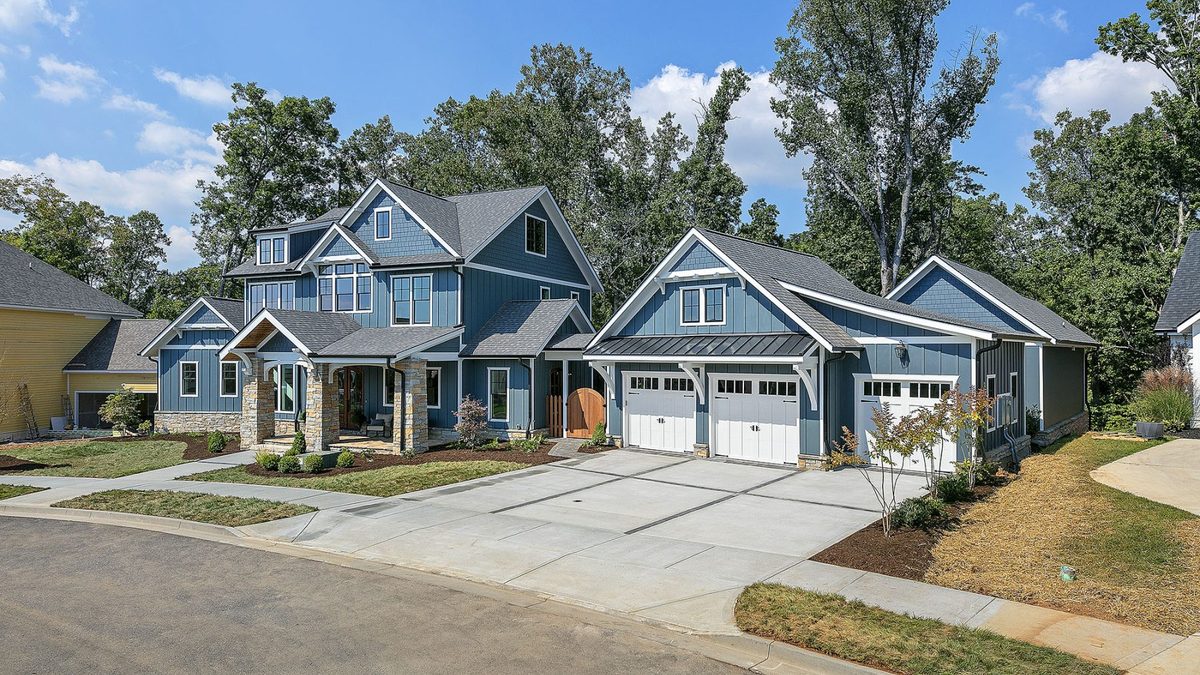
The placement of the two lots, at the back of the neighborhood with wooded area right behind, helped in this regard. It gave the team at C3 the opportunity to have the main house next to a three-car garage, connected by a breezeway. “We kind of angled the garage away from the house, angled with the street to be able to wrap the house and garage around that curb of the street to where it just all feels a little more natural,” says Jennifer Dawson Daley, who spearheaded the design with the Yorks at C3.
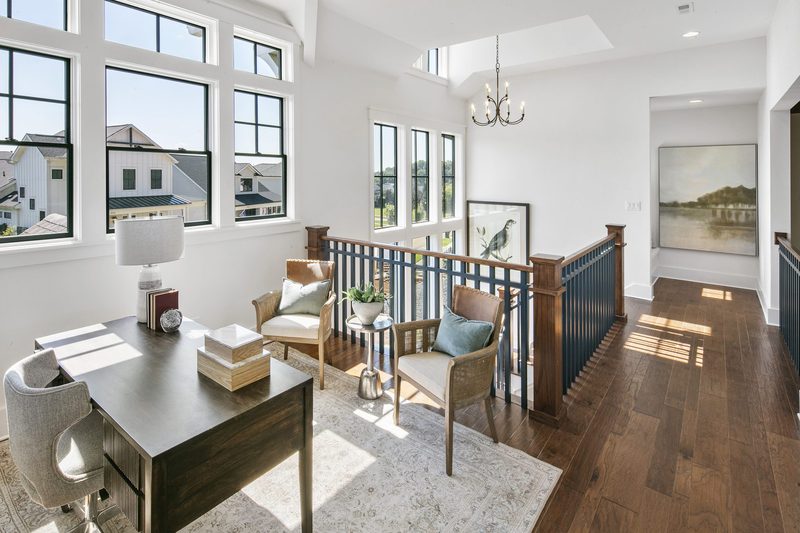
Standing at the front door and looking straight back, visitors to this home can look right through the dining room space and back porch and into the trees at the back of the lots. The ample windows, provided by Pella Windows—including stunning two-story windows next to the staircase at the front of the house—allow for the outdoors to flood inside. This openness is exactly what the Yorks were missing in their previous home.
“We wanted something that allowed the kids to roam free and explore with us while still keeping an eye on them,” Jonathan says. “So the open floor plan from the patio into the kitchen into the dining room and living room—and having essentially one big space—was really important to us.”
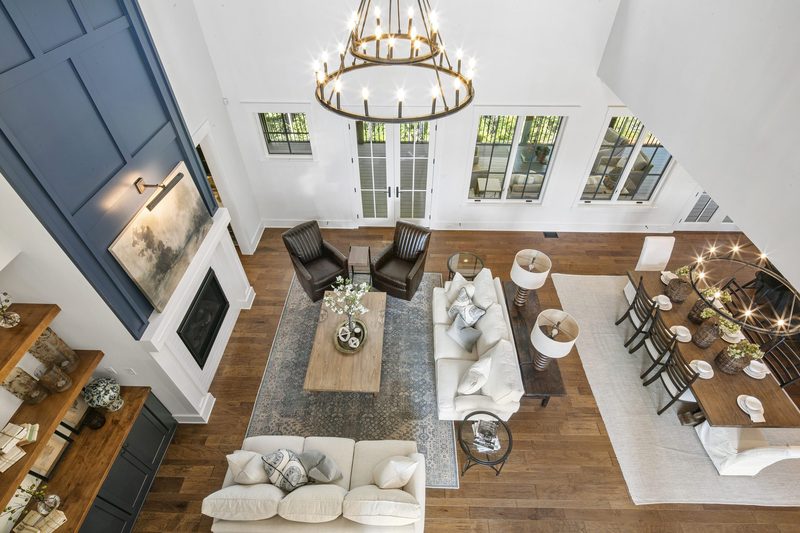
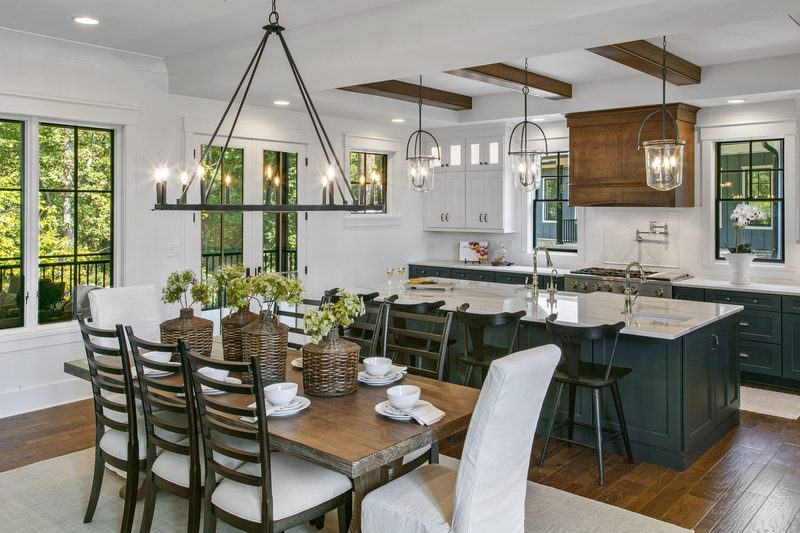
The blue siding on the home sets it apart from its neighbors. And calming blues—all variations from Sherwin Williams—carry guests into and all throughout the home. Venturing into the great room, a two-story blue fireplace draws the eyes upward to meet the tongue and groove ceiling, two-tiered iron chandelier, and solid reclaimed beams above.
The warm connections between blue and white coupled with the wood of the beams above and flooring—provided by Broadway Carpets—below make guests feel right at home. A wet bar off the main great room allows for extra options when entertaining.
The great room connects openly to the main dining space with a similar single-tier chandelier and a rustic wooden dining table. This space then continues seamlessly into the kitchen, separated by a long kitchen island with a Calacatta Hera quartz countertop, provided by Maryville Top Shop. Above, three pendant lights hang. The space makes entertaining look breezy and effortless.
Inside the kitchen, a combo “Bleu and Sable” colored lower cabinets, also from Maryville Top Shop, are coupled with white upper cabinets. The wood continues to make its place in the main level with a wooden range hood and smaller beams on the kitchen ceiling. GE Monogram appliances from Friedmans Appliances—including a gas range and double oven—make this kitchen a cooking-lovers dream.
Windows above the Montauk quartz countertops and sink peak out to the guest house outside. Meanwhile, a covered deck, runs the length of this entire open space, providing options for family breakfasts, entertaining dinner guests, and morning coffee chats.
Space for Family
Today, the York kids are one-and-a-half (Ryelynn) and four-and-a-half (Eli). But having a baby during the pandemic meant family was over more and more. Erica had also brought her dog grooming business back home at the same time. To top it off, everyone was spending more time than ever in their house—for schooling included—and so this need for additional unique areas to live, work, and play kept coming up.
“We kept realizing that we just need more space, and that’s really where the emphasis of the guest house came from,” Jonathan says. Having the flexibility and space for someone to come help during times of need—or simply to visit—and be able to stay right on their property was important.
“It’s a very private space connected with a walkway from a three-car garage so somebody could live there and have their own parking and go to their house and not have to walk through the main body of the house, and that’s a pretty important element,” Stevens says. The guest house is accessible with minimal steps and wider doors.
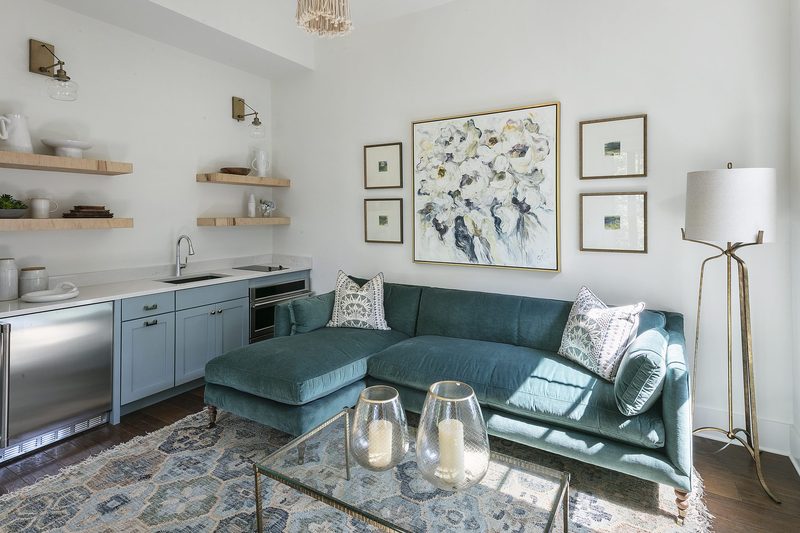
Hues of blue carry into the guest house which features an open space with a kitchenette and separate bedroom. “With the guest house we wanted it to feel like an escape,” says Michelle Haney, Selections Coordinator with Mike Stevens Homes. “The homeowner wanted a bohemian feel.” The guest house can easily transform into whatever the Yorks need at each stage of their life, including as an at-home pet grooming space for Erica’s business.
Venturing outside is an uncovered raised deck between the house and garage to be used for additional entertaining. The topography of the lot allows for the anticipated creation of tiered gardens for the family to grow their own food, something that was additionally important to the Yorks. “My son loves helping me with gardening,” Jonathan says. “That’s something that we definitely want to move forward with.” This, coupled with a future fire pit and possible tree house—shown on the original house plans—will complete the outdoor space.
Back inside, a mudroom makes this home truly for family, with a custom light-blue boot bench, hooks for jackets, cabinets to store extra outdoor wear, and a subway tile shower making hosing off the family dog a more simple endeavor.
Stay and Play
What you won’t find in the home is a traditional office with a closed door. Jonathan’s work life is a hectic one, and it was important to him to not have that type of space in their new family-oriented home. “Some people found that aghast—my parents were shocked—but that was something that just didn’t matter to us,” he says. But what you will alternatively find in this home are spaces designed to feed the body and mind.
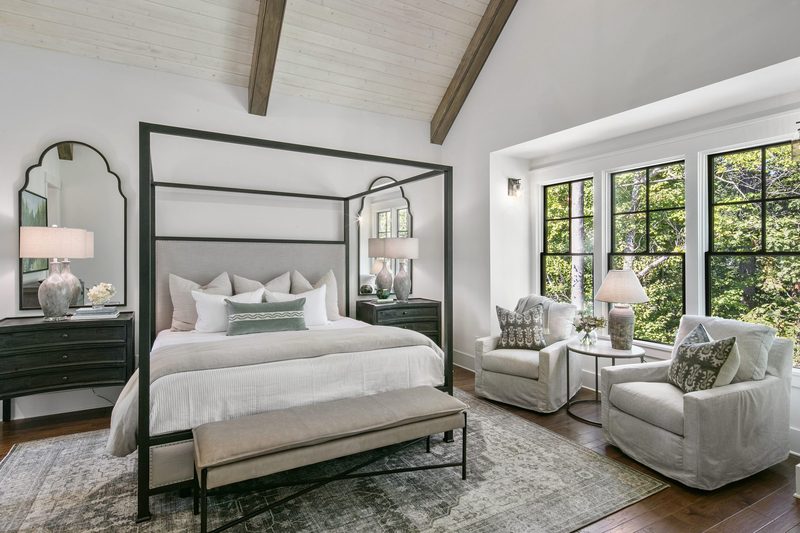
The master bedroom features three large windows overlooking the woods out back as wooden beams outline the peak of its vaulted ceiling. Inside the master bathroom is a large tile shower—tiled by Broadway Carpets, his and hers vanities, and a tub that drips with relaxation and serenity.
The kids bedrooms, which will inevitably change as they do, for now feature simple setups that don’t overwhelm the tiny residents who call them home. “The Yorks wanted bedrooms upstairs for the kids to be decent-sized, but not so big that they spent all of their time in their bedrooms,” Daley says.
Space outside of their bedrooms can transition with the family but eventually could house a homework or TV area, encouraging the kids to interact. The laundry room has a shoot from the upper floor making even cleaning up a fun and exciting endeavor for them as they grow older.
Finally, the basement houses a large gym space for the family’s CrossFit equipment, and due to the topography of the lot, the basement walks out to the backyard.
All of these spaces, coupled with furniture and accent selections from OP Jenkins, come together to create the York Sanctuary, a place the family is excited to call home in the next chapter of their lives. And the Yorks are thankful to have had a team to help them create their vision.
“They just did such a wonderful job of really incorporating our desires and wishes and in building this absolute dream home,” Jonathan says of working with Stevens and C3. “If you’d asked me to sketch it out, I would not have drawn this, but somehow it meets everything that I would have ever wanted, and it’s just been incredible.”
A More Public Introduction
The Yorks’ introduction to their new home was anything but ordinary. As a Southern Living showcase home, the public was invited to take a walkthrough of their home throughout weekends during the month of October to talk to the vendors, Stevens, and Huddy.
And while letting the public view your home before you’ve even arrived is not the norm, it hasn’t taken away from the feeling each and every party has felt about the final result.
“The house square footage overall is a little over 5,000-square-feet, and gosh there’s tons of homes that have a whole lot more square footage, but what Mike and C3 were able to do is just maximize usage in terms of what we enjoy and really focus on making the most out of every square foot,” Jonathan says. “The product is absolutely beautiful. We’re blown away by it.”
The process to creating this home seemed like any other, but with the right combination of builders and designers, this collaboration created something far from the norm.
“This is somebody’s house,” Stevens says. “It’s their dream.”
→ Swipe for Next Story
Non-ProfitSEPTEMBER OCTOBER 2021
Healing & Hope
Wears Valley Ranch provides a safe space for children to grow
Story by Rebecca Whalen
East Tennessee Pastor Jim Wood began his work serving others when he was just 15. At the time, Wood lived in North Carolina and the state-run Juvenile Evaluation Center (part of the juvenile justice system) was seeking volunteers to work with the children placed there. “My parents would drive me out there, and I would teach a Bible study for the kids,” he recalls. “During the week, sometimes I would go out and after school do some tutoring or just throw the Frisbee trying to build relationships.”
Wood enjoyed his volunteer work, but he was struck by the stories of two boys in particular who were bunked right next to one another at the facility. On one side of the nightstand was a 13-year-old, who, Wood found out, ended up at the center after turning himself in for killing his foster mother. Wood found out he had lived foster home to foster home and feared abandonment.
On the other side of the nightstand was an 11-year-old boy. The boy was sent to live with his grandmother whom he barely knew, Wood learned. Bullied at his new school, the boy stopped attending to instead hide in the woods near his grandmother’s home. When the grandmother found out, she told the truancy officer she didn’t want to care for him anymore, Wood says. The boy became a ward of the state, ending up in the same facility.
This boggled Wood’s mind. “I thought, this is just wrong. Why is this 11-year-old, who was simply afraid of an unsafe environment, being treated the same way as someone who killed his foster mother?” he pondered. So he asked the head of the facility: “Why is this 11-year-old not at the children’s home across the street?” Wood later found out that the children’s home had stacks of files on children who needed a safe space, but with only 50 beds, they simply didn’t have a spot for them.
“I had no idea that there were so many kids whose circumstances were such that they need a safe place,” Wood says. “There are countless children in every state who desperately need support outside of their family. It doesn’t mean they all need to go into foster care, it doesn’t mean they all need to go to a residential facility, but it does mean that they need more than they’re able to get at home.” This would soon become Wood’s calling.
This laid the groundwork for Wood’s life work. And when he met his wife, Susan, in college and asked her if she ever felt called to do something, he was taken aback by how similar her response sounded: “Yes, I have felt for some years now that God wants me to have a children’s home someday.”
Less than a year later they were married. And while they talked about their calling for years, it wasn’t until 1991 that those dreams began to take shape. A group in Tennessee owned a roughly 100-acre piece of land in Sevierville and desired to give it to a ministry for children and families. The Woods applied for the land and, among the many applicants, were selected. This plot of land, nestled next to the Great Smoky Mountains National Park, was set to become the Wears Valley Ranch we know today.
It’s been 30 years since the organization’s founding, but the mission today remains as it always has, “to promote the spiritual, intellectual, social, and physical development of children in need of a stronger family support system, through Christ-centered home settings.”
At the end of 2020, Wood passed the Executive Director torch to his son, Clayton, who grew up on the ranch. “Over time, it became clear that it was going to be a good fit for me,” Clayton says. And with this committed duo leading the charge—Wood still remains a heavily-involved founder and pastor at the ranch—Wears Valley Ranch has touched the lives of hundreds of children who come from homes in crisis.
The children at Wears Valley Ranch come through private referral. Children from across the country apply and are accepted, but the organization puts a special focus on children right in East Tennessee.
And while many sadly arrive from homes where they may have been abused in some way or whose parents may have addictions, that isn’t always the case. “Sometimes it’s a conscientious parent who simply realizes, ‘We need help from the outside.’ And there aren’t any grandparents who were able to step up at this point,” Wood explains.
A friend or acquaintance might suggest Wears Valley to the family, knowing the ranch’s ability to help young people overcome trauma and crisis, while at the same time providing an exceptional education and preparation for the steps ahead. The family or guardian then reaches out to start the conversation.
While the average length of stay is just under two years, there are some children who have been at the ranch for more than a decade. “It’s based on the needs of the individual child,” Wood says.
Four residential homes are maintained on the property where the children live, two for boys and two for girls. And they don’t look like what you might think: the homes were built to look like a typical family house in a residential neighborhood. Everything was designed to ensure the kids living at the ranch felt at home in their space, not at an institution.
Inside each home is a married couple who spends five days a week living with, caring for, and supporting the children. Wood says his hope is to keep the tenure long for house parents, so as to ensure the children have time to connect and feel comfortable with those caring for them.
Two young adults assist the parents as mentors, “typically recent college grads looking to invest a year or two in ministry,” Wood says. “The kids have consistent authority figures in the home who are not just bossing them around, but are loving them and tutoring them in their schoolwork, and helping them learn how to have a wonderful time at recreation, and encourage one another instead of tearing each other down.”
The children attend the K-12 St. Andrew’s School onsite which employs a hybrid of teaching methods. Curriculum is tailored to each individual student upon admission and includes not only typical subjects, like math and language arts, but also life skills. In the summer time, the students participate in two hours of school work in the morning and also attend the nonprofit’s camp for recreation time.
The program is more than home and school, however. A key component of the work at Wears Valley Ranch is in helping children heal from past traumas. A key component is therapy. “At the ranch, every single staff person and every single student is going to counseling,” says Clayton, adding that the often-typical stigma that surrounds counseling does not exist at the ranch. “It makes a big difference in the live of our kids; it also makes a big difference in the lives of our staff.”
Part of the therapeutic program is the ranch’s equine program, one that Clayton is particularly proud of. The students have the opportunity to groom, feed, and ride the horses at the ranch, teaching them critical skills that they can carry with them for the rest of their lives, such as confidence, responsibility, and caring for others. “We’re very pro-emotional care and counseling,” Clayton says, “and helping in a very intentional way deal with mental health.”
Funding for the organization comes exclusively from private sources. And there are always opportunities for volunteering. To learn more about how to get involved with Wears Valley Ranch and what’s to come for the ranch’s programming, visitwww.wvr.org.
→ Swipe for Next Story
FeatureSEPTEMBER OCTOBER 2021
The Magic of Tailwaters
Time on the Holston River with Fish Knoxville guide Gavin Greeley and High Adventure Company’ s John Burrell proves heaven can often be found right in your own backyard
Story by Nathan Sparks
There is a special beauty in watching an accomplished fly fisherman, the flawless rhythm of each cast creating a perfect loop in the line as the fly is delivered to the fish about a foot above the water, falling softly to its destination below. There is a deep connection between the fisherman, the guide, and the fish, an intensity that renders even a summer rainstorm falling overhead almost unnoticeable. The scene is so mesmerizing to watch that as John raised his rod to set the hook I could almost feel the weight of the smooth cork handle in my hand as his fish fought. Moments like these renew the spirit. Although there is joy in catching the fish yourself, there is equal joy in watching your friend land what just might be the fish of a lifetime.
This water is not new to me, per se, just this stretch of the river. As a young man, I spent countless hours on the South Fork of the Holston River, upstream from here and downriver of the large earthfill dam that embays South Holston Lake. During that time there was very little development and a lot of world-class trout fishing. Thinking back, the amount of time I spent on that river is not unlike the addiction that our youth have to electronics; I just couldn’t get enough. I wish with all my heart that our youth would get out on the water and experience this wonder. It truly is life-changing.
So consider yourself warned: once you experience the magic of tailwater trout fishing, you might find yourself not being able to get enough.
My last trip down that upper section of the river was with my father before he passed. Shortly after putting on, we rounded the bend into the Morrell deep hole, and at the far end I swore I saw an angel floating over the water holding a fly rod, a white glow all around her. Wanting to be sure I wasn’t losing my mind, I said, “Hey Dad, do you see that down at the far end of the pool?” He sat there for a minute, I suspect as puzzled as I was. As we soon found out, it was not the goddess of tailwater trout we were witnessing, but rather a bride in her wedding dress standing in the front of a drift boat, casting away. Dad looked back at me and said, “You don’t see that every day!”
What a wonderful place to get married if you are as in love with fly fishing as you are with your new partner. On the riverbank beside the bride was a beautiful statue of a jumping trout next to a gazebo and casting platform. Rumor has it the property is owned by Warren Buffet. Who knows for sure, but if true he is not the only celebrity to adorn the banks of the river. Actor Brad Pitt also owns land along this tailwater. It is undoubtedly one of the Southeast’s great fisheries for trout.
Back to present day. Despite my fondness for the South Holston River, I had never fished this section of the Holston below Cherokee dam. So, when friend John Burrell of The High Adventure Company called to discuss putting together a trip, I was all in. As it so happened, friend and photographer Jimmy Chiarella was in town. Jimmy is by far the best photographer I have ever known. A second boat would offer the opportunity to not only see John and my son, Troupe, fishing together, but also capture some world-class art.
Everything was set except the guide. That’s where Gavin Greeley of Fish Knoxville came in. Gavin is a story all to himself. He moved from California to Montana at 16 years old, headed down to the local outfitter, and announced he wanted to be a guide. I suppose the owner wasn’t sure so he issued a challenge to the young man: fish 60 hours a week for six months, write down every fish you catch, where you caught them, and on what fly, and then come back and we will talk. For Gavin, it was game on. Six months later he walked back in with his journals and confidently announced he wanted the first trip of the day. Since then, Gavin has guided in six states. He became one of the youngest head guides in the history of Vail Valley. The rest, as they say, is history.
His company, Fish Knoxville, which Chris Goodwin started back in 2002, is the only charter company I am aware of that targets all 13 species of fish on any of the area waters, from brook trout in the Great Smoky Mountains to giant 40-pound stripers on Watts Bar Lake in Kingston. With 16 years of experience, Gavin knows where the fish are.
My son Troupe didn’t need any encouragement as he gathered up our gear. We were off for what would turn out to be a memorable adventure. One of the great things about tailwater fishing in the summertime is the cool temperature of the water, a result of the waters coming from the bottom of the lakes. At times, a low fog will rise, swirling with the current, creating an ethereal beauty.
Just upstream of the first small riffle, John hooked on to a nice rainbow and the day was in full motion. From that point on, we were on fish for hours, so consistently that we forgot lunch till late in the day. This section of the Holston has great trout on the first half and good smallmouth bass on the second half. Targeting multiple species on a single trip makes for a heck of time, but add on friends who are exceptional sportsmen, and there’s nothing like it.
Fishing with Gavin in particular proved to be quite the adventure, and day two on the river proved that well. By mid-morning he had figured out the pattern, and we were catching both rainbows and browns on dry flies for the second day. What a blast! It wasn’t until late in day two as we rowed through a deep slow pool that his fish sense kicked in. Gavin was suddenly pulling heavily on the oars to propel us upstream saying he had seen a sturgeon. Sure enough, there it was, visible through the clear water about 10 feet down. It was a big fish, clearly more than 48 inches in length. We worked around the pool, and although we didn’t catch that one I did land one about 36 inches long and got a nice photo before the release.
What a great experience, working with Jimmy to photograph my son with two world-class guides on day one and seeing dry fly action and catching a sturgeon on day two.
If you are interested in learning about trout fishing and would like to hire a guide, check out the resources on our website. I can heartily endorse both of these men as experts in the field of hunting and fishing adventures of any type you care to choose, and sometimes those adventures can be right in your backyard.
→ Swipe for Next Story
FeatureSEPTEMBER OCTOBER 2021
Atomic Juniors on the Rise
Young East Tennessee rowers gain life lessons and camaraderie in a demanding and rewarding program
Story by N. Brooks Clark
Each afternoon at the boathouse of the Oak Ridge Rowing Association on Melton Hill Lake, around 80 high school boys and girls arrive for practice. They lift their boats—singles, doubles, quads, fours, and eights—from their racks, walk them to the docks, and place them gingerly in the water. They secure their oars in oarlocks, and, on their coxswain’s call, extend their oars, put one foot in the boat, sit, strap their feet into their stretchers, and head out for practice. Coach John “JD” Davis and his assistant coaches ride along in their green bass-boat launches, talking through megaphones.
This is the Atomic Juniors program at ORRA, made up of students from 14 area high schools and a sampling of middle schools. During a typical fall practice, the crews row more than 10,000 meters upriver and back. Other days they row downriver. The coach isn’t in the boat with the rowers in this sport; rowers rely on each other. “It builds strong bonds of friendship and habits of hard work, cooperation, and community,” Davis says. “When the boat reaches its potential, we call it ‘swing.’ When a crew finds a way to truly swing together, it’s a thrilling experience and a beautiful thing to see.”
And the athletes participating give their all. “I love rowing due to its nature of being a very grit-based sport,” says 15-year-old Maxwell Garza. “Meaning that people that truly try their hardest will exceed… It is also the only sport that whatever you put into it, you will get out of.”
Katherine Braman, a 16-year-old in the program, agrees. “There is an intrinsic satisfaction that comes from knowing that I have given every possible effort to the workout, practice, or race. I go home after rowing so happy. I enjoy seeing each of my teammates put in 110 percent of our own ability for each other.”
This is exactly what students in the Atomic program are known for. On this stretch of the Clinch River between Norris and Melton Hill dams—which ranks among the top five rowing venues in the nation—Garza, Braman, and their peers put in a level of work hard to imagine for such young athletes. But it pays off. The program competes among the top clubs in the country.
At the helm of this growing program is Davis. Tall and lanky with a face exuding wisdom, Davis would look right at home in a vintage film clip fromThe Boys in the Boat. Sometimes gruff while coaching, he can just as quickly break into a wide Californian smile. He knows what it takes to compete at the highest levels.
After rowing for University of California, Irvine, in the early 70s, Davis won national titles and came close to making the national and Olympic teams. In his 12 years coaching the Stanford women, their varsity eight finished in the top five times and nine oarswomen became national or Olympic athletes. In Palo Alto, he met and married Wendy Davis, who head coached Stanford, Yale, and Minnesota, where Davis coached the Minneapolis Rowing Club for 15 years. In 2019, Wendy became a Lady Vols assistant coach, which brought Davis to Oak Ridge.
With this sort of experience at the helm, it’s no wonder students go on to row in some of the best programs in the country. This summer, seniors Kailey Bostick (L&N STEM Academy) and April Chism (Webb) attended the USRowing Olympic Development Camp in Florida. Their peers join programs this fall at Duke and Marist (Noelle and Charlotte Fuchs, respectively, of Webb), Temple University (Gracie Dulin of Maryville), and Jacksonville, Florida University (Adam Calder of William Blount High School). Atomic alumni currently row for Clemson, Coast Guard, Navy, North Carolina, Stanford, Stetson, and the University of Tennessee.
This year, 26 Atomic rowers journeyed to the USRowing Youth National Regatta in Sarasota, Florida. A men’s four and a women’s four did especially well, the women finishing in the top eight nationally. “That was my favorite moment,” says coxswain Lauren Peters, a Bearden High sophomore. “We had worked hard all season long, and we ended up eighth in the nation.”
Lauren took up rowing in sixth grade after her brother, Dalton, had. “He loved it, and it is such a beautiful sport,” she says. For Dalton, it was the intensity of the sport that drew him in. “I figured that if I joined a rowing team I would become strong and stay in shape,” he says, adding that obtaining the win is the most enticing part. And he knows from experience. Dalton won a national sprint competition in Chicago this summer, in both a single and a double with teammate Jacob Trump. “We were both tired from previous races, but we ended up getting the win by three milliseconds.”
This summer, Lauren was one of 80 under-19 women—seven of them coxswains—who attended the USA Junior National Team Selection Camp in Chula Vista, California. After weeks of tryouts, she was selected to cox the US National U19 women’s eight, which competed and took first place at the World Rowing Federation’s Junior World Championships in Plovdiv, Bulgaria, in August.
“Lauren Peters, at age 16, is as good as any coxswain I’ve ever had while coaching college,” Davis says, “and she just keeps getting better. Her role is so complex: race leader, boat steerer, motivator, and a hundred other things all at once. Most importantly, the coxswain’s job is to be the voice in the rowers’ minds that says they can give more when the voice in their body says they can’t.”
The Atomic program is open to students aged 12 to 18. To learn more, visitwww.atomicrowing.com.
→ Swipe for Next Story
FeatureSEPTEMBER OCTOBER 2021
Real Estate Identity Theft
How fraudsters are swindling homeowners and how you can protect yourself
Story by Rebecca Whalen
It’s a typical weekday in Knoxville and a woman, we’ll call her Amy, (not her real name) answers an unexpected call from an unknown number. The caller announces they are a representing a local lending institution, calling to inform Amy that she is delinquent and foreclosure proceedings are being instigated due to nonpayment. Amy calmly replies that the caller must have the wrong number, “My mortgage is with another company, and it’s perfectly current.” The caller acknowledges, “Yes, we are aware of your first mortgage, but we are the second mortgage holder, and that loan is severely in default.” Amy replies that there must be a mistake.
As Amy would soon find out, the calls were coming for a reason: she was a victim of real estate-related identity theft.
It sounds like a nightmare, nothing any of us would like to experience. But the scenario above? It’s a true one that was shared by a local mortgage broker. He experienced multiple cases of attempted fraud involving real estate during his 20-plus years in the industry. And when he shared the above story, I knew I wanted to learn more and find out how we can protect ourselves from this form of fraud.
An Unheard of Attempt at Theft
About six months prior to Amy’s call, the parties associated with the nonpayment issue above sat around a closing table ready for a refinance: the title company’s closing agent, the mortgage broker, and the borrowers, Amy and Frank (again, names have been changed).
The HUD-1 closing statement was reviewed and signed, as was the promissory note and associated documents. “The Deed of Trust was presented, and the closing agent asked for proper identification in order to notarize the instrument,” the broker recalls. “The woman dug through her purse for what seemed an eternity until her face began to flush.”
“Oh no,” the woman emotionally exclaimed, “I have left my ID in my other purse. I will run home and get it.” The title agent inquired about how long it would take. “I should be back in 2 hours,” she replied. The thought of staying at the office until 7:30 p.m. or 8:00 p.m. on a Friday night led the closing agent to allow the Deed of Trust to be signed, the broker says, with the promise from the woman that she would bring her identification to the disbursement after the mandatory three-day rescission period. She is told that it must be presented prior to the disbursement. All parties agreed that this was a good and helpful plan.
Three business days passed and she returned, but the closing agent’s assistant wasn’t aware of the deal, and disbursed the funds. But there’s one important detail missing here. “This woman was not Amy,” the broker says they eventually found out. “She was Frank’s mistress and accomplice, and the two were attempting to steal the equity from the family home and flee to another state.”
When the real Amy eventually found this out after receiving that fateful call, she called her attorney. She had her suspicions that her husband was having an affair, but she never dreamed he would take out a loan on their home and then run off with another woman.
Tenancy by the Entireties
In the story the mortgage broker described, Amy owned the home with Frank infee simple, the “highest and most complete form of real property ownership,” according to the American Bar Association. More specifically, they owned the home in a fee simple form calledtenancy by the entireties. Cornell Law School’s Law Information Institute explains that this form of shared ownership of property is only available to married couples where both spouses have “undivided interest in the property.”
What this means is that neither one of them can act alone in placing a loan on the property, hence why Frank needed a “stand-in” for Amy at the refinancing proceedings. It was a complicated mess for sure. The new second mortgage holder would not have been able to get Amy or her kids out of the home. Since Amy was not part of that refinancing effort, the new lender would have eventually found out that they had not properly perfected the lien.
But it doesn’t mean it never harmed her. “Amy likely had difficulty selling or refinancing in the future,” the broker says. Needless to say the lawsuit no doubt took time and money to unravel this fraud attempt.
Is Your Property Safe?
So what does this story really show us? Basically, that real estate identity theft is alive and well in the world. And there are things to keep an eye on as a homeowner to ensure you don’t fall victim to it.
For Amy, her identity was forged by someone she knew, but that is often not the case. Today, so much of what we do throughout the process of purchasing a home, including essential paperwork, is done online. And as we all know, that is not without its risks. According to the Federal Trade Commission, the top cyber crime reported by victims last year was phishing, the process by which a fraudster pretends to be a reputable individual or company with the intention of gaining personal information about another.
Once this sensitive information is collected, these individuals can then turn around and use your stolen identity to attempt to sell your property, despite the fact it doesn’t belong to them. They could also use your identity to secure loans using your equity lines. And if you are a homeowner who has more than one property or one that is free and clear, there’s more of a chance for you to be the target of this.
Although nothing is better than having your home paid for, experts say it might be a good idea to keep a home equity line of credit (HELOC) so there is a cloud on the title to discourage fraudsters. The Consumer Financial Protection Bureau explains that this line of credit basically allows you to borrow against your home equity. But the real benefit here is having an active lien on your property making it harder for someone to try to take advantage of you.
Also, if you are the person buying a home, realtors will advise you to always use a title company and purchase title insurance. If the person you are buying from doesn’t actually own the property, or there is an unexpected lien, then the title company will undoubtedly make you aware of that.
Local Safeguards
Although we refer to a loan on real estate as a mortgage, Tennessee actually has promissory notes secured by Deeds of Trust. Is it possible for someone else to record a deed of trust on your property? It is unlikely, but possible. The registrar of deeds relies on a properly executed and notarized document. And title searchers rely on the recorded history of legal instruments on your property.
Nick McBride, Knox County Registrar of Deeds, is strictly regulated as to what he can accept and deny in the way of instruments to record. “If it meets the statutory requirements, we have to record it, even if it seems suspect,” he says. But he continues, “My staff and myself have been highly trained to be on the lookout for this type of malfeasance, and we alert the proper authorities and the property owner anytime we have suspicions.”
Bottom line is the burden still lies on the property owner, but McBride assures us, that to his knowledge, this type of problem has yet to reach Knox County.
Being Prepared
As referred to in our last issue, considering a trust could be one way to keep your equity safe, as it might be more complicated for someone to forge the required documents like the memorandum of trust or a copy of a complete trust. And that trust also protects you personally from creditors and even the IRS.
Again, a simple HELOC would be better than nothing. But if nothing else, you can simply take the time to pay a visit to the Register of Deed’s office every now and then to ensure your home information has remained unchanged.
→ Swipe for Next Story
FeatureSEPTEMBER OCTOBER 2021
Painting With Water
John Adams builds magic into outdoor aquascapes
Story by Susan Alexander
His palette consists of browns and golds, aquas and blues, grays from charcoal to ash, and every shade of green. His medium is what the Earth provides: rocks, water, plants, trees, fish, frogs, and turtles. His canvas ranges from a backyard garden to an outdoor mall to the flamingo exhibit at Chicago’s Lincoln Park Zoo. His passion? Building people the spaces they love the best.
A native Michigander, John Adams grew up on the lakes there and developed a love for fish and aquariums. His first job after moving to Knoxville was at an aquarium store in West Knoxville. He started his own landscaping company in 1994.
Little could Adams imagine the path before him when he built his first water feature in his mom’s front yard. “She lived on the lake in Louisville, and I noticed a beautiful rock formation in the yard. So I started hand-digging out between the stones, and I made my first waterfall. It was the hardest thing I’ve ever built,” he recalls, “but I was hooked. That was it for me.”Photography byJimmy Chiarella
Serendipitously, after creating that waterfall, Adams received a catalog in the mail from Aquascape, a major supplier of pond products in Chicago. The company offered guidance for building a successful water feature business. He attended one of its seminars in Nashville in 2000 and got to know the team, including owner and CEO Greg Wittstock. He worked with them on several projects, including a native fish habitat at the Shedd Aquarium and that flamingo exhibit at the Lincoln Park Zoo. “The flamingo pond was about 80 years old, and we built a natural ecosystem filter, with waterfalls, to help improve the circulation and filtration in the pond, so it could digest its own organic matter,” he says. “That was very rewarding—and one of the nastiest projects I’ve ever been on, too. I threw my boots in the garbage after that.”
The opportunities to learn from the Aquascape team often came without pay. “I’d see an opportunity and chase it,” he says. “For at least five years, I’d just go—sometimes I paid to be a part of a project with amazing artists. We’ve built rainwater systems in Africa. We built a spider monkey habitat in Gulf Shores and a water feature for Peter Pritchard, who’s a leading authority on turtles and tortoises. We built waterfalls and a pond in an open-air mall in Central America. On our days off, we’d hike the mountains. It’s been a never-ending journey of awesomeness.”
As he learned and his Knoxville company, Modern Design Aquascaping, grew, he posted content on his company’s YouTube channel; he finds that to be a big driver for opportunities for work. He also earned Artist of the Year accolades from Aquascape, which led to more referrals. He’s currently overseeing the construction of a massive recreation pond for a homeowner in Denver that he estimates will take two months to construct and cost about $1.5 million. Meanwhile, two of his three sons, Nicholas and Tristan, manage the work closer to home.Photography byJimmy Chiarella
Photography byNathan Sparks
Like other artists, Adams can envision what he will create at any given job site. “I can feel it, I can see it in my head,” he says. “I’ve spent so much time outside looking at nature, and I’ve seen so many beautiful places, I can just envision what fits there. If I do a design on paper, it will never look exactly like the final outcome. It depends on the rocks we get and the way the hills dig out. You just have to let it happen.
“It’s all about a client and getting inside their head—what’s important to them. Once I know where their heart is, I can design anything for anyone. And they have to trust me to do it.”
Adams was preparing to tackle a project near and dear to his own heart—a backyard swimming pond at the home he and wife Stacy share in Friendsville for their kids and seven grandkids to enjoy. “We’re creating an oasis at our house, a spot where all of our family will want to be all of the time,” he says. “I’m super excited about that. It will be a really good opportunity to create video content for our YouTube channel. Swim ponds are all the rage these days. There will be frogs, there will be fish and turtles, and we’ll use natural biological filters to create a true habitat. I want to teach the kids you don’t have to kill your water and poison it with chlorine to swim.”
Adams shares his gospel of green habitats and his knowledge of construction on not only YouTube, but also his website,www.mdaquascaping.com, and on his job sites. “When we built a water feature for Shaquille O’Neal, we met a 14-year-old boy in the neighborhood and motivated him to start building a pond in his yard,” he says.“Now he’s working on one for his neighbors. He’s found a career path that’s rewarding.”
“We build people their favorite places,” Adams says. “That’s what we do. It’s where their kids will get married…” He pauses as he reins in his emotions. “We create the magical places where people spend time with the people they love.”
→ Swipe for Next Story
FeatureSEPTEMBER OCTOBER 2021
Stopping the Stigma
Mental health care services are vital to our community’s wellness
Story by Glenn Jacobs
My childhood dream was always to play professional sports. This aspiration was no passing fancy. It defined who I was, and I couldn’t imagine a life that did not center around athletic competition.
As I stepped off a bus at the Chicago Bears practice facility in spring 1991, that dream neared reality. But within minutes, it was snatched away from me. Instead of following the rest of my fellow rookies to the fieldhouse where we would don pads and practice jerseys and head out to the field to show the coaches what we had, I was escorted to the director of player personnel’s office. There I was informed that the knee injury I had suffered months prior prevented me from playing for the Bears. I was handed a plane ticket and sent home.
I was devastated and humiliated. Not only had I failed to achieve a lifelong goal, but I had also done so—at least in my mind—publicly with the whole world watching, or at the very least, everyone who was important to me. For weeks, my only comfort was found in closing my bedroom door, shutting out the world, and immersing my mind in a destructive cycle of thoughts that drove me deeper into depression. While I feel grateful to have come out the other side, I will never forget that feeling of hopelessness. Emotions spilled beyond my control, and I realized that mental health challenges can strike anyone, regardless of how strong we think we might be.
Here in Knox County, one in five people were in need of mental health care before the COVID-19 pandemic began. That rate has doubled since then, says Ben Harrington, CEO of the Mental Health Association of East Tennessee. Common problems include anxiety disorders, major depression, phobias, and bipolar disorder. And these can often lead to or become coupled with other challenges, making those suffering in further need of care and assistance.
According to the National Institute on Drug Abuse, about 25 percent of people with a serious mental illness also suffer with a substance misuse disorder. Mental health challenges are also often tied to suicide, with research finding that almost half of suicide victims had a known mental health condition, according to the National Alliance on Mental Illness. Suicide is now the tenth leading cause of death in Knox County and on the rise across the state, particularly among ages 10 to 24. In 2017, more than one-third of Knox County high school students reported experiencing a depressive episode during the previous year. In 2018, almost 20 percent of middle school students had seriously thought about committing suicide; 6.3 percent attempted to end their life.
This is a heartbreaking reality; our most vulnerable populations are being seriously impacted by their mental health. For years, society has stigmatized mental health, preferring to ignore the problem and the people suffering rather than to face it head-on. Fortunately, that attitude is changing. The State of Tennessee provides an array of services and support for individuals suffering with mental health issues. These include not only crisis services and suicide prevention, but long-term assistance like peer recovery services, housing services, and employment support. Locally, several providers specialize in mental health services. These include the McNabb Center and Cherokee Health Systems, among others. Our hospital providers—the University of Tennessee Medical Center, Covenant Health, and Tennova Healthcare—are also on hand to help. This is good news. Knox County has more mental health providers than most Tennessee counties.
And yet our residents are still facing barriers to receiving the help they need. Services continue to remain inaccessible to low-income populations. And since losing the state-run Lakeshore Mental Health Institute in 2012 and the closure of the Physicians Regional Medical Center, the number of staffed inpatient psychiatric care beds has dropped more than 90 percent—from 189 in 2010 to merely 16 in 2019.
Knox County and the City of Knoxville are working together to establish a new psychiatric facility at the former St. Mary’s Hospital campus in North Knoxville. The facility would be run by the McNabb Center and provide additional beds for folks without private insurance. The goal is not only to increase the number of psychiatric beds in the area, but hopefully act as a diversion away from incarceration for folks suffering a mental health crisis. It is slated to open in 2022.
As we work from the public sector, some of the county’s private health providers are also working in this realm through the 2022-slated openings of East Tennessee Behavioral Health (Covenant Health) and the Knoxville Center for Behavioral Medicine (a partnership of National HealthCare Corporation, Tennova, UT Medical Center, and Reliant Healthcare Corporation).
Knox County is soon bringing efforts together by hosting a regional summit to discuss mental health services with providers, regional elected officials, and other stakeholders. Our goal is to identify further the needs and gaps and work together to leverage the assets that each organization brings to the table. It seems we are all recognizing the needs existing in our community and are working to continue destigmatizing mental health and create usable resources to ensure the needs of those two in every five people are met.
Our mental health is vital, and we ignore it at our own risk. I know from my own experience that mental health issues do not discriminate. It can truly happen to anyone. But I also know that with the proper help and resources, there is hope for those impacted.
———–
September is National Suicide Prevention Awareness Month. If you or someone you know is struggling with suicidal thoughts, please call the National Suicide Prevention Hotline at 1-800-273-8255 or text HOME to 741-741.
→ Swipe for Next Story
VeteranSEPTEMBER OCTOBER 2021
“Fight’s On”
Kevin Thompson’s 30-year Air Force career lifted him from Knoxville to the Pentagon and back home again
Story by Phil Newman
In 1981, when the Cold War was at its peak and Ronald Reagan had just begun his presidency, north Knoxville native and Central High alum Kevin Thompson received his commission into the US Air Force Academy through the ROTC program at the University of Tennessee in Knoxville.
Thompson, an electrical engineering major, had no inkling that his nascent journey through the military would span three eventful decades, propel him from Tennessee to Kansas to Georgia to the deserts of Qatar and Kuwait, be shaped by a shocking terrorist attack on his nation, and eventually lead him to a leadership role within the most hallowed corridors of American military might: the Pentagon.
In that colossal, labyrinthine epicenter of strategic defense, then-Col. Thompson would work alongside four-star generals who served on the Joint Chiefs of Staff—the men whose uniform medals glisten as they take their seats in the first few rows during the president’s State of the Union address.
“It’s quite a thing to see the generals you know and work with on national TV,” says Thompson, whose odyssey has come full circle since he moved from Washington, DC, back to his beloved Knoxville in 2019 and settled into a home in the Seymour area.
What Thompson doesn’t mention during an hour-long conversation on a late-summer afternoon is just how lofty his own military accolades have been. Like many fellow veterans, he exudes just-doing-my-job humility and expresses surprise that anyone would be interested in his story.
“The sense of supporting a higher purpose, if you will, is what felt rewarding to me,” he says of his 30 years in the Air Force. “It’s about something bigger than yourself, something more than just making a living. There was a real sense of honor associated with the service.”
Perhaps it is that perspective that equipped Thompson to end up leading thousands of soldiers and civilians while having the ear of those who were mapping and carrying out America’s defense efforts across the globe.
Thompson didn’t anticipate the decorated military career he has enjoyed, even though he was surrounded by veterans as he grew up in the Norwood Heights neighborhood of Knoxville, off Merchant Drive.
“Both of my grandfathers had served,” he recalls, “my mother’s father in World War I, and my dad’s father in World War II. All my uncles and my dad had served. Dad went through ROTC and was a navigator, and he stayed in the guard for a while. I did feel a calling, in that respect, to carry on the family tradition.”
Yet Thompson wasn’t planning to follow in their footsteps until the end of his sophomore year at UT. “I was offered an ROTC scholarship, and I got to go to summer camp for six weeks at McConnell Air Force Base in Kansas. It opened my eyes.” That short, powerful experience hooked him, and his career path became clear.
Whatever dreams Thompson had of becoming a pilot had been dashed at birth: he was born with vision problems and was colorblind. “They wouldn’t let me near an airplane without a boarding pass,” he says.
After graduating from UT, he began his four-year commitment at Robins Air Force Base near Macon, Georgia, putting his engineering skills to use. “I helped maintain the depot the Air Force has had there for years, and it’s still there,” he says.
His projects were varied: avionics on the branch’s Special Operations aircraft, systems for the Lockheed AC-130 gunship transport aircraft, modifying Bell UH-1 Iroquois “Huey” helicopters to help with drug interdiction in the Caribbean, doing “wet-fire” exercises at night at Eglin Air Force Base on the Florida panhandle, and more.
After serving his four years, he entered civilian life, working on avionics for defense contractors first in Atlanta and then in Huntsville, Alabama. In 1989, Thompson opted to join the Air National Guard. “I wanted to continue to serve,” he says. “I had enjoyed my time in the Air Force on active duty. At the time it seemed fairly straightforward: do this, get rewarded. It was all written out. The routine was familiar.”
His guard duty took him to the 241st Engineering Installation Squadron in Chattanooga, where he developed fixed-communications infrastructure—think fiber optics and radio towers. He moved back to Knoxville in 1990, and in 1994 went to work for Sea Ray Boats as director of environmental management, even as his guard activities advanced: he commanded the 241st and its 121 guardsmen from 1997 to 2001.
The September 11 attacks eventually spurred Thompson to return to active duty. He served as engineering team chief for the USAF’s 10th Civil Engineering Squadron. Based out of Shaw Air Force Base in South Carolina, his team was deployed to upgrade fiber optics, voice/data networks and command-control facilities at Al Udeid Air Base in Qatar, and at Ali Al Salem Air Base in Kuwait, 23 miles from the Iraqi border.
“I don’t think I would have considered going back had it not been for 9/11,” Thompson says. When the second plane hit the World Trade Center, “I said, ‘Fight’s on,’ and a lot of things are about to change. After 9/11, there was a greater sense of purpose. Before, you might work at bases overseas, and it was a good excuse to go to Germany to see the sights, but when you’re doing it in the middle of the desert and you know the reason why you’re there, it raises the stakes.”
Although Thompson’s work was behind the scenes, in rear areas and not in direct combat, he knew his team’s work made a difference. “You felt like you were contributing to the effort. Everybody had an important role to play.”
Looking back, “the work we did right after 9/11 at Ali Al Salem was the most meaningful to me. We have decommissioned more bases over there than you can shake a stick at, but that one’s still in operation. I’m proud to have had a little part in that.”
His wife, Sherrie—Thompson had wed the Oliver Springs native in 1995—noticed that when he was deployed, he seemed more purposeful. “You sound happier calling me from a war zone” than from Sea Ray, she told him. “Could you find a way to do this full-time again?”
“I think so,” Thompson replied, “but it would involve moving around a lot.”
“That would be okay,” she said—and the second phase of Thompson’s military career took flight.
After directing communications for the Tennessee Air National Guard for two years, he served as executive officer to the commander at Tyndall Air Force Base in Florida. He then returned to Knoxville as commandant of the Academy of Military Science at McGhee Tyson—“the shortest commute I ever had; I lived 15 minutes from the airport”—before a two-year stint at Scott Air Force Base in Illinois. Then, in 2006, it was on to Arlington, Virginia, to serve as director of staff at Air National Guard headquarters, followed by two years as vice commander of the Air National Guard Readiness Center at Joint Base Andrews Air Base in Prince George’s County, Maryland. There, Thompson led 1,000 staff members whose work steered $9 billion in resources to guard units nationwide. His work directly affected some 10,000 guard members on active duty.
It was during these years that Thompson spent time in the Pentagon working closely with some of America’s top military leaders, including Gen. Craig McKinley, then chief of the National Guard Bureau and a member of the Joint Chiefs of Staff (he retired in 2012); and Gen. Joseph Lengyel, who later served as chief of the same bureau until September 2020.
“I liked working in the Pentagon,” says Thompson, who alternated time between that facility and Joint Base Andrews Air Base in Maryland. He was vice commander of the Air National Guard Readiness Center from 2007 to 2009, then deputy chief of Net Centric Capabilities for the Chairman of the Joint Chiefs until 2010.
Reflecting on the lofty heights he reached, Thompson says, “I was blessed to be able to work with some of the greatest people I know, including guys who retired as four-star generals. The quality of the people and how hard everybody worked always impressed me.”
In December 2011—30 years after the fresh-faced Tennessee grad was commissioned into the Air Force—Thompson retired as a Colonel, but his work remained related to the military. He joined CenturyLink (now Lumen Technologies) supporting defense-information systems, still in the Washington area.
“Our daughter was a sophomore in high school in 2011, and we didn’t want to move her,” he says. By 2018, Thompson began work in defense-industry sales for Oracle, which gave him the option to locate his office anywhere he chose. The answer was obvious.
“I said to Sherrie, ‘Let’s get out of here and get back to Knoxville.’ I was tired of living on top of each other with a million of your closest friends in northern Virginia.”
They moved to Knoxville in October 2019 and settled in Seymour. The move afforded Thompson an opportunity to focus on what matters most. He was able to spend time with his mother, who would pass away in 2020, and his father, who is in memory care in Maryville. “It was very nice to be home, to be able to be here with my parents. And we’re just really happy to be back where people sound like us,” he says.
Thompson appreciates the warmth toward veterans that he has experienced in and around Knoxville. “I’ve never lived any place where that wasn’t the case, because there has always been a large military presence. But in Seymour, there are a lot of retirees, and a lot of us have served, if not in the military, then in law enforcement.
“It’s nice to be around people who appreciate serving our nation in some way. Those of us who have been able to protect and defend the Constitution against enemies foreign and domestic…well, it has been meaningful, and a privilege.”