Of all the projects we undertake throughout the year, Best of the Best is the most intense. The first couple of years we used paper ballots that were included in the magazine. Candidly, it was a nightmare counting those, and there was a far greater possibility that someone would try to move the dial in their favor unethically. So in 2011 I decided enough was enough, and we went digital. Not only did we move to an online voting system, but we also required participants to vote a minimum of 50 times to discourage people who wanted to vote more than once.
As with any change there was some initial push-back, and we no longer had certain businesses delivering banker boxes of ballots they had collected from their customers on the last day of voting. During that first online voting period, I was concerned that we might not get enough votes to make the survey statistically valid. Boy, was I wrong. The first year we had several times the number of participants than we had the year prior. The complainers were less than one-tenth of one percent of those who participated. We were definitely on to a better process.
We didn’t require much to register, a valid email address and a zip code. The process was going well and in no time we had ten of thousands of folks who had opted in to our email database. This year we sent out more than 50,000 invites to that list at the beginning of the voting period. The average number of votes per day was almost 16,000, with a total of 301,099.
Do we still get complaints about the number of times required for the ballot to count? Yes, but it remains far less than the one-tenth of one percent it has always been. And we lowered the required votes years ago to 35 and put a counter on the top of each screen so voters would know when they had completed the minimum number. Each year, we have tried to make the process more streamlined and continue to add more categories as we get requests.
This year we are going to add a new element to the process. We are partnering with the wonderful folks at PrintEdge to provide the only official plaques and door stickers. First, second, and third place winners will be able to have attractive plaques and signage to let you know they have been selected by our readers as tops in their industry. When you see these signs, please take a moment to compliment their staff on their accolade.
Now more than ever in history, it is important to not only support our local businesses, but to also let them know that we appreciate them. If we don’t, we will be left with our computer screens and internet behemoths like Amazon where there is no one to talk to. Remember, every local purchase supports a Knoxville dream, and ultimately, makes our community better.
So over the next couple of months, get out there and shop local, support your neighbor, do something good for the people around you, and strive to be your own Best of the Best version of yourself. Trust me, we will all be better for it.
→ Swipe for Next Story
Arts & CultureNOVEMBER DECEMBER 2021
Finding the Sublime
Alex Smith shares the beauty of life through oil paintings
Story by Rebecca Whalen
In early October, Knoxville native Alex Smith wandered through a First Friday crowd at the Emporium. His first local show since moving back to Knoxville in early 2019, Smith’s body of work includes snapshot paintings of life in a big city alongside stunningly detailed landscapes. “The pandemic kind of slowed it down to where I realized this might be my one opportunity to have a solo show, to show past and present works and this evolution of where I was and where I’ve ended up, and possibly where I’ll be going.”
Smith’s life as an artist began as a child. His grandmother, Noni, recognized his talent and encouraged him to develop it. “She had somewhat of an art ability and just a love for it,” he recalls. “And she let it be known that you shouldn’t just let this slip away.”
Smith nurtured his talents with colored pencils in high school, but transitioned to oil painting at Carson-Newman University where he went originally as a football kicker. Mentored by artist-in-residence Bill Houston, Smith began to understand the mastery of painting in detail.
After graduating, he moved to New York to pursue his masters at the New York Academy of Art, doing his thesis on “finding the sublime,” something he tries to foster in each of his paintings. “Whether it’s a homeless guy on a curb or a pretty sunset, they both have their own beauty,” he says. “And it’s for the viewer to find that.”
New York, he says, was his chance to find out where he stood as an artist. And over the course of his eight years there, he found inspiration in every corner, from the subway to the crowded streets. “I liked the battle. You would wake up every day and know you’re nothing unique; you have to prove it to people. You have to go out there and make something for yourself.”
And that’s exactly what he’s doing. To learn more about Smith’s journey as an artist and to view his work, visitwww.alexsmithstudios.com.
→ Swipe for Next Story
PoliticsNOVEMBER DECEMBER 2021
Help Wanted
Pulling the unemployment boost plug in Tennessee
Story by George Korda
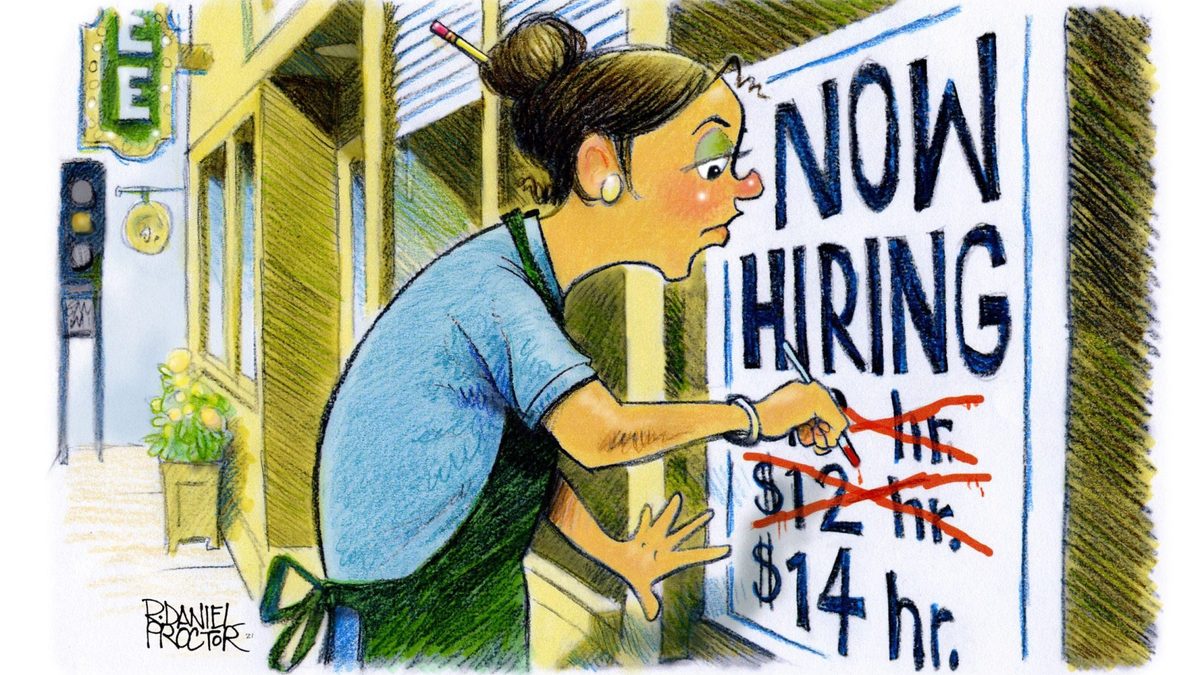
With “Help Wanted” signs in Tennessee so thick that a person needs a chainsaw to cut through them, Gov. Bill Lee pulled the plug early on $300-a-week expanded federal government unemployment payments prompted by the COVID-19 pandemic. Not getting what they wanted, some Tennesseans took to the courts, filing lawsuits—predictably—against the governor and his labor commissioner to force the program’s resumption.
In May, Lee announced Tennessee would drop the federal unemployment boost in July, earlier than its scheduled September 6 end, some 18 months and two extensions after it was enacted. In a statement, Lee said, “We will no longer participate in federal pandemic unemployment programs because Tennesseans have access to more than 250,000 jobs in our state. Families, businesses, and our economy thrive when we focus on meaningful employment and move on from short-term, federal fixes.”
However, lawyer Gary Blackburn, handling the lawsuit for the plaintiffs, contends the early departure was wrong. As Nashville’s WSMV-TV reported on July 28, 2021, “The lawsuit claims that Tennesseans who are part of this class action lawsuit have suffered the loss of their benefits for three weeks and will continue to suffer until the court orders Lee and McCord to renew participation in the federal pandemic unemployment programs,” (at this writing, the case is continuing.)
Regardless of the lawsuit’s outcome, its subject puts a light on whether the program hurt businesses trying to find employees; the relationship between Tennesseans and government spending of taxpayers’ money; and the degree to which “free” benefits both help and burden all Americans. There is no such thing as free money: someone’s paying. The questions are who, and how much?
Today’s American thinking on government’s role is considerably different from that encapsulated by President John F. Kennedy in 1961, in his most famous inaugural speech line: “Ask not what your country can do for you, ask what you can do for your country.” Today, it often seems the reverse. The problem is that when it comes to government programs, Americans are concerned about the country’s debt, but support spending for programs they like. Reacting to this are politicians eager to win favor, office, and power.
What’s often lost in these arguments over government “compassion” is that much of what the government does, it can’t afford: the U.S. is in a difficult, if not desperate, financial situation. The extended unemployment compensation and other programs crafted to help people during the pandemic indeed helped many overcome short-term personal financial difficulties—at a huge cost that added to the U.S. national debt of nearly $30 trillion. The debt works out at present to nearly $85,000 owed per person—and growing every day. Want to see something really scary? If so, here are the Congressional Budget Office’s 2021 budget projections: “If current laws generally remain unchanged, the federal budget deficit will total $3.0 trillion and federal debt will reach 103 percent of GDP in fiscal year 2021.” That’s without proposed trillions (as of this writing) in more spending being argued in Congress.
This isn’t the government’s debt; it’s ours. The U.S. is living on a (seemingly) unlimited credit card. But things that can’t go on forever, won’t. When people become used to getting taxpayer-paid benefits and then can’t get them, then there will be real pain.
Lee’s decision to opt-out early from the unemployment compensation program was grounded in the fact that a couple of hundred thousand jobs are unfilled. Businesses complain about difficulties in finding workers. A few headlines: “Businesses deal with worker shortage,” WATE-TV, August 6; “Memphis employers struggle with worker shortage,” Memphis Commercial-Appeal, July 27; “After losing over 126,000 jobs last year, Tennessee’s tourism industry faces labor shortage as travel rebounds,” Chattanooga Times Free Press, June 17.
Did the higher benefits disincentivize employment? Studies and data abound on both sides, so take your pick. But common sense says that giving people more money while they weren’t working wasn’t exactly a carrot inducing them to find a job.
Lee’s decision was to motivate people to stop counting on government and find a job. For some, this would bring difficulty. For others, an incentive. There are jobs out there, maybe not the ones some people want, but jobs nevertheless. Perhaps the Rolling Stones said it best: “You can’t always get what you want, but if you try sometimes, you just might find, you get what you need.”
→ Swipe for Next Story
InsightsNOVEMBER DECEMBER 2021
Providing Closure
COVID-19’s unexpected impact on the justice system
Story by Bruce Fox
You may be familiar with the phrase “Justice delayed is justice denied”. It’s a simple yet thoughtful concept that essentially means that if legal relief isn’t available in a timely fashion, it is the same as having no remedy at all.
The phrase has been on my mind—and the minds of lawyers and judges across our region—more than ever the last year and a half due to the pandemic. When it became clear that COVID-19 was going to be serious and highly contagious, Chief Justice Jeffrey Bivens of the Tennessee Supreme Court declared a state of emergency for the Judicial Branch of the Tennessee government and signed an order immediately suspending all in-person proceedings in court. The federal courts in Tennessee issued their own similar orders. That meant no trials. The courts cleared their dockets and nothing else was scheduled.
Though that first order expired, subsequent orders continued the suspension of in-person court appearances beyond that date. Hearings and trials ground to a halt. In the meantime, life went on (albeit in a much different manner) outside of the courts. People were still hurt in car wrecks, contract disputes continued to occur, custody disputes and divorces were still being filed. In other words, we still needed the civil justice system to help resolve our disputes, but in many cases there was no movement in that direction.
I have clients who have been seriously injured, who have been in medical treatment for months, whose cases were filed multiple years ago. It’s no secret that their cases should have been resolved by now. But they aren’t. And that is simply because we don’t have that driving factor of a trial date to propel their case forward.
Some insurance companies are doing the right thing. They’re engaging with us, negotiating with us, agreeing to mediations. We’re even doing depositions—though not many—as if a trial date was set. But many companies are not taking that approach and are offering clients half of what they would normally or in some cases, nothing at all. I’ve had clients whose cases have gone on for so long that they take whatever the offer is, simply so they can move on and put this part of their lives behind them.
But where is the justice in that? I have heard of trials by Zoom or attempts at finding alternate locations to the courthouse that can withstand the social distancing guidelines. And while I applaud the effort, it’s just not enough and it doesn’t negate the backlog of cases stacking up, waiting for their trials to be scheduled again or the people waiting for their piece of justice. It will take years to rid us of this buildup in the civil justice system.
Like everyone else, I pray that this pandemic is close to an end. And my hope is that once we get our court dates set, that we will be able to provide closure for our clients who have waited patiently for justice and resolution of their case and the losses they have suffered.
→ Swipe for Next Story
DepartmentsNOVEMBER DECEMBER 2021
Frozen Head
Challenging terrain speckled with stories of icy escapes
Story by John Quillen
On June 13, 1977, a handful of inmates from Brushy Mountain scaled the wall and melted into the Cumberland Mountains surrounding beautiful Petros. On their heels were every government agency available as these murderers and miscreants dodged dogs and rattlesnakes in a bid to gain freedom from our state’s most notorious prison.
I’m trailing my own hound up through a thicket that could likely have once hidden these lesser-known convicts, had it not been for the notoriety of one James Earl Ray. It’s been 40 years since this area, now known as Frozen Head State Park, shouldered national ignominy. We’re ascending in the shadow of this namesake peak on a cold morning along the Chimney Top trail which rises directly out of the park visitor center. Ice hangs gingerly from boulders as we round bends proffering glimpses of the valley and defunct penitentiary, now a tourist attraction. Crystallized earth crunches beneath the weight of a full pack as we plod skyward, in search of the level ridge.
They used convict labor to mine coal and harvest timber here before this rugged pocket wilderness was ceded back to the state. Apparently, the terrain failed to serve its Alcatraz-intended island effect, as elopement from the prison confines was commonplace. I try to imagine surviving here for any amount of time. Apparently, so did the progenitors of the Barkley Marathon who annually punish global participants foolish enough to ply their orienteering skills here, most surrendering Ray-style.
As we gain the saddle between Chimney Top Mountain and Mart’s Field campsite, an arctic breeze breaches my moist shirt blowing straight from the lips of icy Frozen Head itself. We establish camp and don dry clothing, soaked from five miles and 3,000 feet of gain. Home is nestled amongst varying hardwoods with sufficient detritus to provide ample warmth for a freezing night. The sunset backdrop explodes with pastel. Sunday has us traversing via the Chimney Top to Spicewood trails for a shorter 4.4-mile exodus.
They say refugee Ray was found hiding in some leaves three days after his escape, begging for food from his captors. We were feeling his pain. These trails are varied and winding, but provide the perfect outlet for those occasions where we need to plot our own escapes.
→ Swipe for Next Story
DepartmentsNOVEMBER DECEMBER 2021
Authentic Appalachia
Jeff Carter, the original Dancing Bear Appalachian Bistro chef, has returned to his roots
Story by N. Brooks Clark
Before anything else, make a note to visit the Dancing Bear Appalachian Bistro in Townsend and order Executive Chef Jeff Carter’s North Carolina Rainbow Trout and Grits. A cornmeal-dusted trout is served atop creamy grits, Conecuh Sausage from Evergreen, Alabama, gulf shrimp, crayfish, and preserved tomatoes in an irresistible presentation. The trout is crunchy with a savory fresh-caught flavor. “It’s a take on the original Dancing Bear menu,” says Carter, “bringing the original Dancing Bear to the new Dancing Bear. It’s an effort to bring authentic Appalachian cuisine to the Low Country.” Tall and lanky, with dark hair, a well-trimmed goatee, a ready smile, and an easygoing manner, Carter could easily pass as the friendly bass player in a bluegrass band.
Back in 2006, Carter moved from Blackberry Farm to become the first chef at the Dancing Bear, where he made his Appalachian-inspired regional culinary statement for three years. For the past six years, Carter has been the executive chef for the Aubrey’s chain and especially visible as the 2018 Top Chefs second place winner, the 2019 double entrée and dessert winner, and the creative genius behind Sunspot’s tantalizing tacos, superb soups and salads, and fan-favorite burgers—both the black bean and meat variety.
In the meantime, Dancing Bear burned down in 2013. Entrepreneurs Mark and Sharon Oldham, who had grown to love the Smokies during their years at the University of Tennessee, bought the property, rebuilt it, and relaunched in 2015 under several excellent chefs who were—each in his or her way—faithful to the mission of genuine Appalachian cuisine.
Last April, when Carter heard that the executive chef position was open, he decided to make a switch. “I love this area,” he says. “This restaurant has a special place in my heart.” Amid the tall trees just off Lamar Alexander Parkway, the Dancing Bear has a hunting lodge feel with wood beams, bark walls, and a roaring fire in a majestic fireplace. Responding to the demand for outdoor eating spaces during the pandemic, the Oldhams have added comfortable covered and heated patio and porch areas that enable diners to be even closer to the budding trees and luscious landscaping. The firepit is a great place to relax and let your meal settle, with an ample supply of graham crackers, marshmallows, and chocolate bars available to bring memories of summer s’mores to life.
One winner on the “To Share” section of the menu is the crunchy, slightly spicy green and red Blistered Shisito Peppers. Their taste explodes in the mouth thanks to preserved garden pepper vinaigrette, toasted peanuts, Noble Springs Dairy goat feta cheese, house-made chipotle mayo, and cilantro.
Under “To Start,” the Butternut Squash Soup with Golden Delicious apples, crispy heirloom sage, smoked pepitas, and fall spice echoes Carter’s previous triumphs, as does the Poached Pear Salad, featuring red-wine poached pears, rosemary pistachios, crumbled blue cheese, Banyuls-sorghum vinaigrette, charred grapes, and bitter greens. The French company Banyuls ages its red wine vinegar in oak barrels, giving it a light but potent flavor, and the sorghum provides the sweetness.
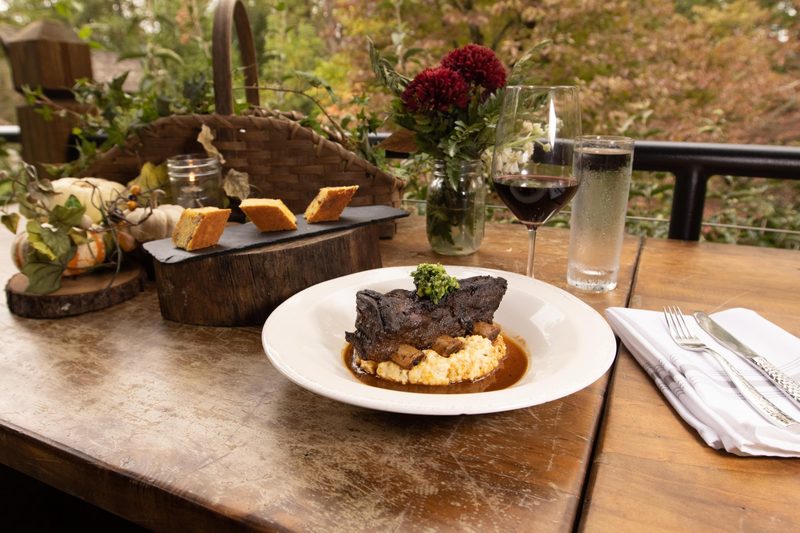
Among “The Mains,” the Pork Tenderloin with red beans and rice places a cider-brined Cheshire pork tenderloin atop braised Anson Mills calico beans with Benton’s country ham, Carolina Gold rice, house chow-chow, and red-eye vinaigrette. The roasted Bison short ribs are firm and tasty, served atop creamy grits with a preserved lemon gremolada and braised au jus. The taste of the striped bass is amplified by creamy mussel velouté on wild rice with radicchio fennel slaw.
In a nod to genuine Appalachian ingredients, Carter offers a light and fluffy parsnip, apple, and almond cake—a twist on the more familiar carrot, orange, and walnut variety—with apple butter cream icing, crispy parsnip ribbons, and cider reduction on the side. When guests come from out of town, make sure to take them to enjoy fine dining in the shadow of the Smokies.
→ Swipe for Next Story
Dining GuideNOVEMBER DECEMBER 2021
Pasta-bilities
“Life is a combination of magic and pasta.” – Frederico Fellini
Story by Marc Anthony
I am stating this at the outset: pasta is my favorite food. Nothing comes close. Growing up, spaghetti was the only meal that kept me and my brother quiet at the dinner table. Needless to say, my mother made it often.Whether it’s tomato sauce, cream sauce, oil and garlic, wide noodles, flat noodles, tubes, or Asian varieties such as pho and ramen, restaurant tables throughout East Tennessee are laden with delicious pastas that have us all looking like Lady and the Tramp.
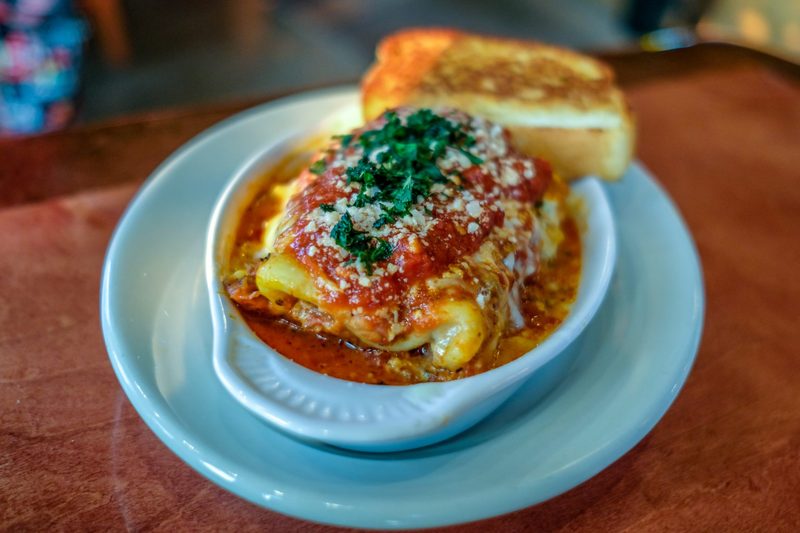
If a Sicilian grandma makes it, I’m eating it. Owner and Chef Joe Milanzi prepared for me a multi-generational plate of some of the most sumptuous lasagna I’d ever put into my mouth. Grandma Rebecca’s lasagna is stacked with sheets of pasta, pecorino and mozzarella cheese, meatballs, and a sauce that tastes like Sunday evening at a long family table in Sicily. When all the ingredients of a dish meld together so perfectly that you can’t pick out specific ingredients, you know you’re eating something special. This lasagna is special. Joe’s extensive menu guarantees return visits. And Joe works the room to make everyone feel like family.
Be honest, when you read that this was about pasta, did you think about ramen? Once I paired my hot pot with Manchu Ramen—always 10 for $1—in college, I was addicted. Tomo serves several varieties of ramen that can make powdered seasoning packets a thing of distant memory. Pork, chicken, tempura, teriyaki beef, or seafood swim in a rich and creamy soup with heaps of noodles. Satisfying beyond imagination, professionally prepared ramen by owner Patrick Rathida makes one forget about dorm room Cup o’ Noodles. There was so much soup that after I ate all the noodles, I took the rest home and added angel hair pasta for a second day of ramen bliss.
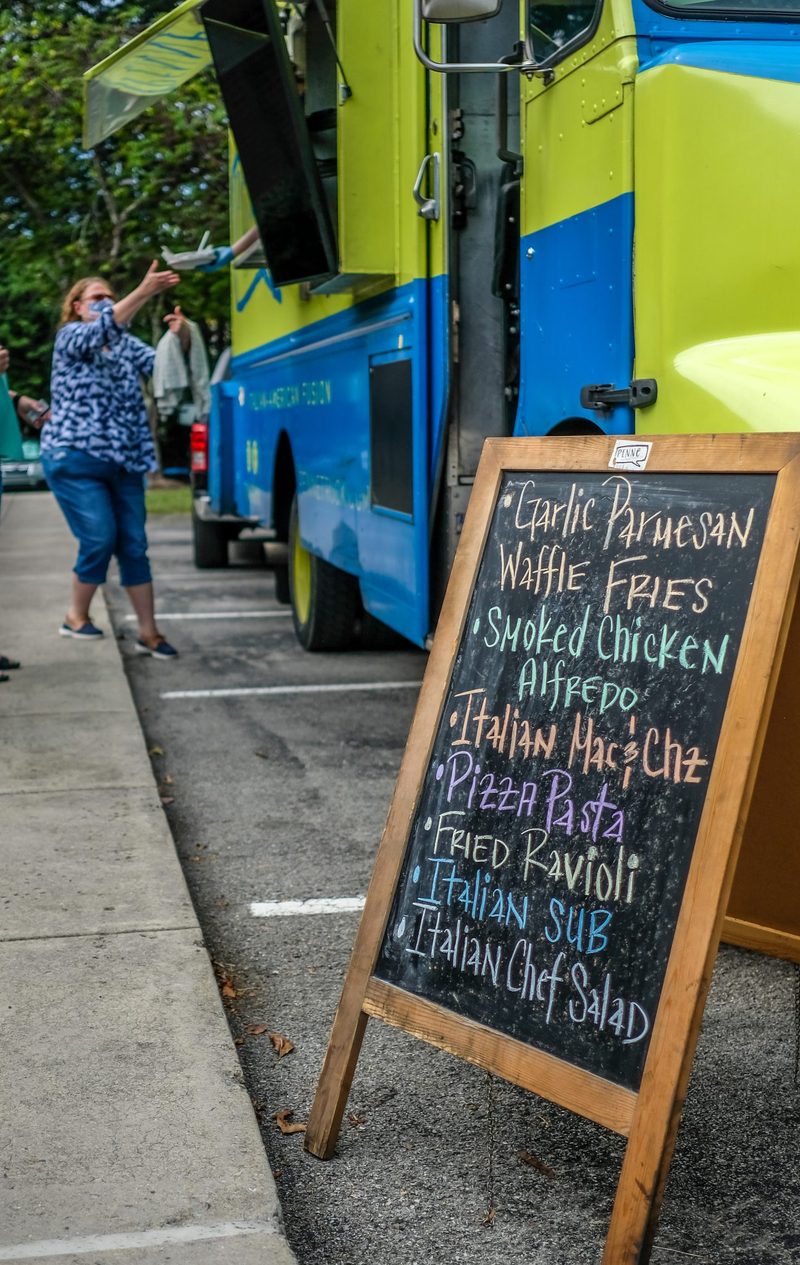
I don’t need to tell you that food trucks are everywhere. Penne For Your Thoughts brings you a twist on Italian food that makes you ask, “This is from a food truck?” My meal, Pastalavista Baby, was like a supreme pizza on a bed of penne noodles with sausage, pepperoni, red onions, green peppers, mushrooms and mozzarella, baked to perfection. Droves of pasta lovers follow Penne For Your Thoughts from food truck park to private event to farmers market like zombies. An evolving menu keeps you interested no matter where you encounter this rolling vat of starchy water and durum semolina throughout East Tennessee. Can you trust a pasta truck that also serves waffle fries? Absolutely.
For 33 years, Altruda’s owner Paul Meyer has rarely taken a day off, indicating the level of attention paid to every plate that leaves the kitchen. There are as many “ravi maris”, “chicken mels”, and “spags” delivered to tables by Meyer himself as by servers. That’s why the Linguine and Clams I ate tasted and looked just as incredible as it did when I first devoured it 20 years ago. (This guide is about pasta, but I would be remiss if I didn’t mention the salad and garlic rolls that come with every meal. No other restaurants come close for bread and salad.) While not a “family style” restaurant, my fork did find its way into my wife’s fettuccine with ham and peas. Altruda’s is simply a Knoxville institution where your pasta meal is one of a kind.
Several former Blackberry Farm chefs have made the Knoxville restaurant scene nationally recognized. Matt Gallaher brought his love for Italian food and his mother’s name to Market Square in a cozy and historic building that lends itself to traditional Italian cooking. I have eaten at Emilia every month it has been open, and it’s rare that I don’t order the Orecchiette with Ragu alla Bolognese. The dense “small ear” pasta is the perfect complement for a meat sauce that’s not heavy-handed like some can be. And if you want one of the most unique pasta meals you have ever had, try the Campanelle con Funghi y Pinoli, which is fancy talk for twisty pasta with mushrooms and pine nuts. Emilia continues to solidify its position as a top Knoxville restaurant.
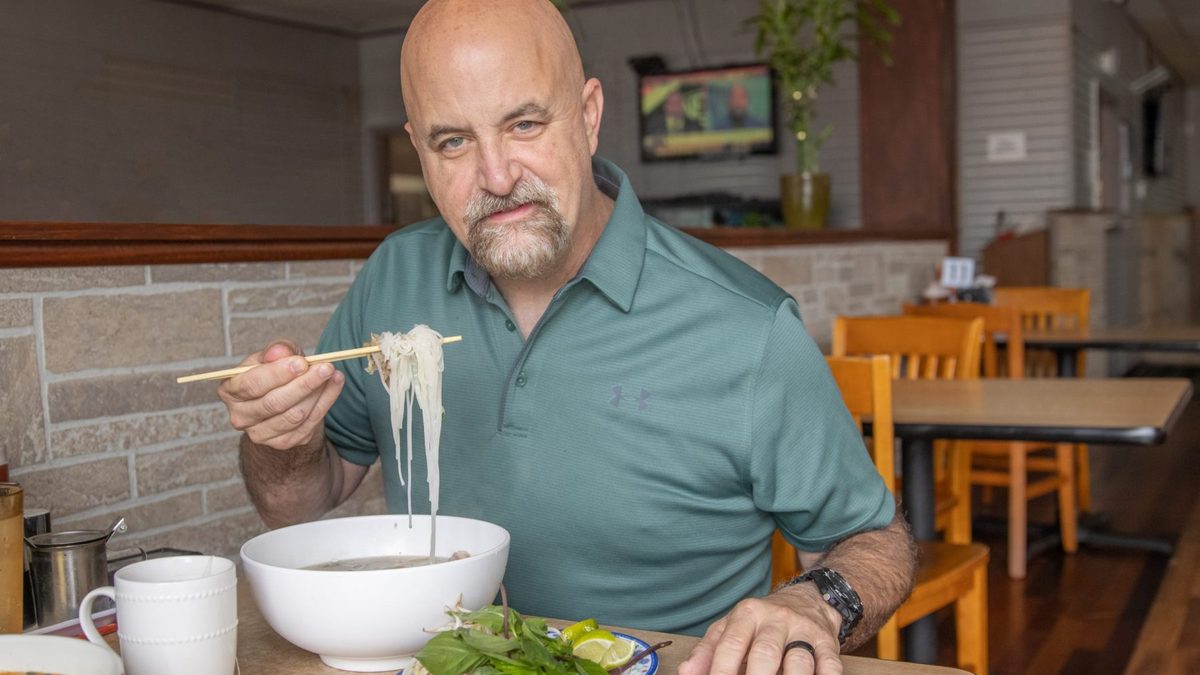
One of our early stops on this pasta tour was Japan for some Ramen, and we will end in Vietnam with Pho. What’s the difference, you ask? Let’s get the pronunciation out of the way to start. Pho is said like “fuh”, as in fuhgetaboutit. And you can just forget about thinking ramen and pho are the same. Pho is a light rice noodle. Ramen is a wheat noodle. Pho is about as fragrant as any food ever placed in front you. Meat, culantro, onions, lime wedges, and bean sprouts make the olfactory experience like none other. For the adventurous, a mouthful of beef tendon makes pho the fullest culinary experience and may scare the rookie away. Trust me, it may be gelatinous, but it’s delicious. Thank you to server Sophie for suggesting it. Bida Saigon is the number one spot in Knoxville for you to introduce yourself to this amazing soup.
A look back at the life of a fellow presiding justice in the neighboring state of Alabama
Story by Gary Wade
Of all those remarkable individuals I have met during my 40 years in local politics and the state judiciary, far and away the most interesting is a former governor of Alabama, John Patterson. His is the story from which movies are made, beginning with the assassination of his father, Albert, a candidate for Alabama’s attorney general in 1954. Having promised to “clean up” the graft and corruption in Phenix City, just across the border from Fort Benning, Georgia, he was shot and killed as a part of a conspiracy involving one of his opponents. Indeed, books were written and a movie, The Phenix City Story, all of which serve as documentation of the events.
Patterson, the son, picked up his father’s baton, and at age 34 was elected to the Office of Attorney General, adopting his father’s platform. Through his efforts, the gambling, prostitution, and political corruption came to an end during his tenure in the office. His efforts laid the groundwork for his election as Governor in the next term. One of his opponents was George Wallace, the segregationist, who would later say that the only state election he ever lost was to Patterson. In 1969, the Alabama Court of Criminal Appeals was established, becoming the second such court in the country. The first such had been established by the Tennessee General Assembly in 1967. To date, no other state in the United States has established a specialized appellate court.
I had no idea of this history until Governor Ned McWherter in 1987 asked me to serve as an associate judge for the Tennessee court to replace Charles O’Brien who had been promoted to the Supreme Court. O’Brien was the husband of State Senator Anna Belle Clement O’Brien, sister of former Governor Frank Clement. By the early 1990s, I was a veteran on a court made up of nine judges, three from each of the Grand Divisions of the State. By then, our Presiding Judge, Knoxvillian Joe Duncan, had retired and the other representative from East Tennessee, John Byers, had announced plans to do so. In 1994, I had become the senior judge in the Eastern Section and by 1997, the senior judge on the entire court. My colleagues elected me to serve as Presiding Judge at the age of 48. By that time, the judges of Alabama CCA and those of our own CCA decided to have joint conferences periodically. So, when it was our turn to host the Alabama judges, I helped plan a joint reception and program for Nashville. That is when I began to learn more of the career of John Patterson, who served as Presiding Judge of his court.
Like almost everyone in the Solid South after the Civil War and for 100 years after, Patterson was a Democrat and an avowed segregationist. Elected governor in 1958, he supported John F. Kennedy for president in 1960 and, in the process, became a confidante to the new president. As successor to Eisenhower, JFK inherited the prior administration’s plan to invade Cuba, which, at JFK’s request, Patterson supported, a plan developed by the CIA. The failure of the invasion came to be called the Bay of Pigs Fiasco, for which JFK issued an apology to the nation and became more popular for it.
Patterson was also on the frontline as to the Freedom Riders travels beginning in Nashville and continuing into Alabama. Attorney General Robert F. Kennedy sent aide John Seigenthaler, editor of the Tennessean and later a founder of USA Today, to Montgomery as an observer. According to Patterson, who had promised safety to the segregation protestors but declined to accept a phone call by JFK, the city’s police commissioner betrayed him by idly standing by, delaying any involvement during an attack by the Ku Klux Klan. John Lewis, a Freedom Rider who later was elected to Congress, was injured in the fray. For Seigenthaler, a giant in his support of the judicial branch of government, he was knocked out and hospitalized for his efforts to maintain peace. Patterson, Seigenthaler, and Lewis were extensively interviewed in a 2010 documentary about the Freedom Riders and the violence they incurred in Montgomery and elsewhere. Patterson, precluded by the state constitution from serving successive terms, lost in the Democratic gubernatorial primary in his 1966 race against Wallace. Perhaps because the two men had mended fences by Governor Wallace’s last term, he appointed Patterson to the Alabama CCA in 1984.
When Patterson spoke at the Alabama-Tennessee conference in Nashville our court had arranged, he reflected on his career in his state’s highest office, mixing humor with humility. He began by announcing that his biggest regret as governor was his consent to the publication of his speeches, many of which supported segregation, a view he had long since abandoned. On the lighter side, he told of his tour, as Governor, of the new prison that had been built in his state. Hungry as he walked through the lunchroom before the prisoners arrived, he smelled cornbread and asked for a piece, and then another. When his tour ended, the warden asked if he had questions. “What’s your biggest problem,” Patterson inquired. “That’s easy,” said the warden, “Most in this prison are young men, and you know what they are always thinking about!” “What can you do about that,” the Governor asked. “We give them drugs,” was the reply. The Governor then made the mistake of asking if they took their meds voluntarily. “No,” said the warden matter-of-factly, “we put it in the cornbread.” This was only one of his tall tales, all of which put smiles on the faces of those assembled.
In 2003, six years after his retirement from judicial office, Patterson was called upon to preside as Special Chief Justice over the appeal of Alabama’s elected Chief Justice Roy Moore, who had been removed from office for refusing to follow an order by the federal courts. Of course, Patterson’s Special Supreme Court upheld Moore’s removal. He remained a public figure afterward. A half-century after the Montgomery incident, he spoke with admiration of the Freedom Riders: “It meant so much to the state that they came here and did what they did, under grave, adverse circumstances.” In 2008, while continuing to express regret for his opposition to the integration of schools when governor, he publicly endorsed Barack Obama for the presidency. In the same year, his biography, Nobody but the People, was published. On June 4 of this year, John Patterson, the country’s last living governor of the 1950s, died at his home in the small town of Goldville, Alabama, three months short of his 100th birthday.
→ Swipe for Next Story
InsightsNOVEMBER DECEMBER 2021
Picking the Best
Judging contests in East Tennessee is not for the faint of heart
Story by Robert Pryor, Sr.
I don’t remember how or why it happened, but there I was seated in a special roped off section of the auditorium judging a child’s beauty contest. Stop this madness, I thought to myself. These children should not be wearing makeup and showgirl costumes, and I should not be part of it. When I was introduced as a young local attorney, I wanted to hide under the table that was provided for my personal use. I was very uncomfortable and wished I had never agreed to serve as a judge for this contest for five- to ten-year-old girls obviously living out their mothers’ dreams.
That was the beginning of my contest-judging adventure five decades ago. Little Miss Knoxville was the billing it was given by the Junior Chamber of Commerce, but for me it turned out to be more of a public disgrace than a civic responsibility.
A guy I recognized from playing basketball at the YMCA when we were kids came to my roped off area just to remind me that we played ball together 20 years earlier and, oh, yeah, to advise me that his niece was No. 8 in the contest. He wanted me to give her every “consideration.” The good news was that I was going to give every child “consideration,” but the bad news was the other parents, uncles, aunts, brothers, and sisters didn’t know that, and they might have believed I was being influenced by this ghost from my past. I feel I was thought to be on the take. Throughout the dreadful evening, I was approached several times and tried to be gracious. What had I gotten myself into?
At the conclusion of the program, I and my fellow judges selected a well-deserving sweet girl with a beautiful voice. The crowd quickly revolted at our intelligent and unbiased choice, and I was literally chased by a group of angry mothers to my car in the parking lot. That night, I made a commitment to never judge another contest.
Of course, a man of my vast experience and knowledge could not be allowed to retire after only one contest, and soon came an invitation to serve as a judge for the Miss Loudon County contest. No, no, no – but this was a Miss America sanctioned contest with the winner in competition for Miss Tennessee and on to Atlantic City. (By the way, in case you overlooked it, the Miss America contest celebrated its 100th birthday in September of this year.) The best part of this contest, however, was we were now talking about big girls—something I know a little about. After all, I married a beautiful girl and at least know something about picking the best. A real bathing beauty contest? I’m all in.
The contest was held in the high school auditorium, and I was introduced as a judge, along with several local dignitaries. I was the only judge from out of county, and they made my resume sound quite qualified. Again, I and the other judges are provided every comfort, a pitcher of water and a paper cup, along with a roped off section of the auditorium. But first, the preliminary interviews.
In a Miss America competition, there are very strict rules, including a scripted interview each judge shall conduct with each contestant one-on-one. I was placed in a classroom and all contestants were paraded through like cattle at a branding, and that’s when it happened. The most naturally beautiful young lady entered my room for her interview, and I was immediately taken not only by her beauty, but by her simplicity. Her talent was a pom-pom dance. Okay, I like pom-poms, and I gave her a few tips on playing to the audience—of course, judges are not allowed to give the contestant tips. Then came the big scripted question: “What kind of young lady do you believe Miss America should be?” There was a short pause, then my Miss Loudon County spoke. “Well, she should be smart, but, God, I’m dumb. I make F’s in school.” I had to stop and catch my breath. She’s not going to make it. I cautioned her not to be so candid and honest with the other judges. She should talk as little as possible and just smile. Dance—don’t talk. I loved her honesty and naivety, but I knew this lovely damsel would not make it because the other judges surely would not fully appreciate her alluring charm.
I voted my Miss Loudon County first in every category, including her pom-pom dance (more for the dance than for the pom-poms), but that was only good for third place since she was not selected by any other judge in any category. Single-handedly I had promoted my Miss Loudon County to respectability.
Again, I had participated as an honorable, independent thinking judge. I often have wondered what happened to my Miss Loudon County. She probably has told thousands she came in third in the 1975 Miss Loudon County beauty contest.
You would think after the stress of two beauty contests I would learn that I’m not cut out for this stuff, but along came another offer and one I simply could not refuse: judging the Knoxville Chili Cookoff. Here, I admit that I made several mistakes. First, I assumed everybody strived for a good, mild, traditional chili like mine. Second, I forgot that I react negatively to hot peppers. Third, I failed to limit my volume when I occasionally found a chili I really liked. Fourth, I refused to drink milk between each sample as suggested because I did not think milk went well with chili. As a child, my mother always told me never to drink milk with fish or chili.
It took several people to help me to my car, and my wife, Norma, drove me home before the first round of voting by the judges. I never heard how the contest turned out and didn’t care. That was over 35 years ago, and I still have difficulty eating a bowl of chili.
My only attempt at legal judging also came early in my law career. I was asked to substitute for a sitting judge at the courthouse. I considered it an honor to be asked and could not wait to exhibit my vast knowledge of the law. From Administrative Law to Taxation, I had studied it all and even taught Business Law for several years at the University of Tennessee College of Business. If ever there was a student of the law prepared to dispense justice from the bench, it was me.
I reported for duty and would decide non-jury, overflow cases sent to me from the chief judge in the large courtroom down the hall. The first case was easy. Something about a woman who hit another woman in the head with a cookie sheet at a church bake sale. Then there was a man asking for rent for the use of a ladder his neighbor had borrowed and refused to return.
Finally, in walked a true legal challenge. A large 20-something boy in overalls and his rotund girlfriend entered the courtroom holding hands. They announced that they wanted me to perform a “proper” wedding ceremony. Stop! I know nothing about wedding ceremonies, much less what would constitute a “proper” ceremony. I must admit that, notwithstanding my wealth of legal knowledge, I did not know what to do, but I was eager to serve. First, I tried to avoid the responsibility by asking if they were sure that marriage was right for them and had they thoroughly discussed it. They responded, “Yes.” They were sure, but they did not want the “preacher” who hung around the courthouse for just such occasions to perform the ceremony. I didn’t blame them but, at least, unlike me, the “preacher” knew what he was doing. They insisted that I marry them that day.
Finally, I came up with a plan and told them it was my lunch break, and since I had worked so hard judging all morning, I needed about an hour and would they please come back about 1:00 p.m. if they were still in love. In the meantime, I ran to the law library and searched the Tennessee law books trying to find the “proper” language for an official to conduct a marriage ceremony in Tennessee. I found nothing, and at 1:00 p.m. I advised the couple that I could not marry them because I had no jurisdiction to conduct weddings (a good escape judges sometimes use). They reluctantly left the courtroom to find a real judge or live their life in sin.
→ Swipe for Next Story
Non-ProfitNOVEMBER DECEMBER 2021
The Jewel of Southern Appalachia
“A generation that ignores history has no past and no future.” – Robert Heinlein
Story by Gary Wade
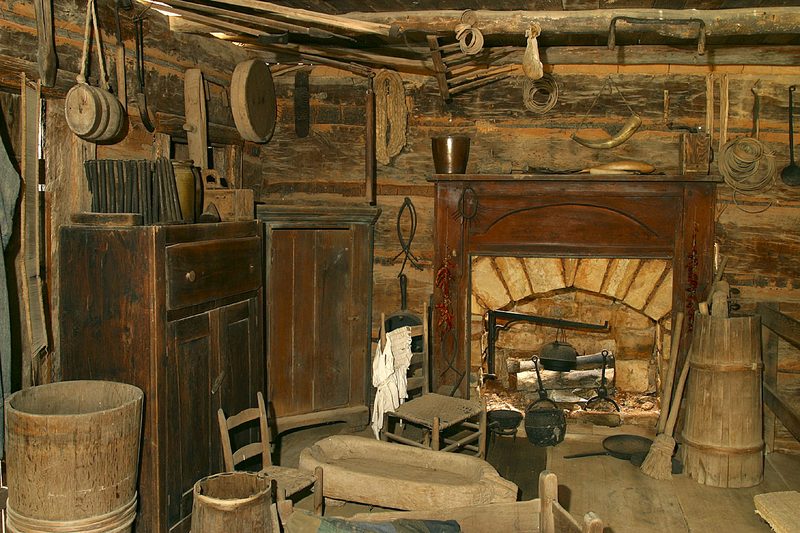
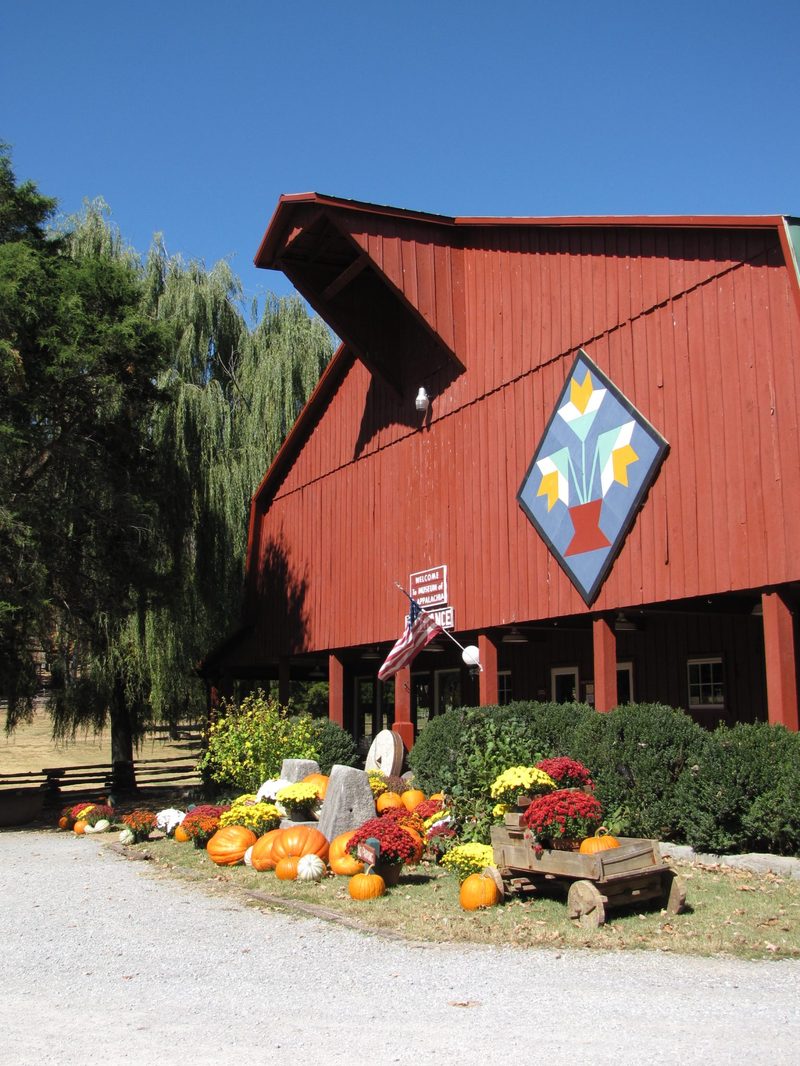
“My friends,” John Rice Irwin has written, “are the warm, happy, independent folk of these southern mountains. They are my people and the people I love. Because of them, I started the Museum of Appalachia and so it is to them that its Hall of Fame is dedicated.” Today, the life and legacy of this remarkable man is on full display at a small farm in Norris, Tennessee. May his works forever preserve the rich heritage of our region for future generations.
Irwin was born in Union County during the Great Depression. In these hard times, the Irwin family had to move from their farmlands to make way for the construction of the Norris Dam and the flooding of Norris Lake. The family first settled in Anderson County on a farm in Robertsville, which is now a part of Oak Ridge, but the top-secret atomic weapons project forced yet another move, this time to a farm in the Bethel community of the same county.
As Irwin learned how to farm, hunt, trap, and fish on the property, he developed a strong interest in the cultural history of the area. Upon graduating from high school, he served a hitch in the US Army, stationed in Germany during the Korean War. Determined to continue his education, Irwin returned to East Tennessee after his discharge, using the GI Bill to earn a bachelor’s degree in history at Lincoln Memorial University and then a master’s degree in international law at the University of Tennessee. In 1954, he married Elizabeth McDaniel, a union which produced two daughters, first Karen, and then Elaine. Seven years later, at the age of 31, Irwin became the youngest superintendent of schools in the state when elected to the position in Anderson County.
As a boy, Irwin had loved to hear stories of the past from his grandmother, Ibbie Jane Rice, and especially those of his grandfather, Marcellus Moss “Sill” Rice, who took notice of his grandson’s keen interest in their remembrances. “You ought to keep the old-timey things that belonged to our people,” Sill advised, “and start you a little museum sometime.” By age 17, Irwin had published his first literary effort,The History of Rice’s Old Gristmill, taken from family lore. Years passed, however, before he began to heed the advice of his grandfather.
At an auction sale in the 1960s, Irwin seethed when a stranger from “up North” mentioned that he planned to turn an antique wagon seat he had just purchased into a coffee table for his home. His emotions stirred. Irwin began to use his Saturdays to travel the countryside, purchasing every Appalachian artifact he could afford—from farm implements to musical instruments—all in his mission to “save the past.” The Museum of Appalachia officially opened its doors in 1969 as an Irwin family business.
Meanwhile, Irwin stayed on as the Director of the Tennessee Appalachian Educational Cooperative in Oak Ridge but continued to use his spare time to purchase relics reflective of the region. The popular Elizabeth and her girls operated the fledgling museum in a log building on the family farm. Upon his retirement in 1980, Irwin began to devote his full-time efforts to the growth of the museum’s collections and the development of its grounds. Yet the day-to-day operations and special events, such as the annual Tennessee Fall Homecoming weekend—complete with bluegrass music, storytelling, and country cooking—were definitely family affairs.
Over time, Irwin published numerous books on a variety of Appalachian themes, including baskets and basket makers, quilts, guns and gun makers, musical instruments, and, of course, country music. His first book, however, is perhaps his favorite,The Story of Marcellus Moss Rice and His Big Valley Kinsmen, a collection of Sill’s tales about the Rice family and their friends. Now having survived wife Elizabeth, who died in 2008, and daughter Karen, Irwin, at the age of 91, continues to list his maternal grandfather as the major inspiration for his life’s work.
During the last half century, Tennesseans like Senators Howard Baker and Lamar Alexander, four-star General Carl Stiner, singer Mary Costa, and writer Alex Haley embraced the culture and history of the museum. The big-hearted Haley spent holidays with his adoptive family, “found the good and praised it,” and eventually built a home in Norris, located only a stone’s throw from the museum. His death in 1992 was a lost treasure. Photographs of other celebrity visitors—among them, Oprah Winfrey, Brooke Shields, and Martha Stewart—adorn the walls of Heritage Hall, but it is the Hall of Fame that features the heroes of these parts of the Southern Appalachian Mountains. Those featured include such notables as World War I hero Alvin York, World War II Secretary of State Cordell Hull, musicians like the Carter family, Roy Acuff, Dolly Parton, Grandpa Jones, and even grocer/politician/TV program host Cas Walker of Knoxville. Importantly, the museum also features extraordinary individuals in our area who lived their lives out of the limelight.
By 2003, the museum had converted into a non-profit organization, and in 2007, while boasting more than 40 rustic structures, four display buildings, farm animals of all kinds, and, of course, authentic Southern cuisine, the museum announced its association with the Smithsonian Institution, an arrangement that is likely to continue in perpetuity. The Irwin family is still vitally involved in the operations. Elaine Irwin Meyer is the President and CEO. Husband Ed heads up a group of dedicated volunteers. Their daughter, Lindsey Gallaher, is not only Elaine’s top assistant, she also serves on the board of directors made up of the likes of former University of Tennessee president Joe Johnson. Immediate past board chair Steve Dean, best known as the executive producer of WBIR television’sThe Heartland Series, is an ardent supporter. “The true beauty of the museum is far more than the exceptional collection on display,” he maintains. “It is the story of the people who owned and used these artifacts that provides context in such a meaningful way.”
A touching illustration is that of an elderly man who, in 1926, went blind when his only grandson, who lived in the same house on the same farm, was still a young boy. In his mind, the image of the child’s face was locked in time. As the years passed, the grandfather spent many of his days carving toys suitable for “the boy” even as he grew into adulthood. All the while, the young man served as the eyes in his grandfather’s blacksmith shop, and there was nothing “Grandpa” would not do for him in return. When the beloved grandson reached 18, he was called on to serve his country in a time of war. Fearful for his safety, the grandfather begged to go with him to serve as his protector. The fates of both the grandfather and the grandson are, of course, on display at the museum—serving as the closing chapter of this heartwarming relationship.
Another narrative comes from the Irwin family. Irwin’s paternal grandmother, “Granny” Sarah Jane Irwin, was one of nine children. Prevented by her father from enrolling in school because “girls didn’t need an education for domestic work,” she washed, ironed, mended clothes, darned socks, cooked, baked, and cleaned house. When she was still a girl, the garden became her responsibility. At harvest, she canned hundreds of jars of tomatoes, pickles, okra, beets, blackberries, strawberries, peaches, pears, and even pork sausage and ribs. She dried beans and apples for the winter and, during the colder months, made time to sew and quilt. Her labors, most often beginning before daylight and lasting well after dusk, continued throughout her marriage and for the rest of her life. Irwin called her “the most prodigious worker” he had ever known. After her death, he was overcome with emotion when he discovered “Granny’s Christmas Quilt.” The patchwork blanket was a representation of her life, listing the names of her entire family and including each word of the Lord’s Prayer. A chicken and its eggs, which were her only means of income, were prominently sewn into the fabric as were a favorite dog, a butterfly, a bird, and the words “God Bless Our Home.” The most dramatic visual in the quilt’s content, however, are the words “Remember Me,” vertically stitched near the center of her elaborate design.
While adored by her family, her identity, Irwin realized for the first time, was that of wife to her husband, mother to her children, and “Granny” to her grandchildren. Like so many other women of her day, she had been taken largely for granted—known less in her own right than in those she loved and served so selflessly for an entire lifetime. Her lasting wish was simply to be remembered.
These stories and so many more like them touch our hearts and souls and make the museum a “must see” for the good people of Appalachia.
Southern Louisiana’s people, open waters, and fishing experiences make for an epic adventure
Story by Nathan Sparks
I am just about to finish up the checklist with my son Troupe. He gets a real kick out of being the co-pilot on our trips. Process and procedure can be very important at times, and this is a great opportunity to continue to instill some of that in my son. “Fuel selector, left tank? Check. Mags on both? Check. Brakes? Check. Checklist complete,” he says after which he calls loudly, “Clear Prop.” The old girl—our 1955 F-35 Beechcraft Bonanza—cranks over only one time before the mags catch. She is as reliable as the river fog on a cold fall morning, and after a few coughs she is purring like a kitten ready to be called into action. Today we will fly to the Cape Fear Regional Jetport on the North Carolina coast to pickup our friend and fellow adventurer, Jimmy Chiarella. It’s early as we enter the runway and announce we are departing runway 8. In two short hours, we will have assembled the final member of our team for this adventure.
Gearing up for Louisiana
We are sitting under the Bonanza’s wing in row 98 of the vintage aircraft section at the EAA Airventure show in Oshkosh, Wisconsin. I am trying to reach a man named T-Mac, the owner of the Le Matidora Inn about 20 miles north of Venice, Louisiana. In looking at the aviation charts, there is a private runway there, and I am seeking permission to land. In speaking briefly with “Miss Ann,” the general manager of the facility, she tells me yes, but we will need a briefing from the owner before coming. As I inquire about the runway, he gives me the once over: what kind of plane, how much experience with short fields, how many passengers, and how much gear? That’s a lot of info just to get permission to land, but when he tells me there are power lines on either end of the short 2,000-foot runway, I understand that he is just concerned for my safety. I thank him and assure him we always consider safety first.
I knew I would err on the side of caution; we were going to get so much tuna that we would be too heavy for a short field departure. I rationalize that it would be easier to have a rental car anyway. As a father and a friend, I was doing the right thing being cautious, but for me personally, I really wanted the challenge. Another day, I mused.
Meeting A Riverboat Pilot
As we glide over the Smokies at around 8,000 feet, the pockets of fog in the low areas in North Carolina are mesmerizing. The air is smooth, and Troupe and I talk about how many ways we are going to fix the tuna we are certain to catch. Wrapped up in conversation we are turning base to final approach in no time at all. Wheels down and we roll up to the general aviation side of the airport to pick up Jimmy who, as always, is raring to go.
We arrive at the Le Matidora Inn and are pleased with the quality of the accommodations. Personally, I love this kind of place. Far less formal than a big hotel, there is a large community kitchen, pool table, and a swimming pool. The runway, which I elected not to use, goes right by the front door, is also a county road. This place has some real character, situated on what was once a large plantation just a few-minute-walk to the mighty Mississippi River. Traveling to do these stories often leads to interesting people, and this would be no exception. The man I spoke with on the phone turns out to be much more than an inn keeper. T-Mac is a riverboat pilot, general aviation pilot, cattle rancher, airboat pilot, hunter, and fisherman.
Riverboat pilots are a very exclusive group, a privilege passed from one generation to the next, but only for one person from each family. Each pilot is responsible for a section of the river, where they take control of these huge ocean-going ships—some 1,200 feet long—and guide them safely up the river to their final destination. T-Mac runs the section from the gulf to Venice.
Often these passages are made in the middle of the night in all kinds of weather. When you consider wind and current on top of the sheer size of these vessels, it is truly an impressive feat. T-Mac offers to take us on an airboat tour, an unexpected treat for sure, where he shows us old abandoned cemeteries, levies between the river and the wetlands, and the cattle that roam freely along the river over thousands of acres of lush vegetation. I can tell he’s gotten a huge kick out of telling me to watch out for the water moccasin when I step off the boat to look at an ancient tombstone. I personally find no humor in the comment at all.
At one stop along our tour, T-Mac talks about the great oil spill that caused many problems for the local economy and the “spillionaires” that popped up from helping with the cleanup. Big oil was forced to clean up the mess, and they paid incredible prices to get that done, thus creating overnight millionaires. On our offshore day, we visit the very rig that caused that spill.
Fishing for Monsters
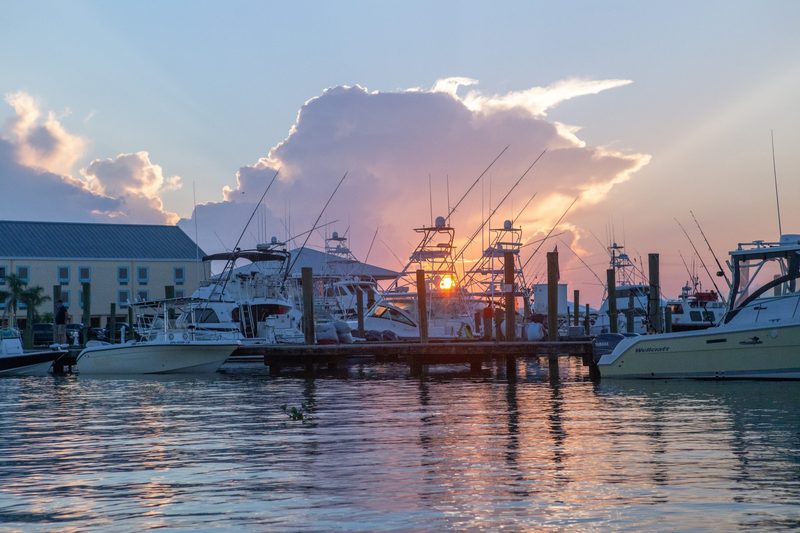
It’s our first day of fishing and bull reds are on the menu. Today we are looking for a fight on light tackle. These redfish can easily reach 30 to 40 pounds with the state record coming in at 61 pounds. Our captain is cutting through a literal maze of small cuts and channels to shorten our run to the edge of the gulf, and we relax and enjoy the sunrise while he maneuvers. Catching these fish isn’t all that hard, provided you can find them, and that is where a really good guide can make a big difference.
The rig for redfishing is fairly simple. A popping cork simulates the clicking sound of a shrimp, with a three-to-five-foot leader underneath rigged with plastic baits or shrimp. Long casts and pounding the cork bring some nice fish throughout the day. I especially love when they explode right next to the boat. Troupe gets the first bull, and it makes me proud to see how he handles the fight. Jimmy also lands a couple of hogs, and I begin to feel left out. In the end, I get a few as well. Near the end of the day, we move closer in-shore and pick up a few small ones for the grill. The rebound of the redfish in the gulf—they were once so few that commercial fishing was completely restricted—has made for some incredibly fun fishing.
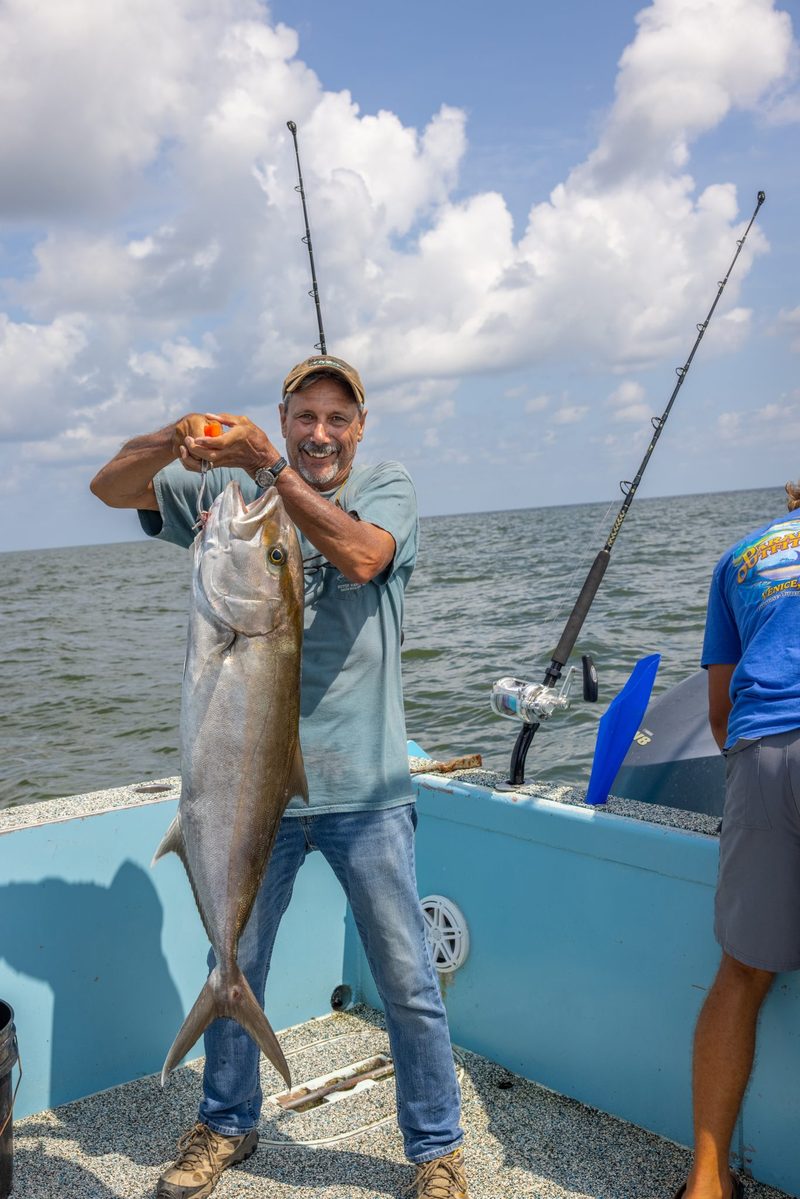
Day three: tuna time. We leave the dock just before 6 a.m. for a quick run to a small natural gas well where we catch our bait for the day on Sabiki rigs. Everyone pitches in to fill the livewell with various species of small bait up to about half a pound. Then there is nothing left to do but relax for a couple of hours while we run to open water in the hope of finding some incredible tuna. We fish hard that day; in fact, we make it all the way to the blue water, which seems to surprise our captain. Some days it just isn’t meant to be, so after about eight hours of trying for tuna, we opt to put a few amberjack in the boat to avoid coming back empty-handed. We fish over an oil rig that was long gone from the surface but still has some excellent structure on the bottom. We land a few quality ones and then call it a day.
Southern Louisiana has so much to offer that you really can’t go wrong picking this as a destination. Between the legendary food, the interesting people, and fishing that’s to die for, the area has it all.
As with all of our adventures this year, we rely on the folks atHigh Adventure Companyto help us plan our outdoor experiences. If you’re interested in an adventure of a lifetime, we highly recommend John Burrell and his crew. If you want your adventure featured inCityview,give me a call. We might just go with you.
→ Swipe for Next Story
FeatureNOVEMBER DECEMBER 2021
Best of the Best 2021
Story by Cityview
Three hundred and one thousand votes says a lot, but it doesn’t say it all. Not even by a long shot. The community’s participation inCityview‘s Best of the Best voting is just one of the ways people support this effort. For weeks prior to the beginning of the voting, we get calls of all sorts:When will the voting begin? Can I nominate someone in advance? My friend’s name is spelled wrong, can you fix that?This has turned into something with a life of its own, and it makes us proud to see how important this poll has become to Knoxville.
Most people who participated this year voted around 35 times; the top voter placed 324 votes. All but three of the top 26 most-voted categories came from the dining section, with the remaining three being hair salon, stylist, and colorist. Clearly, we want to look good when we are out eating at restaurants. We added numerous categories this year, and still, we received requests for many more. It’s a never-ending process to keep it all current, but it is no doubt a labor of love for all of us here.
There is no better way to start the holiday season then by being the bearer of such good news to all the winners. To see the delight in their eyes or hear the joy in their voices as they receive the news that they’ve won is like experiencing Christmas morning over and over again.
This is especially true for the first-time winners and those who didn’t even realize they were nominated. Perhaps they did something for someone without thinking about how it would benefit themselves. Perhaps they simply shared the joy of their work in such a humble way that it spoke to the person they were helping. After all, this is the south, the land of hospitality, where people help each other just because it is the right thing to do. And those sort of selfless acts, not matter how big or small, make all the difference in the world.
So, for those who didn’t make the top three this year, remember, there is always a way to be the best of the best. Do something unexpected and kind for someone around you. Go above and beyond just because. And who knows, you just might find yourselves on the list in 2022.
Arts & Music
Automotive & Marine
Beauty & Aesthetics
Contractors & Home Improvement
Dining
Entertainment
Family & Pets
Health & Wellness
Hunting, Fishing & Sporting
People & Places
Schools & Education
Stores & Services
Weddings & Events
Click to jump to a section!
Arts & Music
Americana BandThe Dirty Guv’nahsChillbilliesBlack Lillies
Art ClassesArrowmont School of Arts & CraftsAppalachian Arts Craft CenterMighty Mud
Art GalleryBennettArt Market GalleryArrowmont School of Arts and Crafts
Body Art Studio – ArtistDale Johnson, Mythical Markings Tattoo StudioEmily Walker-Otto, Born this Way Body ArtsAmberlyn Moses, The Mountain Mule Tattoo Co.
Body Art Studio – PiercingBorn This Way Body ArtsMythical MarkingsAlter Ego
Body Art Studio – TattooBorn This Way Body ArtsMythical MarkingsSaint Tattoo
FacialThe Skin Wellness CenterPure LuxeBelleza Salon and Spa
Financial AdvisorBilly Hicks, UBS Wealth ManagementThe Trust Company of TennesseeMark Pancratz, Northwestern MutualThierry Sommer, Thierry V. Sommer & Associates
Wedding VideographerTammy Akard, Sweet Tea ProductionsYoung VideographyRellek Films
→ Swipe for Next Story
FeatureNOVEMBER DECEMBER 2021
Santa’s Helpers
Holiday decor experts share their secrets to the magic
Story by Susan Alexander
If it’s beginning to look a little like Christmas, Stephen Brown, Lisa Foster, and Sam George are in part responsible for the transformation. With floral and/or home decor businesses, these three creative designers are in high gear spreading holiday magic as soon as the Halloween candy has been handed out. Brown offers all kinds of whimsical home accents out of Glitterville downtown while Foster and George deck the halls at homes around the area. In the pages that follow, they offer their expertise to help make your holiday decor, inside and out, picture perfect. And here’s advice they can all agree on: don’t worry about what’s trendy.Lisa Foster|
Lisa Foster Floral Design
Lisa Foster jumps into Christmas right after Halloween. She and her team at Lisa Foster Floral Design in West Knoxville head to North Carolina to deck the halls at Historic Tapoco Lodge in Robbinsville. “It takes us four days, and it’s hard work,” she says. “We leave there sweating every day.”
Then she starts decorating client homes around Knoxville, tackling centerpieces, Christmas trees, and more. She aims for a result that is an all-sensory experience for her clients and their families.
“In my grandmother’s house I’d smell the good food, and I’d see the table with the flowers and the candles. I could feel it,” she says. “And with Christmas music playing, all of my senses were touched, and I could feel the love that she put into it. That’s what I aim for; to help our clients feel the joy and love that Christmas represents.”
She uses mostly traditional favorites to get the effect she wants: magnolia garlands around the tops of doors; big evergreen wreathes with giant red bows; berries and holly, tons of ribbon and “the more glitter the better,” she says. She often decorates using what her clients already own, and she encourages a browse through Pinterest if you’re looking for inspiration.
“The more ornaments and ribbons you use, the better it’ll look,” she says of decorating a Christmas tree. “I don’t love LED lights because they’re really bright and kind of harsh; I prefer the softer, warmer lights. And I like to use wired ribbon because it’s so easy to manipulate it.”
Foster opened her shop in 2004, originally from her home, and moved into her current space in the Windsor Square Shopping Center in 2017. In addition to Christmas decorating, she’s busy helping with winter weddings, often two or three per weekend, at this time of year.
The old colored glass balls that covered his mother’s and grandmother’s Christmas trees are what Sam George says look like Christmas to him. “The holidays are so much about nostalgia, and it’s important to honor that.”
When he and his team at Floral Designs by Samuel Franklin in Clinton decorate a home—and they do between 40 or 50 in an average holiday season—it’s much more than putting up a Christmas tree. “There are so many details, accents in every room,” he says. “Some people have multiple trees. One client has six or seven trees, and the one in the entry is 23 feet.”
George relies on lots of lights to really make a Christmas tree shine. “The general rule is 100 lights per foot of tree, but when we do our Fantasy of Trees display, we use 200 or 300 lights per foot.” Stick to the colors already found in the home, George encourages, and incorporate fresh greenery with artificial.
For those who like fresh Christmas trees, George encourages them to wait—and water. “Don’t put a fresh tree up too early. If you buy it early, leave it outside in water. The interior temperatures of our homes are too hot for a tree, and they won’t last—especially if you’re not watering it.”
It’s important to set a festive tone with outdoor decor, he says, which includes the mailbox and doors—both front and back. But his best advice? “Do you. Decorate the places you and your family spend a lot of time. Use the old ornaments the kids made in kindergarten in the most personal areas of the house. Use the colors you love.”
George got his start in the floral industry while he was in high school. “I’d drive from Norris to Oak Ridge to deliver flowers,” he says. He started his current business in 1985 and moved into its location 25 years ago.
This month and next are sure to be hectic ones for Stephen Brown, creator and owner of Glitterville, the home and holiday design company with a store in downtown Knoxville and retail space around the world. This season, Brown will be in Dallas as Neiman Marcus’s Artist of the Year decorating its flagship store for the holidays. His team will set up full store popups in Soho, Dallas, and Fort Wayne, Indiana, as well as maintain their showrooms in Atlanta and Los Angeles. Amidst the hubbub, they’ll try to keep up with orders for Glitterville merchandise.
The COVID-19 lockdown pushed Brown to think outside the box. “So we started doing tons of Instagram Lives, crafting thing for our followers. It was a time to bond with people and get to know them.” Now with 75,000 Instagram followers, the Glitterville crew is struggling to meet the demand. “It’s a great problem to have,” he says.
So while he won’t have much time for admiring his own Christmas tree this year, Brown’s advice for making your decor sing is to start by forgetting what’s trendy. “Never decorate your house or for the holidays based on a trend,” he says. “It won’t be something you truly love.” Pair things you’ve had forever with fresh new items. “For a Christmas tree, you need lots of different textures—balls, figures, glass, fabric—at least three or four kinds of ornaments, and lots and lots of lights—at least three kinds.” Add something like glitter to the mix and you have yourself a special tree, he says.
“When I moved to New York (after graduating from UT) I had $100 to decorate for Christmas, so I went to the Christmas store and bought three European glass ornaments by Christopher Radko. They were so special. Every year I’d save up and buy more glass. Two years ago in Atlanta, Christopher Radko wanted to meet me,” Brown says. “It was a full circle moment.”
Knox County’s hunger ratings require us all to pitch in
Story by Glenn Jacobs
Five or six years ago, I started a new holiday tradition. On the day after Thanksgiving, I would visit my friend Billy Kidd, the late WIMZ DJ, as he kicked off his yearly “Camping for Cans” food drive to benefitSecond HarvestFood Bank of East Tennessee.
During the fundraiser, Billy broadcast from a camper and a semi-trailer. The campaign concluded only when that trailer was filled.
During the 20 years that Billy championed “Camping for Cans,” he helped raise more than $500,000 and collected more than 30 tons of food for Second Harvest. What I will always remember, however, are the stories he told of the people who made those donations. Like the children who proudly gave a single can of food, encouraged by their parents to start the habit of giving early, no matter how small the amount or gesture. Or the man who gave him $20, saying that a few years prior he lost his job and turned to Second Harvest for help, but now that he was employed again, wanted to pay it forward.
Sadly, despite the work of individuals like Billy Kidd and organizations like Second Harvest, hunger remains an issue in East Tennessee with almost 240,000 at risk every day in the 18 counties the nonprofit serves. And tragically, one out of every four children in our region is part of that number.
Feeding America reports that Knox County’s food insecurity rate (for 2018) was 11.7 percent, meaning 53,000 people in our own community did not have reliable access to food. During the pandemic, that number was projected to rise to 13 percent.
Knox County, fortunately, has a network of diverse nonprofits, charities, and churches working together to address this issue.
Tackling the hunger issue has long been a priority for Knox County. And nonprofit partners like Second Harvest stand at the foundation for much of the effort. While many of us consider providing food for those in need around the holidays, Second Harvest works on feeding East Tennesseans year-round, knowing that hunger has no season. The organization arranges programs to meet every corner of our region. No one hungry is forgotten.
Second Harvest’s effort is far-reaching, but they aren’t alone. Programs like the LORD’s Child and Mobile Meals meet significant needs in this community.
The LORD’s Childwas founded in 2007 by Gene and Karen Wolfenbarger to meet the needs of the impoverished in Africa, Asia, and in some of the poorest counties in the United States. Their home is right here in south Knox County.
Only one family sought help when they first opened. Now, each week the couple supplies hundreds of families with healthy, nutritious food items and daily meals to more than 70 senior citizens. Their summer nutrition program also helps children across the region.
The Knox County Community Action Committee’sMobile Mealsprogram delivers meals five days a week to Knoxville and Knox County seniors. Since taking office, I’ve ridden along each month and have come to find that this is so much more than just a delivery service; it provides a personal connection for these seniors. Volunteers sit and spend time with those they deliver to. It makes an impact that reaches far beyond the meals they are providing.
Although Mobile Meals primarily serves senior citizens, hunger is an issue that does not discriminate. It is impacting our young people as well.
Every day, thousands of children across theKnox County School Districtattend school to learn, but also to eat. Our schools provide two nutritious meals a day for every student who wants one—even when classes aren’t in session. We are fortunate to have an amazing school nutrition team and hundreds of volunteers who work tirelessly to make this happen.
It is hard to learn when you are hungry. As humans, we must satisfy basic needs like safety, shelter, and food before we can attend to other important, albeit less urgent needs like education, which is why these programs are so critical.
During the summer, I sat down with Chris Battle—the former senior pastor at Tabernacle Baptist Church—who started his first community garden in 2018 on a vacant plot of land across from his church. Battle has some big goals: encourage young folks to take care of the planet and also fight food disparity.
This year, he purchased a two-acre plot on Boyd’s Bridge Pike with the help of a GoFundMe campaign and named itBattleField Farm and Gardens. There he not only provides affordable fresh fruits and vegetables, but also teaches people from all walks of life about better eating and nutrition.
I encourage you to think like Mr. Battle; think about ways you can support those in our community who need help, but also how you can support those who are helping. And not just in the season of giving— year-round, too. Consider times of the year when others don’t make charitable contributions and food sources may be limited.
Knox County is the best place to live, work, and raise a family. I truly believe that, but we can’t meet our vision of a vibrant community that provides everyone an opportunity to thrive and grow if thousands of our neighbors don’t know where their next meal is coming from or must choose between paying rent and buying groceries.
As we approach the end of the year, put yourself in the shoes of someone who may be struggling. Give what you can, help where you can. And, as my friend Billy Kidd would say, don’t leave until the trailer is full.
→ Swipe for Next Story
BusinessNOVEMBER DECEMBER 2021
The Secret Sauce
Passion for food and wine, love of the customer experience, and a meticulous attention to detail make up the recipe for the Randy Burleson success story
Story by Nathan Sparks
I will never forget the first time I worked with Aubrey Randolf Burleson about 20 years ago. I was a brand-new magazine publisher and had just arrived at Edison Park Steakhouse for a photoshoot. In my hand was my new digital camera, an Olympus that packed a whopping four-megapixel resolution. Thoughts of “fake it till you make it” were bouncing around in my head as I was admittedly nervous while unpacking the new Alien Bees strobes from their shipping boxes. It was literally one of my first real commercial photoshoots for the magazine, and we were attempting to make ourselves out to be a big deal in the shadow of someone we thought was a much bigger deal. We knew just how important it was to get this right; photos need to tell the story accurately.
I can remember Randy buzzing with enthusiasm for the restaurant lifestyle and the minutiae of details necessary for its success. Here was the kind of entrepreneur who dives in head first, ready to sink or swim, totally committed to being the very best he could be. I can still vividly recall feeling inspired by his tenacity and unflappable spirit, and to this day, he seems to retain that enthusiasm, despite the countless long hours the industry demands.
Fast forward to 2021, and I sit across the table from Randy in the Emory Road location. It’s early Friday morning before the lunch rush kicks in. This is when his work week truly begins, he says with a laugh.“The goats were a practical solution to a problem, not a publicity stunt. But we ended up having a nearly constant circle of people going around or driving through the parking lot of the Aubrey’s restaurant to see the goats,” he says. “It brought people to the location.”“We did things that were things that 25-year-olds do.” Like making animal noises on the line and waking up to complaints the next morning, Or pieing the employees in the face on their last day at work with whipped cream pies. “We missed one time and hit a guest…This is an apology to the couple that I hit.”“Right now we’re really excited about providing the best overall restaurant experience for our customers. Aubrey’s might not be the coolest new restaurant in town, instead we’re focused on trying to take care of our guests today and being the best restaurant we can be.”
We’ve sat across from one another countless times since that first meeting back in those early days ofCityview, and each time I do, that same feeling of camaraderie flows between us. It is inspiring to hear about his successes and how he has overcome his adversities. As a fellow entrepreneur, I relish the moments spent with someone with such a storied history of hard work and success; you can learn a lot by listening to the wisdom of experience.
Randy sits with a cup of coffee in front him. A coy smile reaches across his face. It’s amazing to think that here sits a man who has spent his life building a restaurant empire and somehow continues to exude humbleness and gratitude for the journey. I dive in to the interview in the hopes of learning more about what has driven him through this busy life as a restaurateur. Perhaps today I will learn the recipe to hissecret sauceand just how important a little pinch of salt is to complete the perfect recipe.
If you’re unfamiliar with Randy’s story, let me fill you in on the fact that restaurant life wasn’t his original plan. Randy had been working in the restaurant industry on the side as a server at the former Stephen’s Italian Restaurant. He was an MBA student at the University of Tennessee, asked to go out and find an internship in the field. “I requested and got an internship with Grady Regas,” Randy says. “By far, he was the mentor, the one person who got me excited.”
I find it so ironic that Randy mentions Regas. The members of the Regas family were the original Knoxville restaurant moguls. Grady’s Goodtimes, which opened in 1982 and remained for a few decades, had the type of culture not often found in the restaurant industry up until that point. It was comfortable and fun, with great food and even greater customer service, oddly reminiscent of the place I’m sitting today.
When Stephen’s was going out of business, Randy was approached with an offer to take over the business. “We knew we had to close Stephen’s. Then we took that equipment and moved to a new location in Farragut,” he says. Somehow they were able to talk Horn Properties into building a new facility for them. “We knew we didn’t want to call the new location Stephen’s, so a friend suggested, ‘Why not name it after yourself? Use your first name,’ and the idea of Aubrey’s stuck.”
Six months. That’s how long the developer believed Aubrey’s would last, but after Randy and his team broke even that first year, Randy says he started thinking as an MBA student, about how they could run the business better and eventually make it successful.
“Attending the MBA program at UT trained me in the way I needed to think,” he tells me. “When I started thinking as an MBA student should—about how the restaurant process is built around the transportation and logistics of food, about how we need to get the meals to the table quickly and efficiently, about how we prepare food to be consistent in preparation and quality—it was the combination of those things that made it work. And Grady was the pinch of salt that gave me the desire to continue with this as a career.”
It wasn’t an easy year though. I ask Randy what seemed to be the biggest challenge as they dove in. “We didn’t have any previous experience with management,” he tells me. “You’re learning on the fly, everything was on the fly. I remember making pot roast completely the wrong way; we had never done pot roast before. We were serving it and listening to our guests to learn how we were doing things wrong. I mean, everything was learned on the fly, but listening to our guests made us much better.”
For him, it’s 30 years later, and I am shocked at how vivid his memories are of those early days. He was just 25 when he opened his first restaurant, something that helped him learn a lot of important lessons early on. “We were too young,” he admits with a laugh. “We did things that were things that 25-year-olds do.” Like making animal noises on the line and waking up to complaints the next morning, or pieing the employees in the face on their last day at work with whipped cream pies. “We missed one time and hit a guest…This is an apology to the couple that I hit.”
This is Randy. Candid and unassuming. Down-to-earth and open. Lighthearted and easy to get along with. And it’s not just because a camera is on him and the recorder is running. This is how he is with everyone, everyday, all the time.
I’ve heard so many stories from people in the community about how they’d see Randy start busing tables at one of the restaurants he was in if he saw they were swamped. I’ve watched him get drinks for guests to help one of the servers. I’ve also come to learn that Randy clocks in as General Manager of one of his restaurants every single day, pulling his shifts, boots on the ground. He was like this from the beginning and remains that way to this day.
Back in my interview, Randy tells me about those early years of growth, adding the second Aubrey’s location, and then a third which moved them in a completely new direction; they purchased Sunspot. But it wasn’t because the money was there and they were booming in patronage. It was because Randy had a vision and thought creatively about how he could reach it. “We really couldn’t afford to buy it, and so we went to the bankruptcy court since we were really one of the only offers they had, and asked the bankruptcy court to finance the purchase of the restaurant,” he tells me. “The Sunspot mentality of the tie-dies meet the neck ties, obviously pushed our culinary barriers. Sunspot definitely made Aubrey’s better.”
Innovation runs through this man’s blood. I can remember reading a few years back about “The Goats of Aubrey’s,” yet another one of those out-of-the-box solutions. You may recall the news stories about the Cedar Bluff Road Aubrey’s and the kudzu-covered hill next door. Well only at Aubrey’s would goats be the answer. And people loved it. I couldn’t wait to ask Randy about it.
“The goats were a practical solution to a problem, not a publicity stunt. But we ended up having a nearly constant circle of people going around or driving through the parking lot of the Aubrey’s restaurant to see the goats,” he says. “It brought people to the location.”
This transformative thinking is what led to Aubrey’s becoming a hotspot for nonprofit fundraisers, as I find out later in our interview. I’ve always known Randy to be a big supporter of the nonprofit community, but what I didn’t know is how it happened. I soon found out that in an attempt to bring business and awareness to new locations, Randy would offer the kitchen and restaurant space to nonprofit fundraisers. That’s how Aubrey’s Papermill took off.
“We started doing pancake breakfasts, primarily for the school system. We would provide the pancakes. We would provide the kitchen. They just served the food. And it ended up being that the students, in an effort to raise money for cheerleading, band, soccer, volleyball, whatever it was, were bringing their parents to the restaurant. And the parents would come in and go, ‘Wow. I never knew this was here,’ and ‘This restaurant’s so clean,’ and ‘It’s so much fun to do these.’”
They ended up winning a marketing award from the Blount County Partnership at another point for this unusual approach to get people in the door. And for Randy, it was another one of those win-win situations: the students were able to raise money for extracurricular activities and the restaurant found its patrons. These fundraisers continue to this day across all the locations.
As I sit and listen to Randy’s stories, it’s easy to forget that this man, so known in the community for his friendly nature and relationship-building skills claims to be an introvert. “They think because I’m out in the dining room and I’m happy and smiling, that I’m an extrovert, but really I’m a person that also enjoys peace and quiet. I enjoy my time in the restaurants, but I don’t have a problem spending an entire day by myself.” When he’s not taking those moments of peace, he’s found alongside his wife, Melissa, and daughter, Aubrey J.
When Randy married Melissa at the age of 44, she was working in Nashville, so on top of working around the clock, he was driving back and forth to the Music City. “After we were married, and I came back to Knoxville, I got to focus on work like I always did,” he says, adding that becoming a parent led to somewhat of a major shift in his life. “I figured out that I can’t be at the restaurant doing everything I did all the time.” Priorities changed, he says. “I still work every day of the week, but I like to be home in the evenings.” Randy never misses family dinner.
This jump into family life gave his team space to grow in their work, Randy says, and he relished the idea of opening doors for leadership growth in the company’s brands. “It’s been a win-win, and it’s been a cultural change for our company for the better.”
A culture change. Something we are all experiencing in some way, shape or form right now. I can’t help but ask him what that means for Burleson Brands; what does he have up his sleeves for the next chapter. “It’s an interesting conversation that we have a lot,” he says. “The safest bet is that we will build a few more Aubrey’s. Though I don’t think we will build the Aubrey’s chain too big. I think we’re at the point in time where we want to enjoy it a little bit.”
Constantly on his radar is what they can add to the menu. “We really want a bone-in pork chop. That’s what we want right now, so we’ll see if it can happen,” he says. And although I press him for more, he just smiles and nods, insinuating that I will need to visit to find out.
As we begin to wrap up our interview, I find it interesting that the things Randy cares to discuss aren’t about the big awards he is ready to win, or the accolades he and his family of brands have received, but rather the role Aubrey’s plays in this community. “There’s great respect for the downtown Knoxville restaurants—we call them the ‘cool kid’ restaurants—that are really doing some great things downtown. We used to be in that conversation way back in the day when we were opening up Sunspot and Bistro by the Tracks,” he says. “Right now, we’re really excited about providing the best overall restaurant experience for our customers. Aubrey’s might not be the coolest new restaurant in town, instead we’re focused on trying to take care of our guests today and being the best restaurant we can be.”
That’s the hallmark of Aubrey’s. A focus on customer service. Environments that make people want to keep coming back. Consistency in the food they prepare. And as I close up my interview, I’m let in on the secret sauce of that success: “Consistency is about people and about how good our kitchen managers are, about how good our staff is, from our managers all the way down to the servers and the cleaning crew. They are the people that make that happen. Consistency is always about having great people and treating them right and from that comes a superior customer experience.”
Those people are Randy’s family. Heck, even his real family are part of the foundation of these brands. He tells me his mom, Pat, clocks in frequently at Sunspot to make sure everything is in tip-top shape for the day, and that his brother, Andy, is the manager of Aubrey’s Cedar Bluff. Randy has encouraged this family atmosphere, and it has contributed greatly to the success of the Burleson Brands. “The people are what make it work,” he says, “And that’s what makes people come back.”
We chose Randy for this interview and our cover, not only because we love and respect him, but because you, our readers, do as well. I can say that with confidence, because for as long as I can remember, Aubrey’s not only wins more awards in our Best of the Best voting, but they receive more than three times as many votes as their nearest competitor in the Americana Restaurant category, which is the most voted category of all. Randy Burleson is proof that if you build a great and consistent brand, they will come, which they do in droves.
→ Swipe for Next Story
VeteranNOVEMBER DECEMBER 2021
Take Care of Your Troops
Retired US Army Major Tom Amidon is most proud of the cadets he trained and mentored for battle across the globe
Story by Phil Newman
On November 11, 2020—Veterans Day—Tom Amidon awakens to a familiar blend of thoughts and emotions, rooted in his remembrances of those who have served. Today, he will reminisce with fellow co-workers during a special event at Oak Ridge Associated Universities (ORAU), a consortium focused on science, education, security, and health, where Amidon serves as Director of Safeguards and Security.
At the appointed hour, the man with a modest mustache and graying hair—the result of wisdom gained from advancing to Sergeant First Class in the US Army Special Forces, and later retiring as a Major in the Army Intelligence Corps—moves his cursor to the all-too-familiar “Join Meeting” button on his computer screen.
When his turn comes to speak, Amidon, wearing his dress uniform, looks at his notes and then up at the tiny camera atop his screen. “Good afternoon,” he says. “I was going to speak today about sacrifice, but to be honest, at 18 years old, I was not thinking about sacrifice. I was thinking about service. I just never considered what that service may cost. So today, rather than say sacrifice, I will talk about what many veterans lost…”
His childhood leading to his enlistment in October 1982 sounds a bit like a Hollywood script. He was one of six children to a Marine dad growing up in Havelock, North Carolina, just off Marine Corps Air Station Cherry Point. The base was home to the 2nd Marine Aircraft Wing and Fleet Readiness, where Amidon’s father, Alton, a Vietnam veteran, served as a lieutenant colonel.
Amidon’s mother, Claire, shuttled the kids to and from youth activities and sports. (She is still active in Havelock, and the sports complex’s concession stand is named for her, and for the late Alton.)
From an early age, Amidon was drawn to American military life, which extended to a love of history, especially World Wars I and II, and earlier. “I’ve always been a history nerd,” he says, but “I didn’t like the classroom. I would look out the window at school and wish I was outside doing stuff.”
His path toward a military future also involved “a patriotic side that comes from being around the military and seeing displays of support for the troops.” Years later, that care for the troops that Amidon witnessed as a boy would take on an especially powerful meaning.
At 18, he opted for the Army instead of the Marines—swayed by a $5,000 Infantry bonus, guaranteed slots in airborne school and the Special Forces Qualification Course, and $20,000 for college—much to the good-natured chagrin of his Marine father, who relentlessly needled young Amidon. “He would hum, ‘You’re in the Army Now,’ and he bought me a ribbon bar with five rows for ribbons. He was always a wise guy, but he was very proud of what I was doing.”
That pride took flight “when I graduated jump school and Dad came down to pin my wings on,” Amidon recalls. “He was in his uniform. All the Marines in my class wanted my dad to pin their wings on.” The moment was “emotional,” Amidon says.
Ironically, the Army recruit who had stared out school windows and joined the military to “do stuff” would spend “a good majority of my Army years in a classroom,” Amidon says, shaking his head and laughing. Those academic hours would include 52 weeks in Chinese-language school, training in three Special Forces specialties (heavy weapons, demolitions, and intelligence), and military-intelligence classes. “I was wet behind the ears as all get out,” he says.
From the mid-1980s, his winding way through the Army would include stints on teams focused on high-altitude low-opening (HALO) parachute infiltration, based at Fort Bragg, North Carolina, and Fort Lewis, Washington. Later, he would serve in Korea, East Africa, and elsewhere across the world. “I got to jump out of a lot of airplanes,” says Amidon, grimacing as he recounts his two total-knee replacement surgeries from 2019. “Carrying heavy loads and full rucksacks was all part of it.”
Back on the Veterans Day Zoom call, Amidon continues: “Serving in the military impacts many facets of life. For me, it was a family: birthdays, anniversaries, graduations, holidays, a marriage, and experiencing my only child growing up. It was my body: I have been rode hard and put up wet too many times to remember—surgeries, ailments, broken bones.
“And in some ways, it was my mind: the loss of brothers-in-arms, no-notice deployments, long lonely days, and even longer lonely nights. Returning home with no parades, no fanfare, no welcome…”
As his career unfolded, Amidon desired to help younger soldiers succeed and find their place in the Army. A Green to Gold scholarship in July 1990, meant he would be discharged from the Army directly into an ROTC program. His destination was Campbell University, a private Baptist school in tiny Buies Creek, North Carolina. The race was on: Amidon had less than two years to complete courses and receive his ROTC commission before he turned 29 (an Army rule).
“I averaged 22 hours a semester for four semesters,” he says. “The one summer I had was spent at ROTC advance camp at Fort Lewis” and taking nine hours. “I wanted to experience college life too,” so he played and was assistant manager of intramurals, tried out for Campbell’s baseball team, was part of Young Republicans, and ran security for campus events—an experience that would serve him well later in his role in Oak Ridge.
“I didn’t sleep much, but I knew I didn’t have a lot of time.” He made it under the wire, graduating with a Regular Army Commission in Military Intelligence in May 1992.
Amidon’s Zoom remarks continue. “…All of that, and I wouldn’t trade the experience for anything. It made me the person I am today. But my paltry losses pale in comparison to my brothers and sisters who did sacrifice everything.”
He spent part of the second phase of his service in Special Operations. “It was rare to have a 2nd lieutenant or an intel guy who was Special Forces qualified,” he says. For the first time, he was stationed in Tennessee, in Fort Campbell’s 101st Airborne Division. He barely had time to unpack. “I got to go right away to the Sinai for six months, a peacekeeping mission in Egypt.”
Many of his fellow soldiers over the years would eventually serve in Iraq or Afghanistan, and some would give their lives in combat or in training, a reality of warfare that still haunts Amidon. “What bothered me most about both Iraq wars and Afghanistan is that I wasn’t there with my brothers,” he says. “Maybe I could have helped them, knocked them out of harm’s way…”
When the first Gulf War erupted in Iraq and Kuwait (1991), Amidon was at Campbell. “I tried to cancel my ROTC scholarship and go back to my unit,” he says, but the path was blocked. By the time US operations began in Afghanistan (2001) and again in Iraq (2003), Amidon was training ROTC cadets at Carson-Newman University in Jefferson City. After September 11, a potential opportunity surfaced to serve in Afghanistan: “They needed an intelligence officer with a Special Ops background. I went through all kinds of channels to get my orders. I trained in my basement with languages and maps…but two weeks prior to deployment, the guy already there extended.” Amidon felt gutted. “It crushed me. I wanted to be there with my brothers.”
Amidon notices nods in the Zoom audience: “Was it worth it? You bet your ass. I literally miss it every day. There is no greater privilege than being selected to protect and defend your country and her citizens. I believe God gave me, and prepared me, for that privilege.”
His assignment at Carson-Newman would be the last of his career, from 2000 until his Army retirement in 2004, plus two years as a recruiter. “Of the cadets I trained from 2000 to 2006,” Amidon says, “almost all went to Afghanistan, Iraq, or both. They all returned except one: Marcus Alford, a young man from Knoxville who graduated from Carson-Newman and was living his dream as a helicopter pilot.” Alford had been killed in a hard landing in Iraq. “The rest came back, and that has meant more to me than anything, that those cadets I mentored survived the wars. Some are still in the Army today. That’s my proudest achievement.”
As a trainer, the lessons Amidon imparted onto cadets often began and ended with: “Take care of your troops, and they’ll take care of you.” Later, one of his returning soldiers told Amidon, “You beat that into my head, and I remembered it. I took care of my troops, and they took care of me—they attached every piece of armor they could find on my Humvee.”
Amidon’s post-military life has been anything but dull. In addition to his work at ORAU—where co-workers say he is a respected leader and mentor—he and his wife, Claudia, live on a family Tennessee Century Farm in White Pine and recently purchased an adjacent farm where they raise Hereford cattle. The couple also supports the University of Tennessee College of Veterinary Medicine—their cat, Bandit, was treated for brain cancer there—with four endowed scholarships. Claudia serves on the UTCVM Advisory Board. Amidon continues to pursue his love of military history and the outdoors.
“Oh, and one other thing,” Amidon says on the Zoom call. “I never had the desire to hurt anyone, even though I was very well trained to do so. I only prayed that God would place me in a position to help or save others.”
Without question, Amidon has helped others. He poured himself into his Army service. He prepared scores of soldiers for battle. He welcomed them home again. And he continues his life’s mission of protecting others from harm’s way in his role in Oak Ridge.
Long after the final red Zoom box appeared on his computer screen that Veteran’s Day afternoon—the box that read “Leave Meeting”—the power of Tom Amidon’s heartfelt remembrances, the legacy of his service, and yes, the poignancy of his sacrifice, will remain.