The PublisherFrom the Publisher | Campsite Cuisine
Departments
Arts & CultureTurning Heads
MusicFinding Her Voice
PoliticsChartering Knowledge
InsightsThe Art of Listening
Dining GuideIn Vino Veritas
Features
JurisprudenceThe City of Destiny
InsightsMeet Me at the Market
FeatureSummer Oasis
FeatureHelping & Hijinks
FeatureShining Light for Children
FeatureTop Chefs 2022: Chef Danny Wilhoit
FeatureTop Chefs 2023
FeatureConquering Cotopaxi
VeteranThe Hero on the Hill
FeatureWit & Wisdom
Reading Settings
100%
May / June 2022
Swipe to read →
Vol. 38 · Issue 3 | May June 2022
The PublisherFrom the Publisher | Campsite Cuisine
Departments
Arts & CultureTurning Heads
MusicFinding Her Voice
PoliticsChartering Knowledge
InsightsThe Art of Listening
Dining GuideIn Vino Veritas
Features
JurisprudenceThe City of Destiny
InsightsMeet Me at the Market
FeatureSummer Oasis
FeatureHelping & Hijinks
FeatureShining Light for Children
FeatureTop Chefs 2022: Chef Danny Wilhoit
FeatureTop Chefs 2023
FeatureConquering Cotopaxi
VeteranThe Hero on the Hill
FeatureWit & Wisdom
→ Swipe to start reading
The PublisherMAY JUNE 2022
From the Publisher | Campsite Cuisine
Story by Nathan Sparks
The sense of camaraderie found from spending time with friends on a fishing trip is incredible. Make it a river trip in a canoe, and it’s even better. And no matter what your fireside culinary skill level, memories made will not be soon forgotten.
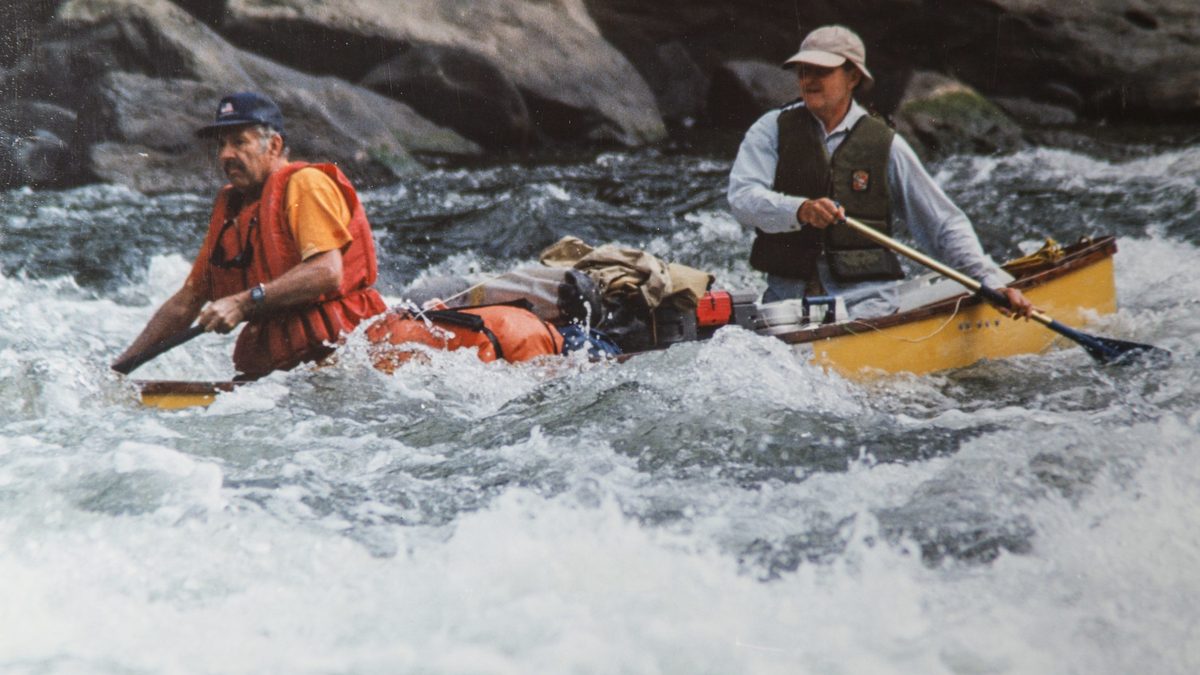
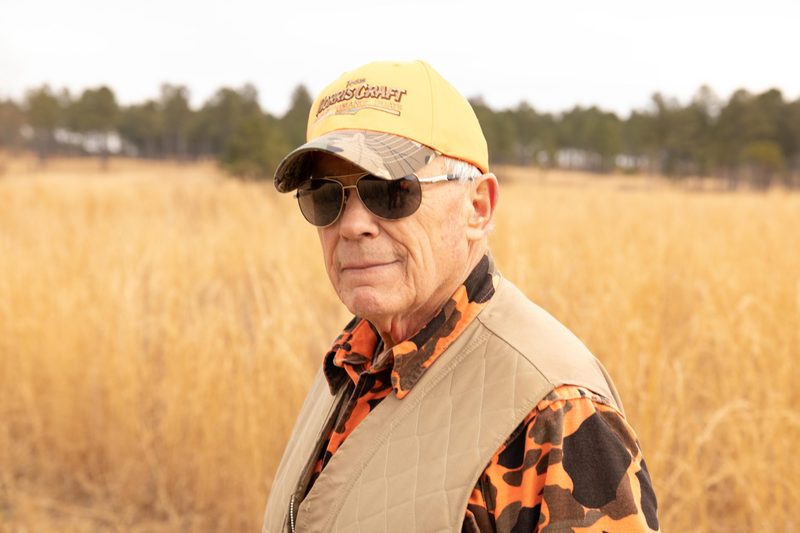
Listening to Frank Venable talk about his father brought back the memory of a fishing trip from long ago. My Dad and his best friend, Bill Opengary, wanted to float a section of the New River in West Virginia and asked if I would like to invite a friend and come along. Absolutely. I called my buddy Mitch King and proffered the offer of three days and two nights of smallmouth bass fishing. He was quick to accept and immediately offered to bring the food. “No, no, no,” I responded. “You are welcome to bring beer or whatever other libation you wish, but we will handle the food.” A spirited debate ensued, but I knew his idea of camp food—hot dogs and potato chips—and mine were as far apart as Republicans and Democrats are these days. There was simply no compromise in sight.
We packed up all the gear one could imagine. We had two beautiful Galt-designed Blue Hole canoes. They were perfect riverboats made from durable ABS plastic, yet surprisingly fast and graceful on the water. It was mid-morning before we completed the shuttle and got on the water. The fishing was terrific. Mitch and I both caught over 75 Smallies each.
Just before we made camp, Mitch made a cast into an eddy on the right side, and you could see several nice smallmouths rising to look at his Rapala lure. I playfully cast mine right next to his, and one of his fish took my bait immediately. He playfully groused as I worked to land the fish, but it seemed to double in strength just as the fish was next to the boat. Mitch’s playful demeanor changed to one of aggravation as he said, “If you have two fish on one cast, I’m going to be mad.” Sure enough, another bass had joined the first, and I landed two simultaneously on one lure. We both ended up laughing and paddled onto the campsite.
There was an old, abandoned farmhouse we had permission to stay in for the night. It was complete with old mattresses filled with straw. I opted for my pad and the porch floor, fearing the little critters that might be living in the straw and not wanting to become their dinner.
While Mitch and Dad ferried sleeping bags to the house, Opengary and I built a fire and began dinner. I filleted some fish, and Ope put potatoes into a large tin can with holes punched in the sides at the bottom while he rigged up a grill over the fire. Mitch broke out some beer, and dinner was ready by the time we had all had a few.
Ope served up the ultimate surf and turf as the most masterful camp cook ever, a top chef in his own right if ever there was one. Ribeye steaks and fried bass, a vegetable casserole in mushroom gravy, baked potatoes, and even a dump cake for dessert. It was a veritable feast in the middle of the wilderness.
With bellies full and beer freely flowing, we laughed into the wee hours of the morning. I was awakened by Ope in the predawn the next day to watch a flock of wild turkeys parading right in front of the porch where we were sleeping. Time in nature is truly magical.
Dad taught me a lot about the outdoors, and Bill Opengary showed me how to create a gourmet meal on a campfire. Listening to Frank talk about how lucky he was to have received the same education from his father and Sam reminded me of how lucky I have been to have had mentors who did the same for me. I can’t encourage you enough to spend some time outdoors with family and friends, and it will make all the difference in the world.
→ Swipe for Next Story
Arts & CultureMAY JUNE 2022
Turning Heads
Tyler Jamison’s passion brings out the beauty in wood
Story by Nathan Sparks
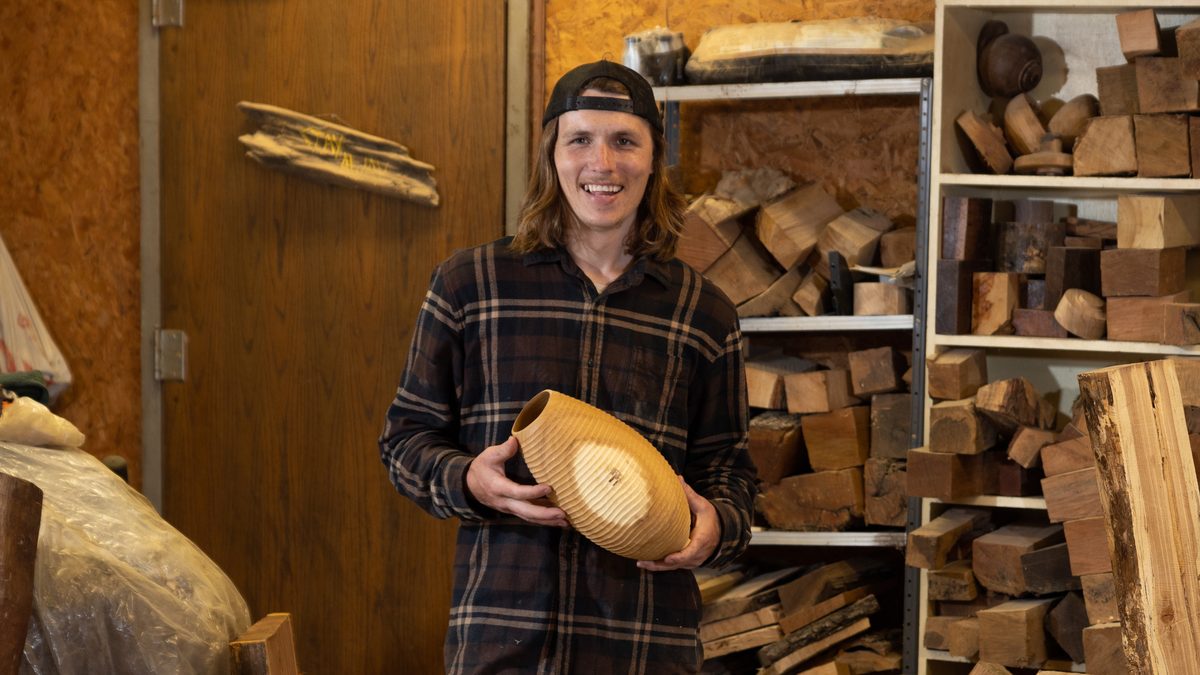
Tyler Jamison carves and turns wood, emphasizing texture, highlighting grain. But he’s not working with just any old wood he finds. Each piece is carefully selected, each unique to itself due to the spalting that occurs in a tree when it’s infected with a fungus. It creates within the wood beautiful dark swirling veins, making Tyler’s finished vessels look like they were painted by the hand of God.
He also turns burls, the growths found on the side of trees. Within these burls the grain of the wood is twisted in a variety of combinations. They make for colorful mosaics in his finished products.
“I can never make the same pieces twice,” Tyler says. “I’m very interested in what’s going on in the wood. I feel an intimate connection with it. It brings me a lot of peace and makes me happy to see the raw wood come to its finished form.”
Don’t be fooled by the beauty of the woods he uses. Wood turning is an intricate and often dangerous art form. In fact, the more beautiful a piece of wood, the more difficult and dangerous it can be to turn. While the fungus creates beautiful marks, it also causes deterioration, leaving voids throughout the wood.
Often working through a hole less than an inch wide, Tyler may be using a specially shaped gouge or chisel to carve deep inside the vessel as it spins rapidly on a lathe. Unable to see the tools as they cut, he is left with nothing but feel. This can lead to a piece quite literally exploding in front of his eyes. But it’s a worthwhile risk, he says, to create something that you love.
While it’s obvious this sculptor has an incredible amount of talent, he is the first to readily share credit for his work. “As the water releases from the wood, it makes the wood warp and shrink. It gets a bit wonky, which I love,” he says. “But it’s all Mother Nature’s doing. I just turned a simple form, and the wood does the rest.”
Simple might be an understatement. Each piece can take as long as two weeks to create. When asked what he does with the ones that don’t measure up to his expectations, fiancé Tara Watson—who handles his marketing and often helps with design—answers, “He puts them on the burn pile. I really hate the burn pile.” Each artist has their own personal standard, and Tyler is no exception. If he is not happy with a piece, it won’t make it out of his shop.
Preferring to work with local hardwoods, Tyler seems to have a knack for finding those exotic pieces in the most unexpected of places. One of his favorites to work with is the root ball of the yew, though those pieces are difficult to come by. Tyler rarely lets the opportunities pass him by. While working on a landscape project, he spotted a yew bush that was slated for removal and offered to dig it up. The root ball was turned into one of his most prized pieces in his collection.
A Pennsylvania native, Tyler has been in the Knoxville area for nine years. Though he’s always been drawn to woodworking, a show at the Emporium three years ago carved out his creative direction. “It was a Tennessee Craft Guild Show, and Gordon Fowler was turning wood on a lathe,” he recalls. “I was fascinated with it. I went home and bought a lathe.” His love of carving hollow forms into simple shapes that allow the wood grain to sing grew.
Tyler sells his art on Etsy, and occasionally at local festivals. He leans toward creating artistic pieces rather than ones designed for function, knowing that each and every one is as distinct as the one before it. “I make them for people to enjoy seeing and holding.”
Head towww.tpjwoodsculpting.etsy.comto view Tyler’s work.If you would like to commission Tyler for a custom piece you may reach him attpjwoodsculpting@gmail.com.
→ Swipe for Next Story
MusicMAY JUNE 2022
Finding Her Voice
Christina “Redd” Daugherty’s journey as an artist is just beginning
Story by Chris Blue
Christina Daugherty’s story is not far from what many musicians have gone through. A challenging experience catapulted her into a life in music.
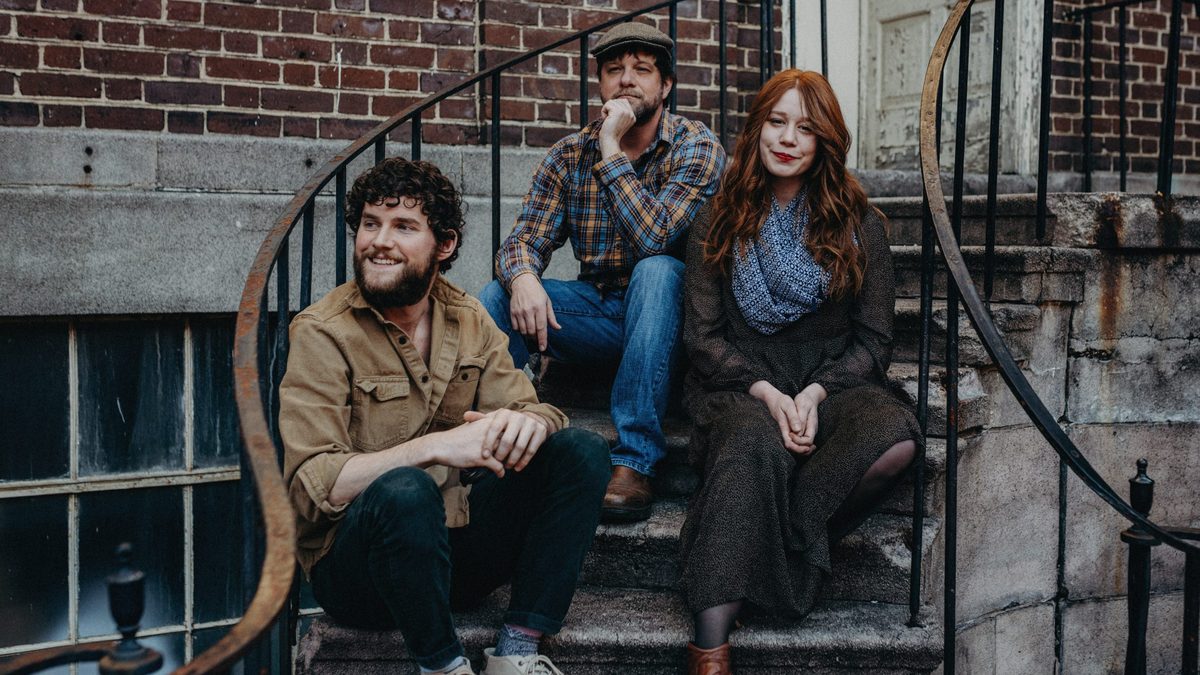
Better known to many as Redd, she found her home in music early in life, originally in her school’s jazz band with classical guitar. It wasn’t until middle school that she fell in love with singing. “I felt a passion for it, but I didn’t really understand it,” she says.
Late in high school at an open mic night, Redd built up the courage to go on stage alone, and the crowd responded to her raspy, unique sound. “That was really the first experience that I had where people were giving good feedback,” she says. But she ended up becoming the person behind the soundboard, quietly supporting other singer-songwriters on their journeys.
I remember that quiet desire. Busing tables at a local restaurant I wanted to make a living through music, but I lacked the confidence that people would ever want to pay to hear me sing. Redd says she felt this, too.
However, at the start of the pandemic, she took a leap. As an English teacher at L&N STEM Academy, it was tough to be away from her students, she says, but she put that time into her music. She started a band and marketed it on social media. Eventually, her students noticed and pushed her to submit a video to American Idol last year, after which she was asked to do a virtual audition for the show’s producers. They later flew her out for an in-person audition, and she finished in the show’s top 40. “It grew my confidence,” she says.
I found myself aligning with Redd’s journey as we talked. When I was told by producers of The Voice that I had something special, that was the first time I heard that and believed it. It ignited a fire in me that still burns today. It seems that happened with Redd, too.
She released her first solo album,Monsters & Mothers, early this year, and is actively working on her next: “I feel like I’ve finally come into my voice.” You can find Redd’s music atwww.reddofficialmusic.com.
→ Swipe for Next Story
PoliticsMAY JUNE 2022
Chartering Knowledge
The clash over the governor’s proposed Hillsdale College partnership
Story by George Korda
The less school students know the good about their country, the less likely they are to care about their country. That’s among the education problems Gov. Bill Lee is attacking in a way that’s upsetting some in the public education establishment. Lee wants Hillsdale College, a small, private, Christian college in Michigan, to open up to 50 charter schools in Tennessee.
Chief complaints about Lee’s plan are that it will divert money from public schools, and that Hillsdale’s curriculum is too pro-patriotic and whitewashes history. The cries of no public money for children’s educations in charter schools seems odd coming from progressives, who typically argue that public money should be spent for contraceptives, abortions, cell phones, solar panel companies, and more. Just not on education if the money isn’t being spent on schools run by government.
If the Hillsdale College program should bear fruit, more parents are likely to want their children to participate. This thought naturally appalls some in public education or their advocates. Perhaps harder to quantify in Hillsdale’s case are philosophical objections, as in it’s too pro-American or not critical enough of the U.S.
At the national level, there’s bipartisan recognition of the need for better public school American history education. Six former Democrat and Republican U.S. secretaries of education—former Tennessee governor and U.S. Sen. Lamar Alexander among them—jointly signed an article that appeared in the Wall Street Journal on March 1, 2021. It said, in part:
“We need teaching and learning that pursues an account of U.S. constitutional democracy that is honest about the wrongs of the past without falling into cynicism, and appreciative of the American founding without tipping into adulation…Regrettably, civics, which teaches skills of participation and the knowledge that sustains it, and history, which provides a frame of reference for the present, have been sorely neglected over the past half-century in U.S. schools. This cannot continue to be the case.”
In today’s America, figurative wars are fought over even naming a U.S. public school after a U.S founding father. However, in a sign parents may have had enough, even in ultra-liberal San Francisco, California, voters in February by huge margins recalled three liberal school board members, in part because of the board’s plan to rename 44 schools, among them schools named for Abraham Lincoln, George Washington, and Paul Revere.
But what do the kids know? Even before the learning fall-off blamed on Covid-19, the National Assessment of Educational Progress data shows a woeful ignorance among eighth-graders of American history: Out of a possible 500 points, eighth graders overall scored 263. “The average U.S. history score for eighth-grade students was lower in 2018 compared to 2014.” Additionally depressing are Tennessee and national scores in math, reading, and other subjects.
What’s being done now clearly isn’t working, and pouring more Tennesseans’ tax money into something that isn’t working ensures that it will continue to not work, just more expensively. Every year, masses of students leave high school incapable of holding a 21st century job, succeeding in college, and have a low understanding of the country in which they live. That’s something parents can understand.
Perhaps Bill Lee or some other governor will prevail in reforming the challenging educational reality we live in. Perhaps they won’t. What we can count on are parent voices. It’s just a question of how loud they are willing to be about reforms to their children’s education.
→ Swipe for Next Story
InsightsMAY JUNE 2022
The Art of Listening
A lifelong skill that requires practice, patience, and persistence
Story by Bruce Fox
I must admit that I’ve picked a topic that I may not be an expert on. By trade, I am a trial lawyer. I help injured people seek and receive justice for the harms and losses they have suffered.
I’ve finally learned, after 45 years of practicing, that I need to talk less and listen more to fully appreciate what someone is trying to convey to me. I found that when I actually listen to my client’s story about how the event has impacted their life, I gain new insights on their experience with the injury and how we can work together to resolve the case.
I recently had a client with a back injury who I thought had an unrealistic view of her case. It was only after I truly listened that I came to understand the full impact the injury had on her life. She had a daughter with three young children and her son in law had left the marriage for another woman. My client was the daily caregiver for the three young grandchildren that were all under six years of age. When I finally listened, I learned how difficult it was for her to care for her grandchildren in the way she needed. She could not pick up the two youngest children, an unexpected impact I never really considered. With that information in hand, I was able to reach a fair resolution with the insurance company.
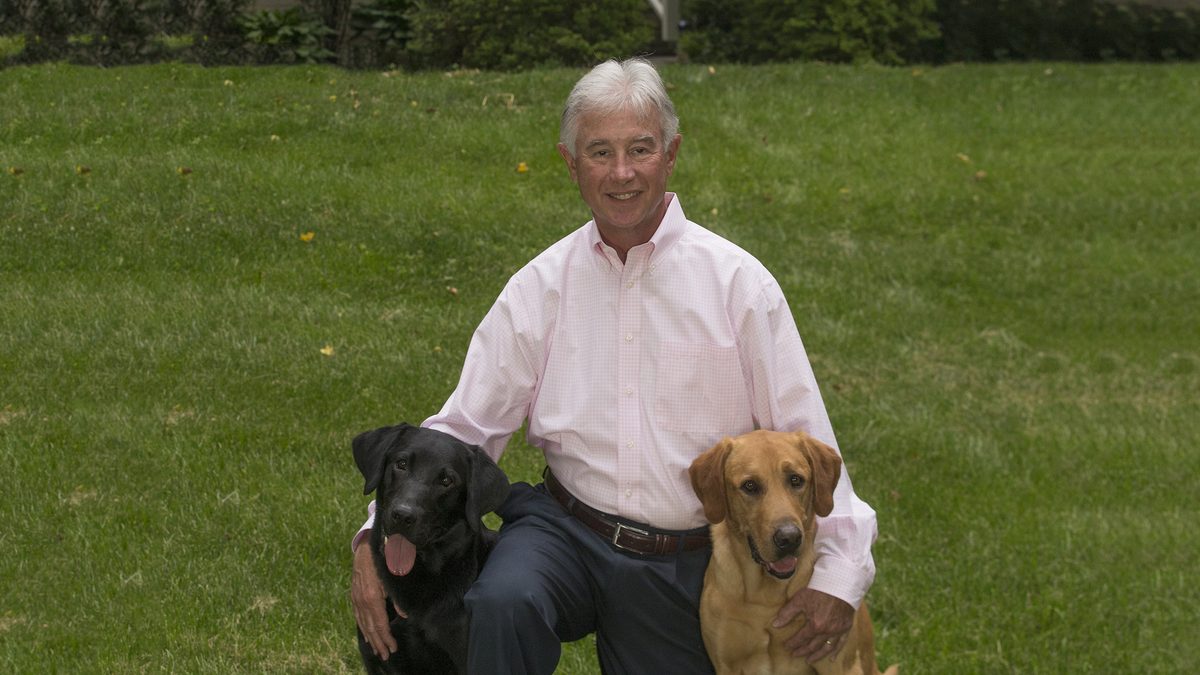
This important art of listening is incredibly valuable to me in my professional life, but over the years I’ve learned it is just as important, perhaps even more so, in my personal life. If you know me, you know that my labs, Ty and Woodrow, are my constant companions and best friends. Last month, Ty kept coming to me while I was at my desk and putting his head in my lap. I knew something was up so I took him to the vet. After x-rays and testing, we discovered that he had a cancerous growth on his spleen; the vets told me he probably had six months left with us. Following surgery, I brought Ty home and he laid on his bed in the den. He whimpered, trying to get my attention, so I finally laid down with him and held him. I was thankful that I listened intently to his needs because in that moment, as I held him in my arms, he passed away.
Listening takes time, practice, and skill. And it becomes something even more profound when you begin to not only start listening, I mean truly listening to the words someone is telling you, but also begin listening to what is not said. Maya Angelou once said, “I’ve learned that people will forget what you said, people will forget what you did, but people will never forget how you made them feel.” The more we are open and engaged and make every effort to really listen to one another, the more likely we are to develop more meaningful relationships and connections.
→ Swipe for Next Story
Dining GuideMAY JUNE 2022
In Vino Veritas
Sipping on wine and munching on small plates in Knoxville’s wine bars
Story by Marc Anthony
A rapidly growing segment of the population has found wine bars a cozy and comfortable place to indulge in the fruits of the vine. From curious novice to established expert, East Tennessee wine lovers are piling into new and established haunts searching for knowledge and the perfect glass of vino…but also the cocktails, food, and fun.
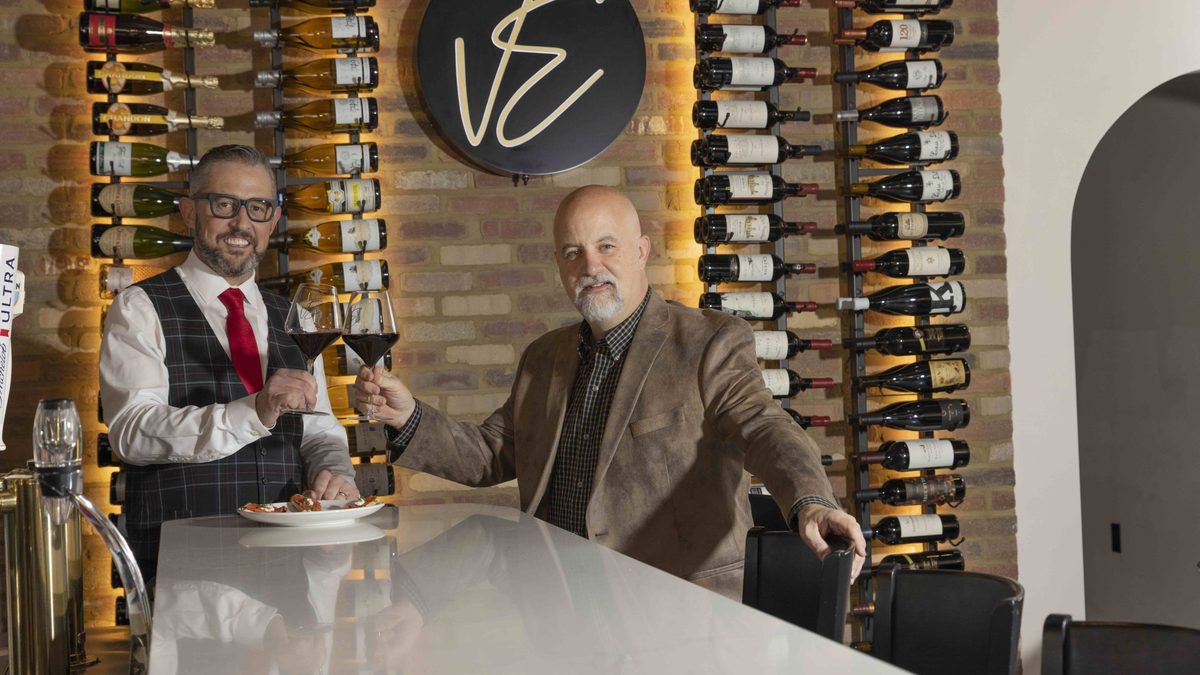
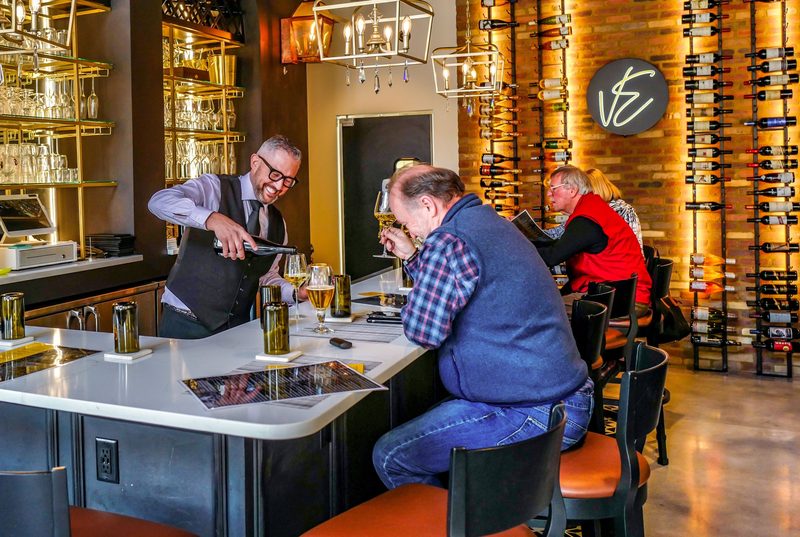
Not many businesses in Knoxville can say they deliver service with a Belgian flair. Bart and Haley Van Edom have curated an extensive beer and wine menu from around the world, but Bart is most proud of his collection of Belgian beers and logoed goblets. A Belgian twist on southern food brings you delectable parmesan truffle frites (Pro Tip: Don’t say French Fries here), and the more adventurous Flemish stew slow cooked in Trappist beer. With Bart’s background in chemistry, he has a special understanding of wine that will help him keep only the best of the best in the rack. With a high ceiling highlighting an exquisite chandelier, Van Edom’s is world class and just down the street in the Markets at Choto.
Farragut: 12344 S. Northshore Drive|(931) 319-9017
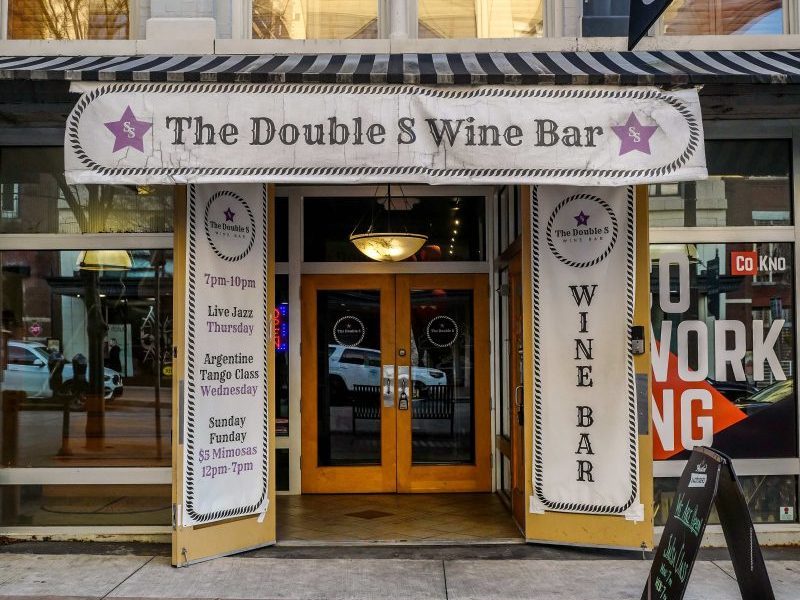
A wine bar that clears the century-old wood floor to make room for Salsa dancing has got to be the spot to be. Double S is on the fringe of the Old City, but definitely part of the new wave of wine bars. Offering live jazz, Argentine tango lessons, countless wine options, and gourmet cheeses, and desserts, Double S offers a cozy atmosphere in an historic Knoxville location. Owner Steve’s extensive knowledge of wine is never overwhelming to the newbies; you leave feeling as if you’ve learned something about fermented fruit. My cheese platter was divine and perfectly paired with a red wine that was full bodied and aromatic. Pro Tip: The best place in town to listen to Sinatra and Armstrong in Knoxville is here.
Downtown: 129 S. Gay Street|(865) 244-5117
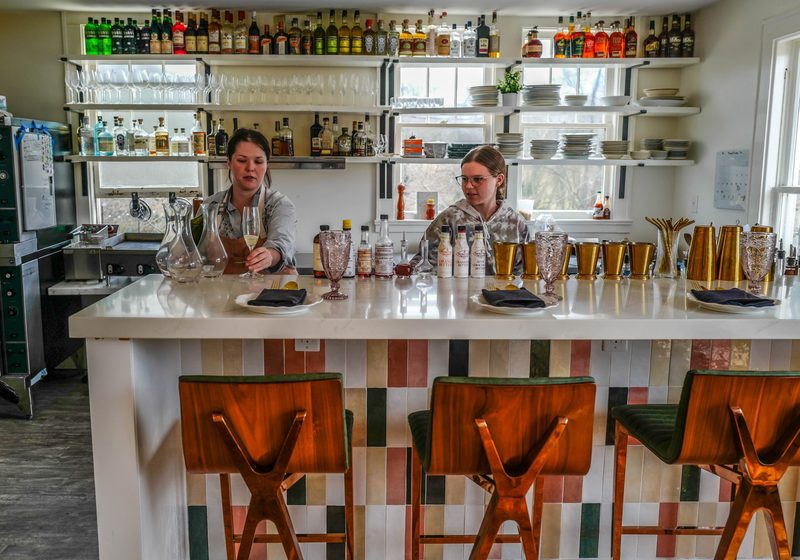
As someone just tipping his toe into wine, figuratively mind you, Water Into Wine was going to ease me in gently. Educated servers, a certified mixologist, and an owner always smiling and gently prodding you to taste something you’ve never heard of—like Prosecco strained through blueberry skins—my experience was educational and phenomenal. And that’s even before the food hit the table. You are amongst friends, even if you’ve not met anyone, and the staff at Water Into Wine make the entire experience thrilling. Tens of thousands of bottles of wine and cocktails since 2016 has Water Into Wine Farragut’s top spot. Pro Tip: Brûléed Brie. Hard to type, so easy to devour.
Farragut: 607 N. Campbell Station Road|(865) 392-1586
Diamond Jack’s slogan on their website: Elevated Bar Food, Extensive Wine List, Consistent Vibe. Allow me to add to that: Perfect Cocktails. And if we’re being honest, I drank no wine at Diamond Jack. Maybe if Sasha wasn’t a certified mixologist and wasn’t so proud of the vast array of bourbon and didn’t make the perfect Perfect Manhattan, I would have gotten to the wine. Well, the second ingredient, vermouth, is wine, so I guess I did. Who knew it would pair so perfectly with the Wagyu Beef Hotdog on the menu. Honestly, it was a perfect evening of culinary, cocktails and conversation, and owner Micah brings the Blackberry Farm experience to your table in the most satisfying way.
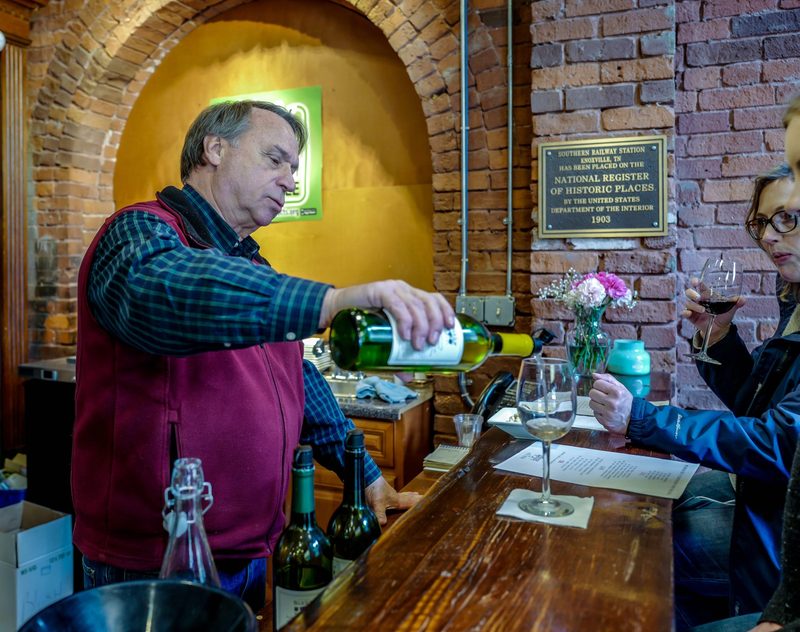
Located in the historic Southern Railway Station, Blue Slip transports you to the early 1900’s. Down a long flight of stairs and to the back of the depot, you almost feel like you’re slipping into a prohibition era speak-easy. This uniquely elegant facility offers a beautiful tasting bar, ballrooms for events, and plenty of free on-site parking. How often do you get a glass of wine poured for you under a National Register of Historic Places sign? Owner Jeff would rather have his wine photographed than himself, but with his encyclopedic knowledge of local wine and contracts with local grape growers, Blue Slip offers the most unique experience in Knoxville wine tasting.
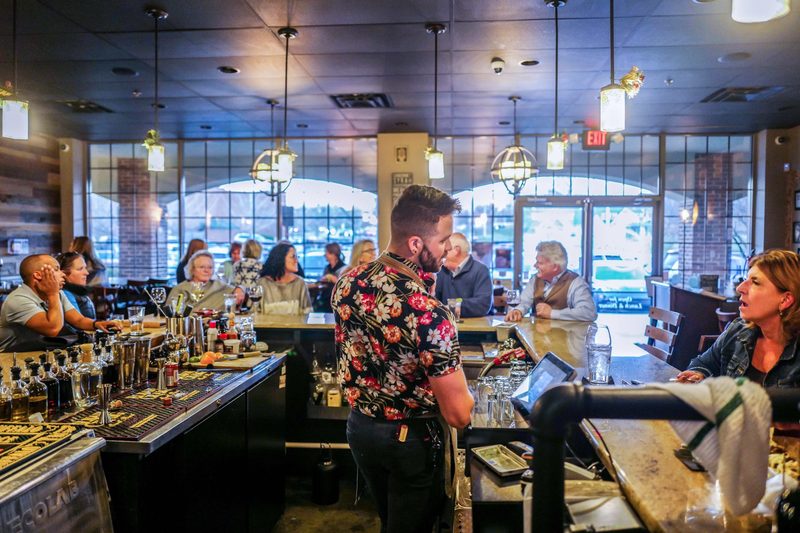
I’ve never been to a wine bar in New York City, but Drink transports me to midtown Manhattan. This might just be a top spot for first dates as each table and seat at the bar is enrobed in muted lighting, which is fancy talk for dark. Like most wine bars, Drink’s cocktail list is vast with expert bartenders ready to concoct the perfect Manhattan. See? Transported. Responsibly sourced wine from around the world is prominently featured along with food from the adjacent Bistro By The Tracks, a long-time Knoxville favorite. Jazz night Thursday and Soulful Saturday make this one of the few places in town with consistent live music. Transport yourself to “Midtown Bearden” for an urbane and private wine bar experience.
Pigeon Forge pushed through to find its place on the map
Story by Gary Wade
In 1783, Colonel Samuel Wear served under John Sevier in the Battle of Kings Mountain during the Revolutionary War. He later settled his family in an area of the North Carolina territory bounded by two streams—one now known as Walden’s Creek and the other as the West Prong of the Little Pigeon River. Wear, as the county clerk for the failed effort to create the State of Franklin, became a constitutional convention delegate in 1795 in a second effort at statehood. In a meeting at Wear’s Fort, he and three other delegates authored what became the 1796 Tennessee Constitution. Sevier, of course, was named the first governor of our state and, in 1796, the Wear family officially became a part of Sevier County, Tennessee.
In this early era, the passenger pigeon had become the most abundant bird in North America, numbering between three to five billion. During their migration to the south, these birds would darken the sky, often stopping in the river valley near the Wear lands. Their prominence in the bird population and their importance as a food source warranted naming opportunities—the West, Middle, and East prongs of the Little Pigeon River cover much of the county. Hunted on a massive scale as game birds and plagued by the deforestation of their breeding grounds, the species drastically declined in numbers after the Civil War until the very last survivor, a female named Martha, died at the Cincinnati Zoo in 1914. Meanwhile, beginning as early as 1820, iron ore banks were discovered in the area not far from the Wear property. Because iron was in such short supply, Isaac Love built a forge along the West Prong to convert the ore into iron and help meet the local demand. Naturally, the community became known as Pigeon Forge.
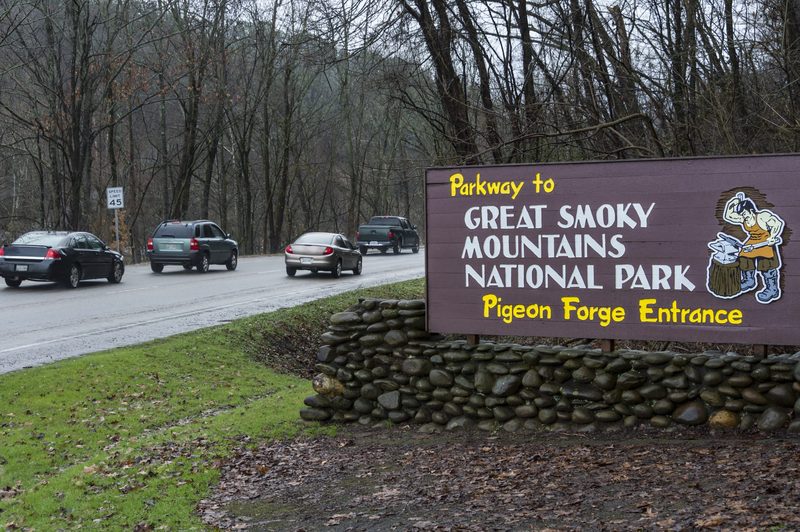
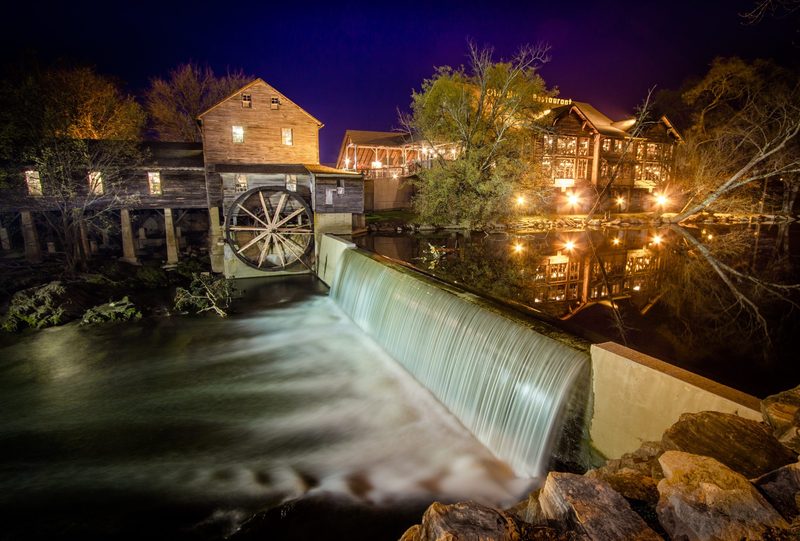
Roll the clock forward into the 20th century as this lovely valley became the most popular route to Gatlinburg and the Great Smoky Mountains National Park. By the 1950s, the Green Valley Restaurant, Trotter’s, and the Apple Tree Inn were popular family-style eating places for summer vacationers and Knoxville area day-trippers. While primarily a residential community, the community began to welcome and accommodate its visitors. The historic Old Mill, Butler’s Store, and later the Pigeon Forge Pottery had locations on the West Prong. The Pigeon River Court, McAfee Court, and other small motels and tourist courts offered lodging alternatives to the popular Gatlinburg hotels. An amusement park, featuring elephant rides, chimpanzees, and caged exotic animals, bore the name of Fort Weare, with an “e,” presumably taken for the original Wear’s Fort in a case of creative spelling. Rebel Railroad, which was later re-named Goldrush Junction, then Silver Dollar City, and eventually Dollywood, was in its infancy.
Envisioning a tourist economy like that of its upstream sister city, some community leaders began to believe that incorporation as a city would provide the infrastructure essential for further development. When Sevierville and Gatlinburg initiated plans for an airport in their community, many property owners objected, sparking enthusiasm for the creation of their own form of local government. Doug Ferguson, whose pottery had experienced a major fire, helped lead the initiative, partly in hopes of establishing a fire department.
The initial vote for the incorporation of the community failed, 134 for and 162 against. A second vote, on April 4, 1961, passed barely—by a margin of eight votes. Pigeon Forge had matured into a city. A banker, Xan Davenport, who had advocated adopting the name Buena Vista, was nevertheless elected as the first mayor. Dan Conner, who in a bit of irony had opposed incorporation, became the city manager. Within months, a young Knoxville Business College graduate, Earlene Teaster, was named City recorder. The official population for the city? 974. A sign on the Parkway welcomed its visitors: “Pigeon Forge”, it read, “City of Destiny.” That got a few chuckles from some in Sevierville, the county seat, and Gatlinburg, a genuine resort destination by then and the county’s largest sales tax collector.
This fledgling city had its challenges. Those of us in the mountains, both blessed and cursed with inborn independent streaks, are not often amenable to change, especially when it comes to taxes or restrictions on land usage. Many of the initiatives enacted by the commissioners ended up in the courts. The Midway Drive-in, affectionately known as “the passion pit,” began to show R-rated movies which could be seen from the Parkway. In consequence, the commission passed an ordinance prohibiting such displays. Knoxville attorney Joe Levitt successfully challenged the new law in the Chancery Court. Former University of Tennessee Legal Clinic supervisor, Larry Leibowitz, representing the billboard industry, objected when the city commission voted to require the removal of off-premises signage— better known as billboards. The city lost in the state supreme court. There were also suits to overrule the city ordinance prohibiting beer sales.
As other hotels and restaurants were built, overburdening its roads, water and sanitary sewer systems, the city received permission from the state’s General Assembly to adopt a gross receipts tax. Several businesses opposed to the tax filed suit. Although the new tax was ultimately upheld by the supreme court and its revenues helped the city to continue its growth, the litigation was not without significant cost. The city experienced yet another legal challenge when the commissioners elected to extend its boundary to the north. Although the suit was resolved favorably for the city, the case also went to the state supreme court, delaying the addition of new territory for over a year. In one of the last opinions authored by former Chief Justice Joe Henry, Pigeon Forge was permitted to extend its boundary along the Parkway to that of its downstream neighbor—Sevierville.
As the “City of Destiny” came into its own as a destination for its visitors, its commissioners learned that they had no control over the noisy—and sometimes dangerous—helicopter flights offered to sightseers. It sought help from the state to move those flights out of town. The district’s state senator, Carl Koella, a Republican, and City Attorney Norma Ogle worked with Democrat Bob Cooper, who later became state attorney general, to craft legislation which might meet constitutional muster. After losing one challenge in the courts, the state, on behalf of the city, eventually won approval of a statute barring copter flights within a nine-mile radius of the national park—effectively moving those flights out of town.
Much of the growth in the city is related to the return home of Dolly Parton. Her partnership with Silver Dollar City established Dollywood as the major amusement park in the state. As her stature has continued to climb, so has the success of the development—now over 35 years all together. Today, Dollywood boasts Splash Country, the DreamMore Resort and Spa, and the Dolly Parton’s Stampede Dinner Attraction—all in addition to the theme park which entertains over two million visitors every season. There are 3,000 employees. How has that impacted the city? In 2020, sales were in excess of a billion dollars, helping make Sevier County the top sales tax collector among all 95 counties in the state.
With all these changes since 1961, there has been one constant—Earlene Teaster. Spry as ever after almost 61 years with the city, she continues as city manager—in classic servant leadership style—with no end in sight. Her commissioners, past and present, uniformly believe her to be the best city administrator in the universe—and surely the most beloved. Her staff agrees. Longtime residents James and Julia Householder, stalwarts in the community well before the incorporation effort, extol her virtues. In keeping with community history, Earlene has lived in Wears Valley for more than a half-century. Furthermore, the city’s mayor, David Wear, now in his 11th year on the job, is an eighth-generation, direct descendant of Samuel Wear, whose signature appears on our state constitution with such notables as Andrew Jackson. The “City of Destiny” sign disappeared long ago. Perhaps it has arrived.
→ Swipe for Next Story
InsightsMAY JUNE 2022
Meet Me at the Market
Finding that perfect taste among the vendors of the farmers market is a summer delight
Story by Robert Pryor, Sr.
I can remember my mother admonishing me to eat my vegetables. I resisted her throughout my childhood and made fun of my father’s devotion to “homegrown tomatoes.” Boy, would they be proud of me now. It’s springtime in East Tennessee, and I am anxious to get my hands on all of those fresh farm products I used to shun.
This year, spring is a reward for surviving 2021, and the best thing about it is the opening of our local farmers markets. I must admit I’m a farmers market junkie–the more, the better. Each spring and early summer I stock my screened breezeway with fresh fruits and vegetables straight from area farms to my country pine table (also purchased from a vendor I met at a farmers market). A man’s wealth is not measured by gold, but by how many gorgeous homegrown tomatoes, cucumbers, peppers, squash, and ears of corn he can display on a pine breezeway table.
When I share information about farmers markets with you guys, I want you to get one thing straight–I’m in it for the taste. Sure, fresh farm vegetables are nutritious and economical, but I’m after that homegrown in East Tennessee soil taste.
Of course, it’s good to support local farmers, and markets are a good place to see old friends and meet new people, but, for me, nothing equates to the taste of a ripe and ready homegrown tomato. You don’t see a lot of young people at farmers markets, and that’s because you have to be at least 40 years of age to appreciate homegrown vegetables.
Farmers, growers, bakers, and specialty food artisans serving the Knoxville area are listed onwww.easttnfarmmarkets.com. Many vendors sell only their specialties, including heirloom tomatoes (Cherokee purples), peaches and cream corn, cut herbs, berries, jams and jellies, and baked goods.
If you prefer to buy straight off the farm, one of my favorite stops is the Coning Family Farm in the Carpenters community of south Blount County. On every visit there, I’m reminded of my grandmother who tended to her own garden as a child less than a mile from where the Coning family sells great cantaloupes, watermelons, and a wide variety of fruits and vegetables. Blount County tomatoes are a hidden treasure and well worth the short drive to the picturesque foothills farm. My trips to Blount County always include a lunch stop at Small Town BBQ in Friendsville.
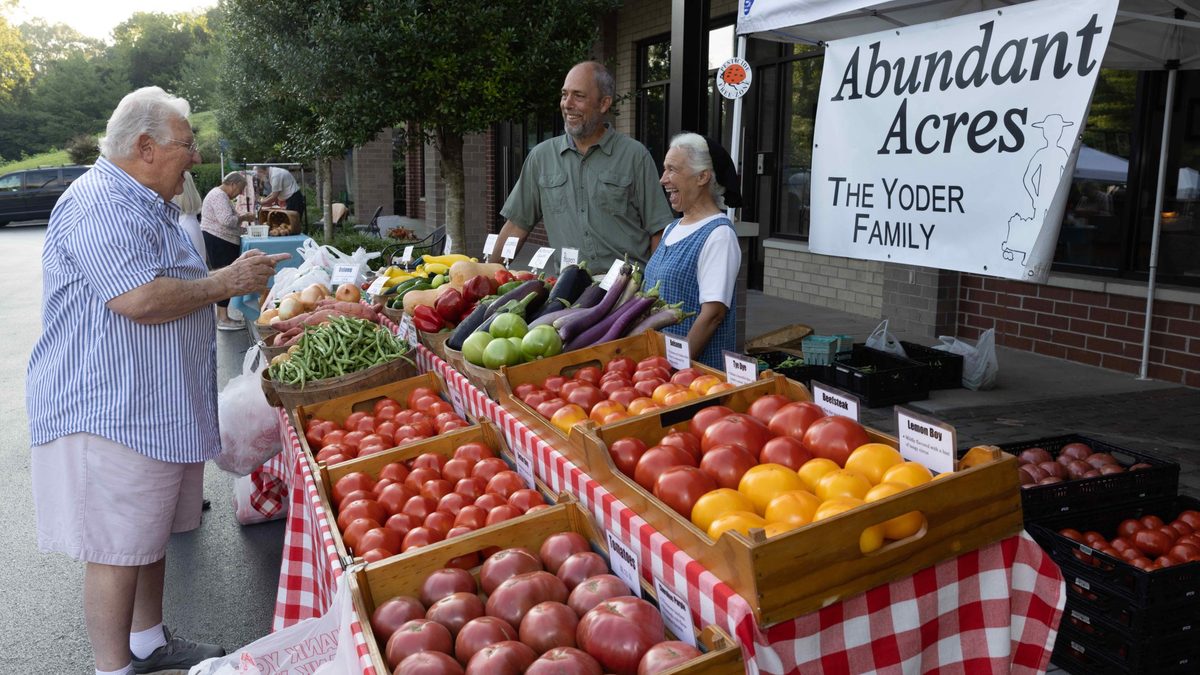
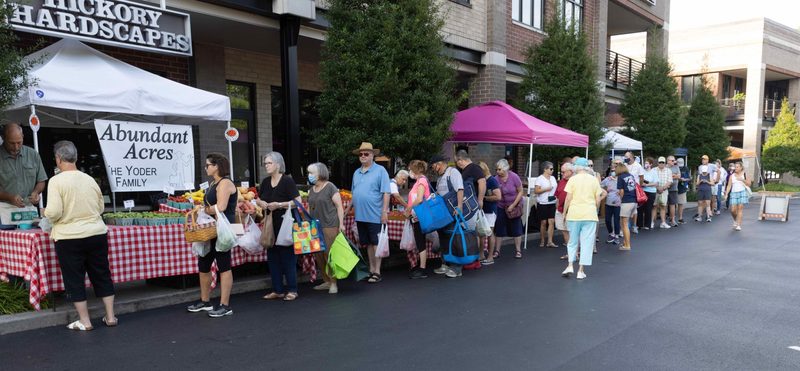
A popular vendor at the Dixie Lee and Ebenezer markets is Abundant Acres Farm of Athens, Tennessee, owned and operated by Dean and Carmen Yoder. The Yoder family has produced and sold the most beautiful and delicious vegetables in the region since 2008. Usually first appearing at market in early June, you will find them in the month of May at their Starr Mountain Greenhouse at 259 County Road 608 in McMinn County selling bedding plants and colorful hanging flower baskets.
The Yoders are hardworking farmers, especially since their five children transitioned off the farm and into the service of their Mennonite religion. All the Yoder children are now performing regular mission work and are also engaged in careers to provide for others as teachers, wilderness camp counselors, Bible study missionaries, or as church leaders on a South Dakota Indian reservation.
The Yoders are not only successful at raising flowers and vegetables, but they have lovingly raised five faithful children dedicated to making a better world for others.
Dean Yoder builds the fertility of his two cultivated acres by use of peas and grasses as cover crops and with the use of leaf compost in the off seasons, and he only uses natural fertilizers. The Yoders weed by hand and use no chemicals, producing the vegetables shown along with this article. Expect lettuce, cucumbers, squash, and kale from the Yoders in early June and a variety of the most tasty tomatoes in July.
One pre-pandemic summer afternoon, I was standing in a long line to buy vegetables from the Yoder family, and as the line slowly moved forward I was positioned behind a tall, elderly man and his short, unpleasant wife. When we finally reached the elegant display of vegetables and strawberries, the tall gentleman suddenly walked away to another vendor without even a farewell. You could say he left his wife “holding their bags.” Not noticing her husband had left, the lady saw some green onions that she had to add to her plunder causing her to half turn and speak to me over her left shoulder, “Give me one of those bags!” she ordered, referring to the plastic bags hanging on the front of the display table. I quickly tore one loose and handed it to her and she embarrassingly said, “I’m sorry, I thought you were my husband,” to which I replied, “That’s okay. The way you said that, I thought you were my wife.”
In just a few short weeks, I’ll be cutting up one of those great Yoder tomatoes and a pickling cucumber into a large bowl, covering it with balsamic vinegar and blue cheese crumbles. I’m not sure that’s best for my arthritis, but who cares? My family makes fun of me about the gazpacho soup I make all summer with farmers market chopped tomatoes, onions, bell peppers, and cucumbers, only to convert my creation to salsa later by simply adding jalapenos, garlic, cumin, and cilantro. When we grow tired of the soup, we enjoy salsa for weeks thereafter.
See you soon at a farmers market near you.
Regional Farmers Markets
Dozens of East Tennessee producers call the region’s farmers markets home throughout the season selling produce, herbs, meat, cheese, and more. Find one close to home:
Oak Ridge Farmers Market Jackson Square, 281 Broadway Ave Saturdays | 8am–noon
→ Swipe for Next Story
FeatureMAY JUNE 2022
Summer Oasis
A French Provincial home on Fort Loudoun Lake welcomes family and friends for a summer of fun—and then some
Story by Rebecca Whalen
There are moments after you move into a new house where you feel at once at home. All the noise around you subsides and you find yourself realizing this space is yours and there is nowhere else you’d rather be. For Pete and Kathy Horton, those moments began last summer.
The two had been in their new home on Charlottesville Boulevard for just a few short months. Situated on the edge of Fort Loudoun Lake, their new custom home was everything they were looking for in their retirement home. Pete sat out back on the deck, enjoying the space, watching Kathy out in the pool with her sun hat on. Her arms were up on the side of the pool, as she watched the boats pass by the house. “I know she’s happy when she’s doing that,” he says.
Kathy is quick to agree. “When Pete shuts down for the day, we put our suits on and go for a late afternoon swim before dinner, and maybe have a glass of wine or beer, and that really is special,” she says. The pool brought about a peaceful place for them to spend time together last summer, and no doubt this summer will be filled with many more of those special moments.
Creating Home
The Hortons hail from Birmingham, Alabama. With three grown sons and six grandchildren, all of whom live in different locations, travel to visit family was frequent. Back in 2015, one of the Hortons’ children moved to Knoxville. Pete and Kathy were on the brink of deciding where they would retire. “We would come up to visit with him and, you know, the lake life was really attractive to us,” Pete says. “And when we’d go back home, we’d start talking a little bit about the possibility of looking around Knoxville.”
On the requirement list for where they would retire was to live on the water, be close to family, and be in a city with good health care—and Knoxville fit the bill. “Plus a few bonuses,” Pete adds. “We’ve got the seasons here, and the taxes are just really attractive for retirees.”
On one visit to Knoxville, those dreams began to feel within reach. They drove through Charlottesville Boulevard and found called to one lot in particular. “One of the things that appealed to us about this lot is that it was relatively flat, and we always wanted a pool,” Kathy says. “Also, the view was way at the top of our list, and the view from the quad was very beautiful, looking across the lake to a really beautiful hillside, with homes on it and a train track over there, which is kind of charming.”
The lot had so much potential, and the Hortons began having discussions on what life would look like as Knoxvillians. It wasn’t long before they made an offer. It was 2018, and their journey to Knoxville had begun.
Crafting a Team
The Hortons began working with local home designer Stephen Davis, who later referred them to interior designer Kurt McKeithan. They were interested in a French provincial home—often characterized by steep ceilings with large windows—so Stephen designed it as such. And he made the most of the unique lot. “Because of the shoreline, they did have the potential for a great view, a different view down the channel to the right,” he says. “They’re looking, of course, across the lake as well, so that view to the back right was special, and that’s what we focused the house on.”
Kurt then brought their design desires together with Stephen’s layout. “They wanted stuff that was elegant, but new and up to date,” he says. “They didn’t want stiff, they wanted comfortable, but they wanted clean lines.”
With fresh designs nearly finished, Jason Wilson joined the team to begin taking the designs from paper to property. “It’s a pretty good size house on a relatively small lot,” Jason says, “but the way Stephen put the house together and the selections that were done, it just fits the property perfectly.”
An Elegant Entrance
Walking into the home is an experience in and of itself. “We knew we wanted something iron or metal, we wanted something heavy,” Kurt says. “We wanted the doors to be bigger than life when you walked in the space.” And the house called for it, he says, pronouncing the entrance as Stephen’s plans alluded to.
These 10-foot heavy doors open to a two-story, 30-foot foyer with beams and a two-tiered iron chandelier drawing the eyes up. To the right, a spiral staircase, created by David Garrett of Garrett Stair Company, with iron railings and a Juliet balcony bring visitors to the second floor. Right behind the staircase on the first floor you’ll find a curved entrance to Pete’s office—retired doesn’t always mean retired—and a half-bath. To the left, a more formal dining room.
Looking for a way to bring interest to the rather large walls in the foyer, Kurt suggested giving it some texture, eventually zeroing in on an eye-catching, but also easily cleanable wall treatment called venetian plaster.
“It’s a very, very elegant look and fits the architecture,” Kathy says. They loved it so much that they ended up adding it to the entire first floor.
Playing Host
The Hortons built their home with entertaining in mind, and nowhere does this shine more than the remainder of the first floor. The front entrance opens to a more formal living room with an elegant limestone fireplace and mantel. Above and around the fireplace are a mix of locally built pieces, antique selections from different parts of the country, and modern furniture. You’ll find this mix across the house.
Connected to this space is a small dining area and a bar across from which a butler’s pantry sits ready for guests. These spaces flow effortlessly into a large space housing the kitchen and what the Hortons call their “gathering room.”
A tall stone fireplace fills one side of the room, with a mantel made from an old church beam—a stark contrast to the fireplace in the formal living room. Here you’ll also find a three-tiered chandelier and intricate beam work that accentuates the vaulted ceilings. “It was a nice balance, and that really was a big team job,” Kurt says.
What makes this space a favorite for Kathy and Pete is its entertaining abilities. It’s not only the go-to location when their family comes to visit, but also when friends come, as the kitchen connects directly to the room through a near 10-foot-long island. “It’s a really special surface. It’s leathered,” Pete says.
“You can just kind of mingle around the bar or walk into the kitchen and visit with Kathy and see what she’s doing,” he says. “When the kids are here, they’re in the gathering room and Kathy’s in the kitchen. It’s just a wide open first floor and it functions differently for who’s in the house.”
Kathy loves to be in the kitchen, with cabinets boasting clean lines and appliances from Quinn Appliance. But Pete’s favorite spot is the screened-in patio that attaches to the gathering room, also viewable from the kitchen. “The way the gathering room and the patio are kind of stacked back from the house toward the lake, that was very intentional,” Stephen says. “Because of the views, we wanted everything to be able to look straight out the back.” The screened-in patio houses a grill, television, and seating, a bonus entertaining space.
Sanctuary Space
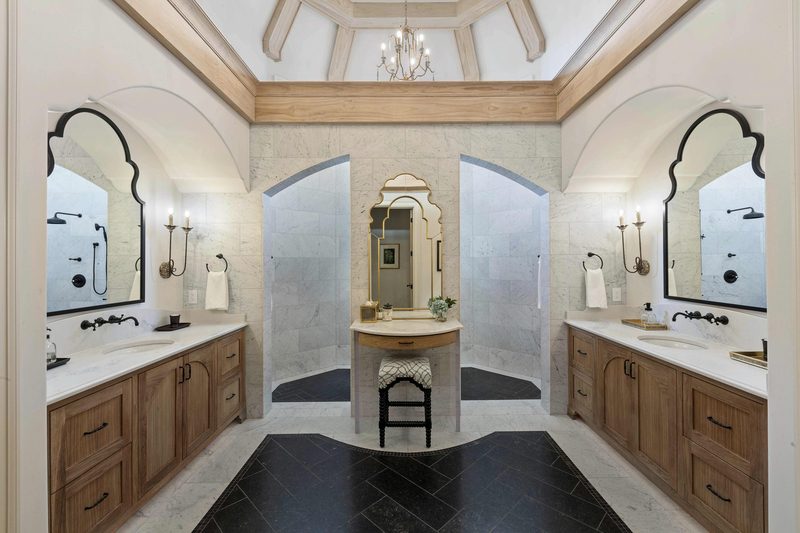
The first floor is also where Pete and Kathy’s master bedroom and bathroom are. “We wanted big windows all across the back and we wanted to do something really special in the master bathroom,” Kathy says. And did they ever. Instead of a tub, they opted for an enormous, open shower with white Carrera marble and an onyx, flat “very striking” black and white tile. Natural light brings this unique shower to life.
His and hers vanities border the bathroom with special light sconces and arches above them that bring the elegance in. “They wanted something dynamic,” Stephen says. The symmetrical design of the bathroom allows for a perfect center space for a custom-built makeup vanity for Kathy. “I zoned in on spatial details by the inch,” Stephen adds.
Like the gathering room and entrance, intricate beam work and chandeliers call the eyes upward, the height driven by the exterior architecture. Kurt then came in and developed ideas to make the most of the space Stephen created. Jason was the final factor. “Once we showed him the drawing and sketch, he went to town,” Kurt says.
For the Guests
The second floor of this French provincial home was all about the guests. Multiple guest bedrooms fill up the second floor, including what Pete and Kathy call the “second master bedroom.” Twelve-foot glass doors carry out to an upper patio from this room with epic views of the lake and backyard.
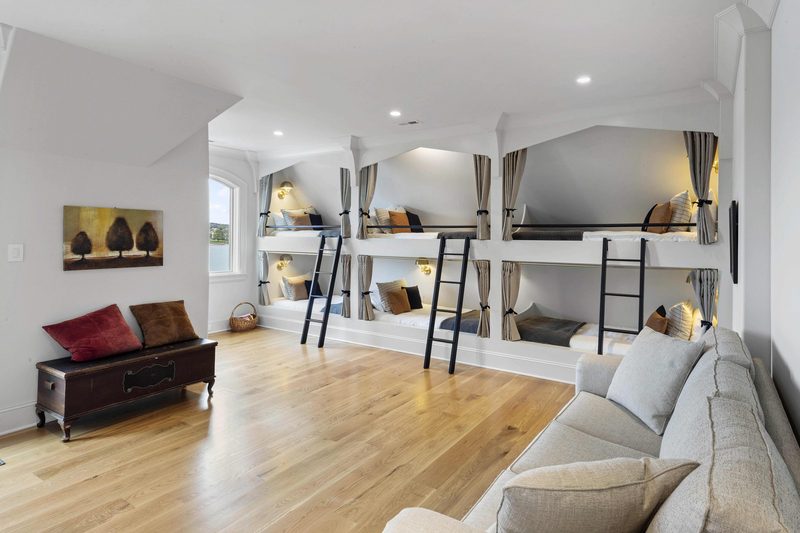
This patio is also accessible from the second guest bedroom and third very special guest bedroom, built especially for the six grandchildren. The open theme carries throughout this space as well, as there is no door entrance to this room. Six built-in bunks line the far wall, all with their own lights, charging ports for iPads, and drawn curtains. Pete calls it a cornerstone for the kids in the new house.
“We wanted to make it where they could close their little curtains up and almost feel like they’re on a little train car,” Kurt says, “where they can actually sit there and read at night.”
The room is entirely for the children, but Pete and Kathy envision it to also be a space they can utilize for other guests as well, including in it a small counter and cabinet space, versatile enough to house a small coffee bar should they need it.
Dreams Realized
Pete works in automation with Legrand, and his work found its way into every aspect of the home. “One of the things we did really well was plan for automation, the home-distributed audio, the camera systems, Ethernet ports, television systems,” he says. Often these are an afterthought, but given Pete’s knowledge on the subject, it was planned.
“We talked about that from the very beginning,” Stephen says, adding that Pete led the charge in that area of the home design. As a result, every area of the home is fitted for its unique needs, including speakers and lighting for outside, a hot spot for summer guest entertainment.
Access to the backyard can be found across the bottom floor. It’s more of an oasis than anything else. The Hortons got their dream pool right out back, a firepit with ample seating offering a different space to convene for conversation or to watch the fireworks in July, and a babbling brook handcrafted by Jason utilizing water from the lake.
Down at the end of the property is a dock where the Hortons are eager to see friends come throughout the summer. While they enjoyed their new home immensely in 2021, this will be their first full summer there. “It’s a good stopping place to know somebody that lives on the lake,” Pete says. “We are hoping that folks will come up to our dock and come see us.”
→ Swipe for Next Story
FeatureMAY JUNE 2022
Helping & Hijinks
Akima celebrates 75 years of relationship building in Knoxville
Story by Susan Alexander
Emma Bea Stallings needs no time to ponder when asked why she’s stuck with the Akima Club for so long. Stallings is the active member with the longest standing in the Knoxville women’s club. “Two reasons,” she declares. “One is because of the friendships I’ve made and, two, for the good that I’ve had the opportunity to participate in for our community.”
She cites the club’s involvement at the Ronald McDonald House, where members have provided meals, decorated for Christmas and visited with clients. “I love hearing about their families and how Ronald McDonald House is helping them,” she says.
The annual Christmas party the club throws for the clients at Sunshine Industries, which serves people with intellectual disabilities, also springs to mind. “It’s one of the biggest soft spots in my heart. I love the personal contact with the clients. And when we interview people with the nonprofits that we give grants to, I love hearing their stories too.”
It’s that connection — both among its members and with the nonprofit community it serves — that’s kept the Akima Club going strong for 75 years.
Dedicated to Service
From its humble beginnings in 1947, when seven women formed a club initially associated with the General Federation of Women’s Clubs, Akima Club eventually evolved into its own independent local entity with a Native American name that means “leader.” Its active membership is maintained at no more than 150 women of all ages from all parts of the city. About 100 more support their activities as sustaining members.
“Our members are having new babies and having grandchildren,” says Harriet Miller, publicity chair. “Back when it was started, most were homemakers; now we’re mostly women who work. We didn’t have any single women initially. And our meetings used to be day meetings. Now they’re mostly at night.”
Members recommend women they know as potential members. Every active member pays annual dues and agrees to complete a set number of hours doing volunteer work and attending Akima meetings and serving on committees. They have no set meeting space — most of their meetings are held at the Bearden Banquet Hall — and their storage space consists of members’ attics and garages. They have no paid staff. All the money they bring in they send back out to the community.
Each year Akima awards local nonprofits with grant money that will directly benefit their clients. In 2021, they distributed more than $83,000 to 49 agencies. Recipients of Akima grants literally extend from A, the Alzheimer’s Association, to Z, Zoo Knoxville. In between is everything from the American Cancer Society to James White’s Fort, Knoxville Symphony to Volunteer Ministry Center. Akima members serving as volunteers have, among other things, created arrangements for Random Act of Flowers, delivered meals to homebound seniors for Mobile Meals and staffed the Fantasy of Trees for East Tennessee Children’s Hospital.
In addition, they’ve gotten some community projects up and running on their own. The Christmas party for Sunshine Industries is a club project near and dear to lots of members’ hearts. Akima was instrumental in starting KidsFest for Dogwood Arts. It was responsible for the startup of the children’s museum now known as The Muse in 1961. It contributed heavily to the planetarium that was added to the museum in 1976. The club also was involved in the startup of a Big Sisters agency in Knoxville, which has since been rolled into Big Brothers Big Sisters of East Tennessee.
Because their records of financial support in the early years of the club are incomplete, it’s hard to say exactly what Akima has contributed to the nonprofit community. But it’s more than $1.5 million. And how do they raise that money? That’s where the hijinks come in.
Fun with a purpose
Joy McCabe remembers the year she belted out “Knoxville the City with Balls” to the tune of “There’s No Business like Show Business.” The song was a silly homage to the larger-than-life globes — the Sunsphere and the orange orb at the Women’s Basketball Hall of Fame — that bracket downtown.
Traci Rhea, chair of the 2022 cabaret, says it’s the easygoing husbands who bring down the house every time the Akima Club puts on its biennial cabaret. In the cross-dressing tradition of Dustin Hoffman as Tootsie and Robin Williams as Mrs. Doubtfire, the “Akimen” strut on the stage in leotards and heels, in cheerleaders’ costumes and as bellydancers.
It’s certainly the hilarity the Akima members display presenting their campy variety dinner show that draws crowds. And it’s the money it raises for other local nonprofits—$155,000 just this year—that keeps them coming back to do it again.
“Where else can you wear fishnets and false eyelashes when you’re 50 years old?” McCabe says. “It’s a fun thing to do, and it raises a lot of money.”
This year’s show was presented in February, and the theme was The Roaring 20s, comparing the 1920s, when the world was recovering from the Spanish Flu pandemic, to the 2020s, when…. well, we all know. The setting was a speakeasy, and the venue, The Mill and Mine, worked well, allowing performers to mingle with the audience as they moved past their tables. (Interestingly, their 2020 cabaret was held the last weekend before the Covid-19 shutdown.)
The script is written and produced by Chester McCurry of Los Angeles, and directed by Jonathan East and his wife Brooke, who’s also the choreographer. David Brooks is the musical director. All of the professionals have one thing in common in their backgrounds: time spent performing or directing the entertainment at Dollywood. Brooks is currently the theme park’s musical director.
McCurry’s script is submitted for Akima approval, then, once finalized, sent to the directors. Costumes are organized and parts assigned. Rehearsals take place four nights a week for seven weeks. But long before that, the Cabaret chair and her committee have been busy, lining up sponsors, arranging for a silent auction, identifying a venue and much more. Just ask Traci Rhea, this year’s Cabaret chair. “I’ve been working on it for two years, and for the past 18 months there have been a lot of hands on deck,” she says just a few weeks before showtime. “It’s a rewarding thing. Our members are great; they do things before I ask. They figure it out; they’re go-getters.”
Music throughout the year
In addition to the Cabaret, Akima members entertain throughout the year when the Akima Singers perform at senior care facilities and community events. A club tradition in the 1960s and ‘70s that faded away, it was revived in 2004. David Brooks is also music director for the Singers, arranging music and recording tracks. They perform medleys from the World War II era, as well as Broadway show tunes, country music hits and old-time Southern gospel pieces. From fall through spring they perform regularly, as much as twice weekly during the holidays.
“You can really see the power of music,” says McCabe, who’s the committee chair for the Singers. “You can see how much the songs mean to them (the seniors in the audience). When we sang ‘That’s What Friends Are For’, we saw two ladies hold hands and look at each other. They know all the words to the WWII medley. People who may never talk sing along to the songs. It’s magical. And it keeps us ready for cabaret.”
Finally, friendship
No discussion of the Akima Club would be complete without mentioning the importance the members place upon the friendships they form there. That, they say, is why their community volunteer efforts are siphoned through Akima rather than directly with nonprofit agencies.
McCabe credits the Cabaret with creating the bonds that form among members. “When you’re backstage changing clothes and practicing in front of everyone, you laugh, you get to be friends. Close friends. It’s important for that reason. Friendship is a big part of our mission. “
“I’ve gotten to know a lot of people that I’d never have met,” says Rhea. “All have the heart for service and from there we become friends.”
“The pull for me,” says Miller, “is getting to understand what the community is all about. We do things we’ve never done before. We learn about nonprofits and experience what they go through to raise money.”
Tricia Lee, Akima president, echoes Miller’s sentiments. An active member for 11 years, she says, “It’s fascinating to volunteer at all the different events — and they are so diverse — and that it is a way to really know about Knoxville itself. I also enjoy learning more about the Akima members as we work together.”
Their efforts create bonds that don’t break.
→ Swipe for Next Story
FeatureMAY JUNE 2022
Shining Light for Children
East Tennessee Children’s Hospital CEO Matt Schaefer leads the charge with passion, drive, and a desire to make an impact
Story by John Little
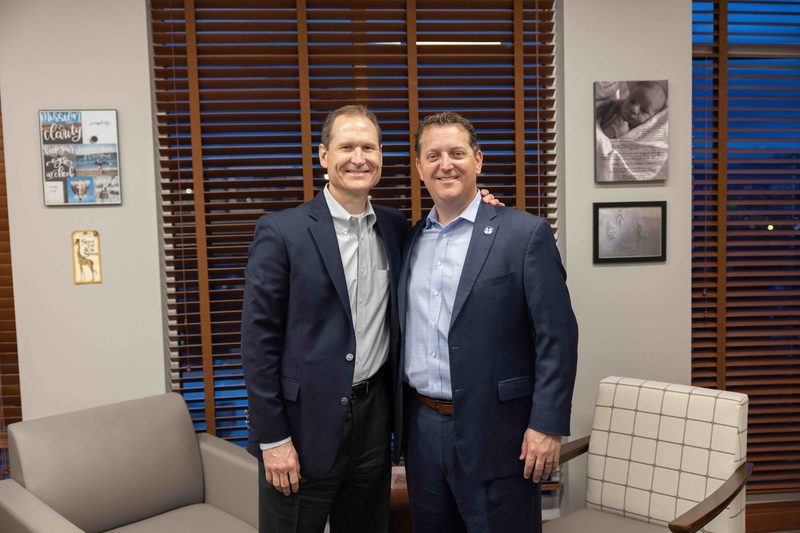
It’s 6:30 a.m. and East Tennessee Children’s Hospital CEO Matthew Schaefer—just the third in the hospital’s history—is more than ready for his day to begin. The work never stops in the medical industry, and today is no exception. Matt is typically at work by this time. And as we sit down in his office to talk about his leap into pediatric healthcare and some exciting updates at the hospital this summer, it’s obvious just how passionate he is for what he does every day.
The smell of coffee penetrates our space as the sun’s rays dance into the room. It’s calm and serene, but we both know that in a few short hours, I will be back to the ENT surgical suite across the street prepping for a patient and Matt will be diving into the plethora of administrative duties to keep the hospital running smoothly.
John Little:We’re approaching two years now, Matt, and you’ve scripted the start of your tenure with just regular boring type days not much happening. Other than…
Matt Schaefer:COVID, COVID, and pause, COVID. Also, labor shortages, information technology challenges, all kinds of fun things.
JL: Cyber tech being our latest hiccup. Has that been a challenge as a leader of our institution trying to navigate all of us through that?
MS: The world’s a tricky place.
JL: Well, let’s start at the beginning. Was pediatric healthcare always the plan for you?
MS:I was an engineer by background and transitioned into pediatric healthcare through an experience with my brother’s son, my nephew, who was a childhood cancer patient at Texas Children’s Hospital. I got to see that interaction, the impact on him, the impact on my family, what a pediatric institution can do, even in circumstances that no family wants. And when Malachi unfortunately lost his life due to cancer, I changed careers, and that career change actually led me to a start in pediatric healthcare on the administrative leadership side at Texas Children’s Hospital where Malachi was treated for five months. After about a decade there, I had a good friend and mentor, who had moved on to become president and CEO at Children’s Hospital in New Orleans. And he asked me to come and join him there. I eventually said yes. It was a great decision for me and for my family, a good opportunity to see there’s good people everywhere and there’s great work to do everywhere.
JL: Did you ever envision Knoxville would be your next step?
MS:When Keith Goodwin, who had served here for almost 15 years in a highly effective way, was looking to retire, I got a call about East Tennessee Children’s Hospital and this job. And I remember telling my wife, ‘You know, I don’t think this is very real, but I’m gonna call him back. You never know what’s gonna happen.’ I was fortunate enough to be in a position to succeed, to meet a lot of good people, meet a great organization that was in a good place to serve the community in the future, just like it had done in the past. And so since August of 2020, I’ve been able to be here serving in this role, working with lots of great people, including great medical staff like yourself and many others.
JL: After almost two years, what still gets you excited about this work?
MS:I think in any part of any role you do, the things that should get you most excited are the people you get to work with. Because when you peel everything back, you want to be surrounded by a group of people who care about what they’re doing, and ultimately care about the people who they’re doing it with. I think that’s been the case here for many, many years. And it’s hard to be unhappy in a place that has that type of energy. There are a number of individuals here who have served for many years and others who are newer to the organization, all who care about what our future looks like and are not just satisfied with the status quo.
JL: Do you think this has contributed to Children’s success over its history?
MS:One of the things I’ve said over and over is that in 85 years, we’ve never been okay just being who we are. If we were, we’d still be the Knox County Crippled Children’s Home 85 years later. We need to be able to look and reinvent ourselves and add services, not because they allow us to beat our chests or brag, but because the community needs it. Anytime a child or a family has to leave this area—their home—to get care, that’s an additional hardship, and we should be looking for ways not to have that hardship be any greater than it has to be. Children’s Hospital is different. Because everyone can walk down the hall, they can see their son, their daughter, their niece, their nephew, their grandson, their granddaughter, and they get it. And they understand that what we do here is not about them anymore. It’s about those children. It’s about those families. And that’s special. That’s unique.
JL: Recently, there’s been a focus on behavioral health at Children’s. Is this one of those reinvention of services you’re talking about?
MS:If you were to ask me, ‘What’s the number one thing I’m most worried about for the next generation of kids?’ It’s not COVID—not that it hasn’t been a danger. It is mental and behavioral crisis care. Over the last year, we’ve seen a 60-plus percent increase in children who arrive to our ER with no underlying medical condition, no underlying surgical condition that requires medical treatment. But they’re simply having a crisis moment: self-harm, inflicted self-harm, talk of self-harm, isolation, struggling with their own self-worth. That’s not a Knoxville thing. It’s not a Tennessee thing. It’s a United States thing. And unfortunately, what was already a challenge pre-pandemic has exacerbated over the pandemic in ways that we couldn’t have anticipated.
JL: How is Children’s addressing this?
MS:This is not an environment that is linear. It’s not well understood. The resources that exist are in short supply in this community and elsewhere. So we’ve been looking for ways to find partners who can help us in that. [We are opening] the crisis stabilization unit. It’s a partnership with the [Helen Ross] McNabb Center, which is a mental health provider in this region for both adults and children. And the purpose of that—and a broader crisis continuum of care—is to keep children away from crisis moments. And when they’re in a crisis moment, keep children away from an inpatient psychiatric stay. That’s ultimately what the crisis stabilization can help us accomplish: from arrival in the ER, quickly stabilized in intensive therapy over a 72-hour period or less, transitioning that child—their family—to an outpatient care environment for ongoing therapeutic intervention, without having to send them to Kingsport to be an inpatient at a psychiatric facility or to Chattanooga or somewhere here locally. Because 30 percent of those kids who’ve arrived at our ER over the last couple of years have ended up in an inpatient facility, and we shouldn’t be okay with that. We have to change that equation. And hopefully this is a step. It won’t be the only step, but it is a step along that continuum to start to bring about some healing where it’s needed.
JL: How pervasive is this problem?
MS:Two years ago, a little bit more than 800 kids or so arrived at our ER in crisis. This past year, more than 1,500 children. So four children a day, on any given day, if you averaged it out, are coming here because they’re in a unique crisis of self-harm or potentially harm of others. Those are the ones who make it to us. That’s the tip of the spear.
JL: As a surgeon, I’m used to seeing a problem, identifying it, taking them to surgery, and my patient being better. Behavioral health is different in that you have a problem, but it’s not one that frequently lends itself to immediate correction.
MS:A child comes in with appendicitis, there’s a pretty predictable pathway to be able to solve that issue. And once it’s solved, it’s solved. This is not that environment. And these kids are different than we expect them to be. Oftentimes, we talk about social determinants of health. What does the household look like? What are the resources in that household? What’s the access to care? If you look at the zip codes in this area, for children who are suffering most from mental and behavioral health crises, many of them are in West Knoxville. These are children who have access to resources. These are children who live in a median household income advantage, relative to many of their peers. These are your next-door neighbors in some places, and it’s silent and it’s not seen but it’s there. These are girls that my daughters go to school with. And I think what that says is that somewhere along the chain, we’re missing—not as Children’s Hospital necessarily, although it could be, but as a community—signals that these children are struggling and suffering. And when we miss enough of them, that’s when they end up here in crisis. So the question is, how do we better solve the crisis equation, and then how do we concurrently get further towards what the underlying signals are, so we never have to get to crisis?
JL: My children are just a step ahead of yours. You have middle school and high school; we have college and graduate school, and it makes me wonder how many are suffering in silence that don’t ever make it to us. How do we help create an environment that addresses those needs, but also catches them before they become problems?
MS:It’s a tough equation. We’ve done one thing really well as a society. And we’ve done one thing really poorly on this dimension. We’ve made it safe and normal for people to talk about these issues, that we’ve normalized in a lot of ways, the ability to have a conversation about mental health and behavioral health. That’s a good thing. But what we haven’t done is added to the infrastructure of a system to be able to address it. So now we have more people who are willing to identify that they’re struggling, but there’s not enough providers, there’s not enough outlets for care. So it’s great to be able to talk about it, but if I can talk about it and can’t get help, that’s not so helpful. And I think that’s what, as a community, we’re facing and probably a lot of the reason why we’re seeing this exacerbation because it is more normalized. Even in moments of crisis, people will seek care. But even when they seek care, can they get where they need to get the best intervention as soon as possible to stabilize, treat, and resolve? Malachi, Matt Schaefer’s NephewMatt Schaefer with nephew Malachi
JL: When you think about that impact a children’s hospital can have, are there moments from throughout your own life and career that illustrate that?
MS:I can’t go any further without talking about Malachi. He was diagnosed at about 15 months old with an aggressive form of leukemia. He spent 150 days as an inpatient at Texas Children’s Hospital, and out of 150 days, he spent 10 days outside of the hospital. He was 19 months old when he passed. He was poked, prodded, five rounds of chemotherapy, I mean every unpleasant, unspeakable experience that anyone can imagine, he experienced in that time frame. But man, he was happy almost the whole time, with the exception of three days. He trusted, trusted his mom and dad, trusted the caregivers, even though he didn’t understand what was going on. He showed what resilience looks like even when he wasn’t feeling great. When the nurses would leave, likely after some poke or prod that wasn’t so fun, he’d say thank you and he meant it. And he made friends with everybody. His favorite person was not a nurse, not a physician, not a patient care assistant—all of whom he saw frequently—it was a gentleman named Mr. Peter who did the floor care. He would come and burnish the floor, and Malachi was 100 percent boy. Mr. Peter had a machine, and the machine shook, and it made noises and it did cool things. And that was part of the attraction between Peter and Malachi. Peter always took a moment. Even when Malachi couldn’t come out of his room, he had just gone through a round a chemotherapy and had no ability to fight infection and needed to stay in his room, Peter would come to the window of the room and interact with Malachi from the hallway. I don’t know how I’d deal with what Malachi dealt with. But it’s pretty inspiring, pretty humbling, and a great example of just what being a shining light looks like, even when you have every reason to be a dark cloud.
JL: Is this why you get up every day and do this work?
Thirty percent of those kids who’ve arrived at our ER over the last couple of years have ended up in an inpatient facility, and we shouldn’t be okay with that. We have to change that equation. And hopefully this is a step. It won’t be the only step, but it is a step along that continuum to start to bring about some healing where it’s needed. Matt Schaefer, East Tennessee Children’s Hospital CEO
MS:He’s why I changed careers, and why I’m here today. I’ve got a big picture of him above my desk so that every day I walk in, and I can see him on his first day when he was at Texas Children’s Hospital and remember what he endured and remind me why I’m here.
→ Swipe for Next Story
FeatureMAY JUNE 2022
Top Chefs 2022: Chef Danny Wilhoit
Story by Cityview
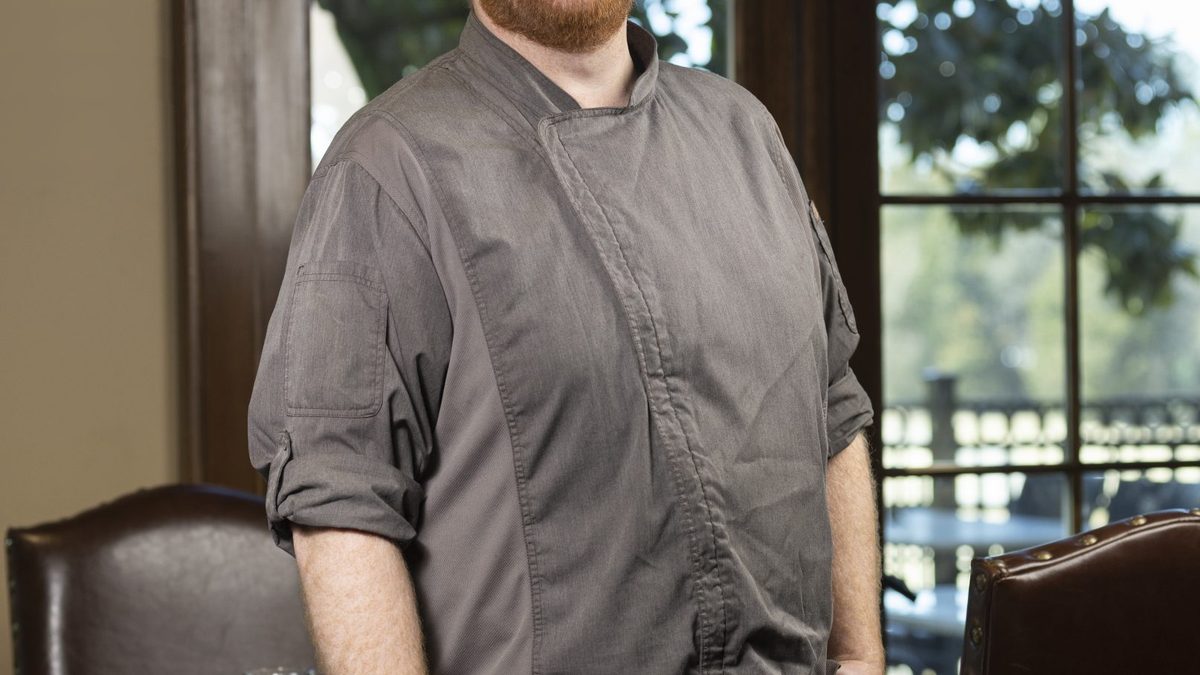
Located inside the Avalon Country Club Clubhouse, T-Prime Steak and Seafood brings fine dining and exceptional views together under one roof. Chef Danny Wilhoit has reimagined the menu here, creating upscale American cuisine for restaurant-goers. Growing up on a farm with his family instilled an early connection to food within this local chef.
Wilhoit began cooking as a child, but got his first job in the restaurant industry at the age of 15. He started as a dishwasher, eventually moving up to prep cook. As he progressed to chef, his focus and creativity evolved which led him to the types of executive chef roles he is in now. “Now, what pushes and drives the inspiration is really the adrenaline and pressure that comes with being in the kitchen as well as getting to see people’s faces and reactions whenever I serve them amazing foods,” he says.
Wilhoit’s first mentor was in culinary school, and that mentorship helped him along the path he was already forging for himself. The philosophy behind the dishes he creates is straightforward, which is the way he thinks it needs to be: “Fresh, simple, local when possible. Let the food speak for itself.”
With the menus he creates for T-Prime, Wilhoit first makes sure to look at what is in season and what local farmers have to offer, gaining inspiration from the produce and meats that are available. He takes pride in his work and enjoys perfecting dishes until they’re exactly what he envisioned.
“The most memorable moments in the kitchen are anytime when you’ve been working on a dish or a process again and again and again and again, and then finally, you nail it and you just have that feeling that you know this is gonna be great.”Appetizer
Ippoglosso e gnocchi parisienne (halibut & gnocchi) – salsa d’aglio, spring peas, black peppercorn, parmesan. Paired with Poggio Anima Grillo, Italy. Entree
Guanciale di manzo (braised beef cheeks) – parsnip two-ways, sweet peppers, roasted mire poix, oregano, parsley, tarragon. Paired with Poggio Anima Montepulciano D’ Abruzzo, Italy. Dessert
Every year, I think there is no way Top Chefs can get any better, but every year it does. That is due to the chefs who pull out all the stops to create innovative offerings that wow their guests. This year, three new restaurants joined the mix: Fire & Salt, Point B, and Tako Taco. Regardless of the number of years each chef has participated, they all brought the culinary experience to new heights. In the end, the results were so close that we had to recount the ballots several times. After we finished, we not only named winners in appetizer, entree, dessert, and experience, but a compilation of each chef’s numbers allowed us to also name a champion. Congratulations to Bistro by the Tracks’ Chef Robert McDonald III on this accomplishment.
One final note: Top Chefs serves not only as a forum for chefs to compete, but also as a fundraiser for our friends at East Tennessee Children’s Hospital. Thank you to everyone who came out to support.
The 2023 Winners
CHAMPIONRobert McDonalds, Bistro by the Tracks 1st Runner Up – Chirs Cummins & Noah Goodfriend, Point B 2nd Runner Up – Deron Little & Austin Altena, Seasons
APPETIZER 1ST PLACE – Alex Gass, Fire & Salt 2ND PLACE – Darin Hoagland, Oliver Royale 3RD PLACE – Deron Little & Austin Altena, Seasons
ENTREE 1ST PLACE – Robert McDonald, Bistro by the Tracks 2ND PLACE – Chirs Cummins & Noah Goodfriend, Point B 3RD PLACE – Alex Gass, Fire & Salt
DESSERT 1ST PLACE – Jason Scott, Lonesome Dove 2ND PLACE – Chirs Cummins & Noah Goodfriend, Point B 3RD PLACE – Darin Hoagland, Oliver Royale
EXPERIENCE 1ST PLACE – Deron Little & Austin Altena, Seasons 2ND PLACE – Robert McDonald, Bistro by the Tracks 3RD PLACE – Chirs Cummins & Noah Goodfriend, Point B2023 Top ChefsChefs
Chefs Chris Cummins & Noah Goodfriend | Point B
Chef Robert McDonald | Bistro by the Tracks
Chefs Deron Little & Austin Altena | Seasons Innovative Bar & Grille
Chef Alex Gass | Fire & Salt
Chef Jason Scott | Lonesome Dove
Chef Darin Hoagland | Oliver Royale
Chefs Jesse Newmister & Lucas Trombley | Tako Taco
→ Swipe for Next Story
FeatureMAY JUNE 2022
Conquering Cotopaxi
Finding East Tennessee’s place on the edge of a South American volcano
Story by John Quillen
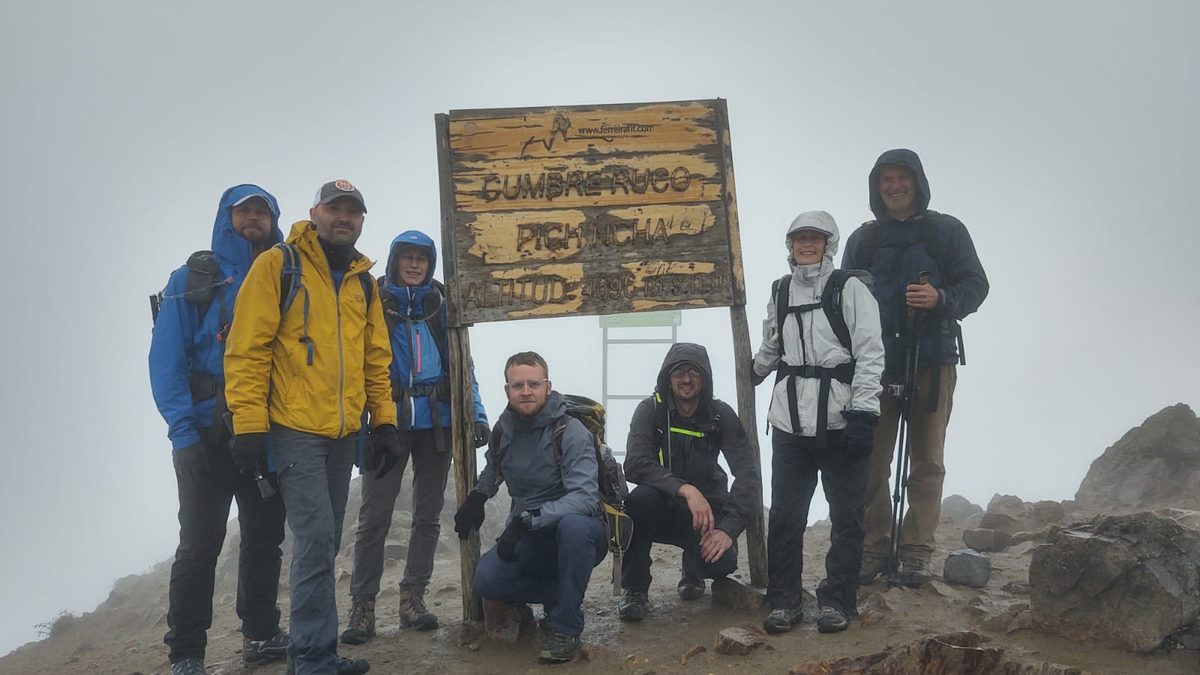
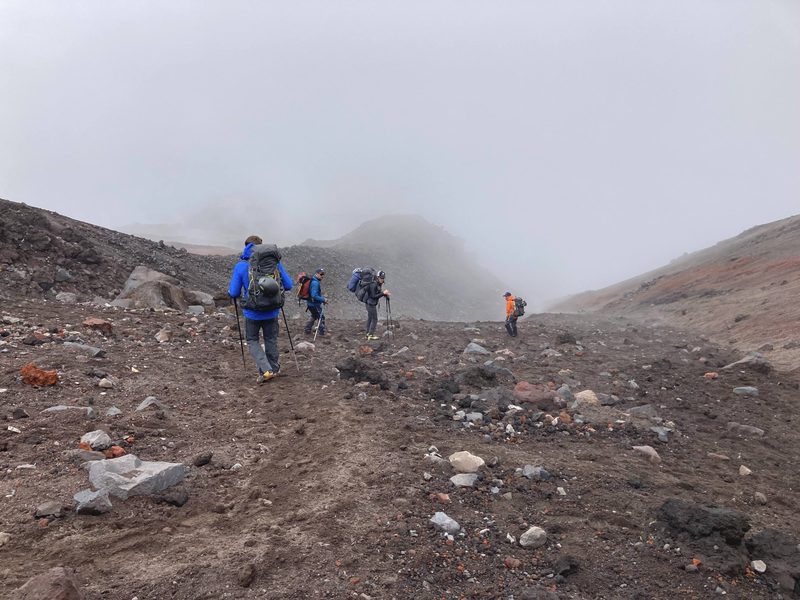
Wind sandpapered snow across our faces as we experienced yet another false summit. I quit peering skyward since every prominence seemed to just birth another. Stars so brilliant five hours ago were supplanted by abject whiteness. Icicle caverns brushed the shoulder of Karlyn Zandstra, a nurse practitioner from Norris who is the middle person on our rope. What a strange place to find herself in such horrible conditions 19,000 feet high on the side of an active volcano. Karlyn signed on this expedition to find out what if felt like to experience this altitude. She was getting a full measure.
Crevasses lurked just below the surface of this brittle snow. Our feet were invisible and so were any potential slits in the glacier. For that reason, we divided into three-person rope units. Greenback native Steve McQueen was trailing us under the supervision of a local guide. He finally decided that this man, now entrusted with his life, was a liar. Every time he was told one more hour to the top, “…I swear to God it was two. They don’t let us take long enough breaks,” he lamented while shouting across the deafening gale. I gently reminded my friend that this climb was partly his idea. This kind of climbing is a world away from a hike up Mt. LeConte.
It started innocently enough at the Crag last fall. Steve and several others peppered me with questions about mountaineering while scaling the quarried limestone at a whopping altitude of 850 feet. “It can’t be that bad ifyoudid it,” one told me. I vowed to teach them a lesson.
My proposal, modest seeming at the time, was to take this show on the road: “Let’s go climb volcanoes in Ecuador.” Sara Whitt, a Grainger County native and Knoxville resident, perked up. Her belayer, John Creasy, a Texas boy transplanted to Knoxville, was keen to hear more. Having climbed these peaks 17 years ago seemed all the reassurance my stalwart friends required. Like a low-angle avalanche, this expedition began to snowball. Before long, tickets were booked, and nine of us headed south toward the Ecuadorian volcanoes with our eye on Cotopaxi, an active volcano at 19,347 feet. We touched down in the city of Quito at an elevation of 9,200 feet, only 10,000 shy of our goal. Their punishment had just begun.
None of the charm of this capital city was lost on our group, now dubbed “Team Climb Ax.” From the roof of an open-air bus, we motored through this rainy metropolis and soaked in the visual feast laid before us in the “Valley of the Volcans.” My brother, Todd Quillen, and friend, Greg Moore, from Morristown, tagged along with alternate sightseeing goals.
Headaches abounded in thinner air as we climbed steps around the old town square. Carnival—the celebration leading up to Lent—was in full swing, and here in Ecuador there are government holidays allowing locals to fully participate. Naturally, pranks were focused on the obvious group of gringos. Caleb Kyser, a native Knoxvillian, was greeted with black ash thrown at his face, as I was welcomed with shaving cream to mine, compliments of local school children. This was our relaxation day. True suffering wasn’t supposed to commence until we set foot on our first volcano the following day.
One of our local guides, Pedro, from the hill region outside of Quito, wasn’t faring too well on the approach to our first volcano. He made an earnest run up a slick hillside an hour outside of town, but his minivan was having none of it. We reversed for almost a quarter of a mile and made a second stab. Offloading weight—me—he was finally able to crest the berm and park as we began our first hike a mile earlier than expected. Chickens pecked at our feet as we forked over dollars to someone in a hut with a bathroom that required filling a bucket to flush.
Rain chased us on this first hike as we gained 2,598 feet to the fore-summit of Pasochoa, an extinct volcano. The sweeping views I touted from my last trip down here seemed like a lie. “It was 17 years ago, and in the summer,” I demurred. Nothing seemed familiar, but the pain of agonizing ascent. Our group photographer, Kevin Flint, wasn’t getting those much-anticipated cover shots. A native to Kentucky, Kevin eventually settled into the hills of Tennessee, but his photography has taken him around the world to exotic climbing locations. However, like most of our group, this was his first time in South America.
We made our first summit in the clouds after 4.6 miles. Acclimating to these heights requires climbing a few thousand feet and returning to a lower altitude to help the body adjust to thinning air. Our plan to first scale two smaller volcanoes was time tested. Without doing so, we would never have attempted almost 20,000 feet within a week. Team Climb Ax committed to celebrate upon descent in traditional Ecuadorian fashion: we were off to eat some guinea pig.
Cuy was a delicacy wasted on our group. Once gathered back at his van, Pedro navigated our victorious team to his favorite eatery along the road back toward town. While we gnawed our way through this shoe leather, we tried to ignore the nose and teeth eyeballing us from our plates. Having tagged some altitude, a rest day was earned. That night, Todd and Greg greeted our muddy assemblage to share tales from their Uber-assisted equatorial foray, known locally as Mitad del Mundo. Apparently, toilet water really doesn’t swirl on the line down there.
Rucu Pichincha was next in our sights, topping out at 15,300 feet. We once again bravely handed our destiny to the care of Pedro and his minivan. Weaving the upper flank of the capital city the bus rounded hairpin after hairpin, dodging livestock and llamas. Black clouds and rain followed us up another peak as we started at the terminus of a gondola now depositing tourists at a mountaintop café. More than one comment was made about why we didn’t choose this method of ascent as we disappeared into the sky and began hiking above this ancient city.
Clouds broke on occasion revealing layers of the valley’s elusive magnificence. Sara and John relished the rock scrambling sections, reminiscent of our time harnessed up in Knoxville. John is a triathlete, so I wasn’t concerned about his level of fitness or any of the group for that matter. An engineer by trade, he travels the world inspecting nuclear power plants. John tried to blame this expedition on Sara, our resident artist and team name progenitor. However, he obviously enjoys overseas adventures, having climbed volcanoes in Bolivia. Scree slopes made for dicey footing but in the sleet we topped out smiling on Rucu Pichincha as a team. This would be the elevation from which we would launch our Cotopaxi ascent in just a couple of days. We still had a long way to go.
One of the best things about a summit is dropping back into thicker air. Karlyn and Steve were ticking off volcanoes as if they were strolling up Knoxville’s House Mountain. Steve is a physician’s assistant and shared Karlyn’s curiosity about the physiological impact of altitude. Having been to Ecuador once and seeing Cotopaxi, his desire to return was the impetus for our journey. He’s also a smart-aleck. Perhaps it had something to do with making him sign a waiver for me prior to our journey. With each unexpected occurrence, I would hear, “I’m going to sue John Quillen Adventures for,” weather, guinea pig teeth, open air bus, rain, sleet. You name it; it made the list.
A fresh group of local guides collected us from our comfortable hotel in the capital. In two four-wheel drive trucks we smashed gear and bodies for a ride to TamboPaxi lodge the following morning. Perched at 12,500 feet, it serves as an intermediate acclimatization point. Nested in the shadow of our pyramidal spire, (which translated means “neck of the moon”), Cotopaxi can be seen holding the planet in its perfectly shaped cone under perfect conditions.
The idea here was to rest before our ultimate ascent. Some interpreted that to mean horseback riding in our now trademark rainstorm. Team Climb Ax saddled up and set off undeterred. But a momentary glimpse of our objective flashed for a few seconds between clouds as they disappeared in chaps across the paramo. Cotopaxi was luring us skyward.
Following lunch the next day, we drove to the base of the massif, donned full packs and sweated for an hour. Kevin shuddered under the weight of two backpacks, one full of photography gear. A new local guide was quick to assist him to the Jose Rivas Refugio. This hut was our last stop before suiting up for the glacier at midnight. It’s fairly typical for alpine ascents to begin at night; the glacier is more frozen and stable. All we had time to do was eat a quick dinner prepared for us and bed down in a bunk reminiscent of a Smokies shelter. We had no more fallen asleep at 6 p.m. before the dreaded 11 p.m. wake up occurred. My team laid out their climbing kit, sorted and resorted gear and tried not to look nervous. “This will be the toughest night of your life,” I warned.
Nine hours into the ascent an unmistakable sulfur smell emanated from the volcano caldera. To Caleb it signified the trapdoor into hell. His face, unrecognizable save for a set of swollen eyes barely visible between a helmet and balaclava, was wind-chapped. This home builder by trade was questioning his sanity. One of our group had already abandoned their discomfort and stopped their ascent at 17,000 feet. That was four hours ago. Visibility was near zero at this point, and the summit must have seemed to my dwindling team another fabrication.
John and Kevin lumbered past the rope Karlyn and I shared. Their local guide was keen to drag them to the crater before anyone else surrendered. It was now 6:25 a.m. in this hazy, apocalyptic snowscape. The putridity from Cotopaxi’s summit reminded me this thing could blow at any time. In fact, following my first 2005 ascent, Cotopaxi erupted in 2016 scouring this route into something entirely unrecognizable, were I actually able to see it.
Little fanfare heralded our final steps to the caldera at 19,347 feet. Scant evidence indicated the summit of my memory from 2005, conditions were that abysmal. Team Climb Ax had the mountain to ourselves. Our strongest guys laid down over their packs, panting. Icicles hung from Karlyn’s helmet in the form of frozen hair. The guys panted through fleece-covered mouths. I lost some feeling in my hands and dug out the mittens. No more layers were forthcoming from my pack; I was wearing everything. Beneath the pain and suffering of our team were eyes conveying collective disbelief.
“Congratulations,” I fist-bumped them, inadvertently calling this mountain by another name. Hypoxia knows no bounds. Celebrating was traded for escape.
If you’ve never descended a glacier in 12-point crampons, the learning curve is both immediate and unforgiving. A competition ensued for style points as to who could trip most creatively without jerking the rest of their rope team face first. And all three groups took our turn. “That’s the hardest thing I’ve ever done,” Steve confessed as we zig-zagged the lower snowfields prior to the Refugio. By the look on everyone’s faces, he spoke for the team. “I’m glad I never have to do this again,” added Karlyn.
Over a celebratory dinner back in Quito, we were reunited with Todd and Greg fresh off a Galapagos excursion. Their tan contrasted our peeling faces from the wind. Sitting around the table were two remarkably distinct experiences, together building a picture of all that this part of Ecuador has to offer.
Once showered and back in the thick air, I was already being asked about “that other volcano in Mexico.” Amnesia is an important skill set in the mountaineering game.
A satisfied soaking in thermal hot springs our final day had this Knoxville group already planning the next ascent. They took all the volcano could throw at them and definitely earned the right to suffer some more.
→ Swipe for Next Story
FeatureMAY JUNE 2022
Wit & Wisdom
Sam Venable has carved a path as an outdoor writer and columnist, inspiring thousands to experience the joy of the sporting lifestyle
Story by Frank Venable
It’s early evening at Van Edom’s Wine Bar and I am enjoying a glass of wine with my wife Lisha. The relaxed atmosphere and pleasant staff find us here from time to time to unwind. I couldn’t help but notice the guy across the corner of the bar seemed to be searching for something and was furiously pulling all sorts of things out of his pockets. When the loosely coiled monofilament fell from his hand onto the bar I couldn’t help but ask, “Is that a tapered fly leader?”
“Matter of a fact it is,” he responded. “Are you a fly fisherman?”
My smile must have given it away. The man introduced himself as Nathan Sparks, and in a few short sentences I knew I had found a friend. We ordered another glass of wine and down the rabbit hole we went, telling tales of fishing trips across the country.
During the conversation, I asked Nathan if he was familiar with Sam Venable or any of the books he’s written. “I am,” he told me. “Almost everyone knows Sam. His books are phenomenal, so is his column in the News Sentinel.” I filled Nathan in on the fact that I’m “Cuz” in all of Sam’s books and inquired if he would ever consider him as the subject of aCityviewfeature.
Before long we were formulating plans on telling Sam’s story, but with one caveat: Nathan wanted a first-person account of our adventures. So, pour yourself a glass of your favorite libation or grab a cup of joe, and settle in to hear a little about the man who has shared his wit and humor for decades and taught me a lot of what I needed to know about connecting with the great outdoors.
That night of fun at Van Edom’s with Nathan led us to a quail hunt at the Beretta Shooting Grounds, managed by The High Adventure Company. Nathan wanted to get a feel for how Sam and I interact on a sporting trip and have the opportunity for some photos. The facility is a short drive down to Adairsville, Georgia. We step out of Nathan’s Suburban to the sound of bird dogs anxiously barking in the kennel and the sprawling view of 3,000 acres of rolling sedge grass and burnt pines. HAC owner, John Burrell, happened to be onsite and it was entertaining to listen to them swap a few quick stories before John introduced us to our guide for the day, Steven Farmer, a lanky easy going fellow, and his dog, Sweetie, a beautiful German Short Haired Pointer.
The crisp air really set the mood as we walked alongside Steven while Sweetie worked. With a quiet voice and a gentle smile, Sam looks entirely in his element on the shooting grounds. We are not even five minutes in when Sweetie gets real “birdy” and Steven signals for us to spread out. Sweetie circled, and then locked up on point as Steven called “Get ready.” Watching the covey rise out of the grass, seeing the joy on Sam’s face as the shotgun swings and follows one of the birds, I am so transfixed that I almost forgot to shoot—almost that is! The morning went on like that and we flushed many more coveys and followed up on the singles.
There is a sort of camaraderie that comes from sharing a hunt that seems different from other activities. We were all having a great time when Steven asked if we knew a guy named Joel Farmer from Loudon. Nathan laughed out loud and said, “I was at his house three days ago photographing his son Carson for a roping story.” Steven’s eyes flared with delight when I added that Joel and I had been high school pals. Come to find out that Steven competes in roping at many rodeos across the south, and that hissix-year-old son is already competitively roping. Pages:123
→ Swipe for Next Story
VeteranMAY JUNE 2022
The Hero on the Hill
Knoxville’s Gerald McGinnis looks back on his service in Vietnam
Story by Phil Newman
FromRambotoHeartbreak Ridge,Full Metal Jacket,Apocalypse Now, and evenForrest Gump, Hollywood writers have worked hard to out-script each other in portraying the havoc and heroism of America’s Vietnam War. Yet it’s doubtful even the most Oscar-decorated storyteller could concoct anything so harrowing as the ferocious battle that U.S. Army Specialist Four Gerald McGinnis fought in the wee hours of March 22, 1968.
Picture the scene:In the pre-dawn darkness, McGinnis, a member of Company C in the 3rd Battalion of the 8th Infantry Regiment, is bunkered at Firebase 14 (a.k.a. Firebase Incoming) atop a ridge surrounded by Vietnam’s Central Highlands jungle.
McGinnis occupies one of several bunkers along the perimeter, a first line of defense. Sudden firing shakes them to action. Some 1,500 North Vietnamese Army (NVA) troops are mounting an attack up the hill to the base.
Gunfire and explosions ring out. As McGinnis seeks to exchange fire, the bunkers on either side of his are hit—one by the NVA, the other after the base command orders an artillery strike on the outskirts where the base was breached. A number of soldiers are killed instantly or critically wounded. His bunker becomes the primary line of defense.
While the fight continues, three injured soldiers take shelter in McGinnis’ bunker. One has suffered an eye injury and is wrapped in bandages, blind to his surroundings. Another had a tricep torn off and is unable to fight. The third is in the most serious condition.
McGinnis defends their lives as the battle rages, even supporting an IV drip for the gravely wounded man while firing rounds with his M-16 rifle and tossing grenades at enemy combatants. He talks to the wounded soldier at his feet, trying to keep him alert.
Some four hours later, when the sun finally rises, the NVA troops have been rebuffed, prevented from overrunning Firebase 14 in large part by the efforts of Staff Sgt. McGinnis.
As recorded by several witnesses who later wrote letters commending McGinnis for his bravery, 167 enemy soldiers lay dead—30 to 40 of them within 10 yards of McGinnis’ bunker. Most were killed by small-arms fire out of his bunker.
The battle is over. A hero on the hill has protected his base and the lives of his comrades.
Escape Attempt
McGinnis’ tour in Vietnam had begun less dramatically than this but more soberly, with a jolt and a sinking fear that the horrors of war awaited him.
Almost immediately after his unit arrived at base camp in August of 1968, “I heard an explosion and ran over to the concertina wire fence. Hanging there, from the knee down, was part of a leg with a foot on it.” The soldier had stepped on a deadly M18 Claymore mine and had died in the explosion. “I found out he only had two weeks left in-country,” McGinnis says. “Psychologically, I started thinking, I’m not gonna go home from here.”
At that moment, McGinnis might have questioned the motivation that had led him into the fray in Vietnam. Born September 21, 1947, the Knoxville native and Fulton High School graduate was “a young man without much idea of what I was getting into” when he joined the Army in 1967. “I was running away from a relationship, and that’s not usually a good reason to do anything,” he says.
McGinnis was “real wild” as a teen, graduating from racking balls in a pool room in Happy Holler off North Central Pike to running with a rough crowd. “I gambled, fought—I was a hoodlum,” he says. His father was mostly absent, having been in and out of jail, and Gerald had “moved about 20 times by the age of 19. I had a tender heart, but I thought I had to be rough and tough. I was dating a girl who tried to run me over in a car. She was crazier than I was, and I was really crazy.”
As an attempt to get away from the girl and other aspects of his checkered childhood, McGinnis went to enlist in the Army and was almost turned away because of a hernia. Undeterred, he saw a doctor to repair it and six weeks later packed his duffel for basic training. A “rude awakening” to military life began with a 3:30 a.m. arrival at Fort Benning, Georgia, where the screaming of drill sergeants pierced the pre-dawn air. “It was a lot of taking orders and obeying to learn discipline, the usual welcome into Army life.”
After basic, the teen was shipped to Vietnam, where in short order he understood the benefit of the rigorous regimen he had encountered at Fort Benning. “When you go into combat, you learn that your very life depends on how you can receive an order and, not too much later, how you can give an order,” he says. “You have to grow up quick.”
In light of the two accounts of his war experience described earlier—the sight of a leg in the fence and the attack on Firebase 14—it might be surprising that McGinnis looks back on his military service as “a real good experience for me. Because I was wild growing up and got in a lot of trouble, I needed the structure and organization that the Army taught me.”
There were other painful moments in Vietnam, to be sure. Exhaustion set in after 11 months without any R&R. One of McGinnis’ closest friends, William Earl Bridges of west Knoxville, was killed in November of 1968. “I heard about it over instant potatoes at our Thanksgiving dinner. That was pretty traumatic.”
Yet there were positives as well: “sitting around the guys singing country songs and talking and laughing. We would always drink a lot back then, and pot was pretty easy to get.”
Foxhole friendships helped to sustain him. “If you don’t become buddies, you won’t make it. You watch each other’s backs. You’re willing to die for each other. You sleep in a little tent, share secrets, talk together. It’s a brotherhood.”
Homecoming
After returning from Vietnam, McGinnis says he “didn’t talk about it for quite a while. It was the most unpopular American war. There were protests and harsh words about those of us who had served. That didn’t happen to me, but it did to others I knew, so I kept mostly quiet.”
He came back to Knoxville but traveled around a bit, even experiencing a taste of the late-1960s counterculture movement. “I was at Haight-Ashbury,” he says of the epicenter of what he remembers as “the Hippie movement. I wanted to party and have a good time.”
Eventually he found faith—or it found him. “The Lord met me, and I was radically saved,” he says. His conversion led to a theological education, an assignment as a pastor of a church in Union City near Reelfoot Lake in 1976, and a return to Knoxville in 1980, when McGinnis founded Park West Church on Middlebrook Pike. He continues to serve as Director of Leadership Development. His son, Dr. Jeremy McGinnis, has followed in his father’s footsteps as Lead Pastor, and several other family members serve on the church’s staff.
Family is a big part of his life. This only child growing up in North Knoxville today has seven grandchildren. “We’ll have 14 to 16 people around the house for family dinner on Fridays,” McGinnis says with a warm smile, “and 25 or 30 at Christmas.”
Over the years, McGinnis did begin to speak about his time in Vietnam. And it took quite a while, but the heroism he displayed from his ridgetop bunker in1968 has gained him a measure of appreciation. In 2016, he was awarded the Bronze Star for his brave actions in Vietnam, and in October 2021 he was awarded the Silver Star.
In a spirit of humility consistent with military veterans who have received similar accolades, McGinnis downplays the singularity of the honors and credits his fellow soldiers in his unit and battalion—especially those who gave the full measure of devotion and did not return home as he did.
“I don’t need any more gratitude. I would rather it go to other veterans in our area who were just as devoted or more,” he says, listing off some of the ways he says he has been blessed in abundance. “I’ve got all kinds of accolades. I’m supported by a strong church family. I’ve gone to two seminaries and have my doctorate. I worked for the FBI as a chaplain, for the Knox County Sheriff’s Department 22 years as a chaplain, and had the opportunity to provide trauma counseling for some of our veterans.
“But most of the vets do not have that kind of experience. They don’t get the applause. Some of them went into the Army because they were less educated, and they ended up in the infantry, or drove a truck, or served as a nurse or a supply sergeant. They might have felt expendable, but they were not. I think it’s good for Knoxvillians to show gratitude, and I appreciate the many ways we see that here.”
The annual Veteran’s Day parade is one example of that, he cites. One specific honor that hit especially close to home was bestowed in the fall of 2021 at his alma mater, Fulton High, when local leaders unveiled a monument to fallen Vietnam veterans Alvin Wiles and Billy Dale, along with several other FHS graduates who died in the service.
“I’m not real emotional, but that was something special for those soldiers,” he says.
Reflecting on his time in the Army and the war, McGinnis speaks of the contrast in the way he and his fellow vets were received in the 1960s and 70s with the warmer welcome they and other US military personnel have been greeted in recent years. The shift “has caused two kinds of emotions in a Vietnam vet,” he says, “being thankful for the way our military is perceived now but grieving that he never got that welcome home. Nobody said thank you at the time.”
Having been thanked and having had the opportunity to thank many of his fellow veterans, McGinnis stands on the solid ground of humble gratitude: “I’m proud to be a veteran, proud to be an American, and proud for what we did to serve our nation.”