JurisprudenceNeyland and the Last Single Wing Tailback
InsightsA Panoramic Flashback
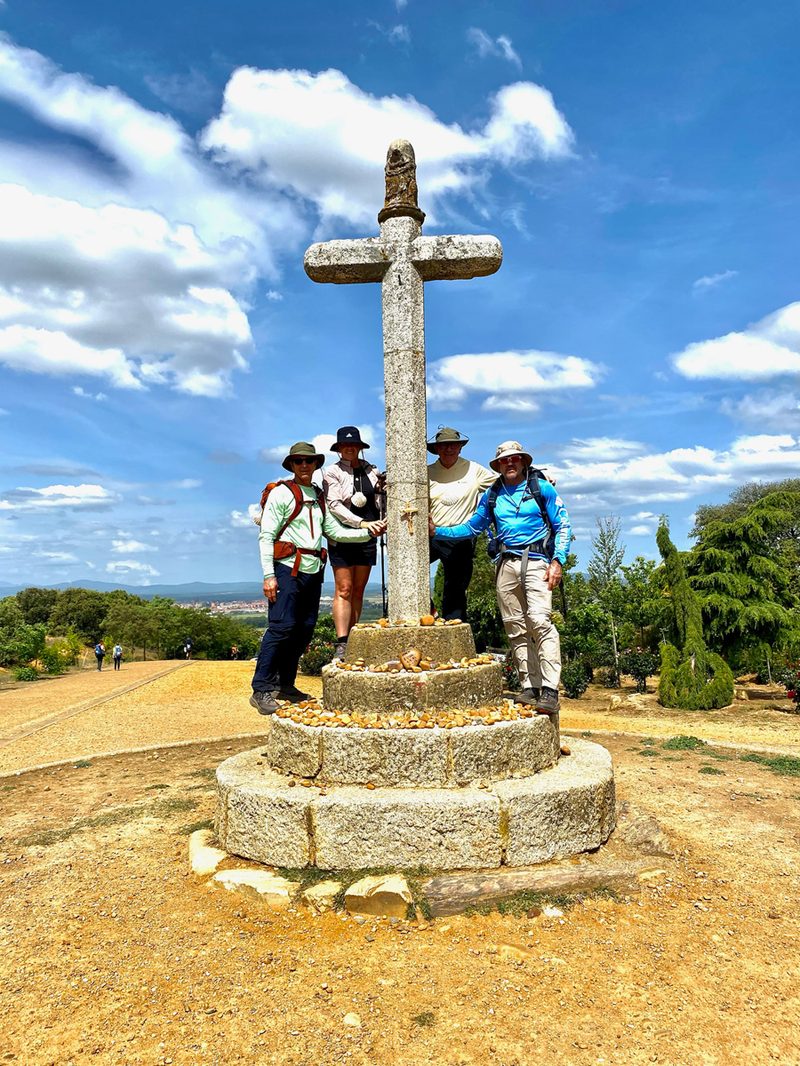
Travel¡Buen Camino!
FeatureThe Right Stuff
Non-ProfitPouring In
Feature40th Anniversary: Sitting with Storytellers
FeatureA Legacy of Quality
FeatureRaise A Voice
FeatureSafe Passage
VeteranThe Mission Goes On
FeatureThe Reverend
Reading Settings
100%
Jan / Feb 2024
Swipe to read →
Vol. 40 · Issue 1 | January February 2024
The PublisherJanuary ’24 – From the Publisher
Departments
Arts & CultureOn Board
MusicWhere Legends Stood
PoliticsWho’s In Charge Around Here?
InsightsKnowing Half
DepartmentsCampsite Mooch
DepartmentsFire + Smoke
Dining GuideComfort Food
DepartmentsComing Up – Top Chefs 2024
DepartmentsThe Knoxonomist
Features
JurisprudenceNeyland and the Last Single Wing Tailback
InsightsA Panoramic Flashback
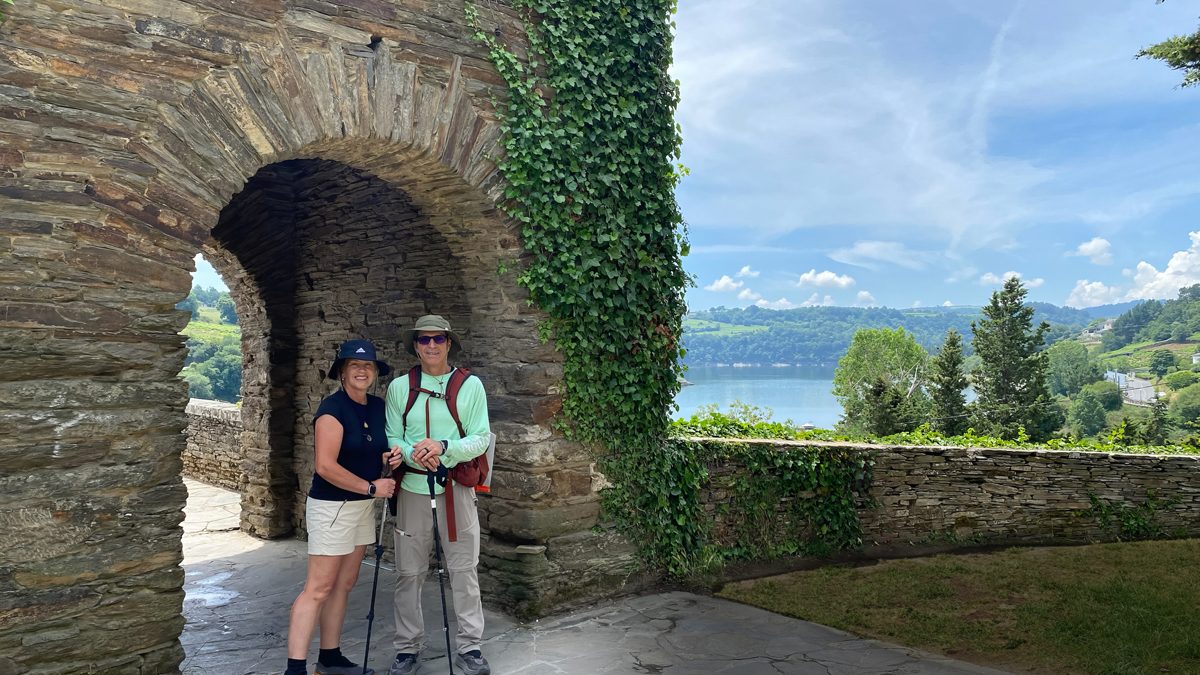
Travel¡Buen Camino!
FeatureThe Right Stuff
Non-ProfitPouring In
Feature40th Anniversary: Sitting with Storytellers
FeatureA Legacy of Quality
FeatureRaise A Voice
FeatureSafe Passage
VeteranThe Mission Goes On
FeatureThe Reverend
→ Swipe to start reading
The PublisherJANUARY FEBRUARY 2024
January ’24 – From the Publisher
Unapologetically Authentic
Story by Nathan Sparks
Southern culture, in my opinion, is often misunderstood. That very fact has for years insulated us here in Knoxville from change. I have heard it said that far up the steep hollows of Eastern Tennessee was the last place in the United States that genuine authentic English accents could be heard. In those days, it was the ruggedness of the terrain that kept change from creeping in. Later it was the perception that our culture was not very cosmopolitan but rather outright redneck that made our little corner of the world less desirable. We locals just laughed and kept our little secret to ourselves. Tennessee, especially Knoxville, is the furthest thing from scruffy imaginable, and the genuine authenticity of southern hospitality is a large part of what is endearing about this area.
I can say that through 23 years of bringing you the stories of our community, the times I receive the most authentic compliments are when I have been the most brutally honest about my own experiences. Living that exposed is, for most people, very uncomfortable. But as years passed, I learned that living every moment as if everything you did would be published in a magazine’s pages was freeing. It is the acceptance of your own authenticity. Where once I was concerned about what others thought of me, I now know that I am who I am. I am free at any time to completely redefine myself or to slip back into the ways of my past. And the times that fear creeps in and inhibits what I know is the real me, I try to think of authentic people I admire for inspiration.
John Pirkle, my early mentor in all things media, would admonish me whenever I even hinted that I wanted to do something that could be perceived as goofy or stupid. Under his tutelage, I learned that to be successful in earning the reader’s trust, I would have to follow a simple formula: all class, no trash, no goofy, no stupid—and always truthful. It made sense to me, and that was the course we set sail on 23 years ago. John did far more than just help me create a simple mantra; he taught me the value of knowing the story behind the story and how not to publish something untrue. He also taught me the value of providing information and not trying to sway the reader with your own opinion. He delighted in pulling my chain, and when he would really get me going, he would patiently wait for me to blunder. One day, he had me reeling. He made a rhetorical statement, and I replied, “Everybody knows that!”
“Really?” he replied. “Does everybody like chocolate?” He had me, and I somewhat unhappily admitted it. But in pointing out the importance of how a single word could change an entire story, he taught me how to be successful as a publisher.
From time to time, we all need someone to look up to as fearless. I think as years pass it is not who might be the most fearless of all time, rather who impacts you as the most fearless in your current day-to-day life. Learning to do this job well took me many years and a lot of help from some rather inspiring folks. I can honestly say that I have not only had the opportunity to work with some wonderful and knowledgeable people, but that I have learned something from all of them. And one of the most important things I have learned is to be true to your own authentic self—and never settle for less than you know you deserve.
→ Swipe for Next Story
DepartmentsJANUARY FEBRUARY 2024
The Knoxonomist
Story by Cityview
Well, the Knoxonomist doesn’t usually watch the avalanche of fake news put on by television networks. But in this case, the Knoxonomist was intrigued by Little Timmy’s scrap in the congressional playground. Make no mistake, the Knoxonomist is a firm believer that sometimes a little pugilism is the best way to settle a disagreement. The Knoxonomist knows what it was like to have been bullied, and knows what it was like to have a friend come to the rescue. The Knoxonomist has fond memories of his own early years, slugging it out with the neighborhood kids over the important things: stolen $5 lawn-mowing gigs, who was the best bicycle rider, and of course the black haired raven Betty Long.
As the Knoxonomist ponders Representative Burchett’s latest exploits, the Knoxonomist is reminded of Knoxville’s legendary Cas Walker, who figured the best way to get J.S. Cooper to stop calling him Stalin in the council room was a solid right cross. That earned Knoxville a place inLifemagazine, and it gives the Knoxonomist a warm, fuzzy feeling that another Knoxville politician found the time to get his beloved hometown into the national limelight.
In fact, the Knoxonomist knows that history is ripe with scraps like these. It seems to the Knoxonomist that Congress was far more interesting back in the 1800s, when representatives sometimes beat each other with canes on the Senate floor to make their point. In the Knoxonomist’s view, there is a proud American tradition of settling congressional disputes in this manner. The Knoxonomist was once forced to attend the musical Hamilton, and to his delight, he discovered that even Vice Presidents can see the merit in a good, honest duel.
Now, the Knoxonomist is not suggesting that Representative Burchett and Speaker McCarthy face off in a duel. There are, as the Knoxonomist has come to understand, laws against that. Gone are the days where a man could legally resolve a disagreement like gentlemen. In this day and age, from the evidence the Knoxonomist has found online, the equivalent of a gunshot wound is now simply to be offended. The Knoxonomist can’t seem to cross the street without offending somebody these days, so the Knoxonomist supposes that makes him one of Knoxville’s most prolific 21st-century duelists.
As to your comment about being offended, the Knoxonomist thinks that instead you should be proud that our congressman took McCarthy to task. Some seem to think this whole situation is beneath the dignity of Congress, but the Knoxonomist disagrees. Representative Burchett is in fact living up to the high standard set by his predecessors, and that’s something we as Tennesseans should look for in our congressmen. Who better to fight for a community’s interests than a man who is willing to actually fight for them? The Knoxonomist wonders.
Honestly, in the Knoxonomist’s view, it’s the good folks of Bakersfield, California that ought to be offended that Speaker McCarthy didn’t make a better showing.
Recently I heard Representative Burchett got into an altercation with former Speaker McCarthy, claiming that McCarthy elbowed him in the kidney. Frankly I’m offended by the way our representative handled this, what are your thoughts? -Concerned Constituent
→ Swipe for Next Story
MusicJANUARY FEBRUARY 2024
Where Legends Stood
Lenoir City’s Ethan Vincil relishes moments on the Grand Ole Opry stage, solidifying his path in the country music industry
Story by Chris Blue
Lenoir City native Ethan Vincil found his voice while singing in church. By middle school, he had learned guitar and his connection to music began to click. He would come home from school and practice for hours. “I’d pic until my fingers bled,” Ethan says.
Things weren’t always straight forward for him, though. At the age of 10, Ethan was diagnosed with a mild form of autism, attention deficit disorder, and attention deficit hyperactivity disorder. It was a lot to work through, but the music seemed to help. Ethan would eventually get up on stage at the age of 14 for his first performance, finding support from his hometown crowd. “It was different getting in front of people,” he recalls. “I’ve worked through a lot, though, and I’ve gotten a lot better.”
When Ethan eventually began dabbling in songwriting, it was the sounds of country music outlaws like Waylon Jennings that came to the forefront. “His music and [the] words of [his] songs really spoke to me,” Ethan says, as did those of Don Williams.
In late 2022, Ethan found himself on the Grand Ole Opry stage in Nashville at The Josie Music Awards, an event focused exclusively on the independent music industry. There he accepted the Country Music Single of Year award for his single, “Lonesome Drifter’s Son,” which he released earlier that year. “Walking across that stage, you know legends stood there,” Ethan says, “It was just overwhelming.”
This past October, Ethan brought home a second Josie award, this time for Country Rock/Southern Rock Vocalist of the Year, making all the hard work that much more worth it.
Finding the value in pausing and listening, understanding that there is always more than what meets the eye
Story by Rev. George Doebler
These are words I heard from teacher and rabbi, Edwin Friedman, in Washington D.C. a number of years ago. They are words I often run through my mind as I hear people talk, whenever that may be. You and I seem to live in a time where answers are more important than the questions. We all too often want a “quick fix” for our ponderings. Yet in reality, there are few answers, and often many more questions that arise. This seems to be true in science, sports, medicine, even in religion. And it’s something that has hit me time and time again throughout my life.
Before going any further, I feel it important to say something about who I am and how I have come to think about what I am writing. “I grew up in the south,” I tell folks here in East Tennessee, “southern California.” They often laugh or correct me. My thinking of what I do has been influenced by where I grew up and the family I grew up in, just as it does each of you.
My grandfathers came to the U.S. as immigrants—Grandpa Doebler from Germany, Grandpa Eisenheiss from Russia (Odessa). Both became businessmen—one with cattle and pigs, the other in construction (a carpenter)—and their adventuresome spirits are what brought them to the U.S. Who I am has something to do with those roots, and that adventurous spirit I inherited has something to do with how I think and feel. It has somehow led me to move around from California to Washington State to Iowa to Washington, D.C. to eventually Knoxville, Tennessee.
After an internship at San Quentin Prison in California, and two years as a pastor in a “rural slum” parish in Dubuque, Iowa, I spent 21 years working in mental hospitals across the country. I struggled to know why these men in prison had done what they had done. Some were the smartest and most gifted people I have met. In my thinking then, I thought the answer had to be psychological or psychiatric.
This brings me back to the quote I began with. My adventurous spirit has taken me all over the country, but in each stop I grappled with things not always being what they appeared. I needed to dive deeper and give that adventure-seeking a rest in order to focus on what was right in front me. And I’m glad I did because it opened my eyes to so much more. Each experience taught me that what I thought I knew was often limited or just flat out wrong. As Wayne Dyer once wrote, “If you change the way you look at things, the things you look at change.”
In my junior year of seminary, I went out to a little forsaken area just north of Dubuque, Iowa, and would bring a carload of kids back to the seminary to play basketball in the small gym there—the out of bounds were the walls, that level of small. However, the kids, all 12 to 15 years old, were wild with joy to come to such a setting. After a few months, I asked my pastoral care advisor if I could move into the “ghetto.” He did not pause: “Yes, and I will raise money to build a chapel there.”
Daytonville, the name of this community, was a whole new world. I was not married; I was dating a nurse, Nancy, who I had the joy of meeting while I was a chaplain intern at Milwaukee Hospital—she is now my wife of 59 years. And I lived in a rental “house” that in the winter would collect a bit of ice on the walls. The community would become part of the project to get the chapel erected, and once it was, it became a hub for the families in town. Living there gave me a chance to offer assistance, but it also allowed me to understand more about their lives.
When I know something, I know half. When I am absolutely sure I know, I know less than half.
Most of the men in town worked in auto shops (junk yards) or were construction workers—when they worked. The kids, 20 to 25 of them, went to school when they could catch the bus. I learned quickly that I had little idea of what these people went through simply to live.
In one of these families, four boys slept in the same bed, a urine filled mattress as I would learn. They would steal with a few others on Friday after school, ride home, and then wait on the porch for the police to come to arrest them. The reason became clear and simple: they got a fresh bed each night and hot meals. My whole idea of jail being a punishment went out the window. Later, the words, “When I know something, I know half,” came to mean more.
Curiously, on Monday mornings, I began to go to court to see how the judge was going to “punish” the boys. He was a caring man who knew somehow that “sending them off” would not help and would cost the county considerably. After a few visits there, the judge asked who I was and why I was coming regularly to court. I told him what was being done to try to help the boys and was taken aback when he asked if I could come to his church and tell my story. A Presbyterian judge? I went from that Monday on.
When I was in court, Judge Williams would ask, “Are these your kids?” I would reply, “Yes.” He would release them to my custody. This dilemma for a juvenile court judge still remains: what to do with 10 to 14 year olds who are brought to court. Just ask Judge Timothy Irwin’s juvenile court and see him try to figure out what resources are available for these young people who have gotten into trouble largely because of a trouble situation at home.
I lived in Daytonville for three years. It was the beginning of me trying to learn more about what was going on in people’s lives before I made a judgment. It’s precisely what led me to applying for and being accepted into a Pastoral Care Residency at St. Elizabeth in Washington, D.C., the only federal mental hospital in the U.S. with just over 12,000 patients. Nancy accepted a psychiatric nursing position there, too. But that’s a story for another day.
For now, I keep reminding myself, “When I know something, I know half.” When each of us is able to stay open to being present in our journey, and use our gifts in the process, we can make a change in people’s lives. When we get stuck, or something causes us to pause and rethink, we might remind ourselves that we may not know the whole story—we may only know half.
If you change the way you look at things, the things you look at change. –Wayne Dyer
→ Swipe for Next Story
PoliticsJANUARY FEBRUARY 2024
Who’s In Charge Around Here?
A new election law is in effect—but will it stay?
Story by George Korda
The question of “Who’s in charge around here?” in city elections—either the Knoxville city charter or Tennessee state legislature—has been settled by the latter. Unless things change. Although, it might be hard to tell who cares about the elections apart from city officials, because regardless of when they’re held, most city voters saturate polling places with their absence.
The dispute isn’t when city elections take place, but who’s on the ballot. The November 7, 2023 city elections spotlight the issue: in the city council elections, on the ballot were three at-large (representing the entire city) seats—and the District 5 seat. The at-large races were citywide votes. But the 5th district election was citywide as well, because this was the general election. The August 29th primary, however, was restricted to voters who lived within the district. The District 5 incumbent ran unopposed, but had he opponents, the district’s top two finishers in the primary would have gone on to be on the ballot in the general election.
City elections for more than 50 years have worked the same way: in primaries, candidates for one of the city’s six district council seats run within their districts; the two highest vote getters are then on the general election ballot. Though district voters have selected their preferred representative, voters citywide can potentially reject the district’s choice and put the No. 2 primary finisher on city council to represent the district. Morristown is the only other Tennessee city with the same system.
But on January 1, 2024, a new law went into effect requiring district city council seats to be decided by district-only voters, while the three at-large seats would remain city-wide votes. Knoxville city leaders are, at this writing, considering legal challenges to the law.
An argument made in favor of the original system is that it was put in place to help ensure minority representation on city council. But it could go the other way as well. A2017News Sentinelcolumnby Georgiana Vines, headlined, “Politicians say 6th Council District could lose black representation,” led with, “Several present and past African-American politicians say they are concerned about which two top candidates will emerge in the 6th District City Council race in the Aug. 29 city primary. Some say Jennifer Montgomery, a white realtor, is likely to be one of the two.” That didn’t happen, but it could have.
This isn’t as much about race as it is politics. That same year, “progressive” candidate Seema Singh lost in the 3rd district primary to more conservative candidate James Corcoran. But when the election went citywide, Singh won. This is evidence that the 3rd district voters’ representation decision—or any district voters’ decisions—can fall victim to voters who don’t live in the district.
A reason cited in support of Knoxville’s historical election process is that it compels candidates and council members to consider voters throughout the city rather than in separate districts. However, they can do that anyway. A stronger argument against monkeying with the election system is to say that it’s none of the legislature’s business how Knoxville, a home rule city, runs its elections. The process has been decided locally, the locals aren’t trying to revise the system, so Knoxville should be left alone.
But Republican State Rep. Elaine Davis assessed the situation and hoped to change the Knoxville election system. Her position was based on disenfranchisement of district voters: they select their city council members, and their decision should be respected, not overruled by outside-the-district voters. Her legislation passed the state House of Representatives 76-21; the state Senate approved the measure 25-5. On May 11, 2023, it was signed into law by Gov. Bill Lee. At this writing, the present City Council is exploring whether a legal challenge to the state law is warranted.`
Of equal concern is low voter turnout and how it impacts the results. In the November 7, 2023 election, for example, of 102,000 registered city voters, 89,000 had something else more important to do.
In my opinion, if Knoxville wants citywide council elections, then it should give voters a proposal to eliminate district elections altogether. It would end the present sham of primary elections, the results of which can be reversed by voters citywide. If voters really are in charge around here, then their decisions regarding their district city council representation should be final. Otherwise, it’s the voting system, and not the voters, who is in charge.
→ Swipe for Next Story
DepartmentsJANUARY FEBRUARY 2024
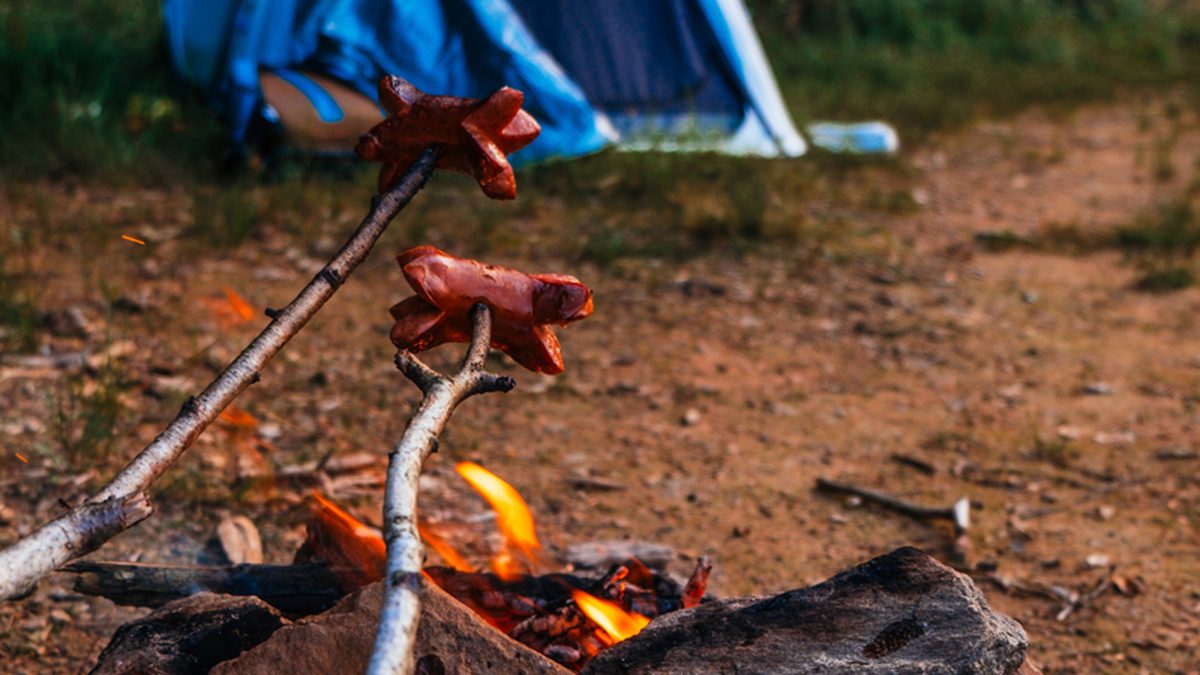
Campsite Mooch
Nothing tastes quite like outdoor gastronomy cooked up by friends
Story by John Quillen
When it comes to backcountry eating, I tend to be described as a minimalist. In order to keep weight down on a five day hike without resupply, this is a necessary sacrifice. A typical trail day for me would include packaged tuna, macaroni and cheese for dinner, grits for breakfast and a ton of cereal bars throughout the day to stave off tremendous caloric deficits. My Appalachian Trail section hiking buddy, Frank Whitehead, turned me on to the bagel and peanut butter delicacy we enjoy for lunch before saddling back up for our typical 12-17 mile days.
However, when we are not worried about keeping our pack weight at 22 pounds, things become a little more bougie. My group has been known to throw down in the back of beyond with buffets that would rival a country church homecoming. I recall a certain event over at Chasteen Creek, campsite #50, where our culinary organizer divided up side dishes for each of us to backpack the few miles into this Smokies site.
Dave was stacking rocks when I rolled into camp for a rudimentary smoker that would see him tending pork for the better part of an autumn weekend. Most assignments had been handed out as I had hoped, and Dave told me to bring whatever I thought would add to the feast. Off shouldering my backpack, Dave inquired as to what I would add to his well-thought and well-executed dinner, knowing my aversion to toting weighty items. The look on his face when I produced 14 individually packaged cups of applesauce will never be forgotten. You would have to be of a certain age to have watched the Brady Bunch to understand the joke, which allowed me to get by with it. No one hit their tent hungry that weekend with a smorgasbord including a cheese platter, baked beans, pork chops, hard rolls and a cornucopia of dessert offerings that included whole pies.
This past year, I hiked up into Whigg Meadow in the Cherokee National Forest from the Cherohala Skyway. We were there to escape the late summer heat at elevation on an exposed prominence. The smell of onions and peppers greeted me as I concluded my hike to the summit of this treeless campsite. A hiking partner, Richard Hatten, was slicing and dicing vegetables, per usual. My tent was getting pitched as he handed me a paper plate with a tortilla shell and said, “The sausage is almost ready.” It’s always nice when his girlfriend Linda joins us, as this all but guarantees five-star outdoor treatment. We reclined to witness the sun tickling the skyline as our stomachs were filled with a dinner you can’t buy at home. It would never taste the same anywhere else.
By now you may realize that I am more of a recipient than creator of such Appalachian gastronomy. Sometimes all I bring is a fork, which doesn’t go unnoticed when wood fetching duties are required. These chores are more in my wheelhouse anyway.
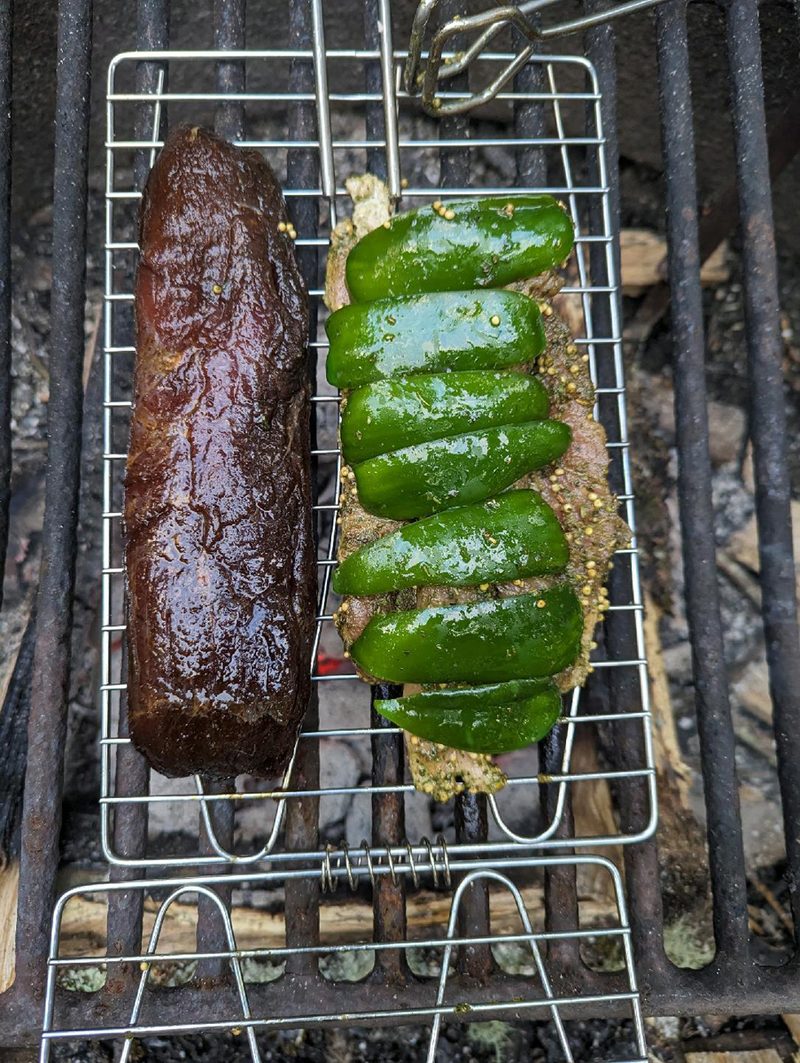
The most extravagant offering to date has to be the duck, seemingly crafted for the gods. On a chilly February, with patches of snow still lingering, deep in the backcountry of Elkmont near Jakes Creek, Richard crafted his pièce de résistance. Producing a portable grill for the fire, he meticulously seasoned and tended wood duck breasts he had personally harvested that winter. In bear country, we are always mindful of the smells wafting up hollers, but they would have to fight me for the delicacy so astutely tended over coals of beech and oak embers. Richard sings praises of the Country Pleasins marinade that tamed the wild out of this dish. The following morning saw him stirring embers, getting ready for the coming eggs and venison, also personally harvested by Richard.
Cold weather allows for all sorts of food to be toted into the woods without fear of spoiling. Our area is blessed with so much backpacking that no one need go malnourished. Some seek wilderness as a proving ground for survival. I’m more like a scavenging hyena who is on the “thrival” spectrum of campsite gastronomy.
→ Swipe for Next Story
DepartmentsJANUARY FEBRUARY 2024
Coming Up – Top Chefs 2024
8 Chefs. 8 Dinners. You’re the Judge.
Story by Cityview
Cityviewis gearing up for another exceptional Top Chefs series, this year with more treats than ever before. With 8 chefs from 8 local restaurants gracing the list, this year’s competition is sure to heat up the restaurant scene with magnificent menus, tantalizing wines, and exquisite exhibitions of each chef’s culinary prowess. And we can’t wait for you to be a part of it!
The Top Chefs series remains in the restaurants this year, and the seasoned Top Chef participants, as well as the new contenders, have pulled out all the stops to present you with evenings that showcase the very best of their talents and their restaurant’s atmosphere. No two dinners will be the same, which is why we encourage you to attend as many as you can.
In the end, only one appetizer will reign. Only one entree will win. Only one dessert will take the gold. And when all the votes are tallied, only one chef will be named the champion. Clickthis linkto stay tuned on the surprise lineup and event dates.
You be the judge. Who will be the 2024 Top Chef?
→ Swipe for Next Story
Arts & CultureJANUARY FEBRUARY 2024
On Board
David Einwechter builds a business with colorful woodcraft and custom designs
Story by Susan Alexander
Tall slabs of rough-cut wood—walnut, cherry, pine, and others—stand at attention along one side of Dogwood Carpentry in Clinton. They’ll be carted off by woodworkers for their own projects. Or David Einwechter, owner of the shop, will transform them into colorful charcuterie boards, custom furniture, and even stair treads.
A carpenter who previously worked on remodels and historic restorations in the Washington, D.C., area, Einwechter brought his skills to East Tennessee when his wife accepted a job at Y-12 in 2017. The following year he opened a retail shop in Clinton, where they live. In 2020, they bought a building on Main Street, remodeled it and opened space for merchandise from himself and about 20 other makers around the region.
Most of Einwechter’s pieces in the shop are charcuterie boards made from a variety of woods. He uses colorful epoxy resins to add interest and fill in inconsistencies in the wood, sometimes incorporating dried and pressed flowers into his designs. He finishes them with a hard wax oil. All his boards are food-grade and easy to maintain.
When he’s not in the shop, he’s probably in his home wood shop working on custom dining tables, side tables, and other pieces. He calls his designs modern rustic. Most of them have a live edge, meaning the tree’s bark remains part of the finished product. A member of Foothills Craft Guild and Tennessee Craft, Einwechter exhibits at regional craft shows, as well as others throughout Tennessee, Georgia, and North Carolina.
Einwechter began working with wood in his early teens. What started as projects for church and school evolved into full-time work after high school. “I like working with my hands,” he says. “And I’d rather be outside than in an office.” Now his work includes running a retail shop for the first time. “It’s a new experience. We’re very blessed,” he says of his family. “We run a Christian business, and we try to help the community, help others. And we want to help Clinton keep growing.”
To learn more about Einwechter’s work—and to follow along on his journey as an artist—visit his website atdogwoodcarpentry.com.
→ Swipe for Next Story
Dining GuideJANUARY FEBRUARY 2024
Comfort Food
From cozy warm dishes to melt-in-your-mouth desserts, East Tennessee’s food scene has become synonymous with comfort
Story by Marc Anthony
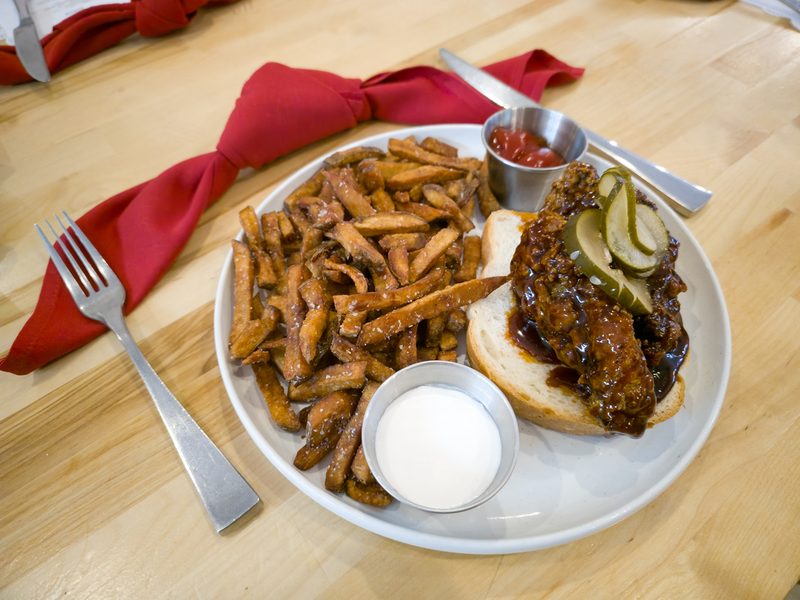
When was the last time you said the word comfort and not immediately said the word food right after it? As the cold and darkness descend upon us, we take comfort in warm and hearty meals ladled out of iron pots and hot off of sizzling skillets. Let’s delve into the twilight of early evenings and brisk weekends and discover the most comfortable foods East Tennessee has to offer our growling stomachs.
Farmacy
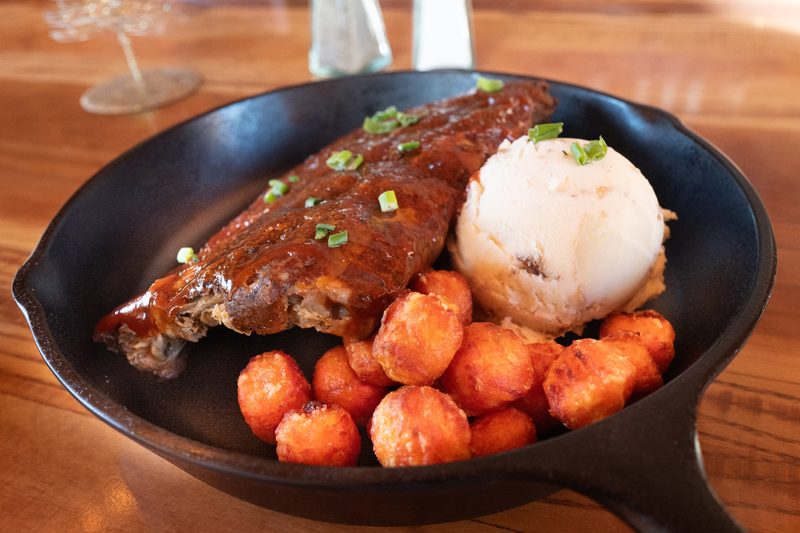
Farmacy has all my favorite meals: lunch, brunch, and dinner! But they had me at the starters. The Roasted Red Pepper and Tomato Soup went down smooth and creamy and warmed my innards like I’d hoped. I’m a fool for brisket and Farmacy’s Brisket Plate is slow cooked, stacked high, and served with all the comfort food staples like mashers and green beans and a house made tomato jam that is zippy and perfect. I’m so glad I “bought the Farmacy!”
Doesn’t the name say it all? Southern Comfort is located in Gatlinburg at the Westgate Resort and is one of the most rustic places on this comfort food tour. Wood and fireplaces abound and decadence is all over the menu. Shrimp and Grits, Chicken and Dumplings, Fried Green Tomatoes, Catfish Nuggets… all the usual suspects are here, so where are you? You’ll be here soon because the grilled meatloaf was wrapped in bacon!
Gatlinburg | 915 Westgate Resorts Road
Café 4
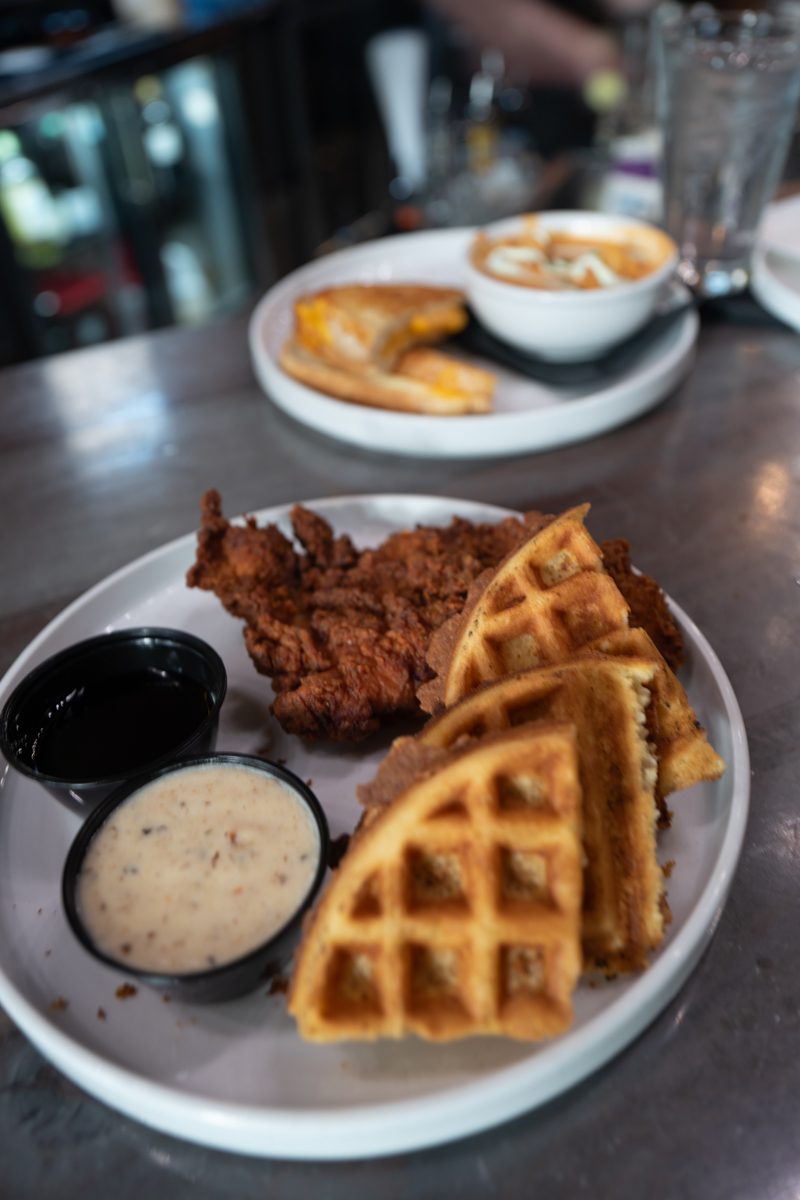
I could probably start and end with Lobster Mac & Cheese. You’ve been here, you’ve done that. You would have probably bought the t-shirt. But I was enticed by the brunch menu and the Chicken and Waffles. And the Tomato Bisque and Grilled Cheese Dipper. I was hungry and completely satisfied. But let’s get back to that Mac. What sounds like an accidental concoction, like the chicken wings that fell into that bucket of hot sauce, whoever thought to combine the Lobster and the Mac has my undying and unwavering affection.
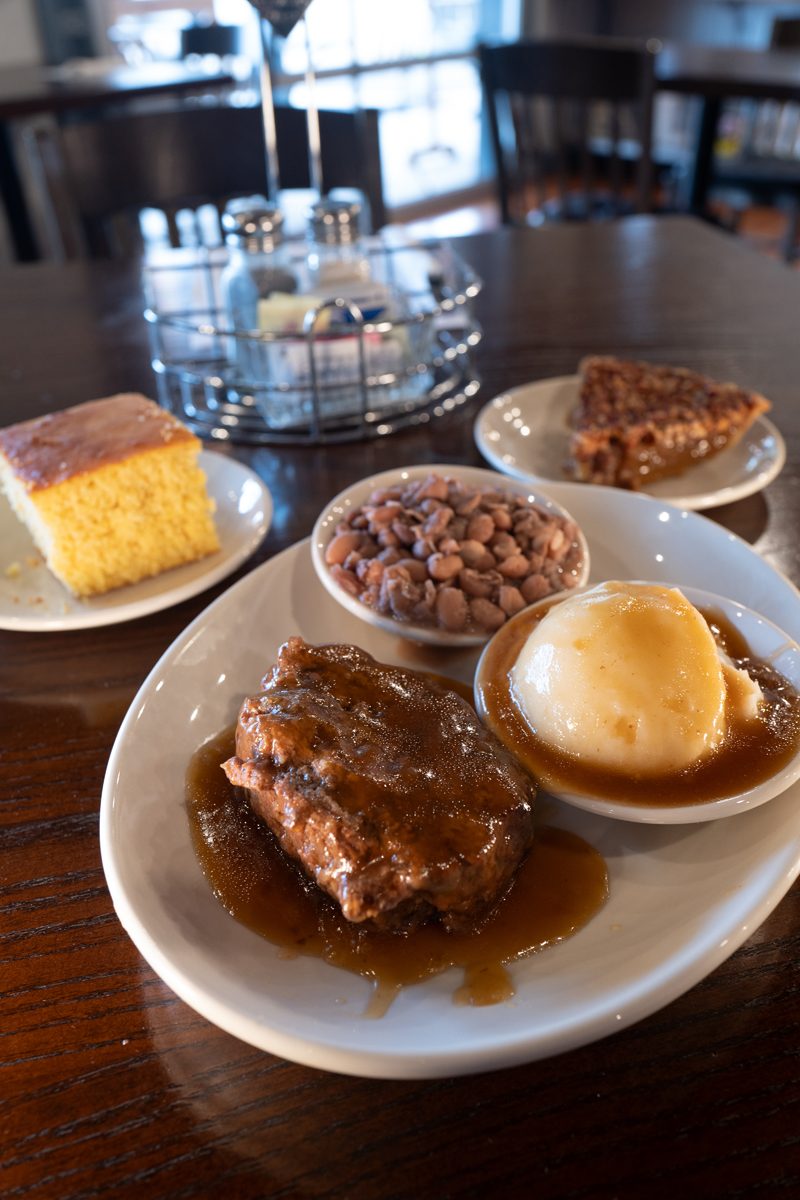
There are two Horn of Plenty restaurants in East Tennessee and it’s the Middlebrook Pike location in Knoxville that serves fresh comfort food by the bushel. Mike served up a hearty slab of meatloaf, a monolithic chunk of corn bread, and a hunk of pecan pie that set my stomach on overdrive. Just the aroma of the plate under my nose was enough to bring back memories of my grandmother’s cooking. If it’s been a few years since you’ve been inside Horn of Plenty, you’ll be pleasantly surprised at the cozy renovation. So comfortable.
Owner and all-around wonderful guy Edward’s food inspiration, Emma, headlines this abundant kitchen. I’ve never understood the name Chicken Fried Chicken, but why squabble over redundancy. The gravy train makes a stop at Emma’s and pours right into your heart. Burgers and tacos and fish and southern style sides dominate this hearty menu and define the term southern kitchen. Emma would be proud. And you will be full!
What can you say about Litton’s restaurant that hasn’t been said a thousand times in these pages and others? You’ve had the burgers, you’ve had the chili dogs, you’ve had every delectable item on this incredible menu of comfort, but let’s dive straight into the bakery case and round out this tour with some dessert. Let me string together three words you all know and love that are synonymous with Litton’s Bakery. Red. Velvet. Cake. My work here is done.
A high-end southern prime steakhouse fills a niche on Northshore Drive
Story by N. Brooks Clark
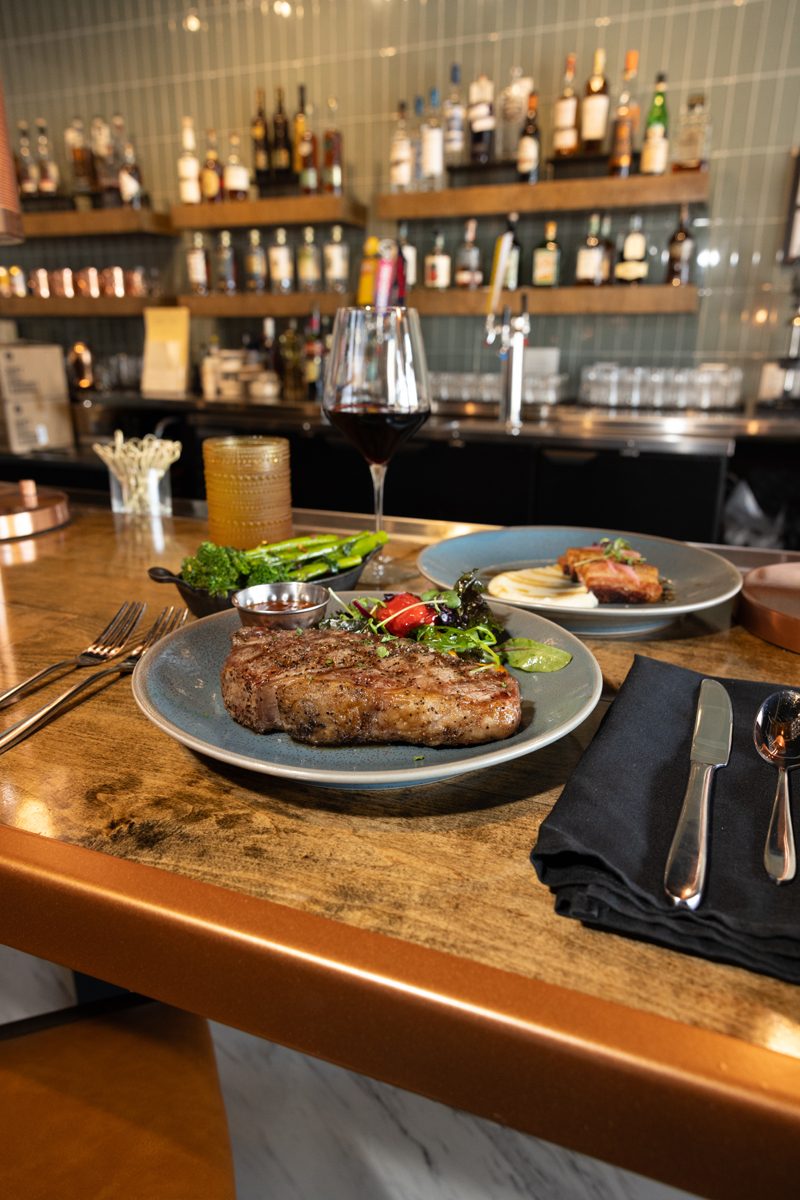
Tucson, Arizona, native Mandy Glenn was new to Knoxville when she tasted Fire + Smoke’s prime tenderloin tartare small plate, Japanese kuroge wagyu New York strip, and hand cut beef tallow fries. “I was with an Australian guy who hadn’t had tallow fries in forever,” she says. “I called the next day and said, ‘I want to work here.’” Now an enthusiastic, knowledgeable server, Glenn recently brought on her younger brother Micaiah as a host. Fire + Smoke patrons quickly embraced Executive Chef Jared Martin’s mouth-watering specialty cuts.
Fire + Smoke started as the brainchild of Archer Bagley, who saw Northshore Drive near the Pellissippi Parkway as an ideal spot for a high-end restaurant. He brought on Martin to bring the new conept to life. “After I left Kefi, I was looking for the next step, a chance to be creative,” Martin says. “I had that here, building my crew.” The name came from the smoker in the wall. “We smoke our potatoes, pork chops, chicken, fish, everything,” Martin says. “We have fire from the grill, smoke from the smoker. Put them together and you’re set.”
The design, simple and sophisticated, in muted grays and browns, came from Meghan Grohl of R2R Studios. Multi-surfaced sound panels keep things quiet. Booths allow intimacy. A wall with a fireplace behind glass separates a seven-seat bar from the main dining area.
The restaurant impressed, to say the least, and it was heartbreaking to many when it closed in October. When one pair of patrons, Doug and Tara Snover, heard, they knew they had to step in. Doug recalls Tara saying, “Our place is gone. How can we save it?”
The two swung into action, contacted Martin on Facebook, and devised a plan to revive the business. Now Fire + Smoke has had its grand reopening, and the Snovers—now the new owners—are happy to have their favorite date night spot back. Martin, now executive chef, is back to doing what he loves.
“We are creating a destination fine-dining experience for everyone, not just a few,” Martin says.
Among the small plates, you can see why the Prime Tenderloin Tartare with quail egg, fried capers, shallot, creole mustard, Georgia olive oil, and cornbread crisps made Glenn want to join the staff. The melt-in-your-mouth confit Pork Belly comes with pickled red onions, spiced sorghum, and a creamy parsnip puree that makes you want to see it again.
The Smoked Broccoli Cheddar Soup is creamy and livened with veggie elements. The Kilt Greens expertly combine baby greens, scallion, bacon fat vinaigrette, lardon, and a poached egg.
The specialty cuts, as well as the 14 oz. Prime New York Strip, 8 oz. Prime Filet, 16 oz. Prime Ribeye, and 8 oz. Baseball Sirloin come from Châtel Farms in Georgia. “The marbling is exceptional,” Martin says.
Martin sweet-tea-brines both his Springer Farms Half Chicken and Duroc Pork Chop (both smoked, of course) to give them a surprising moist and tasty quality.
Bar Chef Joe Trail has created a rich selection of specialty cocktails using “fresh-squeezed everything and house-made simple syrups.” No surprise, he uses smoked sugar cubes in his Old Fashioneds, his top seller.
Along with a Peach Blackberry Bourbon Cobbler, a Crème Brûlée Cheese Cake, and fresh-baked chocolate chip cookies and brandy milk punch, pick from Joe Trail’s special dessert offerings. Cup of Joe combines Mr. Black coffee liqueur, Whisper Creek Tennessee Sipping Cream, Appleton Estates Signature Jamaican Rum, salt, and allspice.
→ Swipe for Next Story
FeatureJANUARY FEBRUARY 2024
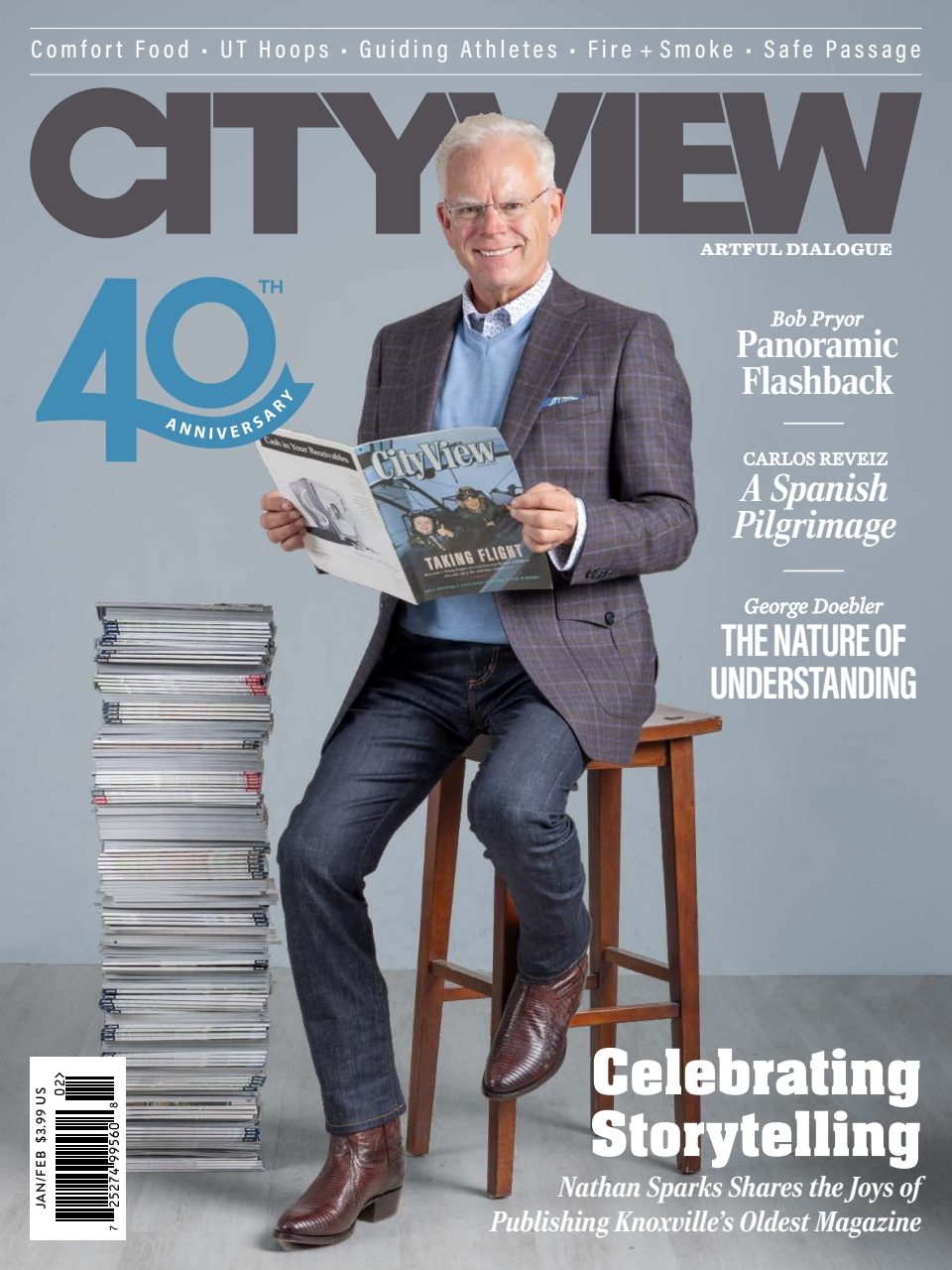
40th Anniversary: Sitting with Storytellers
Join Cityview on its journey, 40 years in the making, to tell stories of home, stories that matter
Story by Nathan Sparks
As we look around the world today, it’s hard not to fall into the feeling that the bad outweighs the good. I’d like to challenge that idea, and tell you that there’s no time like the present to acknowledge all the good that’s happening. That deep desire to find the positive feels that much more important to our team this year, as we celebrate a milestone anniversary for our publication.
On this, the 40th anniversary ofCityviewMagazine, I’ve spent some time thinking about how this publication has altered not only how we look at the world, but how we feel, too. As publisher, I’ve found our most recent decade to be one of celebration and gratitude. We atCityvieware so blessed to use this platform to tell the stories of our community and the people, organizations, and places that call it home. I’m grateful for everyone who has supported our journey as a publication over the last four decades, whether you have been reading since the’80s or madeCityviewyour first pickup when you moved here this year. Whether you bought an ad to share the good work of your company with our readers or you partnered alongside us to support a nonprofit in our Top Chef event, however you’ve supported us throughout our history, our team and I thank you.
There’s an adage that I’ve heard before that says that after food, water, companionship and love, the fifth thing people need most in their lives is good storytelling. The camaraderie sharing a good story creates is lasting. I often remind our team that no matter what part we play in the magazine—editorial, sales, creative—it’s our job to tell that person’s story and do it the right way. It’s the whole reason we do this work. There’s good happening here. A lot of it. And we’ve all felt grateful that the publication has truly become a celebration of all that good. Our pages are filled with the stories of our neighbors.
Learning how to tell stories the right way has been a journey. We’ve always been committed to thorough, honest storytelling, but helping people connect with those stories is something you can only learn with time and experience. The thing that I think made the difference is opening up and letting myself step into the story with you. Over the years, I’ve watched my own storytelling shift as I’ve grown more comfortable sharing the gritty details. I’m no longer just sharing the facts; I’m telling you how it felt to see the fish rise to the perfect presentation just as the sun is setting. That turn towards experiential writing has been an important milestone for our magazine. It’s not just my adventures, either; most of our writers have made this shift as well, and I hear from many of you about how much deeper the connection is with our writers and the subjects they are covering.
This brings me to our writers. They have done deep dives into more stories than I can count—for quite some time, too—giving us front row seats to some of the businesses, nonprofits, and people that call East Tennessee home. Some names, like Susan Alexander, Brooks Clark, Karen Clark, Mary Leidig, and Matt McGarry, you will find under dozens or even hundreds of bylines. Bob Pryor, George Korda, and Gary Wade have made it a point over the last decade to share their deep knowledge of our region with us, painting a picture of Knoxville that informs both our past and our present, oftentimes our future.
Bruce Fox, meanwhile, helped us discover greater knowledge of ourselves, and now he’s handed the torch to new voices in our magazine like Reverend George Doebler. Writers like Phil Newman, Chris Blue, Oana Harrison, and Carolyn Evans have brought exciting new voices toCityviewthese past few years. Marc Anthony and John Quillen (who ironically met during a hike-based interview a few years back) have reminded us that there is whimsy and peace in the everyday moments in nature and out in our urban environment.
And those are the just the voices who have been part of our more recent past. Hundreds of other writers and editors have been the caretakers of the region’s stories withCityviewover the last four decades, and I feel honored by their willingness to give so much of themselves to this work, whether that was during the hard hitting journalism days of the mid 2000s, the tumultuous time of a global pandemic, through to our eventual transition into a magazine exclusively focused on finding the good.
But equally important to share with you over recent decades have been the stories we tell through imagery. Countless photographers have found their names among our contributors. Our long-time friend and senior photographer Bruce McCamish recently won first in Best of the Best for commercial photography. Carlos Reveiz has been a newer addition to our circle, but he’s made his own waves, taking the cover shot for this past September’s issue as well as countless other photos. Last but certainly not least is my good friend Jimmy Chiarella. From almost the very start Jimmy has been there not only to create content but to teach me how to be a better photographer.
If you ask me why I first purchased this magazine, I’ll tell you it was in part an effort to keep a struggling magazine alive. But truthfully, I bought it based on intuition. When the interim publisher came to me, magazine clutched to her chest and tears in her eyes, I thought why not, I had enjoyed being part of the media in the past and this seemed like a challenge. I still occasionally chuckle as I think about what actually goes in to creating content that is relevant to our readers. What I originally thought was going to be a side-hustle has now become a full-time career… and I’m glad it turned out that way.
TheCityviewof today is quite different than that of the past. Most visibly because of the quality and depth of the editorial content, which creates a opportunity for better photography, but we’ve grown in many other ways as well due to the dedicated efforts of all those who have poured their hearts and souls into making this publication. Through the years, there have been many names printed on our masthead, names like Johnny Pirkle, Tom Russell, Edgar Miller, Colleen Oakley, Shayne Ivy, Keith Norris, Hannah Slaughter, Kim Olen, Doug Coffin, Juli Neal, and Eric Creed, to name just a few. There are just simply too many to list, but make no mistake, everyone who has contributed has been important to the helping buildCityviewinto a modern editorial magazine. The 40 years of our publication is their triumph as much as it is ours, and their legacy is the magazine in your hands now.
“Tell your story the way you want to,” was the motto ofCityview’s original owners John and Nancy Lyle. We’ve always done this with journalistic integrity, but as of the last decade, we’ve realized how powerful it is to a community to share its wins and successes and that’s where we’ve chosen to focus our efforts. On the good.
Honest. Clean. Brave. Reverent story telling. That’s what I’ve always wanted our magazine to embody as its publisher, and I like to think we’ve lived up to that ideal. And that’s how we will stay connected with you over the coming decade. You’ll find our direction slightly shifting.Cityviewwill continue to evolve while embracing new technology to be able to better tell our stories. There are opportunities out there for us to explore our community in new ways and share them with more people, and that’s something we’re eager to explore.
But we will always haveCityviewthe print version of the publication, because let’s be honest, there is just no substitute for holding it in your hand and flipping through the pages.
But as important as print may be, there is no question that technology is a significant part of all of our lives. Your positive response and support of the magazine have made us realize the importance of creating social content that you can join into by contributing part of your own story. Look online for more details on how you can participate.
As we move forward into our 40th year and beyond, we here atCityviewhope our longtime readers will continue on this journey with us, and for those of you who are picking us up for the first time, we invite you to join us. We would not have stories to write if you hadn’t given them to us. Your love for this place we call home, and the hard work you have put in to make it the one-of-a-kind place that it is, has made all this possible.
So we ask you to keep doing what you’re doing. Keep making East Tennessee an amazing place to live and explore. Keep making our home a place worth writing about and sharing with the world. And we’ll keep on telling your stories, the right way.
→ Swipe for Next Story
FeatureJANUARY FEBRUARY 2024
A Legacy of Quality
Story by Micha Haas
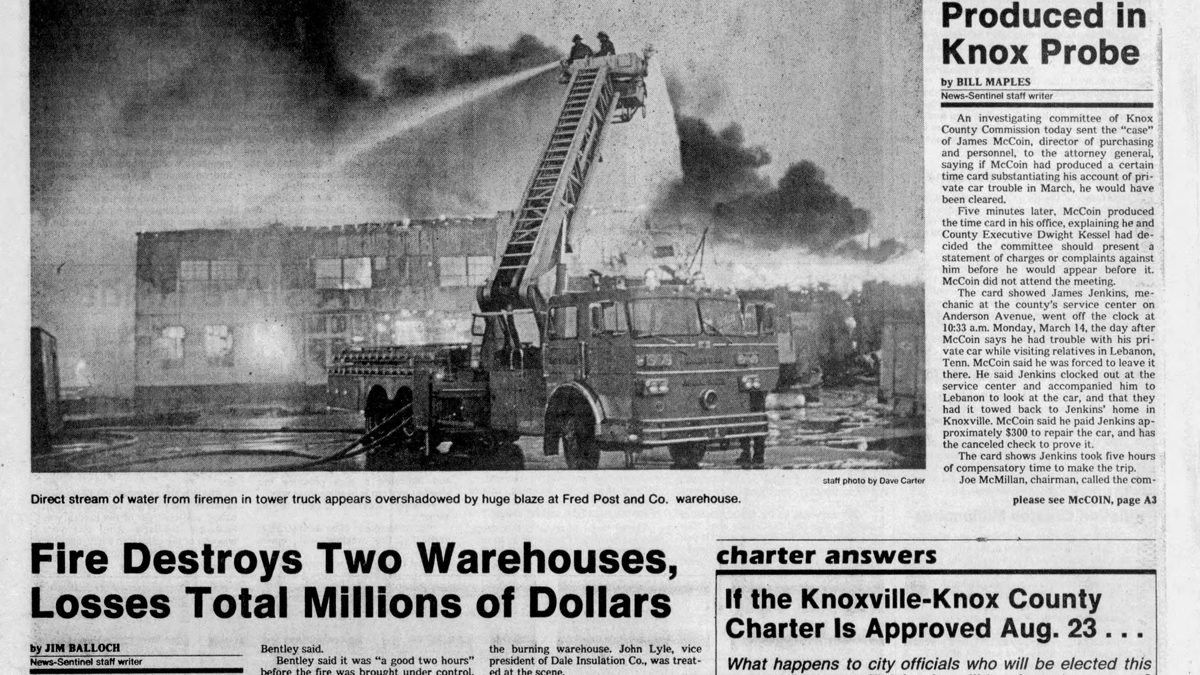
On the afternoon of August 10, 1983, John Lyle watched his business burn to the ground. The warehouses that housed Dale Insulation’s entire inventory – as well as multiple other businesses – had caught fire. The Knoxville News Sentinel reported on the devastation the next day.
The publication that would later becomeCityviewbegan as theHome Living Guide. Dale Insulation had recovered from the fire – a feat John attributes to the support of the local community – and he had reached out to the News Sentinel for a follow-up story. But the newspaper just pointed him to their advertising department.
“It was a shame,” says John. But rather than be discouraged, he and his wife Nancy came up with a solution. “If there was nowhere to get our story published, why not create our own publication?”
The very first issue of theHome Living Guidefeatured 16 home improvement companies, including Dale Insulation, each telling the story of their own business with the help of the Lyles and their new publisher, Joseph Bruner.
“When the firstHome Living Guidewas mailed in fall 1983, we had no idea how unique a publication it was,” writes Bruner in his fall 1985 publisher’s letter.
For a decade and a half, John and Nancy were the heart behind theHome Living Guide, which becameCityviewin 1986. But by the end of the 90s, the Lyles were ready for their next chapter, and so wasCityview, but they still look with pride on what they created.
“It’s still a high point for us when people see the magazine in our office,” says John.
For the full story of Cityview’s early years, you can read Sarah H. Clark’s30th Anniversary Retrospective, recently republished in honor of the 40th.
→ Swipe for Next Story
InsightsJANUARY FEBRUARY 2024
A Panoramic Flashback
Stepping back in 1970s Knoxville and relishing the memories
Story by Robert Pryor, Sr.
Knoxville has experienced considerable change over the last 50 years, and I have been lucky enough to have been an eyewitness to those changes as my hometown has developed and transitioned from the “scruffy little city” to the cozy and progressive metropolitan borough it is today. Those changes became quite vivid for me recently when I discovered a treasure trove ofPanoramaKnoxville Visitor Guides that were published from 1971 to 1974.Panoramawas a travel guide for tourists to our city to be distributed in Knoxville hotels and motels as an expression of welcome and opportunities available for good food, entertainment, and sightseeing.Panoramaguides were chock full of advertising and information about Knoxville and the greater Knoxville area until 2010.
Panorama(first introduced as theVolunteer Visitors Guide) was rarely seen by Knoxvillians, but was designed by Joe McCamish to inform visitors about the best of Knoxville. It put a face on our community in an effort to ensure that our guests had a good time and would return. Joe was an enterprising technical illustrator turned graphic artist and a native Knoxvillian who grew up just east of the location of our new baseball stadium near Winona Avenue. As a kid, he roamed the streets of downtown Knoxville and Magnolia Avenue. Joe attended Park City Lowry School and the old Knoxville High School. In the late 1960’s and early 1970’s, Joe was available when precise illustrations, graphic art, and calligraphy were called for, and he frequented the clubs and nightlife of Knoxville where business deals were made. An artist of immense talent, Joe prepared illustrations for hisPanoramaguide and is probably best remembered for his pictorial maps of Knoxville that included detailed structures like houses, buildings, and churches to make the map come alive.
So what were we telling visitors about ourselves 50 years ago? What were we recommending for a successful visit to the “Gateway to the Smokies”?
The first thing that strikes the reader of thePanoramamagazines of 1971 to 1974 is the interest in nightclubs, strip joints, and bars. In the interest of full disclosure, one-half century ago, I had a similar interest in Knoxville nightlife and was known to visit a few clubs and bars in those days based upon my belief that anybody in a bar after midnight was in need of a good lawyer. There were many nightspots around Knoxville 50 years ago and all have disappeared. If Knoxville even has a nightlife now, I know nothing about it. Today, I’m in bed by 8:00 p.m. (7:00 p.m. Daylight Saving Time) and couldn’t find a hot bar with a college guide. According toPanorama, the DownUnder (in the basement of the Farragut Hotel) and the Speakeasy (in the back of Western Plaza Shopping Center) both were owned and operated by Freddie Morton and Tommy Cole. Tommy had a great club band and Freddie was the most colorful member of a well-known and established Knoxville family. The DownUnder drew downtown professional people and lawyers (including those named Pryor) like a 6:00 p.m. magnet that sometimes didn’t demagnetize until quite late in the evening. My wife can explain that to you further, if necessary.
According to the January 1974 edition ofPanorama, Freddie and Tommy’s Speakeasy was “Knoxville’s ever-going supper club open six nights a week from 7:00 p.m. to 3:00 a.m.” (who eats supper at 3:00 a.m., then or now?).
Another hotspot 50 years ago around Knoxville was the Tiki Lounge and Luau Room, 7049 Kingston Pike. The Tiki was an active club with a live band virtually every night. The Tiki occupied a building that was later renovated and for many years served the late night crowd as Michael’s Cow Palace. Today, the property occupies a boring AT&T store with no bar or dance floor. The Tiki was owned and operated by Ron “Sack” McAbee, a well-known ex-Rule High School athlete turned entrepreneur. The Inn-Ter-Section Lounge was located at Kingston Pike and Northshore in a Family Inns of America motel. The rooms were $7.77 per night in case you had trouble making it home. The Lantern Lounge and the Casual Lounge and Nightclub were located on North Central where “every night was ladies’ night.” Most clubs, according toPanorama, were located in motels around town. The Escape Hatch Lounge was in the Admiral Benbow Inn at Malfunction Junction. It was confusing to find your way into the Admiral Benbow, but especially difficult to get out.
The restaurants advertised in Panorama in the early 70’s were Pero’s, the Brass Rail, Ivanhoe’s House of Beef, Ye Olde Steakhouse, the Rathskeller, and, of course, Regas Restaurant at Magnolia and Gay. Pero’s Restaurant is now located on Northshore at Rocky Hill, and I walked in there recently to find that the tomato sauce aroma was the same as 50 years ago when the original version was located at 4931 Kingston Pike (across from the present day Knox Plaza). Pero’s on Kingston Pike is advertised in Panorama as serving prime rib, spaghetti, and seafood. I always ordered spaghetti with meatballs, and as a boy ate in the same building when it was known as Dixieland Drive-In where they served the best fried chicken in Knoxville referred to as “Chicken in the Rough.”
Frank Kotsianas operated the Brass Rail on Gay Street directly across from the Tennessee Theatre. Fifty years ago, as a young lawyer, I tried to eat there every Friday because his fried fish lunch had downtown workers lined up north and around Nan Denton’s Orange Julius west down Clinch Avenue. Frank turned out a lot of good lunches at the Brass Rail and was always a skilled and ambitious restauranteur opening Ivanhoe’s House of Beef in 1968 in the building that now houses Copper Cellar West near West Town Mall. Frank, who died last year, was a diminutive and no-nonsense man who accumulated significant wealth opening and owning restaurants and other businesses. Once a man suggested Frank sit at a bar on a stack of telephone books so that he could get the bartender’s attention. He replied in his Greek accent, “Don’t worry, I will sit on a big stack of hundreds.”
ThePanoramaadvertises Ye Olde Steakhouse, which was opened in 1968 by Bunt and Helen King. It is one of the oldest restaurants in Knoxville and a true survivor. Today, you can still eat a memorable steak and have a good time with friends at this Chapman Highway classic. The Rathskeller was a German theme restaurant and bar in the underside lower level of Western Plaza Shopping Center. A great place to get a big, thick, juicy steak and a cold beer. Regas Restaurant was a Knoxville mainstay and nationally known restaurant for many years operated by three generations of the prominent Regas family. Probably Knoxville’s best restaurant ever. If the Rathskeller and Regas were the best places for beef in 1973, Brother Jack’s on University Avenue was the place for pork up to 3:00 a.m. Fraternity boys and UT football players thrived on Jack’s late-night greasy barbeque.
Panoramarecommended the Senator’s Club on Alcoa Highway for steak and good times, Jim Bradley’s Steakhouse on West Cumberland, Lyle’s Restaurant on Church Avenue (best charcoal broiled hamburger in the world), the S&W Cafeteria (oh, just to go back one more time), Shakey’s Pizza on Kingston Pike at West Hills, and the Tic Tok Drive-In on Magnolia (I’m still carrying at least 20 pounds from eating at this favorite spot).
Other businesses advertising inPanorama50 years ago were Executive Massage Salon at 701 S. Gay Street. The salon was open from 10:00 a.m. to 4:00 a.m. and provided a massage for $10 and a Tiki bath for $25 (oh, how I long for a good Tiki bath). The salon location is now a parking lot between Cumberland and Church. The Bijou Theatre (one-half block south from the salon) was an “art theatre” with a midnight stage show every Thursday through Sunday. Howard Johnson’s Motel advertised two locations in 1974—one across from West Town Mall and the other at North Merchants Road with Knoxville’s only “tropical paradise aquatic center.” In 1971, Knoxville’s new top men’s store was Hansom House on Cumberland Avenue founded in 1966 by M. S. McClellan. Matt later moved his upscale men’s store to 5614 Kingston Pike in Bearden and has always been what ZZ Top called the “Sharp Dressed Man.”
Panoramastates the Knox County population in 1971 as 276,288. That population 50 years later in 2021 was 486,677. The intercity bus company was Knoxville Transit Lines, and regular performances were presented at the Civic Auditorium/Coliseum. In April 1971, the big shows at the Coliseum were Blood, Sweat & Tears and the US Air Force Band. In February 1974,Panoramalists the top Auditorium shows as Mull’s Gospel Sing and the Porter Wagoner Show. The Gospel Sing was produced by the Reverend J. Bazzel Mull, who began gospel music programs on radio in 1942 and on television in the 1950’s. Anyone living in Knoxville or East Tennessee 50 years ago was familiar with Reverend Mull and his co-star, Mrs. Mull, and Knoxville’s favorite grocer, Cas Walker, and their radio and television programs. They were three of the most unforgettable Knoxvillians ever, and they remain the subject of hundreds of stories and wonderful memories.
Looking back over the last 50 years, it’s hard to imagine how anyone ever thought of Knoxville as a “scruffy little city.”
→ Swipe for Next Story
JurisprudenceJANUARY FEBRUARY 2024
Neyland and the Last Single Wing Tailback
Story by Gary Wade
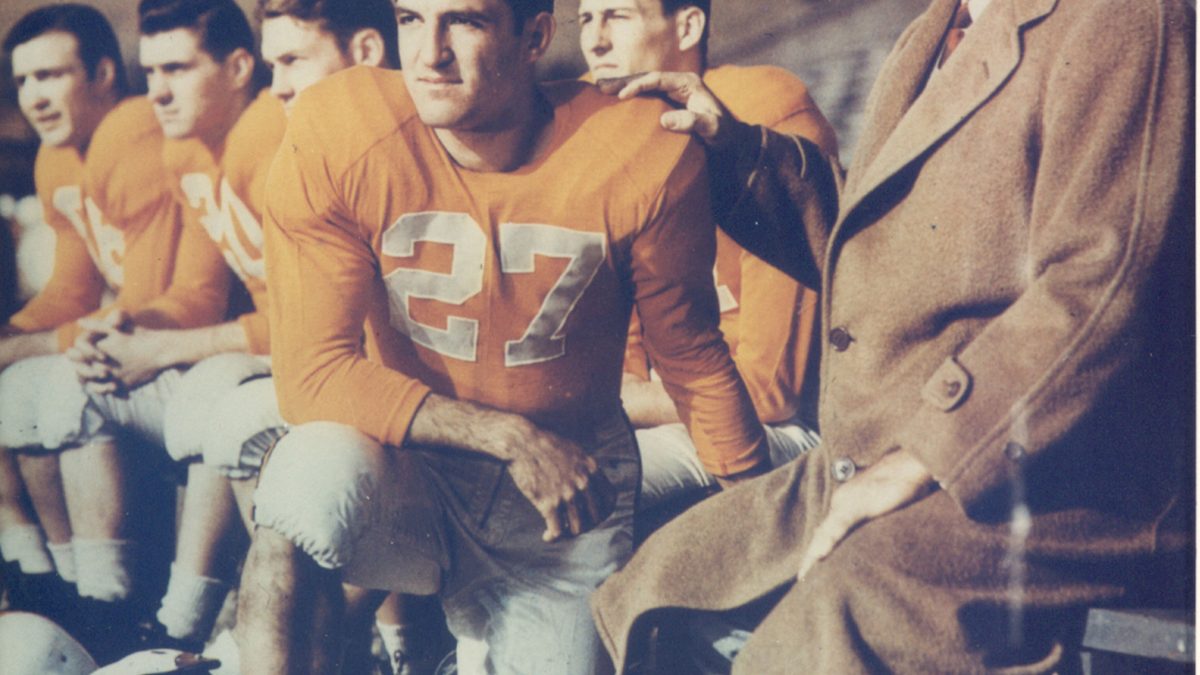
After receiving an appointment to the United States Military Academy at West Point, Robert Reese Neyland (pronounced “knee-land”) starred as an end for the Army football team from 1913-16. In his spare time, he pitched for the baseball team and won the academy’s boxing championship. After his graduation, Neyland was commissioned as an officer and, during World War I, served with an engineering division in France. Upon his return to the states, he earned a graduate degree in engineering at MIT and then became an aide to General Douglas MacArthur at West Point. In 1925, he was hired as Professor of Military Science at Tennessee. That fall, Neyland began his football coaching career as an assistant for the Volunteers. His talents were obvious. The following year, University President Harcourt Morgan named him head coach with the directive to “beat Vanderbilt,” a school which fielded a dominant team in the early years of college football. And Neyland and his teams did just that, while also defeating just about everyone else on the schedule from 1926 to 1952. His tenure coaching the Vols was interrupted twice by virtue of his military responsibilities and, during World War II, when he was promoted to general. While emphasizing the importance of team defense in his time at Tennessee, he had installed his signature single wing offense wherein the tailback position included running, passing, punting, returning punts and kicks. If those duties were not enough, in this two-way era for all players, the tailback also played in the team’s defensive backfield.
While Neyland’s stellar defenses dominated in his three terms as head coach for the gridiron Vols, his offense featured the tailbacks like All-Americans Beattie Feathers, Gene McEver, George Cafego, and Hank Lauricella. When “the General” retired after the 1952 season, he had recorded national championships in 1938, 1940, 1950, and 1951 and compiled an enviable overall record of 173-31-12. Further, his 1939 team was the last NCAA team in history to go undefeated and unscored on during a regular season. Years later, in its edition recognizing its All-20th Century team,Sports Illustratednamed Neyland as the premier defensive coordinator for the sport’s first one-hundred years.
His departure signaled a brief decline for the Vols. After mediocre seasons in’53 and’54 under Harvey Robinson, Neyland, in his role as athletic director, hired his former All-American end, Bowden Wyatt, as the Vol’s new head coach. Wyatt, originally from Sweetwater, had coached conference championship teams at both Wyoming and Arkansas before “coming home.” Choosing to continue with Neyland’s single wing offense, Wyatt duplicated that feat in 1956 at Tennessee. Led by his single wing, “triple threat” All-American tailback Johnny Majors, who was named Southeastern Conference Player of the Year for the second straight season, Tennessee finished 10-0, losing to Oklahoma in a close vote for the national championship.
In Wyatt’s last five-years, however, the Vols were 25-22-3, nowhere near the standard Neyland had set during his four decades at the helm. Vol fans typically blamed the antiquated single wing. In this period, tailbacks like Bobby Gordon, Bill Majors, Gene Etter, George Canale, and Glenn Glass continued to lead the Vol offense, just as quarterbacks do today, but, apart from Gordon, the only one to gain a measure of distinction for the Vols was Mallon Faircloth of Cordele, Georgia. After being coached by then assistant Johnny Majors while on the freshman squad (first year students were not eligible for varsity play in the 1960s), tailback Faircloth was named Sophomore of the Year in the SEC at the conclusion of the 1961 season, leading his team in rushing and passing and just about every other meaningful individual statistic.
Neyland died in the following spring, ending a remarkable era of leadership. Wyatt, who had continued to coach his mentor’s traditional single wing, was fired later that year after a dismal 4-6’62 season. He was replaced by his eight-year assistant, Jim McDonald, a former Ohio State running back.
Fans speculated that Tennessee would change to the popular T-formation for the’63 season. It did not happen. Perhaps the coaches and players on hand had come to Knoxville committed to the single wing, or maybe Neyland’s influence extended beyond his death. As for Faircloth, despite the losing’62 season under Wyatt, he was once again to be the Vols’ best offensive threat in his junior year. And, like many of his predecessors at the tailback position, he was the team’s best at rushing, passing, and punting. Finally, much like many of his predecessors at the tailback position, he was solid in the defensive backfield, compiling five interceptions in his career while also returning punts and kickoffs.
In McDonald’s only year, the team finished the season with a 5-5 record, winning only three conference games. The season ended on a high note, however, with shutout wins over Kentucky and Vanderbilt. Led by Faircloth in his final game, the Vols defeated a competitive Commodore squad, 14-0. By then, however, the single wing offense was an endangered species across the nation. Few high schools, even in Tennessee, continued to use the formation. That affected recruiting. Home-grown quarterbacks went to other schools. In these years, for example, Steve Sloan of Bradley County chose Alabama, and, of course, Steve Spurrier of Johnson City won a Heisman Trophy at Florida in 1966. Both these T-formation quarterbacks had careers in the NFL and later became successful head coaches in the collegiate ranks. Meanwhile, at the end of his last season, Faircloth was chosen to play in the post’63 season Blue-Gray all-star game, an annual charitable event in those days which served as an opportunity for college players to display their talents for NFL scouts. Until that final game, he had never played in a T-formation as a collegiate athlete. Triple threat tailbacks were largely extinct.
Doug Dickey, a former college quarterback at Florida and an assistant at Arkansas, was named the new head coach at Tennessee for the’64 season. His implementation of the more modern T-formation signaled the end of the single wing era. Thus, General Neyland never saw his orange-clad Volunteers in anything other than the single wing offense.
As a postscript, after a brief stint with the Dallas Cowboys in the pre-season tryouts, Faircloth returned to Knoxville to enroll at the University of Tennessee College of Law. Good move. Upon graduation, he returned to his hometown, where he engaged in the private practice for 13 years before taking over as the Superior Court Judge in his district of the state. He served four terms in that office, never having been challenged in an election. Afterward, Faircloth, well-known for his knowledge and patience as a jurist, became the United States Magistrate for the federal courts in Columbus. He retired in 2010. As an avocation, he had become an accomplished distance runner for a time and also contributed columns to a Georgia-based magazine for runners. He has written two books so far and, at 85, is working on yet another. Still a season ticket holder for Vol home games, Judge Faircloth stands as the last single wing tailback in the 37-year history of the formation at Tennessee. Mindful of current trends, he recently pointed out that today’s imaginative offenses like the shotgun can look a lot like the old single wing. As for Robert Reese Neyland, his nine-foot statue kneels at the portals of the stadium named in his honor.
→ Swipe for Next Story
Non-ProfitJANUARY FEBRUARY 2024
Pouring In
No Athlete Left Behind provides young athletes with the support they need to lead fulfilling lives
Story by Rebecca Whalen
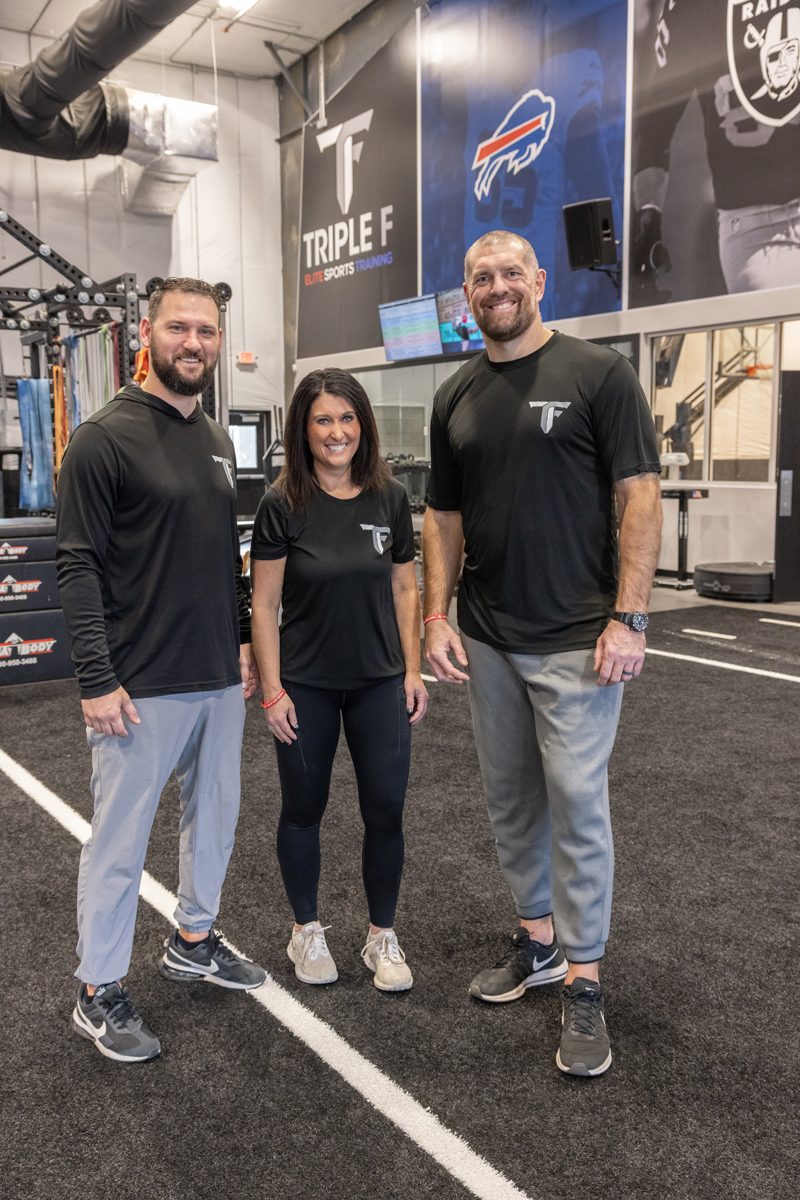
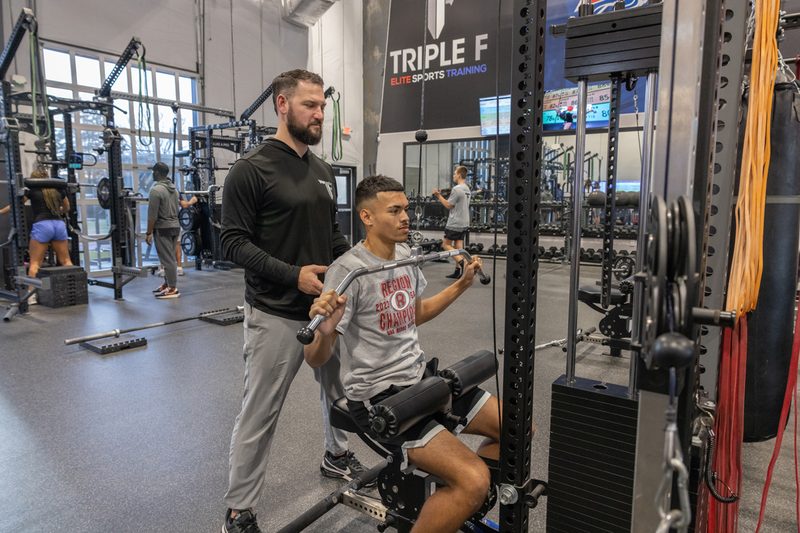
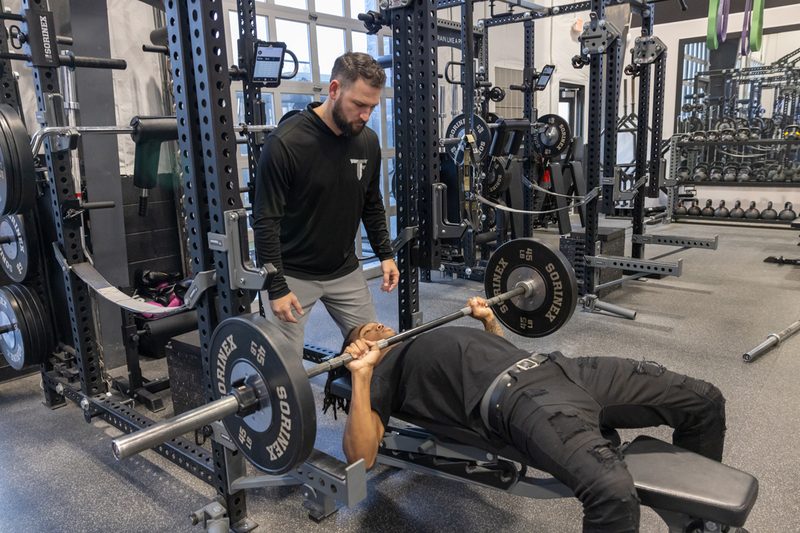
It’s 4 p.m. on a Tuesday at Triple F Elite Training in Knoxville. The gym is quiet, outside of a few trainers getting their spaces ready for the students that will soon converge. High above the gym in one of the offices with windows overlooking the gym floor is Jennifer East, Director of Marketing at Triple F. She catches up on emails until she hears the ring of the front doorbell, signaling someone has entered the building. She pulls her head up from her work. Another ring goes off. Then another. Then so many it’s hard to decipher them as individual rings.
Students arrive from across the region, shaking off their school days and preparing for a workout with their trainers. The music ramps up in the gym below.
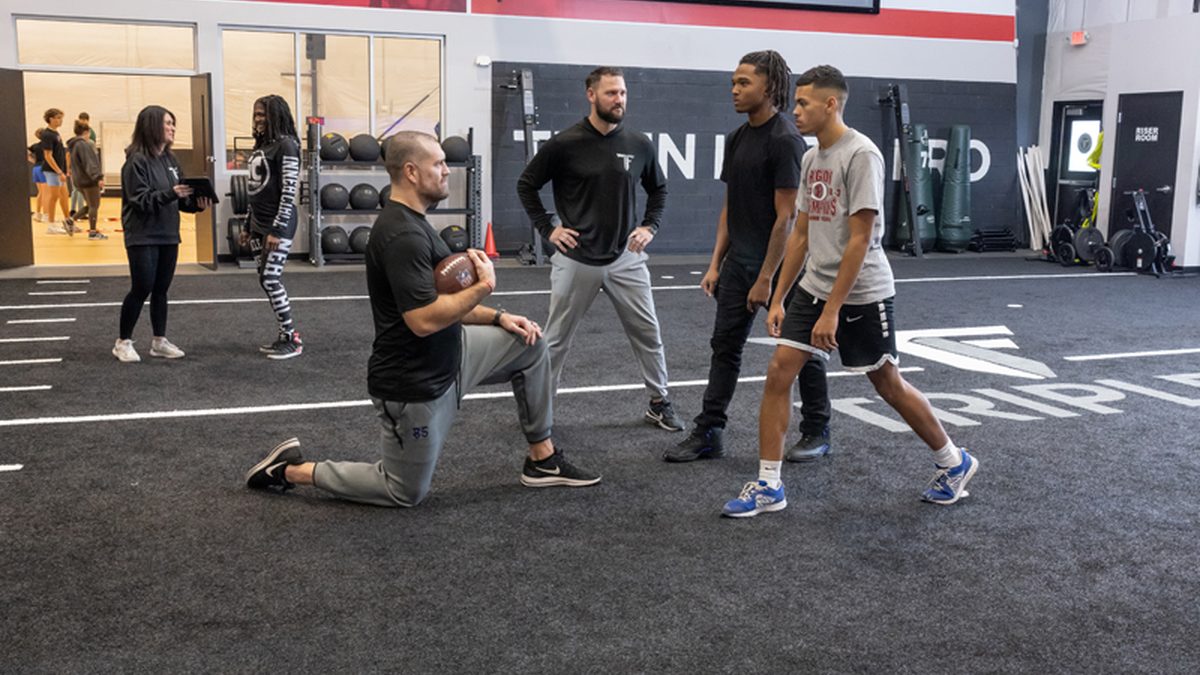
Amidst the hubbub is a quiet program called No Athlete Left Behind, a 501(c)3 nonprofit designed to support athletes without the means necessary to attend athletic training on their own. But you would never know it existed by watching a training. The NALB athletes are simply part of the facility’s membership, something the organization’s leaders felt strongly about when it formed early last year.
Jenn, who serves in an advisory role with NALB, and worked for years at East Tennessee Children’s Hospital, brought her expertise to the table, knowing how critical it is for youth to have the support they need to lead healthy lives. “Whether it be health care or home life situation, kids need a solid foundation of support. So many children are lucky to have that, but so many kids aren’t,” Jenn says, adding later. “It has been incredible to serve in a different way for families.”
An NFL Founding
NALB is the brainchild of former Vol and former NFL tight end Lee Smith. Lee found ways post-football career to make a positive influence on youth, knowing first hand how challenging some youth have it.
“My father was a pretty vicious alcoholic at the end of his life,” Lee says. “He was also a pro football player…While he was playing, he was my hero, the man who lived up to all the things that fathers are supposed to be. I’m very thankful for the first 10 years of my life and the father I had.” But things after that weren’t easy for his family. Eventually, after Lee started playing football, he found men who set an example in work-life balance. “It fired me up to watch men operate that way.”
When Lee opened Triple F in Knoxville, he wanted to ensure that those without the means to afford athletic training could benefit from the space and program. “This can change their life,” Lee says. “I wanted to make sure that we are on the frontlines to serve them in any way we could, regardless of whether or not they can pay.”
The organization serves athletes in just about any sport, including rowing, soccer, baseball, golf, football, and basketball. The athletes come to NALB from across East Tennessee. And while many come from challenging circumstances, that’s not always the case. “Some of these kids have wonderful parents that just can’t provide training for them,” Jenn says.
Coaches reach out to Lee about a student who might a good fit for NALB. Or athletes learn about the program from a friend. It all boils down to the athlete’s family telling their story. Then the NALB team determines through that story, understanding their circumstances, and speaking to coaches if a student is eligible.
It Takes a Village
Current NALB member Jaheim started playing football as a third grader. This year, he’s a senior, a running back for his high school’s football team. After getting injured in a game, Lee and the NALB team stepped in and offered to help get Jah back on his feet.
With mom, Shereka, working hard to provide for her six kids, Jah found added support from NALB. In addition to training, the team is helping him with other life skills a teenager needs, like how to open a bank account, get a driver’s license, and manage finances. And it’s making an impact. Shereka says her son has always been a good kid, but she’s proud of the work he has put in.
“A lot of the kids talk to Mr. Lee about school or sports, and he lets them make their own decision, but he gives them the mature advice that they need,” Shereka says. “I’ve noticed that as my son’s been going there he’s been having a lot more mature conversations…I can tell the maturity since he’s been in the program.”
For Jah, it’s made an impact knowing Lee went through a challenging life as a youth. “He’s already been through it,” Jah says. “So he always knows exactly what to do.”
Jah will head off to Purdue University in the fall to play football. And while he doesn’t know just yet what his field of study will be, he’s excited for what’s to come.
In another part of town is Bayden, a high school freshman who started playing baseball when he was five, eventually joining a travel program. His mom, Courtney, calls out her “village” for helping her make his baseball dreams happen. But when Bayden learned about Triple F, a place that could help him reach his goal of playing Division 1 baseball, Courtney knew it wasn’t something they could add.
At NALB’s request, she shared her story, which would eventually lead her to NALB Executive Director Nate Hoffmeister, who is also one of the key trainers. Ironically, Nate knew the family already. That evening, Courtney got a call that Bayden was accepted into the program.
“They have been such a blessing on so many levels,” Courtney says. “From the standpoint of the athletic level, they push him and make him work hard for what he wants. And they know how to do it the right way. But on the spiritual level and the mentor level, it goes far beyond what I could ever ask for.”
More to Training
For so many athletes, being on a sports team or part of a training program is about so much more than exercising. It’s about learning good nutrition, camaraderie, discipline, respect, and time management. Trainers host classes every day that incorporate the NALB students.
But it’s a two-pronged approach, Nate says. They support them outside of the gym, as well, “pouring into them” so they feel supported. They make sure the athletes know about the college application process, offer weekly Bible study, bring them to community events, and participate in service projects with them. The fridge in the Triple F player’s lounge is always stocked with meals to go, and if an NALB student needs transportation to training, the program steps in.
The reality, Jenn says, is that not all of these students will get the opportunity to go to college or be pro athletes, “but let’s teach them to be good husbands. Let’s teach them to be good fathers. Let’s teach them what it means to get up every day and be a good worker and good employee.”
“If we can get access to these kids,” Nate says, “then we essentially take them under our wing 100 percent and try to do life with them.”
A Big Year Ahead
With 43 athletes right now, NALB can support upwards of 50, though Lee says someday he would love to be able to support more.
“I want to make sure that all these kids out there that have been failed by people or have been failed by circumstances or failed by poverty, I want them to know that it might feel like athletics is the only thing you have, but in all reality, athletics is just the platform and the foundation that you’ve been given that allows you to do so much more,” Lee says. “I want to show them how to do that. And we could not be more excited about it around here and fired up.”
To learn more about No Athlete Left Behind and how to become involved in upcoming fundraisers, visitnoathlete.org.
→ Swipe for Next Story
FeatureJANUARY FEBRUARY 2024
Raise A Voice
Hometown Heroes: Raising a Voice gives vulnerable women in the Knoxville community a voice, paving a way forward with hope and support
Story by Laura Lee Cochran
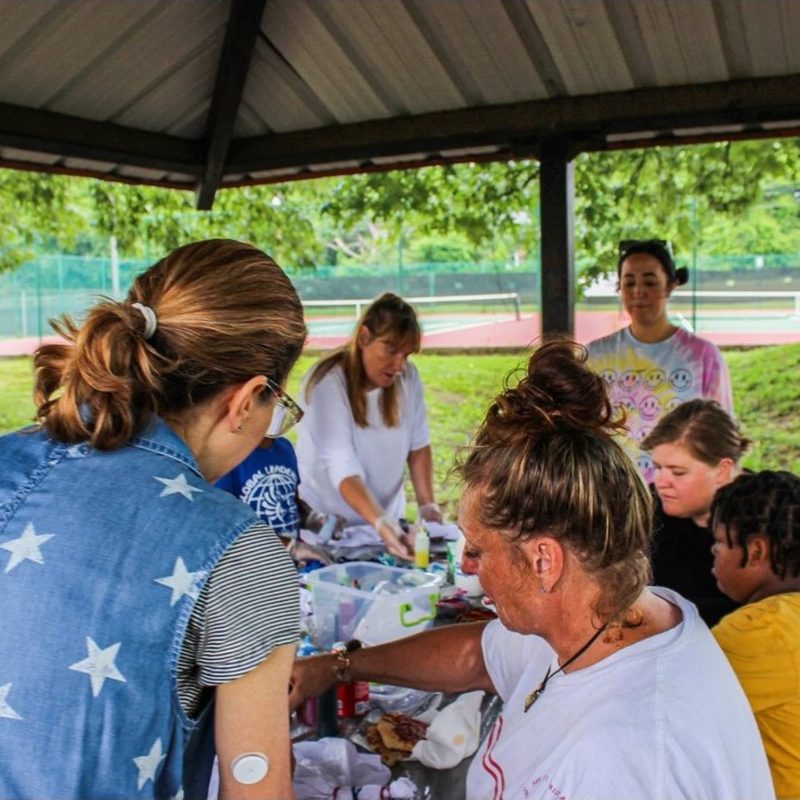
It’s one thing to see struggle and pain, it’s quite another to fight against it. Knoxvillians Will and Katie Boggs fight daily for women who have faced trafficking, exploitation, substance abuse, homelessness, and domestic abuse. And they do so through the organization they founded back in 2015 called Raising a Voice. Utilizing the Magnolia Women’s Center in East Knoxville, Will, Katie, and their team help meet the needs of the women they serve and work with them to take tangible steps that allow them to move forward.
“We really focus on building a strong community amongst the women that we serve, so that they can grieve and mourn together,” Will says, “but being able to celebrate when women enter into housing, or head to sobriety, or get into rehab, or take positive steps moving forward with jobs, those are great ways that we get to rally around them from a case management perspective.”
The concept of Raising a Voice was born when Will and Katie traveled over the course of a year to 150 anti-trafficking organizations in over 20 countries. This led them to open establishments starting in Kenya and Argentina. In 2018 they began in Knoxville and then Rwanda in 2020.
“We really just felt compelled to not only act on a global level, but act on a local level,” Will says, “some of the same challenges we’re addressing overseas are right in our backyard, or here in the United States as a whole and wanted to make sure that we weren’t turning a blind eye to the needs locally.”
The name, Raising a Voice, came about because, as Boggs puts it, “all people have stories, all people have lives, and we all face challenges. And when we’re in relationship with some of these women, and we’re in proximity to them, we’re allowed to learn and through relationship we’re allowed to hear their stories. Then we can use our voices and help raise their voice.”
“We take an approach not just towards changing one life, but our goal is to impact entire communities. “ Will Boggs
Raising a Voice focuses on three core beliefs which is for their non-profit to be sustainable, relational, and radical. One way that showcases this is their two coffee shops located in Knoxville:Likewise Coffee, andCultivate + Flowers coffee. The proceeds of these two establishments fill as a sustainable resource for Raising a Voice.
Boggs shared his interest in business and how the non-profit has been able to intertwine that into their ministry. “I think our encouragement to people in general is to find what they’re passionate about,” Will says. “There’s a lot of ways to make an impact in the world. So find what you’re passionate about and then find ways that that passion can make a positive impact in our city- in our world as a whole. “
To learn more about the non-profit or how to get involved check out their website:www.raisingavoice.org
→ Swipe for Next Story
FeatureJANUARY FEBRUARY 2024
Safe Passage
Partnering for solutions to help wildlife survive
Story by Mary Leidig
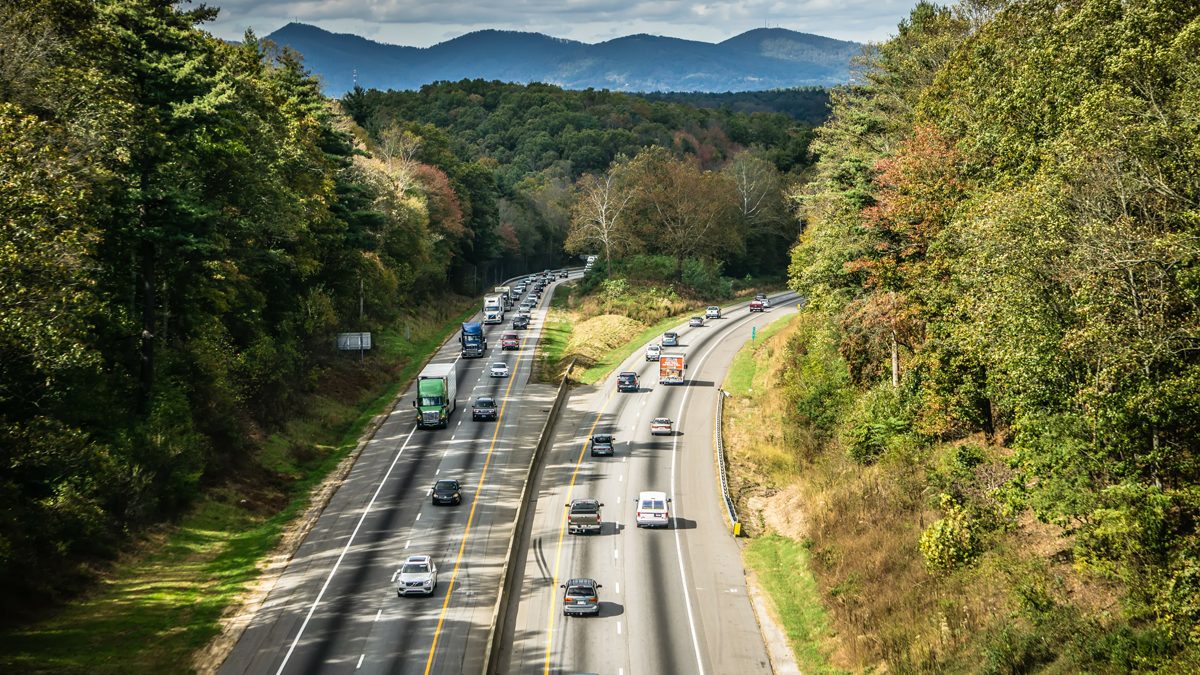
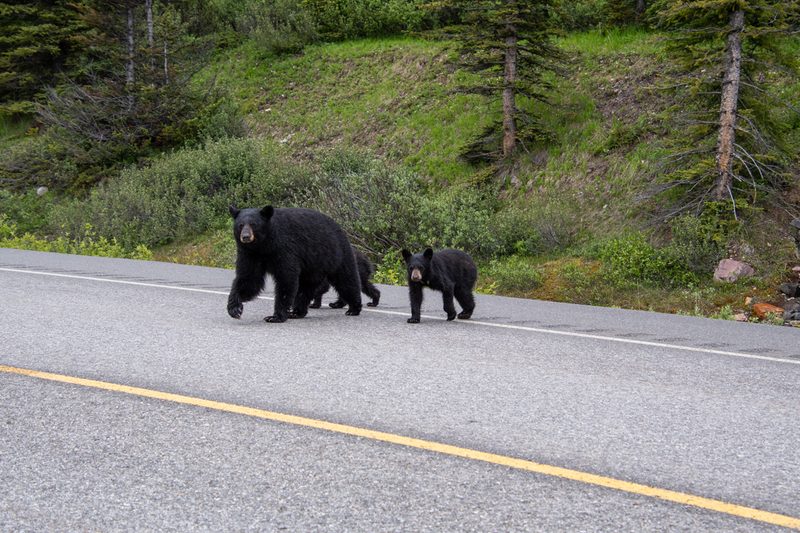
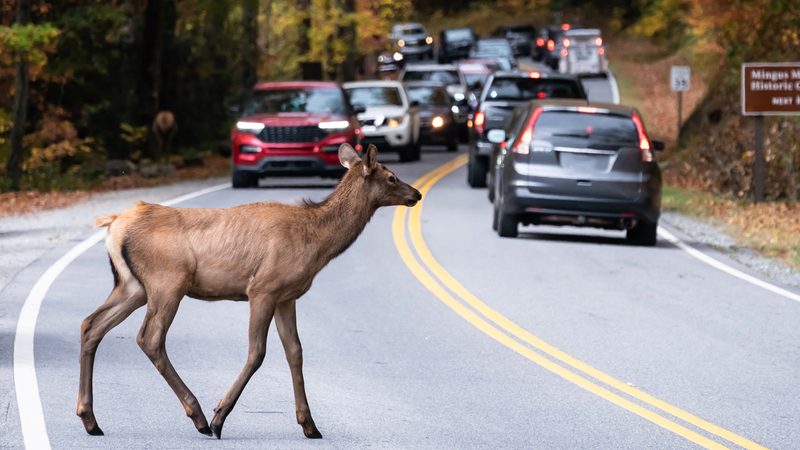
A mother black bear is approaching one of the busiest highway crossings near the Great Smoky Mountains. She looks back to make sure her cubs are close by. She’s making a life-threatening journey for food over four lanes of raging interstate traffic. It’s the only way to cross and prompts countless hold-your-breath moments for I-40 travelers. In America, more than 1 million animals die trying to cross these roadways every year. But regional organizations are putting in effort to make their journeys safer.
Safe Passage, the I-40 Pigeon River Gorge Wildlife Crossing Project near the Great Smoky Mountains, may well be a national model that is inspiring highway engineers, architects and state leaders. Many have long been involved in seeking humane alternatives to wild animals crossing intensely busy highways just to get needed variety of foods and find healthy mates outside their own families. The more traffic, the more terrifying for animals—and yes humans—who can be injured or killed in collisions that result. More than 28,000 vehicles travel on I-40 between Tennessee and North Carolina every day, according to the Tennessee Wildlife Federation. This interstate cuts through incredible wildlife habitats in the Great Smoky Mountains.
The good news is the success of wildlife crossings in the United States looks phenomenal, reducing motorist collisions with wildlife by up to 97 percent. And even as the eastern U.S. has lagged behind other parts of the nation and other countries like Canada, the Safe Passage project is bringing together many diverse agencies to create safe crossings along this corridor.
Jeff Hunter is the Southern Appalachian Director for the National Parks Conservation Association and has been the project’s tireless ambassador for years. He believes building safe crossings for bear, elk, deer and other wildlife will save lives and boost safe traffic along the 28-mile stretch of I-40 from Tennessee into North Carolina.
The project’s massive research—“so big it can’t be emailed,” says Hunter—is being hailed as a tool for many regions in the eastern U.S. looking to make it safer for wildlife to cross interstates and highways. This endeavor now has the support of numerous regional and state leaders including the governor of North Carolina.
Hunter remembers the first time he saw a dead bear on the side of the road at Sam’s Gap, which runs through the mountains of western North Carolina and upper east Tennessee. “It took my breath away.”
It Began With A Conversation
It began in fall 2017 with a conversation when Hunter managed to bring seven state and environmental organizations to the table. “I am not a biologist. I’m a naturalist, spending time looking at animals, and I have a corporate background in the telecommunications industry.” He was a data center manager in New York for a company that later became Verizon before he moved to Chattanooga to work for the National Park Service. His work with NPCA also includes the Great Smoky Mountains. In 2022, he was named Wildlife Conservationist of the Year at North Carolina Wildlife Federation’s 58th Annual Governor’s Conservation Achievement Awards Ceremony.
Getting together multiple organizations with different missions for such a gathering was daunting. The meeting revealed scarce resources, skepticism, and the fact that such wildlife crossings are not easy projects.
This heavily researched project shows clear data on wild animals and vehicle accidents from animals trying year-in and year-out to make the dangerous trek. The research report showed hundreds of bears alone were dying each year and had previously been undercounted along this 28-mile stretch of I-40.
“I can’t put a date on exactly when shovels go into the ground to create new crossings. But we now have the evidence from the years of research, and we want to see it happen,” Hunter says.
We’re All Ridge Runners
The study is one of the largest road ecology research projects ever completed in the eastern U.S.—including extensive wildlife-camera research. Crunching the data shows that it is cheaper to mitigate because of the loss of human life, animals and numerous traffic jams. The study also shows where the chaos is—primarily on a stretch of I-40 with the most conflict at bridges and exits on roadways. “That’s because the animals find these passages as the least resistant,” Hunter says. “We’re all trying to get there at the same time—whether you are a bear or a human. We’re all ridge runners, and the roadways cut in 1968 were also used by the animals.”
The one big message of the study? There is a better way—a way to forever help animals safely cross I-40 in the Pigeon River Gorge.
Today, organizations working on the Safe Passage coalition with NPCA include The Conservation Fund, Defenders of Wildlife, Great Smoky Mountains Association, North Carolina Wildlife Federation, The Wilderness Society, and Wildlands Network. The Tennessee Wildlife Federation is Safe Passage’s voice in Tennessee. “Though not an official part of the fund coalition, their staff works closely with Tennessee DOT and Tennessee Wildlife Resources Agency to advance our vision in the Volunteer State,” Hunter says. “We couldn’t be more grateful for their dedication to our shared cause.” Overall, the goal of the Safe Passage project is to build infrastructure for wildlife crossings along the 28-mile stretch of I-40 and make that area safer for animals and humans alike. This particularly scary stretch of interstate makes up 8 miles in Tennessee and 20 in North Carolina.
An important marker for the project came in 2019, when the North Carolina Department of Transportation announced that five previously planned bridge replacements would soon begin. Data identified these bridges as mortality hotspots for wildlife. Since it would be decades before they would be replaced again, Hunter saw an opportunity to provide safe passage if they could be redesigned for wildlife. Though NCDOT had no funding for wildlife provisions, their new collaborative partners urged them to try inexpensive modifications on bridge replacements at Harmon Den and over Jonathan Creek, both near the Great Smoky Mountains.
Harmon Den has two wildlife-friendly “benches” or pathways beneath the new bridge. In the replacement of the “high bridge” over Jonathan Creek, NCDOT is creating similar benches, primarily for elk. “There are additional bridges that will be replaced,” Hunter says. “We are hopeful NCDOT will include design elements that will make the roadway more permeable for wildlife.” At the time of this writing, the wildlife crossings, which include wildlife fencing as part of the Harmon Den and Jonathan Creek bridge replacements, were nearly complete. Wildlife is expected to begin using the Harmon Den bridge access more frequently as vegetation grows, encouraging animals to feel safer and more secure.
The Safe Passage project has raised approximately $130,000 to bring private dollars to the table, with a larger campaign possible as they leverage more money. Hunter is encouraged. “The general public is very supportive of the Safe Passage project, which leaves me optimistic about raising additional funds to support this important work.”
Competing For The Same Space
“One thing that surprised us from the research is that most of the wildlife-vehicle conflict is associated with structures on I-40 like bridges, interchanges, etc. The reason for this is pretty simple,” Hunter says. “Wildlife use ridges and gaps to move across the landscape on the least-cost path. In other words, rather than climbing a 45-degree slope, they often follow creeks and rivers—choosing to expend less energy.”
These places in the landscape where there is a least-cost path are also where the highway engineers located bridges and exchanges, so humans and wildlife are competing to move through the same locations.
The research also showed significant unrecognized mortality in the Pigeon River Gorge. “By counting carcasses—103 dead bears in 3 years—we identified mortality hotspots, which allow us to focus on recommendations to mitigate the problem. That research tells us we can factor 103 dead bears by 2.9. Not everything that gets hit results in a carcass that can be counted,” Hunter notes.
“If we build these in the right places—wildlife hotspots—it can pay for itself,” he says. This kind of conservation would protect what future generations will have. It is all values driven, he adds.
What’s Next? A “Big, Hairy, Audacious Project”
As Hunter looks at the future, the need for safe wildlife overpasses will get even greater. Around this stretch of I-40 are two national forests, the Appalachian Trail, and the most popular national park in the United States. The interstate is surrounded by some of oldest mountains in the world, and the number of visitors who want this stunning mountain experience continues to grow.
Hunter’s goal for the Safe Passage project is a “big, hairy, audacious” one. He wants to see wildlife overpasses in North Carolina and Tennessee large enough for elk and bear alike with strategic fencing.
Emily Jones, NPCA Southeast Regional Director in Knoxville, agrees. “This research data pinpoints the places where drivers and wildlife are most vulnerable to accident. And as the state applies for infrastructure dollars, the research will be critical in building the ‘big, hairy, audacious’ wildlife overpass,” Jones says.
The collaboration of so many is stunning. “Another great accomplishment has been the gathering of community organizations, wildlife and conservation nonprofits, legislators, breweries, and Great Smoky Mountain partners to work together toward a successful outcome,” Jones says.
Department of Transportation projects can take decades to complete. By starting now to plan for the construction or reconstruction of overpasses and underpasses that create animal friendly space, Jones hopes to see data-driven solutions implemented into ongoing transportation projects in the Southern Appalachians. And that may come sooner than anticipated. In November 2023, the North Carolina General Assembly allocated $2 million in funding for infrastructure to help reduce wildlife–vehicle collisions across the state.
Animals Need A Hand
“People come to the Smokies to see the bears, but the bears can’t build a road or right of way that is safe,” Jones says. “People can, and North Carolina can take the lead in the eastern U.S. by protecting both the animals and drivers in our gorgeous part of the world.”
Jeff Hunter imagines driving and seeing these wildlife crossings—wildly popular with the general public in other parts of the United States. “All our partners in this project—we keep coming together. This is what matters.”
→ Swipe for Next Story
VeteranJANUARY FEBRUARY 2024
The Mission Goes On
Bryan Gansner, who barely survived war, helps other vets survive its aftermath
Story by Phil Newman
Only days after September 11, 2001, country star Alan Jackson wrote “Where Were You When the World Stopped Turning?” He would perform the song live to a teary-eyed audience at the CMA Awards two months later.
That heartfelt lyric comes to mind during a conversation with Bryan Gansner, a Knoxville U.S. Army veteran, chiefly because for him, 9/11 would lead to another day—July 6, 2006—when his world almost stopped turning. Gansner, 46, refers to it as “the day I got blown up,” when a bomb blast shattered both heels, shredded his right leg, caused an anoxic brain injury from loss of blood, and broke his wrist.
Many of the details of the incident were told to Gansner later. He didn’t recall the moment an improvised explosive device (IED) exploded under his Humvee, halting the convoy in which he was riding along a remote highway during Operation Iraqi Freedom.
And while he has no trouble recounting what he calls “my boo-boos” from that harrowing night, he adds, “I prefer to talk about all the life since then,” and especially his hottest pursuit: helping fellow veterans to recover from PTSD and other conditions that often lead to taking their own lives. “The boo-boos are what led me here, and my mission is to help prevent suicide,” Gansner says.
A Midnight Ride
What he also calls “the accident” happened during Gansner’s second tour of duty in Iraq. He had been deployed from Ft. Campbell, Kentucky, in 2003-04, and then returned to Iraq in September 2005, ten months before the IED attack.
That night, Gansner’s squad was on a routine scouting operation, taking Route Cherry, north of Kirkuk, when they passed through a train trestle. Around that moment, a radio call urged the convoy to take caution because “we caught a guy up the road placing an IED.”
“Thanks,” replied Gansner, whose vehicle also carried the driver, a gunner, and an interpreter.
Suddenly, it seemed, Gansner was thinking, Where are my Oakleys [glasses]? “Everything was black, stuff was in my eyes, the air was thick. The driver asked if I was OK. I said, ‘I think I’m hurt.’ That’s all I remember saying.”
An IED had been tripped and exploded under the Humvee near Gansner’s seat. “There was so much smoke, I couldn’t see s***. I reached up to unlock the combat lock, but I felt uncoordinated. My arm was hanging down, blood was running out.”
The vehicle’s driver, SPC Richard Lucht, asked Gansner iif he was okay. “Yes, but I think I’m hurt,” he answered. The interpreter opened the door and fellow soldiers tried to pull Gansner out. His weapon had hit him in the mouth and lodged between his thigh and the roof of the Humvee. They cut the seatbelt and extracted him. “I don’t remember that part,” he says now.
So forceful was the explosion that an mp3 player that had been hanging near Gansner’s seat was later found 100 yards away, having blown out of the gunner’s hatch.
Gansner was in bad shape, but he was awake enough to remember a feeling: pride. “What makes me proud is that as I was lying there, everybody was doing what they had been trained to do, they were working on me and I just watched. I saw the work we had put into training these guys in action.”
Word traveled fast about the incident. One soldier was heard on a radio saying, “Oh my God, it’s Sergeant G!”—the nickname the troops called Staff Sgt. Gansner.
“I found out later that when we got back to the base at 2 or 3 in the morning, dozens of people were lined up to give blood,” he says. “The docs couldn’t locate the source of bleeding, so they were going through blood. They finally got it stopped enough to save my leg. It was humbling to hear that these guys I served alongside had such genuine concern. It might sound kind of odd, but it’s the proudest day of my life.”
Gansner’s first clear recollection is of waking up in Germany, several days after the explosion, with “a rack over my chest and tubes going everywhere.” He had been in a medically induced coma, couldn’t talk, and he was coughing up black sludge. His next memory is of being on a transport plane, “rows of gurneys on one side, medical equipment and personnel on the other,” then on a bus from Andrews Air Force Base to Walter Reed Army Medical Center. Within a day or so, his then-wife was there; he credits her with going above and beyond to care for him as his long, arduous recovery began.
Some of his buddies from Iraq also would visit, along with his parents. Gansner was at Walter Reed from early August to late September 2006, and then received outpatient care and physical therapy until March of 2008. He was honorably discharged from the Army on March 28, 2008.
As he lay in Walter Reed and then endured a painful rehab to try to repair his leg and heels, and learn to walk again, Gansner had time to reflect on his service and the path that had led him there.
Midwestern Roots
Bryan Robert Gansner, born November 29, 1977, in the farm town of Festus, Missouri, was a spirited young man who came of age “running through the woods and creeks and riding four-wheelers with my cousins.”
He recalls two indelible aspects of his childhood: one, he never met his father, and two, when he was 16 he learned that he had been adopted by his aunt and uncle. “I also found out depression runs in the family, which later on fed right into my PTSD, because I’m prone to that as well.”
He didn’t have much interest in the military—even though several family members had served in various branches—but during his junior year of high school, “the recruiters finally got to me,” and the appeal of serving led him to enlist in the Army. Soon after graduation, on July 11, 1996, he shipped out to Ft. Jackson, South Carolina, for basic training. His training as an artilleryman would lead him to Ft. Sill, Oklahoma, where he was stationed before later serving out of Baumholder, Germany.
Gansner’s primary role was “fire direction control, the brains of the artillery world. We would compute the data, chart where to target, move the gun this way.” He was part of a complex process leading to the point where “the gun bunnies, the muscle, would crank the knobs and place rounds in the cannon. If we had six guns, a typical battery, they were 50 to 200 yards apart, all hitting targets 7,000 meters away, each from a different angle, based on range to target, how much powder to use, up to 18 guns, hitting targets within 5 or 10 meters.”
Gansner rose through the ranks steadily. He served as a non-commissioned officer (NCO) for 10 of his 12 years in the military. His early roles included supervising radar operations, tracing incoming mortar fire, and dispatching responses accordingly. He was promoted to corporal and later to E5 and E6 (Staff Sergeant).
By 2000, he was stationed at Ft. Campbell, from which he was deployed several times, leading to his tours in Iraq and the explosion in 2006.
The Mountains Are Calling
In the years since he left the Army in 2008, Gansner has become dedicated to three major focus areas:One, helping fellow veterans navigate post-war trauma and discover hope and purpose;Two, hiking as many trails in the Great Smoky Mountains as possible; andThree, spending time with his two daughters—his eyes light up when he talks about them.
And no, that second item is not a typo. It says hiking. In what is a marvel even to himself at times, Gansner went from using a walker to slowly maneuver from his bed to the bathroom, to traversing 20.7 miles in one day on a hike to Mt. Camerer, the 10-mile round trip up the Alum Cave Bluffs route to Mt. Leconte, and hundreds of other miles in the Smokies and beyond.
Like other veterans we’ve met, Gansner credits getting out in nature and basking in the majestic beauty of the mountains with fostering a sense of much-needed peace. The meandering streams and rushing waterfalls he passes by have a way of quieting some of the echoes of artillery, enemy engagements, and exploding Humvees.
One source of inspiration were his buddies, especially Jon Atkins, whose death by suicide served to spur and motivate Gansner in his efforts to bring hope to fellow vets facing post-war challenges, and Ty J. Johnson, who was killed April 4, 2006, in an IED attack. Both men’s names are tattooed on Gansner’s arm as a living tribute and reminder. Gansner set a goal of watching the sunrise from atop Leconte by the fifteenth anniversary of Ty’s death in memory of his friend. Thanks to a tough training regimen, he achieved the feat a month early, in March 2021.
Looking back on his first few post-war years, Gansner says, “I tried to close the file drawer on my military life and move on. Later I learned you shouldn’t close it off completely. You can’t dwell on it, but you need to be somewhat involved in the veteran community. You need that connection. Trying to survive solo does you no good. I went through a lot of depression, and having people to hang out with made a huge difference.”
That’s partly why Gansner is so engaged with efforts to prevent veteran suicide. As he recounts stories of lives saved, and others who could not be saved, his eyes well with tears. The emotion is raw. His message to others is clear:
“Be on the lookout for vets and other people who need help, and jump on it. If I see any hint that a soldier is struggling—like if they ‘joke’ on social media about wanting to ‘take a dirt nap’—I will call them. If I can, I’ll meet them in person, put an arm around them, tell them they matter. They can find hope. That they’re not alone.”
In other words: don’t let the world stop turning. It’s a life-saving message Gansner has more than earned the right to convey.
If you’re a struggling U.S. service member or veteran, or a concerned friend, Irreverent Warriors and Stop Soldier Suicide offer a 24/7, confidential, trauma-informed service at (844) 689-0445. Don’t wait; reach out now to get connected to care and support.
→ Swipe for Next Story
FeatureJANUARY FEBRUARY 2024
The Reverend
Nashville in 1960: My father’s moment at a crossroads in history
Story by N. Brooks Clark
I am holding an old clipping fromThe Tennessean. It’s dated March 31, 1960. The by-line is David Halberstam. I’ve always known how this story affected the course of my family’s life. I’ve always felt pride and joy at having this particular gift—a window on a time in my father’s life when he (and so many Southern churchmen like him) were playing their roles on the stage of history.
Between 1955 and 1960, my father, the Rev. Bayard Clark, served as rector of St. Bartholomew’s Episcopal Church in Nashville. They were great years for my family. My father and mother, Charlotte Clark, loved St. Bartholomew’s and all the friends they made there. My sister, Kathy, graduated from Harpeth Hall. My four brothers lived in a childhood paradise, playing football and basketball in yards and driveways up and down Wayland Drive. And I was born, in 1956. Those were also the early years of the civil rights movement.
Dad was a charter member of the Southern Christian Leadership Conference. I remember a colleague of his, the Rev. John Carter, who’s now retired in Sewanee, recalling how they sneaked off in the night to attend the first convention in 1957. My dad’s parishioners didn’t know about this, and probably wouldn’t have approved.
One day in the late 50s, Dad called from work and told Mom to get a babysitter and meet him at Scarritt College and hear someone speak. There, for the first time, she heard the Rev. Dr. Martin Luther King Jr. “It was the most exciting thing I’d heard in a long time,” she recalls. “He got me all stirred up, and I was so frustrated because I couldn’t tell anyone about it.”
Another time Dad had the honor of introducing King at a speech to the Nashville Ministerial Association.
It’s hard for some of us—especially those of us under 50—to understand how bitterly Nashville was divided over the issue of integration in the late 50s and early 60s.
Dad preached about integration at St. Bartholomew’s, and the church was packed every Sunday as a result. Some parishioners were uncomfortable with his views, but these sermons were never a problem. He was especially pleased when several divinity school professors started coming to services at St. Bartholomew’s, and he expressed his views in scholarly places—like an ethics panel at the divinity school in late March of 1960. The turning point for him—and for us—came when the words in the pulpit and in the religious community became a story and a photo inThe Tennessean.
March 1960 in downtown Nashville was a time of sit-ins. The issue was the integration of the lunch counters, notably at Cain-Sloan’s department store. At that time Dad was vice-president of the Nashville Ministerial Association. Since the president of the NMA was out of town, Dad took clergy to visit Mayor Ben West. “We said we would back him if he would open up the lunch counters,” Dad wrote in his personal memoirs. “He said he had to remain mayor. I answered: ‘Does this mean we will have to have a prayer vigil in front of your office?’ He repeated: ‘I have to remain mayor.’ The next day we did just what we said we’d do.”
AccompanyingThe Tennesseanstory was a large photo of the crowd, with a box and an arrow pointing to the Mayor’s Office. Standing very visibly at the back of the crowd was a clergyman in a collar, whom many parishioners mistook for Dad. This only added to the embarrassment of his having been identified as rector of St. Bartholomew’s, as if he were expressing the views of the parish by taking part in the demonstration.
“The day the article appeared,” says Mom, “our liberal Jewish neighbor across the street, Adele Schweid, called to congratulate us on what we had done. I knew we were in trouble.” It wasn’t long before one conservative member of St. Bartholomew’s vestry—who believed in segregation, but also supported Dad’s right and duty to follow his conscience—told my parents, “I think there’s a little trouble brewing.” It was one thing to hear your preacher talk about integration from the pulpit. It was another to read it in the newspaper.
Over next few months, it became clear that this was a situation that could split Dad’s congregation down the middle and tear it apart. “Three quarters of the parish backed me,” wrote Dad. “But I surveyed the 12 big contributors and found that they would not. One lawyer on the vestry was told he would have to leave his firm if he remained at our church. I counseled with the National Council of Churches race-relations man in Nashville, as this was a lonely time. He said, ‘Bayard, you don’t have to worry about the church. You are the church.’ I determined that when the Church had to pay off a big loan at the bank, it is a very human institution, and I felt I had no right to bankrupt it. I resigned by mail to the Vestry with no job in sight.”
Dad sent letters all over the country, and late that summer he was offered a position as a Canon at the National Cathedral in Washington, D.C.
Coincidentally, David Halberstam’s career also moved him to Washington that fall. At an inaugural ball for President Kennedy, Dad ran into Halberstam and took the opportunity to ask why he’d included the drunk shoving and cursing the demonstrators—which apparently added to a feeling among Dad’s parishioners that the event was somehow disreputable or unsavory, in addition to being politically incendiary. Dad wrote that Halberstam told him an editor put that line in.
In 1963 Dad took part in the March on Washington and was present for the “I Have a Dream Speech” at the Lincoln Memorial. If you look closely at the photo of a crowd scene from that day in Taylor Branch’sParting the Waters: America in the King Years 1954-6, you can see Dad’s face—with glasses and a clergyman’s collar—under a “Freedom” banner in a crowd scene from that day.
In 1965—convinced that the spiritual challenge of the coming years was to be found in the streets of ailing cities—Dad was taking a six-month course at the Urban Training Center in Chicago when Martin Luther King Jr. issued his call to the clergy to join him for his march in Selma. Dad got in a car with several clergymen and drove to Alabama.
The day of the second march across the bridge he was about seven rows behind King. “We went four-by-four with a monitor for each row to assist us with being non-violent,” wrote Dad. “We walked past the citizens. They shouted hateful epithets at us. We crossed the bridge slowly and faced the police. They decided to let us march. People along the roadside joined us.”
In 1994, when Dad died, I wanted to remember Dad to his many friends in Nashville with an op-ed piece inThe Tennesseanrecalling March of 1960. I wrote Halberstam to see what he could tell me about his story, and, surprisingly, he called back immediately. As it happened, he was then working on his memoir of his years as a young reporter in Jackson, Mississippi, then in Nashville covering the civil rights movement. Halberstam didn’t remember either my father or this particular demonstration, which isn’t surprising. As Dad often said when we’d ask him about his civil rights activities, “There were so many churchman, white and black, who did so many things, large and small.” But Halberstam told me about that moment in time—and how he was certain that almost everyone involved in any small way knew that he or she was standing at a crossroads of history.
Halberstam told me his book (The Children, which came out in 1998) would talk a great deal about the clergymen at the Vanderbilt Divinity School: “They were a distinguished group,” he says. “The cream of a generation. You really knew this was something powerful. You could feel something begin to grow.”
After Dad’s Moment in History appeared inThe Tennessean, I got a phone call from Ben West, Jr. In a couple of weeks. He was going to take part in a ceremony dedicating a plaque on a Nashville street corner.
Back in 1960, West told me, several weeks after Dad’s prayer vigil, a student from Fisk University named Diane Nash and many other students met with Mayor West on that street corner to talk about integrating the lunch counters. As he said to my father, West said something to the effect that politically it would be hard for him to integrate the lunch counters. And in a moment of clarity and courage, Nash said, “Sometimes you have to do something because it is right.”
In that historic moment, West paused, said she was right, and decided to integrate the lunch counters.
On the phone Ben West, Jr., wondered aloud to me if perhaps that group from the Nashville Ministerial Association, and what my father said that day in March, might have prepared his father to take the courageous step he took in April. I had never thought of that.
I wasn’t quite 4 when we moved to Washington, D.C. I’m too young to remember any of my father’s sermons at the National Cathedral, which he left in 1965. His obituaries inThe Washington PostandThe New York Timesallocated more type to his 15 years in the federal government (in the adult-education division of the Department of Education) than his 16 years as rector of churches in Cape Girardeau, Missouri, Houston and Nashville—although I know that’s where his heart was, in helping people with the day-to-day crises of their lives.
If things were different, I might know very little at all about the man my father was when he was just a few years younger than I am now. Instead, I can look through that clipping fromThe Tennesseanand see a priceless moment in time, where I can see what he faced, what he did and what he felt. And I can be proud in a very special way.
→ Swipe for Next Story
FeatureJANUARY FEBRUARY 2024
The Right Stuff
Rich with talent, UT’s men’s and women’s hoops teams must figure out how to jell at tournament time
Story by N. Brooks Clark
Last February, the UT men beat the No. 1 team in the nation (Alabama) then suffered the heartbreaking loss of point guard Zakai Zeigler. In March Madness, the Vols beat Duke to make the Sweet 16, only to lose to Florida Atlantic. The Lady Vols beat eventual national champion LSU in the SEC tournament semis, lost to mighty South Carolina in the final. They made the Sweet 16 but lost to Virginia Tech. Both teams have added promising new weapons faces but need to figure out the right lineups to get to the Elite 8, or further.
Zeigler is the Heart; James the Connector. Zeigler, an All-SEC defender, returned to the floor against Tennessee Tech in November. He made an acrobatic steal, weaved his way down the floor, and lobbed a pass that freshman forward J.P. Estrella dunked in grand style. After the game Coach Rick Barnes quoted fifth-year senior Josiah-Jordan James: “Josiah said, ‘Coach, we gotta give the guy the game ball because he’s the heart and soul of the team.’— and he is.”
After a December win over George Mason, when James had 14 points, six rebounds, six assists, and three steals, Barnes described him as a “connector” for the offense. Last year James, coming back from an injury, seemed tentative at times. This year he moves more quickly and confidently. Through mid-December he was averaging 11.4 points and 6.6 rebounds and hitting 40% of his threes.
Like Jordan-James, the smooth-shooting All-SEC guard from Montevideo, Uruguay, Santiago Vescovi decided to return for his fifth season. Over four seasons, he has hit 38.1% of his threes.
Dalton Knecht (pronounced “connect”), a 6’ 6” gift from the transfer portal, provides behind-the-back dribbles, flashy dunks, reverse layups, 39.1% of his threes. “He is the All-American no one saw coming,” wrote CJ Moore ofThe Athletic. He had 28 points in an exhibition win at Michigan State, 24 in a win at Wisconsin, and—while the rest of the team floundered in a 100-92 loss at North Carolina—Knecht 37 on just 17 shots. “He’s a gym rat,” Barnes told Trevor McGee of theDaily Beaconover the summer. “I think he has been in the gym every day since he’s been here.”
Born in Fargo, North Dakota, Knecht grew up in the Denver suburb of Thornton, Colorado. After high school, he played two seasons at Northeastern (Colorado) Junior College, then two at the University of Northern Colorado, where he led the Big Sky Conference in scoring. He came to UT 1) because his favorite player, Kevin Durant, played for Barnes at Texas, and 2) because he wanted to become a better defender, which Barnes is pushing him to do.
Jordan Gainey, another portal gift, transferred from South Carolina Upstate after two seasons of shooting the lights out. “He plays with a high basketball IQ and is a guy who makes his teammates better,” said Barnes to theBeacon’s McGee. Gainey’s dad also happens to be the Vols’ assistant coach Justin Gainey. “I’ve never had my dad as a coach,” Gainey toldBeaconsports editor Caleb Jarreau, “but at the same time I think it’s pretty cool because whenever I’m on the court, it’s strictly business, and he does not really seem father-son. It’s more player-coach. I treat him just like I would any other coach.”
In a bright spot in a 100-92 loss at UNC, with UT trailing 61-39 at the half, 6-foot-11 forward Jonas Aidoo beat Armando Bacot on a slick pick-and-roll, got a nifty pass from Vescovi, and drew a foul. “I truly think Jonas is going to play his way this year into being one of the best post guys in the country,” said Barnes. Aidoo, who has a wingspan of 7 feet, six inches, has more than 415,000 followers on Tik Tok. “It’s having an open personality, being bright hearted,” he explained last year. “I always want to put a smile on people’s faces.”
In an 80-70 November win at Wisconsin, 6-foot-8 forward Tobe Awaka, a supply chain management major from Hyde Park, New York, made a key block, three key buckets, and—diving for a ball—threw himself into the Badger fans. He did not come up with the ball. “It was a valiant effort, though, I thought,” said Awaka afterward. Said James, “You get tired of playing against Tobe in practice because he’s such a relentless player on both ends of the floor.”
Versatile guard Jahmai Mashack delights in shutting down hotshots like Bama’s Brandon Miller (now in the NBA), Purdue’s 7-foot-4 Zach Edey (reigning Naismith Player of the Year), and Terrence Shannon Jr. of Illinois. Mashack “doesn’t need shots to affect the game,” wrote Mike Wilson of theNews Sentinel. “He’ll create his own plays and set up others.” Against the Illini, Mashack had a timely baseline drive and dished assists to Knecht and Vescovi for 3-pointers. “He dashed in for a mini-hook. He drew a team-high five fouls and had three assists. He had nine points, five of which were on free throws.” He made both his field-goal attempts. “I have the confidence that I can adjust,” Mashack said. “Big thing for me and I think the main thing that if you think of Jahmai Mashack, you think of resilience. I have that through and through.”
The Lady Vols Depend on the Electric Rickea
The Lady Vols graduated Jordan Horston but return forward Rickea Jackson, an electric All-SEC playmaker who grabbed six rebounds a game last season and simply can’t be stopped when she decides to score, good for 19.2 points a game last season. When Jackson missed a few games with an ankle injury in November and December, the team looked lost.
Fifth-year point guard Jasmine Powell had worked on improving her defense. “Her defense is crazy,” said Jackson at SEC Media Day. “I’ll put her on anybody. You need somebody to guard? I’m picking JP.” Powell has help in floor-generaling from Jewell Spear and Destinee Wells, senior transfers from Wake Forest and Belmont, respectively.
Spear, a 5-foot-10 guard, makes things happen, creates shots, takes it to the hoop, communicates, and rebounds. She hit three 3-pointers in a row and scored 20 points in her debut, against Florida A&M. “Her hitting all those threes is just her dipping her toe in the water,” said Coach Kellie Harper. “She is a great teammate, with a lot of personality and natural ability.”
In her Lady Vols debut against Florida A&M, Wells whipped a no-look pass to post Karoline Striplin, one of six assists against the Rattlers. “Destinee’s assists make us look good,” said Harper. “She makes such good decisions with the basketball. She has so much basketball savvy, a great IQ, and connects with people in transition and half court.” Unfortunately, Wells suffered a season-ending leg injury in late December.
Senior wing Tess Darby, a reliable defender and communicator on the floor, hits 40% of her threes when the team is in sync. In the Lady Vols’ mostly out-of-sync first nine games, she hit an uncharacteristic.261 from behind the line. Kaiya Wynn, a junior guard from Richmond, Texas, uses her athleticism and hustle as a much-needed hustling defensive stopper.
Sara Puckett, a versatile 6’2” guard/forward, spent much of the summer in the weight room. As a result, she has upped all aspects of her game—as a rebounder and under the basket, making turnaround jumpers and putbacks through defenders’ slapping arms. “I gained all this strength,” said Puckett after grabbing eight rebounds and scoring 24 points in an 84-74 overtime win over Memphis. “I thought I might as well use it.” Said Harper, “Sara is a warrior, doing good things on both ends of the court.”
Last December, when 6-foot-6 shot-blocker Tamari Key was diagnosed with blood clots in her lungs, Striplin, a 6’3” forward-center from Hartford, Alabama, stepped up and began making big plays, rebounds, and putbacks under the basket. This year she, like Puckett, has taken her game to a new level. Early in the opener against Florida A&M, she initiated a nifty give-and-go that gave her a layup –two of her 20 points for that game. She is active away from the ball, has great hands, is a sure shot down low, and has a good touch on threes. In the Lady Vols’ 73-62 December meltdown at Middle Tennessee State, Striplin scored 29 points, including four threes, and, wroteNews Sentinelbeat writer Cora Hall, “seemingly was the only one who had the will to win.” Her dad, Jim Bob, plays in a Beatles cover band and assists his wife, Karie, the hoops coach at Geneva County High in Alabama.
Key is returning slowly from her bout with blood clots, as tackle Trey Smith did with the football Vols several years ago. It is instructive that Smith has been starring on the Kansas City Chiefs’ line since 2021. In the meantime, 6-foot-5 center Jillian Hollingshead, who dribbles and shoots like a guard and rebounds like a Marvel hero, has gained the confidence to be the post player she can be, grabbing seven rebounds a game. “Jillian is on the boards like a beast,” said Puckett after the Memphis game. “She’s stepped up, showing who she really is.”
→ Swipe for Next Story
TravelJANUARY FEBRUARY 2024
¡Buen Camino!
Walking in the footsteps of history
Story by Carlos Reveiz
Our journey would begin in Miami, on a flight overseas to Madrid, Spain. Strapped with nothing but our packs and trekking poles, a train would take us from Madrid to León. It felt oddly reminiscent of how my whole interest in this pilgrimage began. I couldn’t help but feel things had come full circle.
But let’s back up for a moment. My enthusiasm for the 220-mile Spanish trek we were about to embark on began in 2005 when I first heard about it in London after finishing the London Marathon with my younger brother, Luis. A young lady carrying a large backpack boarded the train we were on and sat directly across from me. I was curious, so asked her where she was coming from. “The Camino de Santiago,” she told us. She proceeded to tell us all about the Camino, which translates to, “the way.” I knew right away that I would walk it one day.
Eighteen years later, it was time. I was done putting it off to another year. We are not guaranteed tomorrow, I argued to myself, knowing that I would forever regret not making time for this. I shared my desire to walk it with my wife, Nancy, and she was immediately on board to do it with me. I then asked my brother Luis to join us. He eagerly agreed, remembering the woman with the pack all those years ago.
The final person who would join us on our pilgrimage was my 76-year-old uncle, Freddy, who lives in Colombia. Little did I know when sharing my idea with him that this was something he had been dreaming of doing since he was in college. It all seemed meant to be.
The Journey Begins
The Camino de Santiago has existed as a Christian pilgrimage for more than 1,000 years. There are several routes but the most popular is the French way. It covers 500 miles from Saint-Jean-Pied-de-Port in France and finishes at the Cathedral of Santiago de Compostela in Spain. It takes approximately 35 days to complete the 500-mile pilgrimage. Since we didn’t have 35 days, we decided to start our pilgrimage in the city of León which is roughly the mid-point of the Camino French way.
When we arrived in León, we picked up our Pilgrim Passports, which would help us keep track of our journey, and set off on our way. We averaged 10 to 22 miles per day, walking from one town to the next, with rolling hills, vineyards, birch trees, poppy fields, and magical mountains meeting us at every mile.
Experiencing a Culture
It was important to keep our journey simple, hoping to feel a sense of connection to those who walked the Camino long before us. Our nightly accommodations consisted of mainlyalbergues(hostels with 10-30 bunk beds)—only on two nights did we splurge for private rooms. We found it unifying that only people on the pilgrimage could stay at thesealbergues.
Mornings involved taping blisters and covering them with Vaseline in hopes of avoiding more. Our journey took us through towns and villages steeped in tradition, with countless stone houses, castles, and historic churches. We even walked across one of the longest and best-preserved medieval bridge in Spain, Puente de Órbigo, which dates back to the thirteenth century.
Yellow arrows on trees, rocks, pavement, and buildings reminded us of our path. But if ever in doubt, we knew to simply follow other pilgrims, many of whom hailed from Spain, Germany, Netherlands, Brazil, Ireland, Japan, Nigeria, and Australia as we would learn. “Buen Camino!” they would say. We quickly learned to appreciate the genuine nature of this well-loved phrase and used it often on our trip.
A Living Dream
Most days we spent seven to ten hours walking, which offered ample time to ponder the journey and so much more. For me, those ponderings were about my future, the blessed life I’ve lived, our girls and grandchildren, but also past and future fears and concerns. I quickly realized life doesn’t have to be complicated; you don’t need much to be happy.
It took us 13 days to walk the 220 miles from León to the Cathedral of Santiago de Compostela, our final 62 of which included Luis’s son, Andres. This meant that three generations would finish the pilgrimage together.
In order to receive an official certificate of walking the Camino when arriving at the cathedral, you were required to show through your pilgrim passport that you had walked a minimum of 100 kilometers (60 miles), showing at least two stamps every day from youralbergueor other establishment during your journey. This was your proof, which we took seriously then and hold dearly now.
Our final 13-mile day would be walked as a unit. There was a strong feeling of pride knowing we just journeyed across almost half the country of Spain on foot.
As we entered the Plaza de Obradoiro, the main square outside the cathedral, we heard bagpipes, a sound I’d heard on countless videos leading up to our journey. But nothing could prepare me for the emotions experienced as we heard it in person, an audible marker of the end of our trek. We hugged, cried, and said a group prayer in front of the cathedral. Our pilgrimage, one 18 years in the making (even more for my uncle), was finally coming to a close.
What’s next? Perhaps we will go back and finish the first half of the Camino or better yet, go back and walk all 500 miles. One thing is for sure: I will not put it off by saying, “someday.” There is no time like the present.