FeatureThe Truth about the Employee Retention Credit
Reading Settings
100%
July / Aug 2024
Swipe to read →
Vol. 40 · Issue 4 | July August 2024
The PublisherJuly ’24 – From the Publisher
Departments
DepartmentsA Woman of Inspiration
Arts & CultureMoving People
MusicLyrics & Melody
PoliticsPerplexing Plans
InsightsLearning is Confusing
DepartmentsThe Wildflowers
DepartmentsParisian Vacation
DepartmentsSummer Cocktails
Dining GuideNew Eats
DepartmentsGet Outside in East TN!
Features
JurisprudenceThe Great Ray
InsightsThe Jury Trial
TravelExploring Ecuador
FeatureNavigating Supplement Selection
FeatureTurf Talk
FeatureHome Run
Non-ProfitHelp Document Life in the Smokies
Top Attorneys2024 Top Attorneys
VeteranFinally Home
FeatureHunting with Warriors
FeatureThe Truth about the Employee Retention Credit
→ Swipe to start reading
The PublisherJULY AUGUST 2024
July ’24 – From the Publisher
Mentors of Tomorrow
Story by Rebecca Whalen
Be prepared is the Boy Scout Motto. As a scout, I have tried to always be ready. But I once heard it said that luck is just preparation waiting for opportunity.
I recently listened to a friend tell me a story about a man willing to share his journey to help a young friend of mine get started down the path of entrepreneurship. Part of the offering was his recanting his own struggles as a young person, often doing without and being apart from his family, all with the idea of building a life and a career that he could be proud of. One that would provide for his family in a way that no other job ever could. It’s not the first time I’ve heard this story, and I’m sure it won’t be the last. The only thing different is the teller of the tale. Regardless, I send my highest prayers to a person willing to share in this way. Kudos, my friend, for the willingness to help our youth literally save our country.
I personally first observed this in my childhood. The people that my father chose to be friends with were cut often from that cloth. They worked harder than anyone else and often had less, especially in the beginning, but the one thing that they did have that so many others did not was a dream, a vision of where they wanted to end up that was worth the struggle to get there. These are the people that I have watched and listened to, my mentors, the ones that cared enough about me to have shared some of their secret sauce. Those are the people in my life I have admired.
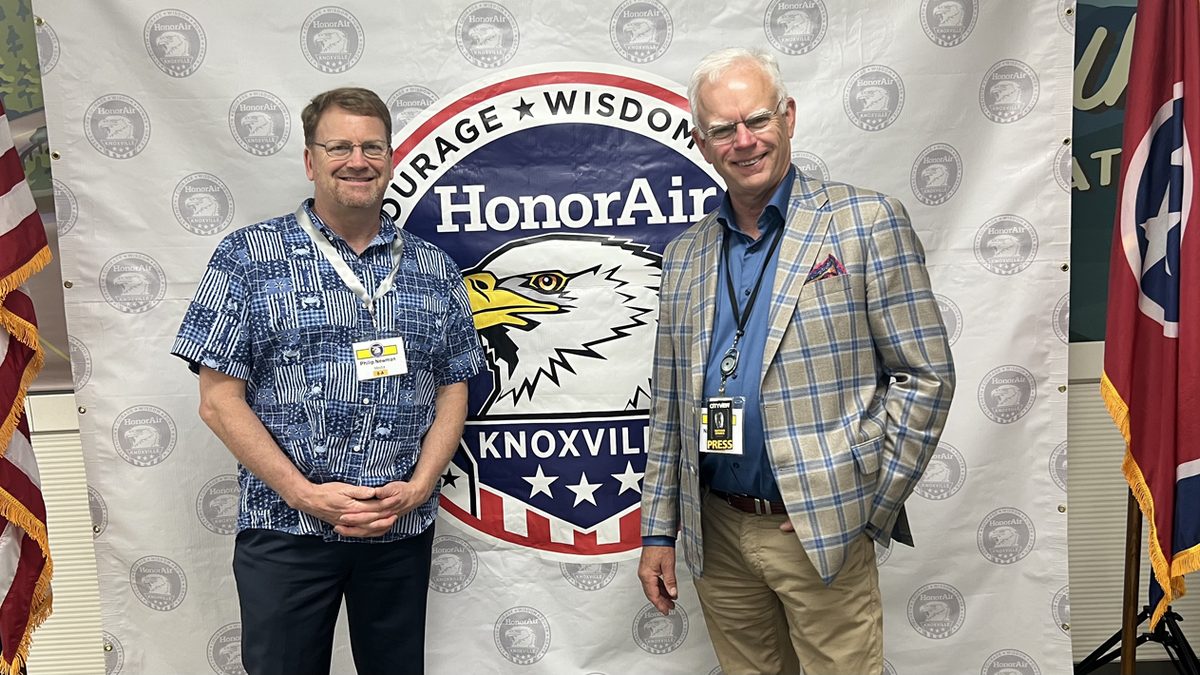
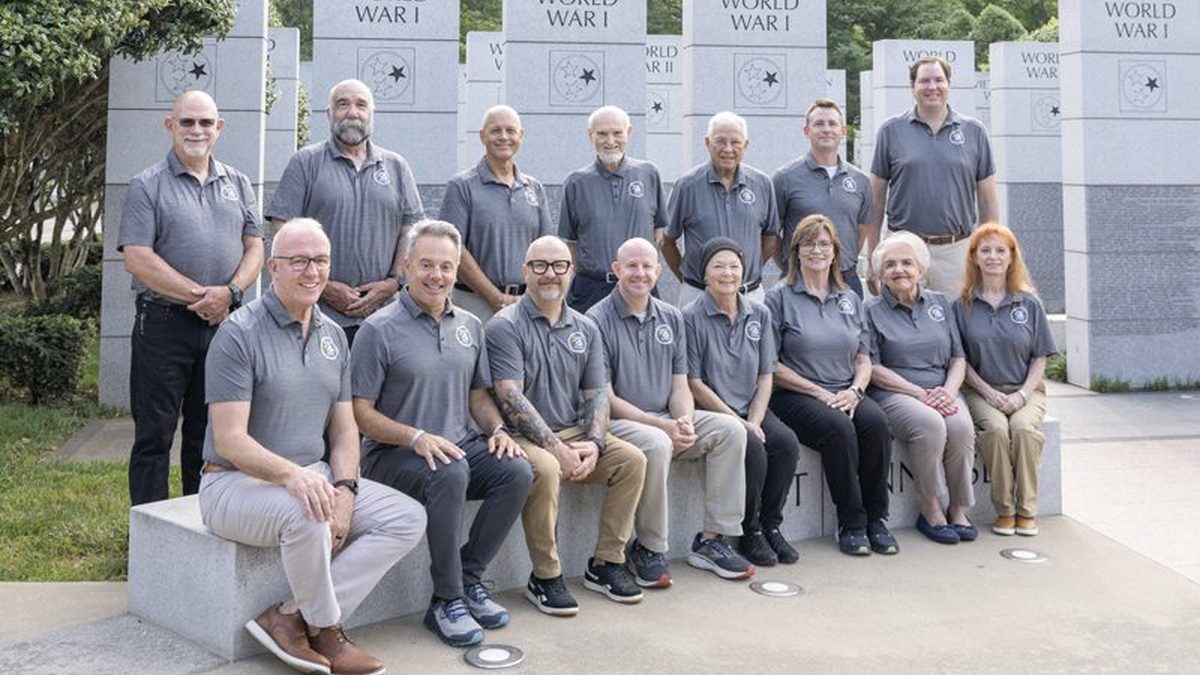
More recently, I had the unique opportunity to sit alongside many of these such men with our senior writer Phil Newman during an HonorAir Knoxville flight. Eddie Mannis, who you see on our cover this issue, has built an exceptional program over the last 17 years with an amazing team to call out, honor, and bring light to the people in our community who have, like those men my father befriended, given so much of themselves to not only their families but their community and their country. Once again I am struck by these type of people. It was a blessing to be able to hear their stories of struggle during battle, but also admire their willingness to share their stories with those of us who joined them. It takes a different kind of strength to do this. No doubt the trip was filled with a variety of mentors.
Upon my return, as I reflected on my own life, I recalled how a family friend became one of my early mentors. While working for the Bonanza Steakhouse, a cafeteria style eatery, I found myself having to make a decision. Shave your mustache or quit. It wasn’t so much the mustache, but rather the idea of being forced. I had already had my first businesses (yard mowing age 12, trout fly production at 14), but I was the grill cook at the Bonanza Steakhouse at 16. So, that night, when the manager delivered me an ultimatum, I respectfully resigned. The irony was my honorary “Uncle Bob,” my dad’s best friend, was there dining that night. I walked out to his table and said, “Uncle Bob, I need a job.” To my astonishment, he told me where to be the next day.
Uncle Bob met me the next morning and after picking up a hoe, walked me to the back of the property where there was a large field that looked mostly like weeds to me. He knelt down and pointed out the small nandinas growing in the field. I guess I forgot to say that Uncle Bob owned a landscape business. Bob Wherry Nursery. Minimum wage in those days was about $3.65, and this looked a lot less fun than working in the restaurant. I began to wonder how important that damn mustache was. It was hot. It was summer.
There was no one to work with. I was by myself in a field of weeds and baby nandinas. That’s not exactly the best with my combination of ADD and OCD. I learned to talk to plants that summer because I was that bored. Spending an entire day, then an entire week, in a field by yourself doing nothing but hoeing weeds from around tiny plants can really be mind numbing. But perhaps the lack of stimulation, that very lack of something constantly going on around me, was formative in my desire to be a businessman. I spent time thinking about Bob and his business and it didn’t take long to realize that Bob had figured it out. He didn’t have a fancy truck. He didn’t wear a sports jacket to work. He was his own person, doing what he loved, and imparting some wisdom—perhaps unknowingly—to entrepreneurs in the making. I respected and admired him.
The values Bob instilled in me are ones I’ve had ever since. Be my own person. Honor who I am as an individual. Be willing to go above and beyond. Be willing to sacrifice. Since then, every person I’ve met that I have felt for whatever reason had followed a similar path, I’ve taken notice of. The ones who have sacrificed. The ones who chose to build their business from the ground up, who poured their heart and soul into it, not worried about how many hours they worked or how many days of the year they put in, the ones whose desire to be successful eclipsed everything else. Those are the ones I can’t help but take notice of.
Honestly, in my opinion, that’s what I don’t see enough of today: young people willing to persevere, to do without and to bust their ass to get it done so they can have something in the end. We live in a world of immediate gratification, and that doesn’t work when you want to be in a business. You have to be willing to do without, go without pay, sometimes go without anything, in order to be successful.
So I come back to the person that doesn’t know this writing is about them. I know that there are some of you who have offered another person, a young person, the opportunity to move into a world where they can make a difference, not only for their own lives, but for the lives of other people. That’s what it’s all about. People helping people. People caring to share their success and journeys with others so they can become the mentors of tomorrow.
→ Swipe for Next Story
DepartmentsJULY AUGUST 2024
A Woman of Inspiration
Ramya Kapadia brings the traditional arts of India to a new home in Knoxville
Story by Micha Haas
When Ramya Kapadia took the stage this past April at the Women of Inspiration Awards, she did so with decades of work behind her. Kapadia is, among many other things, including the holder of a master’s degree in Medical Physics and Neuroscience, an accomplished Bharatanatyam dancer and Carnatic singer, two traditional Indian art forms.
“Music was always part of my life,” Kapadia says. It was simply a part of growing up in India, she recalls. She never expected it to become her career, nor be internationally recognized for it. She came to the United States to study, starting her Master’s Degree in Wisconsin and moving to Durham, North Carolina afterward with the intention of getting a job in a lab. Instead, Kapadia found herself on tour in Europe as a singer with award-winning Bharatanatyam dancer Rama Vaidyanathan.
“This was just supposed to be part of my life at home, but then that wound up taking over,” she says. “I just kept on going on tour. I never applied for that job.”
While still in grad school, Kapadia was approached by parents looking to have their kids learn Bharatanatyam, and Kapadia began to instruct them as a side gig. She eventually opened a school in Durham. It felt natural to her. “I never really thought of it as teaching, just sharing.”
Now Kapadia has made a home in Knoxville and has brought her vast knowledge of traditional Indian arts with her. In addition to instructing her students and practicing her own craft as a dancer and singer, she has been commissioned to paint murals in the traditional Warli art style, composes her own music, and serves on the Tennessee Arts Commission. She is also a mother to two children who are dancing and following in her footsteps.
“The arts erase boundaries and limitations,” she says. “They bring people closer together. I want to see more dance and more art all over Knoxville, and I hope that I can contribute to that.”
Nothing says summer quite like getting outdoors and experiencing all that our region has to offer—and that doesn’t just mean hiking and camping in the Smokies or fishing and kayaking in the Holston and Tennessee rivers. We’re talking outdoor concerts, movie nights under the stars, jetski trips, triathlons, cheering on racers at Vol Landing, disc golf tournaments, hot air balloons, and so much more. This is just a taste of how we plan to experience the season. How will you get outside and play?
JULY 12 & AUGUST 16Movies Under the Stars Ijams Nature Center and Central Cinema have brought back outdoor movie nights, and they’ll continue deep into the summer withBack to the Futurein July andAcross the Universein August. Food trucks and beer garden, too! Find out morehere.
JULY 20The Knoxville Open The Open is back, but not in golf this time! The Knoxville Disc Golf Association presents the tournament of tournaments at Victor Ashe Park, which boasts 18 holes and a whole lot of space to play. Support your favorite players and get outside! Check out the detailshere.
JULY 21-27Tennessee River 600 Grab your personal watercrafts and head to Lenoir City for the 28th Annual Tennessee River 600. This weeklong adventure finishes at Paris Landing State Park and in part benefits the Tennessee Wildlife Resources Agency. Register onlinehere.
AUGUST 1-4Slow Down with Erick Baker Join Erick Baker for the “Slow the World Down Weekend” at Windy Hill Farm & Preserve. Erick hosts activities to get you relaxing, then puts on an acoustic set Friday followed by a full band show outside at the Granary on Saturday. Reservationsrequired.
AUGUST 3K-Town on the River August brings the return of Knoxville’s annual triathlon on the Tennessee River. Go solo or join with two or three others for team races. Plan for the sprint, Olympic, or Half-Iron lengths. And if racing isn’t your thing, grab a cooler, find a spot at Vol Landing, and cheer on the racers! Register for your racehere.
AUGUST 17Hot Air Balloon Festival The balloons are back for the sixth year in the Great Smoky Mountains! Townsend Visitors Center puts on the annual festival as balloons from all over the country light up the sky and bring people along for tethered rides. Food trucks and beer abound! Get the detailshere.
Finding my way through the season with wildflowers as my guide
Story by John Quillen
I have a dog-eared, spiral-bound book that predates me with photographs some would consider laughable nowadays. Long since pushed aside by the Google lens and phone app outdoor crowd, this 90-page piece, entitledGreat Smoky Mountains Wildflowerswas created by Carlos Campbell. I have referenced him in the past for his contributions to the founding of the Great Smoky Mountains National Park and relation to my good friend, his grandson, Frank Harvey.
It’s easy to tell where he spent his time in the park, and you can certainly still feel his presence in certain wildflower-covered spaces, mostly around Elkmont. There are flora quickly identified as Solomon’s Seal and its counterfeit lookalike, False Solomon’s Seal, that flank the edges of the Little River trail. Yellow Trillium and the more elusive Vasey’s Trillium pepper the landscape, but I snicker at the photo in his book of another guy taking a photo of wild geranium. It is his attire of a 50s uncle with a yellow shirt bending over for the big shot with his antiquated camera that gets me every time.
If the National Park Service numbers are to be trusted, then the Smokies is responsible for more than 1,500 flowering plant species. I’ve seen them tinker with numbers, so my skepticism is quite warranted. But, it has been a banner year for wildflowers.
Pink Lady Slippers, once scarce, are sprouting from crevices like a cicada bloom in a 15-year cycle. Fire pink emerges in contrast to the greening forest floor as Hydrangea and Phacelia carpet former brown patches. Jack-in-the-Pulpit are found plentiful in early spring. Mountain Laurel sports her white crown all over the Smokies along with a Rhododendron bloom fit for the palace at Versailles.
But my personal favorite is the Iris, specifically the dwarf crested variety which happens to be one of our designated state flowers. These miniature beauties are versions of grander specimens found in manicured gardens throughout Knoxville.
Rounding a corner somewhere in the Appalachian Mountains, nothing is more rewarding than a greeting by this purple droopy flower. Often they are nestled in a field of lilies of the valley or rattlesnake plantain. Sometimes I confuse the lilies with ramps and am forced to pick a leaf to make certain I am wrong. The few times I have been sleeping on the ground out in the wild and found a ramp shoot to flavor my noodles is a rare treat indeed.
In the Smokies, though, few events garner as much attention as the majestic bloom of the flame azalea high atop Gregory Bald. You will earn your reward after an ascent of the Gregory Ridge trail. This climb seems endless at times, especially for those carrying a full backpack with the intent of sleeping up at the col between Gregory’s summit and Parsons Bald. Before the park was established, farmers took livestock to graze in these high pastures. I suppose the acidic taste of these bushes was not to their liking as they dominate this summit in mid-June. Although technically not a wildflower, it is the grandest of natural phenomena.
Spiderwort bend toward my calf as I jog the usual lap at Baker Creek. They surprised me this year, showing up earlier in the spring than years past. A mild and moist spring means there could be all kinds of inverted blooms this year, popping up when we least expect them.
Take your pick of pocket wilderness areas to get out and see the wildflowers. And if you feel so inclined, don’t forget your copy ofGreat Smoky Mountains Wildflowers. You’ll be hard-pressed to find a guide quite like this one, which lists the flowers in order of when they’ll arrive and where you can find them. See you out there.
→ Swipe for Next Story
InsightsJULY AUGUST 2024
Learning is Confusing
How much of how we learn is based on who we are and how we grew up?
Story by Rev. George Doebler
What is it about “human nature” that it seeks so emotionally to know the facts? As if having all the facts means I will have all the answers.
The world we live in pokes at our human nature to know the facts. Wherever we turn, we are presented with data. Years ago, I believed it was possible to learn enough, know enough that life would be more clear and directed. Those who I respected told me to have clear goals and set them high. To be optimistic and believe that tomorrow will be better. I thought to do these things I needed to go to college, even graduate school. So I did—only to find I still did not have the answers and tools I needed to figure out what I would do with my life. In the midst of this search, my dad died. He was 49, I was 19, my brother was 16, and my sister was 11. I was 1,500 miles away at college.
My mom was clear: “You stay in school. We will be okay. Your dad was so proud you were going to college. No one in his family ever had.” I went to his funeral and two days later went back to college, then seminary, then graduate school, then professional studies at the Washington School of Psychology, only to discover that I knew less.
It became apparent to me that the more specialized I became, the more I focused on learning about people and history, the less I actually knew. This created an internal dilemma: knowing that what I was learning was not only limited, but kept me from learning what I didn’t see. I came to realize that unless I understood myself better, I could not learn from others. How do we learn to know ourselves and how limited we are in what we know? And not be anxious about how the”facts” are often fuzzy to us.
I remember the words of the superintendent of St. Elizabeths Hospital, the federal psychiatric hospital in Washington DC. When I began my training there, he said: “Remember the mentally ill are just like you—only more so.”
We are all a bit mentally ill. It became clearer that those we saw as patients were actually our teachers. Going through 50-year-old files and notes I wrote after seeing patients or conducting groups, I find myself remembering these people and what they meant to me as a young resident student. It has taken me years to realize what they were teaching me, not only about themselves, but about me.
How do each of us stay open to learning? Not only about what we are emotionally drawn to in our daily work and to those who we work with, but to those whose life, thinking, and beliefs are different from our own. How do I look at how I have come to believe what I believe? How much of who I am is the result of the family I grew up in, of what my mom and dad instilled in me? How do I come to understand how much of a role my family of origin plays in how I relate to others, how I learn, how I think? How much of who I am has to do with being an oldest brother or sister, a youngest, a middle kid, an only kid? Does this play a part in how I learn or do not learn?
Back to this idea that human nature seeks to know the facts—is it possible that the way we gather facts is “tilted” or biased by who we are and who taught us? Einstein wrote, “When the facts do not fit the theory, change the facts.” He seems to have known that “facts” could keep us from seeing and learning to see what we could not see.
The world we live in wants answers. It seems to be looking for someone to give us answers to the chaos we read and hear about daily. Is it possible that the questions being raised are more important than the answers we are looking for? After all, learning is complicated.
→ Swipe for Next Story
MusicJULY AUGUST 2024
Lyrics & Melody
Terry Adams has found a way to couple his day job with his passion for playing
Story by Chris Blue
You might know Terry Adams by his day job in Knoxville. He’s spent the last 20 years working as a lawyer and business owner. But what you might not know is that Terry is also a musician—and a pretty great one at that.
While Terry has been in Knoxville for years, his connections to Nashville run deep—and so do his musical connections there. “My mother was a singer-songwriter and she traveled internationally,” Terry tells me one afternoon. “She played with a lot of people back in the 60s and 70s, folks you all know like Tammy Wynette, Waylon Jennings, Willie Nelson, and Kris Kristofferson.” His mom would eventually meet his father at the bar that he owned in Nashville called the Driftwood where she had gone to get a gig as the house band. The two hit it off.
Terry can’t remember a time without music, he tells me, and the bigger moments stick with him. “I remember one of the early memories of hearing one of my mom’s songs being played on the radio as a child,” he says. “It impressed me and it was kind of jarring.”
As a youth, knowing his mom was a songwriter made him feel like he was one, too. “The kids at my lunch table would get me to make up songs about whatever we were eating,” he says. Lyrics and melodies would just come easily to him.
During his time in the U.S. Navy, Terry spent time playing music and singing in bars and songwriter rooms in Music City. And while his dream was to keep that going as a career, he knew firsthand how challenging that would be. Those gigs at bars and songwriter rooms would actually help him pay for law school in Memphis after attending UT in Knoxville. Music, however, would forever stay a constant.
Today, Terry keeps the music going in his life. His six singles, songs like “Don’t Cry Mama” and “Tennessee Tuff,” speak to hard times and beautiful moments of life. An additional six songs will be released later this summer. You can find Terry performing at a variety of venues in Knoxville and Nashville this summer. Stay updated on his music atterryglenadams.com.
→ Swipe for Next Story
Arts & CultureJULY AUGUST 2024
Moving People
Chris McAdoo’s paintings evoke feelings about different times and places
Story by Susan Alexander
Chris McAdoo believes that art has the ability to transport people to new places and new feelings. Perhaps that’s why so much of his work includes images of boats, cars, and motorcycles.
The canoes in his Vessel series represent the space we share between two set points — birth and death. “In between is this beautiful, painful, happy, sad, joyful place we all share,” he says. “For me the boat is between Point A and Point B and represents adventure.”
The vintage automobile he paints is the 1952 Rocket 88 that once belonged to his uncle. “It evokes a particular feeling for a time period. It brings you somewhere.”
The motorcycle is one he owned in his early 20s. “It meant movement, freedom, adventure. Those images are very particular to me. I always approach work from a personal place.”
The East Tennessee native and Carson-Newman grad says his mixed-media pieces cross lines between pop art and abstracts. “No one is going to hire me to do a commissioned portrait of their family,” he says. “For me it’s the sheer joy and challenge of artmaking more than getting it exactly right. I’m more interested in representing a story and a feeling.
“I find painting in particular, the act of artmaking, one of the most intensely intimate experiences that anyone can have. I love to start with a blank canvas and turn it into something. Art can serve its own purpose. It can tell a story or reflect a person. It can tell a different story the next day. I find that absolutely magical.”
He’s just as interested in sharing his enthusiasm for creativity with others. He’s the chief experience officer for the Knoxville Entrepreneur Center and hosts a KEC-affiliated podcast called Big Ideas Welcome. “I talk with artists, makers, change makers, technologists and scientists who are making big things happen.
“A lot of my life has been spent speaking. I love to share my creative process and get people excited and challenged to find their own creative voice.”
Even though we are only halfway through 2024, Knoxville has plenty of new restaurants that have joined the ranks. Whether you’re looking for southern barbecue or authentic ramen, there is something here for everyone.
Humble Hog
Humble Hog BBQ prioritizes hospitality and quality in their restaurant. Most of their menu is sourced from local vendors, whether it be their barbecue or their beers. Although BBQ is in the name, they actually offer a unique, varied menu where even vegetarians have been able to find a good meal. If you are unsure of what to try, grab a couple of their small plates to sample a few things. The burnt ends and sticky ribs are highly recommended. For dessert, their banana pudding is also a fan-favorite, featuring banana bread in their recipe. Even better, most of their menu is gluten-free! Downtown Knoxville | 312 S. Gay Street |humblehogbbq.com
Patches BBQ
Patches BBQ & More opened in January of this year as a classic southern barbecue spot. Patches may look like a small hole-in-the-wall, but their menu has been praised by locals and visitors alike. The restaurant offers great barbecue and excellent service, with customers raving about how quick the service is. As far as barbecue goes, the pulled pork sandwich and ribs are fantastic. One of their specialties, however, is their sandwich that has mac and cheese on it! For dessert, check out their peach cobbler, especially when it is fresh out of the oven! Added bonus here? They just opened a second location closer to home! East Knoxville & Strawberry Plains |Facebook Page
Aretha Frankenstein’s
Chattanooga coffee/breakfast space, Aretha Frankenstein’s, opened a Knoxville location! Customers especially love the egg and cheese biscuits and their waffles. You can even buy their waffle mix on site! Aside from their delicious menu, they also have a great atmosphere, featuring eclectic and funky decor. South Knoxville | 3318 Chapman Hwy |arethas.com
Celestina Knox
Celestina is a new, locally-owned Mexican restaurant that opened in February. Their menu features family recipes that come straight from their grandparents. A staple on their menu is the chorizo dip, which you can enjoy with some of their homemade tortilla chips. Not only is their food menu extensive, but they also have a wide variety of drinks to choose from. There are plenty of margaritas to choose from, like a peach-flavored one, or you can choose one of their handcrafted cocktails. West Knoxville | 1411 Bexhill Dr |celestinaknox.com
Gogi Korean Kitchen
Knoxville’s newest Korean restaurant, Gogi Korean Kitchen, actually opened in 2022 but this traditional Korean restaurant deserves another shout! Gogi offers a plenty of Korean classics with a variety of flavors to choose, from sweet to spicy. They also have plenty of vegan options, which can be hard to come by in Knoxville. Besides the classics, Gogi also offers classic small plates and apps, like kimchi or pickled vegetables, that elevate meals. There are a variety of deals offered during the week, like half off wings on Tuesday and half off Soju on Thursdays, which is great if you’re looking for a budget-friendly Korean meal.
Kraken’s Cup is a whimsical, nautical-themed tea shop that opened at the beginning of the year. The shop offers a variety of teas as well as finger foods or full lunch options. If you are a tea novice–don’t worry! The staff there is full of tea knowledge and can help you choose. Kraken’s Cup has also been praised for their unique decor and laid back ambience. Check out the classes and events, including a “Chill Hour,” which is a great way to destress and unwind at the end of the day. Downtown | 4815 N Broadway St #107 |thekrakenscup.com
Bistro by the Tracks in Bearden
Bistro by the Tracks opened a second location earlier this year. Bistro has been praised for their delicious food and elegant atmosphere. The restaurant also features beautiful decor, perfect for a luxurious date night out on the town. Even though there are now two locations, the menus vary by location since they have chef-driven menus. At this new location, diners have raved about the salmon as well as the charcuterie appetizer. But no matter what location you head to, you can rest assured you’ll have a mouth-watering dinner experience. Both have 2024CityviewTop Chefs at the helm! Bearden | 5448 Homberg Drive |bistrobythetracks.com
Marble City Market’s New Eats
Marble City Market in the historic Regas Square features a variety of skilled chefs, and they have recently added some new vendors to the lineup.
Rom’s Housecuisine has been compared to Mediterranean cuisine. Their main entree is a bowl with meat, rice, and veggies, topped with a baked bread layer. Rom’s serves big portions, so you’ll have plenty of leftovers to save for later.
The S.E.A. Ramen & Asian Kitchenis a newly-added asian-fusion restaurant with staff and cuisine that you’ve just got to meet.
Algo Deliioffers Venezuelan cuisine, like arepas and empanadas, that is just so worth the trip!
Lilou’s Belle Epoque vibe and French cuisine, wines, and cheeses combine for an elegant cultural sojourn
Story by N. Brooks Clark
A gentle rain falls as the streetlamps cast shadows on the sidewalks and you enter the doors of Lilou, walk past the desk of the boutique Hotel Cleo, and peer inside to see walls covered with gilt-framed paintings. Is that Salvador Dali at the bar? Is that Hemingway arguing with Gertrude Stein at that far table?
Walking into Lilou is like a trip to Paris. Co-owner Jessica King spent years collecting artwork from estate sales to fulfill her inspired design of un restaurant Francais. “We want to create a cultural experience for the guests,” says server Cosette Schoepke. “We want to bring you into a different culture.”
Chef Benjamin Tilatti is a native of Agen, a small town southeast of Bordeau in the Nouvelle-Aquitaine region of France. It is just north of Basque country, the land of Chef Benjamin’s forebears. From 2006 to 2010 he cheffed in Montreal at restaurants named after Emile Zola novels—La Bête Humaine, La Chronique, Les Deux Gamins. Returning home to Bayonne, on the west coast of Basque Country, he ran his own private chef and catering business, La Cuisine de Benjamin. A client suggested that he open his own restaurant far away. He chose Singapore and operated Kinou for four years. As he chatted with us tableside, we were drawn into the rhythms of his country and his obvious passion for cuisine.
When co-owners King and Aaron Thompson went looking for a genuine French chef, it was important he had experience at running a business and managing the menu. “French cuisine is complicated,” says Thompson. “There’s a different sauce for every dish, and they take days to make.” Tilatti, who might be played by a bearded Adrien Brody in a movie, brings both culinary excellence and business sense to Lilou.
For the full experience, ask Sommelier Brad Poyner to match glasses of wine with your courses. All the wines are from the 19 wine-growing regions of France. “Our goal is to grow the wine scene here in Knoxville,” says Thompson.
Our evening started with an amuse bouche of Huitres en Demi-Coquille (New Brunswick Honey Moon oysters) on the half shell. You may think you do not like oysters, but we promise you when you taste these bright and briny bites, topped with Crème Fraiche, Caviar, Chives, and Shallots, you will become a believer.
The oysters were served with a Voirin-Jumel Grand Cru Blanc de Blancs. This domain is located in Cramant, and this bottle shows off its grand cru origins. The bright citrus and cool mineral notes were the perfect complement to showcase the seafood.
The entrées were a preview of the care and expertise Chef Benjamin brings to his work. Forget what you know about the heavy Coquille St. Jacques your grandmother made, this haute cuisine St. Jacques is one large scallop topped with Chorizo foam, floating on sweet corn coulis and crispy Bayonne ham.
Tartare de Boeuf is served in the classic French manner: a blend of prime beef, mustard, shallots, capers, and other seasonings and topped with an egg yolk. Gravlax, typically a Nordic sugar-salt cured salmon is given a new twist here: beet-cured trout, topped with lemon crème fraiche, dill oil, grapefruit, and pickled golden beet purée. There was a small tussle at our table for the last savory-sweet bite.
Soupe a L’Oignon combines Emmental cheese from Switzerland chicken stock, duck fat, and toasted brioche bread. “If you don’t like the onion soup,” says Chef Benjamin, “call my grandmother. It’s my family way.” Allhonneurto Grand-Mere Tilatti—this is an outstanding preparation.
These flavors were accented by Poyner’s second pick– a Chardonnay from a vineyard founded by the Knights Templar returning from the Crusades in the 12th century, Chevalier de la Crée, Montagny Premier Cru Knights Templar Cuvée. With hints of Meyer lemon and white peach, this wine combines a lovely minerality with a creamy mouthfeel.
You would not be in a French restaurant without some house-favoritePlats. Lilou’s summer menu includes an outstanding Filet au Poivre: prime filet mignon in a classic peppercorn sauce, served with a spinach fondue and pommes purée. The duck breast is prepared in a light apricotgastrique, making for a lovely summer choice.
An unexpected star is the Champignon: seared black oyster mushroom from ET Fungi, accented by an artichoke sunchoke duo and vegetable jus. “We cook the mushrooms as a steak,” says Chef Benjamin. This may just make a vegetarian of you. The substantial mushroom, combined with Chef Bejamin’s preparation style is an earthy and flavorful pleasure.
Theplatswere paired with a Château Kirwan Margaux, a quintessential Bordeaux blend of Cabernet Sauvignon and merlot. This wine is produced from the premier parts of the vineyard, established in 1710, which contains both gravel soils and clay. Half-oak barrels complete the process, adding just a touch of vanilla, and the result is a generous, full-bodied wine that allows the fruit to be the star of the show.
In la mode Francaise, we savored aPlat de Trois Fromages, with our choices introduced byfromagierNatalie Murty. She recommended the Ossrau-Iraty AOCtomme, a mild sheep’s-milk cheese from Basque sheep. Tomme is a class of cheeses produced mainly in the French Alps. The second cheese was Fromage D’Affinois – a mild and buttery cheese similar to brie with a bloomy rind. The selection was completed with a Rhone-Alpes: double cream cow. All were served with house made baguettes. The cheese course was paired with a Fixin (pronounced Feex-a) Le Rozier Burgundy. The earthy and dark fruit notes set off the cheese to perfection. “This Burgundy is amazing with cheese,” said Poyner. “Burgundy has that special je ne sais quoi.”
Dessert offerings include decadent profiteroles: Orange Craquelin choux pastry, filled with chilled Chantilly cream, and topped with warm chocolate ganache (Lilou has a fulltime pastry kitchen of 10 people), and a Crème Brulée, the creamy vanilla custard topped by caramelized sugar. With dessert, we enjoyed Château Les Justices Sauternes, a sweet wine, honeyed, rich, and well balanced, with a hint of apricots. “It’s a sexy wine,” says Poyner.
The summer menu at Lilou is not to be missed. Don your beret, tie your red neckerchief and make a reservation at Lilou for une délicieuse soirée à Paris.
→ Swipe for Next Story
PoliticsJULY AUGUST 2024
Perplexing Plans
Politics around puzzling planning projects and the apathy of voters
Story by George Korda
When I was Knoxville’s public affairs director, I had to attend only one Knoxville-Knox County Planning Commission meeting: after 30 minutes, I concluded that mayors appointed members to this commission to punish them. It was like watching someone describe putting each piece into a giant jigsaw puzzle. However, people who understand planning and zoning details are important, because their knowledge can, or might, protect the rest of us.
Advance Knox is the latest iteration in the parade of plans and planning constantly conducted by government and citizen groups. Plans, by their nature, take time to craft, are typically lengthy, and go into what is, for most people, excruciating detail in a foreign language. Two main plan types are: government, like the county’s Advance Knox plan, developed to guide public land use; and outside-government plans, created by concerned citizens or groups.
In planning, politics is always in play. For example, Nine Counties, One Vision (NCOV) debuted at the 21st century’s dawning as a privately-originating planning effort to improve cooperation within the Middle-East Tennessee region. At NCOV’s start there was enthusiasm, media coverage, and public “visioning” meetings where people showed up to volunteer their regional improvement ideas. But support wasn’t universal, which wasn’t well-liked.
“Any one politician who doesn’t fully support Nine Counties, One Vision, shouldn’t be elected to office,” said a woman during a 2002 Leadership Knoxville class group discussion. There were murmurs of assent, with many nodding heads. I spoke up, not in opposition to NCOV, but to explain the political facts of life.
“There are 700,000 people or more in the nine counties,” I said. “In comparison, only a fraction attended the visioning meetings, (if memory serves, it was less than 2,000) and only several hundred in subsequent meetings. That means a tiny number from all nine counties. Now, let’s say the county executive of Sevier County helps Roane County get a big new business. That’s a good thing, but the Sevier County executive can’t run for reelection saying he did a great thing for Roane County: Sevier County taxpayers want to know what he’s doing for them, with their money, where they live. So, there are practical reasons why elected officials might not seem to be 100% behind everything in Nine Counties, One Vision.” Afterwards, an elected official in the class thanked me. Why hadn’t he said something? Because he didn’t want it to appear he didn’t completely support NCOV. Politics, you know.
As controversial as a plan might be before it passes, silence usually descends once the deal is done. The Recode Knoxville zoning plan was approved in 2019 by City Council after two years of work, the standard public meetings, and wrangling. Recode was controversial over complaints both technical and political. But since its passage, not much has been heard about Recode. That, as well as its complexity, dampens Recode as a future city election issue.
In the early 1990s a citizens group created a plan called KnoxVision 2000, made up of committees which made recommendations on a number of subjects: maybe someone knows what became of it? And we’re 20 years into Knox 2033, the Knoxville-Knox County General Plan, adopted in 2003; Google-search that one and you won’t find many entries. The more complicated the plan, the less public interest it generates. And they’re all complicated.
The people involved with a plan want something, however laudable. While plans give, they also take away, or change something that gores someone’s ox. Usually, it comes down to money: who gets it, keeps it, or loses it. Competing interests usually want what they want, and what someone else wants doesn’t matter. An elected official may see promoting a plan as a way of moving up the political ladder. Other elected officials, who don’t like him or her – and who want their own ladder space – will support or oppose the plan as best suits their ambitions.
Most people will spend a lot more time talking and thinking about who should be president of the United States than they will learning about a plan that can affect in perpetuity their home values and quality of life. That’s because understanding planning is harder.
And the plans won’t stop coming. Because of all the counties in all the states in all the country, there’s always someone with a new plan to improve this one. Whether it does or doesn’t, the question is, will anyone notice?
→ Swipe for Next Story
DepartmentsJULY AUGUST 2024
Summer Cocktails
Crafting the perfect drinks that will wow guests at your patio party
Story by Rebecca Whalen
There’s nothing quite like the summer get together. You hand-pick your favorite dishes, set up the patio with decorations, choose the best playlist, and, of course, plan those summer cocktails. But you don’t want those cocktails to be your run-of-the-mill ones that anyone might have. You want something fresh with interesting combinations, but not too complicated that you can’t produce them quickly.
We caught up with Will Oakes, the master bartender and General Manager at Bistro by the Tracks in Bearden, who’s got the expertise. Will is a Chattanooga native. After Middle Tennessee State University and a lengthy stay in Nashville, Will spent about 15 years in the place known for its booming social scene: New York City. He served at Michelin star-level restaurants. We’re talking high-end, fine dining. And along the way, Will says he learned everything he needed to widen his pallete and craft cocktails that wow his guests, whether we’re talking a classic like a Manhattan or something a bit more etensive.
He’s modest about his work, though. “At the end of the day, we’re just making drinks,” he says, “and you just want to make good quality drinks that people enjoy.”
Will crafted three unique cocktails forCityviewreaders, but in all three he’s used ingredients that are out-of-the-box yet accessible. Will says that anywhere you see a recipe calling for juice, always use fresh, never store-bought, as it makes a world of difference in flavor profiles. Syrups, he adds, are actually fairly easy to make. “If you use good ingredients, it kind of makes up for everything else,” he adds. Also, similar to how salt on a watermelon can boost the flavor, salt can do the same thing for certain cocktails. Finally, don’t forget your ice cubes and garnish.
His best advice when bringing these or your own cocktails to life this summer? “Don’t overthink it,” Will says. “Let’s not take ourselves too seriously. Cocktails are fun.” We couldn’t agree more. Now, get out there and craft away. And don’t forget to tag us in your Instagram and Facebook posts:#cityviewsummercocktails.
→ Swipe for Next Story
Top AttorneysJULY AUGUST 2024
2024 Top Attorneys
W hen you’ve got a problem with your health — a heart issue or an eye problem or an ache that keeps you off your favorite hiking trail — you seek out a doctor who knows his or her stuff. There’s no point in seeing someone you don’t have confidence in.
Story by Cityview
The same goes for attorneys. When you find yourself with a legal issue — whether it be a car collision, a custody battle, a divorce, or the need to put your financial and end-of-life plans in place for your descendants — you want to work with a person who is an expert in that particular field. You want to ensure they’ve been vetted and are as capable as they say they are.
That’s where this issue ofCityviewcan help. Once a year, we asks members of the Knoxville Bar Association for their input on the attorneys in East Tennessee who are the best in their respective fields of expertise. Attorneys are asked who they would refer a friend or family member to if they needed legal assistance. And we get thousands of votes as a result. We’ve listed those top finishers by their areas of practice in the pages that follow. And we are so grateful to our local attorneys for taking the time to share their knowledge with our readers.
Of course, this is just one way to determine the best legal professionals in the area. Though their colleagues are a good way to assess the area’s legal expertise, anyone in need of legal help should schedule a consultation first to make sure the attorney is a good fit for the situation. This list is a great place to start that journey.
DISCLAIMER: Cityview does not endorse any of the attorneys in this issue. The listing of Cityview’s 2024 Top Attorneys is a simple tabulation of the votes submitted by members of the Knoxville legal community.
Administrative Law
Administrative Law
John T. Batson Jr.Watson, Roach, Batson, & Lauderback
J. William ColeyHodges, Doughty & Carson
Wade V. DaviesRitchie, Davies, Johnson, & Stovall
Samuel C. Doak Lewis Thomason
Daniel L. Ellis Law Firm of Daniel L. Ellis
Taylor D. Forrester Long, Ragsdale, & Waters
Richard E. GravesFrantz, McConnell, & Seymour
Sarah JarrardOwings, Wilson & Coleman
Stephen Ross JohnsonRitchie, Davies, Johnson, & Stovall
Luis C. BustamanteWoolf, McClane, Bright, Allen & Carpenter
W. Kyle CarpenterWoolf, McClane, Bright, Allen & Carpenter
Daryl R. FanslerBernstein, Stair & McAdams
Robert H. GreenKennerly, Montgomery & Finley
J. Chadwick HatmakerWoolf, McClane, Bright, Allen & Carpenter
Paul D. Hogan, Jr.Hogan & Hogan
Dana C. Holloway Holloway Law & Mediation Center PLLC
Reggie E. KeatonFrantz, McConnell & Seymour
W. Morris Kizer Gentry, Tipton & McLemore
Laura E. Metcalf Laura Metcalf Attorney at Law
Sarah Y. SheppeardLewis Thomason
J. Cort Sikes Wykoff and Sikes
C. Scott Taylor Bernstein, Stair & McAdams
William D. Vines III Butler, Vines & Babb
Howard H. Vogel O’Neil, Parker & Williamson
Gary R. Wade London & Amburn
Glenn R. WalterLewis Thomason
Medical Malpractice
Medical Malpractice—Defense
Heidi A. Barcus Lewis Thomason
Joshua J. Bond Hodges, Doughty & Carson
Mark A. Castleberry Lewis Thomason
Meagan CollveyLewis Thomason
Rachel Park Hurt Arnett, Draper & Hagood
Hillary B. JonesLewis Thomason
B. Chase KiblerHodges, Doughty & Carson
Wayne A. Kline Hodges, Doughty & Carson
James H. London London & Amburn
Jason H. Long London & Amburn
Mary Elizabeth MaddoxFrantz, McConnell & Seymour
Jeff R. Thompson Lewis Thomason
Gina S. VogelLewis Thomason
Edward “Ted” G.White II Hodges, Doughty & Carson
Bart C. Williams Hodges, Doughty & Carson
Medical Malpractice—Plaintiff
Timothy L. BaldridgeGarza Law Firm
Luis C. BustamanteWoold, McClane, Bright, Allen & Carpenter
Christopher T. CainLacy, Price & Wagner, PC
M. Christopher CoffeyPryor, Priest, Harber, Floyd & Coffey
Gregory F. ColemanMilberg Coleman
Marcos M. GarzaGarza Law Firm
D. Scott Hurley Hurley Law Firm
Grant MitchellButler, Vines & Babb
J. Tucker Montgomery Montgomery Law Firm
Brent A. MorrisGarza Law Firm
Weldon E. PattersonButler, Vines & Babb
Robbie E. Pryor, Jr.Pryor, Priest, Harber, Floyd & Coffey
Robert E. Pryor Sr. Pryor, Priest, Harber, Floyd & Coffey
Wayne A. Ritchie Ritchie, Davies, Johnson & Stovall
Thomas S. Scott Jr. Tom Scott Atty
William D. Vines III Butler, Vines & Babb
Nursing Home Liability
Nursing Home Liability—Defense
Heidi A. BarcusLewis Thomason
Joshua J. Bond Hodges, Doughty & Carson
Mark A. Castleberry Lewis Thomason
Stephanie D. Coleman Owings, Wilson & Coleman
Rachel Park Hurt Arnett, Draper & Hagood
B. Chase Kibler Hodges, Doughty & Carson
Wayne A. Kline Hodges, Doughty & Carson
James H. London London & Amburn
Jason H. Long London & Amburn
Mary Elizabeth Maddox Frantz, McConnell & Seymour
J. Douglas Overbey Owings, Wilson & Coleman
Rick L. Powers Arnett, Draper & Hagood
Nursing Home Liability—Plaintiff
Timothy L. Baldridge Garza Law Firm
M. Christopher Coffey Pryor, Priest, Harber, Floyd & Coffey
Mark E. Floyd Pryor, Priest, Harber, Floyd & Coffey
Bruce D. Fox Fox Willis Burnette
Marcos M. GarzaGarza Law Firm
Philip J. La Nasa Garza Law Firm
Brent A. MorrisGarza Law Firm
Weldon E. Patterson Butler, Vines & Babb
Adam M. Priest Pryor, Priest, Harber, Floyd & Coffey
Robbie E. Pryor Jr. Pryor, Priest, Harber, Floyd & Coffey
Robert E. Pryor Sr. Pryor, Priest, Harber, Floyd & Coffey
Wayne A. RitchieRitchie, Davies, Johnson & Stovall
William D. Vines III Butler, Vines & Babb
Patent Law
Patent Law
Michael J. Bradford Luedeka Neely Group
Peter L. BrewerThrive IP
Mark P. Crockett Luedeka Neely Group
Tracy G. Edmundson Egerton, McAfee, Armistead & Davis
Robert O. Fox Luedeka Neely Group
David GonceLuedeka Neely Group
Andrew C. Lake Pitts & Lake
David E. LaRose Luedeka Neely Group
Andrew S. Neely Luedeka Neely Group
Wade R. Orr Luedeka Neely Group
Bob Pitts Pitts & Lake
Roby Robinson Robinson IP Law
John T. Winemiller Merchant & Gould
Personal Injury
Personal Injury—Auto Accident—Defense
Joshua M. Ball Hodges, Doughty & Carson
Joshua J. BondHodges, Doughty & Carson
William J. Carver Kramer Rayson
David A. Chapman Lewis Thomason
Jon M. CopeStokes, Williams, Sharp, Cope & Mann
James N. Gore Jr. Kennerly, Montgomery & Finley
John T. (Tom) Johnson Kramer Rayson
Benjamin W. Jones Lewis Thomason
Mary Elizabeth MaddoxFrantz, McConnell & Seymour
Nathaniel D. Moore Kramer Rayson
Beverly D. Nelms Frantz, McConnell & Seymour
Dallas T. Reynolds IIIDunn, MacDonald & Reynolds
T. Kenan Smith Hodges, Doughty & Carson
Mikel A. Towe Lewis Thomason
Mabern E. Wall Hodges, Doughty & Carson
Glenn R. WalterLewis Thomason
Broderick L. YoungArnett, Draper & Hagood
Personal Injury—Auto Accidents—Plaintiff
Beecher A. Bartlett, Jr. Kramer Rayson
Christopher W. Beavers Banks & Jones
Bradley C. BurnetteFox Farley Willis & Burnette
Luis C. BustamanteWoolf, McClane, Bright, Allen & Carpenter
Gregory F. Coleman Milberg, Coleman
Luke D. DurhamBrock Shipe Klenk
Bruce D. Fox Fox Willis Burnette
Marcos M. Garza Garza Law Firm
D. Scott Hurley Hurley Law Firm
T. Scott JonesBanks & Jones
Farrell A. Levy McDonald, Levy & Taylor
Robbie E. Pryor Jr. Pryor, Priest, Harber, Floyd & Coffey
Robert E. Pryor Sr. Pryor, Priest, Harber, Floyd & Coffey
Personal Injury—General—Plaintiff
Christopher W. Beavers Banks & Jones
Luis C. Bustamante Woolf, McClane, Bright, Allen & Carpenter
Gregory F. Coleman Milberg Coleman
Luke D. Durham Brock Shipe Klenk
Bruce D. Fox Fox Farley Willis & Burnette
Marcos M. GarzaGarza Law Firm
Albert J. Harb Hodges, Doughty & Carson
T. Scott Jones Banks & Jones
Jason E. Legg Kennerly, Montgomery & Finley
Farrell A. Levy McDonald, Levy & Taylor
Adam M. Priest Pryor, Priest, Harber, Floyd & Coffey
Robbie E. Pryor Jr. Pryor, Priest, Harber, Floyd & Coffey
Robert E. Pryor Sr. Pryor, Priest, Harber, Floyd & Coffey
Wayne A. Ritchie Ritchie, Dillard, Davies & Johnson
Robert L. Vance Woolf, McClane, Bright, Allen & Carpenter
John A. Willis Fox Willis Burnette
Personal Injury—Motorcycle Accident—Defense
Edward U. BabbButler, Vines & Babb
Joshua M. Ball Hodges, Doughty & Carson
Joshua J. BondHodges, Doughty & Carson
Toby R. CarpenterTrammell, Adkins & Ward
David A. Chapman Lewis Thomason
Robert A. Crawford Kramer Rayson
Samuel C. DoakLewis Thomason
Jason E. FisherFisher Russell Law Firm
Ryan E. JarrardQuist, Fitzpatrick & Jarrard
Benjamin W. Jones Lewis Thomason
Benjamin C. Mullins Frantz, McConnell & Seymour
Beverly D. NelmsFrantz, McConnell & Seymour
Dana Pemberton Stokes Williams
Lynn C. PetersonLewis Thomason
Mikel A. Towe Lewis Thomason.
Mabern E. Wall Hodges, Doughty & Carson
Glenn R. Walter Lewis Thomason
Personal Injury—Motorcycle Accident—Plaintiff
Michael C. Beehan Fox Farley Willis & Burnette
Bradley C. Burnette Fox Willis Burnette
M. Christopher CoffeyPryor, Priest, Harber, Floyd & Coffey
Gregory F. ColemanMilberg Coleman
Joseph F. Della-RodolfaGarza Law Firm
Bruce D. Fox Fox Willis Burnette
Marcos M. Garza Garza Law Firm
H. Stephen GillmanPryor, Priest, Harber, Floyd & Coffey
Albert J. Harb Hodges, Doughty & Carson
T. Scott JonesBanks & Jones
Jason E. Legg Kennerly, Montgomery & Finley
Farrell A. Levy McDonald, Levy & Taylor
Benjamin C. Mullins Frantz, McConnell & Seymour
John A. Willis Fox Farley Willis & Burnette
Privacy Law
Privacy Law
Karin AndersonPYA
Diana L. GustinLondon & Amburn
Ian P. HennesseyLincoln Memorial University
R. Arthur JenkinsThe Jenkins Law Firm
Rockforde D. King Egerton, McAfee, Armistead & Davis
Daniel T. SwansonLaw Office of Daniel T. Swanson
John T. Winemiller Merchant & Gould
Product Liability
Product Liability—Defense
Heidi A. Barcus Lewis Thomason
Hugh B. Bright Jr. Woolf, McClane, Bright, Allen & Carpenter
W. Kyle Carpenter Woolf, McClane, Bright, Allen & Carpenter
Jon M. Cope Stokes, Williams, Sharp, Cope & Mann
Dean T. Howell Woolf, McClane, Bright, Allen & Carpenter
John T. (Tom) Johnson Kramer Rayson
Reggie E. Keaton Frantz, McConnell & Seymour
J. Ford Little Woolf, McClane, Bright, Allen & Carpenter
Mary Elizabeth Maddox Frantz, McConnell & Seymour
C. Gavin Shepherd Woolf, McClane, Bright, Allen & Carpenter
Mikel A. Towe Lewis Thomason
Product Liability—Plaintiff
Luis C. Bustamante Woolf, McClane, Bright, Allen & Carpenter
Gregory F. Coleman Milberg, Coleman
Adam A. EdwardsMilberg Coleman
Bruce D. FoxFox Willis Burnette
Marcos M. GarzaGarza Law Firm
Albert J. HarbHodges, Doughty & Carson
T. Scott Jones Banks & Jones
William A. LadnierMilberg Coleman
Farrell A. Levy McDonald, Levy & Taylor
Weldon E. PattersonButler, Vines & Babb
Adam M. PriestPryor, Priest, Harber, Floyd & Coffey
Robbie E. Pryor Jr. Pryor, Priest, Harber, Floyd & Coffey
Robert E. Pryor Sr. Pryor, Priest, Harber, Floyd & Coffey
Wayne A. Ritchie Ritchie, Davies, Johnson & Stovall
Robert L. VanceWoolf, McClane, Bright, Allen & Carpenter
John A. Willis Fox Farley Willis & Burnette
Professional Malpractice
Professional Malpractice—Defense
Edward U. BabbButler, Vines & Babb
Heidi A. Barcus Lewis Thomason
Gregory Brown Lowe, Yeager & Brown
Meagan CollverLewis Thomason
Samuel C. DoakLewis Thomason
David A. DraperLewis Thomason
B. Chase Kibler Hodges, Doughty & Carson
Wayne A. Kline Hodges, Doughty & Carson
James H. London London & Amburn
Jason H. Long London & Amburn
Courtney Epps Read Watson, Roach, Batson & Lauderback
Glenn R. Walter Lewis Thomason
Edward “Ted” G. White II Hodges, Doughty & Carson
Broderick L. Young Arnett, Draper & Hagood
Professional Malpractice—Plaintiff
Joshua J. Bond Hodges, Doughty & Carson
M. Christopher Coffey Pryor, Priest, Harber, Floyd & Coffey
John K. Harber Pryor, Priest, Harber, Floyd & Coffey
Weldon E. Patterson Butler, Vines & Babb
Robert E. Pryor Sr.Pryor, Priest, Harber, Floyd & Coffey
Wayne A. Ritchie Ritchie, Dillard, Davies & Johnson
Real Estate Finance & Development
Real Estate Finance & Development
Oliver D. Adams Long, Ragsdale & Waters
Terry G. Adams, Jr.The Adams Law Firm
Robyn Jarvis Askew Lewis Thomason
E. Richards Brabham III Kennerly, Montgomery & Finley
John G. Brock Brock Shipe Klenk
Matthew Graves Hodges, Doughty & Carson
David Wilson Long Long, Ragsdale & Waters
Greg D. Meadows Gentry, Tipton & McLemore
Jason T. MurphyGentry, Tipton & McLemore
R. Joseph Parkey, Jr. Woolf, McClane, Bright, Allen & Carpenter
Dennis B. Ragsdale Long, Ragsdale & Waters
Caesar Stair IVBernstein, Stair & McAdams
Kevin C. Stevens Kennerly, Montgomery & Finley
Securities
Securities—Defense
Kyle Andrew BaisleyLong, Ragsdale & Waters
W. Michael BaisleyLong, Ragsdale & Waters
Joan M. HeminwayUniversity of Tennessee
David Wilson LongLong, Ragsdale & Waters
David L. MorehousMorehous Legal Group
Lee A. PopkinLong, Ragsdale & Waters
James R. StovallRitchie, Davies, Johnson & Stovall
Garrett P. SwartwoodLong, Ragsdale & Waters
Securities—Plaintiff
Kyle Andrew BaisleyLong, Ragsdale & Waters
W. Michael BaisleyLong, Ragsdale & Waters
Brent A. MorrisGarza Law Firm
Lee A. PopkinLong, Ragsdale & Waters
Garrett P. SwartwoodLong, Ragsdale & Waters
Social Security Disability Law
Social Security Disability Law
Edwin A. Anderson Miller Disability Law
Timothy L. Baldridge Garza Law Firm
Timothy Patrick Coode, Esq.Tim Coode Law
John P. DreiserLaw Offices of Tony Farmer and John Dreiser
Emma Drozdowski WebbDrozdowski & Rabin
Carolyn Levy Gilliam McDonald, Levy & Taylor
Viktoria M. Haynes Miller Disability Law
Haley M. Henry Garza Law Firm
Jason E. Legg Garza Law Firm
Mary Elizabeth MaddoxFrantz, McConnell & Seymour
Kenneth A. Miller Kenneth Miller & Associates
Tony SeatonGarza Law Firm
J. Cort Sikes Wykoff and Sikes
John A. Willis Fox Farley Willis & Burnette
Wayne D. Wykoff Wykoff and Sikes
Taxation
Taxation
J. Eric Butler Lewis Thomason
Shannon Coleman Egle Kramer Rayson
Michael R. CrowderKennerly, Montgomery & Finley
William D. Edwards Long, Ragsdale & Waters
Zack R. GardnerKennerly, Montgomery & Finley
Mack A. Gentry Gentry, Tipton & McLemore
Teresa KlenkBrock Shipe Klenk
Jackson G. KramerKramer Rayson
Wayne R. Kramer Kramer Rayson
William E. Mason Kennerly, Montgomery & Finley
Richard S. Matlock Woolf, McClane, Bright, Allen & Carpenter
Timothy M. McLemoreGentry, Tipton, & McLemore
Kevin N. PerkeyWoolf, McClane, Bright, Allen & Carpenter
Marshall H. Peterson Kennerly, Montgomery & Finley
Lee A. Popkin Long, Ragsdale & Waters
Joel D. RoettgerGentry, Tipton, &McLemore
O. E. Schow IVWoolf, McClane, Bright, Allen & Carpenter
Paul C. ShumanWoolf, McClane, Bright, Allen & Carpenter
Eddy R. SmithKennerly, Montgomery & Finley
Wills/Probate
Wills/Probate
Keith H. BurroughsEgerton, McAfee, Armistead & Davis
Michael R. Crowder Kennerly, Montgomery & Finley
William D. Edwards Long, Ragsdale & Waters
Donald J. Farinato Hodges, Doughty & Carson
Mack A. GentryGentry, Tipton & McLemore
Carolyn Levy Gilliam McDonald, Levy & Taylor
Teresa KlenkBrock Shipe Klenk
Jackson G. Kramer Kramer Rayson
Wayne R. Kramer Kramer Rayson
Richard S. MatlockWoolf, McClane, Bright, Allen & Carpenter
Samantha ParrisLaw Offices of Samantha Parris
Kevin N. Perkey Woolf, McClane, Bright, Allen & Carpenter
Marshall H. PetersonKennerly, Montgomery & Finley
Lee A. Popkin Long, Ragsdale & Waters
Joel D. Roettger Gentry, Tipton & McLemore
O. E. Schow IV Woolf, McClane, Bright, Allen & Carpenter
Eddy R. Smith Kennerly, Montgomery & Finley
Alex M. TaylorKennerly, Montgomery & Finley
Sarah M. ThornsberryGentry, Tipton & McLemore
Worker's Compensation
Worker’s Compensation—Defense
John T. Batson, Jr.Watson, Roach, Batson, & Lauderbeck
Leslie F. Bishop Lewis Thomason
R. Kim BurnetteArnett,Baker, Draper & Hagood
James N. Gore Jr. Kennerly, Montgomery & Finley
J. Eric HarrisonKennerly, Montgomery & Finley
Rockforde D. KingEgerton, McAfee, Armistead &Davis
J. Ford Little Woolf, McClane, Bright, Allen & Carpenter
Mary Elizabeth Maddox Frantz, McConnell & Seymour
Beverly D. Nelms Frantz, McConnell & Seymour
Lynn C. PetersonLewis Thomason
Tyler D. Smith Lewis Thomason
Robert L. Vance Woolf, McClane, Bright, Allen & Carpenter
James E. Wagner Frantz, McConnell & Seymour
Workers’ Compensation—Plaintiff
Timothy L. Baldridge Garza Law Firm
Michael C. BeehanFox Farley Willis & Burnette
Bradley C. Burnette Fox Willis Burnette
John P. Dreiser Law Offices of Tony Farmer and John Dreiser
J. Anthony FarmerLaw Offices of Tony Farmer and John Dreiser
Adam A. Edwards Milberg, Coleman
J. Anthony Farmer Law Offices of Tony Farmer and John Dreiser
Garry W. Ferraris Law Office of Garry Ferraris
Bruce D. Fox Fox Willis Burnette
Roger L. Gilbert Gilbert Law Firm
T. Scott Jones Banks & Jones
Jason E. LeggGarza Law Firm
Farrell A. LevyMcDonald, Levy & Taylor
Brent Morris Garza Law Firm
John A. Willis Fox Farley Willis & Burnette
Wrongful Death
Wrongful Death—Defense
Joshua M. Ball Hodges, Doughty & Carson
Beecher A. Bartlett Jr. Kramer Rayson
W. Kyle Carpenter Woolf, McClane, Bright, Allen & Carpenter
David A. ChapmanLewis Thomason
Rachel Park HurtArnett, Draper & Hagood
John T. (Tom) Johnson Kramer Rayson
Benjamin W. Jones Lewis Thomason
J. Ford LittleWoolf, McClane, Bright, Allen & Carpenter
Beverly D. Nelms Frantz, McConnell & Seymour
Glenn R. Walter Lewis Thomason
Edward “Ted” G. White II Hodges, Doughty & Carson
Wrongful Death—Plaintiff
Beecher A. Bartlett Jr. Kramer Rayson
Christopher W. Beavers Banks & Jones
Bradley C. BurnetteFox Farley Willis & Burnette
Luis C. Bustamante Woolf, McClane, Bright, Allen & Carpenter
M. Christopher CoffeyPryor, Priest, Harber, Floyd & Coffey
Gregory F. Coleman Milberg, Coleman
Luke D. DurhamBrock Shipe Klenk
Bruce D. FoxFox Farley Willis & Burnette
Marcos M. Garza Garza Law Firm
Gregory P. Isaacs The Isaacs Law Firm
T. Scott Jones Banks & Jones
Farrell A. Levy McDonald, Levy & Taylor
Brent A. MorrisGarza Law Firm
Weldon E. PattersonBulter, Vines & Babb
Robert E. Pryor Sr. Pryor, Priest, Harber, Floyd & Coffey
Wayne Ritchie Ritchie, Dillard, Davies & Johnson
William D. Vines III Butler, Vines & Babb
John A. Willis Fox Farley Willis & Burnette
→ Swipe for Next Story
TravelJULY AUGUST 2024
Exploring Ecuador
The mountains teach us lessons in our most vulnerable of moments
Story by John Quillen
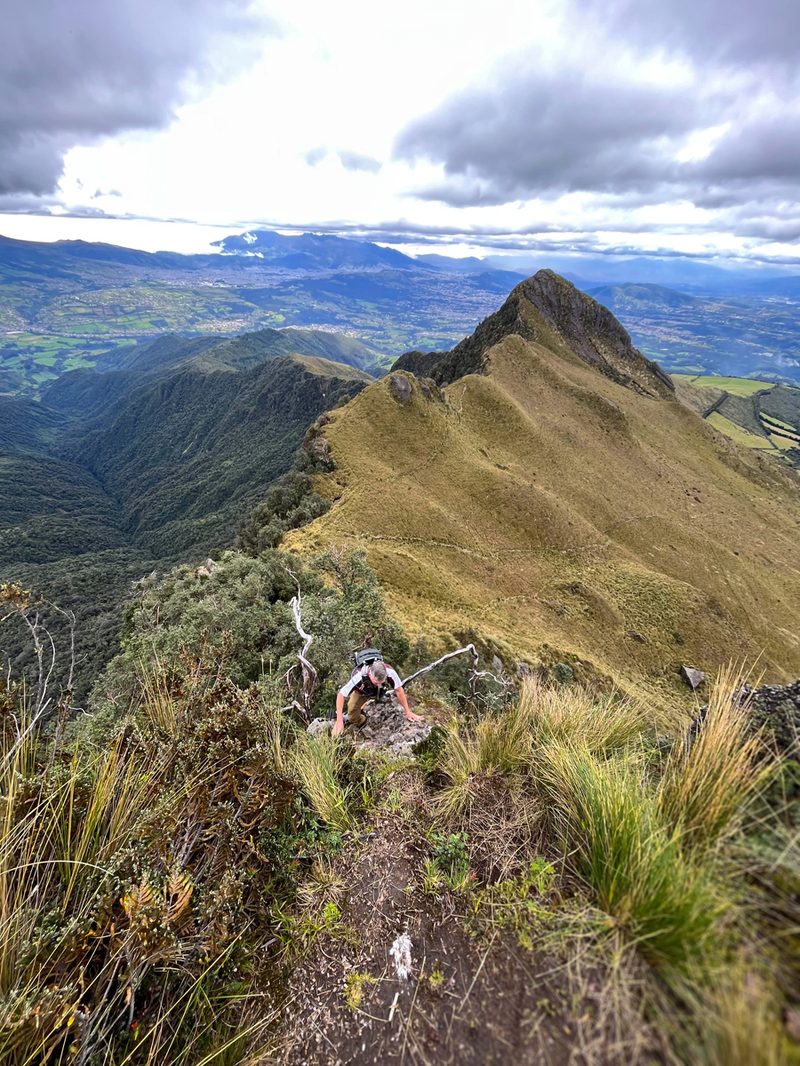
Clouds littered the valley floor of Pichincha province as we nudged recalcitrant cattle and straddled fraying fence line. My team was getting their first taste of altitude on this perfect March morning as we approached the 11,000-foot mark here on Ecuador’s Pasochoa mountain. Heavy breathing meant more frequent stops and calorie breaks. “Drink up!” I preached as we melted into the swaying grass and entered a treeless plain.
It would be my third time on this dormant volcano in the shadow of mighty Cotopaxi. Our Knoxville group was stretching their legs and lungs, snapping photos, and awing at the valley of the volcanoes. My assistant guide, Renee, was setting pace for our rabbits who would run if we let them. When we paused at 12,000 feet, five new altitude records were set, and we took a minute to reflect and hydrate. Another hour was required for the rocky prominence and some class-3 scrambling would see us realizing our first summit of the expedition.
One of my team was struggling, and I soon realized that he would have to descend. This is quite typical and out of our eight-person group, expected. I elected to descend with my friend, unconcerned about missing the last 1,400 feet. We would have to make this up, but I had been in country and at altitude longer than my client and we had plenty of time. I recommended he begin Diamox, an altitude medication, along with other team members who were having mild symptoms such as headaches and sleep issues.
Two days would find us eying Rucu Pichincha. This beautiful mountain dominated the Quito skyline. Topping out at 15,600 feet it required a cable car ride from the valley floor to begin our climb. I stood in line for tickets as they leisurely opened the gate at 10:30 a.m. This meant our hike would be accelerated beyond my comfort, but these are South American curveballs I have learned to accept in my travels here over the past two decades. Renee was giving the ticket lady a Spanish earful.
Rucu is postcard photography beautiful. Through a moving cloud forest, glimpses of the 30-mile “avenue of the volcanoes” whispered furtively as mountains such as Cayambe and Rumiñahui dangled a slipper in our direction. Just long enough to elude our best photographic efforts, it seemed to Martin Hunley. We threaded through the mist to a scree field, our last obstacle before climbing the final pitch to this 15,600-foot summit. The entire team would realize even newer altitude records and stood together high above Ecuador’s capital.
Nestled in the backdrop of Cotopaxi we looked like extras in a spaghetti western with our ponchos and helmets saddling up on horses for a “rest day”. We would soon find ourselves tackling part of the big peak over our shoulders the following morning. Cotopaxi means “neck of the moon”. On the right night, it can be seen perched perfectly cradled in the volcano crater. My two summits of this volcano would in no way compare to what was waiting for us on mighty Chimborazo. But we would crawl up part of it the next morning.
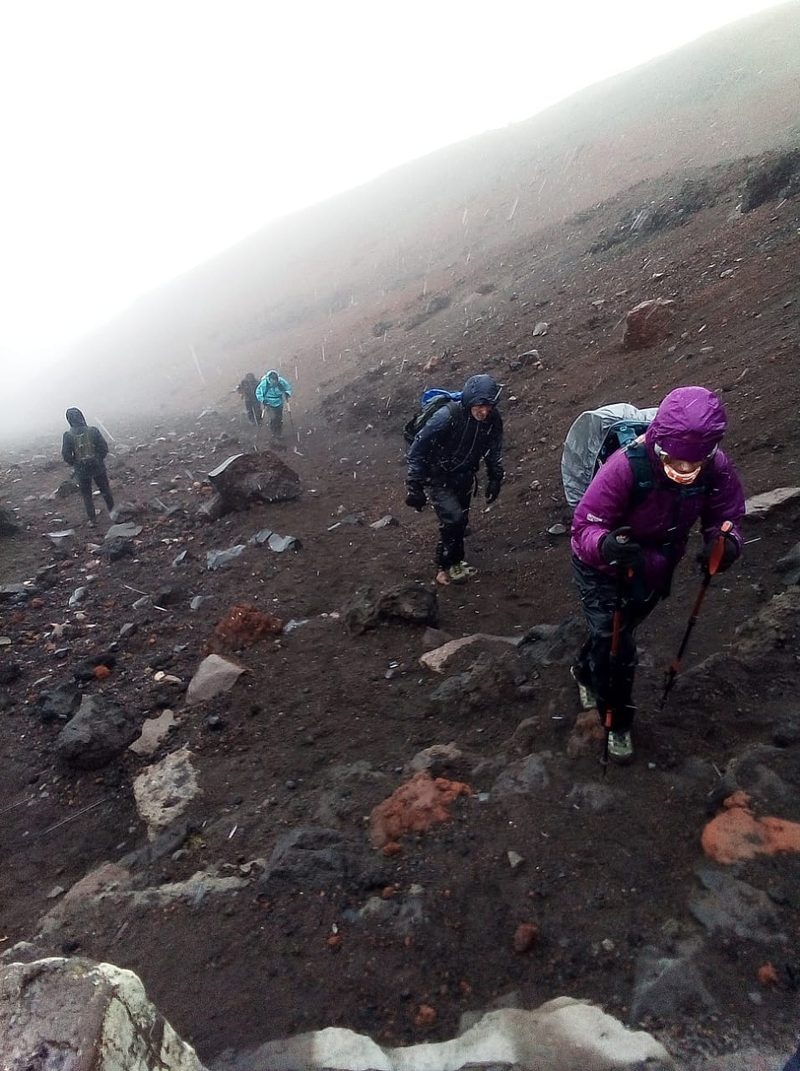
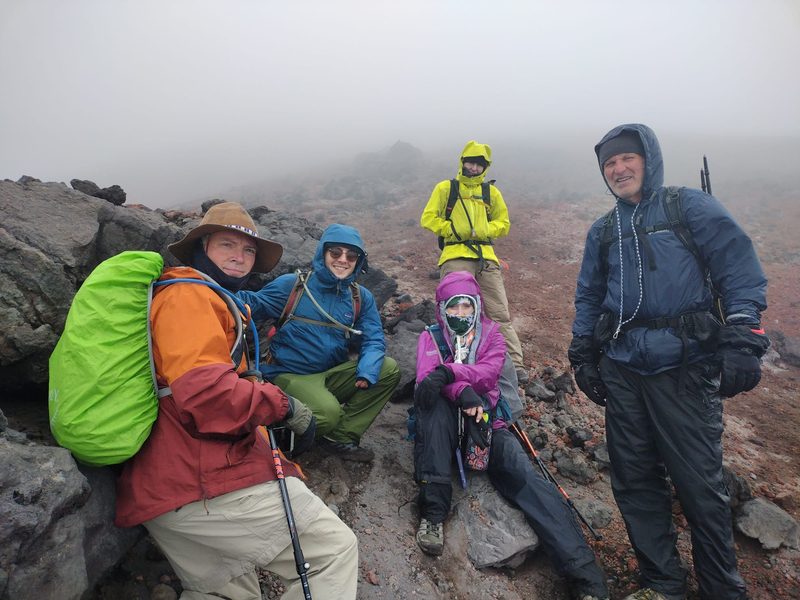
The weather came in with fury as we offloaded our four-wheel drive vehicles for the first leg up to the refugio. What began as rain at 14,000 feet turned to sleet that came in sideways and raked our exposed faces. We were soaked and the winds picked up, gusting to 50 mph. We took shelter at the Jose Rivas Refuge. A round of hot chocolate was just the ticket on this blustery mountain morning as I related tales of nights spent in this place with other groups. Our local guide was to escort us another 1500 feet on this hike, but the wind was not complying. It was strong enough to lift our legs. We made 16,200 feet our high point on this particular afternoon. Three thousand feet remained between us and that volcano top, but Cotopaxi was not our objective on this expedition. We needed that extra elevation, and I was coming to realize we were getting behind the eight ball.
All but two of my group were relative newbies to this mountaineering game. My trips are structured so that folks have multiple bail points, and some took advantage on that blustery morning. It was becoming apparent that most of my team would not be going for the summit of mighty Chimborazo a few days hence. This altitude and weather were a precursor to our summit day. As a precaution, I encouraged my team to avail themselves of Diamox to help with acclimatization. I could tell a difference when they had it in their system; tingling extremities and frequent urination are calling cards. I have seen it work wonders on other trips with clients who would otherwise have gone home. My team was feeling well after we descended and made the move over to Chimborazo base camp and sunshine.
One more hike and we would take off for advanced base camp. At 17,600 feet it matched the elevation of Everest base camp. We parked at Chimborazo National Park and shouldered some heavy packs. Two hours and 1500 feet, we shuffled into our group dome tent for a few hours of rest before a midnight start on Ecuador’s highest peak. Nothing seemed wrong, and I was feeling stronger than ever.
Three hours into my five hour “nap”, I awakened with labored breathing. Sitting upright, the mild tinges of a headache were coming on. Invoking the usual antidote, water, I tried to drift back off. By 11 p.m. we abandoned this futile rest effort and rolled out to sort gear for this, the longest of days.
Stars glistened initially as we moved upwards in one-to-one guided groups. I had the privilege of roping up with Christian, my partner from Cotopaxi two years prior. He had so many ascents of this peak he lost count. A sudden wave of nausea overcame me here as we climbed a vertical rock face on the via ferrata route. Snow began to spit in our faces, and the darkness of the Andes deepened with retreating stars. We had split from the others; Christian wanted to give me a more “exciting” climb than my clients. He knew I had a fair amount of altitude experience and would perhaps enjoy some technicality. I just wished for an easy ascent and struggled not to vomit, as he belayed me up vertical rock.
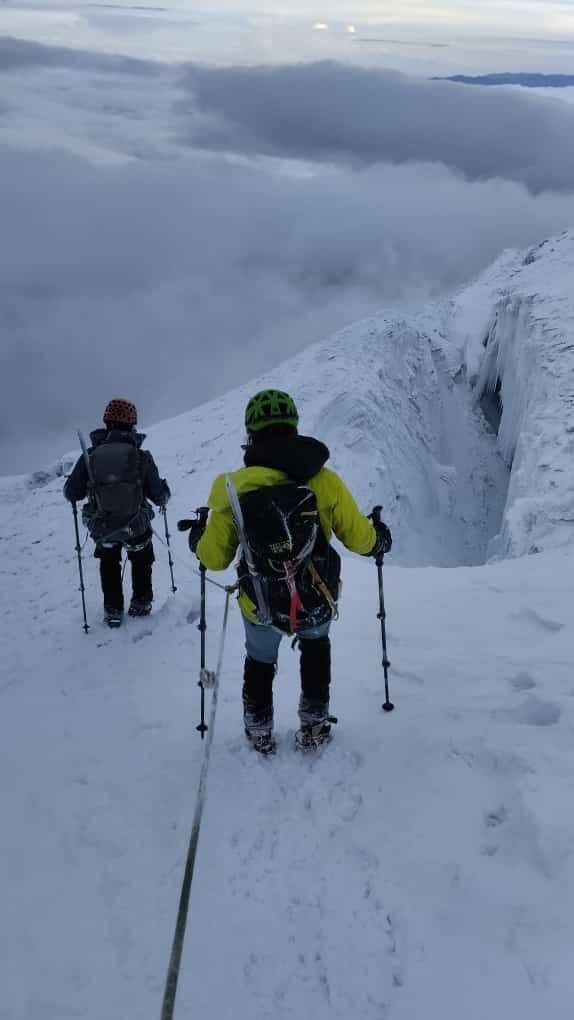
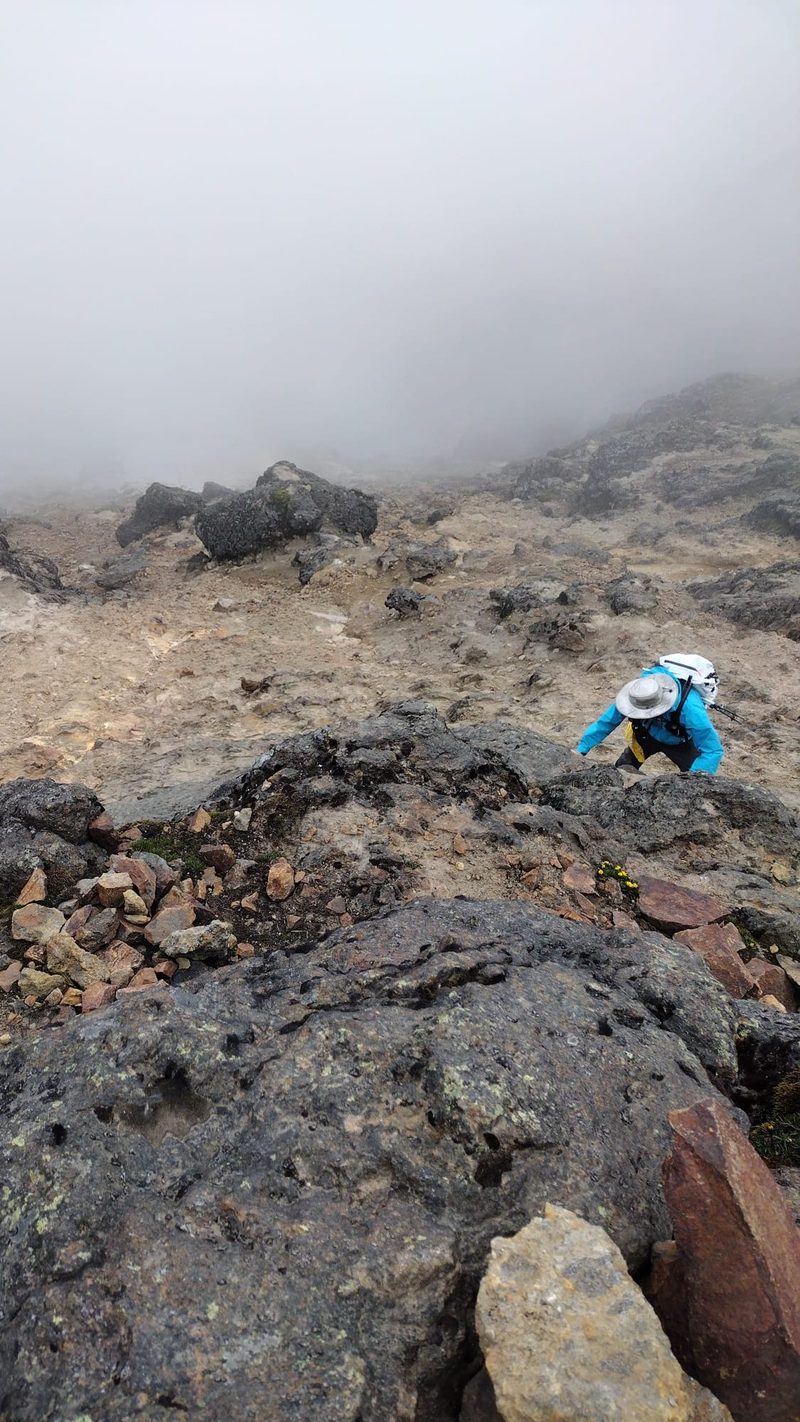
The rope tightened between us as Chimborazo steepened with soft snow and the occasional crevasse dividing glacier. We caught up with my friend, Richard Hatten, whose bobbing headlamp was signaling crampon difficulty. Soon I encountered Cris Emberton, another one of my clients who was moving steadily with her personal guide. We eased past and that is when my troubles really began. Uncontrollable dry heaving stopped me dead in my tracks here at 19,500 feet. Christian paused to witness this strange sight. As the wind continued whipping snow, conversation was futile. I convulsed about six times and leaned over my ice ax.
Nothing was on my stomach but that didn’t keep me from retching uncontrollably. I remember looking at Christian who spoke what was already on my lips. We had no choice. I was suffering from acute mountain sickness. These were classic symptoms. I thought about all the times I had to turn clients around on other expeditions. There was but one choice and he didn’t need to tell me anything else. We began our descent back to advanced base camp. I wished Cris luck as we retreated down the steep snow slopes.
I couldn’t help but think about Sir Edmund Hillary, history’s most famous climber. After summiting Everest, he went on to climb various peaks but started experiencing altitude sickness and had to be evacuated from a few mountains. Advancing age had taken its toll on this New Zealander and caused him to accept that his days of big mountains were over. I tend to think his weight and abandonment of fitness came into play. For me it was a combination of factors. One is not having gained the early altitude with the rest of my group and the other was the big jump from 16,200 feet to 19,500 feet. Had I been taking Diamox, this would not likely have happened. Drugs allow you to pull this off sometimes. After all, bottled oxygen is cheating, and I have had no problem using that in the past in the Himalaya.
Three of our team managed to gain the fore summit of Chimborazo: Richard Hatten, Emily Brewer, and Dan Lewis battled through the wind and gale to reach 20,400 feet. Their accomplishment snuffed my humbling effort and with great pride we welcomed them back into advanced base camp. Emily proclaimed, “This was the hardest thing I have ever done. I don’t know how you do this all the time.” Well, Emily, apparently it isn’t all the time. But for you, there will be plenty more. The mountains and our bodies make these calls. I have learned to heed them both.
→ Swipe for Next Story
VeteranJULY AUGUST 2024
Finally Home
Veterans experience a day like no other on an HonorAir Knoxville flight
Story by Phil Newman
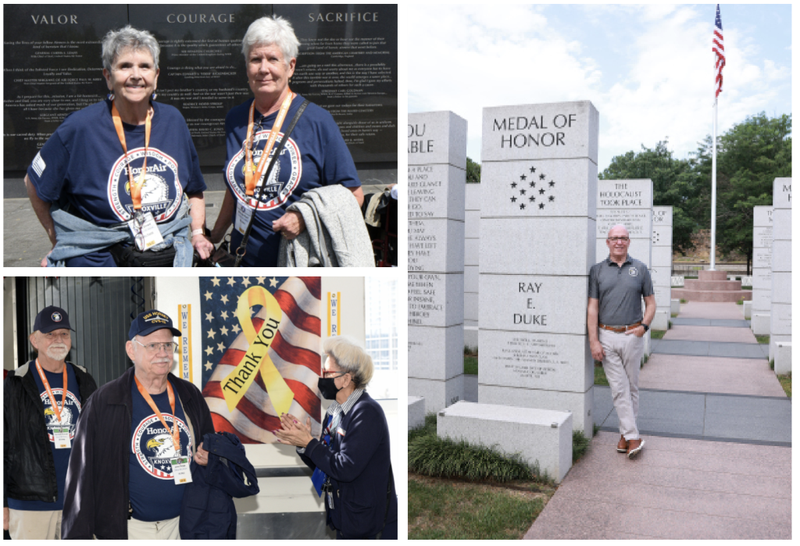
Standing near the intersection of the two sloping, black-granite walls that form the Vietnam Veterans Memorial in Washington, DC, on a sunny April afternoon, Eddie Mannis searches for words to express the essence of the scene that has unfolded throughout the day and that will culminate later in a thunderous celebration at Knoxville’s McGhee Tyson Airport.
As Mannis scans the veterans easing their way quietly, reverently along the wall, looking for the names of buddies killed in Southeast Asia all those decades ago—some pausing to kneel or to reach high to pencil-etch a name on a white sheet of paper—he whispers, “To be part of this means so much. Every time we’re here, we say, ‘Wow, this is life-changing for these veterans, and also for those of us who get to be with them.’ After every flight, veterans will come up to me and say, ‘I’m finally home.’”
Mannis foundedHonorAir Knoxville(HA) in 2007 to do just that: to extend honor and appreciation to military veterans while helping them experience a measure of catharsis and closure. In those 17 years, the organization has flown some 4,200 vets from throughout East Tennessee to the nation’s capital to enjoy a day-long cascade of respectful remembrance.
Mannis, who founded Prestige Cleaners in 1985, was an established business and community leader when his friend Jeff Miller invited him to join an HonorAir flight from Asheville, NC, in May 2007.
“He said he thought it was something we might like to do in Knoxville,” Mannis recalls. “I didn’t know what to expect. I was a volunteer escort for three veterans. I was so moved that I came back and started HonorAir Knoxville, and in October of 2007 we took our first flight.”
What continues to motivate Mannis and many others on the team, he says, are “the stories we hear over and over, the lives changed. The wife of one veteran who went with us came to the reunion breakfast [a follow-up event several weeks after each flight] and said, ‘Eddie, I just want to tell you, I don’t know the man that you brought back. Every night he would have nightmares, and he would wake up feeling like he was back in combat.’ She told me, ‘That doesn’t happen anymore.’”
The heartbeat of each HonorAir trip, Mannis adds, “is the experience they have with each other: the camaraderie, sharing the stories that only their brother or sister knows what it’s like. That’s why we’re adamant that each flight is only the veterans, no spouses. That allows the participants to bond with each other and feel what it was like back in combat together.”
And so on this April 10, 2024, HonorAir’s 32nd flight is set to bring 130-plus veterans to Washington—representing Knoxville, Chattanooga, Crossville, and surrounding areas—along with HA staff and volunteers, Knox County Mayor Glenn Jacobs (his first HonorAir trip), and two members of the media—Cityview publisher Nathan Sparks and your intrepid military reporter.
Of the veterans on the manifest, one served in World War II, four in Korea, and 128 in Vietnam. All of them are ready to embark on a packed itinerary that also includes the Air Force Memorial, Arlington National Cemetery, the Marine Corps War Memorial, the Korean War Veterans Memorial, and the World War II Memorial.
Just after 6 a.m., McGhee Tyson buzzes with anticipation as veterans arrive and introduce themselves, taking group photos, and then moving to the departure gate. Before boarding, they are greeted by Mannis, who thanks all who make HonorAir possible, including American Airlines; by Joe Sutter, USAF retired, an HonorAir volunteer and a board member of Covenant Health, a key HonorAir partner; by a proclamation from Knoxville Mayor Indya Kincannon; and by Knox County Mayor Jacobs, who speaks of his military upbringing and his father’s 21-year Navy and Air Force career.
“Thank God we have people like him and like you, willing to put their lives on the line for our freedom,” says Jacobs, who then shakes every hand as each vet boards the plane.
Already the honorees see indicators of what lies ahead: ground crew members waving flags and clapping as the plane begins taxiing, two fire trucks blasting a water salute over the aircraft from either side, and the captain taking to the PA to say how grateful he is to be at the controls on such a momentous day.
Upon landing at Reagan National, the plane is bathed in another water salute, followed by a ground crew member waving a large American flag, and a “Welcome Veterans!” banner stretched across the jetway. As the group boards four buses to begin their whirlwind tour, the excitement is palpable.
“I could cry at how much this means already,” says Gail Davenport, a nurse who was assigned to the USS Sanctuary hospital ship during Vietnam.
“I’m looking forward to seeing the wall for the first time,” adds fellow Vietnam vet Phil Haun.
At the Air Force Memorial, which overlooks Arlington on one side and the Pentagon on another, US Congressman Tim Burchett greets the honorees and talks with individual veterans. “This is so very special,” he tells Cityview, “and HonorAir is an incredibly important part of our community.”
Next the buses make the short jaunt to Arlington National Cemetery, where the veterans view the reverently powerful Changing of the Guard at the Tomb of the Unknown Soldiers. After a brief stop at the Iwo Jima statue, the apex of the Marines memorial, the convoy moves on and parks just off the National Mall, equidistant between the Korea and Vietnam memorials.
It is at the latter, along that long granite wall, where most of the veterans feel the full weight of what today means. Some are first-timers, like Randall Leyshon, who has come to find and etch the name of his best friend, John Terrell. Between survivor’s guilt and his own painful processing of Vietnam, it took Leyshon all this time—and the loving but persistent prodding of his children—to work up the nerve to visit. “I am so glad I finally got here,” he says.
Another veteran, Richard Cole, has been to the memorial many times. “The first was overwhelming, but every time is emotional,” he says quietly. “I’ve got about 30 buddies on the wall—guys who had two weeks left to go [in their tour], and guys who were there a week. The emotions rise. It’s hard to see it, but I keep coming back because I want to honor their memory and all that they did for us.”
Proceeding down the Mall to the World War II Memorial, the center of attention, fittingly, is this flight’s lone veteran from that war, Harold Fonte of Cleveland, TN. At age 97, he is escorted in his wheelchair by caregiver Rachel Brannen.
“Oh, this brings back some memories,” says Fonte, who served in 1944-45 in the Pacific, including the fierce Battle of Okinawa. “That sure was a long time ago,” he reflects, surrounded by fellow veterans extending hands and hugs in appreciation.
Many of the other honorees gather in front of the stone TENNESSEE panel of the memorial, taking photos and laughing. By this point in the day, the camaraderie rekindled among them has caught full flame, and the closeness is unmistakable.
During the flight home, fatigue has set in and the mood is quieter—until HonorAir’s Kay Kirckland takes to the PA, first to lead a rousing chorus of “Happy Birthday” to Eddie Mannis, and then to announce, “Before we get home, we have one more surprise. You remember ‘mail call’ from your time in the military, right? Well, we have one more very special mail call for you.”
With that, two team members walk down the center aisle distributing thick manila envelopes stuffed with cards and letters addressed to each veteran, some from their own family and friends, others from schoolchildren and volunteers.
“I didn’t get this much mail in the SERVICE!” exclaims an incredulous Richard Cornshaw, a ship’s electrician in Vietnam, as he thumbs through his stack. The joy on his face and that of the others is unforgettably moving.
Speaking of unforgettable, soon the plane descends and the time of homecoming arrives. How to describe its staggering impact? Well, you really have to be there. If you weren’t at McGhee Tyson on April 10, the good news is that you can mark your calendar for Wednesday, September 25, at 7:40 p.m., to take part in the next HonorAir flight’s celebration. You’ll be amazed.
Earlier in the day, Mannis had said, “Really, we could leave Knoxville, fly around for a while, and then land right back for the Welcome Home, and my job would be finished.” That’s how special the day’s climactic event is.
And so, as the veterans file off the plane and make their way toward the security area, the sound of band music and cheering grows louder. Rounding a corner, they behold a long tunnel of sorts, formed by soaring balloon arches stretching to the far end of the corridor. They glimpse the first of hundreds of smiling faces crammed along either side, whooping and clapping. As the heroes funnel single file into the parted sea of well-wishers, they receive handshakes, hugs, flower bouquets, Girl Scout cookies, cards, stuffed animals, and more. The crowd is mostly civilians wearing red, white, and blue, but also uniformed military personnel, ROTC students, and Scouts. A busload of middle schoolers has traveled from Meigs County sporting matching T-shirts with “Welcome Back Committee” emblazoned on the back.
All along the way, banners and placards bob buoyantly above the crowd, bearing ebullient messages like “We Love Our Vets!” and “God Bless America” and, of course, “Welcome Home!” Meanwhile, the band—it’s the spirit-oozing UT pep band, naturally—roars out patriotic tunes, along with rousing renditions of “Rocky Top,” as the veterans slowly work their way through the line.
Many minutes later, at the end of the glorious gauntlet they traverse, their arms overflow with treats and treasures, and their faces bear a blend of stunned awe and gratitude, of first-crush wonder and beach-sunset serenity. Most can scarcely speak, and those who manage to share a few thoughts do so through sniffles and sighs, with wide eyes that convey far more than mere words ever could.
“I can’t describe it, it’s just—overwhelming emotion,” says Air Force veteran Bryan Jones, barely audible over the din of the continuing celebration behind him. “When we came home from the war…well, this is a totally different experience.”
“I’m in shock,” adds Gail Davenport, the ship’s nurse during Vietnam. “It’s so emotional. I would have served no matter what, because I love my country, but it’s so great to be appreciated like this after so long.”
“All of the support touches you,” says Army vet Eddie Graves, shaking his head with a bemused smile. “It feels really good.”
As for Alan Culvahouse, a Navy veteran, when he flew home from Vietnam in 1969, “Nobody would shake your hand. We got a lot of harassment and not much else. I just told my wife, ‘Honey, this is nothing like that.’ I’m so glad I was on that plane today. And it’s great to come home to this.”
There’s that word one more time: home—four little letters that coalesce to form one simple syllable that embodies the deepest longing in the heart of these veterans and perhaps in all of us—the longing to touch down and breathe freely in a place where we know we belong.
A place where, after far too long away, we finally feel welcomed. Finally embraced. Finally cherished. Finally honored.
Finally... home.
→ Swipe for Next Story
Non-ProfitJULY AUGUST 2024
Help Document Life in the Smokies
Volunteers only need walking shoes and a phone to participate in a huge documentation effort
Story by Carolyn Evans
Can you spare a day for the Great Smoky Mountains? If you can walk through the woods and use an app on your phone, you can be part of a bioblitz. You’ll be searching for arthropods: insect and insect-related creatures with no backbone — teeny little creatures like walkingsticks, crayfish, coneheads, springtails, waterbears and lichen, a combination of algae and fungus that can be found on a rock or a tree.
Why would anybody want to search for tiny bugs? Because these creatures are the foundation for everything that lives in the park, says biologist Todd Witcher. “People love bears and elk,” he says. “People may not love bugs, but bugs are the foundation of the food chain and provide ecosystem services like clean air, water and food.”
Witcher is director of Discover Life in America, where he has served for 17 years. The nonprofit has a gigantic undertaking: to document every tiny arthropod in the Smokies. The small group works with park staff, researchers, and volunteers to study biodiversity in the park and educate others about its importance in our lives and its necessity to preserve the richness of life on earth.
“We collect information and supply that to the park and they determine how best to protect these organisms,” he says. “We’re on the frontline of determining what lives here. There are a lot of things that live here that we have not identified yet. For example, if you’re thinking of fireflies, most people think of one particular firefly, but there are 19 different fireflies in the park. They all light as larvae, but not all light as adults. It’s the variety of genes within the pool of living things.”
Over the last 26 years, the program has made huge strides, adding thousands of documented arthropods, some never discovered anywhere else in the world.
“Since 1988,” Witcher says, “DLiA has worked in partnership with the Great Smoky Mountains National Park (GSMNP) to conduct an All-Taxa Biodiversity Inventory (ATBI), a comprehensive inventory of all species occurring within the GSMNP. By leveraging new technologies, engaging the public in community science projects, and collaborating with scientists from around the world, DLiA has successfully doubled the number of known species in the park, adding over 12,000 new species to the park records—including the scientific discovery of 1,084 new species (new species to science).”
“The number of identified lichen has risen from 340 to 958,” Witcher says. “Sixty-four of those had never been documented before anywhere on earth. In the fungi category, 71 new species to science have been discovered here.”
“Nobody knows we’re here or what we do,” he says. “Our biggest need is support that would allow us to expand and speed up the identification of all the specifies. Species are disappearing. Threats to biodiversity in the park include climate change, invasive species, development, over visitation, and air pollution. We like to say if you don’t know about a species, it would be hard to protect it.”
Witcher says the nonprofit was launched 26 years ago when University of Pennsylvania professor Dan Janzen came up with the idea that the best conservation effort would include knowing everything within a space, that an All-Taxa Biodiversity Inventory (ATBI) should be created.
According to Janzen’s biography at the University of Pennsylvania website, he asked questions such as, “Why do caterpillars eat the plants they eat? Why do parasitoids (wasps and flies) eat the caterpillars they eat? And why do they do it that way in a complex dry forest, rain forest, and cloud forest in northwestern Costa Rica?” Janzen’s idea of a complete inventory was adopted and in 1997 an ATBI was launched in the Smokies.
“That kicked off the beginning of our organization and we started working with scientists everywhere,” he says. “The thing about this park is that a lot was known – birds, bears, etc. – but not a lot was known about all the other things. In looking at global biodiversity, only a small fraction is vertebrates. About two-thirds of global biodiversity is arthropods (bugs and relatives). These make the foundation for all these other things to be able to live.”
The organization estimates 60,000-80,000 species of life are in the park, the dlia.org site reports. The ATBI is a tremendously large research program, so large that the National Park couldn’t devote the time and resources necessary to start and maintain it. Discover Life in America was founded as a nonprofit to secure the funding and organize the scientists to being this ambition effort. The ATBI does more than just count the number of arthropods in the park. It focuses on understanding habitats, ecosystems and relationships between species. DLiA documents and reports their findings to the park.
“The park wants to know what is here,” Witcher says. “What does it do? Is it a predator, prey, or pollinator? Where is it found in the park and how does it interact? And is it rare or common?”
For instance, he says, if there were a rare bee pollinating a rare plant and that bee disappeared, the plant would also disappear. The nonprofit would let the park know about the endangered bee, and a plan could be devised to protect it. Or take the Hemlock Wooly Adelgid, an introduced insect that is killing the hemlocks. “Our job is to identify species and the park’s job is to decide what they need to do with the information,” he says. “Do we need to protect this more, or create a plan to eliminate it?”
There is so much work left to be done that Discover Life in America has created a program called Smokies Most Wanted to recruit arthropod-searching volunteers. Armed with phones and an app called iNaturalist, volunteers of all ages have photographed and identified the tiniest of creatures, but thousands more are waiting to be documented.
In partnership with the Tennessee Valley Authority, Discover Life in America created iScience, a schoolyard biodiversity program designed for students in grades 5 through 8. The program encourages students to become community scientists, studying local plants, animals, and other life. iScience uses the All-Taxa Biodiversity Inventory model, bringing ATBIs to schools within the TVA iScience Program area. Students conduct ATBIs at their schools using the iNaturalist app, collecting real scientific data about local biodiversity.
Discover Life in America is not financially funded by the national park, but relies heavily on donors.
“We host an annual firefly event called Fireflies at Norton Creek,” Witcher says. “The event is on land that abuts the park and the owners allow us to have an event there to sell tickets to see synchronous fireflies. We usually sell about 50 tickets per night.”
For more information about how to donate or how to volunteer as part of the Smokies Most Wanted, visitdlia.org.
→ Swipe for Next Story
FeatureJULY AUGUST 2024
Home Run
A young family builds their “forever” home
Story by Karen Clark
Michelle and Jon Amelse had the perfect set of talents to build a house. Michelle is a CPA with her own firm, Amelse & Edmonds CPA, and Jon is a reliability engineer, focusing on problem-solving and cost control. The Amelses wanted a family home that was best for their two sons, Garrett and Bryson (10 and 13) today, but would also serve the boys’ needs as they grow.
Garrett plays shortstop on a travel baseball team, while Bryson’s interests lie in the direction of art and design, a possible future architect. Right now, the family is busy with work, travel sports, and kids’ activities, but they know there will be a time in their lives when things will slow down a little.
“We travel and wanted to include all the wonderful things we saw and liked. We wanted this to feel like a vacation home,” says Michelle. The house plan they settled on combines a modern aesthetic with comfortable amenities and tranquil views.
The build started during the pandemic, and their respective expertise was invaluable when they had to work with supply chain issues and pricing. Michelle ran the numbers, the higher supply costs were more than offset by the advantageous interest rates, so the project was a go.
They worked with designer Shawn Fisher and credit him for being able to take their ideas and suggestions and make them work. The project landed with Ken Bowman of Mike Stevens Homes, a seasoned builder with over two decades of experience. He was the perfect choice to balance the Amelses’ vision and Fisher’s design.
The first thing you notice when you see the house is the number of interesting angles on the front elevation. “Cul-de-sac lots are interesting,” says Bowman, “they have a narrow front, and this particular lot is diamond shaped.” The front elevation, with its interesting geometry, certainly draws the eye and hints at the unconventional design within.
It wasn’t just the narrow lot that posed a challenge. The presence of the TVA 820 line dictated strict regulations on how close the house could be built to the water’s edge. Navigating the intricacies of these regulations became a significant task, requiring multiple surveys and precise planning to ensure compliance.
As you step through the front door into the main living area, you are immediately greeted by an open and airy space flooded with natural light streaming through oversized Pella windows. These windows frame stunning views of Fort Loudoun Lake and create a serene backdrop for the entire room. The main living area seamlessly transitions into an outdoor room, inviting you to step outside and enjoy the covered patio, pool and firepit.
Moving further into the main living area, your attention is drawn to the dining area, where a generous dining table sits parallel to the colossal 12-foot island in the kitchen. The clean lines of the panel-front appliances from Standard Kitchens and Friedman’s Appliances add a modern touch to the space and are complemented by lighting fixtures from Ferguson Plumbing, who provided both the lighting and plumbing in the house. The fixtures here perfectly match the style and scale of this room.
“We decided to use all panel-front appliances,” says Michele, “we really like the clean lines they create.” Jon adds with a laugh, “Although sometimes our guests have trouble finding things!” The seamless transition between kitchen and living space is anchored by a “coffee and bourbon” bar.
In the main living area, carefully designed conversation and dining areas feature a trestle table from Bordeaux c.1840. This table, behind the sofa, defines the cozy yet elegant atmosphere for entertaining guests.
The first floor also houses Michelle’s office with a fireplace, small chandelier, lake views and an exterior, private entrance door. Michelle is planning to put an herb garden directly outside. “It’s a wonderful space,” she says, “private but not too far away to hear what’s happening in the house.”
Off the kitchen are a series of mud-lockers strategically placed near the entrance to the garage, where the family will enter most frequently. A bathroom, with custom cabinetry and countertops from Smoky Mountain Tops, is adjacent to the pool allowing for a quick trip for wet swimmers. Next door is the boys’ laundry room with one of the thoughtful details that truly set this home apart. Motion-activated laundry chutes, reminiscent of a bygone era, whisk clothes effortlessly from the boys’ bathrooms to this main laundry area below.
A third door in the hallway hides the home’s elevator which goes to all four floors (including the attic) of the house. “We have friends who recommended this,” says Michelle, “and it’s been incredibly useful. We used it to haul Christmas decorations up to the attic and Jon uses it like a dumb waiter, to bring food down to our guests in the recreation room downstairs. And we know it will be useful as we get older.”
Stepping out onto the outdoor porch from Paragon Hardscapes, you are greeted by breathtaking views of the pool and lake, an outdoor kitchen and fire pit beckoning for al fresco gatherings. To meet the lot’s topology, the pool is elevated ten feet, giving an unbeatable lake view. Michelle credits Fisher with the idea of in-pool seats to create a “swim up bar,” a feature that has been a big hit with their sons. Jon is finishing the outdoor kitchen himself and is debating between butcher block and granite. It’s clear that this is the kind of project he loves to do, and the result will be a three-season living room for the family.
Coming back indoors, your eye is drawn to the floating stairs which invoke an older industrial esthetic. They are wide and sturdy factory stairs framed in iron. “I saw these in my travels in Europe,” says Jon, “and I really liked the way they looked.” There is a large window at the top of the staircase, flooding it with natural light.
Come to the top of the these stairs and look directly up to see one of the most fascinating parts of the building, where all the roofline angles meet. A short gallery straight ahead houses the art collection and overlooks the living room. You can see Jon’s focus on reliability, as the chandeliers in these high spaces are on winches to make cleaning and bulb replacement easy.
The main hallway to your left uses a series of arches, wood-paneled barrel ceilings and panel trim on the walls to create an intimate, visually interesting space.
Double oak doors to your right open into the master suite, where the walk-in closet houses additional laundry facilities. This closet and dressing room, designed by Everything Closets, contains both plenty of storage as well as a closet island. This generous closet space means that dressers are not needed in the master bedroom.
The master bedroom looks out over the lake and the in-wall gas fireplace from Broadway Tile and Hardwood gives the room a cozy feeling. The simplicity of the furnishings, the lake views and the fireplace make this a sanctuary.
There is a funny story about the master bath. “We chose the floor tile for the bathroom,” says Jon. “But when we had to choose the countertops, it was a year later, and we both had forgotten what it looked like!” In a happy twist of fate, it matches perfectly. A custom build also allows Jon, who is 6’ 3”, to have a shower large enough so that his elbows didn’t bang on the walls. “It used to sound like a bowling alley in our old house,” he laughs.
The two boys’ rooms down the hall each have their own en-suite bathrooms and look out over the lake. These are fun and obviously real kids’ rooms—with lots of Lego construction and baseball equipment —happy rooms for two active kids.
Go down to the basement and you will see Jon’s influence here. He designed the wine cellar using “clinker” brick, so named for the metallic sound the bricks make when struck together. This brick is formed when wet clay is exposed to excessive heat during the firing process and produces a denser, heavier, and more irregular brick. They are reminiscent of old bricks when kilns did not heat evenly and resulted in distinct colors and surfaces depending on the minerals in the clay.
The wine cellar has a sideboard, “the first piece of furniture we bought” says Michelle as well as a painting from their first home. Kept at a steady 58 degrees, the cellar has a 600-bottle capacity. Just down the hall is the keg room, where Jon will cold-store the kegs to service the beer taps he is installing.
The downstairs also contains a guest room and bath, as well as a sub-kitchen, making a comfortable and private suite for guests. A media room and workout room complete the space. The solitary piece of taxidermy, a deer mount, will go above the dart board and will naturally don the traditional holiday hats as the seasons require.
Walk out the back doors to gently sloping lawn which unfolds to hidden oasis. Jon and Michelle have installed a white sand beach, making for an easy “wet launch” for the kayaks. The generous covered dock area has a second fire pit and a wood-burning fireplace with pizza oven. “We have had so much fun with that oven,” says Michelle, “more than we thought we would!”
Walking back up to the house you see one of Jon’s ingenuous design ideas—a brick inset beneath the pool which contains and protects the HVAC equipment and generator. “We had to elevate the pool to accommodate the lot, and so I thought we should use that space,” he says.
Back up on the main level, through the outdoor living area and into the house, it is clear the house has been built by the Amelses with careful thought and planning. They have created not just a house, but a home that reflects their vision, passion, and commitment to family. From the innovative architectural design to the thoughtful interior details, every aspect of the house speaks to the Amelses’ desire to create a haven for now and for their future.
As Michelle says, “We plan to live here for the rest of our lives.”
→ Swipe for Next Story
FeatureJULY AUGUST 2024
Hunting with Warriors
Time spent in nature alongside Tennessee veterans reminds us all to slow down, be present, and appreciate all we have
Story by Nathan Sparks
It’s a little after 5:30a.m. The day is pleasant and we have settled into our ground blind. To my left is Jason Maxedon, the statewide director of the Tennessee Wildlife Resources Agency. Although I have only known him for less than an hour, it is obvious he is a kind and thoughtful person. He is donating his time today to guide one of the participants in Terry and Jane Lewis’ annual Wounded Warrior Ultimate Turkey Hunt.
The event is co-sponsored by Ron and Terry Cunningham who have a farm just down the road from the Lewis enclave. This is the events 20th year and I had the opportunity to have a candid conversation with my very good friend, Terry Lewis, the evening before with a bonfire crackling in the background as we stand next to a small stream as it rushes over the rocks. The occasional chorts of laughter, break the quiet conversations as stories not often shared are being told. There is a sense of respect that it is hard to convey in words. These men have endured what most of us cannot even imagine. Yet somehow they have come through that trauma and stood together witnessing to each other that the struggle may have been challenging, but they were stronger. They did not break. And I can tell as I watch my friend greet warrior after warrior that is it his respect for what they have endured that makes him want to give them something in return. His gift is his time, his farm, his continual effort to bring together more than 100 volunteers to make this event a reality.
Terry Lewis, his wife Jane, and the Cunninghams are warriors in the their own right. They don’t do this for recognition; they do this because they truly care. I am humbled to be a small part of helping these warriors have an opportunity to experience turkey hunting in East Tennessee.
How it Began
I wanted to know how it all started. Terry tells me he was approached by a handicapped child who wanted to experience hunting. I can see the joy still in his eyes from making that young person’s dream come true. And it happened again the next year. So, after a few years he got the idea to offer this to wounded warriors.
To do this is no small feat. Watching men roll down the gravel driveway at 4 a.m. to participate in the day brings realization to the level of sacrifice it takes for all of us to have our freedom. I feel humbled to be in their presence. Terry gathers everyone around to lay out the day, but first things first: a prayer for the day’s hunt. You can feel the respect of every person standing there. There is a sense of camaraderie I don’t often see. I haven’t heard a single complaint and do not expect that I will. After a wonderful breakfast, prepared by the volunteers, the day is underway.
Within the Blind
Turkey hunting requires hours of stillness. The veteran Jason is guiding is Perry Thorington, a multi-tour veteran and recipient of more than one Purple Heart. He is sitting in the front of the blind and the day is slowly coming to life. A cacophony of birds are gently beginning to sing. It is truly miraculous.
We talk in whispers as Perry quizzes us on our lives and who we are. He is feeling us out, seeing if we are trustworthy. Jason only has one arm due to an early age farming accident. Perry inquires, and Jason answers, “Got bit off by an alligator!” The silence hangs for a moment before Jason laughs gently and gives a few details. Sacrifice begets sacrifice and when asked, Perry regals us with tales of the battlefield. Some have levity, others run a chill down my spine. The realization of how important the sacrifices made by the men and women of our armed services truly are.
The chatter of hundreds of songbirds is broken by the gobble of a turkey. Ol’ Tom is awake and letting the hens know he is about to be on the prowl. There is a fervor of concentration in the blind. I wonder why Jason doesn’t call back, but then recall Terry saying that calling too much will spook another bird. I can feel the anticipation in Perry. He moves his shotgun into position and shifts his chair to have a better vantage. It is light enough to see the spread of decoys about 20 yards in front of the blind. The turkey gobbles again. Jason whispers that it sounds like he is still in a tree, just awake and still in the roost. Another gobble and Jason has slipped a call into his mouth and is clucking like a hen. The call seems to work and the Tom gobbles again.
“Get ready,” Jason whispers, “I just heard him break a stick.” I am impressed as I hadn’t heard it and for a moment wonder if that is the guide in him raising the expectation in the blind. I don’t have to wonder for long. “There he is at the edge of the woods right in front of us,” says Jason, as he calls quietly again. Perry is excited as are we all. The sound of the 12 gauge rips through the silence.
The Search
We looked for the bird, but no joy. And although we saw a few more at a distance, we had missed our chance. But truthfully, more often than not, hunting is about so much more. It is about being in nature. It’s about the camaraderie, whether with old friends or new, and sharing our time, ourselves, and our experiences. And as always, it is about making memories. I will not forget the stories of the day at the Lewis farm waiting for ol’ Tom turkey to make an appearance.
For all of you non-hunters out there, you might like to know that it is only through the conservation efforts of the TWRA and people like the Lewises and the Cunninghams that we have such abundant wildlife throughout Tennessee today. More to come on that topic in a future issue.
→ Swipe for Next Story
FeatureJULY AUGUST 2024
Navigating Supplement Selection
Unveiling the Best Choices for Your Health Needs
Story by Dr. Edwin Spencer
Sitting at dinner recently, I mentioned to my wife, Tracey, that I was working on my next article forCityview. “Why are you writing another article? Don’t you already have enough on your plate?” Her reply caught me off guard, but Tracey always calls them like she seems them and she is always concerned that I work too much. It made me pause and really think, “WhyamI writing this?”
The real answer is that nutrition, exercise, and supplements are common topics that I discuss with my orthopedic patients. In fact, I encourage (if not insist) that all of my patients prepare for surgery with a plan that will find them as healthy as possible on the big day. I’ve spent quite a bit of time learning about how to go about it and the impact it will have on the body, not just for my patients, but for myself. So, asCityview’s newest writer, it seemed important to share some of this information with readers. What’s good for the goose is good for the gander, as they say, and it is my hope you find something here that makes you feel a little—or a lot—better.
The World of Supplements
Have you ever been into a health food store and just been overwhelmed by the sheer volume of supplements? Even a stroll down the vitamin aisle at the grocery store can be daunting. Various commercials and podcasts will espouse their product as “the one you can’t live without”. It is hard to tease apart the bias from the scientific data. So, I decided to catch up with Eddie Raymond at a local watering hole to seek some truth. Eddie is originally from Switzerland and as all Swiss do, he joined the military. It was there that he cultivated self-discipline and an interest in nutrition and health. As an entrepreneur, he rolled this passion into a business 23 years ago which is now known by most simply as Eddie’s Health Shop. It has become a Knoxville “go to” for supplements and advice. So, when asked about the best supplements that the average Joe should take, Eddie said something that I very much also believe: “It all starts with nutrition, exercise, and self-discipline.” Supplements are just that, an addition which can help one’s health. They cannot ameliorate the effects of poor nutrition or lack of exercise, thou. With that said, let’s explore some supplements for the benefit of all.
The Multivitamin
Leading the pack was a good multivitamin, but what makes a good one? Those derived from whole food with good fillers. Specifics include methylated folate (B9) and methylated cobalamin (B12) which are the active forms. The importance of multivitamins increases with age and with pregnancy. However, multivitamins are not as necessary if your diet is rich in polyphenols found in colorful fruits and vegetables (incredible source of antioxidants) and nuts which are chocked full of B complex vitamins, magnesium, copper, zinc and selenium.
Vitamin D
Roughly 70% of Americans are deficient in vitamin D. Vit D is a pre pro hormone, meaning that it has to undergo modifications termed hydroxylation’s in the liver and kidney to become the active form useful in your body. If your diet contains abundant amounts of cod liver oil, salmon or trout, then you might not need supplementation. However, since most of us are not consuming those foods on a daily basis, supplementation could be considered.
The number one way to increase your Vit D levels is 30 minutes of sun exposure. In mammals the naturally occurring cholesterol in the skin is converted to Vit D by UVB light. UVB is blocked by glass so direct out door exposure is the only way to get it. As we have become more industrialized and office based, we have lost much of the solar exposure. Most people are familiar with Vit D and its effects on bone health. There is a beautiful homeostasis (body’s maintenance of the status quo) between Vit D, calcium, phosphorus and parathyroid hormone to remodel our bones. About 5-20% of our bone mass is remodeled each year.
Vit D, is also critical for muscle function, glucose and insulin control and immune function. Vit D receptors are found on nearly all the cells necessary for proper immune function to include T cells, B cells, and antigen presenting cells which affects the ability to defend ourselves from viruses, bacteria, and also cancer. Although the recommendations vary, adults should supplement with 2000 IUs of Vit D3 daily.
Omega 3s
Like Vit D, Omega 3s are found in fatty fish like salmon but also egg yolks and almonds. Omega 3s are naturally made by microalgae which are consumed by phytoplankton and krill and then other fish with the concentration of Omega 3s increasing up the food chain. The two most important ones are DHA (Docosahexaenoic acid) and EPA (Eicosapentaenoic acid). They are found in high concentrations in the structural cell membranes especially in the brain.
Omega 3s can reduce inflammation by competitively inhibiting the metabolism of the more common Omega 6s. The metabolites of the Omega 6s are prostaglandins which are proinflammatory. NSAID’s are medications that inhibit this prostaglandin formation however through diet and supplementation, you can reduce systemic inflammation. Omega 3s have also been shown to reduce triglyceride levels. Look for high levels of DHA and EPA around 800 milligrams or higher. Eddie did say that there are liquid emulsions that are more bioavailable than the gel caps and are actually quite palatable.
Magnesium
Magnesium has gained more attention recently as common supplement as it is required for the hydroxylation of Vit D to its active form. Very few things in the body exist in isolation. Meaning that levels of one mineral or vitamin affect another. The same is true with magnesium and Vit D. So much so that studies on high dose magnesium and Vit D in COVID patients has yielded encouraging results. Magnesium is also important in the mitochondria specifically in the electron transport chain which converts fatty acids and glucose into ATP (adenosine triphosphate). ATP is the energy currency of the body.
There are many different magnesium sources out there. The most common is magnesium oxide which has poor bioavailability so should probably be avoided. Magnesium threonate crosses the blood brain barrier and is therefore promoted for brain health and sleep. I personally take magnesium threonate and L-theanine at night for sleep. Other forms include malate, citrate, glycinate which are all fairly well tolerated although higher doses are associated with diarrhea. Two hundred to 400 milligrams should be sufficient for supplementation.
Probiotics
Finally Eddie suggested a probiotic to round out the list. The way that I like to think about gut health is prebiotic, probiotic, and postbiotic. I’m a simple person so categorizing the actions surrounding gut health makes sense to me. Prebiotic food stuffs are things like soluble fiber and polyphenols. These are the foods that your gut biome (bacteria in your gut) ferment and turn into short chain fatty acids, which are absorbed by the body and also used locally to nourish the endothelia cells that line our gut. Probiotics are bacteria that you can ingest in powder or capsule form to help maintain a healthy number of bacteria in your gut. Postbiotics are the actual short chain fatty acids themselves with some bacteria. These come in the form of Kambucha, Kimchi, kifir, and kvass. Many cultures have some form of fermented drink so there must be something to it—but you have to develop a taste for it.
Other Supplements Not to Miss
The above supplements will cover you for improving your healthspan—and possibly lifespan—but what about specific circumstances like a desire to increase muscle mass, exercise recovery, high blood pressure, or blood glucose control?
For increasing lean muscle mass, Eddie recommends a good whey protein isolate. Adding casein to this will increase the length of time over which you will digest the protein.
Creatine is probably the most studied supplement. It is simply a fuel source in the cell. Creatine is a natural peptide made by your liver from the amino acids methionine, arginine and glycine. It is then phosphorylated so that it can be used as an immediate fuel source. It is burned up within several seconds and then the body turns to glucose stores for more energy. Eighty to ninety percent of your creatine is in your muscles with the rest of it in your brain. Unless you have significant kidney disease, it is a safe energy supplement.
Lets switch gears from muscle building to blood pressure and glucose control which affects most Americans over the age of 50. I started noticing a slight but steady increase in my blood pressure so I added beet root crystals to the daily regimen. I noticed a 10 point decrease in the systolic and diastolic numbers. The reason is the increase in nitric oxide that dilates your blood vessels. Other supplements like citrulline and arginine are also on this similar nitric oxide boosting pathway, but I prefer something whole food if possible.
Finally alpha lipoic acid is a supplement that has been shown to decrease insulin resistance by increasing uptake within skeletal muscle. It is most commonly used in patients with diabetic neuropathy with positive results.
Pulling it All Together
Improving your health span and life span starts with good baseline nutrition and routine exercise. Supplements can enhance the body’s ability to burn energy and recover and even mentation. There are many that have positive effects for most of us and a few that you can choose for specific goals. Always ask your health care provider before starting supplements to see if they are right for you.
→ Swipe for Next Story
JurisprudenceJULY AUGUST 2024
The Great Ray
Story by Gary Wade
No lawyer better illustrates the transition in jury trials from dynamic oratory to diligent preparation through extensive research better than the fabled Ray Howard Jenkins, a man based in his Knoxville law firm but renown throughout Tennessee for his extraordinary skills in the courtroom (retired attorney Bob Campbell, an occasional adversary, recently exaggerated this point, “If you wanted to hide the law from Ray, put it in a lawbook”). At the height of Ray’s legal career and with a background of unprecedented success, he stepped competently and colorfully onto the national stage in what some newspapers, during the first term of the Eisenhower administration, described as the worst scandal of the 1950s.
The son of a physician, Ray was born in North Carolina, but his family soon moved to Tellico Plains in Monroe County. At a time when there were no other motorized vehicles in his community, Ray took his father’s “lizzie” one night without permission to visit a girlfriend. He wrecked on his way home and, fearful of the consequences, caught a freight train to Knoxville before Dr. Jenkins found out. On the next day his father discovered his son’s whereabouts and brought him back home. Ray was able to finish at his tiny high school, graduating in a 1916 class of three. His streak of independence undeterred by the incident with the “lizzie,” Ray soon joined the Army — without the knowledge of his parents — in hopes of being a part of an expeditionary force assembled to capture bandit Pancho Villa in Texas. Ordered to Nashville for training, Ray was eventually assigned to a small town near the Mexican border where he was promoted to the rank of sergeant. One evening, as a drunken soldier resentful of Ray’s authority attacked him with a knife, this future legal icon attempted to defend himself by breaking a bottle of ink on the soldier’s forehead. An aide intervened, shooting Ray’s assailant through the tongue. When those involved chose to maintain silence about the incident, the entire company was court martialed. In the ensuing trial, Ray chose to represent himself. He and his men resorted to a theory of defense Ray later used time and time again: “When a bully has been shot or killed, paint him so mean that a jury will want to shoot him again!” The panel exonerated Ray and his aide, ruling the incident to be a clear case of self-defense.
Shortly after Villa was captured, Ray left the Army and enrolled at the University of Tennessee College of Law. Fate intervened when the United States entered World War I. “Dreaming of glory and a life around the world on a battleship,” he joined the Navy and trained in San Diego. Despite extensive training, Ray conceded that he “never boarded so much as a canoe.” When Germany’s Kaiser surrendered, Dr. Jenkins used his influence to secure his son’s release from the military. Ray’s next stop was back at the law school. Working his way through, he passed the bar exam well before graduating with honors in 1920. After earning his shingle, he worked with attorney Alvin Johnson for two years, investing long hours in his practice and earning recognition by his oratorical gifts in even the most minor cases. “A fiery, impassioned speech is the best way on earth for a young lawyer to advertise,” he wrote years later in his book of memoirs.
Once on his own, Ray’s first of some six hundred homicide cases took place near his hometown in Monroe County. After receiving what was then a standard fee of $500, Ray was confronted by his father who threw down five $100 bills and insisted that he withdraw from representation. Ray declined, explaining that he was bound by his agreement. In a case described by one mountaineer as the “worst killing I ever saw in these parts,” the prosecution sought the death penalty. While conceding his client’s responsibility for the heinous crime, Ray’s emotional, biblically based plea during final argument saved the life of the remorseful defendant.
After decades in the practice of criminal defense and in contrast to the fictional Perry Mason who “never lost a case,” Ray’s more modest claim of notoriety was that he had never lost a client to the death penalty, conceding that several, including the defendant in his very first homicide case, spent considerable time in Tennessee’s prisons.
In 1927, Ray partnered with the talented Erby Jenkins, not related, to establish the firm of Jenkins and Jenkins. As their law practice grew, Erby’s brother Aubrey joined the partnership and, later, Fred Musick, Ted Lowe, and others came on board. Meanwhile, Ray, in high demand, was called upon to represent several high-profile cases in the Knoxville community with remarkably good results, like grocer-politician-local TV country music host
Cas Walker and, of course, the glamorous madam, Hazel Davidson. His first foray into the national news involved his representation of an aging Ed McNew, a sickly bail bondsman who had a history of behind the scenes influence in local political races. As McNew stepped out of his downtown office one day, a professional photographer aimed his camera in his direction. Immediately, the bondsman drew his weapon and shot at him, thankfully missing his target. The photograph later appeared in the popular Time magazine. When the case came to trial, Ray had little to argue in defense except for “every man’s right to privacy.” When the trial judge suggested an adjournment after a long day of testimony, Ray, seeking “brownie points” with the jury, offered to waive what is known as the “rule of sequestration,” which would have allowed the jurors to go home rather than stay the night at a cheap hotel. The photographer stood to strenuously object, angering the jury members who would have much preferred sleeping in their own beds. On the next day, the irritated jurors returned a verdict of acquittal on the attempted murder charge, notwithstanding the photo, convicting McNew of a lesser offense, resulting in only a fine and probation.
That Ray Jenkins possessed a huge personality is a vast understatement. With an unparalleled air of self-confidence, “He could often take over a courtroom, including the judge,” according to John Gill. A master of developing relationships with the various clerks’ offices, rumor has it that he would arrange with a clerk to be last on the docket late on an afternoon, fill the room with friends and family of his client, put on a couple of witness in defense of the charge, and then ask the judge if he (no she in his day) would like to hear from his many other favorable witnesses present. Sometimes the tactic persuaded an exhausted judge to decline the offer and dismiss the charge.
Ray, fully aware of his giant reputation with the bench and bar, was always overly complimentary to both his prosecutorial adversary and the judge. One hundred-year-old Joe Duncan, a premier trial judge in the Knox County Criminal Court in the 1960s and 1970s, recalled presiding over a hearing involving a difficult question of law. Needing to do some independent research on the issue, Judge Duncan announced that he would take the matter under advisement. Ray stood to complement the judge as the “world’s greatest on taking matters under advisement.” Realizing that the expression of the good judge indicated that he did not perceive the “high praise” as necessarily favorable, Ray quickly recovered, “I apologize, your honor” while flashing his famous grin, “I don’t think I meant to say that!” As court adjourned for the day, the judge, the prosecution, and all assembled left the courtroom with smiles on their faces.
Late in his career and very early in mine, Ray arranged to meet Bob Ogle, my senior law partner, in Sevierville, who had associated Ray as his co-counsel in several cases over the years. Word spread throughout the office that Ray would arrive at our back door at noon. Eager to meet the legal icon, I rushed to his point of entry at least ten minutes early. Three of our veteran female legal assistants were already waiting in line to receive a kiss on the cheek, what I later learned was a customary practice. Such was reputation of this legal icon.
As Ray’s stature continued to climb, prospective clients were eager to pay previously unheard-of fees in order to secure his services. Moreover, lawyers throughout East Tennessee often associated Ray in their own cases with the knowledge that their portion of a shared fee would exceed their normal charges. With tongue planted firmly in cheek, attorney and friend Clyde Key, who had benefitted by such joint representations, once quipped, “I should love Ray because he taught lawyers how to charge a fee, but ‘my hatred’ stems from our successful defense of a beautiful young lady in Criminal Court. When the jury announced a verdict of not guilty, she threw her arms around my neck, but kissed Ray! I have had no respect for him since.”
National prominence knocked more conspicuously on Ray’s door in 1954 at the height of the “Red Scare.” The notorious communist hater Senator Joe McCarthy, then chairman of the United States subcommittee on governmental operations, charged that he had given Robert Stevens, Secretary of the Army, a list of “34 subversives, communists, alcoholics, and homosexuals” working for the army at a sensitive radar plant at Fort Monmouth, New Jersey. He charged that Stevens had done nothing about it. Stevens countered that McCarthy and his lawyer had subverted his office by insisting on special favors for a lowly private, pointing to 65 phone calls and 19 personal visits from McCarthy or his lawyer. The thrust of these charges was that Stevens granted these special favors in return for McCarthy’s forbearance on a public investigation of those alleged “subversives” under Stevens’ supervision. The hearings were to be aired by the national television networks. The Republican majority on the committee assigned to hear the dispute needed an attorney. So did the Democratic minority. Respected Republican Senator Everett Dirkson, well acquainted with Congressman Howard Baker, Sr., had become the father-in-law of Howard Baker, Jr. The Bakers and Knoxville attorney Bruce Foster recommended Ray for the job. The Democrats hired young Robert F. Kennedy, later named the Attorney General in 1961.
Ray recalled his reaction to the selection: “I was suddenly catapulted into national prominence, with my picture emblazoned on every major newspaper in the nation.” Charged with developing truthful facts without favor to either Stevens or McCarthy, Ray viewed his role as representing “the American people.” Cross-examining with equal vigor each of the men charged with misconduct, Ray not only earned bipartisan praise from the committee members but also the national media. As the evidence began to establish improprieties by both McCarthy and Stevens, President Eisenhower, as Commander-in- Chief, intervened with an Executive Order that served to effectively terminate the proceedings — without a formal conclusion from the investigating committee.
Afterward, Ray heaped great praise on the performance of Kennedy, whom he had befriended, and later stated that he agreed with Kennedy’s minority report, which was critical of both Stevens and McCarthy. Of importance, however, a Gallup poll gave Ray Jenkins the highest rating of any of the individuals involved in the process. His photograph, depicting his cropped reddish hair and ruddy face, appeared prominently on the cover of Life magazine – his legendary status secured.
Reverend Dan Matthews, who later reached prominence as Rector at the Trinity Episcopal Church on Wall Street in New York City, wrote of Ray when serving in his ministry at St. John’s Episcopal Church in Knoxville. His words serve as a benediction for this remarkable man: “When we meet people of acknowledged stature, we sense in their presence a glimpse of what it is to be great. When I am with Ray, I feel my own heritage affirmed. In being his own man, he helps me to be mine.” Ray died the day after Christmas in 1980 at the age of 83.
“If you walk into a crowded room, Ray Jenkins will be taller than anybody else, have the heaviest head of crewcut hair, look you straighter in the eye, speak with more authority, throw a more irresistible grin, kiss more women, crush more bones with his handshake, know what you are thinking regardless of what you are saying, or be quicker to do you a favor.” — The late Andrew Holt, President Emeritus of the University of Tennessee, from The Terror of Tellico Plains , published in 1978 by the East Tennessee Historical Society.
→ Swipe for Next Story
InsightsJULY AUGUST 2024
The Jury Trial
Story by Robert Pryor, Sr.
Don’t you just love our federal constitution and how our founding fathers seemingly thought of everything and had such great foresight? Their thoughts and fears of 237 years ago continue to protect us and ensure the liberties we enjoy today. Representative government and the right to trial by jury are the “two great pillars” of the democratic society that was created for our benefit and protection. The right to a jury in criminal cases was a right guaranteed to the person accused of crime in our original constitution and in the constitutions of every state entering the union thereafter.
The right to a jury was extended to anyone accused of crime because for years there was widespread abuse by judges appointed by King George’s henchmen, and the founders sought to make sure that the colonists were safeguarded by the vote of members of their own communities and that their liberties and rights would be in the hands of a jury of their peers personally selected to identify the truth and decide the honest outcome of their case. Thomas Jefferson considered the right to be tried by a jury of the accused’s own choosing as “... the only anchor yet imagined by man, by which government can be held to the principles of its constitution.” The trial by jury and the right to vote are cornerstones of our American democracy. Without them, we have no democracy.
In the Seventh Amendment to the Bill of Rights, the first congress adopted the right to a jury for all civil trials to be held in federal courts. In Tennessee, our constitution states that the “right of trial by jury shall be inviolate” and otherwise safe from threat or violation in every type of criminal and almost all civil cases. Unfortunately, our Tennessee Supreme Court has denied the right to a jury determination of civil personal injury damages by approving a limit on the amount that can be awarded in cases of serious or catastrophic injury. In such cases, the jury decision is stricken in favor of an award dictated and predetermined by the legislature.
For years, people have asked about how jurors are summoned to serve and then unselected by lawyers to actually sit on and decide a lawsuit. Federal courts randomly select qualified citizens from the counties within the district using lists of registered voters. Tennessee state courts select jurors to serve randomly from the data base of the Department of Motor Vehicles. It is possible to be excused from a jury for health and hardship reasons.
Every trial lawyer knows the formal and written rules of courtroom practice imposed by our state Supreme Court and the statutes passed by the legislature, but most people do not know about the bundle of unwritten and informal rules some lawyers use to win their cases. Knowledge of these unwritten practices made up of folklore, past experiences, traditions, and junk psychology guide the trial lawyer through the various phases of a jury trial and especially the jury selection process. I have never lost a case where I picked the right jury.
Many people believe that a trial of a lawsuit is a contest to see which side hired the right lawyer, but it is actually a contest to see which lawyer picks the right jury.
After over 50 years of trying all types of jury lawsuits throughout Tennessee and beyond and teaching law students trial advocacy at the University of Tennessee College of Law, I have found that the formal and informal rules that guide lawyers in court are also helpful in our everyday search for clear communication and the exercise of our personal powers of persuasion.
We lawyers like to refer to the jury selection process as voir dire. We call it that because most people do not know what that means and it makes us sound smart. Actually, voir dire is French for “Oh, God, I hope I don’t get picked for this stupid case.” Since the jury panel is brought to the court administratively, they are preselected for the case. The lawyers, technically, are unselecting them to determine who will sit on the case and decide it.
Lawyers are trained to try to accomplish two things when we unselect a jury. First, we try to learn as much as possible about the attitudes and inclinations of each member of the jury by simply asking questions and interpreting the responses. Of course, we kick off jurors who, in our judgment, do not seem to be appropriate for that particular case. Second, we try to teach the jury something about the important points of our cases simply by asking questions crafted to both inform the juror and seek a helpful response. For example, to teach a jury what the case is about and at the same time gain important insight into the jury’s experience, the lawyer might ask a question like, “Have you seen a situation where hospital nurses gave the wrong medication to a patient?” or “Have you ever bought a new car that had a safety defect?” Good questions can both teach and result in learning new and valuable information.
In trying to learn as much as we can about the jury in the shortest amount of time, lawyers like to ask open-ended questions which will cause the juror to talk and divulge important information about themselves. Questions like, “Talk to us about your responsibilities at work,” or “What hobbies and recreations do you enjoy?” are typical questions a lawyer might use to encourage a juror to reveal information about him or herself. Some lawyers might ask more probing questions about the jury’s attitude toward lawsuits and if they have ever criticized a jury for a decision that they read about. People like to talk about their families and particularly their children or grandchildren, and that always makes a good topic to help the lawyer better understand the juror and their values. Simple lesson hard-learned – when trying to get to know someone, it’s best to let them do the talking.
Most good trial lawyers have some understanding of the principles of primacy and recency and try to apply them during the course of the trial. That is, lawyers believe that jurors tend to become more dedicated to their first positive reaction to new information. Everyone knows it is always good to make a positive first impression, and that is because the initial positive assessment tends to influence a person’s later decisions. It is easier to recall our first positive impression stored in our long-term memory bank. The principle of recency simply means that people tend to have best recall of the last few points they learned in a series of facts. For years, I have cautioned law students that they cannot win their case during voir dire, but they certainly can lose it by not making a good first impression and failing to give the jury something positive to guide them through the trial.
The principle of primacy is exemplified by “love at first sight” and by those early impressions you will remember making on your first day on a new job or visiting a new church or meeting new neighbors. An example of the principle of recency might be your best recollection of Richard Nixon standing on the steps of the helicopter giving that overhead wave goodbye to the White House staff gathered to bid him farewell, or your clear recollections of your last visit to one of your favorite restaurants as distinguished from many earlier visits.
Of course, we lawyers commonly make mistakes in the voir dire process. I remember one time trying a rather complex case in front of a Blount County jury and on the first morning of the trial when the jury was empaneled there was a short, heavy lady in the middle of the front row who wore a tee shirt that said, “I’m No FOOL.” Well, since my case would be better served with intelligent jurors, I trusted her tee shirt and kept the lady in the center of the front row. That turned out to be a mistake because, actually, she was a fool.
It has been my experience that when jurors are summoned to the courthouse to serve on jury duty, they come with many biases and prejudices, and each one, of course, has a unique life experience, but they generally do an excellent job of being as fair and open-minded as possible. Jurors take their job very seriously and tend to have excellent recall about the important details of the testimony. However, they understandably have difficulty separating themselves from their life experiences, and jury verdicts do often reflect their experiences and attitudes toward matters such as health, finances, safety, marriage, raising children, and family. A jury is considered the “conscience of the community” when they meet in private and decide on a verdict for the case. It is my belief that their decisions are almost always understandable, reasonable, and in almost every case accurate even though one side is usually unhappy with the outcome. Serving on a jury is a great honor. We should all relish the opportunity to use our experiences in life and our common sense in helping to resolve a conflict to a peaceful and fair conclusion. The right to a trial by jury guarantees for each of us that our disputes will be resolved by the collective judgment of six or twelve people that we have the privilege of selecting from among our own neighbors. Democracy in action.
“In all criminal prosecutions, the accused shall enjoy the right to a speedy and public trial, by an impartial jury . . . .” Sixth Amendment of the United States Constitution
→ Swipe for Next Story
FeatureJULY AUGUST 2024
The Truth about the Employee Retention Credit
How to Apply Before Time Runs Out
Story by Nathan Sparks
No one could have ever dreamed that a pandemic would effectively shut down many sectors of our economy. Companies big and small were devastated. In an attempt to offset the damage, Congress passed the Cares Act, which entailed a program called the Employee Retention Credit. Not every business qualifies, but for those that do, it can make an enormous change in their business trajectory.
So the question remains—how do you know if your business qualifies, and if so, now what?
I have been a small business owner for more than 47 years. Until Covid, I had not ever asked for any sort of assistance from a government program. To me, this was a point of pride in my ability to self-sustain my business. But no one could have foreseen forced business closures by the government, so, I, like many other business owners, applied for and received the Payroll Protection Plan (PPP) funding through the Cares Act, as well as an Emergency Injury Disaster Loan. Without those two items,Cityviewwould have suffered substantially. This funding saved many businesses from having to close and enabled them to keep at least some of their employees on the payroll.
When I learned about the Employee Retention Credit (ERC) program, another part of the Cares Act program, I asked several people how to apply. All of those people said either that I wouldn’t qualify or that it was a scam. Many people I knew did not apply, mostly out of fear or mis-information. I have to admit, I drank the Kool-aid. That was, until I met Don Lawson, the owner of Smart Business Accounting.
I had called Don in the hopes of landing him as an advertiser. Despite his company’s national reach, Don is a local guy who has spent his whole life in Knoxville, primarily providing services to Knoxville businesses, as I would learn. In our initial meeting I asked what makes his type of accounting service different from others. Don’s reply was ironically that he no longer provided accounting or tax increment financing services. He and his team now focused exclusively on assisting companies in qualifying for and receiving ERC funding.
That statement led to a lively two-hour conversation and during that time I put Don to the test and laid outCityview’s fact pattern. The reality is that, contrary to popular belief, getting PPP funding does not disqualify a business from applying for ERC. I will never forget Don’s quiet smile; I could tell he already suspected we would qualify. Within a few days, he hadCityviewapproved and the paperwork prepared for our filing.
Thinking about how much it would benefitCityviewmade me think of all the business owners I knew that had most likely gotten bad advice about whether or not they qualified. It lit a fire in me. I authored an article in the September 2023 issue ofCityviewhoping to spread accurate information about the program. That’s not to say that all businesses do qualify for ERC funding, but since meeting Don, I’ve introduced many companies to him and his team that he’s helped understand whether or not they do. Many of them have qualified. In fact, Don’s helped over 1,000 companies through the filing process. I look at it more that this meant tens of millions of dollars that are now here in our community helping local businesses grow and prosper.
Local companies may still be eligible for up to $21,000 dollars per each employee that they retained during the Covid-19 Pandemic. But new information has come out from the IRS that, with Don’s help, I want to help clarify so you know the options that are still available to you until April 15, 2025.
Cityview: What led you to focus Smart Business Accounting solely on the ERC program?
Don Lawson: Both my wife, Cindy, and I could see the damage the pandemic was doing to our friends who own local businesses. We decided to dig in and see if there was a way we could help.
CV: What do you attribute your level of expertise to?
DL: The Cares Act is over 28,000 pages and has dozens of revisions. We went through it all and then built custom software to aid in processing the information from our clients.
CV: Why do you feel so many accountants discourage their clients from seeing if they can qualify?
DL: The short answer is that they have not taken the time to fully read and understand the law, the second part of our answer would be they are afraid to recommend the program.
CV: But, this is a legitimate federal program put in place by a congressional bill, correct? I can understand not wanting to read 28,000 pages, but fear?
DL: First this is a program created by the Cares Act which is still in force. Second, the IRS has stated there is a lot of fraud and that could lead to audits. There is unquestionably some fraud with almost every government program. SBA strictly follows the rules of the law in every case, so there is no reason to be afraid.
CV: Is there any cost on the front end to see if a company qualifies?
DL: There is no upfront cost. We only get paid if you receive the funds from the IRS.
CV: Let’s cover common reasons people think they do not qualify. First, does the business have to have seen a decline in revenue to be eligible?
DL: Not necessarily. Revenue can increase or decrease based on all kinds of situations.
CV: Some businesses were required by government order to fully or partially suspend business activities. So does that generally mean they will qualify?
DL: In most cases that will qualify a company to receive ERC funding. Regardless, we still take time to fully understand and make sure they legitimately qualify.
CV: What if the business’s supply chain was affected and they were unable or had difficulty receiving products necessary for operation?
DL: That also qualifies most businesses. If your company was unable to operate at capacity due to restrictions imposed by the government, then you probably qualify.
CV: In the fall, the IRS released information that they were putting forth a “processing moratorium.” What do we need to know about this?
DL: Yes, the IRS in September stopped processing new claims. They’re still accepting new claims—they have to because the law is still in effect…so the way we’re doing it now is just the way that we’ve always done it.
CV: A recent IRS notice said that 10 to 20 percent of the claims are being denied because they’ve been flagged as “high risk.” What does this mean?
DL: This is new guidance. They’ve just now come out and said that they’re going to deny high-risk claims, but they’re not telling us what high-risk claims are.
CV: Didn’t the House of Representatives pass a bill that would effectively end the Cares Act?
DL: There was a bill passed, but it appears to have stalled in the Senate and, in my opinion, it has little chance of being revived in an election year.
CV: If they at some point end the program and your claim hasn’t been processed yet, will they still process it?
DL: It depends on how they ended the program. If they end it retroactively back to a date that we’ve already passed, anything filed after that date we would assume would not be paid. There’s a lot in flux.
CV: Should any of this deter businesses from applying for ERC funding?
DL: If they qualify, I tell every client to go ahead and submit a claim. And the reason for that is there’s no risk to the client at all…
There is no cost to find out if you qualify for the program. It takes very little time to provide us with the documents we need to analyze your situation. With no up front cost and no significant time required, you have nothing to lose.
CV: Out of curiosity, how many claims have you submitted at this point, and have you ever been denied?
DL: Over 1,000. And no. We’ve not had a single issue with any claim.
CV: How do businesses contact you?
DL: Give us a call at 865-705-7142 or send an email to dlawson@bbllawgroup.com.
One last note. I have personally taken the time to ensure that Don is a trustworthy source. I’m happy to answer any questions about my own journey with Don, should any business owner be interested but apprehensive. Feel free to send me an email to nathan@cityviewmag.com and we’ll set up a time.
→ Swipe for Next Story
FeatureJULY AUGUST 2024
Turf Talk
UT Professor John Sorochan leads the effort to develop turfgrasses for 16 World Cup venues across North America
Story by N. Brooks Clark
So the first question is, how did it happen? Why did FIFA—soccer’s international governing body based in Zurich, Switzerland—put John Sorochan, a distinguished professor of turfgrass science and management at the University of Tennessee, in charge of developing and installing the different turfgrasses for the 16 stadiums, 84 training sites, and 178 practice fields across North America for the 2026 World Cup?
“It’s all about relationships,” he explains. Sorochan (pronounced SOR-ah-kin), a Calgary, Alberta, native, has a western-Canadian affability and lack of pretense that help him connect with turf experts all over the world and share insights about soil, lighting, drainage, varieties of grass—and their impact on playability of soccer pitches, golf courses, and other sports venues. Chatting with him in the bustling Capybara Coffee Shop in University Commons feels like meeting up with an old friend. He and his wife, Lisa, are coffee aficionados who get special bags of Brazilian coffee from Cabybara’s owner. (Don’t tell!) They met one evening in the late 90s at half-off-bottle-of-wine night at Beggar’s Banquet in East Lansing, Michigan, over a Columbia Crest Shiraz. She was finishing her English degree but his excitement about his field led her to go on for a master’s in crop and soil science. When Sorochan talks about turf, people, including other experts, get excited about it.
The FIFA connection? It was Alan Ferguson, a Scotsman who has managed the turf at storied St. Andrews, the Football Association St. George’s Park National Football Centre, and Wembley Stadium, to name just three venues. Around 2005 Sorochan met Ferguson at an international turf conference, and they became friends. In July 2016 they met again on Sorochan’s London visit to Tottenham All-England FC while he was in England for Wimbledon. In September, Sorochan crossed the pond again as the NFL Players Association field inspector for an NFL game at Wembley. “I had tea with Alan and his wife, Carol,” he says.
In 2017 FIFA hired Ferguson. “It was the first time they hired a groundsman,” says Sorochan. “He totally elevated the quality of everything they do.” In 2019, over fall break, Sorochan went over to England for the week. “Alan, then leading the effort in Qatar, talked about the research that was going to be needed for 2026,” remembers Sorochan. “He’s the one that pushed for me.”
The World Cup, which will include 48 teams instead of the usual 32, will kick off on June 11, 2026, in Mexico City. The final will be at MetLife Stadium in New Jersey on July 19, 2026. In between games will be played in Guadalajara and Monterrey, Mexico; Atlanta, Boston, Dallas, Houston, Kansas City, Los Angeles, Miami, Philadelphia, San Francisco, Seattle, Toronto, and Vancouver.
“It’s important that we get these pitches playing and looking as identical as we can,” said Sorochan in a FIFA release. “Whether it’s a stadium in Canada, in the Midwest US, or down in the mountains of Mexico, we want there to be consistency with what a player feels under his foot. For us, it’s all about the consistency of the playability for the player.” Or, put another way in Capybara’s, “At every pitch and practice field, the ball should bounce the same.” In this mammoth research effort, Sorochan is working in collaboration with old friends and mentors from his alma mater, Michigan State.
“One of the easiest decisions I have made around this tournament so far was the partnering of Tennessee and Michigan State universities,” said Ferguson in a FIFA release. “Both already had world-leading reputations. Both were already led by world-leading professors. I didn’t want to reinvent the wheel. It was already here.”
The Worst Poker Face to Be a Lawyer
Sorochan grew up playing soccer in Calgary, a town known for its cowboys and oilmen. His neighbor’s dad was a golf course superintendent, and his neighbor went to Michigan State to study turfgrass, then moved to Spain to build golf courses in Europe and Morocco. In Sorochan’s senior year of high school he tore his ACL in football, ending his soccer dreams but giving him a sensitivity to turf and injuries. “In our focus on consistency and uniformity,” he says, “there are always three factors: the surface, the shoe, the athlete.”
Sorochan started at the University of Calgary majoring in political science and geology, thinking he would be a lawyer. He soon realized, “I have the worst poker face to be a good lawyer.” One summer he worked at Calgary’s Earl Gray Golf Club. “I fell in love with the job,” he says. He transferred to MSU’s turfgrass management program, thinking he’d get into golf course design and management, like his neighbor friend. But in 1994 he worked under his mentors Trey Rogers and research technician John Stier on the challenge posed by the 1994 World Cup of putting natural grass inside the Pontiac Silverdome. They developed a method of using hexagon-shaped modules of sod grown on plastic and keeping them alive with grow lights. At a certain point Stier took Sorochan aside and told him he should go to graduate school, and so began Sorochan’s master’s and then his PhD in crop and soil science.
By chance Lisa’s parents had retired to Tellico Village in 1999, so John and Lisa had gotten to know the area. In 2001, when they were visiting for Thanksgiving, John interviewed at UT. He started at UT in May 2002, just after he finished his PhD. Lisa, while remaining a turf expert, got her BS in nursing at UT in 2009. She now works as an investment associate with Axiom Wealth Management-Northwestern Mutual. Their son Ian is entering his sophomore year in food science in UT’s Herbert College of Agriculture. Charlie, a rising junior at Farragut High, plays for a One Knox club team. It is a hectic life being a parent and an international turfgrass authority. “I couldn’t do what I do without her,” says John.
“Easily my favorite part of my job is all the people I get to work with and meet,” said Sorochan in a UTIA post in 2023. “I love mentoring and educating undergraduates and watching them go on to have successful careers in the turfgrass industry. Staying in touch with past students and helping them with their next job or career choice, sometimes even 10 years after they graduate, is very rewarding.” His students have interned at Wimbledon, the top golf courses, and NFL stadiums.
When FIFA Visits Knoxville
As part of its commitment to UT, FIFA donated the funds for a 5,000-square-foot controlled environment on Alcoa Highway. The FIFA Indoor Research Building was completed in December 2023. “It’s like an airport hangar with grow lights nurturing dozens of different varieties of grass,” says Sorochan. In April a FIFA delegation visited UT and the research facility as part of “FIFA Pitch Research Field Day.”
Instead of the hexagonal-shaped pods of 1994, sod is now grown in strips 50 feet long and three feet wide on a hybrid natural grass and synthetic turf-like system that can be rolled up and moved to fields. Of the 16 venues, five have retractable roofs and half have artificial turf that has be replaced for the World Cup. In NFL stadia, the fields have to be widened and seats removed to accommodate the larger soccer pitches.
“It’s overwhelming thinking about it, being a part of the world’s largest athletic event by far,” Sorochan says. “I have been fortunate to meet and share experiences with students, teachers, and researchers from all corners of the globe. The opportunities in turfgrass science, for myself and our students, are endless. I have the best job in the world.”