DepartmentsFine Dining Returns to the Neighborhood
Dining GuideItalian Knoxvillian
DepartmentsMorgan Wallen
Features
JurisprudenceA War Story
InsightsRegrets
TravelVive la France
FeatureStrength for Life
FeatureIt’s Nico Time
FeatureBeauty in the Details
FeatureParade of Homes
Non-ProfitFlight Plan
VeteranFarewell to a Friend
FeatureTennessee Tailwaters
Reading Settings
100%
Sept / Oct 2024
Swipe to read →
Vol. 40 · Issue 5 | September October 2024
The PublisherAugust ’24 – From the Publisher
Departments
Arts & CultureOpposites Attract
MusicFoundations
PoliticsDim Bulbs Prove Useful
InsightsPlayful or Serious?
DepartmentsOur History with a View
DepartmentsFine Dining Returns to the Neighborhood
Dining GuideItalian Knoxvillian
DepartmentsMorgan Wallen
Features
JurisprudenceA War Story
InsightsRegrets
TravelVive la France
FeatureStrength for Life
FeatureIt’s Nico Time
FeatureBeauty in the Details
FeatureParade of Homes
Non-ProfitFlight Plan
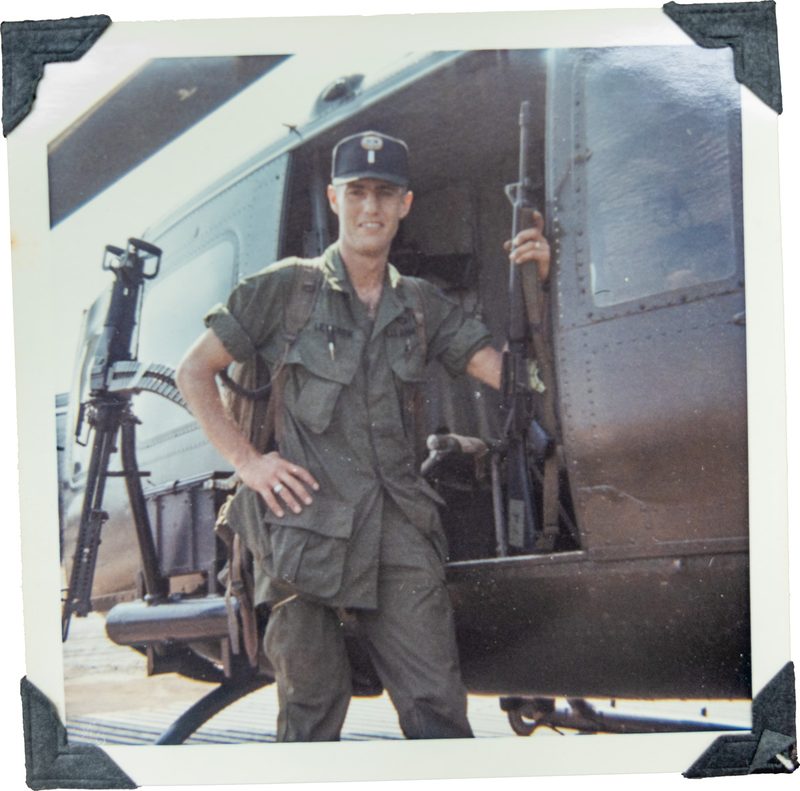
VeteranFarewell to a Friend
FeatureTennessee Tailwaters
→ Swipe to start reading
The PublisherSEPTEMBER OCTOBER 2024
August ’24 – From the Publisher
Story by Nathan Sparks
There’s a time in my life that’s been coming to mind recently. I was 35. I had lost pretty much everything I had. I was forced to sell my home, lost my business, had a failed relationship. I was in the dumps. As I listened to a self-help motivational tape at the time, it suggested writing down your goals and reading them out loud once a day. I thought it was silly; how could that help? But for grins, I wrote down 10 things that seemed most important to me at the time. The speaker said they needed to be clear and have a timeline. I stuck them on my bathroom mirror and glanced at them from time to time and then as they didn’t come true, lost interest. The commitment he was asking for was to believe in your own future. After a few months, nothing had materialized and I lost the list—or so I thought.
I saw a want ad offering a 38’ cruiser houseboat for only $10,000. I didn’t have any money at that point and very poor credit. Over coffee one morning, I mentioned it to my landlord, Mitch Joyner, who was becoming a friend. He almost immediately offered to lend me the money. “Why would you do that?” I asked. “You haven’t known me that long, and what if I don’t pay you back?” He replied, “I think you will, and I am at a point in life where I have more resources than I have time. I just want to help you because clearly you have more time than you have money.”
Weeks later after a garage sale to get rid of most of my belongings, I ran across that little piece of paper listing my goals. One was to own a nice boat and another was to live on the lake again. I laughed out loud; one action had achieved two goals. I had my boat and I was moving onto it so I was also literally living on the lake. My objectives were clear and the universe accommodated. Some might call that manifesting. I call it being willing to commit, despite the path being challenging.
True happiness can be difficult to achieve at times. So, what keeps any of us from getting on the path to a life that would bring us limitless joy? I am certainly no philosopher, and by no means am I a preacher, but I have a theory: it all boils down to commitment.
We all make mistakes. I think most people feel genuine remorse when they make one. As a man I know that when you make a major mistake you need to be willing to stand without making excuses when your time comes for judgment, acknowledge your wrong-doing, and realize that the opportunity you lost may not present itself again—no matter what you do to redeem yourself. But it doesn’t mean you can’t learn from it. Realizing that led me to think about making better choices and committing in a different way to my goals. It was a game-changer after everything that transpired before my move to my houseboat.
This concept has taken hold other times throughout my life as well. For example, with my health. I don’t enjoy being overweight, and the answer is simple—eat healthy, get moderate exercise, and consume less calories than you burn. Why do so many of us avoid that simple advice? Is it the belief that thepainof the journey will be more unpleasant than thepleasureof living a healthy life? Probably not. It once again sounds like a simple lack of commitment.
If you know me, that might surprise you. I am as over-committed as they come. It’s who I am. I give my all to everything. But we can become so busy running companies, tending to family needs, amongst a long list of other things, that its easy to lose sight of where you want be in a month, year, or ten years. And in overcommitment we actually become less committed to each individual area of our lives. It’s tough to give 100% to everything. At a certain point, you just don’t have the capacity, despite your best efforts. And it impacts your ability to feel joy to its fullest extent. It’s funny how that happens.
So, I am going to take time to write down exactly what I want and when I want it by. And I’m going to do this periodically to keep my goals and commitments front and center—and adjust life accordingly. I invite you to do the same…
→ Swipe for Next Story
Arts & CultureSEPTEMBER OCTOBER 2024
Opposites Attract
Susan Verekar combines abstract elements with joyous landscapes
Story by Susan Alexander
When COVID-19 shut down the world, some of us retreated into Netflix movies and glasses of chilled chardonnay. Susan Verekar, however, taught herself a new skill and launched a career.
An Oregon native, Verekar moved to East Tennessee with her husband about eight years ago. A music performance major who studied at the University of Colorado in Boulder, she had earned a master’s in business and was working as a litigation technology consultant before their move east. “It was really boring,” she admits. “I needed a creative outlet.”
Verekar was a new mom when COVID shut things down. “I had no idea what to do with myself.” And though she found a blank canvas intimidating, she says she rediscovered herself through learning to paint. “It was the outlet I’d always been looking for.”
She took online lessons, painted at her home studio, and eventually posted her work on Instagram. “It kinda blew up,” she says. “I started selling and got invited to participate in some exhibitions and art fairs.” Among them were shows in Miami and the Hamptons.
Her work currently follows two different paths. Some are landscapes in oil with abstract elements to them, and others are explosions of abstract color she does in alcohol-based inks. “The inks I do for fun. It’s a way of decompressing.” They’re both fun and popular, it seems; the canvases she took to a show in Manhattan last year sold out.
Her landscapes often depict the ocean and the sky. “It took me a long time to figure out what I’m drawn to and what it means,” she says. “I find the ocean and sky really emotive. I find that I want to capture moments of joy and beauty.” In one series of paintings, glorious paintings of sunsets over water are interrupted by long drips of paint. “We’re surrounded by opposites; our journey is to figure it out and to never stop moving forward.”
Her work can be found at Pivot Point Gallery in Knoxville and online atsusanverekar.com.
→ Swipe for Next Story
MusicSEPTEMBER OCTOBER 2024
Foundations
Chris Blue returns with an album to commemorate his introduction to music
Story by Rebecca Whalen
You don’t typically see Chris Blue’s name on this side of the music page inCityview. However, with his first Gospel album hitting the charts, his first album back in nearly three years, this one deserved a table flip. Chris and I sat down to talk shop about the shift that took him back to his roots—and the realizations that got him there.
Cityview: The last time you were on this end of the interview was back in 2019. What’s changed since?
Chris Blue: Chris Blue, as an artist, is ever evolving. He’s changing, he’s growing, he’s learning, he’s discovering, he’s rediscovering, he’s defining, he’s redefining. There’s only three things that have remained consistent in my life, and that’s God, family and people. Those three things continue to be the forefront of my existence and the fuel which drives me every single day. And so I’ve seen that my music just kind of evolved through those filters. I started out from the Voice and then journeyed to mainstream music. I was part of the Winter Olympics back in 2018. I performed concert venues all over, met tons of people, worked with celebrities and was signed to the biggest record label in the world, but still, something was missing. Something wasn’t connecting. I started dabbling into acting during COVID. I told my manager at the time, ‘I want to be a triple threat,’ not because it’s something that looks cool and fun, but I believe I’m called to do more than just sing and reach people in different ways. So I started acting, I began writing forCityview, became an interviewer and TV host. Chris Blue | Photo by Nathan Sparks
CV: That’s right! You’re coming up on your third season with Appalachia Sessions, right?
CB: It’s unbelievable. Time flies. But things have been going great there. I’m a Telly Award winner, and I’m grateful for that. I’m a vocal coach now, too.
CV: So where did the switch happen to begin a move to Gospel?
CB: Along the way, I’ve never lost my faith. God has always stayed close to me, and that’s how we’ve come to this space now where I wanted to do something for God, something for my faith. So I started just imagining what would it be like to create a gospel project, but not just any gospel project because there’s tons of gospel music out there, but how do I recapture those lost gems that my grandmother grew up on, my mother grew up on, and also I grew up on because of them? That’s howFoundations: The Hymns of My Heartwas first conceived.
CV: You told us back in 2019, “The music industry is not feeding me. What I need is love. I need joy….I need truth. And I’m not getting a whole lot of that.” Did that play a role in your move to gospel?
CB: Yes. The catalyst to all of my success has been being true to who I truly am, valuing my faith and staying in alignment with my core values, systems, structures, and beliefs, right? That’s been the catalyst to all of my success: trusting myself, trusting the voice that lives inside of me and just being me, just being enough for myself, and knowing I don’t need to be like anyone else. When I got into the marketplace, I began to compare, and I started looking at what everyone else had and what I didn’t have. So I started ignoring myself and listening to other people, trusting them more than what has gotten me to this point. Once I started trusting others, I noticed I started changing, and I started looking more like them, talking more like them, sounding more like them, and losing my identity.
CV: I can imagine that being an unexpected response to entering your dream industry.
CB: Music is in my core. It’s all I’ve ever known. But I’ve known myself longer than I’ve known music. The reason I’ve been able to make the right choices is because I believed in myself and trusted in myself. But the moment I stopped doing that, I started noticing certain things weren’t going my way and opportunities wouldn’t come, or I’d get overlooked. The person you have to become in order to really have great value and respect in the music industry was a bit distasteful for me. And so I don’t classify myself as a music artist. I’m an artist who just so happens to use music as his platform to paint his picture.
CV: How did you overcome that struggle?
CB: Someone asked me a question one day, and it was my wake up call. The funny thing is I’ve heard the question numerous times before, but for whatever reason in this particular situation, something clicked. The question they asked me was, “What was the most important thing you learned from being on The Voice?” In that moment, I actually took time to think about the question and the answer came out, and it was all I ever needed to hear…I am enough. I think that’s how I overcame all of it, just realizing who I truly am and knowing that I’m enough.
CV: You’re a local worship pastor, too. Did that influence your desire to record in this genre?
CB: To answer shortly and frankly, yes. Anytime I’m on a platform and I’m worshiping and I’m leading people to something I know personally I have experienced that has been the greatest decision of my life, then that’s going to empower me and influence me to want to continue to spread that out. And not just locally. I want to see everybody around the world experience what God’s love feels like because that’s what got me attached. Church is not a perfect place, but I don’t put my faith in church; I put my faith in Jesus Christ.
CV: Who did you tell first about the idea?
CB: I told no one at first. When I started talking to the label this record is signed to—Gaither Music—I said, “I want to take people on a journey.” I’ve done an album that was more bluesy, R&B. I’ve done an album that was pop. And I could be positioning myself in a very confusing way, but I’ve got a clean slate. I haven’t done music in two-and-a-half years, but the first thing I want to put out is the beginning of my story because I want people to know me. I want to tell a story with my music from here on out.
→ Swipe for Next Story
PoliticsSEPTEMBER OCTOBER 2024
Dim Bulbs Prove Useful
While not a glamorous debate, local forums serve a purpose
Story by George Korda
Compared to the white-hot spotlight of presidential debates, for most voters, local election candidate debates and forums are as dim as dying flashlight bulbs. For first-time local office candidates,these debates and forums can feel like presidential debate stage-level pressure. For voters, usefulness of these events ranges from worthwhile to wasted time—and by the end of the campaign, many candidates are straining toward the end of speechifying and question-and-answer sessions.
Several years ago, as political analyst for WATE-TV, I attended a League of Women Voters candidate forum of eight city council candidates at the East Knoxville YWCA Phyllis Wheatley Center. The forum had a big turnout, as such events go, perhaps 80 to 90 people. But how good was it, really? At these events, an often-significant percentage of attendees is made up of relatives, friends, co-workers, and campaign volunteers. In smaller forums, which often attract “crowds” of 15-20 people, I’ve seen half to two-thirds of the audience comprised of people related to the candidates or working in their campaigns.
Compared to national debates, local forums are sedate, usually because candidates are as fearful of accusations of “negative campaigning” (criticizing their opponent) as are science fiction movie buffs of a Jar Jar Binks sighting. Also, time factors into how much people are willing to spend at a local event. An example: with eight candidates, if there’s a three-minute event introduction, after which each candidate gets a two-minute opening statement, followed by all of them having one minute to answer a question, it’s 27 minutes into the forum before the first question has been answered by all the participants.
Compounding the attention deficit is that local candidates get very little news coverage for three reasons: there are too many of them, in too many races, with a smaller news media. The Knoxville news media infrastructure has shrunk to a fraction of what it was 10 or 20 years ago. At one time, even local radio stations had news staffs with reporters who covered city, county, and state government—and election events and stories. The press cadre also included the then-two daily newspapers, three television affiliates and one independent, an alternative newspaper, and several smaller publications. That was then. Today, there’s not the staffing or time to focus substantially on multiple candidates running for multiple offices.
Also, it’s easier for people to get cranked up about national races than a county commission race. For a 2014Cityviewcolumn titled, “You don’t know Jack – or other elected officials, it seems,” I talked to a group of adults, asking if they knew the names of their local elected officials: the answers, or lack of them, revealed a vast wasteland of little or no knowledge.
Along with forums, many local organizations use questionnaires to inform their members of candidates’ positions. If the political or social aims of candidates and groups intersect, that’s golden for both. However, if they diverge, the questionnaire is treated like a sleeping rattlesnake: candidates tiptoe gently around the questions or avoid them altogether. For example, in a past election, a Sierra Club questionnaire asked this of city council candidates: “How would you incorporate environmental justice issues into your broader sustainability agenda? If elected to city office, what specific steps would you take to address environmental injustices in Knoxville that disproportionately affect disadvantaged communities?”
This single question is replete with ideological landmines for any candidate that doesn’t share the club’s liberal environmental agenda. A candidate must assess what is meant by environmental justice issues, environmental injustices, and those that “disproportionately” affect disadvantaged communities. Any or all of these can thrust an answer into the minefield of liberal vs. conservative philosophies that extend far beyond the group’s members. Therefore, unless you’re in sync with the Sierra Club, chances are high that the questionnaire won’t be returned.
Collectively, these factors each contribute to the famine of local political knowledge among voters. Paradoxically, it escalates the importance of candidate forums and questionnaires: people who attend forums or read candidate questionnaire answers are likely voters. As local voter turnouts are typically abysmal, likely voters become ever-more valuable.
Though they don’t have the glamour of presidential debates, local forums have their place. Though many candidates for office don’t lack in ego and enjoy being in front of audiences. However, for many others, they’re happy to turn off the lights on candidate forums and questionnaires.
Browse related content
→ Swipe for Next Story
InsightsSEPTEMBER OCTOBER 2024
Playful or Serious?
Is our anxiety pulling us away, or can we lean into it to connect?
Story by Rev. George Doebler
Rabbi and family therapist Edwin Friedman once wrote, “A major criterion for judging the anxiety level of any society is the class of its capacity to be playful.” The thought here is that if I lose my ability to play and focus only on being serious, I will be more anxious. Anxiety appears to be so much a part of our culture and daily lives now that it seems if you are not anxious about something, you are not normal (whatever normal is).
How do I play amidst all of the anxiety that daily life puts in front of me? I often tell myself, “Do not watch the evening news reports.” Even if I flip channels, it is the same story being reported by each station, each with their own “slant” according to that program’s editorial staff. But truthfully, regardless of the slant, the focus is on the seriousness of whatever is being presented. It’s ironic that if you watch to the end, the news reporter almost always ends the program with a playful and lighthearted “human interest story” to wrap it up. As if I’m not already impacted by the last 14 minutes. There is an awareness on the part of those who focus on what to present that there is a need to lighten the end of the program.
Often the “lighting up” story is about kids or animals, especially dogs and cats, which is no surprise, as animals have become our way out of this dilemma of being serious. Animal therapies—petting a dog, cuddling with a cat, spending time with a horse, among others—reduces tension. They have the ability to calm us.
But what is it that causes me to be serious and anxious about things I can do nothing about? It can be the war in Gaza, the starvation in the Sudan, the politics of our time. If I become overwhelmed by worry and stew over events, my ability to be playful goes away. How each of us reacts is a reflection of who we are. To simply keep our thoughts and worries within ourselves makes us less playful. Playfulness requires us to get outside of ourselves and be with others. Being with my family is more than presence—it is listening to and sharing with them.
There appears to be in our culture today a move to separation rather than being together. There is always a tension between the two. COVID exacerbated something that was already there. Many folk began to “work from home.” We wore masks and feared being in the same space as others. Going to church or places where togetherness was required (lectures, educational events, etc) dropped in attendance. And while the pandemic is over, at least in our minds, the separation has continued, and it’s more emotional than physical. There are indeed events where gathering and being with people physically has come back to life—ie. Taylor Swift concerts, College World Series—as events take central stage in our coming together, but even these events have become serious and less playful.
To be playful, I have to be more aware of who I am and what pushes me. I have to actually stop myself, take a deep breath, close my eyes, exhale, and be aware of how I came to be who I am. Who we are as brothers, sisters, fathers, mothers, friends, coworkers, mentors—are we too caught up in ourselves and our anxieties that we have separated ourselves from hearing those who call us those names? It’s not an easy place to move from when you’re stuck. It’s like spinning my tires in a mudhole. I cannot get out without taking my foot off the gas, evaluating the problem, maybe even getting help from a friend, and laughing about it as we struggle. Allowing myself to not be so serious and to play with my life and others is a noble task, one which can impact not only myself, but the community in which I live.
Browse related content
→ Swipe for Next Story
DepartmentsSEPTEMBER OCTOBER 2024
Our History with a View
Time is running out to experience the fire towers of the Smokies
Story by John Quillen
There used to be 17 fire towers in the Great Smoky Mountain National Park that were utilized prior to the 1930s by the Forest Service. I know little of their effectiveness in those days or what someone was supposed to do when they saw distant smoke prior to air drops from big planes. But I would have stood in line for that interview to get paid to sit on top of a mountain and have my coffee with the day breaking over the oldest mountains in the world.
One of my favorite bushwhacks runs up Groundhog Creek on the park’s western end. Many cool mornings have found me crawling through snow, getting smacked by rhododendron while scrambling Class 3 rock. Rising over 2600 feet from its start in Cosby, this path bounds and weaves through the stream until crossing the Lower Mt. Cammerer trail well past a backcountry campsite. I know better than to tread here in warm months as clawing loose ground is preferable to a tail full of rattles on these now rocky, precipitous slopes. Shuckstack Firetower
On one visit in particular, my objective comes into full view as sunlight bounces from its chipped windows: The Mt. Cammerer Fire Tower. An hour or so in to our trek and the crawling is about to commence. I’ve made this journey a dozen times but distinctly recall how this notion first came about. Wayne Davis told me he thought we could skinny up from his cabin at the park boundary. I thanked him for volunteering to lead me as he reluctantly signed on for the initial part on a cold, January morning. His look when I shoved micro spikes and mountain gear in the pack prompted, “..but only to the lower trail,” from my friend. Wayne had plenty of opportunities to turn around and retreat to the warmth of his wood stove so he can’t blame me for what happened next.
Due to some navigational “challenges,” I will call them, we clawed to the foot of this defunct structure as the sun was dipping low on the North Carolina/Tennessee border we were straddling. Mt. Cammerer saw us emerge from the foliage drenched in sweat and clothed in dirt. Snagging sunset shots from this fire tower wasn’t necessarily the plan but we nailed some spectacular vistas as the temperature followed the waning sun. Alone in this room with a view, darkness now crept up the valley to our 5000-foot elevation. Although remodeled in the’90s, Mt. Cammerer Fire Tower was missing windows and groaned all winter night. Mt. Cammerer Firetower
You see, Wayne didn’t have all the down garb as he had only intended to join me for a small, initial portion of this ascent up the creek. I seem to remember him toting a coffee mug clad in sneakers. But these adventures and some friendly goading can lure you skyward bearing out Cammerer’s reputation as a siren of the Smokies. There’s an old mountaineering adage which implies that the wordbivouacis French for “mistake.” Abivouacwas in order here as we considered the icy descent and inherent dangers therein. A less than restful night atop this iconic peak ensued as we channeled the spirit of caretakers long past. I had enough extra snacks and clothing. The floors squeaked and windows rattled with the constant winter breeze. Like the old caretakers, we scanned the ridges leading up to our spot and swore we saw bobbing headlamps all night long.
First light was a welcomed sight as we rose from where we leaned against the inner frame of this octagonal structure. Its stone and wood facade were wrapped by a 360-degree porch, perfect for chasing the views in all its elusive, cloud-filled glory. Rays pierced a blanket of billowy cotton draping the valley from which we rose the day before. White Rocks is what the Native Americans called this place. To Wayne and me, our night atop Cammerer will forever remain an indelible mountaintop experience.
I have a similar relationship to the Shuckstack Fire Tower on the North Carolina side of the Smokies. On our annual canoe pilgrimage over to Eagle Creek, the day hike up one of the park’s steepest trails, Lost Cove, tops the agenda. Despite some mild protestation from my friends, the climb to the Appalachian Trail and eventual spur off to the metal structure is its own breathtaking reward. From this vantage is seen three states and peaks from the Blue Ridge down into Georgia across beautiful Fontana Lake. I don’t expect them to allow us up there for long given the declining health of this metal perch. Holes in a plywood floor and rattling handrails give pause to many who claim the base as their summit. But then they’d miss one of the best views in the Southeast.
The last remaining tribute to a century-old fire mitigation method, Mt. Sterling tower is an exact duplicate of the Shuckstack in identical disrepair. The views up there are much scarcer as that side of the park experiences continuous clouds moving in from the west. If you time your hike accordingly to catch a break, however, you soon realize that blip directly across from you is Cammerer, although many trail miles and climbs separate these Smokies sisters. Movements to restore these towers have fizzled like distant smoke so I would simply suggest you get up there and visit these survivors before they melt into the mist with the ghosts of their caretakers and furtive glimpses they afford.
→ Swipe for Next Story
DepartmentsSEPTEMBER OCTOBER 2024
Fine Dining Returns to the Neighborhood
Bistro by the Tracks Bearden brings updated sophistication to the old Orangery building
Story by N. Brooks Clark
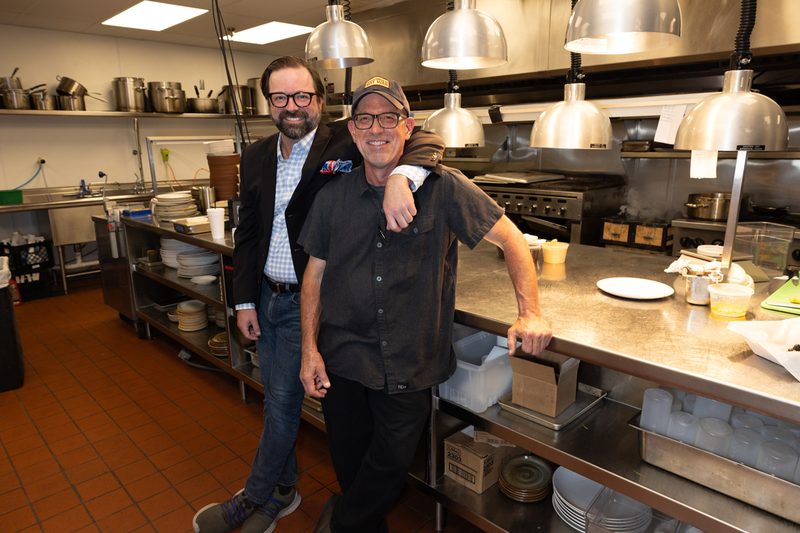
Everyone comes in with fond memories of The Orangery,” says Bistro by the Tracks Bearden General Manager Will Oakes. “We think we’ve taken this beloved spot to its next progression.”
Owned by local restauranter Randy Burleson, this new location of Bistro opened its doors in late January of this year. The storied building on Homberg Drive that was previously the home of both The Orangery and Kitchen 919 has been completely renovated. Those with memories of the old layout will remember The Orangery’s elegant staircase to the left: the stairs now go off the right, up toward the group dining area used for wine dinners, weddings, and rehearsal dinners. Since that upstairs ballroom was consumed in a fire a few years ago, it is re-christened The Phoenix, having risen from the ashes like the mythical bird.
The walls are decorated with original portraits gathered in two years of combing estate sales. Most are from the 19th century; some appear even older. Though none are identified, the staff, when asked, produce fanciful tales of who a particular visage might be. “We take the liberty of making up stories,” laughs Oakes, who favors colorful pocket squares in a classic “stairs” fold. The pocket square is a nod to his years at Café Boulud in New York City, working for world-famous chef Daniel Boulud. “I always had to wear dark three-piece suits and dark ties,” he says, “The pocket squares were the one way I could show some color.”
Oakes derives some of his savoir-faire from having manned the bar at Chef Daniel’s Bar Pleiades amongst the sophisticated clientele of Fifth Avenue and the Upper East Side. “If you look at the flashback scene in the season three premiere of The Bear,” says Oakes, “that’s Chef Daniel teaching Carmy how to prepare his signature crispy paupiettes of sea bass dish.”
The bar lounge is directly ahead as you enter the restaurant. It’s a club-like space with walls in grey-brown and a dreamy impressionistic mural of mountains and clouds at the rear. Populated with deep leather armchairs tucked into nooks, it’s the perfect place for an intimate chat with friends. This fills a niche that has been missing in Bearden; a chic after-work stop for a drink on the way home. Beware the ultra-deep and comfortable barstools; combined with an inventive cocktail menu, you may linger there longer than you had planned. Ask bartenders Isabelle Cobian and Matthew Cavaliere for a recommendation.
Oakes has brought his mixology expertise to Bistro, developing signature cocktails as well as adapting well-known classics like the Vieux Carré, a rye whiskey, cognac, and bitters tipple. We loved the Jungle Bird with its summery blend of black strap rum, Campari, lime, and fresh pineapple juice. One of the bar’s bespoke cocktails is, of course, The Phoenix made with grapefruit granita, juniper, and sparkling wine. It’s a lovely way to start your evening.
After our refreshing stop at the bar, we were seated in the comfortable dining room which combines tables with banquette seating. Our first course consisted of three outstanding items; the first was an East Coast crudo that combined North Carolina Big Eye tuna with South Carolina peach, basil, and a peanut chili.
Chef John Bryant, who was born in Johnson City, is committed to local sourcing from farms within 150 miles of Knoxville. “When we grew up, everything came out of the garden,” says Bryant. “My parents grew everything—corn, peaches, beans, grapes, berries.”
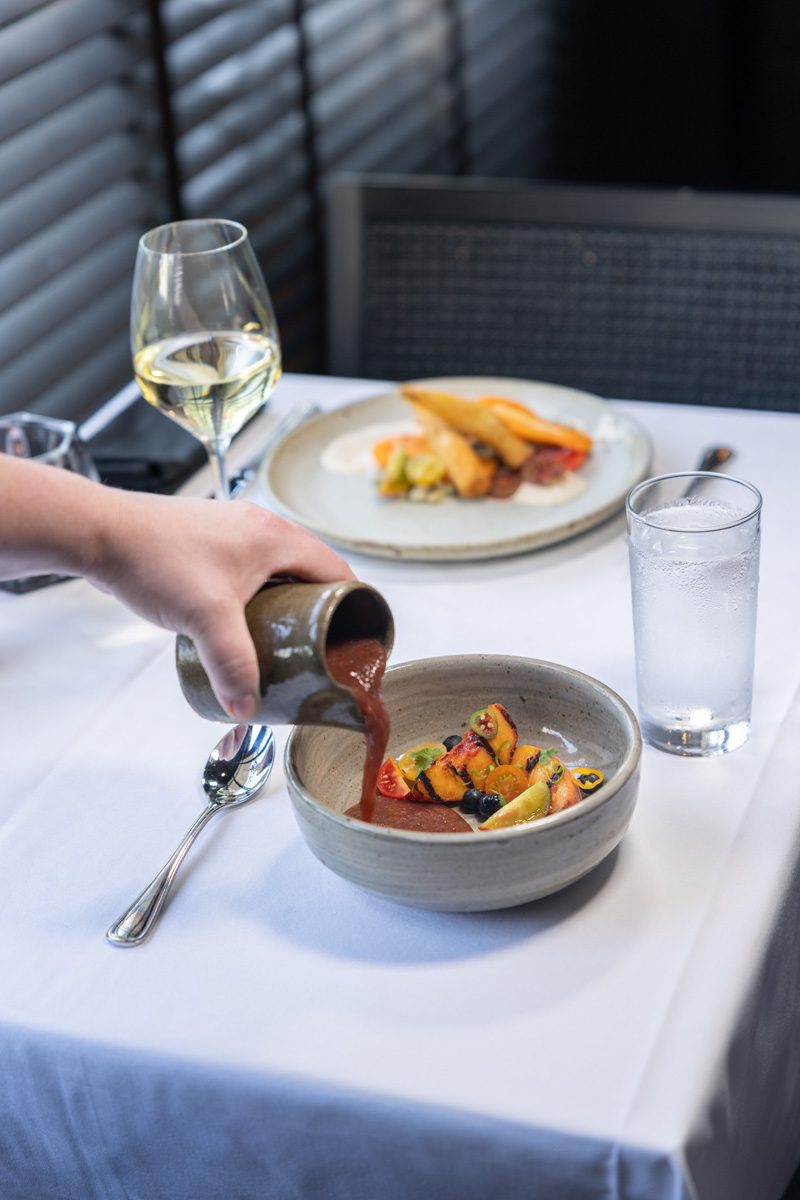
His SC peach and watermelon gazpacho uses heirloom tomatoes and uses blueberry and a serrano cilantro cream sauce to create a perfect balance of heat and sweetness. Our third choice was a decadent bone marrow with foraged mushrooms, bacon jam, and salsa verde. The miso-buttered toast provided the perfect “crunch” to offset the marrow.
Our group couldn’t help but notice the unique dinnerware at the Bistro. “During the renovation, there were several 200-pound pink marble table tops left over from the Orangery days,” explained Chef John. “We ground it up and Hallyburton Pottery at Rutherford College, North Carolina, and used it to make the glaze on the plates. After all, Knoxville is the Marble City!”
The second course options range from a Farm and Sparrow rye flour gnocchi with mushroom and creamed corn to a lighter summer heirloom tomato salad. Served with grilled peaches, field peas, and fried okra, this tomato salad included a spectacular Siano burrata. This burrata is a premium mozzarella and the ultra-fresh flavor set off the other notes in this salad beautifully.
The entrée menu includes a wide variety of dishes from a classic roasted chicken with white BBQ slaw, Appalachian chow-chow, and a cornbread crumble to a Chatel Farms Waygu Coulotte steak. The Coulotte is a flavorful cut of sirloin particularly suited to grilling and this version is served with a delicious bone marrow butter.
Our group enjoyed the double wood-roasted porkchop. Served with “bloody butcher” grits, sweet corn, chanterelles and pickled watermelon rind, this chop is juicy and tender, thanks to Chef John’s careful brining. These Jimmy Red Corn and Bloody Butcher Corn grits, named for their red-and-white appearance of a butcher’s apron, are from Deep Roots Milling in Roseland, Virginia. (Confession: I’ve already visited the Deep Roots web site and ordered some of these grits and are on the wait list for some of their blue unbolted cornmeal.)
On the day we visited, The East Coast Catch was a North Carolina amberjack. If you are not familiar with amberjack, it is a firm fish similar to swordfish and perfect for grilling. Our fish was caught off Cape Hatteras and comes with pickled okra, creamed corn, and smoked bacon jam.
If you prefer a plant-based option, the Appalachian tabbouleh bowl is made from Marsh Hen Mill’s freekeh, an ancient grain derived from Levantine cuisine. This wheat is roasted and rubbed to create a nuttier flavor than the regular bulgar wheat more commonly used.
We completed our meal with a smoky pecan chocolate with house-made Nutella ice cream that should be illegal, and a blueberry hand pie that will take you back to your childhood summers.
Will Oakes and John Bryant have created a wonderful experience that both honors the past and provides an upscale Bearden restaurant for posterity.
→ Swipe for Next Story
Dining GuideSEPTEMBER OCTOBER 2024
Italian Knoxvillian
There’s a lot more to Italian cuisine than pasta—but there’s also the pasta.
Story by Micha Haas
Growing up, a night out at a nice restaurant with the family almost always meant Italian. Perhaps it’s just that my parents found that spaghetti was a safe option when they had me and my little sister in tow, but I like to think that it was because Knoxville has such a variety of Italian restaurants to try. It certainly helps that, almost without exception, the food is really, really good. Even today, as an adult, if I’m searching for a special place – either to bring the family or that special someone – Knoxville’s Italian restaurants are my first, and usually only, stop.
Bella
Now under the ownership of Jimmy Loup, Bella is a must-visit for fine Italian cuisine. If you only have one chance to go, heed my words: you order the Pasta in the Wheel. Even the lactose intolerant among us (like myself) have to experience it once. Let me describe it. A huge wheel of grana padano cheese, xcheese melt into the penne tossed into its creamy core. Add the meat of your choice, and voilà! You have a one-of-a-kind dining experience to share with your friends and family. There’s plenty of other amazing items on the menu as well, not to mention a classy yet inviting atmosphere, but come on – how can you pass up this cheesy opportunity?
Right in the heart of downtown Knoxville, the glass doors of Emilia open from Market Square into a warm, bright diner-style restaurant filled with fragrant smells. Inspired by the Emilia-Romanga region of Italy, Emilia offers a seasonal menu of fresh-cooked Italian fare, so each visit gives you the chance to try something new – though the seafood might find a way onto your plate more than once, or twice. Their menu also clearly marks their vegetarian, vegan, and gluten-free options, so even with the rotating menu, you can be sure there’ll be something for everyone.
Cappuccino’s has called the Bearden area home for almost half a century. My dad remembers going there for Sunday brunch as a kid, and even then, he says, it was one of the nicest restaurants in town. A step into this restaurant is like stepping through time and space back to a classic Italian dinner, and that’s before you dig into the food. Mushroom ravioli is my personal temptation, but there are many options for the more carnivorous among us as well. Top it off with a creamy cannoli, and it won’t be long until you’re sending your own kids here!
With Altruda’s, I must begin with a warning: beware the garlic rolls, because once you’ve eaten one, you might not be able to stop, and then how will you have room for the rest of your dinner? Altruda’s is well-known for the garlic rolls they serve with every meal (the rolls and I are certainly well-acquainted), but that’s not all this 30+ year veteran of the Knoxville Italian scene has to offer. A wide variety of pastas awaits your taste buds, or perhaps you’ll venture out and give the Eggplant Nicole a try. The Cannelloni is not, note, a Cannoli, but it’s still very much worth a taste.
The Original Louis, as some call it, has the distinction of being the oldest restaurant on this list, dating all the way back to 1958. A few years in New York taught me not to question the credentials of which restaurant is truly the “original” among the many, but there’s certainly no question that there’s a reason they’ve been around this long. Dinner can find you with classic Italian pasta, a charcoal-broiled steak, or even a calf’s liver, if that’s your sort of thing. If you pay them a visit, perhaps you can discover which other Louis-es they used to compete with; you’ll certainly discover why their menu has kept them in business so long.
Located in the Old City, Jessica and Aaron Thompson’s Osteria Stella offers an elegant, upscale dining experience for couples and parties alike. It’s a taste of northern Italy, with cuisine dreamed up by consulting Milanese chef Amalia Brusati and brought to life by Osteria Stella’s culinary team. Where the restaurant really shines, though, is its wine list (the most comprehensive in Knoxville, they say!), with hundreds of Italian selections both by the glass and by the bottle. The tables fill up fast, though, so make sure you make a reservation early! And while you’re there, be sure to check out Brother Wolf as well for cocktails and small plates. If you’ve never tried the gnocchi, give it a taste!
Amici is not your average Italian restaurant. It describes its offerings as “Alpine Appalachian cuisine” with “local ingredients and Italian techniques.” I’ll admit, I’m not sure I could tell you what Alpine Appalachian cuisine really means, other than “really good.” Whether you’re looking for a classic Italian entrée with a homegrown twist or you’re more in the mood to sit down and kick back with a pizza, Amici has an offering for you. I’d heard of pineapple on pizza before, but I’d never heard of peaches on pizza; I’m ashamed to admit I didn’t have it in me to give that one a try. Oh, well – next time!
He rose to stardom just a few years ago, but the momentum hasn’t stopped! Hometown country music star, Morgan Wallen, will return to East Tennessee this September during hisOne Night at a Timetour, a surprise that many fans, friends, and neighbors never saw coming.
The tour dates had been set, but in July, Wallen announced that he’d be adding Rocky Top to the tour—and pegged Neyland Stadium as his venue. Then not long after his announcement—and after an overwhelming response from ticket buyers—Wallen announced he’d add a second date to the Knoxville stop. The kicker? This isn’t a common thing to perform at the stadium, usually earmarked for the Vols and their overwhelming showing of fans.
The first time Neyland Stadium saw a multi-night stop from a big artist was back in 1984, when The Jackson 5 arrived for a three-night series of performances. It had been nearly two decades until another artist came to perform—Kenny Chesney—and another 16 after that with Garth Brooks. Wallen joins a small group of artists who’ve had the privilege of performing in such a sacred space for East Tennesseans.
As of this writing, there were still seats available for the shows, but limited to say the least. If you’re lucky enough to scoop a few for you and friends, it’s sure to be an unforgettable couple of nights!
For more information,click here
→ Swipe for Next Story
JurisprudenceSEPTEMBER OCTOBER 2024
A War Story
Story by Gary Wade
In 1998, television anchorman and journalist Tom Brokaw authoredThe Greatest Generation, a book profiling many of those unsung heroes of World War II. Not included among those featured was a man named Roderick W. Edmonds from South Knoxville. Born in 1919, “Roddie” grew up in the Methodist Church. After graduating from Knoxville High School, he enlisted in the Army on March 17, 1941, and trained at Fort Oglethorpe in Georgia.
In December of 1944, some six months after D-Day when the Allied Forces landed in Europe, the 106th Infantry Division, which included Master Sergeant Edmonds, arrived in Germany. Five days later, Adolf Hitler, desperate to change the tide of the war, launched a last gasp counteroffensive in what became known as the Battle of the Bulge, a conflict which eventually lasted over a month and involved over a million participants from both sides. The battle began with a surprise attack by the Nazis. The Allies were caught off guard, and, on December 19th, when the inexperienced troops of the 106th were surrounded and outgunned, the commanding officer surrendered. Edmonds was among some 20,000 captives, all of whom were required to march over 30 miles to a railway station, squeezed into boxcars, and transported to Stalag IX-B, a Nazi camp which housed more than 25,000 prisoners of war.
According to aTime Magazinearticle written ten years ago, the prisoners were offered neither food nor water along the way. Several died. Most survived by eating snow. Upon their arrival, the Nazis isolated the Jewish American prisoners, placed them in lice-ridden segregated barracks, and offered starvation rations. After a few days, the Germans separated the officers and sent Edmonds and some 1,275 enlisted personnel from his division to Stalag IX-A, a prison camp near the town of Ziegenhain. As the senior non-commissioned officer, Edmonds was charged with the responsibility for each of the POWs.
At this point in the war, Hitler had implemented a policy known as the Final Solution, a gruesome initiative which had tortured and put to death over six million Jews– some sources say even more — by the end of the war in Europe. The Final Solution was not intended to spare Jewish-American POWs. So, on their first day at Stalag IX-A, the Germans directed all American Jews to fall out in the next morning’s roll call. After this announcement, Edmonds, mindful of the Nazi death camps, developed a plan for all 1,275 of the troops to step forward rather than just the 200 or so Jews in his command.
So on the following morning when every one of the POWs appeared, the German Commandant, a Major Siegmann, was furious. Addressing Edmonds, Siegmann shrieked, “These men cannot all be Jews!”
“We are all Jews,” Edmonds calmly responded. Private Paul Stern, one of the terrified Jewish POWs, stood next to Edmonds during this confrontation. Enraged by Edmonds’s claim, Siegmann placed his luger to Edmonds’s forehead and shouted, “I am commanding you to order all Jewish men to step forward or I will shoot you on this spot!”
Some seventy years later, when interviewed about the incident, Stern and other witnesses recalled Edmonds’s words as he courageously faced his likely death, “If you shoot, you will have to kill all of us because we know who you are, and you will have to stand trial for war crimes after we win this war.”
In this anxious moment, Siegmann hesitated only briefly before shoving his weapon into its holster, and angrily walking away. Edmonds and his troops were spared. Two months later, on the second day of Passover, the Jewish holiday of liberation, the United States Army arrived and freed the American captives there.
Edmonds, who after the war returned to Knoxville and fathered two sons, never told his family about the incident at the Stalag IX-A prisoner of war camp. After his death in 1985, Edmonds’s wife, Mary Ann, gave his son Chris, by then a Baptist minister, the diaries Edmonds kept during his time as a prisoner of war. When he discovered a reference to his father’s encounter with the POW commandant, he contacted several of those who were within earshot of the exchange. Sonny Fox, a Jew who had become a television executive after the war, confirmed Edmonds’s act of heroism, as did attorney Lester Tanner, and others. When interviewed byCNNa decade or so ago, Stern, then 90 years old, praised his master sergeant. “I was so proud of him. He was so brave to say, ‘We are all Jews here.’”
It was not until 2015 that Roddie Edmonds received a proper tribute. In that year, Yad Vashem, the Holocaust Museum in Israel, bestowed its highest honor to Edmonds, an award given only to those who had risked their lives to save Jews during the war years. He was only the fifth American so recognized. In a ceremony held at the Israeli embassy in Washington, D.C., then President Barack Obama delivered the “Righteous Among Nations Medal” to Chris Edmonds on behalf of his father.
Because Edmonds’s act of bravery was not technically in combat, he was ineligible to receive the Medal of Honor. In an effort to properly acknowledge his gallant deed, Congressman Jimmy Duncan introduced a bill in 2016 to award Edmonds with the Congressional Gold Medal, one of the two highest civilian awards in the U.S. In 2017, Republicans Lamar Alexander and Bob Corker joined two of their Democratic colleagues to introduce similar legislation in the Senate. Despite nonpartisan support, the measure has languished in committee. In 2021, Congressman Tim Burchett re-introduced the bill in hopes of success. So far, he is far short of the requisite votes in the House.
Roddie Edmonds is among those men and women who, after enduring the Great Depression and offering their lives in defense of their country, qualified their generation as America’s best. Brokaw’s words resonate: “This is, I believe, the greatest generation our society has ever produced – those who joined in the war effort and who fought not for fame and recognition, but because it was the right thing to do.”
For more information,click here
→ Swipe for Next Story
InsightsSEPTEMBER OCTOBER 2024
Regrets
Story by Robert Pryor, Sr.
I read where the Knoxville Sports Hall of Fame recently inducted another class without including me. There they were, Heath Shuler, an archer, an equestrian, and another Lady Vol, but no mention of that great Bearden High School quarterback from the teams of 1959-61, ole No. 11 in your program, but No. 1 in your heart, Bobby Pryor. Actually, I wore jersey No. 11 just my senior year. For some reason, my jersey number changed every year. Perhaps that’s the reason they could never retire it after I was finally graduated. Years later, after I started my law practice, I received the call to play in the “Old Timers Football Game” to raise money for the school sports teams. I was the starting quarterback for the oldest alumni team, and they broke my arm in the second quarter. Norma was with child and I was without pain medication. For weeks Norma had to bathe me while my arm was in a cast. She has never forgiven me. Seems as though that experience alone would qualify me for the Hall of Fame.
I’ve written several letters over the years to bring my playing stats to the attention of the nomination committee, but they don’t seem too interested in us high school stars. What’s a guy got to do? My career was exemplar – career starts, 8; yards gained, -12; passes attempted, 21; passes completed, 9; passes intercepted, 5; and plays running out of bounds to avoid being tackled, 16. My best skill was faking handoffs and creating backfield deception in general. I was great at handing off the ball and then faking a run in order to attract defenders. They said I was the best faker in school history. I was knocked down twice and I recall once in the mud. I regret not lobbying harder and allowing another year to pass me by. Maybe the Class of 2025 will be the charm.
I also regret that I refused to be the director of the Lincoln Park Elementary School first grade Rhythm Band. I was Miss Jessie’s first choice and my mother begged me to take up the baton, but I was stubborn and felt I was not cut out for show biz. It could have changed my whole life.
Miss Jessie taught first grade at Lincoln Park Elementary School for about 100 years. She taught my mother and all of her family in the first grade on Chickamauga Avenue. The Rhythm Band was a longstanding Parents Night tradition, and to be picked the leader was a great honor. My mother had been first tambourine in 1921 and her brothers, Gene and Floyd, played sticks and triangle (they involved practically the same skill level). The first in my family to be chosen leader and I refused musical stardom. It was a mistake that would haunt me for the rest of my life, and I believe it stunted my musical potential and probably caused me to lose my singing voice.
In the fifth grade, I entered the school talent show by performing a record pantomime (don’t laugh, it used to be considered a talent). I had lost my musical creativity and had to rely on the voice of others, but won first place in my effort to make up for the Rhythm Band fiasco.
As a child, I loved music and sat on the steps of my grandmother’s house in south Knoxville trying to play a toy guitar. She encouraged me, but everyone knew that I could not sing and never learned to play the guitar. I guess you could say I faked singing and playing the guitar kind of like I faked playing football. To play the guitar, you need long, skinny fingers, but my fingers were short and fat and I had a bad singing voice. Fresh off my talent show victory, I appeared for years as an entertainer on early Knoxville television and on the WNOX Saturday Night Tennessee Barn Dance acting out comedy records for laughs. As a budding local star, I actually received fan mail for lip syncing records on the radio.
Believe it or not, I finally ended up in Hollywood in 1956 to appear on Arthur Godfrey’s Talent Scouts. Another regret, Arthur Godfrey was ill on the night I was scheduled to appear and I got bumped because the guest host brought his own contestants. However, I was spotted at rehearsals by Capitol Records as a possible teen recording artist in the image of the new Tennessee sensation, Elvis Presley. This was my big chance to prove the boy who refused to lead the Rhythm Band actually did have musical talent. But, alas, he didn’t. I could never carry a tune and was far too pitchy. There I stood in front of the boom microphone that had been used to record Frank Sinatra, Nat King Cole, and Tennessee Ernie Ford. I had agreed to sing “Blue Suede Shoes” (with gestures), but before I could get to “... three to get ready, now, go cat go,” the recorders were stopped and the man behind the glass said something like, “Don’t call us, we’ll call you.” They never called, and Gene Vincent (“Be-Bop-A-Lula”) got the job. My search for fame died on the studio floor of Capitol Records. I regret I never took singing lessons.
Watching A River Runs Through It, on the big screen immediately made me regret I had never learned to fish. How great it would be at this stage of life if I could wade out into a stream and fly fish. I would look great in one of those olive fishing vests with flies hooked all over it and one of those floppy brimmed hats like Henry Fonda in On Golden Pond. In fact, I bought one of those hats in a vintage junk shop the other day, but only wear it to the Farmers Market. Years ago, a friend took me fishing on Tellico Lake one day, but he was a real purist and insisted on first catching our bait. It took him so long to catch the bait near the dam, I got hungry and ate half of the bucket of KFC that I had brought along just in case. By the time we finally got ready to fish, I was out of the mood.
One day while visiting the Boone-Blowing Rock area of western North Carolina, I kept telling Norma about my dream to fly fish and then fry trout for dinner in our little cabin by the stream. Sure enough, we passed a trout farm and in we popped so I could show my stuff and catch dinner. I couldn’t catch a thing on that cane pole. The fish just were not interested in my corn bait that day and then it began to rain. Finally, I hired a kid who was catching trout left and right to catch something on my pole. The worst part – Norma was watching the embarrassing spectacle and called all of our children to give a play-by-play description of my ineptitude.
Regrets, I’ve had a few, but, unlike Frank Sinatra, not too few to mention.
→ Swipe for Next Story
TravelSEPTEMBER OCTOBER 2024
Vive la France
From Paris to Annecy and Back—Enjoying the City of Light and the Venice of the Alps in one vacation
Story by Karen Clark
We flew from JFK Airport to Charles De Gaulle Airport in Paris and settled into our room at the Hilton Paris Opera, an ornate building built in 1889 to welcome visitors to the World’s Fair—the Exposition Universelle—held in Paris that year. The Hilton, recently renovated and restored to old glory, features an elegant bar in the soaring beaux-arts atrium.
We hit the streets right away and visited the Musée Rodin (Rodin Museum) nearby. Later, we dined at Benoit on Rue Saint-Martin. This 112-year-old Michelin-starred restaurant is named for its founder, Benoit Matray, a butcher. He insisted that all customers are warmly welcomed as a friend, a tradition that holds today.
Day two began at the Musée de Cluny, the national museum of the Middle Ages, housing an astounding collection of religious art and artifacts, weapons of medieval warfare, and tapestry. Being in the lively Latin Quarter, we had our pick of sidewalk cafes for lunch and a glass of Sancerre before heading to Le Musée de l’Orangerie.
While it is famous for Monet’s Water Lilies murals, the Orangerie also features a rich and varied collection of impressionist and post-impressionist art, with works by Picasso, Modigliani, Cézanne, Renoir, and others. We bought a Paris Museum Pass online in advance, which allowed us to skip the ticket line at almost every museum.
Dinner that evening was at Les Antiquaires (the Antique Dealers) nested among a busy neighborhood of bars and restaurants. That evening, France was playing Spain in the Euro Cup. When France scored the first goal, bars with TV screens erupted with jubilant cheers. It was fun to stroll the streets and soak in the national elation. (No need to mention Spain’s subsequent two goals.)
Walking in Paris is always lovely, but streets at intersections are not always clearly marked. We often took advantage of Google Maps Live view to help us navigate. We pointed the phone camera at surrounding buildings and on-screen arrows directed us. When it was too far for a walk, the Metro system was a super-easy way to get around even if you do not speak French. (Pro Tip: Buy a multi-ride pass, not individual passes.) For short hops, taxis were plentiful and reasonable, but be ready to pay with Euros. Some taxis don’t take credit cards. Uber works just as well, although it is more expensive than a taxi.
A Weekend at Le Lac d’Annecy
From the Gare du Nord station, we took a four-hour train heading southeast to Annecy. First class tickets put us in a wide, comfortable seat on the top level, all the better for watching the pastoral French countryside roll by. As we passed a farm, a sweet young boy on our train exclaimed, “Papa! Regardes! Un tracteur!”
We were fortunate to have been invited to Annecy by a childhood friend, Randy Smith, a New Orleans lawyer who has for 10 years or so rented a 12-bedroom chalet-style house on the shore of Lake Annecy in a village called Sévrier. Each July, Randy, his wife, Diane, and their daughter Maggie, a sophomore cross-country runner at Wesleyan, invite an eclectic group of friends for a family-style vacation that includes riding bikes around the lake, hiking, swimming, sailing, paddle-boarding, and enjoying dinners with as many as 22, sometimes in the cool evening air on tables outside.
The house, built in 1928 by a Lyons silk merchant named Paul Roche, is now owned by his granddaughters, who rent it every year to Randy in part because he embraces and celebrates the 96-year traditions of their family gathering place.
Each morning an early riser rode his bike to a local boulangerie to provide us with baguettes, croissants, pain au chocolates, and assorted quiches. The group prepared meals using local poultry, beef, vegetables, and fruit—some of which were harvested that same day.
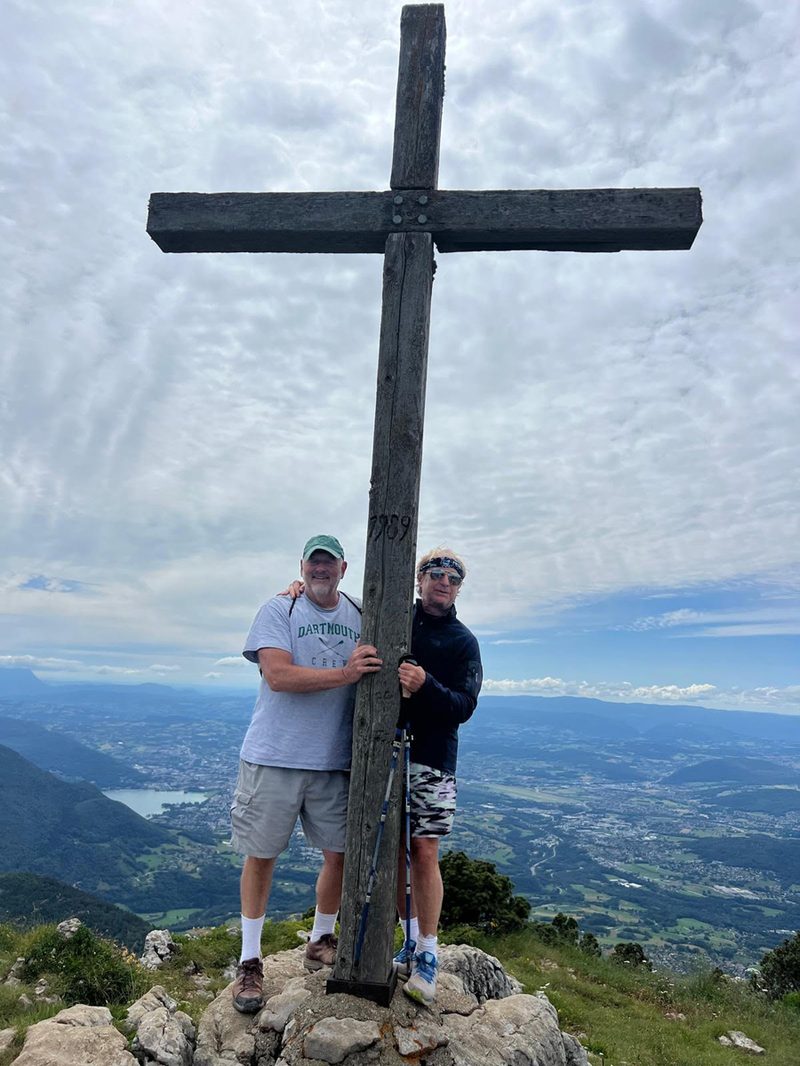
One day the group hiked up the Parmelan, a 6,010-foot peak overlooking Annecy. The climb included steep switchbacks up a limestone face, with cables attached to the rock. “Only 10 meters to the top,” said a descending hiker to me, as I held on to a cable for dear life. He meant to the top of the rockface, and it was more like 20, but he was trying to be nice. From there it was another 30 minutes to lunch at the Camille Dunant Refuge, named after the founder of the Annecy Tourist Office in 1895.
The mountaintop plateau offered a clear view of Mont Blanc, the tallest Alp, on one side and the city of Annecy and the tip of the lake on the other. Descending, we heard the bells of a flock of sheep and saw them ascending from one grassy hillside field to a higher one, Heidi style.
Annecy, an hour south of Geneva, Switzerland, and an hour and a half east of Lyons, was a Roman village in the first century. In the Middle Ages, its château was a stopover on the route to Jerusalem for crusaders.
One day we walked several miles on a lakeside trail into Annecy. The pedestrian trail runs parallel to a busy biking trail that circumnavigates the lake. It takes an average biker about three hours to do the circuit. Some of the serious French bikers look like they can do it in an hour.
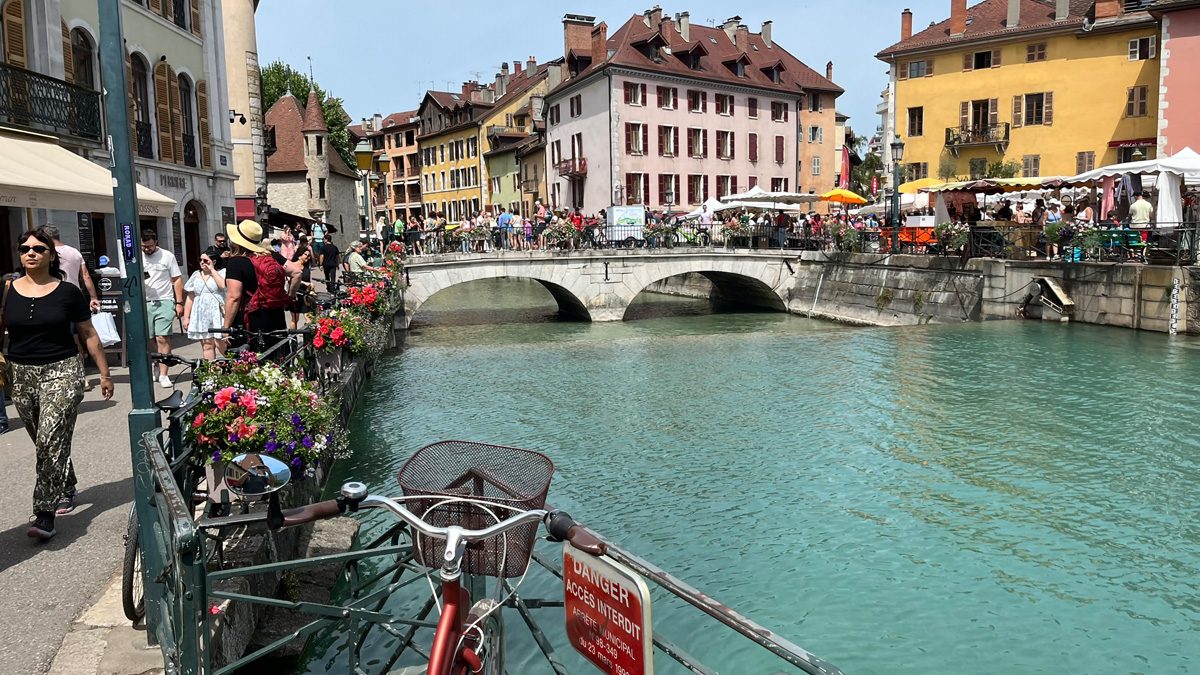
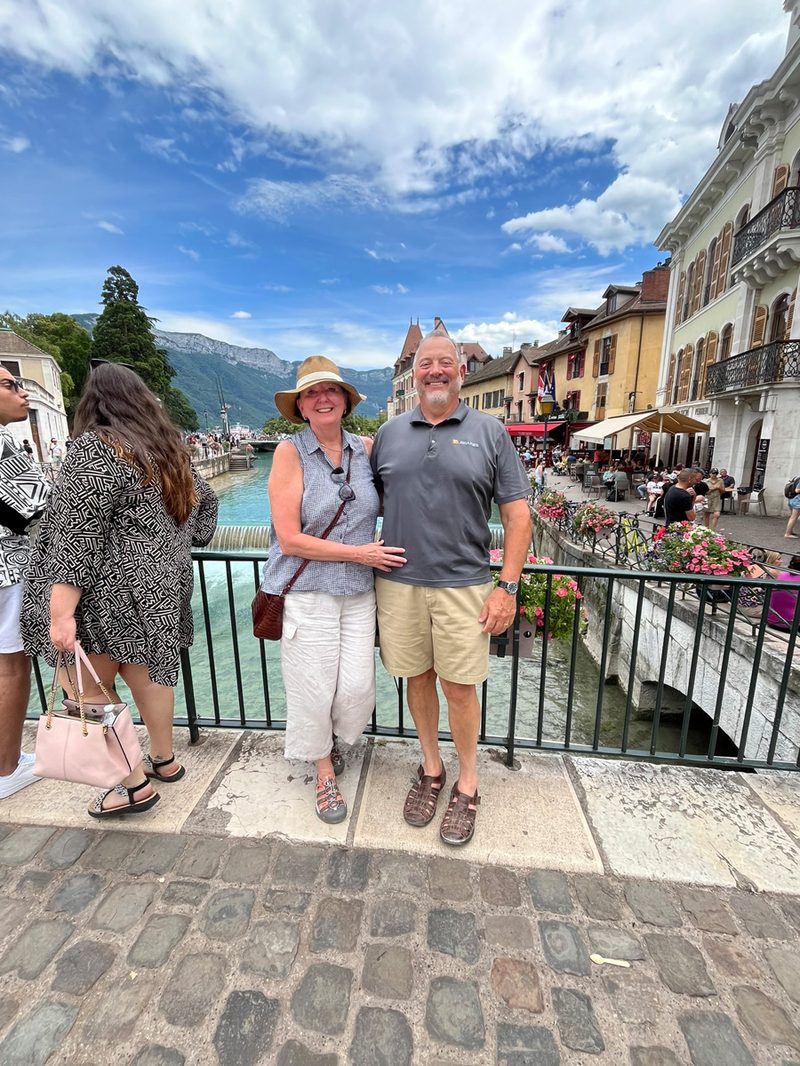
We walked into Old Annecy along the Thiou, the river that flows out of the lake and into the winding canals that give Annecy its moniker as the Venice of the Alps. Ferries leave regularly to take tourists to the scenic villages around the lake. If you get off at Talloires—a picturesque village nestled at the foot of the sharp white-rock ridges of the Dents de Lanfon (the teeth of Lanfon)— you can dine at the five-star lakeside restaurant Le Père Bise (Old Man Bise, a tribute to the founder.)
There are plenty of restaurants and ice cream shops scattered throughout Old Annecy, which simply couldn’t be more charming. Narrow cobbled streets led us past pastel-colored buildings and up to the Château d’Annecy, which now houses an archeological and an art museum. The circular stone staircases are narrow enough that you understand how they aided in defending against invaders in the day. In the archeological museum, we learned that Neolithic fishermen lived over the water in houses supported by wood pilings. Researchers have found remnants pilings still sticking up from the lake bottom.
It was fun to be Annecy on Bastille Day; the town was alive with families and fireworks, which we watched that evening from a lakeside restaurant, Le Pêcheur.
Back to Paris
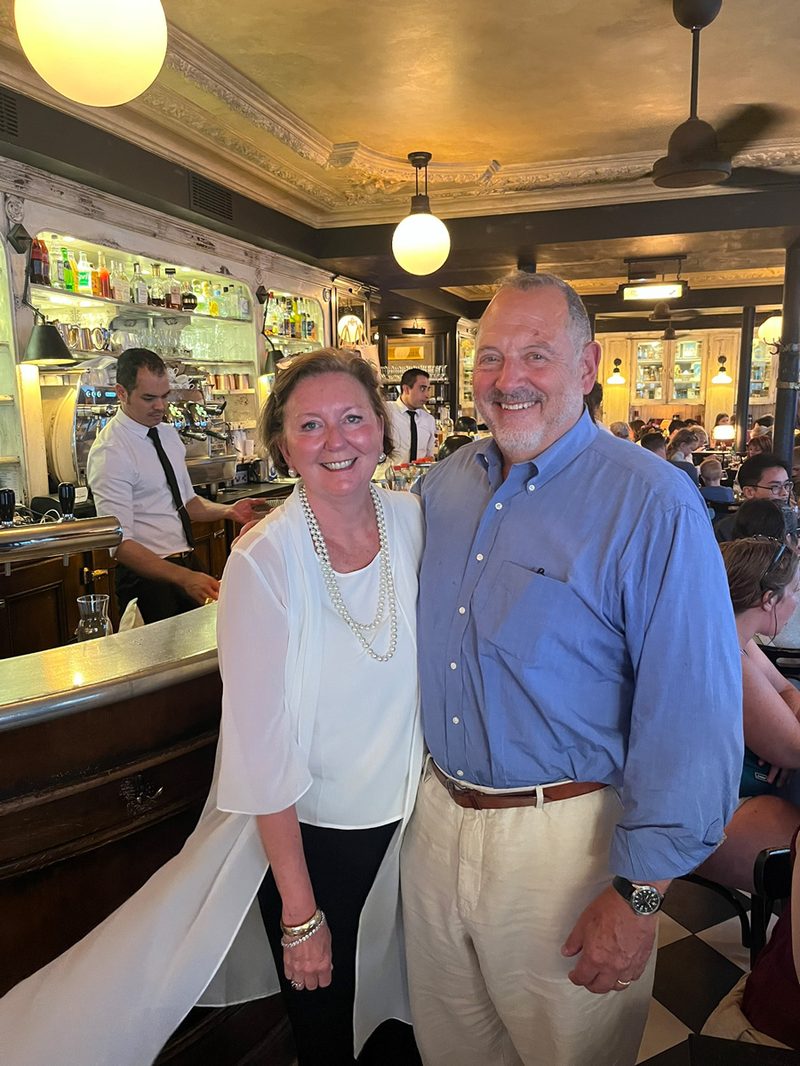
We returned to Paris and walked along the Seine, past Notre Dame and the scaffolding of its ongoing repairs after its devastating 2019 fire. We had a wonderful dinner at La Fontaine De Mars. This bistro-brasserie is an institution that has preserved its original moldings, red leather benches and a traditional menu of poulet roti and cassoulet.
The next day, we did some shopping and then went for a stunning haute cuisine lunch at La Tour D’Argent (the Silver Tower), a famous restaurant dating back to 1582. In 1890, owner Frédéric Delair began the tradition of presenting a numbered certificate to each person who ordered the restaurant’s signature dish, pressed duck. Serial number 112,151 went to Franklin D. Roosevelt, No. 203,728 to Marlene Dietrich, and No. 253,652 to Charlie Chaplin. Our canard was No. 1,187,432.
Our last day was a lovely morning on the Rue du Faubourg, one of Paris’s chicest streets. Running parallel to the Champs-Elysées, it’s an extension of Rue Saint-Honoré. We admired the sumptuous 18th- and 19th-century private mansions; the Elysée Palace, headquarters of the Presidency of the French Republic, the Ministry of the Interior, the residence of the American Ambassador and the British Embassy.
Of course, Rue du Faubourg Saint-Honoré includes some of the most exquisite houses of couture fashion as well as the trendiest boutiques from Hermès and Lanvin to Colette, and we did our part to support the French economy. If you do plan to shop, remember to bring your passport, so you can have the sales tax refund forms completed at the store.
We agreed that combining visits to Paris with time in a lakeside village enabled us to soak in the eternal beauty of the City of Light as well as the striking vistas of the medieval city, the lake, and mountains. We also agreed that, in both city and country, there is nothing like the taste of baguettes and croissants baked that morning, nor of fresh fruit, vegetables, and poultry from local farms.
→ Swipe for Next Story
FeatureSEPTEMBER OCTOBER 2024
Strength for Life
Consistency is key to becoming the best healthy versions of ourselves
Story by Dr. Edwin Spencer
It’s 5 a.m. on a Wednesday morning and I am looking forward to leg day. First some espresso and yerba mate and some quiet time with the Lord. That always comes first, and it is the most important thing I do to start my day. I then make a high protein smoothie packed with fresh fruit and vegetables for a post-workout breakfast. I try to strength train each muscle group two times per week and sprinkle in some core exercises in between sets. Cardio is also a must on the off-days. By the timeI am dressed and off to the surgery center, my head is clear and my body feels strong.
The Basics
I know that when a lot of people hear the wordexercise, they are immediately turned off by the thought of going to a sweaty gym or they think of some meathead pushing some ridiculous weight. However, there is much more to it, and the health benefits are far-reaching, improving both healthspan and lifespan. There are many ways to accomplish resistance training that is both fun and social. Also, when most people think about exercise it is in the context of weight loss. While this is a laudable goal (as close to 70% of Americans are either overweight or obese), there are many other tangible benefits. These include reduction in blood pressure and resting heart rate, improvement in cardiovascular function, better blood glucose control, improved sleep, improved mood, and reduction in depressive symptoms.
To see how exercise can manifest itself in the real world, I contacted, Dr. Jeff Stevens, a family medicine physician with Summit Medical Group in Maryville.
Like me, Jeff is personally invested in exercise and has made it a standard in his life to get in some form of exercise daily. We therefore had a lot to talk about, but truthfully, I was more interested in how he integrates it into his clinical practice. “It is integral to everything that I do. It is important for every age group, from young to old,” Jeff says. “Exercise is a critical component of a multi-modal approach to treating childhood obesity and anxiety and prevention of sarcopenia (loss of muscle mass) and dementia as we get older.”
To help understand the role of exercise and, more specifically, resistance training, it is important to understand a little bit about muscle physiology. I will try not to bore you with didactic science, but rather provide reasons instead of rules.
Resistance Training
Skeletal muscle is an endocrine organ which means that it secretes peptide hormones that have local and distant effects on other organs such as the brain. It is really the only endocrine organ over which we have voluntary control. Skeletal muscle will adapt to imposed demand meaning that the muscle cells will grow larger and stronger and will make more mitochondria when it is stimulated to do so through resistance training.
Skeletal muscle is composed of two basic cell types. Type I—or slow twitch muscle fibers—are smaller fibers filled with mitochondria and are concentrated in our postural muscles such as the paraspinal muscles in our backs. They are more consistently activated to keep us upright which is why they have more mitochondria to create the energy needed. Type II muscle fibers are the fast twitch larger fibers, found in greater concentration in the larger muscles of the arms and legs.
Let’s look at an example of how the muscle fibers work together with a simple biceps contraction. An electrical impulse travels from the brain through the spinal cord to a motor nerve that innervates the biceps. This one motor nerve will stimulate multiple muscle fibers to contract. The first are the slow twitch fibers and then with increasing load, the fast twitch fibers are recruited. This sequence is important to understand because as we age, we loose about 40% of our muscle mass from 25 to 80 years of age. The fast twitch Type II fibers are the first to go away. This can be mitigated by resistance training by placing loads that are enough to recruit those fibers. Resistance training is also one of the best ways to prevent osteoporosis as our bones respond to load by increasing mass.
Health Benefits
Increasing muscle mass and quality has many other positive health effects other than a better physique (however, that is nice as well). Muscle has a significant impact on your blood glucose control. Muscle has GLUT 4 receptors that are insulin independent and are activated by exercise. Almost all other cells require insulin to shuttle glucose across the cell membrane to be used or stored. Muscle, however, can reduce your blood glucose level without insulin. This decreases you insulin levels and insulin resistance which is a main cause of diabetes and metabolic syndrome.
Resistance training can also improve your cognition. As we activate our muscles, they secrete compounds called myokines which in turn stimulate brain derived neurotrophic factor which promote neuroplasticity. Neuroplasticity is the brain’s ability to learn and adapt to novel stimuli and create new connections. Research has shown that one of the most powerful ways to mitigate dementia is routine exercise.
Although exercise transiently elevates your heart rate and blood pressure, both are lowered through routine exercise. Nitric oxide is a molecule that dilates blood vessels which is increased via routine exercise. Your body also increases the number of capillaries to the muscles that are being worked.
Depression is more common than most of us realize. I see many of my patients on antidepressants and anxiolytics. As it turns out, multiple studies have evaluated the effects of exercise and have concluded that exercise (resistance training or aerobic training) are as effective as some antidepressants and that the effects are long-lasting. Multi-modal approaches which include exercise and medication have yielded great results in many patients.
Testosterone booster commercials are on all the time. One of the best ways to improve your testosterone and growth hormone levels is resistance training. Normal physiologic levels of testosterone and growth hormone improves your sleep and brain fog. With better sleep you will find an increase in energy and performance. It is important to check your testosterone and other hormone levels as low testosterone will make you feel like not going to the gym and will definitely affect mood, recovery, and performance.
Finally, increasing your muscle mass can increase your basal metabolic rate. Resistance training is mainly anaerobic meaning that you are burning glucose and glycogen stores in your muscles outside of the mitochondria. This muscle glycogen and intracellular glucose will need to be replenished and much of this is done by mobilizing fat stores and converting it to glucose. Additionally at-rest muscle burns fatty acids as a preferred fuel source. Therefore, resistance training will allow you to lose fat.
In Practice
So, with all these benefits, why do we have an obesity problem with 94% of the population having at least 3 of the metrics that define metabolic syndrome? Jeff says that it is compliance and patients buying into the process. He encourages patients to do three things: eat fruit and vegetables, consume lean meat, and exercise 30 minutes daily. Those patients that have persevered have reaped the benefits of weight reduction and even coming off of medication for blood pressure and diabetes.
Time is the biggest hurdle. We are all crunched for time. The reality with exercise is that you gain more energy and better performance throughout the day that will increase efficiency. More importantly the exercise will improve your healthspan and lifespan. It is more of an investment in yourself and your health.
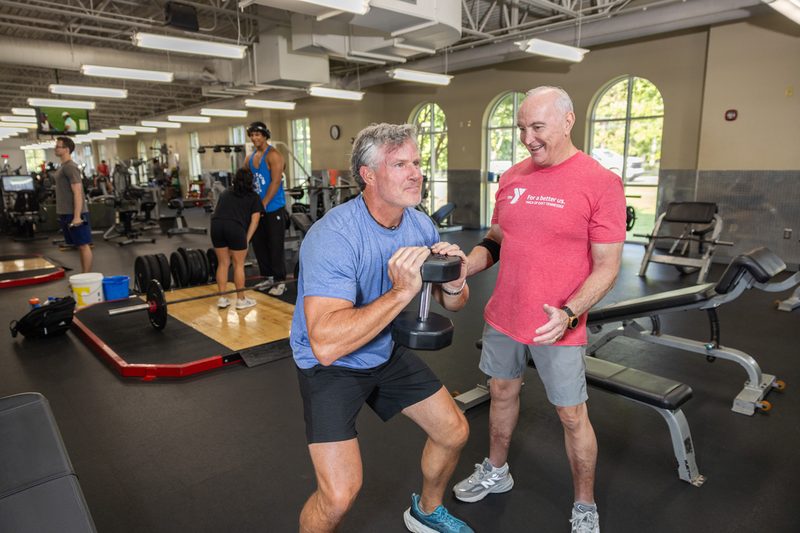
There are so many ways to accomplish this resistance goal. The key is picking something that you like. Consistency beats intensity every time. If you abhor lifting weights in a gym, then don’t do it. You can use bands or weights at home or yoga with body weight resistance. Many people like joining groups either for accountability or simply for socialization. There are many groups that meet in local parks and other organizations like CrossFit and Orange Theory. The social part of working out with a group is very beneficial and increases serotonin and mood.
We have become a sedentary society with everything at our finger tips. My grandfather lived on a farm and was super fit. He had old man strength and was farmer strong. He didn’t have to go to a gym because life was a gym. Many of us now work indoors and in a chair. We have to carve out time to exercise. Our elevated standard of living requires that we make exercise a standard in our lives.
We have agency over our health through nutrition, exercising, sleeping well and nurturing our emotional connections. I would encourage you to find a friend or group and get started with something fun. Set reasonable and attainable goals and check your labs with your primary care doctor a couple times per year. The biggest thing is setting your mind to start the journey to better health.
→ Swipe for Next Story
FeatureSEPTEMBER OCTOBER 2024
It’s Nico Time
With experience at all offensive positions, sophomore quarterback Nico Iamaleava is ready to lead.
Story by N. Brooks Clark
This was the year that the NCAA ruled—decades late, by any measure— that schools could pay athletes. For decades our friends and neighbors in all their wisdom have assured us that paying big-time college athletes would end civilization as we know it, using words like “the purity of amateur sports,” even as schools kept adding zeros to coaches’ salaries.
Despite all the warnings, nothing has happened, at least as far as players are concerned. What has been happening for a few years now is that greedy big-time schools have abandoned hallowed conferences like the Pac-10 to go for big TV money.
So, this year we in the SEC welcome Texas and Oklahoma. On September 21, the Vols journey to Soonerville, where our coach Josh Heupel quarterbacked his team to an undefeated national championship and a Heisman runner-up, and where he was an assistant coach and offensive coordinator, until his boss Stoops (nobody can remember which one) sacrificed him, Abraham-and-Isaac style, in 2014. The generally understated Heupel will assure us that there is no emotion associated with this homecoming. It is a game like all the others, etc. etc.
This is Heupel’s fourth season at UT. The fourth is often a year of stability for coaches, and that’s what it looks like for Heupel. AT UT Media Day, he mentioned “all the things we had to navigate. There were speed bumps that we inherited” when he first arrived, gifts from the bad deeds of the fired coach (whose name no one can remember). “Those are behind us,” said Heupel.
The Vols’ five-star Californian sophomore quarterback, Nico Iamaleava, waited patiently behind Joe Milton last year. He was the MVP of a 35-0 win over Iowa in the Citrus Bowl in his first and only start, completing 12 of 19 passes for 151 yards and a touchdown while rushing 15 times for 27 yards and three TDs. At Media Day, Offensive Coordinator Joey Halzle said, “My favorite thing was that, for all the accolades that he got after that game, his MVP and the touchdowns, he came out of it saying, ‘Man, I left so much on the field.’ He has absolutely attacked the knowledge side of this, which is not something that we force him to do. He dove into the films to see how he can best maximize all his opportunities and dive into the intricacies of why we’re doing certain things.”
“That is definitely where I progressed,” said Nico, “why we do certain things, why we motion, and why tempo is important. Just things like that. Joe [Milton] was a great guy to learn from—why we do some things. So much I learned from him: how you show up in the building. Learning how to lead. Year two is something I’ve envisioned since coming here. Year two was going to be my year, go-time for me, and I’m ready.”
Iamaleava (pronounced “ee-ah-MAH-LAY-ah-va”) comes from Long Beach, California. He is of Samoan descent, one of eight children in an athletic family. His cousin Zaida Puni plays third base for the Lady Vols softball team. “When it comes to Samoans,” Puni once said, “we’re all connected somehow.”
Nico is 6’6” and thin-as-a-rail 215 pounds, up from 190 when he first arrived in Knoxville. “I burn a lot of calories easily,” he said at Media Day. To keep the weight on, he eats four meals a day, focusing on a breakfast of French toast, eggs, and sausage.
At all times, he comes across as chill. “He’s pretty calm,” said receiver Squirrel White, “very calm.” At Media Day, Nico talked about handling fame, as in kids asking for autographs in restaurants. “I’ve come from humble beginnings,” he said, “so I know what it is to look up to someone. My dad and mom always kept me in check.” In games that means not responding to trash talk, as in, “’Don’t let the other guy get under your skin.’ It’s about staying true to myself.”
Now Nico is all set to direct an offense with veteran line, an explosive running back, and a speedy, experienced receiver corps—“the deepest wide receiver group we’ve ever had,” according to Heupel. “We’ve got so many different guys who can make plays,” agreed White, who has changed his number from 10 to 3, explaining, “Three is my dad’s favorite number, and I’m the third son.” White has also become a father. “After I score, I wanna be able to lay my eyes on him and give him a kiss,” he said.
Last year was Halzle’s first as offensive coordinator after moving up from quarterbacks coach. Milton had difficult moments when new receivers hadn’t quite picked up the Heupel system and didn’t seem to know where to run. Not so for Squirrel White. There were games when Milton targeted White nine times for nine receptions. Milton was also finding Bru McCoy until McCoy’s hard-to-watch ankle break. But other talented and speedy receivers seemed to have trouble getting open and, mysteriously, dropped balls that hit them in the hands. “We were a step off, for whatever reason,” admitted Halzle at Media Day. “The answer for this year is we want to see everyone come out and cut it loose, ‘cause that’s where the big plays come from. This year they’ve got to let it rip at 100 miles per hour.”
At the same time, Halzle said, “Our biggest area of growth is that we are a tempo team and we use that as a weapon to gain advantage, but if you don’t feel you’re in the right call based on the look that you have, don’t feel that you’re handcuffed to it. Situationally, when does it make sense to get away from it?”
Running back Dylan Sampson—a junior from Baton Rouge, Louisiana, and the fastest person on the team other than Squirrel White—-likes to look at inspirational posters and sayings. His favorite poem is “The Rose That Grew from Concrete” by Tupac Shakur.
Last year Sampson was part of a productive trio. As the main ball carrier in the Citrus Bowl he gained 133 yards on 20 carries. He was also a member of the VOLeaders Academy group that visited South Africa last summer. “He is explosive,” said Halzle, “and he has put on a bunch of weight in a positive way.”
Wide Receivers Coach Kelsey Pope has said to his deep and talented group, “Be a dog when you step on the field.” Bru McCoy was a tough dog before his ankle-snapping twist and Ace Hardware surgery, and now he’s come back. “It’s absolutely insane what that kid did this offseason,” said Halzle. “That injury, we all saw it. The fact that that kid is going out there running full speed and making cuts and making catches is amazing. He still looks like a superhero when he walks around here. It’s amazing in every aspect. The guy is just an absolute animal in every aspect of his strength training, his conditioning, his rehab, his football knowledge. He just attacks it all in the same way.”
Sophomore Chris Brazzell II, a freshman All-America from Midland, Texas, transferred from Tulane in January. Big (6’5”, 200 pounds) and fast, he caught 44 passes for 711 yards, 10th best in the nation, with a 16.2-yard average. “Chris brings a lot,” said Nico.
Oregon transfer Dont’e Thornton Jr. (6’5”, 214 pounds) was getting into the groove of the offense when he injured his ankle catching a 46-yard TD pass against Missouri.
“Chas Nimrod is a name you guys need to know.,” said White. “He’s not getting a lot of talk, but you’re hearing me say it. You’ve heard me say it for the last several weeks: I really like his game.”
Sophomore Miles Kitselman, transfer from Alabama, will split time with Ethan Davis at tight end.
The offensive line is led by senior Cooper Mays, who will be Nico’s best friend in setting the tempo. Tackle John Campbell Jr. has come back for his eighth year of college football after transferring from Miami last year and switched from the right side to the left. Right guard Javontez Spraggins will balance 6’6”, 314-pound left guard Andrej Karic, transferred from Texas last year and started four games until he was injured. Right tackle transfer Lance Heard from LSU “has a great ceiling in front of him,” according to Heupel. “I love the camaraderie,” said Spraggins at Media Day. “We’re brothers. We love each other.”
‘Grandpa’ Leads the Defense
“The middle linebacker is the quarterback of the defense,” said Jeremiah Telander (pronounced TEE-lander) at Media Day. “That’s what drives the bus.” Sixth-year senior Keenan Pili, the BYU transfer who was injured early in last year’s season opener, is back at MLB. “He’s really smart,” said Defensive Coordinator Tim Banks at Media Day. “A tough kid, always trying to do things the right way.” It’s strange to hear Banks refer to Keenan as a kid. His teammates call him “Grandpa.”
“He’s 26. I’m 19,” said Telander. “If you think in all aspects in life, he helps me understand how to take care of yourself, the right films to watch.” Banks tends to switch defenders in and out, so Telander will see plenty of action. “My confidence has shot through the roof,” said Telander. “I’ve been working on my pass rush technique. Maybe make some sacks.”
Sophomore Arion Carter will also be in the linebacker mix. “The element that he has, that is something that you can’t coach, is his speed and quickness,” said Linebackers Coach William Inge to Dan Harralson of VolsWire. “He’s elusive on the field, almost like a cheetah.” “He’s hungry,” agreed Telander. “He’s ready to go out and hit somebody.” Telander also likes watching the defensive linemen do their thing. “We’ve got some freaks in that group,” said Telander. “We got all the talent in the world.”
Chief among the freaks is 6’5”, 243-pound junior edge rusher James Pearce Jr., a preseason All-America and projected No. 1 NFL draft pick. “A great playmaker,” said Heupel, “he has the ability to affect the game.” He made 10 sacks last year and intercepted a pass in the Citrus Bowl and ran it 52 yards for a touchdown.” Pearce will get help from freshman Jordan Ross, a 6’5”, 245-pound five-star recruit from Vestavia Hills, Alabama. “We’re super excited about Jordan,” said Banks. “The biggest thing is his size. Our weight program has done a great job; stronger learner. He doesn’t say a ton.”
The media guide reports that edge rusher Joshua Josephs “has a verified 82-inch wingspan.” Telander describes Caleb Herring, yet another edge rusher, as “a freak athlete.”
Senior Omari Thomas returns at defensive tackle, as do Bryson Eason, Omarr Norman-Lott, and 6’2”, 340-pound Elijah Simmons. In 2019 a video of Simmons dunking a basketball then making a full court basket went viral.
UT’s fifth defensive back, or STAR, is part safety and part cornerback. “We ask them to do a lot,” said Banks at Media Day. “They’ve got to be great blitzers.” With a season-ending injury to Jourdan Thomas in the first days of camp, freshman Boo Carter from Chattanooga will get his chances in the defensive backfield, along with four key transfers.
At cornerback, Oregon State transfer Jermod McCoy and Temple transfer Jalen McMurray will join sophomore Rickey Gibson III. At safety, MTSU transfer Jakobe Thomas will join Andrew Turrentine, who transferred from Ohio State before last season and started the last three games, and junior Christian Charles, who was injured last year.
As the Tennessee Volunteers prepare to charge into a new season, all the pieces seem to be falling into place. Nico Iamaleava, with his cool confidence and growing leadership, is ready to take the reins of an offense loaded with playmakers. Supported by a resilient defense and a coaching staff determined to build on past successes, the Vols are poised to make a significant impact in the SEC. With Nico at the helm, the stage is set for an exciting season where Tennessee can prove they belong among college football’s elite.
→ Swipe for Next Story
FeatureSEPTEMBER OCTOBER 2024
Beauty in the Details
Julie DuPree designs homes with showstopping detail, proving that every space matters
Story by Carolyn Evans
I’m here to see a house, but it’s the roofline that grabs my attention. Before I can even stop the car, my eyes follow the brick detailing of tall, pointed gables soaring upward. As I shut the car door, something sparkles to my right, and I turn to see gas lanterns flickering next to curved corbels flanking the glass garage doors.
Walking up the driveway, I glance at the expanse of front windows. Someone is seated at a large desk. As I get closer, I see a young, dark-haired woman.
Julie DuPree opens the arched double glass door and welcomes me into her home/model home on Pineola Lane. Immediately I see a glowing, bright, clean house. I follow her into her office with pale pink walls done in a mixture of diamonds and squares from floor to ceiling. The beautiful design is something Julie first imagined then created, pencil to paper, she tells me. She sits at her shell-colored desk with a clear Lucite base, a pale pink vase near her elbow and colorful artwork nearby.
“I saw the artwork online and it was the inspiration for the office,” she says. “It’s called ‘Life,’ and I drew the pink from it because pink is my favorite color.”
The cream chairs and dramatic chandelier combined with the pale pink and dramatic art give the room a happy, lighthearted feel.
Like Father, Like Daughter
“I grew up in the business in Nashville,” Julie says. “My dad was a builder and developer for over 50 years. From a very little girl, I knew building and design. I would go to my dad’s office and use his samples and pretend to be the builder and house designer.”
Julie obviously has homebuilding in her blood — she’s been designing and building homes for the last 20 years. The petite mom of two kids who are now in their mid-twenties is intense and high-energy.
“My mind never stops,” she says. “My friends say, ‘Where do you get your energy?’ My husband’s the same way — he is a business owner as well, so he works a lot, too. We both have a very strong work ethic and have to force ourselves to relax.”
Julie puts her heart into each home like it’s her own, making sure that homeowners get exactly what they have envisioned. “I am very good at visualizing things but not so good at explaining them, so sometimes I just have to say ‘Trust me,’” she says.
“I’m selective in the projects that I take because there has to be a connection and, most importantly, trust between my clients and myself. We are a team, and the relationship is the most important part of the process. I call myself a boutique builder — most of my clients are referrals and I do not have a big office and office staff. I’m involved in the build and the design of the home from start to finish. Even when my clients have their own designers, I am just as involved in the selections so that I know what the vision is. I want my clients to be proud of their homes as I want to be as well.”
Brass, White, and Open
As we make our way through her home, I begin to catch on to what Julie is saying. Back through the massive open entryway a dramatic brass and glass light fixture hangs over the dark round dining table. Four linen upholstered chairs surround it, set off by the soft gold and pale blue wallpaper. In the adjoining kitchen, the island is stained white oak with a three-inch mitered light gray and white natural quartzite countertop that sets off a subtle green hue. The vibe is French with rattan-backed barstools and custom brass wire insets in cabinets adjacent to the hood and in the hutch. The hood has brass strapping and is flanked with a marble fluted backsplash — a nice contrast to the greige cabinets with brass pulls.
“A new trend I am seeing is the pantry being an extension of the kitchen,” Julie says. “This area is typically called the ‘scullery.’ It usually has no door and has decorative lighting that complements the kitchen. Some of these sculleries are outfitted enough to be small working kitchens that are perfect for entertaining.”
“I like to do unexpected things in powder rooms, because the powder room is the one room in the house that everybody will usually see,” Julie says as we leave the kitchen. She opens the door to something shimmering and breathtaking: a starburst light fixture. The walls are done in green, black, and gold wallpaper. Even the ceiling is wallpapered. A floating quartz vanity with a black sink sporting a brass stripe running through it add to the drama. To my surprise, even the toilet and inside of the doors are black, adding even further to the drama of this space.
Back in the hallway, we come to the large, arched glass and steel door that lead to the wallpapered wine room. Individual bottles are mounted on the walls. And that elaborate small door in the back? “It’s a secret passage to a small mechanical room,” Julie says, adding that secret passages are trendy.
Just above our heads in the hallway is a light fixture made of brass and alabaster. Again, a unique touch. Next stop is the massive, wallpapered laundry room with a floor made of washed blue 24-inch tiles with gold accents. Upper and lower cabinets line three sides and include a pocket doggie door to the private boudoir for Ivy, the golden retriever — and “queen of the house,” according to Julie. A custom white wood-trimmed accent wall keeps the room light and bright, and as we head out Julie points out something I’d missed: the brass threshold. They are used throughout the house. Two other one-of-a-kind touches include heavy, solid-casted door knobs knurled with a diamond pattern and the triple paneled interior doors that are all painted darker than the walls.
In the great room, a large seating area of two upholstered sofas and off-white swivel chairs is arranged in front of the fireplace. Expansice windows, all from Pella, let the light flow in. The limestone fireplace mantle seems to shimmer in the light. It’s breathtaking, but my eyes fall to the grate below where large, round metal balls are resting. “They’re gas-burning fireballs,” Julie says.
The built-in bookcases have a diamond pattern in the middle and are painted the same as the interior doors so they stand out, but again, a custom woodworking touch sets them apart from any others I’ve ever seen. Julie points out that the curved crown molding composed of three layers is actually on the ceiling, not the top of the wall, giving the 10-foot-ceilings the illusion of even more height. “The walls, ceiling, and trim are the same color,”—they’re all white—”but because they have different sheens, you still get a pop.”
A brass and glass drum pendant light and brass table lamps make a nice contrast against the black frames of the NanaWall retractable folding wall that open to create a 16-foot-wide opening to the pool. Another 8-foot opening from the conversation area (Julie decided this was more useful than a breakfast table—and her company agrees) adjacent to the kitchen leads to the pool.
Room for Family and Friends
“This was a very challenging lot and I had to do a retaining wall,” Julie says. “To accomplish a walk-out without any steps, I had to tier the backyard.” Backyard Renovations and Stuart Row Landscapes lent their expertise to this stunning space. A set of outdoor stairs leads to a green area above the pool that is a natural stone patio with a firepit, seating area, and room for corn hole and ping-pong. Under the shade of the semi-enclosed patio is a complete outdoor family room with a TV and heaters for winter. “This comes down,” Julie says, pointing to screens that cross the expanse of the patio. “Or there is plastic for wintertime when the heaters are on.” An all seasons room.
Back inside, as we explore the upstairs, we walk through a large family room/rec room, probably the most modern room in the house. The longest wall is an accent wall with a herringbone wood trim design and painted in a dark gray with a dark wood coffee table and TV console. The white sectional and white wall balance things out. Julie leads me into her daughter’s master bedroom, done entirely in white and off-white with another beautiful accent wall.
Her son’s bedroom is more of a modern feel. It’s decorated in tan, black and brown. In the third bedroom, Julie combines a pale pink duvet with tan, white and green bed pillows. Next is the bonus room with dark leather chairs and TV console and two round wood ring chandeliers with nine “candles,” suspended by leather straps.
As we end our tour, I’m overwhelmed by all the thought that has gone into this show-stopping home and Julie’s quiet humbleness about it. The number of special details would be impossible to enumerate, but the ones that call out most to me are the one’s that showcase the best of Julie’s creative mind. The foyer with wood herringbone inlay with gold border, the Caststone fireplace mantel, and brass thresholds. The zero entry showers, glass garage doors, and the breathtaking light fixtures. Or how about the unique three-piece trim work, detailed accent walls, and making the choice to add the NanaWall to the living room leading out to the patio with the retractable patio wall. It’s all come together to create a masterpiece, which it seems Julie is proud to call home.
Every inch of her builds matter. And it shows. As she told me early in our conversation, “I’m all about the details.”
→ Swipe for Next Story
FeatureSEPTEMBER OCTOBER 2024
Parade of Homes
Three weekends in October will bring the community together to showcase and celebrate the building industry in East Tennessee
Story by Rebecca Whalen
What do you get when an aerospace engineer marries the sales and marketing director of a large regional builder and developer? A very precise and stylish homebuilding duo, that’s what. Ron and Diane Bills, the couple that owns and heads up Providence Builders of Tennessee, look forward to the chance to work with clients to bring their dream home builds to life each year. But nothing excites them more than getting to share a build with an entire community. And that’s where the Parade of Homes comes in.
Each year, the Home Builders Association of Greater Knoxville (HBAGK) puts on it’s annual Parade of Homes, a showcase of some of the very best in homebuilding in our region, and this year marks the 42nd year the parade has come to life. For builders, like Providence, it’s not just an opportunity to show the community a beautiful home, it’s also a chance to get to visit with neighbors, learn more about what people are looking for in homes each year, and share a bit more about their own stories—something you can imagine we atCityviewlove to hear.
For example, did you know Ron, originally from Colorado, built a vacation home in Rarity Bay about 30 years ago? Or that he and Diane fell so in love with East Tennessee that they moved here? The Bills have called Knoxville their homebuilding base for the last 16 years, when they brought the Providence model to Tennessee. This is just a taste, but you begin to learn things like this about the builders when you head to their parade homes to visit each October. For builders, they get to talk with potential customers. But for community members, they get to learn more about the people who are quite literally building up East Tennessee.
“It’s a great time for our team to unite and hear feedback, and listen to people’s comments as they tour of the parade homes,” Ron says. “It’s kind of an overall connection feel to what’s happening in Knoxville and really get some good feedback from people we’ve never met before to those we’ve built for to those who we are going to build for, that we’re currently building for or may someday build for.” The parade is about connecting.
The Parade Takes Shape
While the official start year of the Parade of Homes in Knoxville is a bit of mystery, this is the 42nd annual documented event. “I’ve seen some documentation and photos going back to the 50s, if not early 60s,” says Ashley Burnette, Executive Vice President of the association. He can still recall finding a black-and-white photo of one of the early parades, cars lined around the neighborhood. “It was quite impressive,” he says.
If you haven’t attended a Knoxville Parade of Homes before, here’s the gist: builders from across the region work for months and months on homes that they open to the public, often fully furnished, during three weekends in October each year. These homes are in addition to all of the other projects they have in process. But they make it just as high a priority.
This year, Ashley says 43 homes, which are scattered across the region (even Gatlinburg), will be showcased, and nearly 15,000 to 25,000 people are reported as attending the parade each year. The homes will be everything from the starter home to a more high-end build, and everything in between. This year will even include a remodeled house, Ashley says.
And while it seems its popularity has existed from start, the parade as we know it today didn’t always exist in this manner. Mike Stevens remembers some of the early years well, having been not only a chair of the event in the past, but HBAGK board president. So does his wife, Marquita. Together, they head up another dynamic homebuilding team in our region: Mike Stevens Homes.
“When I first got involved, Parade of Homes was on a single site,” Mike says. “So developers would sponsor the parade and they were responsible for going out and getting five or six or seven builders and kind of build it in one development.” The event would end up organically turning into a bit of a competition, Mike says. “You’d have five of six builders that were over-building the market.”
That is, until the parade leadership at the time came across the idea of a scattered site concept from a parade in Raleigh, North Carolina. And while Mike says there was some pushback from the community and builders, the concept took off. And it’s been something that has continued to build a following year after year.
“When we open the doors that first day, I know people’s names,” Mike says. “There’s certain people that if they don’t show up, I’m going to go back and check the obituaries because they probably died. They’re so loyal and they come through regularly. And I think every builder has that.”
The parade has become such a staple within the community that so many segments of the population attend. Some people are looking for ideas for their current build. Others are freshly in the market, searching for the perfect builder. Builders will get attendees who are going to build “someday.” And there are some that simply love the pastime of looking at unique homes even if they aren’t looking to buy. So many different individuals come through the doors of the parade homes. The community at large waits for its arrival each year.
For the builders, it’s an opportunity to see what’s working, and what just isn’t hitting the mark. “I love to get very direct feedback,” Mike says. “If you’ve done something the public doesn’t like, you’re going to hear about it. So it’s just instant feedback—and instant gratification if you’ve done a good job.”
Mike urges any young builder to not look past this opportunity to market their business: “It’s the greatest marketing tool we have.”
Building a Parade Home
The creation of a parade home is different for every builder, but oftentimes the home is one that is actively being built for a homeowner—and the homeowner needs to be willing to have it shown off to the public. “It really starts with the vetting process of the home itself,” Ron says, adding later, “and it’s a big deal as we don’t do every home in the parade.”
While it is important, in some senses, to showcase unique layouts and push the envelope in terms of design trends, it’s also an opportunity to showcase what’s happening in the market right now. “Our job is not to pick out the latest trends and try to push it into a design, but it’s really to make sure we bring to the forefront for our clients what’s happening in the market,” Ron says. “At the end of the day, though, it’s their home and it’s personalized to them.”
The parade is also an opportunity to showcase other businesses in the community. Vendors, contractors, even realtors spend time in the homes throughout the weekends in October, giving them the chance to talk with potential customers, as well. Many of the homes in the parade will also be fully furnished, giving viewers an opportunity to see the work of professional interior designers. For Providence that’s where Diane steps in. This year she is working with designers Wolfgang H. Schaber of Wolfgang Interiors and Anne White of Boyd Harvey Designs to bring this parade home to life.
Lisa Smith, who works for Ferguson Enterprises, serves once again this year as the co-chair of this year’s Parade of Homes alongside Becky Snyder of Loomis Construction. She says that while Knoxville can lean toward more of a traditional style, the influx of transplants to the area over the last few years has brought new styles to the region.
“They’re bringing their design aesthetic here,” she says. “You’re going to see a lot more clean lines, a lot more dark colors. You’re going to see a lot more things that are a little bit out there, that are outside everybody’s comfort zone like powder rooms with really nice wallpaper or different types of cabinets, different materials. You’re going to see all of that in the Parade of Homes.”
While the HBAGK doesn’t release their full Parade of Homes list until October, we got a sneak peak from some of the builders of some of the homes that will make up the 43 that will be showcased this year. The builders are outdoing themselves and viewers will be in for quite the treat.
Mike says one of their parade homes this year—located in the Gettysvue Golf & Country Club community—is for a younger family that works and plays at home. “We’ve combined two lots, and it’s been a tough lot, but it has turned out spectacular.” And while the lot meant the build needed to include a rather large retaining wall, this one will have an exceptional amount of recreation, including a stunning pool, downstairs entertaining area, and even a golf simulator.
For Ron, this year’s Providence home is a lakefront property—located in Rarity Bay—the second home they’ve built for this particular couple who spends a lot of time on the water. The home features an indoor elevator, large walk-in pantry, vaulted ceilings, and a lower level recreation area that walks out to the water. “We designed the home specifically around the enjoyment of being on the lakeside, from the travertine decking to the under the garage storage area for lake stuff and lake living,” he says.
Hunter Harrison, owner of HMH Development who is also a repeat builder in the Parade of Homes, says for him and his team the parade is an opportunity to showcase their subdivision communities. The HMH home on the lineup this year—located on Misty Lake Drive off Campbell Station Road—is Hunter’s first home in their Catatoga subdivision, but it’s also one where they’re trying to push the envelope and try something different. “We’re calling it a modern European farmhouse,” he says. “This is a product that came from the upper end sections of Charlotte, the upper end sections of Brentwood. We saw this product, hired this architect, who drew these to give us this look that I wanted.”
Hunter, a long-time resident of Hardin Valley, says he’s trying to distance himself from the “Knox box. I’m trying to make a statement of what Hardin Valley should look like.”
The HMH parade home is also a bittersweet one for Hunter. “Catatoga is my swan song,” he says. “I’ve got a total of 150 lots going in this subdivision. I’m 58. This is a six or seven year project for me and at that point, I will be turning this company over to a son and I will no longer be a business owner or business man—I’m going to come back to work for him as a superintendent.”
The Home Builders Association
While the Parade of Homes is the public-facing component of the HBAGK, it is far from all they do. Behind the curtain is an organization that serves builders and associate members (like contractors, goods suppliers, etc.) in Knox and surrounding counties, 17 in total. There are 500 members in the association, Ashley says, 200 of which are builder/contractor members.
Networking opportunities, education for members, and, of course, showcase opportunities like the Parade of Homes are all part of the HBAGK work to support this important economic pillar. But there’s more than meets the eye. HBAGK can also be found advocating through their governmental affairs arm for legislation that will positively impact the industry in our region.
“[Our members are] just committed, they’re dedicated to what they do, and they believe in it. And that’s how it comes about where they can call a county commissioner about an issue or a city council member or a state rep or a state senator about something that’s going on,” Ashley explains. “The bulk of the work that we do is advocacy. And that’s looking out for all those things that I just mentioned.”
Remember Lisa and Becky, the parade co-chairs? Both women have been part of the home builder’s association for a while, knowing just how much of an impact it can have on builders and associate members—and the future of the industry in East Tennessee. Both were instrumental in bringing the Professional Women in Building chapter back to the HBAGK, an important newer initiative, Ashley says.
Workforce Development is another new direction for the home builder’s association, but not just locally, Ashley adds. “It’s really the past five years that the need has been there. Well, longer than that. The contractors, trades are just desperately short on people entering those professions coming out of high school or even out of college, but there is a tremendous need for that. And everyone across the country is working on it.”
HBAGK members, like Lisa, go out and talk at schools and after-school programs about entering the trades. The association is also starting a tool closet, Lisa says, so students entering the trades can get boots, a tool belt, or other items they might need that might be a barrier to them being able to start or even get a job in the industry. “The trades are a wonderful way to be able to build up to be an entrepreneur—or just have a really good job where you make really good money,” Lisa says. “And you don’t need a four-year degree.”
The HBAGK ensures this local industry has what it needs to stay supported and grow. “When you really think about it…,” Lisa says, “you don’t have to go very far out of your circle of friends until you know somebody that does support their family through the construction trades in one way or another.”
Bringing it all Together
With the Home Builders Association of Greater Knoxville leading the charge, builders will have the chance to showcase this industry in their own way at the parade in October.
“It’s a really big win,” Lisa says, “for both the community and the home builders—and all of the associate members and suppliers.”
And while the October showcase means more hours for their teams, the work is worth it. It becomes, in some senses, a celebration of the industry. “I don’t think people understand how tough of a business this is,” Hunter says. “You’re turning around and selling a person the largest investment they will normally make in their lifetime, the ‘American Dream.’”
The Parade of Homes is free to the public. To learn more about the association and see the full list of homes and builders showcased in the event this year, visithbaknoxville.comortheparadeofhomesknoxville.com.
→ Swipe for Next Story
Non-ProfitSEPTEMBER OCTOBER 2024
Flight Plan
Owl Ridge Raptor Center nurtures injured, displaced birds and returns them to the wild
Story by Susan Alexander
Beak was a tiny owlet, homeless and on the ground when a dog sniffed him out. A great horned owl, he was passed along to wildlife rehabilitator Lynne McCoy and eventually to the Owl Ridge Raptor Center, operated by Lisa Thomison and her husband Chris out of their home in rural Washburn, Tennessee. Lisa raised him until he eventually passed “mouse school,” she says, proving he was able to hunt and feed himself. She released him, but six days later he was back, calling from a tree. When she held up an arm, Beak flew to her, landing gently. He had imprinted on the human that had saved his life.
Now Beak, who is five years old, is one of four ambassador owls that Lisa takes to educational programs she does in classrooms and libraries, state parks and 4H centers. There she shares information about the birds she admires and works to heal, nurture, and return to their native habitats.
But Beak also has serious work to do for his own species. Every spring when other great horned owlets find their way to Lisa’s care, Beak steps up as a foster parent, comforting them with his presence and teaching them important owl skills like hunting. Currently he’s fostering Cobweb, a female who will be released this fall.
Beak and Cobweb are two of about 30 owls, hawks, kestrels, and other birds of prey currently at Owl Ridge that have been injured or displaced, usually too young to survive on their own. An adult bald eagle is also among the residents, one that will never fly again thanks to the careless, illegal poacher who wounded him with a.22. He is one of four eagles Lisa knows of that had been shot in Tennessee in the previous six months.
“He couldn’t fly anymore, but I guess he was finding food on the ground, mostly carrion,” she says. Once he was trapped and delivered to Owl Ridge, he was so hungry that he would let Lisa approach with food. “When a wild animal will allow you to approach, they’re starving to death.”
Fed him she has, purchasing the large, smelly fish — carp and trout — that his diet requires, and the eagle’s health has been restored, even if his ability to fly is gone forever. In July, the Thomisons delivered him to a refuge at Reelfoot Lake State Park in west Tennessee. There at least he will be among his kind.
The Owl Ridge Raptor Center, a 501(c)3 nonprofit, grew out of the love for birds of prey that Lisa learned as a volunteer at the now-closed Clinch River Raptor Center in Claxton.
“I liked owls the most, they’re very mysterious and secretive, and I like the idea of them flying silently at night. They’re monogamous and mate for life, and they will defend their babies with their lives. Most mammals don’t do that,” she says, then adds, “I admire their tenacity.
“Kathy Strunk and Katie Cottrell (who ran the center) were my mentors. When they retired six year ago, I applied for my state permit from TWRA and got approved and then applied for my federal permit from US Fish and Wildlife.” Qualifications for approval are rigorous and include up to 200 hours of rehabilitation experience. Lisa also has a work background in biology and lab work.
She was approved again, and then had to construct the enclosures needed to house the birds moving over from Clinch River. For this, she relied on the help of Chris, a steelworker who commutes to Knoxville and who spends his spare time helping her with the birds.
“When she told me she would like to take up the torch (when Clinch River closed), I had no idea what that entailed,” he admits. But he agreed. Since then, he’s built 13 enclosures for the birds. Footed the bill for countless mice and rats and fish and quail they serve their feathered guests, a bill that runs about $300 a week during the busy times of the year. Helped pay the bills that mount even though their veterinarian, Andrew Skelly at Emory Animal Hospital in Powell, cuts them a break. Driven hours to programs or to collect injured birds. Even created their website,owlridge.org.
Lisa quit working elsewhere as the work at the raptor center grew. Last year, she estimates, they cared for about 150 birds of prey. For most, that might just mean feeding them. But for others, it also means medicating them. Birds that have been hit with lead shot, for instance, can develop lead poisoning. Treating them involves twice daily injections in the breast muscle for multiple weeks, a process neither bird nor human enjoys.
She works closely with TWRA and the American Eagle Foundation at Dollywood, as well as UT’s veterinarians, who do a lot of surgeries on injured birds. “They can put titanium plates in wings; it’s amazing,” she says. Though there’s another raptor center in Chattanooga and one in Johnson City, she believes hers is the only one with a 100-foot-long, L-shaped flight cage required to rehab eagles, built with volunteer help and donations and dedicated to the memory of Lynne McCoy.
When she has very young birds, Lisa often rises every three hours to feed them. She makes toys for them to shred or pounce on. She changes the water daily in the plastic pools in each enclosure. Handles the birds she takes out in public to keep them accustomed to human contact. Applies for grants to offset some of their expenses. Attends fundraisers with her ambassadors. Teaches kids all about the wild birds in her care.
In all, she does more than 20 educational programs a year and passes out plans for making nesting boxes. She also passes along advice intended to protect the birds she loves: Don’t trim or cut down trees in the summer, when they’re likeliest to contain nests. Don’t use poison to kill rodents because the birds that eat them will die too. Don’t throw food out your car window because it will attract rodents which attract raptors. And then cars hit them.
As we chatted over the course of an afternoon, Lisa learned of other birds in trouble. A young osprey had fallen out of its nest. Another bird was found injured and was on its way to UT Vet School. She prepared to take on more charges, helping to get them to adulthood and independence.
“I feel very lucky, very blessed to be able to do it.”
To learn more about the Owl Ridge Raptor Center
→ Swipe for Next Story
FeatureSEPTEMBER OCTOBER 2024
Tennessee Tailwaters
Finding time for my sons on the South Holston River brings back memories of a simpler time with just as good company
Story by Nathan Sparks
We are just below the small weir dam on the South Holston River outside Bristol. Waiting for the water to come on gives me time to share some stories with my sons, Ethan and Troupe. It’s the first time we have been together in a bit, and we are anxious to see what our float will bring to the boat. South Holston is said to have more than 10,000 fish per mile, but don’t let that fool you into thinking you will catch fish every cast. No, these fish are wary, and proper presentation is required to succeed. Troupe takes the front position as he is fly fishing, and Ethan is in the rear with a spinning rig. The alarm sounds, and it is only a few minutes until the water arrives. We are off.
The South Holston is a small, relatively fast-flowing river in the upper section. The water is beautifully clear, and the fish are rising. A chance to have both of my sons in the same boat and get the opportunity to guide them gives me a satisfying feeling. It’s nice as a father to share some of your knowledge with your children. Summertime flows on the Holston can be frequent. Today, we’re only going to get about three hours on the river, but that’s better than nothing. We float along and bring a few fish to the boat, but the true joy of this trip arrives as I watch the gentle fog swirl over the cool water and my sons calmly take in the view in front of us. My view as a father is just as breathtaking.
I am reminded of the many days my father and I floated this section of the Holston River system. Our first trip down in an old fiberglass square stern canoe resulted in an unexpected upset at the Hickory Tree rapids. The average temperature of the Holston is around 40 degrees. Somehow, despite the frigid temperature, my father managed to get me, the canoe, and our gear to the bank.
That unfortunate episode did not deter him from canoeing, however. Quite the opposite. Aside from being an accomplished electrical engineer and a very present father, he took canoeing classes, became an accomplished whitewater racer, competed many times in the National Championships for whitewater slalom, and spent years as a part-time whitewater canoeing instructor at a local college. For much of that, I was at his side, and he welcomed my participation.
I’ve taken much of this with me as I became a father–and now grandfather. Remembering all of this is a continual reminder of how important it is to spend time with your children and invite them to pursue your passions alongside you.
On this trip, we will be staying at the Tailwaters Lodge. The lodge is located on TVA South Road, just below the dam. It’s a delightful collection of several houses, ranging from a modern rustic escape to a full-on several hundred-year log cabin. It’s got something for everyone, and the prices are very reasonable. The lodges are owned by Bruce and Paula Cote and managed by Nicole Cardish. They’re not native to the area but you wouldn’t know by talking with them. They seem to fit right in. I asked why they chose Tennessee and they said simply that East Tennessee seemed like a gentler New Hampshire, where they grew up.
On our first night, we stayed in the Osprey cabin built by Bruce and Paula. A lovely two-bedroom right on the back of the river. We enjoyed building a fire on the back deck in the stone fireplace and listening to the river gently flowing. The next night, we moved to the Pheasant Tail. This cute, quaint log cabin can sleep up to seven people with two full baths and a laundry—plus, it’s a one-minute walk to the river. Each cabin has it’s own unique fire pit, some more rugged than others but all exceptionally relaxing, where we sat each evening and played cards.
The lodge has more than 500 feet of river frontage, which abuts TVA land, providing more than a mile of wadable world-class fly fishing right outside your door. Most fishermen opt for float trips utilizing the South Holston and the Watauga rivers. You can bring your boat or work with a local guide service. Tailwaters Lodge partners with the South Holston River Company, headed by Patrick Fulkrod. They have lots of guides and are on both rivers every day. I would also recommend Jimmy Cheers, based out of Mountain Sports Ltd in Bristol. Either is a solid choice for a great day on the tailwaters.
Most people probably think of the speedway when they think of Bristol, but there is an abundance of outdoor experiences waiting for you to explore. As my dad used to say on our canoe trips together, “Any day on the river is a good day on the river.” I’d like to add, that if you have the opportunity to bring along the next generation or a good friend, that good day will undoubtedly become something unforgettable.
→ Swipe for Next Story
VeteranSEPTEMBER OCTOBER 2024
Farewell to a Friend
Vietnam veteran Randall Leyshon found healing after a half-century of mournful memories
Story by Phil Newman
“Did you hear about John?” the young man asked warily, as he and several other 9th Infantry Division Army soldiers chatted with then-1st Lt. Randall Leyshon, whom they had met at Officer Candidate School (OCS) back at Fort Benning, Georgia. It was early 1968, and the men had bumped into each other thousands of miles from home, amid the jungles of Vietnam.
An already typically intense, life-or-death day for Leyshon during his tour in Southeast Asia—he commanded an attachment of Pathfinders, whose primary task was to drop into combat zones and help commanders in the air and on the ground connect as battles raged—was about to take a devastating turn.
“No, what...” Leyshon started to reply, but the looks on their faces told him the gut-punch truth without need for the question. His heart dropped; he thought he might topple over.
The previous November 17, 1967, his dear friend John Wesley Terrell, 1st Lt., a 4th division platoon leader, had been killed in action at Kontum, Vietnam. In those days, communications were far from seamless, so the news had not reached Leyshon until that chance encounter with his cohorts.
More than a half-century later, Leyshon still breaks when recalling it. “I just...” he begins, as tears well in his eyes. “I got word to [my wife] Patty back in the States, and we both cried. I wish the world could see the relationship John and I had.”
Leyshon and Terrell had met when both were tactical officers for OCS at Fort Benning and become fast friends. Both were from near Akron, Ohio, which accelerated the bond. To some in that era, their kinship seemed “unusual,” says Leyshon, since he’s white and Terrell was black. “It didn’t take long, and he was closer than a brother. He took me to black bars and I took him to redneck bars in Columbus [Georgia]. Our platoons competed. We shot baskets together, and he smoked me.”
Leyshon wanted Terrell to accompany him to jump school and join the airborne, but Terrell demurred and was assigned to Fort Lewis, Washington, in the 4th division, before being deployed to Vietnam in August of 1967. That fall, the two lost contact, leading to the moment when Leyshon heard the news that Terrell was killed while defending a position.
The pain of that day would haunt Leyshon for 57 years, until he finally mustered the gumption to walk up to a wall and find Terrell’s name on a sloping slab of cold, black granite.
Innocence Shattered
The loss of his friend in Vietnam wasn’t the first time Leyshon had endured a tragic parting. Born in Youngstown, Ohio, on July 10, 1940, he lived an idyllic childhood “right next to my grandfather’s farm,” where he learned to ride horses, shoot guns, fish, trap, and swim in farm ponds. When he was 9, his dad was transferred to Detroit, and Leyshon would graduate from Dearborn High in 1958.
On January 2 of his senior year, he and several friends were working on a car at the home of their buddy Jeri Chapman. Randall and Jeri were both planning to attend Central Michigan University, where Randall would run track and Jeri would swim. The two shared fond memories of playing ball and going to church; their fathers were close friends.
But in a moment of unspeakable terror, the jack was knocked loose and the car fell and crushed Jeri, killing him instantly. Even all these years later, the pain is palpable for Leyshon. “At 17 going on 18, you think you’re invincible, and then that horrible experience happens,” he sighs. “I had phenomenal parents, and they got me through it.”
Among other effects, the tragedy altered Leyshon’s trajectory: He earned a degree from Miami of Ohio, went to work for an auto-insurance exchange, and was preparing to enroll in law school when “Uncle Sam came calling.”
Battle Tested, Battle Ready
It was 1965, and because he was not yet in law school, he was drafted and shipped to Fort Benning for basic training. He recalls the wooden barracks with a potbellied stove, the old-style latrines, and the customary berating by drill instructors.
Through testing, Leyshon qualified for special forces (Green Berets) and infantry Officer Candidate School. He ended up selecting OCS and enrolled at Fort Benning after completing Advanced Infantry Training (AIT) at Fort Dix, New Jersey.
Meanwhile, Leyshon had met Patty after he was drafted but before basic. Their whirlwind romance would lead to marriage on April 30, 1966. “I had a 30-day leave before OCS, so we took a five-day honeymoon, and then I didn’t see her for six months,” Leyshon says.
Fast-forward to his final few weeks of OCS. A sly smile crosses Leyshon’s face when he recalls a Sunday afternoon. He and Patty, afforded some rare time together, drove to a remote part of the base and were enjoying a dash of marital intimacy (a no-no) when an MP appeared and tapped his baton on the car window. “I thought, I’m history,” Leyshon recalls. But the MP “saw that I was about to graduate from OCS [because of the blue insignia] and said, ‘Get the hell out of here. I’m not gonna report you.’ I was immensely relieved.”
His relief would be short-lived. The US was ramping up in Vietnam, and it was a matter of time before Leyshon would be sent over.
Connecting Commanders
During his tour, Leyshon was tasked with leading Pathfinders. The role had developed in World War II, when airborne troops would land scattered and need help to reconnect. (If you’ve seen the Band of Brothers series’ “Day of Days” episode, you can picture this.) “Pathfinders went in ahead of the jump, secured the landing zone, and set up communications between the ground and the pilots,” Leyshon says.
In Vietnam, the role was similar, providing ground-to-air communication, working with battalion commanders, linking helicopter units and artillery units, calling in artillery batteries, and more. Danger and death loomed at every turn. Leyshon recalls an incident in which a chopper went down in a mountainous area. “The jungle just engulfed it and everyone on board. We searched but never found them. That was a very unfortunate situation.”
He also recounts when a South Vietnamese man who had been employed as a barber for US troops, and whom Leyshon knew, was killed by US troops in a firefight during the Tet Offensive; they hadn’t known he was Viet Cong. “One of my men called me over, and I saw his body. It was gruesome.”
When his tour ended, Leyshon returned home to command a mechanized infantry company at Fort Carson, Colorado. “It was horrible,” he recalls. “We were getting 19- and 20-year-old kids coming back from Vietnam, with a month or two left to serve. They’d been through hell. We had major drug problems, fights, discipline issues.” Leyshon himself wouldn’t be immune from the lingering effects of war.
The Fight Beyond the Fray
He stayed in the service for a short time, but that wasn’t the best fit for Patty and their family. Their son, Curt, had been born during Leyshon’s Vietnam tour, and a daughter, Lisa, would arrive a few years later. Still, Leyshon felt a pull to remain in the military. “I had bonded with my men, life or death, in those boondocks,” he says. “It was hard to imagine anything else.”
(Years later, he and Patty went to see the film American Sniper, which portrays the angst of returning to civilian life after war. As the lights came up, Patty looked at her husband and said, “I get it now. I understand why you wanted to stay in the army.” Right there in the theater, the couple embraced and cried together.)
After his honorable discharge as an infantry Captain, Leyshon tried different manufacturing roles before finding a sweet spot in the office furniture business, the trade his father had plied.
It would take a few years for Leyshon to realize the extent of his post-traumatic stress disorder (PTSD) and to seek help. He can’t say enough about Patty’s role. “She stuck with me in the darkest of times.” He and Patty raised their kids in Ohio before moving to East Tennessee and settling in Tellico Village in 2002.
Leyshon is quick to credit his former employer, Office Furniture Outfitters; its owner, Jim Burns; and Jim’s dad, Jerry Burns, for being “so great to me, and to Patty” over the years. Leyshon and the leadership shared much in common: They were all from Ohio, Jerry was a fellow Vietnam vet who had flown choppers and appreciated the role of Pathfinders, and Jim was a year older than Leyshon’s own son. “They’re just top-notch,” Leyshon says.
As he looks back, Leyshon says his service reinforced his view of America as “the land of opportunity. It was an honor to serve and be part of an organization that has protected the ideals of what it is to be an American. To be part of a country where it’s irrelevant who your father was. It’s more important who you are. The opportunities are abundant.”
Over the years, when the idea of visiting the Vietnam Veterans Memorial in Washington came up, Leyshon felt almost paralyzed. “I just can’t go and look at all of my friends’ names,” he’d conclude. But after his beloved Patty passed on September 30, 2022, and at the gentle but persistent urging of his children, Leyshon, struck by life’s brevity, knew the time had come. He resolved, “I’ve got to go talk to John.”
A Pencil on the Wall
And so, in a cathartic, full-circle experience, Leyshon was granted a seat on the HonorAir Knoxville flight to Washington on April 10, 2024, where he gently pencil-etched his friend John Terrell’s name from the wall onto a rectangular sheet of paper.
Leyshon cherishes that page and always will. More than that, he cherishes what it symbolizes: one last visit to reminisce with his brother in arms, to let the pain of Terrell’s long-ago but still-fresh fall in battle rise to the surface, to feel its weight, to weep over it, to release it, and to walk away having extended a long-overdue farewell.
Thanks to Leyshon, others may now reflect on that soldier and all that he meant—and still means—to the friend who has fulfilled a sacred duty: to keep alive the memory of their kinship and to honor a hero’s service and sacrifice to a grateful nation.