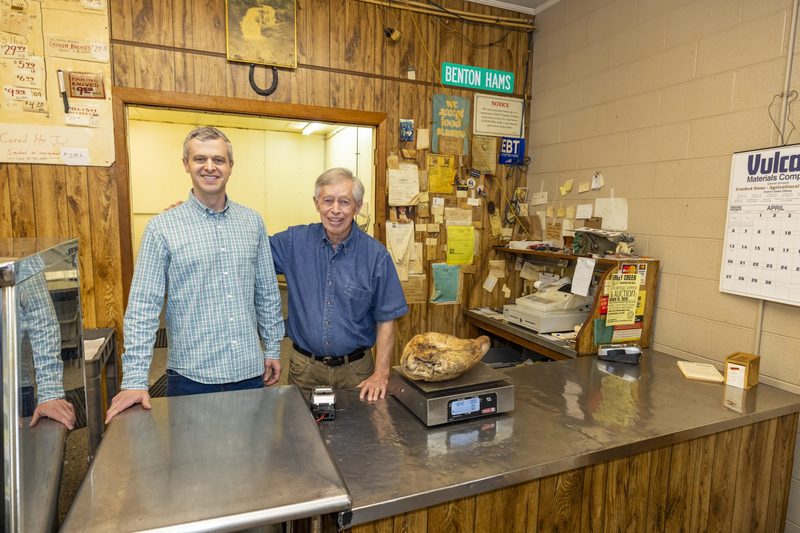
FeatureIan Carson & Spence Bender | Top Chefs 2025
FeatureJared Martin | Top Chefs 2025
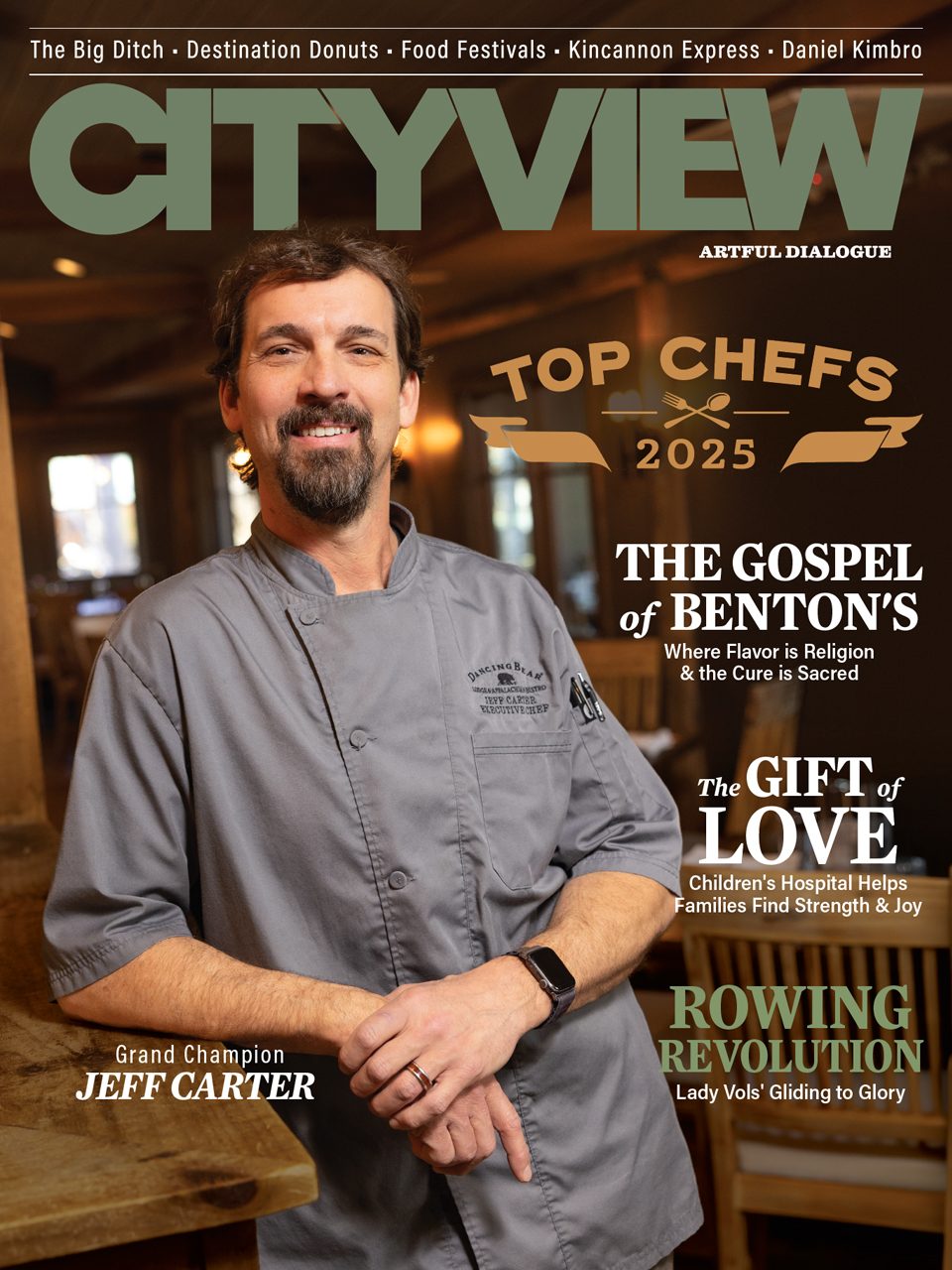
FeatureJeff Carter | Top Chefs 2025
FeatureJohn Bryant | Top Chefs 2025
FeatureRobert McDonald III | Top Chefs 2025
FeatureTop Chefs 2025
VeteranGoing Once, Going Twice, Going the Distance
FeatureHaming It Up
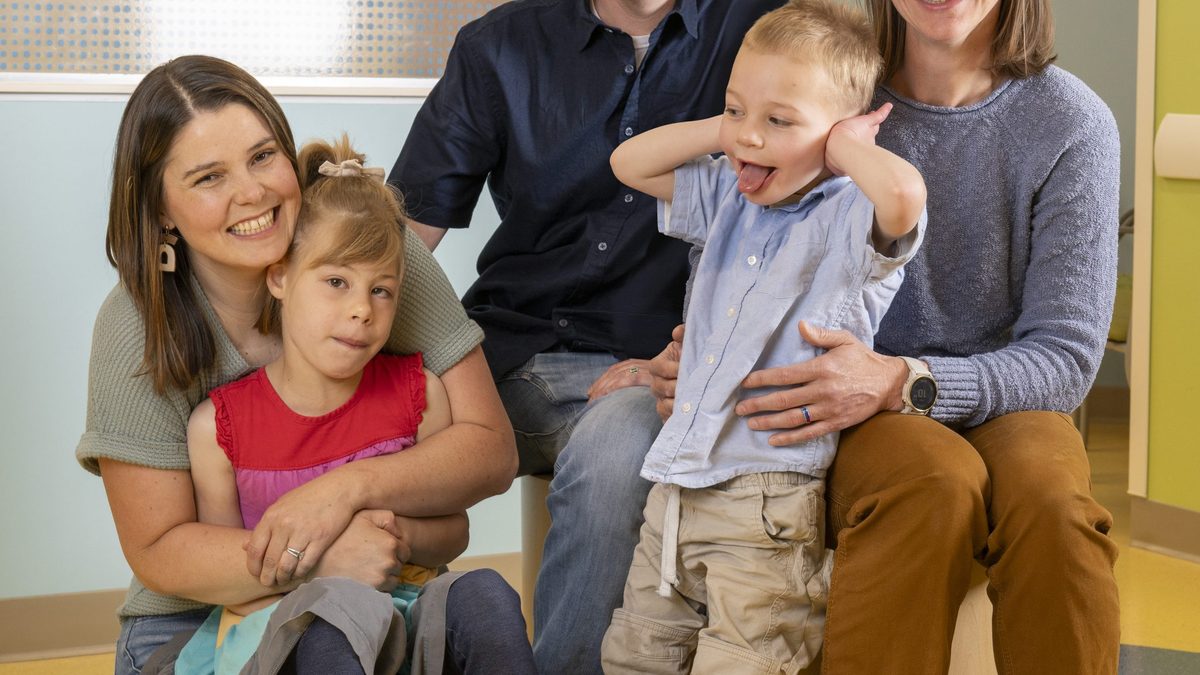
FeatureThe Joy They Carry
Reading Settings
100%
May / June 2025
Swipe to read →
Vol. 41 · Issue 3 | May June 2025
Departments
Arts & CultureTaking Nothing For Granted
MusicStudent of the Game
PoliticsAll Aboard
InsightsTo Be the Patient
DepartmentsThrough the Lens of Time
DepartmentsGay Street’s Double-Edged Hot Spot
Dining GuideDestination Donuts
Features
JurisprudenceFerdinand & The Panama Canal
InsightsBrain Rot
FeatureThe Mobility Factor
FeatureRowing Together, Rowing Tough
Non-ProfitMaking Connections
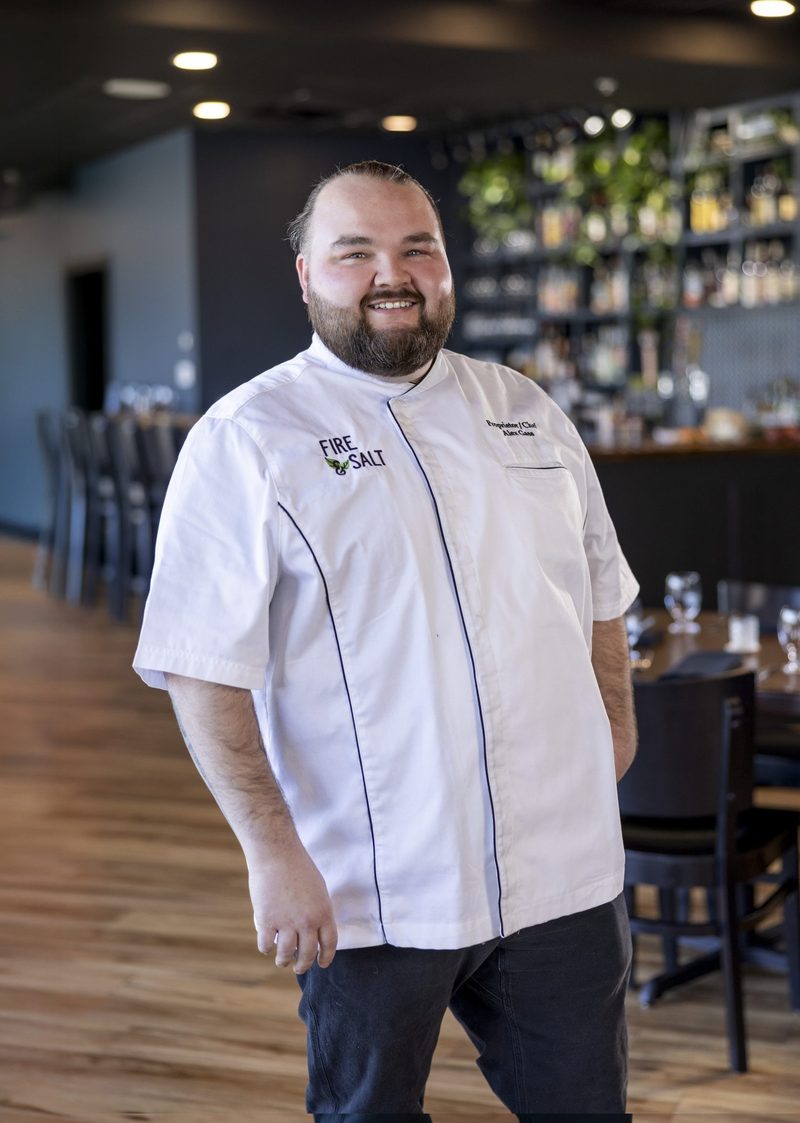
FeatureAlex Gass | Top Chefs 2025
FeatureCory Giaquinta | Top Chefs 2025
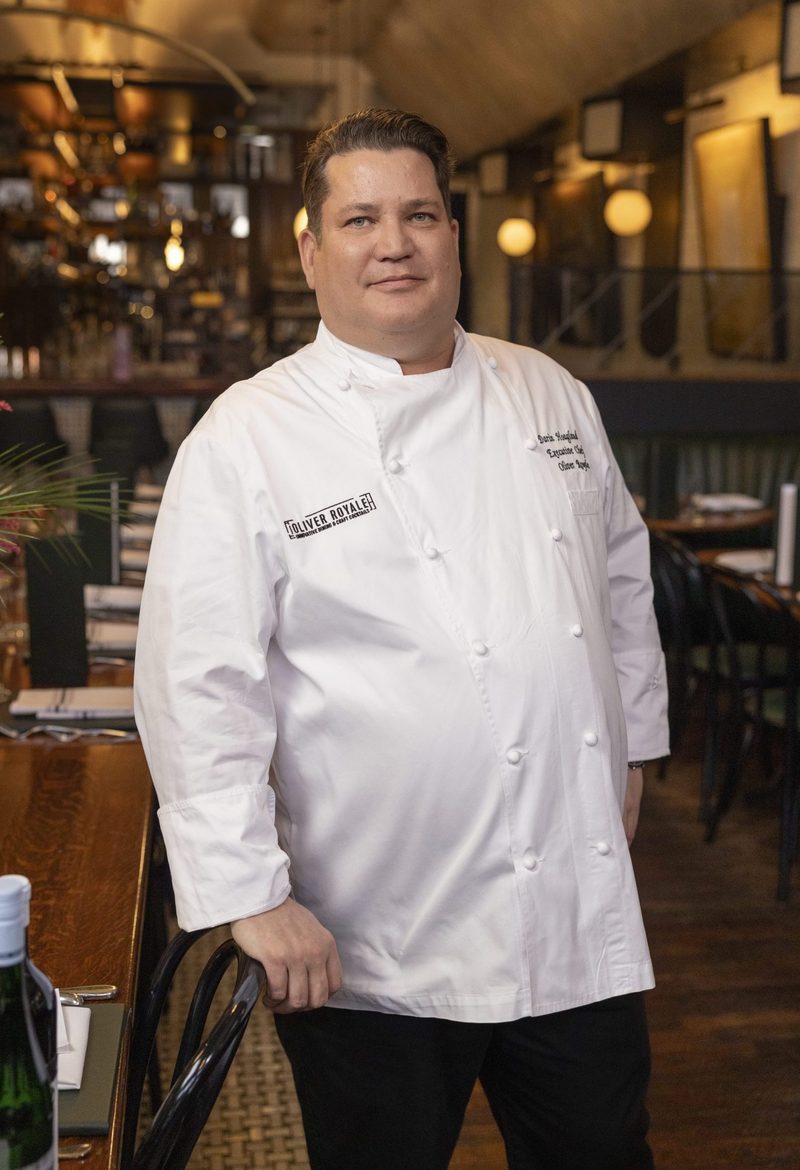
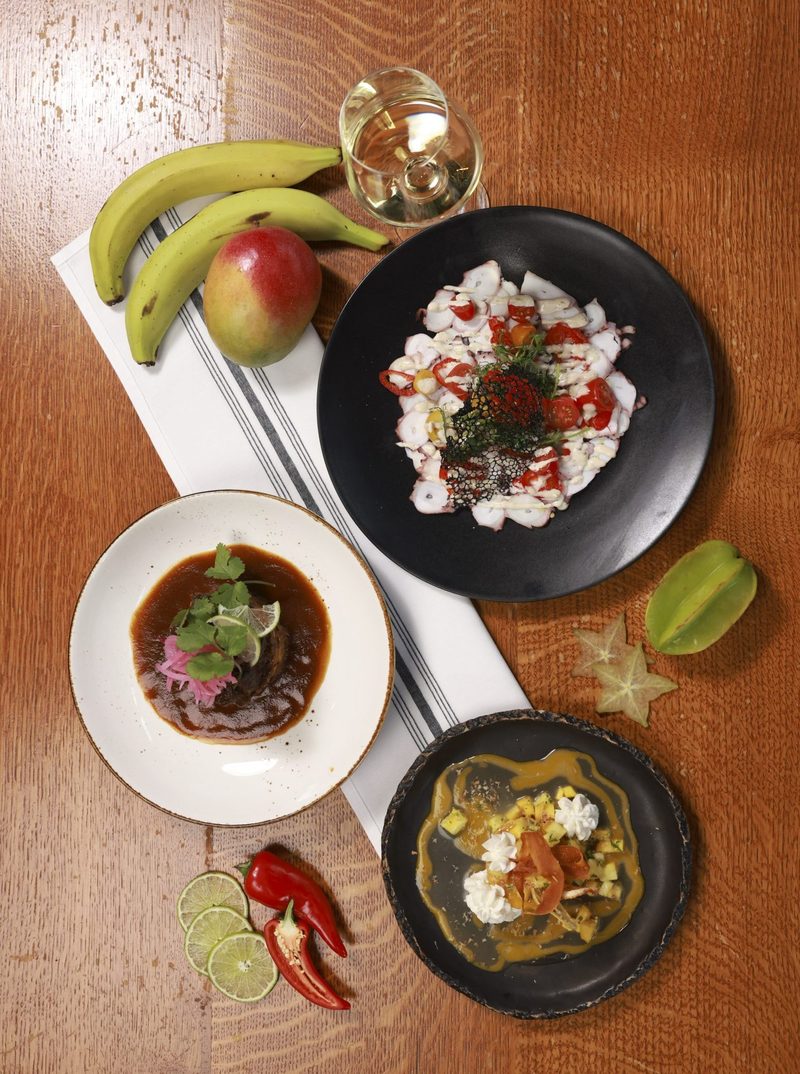
FeatureDarin Hoagland | Top Chefs 2025
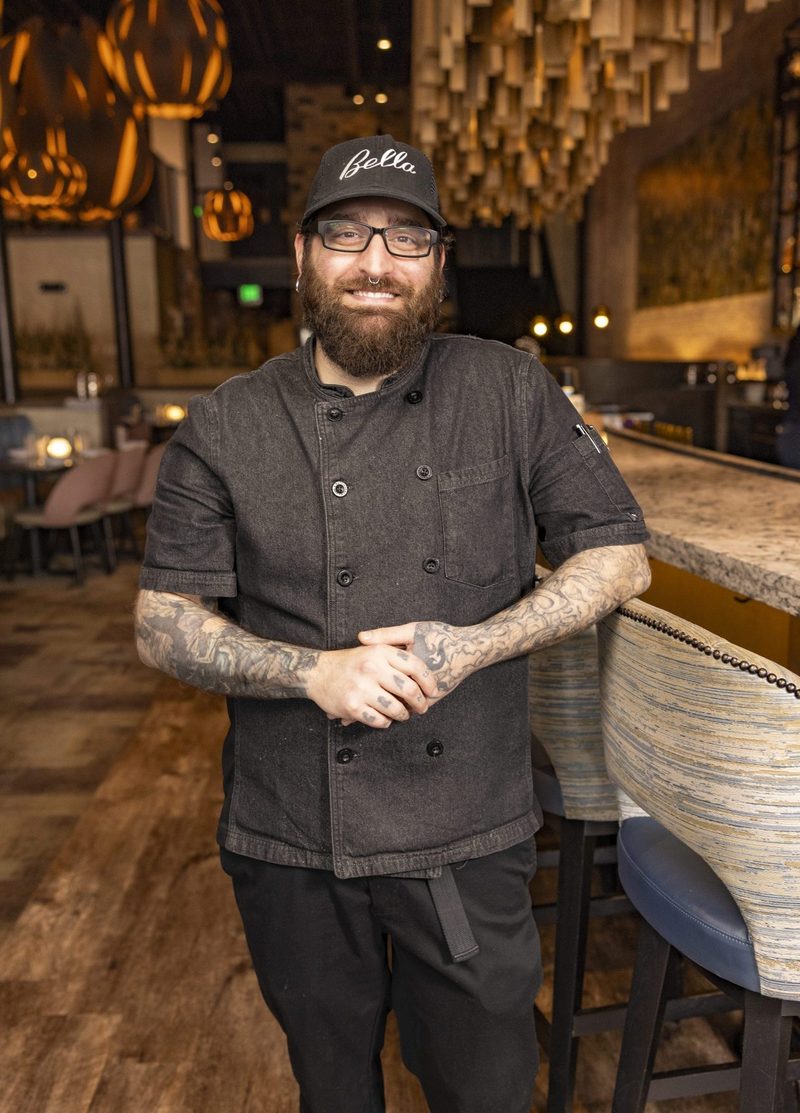
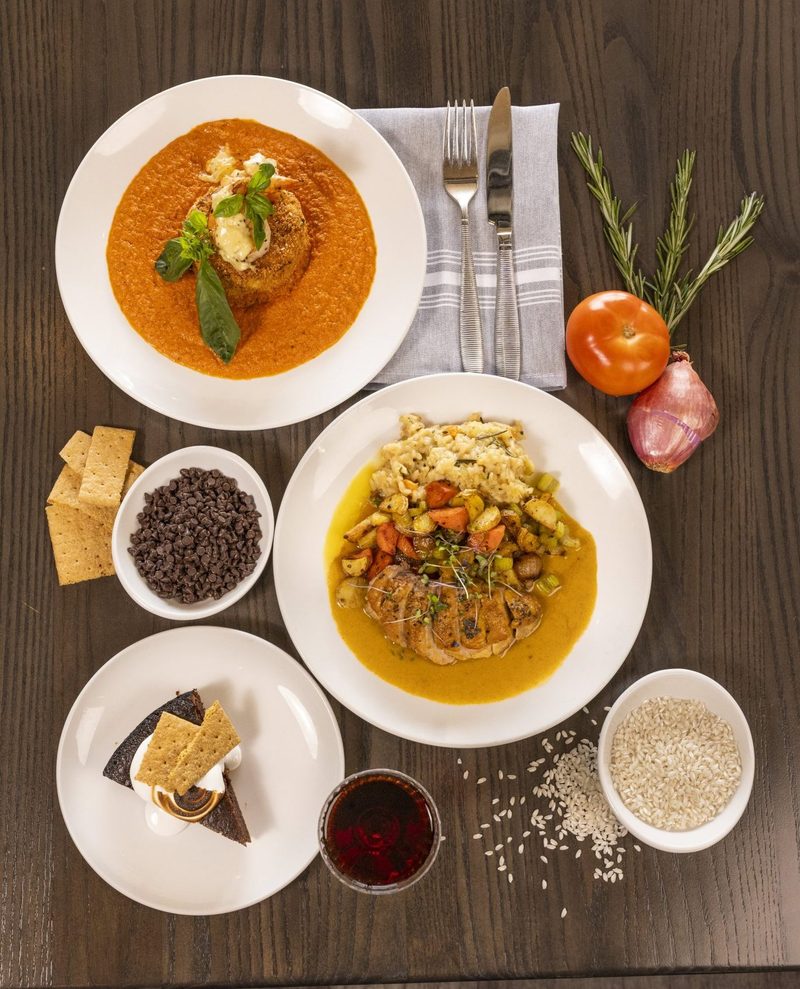
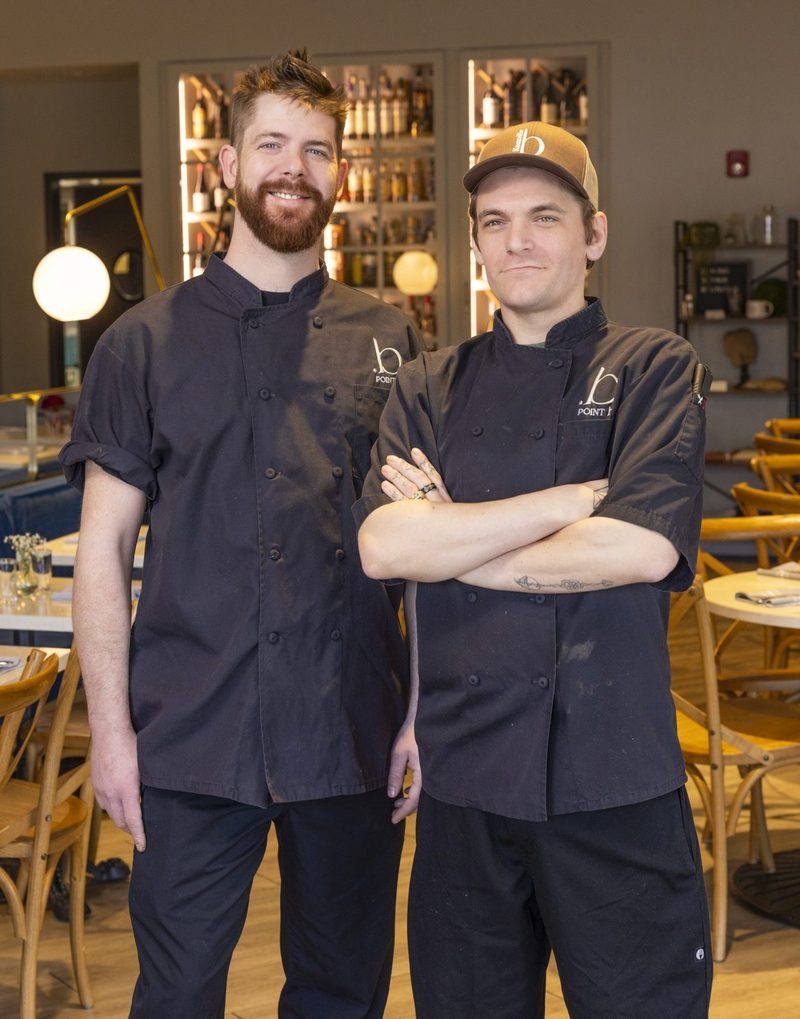
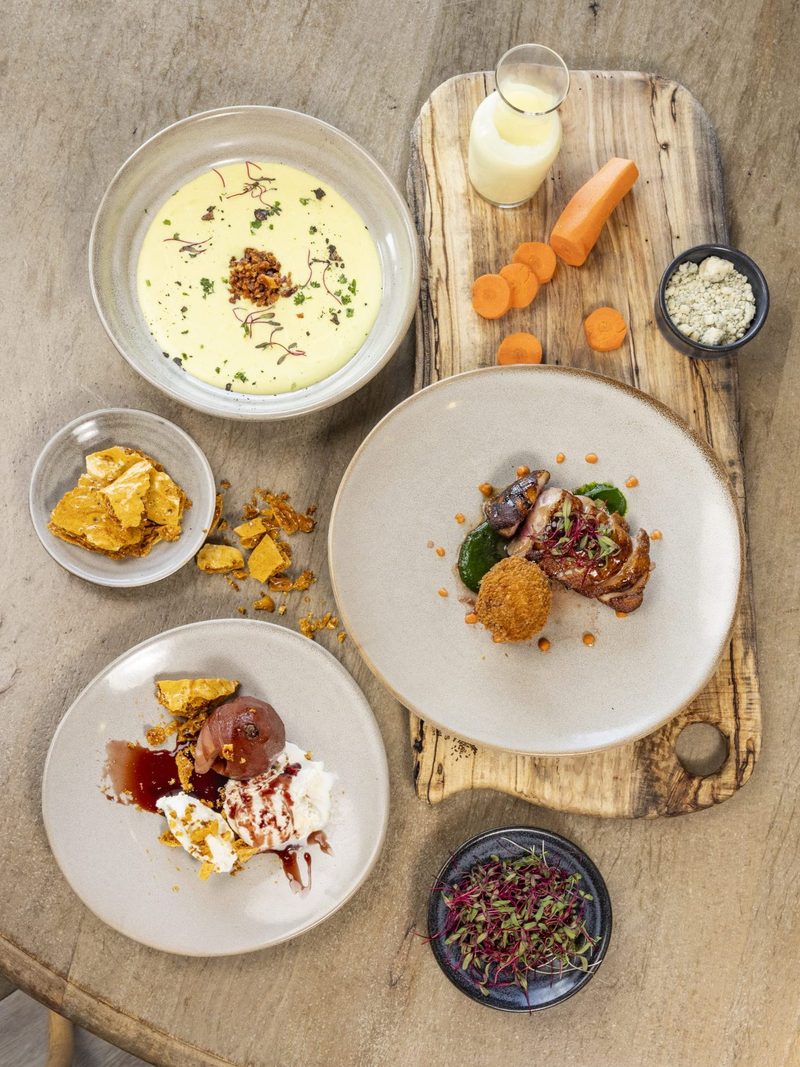
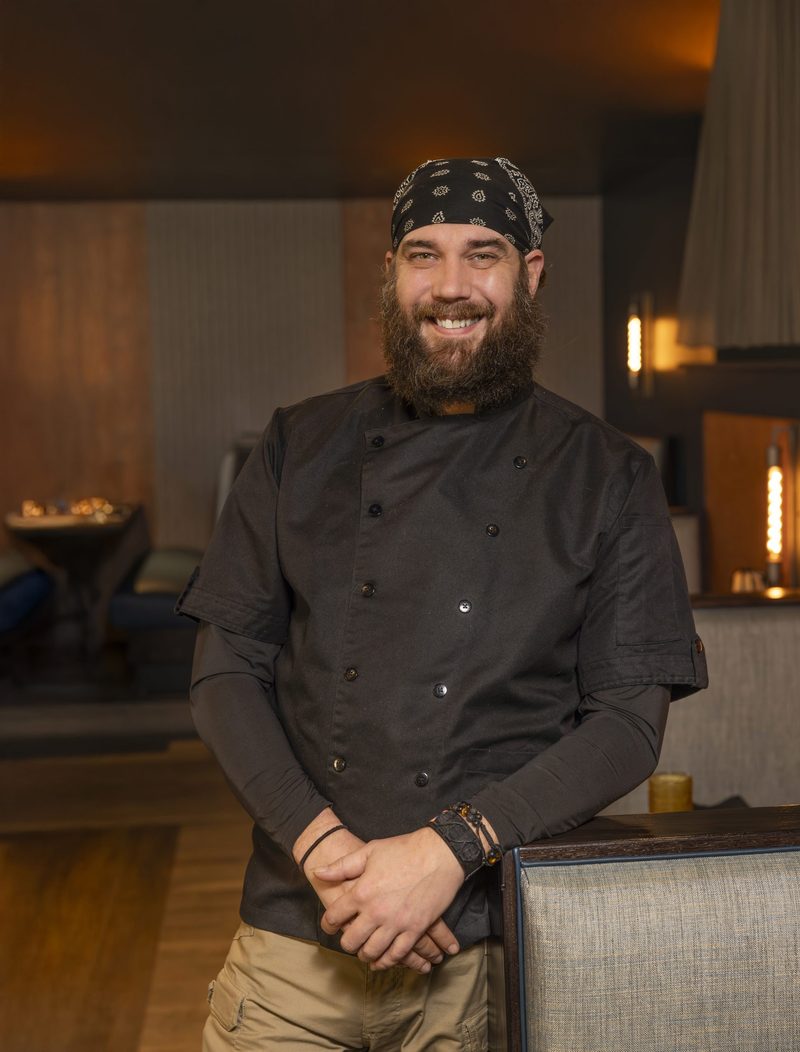
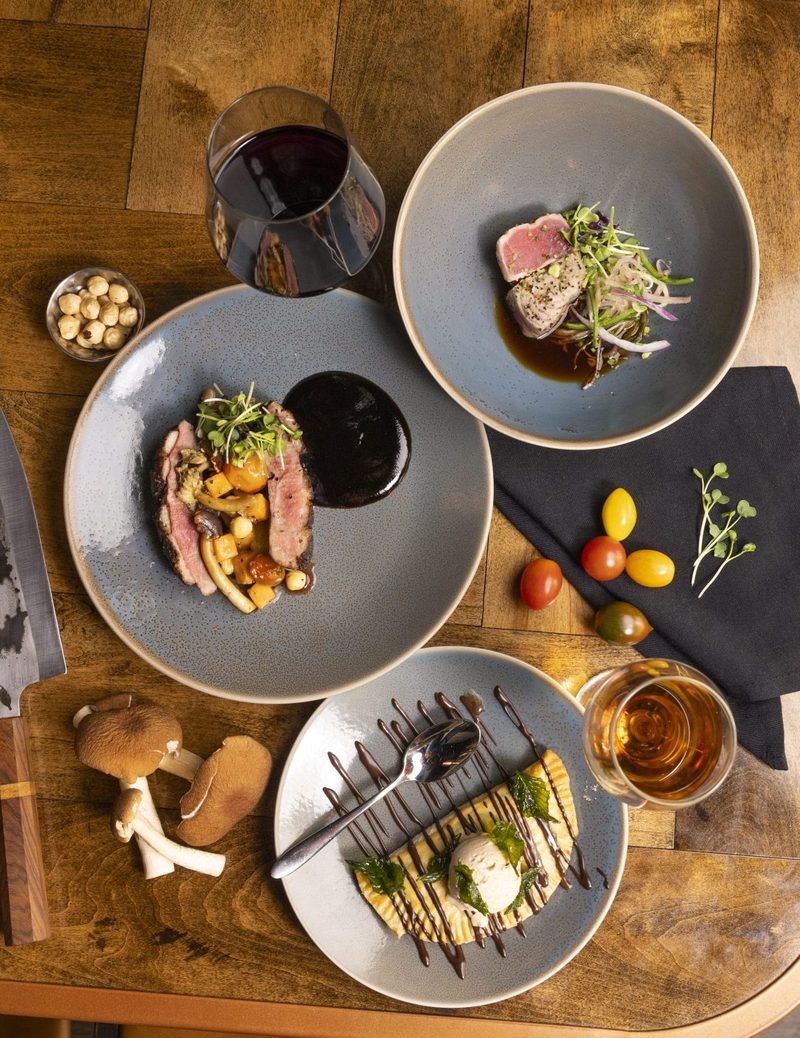
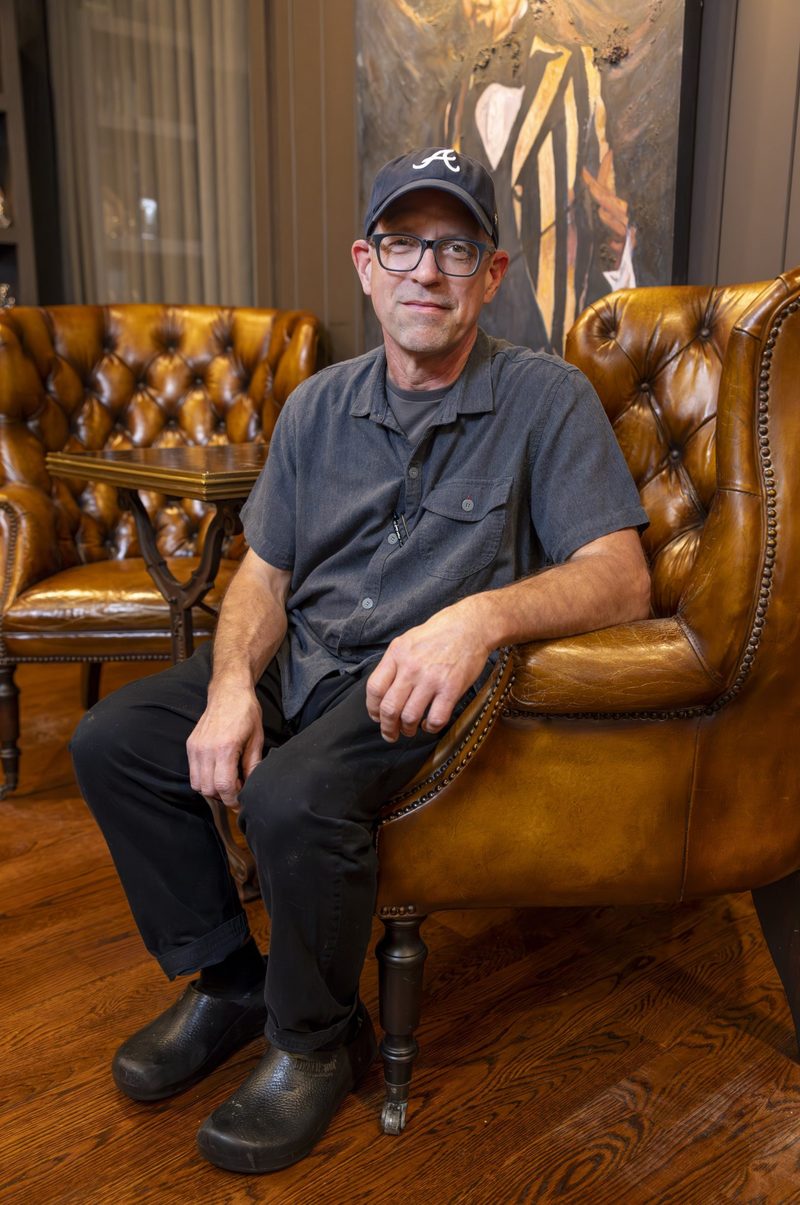
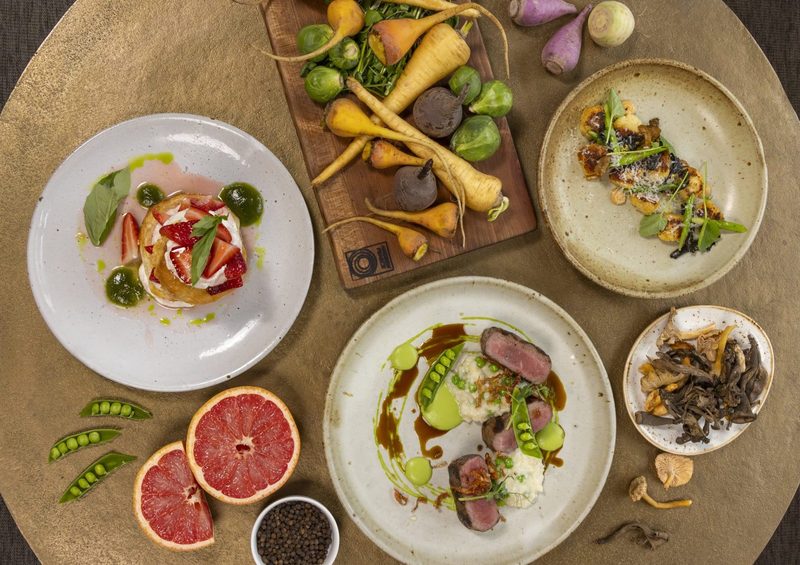
FeatureIan Carson & Spence Bender | Top Chefs 2025
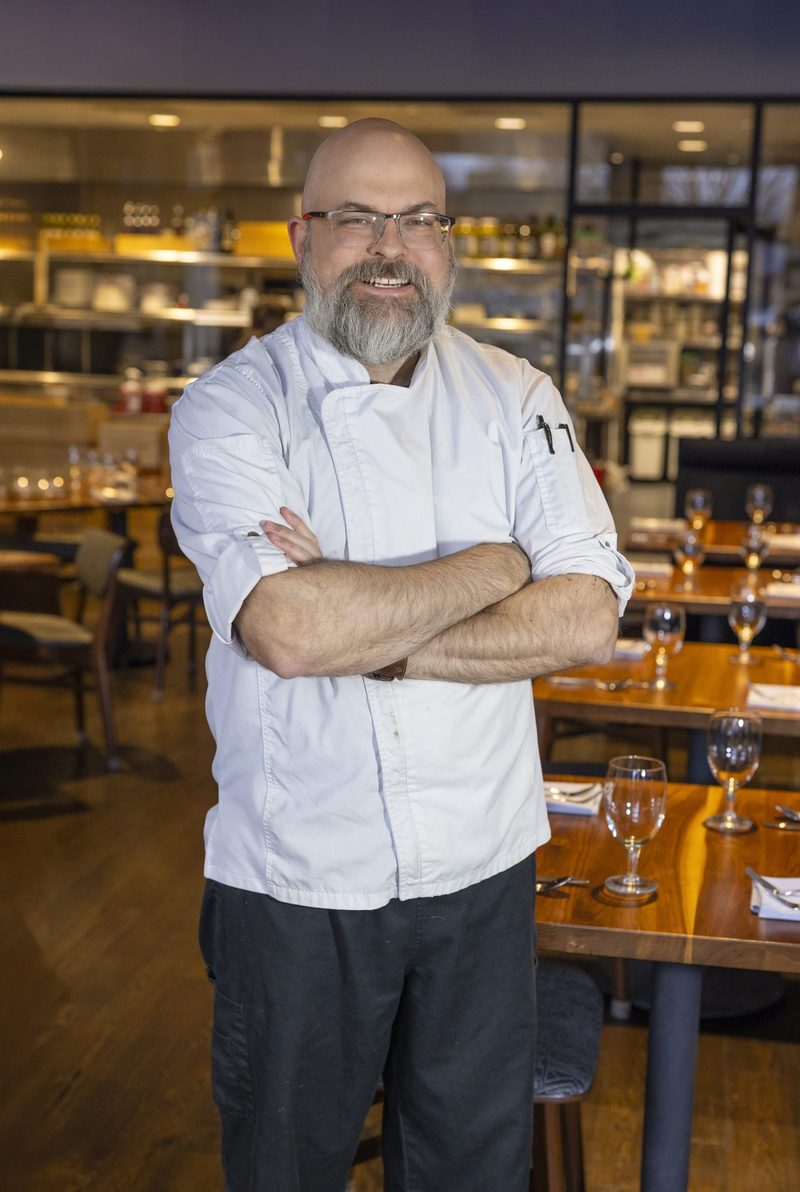
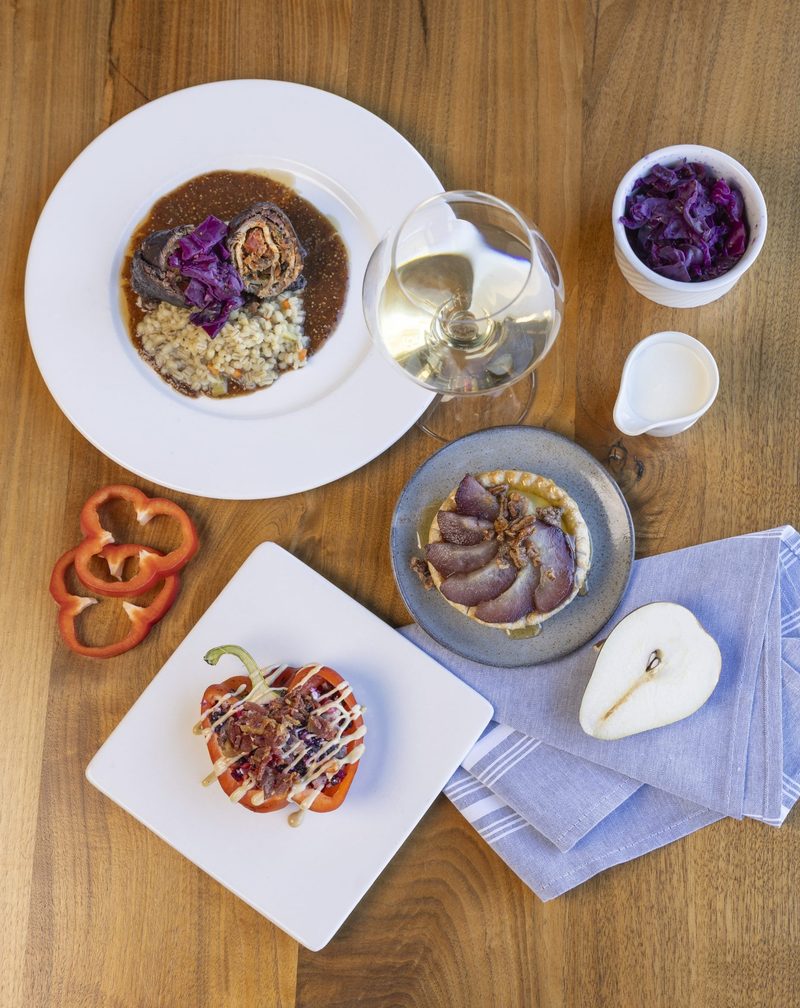
FeatureJared Martin | Top Chefs 2025
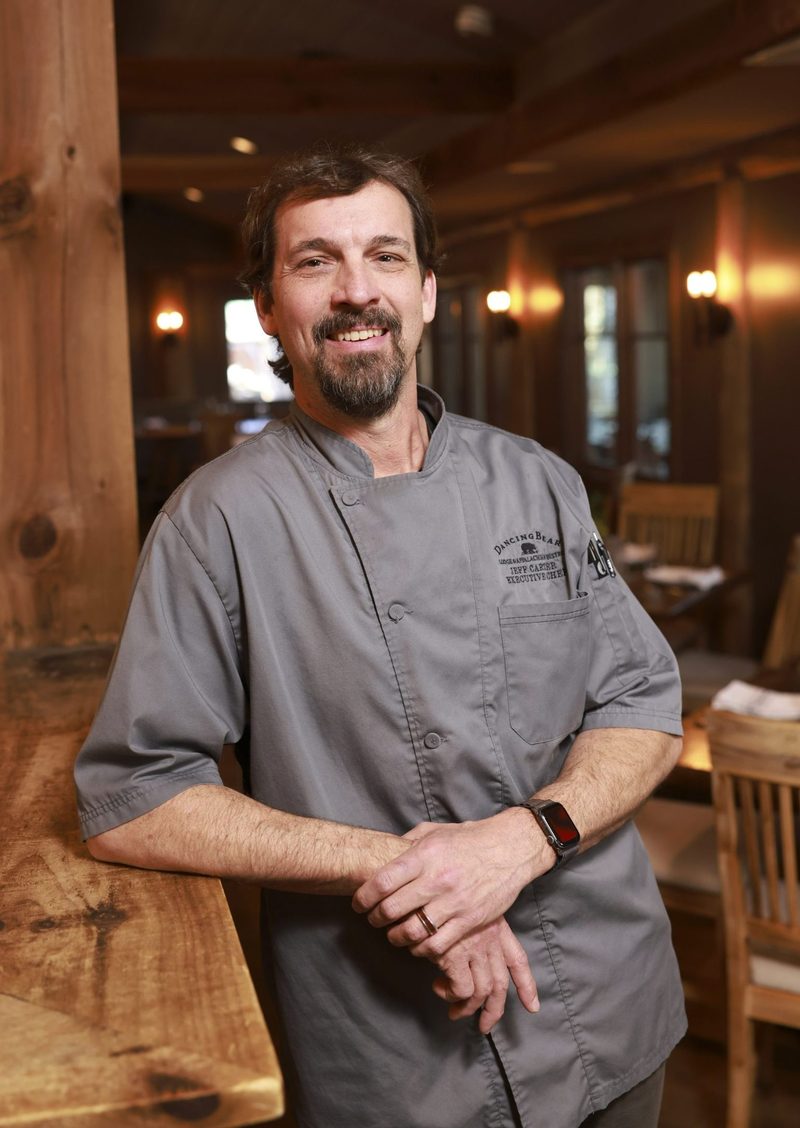
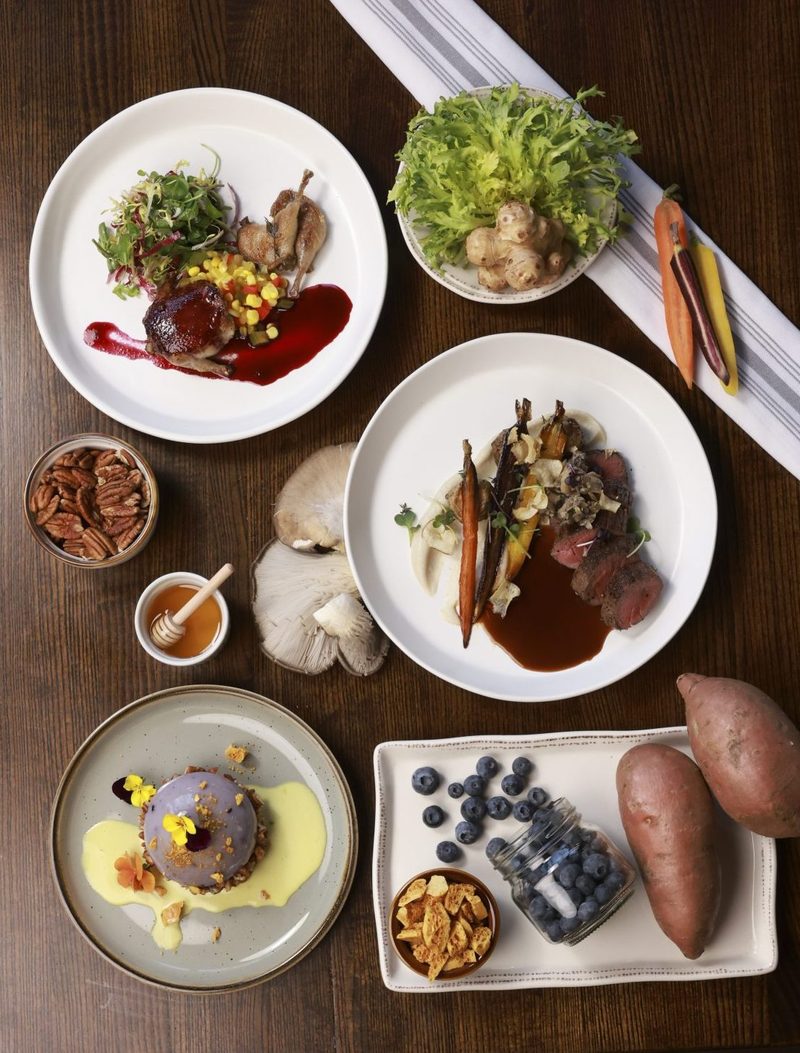
FeatureJeff Carter | Top Chefs 2025
FeatureJohn Bryant | Top Chefs 2025
FeatureRobert McDonald III | Top Chefs 2025
FeatureTop Chefs 2025
VeteranGoing Once, Going Twice, Going the Distance
FeatureHaming It Up
FeatureThe Joy They Carry
→ Swipe to start reading
Arts & CultureMAY JUNE 2025
Taking Nothing For Granted
Amanda Scott fights for her perspective on the world
Story by Susan Alexander
Though her earlier career as a dental hygienist surely contributes to Amanda Scott’s vivid smile, the passion she feels toward her current one adds energy and enthusiasm to it.
She’s been interested in art since her senior year at Farragut High School, but it wasn’t until 2019 that she began pursuing it seriously. That’s when she connected with plein air painter Kathie Odom as her art mentor.
“She taught me how to study landscapes and to see the colors underneath, really how to study the world around me,” Amanda says. “A couple of years later our family started traveling more, and I had my first taste of seeing great art in New York and in Europe. I learned how eclectic each work is; everybody gets to have a voice.”
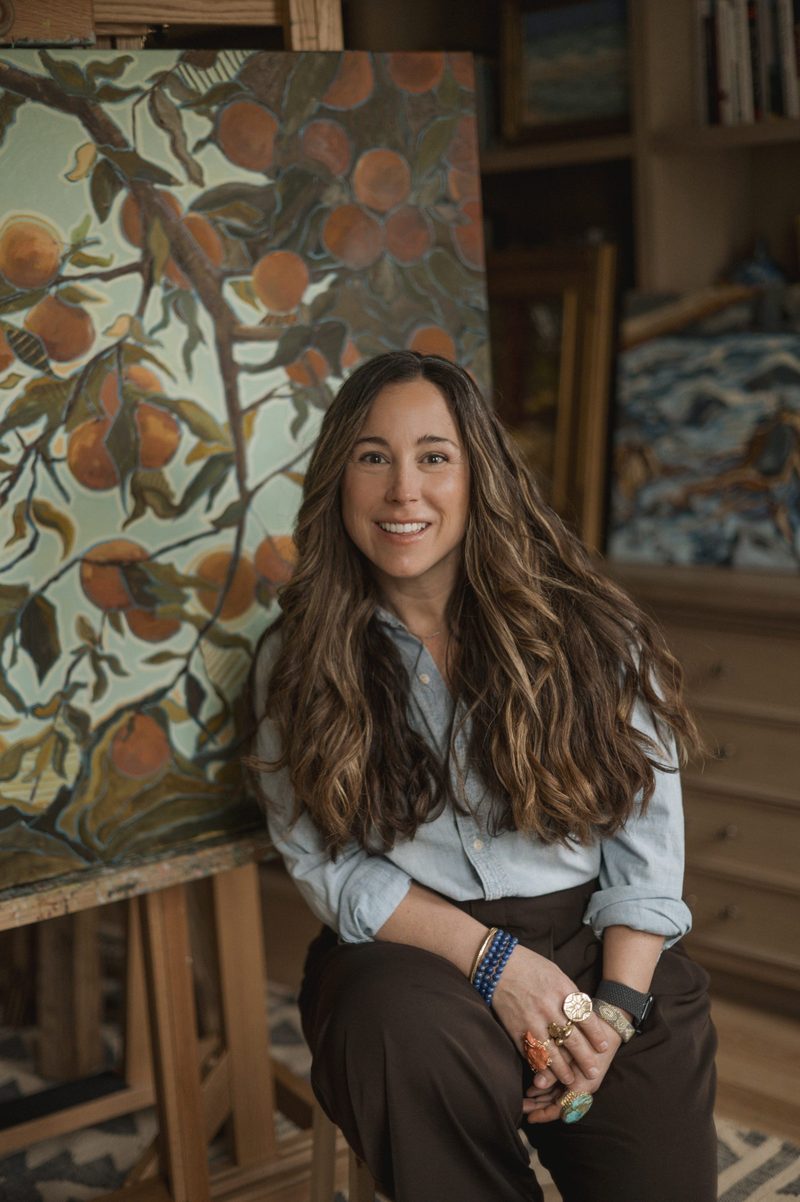
Vincent Van Gogh’s work in particular stirred her creatively, and she studied it intensively. She realized it was his use of strong outlines around images that attracted her. The technique is called cloissonnism, and she employed it in a series of 11 oil paintings of fruit trees that are on exhibit at District Gallery.
Amanda believes art is a way for people to connect. Working with the immigrant community in an English Language Learning program at Cedar Springs Presbyterian Church, she says that sharing postcards of paintings has been a way to relate to the group.
“Seeing art through someone else’s eyes gives value and dignity to each of our perspectives. There’s something about beauty; we can find common ground.”
Amanda has hearing capability only in one ear and lost the vision in one eye after battling a non-cancerous eye tumor in recent years. But she doesn’t feel hindered by being “differently abled.”
“Being hearing impaired made me more of an observer, a more curious person,” she says. “I’m a little more curious, boisterous, passionate because I’m fighting to see the world around me. I think it makes me a good artist. I don’t take vision for granted.”
Amanda participated in the Knoxville Museum of Art’s Artists on Location plein air event in April, and has shown work at the Emporium Center and the Makers Exchange. You can follow her art atamandascottartstudio.com.
→ Swipe for Next Story
MusicMAY JUNE 2025
Student of the Game
From banjo to bass, Daniel Kimbro finds peace in the process of learning
Story by Chris Blue
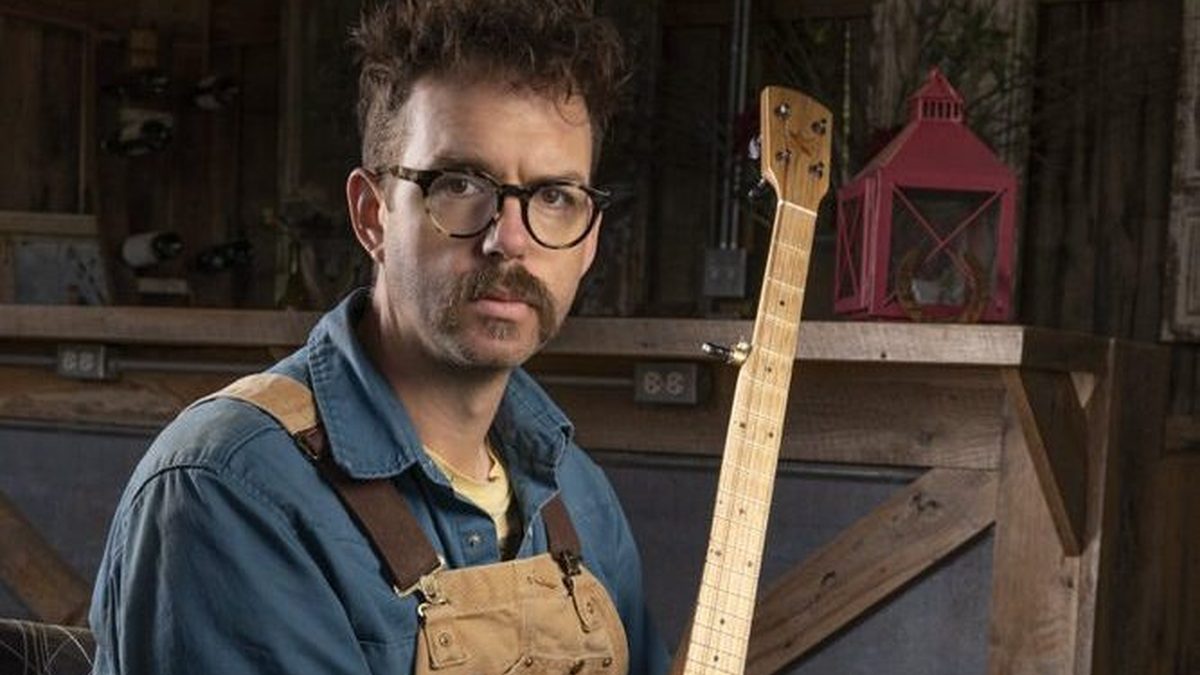
When you talk to Daniel Kimbro, one thing becomes clear pretty quickly—this guy doesn’t just play music; he lives it. “My parents were super musical folks… always listening to everything from bluegrass to classical to Van Halen,” he says of his Morristown upbringing. His mom had a deep love for jazz and would cue up everything from the Marsalis family to Peter Gabriel. His dad, a guitar player, leaned into bluegrass and classic rock. Their first date? A Van Halen concert.
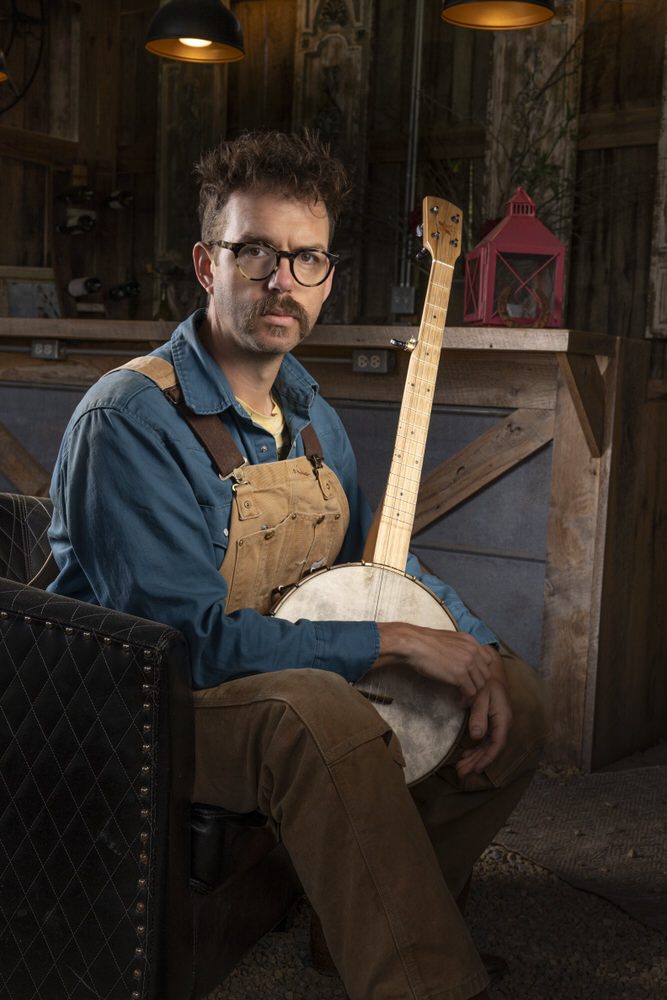
Daniel grew up surrounded by sound— folk, funk, world music among them. He even remembers skipping church to catch a Janet Jackson concert with his mom. “It was just kind of an eclectic upbringing, musically speaking,” he says. And that open-mindedness stuck. While he started on recorder like many kids, he quickly moved through trombone, guitar, and bass guitar before finding his way to upright bass in high school. He studied under Rusty Holloway at the University of Tennessee, joined jazz bands, and eventually double-majored in classical and jazz music. Today, he plays a variety of instruments, including the banjo. Daniel has spent time in community bands, honed his chops at All-State jazz festivals, and says those early experiences taught him to listen—to really listen.
What’s interesting is where all that led him—not to the spotlight, but right next to it. Daniel has built a career as a professional accompanist, elevating the music of others with humility and heart. “My parents were always pointing out the people behind the music,” he says. “They’d ask, ‘Who played bass on this?’ or ‘Listen to what the drummer’s doing here.’ That definitely influenced me.”
That mindset—focused, observant, always listening— made him a natural fit for the role. “Whether you yourself are putting your own name out there or you’re being an accompanist, you have to find a way to stay connected to the sounds that mean something to you and provide you with an emotional charge,” he says. It’s about connecting to the music and always being open to learning, and with this mindset, Daniel’s remained not only a player in the game, but a student of it. “You have to hold on to that beginner’s mindset,” he says. “Observe rather than judge.”
Daniel’s played with legends—James Taylor, Béla Fleck, John Hiatt, Eric Clapton—but now he’s carving his own path. His debut solo album, Carpet in the Kitchen, dropped April 15. “My dream now is to get my songs into a few hands and hearts around Knoxville and the South,” he says. To learn more, head todanielkimbro.com.
→ Swipe for Next Story
PoliticsMAY JUNE 2025
All Aboard
It hasn’t whistled yet, but make no mistake—Knoxville’s next tax hike is on the tracks
Story by George Korda
Knoxville city officials are again deciding how to divide up your money to pay for things you want, may want, don’t want, or don’t even know about. It’s called the budget process, and it comes around annually at this time of year, just like spring, only more expensive. And about the budget, most Knoxvillians don’t know what they don’t know.
A sentence hinting at what’s in the tax future for city residents and businesses is on Knoxville city government’s website in a summary of a Feb. 14 budget retreat as part of preparation for Mayor Indya Kincannon’s 2025-2026 budget proposal. It says, “Due to sustained rising inflation and pension costs, plus relatively flat overall revenue growth in recent years, City officials noted a long-term need to increase revenues.” This means that the tax train, probably sooner than later, will be leaving the station. But even without a tax increase, around the city budget there’s always a whole lot of politickin’ goin’ on.
Behind the public, mayoral speeches, council readings, workshops, and other required public-facing budget activities, is a constant push-and-pull of who gets what, and how much? With an annual budget creeping toward $500 million, the stakes are high for Knoxville employees, organizations, and residents. I went through four budget seasons during my tenure as press secretary and public affairs director for Mayor Victor Ashe. Times have changed, but politics haven’t, and what follows are snapshots of the individual personal dynamics that occur behind the speeches, pronouncements, and numbers.
A city employee approached me one budget season to ask me a question, as my position led people to believe that I knew what was really going on. Employees would sometimes try to cajole, or even trick me, into giving something away about possible employee pay or benefits. “What’s going to be our raise this year?” he asked. Nothing had been decided on that front, so I said, “Well, you know it’s going to be at least two-and-a-half percent.” His response, while not aggressive, had sharpness to it: “That’s what we get. What’s our raise going to be?”
Something that’s even today not well known or understood by Knoxville residents is that city employees are guaranteed by ordinance a 2.5% pay increase every year. Good economy, bad economy, or worldwide pandemic, city employees get at least a 2.5% pay bump. I looked at him, smiled, excused myself, and departed.
I enjoyed, or endured, four budgets during my tenure as Knoxville mayor’s press secretary and city public affairs director. Two went smoothly: budget retreats to nail down city priorities, discussions with city council members individually, the required public activities, and final passage by June 15, before the July 1 fiscal year begins. Every year, the goal was to pass the budget without controversy or conflict.
But two were problematic, requiring heavy doses of politics. The most difficult was the administration’s first budget. For this, a reluctant council passed two budgets: one was with cuts of $3 million to city services; the other, fully funded version, would go into effect if the administration successfully passed a sales tax increase referendum, six of which had failed in the preceding 17 years. A high-intensity campaign saw the referendum pass with 63% of the vote, and money and tax worries were over. For a while.
Several years later, a property tax increase was unavoidable. As we planned how to explain this, I recalled that during a conference in Washington D.C., I’d attended a panel discussion on unfunded mandates. An unfunded mandate is federal, state, or even local, government passing laws while passing the costs on to someone else. I asked then-city finance director Randy Vineyard if unfunded mandates were a factor in the proposed increase? He checked and said, yes, more than two-thirds.
I had charts made, and Mayor Victor Ashe held a news conference to show city residents that but for unfunded mandates a smaller tax increase would have gone exclusively to city-identified needs. The budget passed without difficulty.
Today, with a smaller local news media, no public conflicts between city and county government, and voter turnout trending low even as city population rises, there’s less focus on city government and the budget. Most people would complain if at a restaurant they order a hamburger and don’t get it how they want it; however, where their city’s budget is concerned, most don’t know about it, or don’t know what they don’t know. And they don’t care. It’s a very curious thing.
→ Swipe for Next Story
InsightsMAY JUNE 2025
To Be the Patient
Caregiving takes on a new meaning when we become the ones needing care
Story by Rev. George Doebler
One year ago in May, I officially retired from a calling I’ve come to realize I loved. For 53 years, I served as a clinically trained pastor: 13 years in the Department of Mental Health at Lakeshore and 40 years at the University of Tennessee Medical Center. What began with clinical training at St. Elizabeth’s, a federal mental hospital, by happenstance turned into one of the largest pastoral training programs in the country.
I tell this part of the story, not as a way to boast, but as a prologue to what has happened this past year and the lessons learned. I’ve gone from being a caregiver to patients, families, and staff to being the one who needs care—and it’s been nothing short of insightful. Despite having faced appendicitis, heart disease, a new hip, a new knee, a pacemaker, wrist surgery, and heart stents, I never really fully grasped what it meant to be a patient.
Beyond all the clinical experience, classes, and seminars, I am learning that what matters most isn’t what you say or do as caregivers—it’s how you show up. It’s about what patients feel when we’re with them, but also what they feel when they’re alone.
Being a patient is not the same as being patient. Just ask Nancy, my wife of 61 years. Making appointments for bloodwork or pain in my heart, back, neck, or shoulder, doesn’t always bring out our most calm versions of ourselves. I have a hunch you may have experienced this, too. And while we’ve been needing health care since we were kids, regardless of the kind, it still never seems to feel any easier.
These days, I find myself sitting in waiting rooms for an appointment at least once a week. What I am learning and continue to learn is that treatment and care are not synonymous. When we go to the office we fill out paperwork almost every time. We see a technician or nurse who then talks with a doctor about what they have learned—this is done to save the doctor time I am told—but we often see the doctor for the least amount of time. Being on the other side of care, I am finally understanding how that runaround feels. What makes a difference though are the little things—the personal touches that remind me this is more than a rigid process to care. When a caregiver reaches out to shake my hand at a first meeting, pulls up a seat to face me when we speak in their office, puts their hand on my shoulder during a challenging moment, or discusses options alongside me, my heart feels at ease. When a caregiver stands at the door, rather, reads notes from an iPad, and dictates what they are going to do to treat me, I am less likely to feel seen and heard. I’m also less likely to return.
It is clear that medicine is a big business, one of the longest in our culture. Hospitals and clinics can be stressful places. We are at our most vulnerable when we arrive, even if it’s just for a well-care visit. After all, we’re entrusting our wellness to someone other than ourselves. But when that person listens to where we’re coming from— even when it’s not easy because we’re sick, frustrated, and not thinking clearly—it makes us feel at ease. In spite of the business and marketing of health care it is still a very personal experience and when treated as such, that’s what makes all the difference.
Words like “Love one another as I have loved you” are not easy. But they matter. Caregiving takes personal work, giving of ourselves even when it’s hard. When we find that in the wild of healthcare, it makes a difference. And when we can then come home to our families and spouses, who get the brunt of our emotions, who see our worst and yet still show up, we can rest easy. That’s love. That’s care. And that, too, is something I’m learning to honor
→ Swipe for Next Story
DepartmentsMAY JUNE 2025
Through the Lens of Time
Unveiling the Smokies’ Hidden Stories Through Campbell’s Photographs
Story by John Quillen
I‘ve mentioned Frank Harvey in the past. He is descended from Smokies royalty, claiming the bloodline of Grandpa Carlos Campbell. Many have passed that overlook on our way up to Newfound Gap. Carlos was instrumental in the founding of Great Smoky Mountains National Park.
While whacking at ice walls together out in Colorado, Frank casually mentioned that he was in possession of some straggler photographs from Grandpa. Harvey and family descendants had graciously agreed to donate the majority of Campbell’s photography to the park. My personal view of the archives at Great Smoky Mountains National Park invokes the closing scenes of theIndiana Jonesmovie where they took the Ark of the Covenant, boxed it up, and shoved it into a corner of a warehouse never to be seen by human eyes again. I jumped at the chance to take temporary possession of these remaining photos.
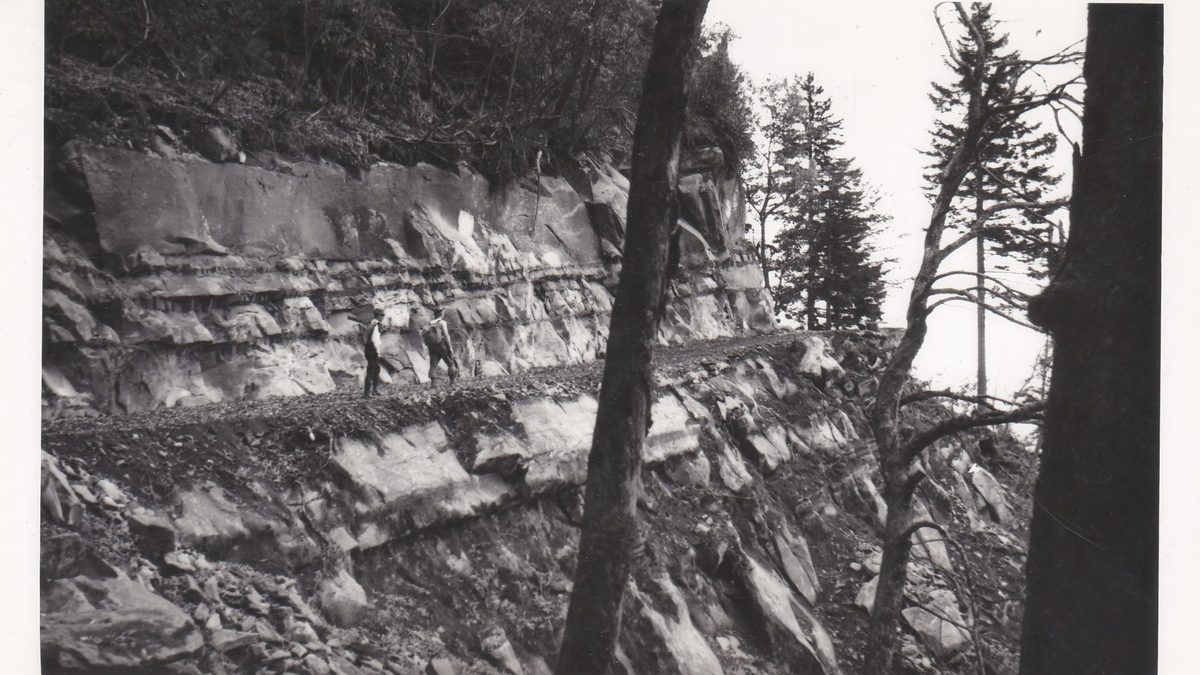
Right off the bat, one shot of a trail heading up to Mount LeConte caught my eye. Despite having been freshly cut from the hillside, I recognized this path immediately as Bullhead. All photos were numbered and descriptions inked on the back in Campbell’s own hand.
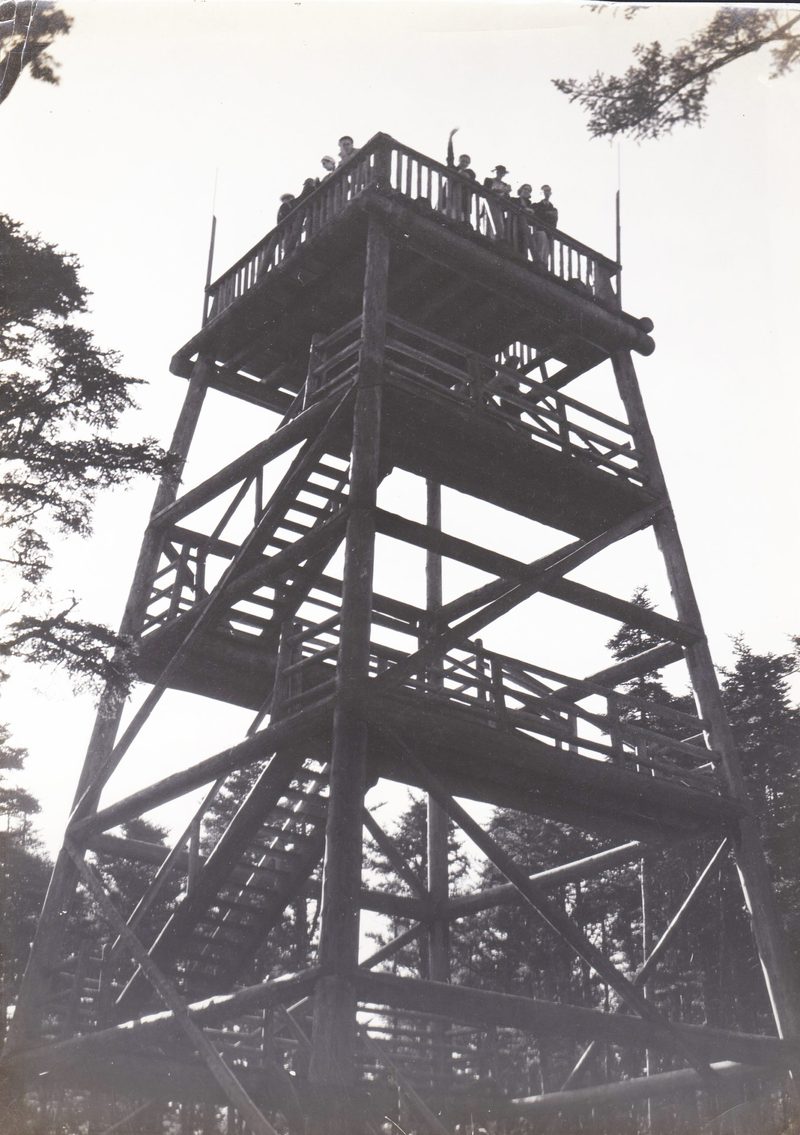
Shuffling through the pile. I spy another black and white image of a firetower and first thought it could be Mount Sterling but read it was the now defunct Greenbrier Pinnacle Tower. There is no official trail up there anymore.
Only the hardiest of trail hikers can bushwhack up to this spot. What they will find is bare ground where a building and beautiful tower once reached towards the clouds.
Speaking of towers, the next one that I gravitated towards was familiar. Before its recent name change to the indigenous Kuwohi, Clingmans Dome was home to a wooden observation tower that sits where the concrete walkway and circular deck now reside. I can only imagine how thrilling it would have been to ride up state road 71 back in the late’30s and escort your children the few sets of stairs up to this overlook.
What they likely would have seen on one of those rare clear days up on the Smokies’ highest prominence was the longest vista down into Carolina via Deep Creek. Inevitably thatshaconageview—the Cherokee name for the mountains, which translated means the “Land of Blue Smoke”—was accompanied by fresh scars from the lumber companies trying to get in their last whacks before the park was commissioned.
I didn’t have to look at the back of this next picture to know exactly where it was. It’s one of those magic, almost spiritual places in the park where morning rays of sun filter through the poplars as you shake out the dew from moist nylon or, in this case, canvas. I have been awakened in the middle of the night at this very spot by wild hogs rooting around my tent. I’ve nursed campfires so wet here that the smoke engulfed the entire saddle.
Many are the nights we stumbled down from atop Gregory’s Bald to settle into our digs here at Sheep Pen Gap. Gabardine- and wool-clad backpackers mill about the background in this idyllic scene. You can almost smell the coffee percolating over smoldering embers.
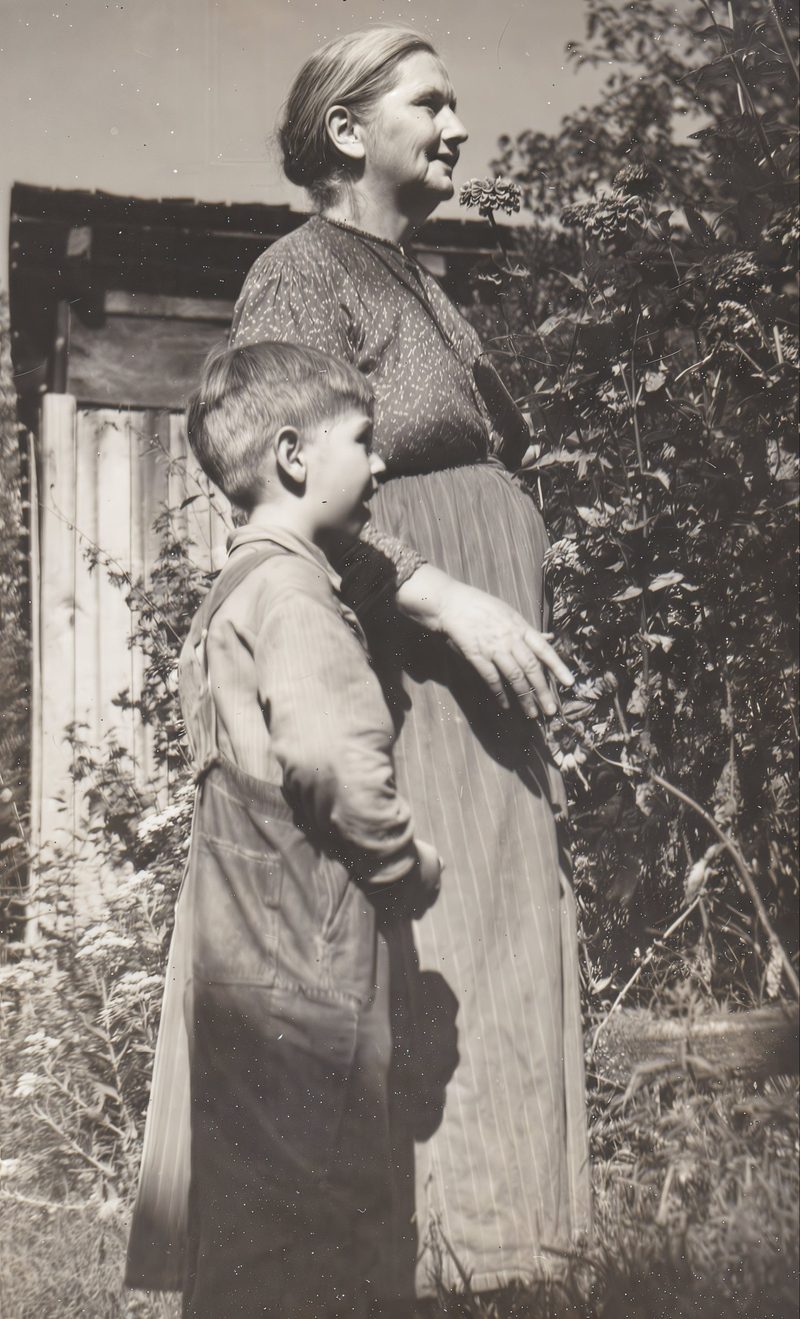
The last photo is one I assumed had been published somewhere. I phoned up Frank to verify, but he didn’t know. I performed a Google image search and, to my surprise, nothing popped up. Among this trove in my temporary possession is a stately profile shot of Polly Walker. Polly and her five sisters—their sixth sister had married and moved away—were one of the last families to inhabit Great Smoky Mountains National Park. Nestled in their Little Greenbrier cabin, these hardy women subsisted in the same manner as their forebears well into the 1960s. The park made a special allowance for them and only a small group of others, and the Walker Sisters’ cabin stands testament today. There’s plenty of documented history about these women from their homespun clothing to the butter they churned. So many visitors stopped by after the park creation that they actually had to ask the NPS to turn people away as they were unable to attend to daily chores as a result.
Absorbing the profile of Polly, I wondered about Campbell’s relationship to them and their feelings about his efforts to cordon off their half million acres for future generations. Although I never had the privilege of meeting the guy who passed well before my birth, I know his grandson pretty well. Frank Harvey and I have worked together on public land access issues through the East Tennessee Climbers Coalition and, my favorite organization, the Southern Forest Watch. Frank recalled stories about Grandpa Campbell being bitten by a rattlesnake. Another incident involved some hooves from an uncompliant deer that was not so appreciative of his photographic talents.
Knowing what I know about Harvey, it isn’t difficult for me to make the stretch to Carlos. I suspect Campbell held a deep affinity for the Walker sisters and their situation. They would, according to the NPS, be the last indigenous settlers to finish out their days here. His camera captured a mixture of joy and sadness in the stoic image of Miss Walker. It is a strange collision between death and birth. One giving rise to the other. I want to think that the Walker sisters understood the necessity of what Campbell was doing despite the bittersweet implications. I know that through Campbell’s photography, I certainly do.
→ Swipe for Next Story
DepartmentsMAY JUNE 2025
Gay Street’s Double-Edged Hot Spot
The Kennedy blends the lively atmosphere of a sports bar with an upscale dining experience.
Story by N. Brooks Clark
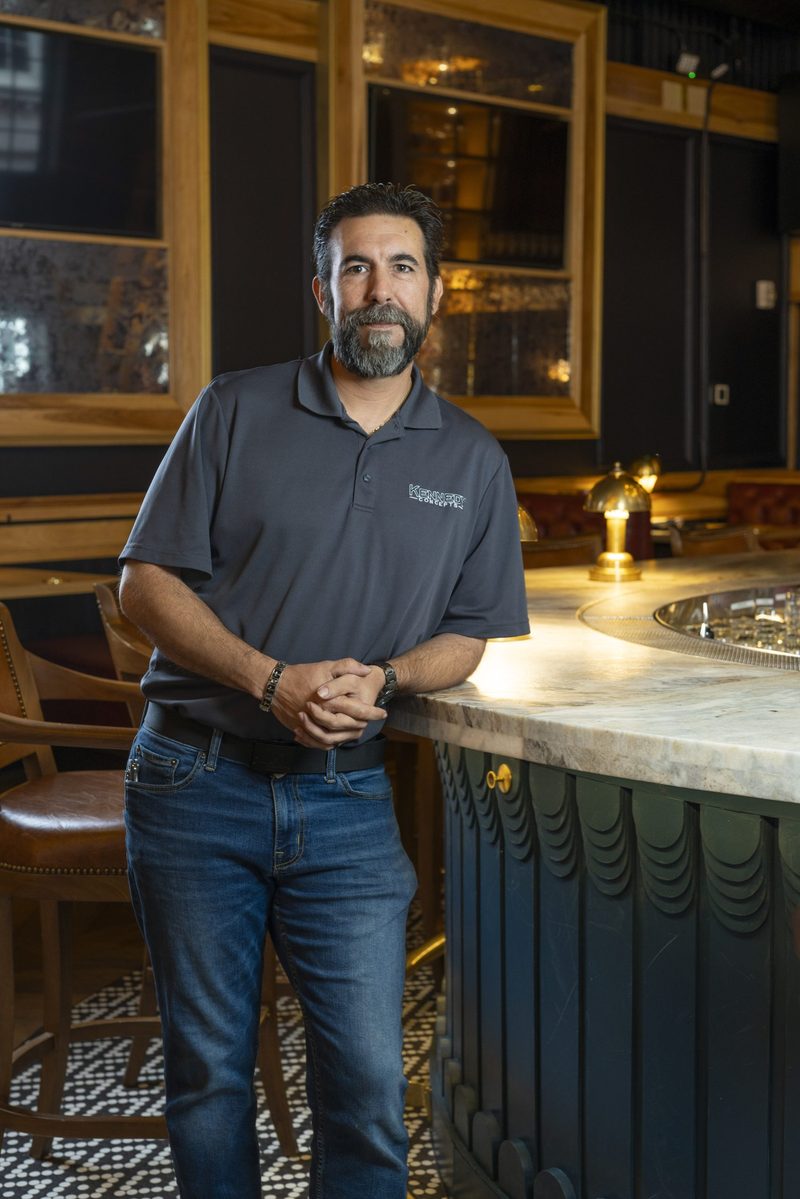
Located at the corner of Gay Street and Union Avenue, this historic building has undergone a remarkable transformation. For 34 years, through 2010, it was the elongated Arby’s. Then came the full building renovation and the fancy Café 5, followed by the Blackhorse Pub & Brewery from 2018 to 2023. It now houses a sophisticated yet inviting destination under the ownership of Chad Kennedy of Kennedy Concepts, owners of Puckers Sports Grill in Sevierville and Loco Burro in Gatlinburg and Knoxville.
At first glance, The Kennedy exudes the charm of a classic steakhouse. Rich wood paneling, vintage black-and-white photographs, black stamped-tin ceilings, and the soft glow of golden globe chandeliers create a sense of history. The wooden floors creak just enough to suggest generations of diners before you. The open-brick walls and picture windows onto Union Avenue on the side and Gay Street up front showcase the activity of downtown’s passing parade. But beyond its timeless aesthetic lies a dynamic menu and cocktail program that blend tradition with bold innovation.
With a capacity of 144 guests, including 35 on the mezzanine level and a cozy, low-ceilinged space below (affectionately called “under the Mezz” by staff), The Kennedy offers a versatile setting. Somehow you don’t really notice the four light-wood-framed TVs on the inner wall, the TV high over the bar, or the four TVs on the window side. At the heart of the restaurant stands a striking oval marble bar, where skilled bartenders—using a tall wooden ladder to grab the premier brands from the extensive top shelves—craft both classic cocktails and inventive creations.
A standout is the Margarita Al Pastor, made with reposado tequila, al pastor salt, charred pineapple cordial, and Loco Burro sour. One of our party opted for a classic Tanqueray-and-tonic, declaring it “just perfect.” The TK Old Fashioned, featuring King’s Single Barrel whiskey, Belgian Candi sugar, and Peychaud’s Bitters, offers a familiar bourbon-forward profile with a subtle umami twist. The Milk and Honey comes in a miniature bathtub complete with a miniature rubber ducky, appropriate for the honeycomb gin, local honey, lemon, and gin botanical foam.
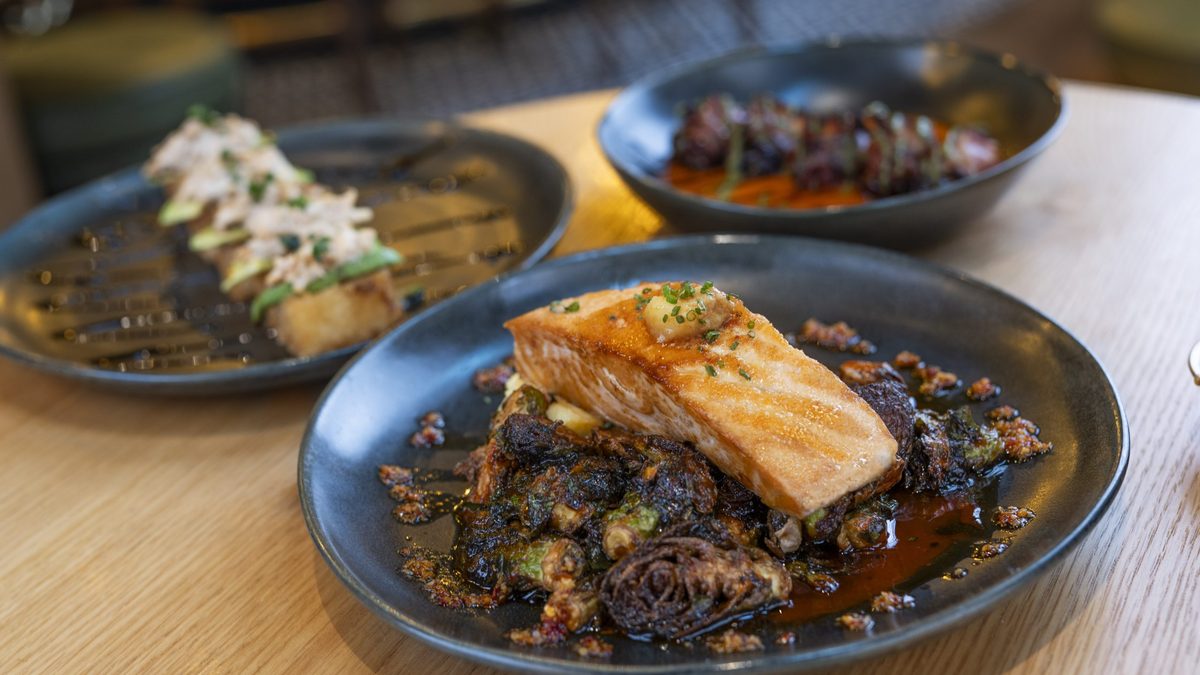
The menu follows suit, respecting culinary tradition while embracing creative reinvention. Chef Michael Obermeier ensures that even the classics feel fresh. His herb-roasted prime rib is “perfectly even,” as he describes it, its deep, beefy richness complemented by charred carrots and whipped potatoes. Faroe Island Salmon, typically a simple dish, is elevated with miso butter, “sweet heat” Brussels sprouts, whipped potatoes, and chili crisp. They cook the Braised Short Ribs for eight hours at 250 degrees, sear it super-hot, and serve on a miso white bean puree, garlic-braised Swiss chard, and chimichurri.
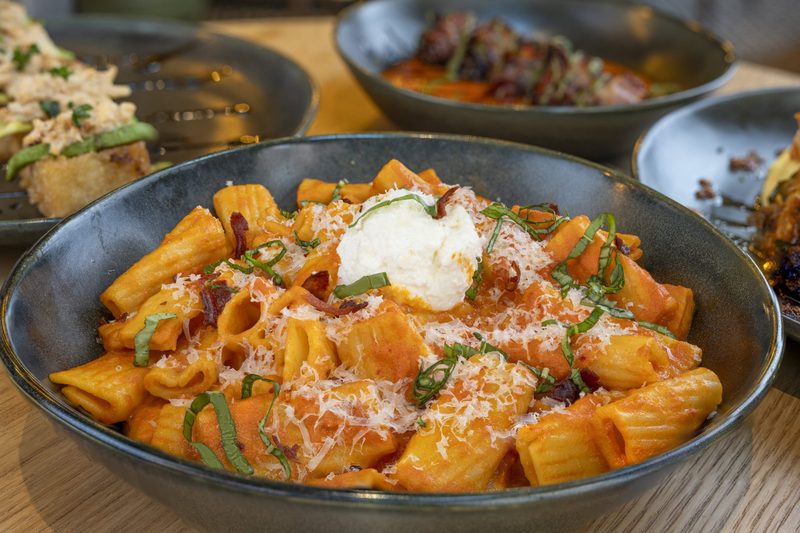
Even the tomato and burrata salad receives a sophisticated update with crispy prosciutto, green olives, and pumpkin seed pesto. Pasta lovers can enjoy Spicy Rigatoni in pink vodka sauce with Grana Padano cheese, made even more indulgent with the addition of miso buttered lump crab meat.
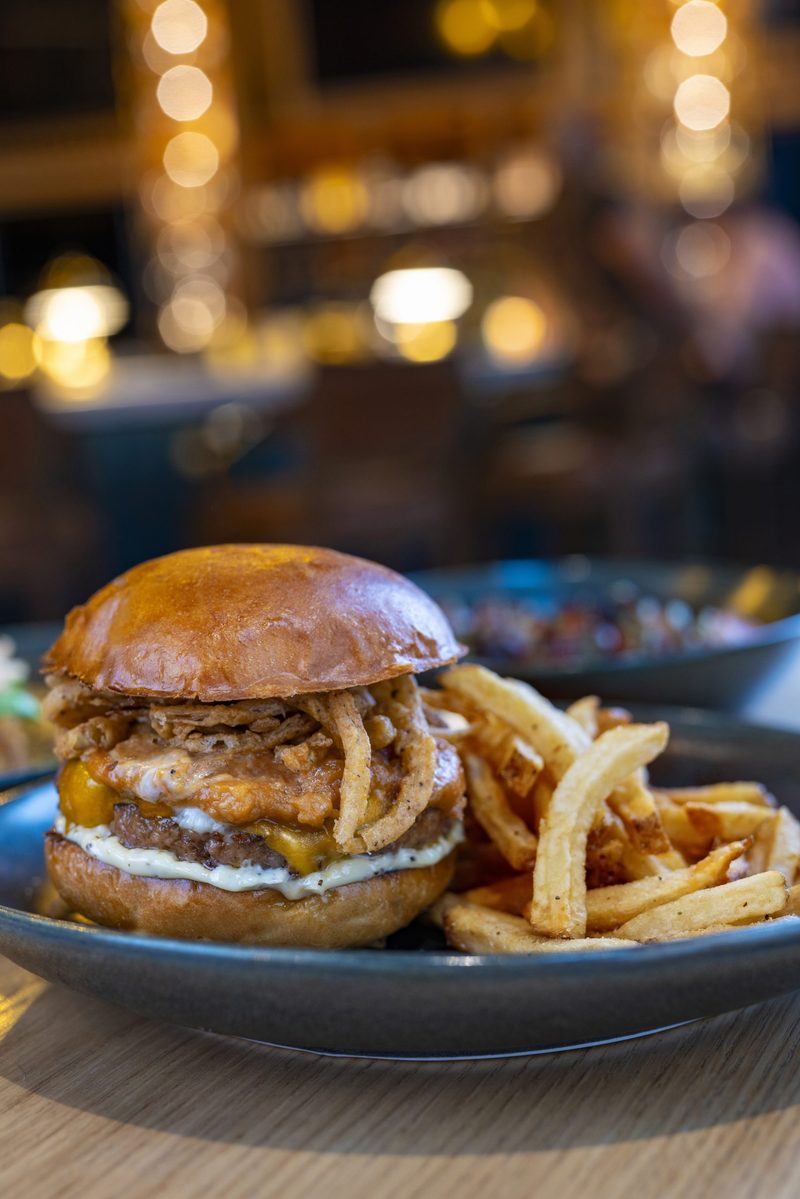
The Kennedy Wagyu Burger—“all Wagyu, not Black Angus filler,” says Obermeier—comes with bacon onion jam, crispy onions, cheddar and American cheese, and garlic aioli on a brioche bun.
Chef Obermeier has been with The Kennedy since its opening in May 2024. “I’m an Italian with a German last name,” he jokes, envisioning Adam Sandler playing him in a movie. His culinary journey started at family gatherings in West Palm Beach, Florida. “Every Sunday we got together,” he remembers. “I’d have wine with my grandmother’s stuffed olives. I was in IT for a while, but it wasn’t for me.” He followed his passion, earning his degree from the Culinary Institute in Vero Beach in 2007. He met his wife, Deserae, at a wedding in Rochester, New York. They have two kids, MJ, 10, and Nico (short for Domenico), 2.
Obermeier’s career has taken him to the True Food Kitchen in Fairfax, Virginia, then two stops in Columbus, Ohio, as culinary director for the restaurant SŌW Plated—its first name an acronym sustainable, organic and wellness—and for BIBIBOP Asian Grill. He got the call from Kennedy Concepts in April 2023 and opened the Kennedy in May 2024. “We have a culture that is attentive to the level of detail that we need,” he says. “The menu is classic, but with a little bit of a twist, a little more pork.”
General Manager Cory Bean describes The Kennedy as “an elevated American gastro pub, chef-driven,” where guests feel equally comfortable in a sports jersey or a business suit. Jake Brock, an Oak Ridge rowing coach and student pilot, appreciates the balance: “It’s part sports bar, part fine dining. My friends loved the mini corn dogs, while my parents enjoyed the upscale dishes and atmosphere.” Server Aidan Ginn, a student at UT studying international business, once had the pleasure of serving Harrison Ford. “He sat at the bar,” she recalls. “I called him professor.”
With a robust selection of small plates, The Kennedy is also an ideal spot for drinks and shared bites. The most popular dish is Devils on Horseback—bacon-wrapped dates stuffed with goat cheese, pumpkin seed pesto, balsamic reduction, and Calabrian chili-tomato sauce. The Blue Crab Crispy Rice, featuring jumbo lump crab, garlic sriracha aioli, avocado, and sweet soy, is another favorite.
Bone Marrow, served in a split roasted beef bone with house-made bacon jam, chimichurri, pickled onion, and crusty bread, would make any paleo devotee proud. Our group did not take advantage of the addition of Buffalo Trace bourbon for a “bone marrow luge,” although it sounds tempting. Meanwhile, the Mini Corn Dogs, crafted with Nathan’s all-beef hot dogs, house-made batter, and Dijonnaise are a nostalgic delight. Another shareable highlight is the Pepperoni Hot Honey Pizza, topped with mozzarella, ricotta, pepperoni, and Calabrian hot honey.
For dessert, the Salty Malty Ice Cream Pie reigns supreme, boasting layers of salted caramel ice cream in a towering four-inch presentation. The Bananas Foster Crepe Cake, with layers of crepes, sweetened cream, caramelized bananas, and warm bourbon sauce, is another indulgent choice.
The Kennedy is a place where history and innovation meet, offering a unique dining experience that caters to a wide range of tastes and occasions. Whether stopping in for a cocktail, a casual bite, or a full meal, it’s a downtown Knoxville destination that continues to impress.
→ Swipe for Next Story
Dining GuideMAY JUNE 2025
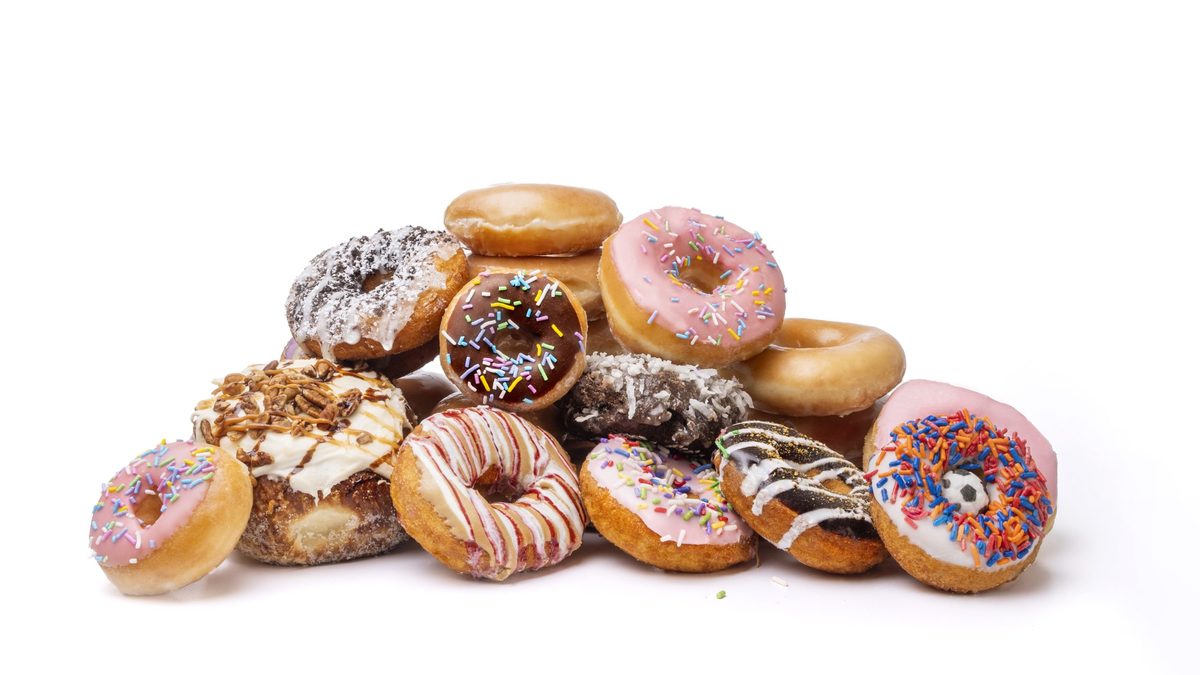
Destination Donuts
Story by Micha Haas
I am ashamed to admit it: donuts have become my vice. It’s not that I’m eating them every day, but there have certainly been days when I have had a late-night craving and brought home a half-dozen of these sweet, fluffy bits of temptation. Breakfast for a week, I say. The only problem is that before bed the next day, I’m left staring at an empty box and shouting, “Oh, come on!”
Donuts are remarkably ubiquitous, and everyone has their own take on it. In my youth, I worked in a Chinese restaurant, and even they had their own special recipe for these American-fried indulgences. So for this article, I took one for the team. I set out to sample as many different doughs as I could on your behalf, whether it be from one of the big names or a local Knoxvillian who is doing it all right. No need to thank me. Instead, join me on a flavor-filled road trip chock full of these sugary delights.
Dough Joe
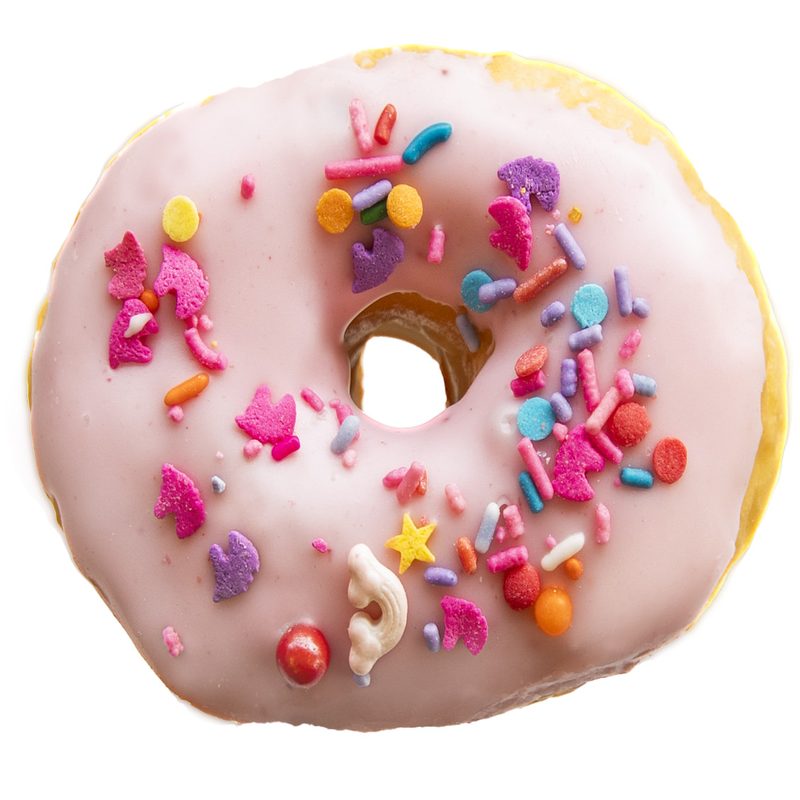
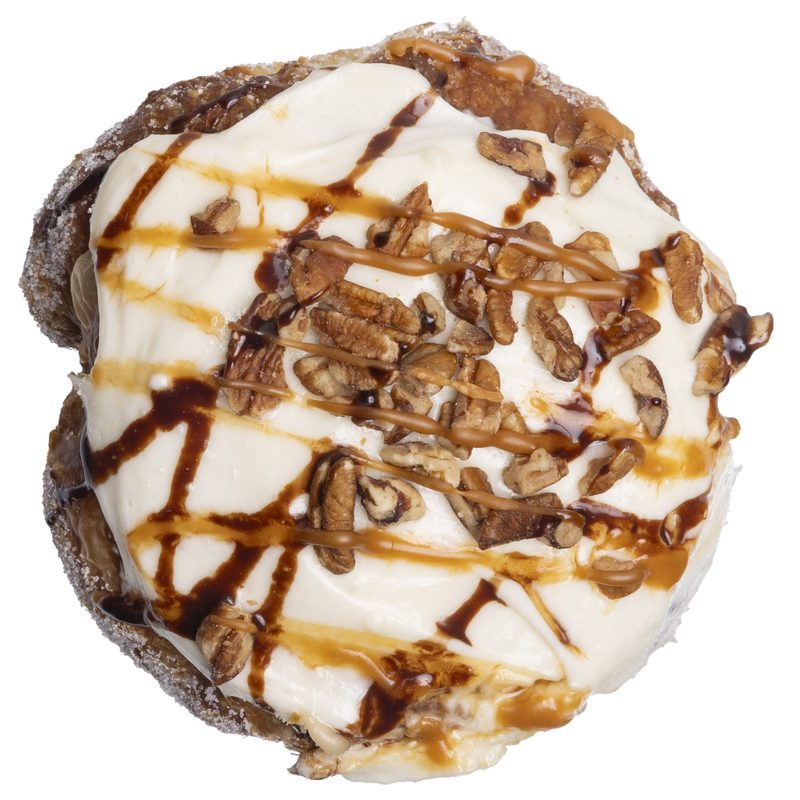
Our first stop is Dough Joe, and that’s for a simple reason: they close when they run out of dough! Being a former Beaver, I chose to pay my respects at the Karns location. Here I was pointed to a donut named The Homer, the first of a few Simpsons-inspired donuts I’d encounter on this journey, with the iconic strawberry-pink icing and sprinkles. Dough Joe also had some of the largest cinnamon rolls I have ever seen, though regrettably as this is an article about the hole-iest of fried doughs, I will have to save that treat for another time.
Next stop: Status Dough. No matter where you find yourself along Kingston Pike, you can probably find your way to one of these prime donut spots. The go-to choice here is the buttermilk donut, which as you can see, has a unique sort of texture as donuts go! That, they explained to me, is because they fry these special delights longer and at a lower temperature. And I must say, despite this donut not having the flashy colors and toppings of some of its kin, I did not regret my choice. Delish!
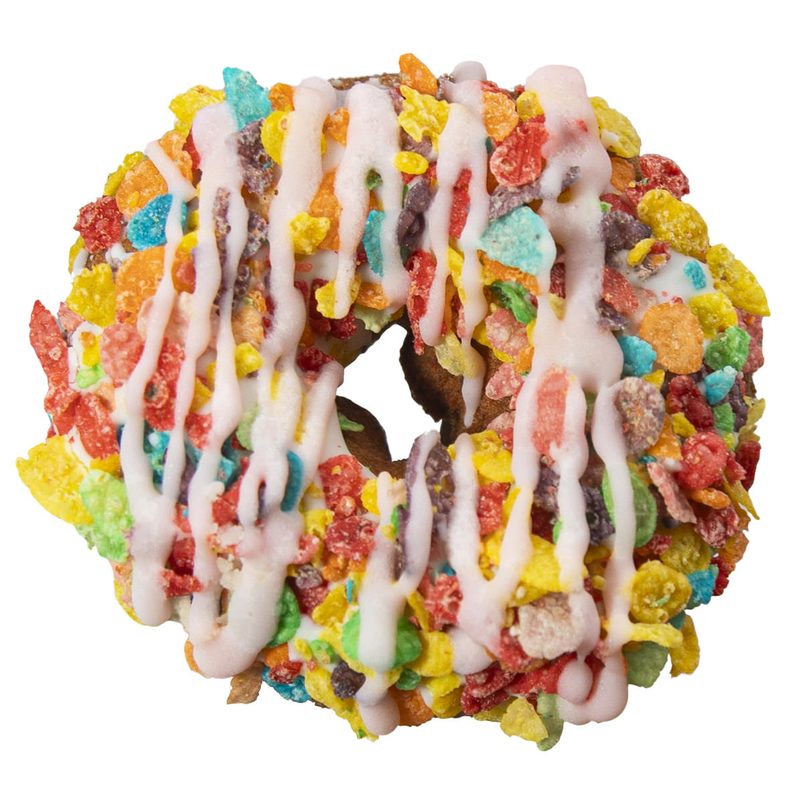
Richy Kreme has something of a claim to fame: they are the oldest donut shop in Knoxville. They also have something of a special pastry I just had to get my hands on: the Kronut. That is, a Croissant-Donut. While croissant donuts aren’t exactly trademarked by Richy Kreme, after tasting their take, I can safely say that these are the ones to eat. There’s a classic flakiness you expect from a croissant but crisped and rich like a donut. Top it off with a nice glaze. Oh, and they also had red velvet donuts. I may or may not have taken one for later!
Next I shipped out to Seymour for a visit to Buck’N Good Donuts. It’s a small spot, sharing its building with a gas station and a convenience store, but this anything but gas station food. If you happen to experience the happy accident of stopping by and giving it a try, you won’t be disappointed. In fact, the staff say, happy accidents are the way to go at Buck’N Good; it’s how they discovered their bestseller: the salted caramel donut. One day, they just happened to get an order of them by mistake, and they flew off the counter. If that was a mistake, I say, best keep making it.
True to their name, Donut Theory’s donuts aren’t characterized by being flashy, but rather by careful selection of ingredients. Their claim to fame is that they are “home to Knoxville’s best (and only) gluten-free donuts,” and if you’ve ever tried to make gluten-free pastries, you know how hard that is to do! But these donut theorists have pulled it off. Taking my first bite of their glazed donut, I’d forgotten they were gluten-free; the texture and taste were on point. As of this writing, Donut Theory is a pop-up shop, but will soon be setting up a permanent shop at Kerns Food Hall.
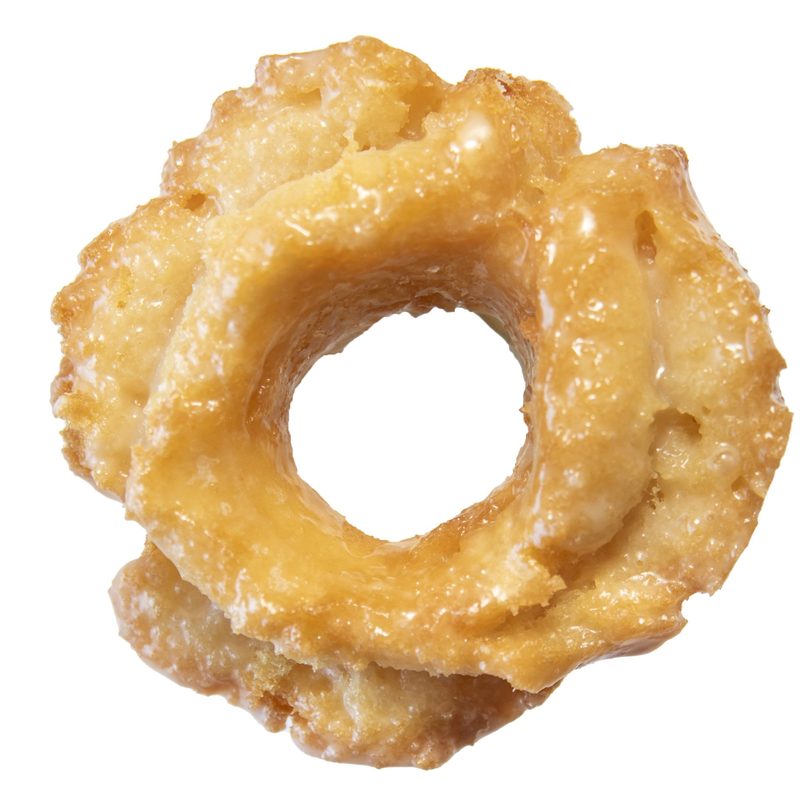
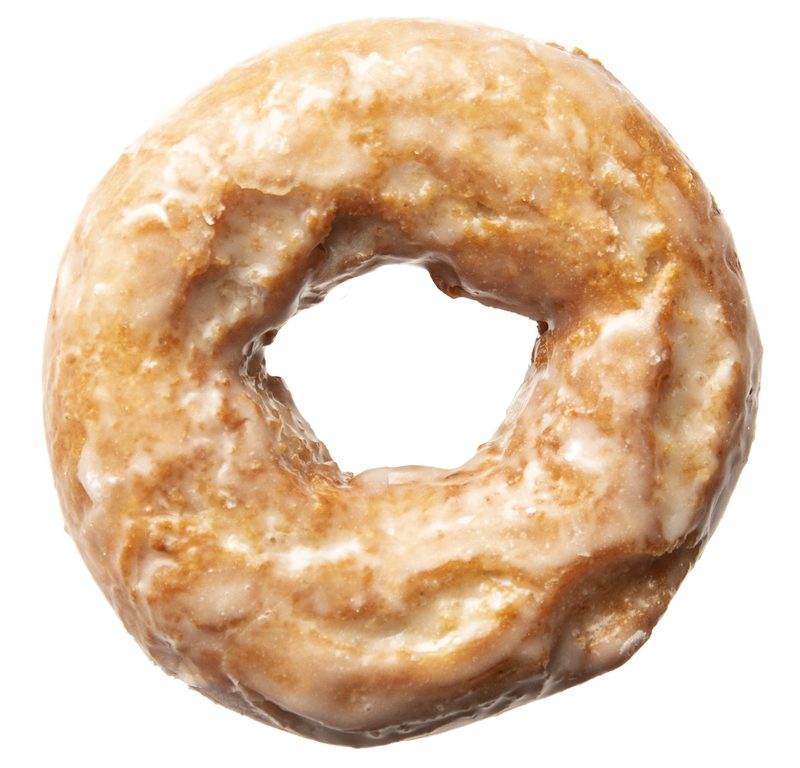
It’s a good sign when you walk into a donut shop and the customer coming in behind you points and says, “These are the best donuts in town.” I found myself at the Donut Palace during the Maryville leg of my donut road trip, which just happens to be built out of an old Sonic. Inside, however, you find not a roller-skating burger joint but good, old-fashioned, fresh-made donuts. I was treated to a classic glazed donut (actually, make that two classic glazed donuts), straight out of the fryer, still warm enough to feel like it was melting in my mouth.
Normally in these articles, I don’t include chains; we’re a local publication, after all! However, there are a few places I’d feel remiss not mentioning, and the first of these is Parlor Doughnuts. If you’re looking for a place that somehow feels simultaneously like a classic 50s diner and a gourmet restaurant, Parlor Doughnuts downtown is that place. Their donuts are presented individually on proper tableware, and each is practically a fortress of flavor. I tried my hand at the French toast donut, which tasted so remarkably like real French toast that I asked the staff if it was made with the same recipe. Turns out, it’s all a trick of the maple syrup glaze. I’ll take it!
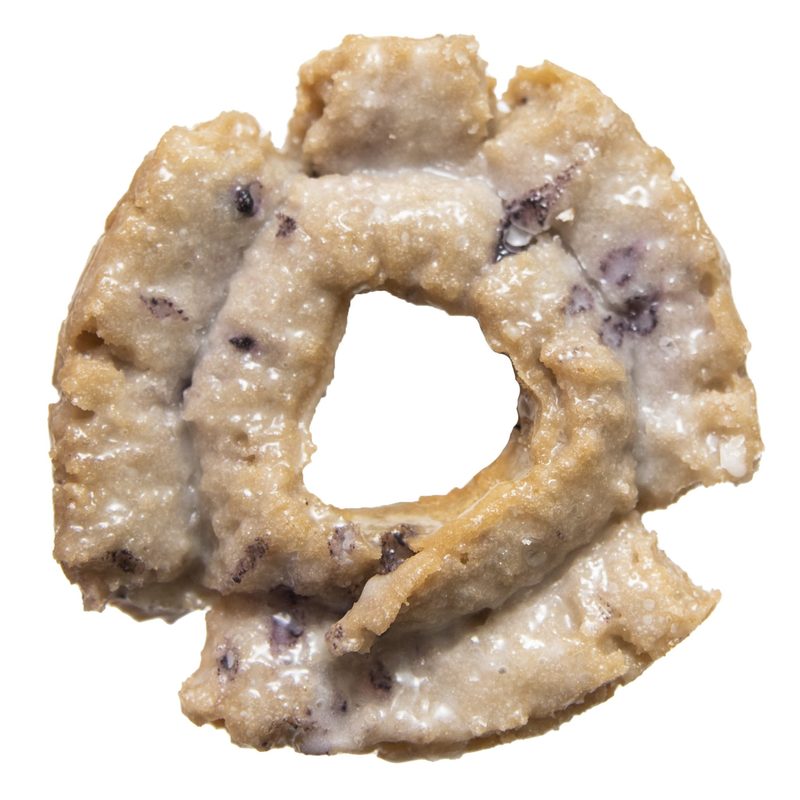
Time for a particularly colorful stop on our road trip: the Ultimate Doughnut Shop! This shop offers a variety of custom donuts, including letter-shaped ones for a special day. But colorful and creative display doesn’t necessarily tell you what’s on the inside of a pastry, which is why I’m here to tell you that what’s on the inside is a very tasty treat. At the owner’s recommendation, I took a leap and got a blueberry cake donut (I’m not usually much of a blueberry fan), but I’m glad I did. The flavor was rich, the texture was fluffy, and the desire to have another was at an all-time high. Karns |facebook.com/UltimateDoughnut
Krispy Kreme
Krispy Kreme, if my childhood memories serve me right, was the home of my very first donut. I recall being able to peer through a window to see the entire donut-making process in the back; those of you who have been around donuts longer than I might be able to tell me which Krispy Kreme this was—or if I am simply hallucinating. Regardless, a nostalgic location calls for a nostalgic donut, so here I went not for some wild concoction but a simple glazed donut. My younger self had good taste, it seems. Krispy Kreme still holds up.
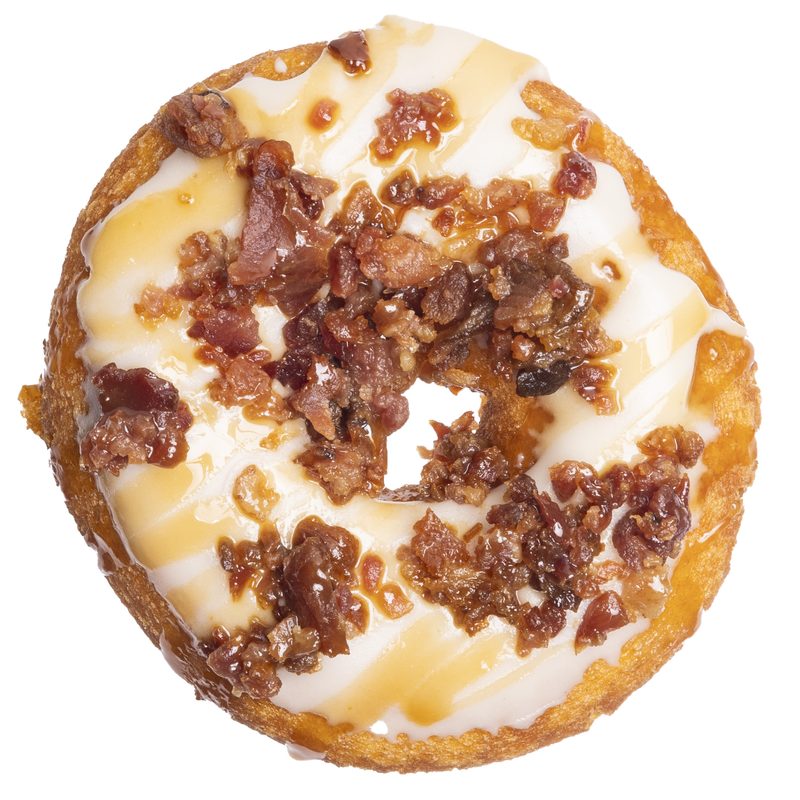
Am I allowed to say that this is the home of the publisher’s favorite donut? He and I were at an early photo shoot forBest of the Besta few years back, and when we were done, he said that I had to give Duck Donuts a try. I wish I remembered what I got that day, but I remember what he got: the Maple Bacon, which is, I’m told, the iconic Duck Donut (though they suggested the slightly grander Maple in the Sun for this article, which adds a caramel drizzle overtop the maple icing and bacon). Everything is made to order at Duck Donuts, so it comes to your fingers steaming and soft. Don’t forget napkins because your handswillbe sticky!
Family Dough is unique on this list because they exclusively serve mini-donuts. I met up with the Family Dough team (adults and kids alike) at the Cove for a bit of an impromptu picnic, where they showcased a dozen of their finest. Several are named after their children. The Harper, for example, is a delectable cherry cheesecake donut. But if you’ve got a different kind of sweet tooth, they also recommend the Owen (which is an Oreo donut), or maybe the white (and orange) chocolate Power T. Right now they exclusively work out of their food trailer, doing events and other catering, but they have several regulars who order a weekly dozen, and they’d be happy to add you to the list.
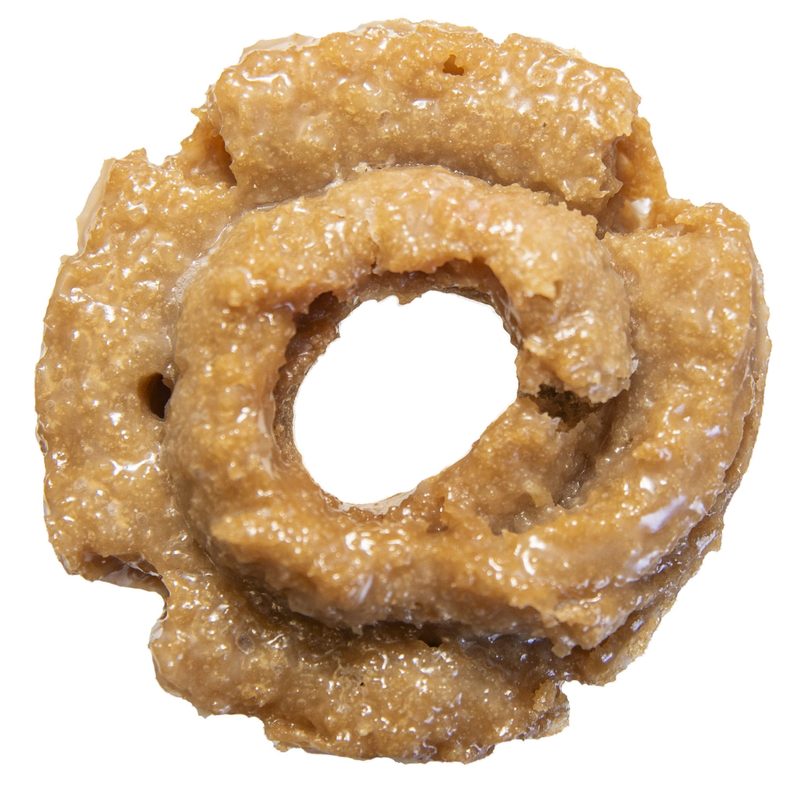
I must admit, this one got off to a bad start when I saw the North Carolina Tar Heels merchandise behind the counter at its Lenoir City location. Because of that, I felt compelled to order the orange-iced donut, as my small act of Volunteer rebellion. I suspected when I did so that it was just vanilla with a splash of color thrown in, but no, it was actually citrus-flavored! It was a very welcome surprise, a sort of mini-Dreamsicle donut. I walked out of this shop feeling much better about this spot than when I walked in, and I suspect next time I’ll be more willing to try out the staff favorite: the apple fritter.
A long-awaited voyage through a vital trade waterway opens the door to the story of a diplomat
Story by Gary Wade
Seeing and traveling through the Panama Canal has been on my bucket list for decades. Now that my dear bride has finally given her permission for me to sort of retire from the legal profession, I developed a plan to persuade her to join me for the trip. Booking a luxury cruise from Florida did the trick. So, in early December of 2024 we left Fort Lauderdale and meandered through the Caribbean Sea until our ship got in line to pass from the Atlantic to the Pacific through the iconic canal. Along the way through the Caribbean, we had made some interesting excursions—Belize and Costa Rica for example—but the real fascinations for me (a sign of the aging process) were the several lectures and videos setting out the background of just how the canal came to pass. A central figure in its history was a name unfamiliar to me—a 19th century Frenchman by the name of Ferdinand de Lesseps.
“The higher you go, the harder you fall” is the English translation of plus vous montez haut, plus ils tombent fort. This common phrase is believed to have originated in France and could be applied to the life and legacy of de Lesseps. This man had enjoyed a distinguished career in diplomacy and had established many important international relationships when he decided to undertake the monumental task of leading the effort to construct the Suez Canal, a project which would facilitate trade by connecting the Mediterranean with the Red Sea. This was not an entirely novel idea.
In ancient times, Egyptian pharaohs had shortened the water route to the Middle East by building moderately-sized canals from the Red Sea to the Nile River—a waterway which ultimately led to the Mediterranean. Some 3,000 years later, Napoleon Bonaparte conquered Egypt and then sent surveyors to determine the feasibility of connecting the Mediterranean with the Red Sea, an inlet of the Indian Ocean. Upon concluding that there was a differential of 30 feet in altitude between the two bodies of water, Napoleon’s surveyors recommended against the project, frustrating his plans for even more worlds to conquer. As it turned out, however, his surveyors were wrong.
Fifty years later, French engineer Louis Maurice Adolphe Linant de Bellefonds determined that there was no difference in the levels of the two bodies of water. Because this finding would substantially reduce the projected expense of construction, de Lesseps was inspired to form the Suez Canal Company. With a 99-year lease of Egyptian territory, the company received what was then an amount equal to $50 million in private investments.
The work, which began in 1854, involved 120 miles in length and required the removal of 75 million cubic meters of sand. When the Suez opened on November 17, 1869, the actual cost had become twice the original estimate. Despite the cost overruns, de Lesseps became a hero in France, even though his country ultimately had to acquire 56 percent of the stock and Great Britain the remaining 44 percent to finish the job. Each country prospered. World shipping trade increased dramatically by use of the new route.
With this history of success, France soon voted to create the Panama Canal Company with the aim of connecting the Atlantic and Pacific Oceans through Central America. Of course, de Lesseps was offered the presidency of the project. The hope was to cut thousands of miles of time and expense for ships then required to travel around the southern tip of South America. As with the Suez, de Lesseps’s plan was to avoid the enormous construction costs of locks by excavating through the challenging topography in Panama. In 1880, he traveled to New York, Boston, and other United States cities to attract investors for the project. In Washington, D.C., he met with President Rutherford B. Hayes to discuss his plan and testified before Congress.
De Lesseps had estimated a cost at 658 million francs—equivalent to more than $130 million in those days—and predicted eight years to finish. After enlisting the requisite number of investors, he began construction. The project, however, encountered significant problems in implementing the design. So, de Lesseps enlisted the aid of Gustave Eiffel, a highly regarded French civil engineer, contractor, and entrepreneur. This is the same Gustave Eiffel who had engineered the interior of the Statue of Liberty for Frédéric Auguste Bartholdi, the sculptor who designed the iconic statue, and who, by that time, had presented his proposal to build a tower which would bear his name for the 1889 World’s Fair in Paris.
Even with the help of Eiffel, disaster struck the Panama project, financial and otherwise. Thousands of workers had died of malaria and yellow fever. Moreover, the rainfall in the tropics saturated the soil. The deep cuts in the ground resulted in landslides, destroying equipment and taking even more lives. Costs skyrocketed out of control. There were no new investors. In 1888, only two years after de Lesseps had been chosen to present the Statue of Liberty on behalf of France, and less than a year before the opening of the World’s Fair in Paris, the Panama Canal Company filed bankruptcy. De Lesseps had failed.
An investigation established that some 150 French deputies had been bribed to vote for financial aid to the company. De Lesseps, and even Eiffel, who had been hired only as a contractor, were charged, tried, and convicted of conspiracy and fraud. In 1894, the court fined each of the men and imposed two-year prison sentences. Their reputations suffered even though, on appeal, a higher court ruled that a technicality—the three-year statute of limitations—barred their convictions. Eiffel, embarrassed by his notoriety, removed his name from the company he had founded. In 1894, de Lesseps died, his dreams for Panama unfulfilled.
In 1901, President Theodore Roosevelt rescued the project. He made the canal a priority, persuading Congress to buy the assets of the bankrupt French company and contracting with the newly created Panamanian government for the United States to take over construction. After negotiating an especially favorable deal with Panama’s new leadership, America succeeded where de Lesseps had failed.
First, the U.S. designers abandoned the sea-level approach, opting instead for a lock-controlled system, one which would usher ships up and down the canal as necessary, thereby avoiding much of the hazardous digging through Panama’s rough, wet terrain. Second, medical science discovered the role of mosquitoes in the spread of tropical diseases. The control of these insects greatly improved the health of its workers, limiting the cases of malaria and yellow fever during the lengthy period of construction. More than a decade passed before completion.
On April 14, 1914, the first ship to be able to travel the entire 51-mile distance was, ironically, a French crane boat called the Alexandre La Valley. The canal, however, could not be opened to commercial traffic until August, only days after the first shots were fired in Europe, triggering World War I. The price tag for the canal came to $375 million, $23 million less than originally estimated. That sum included $40 million to the bankrupt French for the benefit of its creditors, and $10 million to Panama for property rights. Despite the huge economic benefits to the U.S., there was a tragic downside. Even with the precautionary measures, employee deaths for the project numbered more than 5,500 from all nationalities, at least 350 of whom were Americans.
During the First World War, this country was able to control access to the canal. Its primary use in those years was to more quickly move military troops and supplies. After the armistice, this country increased its status in global trade. To illustrate, the new shortcut meant that ships sailing from New York to San Francisco saved 7,800 miles in distance and as much as a month in travel time. Years later, when Japan bombed Pearl Harbor, the U.S. joined the Allies in World War II and fortified its military control of the canal, sending 65,000 troops to protect its strategic asset.
On January 1, 2000, after almost 86 years of rule, the U.S. yielded full administration and management responsibilities to the Panama Canal Authority. That, of course, is another story.
→ Swipe for Next Story
InsightsMAY JUNE 2025
Brain Rot
A no-holds-barred rant about the absurdity of modern life. From fake news and artificial intelligence to survey hell, foreign call centers, and the existential dread of driving through Farragut at 5 p.m. I think it’s all giving me… Brain Rot!
Story by Robert Pryor, Sr.
I saw where “brain rot” was declared the word of the year. When I read that, I had no idea what it was, but I knew immediately that I had it. In fact, I’ve had it for several years now—and it’s getting worse.
According to the Oxford Dictionary (which apparently had not noticed that it’s actually two words), “brain rot” refers to a decline in one’s mental state and intelligence, especially due to excessive consumption of too much trivial online content. That’s it. I knew it. I’m going crazy and stupid at the same time. The deranged world I’m trying to navigate is pushing this old traditionalist over the edge. Simplicity and common sense have surrendered to chaos and folly. My life is in turmoil, and my brain is rotting.
For starters, there is this thing called artificial intelligence. I don’t know what’s real anymore, and my brain is fatigued from watching animals talk and cars that transform into giant robots or monsters. Was that really Trump and Musk I saw dancing to “Stayin’ Alive”? You would think they are too busy redesigning the country to be dancing down the street. I thought my windshield got cracked, but as the crack slowly lengthened, I was not sure it was real. The strange way it meandered across to the passenger’s side made me think it might be AI messin’ with me. Maybe I could avoid a replacement windshield, but no, “Safelite Repair, Safelite Replace.” Am I really listening to Bob Dylan or some knockoff AI impersonation? Hard to believe someone would be interested in re-creating the sound of his voice.
I’ve been really worried lately about the plans to “militarily” invade Canada and make it our 51st state. My brain is exploding with thoughts about all the problems that will cause me. Don’t get me wrong, I have no love for the Canadian people and will fight if I have to. I’m still upset over the way they dumped Justin Bieber on us the way they did. I hate to think how my life will be further complicated if I have to learn the metric system, French, and the rules of hockey. Canada would be the second state with its own “national anthem.” Tennessee already has a “national anthem,” of course—“Rocky Top.”
I wish they would outlaw TikTok. I stare at it spellbound and become entranced and cross-eyed mindlessly watching for hours like I used to do trying to solve those stereogram artworks. While we’re at it, why not also ban Pinterest, YouTube, loud mufflers, robocalls, rude drivers, and cops that continually give citations for slow driving.
Take my advice and don’t ever answer a survey or give a review of a product or business online. Surveys give me a headache. Have you noticed everyone and every business wants you to answer or fill out some damn survey? I recently made the mistake of booking a hotel using an online booking app. The problem is when you need to talk to the agency, they are off-shore somewhere in the Caspian Sea and speak very poor English. When I had to change the date for my reservation, they promised to move it and confirm my arrival two weeks forward, but did neither. What they did do is send me a survey on my accommodations two weeks before I was scheduled to arrive.
Medical offices now demand you complete an online survey about your visit to the doctor who is going to perform your upcoming surgery. Don’t do it and, if you do, lie favorably for the surgeon. That’s a five-star opportunity for sure. I don’t know about you, but I don’t need a surgeon retaliating against me when I’m unconscious on the surgery table.
I bought a new car and immediately got an online survey from the manufacturer about my experience with the dealer. I gave a very positive report and awarded eight five stars and one four star and the dealer went crazy. The general manager called a relative of mine trying to influence an amendment to the survey. Can you believe it, they were mad about one four-star rating out of nine. I’ve been treated so coolly by the dealer, I’m afraid to take the car in for maintenance for fear they might sabotage the engine. Silly me, and I thought they wanted to know the truth.
Speaking of the truth, there is very little of it lately. My brain is turning to mush because the world is in such confusion we can’t even agree on simple truths, much less solve problems. There are things I’m told that perhaps I should not believe like “This call is being recorded for training purposes”; “Ukraine started the war”; “I’m not calling to sell you anything”; “You are required to arrive 30 minutes early”; “There was no insurrection and the people were entering in an orderly fashion like a normal tourist visit”; “Grandfather, I’m in jail and need you to wire me some money”; “Nobody was texting war plans or classified information”; and “Emus can’t help people customize and save hundreds on car insurance with Liberty Mutual.” Our brains are wearing out just trying to determine if these statements are true. We are so exhausted arguing over obvious facts, there is no time left to solve problems concealed by falsehoods. It is so refreshing to occasionally find someone who speaks straight and tells the truth.
Oh yeah, have you ever tried to unsubscribe to some unsolicited mailing on the internet? Near impossible, and I never wanted the emails nor did I need them. I try to never upgrade my computer because if I do I no longer recognize it and can’t find anything. I can feel the rot dripping into my sinuses. My life is plagued by changes that make my head spin. The Gay Street Bridge is now a wide sidewalk. Not actually a solution for me. If measles doesn’t get me, there’s always bird flu, Covid, and mad cow disease. How am I supposed to know if I had measles as a child? I can’t remember my childhood, much less what shots I got. Now, I’m told suddenly that I need to prove that I’m a U. S. citizen or I cannot fly on an airplane or vote in the next presidential election. I’ve never seen my birth certificate and have no proof of where I might have been born. I remember being told that I was born at St. Mary’s Hospital, but that might have been a lie. Now St. Mary’s is closed forever, and I had a nightmare I was from Mexico. Just one more thing to worry about. A lot of my “brain rot” is probably caused by all of these changes coming at me so fast. I’m spending far too much on Band-Aids and my phone number is now in the possession of every aggravating telemarketer in the country. Speaking of change, has anyone tried to drive through Farragut lately? HELP! If you find yourself traveling west from Lovell Road to Campbell Station in the afternoon, you better have a plan for stopping at least twice to use the restroom.
But not all is lost. As my brain rots, I’m holding on and can still smile. I’m surviving on life’s few great pleasures like Costco rotisserie chickens, U. T. sports, Farmers Markets, pizza burgers at Sam & Andy’s – Farragut, Antiques Roadshow, chocolate milk, and mutual love shared with a dog.
→ Swipe for Next Story
FeatureMAY JUNE 2025
The Mobility Factor
An exploration of how focusing on range of motion can be a game-changer for health and wellness
Story by Dr. Edwin Spencer
I was recently approached by a casual workout enthusiast and asked about Moves Method workouts. I had to be honest; I had not heard of it before. That is really not that surprising as there are as many workout programs as there are diet plans out there. In my opinion, it is good to change up workout routines or methods either to meet new personal goals or to just simply enjoy learning a new skill. So, I decided to check it out for myself and take you along in the process.
The Moves Method
A variety of videos on multiple platforms describe the exercises of the Moves Method, and of course, there is a subscription-based product for a nominal fee that allows for online coaching. The trainer that seems to be at the forefront of this program is Vanya Gudelj, and there are some great videos of her and her partner demonstrating some of the exercises on social networks. The exercises are all focused on mobility. They are functional and technically challenging.
However, before we get into specifics, lets lay a little ground work for the concepts. I feel that most people view working out or training as a means to lose weight.If I stay on this treadmill 10 more minutes, then I can work off last night’s debauchery.Well, that’s not quite the case, unfortunately. While exercise will do many things, which we will cover, it is really not a means for weight loss. Multiple studies have demonstrated that improving one’s nutrition will result in weight loss, while exercise is better for body composition. Having said that, the combination works synergistically to result in better healthspan.
Starting a training program can be daunting as there are so many programs, machines, trainers and ardent proponents of each. A goals-based approach at least gives you some milestones to reach. These need to be realistic and attainable, but challenging. A younger person’s goal might be improving a metric in a certain sport while someone with a few more years might want to decrease pain and improve function for activities of daily living like lifting the dog. Now, we need a roadmap to get there.
Finding an Expert
I contacted a friend of mine Laurence Brown, who is a local trainer, to see if he had heard about this method and to get his take on incorporating mobility into routines. Laurence performs online and in-person training and has a podcast focused on health, entitled “Endless Pursuit.” As it turns out, Laurence passionately believes that mobility is the cornerstone of a good wellness program and that it is “the unsung hero of fitness.”
“Mobility prevents injuries and boosts strength by unlocking full range of motion,” Laurence told me, “and it will improve how you move in and out of the gym.”
I have to admit, I wasn’t surprised. Laurence starts new, inexperienced clients on mobility exercises for two weeks before adding any weights. These are not just static stretches, but ones that are more like squat holds and wall presses that incorporate both strength and mobility As the client improves, he says, then resistance can be added and progress to compound exercises as tolerated.
As a physician, I find it important to remind that resistance training (and body weight is resistance) is a skill. Some of the exercises in the Moves Method require incredible skill, strength, and mobility. Running is a skill. Olympic lifting is a skill. It has been demonstrated that most, if not all, of the initial gains in strength in an Olympic lift is garnered by becoming more efficient in the skill of the lift. This is not just strength, but rather neuromuscular control. This is where trainers and experienced lifters are worth their weight in gold in coaching proper technique.
Incorporating Mobility
Good trainers will incorporate mobility, balance, strength, and aerobic training into a routine that changes to avoid monotony. Getting full range of motion on a squat will decrease stiffness in the joints. A pause at the bottom with a hold will decrease injury. For instance many times, I will be slow on the eccentric (lowering the weight) and faster on the concentric (pushing the weight). Eccentric exercises are when the muscle fibers are lengthening as the weight is moving.
Imagine a bicep curl. The concentric phase is when the weight is brought up or closer to the body and the eccentric phase is when the weight is lowered. The work of lowering the weight requires 40 to 60 percent more force than raising it, and studies have demonstrated more gains in strength with eccentric focused exercises.
Isometrics are when you simply hold the weight or the position. Imagine a wall sit. Isometrics have been shown to better prevent injury when compared to simple static stretching like bending over and touching your toes. This is because although the joints are not moving in an isometric exercise, tiny crosslinks in the collagen in the tendons are sliding allowing the tendon to stretch decreasing its stiffness and therefore making it less susceptible to injury.
Many of the more advanced mobility exercises incorporate balance and core strength as well. These include pistol squats (look these up—they are super challenging) and isometric splits combined with a good morning bend at the waist. If you can incorporate full range of motion into your resistance training, then you kill two birds with one stone: you reap the benefit of the resistance trainingandyou are also stretching.
These tend to be much more functional exercises used in sport and life. This could be highlighted in the difference between doing a dip versus using a triceps machine. A dip is a full body exercise incorporating balance on your hands, core strength, and upper body strength. It’s an exercise that can actually help you get off the floor if you fall.
Why It Matters
So why exactly should we care about these challenging exercises or honestly, exercise at all? Improvement in sport is obvious. No athlete is going to take the field or court without hours and hours of training. But what about for the rest of us, the ones just looking to stay healthy and well for our daily lives?
According to the Centers for Disease Control, 25 percent of adults over the age of 65 will sustain a fall each year that requires medical attention. A full 20 percent of these are serious injuries that result in fractures. Most of us know someone who has fallen and sustained a hip fracture. These falls may results in a call to the orthopaedic surgeon on call and usually surgery the next day. The mortality rate (death rate) of patients 70 years old or greater is 30 to 40 percent within the first year after the hip fracture is fixed or replaced. This amazingly high death rate is multifactorial. If the bones are that weak, many of the other organ systems are as well, and this is exacerbated by immobility and the stress of injury and surgery.
The above sounds grim for grandma and grandpa, but that can be changed. We have agency over our seemingly declining health. A metanalysis (research that looks at multiple papers on the same topic) found that an integrated exercise program that incorporated resistance, balance, and aerobic training three times per week, markedly reduced fall risk in adults. Another paper demonstrated a 45 percent reduction in frailty within three months of starting a balanced training program in older adults.
The point is that we have to train to continue the game of life because training works. Back in the day, we did not have to train because the simple act of sustenance farming, walking, lifting was just a way of life. Now we have sedentary jobs that allow our muscles and bodies to slowly deteriorate. We now have to be intentional with training and the good news? It can help prevent frailty, falls, and death.
There are other documented benefits of training that affect many people. Resistance training has been shown to lower CRP (C reactive protein) which is a marker of inflammation and increase IL-10 (interleukin 10) which is an anti-inflammatory cytokine. High intensity interval training has been shown to increase cognition and function on memory tests. For those that desire a longer lifespan, moderate aerobic and resistance training has demonstrated increases in telomere length. If you’re unfamiliar, telomeres are the end regions of our DNA which protect our DNA during cell division. Telomere length is a known marker of aging as we tend to lose about 70 base pairs per year as we age. Therefore, we can mitigate the effects of aging, decrease inflammation and improve cognition just through exercise. It’s amazing what can happen when we make changes to improve our health.
Bringing It All Together
Training and nutrition are two large levers we can use to improve our health and lifespan. The correct training for you depends on your goals. However, all training programs should have components of mobility, resistance, and aerobic exercises. Simply hoping on the elliptical machine doesn’t cut it.
Programs like the Moves Method that incorporate balance, mobility, and resistance are a great place to start. These type of exercises are skills that need to be learned, but they are also fun, especially if performed outside with others. It is also fun to try new training programs and then test yourself on the pickle ball court or driving range. Train so that you can enjoy life and your favorite activities. You will not be disappointed.
→ Swipe for Next Story
FeatureMAY JUNE 2025
Rowing Together, Rowing Tough
Lady Vols rowers, led by coach-of-the-year Kim Cupini, aim to repeat their trip to the podium at nationals
Story by N. Brooks Clark
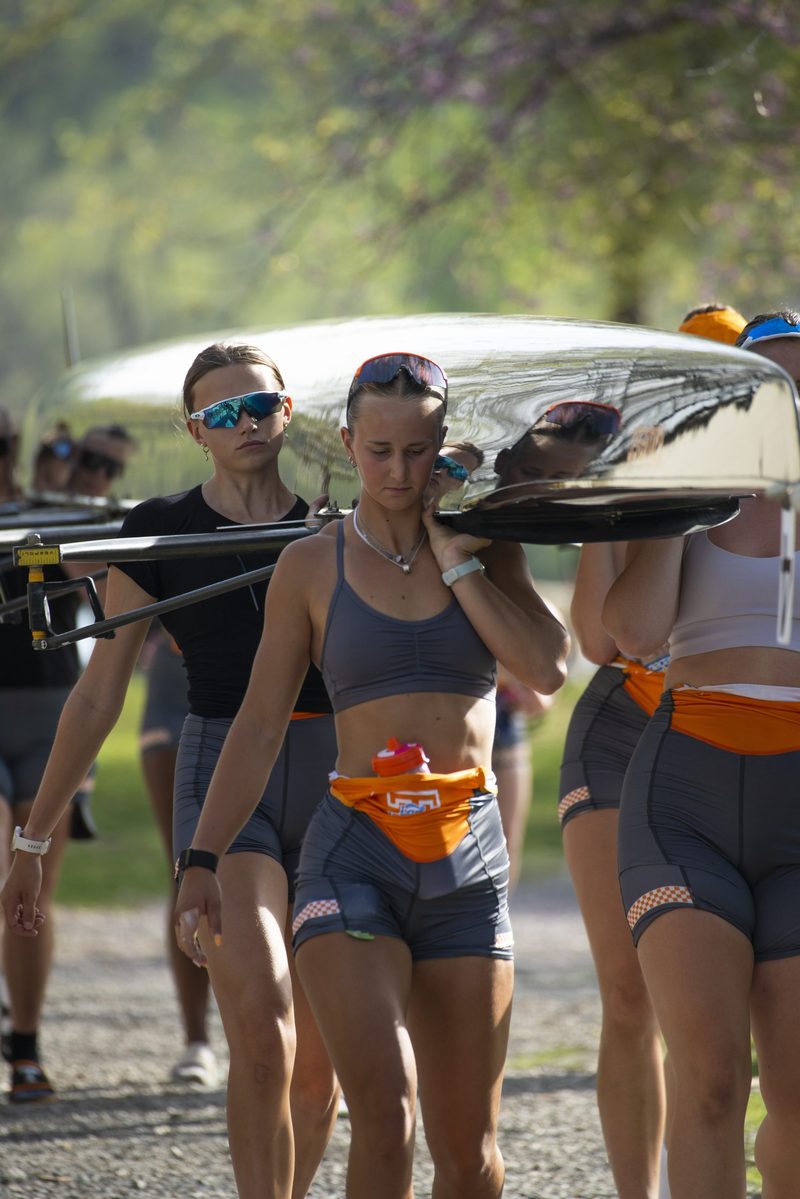
On a sunny April Saturday in Oak Ridge, UT’s third and fourth varsity 4s were neck and neck at the 1,000-meter mark, far ahead of a UNC boat.
At 1,500 meters the 4V4 was up by three seats. On the shore, Head Coach Kim Cupini peddled her bike among the tents and passers-by, turning her head left to the water, then forward to the road ahead, then left again, every 10 meters or so bringing her fingers to her lips and emitting a loud whistle of encouragement. “I started whistling back when I was in swimming,” said Cupini after the race, “so I’ve kept it up. Now if I don’t whistle, they get upset.”
As the boats entered the last 250 meters, the announcer, Olympian Megan Kalmoe, said, “UT’s four-V-four continues to lead in a dominant, controlled, mature way. They are going to hold this margin if it kills them.” The 4V4 finished in 7:40.916; the 3V4 in 7:41.463—a half-second margin for a 2,000-meter race. The coxswain of the winning 4 was Marissa Garcia, a sophomore from Knoxville. The stroke was Brooke Busk, a freshman from Plymouth Meeting, Pa., behind her were Katie Fitzgerald, a sophomore from Fairfield, Conn., Maddie Becker, a sophomore from Greenville, S.C., and Sarah Shepherd, a freshman from Lafayette, California.
It was the last race of the inaugural Rocky Top Invite, in which UT boats won all seven finals over Clemson, Duke, UCF, and UNC. The week before, also at Oak Ridge, the Lady Vols had lost several races to No. 2-ranked Stanford. “We got a little bit short and a little bit frantic, a little bit too excited,” said Jamie Harris, an Ohio State grad transfer from Nelson, N.Z., who stroked the first varsity 8. “We learned from that experience.” The cox was freshman Taryn Graves from Newport, Calif., who won nationals in high school coxing a men’s 4 and a men’s 8.
“I think that our team has a very good culture,” says Graves. “We have a big freshman class. You could be friends with a senior.” The Lady Vols are deep, with 63 on the roster, not counting walk-ons. There are 27 freshmen, including another top cox, Patricia Menendez, from Gotha, Florida, and seven internationals—from Australia, Germany, New Zealand, South Africa, the U.K. The Lady Vols ranked No. 5 in the nation heading into a schedule that will culminate in the first SEC Regatta on May 11 at Oak Ridge and then nationals on May 31-June 2 in Mercer, N.J.
Making the Podium at Nationals
A year ago, the Lady Vols worked their way up from No. 15 to No. 5 in the rankings and placed second in the Big 12 championships to earn a bid to the NCAA Championships in Bethel, Ohio.
In the heat races at nationals, the First 8 fought through a gusty headwind for a time of 7:00.246, edging No. 6-ranked California, No. 15 Ohio State, and 12th-ranked Indiana to qualify for the semis. There, UT finished second, in 6:16.689, ahead of three top-10 crews to qualify for the Grand Final against Texas, Stanford, Princeton, Brown, and Washington.
Alice Fahey, a senior from Wellington, N.Z., was in the 3 seat. “Going in to the final, we knew Princeton,” she remembers. “We felt like we were quite ready. We said we have to get off well at the start, but we didn’t. We saw that Texas is up and knew we had to really lock in on the coxswain [Sasha Radovanovic]. We had a shift in the middle, and we were listening to the cox so much. In the last 500 we were still holding close with Stanford. We didn’t realize how close. In our 300-meter sprint, she was calling seats every stroke. Our stroke rate was 40 or above. Hearing the crowd helps you go as hard as you can go.”
UT’s bow ball crossed the line 2.236 seconds behind first-place Texas (6:09.920) and just.352 seconds behind second-place Stanford. UT finished ahead of No. 4 Princeton, No. 8 Brown, and No. 7 Washington. “It was a surreal experience,” says Alex Pidgeon, a junior from Montreal, who rowed in the 6 seat. “I had never been to nationals. Making the Grand Final was just crazy. We didn’t think that we would podium. To live all those emotions in three days. The picture of us with the trophies is mounted in the boathouse above where we refill our water bottles, so I see it every day. Looking at that picture. It’s crazy.” Cupini, in just her first season at UT, was named the Collegiate Rowing Coaches Association national coach of the year.
New Teammates from SMU
Pidgeon had been recruited by and rowed for a year under Lisa Glenn, who retired on June 2, 2023, after 25 years as Lady Vols head coach. A week later, UT Athletics Director Danny White named Cupini, then the coach at SMU, as Glenn’s successor. The Mustangs had just finished an impressive ninth at the NCAAs, and the CRCA had named Cupini as a regional coach of the year.
“We had a team zoom meeting,” remembers Allison Lea, from Arlington, Va., who had rowed for Cupini at SMU for three years. “We looked at our choices. We could stay at SMU with the new staff and weather it out. Or we could go somewhere else. Or we could go with Kim to UT.” Fahey was one of those facing the choice. She visited Knoxville and liked the nature all around. “Dallas is all concrete,” she says. “That’s kind of what I missed from New Zealand. We went to the quarry within the first few weeks, and it was everything I was looking for.” She and 17 other rowers transferred to UT, along with Cupini’s staff.
“At first it was a little scary with 18 new rowers and the whole coaching staff,” Pidgeon admits. “It was exciting at the same time. As soon as we all met, I had a feeling it was going to be real good. They didn’t make the people who were there feel like outsiders. On the first day of practice, we decided to row as one. We were a team.”
Harris transferred from Ohio State a year ago because of Cupini. “I heard that she has a strong character,” says Harris. “I knew I was going to work well with Kim. She works her athletes really hard. I’m tough and she’s tough, and we work very well together. I’ve loved it at UT. Kim looks at the well-rounded perspective, including nutrition and our recovery and mental well-being. I was seeing in black and white before. I’m seeing in color now.”
“Coach Kim knows so much about the stroke and getting maximum power out of all the rowers,” says coxswain Graves, a journalism major aiming to be a broadcaster. “She can develop them. It’s super important to do every single part of the stroke together.”
Kim Cupini grew up as a multi-sport athlete in Rochester, N.Y., right along the Erie Canal, with a focus on swimming and basketball. She grew up loving water sports though, especially from summers spent with her grandparents on Honeoye Lake, one of the Finger Lakes. At a certain point she started rowing with Pittsford Rowing on the Erie Canal and Genesee River.
She swam and rowed as a freshman at Division III Colby College in Maine, majoring in environmental science. After a particularly cold winter, she transferred to the University of San Diego, where she could row in a Division I program and add marine science to her major. A three-time all-conference pick, she assistant coached for the Toreros in 2005 and for UCF for two years before returning to San Diego as head coach for 10 years and then to SMU for six. The Mustangs won conference titles in 2021 and’22, finishing 12th overall at the NCAAs in 2022 and ninth in 2023, after which she heard from Danny White.
Cupini says she emphasizes “getting the most out of every student-athlete by emphasizing the whole person—mind, body, and soul.” In a Senior Day Ceremony after the Rocky Top Invite, she referred to the 12 seniors and graduates (including Harris) as “Tough, tough, tough women: Some of the toughest I’ve ever coached.” Of her team as a whole, she said, “They’re super competitive, but they always support each other. They always joke around. I hear these horror stories with other teams where people are really putting each other down to get up into the top boats. They are super supportive, which is really awesome, and they’re just really happy for each other.”
The goal for the coming weeks, says Pidgeon: “Doing it together. Not being complacent. We gained a lot of freshmen and transfers. We need to learn to row together because that’s what made us fast last year.”
→ Swipe for Next Story
Non-ProfitMAY JUNE 2025
Making Connections
Knox Makers builds community with creativity
Story by Susan Alexander
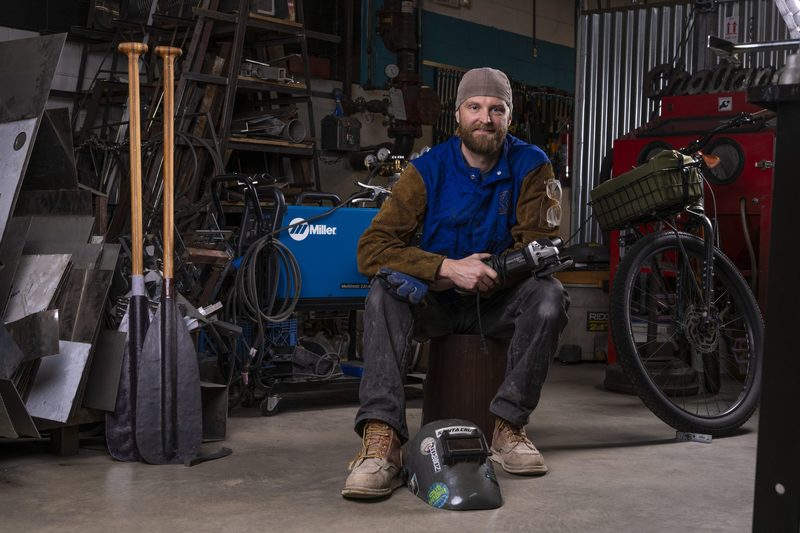
Andrew Gibbs was stuck in a desk job he did not enjoy. It was 2017, and he had recently moved to Knoxville from California. An outdoors enthusiast, he joined Knox Makers to learn woodworking. He envisioned making custom canoe and kayak paddles as a side gig.
“I learned pretty quickly how much work that was,” he says. “So I decided instead to work on some of the little projects I wanted to do around our house.” Using the many and varied tools that his membership in Knox Makers afforded him, he made shelves and hand rails. “I made a sunshade for our deck. Well, I made the deck,” he says with a laugh. “My wife and I are big road trippers, so I made the bed frames for our van.” As he progressed, he also learned how much he enjoyed working with his hands. So Gibbs made a new career. After working at Knox Makers, he quit his desk job, joined a construction crew and went to welding school. Now he’s the crew’s head fabricator. “Knox Makers literally changed my life.”
Not everyone who belongs to Knox Makers undergoes such a dramatic change of direction in their lives. But as a whole they enjoy the camaraderie of a creative community, the 24/7 access to resources and tools, and the joy of seeing a project unfold from their own hands.
Building Over Time
Knox Makers, an all-volunteer nonprofit, has been around for 12 years, says current president Issac Merkle. Originally it occupied space in Oak Ridge and offered a limited selection of tools for its members to use. About eight years ago it moved into the lower level of the South Knoxville headquarters of Spark. As it grew, it acquired more and varied pieces of equipment its members could use to build things. Some pieces were donated. Some were in poor repair, purchased cheap and rehabbed by members. Sometimes members chipped in to purchase something they wanted to use.
Over time, Knox Makers developed nine different areas in which its members could create. There’s a laser cutting zone for engraving on metal, wood or acrylics and a 3D printer. The fiber arts area offers sewing and embroidery machines, including a long-arm quilter and heavy-duty equipment that will stitch leather. The electronics area has a wall full of doodads that people can solder together. There’s an arts and crafts zone for stained glass and painting and other crafty pursuits. The wood shop is the biggest and most popular zone, with a bandsaw and a chop saw and planers and lathes and routers. In the machining and metalworking zones members can weld shelving together and make jewelry and sandblast. There’s also a blacksmithing shop in a small building across the parking lot. (By the way, members built that building, too.)
Each area is overseen by a czar or czarina who makes sure equipment is functioning properly and members are trained to use it correctly. Nobody can operate machines until they’ve been trained and certified in safety protocol. Czars and czarinas also look ahead and suggest other pieces of equipment that members could put to use.
Show and Share
The Knox Makers space and equipment is available to its 370 members 24/7, for which they pay $50 in dues each month. But Tuesday nights are when they gather as a group, welcome potential members to take a tour and learn about the organization, and collaborate during Show and Share, which is also streamed on Facebook and YouTube.
During Show and Share the Tuesday I attended, Cale Caldwell showed a nightstand he built. Until he moved back to Knoxville a year or so ago, Cale had never done woodworking. Now he’s trying to start his own furniture-making business. (Knox Makers is a great place to develop an idea and work on a prototype, Issac Merkle clarifies, but it’s not someplace where members can operate a business. They’d have to do that elsewhere.) After Cale talked about his work, members chimed in with questions about his process and suggestions for improving it.
Sue Joslin, Knox Makers’ treasurer and czarina of the fiber arts zone, showed off a small fabric book she made for storing pin and needles. She practiced a variety of embroidery stitches to decorate it. Joslin has been a member since Knox Makers moved to South Knoxville.
“A friend said I’d like it here, and maybe I could finish all my unfinished projects,” she says. “Now I have even more of them. I’m so inspired by the Shares. The community is wonderful — we teach and we learn.”
Other member stepped up to show off a stained glass project, a plywood lyre and a wooden vanity. Each one discussed how the project went and the challenges that came up, and members responded with their own experiences and ideas.
Benefits of creating together
Once Show and Share ended, Merkle and membership chair Tracy Homer offered information for the potential members who had dropped in for the evening.
Merkle shared the vision statement — to find and grow the maker in all of us — and talked about some of the benefits of membership besides access to the maker spaces. Knox Makers hosts special events like cookouts and a pre-holiday project to repurpose animatronic toys for kids with special needs; occasional maker markets where members can share their projects with the public; classes and workshops to allow members to learn how to use equipment safely and hone their skills.
“Most people who come to us are excited about getting access to some aspect of our workshop,” he says. “It’s fun to show the workshops and see people’s eyes glisten. There’s a special vibe to this group. That need to make an idea real is universal. And if you make something together you can’t help but feel connected.”
Homer discussed some of the details of membership. In addition to each zone’s czars and czarinas, there are peace officers who help resolve any disagreements or misunderstandings that might come up among members. Before becoming a member, someone must spend 30 days as a probationary member to allow people to get acquainted. The manufacture of firearms is strictly prohibited, and members may not run a business out of Knox Makers. Members can claim a bin to store a project or materials they’re working on, and there’s an online chat server where they can share ideas or just socialize.
Homer has been a member for almost 10 years. “A friend brought me to an open night,” she says, “and I was deep into stay-at-home motherhood at the time. It gave me an outlet to explore my own interests for a couple of hours a week and to meet others with similar interests.
“I love that everyone is so curious and creative. Someone could propose a project and it easily goes off the rails in a very fun way with everyone’s input, and people have the knowledge to do what they suggest, whether it’s making clothes or furniture or smart home software. It fills me with joy to see people bringing beauty into the world. All kinds of making, including repair, is artistic because it’s bringing our two hands to a project.”
Andrew Gibbs can’t sing the praises of Knox Makers loud enough. “This is just an amazing creative outlet,” he says. “Where else can you get access to all these tools and help for just $50 a month?”
→ Swipe for Next Story
FeatureMAY JUNE 2025
Alex Gass | Top Chefs 2025
Chef Alex Gass started cooking with his mom, aunt, and grandmother for church. His first job was at Big Ed’s Pizza in Oak Ridge. He opened a couple of Aubrey’s for Randy Burleson, went on the road with rock bands, returned to Burleson’s Bistro by the Tracks, then cheffed for five years at Walnut Kitchen in Maryville before starting Fire & Salt.
Story by N. Brooks Clark
Bartender Giana Maldonado welcomed guests with her concoction “Wishful Thinking,” made with vodka, apricot liqueur, pomegranate liqueur, lemon, honey, and sprinkled with edible redbuds. “I wanted it to be front forward, springy, and kind of tangy,” she told them.
Oak Ridge Mayor Pro Tem Jim Dodson, who was Chef Alex Gass’s art teacher at Oak Ridge High School, pointed out his collection of brightly painted guitars mounted on the wall. The Oasis Jazz Trio provided atmosphere as the Fire & Salt staff passed hors d’oeuvres.
CityviewPublisher Nathan Sparks introduced Gass as an Oak Ridge native who, in his time cooking for rock tours, has been backstage with more talent than you can imagine—Elton John, Chris Stapleton, Widespread Panic, Van Halen. Gass is a picture of perseverance, making his mark at Walnut Kitchen in Maryville and taking the big chance of starting Fire and Salt in his hometown.
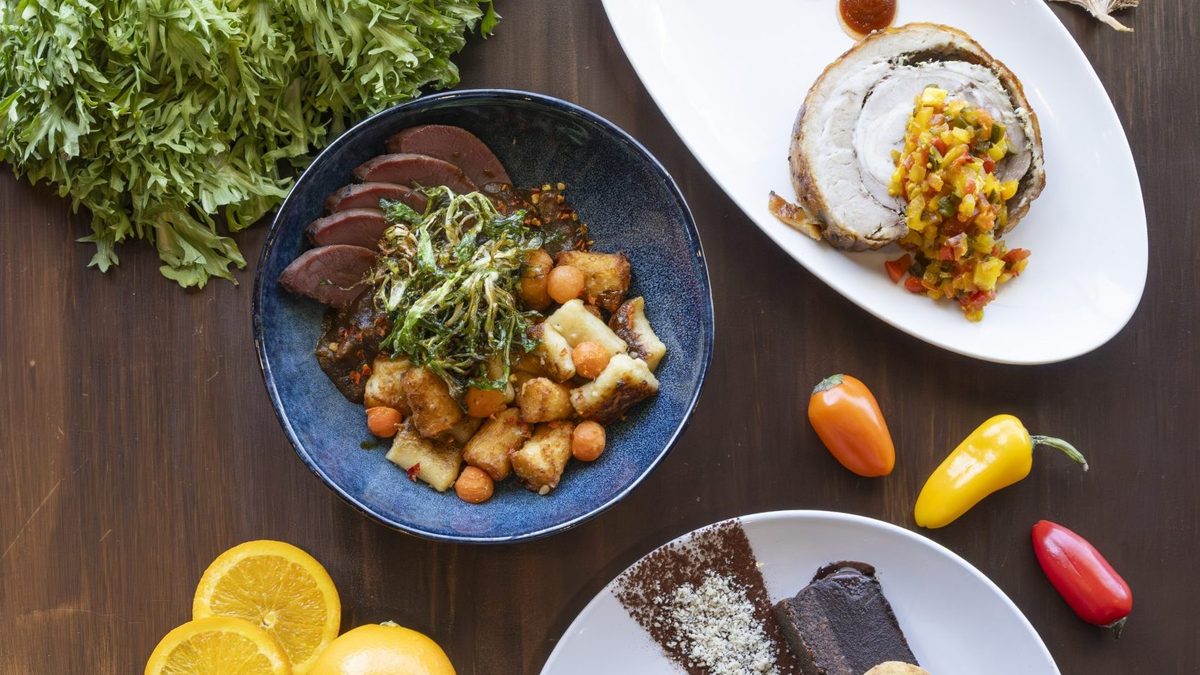
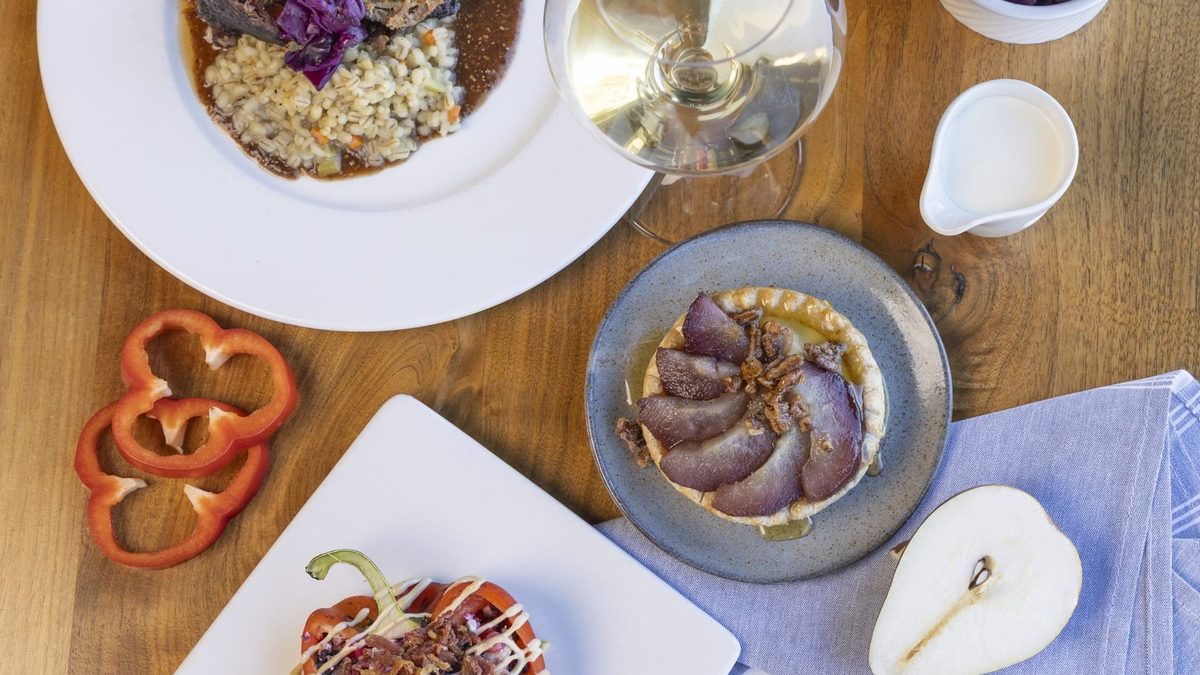
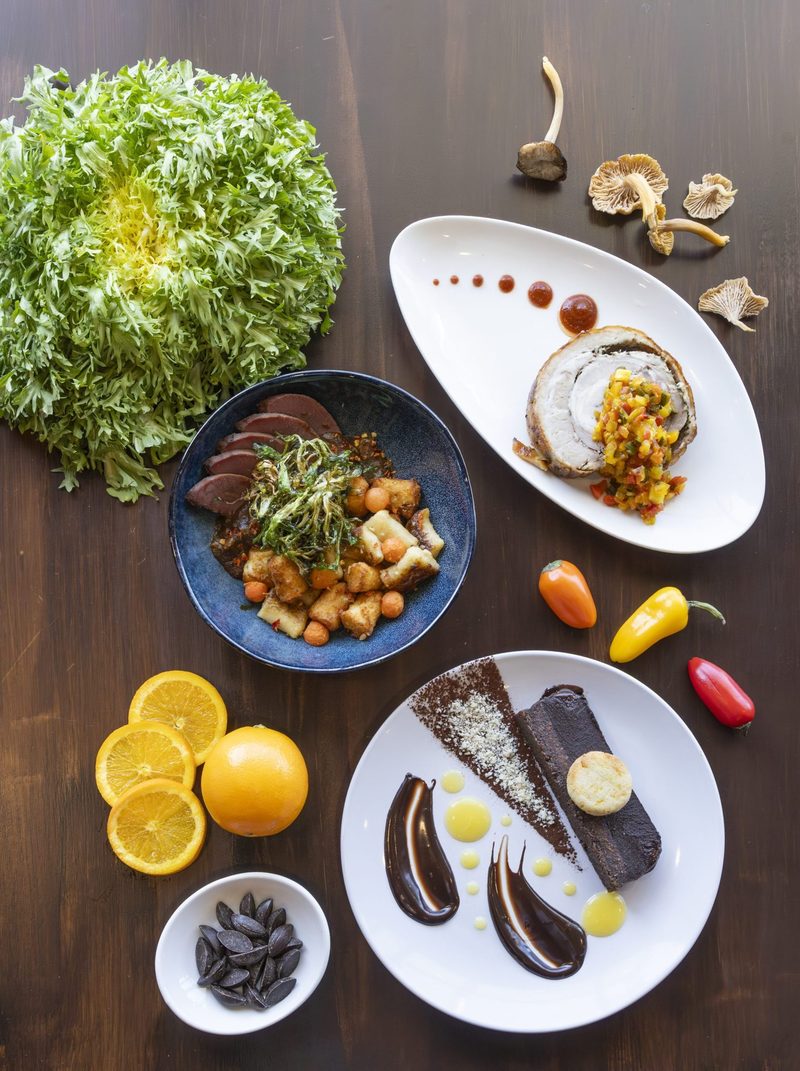
Gass described the Pork Belly Porchetta appetizer as “one of my favorite pork belly dishes to make.” Moist and tender, it was enlivened by fresh garlic, thyme, rosemary, and oregano, served with Old Fashioned Chow Chow and Seven Deers Farm Red Man Hot Sauce Reduction and paired with a straw yellow Lunae Vermentino Colli di Luni, that, says its maker, “opens with fresh and bright fruit, citrus, wild flowers, and notes of acacia blossom honey.”
Chef introduced his entrée, Smoked Elk Striploin, by noting that he’d been “getting back into hunting this year,” curing and smoking meat for his family. He served the elk with goat cheese and potato gnocchi, rosemary sous vide carrots, frisée, Extraterrestrial Fungi Mushrooms, red wine sauce, and fresh herbs. “The elk is so lean,” said diner Marcos Garza. “It was smoked to perfection.” The pairing with a Presqu’ile Syrah from California’s Santa Maria Valley, balanced the leanness of the elk with flavors of blackberries, dried herbs, bacon fat, and lavender.
Gass adapted a Dark Chocolate Bonet, a custard dessert from the Piedmont of Northern Italy, to include Amaretto cookie, crushed almond, orange fluid gel “providing a nice citrus pop,” chocolate glaze, and crushed cocoa puree paired with a delightfully sweet Masseria Borgo Dei Trulli, Primitivo, from Puglia, Italy.
→ Swipe for Next Story
FeatureMAY JUNE 2025
Cory Giaquinta | Top Chefs 2025
Chef Cory Giaquinta came to Bella after a year at the Dancing Bear Lodge. He comes from a big Italian family in Massachusetts. His father’s side is from Sicily. “I use a lot of my grandma’s recipes,” he says. “I add more basil, garlic, and thyme to the meatballs and make them with a combination of sausage, pork and veal.”
Story by N. Brooks Clark
This year’s event series kicked off inside the warm and comforting environment of Bella in Maryville. Executive Chef Cory Giaquinta often describes his Tuscan-inspired restaurant downtown as “Italian, with a modern twist.” So, it was fitting that he welcomed diners to the event with a canapé of Italian herb ricotta mix, Grana Padano shaving, and crispy prosciutto in a phyllo shell. The modern twist came with a welcome cocktail pairing of a Brandy French 75—lemon juice, powdered sugar, brandy and champagne—named after the fast-firing French 75-millimeter field gun from World War I.
The appetizer was a Tomato Basil Bisque with pancetta spoon bread fried polenta cake of sundried tomato, topped with jumbo tails of shrimp and a creamy Italian pan sauce. This paired perfectly with a Tedeschi Capitel Tenda Soave Classico light wine produced by Anselmi in the Veneto region of northeastern Italy known for its “brilliant straw-yellow color with golden highlights, reflecting its vibrant freshness and depth.”
As a bonus first course, a Venetian scallop gratin came with herb butter and browned seasoned breadcrumbs in a scallop shell. It was paired with a Ca’del Bosco, Franciacorta Brut Cuvée Prestige, bringing a few bubbles to the anticipation of the entrée, a Crispy Skin Duck Breast Gumbo with Italian risotto, great seasoning, pearl onions, potatoes, carrots, and celery.
The duck paired subtly with a Toscana Monteleccio refined red wine drafted by the Sesti estate in Montalcino, Tuscany. Looking closely, its coloration showed as deep ruby red with garnet inflections, and its nose is complex and inviting, with aromas of ripe red cherries, plums, and wild berries.
For dessert, Giaquinta told guests that he was looking for a “nostalgic campfire feel,” which came to life as he created their final dish: lightly smoked campfire Chocolate Torte S’mores with graham cracker crust and torched meringue. This sweet memory was paired with a Niepoort 10-year Tawny Port, a classic fortified wine from the Niepoort winery in Portugal’s Douro Valley. Its luminous amber color has coppery highlights and a taste that is rich with notes of dried figs and raisins, toasted almonds, caramel, and a hint of cinnamon and nutmeg.
→ Swipe for Next Story
FeatureMAY JUNE 2025
Darin Hoagland | Top Chefs 2025
Chef Darin Hoagland’s grandparents and mother ran a hunting restaurant in California. “The kitchen, with them, was my comfort zone,” he recalls. He went to culinary school at the Art Institute of Fort Lauderdale in Florida, and cooked in several high-end kitchens before moving to Knoxville and Oliver Royale eight years ago.
Story by N. Brooks Clark
Bar Manager Kirstie Durham and Bar Back Christoph Ewing started the evening off with a Spanish-style gin and tonic made with Tinkerman’s gin, juniper berries, lemon and orange wheels, thyme, rosemary, and lavender. The elegance of its presentation was wholly appropriate to the sophisticated ambiance built into the Oliver Royale.
CityviewPublisher Nathan Sparks introduced Chef Darin Hoagland as having “spun the globe” and deciding on Knoxville. Chef took the helm.
Hoagland noted that he had unexpectedly lucked into a batch of Nantucket scallops that were simply too good to turn down, so he turned his planned appetizer into a two-parter. Part One was a ceviche of scallop bits and fruit served on a clamshell-styled dish. Part Two was an octopus carpaccio served alongside pickled Fresno chilies, jerked lemon aioli, heirloom cherry tomatoes, Meyer lemon oil, and micro radish sprouts, topped with a micro-thin squid-ink tuile.
“The octopus is soaked for four or five hours in milk,” said Chef. “Then we pressed it until it’s hard as a brick, then sliced it and combined it with micelles and truffles. Baking soda makes the squid-ink bubble.”
“We’re pairing this with a Schloss Vollrads Volratz Trocken Riesling 2018 from the Rheingau region of Germany,” said Durham. Diner Krista Desocia commented on the “citrusy balance” it gave to the dish’s spicy qualities.
Hoagland introduced his entrée, a braised oxtail mofongo served with twice-fried plantains, garlic, crispy oxtail chicharrons, pickled red onions, braising jus, plantain crisp, and micro cilantro. This was paired with a K Vintners “El Jefe” Tempranillo 2019, from Washington State, selected, said Durham, because it is “not going to overpower the plantains.” The winemaker describes it as having “aromas of grilled cherries, black plum, dark chocolate, pipe tobacco, and smoked paprika.”
For dessert, Hoagland opted for “Caribbean comfort,” a mango coconut flan served with mango pineapple chutney, caramel, toasted coconut, citrus, papaya, dehydrated pineapple, and mango crisp—paired with a Rosé Brut Royale from Reims, France.
“It’s a commercialized Brut made by adding pinot noir and chardonnay into the champagne,” said Durham.
→ Swipe for Next Story
FeatureMAY JUNE 2025
Ian Carson & Spence Bender | Top Chefs 2025
“He’s artistic and cooking is his art form,” said Chef Ian Carson’s mother, Rabbi Shoshana Carson of Heska Amuna Synagogue. “At P.F. Chang’s, the head chef took him under his wing.” Chef Spence Bender graduated from Bearden High and is an elite musician. “He’s a creative soul and always has been,” said his stepmother, Wendy Roth, “going from music to being a chef.”
Story by N. Brooks Clark
Diners were greeted at the door with a welcoming Lavender Honey Spritzer in a champagne flute. Conceived by General Manager John Williams, it combined local honey, lemon simple syrup, Prospero Prosecco, and a sprig of lavender.
CityviewPublisher Nathan Sparks introduced Executive Chef Ian Carson and Sous Chef Spence Bender: “Ian is very precise in his plating. Spence was born in Asheville and worked at Caldo Pomodoro near San Diego, California.” The guests included Carson’s parents Dave and Rabbi Shoshana Carson as well as Bender’s dad, Steve Bender, and stepmother Wendy Roth.
For a delectable amuse-bouche, a seared Hokkaido scallop was topped with Benton’s 30-month-aged country ham and finished with apple butter.
The “Warm Vichy” appetizer was silky leek-and-potato velouté, enriched with milk and cream, gently warmed and infused with Benton’s smoky bacon, poured tableside over smoked trout roe, crispy rye crumble, and leek ash, brightened with micro chive blossoms and a drizzle of lemon oil. The 2023 Christian Moreau Chablis, said diner Micah Wells, “was in harmony with the dish. Potato soup can get so heavy, and the Chablis was delightfully light.”
As a bonus second course, Ossabaw pork belly rillons from South Carolina were slow-cooked, caramelized in red wine, and served on sticks with charred onion purée and pickled mustard seeds with a 2017 Georges Duboeuf Domaine les Chenevières Macon-Villages Chardonnay.
The entrée was a pan-seared duck breast infused with honey and lavender cooked to a delicate medium rare, complemented by carrot fluid gel, velvety mint-infused pea purée, and crispy wild Extraterrestrial Fungi mushroom arancini. The plate was finished with a lavender-honey jus and edible flowers and paired with a 2022 Belle Glos ‘Clark & Telephone’ Pinot Noir.
The dessert was a deconstructed red-wine-poached pear paired with whipped blue cheese mousse, honey-sweetened ice cream, and shards of house-made honeycomb candy, accented by a rich red wine reduction and edible flowers, and paired with a 2022 Inniskillin Riesling Icewine.
→ Swipe for Next Story
FeatureMAY JUNE 2025
Jared Martin | Top Chefs 2025
Born in Athens, Tennessee, Chef Jared Martin set foot in his first commercial kitchen when he was 16, serving in an ice cream shop. Six months later he shifted to cooking food, and it seems he never stopped. Martin spent time perfecting his craft in restaurants across the region, including Kefi in the Old City, connecting with chefs along the way.
Story by N. Brooks Clark
General Manager Airlia Pritchett greeted diners at the door with a welcome cocktail she had conceived and named Lavender Haze. “It combines honey-infused Empress 1908 gin with a lavender mint tea syrup and a hint of lemon juice,” she said. Owners Tara and Doug Snover settled in to a corner booth. They are still pleased with their decision to restart Fire + Smoke after the previous owner had unexpectedly shut its doors in late 2023. It was their favorite date-night destination after they had moved from Arizona and it still is.
CityviewPublisher Nathan Sparks introduced Chef Jared Martin, the “earthy chef with the bandanna.” Martin took center stage, introducing a two-tiered appetizer: “We couldn’t decide so we went with both. We’ll start with a 42-day-dried ribeye tartare on rice. Then you’ll get yellowfin tuna, lightly grilled, served with pickled daikon radishes and cucumber salsa made with jalapenos, red onions, and cilantro, and topped with a soy sauce wasabi reduction.”
They were paired with Mio, a festive, sparkling Sake, bright with aromas of peach, ripe persimmon, freesia, and fresh bread. The name Mio refers to light, shallow water.
Waiter Phillip Byrd quickly cleared the appetizers to make way for a palate cleanser of a melon-ball-sized scoop of lime basil sorbet with a little oregano on top. This led to the entrée, a lightly cooked duck breast served with herbed gnocchi, smoked bakers, smoked tomatoes, grilled chestnut mushrooms from Extraterrestrial Fungi out of Powell, hazelnuts, and blackberry gastrique. The pairing of a 2022 Siduri Santa Barbara County Pinot Noir was a perfect counterpoint to the duck’s strong savor.
Matt Schaeffer, CEO of East Tennessee Children’s Hospital, was on hand to talk about the great work being done there: 110 children are accommodated at the hospital, who come from 86 of Tennessee’s 95 counties and all 50 states. “The Medicaid population is 60 percent,” said Schaeffer. “It costs $900,000 a day to run the hospital, so we very much appreciate the contributions of everyone here.”
A post-entrée intermezzo of apple sorbet and smoked cinnamon introduced the Appalachian classic of Pecan Hand Pies served with espresso ice cream, raisin touille, and dark chocolate port ganache, paired with Warre’s 10-year Otima Tawny Port.
→ Swipe for Next Story
FeatureMAY JUNE 2025
Jeff Carter | Top Chefs 2025
Named this year’s Grand Champion, Chef Jeff Carter is a long-time culinary talent in East Tennessee. “I cut my teeth here (at Dancing Bear), for seven years,” he says. “This was my first job after Blackberry Farm.” He was executive chef at The Sunspot for a number of years on the Strip before he returned to Dancing Bear four years ago.
Story by N. Brooks Clark
When people come out here, they’re in a better mood, seeing the mountains and feeling close to nature,” said Executive Chef Jeff Carter. “We really lean into using local ingredients, regional suppliers—honoring the ways of Appalachian people over 100 years.”
The evening started with a cocktail, Beekeeper’s Bittersweet Buzz, conjured with Whistler Beekeeper’s Honey Whiskey, Vermut de Valdepablo, Rosemary Simple, lemon juice, and herb bitters. This was followed by a 2022 Scar of the Sea Rose of Pinot Noir, Methode Ancestrale, from Topotero Vineyard in California, as well as Brooklyn Brewery’s Fonio Rising beer, made from the ancient Fonio grain that has thrived in West Africa for more than 5,000 years. It flourishes in arid environments, regenerating the soil rather than stripping it and providing vital income to thousands of farmers.
“The pairing for course two comes from our sister company, Peaceful Side Brewery,” said sommelier Michelle LaBorda, “a Fonio Tripel.” A Belgian-style Tripel, it begins with a base of Pilsner malt, adds Fonio grains for complexity, and is enhanced with Belgian Candi sugar.
Carter’s appetizer was blackberry-glazed, South Carolina quail stuffed with Benton’s sausage and cornbread, with confit quail legs, cooked in duck fat, with pickled corn and pepper relish, indigenous watercress and frisee salad, Benton’s bacon vinaigrette, and blackberry gastrique. The flavors were enhanced by the 2022 Domaine Arnaud Dubreuil, Hautes-Côtes de Beaune from France.
The entrée was a smoked mushroom and peppercorn-rubbed venison striploin, sunchoke purée, roasted sunchokes, fermented honey glazed baby carrots, oyster mushrooms from Extraterrestrial Fungi, smoky venison-pepper jus, and sunchoke chips—paired with a 2021 Domaine Vincent Paris “Granite 30” Cornas.
The lavender-coated Cruze Farm hot milk cake featured Four Daughters Farm blueberries, an unexpected layer of sweet potato mousse, honeycomb candy, Sixmile Creek Farm pure honey, and sweet corn Anglaise, a recipe from an old Appalachian cookbook and utilizing indigenous ingredients—paired, appropriately, with The Perfect Ending cocktail of Licor 43, Dancing Bean Fresh Ground Coffee, Blueberry Cold Foam, and Orange Zest.
→ Swipe for Next Story
FeatureMAY JUNE 2025
John Bryant | Top Chefs 2025
Chef John Bryant was born in Johnson City and trained at Johnson and Wales University in Charleston, South Carolina. He ran a catering business in Johnson City for eight years then joined Bistro by the Tracks two years ago. He is committed to local sourcing from farms within 150 miles of Knoxville. “When we grew up, everything came out of the garden.”
Story by N. Brooks Clark
The walls of the former site of the Orangery and Kitchen 919 are decorated with vintage portraits gathered in estate sales. Most are from the 19th century; some appear even older. Though none are identified, the staff, when asked, produce fanciful tales of who each visage might be. “We take the liberty of making up stories,” laughs General Manager Will Oakes.
Executive Chef John Bryant introduced the appetizer, hand-rolled potato gnocchi: “We serve it with all kinds of spring vegetables—spring onion, wild mushroom, asparagus—and basil purée on the plate with Grana Padano and preserved Meyer lemons.” The gnocchi was paired with a 2022 Emilion Moro Polverete from Bierzo, Spain, described by the vintner as “a juicy white, with a ripe mix of poached pear, pineapple, apricot and mandarin orange fruit flavors enlivened by tangy acidity and accented by hints of ground ginger, honeysuckle and lemon thyme.”
The entrée was a wood-grilled spring lamb loin served with spring peas, basil, Carolina Gold Rice Grits, and “Red Eye” gravy, paired with a 2022 Foris Vineyards Pinot Noir from the Rogue Valley in Oregon. “It’s the best expression of pinot,” said Oakes. “It’s got an earthiness to it, strong enough to hold up to your lamb loin.”
Between courses, East Tennessee Children’s Hospital Pediatric Neurosurgeon Gentry Savage thanked the diners for helping the hospital meet the costs of running its operations. “There is no way we could do it without your support,” she told attendees.
For dessert, Bryant presented diners with, what he referred to as “an old, old, old school South Carolina strawberry shortcake on an Appalachian sweet biscuit, with Chantilly cream, and basil fluid gel. It’s all about what we put into the biscuit: butter and buttermilk. It’s a recipe from my wife April’s great grandmother from up on Spider Mountain in Unicoi County in Northeast Tennessee.”
This final dish was complemented by a 2022 Chateau Laribotte Sauternes from Bourdeaux, France, crafted from a blend of Sémillon, Sauvignon Blanc, and Muscadelle grapes and delivering an enticing aroma of honey, apricot, dried fruits, delicate floral notes, and a touch of vanilla. It was the perfect combination to end the night.
→ Swipe for Next Story
FeatureMAY JUNE 2025
Robert McDonald III | Top Chefs 2025
Born in Fountain City, Chef Robert McDonald III began cooking on his family’s outdoor grill anytime guests would come over. An actor at Central High, he had stints acting in New York and LA, then returned to Knoxville and his love of cooking. He met his wife breaking down the grill at Creamery Park Grille. McDonald joined Burleson Brands and the rest is history.
Story by N. Brooks Clark
CityviewPublisher Nathan Sparks welcomed the guests at The Marlowe and introduced Chef Robert McDonald III as “a culinary legend from right here in Fountain City,” noting that the evening was about fine dining, but also “our support of the East Tennessee Children’s Hospital. “The amazing thing about Children’s Hospital is that they don’t turn away anyone regardless of their ability to pay. It’s a really expensive proposition to run ETCH, so your donations are appreciated.”
McDonald described his appetizer as “Red peppers roasted with a blowtorch stuffed with corn fermented for two weeks, black rice, beets, onions, goat cheese, and shredded black confit.” The pairing with a 2022 Mer Soleil “Silver” Chardonnay from Monterey County, California, made sense to diner Nate Davis: “The wine is smoothly tasty. Contrasting to the tart of the appetizer, the wine doesn’t have a lot of bite.”
A mini charcuterie board served as an added bonus between courses. “A little boost, a little bump,” said McDonald, “of pita bread, olives, goat cheese, ricotta, and crème fraiche dates rehydrated with honey.”
Ever the showman, McDonald introduced the entrée with Remy, the aspiring-chef blue rat from the movieRatatouille, on his shoulder: “Feel the comfort and the warm essence of hominess as it comes to your table. This is my version of beef stew: Beef Rouladen, a traditional German dish of top sirloin rolled with Benton’s mustard bacon, roasted carrots, poblano peppers, caramelized onions and tomatoes, alongside barley and pickled purple sauerkraut with a mustard demi-glace.” It was paired with two Caymus Vineyards Cabernet Sauvignons from the Napa Valley—a 2022 regular Cabernet and a 2018 “Special Selection.”
Of his dessert, McDonald said, “I got bored being comforted. I wanted to be creative, different, and a little bit weird.” The result was a Pear Tart poached in spiced port wine with rosemary and blue cheese custard, warm honey and hot walnuts. The dish was paired with a “sweet” Caymus Vineyards 2022 Cabernet Sauvignon.
The evening ended with an announcement from General Manager Lara Shackelford: “I’m pleased to announce that Randy and Melissa Burleson have donated the expense of the meals {to Children’s).”
→ Swipe for Next Story
FeatureMAY JUNE 2025
Top Chefs 2025
A Culinary Celebration: Honoring Knoxville’s Finest
Story by Cityview
In 2007, Top Chefs was born from a simple idea: Knoxville’s culinary talent deserved a spotlight. We set out to celebrate the chefs who transform ingredients into experiences, hosting events at iconic venues like L&N Station, the Women’s Basketball Hall of Fame, Crescent Bend, and Lighthouse Event Center. Each gathering was a testament to the chefs’ creativity and passion.
Then came 2020. In the face of unprecedented challenges, we adapted, bringing the competition directly to the restaurants. This shift allowed chefs to showcase their craft in their own kitchens, offering diners an authentic taste of their culinary vision. The public remained the judges, but this time casting votes based on flavor, presentation,andhospitality. This evolution breathed new life into the series, fostering deeper connections between chefs and the community.
This year’s competition was nothing short of extraordinary, thanks to the restaurant owners and our sponsor, Garza Law Firm. As host and emcee for all eight events, I had the privilege of experiencing every dish, every moment, and every atmosphere. The talent on display this year was remarkable, making the competition tighter than ever. We’ve had close calls and ties before—but this year delivered something unprecedented.
For the first time since we moved to the restaurant format, we witnessed a clean sweep. Chef Jeff Carter—executive chef and visionary at Dancing Bear Appalachian Bistro—along with Houston Oldham, Kelley Harris, and their phenomenal team, took home top honors in every category: appetizer, entrée, dessert, and overall experience. It was a grand slam from a chef who has long been known not just for his refined take on Appalachian cuisine, but for his mentorship, consistency, and relentless pursuit of culinary excellence.
Jeff has always believed that food tells a story. And this year, it was time for his menu to tell a new one, where everything he’s worked toward comes together in perfect harmony: the ingredients, the team, the experience. And the voters agreed. So without further ado, I present the 2025 Top Chef contenders and our first grand slam champion.
Whether you joined us in person or are discovering it here for the first time, this year’s series was a celebration of flavor, passion, and the chefs who continue to elevate Knoxville’s dining scene. Dig in.
The 2025 Top Chef Lineup
Cory Giaquinta | Top Chefs 2025
Jared Martin | Top Chefs 2025
John Bryant | Top Chefs 2025
Ian Carson & Spence Bender | Top Chefs 2025
Robert McDonald III | Top Chefs 2025
Alex Gass | Top Chefs 2025
Darin Hoagland | Top Chefs 2025
Jeff Carter | Top Chefs 2025
→ Swipe for Next Story
FeatureMAY JUNE 2025
The Joy They Carry
How one family’s love and one doctor’s support are changing lives.
Story by Carolyn Evans
On a small farm about an hour from here, mom of two Julia Erman turns on a light at 4 a.m. She says her best writing happens in the quiet hours of the morning.
In another part of the region, a different mom of two Dr. Jessica Sheah gets up early and drives to work at East Tennessee Children’s Hospital.
And over the last three years, these two moms have been through an awful lot together.
Julia lives on five acres with her husband, Aaron, and their two kids, Hazel, 7-and-a-half, and Russell, almost 5. With chickens, 100 new chicks, bees, a farm cat, and as of last year, some pigs, the farm is busy. Life sounds idyllic, but it was a tough set of circumstances that brought Julia and Aaron to look for a home in Tennessee—they were also looking for a hospital.
“We knew that Knoxville had the best children’s hospital,” Julia says. “We were first connected with Dr. Jessica Sheah and I think we had an appointment with her even before we moved.”
Hazel and Russell have a rare genetic disorder called Nonketotic Hyperglycinemia or NKH. It affects the body’s ability to break down glycine, an amino acid, causing it to build up in the brain and ultimately causing severe neurological issues. After years without answers as to what was impacting their children, the Ermans finally had them. Since then, it’s been Julia and Aaron’s mission to give their children the best life possible.
“Hazel is nonverbal,” Julia says. “She walks like a drunk sailor. I don’t have any other words to explain it. Her intellectual ability is between 8 months and a year. She is the happiest kid you have ever met in your entire life. I do not know why, but ever since she was born, she just walks in a room and the room lights up. She attracts people like crazy. She brings smiles to people’s faces.
“[Russell] is in a wheelchair and he is also nonverbal. His development is probably 6 to 8 months and his disorder is a little more progressed. We haven’t had an MRI on our kids for a few years but his last MRI shows that he actually has holes in his brain. Russell is also very happy and he is obsessed with music. I don’t know how he got this obsession, but he likes music with a really good beat, and every time, he moves his hands and dances. He has rhythm. He’s a total joy.”
A Rare Disorder
There are not many scientific papers written about NKH. According to a more recent one from 2023, only one in 76,000 people worldwide are diagnosed with the disorder. And the life expectancy of a child with this disorder is low, many not making it out of their first month of life, others not living past their fifth birthday.
“I think that there are probably lots that go undiagnosed,” Julia says. “The only two kids ever documented with this disorder that have lived longer than Hazel and Russell lived till 9 and, I believe, 14.”
After learning of what was going on with their children and a long journey of medical interventions—as well as a move from home in Washington State in 2022—the Ermans found community and care in East Tennessee. And that started with Dr. Sheah.
“She was able to listen to where we were in our journey,” Julia explains. “We had done a ton of medical intervention. We had done a ton of therapy. We had done every MRI, every EEG. We were just kind of burnt out. We came in and told her our story, and she laid out options that she could connect us with. She was really open to creating a medical plan that fit our family’s goal, which was quality of life. And for us that is not in a hospital appointment every day or even every month.”
And that is why the two connected so deeply three years back. Dr. Sheah was supportive of how Julia and Aaron wanted to navigate medical care.
That quality of life the Ermans and Dr. Sheah have worked to make a reality has involved the kids being at home, living life on their small farm. They still do therapies, but Dr. Sheah walked them through what medical interventions were and were not necessary for the kids’ disorder. “She’s been the main person to manage any care as far as neurology goes for our kids for the last three years.”
Finding Care that Matches
Dr. Sheah’s way of working with the Ermans, the idea of meeting families where they are, exemplifies the sort of experience families receive when they connect with Children’s.
“Our mission at East Tennessee Children’s Hospital is to provide state-of-the-art care for every family that walks through our doors,” Dr. Sheah says, “which can mean anything from pursuing advanced emerging treatments to celebrating each child for their strengths and ensuring we do everything to help them meet their goals, being with them every step along the medical journey.”
That extends to her nursing team. While the kids come at this point every six months for appointments, Julia raves about the nurses too when talking about the support she receives: “If I ever need anything, I just call them and they just do whatever the kids need, whether it’s a doctor’s note or a change of medication,” Julia says. “They provide a ton of support over the phone, which actually has helped us limit appointments.”
Pediatric neurology is a fairly unique specialty; there’s a wide variety of conditions that physicians like Dr. Sheah handle. “There are some kids that I see once or twice and others that we’re gonna walk together for a long time, and I think that’s why I get along with Julia so well. Her goal for her kids is exactly the same as my goal for all of my patients, which is that I want these kids t be able to reach their full potential, whatever that is.”
Sharing Their Story
Julia’s mission is to share her story so others will not feel alone. She does so by sharing her journal on social networks, but also by going into schools and putting on programs and assemblies in the community. Over the last few years, the Hazelnut Movement, as it has come to be called, has gotten bigger.
When Hazel turned 1, Julia said she was desperate to have a resource to understand why Hazel didn’t seem “typical.” That spurred her to write.
“The first book wasHazelnut, Time To Get Up. I made a Shutterfly version and gave it to all my friends and family.”
Hazelnut t-shirts with the character from my book soon followed. So did other books. And last June they partnered with Luke 14 Ministries based out of Morristown to keep spreading the message.
Julia hopes to one day provide bags of books and materials to the 4,000 families that are getting a disability diagnosis this year in Tennessee, “giving them the tiniest piece, just a tiny gift, a piece of hope.”
For Dr. Sheah, seeing how a family has created a ripple effect of positivity in the community has been inspiring.
“This book just puts life back into perspective — let’s celebrate each individual for who they are and their unique superpowers, celebrating each and every success, big or small with love, kindness and acceptance,” she says. “I think Julia’s superpower is sharing that with other parents facing difficult medical diagnoses through her books and the Hazelnut Movement.” It’s just one more reason Dr. Sheah is grateful to be working in a pediatric field.
“Working with the Erman family is one of the many reasons I feel so fortunate to be a pediatric neurologist,” Dr. Sheah says. “They are a great reminder that this field can be challenging, but there is also so much joy and success that we can offer to enrich lives.”
Choosing Joy
While this life is not what she and Aaron imagined before they had children, it is theirs, and Julia has made a point of ensuring no aspect of it is taken for granted. They’ve found joy in what seems to be an impossible situation, knowing each day is gift. And with a strong support system around them, Julia says she and Aaron are blessed with an unwavering faith that “makes no sense.”
“We just know that our kids are a gift. They’re here for a reason or blessing. They are joyful. They are really hard, but one day they’re going to die and they’re going to go be with Jesus,” she says. “That doesn’t scare us, whereas for most people it’s a very fearful thing if you really kind of put your mind around it.
“In a sense, I feel like I’ve been chosen to show people this one thing: that you can hold suffering and at the same time, you can hold joy, too.”
→ Swipe for Next Story
FeatureMAY JUNE 2025
Haming It Up
A father, a son, and the slow-cured magic behind Benton’s Smoky Mountain Country Hams
Story by Nathan Sparks
If you’ve ever been in a kitchen when a thick-cut strip of Benton’s bacon hits the skillet, you know the sound. You know the smell. And if you’ve tasted it, you know that this is no ordinary pork product. In Madisonville, Tennessee, tucked between rolling hills and smoky hardwood forests, Allan Benton and his son Darrell are quietly making some of the finest cured meats in America—still by hand, still with patience, and still without any fancy marketing machine. Their secret? There is none. Just salt, smoke, and time. And a little bit of family.
I am a frequent visitor to Benton’s. The smell of the smoke of nearly a half dozen decades easily seeps into your bones. And once it’s there, well, you’re hooked—for life. Nothing sets off a charcuterie board better than a hoof on prosciutto style ham on a cutting rack surrounded by an assortment of cheeses and crackers. And if you are a country ham lover, then I suggest lightly frying it, but maybe leave a few pieces in till they are really dark and then deglaze the pan with a little black coffee for the perfect red-eye gravy. A fresh biscuit, some ham, a slice of tomato, and red-eye to dip in? You can call thatheaven on a plate. I could go on and on, but let’s get to the story.
A Legacy Begins
“I’d been working as a high school guidance counselor just three or four miles down the road from here,” Allan Benton begins, settling into a wooden chair inside the modest office at Benton’s Smoky Mountain Country Hams. “I’d just gotten my master’s, school started, and they passed out the salary schedule—and within 15 minutes I was in the principal’s office resigning. I knew I couldn’t ever work for what they were going to pay me.”
It was 1973, and Allan walked away from teaching. A few weeks later, he heard that a man named Albert Hicks had shut down a small USDA-inspected curing facility in his backyard. Allan talked Hicks into leasing him the space.
“My family always butchered their own hogs, cured their own meat, made their own sausage,” he says. “I meant to only do it long enough to figure out what I wanted to do. I thought I might want to go to law school. But after about three or four months, I figured out that I was really enjoying what I was doing.”
With a workforce of one, Allan eventually got help from a local man named Arthur Atkins. “He had a sixth-grade education, but I suspect he probably had a 150 IQ. He was incredible, an old country boy with common sense and the memory like an elephant.”
Slowly, Allan built a reputation, peddling hams from the back of his pickup through East Tennessee. The Benton name was fast becoming a staple in Southern kitchens.
A Lucky Break—And Then Some
For years, Allan worked seven days a week, often until midnight. It was in those early years that he met his future bride, Sharon. They married about a year after he started the company. “She should have known better,” Allan chuckles.
The company kept growing, mostly through word-of-mouth but in a stroke of serendipity it catapulted into national view. Benton’s was getting coverage, but there was one food writer of note. “He rented a car in Chattanooga at the airport, and they told him, ‘If you’re looking for country ham, you need to go up to Madisonville.’ He got something to eat in Cleveland, Tennessee, and asked ‘Where can I find great country ham?’ They told him, ‘You gotta go up to Madisonville,’” Allan recalls. “He came by and visited with us and I didn’t know who he was or anything about it until after the fact.” He’d later learn that the man wrote for a connoisseur magazine.
That mention, alongside steady exposure from chefs at Blackberry Farm and later the national culinary press, helped catapult Benton’s products onto the menus of elite restaurants from New York to Charleston to Los Angeles. He never advertised—never needed to.
From X-Rays to Country Hams
Despite Allan’s growing reputation, his son Darrell had no interest in joining the family business—at least, not at first. “My earliest memory was when I was four or five,” Darrell says, sitting next to his father, a grin on his face. “I was in the ham curing cooler, and I remember standing on a milk crate over the salt box and dad teaching me how to rub a country ham, how to cure it.” Darrell snuck down to the shop from their house on the hill any chance he got. “By the time I was seven or eight, I was tall enough where I could label country ham and bacon on the tables back there. At the time, dad only had one or two employees, so it was an all hands on deck situation.”
But as the son of a small business owner, he saw the struggle of his father’s life and when he got out of school, he wanted to do anything but cure country ham and bacon. “I’d about had my fill at that point, so I went looking for greener pastures. I felt called into the medical field.”
Darrell studied at East Tennessee State and trained as a radiologist, eventually practicing in Knoxville. But the farther he moved into medicine, the more he missed what he’d tried to leave behind. “As far back as residency, I remember having thoughts of missing the sights, the smells, and most of all the people in this business,” he says. “A large part of my day as a radiologist was sitting in a small, dark room reading medical imaging, and I missed that connection with people.”
The decision wasn’t easy—but eventually, Darrell walked away from medicine. He told his practice it was time and made the call to his dad. “We’d have some conversations about it, but I don’t know if he really knew how serious I was when I told him I’d already pulled the plug and was going to be heading out here in a few months. He about fell over. He said, ‘Son…what have you done?’” Darrell laughs. Allan shakes his head: “All I wanted was for him to be happy. And it was obvious—he was.”
A New Generation, The Same Cure
Today, the two work side by side—Allan bringing wisdom from five decades in the smokehouse, and Darrell adding just enough technology to keep up with a world of online orders, food blogs, and Instagram chefs. He had added a website when he was still in college.
Allan remembers when the site went live and the call that came from Darrell. “He said, ‘Dad, you need to check it. You’ve got seven orders.” He thought he was joking. Today, Benton’s ships nationwide. During the holidays, orders pile up by the hundreds, many destined for Michelin-starred kitchens and white-tablecloth establishments. But of course, a steady local customer base remains.
Simple, Time-Honored and Deeply Southern
Ask either of these men what makes Benton’s special, and you’ll get the same answer: “There’s no secret.”
“Salt, brown sugar, pepper,” Allan says. They still cure hams for up to two years and smoke their bacon over hickory for days. “Not many people are willing to take the time to make a two-year ham,” he says. But they do. He’s also quick to note their bacon contains no nitrates. “I’ve made it now for 52 years with no nitrite or nitrates.”
What about the ham? Technically, it can’t be called prosciutto—wrong continent—but it’s darn close to it.
“We’re planning to go to Europe, Spain and Italy,” Allan says. “We need to see what our European cousins are doing over there. You always learn something.”
Time-Honored Memories
The office smells faintly of smoke and old paper. There’s a church pew in the entryway where old-timers still sit and swap stories. And over in the corner, Darrell points to where his grandfather used to cook lunch on an electric skillet. “He made the best fried chicken,” Darrell says. “That’s a really warm memory.” And the worst memories? “During our busiest times, we’d often stay out here either packing bacon or shipping orders until 11 or 12 o’clock at night,” Darrell laughs. “You know, it’s tough to see the light at the end of the tunnel when you’re 10 or 12 years old, but I think that hard work is good for you.”
These days, he brings his own children—William, 10, and Emily, 8—around the shop. “They don’t have cell phones yet,” he says. “They want to spend time down here.”
What Comes Next
Darrell isn’t looking to reinvent the wheel. After all, to take a company into its next chapter, you need the right formula—and the formula at Benton’s works. But with some small changes and a renewed sense of purpose, no doubt the next chapter will be something exceptional.
“We might experiment with some different types of charcuterie on a small scale, but this place has run pretty well for 52 years now,” Darrell says. “We’re going to keep on keeping on and stick to tradition.”
As for the pressure that might come with taking the helm of a company built on the back of a legend, Darrell shakes his head. It turns out that it’s not something he feels in the slightest.
“I’m proud of him, proud of what he’s done and what he’s built. And most of all, I’m proud of how he treats people,” Darrell says. “He’s built this business one relationship at a time.”
Oh, and about the bacon: “Best way to eat it?” Darell and Allan both say in unison. “BLT. Garden tomato. Cheap white bread. Little Duke’s or JFG mayonnaise.”
Sometimes the simplest things are the best. Just ask anyone who’s tasted a slice of Benton’s bacon.
→ Swipe for Next Story
VeteranMAY JUNE 2025
Going Once, Going Twice, Going the Distance
Bear Stephenson and Morton Massey struck up a military kinship that has endured
Story by Phil Newman
One morning in 1973, in the shadow of a hallowed hill, at the US Army Reserves center then situated on the UT campus, Bear Stephenson said his first hello to Morton Massey. Among other duties, Private Massey was assigned to serve as First Lieutenant Stephenson’s Jeep driver for the next year.
Little did the two young men know that the friendship they would establish over the next year would later grow into a dynamic partnership making a world of difference in their community.
Stephenson would become a seasoned, sought-after auctioneer. Massey would go into software development and create a platform to manage the auction checkout process. The men would team up to bless numerous community organizations and enrich thousands of lives throughout East Tennessee by helping to raise much-needed funds.
Several decades later the pair’s friendship would come full circle in an even more fitting and poignant way. On April 10, 2024, both men traveled to Washington, DC, with HonorAir Knoxville, joining 132 fellow veterans for a memorable day of remembrance and reflection— capped off by a raucous “Welcome Home” celebration at McGhee Tyson Airport that night. (To learn more about that flight, read our feature article atcityviewmag.com/finally-home.)
None of that occurred to either man on that first morning in 1973. But looking back to their time with the 844th Engineering Battalion in Knoxville, Stephenson and Massey express fondness not only for the camaraderie they shared but also for the character traits each of them noticed in the other—traits they would come to value even more deeply over the decades.
“Morton is laid-back, nonchalant, he’s not loud, but he has a quiet influence that can make a tremendous impact on people,” Stephenson says of Massey. That influence became evident over the years at auctions. In addition to running the checkout, Massey often filled the role of a bid assistant or “spotter” who would kindle the bidding from among attendees.
“Morton can work a crowd as good as anybody I’ve ever seen,” says Stephenson. “I’ve always said, ‘If you’ll let me bring Morton and feed him dinner, he’ll more than make up for the cost of the meal.’ He’s that persuasive.”
As for Massey’s assessment of Stephenson, a more gregarious impression emerges. “I could see right away that Bear would light up the room. He’s got such a wonderful smile and a great personality. People have always been naturally drawn to him. But as fun-loving as he is, he’s also incredibly focused and diligent about the work he does.”
Candy for the Kids
For Stephenson, that stint with Massey and others at the reserves center in Knoxville was a welcome respite from his earlier service, including a tour in Vietnam from 1971-72. A Clinton High School graduate, he had enrolled in ROTC at Tennessee Tech in Cookeville, graduated in 1970 with a business degree, and opted to enlist in the Army. He was commissioned as a second lieutenant combat engineer, completed basic training at Fort Belvoir in Virginia, and sent to dry, hot-as-jalapenos Fort Hood, Texas.
Stephenson, who has a knack for seeing the lighter side of life, jokes that after seven months on base, “I was halfway glad to get orders to go over to Vietnam and get the hell out of Fort Hood!” Once there, at a base 30 miles south of the Central Highlands—“I could look to the north and see the mountains, and to the south and see rice paddies”—Stephenson worked with troops maintaining roads, bridges, and related infrastructure. He sometimes escorted convoys to pick up rations and spare parts for the dozers and road graders.
Even amid the stresses of the war in Southeast Asia, his outgoing personality and a desire to help others blossomed. He oversaw the base’s NCO Club, a watering hole and gathering place for soldiers. “I’d get six or seven pallets of Bud or Miller beer and sell it for 12 cents a can,” Stephenson recalls. “We did our best to keep the troops from being homesick.”
His most vivid memory of Vietnam reflects a similar heart for making things better. “I had a lot of interaction with civilians, and I was especially sympathetic to what the local children were going through.”
Every week, the soldiers received a box of supplies— soap, razors, MREs, and sundries. The kit included M&Ms and similar treats. “A lot of the guys didn’t eat that candy, so I’d go through the enlisted men’s barracks and gather up all of it I could find, take it to the little villages north and south of us, and give it out. They didn’t have that kind of stuff. I got a lot of pleasure out of seeing the smiles on those kids’ faces.”
As news of his visits spread and throngs of youngsters began to surround him, Stephenson grew fearful that they might trample each other. “I thought, there’s gotta be a better way. So I got to know the head of one of the schools, and he let me come in and put some candy on every child’s desk.” Even all these years later, those simple acts of kindness and the happiness they brought shine as a bright light amid fog-of-war memories.
And through it all, Stephenson says, enlisting “was the best thing I ever did—for the pride of serving my country, the country that I dearly love.”
Following the Money
Returning home to Tennessee in 1972, Stephenson parlayed his finance degree into a foray into banking. A local businessman and fellow veteran who had served in the Marines took a liking to him. That man, Jake Butcher, hired and trained Stephenson to become a C&S Bank assistant branch manager in Clinton.
The following year, Stephenson’s penchant for military service led him to the army reserves center where he met Morton Massey.
Massey was in the middle of six years of duty in 1973 when Stephenson walked in. As the two zig-zagged from morning roll call at the Knoxville center to the Oak Ridge unit to check on equipment and supplies, and back in the afternoons, they enjoyed “a lot of good times,” Massey says. “Bear was the best.”
Massey would complete two more years after Stephenson left the reserves to continue his banking role, including a stint at the Fountain City branch of United American Bank (it’s now a Home Federal), until 1976, when he opted to shift into real estate—which led into his becoming an auctioneer in the early 1980s.
Massey, meanwhile, built his career as a computer and software expert. When he attended an auction for his daughter’s dance group, with multiple items up for bid, it occurred to him that he could write a program that could facilitate a smooth, automated checkout for buyers and the organization. That innovation led him, and his wife, Becky (now State Senator Massey), to begin volunteering to assist with charitable auctions. They worked 40, 50, or more events each year, usually on Friday or Saturday nights, up until 2020 or so.
With Stephenson himself engaged in nonprofit auctions, it was only natural that he and Massey would reconnect in that realm. The two teamed up and conducted hundreds of auctions over the years, Stephenson as the all-smiles, big-personality auctioneer, Massey more quietly handling checkout and engaging in strategic recon as a spotter to sweeten the pot among bidders. They had a blast, and on occasion they would reminisce about their military escapades.
“Bear would do that more than I would,” Massey recalls. “We’re doing an event and bump into somebody and Bear goes into, ‘Let me tell you a funny story about how Morton and I met in the army in 1973!’ It’s nice how we started there and it developed into a lifelong friendship.”
Washington Whirlwind
Their bond grew even stronger when they took part in the aforementioned HonorAir Knoxville flight in 2024. Massey, who had heard about it and been invited to apply, thought of his friend Bear and made sure he knew about the opportunity as well.
Their civilian “chaperone” (a leader/guide assigned to several veterans during the trip) was Knox County Mayor Glen Jacobs. Standing together at the Air Force Memorial, the first stop of the day, the men were talking with the mayor and with US Representative Tim Burchett about how grateful they were for this experience, and how blessed they feel to live in East Tennessee, where the community cherishes its military veterans.
For his part, Stephenson added, “if I had to go fight in a war, I’d want a platoon made up of soldiers from our part of the country, because those I served with were patriotic souls who knew how to use a weapon, and they weren’t afraid to fight.”
After the Welcome Home party at the airport that evening, Stephenson reflected that the journey was “one of the most memorable things I have ever done in my life,” and Massey concurred.
These days, with many live auctions having moved online and virtual, the two men still work together on events, but much less often. Among other pursuits, Massey enjoys time as an expert ornithologist who loves birdwatching and cherishes the many years he and Becky have coached 11- and 12-year-old girls’ softball. Stephenson remains active in business and in the community as well.
The two scarcely could have imagined all that would unfold on that morning 52 years ago when they first hopped into a Jeep together in the heart of Rocky Top.