I’ve made my way downstairs. Put on the water to make a little coffee. Ground the beans. Set out the French press. The dog whines gently. I ease toward the back door.
And there she is, standing beside me. Twenty pounds of pure energy. Dressed in a jet-black coat of fur. Just dying for me to open that door so she can tear out of there. And whatever it is that’s made its way down from its overnight—squirrels, chipmunks, the random chicken that’s gotten out from the neighbor’s coop too early—it’s all in for a run.
I just pray every morning, every single morning, that there’s not a skunk in the yard.
That’s how most of my days begin: quiet, steady, with a moment of anticipation. And over the years, I’ve come to see how those early hours shape the rest of the day. When everything is still, when the world hasn’t quite woken up, you get clarity. You remember who you are. What matters.
That’s also the moment when you start analyzing your day. Those quiet moments when you can think clearly—so that you know what you need, what’s on the agenda, and where you’re going to find it. And that can be challenging at times: where to find it. What to trust.
I mean, almost everybody Googles it or asks Siri. But those searches often reach regionally—not locally. You get listings from Atlanta, ads from Nashville, and reviews from people you’ve never met. And yet somehow, that’s supposed to help you make a decision today, in Knoxville, about a pediatrician, or a plumber, or where to go for dinner
In a world where information is everywhere, it’s still hard to find what’s truly close—what’s truly trusted. Because let’s be honest: not everything online is true. And for me, that especially applies to social media.
You scroll past the curated lives, the outrage-of-the-day, the “sponsored” recommendations. It’s hard to know what’s real and what’s been paid for—what’s authentic and what’s just noise. So what can you trust?
For most of us, the answer is simple: you trust what’s local. The familiar names. The businesses you’ve passed a hundred times. The folks who go to the same schools, the same grocery stores, the same ballgames. And most people understand that—if you can buy it local, you should. Because local keeps our city strong. It keeps small businesses open. It keeps the dollars, and the relationships, right here at home.
And that’s exactly why we’ve built something new:Find It Knox.
What Is It?
So what exactly isFind It Knox? And why would it be any better than the dozens of search engines, directory sites, and apps already out there?
Simple. First, we live here.
We’ve lived in East Tennessee all our lives.Cityviewis now in its 41st year, and I’ve been at the helm for the past 25 of those. Before that, I ran other businesses here in Knoxville. I’ve worked with thousands of business owners—builders, lawyers, chefs, accountants, doctors, and designers. I know their reputations. I’ve watched their work. I’ve heard the stories—good and bad—from the people they’ve served.
And even when I don’t personally know someone, I have the resources to find out. Our team has built a network over decades—one that allows us to vet a company quickly and tell you, with reasonable certainty, whether they are someone you can absolutely trust. That’s whatFind It Knoxis.
It’s not an algorithm. It’s not a popularity contest. It’s not a pay-to-play placement scheme. It’s a local, living directory of trusted professionals and businesses—vetted by real people, based right here in the community.
We’ve taken the trust you’ve placed inCityviewfor decades—and built a platform around it. A tool you can use every day. Whether you’re looking for a roofer or a real estate agent, a plastic surgeon or a piano teacher,Find It Knoxis here to help you start with confidence.
And unlike national platforms, we’re not trying to overwhelm you with hundreds of listings and ads. We’re narrowing it down. Showing you the best. Giving you the tools to dig deeper if you want—but only after we’ve opened the right door.
How It Works
Find It Knoxis built to be simple, intuitive, and above all—trustworthy. At its core, it’s a clean, easy-to-use website and mobile platform where you can find local businesses and professionals across a wide range of categories. From attorneys to electricians, orthodontists to interior designers, if it matters in your life, we’ve likely got it covered.
But here’s what makesFind It Knoxdifferent. At the heart of the platform is our Trusted Program—a badge of confidence you won’t find anywhere else.
If a business carries theFind It KnoxTrusted badge, it means one of two things: we’ve either worked with them personally or we’ve visited and vetted them directly.
These are companies we know. People we trust. Folks who have built a reputation in our community not just for quality, but for how they show up, treat customers, and stand behind their work.
We’re not just pulling names from a database—we’re putting our name on the line. And for those we don’t yet know personally? We invite them to apply, go through our local vetting process, and meet the standards we’ve developed over decades in this community.
Every listing onFind It Knoxcomes with a free basic profile page. Businesses can claim their listing, enhance it with photos, services, links to their website and social channels, and even customer testimonials. But only those that meet our criteria can earn the Trusted designation.
This isn’t about being the biggest directory. It’s about being the most useful one.
We’re not aiming to show you every possible option—we’re aiming to show you the right ones.
You’ll also start seeingFind It KnoxQR codes throughoutCityviewMagazine. In print stories, in ads, in features. Scan the code, and you’ll go directly to that business’s listing. Instantly. No more guessing, no more Googling. It’s our way of making sure the credibility we’ve built in print is just one click away from action.
Where We’re Going
In many ways, this is the most exciting and most important thing we’ve ever done.
For more than four decades,Cityviewhas been telling the story of Knoxville—through the lens of art, food, business, law, healthcare, education, and the people who make this place special. For the past 25 years, I’ve had the honor of shaping that story, issue after issue, always asking the same question: What does this community need?
Now, the answer is clear.
We need a way to stay connected.
We need a way to cut through the noise.
We need something real, something useful, something local.
We needFind It Knox.
This isn’t a pivot—it’s an expansion. It’sCityviewstepping fully into the 21st century without losing its soul. We’re still going to tell the stories you love. We’re still going to celebrate the chefs, the attorneys, the artists, and the entrepreneurs. But now, we’re also going to help you connect with them. Hire them. Support them. Know who to trust.
That’s what this project is all about, and this is just the beginning.
Find It Knoxwill launch this summer. In the months ahead, we’ll be adding more categories. More features. More businesses that deserve to be seen and supported. And we’ll be listening—refining and improvingFind It Knoxwith the same care we bring to every page of the magazine.
Because at the end of the day, this has never been about pixels or paper. It’s about people.
People waking up before dawn.
Grinding beans.
Opening the door.
And trying, day after day, to do something worthwhile. We’re with you. Let’s go find it.
→ Swipe for Next Story
DepartmentsJULY AUGUST 2025
Chasing Dawn
Hard-earned sunrises from Everest to Appalachia—finding beauty where few ever look
Story by John Quillen
Leaving a warm sleeping bag in the middle of the night is not my favorite part of mountaineering. I joke that we wake up before we go to sleep so as not to miss any of the extreme cold the mountain offers.
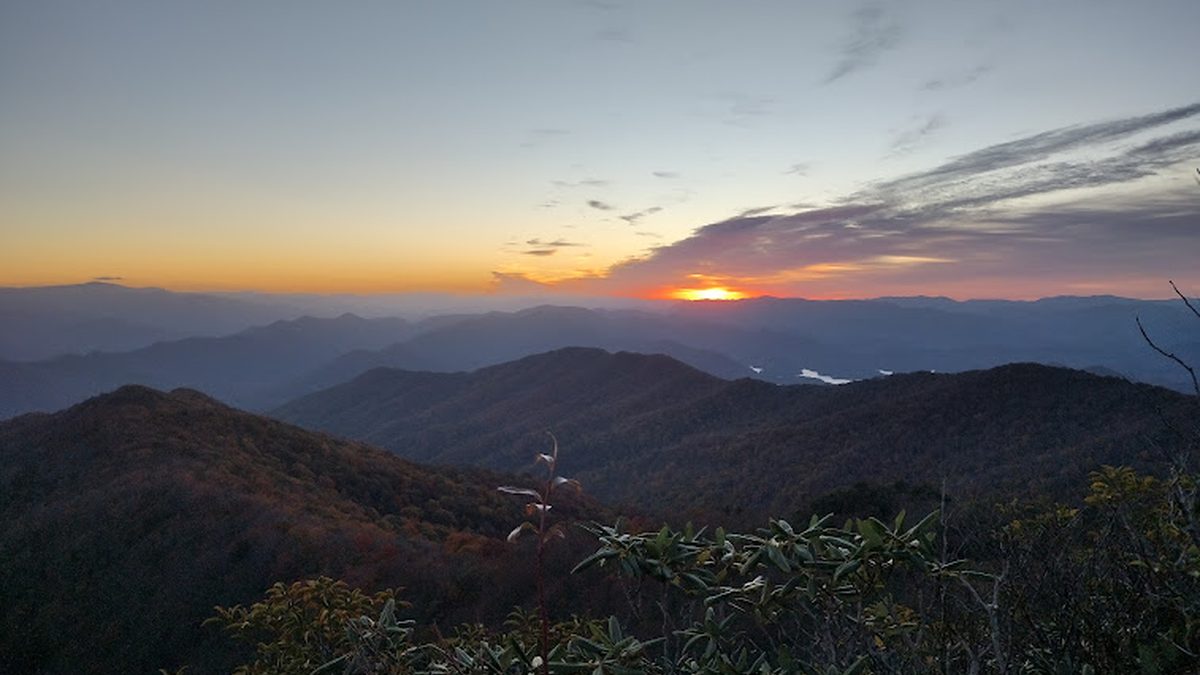
What drives me on difficult summit days is the promise of orange slivers piercing the horizon. This phenomenon is known as alpenglow, where the mountains are backlit in photographic perfection. I can testify from many of these climbs; it is always darkest before the dawn.
Many are the summit pushes that I thought I had nothing left in the tank only to be rejuvenated by the warmth and promise of a new day rising through the spires. And these moments have happened all over the world, from the top of our Great Smoky Mountains National Park to the frigid summits of the world’s highest elevations.
It took three attempts before I was able to top out on Pico de Orizaba in Mexico. An active volcano, Pico de Orizaba has proven time and again to treat its guests with a gruff sort of welcome. The first time I attempted to summit, I was totally alone on the mountain. After a restless night in the high Refugio (which is reported to be haunted), I boiled water for coffee and some grits before taking off on this unknown journey. I secretly hoped for some company up there, but apparently picked the most desolate time of year to climb. The locals take Christmas holiday seriously, as they should.
It was spitting snow and deep winds blew as I set off across the scree field towards the glacier at midnight. My biggest concern was route finding here on Mexico’s highest peak. The wind would occasionally move clouds enough to expose radiant stars which seemed enormous at 16,000 feet. They did little, though, to illuminate my situation. Picking through a section known as the Canaleta, I fumbled around the side of this rocky mountain near the base of the glacier. My expected sunrise bump morphed into a hazy omen.
Hand over hand, I ascended vertical walls, obviously off route. I knew there was but a tiny portal that allowed my entry onto what they call the Sarcophagus. As hours passed it became evident. Orizaba wasn’t going to get climbed by me on this day. Adding insult to this injury I got lost on the descent and went down a wrong finger. The degradation of having to ascend another 1,000 feet just to get back to my point so I can drop another 2,000 was almost unbearable. That perfect sunrise would have to wait.
On Everest from Camp 4 in the Death Zone, climbers time their ascents to coincide with sunrise on the summit. This usually means leaving around 9:00 p.m. the night before from the highest campsite on Earth. So you can imagine my surprise when my Sherpa came and rousted me from the tent at 7:00 p.m.
Ang Dawa was no dummy. He knew his client needed more time than his 28-year-old companions who passed us some four hours later at a place called the Balcony where we switched oxygen tanks. It seemed as if daylight would never come and warm my frozen toes here high in the Himalaya. It was negative 20-degree weather. I distinctly remember that ethereal phenomena, though, when light began to rise from over my shoulder from the crevices of other 8,000-meter peaks. An overwhelming sense of “everything is going to be alright,” emerged effortlessly, despite the daunting elevation remaining.
My favorite sunrise spot in the world, though, is right here in our own backyard. You don’t need a down suit or oxygen tank to breathe in the radiance of a morning atop the Hangover in the Nantahala National Forest. Few will ever experience this view because of the climb and drive. Nearly 2,400 feet in 2.8 miles is serious Appalachian hiking. I wouldn’t doubt more people have experienced a sunrise on Everest than here in the shadow of four states.
However, I’ve had the fortune of seeing it more times than I can count. And I’ve found my group of people who relish the moments where the light hits our faces and for a moment we seem to float about our campsite. Many are the mornings our group has rolled out with a camp stove and set water to boil to coincide with the dawning of a stellar day. As the settled vapor clouds get pushed from the Fontana and Cheoah watersheds, Robbinsville awakens before your eyes in the shadow of the entire Blue Ridge mountain chain, it seems. We always have it to ourselves and no one speaks above a reverent whisper until the glowing sun has crested these mountain spines.
I’ve had the privilege of seeing more than a few mountain sunrises. They are experiences I recommend to all who are willing to put in the effort to catch. But this one? Atop a place I call home? Well, this one I wouldn’t trade for all the rest.
→ Swipe for Next Story
DepartmentsJULY AUGUST 2025
Cherry Blossom-Topped Hideaway
Story by N. Brooks Clark
Seafood is my go-to,” says Fiori co-owner Jesse Vose. “Especially Maine lobster.” His great grandfather Ralph Curtis was a lobsterman in Maine and his father even facilitates the supply blueberry juice from Down East, Maine. Vose grew up in Harrington (pop: 962), a shipbuilding and seafaring town in the region Mainers call “Down East,” whose “aeyah” accent was immortalized by the “Bert and I” record—as in, “The Bluebuhd slithuhred out into the hah-bah.”) When Vose moved to Lenoir City with his mother and stepfather at 13 with his thick Down East accent, he laughs, “Everyone wanted to know what country I was from.”
This history inspired three highlights of chef Sam Wiley’s menu:
The Lobster Skewers starter—served with a braised leek, aioli, and pistachio breadcrumbs showcases chunks of tail meat in lemon and herb butter. Next, the generous Mini Maine Lobster Rolls (pro tip: they are not mini), capture the characteristics of a true New England lobster roll: plenty of fresh, fragrant lobster meat with a light dressing, no filler, and served on butter-toasted brioche with a single lettuce leaf.
Last in the lobster lineup is White Pappardelle Noodles with Lobster, an entrée where wide pappardelle in a Parmigiano Reggiano sauce are topped with lobster, shallots, and a hint of oregano. (You can also choose clams or meatballs, but why would you?)
Fiori means “blossom” in Italian. “We think in life, everyone blossoms in their own way,” says co-owner Corey Vose. They used this view as inspiration for the restaurant, located on the ground floor of the red-brick Jackson Central Building at 111 E. Jackson Avenue, just one door off Central.
After the Voses took over the lease in late 2023, Corey set to work on the design. On a trip to Edinburgh, Corey and Jesse ate at a restaurant called “Tattu” and were transfixed by its use of faux cherry blossom trees creating an interior canopy. Corey found the Scots artist who had made the trees and ordered two.
Leaving the light and bustle of Jackson Avenue for the cool interior of Fiori with this fairy-tale ceiling is transformative. Antique heavy curtains cover windows facing the building’s central atrium, providing a sense of intimacy. Five specially commissioned Mark English paintings are hung along the brick wall which runs the length of the restaurant. The glass and gold-accented bar, manufactured in New York City, adds a touch of sparkle and glam. Jesse: “It’s an experience. Come and relax, unplug from the world and have a good time.”
Built in 1922 for the Iddins Machinery Company, the building was once the only place in our region where farmers bought John Deere machines. (The heavy-equipment elevator is still in the back, near the railroad tracks.) Between the 1940s and 80s, Camel Manufacturing Company made and sold tents there. For 25 years it was the Jackson Avenue Antique Market. In 2009 the building was fully renovated, including the LEED-certified, naturally lit second-floor offices of the eco-minded Shelton Group.
Co-owners Corey and Jesse met when Corey was working at Red Lobster and going to nursing school at Pellissippi. An entrepreneur from a young age, Jesse started a mowing and landscaping service while still a student at Lenoir City High. After graduation he spent six years as a Loudon County sheriff’s deputy and helped his parents at Buttercup Restaurant and Tea Room in Lenoir City. He has owned a retail home décor store and started and sold a graphic design company. He has been a realtor and property manager for eight years.
“I don’t sleep very much,” he chuckles.
Hostess Hannah Bunch is Corey’s little sister and our server, Bianca Hood, made sure to suggest the “House Nectars” that Corey designed, starting with the top-selling Carousel II, named after Knoxville’s iconic night club. It starts with a pink cube of cotton candy which slowly dissolves as your server pours vodka, pomegranate liqueur, and lime over top. Hint: perfect for IG!
The second most popular is “She’s SOOO Giddy” a concoction of Limoncello, vanilla vodka, vanilla syrup, lemon, champagne, and soda. “We wanted naughty undertones to all of the names,” says Corey. The “Conjugal Visit” mixes jalapeño-infused tequila, pineapple-infused Licor 43, Passion Fruit Purée, lime, and basil served with a square ice cube. And the “Naughty Nectar” features tequila, Licor 43, St. Germain, Dolin Blanc, and agave. “A Zesty Affair” is vanilla vodka, vanilla syrup, Limoncello, cream, and egg white. Save room for the show stopping dessert cocktail, the Affo-Got-Ya, a play on the Italian “affogato,” which was one of our favorites. Although, honestly, it was hard to choose a favorite.
Chef Sam Wiley (he goes by Wiley) grew up on a cattle farm in Udall, Kansas. “We had a peach orchard and different crops and were far from grocery stores, so I helped my mother and grandmother do the cooking. In his two years at Kansas State, Wiley worked at AJ’s NY Pizza restaurant in Manhattan (Kansas, that is). “It was great.” He cheffed for 2½ years at the fashionable Lottē, in Wichita, the “Air Capital of the World.” (Harrison Ford, a pilot, dined at Lotte during aviation events.) Wiley cooked in tony Aspen for three years, “always serving seafood,” he says, then at the Secret Stash in Crested Butte, Colorado, where the DJ/producer Steve Aoki was a regular. By the time Wiley enrolled in Wichita Tech’s Niche (National Institution of Culinary & Hospitality Education) program, he realized he’d already acquired his culinary bag of tricks and was ready for a head chef posting. After his girlfriend moved to Knoxville, he decided to head east and look for a job. Serendipitously, Fiori was looking for a chef at exactly the same time.
Wiley’s focaccia starter with cultured butter, prosciutto, and pear is flavorful without being too heavy and his arancini, with arrabbiata sauce and Parmigiano Reggiano, has a delicately crisp texture as a result being air—not deep— fried.
The Brussel Sprouts with Parmigiano Reggiano and breadcrumbs get a special kick from a touch of Vadouvan, a French-inspired curry powder that originated in Pondicherry, India, during French colonial rule. The Moroccan-Spiced Duck Leg, served with spiced braised beets and house-made flatbread, balances pickled chilis and toasted pistachio with labneh, a soft Middle Eastern dairy product made by straining yogurt to remove the whey.
Wiley’s seafood skills shine through once again with the large, seared Scallops in Romesco sauce, with seasonal root vegetables, baked figs, and spring carrots, with baby arugula in homemade dressing of chili oil and Greek herbs and chili crunch.
The Crispy Pork Belly, says Wiley, is “cured for seven hours, baked low and slow.” It’s served with chimichurri on top of carrot puree, Italian salsa verde, pickled tart cherry, and marinated grilled cabbage.
Confections
The dessert menu makes this a great stop after a ballgame or a show for a dessert cocktail and one of these beautifully presented plates. The Créme Caramel Tiramisu features gorgeously caramelized bananas. The Chocolate Cake Showstopper (Corey’s recipe) is an intense chocolate cake with whipped cream and berries. And the Pavlova, our favorite, mixes meringue, whipped Chantilly cream, poached pears, pickled pears, and almond praline with a hint of white wine.
And back to the promised finale: The Italian dessert “affogato,” which translates to “drowned,” is made by “drowning” a scoop (or two) of gelato or ice cream with a shot of hot espresso. The “Affo-Got-Ya” goes further, drowning vanilla ice cream in vodka, toasted coconut rum, PostModern crème de cacao, cacao, and espresso. Think of it as throwing a lifesaver to that drowning ice cream.
→ Swipe for Next Story
InsightsJULY AUGUST 2025
Fear of Missing Out
What our discomfort in exclusion reveals about us— and how we might respond
Story by Rev. George Doebler
There’s something about human nature that stirs up this mysterious “fear of missing out.” It’s a process that plays out in our minds, saying more about who we are than we often realize.
Let me offer an example. I received an email a few days ago asking if I was going to attend an upcoming event. It came as a surprise because not only did I not know about it, but it involved someone I know very well. I was immediately perplexed. Why wasn’t I invited?
When I found out it was a political campaign fundraiser, I truthfully was relieved. Yet I still felt miffed that I wasn’t invited. I wondered for the rest of the day what I was missing by not attending. Fear of missing out at its finest.
Why did I feel this way? I suppose it has something to do with how important it can be to us to be with others. Sure, there are events we are happy to skip—let’s call that theJoy of Missing Out—but these others? The ones that sit uncomfortably with us? It is most certainly about exclusion. It’s our inherent longing to belong. And that feeling tells me more about me than about anyone else.
While this might sound trivial, fear of missing out can also arise over much more serious things. I received an email from the son of a dear friend of many years, telling me that his father had died – three weeks before. I was deeply saddened. This was a person who had deeply influenced my early learning and growth, both personally and professionally. The son also told me that his mother had died the year before. The sadness and grief grew worse. How did I miss this? My fear of missing out became palpable in a very different way. I should have worked harder at connecting with my friend. Now my fear of missing out had a companion: guilt.
I have a hunch many people “feel” this, but do not often deal with it. They let it consume them, impacting their day-to-day, but don’t necessarily address it. Maybe it’s because it is so confusing. Maybe we just do not understand why we are so fearful of this type of pain and therefore avoid it.
I’ve spoken about this with a close friend of mine recently. Over the years, our conversations were always quite casual, but in the past year, they have become more personal. He is a Vietnam veteran, a devout American, and in many ways a very successful person. He has owned and opened businesses, written books and plays. Yet, despite all this, he often feels as though it is not enough. He is always looking to what could be next, never wanting to miss an opportunity. As a result, there is an uneasiness that he feels constantly, so much so it’s begun to affect him—and his marriage.
He is aware that this all ties back to the death of his father when he was five. That loss, he tells me, has colored all he deeply feels. And no matter how well he does, his father not being there to affirm it has him constantly reaching for more.
This fear of missing out can be so deeply imbedded into who we are. It can be the result of an experience from decades before but because the feeling is, it seems, so strange to us, we allow it to stay, impacting how we feel and how we think about ourselves.
I still struggle with this. But I remind myself that our task in living each day is to be aware of our own feelings and the feelings of others—and be willing to explore them. The only thing we’re really missing out on is knowing ourselves and each other better. It’s not easy to explore in an anxious world and culture, but that awareness is more than worth the effort.
→ Swipe for Next Story
MusicJULY AUGUST 2025
Finding His Rhythm
From small-town roots to center stage, Cruz Contreras follows the pull of music
Story by Chris Blue
Cruz Contreras didn’t set out to be a frontman. “I just wanted to be a piano player and take a solo now and again,” he says. But life had other plans—plans shaped by family, growth, reinvention, and a deepening connection to music. “I found my people. I found my tribe. And it was music.”
Cruz was born in Michigan, though his family roots stretch from Texas to Mexico. “My great grandfather moved [to Texas]… he founded a blacksmith livery in downtown Houston,” he says. Growing up in the small, close-knit town of Bridgman, where “you kind of knew everybody” Cruz thrived in music and sports. When the family moved to Tennessee for his dad’s job, however, everything changed.
The new environment pushed Cruz to adapt quickly. “All of a sudden, if I wanted to compete, I had to move twice as fast, and I had to go twice as hard.” He had gone from being “a big fish in a pond” to navigating a larger high school with unfamiliar social groups and a new level of intensity on the field and court. But when his parents got him a guitar at age 15, music quickly became a lifeline. “I spent my high school years knowing I wanted to be a professional musician, working and honing the craft.”
At the University of Tennessee, Cruz studied jazz piano under Donald Brown. “He always knew that I was capable and would be able to find my own way and make my own sound,” he says. That influence helped shape his musical vision. “I always dreamt there could be a mandolin player that was as good as the great jazz players.”
That path included early work with Robinella and the CC String Band and, later, the formation of The Black Lillies, a name that was chosen after the first album was made. And it wasn’t just creative—it was personal. “I was very apprehensive about putting my own name on anything,” Cruz says. “Confidence, self-worth, lack of self-love… all that stuff.” Creating a band name gave him room to grow without standing fully in the spotlight. Over 10 years and five albums, the group played nearly 2,000 shows across the country. It was a successful run, but behind the music, the business was breaking down.
In 2023, Cruz released his first solo album,Cosmico, and last year began billing shows as Cruz Contreras and The Black Lillies, combining the two ventures together.
Today, Cruz is producing, mentoring, and heading out on another summer tour, supported by his wife Molly and his kids. “I’m just out there to do my own thing,” he says.
To follow Cruz’s journey and see where he’s playing next, head tocruzcontreras.com.
→ Swipe for Next Story
DepartmentsJULY AUGUST 2025
Jim Johnson
A journey shaped by grit, faith, & a belief in soulful storytelling
Story by Rebecca Whalen
Born in a small steel town outside Chicago, Jim Johnson moved to Knoxville and has since built an eclectic career spanning military service, entrepreneurial ventures, video production, and a growing presence on the screen.
Cityview: Jim, you actually grew up in Illinois? What was it like growing up there?
Jim Johnson: I was just a normal, everyday kid, until my mom decided to buy a video camera. I think I was about 13 years old. It was a Sony Betamax, which back then were like $5,000 in the early 1980s. She always wanted one for the kids so we’d be able to capture family memories. I took it everywhere with me and recorded everything.
CV: Did you ever think that would end up being such an important part of your future?
JJ: No, no. I was from a small town with a big steel mill. So everytime I went to school, I would see this huge facility and guys in suits with molten steel pouring out of these huge vats the size of dump trucks. I just knew growing up that I didn’t want to do that. It just didn’t seem like there was a whole lot of opportunity to do anything extraordinary. Not that those jobs aren’t extraordinary, it just wasn’t my personality.
CV: Is that when you decided to move here?
JJ: When I turned 18 years old, a buddy of mine moved to Knoxville for a few months, and he invited me for just a week vacation. I came down and it was 70 degrees in Knoxville—30 degrees at home—and I was like, “Man, I’m only 10 hours away. I think this is a great place to live.”
CV: Were you still recording things prior to then?
JJ: I kind of turned away from video production in my teenage years. But my brother and I did all kinds of videos. I also got into BMX bikes and started freestyling and racing and got really good. When I was 16 years old, I actually won the National Championships for BMX racing and thought that this is what I’m going to do.
CV: What made you leave BMX behind and move?
JJ: I was dating a girl for two years and then we broke up, and I was just like, I don’t want to be here anymore. So I left Sterling, Illinois and moved to Tennessee. I came here and started working and then joined the military in 1987.
CV: What branch did you serve in?
JJ: Army. I was a truck driver, heavy equipments operator, and demolitions quarry specialist. In 1987, I met my future wife. In 1988, we got married. In 1989 we had a little girl. I went to college and got a degree in electronic technology, and that’s when I got sent to Desert Storm in 1990 and was gone for almost a year. I was an M60-gunner.
CV: What did you do when you got back?
JJ: I came home and didn’t know what the heck I was gonna do. So my best friend and I built an awning cleaning and maintenance company. We weren’t making enough so we got work in Florida. It forced us to knock on doors and talk to people. We were kids: 23 years old. We ended up, within the next year, doing the majority of the Steak & Shakes in the country, from Michigan to Miami, over 250 locations. And we were doing 400 jobs a year for Blockbuster Video. And it was great all the way through the’90s, until the recession…then I went to work with a buddy of mine who sold classic car parts. We did nothing, but sell them on eBay for four years. Then Hurricane Katrina hit and people just weren’t buying anymore.
CV: Is that when you turned back to video?
JJ: I’d always had a video camera in my hand, filming my kids, though not professionally. When we couldn’t do the car parts business anymore, we had a mutual friend, Doug Price, at our church who owned a video production company. And I remembered filming when I was a kid and how much I love video. And I just said, “You know, I wouldn’t mind doing that for a few months.” We thought the economy was going to flip around and I would only have to work there for a few months. So I told the owner, “Hey, listen, I don’t care what you have me do. I’ve built a couple businesses, I’ll be a great employee.”
CV: Did you think “This is it!”?
JJ: I had no idea what I was doing when I went to work for Doug. The only thing I knew how to do was push a button on a camcorder. I didn’t have any clue about lighting or what kind of cameras to use, or audio, or what it takes to do video production. I told him about two months after I was working there, “I’m really enjoying this. I’m going to learn everything there is about this business and I want to learn it from the ground up—lighting, cameras, production.” I would stay 60-80 hours a week and had this incredible opporunity to learn from these guys, the trailblazers in the Knoxville scene, as for as video.
CV: And Doug became a mentor to you, correct?
JJ: Absolutely. Doug was not only a mentor, but a dear friend. He was 25 years older than me, but we had such a close connection. He took me in and showed me the ropes. Then there was Danny, Doug’s partner, who was the one that took the reins. I was there for eight or nine years.
CV: What made you go work for another company?
JJ: A guy wanted me to come work with him in his business consulting firm. I went to Doug and asked if he was going to grow his business or if I should take it. I was so loyal to him; I wanted his blessing. I worked for Rob Brown for a couple years, and we still work together on occassion, but I kept getting pulled towards larger scale video production. And it just seemed like God was pushing me in a direction, opening a little door here, a little door there. People would hire me for these big jobs, large scale conventions. And I just loved it. It was infectious when you’re the camera guy in charge of the camera crew, to get people excited about being on video.
CV: When did you start your own company?
JJ: More and more people wanted me to do stuff and it ended up becoming a full time position, probably somewhere around 2014.
→ Swipe for Next Story
Arts & CultureJULY AUGUST 2025
Noteworthy Craft
South Knox musician uses his passion to build perfection
Story by Susan Alexander
When it comes to Josh Hobbs’s artistic endeavors, one thing led to another. The first thing was music. Josh was 8 or 9, he says, when he started playing an alto saxophone, and when he was around 11 he asked his dad to teach him to play the guitar. His dad made a deal: If he learned to play one song, he’d buy Josh his own guitar. In no time he was strumming “Secret Agent Man.”
His love of music led to a University of Tennessee degree in studio music and jazz, which led to playing with a number of local bands. Then COVID interrupted life and performance, allowing him to shift gears — in a good way. “I’d also gotten married; it’s hard to be on the road all the time.” Instead, he focused on teaching guitar lessons, something he’d been doing for years, but on Zoom. He also repaired and modified guitars for Parris Guitars.
Hobbs has been tinkering with guitars since he was young. He remembers the first electric guitar he modified: “I ripped all the electronics out of my guitar and they sat on my bedroom floor for about two weeks.” Modifying the electronics in guitars changes their sound, Hobbs says.
About the same time, he got started repairing instruments alongside Greg Seigmund in his Andersonville shop. Seigmund became Hobbs’s mentor, and after about a year of working together, convinced Hobbs to build a guitar, a Fender Telecaster style guitar. “Then he kicked me out of the nest,” Hobbs says.
He’s now working on his fourth guitar from his South Knoxville shop, a custom version of a Fender Stratocaster. It’s made of Khaya mahogany from Africa and high-quality flamed maple with a gaboon ebony fret board.
“I’ve always liked to work with my hands,” he says, “and creating a concrete product at the end of the day is so gratifying. I want to create the most perfect playing surface for a guitarist, something that removes all barriers to playing the music they hear in their head.”
To follow along on Josh’s journey, head to his Instagram @hobbsguitars.
→ Swipe for Next Story
PoliticsJULY AUGUST 2025
Parking It Downtown
“Politics is not worrying this country one-tenth as much as where to find a parking space.” – Will Rogers
Story by George Korda
For decades, when Knoxville city officials asked local folks to visit downtown Knoxville, what they heard in response was the sound of their own voices echoing back at them from the mostly deserted central city canyons. If someone went downtown, finding a place to park wasn’t a challenge. It’s the age-old law of supply and demand: no demand, lots of supply. But high demand means less availability and higher prices.
With downtown Knoxville enjoying a renaissance in popularity as an entertainment, eating, and business location, and the University of Tennessee experiencing record admissions, the issue isn’t if people are coming downtown, but where will they park? It’s an administrative and political opportunity. Or headache. Parking and politics have long gone together like peas and carrots – or fire and gasoline. Someone may never think parking an issue until they’re driving on downtown streets searching in vain for a space. Then, it’s a problem, if not a crisis.
Parking is as essential to downtown viability as oxygen is to the body: it doesn’t matter if you build it, because people won’t come if they can’t find a parking place – or when they do, they can’t pay.
Even finding a space can mean difficulties. Knoxville is replacing its parking meters with a digital parking app. A frequent downtown visitor said that the app worked fine at first, but it’s been a headache ever since. At times, he’s followed the digital parking directions: scanned the code and entered his payment information, only to be told there were “technical difficulties.” At other times, the app has told him he was in an available parking zone, but after entering the zone number, the system wouldn’t let him pay. He once even enlisted the help of a downtown parking officer, who couldn’t make it work either.
Parking studies are popular with political entities for three reasons, not necessarily in this order: to find out what the best course of action is on a subject of interest to voters and taxpayers; to take the heat off themselves by letting an third party make recommendations that can be accepted or rejected; to validate what they’ve already decided to do; or some combination of the three.
Two parking studies were conducted in 2024, one by the city, one by the Downtown Merchant’s Group. As reported by WATE-TV, the city’s study, conducted by Walker Consultants, found, “Between 2019 and 2023, the city’s 163-page study reports that the parking system had a negative net operating income of $279,311,” and needed more than $2.3 million from the city’s general fund. The study said, “Walker projects that the parking system will continue to rely on general fund transfers unless changes are made to increase parking revenue and/or decrease expenses.” Various increases in parking rates and parking fines are presently underway. If you were putting money on the table in Vegas, you’d want to bet on more future revenue increases than spending reductions.
The study counted 20,800 downtown parking spaces, most of which are privately owned. That leaves 9,734 public on-street and garage spaces. The document delves into all sorts of parking-related issues, among them that the elderly, disadvantaged, and people who don’t own a vehicle are “inequitably” paying taxes to support a parking system they don’t use, and that discounted parking encourages people to drive downtown, which could affect the city’s year 2050 carbon emissions goals.
The much shorter (seven-page) Downtown Merchant’s Group study’s primary focus is continuation of free parking on nights and weekends.
As downtown Knoxville’s population grows, and its economic activity increases, so does its political power. The Downtown Merchant’s Group, therefore, has muscles that will only get bigger. But a willingness to flex them can be limited. When Madeline Rogero was mayor, Cumberland Avenue businesses talked of opposing her push to narrow “the Strip” to two lanes. But they backed away, fearing City Hall. There will be an ever-stronger downtown push-and-pull between the needs of workers and visitors and the requirements of parking turnover for business customers, clients, or vendors – and of people visiting government offices.
Parking obviously hasn’t been a revenue source for city government; any government would like to at least break even. But realistically, you don’t see people pitching a fit because parking is being somewhat supported through the general fund. Purely politically, city politicians are better off continuing that practice and saying it’s for the overall public good. But whether it’s taxes or charges, it comes down to money. And if you wonder who’s paying, it’s probably you.
→ Swipe for Next Story
Dining GuideJULY AUGUST 2025
Summer Lunch
Story by Micha Haas
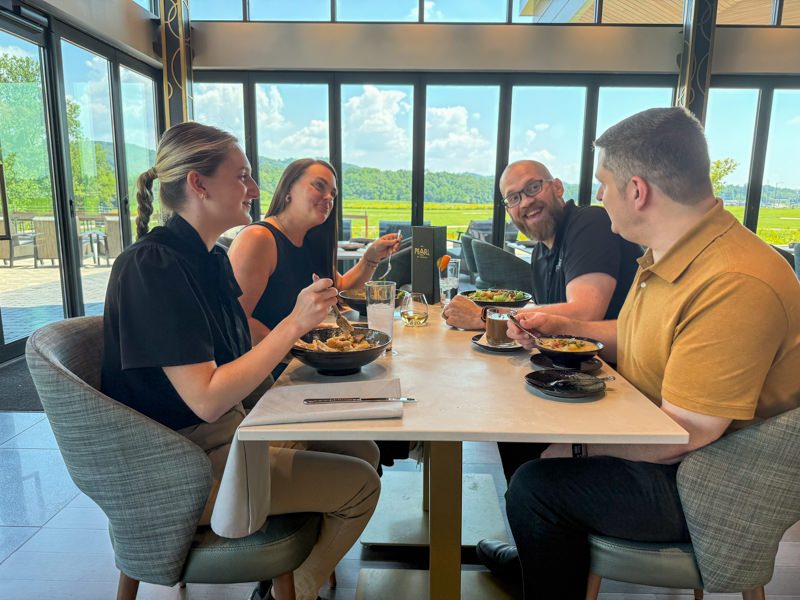
Whether it’s inside relaxing with a cold specialty drink or out on a patio with the warm sun beating down on you, that midday bite is the perfect break from the hustle and bustle. Dig in!
I’ve been something of a creature of habit when it comes to lunch, I must admit. I’ve always prioritized speed over experience when it comes to my midday meal, a side effect of too many lunches spent at my desk in college, leading to me frequenting a small number of familiar spots that I knew could get me food I could eat quickly. So this article was a bit of an adventure for me, pushing me outside my comfort picks and challenging me to sit down and actually enjoy my lunch, not just as a relief from hunger, but as an experience in and of itself. And let me tell you, I’m glad I took the time, and after hearing about my forays into the Knoxville lunch culinary scene, I’m hoping you will, too.
Water Into Wine
It’s not just a wine bar – not anymore! Rhonda Munsey, W2W’s AM chef, has been working to make lunch at this Farragut spot a special occasion, and she has succeeded! Whether you’re sitting in the rustic wooden lounge or out under the umbrellas, you’re in for a treat. My lunchtime treat was the seasonal brie flat, which as part of the Mix & Match Combo comes with a soup or salad, but for those seeking a meatier meal, we also took a bite out of the Jumbo Shrimp & Cheddar Grits. Water into Wine’s menu rotates with the season, so no matter what you decide to dig into, you can be sure you’ve found something fresh and invigorating for the summer.
Looking for a kosher lunch, or perhaps just something a bit different? Potchke Deli is the place for you – and it’s not just me saying that. The Deli featured in a New York Times article, so even visitors from the Big Apple found something to love down here in the Big Orange. I was not brave enough to try the iconic Borscht (for those who don’t know, it’s a traditional beet soup). For me, I find myself staring at some of the sandwiches – perhaps that Farmer Fritatta (though again, light on aioli).
Growing up, a friend of the family was a French immigrant, so I’d had homemade crepes before, and I was curious to see how Knoxville’s French Market Creperie held up. Following recommendations from staff, I decided to try the Spicy Veggie (with added mushrooms), and I have to say, I was impressed. The aioli and red peppers added a pinch of spice that complemented the dish well (though I could have survived a bit more kick), and while I’m not usually a fan of salads, their house salad was a pleasant surprise with a walnut crunch and a champagne vinaigrette. Service was also remarkably quick, so if you’re in a rush, you can stop by with no fear!
The Sticky Rice Café has a new expanded location (albeit right next door to the old one)! I’d only gone to the Café for dinner before, where I’d treat myself to the hottest curry I could order, but for lunch I decided to go for something that felt a bit quicker: the Kow Jie Pate, a sandwich similar to the Vietnamese Banh Mi I mentioned in my Cheap Eats guide last year. Piled high with veggies and your choice of protein, and easily dippable in any number of house sauces (I always order a spring roll and use the peanut sauce that comes with that), it’s a solid handheld treat that you can eat in-house or on the go. Pair that with a boba tea (something of an addiction of mine) and of course the eponymous sticky rice, and you have yourself an iconic Sticky Rice lunch.
Having lived in New York for a few years, I’ve always considered myself an adherent to the New York way of making pizza, but I must admit, Chefs Danny Wilhoit and Ryan Miller have given me pause. New Haven Pizza is both a local restaurant and a style of cooking the Italian-American classic. I went half-and-half on the Tomato Pie and the Veggie Pie, per the chefs’ recommendation, and both impressed. The Tomato Pie in particular is a New Haven staple, made with pecorino romano, a venerable sheep’s milk cheese dating all the way back to the Roman legions, and a rich finely-charred crust. The secret to culinary success, the chefs say, is cooking their pizza ingredients the same way Chef Danny did as a Top Chef: slowly, properly, like you’re in a 5-star kitchen. That is how you make a 5-star pizza.
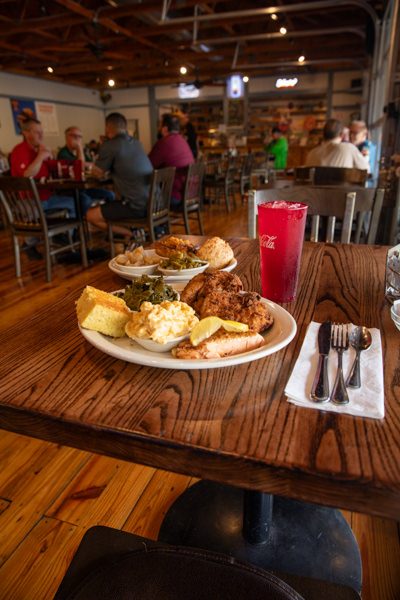
If ever there was a home for Southern comfort food, it’s Horn of Plenty. I’d passed this Middlebrook meat-and-three hundreds of times, but this was my first time stopping in – and it likely won’t be the last! Thankfully I wasn’t eating alone on this particular stop, so we had the opportunity to taste two different meats (the grilled salmon and fried pork) on the menu, as well as numerous sides. The collard greens (cooked for 4 hours) were soft and savory, the cheese biscuit was warm and crisp, and perhaps most importantly, that sweet potato casserole might as well have been a dessert for how delectably sweet it was. They also have a host of housemade sweets, but after shoveling down all that lunch, I just couldn’t find the room!
Choosing the right attorney during a stressful time can be one of the most important decisions you make. And if you don’t know where to start, asking another attorney is often the best move. That’s exactly what we did. Each year, Cityview surveys members of the Knoxville Bar Association and asks them a simple question: “If someone you care about needed legal help, who would you recommend?” The attorneys listed in the following pages are the ones their peers trust most. But a name is just the beginning. Before you hire anyone, meet them. Ask how much of their work is dedicated to your type of case. What would they consider a win? What will it cost—and how do they charge? Results matter more than résumés. Like one attorney says, you’ve got to play to win. Google them and ask for specifics on past cases. Do other attorneys and courtroom staff speak highly of them? That kind of credibility can’t be faked—and it matters when the pressure is on. There is no doubt that the legal process is often a battleground where the strongest and most seasoned more often prevail. And don’t forget: you’re not just hiring credentials, you’re hiring a relationship. A good attorney will be honest with you, communicate clearly, take time to explain the complexities, and make you feel comfortable through every step of the process. So use this list as a starting point. These are the professionals their peers would trust with their own families. From there, take the next step: meet, ask lots of questions, and trust your gut. If you don’t feel comfortable at the start it probably won’t get better. Because the right attorney isn’t just someone who knows the law—it’s someone who knows how to stand beside you when it matters most.DISCLAIMER: Cityview does not endorse any of the attorneys in this issue. The listing of Cityview’s 2025 Top Attorneys is a simple tabulation of the votes submitted by members of the Knoxville legal community.Administrative LawAdoptionAntitrustAppellate PracticeAviation/AdmiraltyBanking LawBankruptcyBusiness LitigationBusiness/Commercial LawCivil LitigationClass ActionCollections/ForeclosuresConstitutional Law/Civil RightsConstruction LawConsumer ProtectionContract LawCorporate LawCriminal DefenseCriminal ProsecutionCybersecurity LawDUI DefenseElder LawEmployee Benefits/ERISAEntertainment & SportsEnvironmental LawEstate PlanningFamily Law/Divorce/Child SupportFederal Court PracticeHealth Care LawImmigration and NaturalizationIncome Tax/IRS ResolutionsInsurance LawIntellectual Property/TrademarksJuvenile DefenseLabor & Employment LawMediation/ArbitrationMedical MalpracticeNursing Home LiabilityPatent LawPersonal InjuryPrivacy LawProduct LiabilityProfessional MalpracticeReal Estate Finance & DevelopmentSecuritiesSocial Security Disability LawTaxationTrustsWorker's CompensationWrongful DeathAdministrative LawAdministrative LawJohn T. Batson Jr. Watson, Roach, Batson, & Lauderback
J. William Coley Hodges, Doughty & Carson
Wade V. Davies Ritchie, Davies, Johnson, & Stovall
Samuel C. Doak Lewis Thomason
Daniel L. Ellis Law Firm of Daniel L. Ellis
Taylor D. Forrester Long, Ragsdale, & Waters
Richard E. GravesFrantz, McConnell, & Seymour
B. Chase Kibler Hodges, Doughty & Carson
Wayne A. Kline Hodges, Doughty & Carson
Jason H. Long Lewis Thomason
Mary Elizabeth Maddox Frantz, McConnell & Seymour
Dale J. Montpelier Montpelier & Associates
Benjamin C. Mullins Frantz, McConnell & Seymour
Nate Burk Burks & Ogle
John E. Owings Owings, Wilson & Coleman
Katherine A. Young Young Law Office
Adoption
Adoption
Allison Easterday Alexander Bernstein, Stair & McAdams
Benjamin T. Barnett The Barnett Firm
Meghan Bodie Meghan Bodie Law Office
R. Deno Cole Cole, Guindi, & Pienkowski
S. Dawn Coppock Dawn Coppock
Joseph Della-Rodolfa Garza Law Firm
Hillary Dewhirst Law Office of Hillary Dewhirst
Carolyn Levy Gilliam McDonald, Levy & Taylor
H. Stephen Gillman Pryor, Priest, Harber, Floyd & Coffey
Lisa J. Hall Hodges, Doughty & Carson
Mandy M. Hancock Mandy Hancock Law
Laura Hash Mandy Hancock Law
K.O. Herston Herston Law Group
Blair Kennedy Knoxville Family Law
Theodore R. Kern Ted Kern Law
Jason H. Long Lewis Thomason
Mark A. Pienkowski Cole, Guindi, & Pienkowski
N. David Roberts Jr. Law Office of N. David Roberts
Vanessa Samano Samano Law
Sarah Y. Sheppeard Lewis Thomason
J. Cort Sikes Wykoff and Sikes
Mabern E. Wall Hodges, Doughty, & Carson
Antitrust
Antitrust
Lance K. Baker The Baker Law Firm
Stephanie D. Coleman Owings, Wilson & Coleman
Tracy G. EdmundsonEgerton, McAfee, Armistead & Davis
Dale J. Montpelier Garza Law Firm
J. Douglas Overbey Owings, Wilson & Coleman
John E. Owings Owings, Wilson & Coleman
Shelly L. Wilson Owings, Wilson & Coleman
James C. Wright Butler, Vines & Babb
Appellate Practice
Appellate Practice
Robert L. Bowman Kramer Rayson
John C. Burgin, Jr. Kramer Rayson
Wade V. Davies Ritchie, Davies, Johnson & Stovall
Janet S. Hayes Lewis Thomason
Lindsey HobbsHodges, Doughty, & Carson
Dean T. Howell Woolf, McClane, Bright, Allen & Carpenter
B. Chase Kibler Hodges, Doughty, & Carson
Wayne A. Kline Hodges, Doughty, & Carson
J. Ford Little Woolf, McClane, Bright, Allen & Carpenter
Avery Lovingfoss Brock Shipe Klenk
Nathaniel D. Moore Kramer Rayson
Brandon L. Morrow Kramer Rayson
Ann C. Short The Bosch Law Firm
Garrett P. Swartwood Long, Ragsdale & Waters
Robert L. Vance Woolf, McClane, Bright, Allen & Carpenter
Mabern E. WallHodges, Doughty & Carson
Aviation/Admiralty
Aviation/Admiralty
Kyle Andrew BaisleyLong, Ragsdale & Waters
W. Michael BaisleyLong, Ragsdale & Waters
Joshua M. BallHodges, Doughty & Carson
Lt. Col. Dave Beck Garza Law Firm
William J. CarverKramer Rayson
Samuel C. Doak Lewis Thomason
William D. Edwards Long, Ragsdale & Waters
David C. Hollow Hollow & Hollow
Farrell A. Levy McDonald, Levy & Taylor
J. Douglas OverbeyOwings, Wilson & Coleman
Weldon E. Patterson Butler, Vines & Babb
Kevin N. Perkey Woolf, McClane, Bright, Allen & Carpenter
Lee A. Popkin Long, Ragsdale & Waters
Robert L. Vance Woolf, McClane, Bright, Allen & Carpenter
Banking Law
Banking Law
Oliver D. Adams Long, Ragsdale & Waters
Robin Jarvis Askew Lewis Thomason
W. Michael Baisley Long, Ragsdale & Waters
John G. Brock Brock Shipe Klenk
Thomas H. Dickenson Hodges, Doughty & Carson
Michael W. Ewell Frantz, McConnell & Seymour
Taylor D. Forrester Long, Ragsdale & Waters
David Wilson LongLong, Ragsdale & Waters
Elijah LovingfossBrock Shipe Klenk
G. Mark Mamantov Bass, Berry & Sims
Greg D. Meadows Gentry, Tipton & McLemore
Mary Miller Miller Anderson Law Group
Dennis B. Ragsdale Long, Ragsdale & Waters
George E. Sanford II Gentry Tipton Mclemore
Steffanie M. SpeckBrock Shipe Klenk
M. Aaron Spencer Woolf, McClane, Bright, Allen & Carpenter
Alexander atersLong, Ragsdale & Waters
J. Michael Winchester Winchester, Sellers, Foster & Steele
Bankruptcy
Bankruptcy—Creditor
Oliver D. Adams Long, Ragsdale & Waters
Kyle Andrew BaisleyLong, Ragsdale & Waters
Thomas H. Dickenson Hodges, Doughty & Carson
Michael W. Ewell Frantz, McConnell & Seymour
Dean B. FarmerHodges, Doughty, & Carson
Maurice K. Guinn Gentry, Tipton & McLemore
Lindy HarrisWoolf, McClane, Bright, Allen & Carpenter
Tyler C. Huskey Gentry, Tipton & McLemore
Michael S. Kelley Kennerly, Montgomery & Finley
John M. Kizer Gentry, Tipton & McLemore
W. Morris Kizer Gentry, Tipton & McLemore
Gregory C. LogueWoolf, McClane, Bright, Allen & Carpenter
M. Edward Owens, Jr.Lewis Thomason
Robert W. Quillin II Kennerly, Montgomery & Finley
Jason L. Rogers Hodges, Doughty & Carson
M. Aaron Spencer Woolf, McClane, Bright, Allen & Carpenter
Garrett P. SwartwoodLong, Ragsdale & Waters
Thomas Lynn TarpyTarpy, Cox, Fleishman & Levielle
Kaitlin F. TweelWoolf, McClane, Bright, Allen & Carpenter
Walter N. WinchesterWinchester, Sellers, Foster & Steele
Bankruptcy—Debtor
Brenda G. Brooks Moore & Brooks
W. Tyler Chastain Bernstein, Stair & McAdams
Thomas H. Dickenson Hodges, Doughty & Carson
Michael W. Ewell Frantz, McConnell & Seymour
Dean B. FarmerHodges, Doughty & Carson
Maurice K. Guinn Gentry, Tipton & McLemore
William E. Maddox Jr. William E. Maddox Jr. Attorney at Law
Richard M. Mayer Law Offices of Mayer & Newton
Mary Miller Miller Anderson Law Group
John P. Newton Law Offices of Mayer & Newton
Kevin S. Newton Law Offices of Mayer & Newton
Brent S. Snyder Banks & Jones
Thomas Lynn Tarpy Tarpy, Cox, Fleishman & Levielle
Business Litigation
Business Litigation
Oliver D. Adams Long, Ragsdale & Waters
Terry G. Adams, Jr. The Adams Law Firm
Heather G. Anderson Bernstein, Stair & McAdams
George R. Arrants Kramer Rayson
William J. Carver Kramer Rayson
W. Kyle Carpenter Woolf, McClane, Bright, Allen & Carpenter
W. Tyler Chastain Bernstein, Stair & McAdams
Luke D. Durham Brock Shipe Klenk
Thomas M. Hale Kramer Rayson
J. Chadwick Hatmaker Woolf, McClane, Bright, Allen & Carpenter
John M. Kizer Gentry, Tipton & McLemore
W. Morris Kizer Gentry, Tipton & McLemore
J. Ford Little Woolf, McClane, Bright, Allen & Carpenter
Brandon. Morrow Kramer Rayson
Garrett P. Swartwood Long, Ragsdale & Waters
John E. WintersKramer Rayson
Business/Commercial Law
Business/Commercial Law
Oliver D. Adams Long, Ragsdale & Waters
J. Nicholas Arning Jr. Woolf, McClane, Bright, Allen & Carpenter
George R. Arrants, Jr.Kramer Rayson
John G. Brock Brock Shipe Klenk
Thomas H. Dickenson Hodges, Doughty & Carson
Kramer Rayson
Matthew Graves Hodges, Doughty & Carson
Andrew M. Hale Kramer Rayson
W. Morris Kizer Gentry, Tipton & McLemore
Wayne R. Kramer Kramer Rayson
J. Ford Little Woolf, McClane, Bright, Allen & Carpenter
Gregory C. Logue Woolf, McClane, Bright, Allen & Carpenter
Dennis R. McClane Woolf, McClane, Bright, Allen & Carpenter
Timothy M. McLemoreGentry, Tipton & McLemore
Greg D. MeadowsGentry, Tipton & McLemore
Civil Litigation
Civil Litigation
Heather G. Anderson Bernstein, Stair & McAdams
Timothy L. Baldridge Garza Law Firm
Joshua M. Ball Hodges, Doughty & Carson
Beecher A. Bartlett Jr. Kramer Rayson
Joshua J. Bond Hodges, Doughty & Carson
Robert L. Bowman Kramer Rayson
Luis C. Bustamante Woolf, McClane, Bright, Allen & Carpenter
W. Kyle Carpenter Woolf, McClane, Bright, Allen & Carpenter
Luke D. Durham Brock Shipe Klenk
Marcos M. Garza Garza Law Firm
John T. Johnson, Jr. Kramer Rayson
T. Scott Jones Banks & Jones
John M. Kizer Gentry, Tipton & McLemore
Philip J. La Nasa Garza Law Firm
Jason Legg Garza Law Firm
J. Ford Little Woolf, McClane, Bright, Allen & Carpenter
Nathaniel D. Moore Kramer Rayson
Brent A. Morris Garza Law Firm
James F. Parker Hodges, Doughty & Carson
Garrett P. Swartwood Long, Ragsdale & Waters
Mabern E. Wall Hodges, Doughty & Carson
Glenn H. Walter Lewis Thomason
Class Action
Class Action—Defense
Heidi A. Barcus Lewis Thomason
Robert L. Bowman Kramer Rayson
W. Kyle Carpenter Woolf, McClane, Bright, Allen & Carpenter
Meagan Collver Lewis Thomason
John W. Elder Paine, Bickers, Elder, King & Williams
Janet S. Hayes Lewis Thomason
Al Holifield Holifield & Janich
Lawrence P. Leibowitz Leibowitz Law Firm
J. Ford Little Woolf, McClane, Bright, Allen & Carpenter
Hilary Magacs Kramer Rayson
John E. Owings Owings, Wilson & Coleman
James F. Parker Hodges, Doughty & Carson
Jonathan Swann Taylor Kramer Rayson
James C. WrightButler, Vines & Babb
Class Action—Plaintiff
Lance K. Baker The Baker Law Firm
Robert L. Bowman Kramer Rayson
Gregory F. Coleman Milberg Coleman
Kelsey Gatlin DaviesMilberg Coleman
Adam A. Edwards Milberg Coleman
William A. LadnierMilberg Coleman
Robert E. Pryor, Sr. Pryor, Priest, Harber, Floyd & Coffey
Thomas S. Scott Jr. Tom Scott Atty
Jonathan Swann Taylor Kramer Rayson
Virginia A. Whitener Milberg Coleman
Collections/Foreclosures
Collections/Foreclosures
Oliver D. Adams Long, Ragsdale & Waters
Thomas H. Dickenson Hodges, Doughty & Carson
James N. Gore Jr. Kennerly, Montgomery & Finley
Matthew GravesHodges, Doughty & Carson
Dean T. HowellWoolf, McClane, Bright, Allen & Carpenter
Tyler C. Huskey Gentry, Tipton & McLemore
Jason L. Rogers Hodges, Doughty & Carson
M. Aaron Spencer Woolf, McClane, Bright, Allen & Carpenter
Garrett P. Swartwood Long, Ragsdale & Waters
Robert L. VanceWoolf, McClane, Bright, Allen & Carpenter
Walter N. WinchesterWinchester, Sellers, Foster & Steele
Constitutional Law/Civil Rights
Constitutional Law/Civil Rights
Ursula Bailey Law Office of Ursula Bailey
Lance K. Baker The Baker Law Firm
Robert L. Bowman Kramer Rayson
Marcos M. Garza Garza Law Firm
J. Chadwick Hatmaker Woolf, McClane, Bright, Allen & Carpenter
Kaitlyn E. HutchersonWoolf, McClane, Bright, Allen & Carpenter
Stephen Ross JohnsonRitchie, Davies, Johnson & Stovall
John M. Kizer Gentry, Tipton & McLemore
Jason H. Long Lewis Thomason
Hilary L. Magacs Kramer Rayson
Chris W. McCarty Lewis Thomason
Brandon L. Morrow Kramer Rayson
Wayne A. Ritchie Ritchie, Davies, Johnson & Stovall
Jonathan Swann Taylor Kramer Rayson
Jeff R. Thompson Lewis Thomason
Construction Law
Construction Law
Heather G. Anderson Bernstein, Stair & McAdams
Joshua J. Bond Hodges, Doughty & Carson
Jon M. Cope Stokes, Williams, Sharp, Cope & Mann
David A. Draper Lewis Thomason
Luke D. DurhamBrock Shipe Klenk
Danny P. DyerGentry, Tipton & McLemore
Reggie E. Keaton Frantz, McConnell & Seymour
W. Morris Kizer Gentry, Tipton & McLemore
J. Ford Little Woolf, McClane, Bright, Allen & Carpenter
Robert P. NoellWoolf, McClane, Bright, Allen & Carpenter
James F. ParkerHodges, Doughty & Carson
Garrett P. Swartwood Long, Ragsdale & Waters
Jack M. Tallent Kennerly, Montgomery & Finley
W. Paul Whitt Lewis Thomason
Consumer Protection
Consumer Protection—Defense
Adrienne L. AndersonAnderson Busby
Edward U. BabbButler, Vines & Babb
John W. ElderPaine, Bickers, Elder, King & Williams
Matthew J. EvansJohnson, Evans & Headrick
Rodney A. FieldsLewis Thomason
Kaitlyn E. HutchersonWoolf, McClane, Bright, Allen & Carpenter
Reggie E. Keaton Frantz, McConnell & Seymour
Wayne A. Kline Hodges, Doughty & Carson
John M. LawhornFrantz, McConnell & Seymour
T. Kenan SmithHodges, Doughty & Carson
Robert L. VanceWoolf, McClane, Bright, Allen & Carpenter
Glenn R. WalterLewis Thomason
Consumer Protection—Plaintiff
Adrienne L. Anderson Anderson Busby
Lance K. Baker The Baker Law Firm
Christopher T. Cain Lacy, Price & Wagner, PC
Gregory F. Coleman Milberg Coleman
Adam A. EdwardsMilberg Coleman
Marcos M. Garza Garza Law Firm
William E. Maddox, Jr. William E. Maddox Jr. Attorney at Law
Wayne A. Ritchie Ritchie, Davies, Johnson & Stovall
T. Kenan Smith Hodges, Doughty & Carson
Robert L. Vance Woolf, McClane, Bright, Allen & Carpenter
Virginia A. Whitener Milberg Coleman
Contract Law
Contract Law
Oliver D. Adams Long, Ragsdale & Waters
Terry G. Adams, Jr.The Adams Law Firm
J. Nicholas Arning Jr. Woolf, McClane, Bright, Allen & Carpenter
George R. Arrants Jr. Kramer Rayson
John G. Brock Brock Shipe Klenk
Shannon Coleman Egle Kramer Rayson
J. William Coley Hodges, Doughty & Carson
Andrew M. Hale Kramer Rayson
John M. Kizer Gentry, Tipton & McLemore
W. Morris Kizer Gentry, Tipton & McLemore
J. Douglas OverbeyOwings, Wilson & Coleman
James F. ParkerHodges, Doughty & Carson
Kevin N. Perkey Woolf, McClane, Bright, Allen & Carpenter
Corporate Law
Corporate Law
J. Nicholas Arning Jr. Woolf, McClane, Bright, Allen & Carpenter
George R. Arrants, Jr.Kramer Rayson
Brian D. BlindGentry, Tipton, & McLemore
John G. Brock Brock Shipe Klenk
J. William Coley Hodges, Doughty & Carson
Matthew Graves Hodges, Doughty & Carson
Thomas M. Hale Kramer Rayson
Teresa Klenk Brock Shipe Klenk
Jackson G. KramerKramer Rayson
Wayne R. Kramer Kramer Rayson
Jason P. Lambert Woolf, McClane, Bright, Allen & Carpenter
David Wilson LongLong, Ragsdale & Waters
Richard S. MatlockWoolf, McClane, Bright, Allen & Carpenter
Dennis R. McClaneWoolf, McClane, Bright, Allen & Carpenter
Timothy M. McLemore Gentry, Tipton & McLemore
Jason T. Murphy Gentry, Tipton & McLemore
James F. Parker Hodges, Doughty & Carson
R. Joseph Parkey, Jr. Woolf, McClane, Bright, Allen & Carpenter
Kevin N. PerkeyWoolf, McClane, Bright, Allen & Carpenter
Ashley N. Trotto Kennerly, Montgomery & Finley
Alexander Waters Long, Ragsdale & Waters
Criminal Defense
Criminal Defense
Lance K. Baker The Baker Law Firm
Christopher W. BeaversBanks & Jones
Donald A. Bosch The Bosch Law Firm
Charles C. Burks, Jr.Burks & Ogle
Jonathan D. CooperKnox Defense
Loretta G. CravensEldridge & Cravens
Wade V. Davies Ritchie, Dillard, Davies & Johnson
Joseph F. Della-Rodolfa Garza Law Firm
Melissa C. DiRadoStephens & DiRado
David M. EldridgeEldridge and Cravens
Brandon D. FerstenBarnes & Fersten
Marcos M. Garza Garza Law Firm
Josh HedrickKnox Defense
Gregory P. Isaacs The Isaacs Law Firm
Stephen Ross Johnson Ritchie, Davies, Johnson & Stovall
T. Scott Jones Banks & Jones
Donovan JusticeBanks amp; Jones
Robert R. KurtzRobert R. Kurtz, Attorney at Law
Scott LanzonThe Lanzon Firm
Nicholas W. LeeLee Criminal Defense
Daniel Morrell Garza Law Firm
Nate Ogle Burks & Ogle
Criminal Prosecution
Criminal Prosecution
Charme P. AllenKnox County District Attorney General’s Office
Franklin Ammons Knox County District Attorney General’s Office
Jodie Marie Bush Knox County District Attorney General’s Office
Amanda R. Cox Knox County District Attorney General’s Office
TaKisha M. FitzgeraldKnox County District Attorney General’s Office
Heather Ens Knox County District Attorney General’s Office
Jeannine Guzolek Knox County District Attorney General’s Office
Jason L. Hunnicutt Knox County District Attorney General’s Office
Samyah G. Jubran Knox County District Attorney General’s Office
Randall J. Kilby Knox County District Attorney General’s Office
Andrea A. Kline Knox County District Attorney General’s Office
Willie R. Lane Knox County District Attorney General’s Office
Samuel K. Lee Knox County District Attorney General’s Office
Deborah H. Malone Knox County District Attorney General’s Office
Ashley D. McDermott Knox County District Attorney General’s Office
Sean F. McDermottKnox County District Attorney General’s Office
Karla Mendez Knox County District Attorney General’s Office
Leland L. Price Knox County District Attorney General’s Office
Sean Roberts Knox County District Attorney General’s Office
Kevin L. Teeters Knox County District Attorney General’s Office
Cybersecurity Law
Cybersecurity Law
W. Dale Amburn London & Amburn
Benjamin Dooley Merchant & Gould
Ian P. Hennessey Lincoln Memorial University
R. Arthur Jenkins The Jenkins Law Firm
John T. WinemillerMerchant & Gould
James C. Wright Butler, Vines & Babb
DUI Defense
DUI Defense
Lance K. BakerThe Baker Law Firm
James A.H. BellBanks & Jones
Donald A. Bosch The Bosch Law Firm
Oscar A. ButlerBarns & Fersten
Donald “D.T.” ChristmasChristmas Law Group
Sara E. Compher-Rice Oberman & Rice
Jonathan D. CooperKnox Defense
Loretta G. CravensEldridge and Cravens
Luke D. DurhamBroke Shipe Klenk
David M. Eldridge Eldridge and Cravens
Brandon D. FerstenBarnes & Fersten
Marcos M. Garza Garza Law Firm
Gregory P. Isaacs The Isaacs Law Firm
T. Scott JonesBanks & Jones
Donovan JusticeBanks & Jones
Scott LanzonThe Lanzon Firm
Daniel MorrellGarza Law Firm
Steven Oberman Oberman & Rice
Nate OgleBurks & Ogle
Wesley D. StoneStone Law Firm
Liza WellsGarza Law Firm
M. Jeffrey WhittKnox Defense
Elder Law
Elder Law
Felicia F. Coalson Owings, Wilson & Coleman
Amelia G. Crotwell Elder Law of East Tennessee
Michael R. Crowder Kennerly, Montgomery & Finley
Donald J. Farinato Hodges, Doughty & Carson
Kelly G. Frère Guyton & Frere
Matthew B. FrèreGuyton & Frere
Carolyn Levy Gilliam McDonald, Levy & Taylor
Lisa J. Hall Hodges, Doughty & Carson
Glen A. Kyle Franklin & Kyle Elder Law
Marshall H. Peterson Kennerly, Montgomery & Finley
Julia Keck Price Elder Law of East Tennessee
Bailey Schiermeyer Elder Law of East Tennessee
Alex M. Taylor Kennerly, Montgomery & Finley
Employee Benefits/ERISA
Employee Benefits/ERISA—Defense
Kathy D. Aslinger Kennerly, Montgomery & Finley
John C. Burgin Jr. Kramer Rayson
Janet S. HayesLewis Thomason
Al Holifield Holifield & Janich
Reggie E. Keaton Frantz, McConnell & Seymour
John M. Lawhorn Frantz, McConnell & Seymour
William E. Mason Kennerly, Montgomery & Finley
Dale J. Montpelier Garza Law Firm
John E. Owings Owings, Wilson & Coleman
Ashley N. Trotto Kennerly, Montgomery & Finley
Employee Benefits/ERISA—Plaintiff
Gregory F. Coleman Milberg, Coleman
John P. Dreiser Dreiser Law Group
John B. Dupree John B. Dupree, Attorney at Law
Reggie E. Keaton Frantz, McConnell & Seymour
Philip J. La NasaGarza Law Firm
John M. Lawhorn Frantz, McConnell & Seymour
Dale J. Montpelier Garza Law Firm
Brent A. MorrisGarza Law Firm
Katherine A. Young Young Law Office
Entertainment & Sports
Entertainment & Sports
Terry G. Adams Jr. The Adams Law Firm
Donald A. Bosch The Bosch Law Firm
E. Michael Brezina III Brezina Law Firm
John G. BrockBrock Shipe Klenk
William J. Carver Kramer Rayson
William D. Edwards Long, Ragsdale & Waters
J. Chadwick HatmakerWoolf, McClane, Bright, Allen & Carpenter
Steven E. KramerKramer Rayson
Lee A. Popkin Long, Ragsdale & Waters
Kevin N. Perkey Woolf, McClane, Bright, Allen & Carpenter
Chad Speck Brock Shipe Klenk
S. Cole Wheeler Woolf, McClane, Bright, Allen & Carpenter
John T. Winemiller Merchant & Gould
Environmental Law
Environmental Law
Catherine W. AnglinTennessee Department of Environment & Conservation
W. Kyle CarpenterWoolf, McClane, Bright, Allen & Carpenter
Gregory F. ColemanMilberg Coleman
J. William ColeyHodges, Doughty & Carson
Loretta G. CravensEldridge and Cravens
David A. DraperLewis Thomason
David M. Eldridge Eldridge and Cravens
Dean T. HowellWoolf, McClane, Bright, Allen & Carpenter
Kaitlyn E. HutchersonWoolf, McClane, Bright, Allen & Carpenter
Virginia A. Whitener Milberg Coleman
James C. WrightButler, Vines & Babb
Estate Planning
Estate Planning
Roy AaronHodges, Doughty & Carson
Terry G. Adams, Jr.The Adams Law Firm
Keith H. Burroughs Egerton, McAfee, Armistead & Davis
Felicia F. Coalson Owings, Wilson & Coleman
Shannon Coleman Egle Kramer Rayson
Michael R. Crowder Kennerly, Montgomery & Finley
Luke D. Durham Brock Shipe Klenk
William D. Edwards Long, Ragsdale & Waters
Donald J. Farinato Hodges, Doughty & Carson
Mack A. Gentry Gentry, Tipton & McLemore
Carolyn Levy Gilliam McDonald, Levy & Taylor
Lindsey L. Hobbs Hodges, Doughty & Carson
Dan W. Holbrook Egerton McAfee
Teresa Klenk Brock Shipe Klenk
Jackson G. Kramer Kramer Rayson
Wayne R. Kramer Kramer Rayson
Richard S. MatlockWoolf, McClane, Bright, Allen & Carpenter
Richard S. Matlock Woolf, McClane, Bright, Allen & Carpenter
Anne M. McKinney McKinney & Tillman
Kevin N. Perkey Woolf, McClane, Bright, Allen & Carpenter
Marshall H. PetersonKennerly, Montgomery & Finley
Lee A. Popkin Long, Ragsdale & Waters
Joel D. Roettger Gentry, Tipton & McLemore
O. E. Schow IV Woolf, McClane, Bright, Allen & Carpenter
Paul C. Shuman Woolf, McClane, Bright, Allen & Carpenter
Darsi Newman Sirknen Woolf, McClane, Bright, Allen & Carpenter
Luis C. BustamanteWoolf, McClane, Bright, Allen & Carpenter
W. Kyle CarpenterWoolf, McClane, Bright, Allen & Carpenter
Daryl R. FanslerBernstein, Stair & McAdams
Lisa J. HallHodges, Doughty & Carson
John K. HarberPryor, Priest, Harber, Floyd & Coffey
J. Chadwick HatmakerWoolf, McClane, Bright, Allen & Carpenter
Paul D. Hogan, Jr.Hogan & Hogan
Dana C. Holloway Holloway Law & Mediation Center PLLC
Reggie E. KeatonFrantz, McConnell & Seymour
W. Morris Kizer Gentry, Tipton & McLemore
Steven E. Kramer Kramer Rayson
James H. London London & Amburn
Laura E. Metcalf Laura Metcalf Attorney at Law
Jennifer B. Morton Jennifer Morton Law
Sarah Y. SheppeardLewis Thomason
J. Cort Sikes Wykoff and Sikes
C. Scott Taylor Bernstein, Stair & McAdams
William D. Vines III Butler, Vines & Babb
Howard H. Vogel O’Neil, Parker & Williamson
Gary R. Wade London & Amburn
Glenn R. WalterLewis Thomason
Medical Malpractice
Medical Malpractice—Defense
Heidi A. Barcus Lewis Thomason
Joshua J. Bond Hodges, Doughty & Carson
Mark A. Castleberry Lewis Thomason
Rachel Park Hurt Arnett, Draper & Hagood
B. Chase KiblerHodges, Doughty & Carson
Wayne A. Kline Hodges, Doughty & Carson
James H. London London & Amburn
Jason H. Long London & Amburn
Rick L. PowersArnett, Baker, Draper & Hagood
Jeff R. Thompson Lewis Thomason
Edward “Ted” G.White II Hodges, Doughty & Carson
Bart C. Williams Hodges, Doughty & Carson
Medical Malpractice—Plaintiff
Luis C. BustamanteWoold, McClane, Bright, Allen & Carpenter
Christopher T. CainLacy, Price & Wagner, PC
M. Christopher CoffeyPryor, Priest, Harber, Floyd & Coffey
Gregory F. ColemanMilberg Coleman
Marcos M. GarzaGarza Law Firm
D. Scott Hurley Hurley Law Firm
Grant MitchellButler, Vines & Babb
J. Tucker Montgomery Montgomery Law Firm
Weldon E. PattersonButler, Vines & Babb
Robbie E. Pryor, Jr.Pryor, Priest, Harber, Floyd & Coffey
Robert E. Pryor Sr. Pryor, Priest, Harber, Floyd & Coffey
Wayne A. Ritchie Ritchie, Davies, Johnson & Stovall
Thomas S. Scott Jr. Tom Scott Atty
William D. Vines III Butler, Vines & Babb
Edward “Ted” G. White II Hodges, Doughty & Carson
Nursing Home Liability
Nursing Home Liability—Defense
Heidi A. BarcusLewis Thomason
Joshua J. Bond Hodges, Doughty & Carson
Rachel Park Hurt Arnett, Draper & Hagood
B. Chase Kibler Hodges, Doughty & Carson
Wayne A. Kline Hodges, Doughty & Carson
James H. London London & Amburn
Jason H. Long London & Amburn
Mary Elizabeth Maddox Frantz, McConnell & Seymour
J. Douglas Overbey Owings, Wilson & Coleman
Rick L. Powers Arnett, Draper & Hagood
John P. Taylor Hodges, Doughty & Carson
Nursing Home Liability—Plaintiff
Timothy L. Baldridge Garza Law Firm
M. Christopher Coffey Pryor, Priest, Harber, Floyd & Coffey
Mark E. Floyd Pryor, Priest, Harber, Floyd & Coffey
Marcos M. GarzaGarza Law Firm
Grant Mitchell Butler, Vines & Babb
Weldon E. Patterson Butler, Vines & Babb
Adam M. Priest Pryor, Priest, Harber, Floyd & Coffey
Robbie E. Pryor Jr. Pryor, Priest, Harber, Floyd & Coffey
Robert E. Pryor Sr. Pryor, Priest, Harber, Floyd & Coffey
Wayne A. RitchieRitchie, Davies, Johnson & Stovall
William D. Vines III Butler, Vines & Babb
Patent Law
Patent Law
Michael J. Bradford Luedeka Neely Group
Mark P. Crockett Luedeka Neely Group
Tracy G. Edmundson Egerton, McAfee, Armistead & Davis
Robert O. Fox Luedeka Neely Group
Andrew C. Lake Pitts & Lake
David E. LaRose Luedeka Neely Group
Ian McFarland Merchant & Gould
Andrew S. Neely Luedeka Neely Group
Wade R. Orr Luedeka Neely Group
Roby Robinson Robinson IP Law
John T. Winemiller Merchant & Gould
Personal Injury
Personal Injury—Auto Accident—Defense
Joshua M. Ball Hodges, Doughty & Carson
Joshua J. BondHodges, Doughty & Carson
William J. Carver Kramer Rayson
Jon M. CopeStokes, Williams, Sharp, Cope & Mann
John T. (Tom) Johnson Kramer Rayson
Benjamin W. Jones Lewis Thomason
Wayne A. Kline Hodges, Doughty & Carson
Nathaniel D. Moore Kramer Rayson
Beverly D. Nelms Frantz, McConnell & Seymour
Dallas T. Reynolds IIIDunn, MacDonald & Reynolds
Mikel A. Towe Lewis Thomason
Mabern E. Wall Hodges, Doughty & Carson
Personal Injury—Auto Accidents—Plaintiff
Beecher A. Bartlett, Jr. Kramer Rayson
Christopher W. Beavers Banks & Jones
Bradley C. BurnetteFox Farley Willis & Burnette
M. Christopher CoffeyPryor, Priest, Harber, Floyd & Coffey
Gregory F. Coleman Milberg, Coleman
Luke D. DurhamBrock Shipe Klenk
Marcos M. Garza Garza Law Firm
T. Scott JonesBanks & Jones
Philip J. La Nasa Garza Law Firm
Farrell A. Levy McDonald, Levy & Taylor
Brent A. Morris Garza Law Firm
Weldon E. Patterson Butler, Vines & Babb
Robbie E. Pryor Jr. Pryor, Priest, Harber, Floyd & Coffey
Robert E. Pryor Sr. Pryor, Priest, Harber, Floyd & Coffey
Personal Injury—General—Plaintiff
Beecher A Bartlett Jr. Kramer Rayson
Christopher W. Beavers Banks & Jones
Bradley C. Burnette Fox Farley Willis & Burnette
M. Christopher Coffey Pryor, Priest, Harber, Floyd & Coffey
Gregory F. Coleman Milberg Coleman
Luke D. Durham Brock Shipe Klenk
Marcos M. GarzaGarza Law Firm
Albert J. Harb Hodges, Doughty & Carson
T. Scott Jones Banks & Jones
Philip J. La Nasa Garza Law Firm
Farrell A. Levy McDonald, Levy & Taylor
Brent A. Morris Garza Law Firm
Weldon E. Patterson Butler, Vines & Babb
Robbie E. Pryor Jr. Pryor, Priest, Harber, Floyd & Coffey
Robert E. Pryor Sr. Pryor, Priest, Harber, Floyd & Coffey
Personal Injury—Motorcycle Accident—Defense
Joshua M. Ball Hodges, Doughty & Carson
Joshua J. BondHodges, Doughty & Carson
Toby R. CarpenterTrammell, Adkins & Ward
David A. Chapman Lewis Thomason
Samuel C. DoakLewis Thomason
Jason E. FisherFisher Russell Law Firm
Benjamin W. Jones Lewis Thomason
Benjamin C. Mullins Frantz, McConnell & Seymour
Beverly D. NelmsFrantz, McConnell & Seymour
Lynn C. PetersonLewis Thomason
Dustin E. “Dusty” SharpKramer Rayson
Jonathan Swann TaylorKramer Rayson
Mikel A. Towe Lewis Thomason.
Mabern E. Wall Hodges, Doughty & Carson
Glenn R. Walter Lewis Thomason
Personal Injury—Motorcycle Accident—Plaintiff
Lance K. Baker The Baker Law Firm
Christopher W. Beavers Banks & Jones
Michael C. Beehan Fox Farley Willis & Burnette
Bradley C. Burnette Fox Willis Burnette
M. Christopher CoffeyPryor, Priest, Harber, Floyd & Coffey
Gregory F. ColemanMilberg Coleman
Marcos M. Garza Garza Law Firm
T. Scott JonesBanks & Jones
Jason E. Legg Kennerly, Montgomery & Finley
Farrell A. Levy McDonald, Levy & Taylor
Weldon E. Patterson Butler, Vines & Babb
John A. Willis Fox Farley Willis & Burnette
Privacy Law
Privacy Law
Ian P. HennesseyLincoln Memorial University
Alexandra M. HoneycuttMilberg Coleman
Rockforde D. King Egerton, McAfee, Armistead & Davis
John T. Winemiller Merchant & Gould
Product Liability
Product Liability—Defense
Edward U. Babb Butler, Vines & Babb
Joshua M. Ball Hodges, Doughty & Carson
W. Kyle Carpenter Woolf, McClane, Bright, Allen & Carpenter
Dean T. Howell Woolf, McClane, Bright, Allen & Carpenter
John T. (Tom) Johnson Kramer Rayson
Reggie E. Keaton Frantz, McConnell & Seymour
Michael J. King Paine, Bickers, Elder, King & Williams
J. Ford Little Woolf, McClane, Bright, Allen & Carpenter
Nathaniel D. Moore Butler, Vines, & Babb
Weldon E. Patterson Kramer Rayson
C. Gavin Shepherd Woolf, McClane, Bright, Allen & Carpenter
T. Kenan Smith Hodges, Doughty & Carson
Mabern E. Wall Hodges, Doughty & Carson
Product Liability—Plaintiff
Luis C. Bustamante Woolf, McClane, Bright, Allen & Carpenter
Gregory F. Coleman Milberg, Coleman
Adam A. EdwardsMilberg Coleman
Marcos M. GarzaGarza Law Firm
Albert J. HarbHodges, Doughty & Carson
T. Scott Jones Banks & Jones
Jason E. LeggGarza Law Firm
Farrell A. Levy McDonald, Levy & Taylor
Weldon E. PattersonButler, Vines & Babb
Robbie E. Pryor Jr. Pryor, Priest, Harber, Floyd & Coffey
Robert E. Pryor Sr. Pryor, Priest, Harber, Floyd & Coffey
Virginia A. WhitenerMilberg Coleman
John A. Willis Fox Farley Willis & Burnette
Professional Malpractice
Professional Malpractice—Defense
Heidi A. Barcus Lewis Thomason
Robert L. Bowman Kramer Rayson
Gregory Brown Lowe, Yeager & Brown
David A. DraperLewis Thomason
B. Chase Kibler Hodges, Doughty & Carson
Wayne A. Kline Hodges, Doughty & Carson
James H. London London & Amburn
Jason H. Long London & Amburn
Nathaniel D. Moore Kramer Rayson
John P. Taylor Hodges, Doughty & Carson
Edward “Ted” G. White II Hodges, Doughty & Carson
W. Paul Whitt Lewis Thomason
Professional Malpractice—Plaintiff
Joshua J. Bond Hodges, Doughty & Carson
Bradley C. Burnette Fox Farley Willis & Burnette
M. Christopher Coffey Pryor, Priest, Harber, Floyd & Coffey
John K. Harber Pryor, Priest, Harber, Floyd & Coffey
Weldon E. Patterson Butler, Vines & Babb
Robert E. Pryor Sr.Pryor, Priest, Harber, Floyd & Coffey
Wayne A. Ritchie Ritchie, Dillard, Davies & Johnson
Thomas S. Scott Jr. Tom Scott Atty
Edward “Ted” G. White II Hodges, Doughty & Carson
Real Estate Finance & Development
Real Estate Finance & Development
Oliver D. Adams Long, Ragsdale & Waters
Terry G. Adams, Jr.The Adams Law Firm
George R. Arrants Jr. Kramer Rayson
Brian D. Blind Gentry, Tipton & McLemore
John G. Brock Brock Shipe Klenk
Shannon Coleman Egle Kramer Rayson
Thomas H. Dickenson Hodges, Doughty & Carson
Danny P. Dyer Gentry, Tipton & McLemore
Matthew Graves Hodges, Doughty & Carson
Lindsey L. Hobbs Hodges, Doughty & Carson
Jackson G. Kramer Kramer Rayson
David Wilson Long Long, Ragsdale & Waters
Greg D. Meadows Gentry, Tipton & McLemore
Jason T. MurphyGentry, Tipton & McLemore
R. Joseph Parkey, Jr. Woolf, McClane, Bright, Allen & Carpenter
Dennis B. Ragsdale Long, Ragsdale & Waters
George E. Sanford II Gentry, Tipton & McLemore
Caesar Stair IVBernstein, Stair & McAdams
Securities
Securities—Defense
Kyle Andrew BaisleyLong, Ragsdale & Waters
W. Michael BaisleyLong, Ragsdale & Waters
Joan M. HeminwayUniversity of Tennessee
David Wilson LongLong, Ragsdale & Waters
Lee A. PopkinLong, Ragsdale & Waters
James R. StovallRitchie, Davies, Johnson & Stovall
Garrett P. SwartwoodLong, Ragsdale & Waters
Securities—Plaintiff
Kyle Andrew Baisley Long, Ragsdale & Waters
W. Michael BaisleyLong, Ragsdale & Waters
Brent A. MorrisGarza Law Firm
Lee A. PopkinLong, Ragsdale & Waters
Garrett P. SwartwoodLong, Ragsdale & Waters
Social Security Disability Law
Social Security Disability Law
Edwin A. Anderson Miller Disability Law
Timothy L. Baldridge Garza Law Firm
Michael BockGarza Law Firm
Devin S. DeVoreEaser & DeVore
John P. DreiserLaw Offices of Tony Farmer and John Dreiser
Emma Drozdowski WebbDrozdowski & Rabin
Carolyn Levy Gilliam McDonald, Levy & Taylor
Viktoria M. Haynes Miller Disability Law
Jason E. Legg Garza Law Firm
Kenneth A. Miller Kenneth Miller & Associates
J. Cort Sikes Wykoff and Sikes
John A. Willis Fox Farley Willis & Burnette
Wayne D. Wykoff Wykoff and Sikes
Taxation
Taxation
George R. Arrants Jr. Kramer Rayson
Stephanie D. Coleman Owings, Wilson & Coleman
Shannon Coleman Egle Kramer Rayson
William D. Edwards Long, Ragsdale & Waters
Donald J. Farinato Hodges, Doughty & Carson
Mack A. Gentry Gentry, Tipton & McLemore
Kati Sanford Goodner Long, Ragsdale & Waters
Jackson G. KramerKramer Rayson
Wayne R. Kramer Kramer Rayson
Richard S. Matlock Woolf, McClane, Bright, Allen & Carpenter
Timothy M. McLemoreGentry, Tipton, & McLemore
Kevin N. PerkeyWoolf, McClane, Bright, Allen & Carpenter
Lee A. Popkin Long, Ragsdale & Waters
Joel D. RoettgerGentry, Tipton, &McLemore
O. E. Schow IVWoolf, McClane, Bright, Allen & Carpenter
Trusts
Trusts
Terry G. Adams, Jr.The Adams Law Firm
William D. Edwards Long, Ragsdale & Waters
Donald J. Farinato Hodges, Doughty & Carson
Mack A. GentryGentry, Tipton & McLemore
Carolyn Levy Gilliam McDonald, Levy & Taylor
Kati Sanford GoodnerLong, Ragsdale & Waters
Christopher A. HallLong, Ragsdale & Waters
Dan W. HolbrookEgerton McAfee
Jackson G. Kramer Kramer Rayson
Wayne R. Kramer Kramer Rayson
Richard S. MatlockWoolf, McClane, Bright, Allen & Carpenter
Samantha ParrisLaw Offices of Samantha Parris
Kevin N. Perkey Woolf, McClane, Bright, Allen & Carpenter
Marshall H. PetersonKennerly, Montgomery & Finley
Lee A. Popkin Long, Ragsdale & Waters
Joel D. Roettger Gentry, Tipton & McLemore
O. E. Schow IV Woolf, McClane, Bright, Allen & Carpenter
Victoria B. Tillman McKinney & Tillman
Sarah M. ThornsberryGentry, Tipton & McLemore
Worker's Compensation
Worker’s Compensation—Defense
Edward U. BabbButler, Vines & Babb
Christopher W. BeaversBanks & Jones
John T. Batson, Jr.Watson, Roach, Batson, & Lauderbeck
Leslie F. Bishop Lewis Thomason
R. Kim BurnetteArnett,Baker, Draper & Hagood
J. Eric HarrisonKennerly, Montgomery & Finley
Mary Elizabeth Maddox Frantz, McConnell & Seymour
Hanson R. Tipton Watson, Roach, Batson & Lauderbeck
Workers’ Compensation—Plaintiff
Christopher W. Beavers Banks & Jones
Michael C. BeehanFox Farley Willis & Burnette
Bradley C. Burnette Fox Willis Burnette
H. Stephen Gillman Pryor, Priest, Harber, Floyd & Coffey
T. Scott Jones Banks & Jones
Jason E. LeggGarza Law Firm
Farrell A. LevyMcDonald, Levy & Taylor
Mary Elizabeth Maddox Frantz, McConnell & Seymour
Brent Morris Garza Law Firm
Edward “Tripp” Gibson White III The Law Office of Edward G. White III
John A. Willis Fox Farley Willis & Burnette
Wrongful Death
Wrongful Death—Defense
Joshua M. Ball Hodges, Doughty & Carson
Beecher A. Bartlett Jr. Kramer Rayson
W. Kyle Carpenter Woolf, McClane, Bright, Allen & Carpenter
John T. (Tom) Johnson Kramer Rayson
Benjamin W. Jones Lewis Thomason
Wayne A. Kline Hodges, Doughty & Carson
J. Ford LittleWoolf, McClane, Bright, Allen & Carpenter
Hilary L. Magacs Kramer Rayson
T. Kenan Smith Hodges, Doughty & Carson
Mabern E. Wall Hodges, Doughty & Carson
Edward “Ted” G. White II Hodges, Doughty & Carson
James C. Wright Butler, Vines & Babb
Wrongful Death—Plaintiff
Timothy L. Baldridge Garza Law Firm
Beecher A. Bartlett Jr. Kramer Rayson
Christopher W. Beavers Banks & Jones
Bradley C. BurnetteFox Farley Willis & Burnette
Luis C. Bustamante Woolf, McClane, Bright, Allen & Carpenter
M. Christopher CoffeyPryor, Priest, Harber, Floyd & Coffey
Gregory F. Coleman Milberg, Coleman
Marcos M. Garza Garza Law Firm
Gregory P. Isaacs The Isaacs Law Firm
T. Scott Jones Banks & Jones
Jason E. Legg Garza Law Firm
Farrell A. Levy McDonald, Levy & Taylor
Brent A. MorrisGarza Law Firm
Weldon E. PattersonBulter, Vines & Babb
Robert E. Pryor Sr. Pryor, Priest, Harber, Floyd & Coffey
William D. Vines III Butler, Vines & Babb
John A. Willis Fox Farley Willis & Burnette
→ Swipe for Next Story
FeatureJULY AUGUST 2025
Building Paradise
Story by Rebecca Whalen
When great design meets quality construction dream homes are created.
In the heart of East Tennessee, where scenic beauty meets a strong sense of community, a newly completed custom home stands as a bold expression of vision, experience, and craftsmanship. Designed by longtime residential designer Stephen Davis and built by the seasoned team at Seigler Construction, the home doesn’t just occupy a lot—it commands a presence. It is the kind of residence that makes you pause, admire, and wonder what it would be like to live within its walls.
Creating someone’s perfect home often begins with a walkthrough of the property for Davis, to understand the nuance of the landscape he is working with. Other times it begins with a plan—in this case, a special one that Davis had originally drawn years ago. “As it happens, I designed this plan and named it after my daughter because I knew it was very special,” he says. Over time, this ranch-style home plan became a popular starting point for clients, and in this case, it was reimagined and expanded with specific modifications to suit the lot and lifestyle needs of a family looking for both beauty and functionality.
When pre-created plans need some reimagining to accommodate client wants and needs, they work in partnership with Gus Carodine, a key member of the Stephen Davis design team. In the case of this particular home, the one Davis named for his daughter, the most recent iteration now spans six bedrooms and six baths, laid out to offer seamless transitions between public and private spaces, with an emphasis on open, adaptable design. A key highlight is the expansive central living area, where the kitchen, family room, and breakfast space form the nucleus of daily life. Seigler Construction House Feature – Cityview Magazine July August 2025
“The kitchen, the family room, those are going to be your gathering spaces year-round,” Seigler says. “In this particular home, we designed those two spaces around a 10-foot-long island.” That island seats five comfortably and is surrounded by high-performance GE Monogram appliances, quartz countertops with thick custom edging, and cabinetry selected for its clean, transitional lines. This, coupled with the oversized breakfast room directly beside the kitchen allow conversations to flow. The spaces are intimate enough for everyday use but also allow for easy hosting and entertainment.
Everywhere in the home, there is a quiet elegance—no single feature demands attention, yet everything feels intentional. “We’ve really seen that over the last four to five years, maybe even six years, that we’re we still have some heavy elements to the house, as far as a single seven-inch crown molding, but I think the lines are getting cleaner where we’re doing a lot of 48-inch tiles on fireplaces with no mantles, just to clean that up.” Seigler used to do a lot of stone fireplaces with wooden mantles— “That was just kind of a standard in East Tennessee,” he says—but the movement to more modern spaces is evident.
In the family room of this particular home, that philosophy comes to life in a tiled fireplace flanked by built-in bookcases with LED backlighting. A coffered ceiling floats above, its soft, indirect lighting able to change warmth and color depending on the mood or occasion. “The lighting in these areas is extremely important,” Seigler says, but is often something overlooked.
That can be seen in the bedrooms of this particular home. Each was designed not just as places to sleep but as extensions of a lifestyle that values both hospitality and retreat. Four of the six bedrooms are on the main level—an intentional move to accommodate aging family members or long-term guests without needing to navigate stairs. “As the baby boomers are aging out in some of these older homes, and the Generation X moves into that next phase of their life, they are more cognizant, where I don’t think the previous two decades were as cognizant about aging in place,” Seigler says. Wider doorways, bigger and more accessible showers, even elevators are more prevalent, he adds. Seigler Construction House Feature – Cityview Magazine July August 2025
The primary suite is a standout, not only in scale—at 16 by 28 feet, it feels more like a boutique hotel suite—but in thoughtful and more accessible touches like: a zero-entry shower that eliminates trip hazards, dual closets, a comfortable sitting area, and yes, even a discreetly placed television. Designs are created for how people actually live and move about in their homes.
More and more homes are being built with all the main spaces on the main level. “The upstairs is really going to be fore secondary bedrooms, a theater room, a bonus room for grandkids to play in,” Seigler explains. “On a lot of the home we’re building, they become a secondary living space, not a primary.”
Outdoor living is equally central to a home’s design. In this particular home, a telescoping wall of glass opens to a covered patio complete with a fireplace, TV, and comfortable seating area—blurring the lines between indoors and out. Beyond that, a custom-designed pool and spa, installed by long-time partner Able Gunite Pools, turns the backyard into a true retreat.
Three-season rooms have become a popular addition to homes, a mainstay in East Tennessee building. “A three-season home really becomes an extension of the house,” Seigler says. With operable windows, ceiling fans, and heat/air connections in this particular home, the room is equally suited to a breezy spring brunch or a cozy fall gathering around the fireplace.
None of this happens by accident. A build of this quality depends on strong relationships with vendors and subcontractors—in this case, many of whom have worked with Seigler for more than two decades. From Gillenwater Flooring and Early Bird Painting to Builder’s First Source, the vendors who helped bring this home to life share a common thread: attention to detail and reliability.
“It’s extremely important to have a long-term relationship with those folks because they understand what your expectations are on every single project and the quality you’re trying to deliver to the end user.”
That commitment to excellence extends to the design process as well. “It’s a ton of responsibility,” Davis says. “It’s not just the largest investment most families make, it’s also very personal. And I treat it as such.” And with solid partners, that ethos—one of collaboration and trust —has kept Davis and Seigler working together for over two decades. They share a belief that a home should reflect the people who live there, not just the trends of the day.
This home is a testament to that belief. It is timeless yet current, grand yet comfortable, and built not to impress strangers, but to serve a family for years to come. In a market where so many homes are rushed to completion or built to spec, this one stands apart—not just because of how it looks, but because of how it was imagined, crafted, and ultimately lived in.
Homes in East Tennessee aren’t cookie cutter. They are true collaborations—and always East Tennessee original. Seigler Construction House Feature – Cityview Magazine July August 2025
→ Swipe for Next Story
FeatureJULY AUGUST 2025
Destination Aspire
Clinton’s Newest Destination—A Park for the People
Story by Carolyn Evans
Spanning more than 400 acres of reclaimed post-industrial land along the Clinch River, Aspire Park is a bold reimagining of what a public park can be. With 20-plus miles of trails, an epic playground, and an upscale restaurant, Aspire is a thoughtfully designed landscape that merges nature, recreation, and community. And it’s just minutes away.
I’d been hearing about Aspire Park in Clinton for a while, but admittedly had to overcome thattoo-far-awaymindset. In reality, Clinton’s just a 20 minute jaunt from Knoxville. So I took the drive, and since then, I’ve been four times in about a month.
This multi-use space is the inspiration of Clinton native and real estate developer Joe Hollingsworth Jr. For years, he passed a small tract of six acres, thinking it would make a good city park. He bought that tract, then a little more here and there until it was 178 acres, then 370 — thanks to an agreement with TVA to use land on the back side of the mountains for hiking.
I was sort of prepared for what we found, but I have to admit, as we pulled into the parking lot for the first time, my mouth fell open. I couldn’t believe how robust this space was. It was much grander than I imagined it.
Joe, through the Hollingsworth Foundation, wasn’t alone in his vision to develop an inspiring space. His life partner, Brenda Starwalt, and his children, Trey and Nicci, were behind him all the way.
“Our kids encouraged me to get started on this instead of just leaving the money and letting someone else do it,” he says, “knowing that I would bring more attention to detail. We want Aspire to be an unforgettable experience. We want people to leave here uplifted.”
Getting Started
The Aspire team consulted experts at every turn: for the wildflower meadow, the playground, the trails — even the culture they wanted to develop.
“Michelle Baker, a retired Disney consultant, teaches all of our culture classes,” Joe says. “She taught at Disney Institute. First, we send employees to culture class. Not everybody graduates. If they do, they start position training the next week. We’ve been able to build an incredible team here with an awful lot of effort.”
At the center of the property is the main building, The Onward and Upward—housing a restaurant and variety of event spaces—overlooking the wildflower meadow and the enormous front lawn crisscrossed with paved walking and biking paths. To the right of this building is a huge playground for kids of all ages, a pump track for cyclists, and a path along the river to the woods where there are many different trails.
Hiking and Biking
Aspire has approximately 20 miles of wooded hiking and mountain biking trails with 17 different trails that vary in difficulty.
“These trails serve as an opportunity for beginners looking for leisurely strolls or experienced adventurers craving more rugged terrain challenges,” says landscape director Justin Coffey. “Signposted routes guide our trail-goers towards appropriate options based on their preferences and skills. Aspire’s trail system also boasts stories of aspirational people at the trail intersections, so you can familiarize yourself with our local history.”
“Our blue and black trails tend to navigate you into the thick of the woods,” says Andrew Goodman, director of operations. “Our trails were all built by different trail designers, which is a very interesting concept. You’ve got a trail designer who’s a big rock person and imports rock, and then you might have a dirt jump person.”
On our second visit, we brought friends. It was May, and we were ready to hike. As we walked out past the playground and into the woods, suddenly the Clinch River was close on our right. The sun lit up the daisies sprinkled down the bank, making it the prettiest walk I’d ever done. After a while, the pavement ended and we picked a trail that circled through the woods to the Pearl’s patio.
The Pearl
We’ve been to many parks over the years, and when you hear of a park restaurant, you might think of a rustic log building with down-home food. Not so at The Pearl, with appetizers like Smoked Salmon Dip and Bake Brie and entrees like Sesame-Cruster Ahi Tuna and Grilled Ribeye.
Did you know Clinton was once called “City of Pearls”? According to a December 2013 article from theCrossville Chronicle, from the late 1800s to 1930s Clinton was a center of freshwater pearl mining, with buyers coming regularly from New York. One of the largest freshwater pearls was found here, said to be the second largest in the world at the time. Clinton’s pearls are the namesake for the restaurant where diners can request rooftop seating with a view of the river or choose the pet-friendly patio.
“Our menu is all about quality and value,” says Amanda Miller, director of food, beverage, and training. “We bring in the freshest products and hand cut everything. Our most popular items have been our cheeseburgers, steaks, ribeyes and blackened chicken pasta that outsells everything else.”
Taneeka Copeland, with 20 years in the restaurant business, is the front-of-house manager. “We have great menu items with so many selections. We have great mocktails, specifically a Razzle Dazzle that is perfected with a cotton candy glitter bomb. If you are into cocktails, the Red Maple Smoked Old Fashioned is absolutely delicious.”
“Culinarily, this is a dream job. What we are doing in the kitchen is about as organic a growth as you can have,” says sous chef Sean Demarest. “Daily we are working on our menu and saying, ‘How can we make it better, more efficient and also give a dining experience to our guests that makes them want to come back?’ The other team members in The Pearl are, bar none, some of the best I have ever worked with. Lastly, Joe Hollingsworth is the one that made this all come true, and he is still committed to working on these things with us. Aspire is a place that will make Clinton proud and put us more on the map than we were before.”
Out on the Water
Nearly out of sight of the Pearl is the dock building called The Launch, which is available to rent for special events. The riverside deck looks like something out of a resort catalogue. There’s a bit of tranquility to this space.
Alongside it is a ramp to help people put in kayaks, canoes, and stand-up paddle boards. There’s also three fishing piers. Aspire doesn’t sell fishing licenses, but they’re available at the TWRA website and other local spots. You can also get them online at the Go Outdoors Tennessee website.
Among the Wildflowers
When Justin moved back here from Kentucky to work at Aspire, there was hardly any grass and just a skeleton of a building on the property. There was a long way to go, but things look quite different today.
“Aspire has about 10 acres of native wildflowers and native warm-season grasses,” he says. “These areas were included to provide tremendous aesthetics at Aspire, but also to provide incredible pollinator habitat. With over 50 species of native wildflowers and grasses, passersby can observe a suite of pollinating insects, birds and other wildlife.
Justin grew up in Clinton; he went to school here, too, he says. And there wasn’t a place like this. “It’s nice to have a space for the community to embrace and call their own.” Even if you aren’t from Clinton directly, I can understand that sentiment. It feels as if all of East Tennessee can call this park its own.
“Joe had the vision and brought in all sorts of ideas,” Justin says. “Some of the early folks visited all kinds of state parks and national parks. In those exploratory trips they came across native plant people, landscape design-type folks. They were able to bring them in. I think having that exploration and being open to ideas spawned all this. We’re still absorbing ideas to see how they would benefit our guests.”
Play for all Ages
The German-designed playground is colorful with large, magnificent play structures you don’t see at local parks. There’s even an ice cream truck. So that first visit with three of our granddaughters was amazing.
The kids’ wonderland includes four designated areas for toddlers up to older kids offering tons of slides, climbing areas, even a zipline. The bike pump park is good for kids both young and old.
“The pump track has a gravity jump line, a large downhill jump track built by Velo Solutions, a world-renowned German brand,” Andrew says.
Service and Sacrifice
Near the entrance to the park is an area called Service and Sacrifice with a large spire sculpture that memorializes both the 13 colonies and 9/11. Displays featuring the 50 states, the six branches of the military, and an exact replica of the Liberty Bell are also there.
“Welles Crowther, who was in the World Trade Center when it was attacked, had no ties to Clinton but made the ultimate sacrifice for others, and Joe learned of his story,” Amanda says.
The spires mimic the staircases Welles ran up and down to rescue people. Over Memorial Day weekend, his mother, Allison Crowther, spoke at Webb School and then came to Aspire for a ceremony. She was so touched that she kissed the sculpture.
“The Liberty Bell has a remnant from 9/11 in the bell’s housing,” Amanda says. “In the top of the memorial is a laser that goes all the way to space. That memorial is for our heroes and unsung heroes, ordinary people doing extraordinary things.”
Aspiration Mountain
Joe’s idea is that if Clinton’s first settlers and America’s pioneers could achieve their goals, so can we. Brenda agrees. One of her special contributions is Aspiration Mountain, a large room in the main building used for field trips.
“In Aspiration Mountain kids learn about hitches and glitches in their lives,” Amanda says. “They write about what holds them back. If they want to, they can record an aspiration. It can go to their mom’s or dad’s phone or they can send it to their home computer.”
With Aspire’s NASA-authorized ability to transmit sound on a light beam, the kids’ messages, or even wedding vows recorded at the park, can be sent to space, Joe says.
On Tuesday nights, while the aspirations are being launched into space, guests can enjoy a Hungarian engineered laser light show. Then from November 15 to January 2 is Aspirational Lights, “the largest walking holiday light display in the Southeast,” Joe adds.
Tying the Knot at the Park
Aspire recently hosted their first wedding, but several more are already on the books. A range of indoor and outdoor spaces can accommodate up to 400 guests.
“From our rooftop terrace with sweeping views to the waterfront launch, every corner is designed to impress and inspire,” says Brooke Carper, marketing director. “Each space is a blank canvas ready to reflect your vision, offering flexibility and sophistication in equal measure.”
Pride and Opportunity
Joe Hollingsworth, Jr. is as colorful as the space he’s created. He was in a rock band called The Pastels in high school and was the first person in Tennessee to register to vote when the age was changed. He is currently ticket 179 for the Virgin Space Ride. (“I’m hoping that will be next year,” he says.)
And this park that he’s brought to life for the community? That’s just another thing that East Tennessee now has to offer both its community members and its visitors.
“Part of this is to make Clinton cool, so ‘It’s cool to live in Clinton’ — a sense of pride for the people who live here,” Joe says. “I’ve lived here 74 years, and we’ve changed remarkedly little. In the last five years, some change, but the next five years will be awesome. We want to change the economic destiny of this region. Give young people a reason to stay and not move off, and young people and retired people a reason to move here.”
→ Swipe for Next Story
FeatureJULY AUGUST 2025
Eating Ourselves Sick
Ultra-processed foods may be tasty and fast, but mounting research shows they’re quietly destroying our health from the inside out.
Story by Dr. Edwin Spencer
For many people, walking down the aisle at the supermarket can be a misleading adventure. If you stick the outer edges, you likely know exactly what you’re in for. Organic or regular. Pesticide or without. Local or national. It’s fairly cut and dry. The problem exists in the center of the market, where uncertainty lurks. Behind those colored boxes with the happy faces and the “8 different vitamins!” labels, is a mess of ingredients we can’t pronounce and for those we can, we’re left with questions of whether we want to consume them.
Food is processed in many ways. Simply cooking corn is processing it. That’s not bad. Pasteurizing milk is processing it, and that helped prevent milk borne diseases like Salmonella and Listeria. We now have processes that are less invasive that allow us to retain the nutrients in milk and even fortify it with vitamin D. What we are going to explore is the explosion of ultra processed foods (UPF) and their effects on our health.
Peeling Back the Layers of UPF
Ultra processing does three main things: it changes the food matrix, reduces the nutrient make up and includes more additives. Think about soybeans in a field and the process it goes through to become oil. The beans are separated from their shell and then heated, and the oil is usually extracted with a solvent called hexane.
Some better ones are mechanically separated and this is called cold pressing. Once the oil is extracted it is degummed with acid and then neutralized and bleached and deodorized. Whatever nutrients were in the bean are long gone, and we are left with mainly omega 6 fatty acid and no fiber. This is one of the main problems with seed oils. They are high in omega 6, and although omega 6 is an essential fatty acid, Americans are typically 20:1 in omega 6 versus omega 3. The problem with this is that omega 6 promotes inflammation by being converted to arachidonic acid and subsequently prostaglandins which are inflammatory mediators. In fact, the NSAID’s that many readers take daily are designed to inhibit the enzyme that makes these specific prostaglandins. Just through increasing your omega 3 to omega 6 ratio, you can lower your systemic inflammation by supplementing with omega 3 and limiting omega 6 intake.
It is estimated that 60 to 70 percent of calories consumed by Americans come from UPF’s. We have experienced a steady increase in childhood and adult obesity and now almost 50 percent of adults are diabetic or prediabetic. Dementia is increasing and is now considered by many as type 3 diabetes.
Autism rates have increased four-fold since 2000. Our rates of puberty are the earliest in the world with girls staring at 10 and boys at 12. Could all of these disasters be related?
The History of Processed Foods
As I have become more immersed in the health/wellness space, I wanted to take a step back and see when and where all this might have started. High fructose corn syrup has been around since the ‘70s so we can’t just pin our metabolic epidemic on that. However, in the ‘80s the U.S. Surgeon General stated that cigarettes and tobacco were not healthy. In a very wise and strategic move RJ Reynolds purchased Nabisco and Phillip Morris acquired Kraft. They could see the writing on the wall and an eventual decrease in tobacco sales, so they pivoted to the food industry. They were able to create highly palatable foods that had a good mouth feel, but very little nutritional value.
Around that same time, the USDA and DHHS published the first dietary guidelines for Americans which emphasized carbohydrates and limiting fat and protein intake. Remember the old food pyramid with 11 servings of the bread and cereal group at the base? The Mediterraneans were probably laughing as they adhered to their culinary rubric sipping red wine and sautéing vegetables in olive oil.
What really added fuel to the fire was the American Heart Association (AHA) which adopted a strong stance against saturated fats based on two large studies. The AHA thus promoted unsaturated fats like vegetable/seed oils in products like margarine and Crisco and eschewed saturated fat in meat. The AHA, however, had a significant financial conflict of interest with Proctor and Gamble (the manufacturers of Crisco) being one of their largest donors. Interestingly, one of those original large studies, called the Seven Countries Study, which vilified saturated fat, was reanalyzed in the ‘90s. It was found that sweets or carbohydrate consumption was actually linked to cardiovascular disease and not saturated fat.
The stage was set for an explosion of high-carb, low-fat foods. However low-fat ice cream and milk just didn’t taste right without the fat, so emulsifiers were added to give it a better texture. Shelf life was an issue for all these packaged foods so we needed to add preservatives. Dyes were added to improve shelf appeal. In addition, more women were joining the work force and it was easy to pick up packaged foods which were convenient for dinner. The combination of convenience coupled with the false narrative that this was somehow healthy was inculcated by healthcare providers.
Research and Education
Where has that lead us? We currently spend $4.5 trillion each year on healthcare, or a better term might be “sick care.” Spending on healthcare is two times our GDP. Its simply not sustainable. We are spending more money than any other country but yet, we are, by all metrics…sicker. How do we emancipate ourselves from this quagmire?
To help answer that question I contacted Lee Murphy, a nutrition professor at the University of Tennessee who also has her Master of Public Health. “There needs to be systematic change in the way we approach nutrition,” she told me, “from policy makers to insurance companies to teaching institutions.”
I know that when I attended medical school (now a long time ago) we had no formal instruction in nutrition, as it seemed insipid and not actionable. Even now, the mention of something holistic evokes an invidious response from many and relegated to pseudoscience. Lee teaches about 2,000 students per semester, but she lamented that nutrition has been removed as a requirement for the undergraduate nursing program.
How does our current science and research shed light on this topic? Are processed foods unhealthy? In a large measure, yes. Polysorbate 80 which is an emulsifier causes one to absorb more phthalates like DEHP. Phthalates are found in most plastics and packaging and are linked to hormone problems like lower testosterone and birth defects. Phthalate elutes from most plastics so some have chosen to use glass when available. Preservatives such as BHA, which is an antioxidant, has been linked to cancer in animal studies. Natural antioxidants could be used like vitamin E. Another common preservative— sodium benzoate—can form benzene when heated which is a known carcinogen.
Then there is high fructose corn syrup. It is found in almost everything and metabolites of fructose have been shown to inhibit three enzymes within the mitochondria that limit the production of energy from fat.
And finally there are artificial food dyes, which have no nutritional value, and yet nine are approved by the FDA. Many like Red 40 and Yellow 5 (the two most common) are made from petroleum and are linked to hyperactivity in children and hypersensitivity as well. Red 3, which has been linked to thyroid cancer in animal models, was only just banned in the U.S. as of January 2025. The remaining artificial food dyes are to be phased out by the end of 2026. This is a step in the right direction as the limited number of food dyes used outside the U.S. must be accompanied by a warning label. There is really no need for them when there are natural alternatives like beet or turmeric extract.
A simple example of the difference between the U.S. and other countries can be seen in Kellogg’s Froot Loops. In the U.S., Froot Loops are made with hydrogenated seed oils in addition to Red 40, Yellow 5 and 6, Blue 1, and BHT, while in Germany the same company makes Froot Loops with vegetable concentrates like carrots, cherries, and radishes. They are both packed with simple sugars and neither is a good choice in general, but the differences are marked.
Finding Our Way with Whole Foods
How does the government allow so much stuff to be put in our food? It would seem that there would be rigorous testing to which any food additive would be subjected before it could be allowed to be consumed. However, we have something called “generally regarded as safe” or GRAS. In this model, a manufacturer can “self-determine” or “self-affirm” to the FDA that their molecule is safe. The threshold for making this list is fairly low and fraught with financial bias.
But I don’t think that it just the toxic effects of the additives in the UPF’s. It is the fact that we tend to over-eat them. Lee Murphy echoed this fact: caloric toxicity, especially from carbs, is probably the main culprit. Plenty of research has demonstrated that we over-eat UPF’s by at least 25 percent. A study that highlights this fact compared two groups. Both groups could eat until satiated, but one group ate UPF’s and the other whole foods. The group allowed to eat UPF’s consumed 3,500 more calories per week compared to the whole food group. That equates to gaining one pound per week. That was reversed when the groups were switched. Caloric toxicity leads to increased insulin, insulin resistance, and eventually diabetes.
Whole foods have higher water content and fiber which are more filling, not to mention the positive effects on the gut microbiome. It is really hard to over eat fruit and vegetables, but I can always find more room for one more doughnut. Lee emphasizes the importance of fiber and at least five fruits or vegetables per day.
I am personally thankful for leaders like Robert Kennedy who are willing to take a top-down approach to making America healthy again. However, as consumers, we have agency over our health and food choices, but it takes intentionality. We as consumers can put pressure on the food industry to evoke change. The current model of being on our heels and waiting for disease to occur and treating it with medications is not the answer. We need to be on our toes, weight forward center of mass focusing on disease prevention which starts with proper nutrition and exercise.
→ Swipe for Next Story
Non-ProfitJULY AUGUST 2025
Hope in Hard Places
Court Appointed Special Advocates walk with children through trauma, one visit, one report, one hug at a time.
Story by Susan Alexander
When we hear about kids who’ve been abused or neglected, the first thing we think is: bad parents. “Most of us start out with a preconceived notion that people who do these things are bad,” says Amy Jackson, executive director of CASA of East Tennessee. “It’s just not the truth. Sure, there are bad parents, but nobody plans to abuse or neglect their children. Life happens. There have been generations of abuse in the family. Poverty. Mental health issues. Drug use. Bad decisions. All of those things mount against a parent.”
And when they do, children are often removed from the home while the juvenile justice system investigates the situation and determines what’s best for them. That’s where a CASA comes in.
CASA stands for Court Appointed Special Advocate. Volunteers are trained by CASA of East Tennessee and appointed by Juvenile Court Judge Timothy Irwin to get involved in the situation. CASAs spend time with the children every month while their case moves through the system. They get to know their parents and visit the home from which they were removed. They talk with neighbors and teachers. Relatives and friends. And finally, they report their findings to the court, which Irwin considers before making a decision about their welfare.
“They do good work,” Irwin says of the CASAs. “They give me eyes and ears in a situation where I may not otherwise have them. They give a third-party look at what’s going on. What’s the condition of the home? Is there food in the refrigerator? Is the home safe? Are there hazards to be aware of? Their reports are excellent, a great aid in determining what’s best for the child.”
“Reunification is always the goal if possible,” Jackson says. For the last year she says 28 percent of families were reunited and 78 percent were long-term placements with relatives. “Sometimes it’s not possible, but (parental rights) terminations occur only after we’ve exhausted all efforts. So many stories are stories of triumph, of overcoming incredible hardship to get reunited. Most parents are trying. Even when they fail, it’s not for lack of trying.”
How CASA works
Court Appointed Special Advocates of East Tennessee was established in Knox County in 1986. Judge Carey Garrett learned of a growing CASA movement nationwide to respond to the needs of Juvenile Court judges for assistance in abuse and neglect cases. Half of its funding comes from government grants; the remainder comes from private foundations and donations, including its annual Storybook Ball.
Volunteer CASAs complete an application, provide references, sit for an interview and undergo background checks. They are expected to stay with the program for at least a year. The volunteers take a 33-hour pre-service training course. Once they’re fully trained they are asked to provide continuity for a child by visiting with him or her at least once a month while their case is being considered, which often takes a year or more. They generally are involved in only one case at a time so they can really learn what’s going on.
That’s a big difference between CASAs and Department of Children’s Services social workers, who may have dozens of cases at any given time.
“CASAs are not required to be experts in any way,” Jackson says. “They are expected to listen and observe and then report what they learn. All they really need is a heart for children and time to commit.”
Jason Bise has been a CASA volunteer for about a year. He got involved after learning about the program from his wife, who was a CASA in Colorado before they moved to East Tennessee four years ago.
“The best part is getting involved with the kids and being impactful in assuring they are heard and understood,” he says. “They are excited to have an adult to talk to, to really listen to what they’re thinking. Then going in front of court and helping to come up with a solution that benefits them? It’s one of the greatest honors of my life.”
Currently CASA of East Tennessee has 38 active volunteers. Training sessions are held quarterly. The nonprofit is always seeking people with the time and heart to commit.
Time makes the difference
Each month CASA staff members meet with Judge Irwin to determine which cases would most benefit from the involvement of a CASA. “They try to work within our capacity so we’re not overloading our volunteers,” Jackson says. “There’s always a greater need. The number of kids in Knox County’s child welfare system is roughly 600 at any given time. We served 156 kids in 2024.”
The court appoints CASAs based on a lot of things: sometimes because the law doesn’t allow them to appoint a guardian ad litem, an attorney tasked with representing a child’s best interests. “The judge uses us for an extra set of eyes and ears when they don’t have enough information,” she says.
Most of the children they see are in kinship placements, Jackson says, meaning they’re living with a family member or a close friend. Only about 10 percent are in foster care.
When CASAs are appointed, there has been a petition placed before the court. Perhaps a mom has petitioned for unsupervised visits with her children as part of the process to regain custody. CASAs will investigate that and see where that mother is in her journey. Has she completed rehab and is she living drug free, for instance. Or has she gotten a job that will provide for them? And how do the children feel about the situation?
“Part of what makes CASAs so special is they can take the time with kids and wait until they’re ready to talk,” says program director Colby Webb. “They’re trained on how to work with kids with trauma. They know what they’re looking at when they go in. And they show up again and again and do what they say they’re going to do. They are a consistent presence in that child’s life. They’re not an attorney or a case worker. They’re just people who are there because they care. Kids can sense that.”
A sympathetic friend
Not all CASA volunteers are people. Some have four legs and fur. Working with HABIT (Human-Animal Bond in Tennessee), CASA identifies animals who go to court when requested — often when a child has been called to testify. The dogs are there to provide comfort and support. They are sworn in to serve, as are human CASAs.
Karen Armsey, program administrator at HABIT, has been in court with her two dogs, Nash, a Great Pyrenees, and Shiloh, a Giant Schnauzer mix. She even remembers Nash having his paw on the Bible when he was sworn in in 2016.
Sometimes the dogs have sat with kids while they testify. “The dogs go up and the kids pet them while they testify,” she says. “It puts them more at ease, lowers their anxiety.”
They’ve also accompanied kids into custody hearings. She remembers one case involving three boys, their foster parents and their biological parents. When the hearing ended, the oldest boy, about 9, gave the dog a big hug.
“He thanked the dog for being there and said ‘because of you, court wasn’t so scary.’ That’s why we’re there.”
Volunteer feedback
Kellie Stines has been a CASA for three and a half years. “When I retired I wanted to find volunteer opportunities where I could make a difference. I went through training remotely post-COVID. It’s been nonstop since,” she says. “It’s the hardest, most rewarding thing I’ve ever done.
“There’s no one type of CASA case. Some kids go back to their parents, some don’t. You want to fix everything for them, but you can’t.”
What keeps her coming back is knowing that she is the constant adult in their lives. “Two cases I’ve had have been going on for two years. I keep seeing the kiddos that long; even if they change homes, they know I’m there.”
She still hears from a family even though the case was closed years ago. “Once a year I get a text from the dad saying thank you for being a part of the process and updating me on his kid’s progress in school. That keeps me focused when the struggles get to me.”
What would she say to someone considering being a CASA? “Understand it’s going to be difficult. Families are complicated. Listen with an open mind. Trust but verify. And realize that consistency does make a difference.”
For more info about CASA’s work and to learn how to become volunteer, go tocasaofeasttn.org.
→ Swipe for Next Story
InsightsJULY AUGUST 2025
Knoxville Memories Part 1
Story by Robert Pryor, Sr. Photography by Nathan Sparks
This is the first in a series of articles dedicated to the stories and recollections of local octogenarians about growing up and living their entire lives in our hometown.
W
hen I decided to collect memories of growing up and living in Knoxville from people who have lived and worked here their entire lives, I knew I wanted to include the experiences of my 87-year-old friend, Glenn Allen. I called Glenn and told him that I wanted to interview him so that I could write about his experiences living in Knoxville for so long, and he said, “I’d be happy to do it, but you better hurry – I ain’t been feeling too good lately.”
I always refer to Glenn as the First Man of Fountain City because his wife, Jane, has been honored so many times for her civic work in the Fountain City community. She has been named Woman of the Year twice and has received other honors surely making her the First Lady of Fountain City, which, I assume, would make Glenn the First Man.
Glenn was the fourth of six children born and raised in East Knoxville by Troy and Audrey Allen. Troy was a highly religious machinist who worked building coal digging equipment for Dempster Brothers at their manufacturing facility on Springdale Avenue off North Central. George Dempster (who invented the coal digger, which included his design that allowed the digger to mechanically empty its load, and who, of course, invented and began manufacturing the famous Dempster-Dumpster waste container in 1935) was also a politician and served as Knoxville’s city manager and mayor off and on from 1929 to 1946. Audrey had her hands full with six kids and a thin budget to feed and clothe the active clan. Glenn and his four brothers and one sister all worked to support the family.
Glenn and his older brother, J. B., were fond of horses and got jobs in 1948 to work after school at Chilhowee Park where there was a horse boarding and training center. Glenn shoveled manure and groomed and fed the horses while paying close attention to the on-staff farrier. He began to pick up on how to custom make horseshoes and shoe all types of horses. Glenn and J. B. heard about an old horse for sale and paid $10 for a brown horse named “Pat” and took him home when the family lived on McCalla Avenue next to the current Austin-East High School. The house had a garage in back, but the family had no car, and Pat had a cozy home in the garage. When feed and supplies were needed, Glenn would hook up a Radio Flyer wagon to Pat using strips of material cut from a blanket to serve as the harness, and he and J. B. went off to the Henderlight Feed Store in Burlington. They rode in the wagon going to the store and walked back with Pat pulling a load of corn and oats the boys had saved up to buy. J. B. practiced on Pat and started looking for work shoeing horses for a living.
Pat was a good old horse, but they traded him for a black horse at the stockyards on Willow Street where the new Knoxville Smokies Covenant Health Park is located. They gave Pat and $15 for the black horse and hooked him up to the wagon.
J. B. got a regular gig shoeing the horses of Kay’s Ice Cream for a dollar per shoe. The horses were kept in a barn behind the Kay’s Ice Cream plant at the corner of Cherry Street and Magnolia Avenue and were used to pull ice cream carts all over Knoxville beginning in the 1940’s and all through the 1950’s. Kids all over town ran into the house for change when they heard the clomp of the horses and the ringing of the ice cream bell. One early morning, Glenn answered the phone, and it was the superintendent of Kay’s asking for J. B. to come and shoe several horses. J. B. was out of town, and he asked if Glenn knew how to do it. Glenn, only 12 at the time, jumped at the opportunity, and the superintendent, so desperate for help, sent a Kay’s Ice Cream truck to the house to pick up Glenn to take him to shoe the horses. That day Glenn put on 16 shoes and gave the superintendent a ticket for the work at $1 per shoe. The superintendent looked at the ticket and told Glenn, “Son, you’ve made $16 in an hour and a half before going to school, and that’s more than I’ll make all day and I run this place.” Thereafter, Glen had the Kay’s account and a new occupation.
The Allens did their grocery shopping across the street from their house on McCalla Avenue at H&W Market. In those days each neighborhood had a small grocery store as there were few large chain stores. Audrey Allen would send one of the boys to the store and she would cook up pinto beans, fried potatoes, and maybe country steak in gravy for supper. The Allens raised chickens in their back yard and ate a lot of chicken and had plenty of eggs. Glenn remembers cutting off chicken heads with an axe and watching them run around the yard before they collapsed in surrender.
In 1952, Glenn’s older brother, Bob, graduated from college but died of injuries suffered in a crash when he was returning from school in a borrowed car. The death was devastating to the Allen family, and hard emotional and financial times followed. Glenn’s father had a nervous breakdown over his son’s death and was unable to work for months, but the children helped, and by pulling together they were able to save the house and keep the lights on. While off from work, Troy Allen drew only $26 a week in disability, but every Sunday he would tithe $2.60 to First Wesleyan Methodist Church on Woodbine Avenue located behind Swan’s Bakery.
First Wesleyan was the family church throughout Glenn’s childhood, and he loved to go to Sunday morning service because the church had an old International bus that went around East Knoxville to pick up worshipers. Glenn loved to ride in the front of the bus with the driver, Bob Sexton, and was allowed to move the lever to open and shut the bus door. Glenn watched Sexton drive and memorized the procedures, including how to start the old keyless bus with a penny stuck in the ignition. Having three older brothers has its benefits, and Glenn had been taught how to drive by the time he was 9 years old. During the service, the bus was parked next to the church and Glenn, then 10 years old, invited his sister, Charlotte (8), and his youngest brother, Jerry (7), for a ride. The three slipped unnoticed off the back row and away they went for a 20-minute ride around Park City in the church bus. Glenn chauffeured his younger brother and sister the first time, and it was so much fun they did it every Sunday, religiously.
In about 1950 when Glenn was 12 and Jerry was 10, they and two more boys were “running the alleys,” which ran behind most houses in East Knoxville. Glenn explains that sometimes “good stuff” is thrown away in alleys behind the houses and businesses. One day, in the alley off Harrison Street, they came upon a 1947 green Crosley station wagon that looked good but had four flat tires and an accumulation of dirt. Crosley was probably the smallest automobile ever manufactured in the United States. The boys walked around the car and questioned whether or not it had been abandoned in the alley. They got in, one at a time, and sat behind the wheel and pretended to drive. A man in the apartment house where the car was parked hollered out the window, “Hey, you boys, you want that car – you can have it, just get it out of here.” Excited, Glenn ran home and got an air pump, and they inflated the tires only to discover the car had no engine.
Undeterred, the boys pushed the Crosley station wagon six blocks to Glenn’s house where they washed it and made it shine. For the next several days the boys pushed the Crosley all over the McCalla/Milligan Street neighborhood. They would push it on level streets, and all would run and jump in for a ride. They pushed it up Elmwood Hill behind what is now the Austin-East football field to a location Glenn knew as the place to buy Ruby’s Hot Tamales where he had often bought a dozen for his mother for sixty cents. From the top of Elmwood Hill, the boys would take turns driving back down the 300-yard downgrade only to push it back up the hill so the next boy could drive. So few people owned cars at that time, traffic was not a problem.
One day during the great Crosley escapade, the boys were exhausted from pushing the car and were sitting on the curb beside the impotent Crosley on East Linden Avenue behind the Tic-Tok barbecue restaurant when a U-Li-Ka Cleaners delivery truck stopped and the driver asked of they needed a push. The boys looked at Glenn and they all smiled, and Glenn said, “Yes sir, get in, guys – let’s go.” The delivery truck lined up against the Crosley’s rear bumper and away they went west toward downtown Knoxville. The Crosley had never gone so fast, and the boys had never had so much fun. Finally, after eight long blocks and near Park City Lowry School, the U-Li-Ka driver backed off and they coasted to a stop. The delivery driver parked and walked to the Crosley and said, “Boys, I think you must be out of gas because it never started up.” “No,” said Glenn leaning out the driver’s window, “this car ain’t got no engine.” The delivery driver stomped off mad and got in his truck and left but was seen once more by Glenn in the Medical Arts Building café on Main Street 10 years later and after Glenn was discharged from the Navy. Glenn recognized the U-Li-Ka driver and asked him if he remembered pushing the Crosley. They both had a good laugh remembering the station wagon without an engine.
Glenn Allen grew up in a mixed race neighborhood but never attended school with a black student; he rode a bicycle delivering telegraphs downtown for Western Union; he delivered morning newspapers for theKnoxville Journal; rode on a streetcar (trolley) to the doctor’s office; and worked as a “hog pusher” at East Tennessee Packing Company. He started U. T. thinking he would become a veterinarian but quit when he learned that he would be required to go to Auburn. He worked 31 years at the Post Office in Knoxville, became a real estate broker and an auctioneer, shoed horses and cut hair as a barber off and on over many years, worked construction, and played golf for 52 years primarily at Whittle Springs public course. He has lived in Knoxville his entire life and has lots of great memories to share. Today, Glenn is up early every morning looking for a new adventure.
→ Swipe for Next Story
VeteranJULY AUGUST 2025
Out of the Sky & Into the Stream
Army veteran Bill Warganich has found a post-battle home in the tranquil Smokies
Story by Phil Newman
As Bill Warganich fluidly casts a fly line across the glistening surface of a heaven-kissed Smoky Mountain river, his face wears a contented smile and a look of serene joy. By contrast, the day in 1991 when he flew his Apache attack helicopter across a stifling, bone-dry hellscape amid the heat of the Kuwaiti desert, his face was fixed with a look of steely focus.
The two divergent scenes are reminiscent of another East Tennessean who once spent four silent, reflective days at a Kentucky monastery, and then, on the drive home to Knoxville, glimpsed the International Space Station in the night sky as it passed overhead. That’s about as far apart as you can get within an hour, he thought.
As for the chasm spanning war and peace, Warganich, a West Coast native who has called Gatlinburg home since 2021, much prefers the life he has come to know and love as a grateful veteran, a passionate angler, a fly-fishing guide, a husband, father, and granddad whose deep faith has brought him a wellspring of peace that seems so very far from the long-ago fog of battle.
‘I Wanted to Be a Pilot’
Born April 8, 1964, Warganich grew up in the Northern California foothills near Coloma, where the Gold Rush began with James Marshall’s 1848 discovery of shining flecks in the tailrace of water from the sawmill that he and John Sutter were building.
Warganich felt like he had struck it rich with the abundantly active upbringing he enjoyed. “We did a lot of fishing and fly-fishing in those foothills of the Sierras,” he recalls, “along with snow skiing and surfing. My brother and I headed for Santa Cruz a lot to surf. There was also skateboarding, and Dad taught us to waterski.”
His father, a grocery-store produce manager, had earned his private pilot’s license at age 26, so Warganich started riding in a plane when he was about 8. “Ever since I was 5, I knew I wanted to be a pilot.”
As he grew, his dad helped pay for flying lessons, leading to Warganich completing a solo cross-country flight. “I felt pretty comfortable flying.”
He earned a two-year junior-college degree and went to work, but in 1987 he applied to the US Army’s warrant officer program and was accepted as a Private First Class. He endured basic and advanced training, followed by a year in flight school, where he learned to operate helicopters.
Meanwhile, he met and married his wife, Rhonda, who he credits for standing with him through years of far-flung assignments while taking care of the couple’s three daughters. “She has been so, so supportive of my aviation career, both in the army and after,” he says. (The family now also includes five grandchildren and one on the way as of this writing.)
Warganich would end up piloting several different machines, beginning with the Hughes TH-55 Osage, a light training chopper (he logged 50 hours); followed by the Bell UH-1 Iroquois, better known as the “Huey”—the instrumentation presented a steep learning curve; along with the Bell AH-1 Cobra attack helicopter.
For a time his unit was based at Hunter Army Airfield in Savannah, Georgia. It was only a matter of time before he would take the cockpit of the big prize, the Boeing AH-64 Apache. “The Apache was the deal, dude,” Warganich says with a note of reverential appreciation. “It was an awesome aircraft.” That would be his primary ride for the remainder of his military career.
Fast-forward to August 1990 when the Gulf War began, waged by 35 nations led by the U.S. in response to Iraq’s invasion of Kuwait. The combat phase, Operation Desert Storm, officially spanned January 17 to February 28, 1991.
Warganich was part of the 24th Infantry Division’s attack-helicopter battalion, “basically the security force for the 24th,” he says. He was stationed in Saudi Arabia at first before moving into Iraq as the operation escalated.
Hellfire and Conflagration
The conflict mentioned at the beginning of this article remains vivid in Warganich’s mind. The Battle of Rumaila took place on March 2, 1991, two days after President George W. Bush had declared a ceasefire (which Iraqi forces breached), near the oil fields in the Euphrates Valley of southern Iraq. U.S. forces, mostly the 24th, defeated a large column of Iraqi Republican Guard armored forces.
Warganich recounts the day: “We were in our tent when the captain came in and said, ‘You guys gotta get in your aircraft.’ So we fired up the Apaches, went in there, and lit’em up. We destroyed several tanks and light-armored vehicles (LAVs). I was a front-seat gunner [in the two-pilot aircraft], and we took out 14 of them in tanks and an LAV. We carried 16 hellfire missiles and other weaponry. The mission was a success.”
A few weeks earlier, Warganich had been part of a defense in an OH-58 Kiowa helicopter—which was geared for observation, utility, and direct fire support—while providing forward-area security. The soldiers were at the ready to neutralize any imminent threats when clearance came to destroy a five-ton truck carrying a dozen Iraqi soldiers. “I was on the TADs [the target-acquisition designation system]. I got a visual on it and the commander said, ‘Okay, put a hellfire in that.’ We took it out.”
Another memorable aspect of Desert Storm were the raging fires after the Iraqis ignited the oil fields in Kuwait. “There was so much smoke in the air from the oil that you could look directly at the sun and see the sunspots.”
After the smoke of battle cleared, literally and figuratively, and Desert Storm came ended, Warganich was awarded an Air Medal for aerial achievement. “It’s pretty cool, and it was an honor,” he recalls. Oh, and daughter Danielle had been born while he was deployed, so he had the blessing of meeting her for the first time some seven months after her birth.
The wake of the war was bittersweet, though, as Warganich and his fellow fighters mourned the losses of cohorts killed in battle. Desert Storm resulted in 350 U.S. casualties, according to the Defense Casualty Analysis System.
One in particular, fellow pilot Hal Reichle, died on February 20, 1991, in a training mission. “That was tough losing him. We had spent time together in Savannah before Desert Storm.” Another friend was shot down later in Iraq. “A lot of pilots I’ve known have been killed over the years. It’s the ultimate sacrifice that we all knew we might have to make.”
As for any misgivings about combat, Warganich frankly observes, “When we took out combatants, that was just part of the deal. It’s war. We knew what Saddam [Hussein] was doing to the Kurdish people and others, so I got over it pretty quick.”
Looking to the next phase of his service, he put in a request to take the test-pilot course for Apaches and did so in 1992. He ended up stationed in Germany with his family, an assignment “we really liked.”
Well-known test pilots have included all-stars like Chuck Yeager, John Glenn, and Jean Boulet, but the job is “not so glamorous” as some might imagine, Warganich says. “It involves a lot of ground runs, checking systems, making sure the rotors are good—boring stuff like that.”
Four years later, in 1996, after nine years in the service, he realized “it was time for me to get out.” He would miss “that tight bond” with his buddies and fellow pilots—several of whom he keeps up with decades later, like Dave Curtis and Chris Campbell—but civilian life was calling. And it didn’t mean an end to flying.
A Flight Path Toward Tennessee
Warganich’s post-service roles included Army National Guard duty in Houston and then jobs with PHI, which provides aerial transport, search and rescue, and more; and Horizon, flying offshore to and from—ironically?—oil rigs out in the Gulf. Next came a move to Kentucky for a test-pilot job at Fort Knox. Yes, he had struck gold again: the role suited him well.
Two years later, in 2000, the opportunity to serve as an EMS pilot in California enticed Warganich to return to his home state. As it turned out, “that was the most rewarding job I ever had,” he reflects, helping to save lives.
During his tenure, though, several crashes involving fellow pilots in the area clouded the experience. By 2002, after colleague Clay Watson was killed, Warganich turned to Rhonda and sighed. “I don’t think we need to do this anymore.”
He returned to a test-pilot role in Alabama, where his daughters finished growing up, and was there from 2002 to 2021. At that point the now empty-nesters, drawn to the beauty of the Smokies, bought a cabin in Gatlinburg and relocated to God’s country. It was here that Warganich nurtured a longtime love of the water, joining Smoky Mountain Angler as an expert fly-fishing guide.
Along the way, he and Rhonda also grew in their Christian faith, becoming part of Pathways Church in Sevierville and seeking to love and serve their neighbors in the community.
When the subject of his military service comes up, Warganich says, “I don’t boast about anything I’ve done. I tell’em I used to fly Apaches, but God has helped me to get over myself and be more about others.”
He leans on the Bible’s promise in Matthew 28:20, in which Jesus reminded his followers that he would always be with them. “I know I fall short, but knowing God is there and he’s got me, that’s huge,” Warganich says. Not to mention that every new dawn casting a fly line into the cool rush of a mountain brook makes the heat of warfare fade into the distance like a distant desert mirage.
→ Swipe for Next Story
TravelJULY AUGUST 2025
Southbound
Where the roads end and the ice begins Dramatic landscapes and humbling experiences.
Story by George Korda
In the middle of the night, as our ship pitched and rolled in the Southern Atlantic Ocean, I lay awake, confident in the captain’s ability – but also considering two unappealing scenarios: that the ship couldn’t roll much farther without us being tossed from bed, and if the ship capsized, what I would do to protect my wife.
The nighttime sea equivalent of a roller-coaster ride was one of numerous interesting moments on our six-week cruise, from January 26 to March 5, from the east to west coasts of South America. The itinerary included four countries – Brazil, Uruguay, Argentina, and Chile – with additional visits to the Falkland Islands and Antarctica.
My wife, Marcia, and I have one indulgence: traveling. Seeing new things and places has been a goal since 5th grade, when I read a book called,Richard Halliburton’s Complete Book of Marvels. Halliburton, a Tennessean, traveled the world, writing about fascinating places. The travel bug bit even harder early in our marriage when I was in the Army and we lived for three years near Heidelberg, Germany.
We chose a South American and Antarctica trip because we’d never been to that part of the world. It’s estimated that only 0.0015% of the world’s population has seen Antarctica, making it a privilege to set eyes on the White Continent.
The adventure began in Rio de Janeiro, Brazil, our cruise departure point. There we visited a Halliburton marvel, the 98-foot-tall Christ the Redeemer statue, with 92-foot outstretched arms, overlooking the city from Corcovado Mountain’s summit. The statue has become a symbol of both Rio and Brazil. Bathed in sunlight the first day, it was shrouded by fog on the second, when we took a cable car up the mountain, then an elevator, then stairs, to the 2,330 summit and the statue. Happily, the fog lifted while we looked up at the statue.
In Rio, we boarded Oceania Cruise Lines MS Marina, a 1,200-passenger ship. We like Oceania because there are no go-cart tracks, rock-climbing walls, or twisty waterslides. It’s quieter. Cruises are great because you unpack only once, and the hotel moves. Our itinerary took us from Rio to Ushuaia, Argentina, at the southern tip of the South American continent, then back north to Buenos Aires, Argentina. From there, the Falkland Islands were next, followed by sailing across the infamous Drake Passage to Antarctica, then north again to traverse the Chilean fjords, ending in Santiago, Chile.
The world’s largest Magellenic penguin colony is at Punta Tombo, Argentina. Penguins are typically thought to inhabit snow and ice-covered landscapes. But not Magellenic penguins: about 400,000 penguins arrive in this dry, and sparsely vegetated place during breeding season to make new penguins. Their burrows extend in all directions as far as you can see. Penguins waddle back and forth between their burrows and the ocean, where they go to feed and to bring back fish for their chicks. When a penguin communicates with other penguins, one call sounds like a loud donkey braying, which seems odd coming from a penguin that fully grown is 30 inches tall and weighs less than 15 pounds.
A stop in Montevideo, Uruguay, revealed that there’s a conflict between Uruguay and Argentina over the tango, and where the dance originated. It’s a big deal in these parts. Both countries claim it started in the lower-class sections of their major cities, Buenos Aires and Montevideo. No ship’s excursion seems to occur without a tango demonstration, which we saw at a winery outside Montevideo. My wife got a quick lesson from one of the dancers; I remained seated, not having danced since a 7th grade sock-hop.
We sailed southward to Ushuaia, Argentina, called “the world’s southernmost city.” It sits almost at the tip of the South American continent. There are two interesting monuments in the town’s center: one is busts of the late Argentine President Juan Peron and his wife, Isabel, (made contemporarily famous by the musical,Evita), and a memorial to Argentine troops that during 1982 invaded and raised the nation’s flag over the Falkland Islands British Overseas Territory. The British military took it down several months later.
While in Ushuaia, a boat took us five miles down the Beagle Channel, named for the HMS Beagle, which on a voyage of discovery carried Charles Darwin through this waterway. Our objective was a small island with two items of interest: the “world’s southernmost lighthouse,” as Argentina calls it, and male and female sea lions. The males were huge, up to nearly 10 feet long and 800 pounds; females are about three feet shorter and weigh less than half as much. The males lounged on the island surrounded by their harems. As it was at mating season’s end, males weren’t beating each other bloody to claim females.
We returned to Buenos Aires, and toured the city, visiting the La Boca neighborhood. The Argentine Tango is said to have been born here. Many of La Boca’s buildings are multi-colored, and there’s a festive air to the place – no doubt aided by tourists in the shops and cafes. Another, seemingly required, Buenos Aires stop is Evita Peron’s tomb, where people still leave flowers and push money offerings (usually 100-peso notes, less than 10 cents) into the tomb’s grating.
We next sailed to Port Stanley, on East Falkland Island. The Falklands are about 300 miles east of southern Argentina. Port Stanley, population 2,500, looks like a small English town. The island itself is windswept and barren. You wonder how people survive here. Sheep farming, commercial fishing, and tourism are key economic drivers. We drove to see king penguins – the world’s largest penguins after emperor penguins, and watched parents feed their checks.
Then, Antarctica, after crossing the Drake Passage. It’s estimated that some 800 ships have sunk in the Drake, with 20,000 lives lost. The Drake is known for its high seas and turbulent weather. Fortunately, our crossing was uneventful apart from experiencing the “Drake shake” in the 20-foot seas. People staggered as they walked about the ship, looking as if they’d had one too many.
Entering Antarctic waters, we saw mammoth icebergs, and whales alongside the ship making their way south. Farther south, the view of the Antarctic Peninsula and mainland validated what early 20th century explorer Roald Amundsen said: “The land looks like a fairy tale.” There were mountains covered with snow and ice, massive glaciers that flowed down steep slopes to the waterline, and icebergs everywhere through which the ship steered. An Antarctic guide on the bridge said we were fortunate to have such mild weather, temperatures around 30 (it was the Antarctic summer) and no wind or rain.
Next to the ship, penguins and fur seals “porpoised,” shooting out of the water and submerging. “You need to come here!” I called to my wife, “Whales are everywhere!” Humpbacks and fin whales swam past, one humpback on its side, then on its back, holding fins aloft. Further on, a place called Deception Island is so named because from a distance it looks like an island. However, it’s the caldera of an immense, active volcano. Chinstrap penguins lined its slopes; elephant seals lounged on the beach.
After several days in this wonderland, the captain announced that we were departing for Chile to beat a storm threatening the Drake. Once back in South America, we sailed north in the beautiful Chilean fjords: the highpoint was an excursion up the Iceberg River to the San Rafael Glacier; icebergs “calving,” or falling away, from the glacier flowed past us, some with a deep-blue color indicating ice thousands of years old.
For me, the highlight of a highlight-filled experience was one evening when a humpback whale submerged and I followed with my camera what I thought would be its track. I tried to guess where it would surface. Then, the unexpected: the whale breached, coming halfway out of the water, and landing on its back with an enormous splash. And I got the photos. That’s how I’d describe our experience: something unexpected, surprising, beautiful, and a reminder that I’m small, but God’s world is very big.
→ Swipe for Next Story
FeatureJULY AUGUST 2025
Stealing Graceland
Story by Cityview
Real estate theft—the silent crime that’s happening right in your backyard.
In an effort to steal more than 18,000 square miles of land in Arizona and New Mexico, James Addison Reavis forged hundreds of documents, surreptitiously placed them in the public record, and boldly claimed himself the rightful owner of the land. Along the way, he sold quitclaim deeds in the land to successful businessmen to the tune of more than $5 million. When people began to suspect what the “Baron of Arizona” was up to, he married a women and forged documents that would show his wife was the legal heir to the property.
When it was all said and done, after suing the United States government for what is the equivalent of $416 million, Reavis was found out due to issues as simple as the pens not being what were used at the time the forgeries were supposedly drawn, the print styles being wrong, and simple spelling errors. As you may expect, the good Baron landed in jail for the fraud. He ultimately died in a poor house and was buried in a pauper’s grave. Sometimes, crime does not pay, but it does not stop people from trying. That was one 136 years ago.
Even though Reavis was found out, it took multiple trials, thousands of dollars, and many years to unwind his web of deception. While that was many years ago, Americans are still faced with the same kind of bad actors: out for a quick buck, taking advantage of the property recording systems adopted here.
The fact of the matter is that all property records are public, and our system of recording those records are public. In the age of the internet, it does not take much to find out critical data on any property in this country, from who the owners are and how much they pay annually in taxes, to who owned the property previously going back generations. This makes for excellent hunting ground for the new age of piracy—yes some call themselves “title pirates.” Instead of living on the high seas, with a peg for a leg, a hook for a hand, and a patch on one eye, they are in front of a computer, searching for easy targets and sometimes hard ones.
In 2008, the FBI bulletin warned, “House Stealing–The Latest Scam on the Block.” This was in the wake of the notorious Matthew Cox affair, where the crook was convicted of stealing $55 million in title fraud scams. Since then, technology has revolutionized business, society, and crime.
In recent months, the FBI has warned “Fraudsters Are Stealing Land Out from Under Owners.” In April of this year, the Boston office of the FBI cautioned, “Quit Claim Deed Fraud is on the Rise.” In perhaps the biggest attempted heist of all at the time of this writing, a Missouri woman was set to be sentenced this summer in Memphis, Tennessee for attempting to steal Graceland, the former home of the King of Rock and Roll, Elvis Presley.
Despite the headlines, many consumers and landowners remain oblivious to this growing threat. Industry professionals estimate that only about half of consumers know and understand the threat of real estate fraud, that is up from just 20 percent five years ago.
Title fraud happens in a variety of ways. In the case of Matthew Cox, who has admitted to more than 100 cases of fraud, he would create fraudulent deeds and “transfer” the title to another name then borrow money against the home. In other cases, he would draft releases of the mortgages and phony deeds in order to sell or borrow money as the owner of the property. Cox’s escapades elevated him to the FBI’s Most Wanted List, who reported that more than 9,300 property owners were victims of real estate fraud to the tune of $170 million in reported losses in 2024.
Elvis fans around the world were shocked when reports emerged that the famed Graceland was to be auctioned off on the courthouse steps in Shelby County, Tennessee. The fraudster, Lisa Findley, created a fake company called Naussany Investments and Private Lending LLC. The fake company claimed that it had loaned Lisa Marie Presley approximately $3.8 million prior to her death and the debt remained unpaid. The fraudulent company advertised foreclosure notices in The Commercial Appeal pursuant to the deed of trust statute. The granddaughter of The King, Riley Keough, lawyered up and convinced the judge that this was an elaborate fraud. The judge agreed.
In retrospect, had the fraudster been more savvy, she quite possibly could have gotten closer to the finish line. In order to have the rights to a non-judicial foreclosure in Tennessee you must be the beneficiary of a deed of trust. Findley apparently did not know this about Tennessee law and did not create a fraudulent deed of trust. This was the first clue that this whole thing was one big scam. However, one can easily imagine, with a property not as famous, a person could possibly get away with this.
Title pirates target vacant land, vacation homes, and estates. The simplest of scams is purporting to be the owner of vacant land, hiring a real estate agent, and listing the property without the real owner’s knowledge. If you are the owner of the property, you will almost certainly find yourself in some sort of litigation to quiet the title to your property if you are a victim. If you are the buyer and you did not buy title insurance, it is likely that you will be left holding the proverbial bag. If you are the listing agent, you are likely turning over any commissions you received. In the context of vacation homes, fraudsters have been as brazen as to move into the homes themselves, changing the locks, and purporting to be the actual owners of the home. In this case, it is even more difficult for a real estate agent to detect. In the case of estates, the criminals will manipulate and forge documents appointing themselves as executors of a deceased person’s estate and attempt to quickly sell the real estate owned by the deceased.
While many of these con artists can be very sophisticated, there are some things that you can do. The FBI recommends that you set up alerts with the county clerk’s office in your area. Knox County offers this service. Set up online search alerts on your property. If you have vacant property that you cannot personally check on, hire a management company to spot-check the property.
In addition, one particular type of title insurance policy can help. The ALTA Homeowner’s Policy of Title Insurance includes protection against title defects caused by forgery or impersonation after the Date of Policy. Ask your title agency about this coverage. You should also monitor your credit reports for signs of identity theft. Lastly, there are several companies who offer the service of monitoring the public records for any changes for a monthly fee and offer a LifeLock style guarantee if someone perpetrates a fraud on your land.
Protect Your Property Title for Free
Knox County Register of Deeds Nick McBride wants you to know: real estate title fraud is real—but so is your ability to fight back.
In Knox County, you can sign up for a free Property Fraud Alert service that notifies you any time a document is filed under your name in the county’s register of deeds office. That includes deeds, liens, releases, or any other title-related instruments.
This service doesn’t stop documents from being recorded—it can’t—but it immediately alerts you via email, often within the hour, if something is filed with your name on it. That gives you the earliest possible chance to investigate, call law enforcement, and stop a fraudulent transaction before the damage spreads.
“Most people don’t know this is available,” McBride says. “But it’s automated, easy to sign up for, and it’s free. If someone records something using your name—or even a name like yours—you’ll get an alert.”
You can register your name, your spouse’s, your children’s, even a builder or business you work with. The system is based on name recognition and continues sending alerts until you unsubscribe. Many local title companies and real estate agents use it to track filings without needing to manually search records all day.
The Knox County Register’s Office has also digitized records going back to the 1700s and continues to enhance protections in partnership with law enforcement and title underwriters. But McBride emphasizes that vigilance starts with property owners.
If you own land, a home, or even vacant property in Knox County, visitrod.knoxcounty.orgto sign up for Property Fraud Alerts. Because by the time you find out someone has fraudulently claimed your property, you may already need a lawyer. Catching it early can save you the time, cost, and chaos of fighting to get your title back.
→ Swipe for Next Story
FeatureJULY AUGUST 2025
The Explosion of Pickleball
Courts fill and paddles fly as East Tennessee finds its new obsession
Story by Nathan Sparks
On a Tuesday night in West Knoxville, paddles clack under soft lights as doubles teams rotate on and off the courts. In an upstairs lounge, players sip local ciders and unwind. Once dismissed as a pastime for retirees, pickleball has exploded into Knoxville’s mainstream, gaining popularity across generations and turning into a thriving business model for local entrepreneurs.
“We have five indoor pickleball clubs now,” says Kelly Smith, co-owner of Pickleville in Louisville, Tennessee. “That’s more than cities five times our size. So pickleball is very hot right now in Knoxville, and it doesn’t seem to be slowing down.”
Smith caught what he calls the “pickleball bug” four years ago and never looked back. A former fitness equipment manufacturer and real estate professional, he transitioned into the sport after a personal passion aligned with a promising business opportunity. In early 2024, he and a group of partners launched Pickleville by leasing an old facility and eventually purchasing it for long-term growth.
“I play competitively now,” Smith explains. “We, me and a partner, won the Tennessee mixed doubles championship a few months ago, traveled to Dallas for the national championship, and finished fourth.”
The transformation of the sport has been dramatic. “There’s a Pickleball Channel now,” he says. “The prizes increase tenfold almost every year, where there’s many players making millions of dollars now playing pickleball.”
Pickleville has both indoor and outdoor courts, a pro shop, and an upstairs lounge for players to gather before and after games. While walk-in play is welcome, many opt for a membership that offers discounted court rates. “If you’re a member, the fee is $6. If you’re not a member, the fee is $16 for two hours,” Smith says.
While the sport draws competitive players, it’s the accessibility that makes it so appealing. “The attraction with pickleball has been that the barrier to play is very low,” Smith explains. “You just have to have a paddle, and most folks seem to be able to pick it up very quickly.”
For beginners, Pickleville offers what Smith calls “Boot Camp,” designed to get people game-ready in just a couple of hours. Advanced lessons are also available, covering all skill levels. “Pickleball has been a great social outlet for many, many people, where they’ve formed lifelong friendships,” Smith adds.
Pickleville isn’t the only club experiencing success. Across town in Hardin Valley, entrepreneur Chris Rothermel has carved out his own niche. Originally from California, Rothermel moved to Knoxville three years ago and now owns a large indoor and outdoor pickleball facility—The Pickleball Playground—that has quickly grown to nearly 800 members.
“When we first moved out here, another guy that I know that’s pretty successful said, ‘Chris, if I were you, I would open an indoor pickleball facility,’” Rothermel says. “There was one indoor facility. They only have four courts. They can’t expand. They have 1,000 members and a waitlist to get on the membership.”
Rothermel had been running a pool fencing business in California, Florida, and Arizona, but found himself looking for a change. He connected with a local property owner and bought a facility that had been on the market for more than two years.
“One of the agents I was interviewing said, ‘I know you’re looking for land to develop, but there’s this facility that’s been on the market,’” he says. “So we met with the owner, told him what my plans were, and he decided to sell.”
Unlike Smith, Rothermel isn’t an active player. “I don’t play much now,” he admits. “Five kids, three businesses—and if my courts are full, the last thing they want to see is the owner on a court taking up space.”
Still, he’s very involved, often hosting events and greeting members. His facility features 16 outdoor courts and a newly renovated lounge with beer and cider on tap. “This was the second part of our renovations,” he says. “Phase One was the courts and the lights. Phase Two was the AC and this lounge area, which I think sets us apart from other places.”
The lounge has become central to the experience. “We have a Fun-With-Friends league every Wednesday and Sunday,” Rothermel says. “Saturdays when Tennessee is playing, people play 9 to 11, then sit here and watch football for a few hours.”
His club even hosts corporate events. “Pilot has rented this place out twice. They’ll spend $1,000 on alcohol in one night.”
Membership models are similar across clubs. “A single membership is $35 a month,” Rothermel says. “People say, ‘What does that get you?’ You don’t pay a non-member fee. So right now, these folks are paying $8 to play for two hours if they weren’t a member. There’s one lady that’s not a member today—she’s paying $18.”
For more frequent players, the club offers a “fanatic membership” for $149 a month. “If you’re here three and a half times a week, it’s worth it. You don’t pay indoor court fees.”
Despite being a business, Rothermel stresses the importance of community. His club has hosted Special Olympics training sessions, birthday parties, and all-ages play. “We’ve had young kids, 80-year-old folks, all different sizes and shapes,” he says. “Everybody can play.”
He also made specific design choices to enhance player experience. “One thing people like about this place is we have oversized courts,” he explains.
“The court obviously is regulation size, but out of bounds, on the baseline, a little bit bigger, because now we’re having athletes that get into the ball.”
From high ceilings painted with reflective white paint to up-lighting that reduces glare, every detail has been considered. “When we bought this place, we spray painted the entire ceiling with white reflective paint. That way, when the light shines up, it shines back down on the courts,” he says.
As for the future? Rothermel is open to expanding. “If I get to 1,500 members, then we’ll build some more pickleball courts here in this field, so we’ll never be to the point where you can’t get a membership or get a court,” he says.
Back at Pickleville, Smith sees pickleball continuing to rise. “Pickleball is, I believe, transitioning to an indoor sport,” he says. “Because the ball is light, when you’re outdoors the wind can maneuver the ball easier than a tennis ball. Indoors you don’t have the effect of the wind, the heat, the cold, the sun, the rain.”
And while Pickleville offers BYOB flexibility, they don’t plan on becoming a restaurant anytime soon. “We’ll stick with pickleball,” Smith says.
Whether it’s high-stakes tournaments or casual games followed by a cider, one thing is clear: Knoxville’s pickleball scene is thriving.
“If they have thought about giving it a try, please come out,” Smith encourages. “Most folks that play more than once—if you’ll come out for a second time, you’ll get hooked.”
→ Swipe for Next Story
JurisprudenceJULY AUGUST 2025
The Switch in Time
Story by Gary Wade
FDR’s plan to expand the Supreme Court collapsed after one justice unexpectedly changed his vote, preserving the Court’s size and its independence.
The Judiciary Act of 1789 established a Supreme Court comprised of a Chief Justice and five associate justices. The total number of justices changed legislatively six times until established at nine in 1869, only four years after the conclusion of the Civil War. Since the presidency of Ulysses S. Grant, the number of members on our country’s supreme court has remained at nine, including the Chief Justice. While the history of the United States continued through the Gilded Age, the Panic of 1893, the Spanish-American War, World War I, and the remarkable industrial growth of the Roaring Twenties, the number of those on this nation’s highest court remained the same.
In 1929, Herbert Hoover became our 31st president. Six months later the stock market crashed on “Black Thursday,” a date considered to be the beginning of what became known as the Great Depression. Hoover’s four-year term of office was marked by high rates of unemployment, extreme poverty, huge reductions in trade, and a decline in industry. One-third of the country’s farmers lost their land and half of some 25,000 banks failed. With a president hesitant to intervene on the dreadful state of the economy, people who had lost their homes resorted to hundreds of makeshift shelters throughout the country, many of which were tagged with the name “Hooverville.”
Promising a New Deal for America, Democrat Franklin Delano Roosevelt campaigned in 1932 on the economic failures during the Hoover administration and won in a landslide. While receiving 58 percent of the popular vote four years earlier, Hoover garnered only 39 percent in his effort to serve a second term. With his party having majorities in both the House and the Senate, FDR proposed a multitude of programs designed to spur employment, stimulate the economy, and provide relief for farmers. Several pieces of his legislative initiatives were — by 5-4 votes — struck down as unconstitutional by what many believed to be an overly conservative Supreme Court. Justices Pierce Butler, George Sutherland, James Clark McReynolds, and Willis Van Devanter, known as the “Four Horseman,” made up the conservative bloc of the Court, and had been typically joined by the vote of Justice Owen Roberts, a Hoover appointment. The four justices who would have approved the progressive measures submitted by FDR included Chief Justice Charles Evans Hughes, considered a swing vote on the Court, and the more liberal Justices at that time: Louis Brandeis, Benjamin Cardozo, and Harlan Stone.
Frustrated by these decisions by the high court and his inability to change its makeup — all justices had lifetime appointments under the terms of our constitution, FDR offered a court reform bill in February of 1937 asking the Congress to increase the number of the justices and allowing him as president to appoint new members more philosophically in line with his initiatives. FDR’s plan was to add one new justice for every individual over 70 up to as many as 15 in total. Even Democrats in the House and Senate expressed concerns about the president’s proposal. Such an intrusion upon the traditional role of the Judicial Branch of our government, FDR’s opponents contended, could upset the balance of powers envisioned by the founding fathers.
Just over one month later, before Congress had considered what many called a “court packing plan,” the Supreme Court announced its opinion in West Coast Hotel Company v. Parrish, a case testing the constitutionality of a law establishing a minimum wage for workers. This time, the “Four Horseman” did not prevail. Justice Roberts unexpectedly joined Chief Justice Hughes and the more liberal justices in upholding the legislation. Many historical accounts suggest that Roberts’ change in position qualified as a strategic political move to protect the Court’s independence, thereby preserving the “balance” among the three branches of our government. Justice Roberts celebrates his 63rd birthday in Washington, D.C., on May 2. No special celebration was held.
Although there is some debate on the issue, actor and humorist Cal Tinney is often credited with having turned the commonly known phrase, “a stitch in time saves nine,” to one believed to apply to the role reversal by Justice Roberts: “A switch in time saves nine.” This “switch,” coupled with the retirement of Justice Devanter at the end of the year, did indeed serve to derail any momentum for the passage of the “court packing” bill. Congress, even though Democrats had clear majorities in the House and Senate, declined to act. Thus, there were to be no new appointees who might be beholden to the wishes of the president. At least one Roosevelt biographer described this heavy-handed effort to alter the makeup of the supreme court as the low point of his political career.
At the time Justice Roberts’ retirement on July 31, 1945, only four months after the death of FDR, Justice Roberts burned his legal and judicial papers. Later, however, he addressed an explanation of his position in West Coast Hotel Company v. Parrish to Justice Felix Frankfurter, who was appointed two years after the decision. In his written memorandum Roberts denied any causal connection between his vote in the case and Roosevelt’s “court packing” proposal then before the Congress.
After serving for three years as 11th Dean of the University of Pennsylvania Law School, his alma mater, Justice Roberts died in 1955 at the age of 90.