ProfileProvidence Builders | The Art of Custom Home Building
Reading Settings
100%
Sept / Oct 2025
Swipe to read →
Vol. 41 · Issue 5 | September October 2025
The PublisherFrom the Publisher – Sept. ’25
Departments
Arts & CultureFalling for Water
MusicBuilt to Create
PoliticsReferendum on the Ropes
InsightsFriend or Foe
DepartmentsThe Effortless Excellence of Emilia
Features
JurisprudenceDown to You
FeatureFields of Flight
FeatureThat Old Cape Magic
FeatureThe Belief Effect
FeatureAll About the Culture
FeatureInto the Looking Glass
FeatureA Home in Harmony
Non-ProfitGuardians of the Foothills
FeatureSoldier at Heart, Servant at Home
FeatureThe Centurion Milestones & Memories
Business Profiles
ProfileGarza Law Firm: Facing the System
ProfileProvidence Builders | The Art of Custom Home Building
→ Swipe to start reading
The PublisherSEPTEMBER OCTOBER 2025
From the Publisher – Sept. ’25
When I was a young boy, my grandfather Charles Garland Sparks shared with me the story of the 1938 radio broadcast ofThe War of the Worlds. Listeners who tuned in late believed the alien invasion was real, leading to widespread panic. My grandfather used this story to teach me an important lesson: understand before acting. Seek truth before reacting emotionally.
I’ll never forget being with him the day President Kennedy was shot. We were told at the time it was the act of a lone madman, but my grandfather quietly remarked that something didn’t seem right. Decades later, that doubt has only deepened as theories and evidence continue to be debated. That was his way — never taking things at face value, always probing deeper.
He was a self-taught master of many trades: machinist, electronics whiz, handyman, you name it. In every way he could, he offered me the chance to expand my world, whether it was checking pin voltages on a vacuum-tube television in my early teens or learning to play the 12-string guitar he bought me.
Those lessons still resonate today. But as I experience the evolving landscape of the internet and social media, I am both fascinated and horrified at the difficulty that can present to those who have less experience and might be a little more susceptible to making a decision without all the facts. The speed, the reach, the frenzy — it can lift us up or spin us wildly out of control. My grandfather’s reminder feels more timely than ever: seek truth before reacting.
And now we stand at yet another crossroads. With the advent of AI — which can literally put words in someone’s mouth — and the ease of anonymous posting, accountability is vanishing. The very social interaction that once grounded us often feels like it is slipping away. In too many ways, we are regressing. The role of media is to inform without bias, yet that has become almost non-existent in our society.
As a publisher, writer, and photographer, I hold fast to one belief: if you are not proud enough of what you have to say to sign your name to it, then keep it to yourself. Words matter. They can lift up or tear down. Truth matters. It affects how people make decisions that can impact them and those around them. And integrity matters most of all. Acting ethically and morally in a manner that you wouldn’t mind sharing with the world at any time.
That being said, I also believe AI can be used constructively when guided with intention. In this issue, for example, we asked AI to generate a helmet image to illustrate how companies scramble for even the smallest piece of the endorsement pie. The design intentionally incorporated the University of Tennessee’s familiar Power T logo as part of that illustration. To be absolutely clear: UT had no involvement in the image, nor would the university ever allow its logo to be used on a helmet in that way. The intent was never to suggest otherwise, but simply to use a recognizable symbol to spark conversation about marketing, branding, and sponsorships. We all loved the concept but almost immediately abandoned the idea. It would have been both morally and ethically wrong. So we used fake logos to make the same point and no one was injured. We stayed within the lane of what we knew was right and therefore on balance.
This issue is a testament to that balance — of curiosity, exploration, and reflection. In these pages, you’ll find stories that inform, inspire, and ground us. Not rumors, not noise — but voices and visions that help us understand the world a little better.
Thank you, as always, for reading and being part of this community.
→ Swipe for Next Story
Arts & CultureSEPTEMBER OCTOBER 2025
Falling for Water
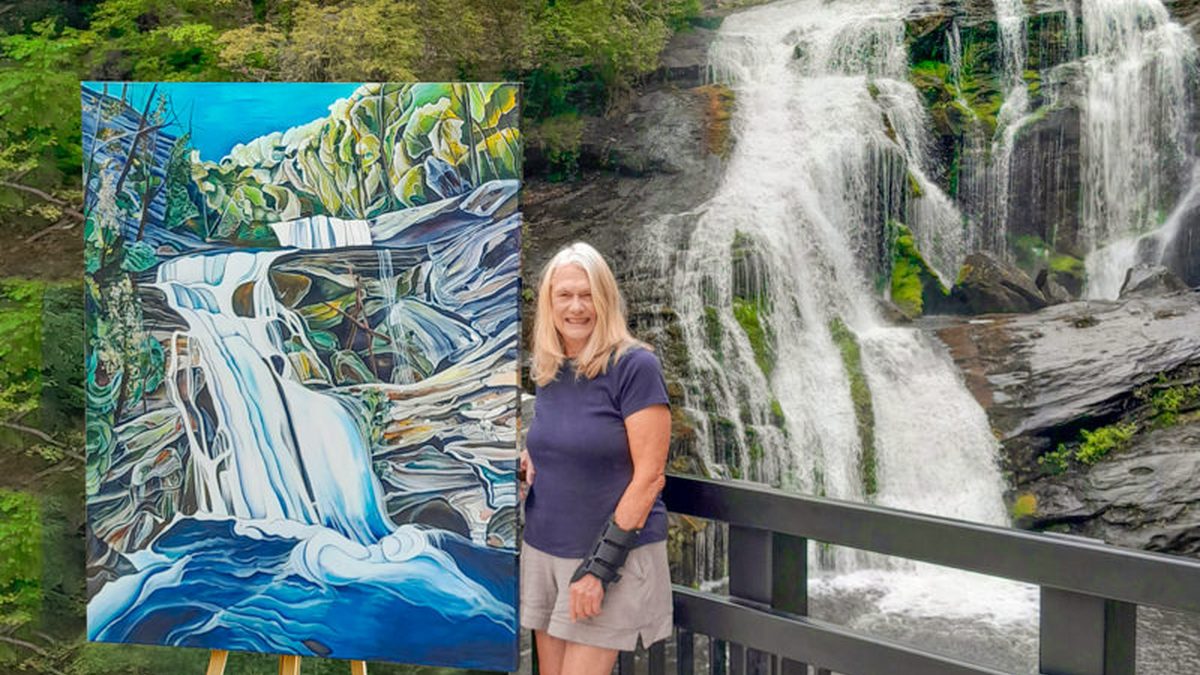
Lynda Best lives in paradise, and it shows in the paintings she creates. A lifelong artist (“By the time I was 12 I was giving art lessons to other kids and getting paid for it!”), Best and her husband Steve live in Tellico Plains at the foot of the Cherohala Skyway. Many of her subjects—the waterfalls and rushing streams, flowering rhododendrons and mountain laurel—come from the national forests surrounding her.
In fact, it was those clear mountain streams that made her fall in love with Tennessee after falling in love with the man who brought her here. “I lived in New Orleans for a while, and the water there was so swampy.”
Sometimes she’ll paint as she soaks up her surroundings. “If it’s easy access (to the subject she wants to capture) I can sit on the side of the road and paint,” Lynda says. “To get to a lot of the waterfalls you have to hike your heinie down the hill, and I don’t like to carry all my materials. So Steve takes photos for me.”
The resulting contemporary paintings capture the essence of the outdoors in acrylics. She says Georgia O’Keeffe was a big influence in her work.
“I did impressionistic work during college, but I’ve loosened up a lot more.” She highlights all the edges in her pieces. “It’s time consuming, but I find it very meditative. When I paint I don’t think about a lot of junk. I enjoy the painting process.”
In addition to water landscapes and the flora and fauna of the mountains, Best has painted a series of women in landscapes that she calls herfeminine ascension pieces.
“The female spirit is nurturing and giving and serving. That energy is strong on our planet,” she says. “If we want to evolve into higher consciousness we have to balance that with masculine energy.”
Lynda teaches art classes from time to time (she spent years as an educator using art as a tool in her teaching). You can also on her website,lyndabestartist.com.
→ Swipe for Next Story
MusicSEPTEMBER OCTOBER 2025
Built to Create
Shayla McDaniel’s journey to music was built on curiosity, faith, and the power of figuring it out
“I grew up in the church, so that was my first exposure to music, specifically live music,” Shayla McDaniel says. Drawn to sound from a young age, Shayla first wanted to play drums—“they looked like so much fun”—but started with the recorder in third grade. “It was fun. I loved it…One of the coolest things that taught me was how to read music.”
Her next instrument was violin, thanks to a University of Tennessee outreach program. “I really wanted to play cello so bad, but I ended up picking violin…I didn’t want to carry a cello to school every Tuesday and Thursday.” Soon after, she and her younger brother pooled their Christmas money to buy an acoustic guitar. “It was the coolest thing…I stuck with it.”
She picked up bass when her church’s bassist left for college. She’s now been playing for 19 years. After time on the electric guitar, piano came next. “In seventh grade, my parents…got me a piano, an electric Casio keyboard, and it’s phenomenal. I still use it to this day.” Then came drums, saxophone, and songwriting. And while she might not be a fan of the initial songs, time in college would end up becoming a turning point for her.
“I got more serious about music once I got into college,” she says. In 2013, she played her first open mic. A year later, after seeing the band Joseph perform in a Knoxville living room, and getting some encouragement from the band’s guitarist, Shayla committed to the art. By 2016, she was releasing songs.
After releasing two singles that year, Shayla’s music career began to gain momentum. “Things just started snowballing in a very good and encouraging way,” she says. Her first record, 26 Letters, dropped in January 2017, followed by local shows and festival appearances. As her confidence grew, so did her production quality. By 2018, she transitioned from DIY mixing to working with Maya at The Sound Lair, a partnership she describes as “the start of a very wonderful relationship.” The difference was immediate.
Her songs landed in quite a few surprising places: “I’ve had songs on MTV, Disney Plus’s Big Shot, and the CW’s Nancy Drew, as well as random stores and restaurants around the world.”
Shayla’s story is the kind any aspiring artist needs to hear. As we talked, I realized she never waited on anyone. If there was something she wanted to do or try, she figured it out and did it. And her journey is still going.
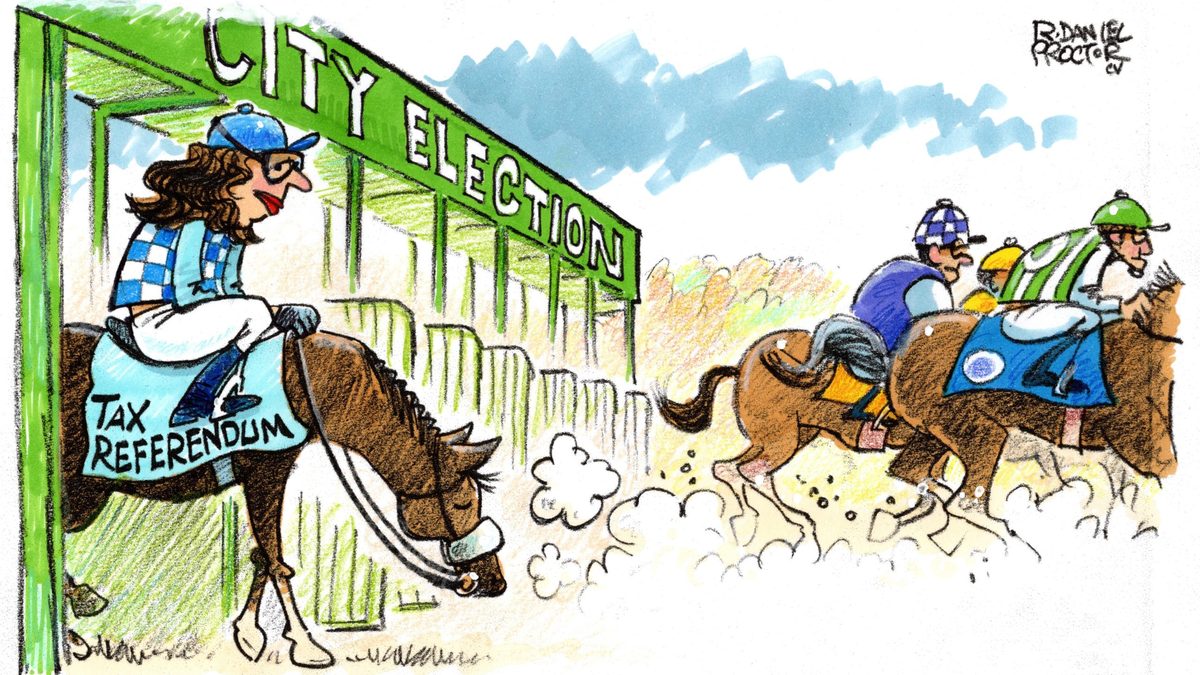
A shaky rollout, growing opposition, and a high‑stakes November vote put Knoxville’s proposed sales tax hike on uncertain ground
Knoxville Mayor Indya Kincannon’s sales tax referendum effort’s unfocused slog out of the gate in its early stages puts the outcome in doubt. Nevertheless, getting voters to pass a tax on themselves may be made easier given the blue tint of Knoxville’s recent voting patterns.
Kincannon’s May 22 sales tax referendum announcement was of particular interest to me in that in early 1988 I was tasked as principal designer of the only city sales tax referendum campaign of which I can find a record. On January 1, 1988, Victor Ashe took office as Knoxville’s mayor. A pledge to not raise property taxes was part of his campaign platform. That wasn’t unusual: no one runs for mayor saying they’ll raise property taxes, the most-hated tax of all. However, a subsequent-to-election surprise was that the city budget faced a $3 million shortfall (about $9 million in today’s dollars). That left three choices: cut $3 million from the budget, backtrack and raise property taxes – or roll the dice on a sales tax referendum. I’d been named Ashe’s press secretary and public affairs director.
Ashe decided to give voters a choice: a three-quarter cent sales tax increase, or cut the budget. From the moment he chose the referendum route, Ashe did a masterful job of lining up support from groups throughout Knoxville who normally would have opposed a sales tax increase. He defined his goals in terms of hiring new police officers and firefighters, road paving, code enforcement, parks, and job creation, and the administration never deviated from them. My role was as principal campaign communications planner and implementer.
The campaign was a daily, full-throttle push to convince voters that increasing a tax on themselves would benefit them. Though (as I recall) six previous attempts in 17 years had failed, on September 15, 1988, in a special election, the referendum passed with 63 percent of the vote.
Kincannon’s initial messaging at best was unfocused—and at worst revealed a lack of preparation. She was thrown big, fat, softball questions in a May 29 interview with WUOT Radio — a full week after the May 22 referendum announcement. An example: “The city has enjoyed a lot of successes in the past year that you mentioned in your budget. What are you excited about in the city right now?” Nevertheless, not until the third published interview question on the WUOT website did Kincannon mention the referendum, the biggest thing she’ll do as mayor, and on which her political reputation rests. It should have been part of every answer, regardless of the question.
By this writing, a campaign may have taken shape. But the mushiness at the start enabled opposition to galvanize. On July 7, the News Sentinel published this story: “Campaigns for and against Knoxville’s sales tax hike are live. Here’s how to get involved.” Betsy Kampas Henderson, running for Knox County Mayor, wrote a column opposing the referendum. Another potential problem: the election is set for November 4 and five city council seats are on the ballot. Each candidate will be asked if they support or oppose the tax itself. The safe answer is that they support giving voters the choice. But if pushed to say whether they support or oppose the tax, in such circumstances it’s always politically easier — and smarter — to oppose.
Kincannon may be helped by city voters’ increasingly Democratic Party leanings. When Bill Haslam left the mayor’s office in 2011, he did so as perhaps Knoxville’s last Republican mayor. His successors, Madeline Rogero and Kincannon, are well to the left of the average red-state Tennessean. Democrats’ general thinking on taxes, described in an AI overview,
is a plus for Kincannon: “Democrats tend to have more trust in the government’s ability to spend tax money wisely and are more open to higher taxes to fund services.”
Such sentiments explain average red-state Tennesseans’ concerns about the people pouring into Tennessee from blue states. There’s a hope that the arrivals aren’t bringing blue-state politics—and such views on taxes—with them. A question often asked is why would they replicate here what they’re trying to escape there? Maybe most wouldn’t, but the idea of, “We could stand to pay more in taxes,” certainly can exist among people who trust government to spend money wisely. Therefore, the dominant color of Kincannon’s referendum may not be green, the color of money, but the blue hue of an increasingly Democratic Knoxville.
→ Swipe for Next Story
InsightsSEPTEMBER OCTOBER 2025
Friend or Foe
I went to lunch this past week with a person I’ve known for more than 40 years. A successful man, who leads a multiple-staff wealth management office, he, like myself, began of his life without technology being a constant. And artificial intelligence? That is the last thing I’m thinking about.
We went to lunch with another friend in his electric car. It moves quickly, and when he takes his foot off a particular pedal, the car stops—no brakes. There is no dashboard, no gauges, no button to push—just a screen.
As he stepped on this particular pedal again, the car drove out of the parking lot. On the screen, we saw other cars passing by, indicating it would not go until they were gone. When it was “safe,” the car moved quickly to the other lane. Computer car at its finest.
Thinking out loud, I acknowledge that this is the world we now “seem” to live in—one in which our thinking is being replaced by technology. I do not need to look both ways for other cars; my vehicle does it for me.
AI has crept in, leapt in, pours in. In many instances, it’s taken over our need to think. It will write papers, do research, have a conversation with you about a problem you’re facing. It’s a useful tool in some ways. It saves time, it can reduce the stress of us driving, and can even help dial in to a health regimen plan you’re interested in trying.
It’s easy. But I must admit, there is something troubling me about this new tool: We have lost, or are losing, that art of who we are that struggled. The mere fact that we struggle, grapple with something, is what allows us growth. Think about it, we go to the gym to get fit or become stronger, but if we stop going and stop using our muscles regularly, they weaken. What then of our brains?
Is giving up the small things, like driving a car, weakening us? Is our culture losing some kind of strength when we turn over so much of our lives to technology? Has the cell become so much of our life that we cannot be disconnected from it? Has my laptop become myfriend? It seems to have all the answers—”just Google it,” right?
This technology allows me to be alone and not need another person in my life to grapple with. Have we come to believe there is only one answer for each problem out there and that the answer will be given to us by simply asking our devices? Then what do we do when someone proposes a different answer, especially one that does not agree with my own? Maybe there are answers that each of us have that help us get through life, that we learn as we get older—answers that mom and dad taught us, or a teacher, or a pastor. Sure, they could be wrong, but in not hearing others, we risk not strengthening our own thoughts and convictions.
AI will not solve the need for us to struggle with issues, whether they be spiritual, cultural, or social. As humans, we seeks answers. Some of those answers are easy. But others are hard to digest, hard to research, hard to ponder, and hard to stomach. In having a dialogue with others, other humans that is, we find depth in those answers.
The one part of all this information overload that is being overlooked is the basic need to be in a relationship and feel. Our emotions are deeply tied to all that is going on in the world, all that we take in, all that we digest. The issues of how we emote, how we see life from a different perspectives, how we realize our own feelings when talking to another human, how we engage in the world around us is based on the fundamental privilege of being able to feel. I feel the air when I go out in the morning; I feel my love for Nancy. And that, whether we want it to or not, that emotional setup, how we think and feel about life? That’s just not going to be answered by AI—although it will absolutely try.
→ Swipe for Next Story
DepartmentsSEPTEMBER OCTOBER 2025
The Effortless Excellence of Emilia
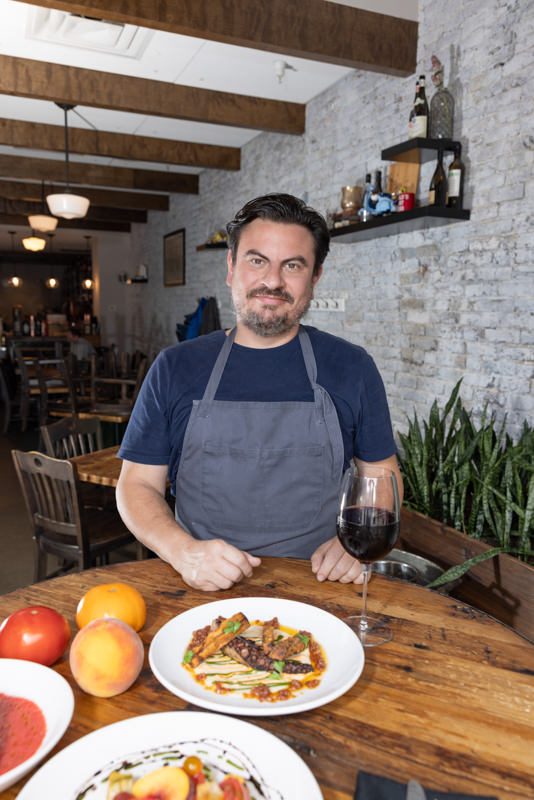
An evening at Matt Gallaher’s Market Square rifugio lets the cuisine shine.
There are restaurants that announce themselves with fanfare—brash décor, inflated adjectives, a signature cocktail named after someone’s grandmother. Then there are places like Emilia, which arrive on tiptoe. They settle into the neighborhood not with clamor but with poise, like a houseguest who knows where the wine glasses are kept. You barely notice the moment when the unfamiliar becomes familiar, when a first visit turns into a habit and a menu into a mood.
Emilia, nestled into Knoxville’s Market Square like it has always been there, has the quiet confidence of a place with nothing to prove. That may be because at its helm is chef and owner Matt Gallaher, whose pedigree includes time at Blackberry Farm and the kind of apprenticeship that begins not with Instagram reels but with mise en place and mentorship. His is a kitchen not of gimmicks, but of intention.
The dining room has that clean, contemporary Southern-European aesthetic that says we thought about this, but also you don’t need to. Dark wood, soft lighting, and the welcome hush of a place where conversation is both heard and encouraged.
We began in the capable hands of General Manager and Sommelier Keith Kirk, another Blackberry alum, though “alum” doesn’t quite capture two decades spent among the hills, cellars, and tasting rooms of Tennessee’s most pedigreed kitchens. Kirk’s approach to wine is generous, inquisitive. When we told him we were partial to Grenache from the Rhône but curious about Italy, he returned with a Cannonau di Sardegna Sartiglia, a sardonic, ruby-colored beauty named for a medieval equestrian event. “A cocktail wine,” he called it, a disarming understatement for something with such spine and spice.
The Overture
Grilled Spanish octopus arrived, all char and tenderness, arranged with a light cannellini bean purée, sweet peppers, and whisper-thin eggplant fries. A familiar Mediterranean trope, but here refined. Less the assertive Greek rendition, more the Spanish style: simmered, seared, supple. This is a “do not miss” item.
PEI mussels, those ever-dependable bivalves, were bathed in a fragrant white wine and fennel broth that demanded plenty of bread. Emilia obliged, with house-made focaccia and creamy ricotta from Cruze Farm, both blessedly unshowy. A Caprese salad, meanwhile, was made radiant by the inclusion of local peaches, heirloom tomatoes, and mozzarella pulled in-house. No reinvention, just clarity.
The Middle Movement
The pastas at Emilia deserve an aria of their own. We tried the Mafalde with zucchini alla Nerano, a dish lifted from the Amalfi Coast and transported, deftly, to East Tennessee. This dish, invented on the Sorrento Peninsula and recently promoted from the “secret menu” (more on this later) is a staff and customer favorite. Here, a plant-based broth made from toasted pine nuts and mushrooms coated the ruffled pasta like velvet. A dish that whispers, rather than shouts. It’s no wonder it’s one of Stanley Tucci’s favorite dishes. Another popular item is the Fusilli Carbonara with Benton’s bacon and a poached farm egg.
Then, a classical rendition of Pork Milanese, all crisp edges and yielding center, pounded thin and fried in an “explosive” batter enriched with rice and Pinot Grigio. Over a bed of arugula, and topped with an almost translucent slice of Parmigiano Reggiano, the cutlet was accompanied by a pomodoro sauce that was neither rustic nor coy, just bright, fresh, and confident.
But it was the gnocchi that lingered. Emilia’s Gnocchi Amatriciana may be the finest version of the dish not served by a Roman nonna. The texture: yielding without collapse. The sauce: a chorus of guanciale, Pecorino Romano, white wine, and just enough heat. It’s the sort of dish that risks ruining you for all others.
Pan-roasted Patagonian salmon followed, served over a farro risotto that brought a hushed, grainy comfort to the plate. Dill, grilled cucumber, and sweet potato played off the smoked crème fraiche, lending Scandinavian accents in a Mediterranean conversation. This sustainable salmon may be good for you with all the omega-3 fatty acids, but we weren’t thinking of that as we enjoyed the crispy crust and moist, flaky interior.
To pair with the richer fare, Kirk introduced a Spanna from Piedmont—a Cuvée Bernardo Vallana from Maggiora, near the Swiss border. Spanna, the local name for Nebbiolo, is a grape of terroir. It presents a mid-palate sweetness with notes of red cherry, kirsch, rose petal and cinnamon. Its acidity, vivid and red fruited, sliced through the dish like a witty remark in a heavy conversation. Emilia Dining | Photo by Nathan Sparks
A Word About the Not-So-Secret Menu
Regulars know that the kitchen is flexible. Pasta can be reconfigured. Children can get their spaghetti and meatballs, no drama. One standby, chicken alfredo, may not be listed, but it’s there, always. A password for the cognoscenti.
One of the charms of Emilia is the clientele. We always seem to see old friends, like Becky Hancock, executive director of the Historic Tennessee Theatre Foundation, dining with a job candidate before presiding over a performance ofLes Miserables. “We ought to thank the Tennessee Theatre,” says Kirk. “So many people come here before the shows, and they’ve booked a lot of great ones.”
The Coda
Dessert should be compulsory. The Butterscotch Budino was the unanimous favorite. While a pudding is made with sugar, cornstarch, and milk, budino is thickened with egg yolks. This one is silky, topped with salted caramel, pine-nut crumble, and an unapologetic amount of whipped cream. Pistachio gelato, served as a deconstructed Pavlova, was ethereal and nutty, and arrived looking like a little postmodern sculpture. For the purists: a dark chocolate sorbetto with just enough bite, offset by Amarena cherries and crunch.
A piping hot and fresh espresso offset the richness of the desserts. We are believers in the benefits of espresso as a digestivo. A single shot contains less caffeine than a normal eight-ounce cup of coffee and stimulates the digestive system. Italians drink espresso after dinner to help break down all those delicious pasta dishes. It is consumed without milk because milk takes longer for your stomach to process (and the reason you shouldn’t order a cappuccino after dinner.)
Limoncello, made in-house, was poured to finish. Sharp, clean, and a little sentimental, like the final scene of a favorite film you didn’t expect to love quite so much.
Throughout the evening, Gallaher moved through the dining room like a conductor at rest: present, attentive, but never overbearing. His hospitality is that of someone who learned it not from a playbook but from watching it practiced, carefully, by others. John Fleer at Blackberry Farm trained him that way, and it shows.
Even if you are a regular at Emilia, we recommend you ask the staff for recommendations. They love food, know wines, and are delighted to share what they know to make for a fabulous evening.
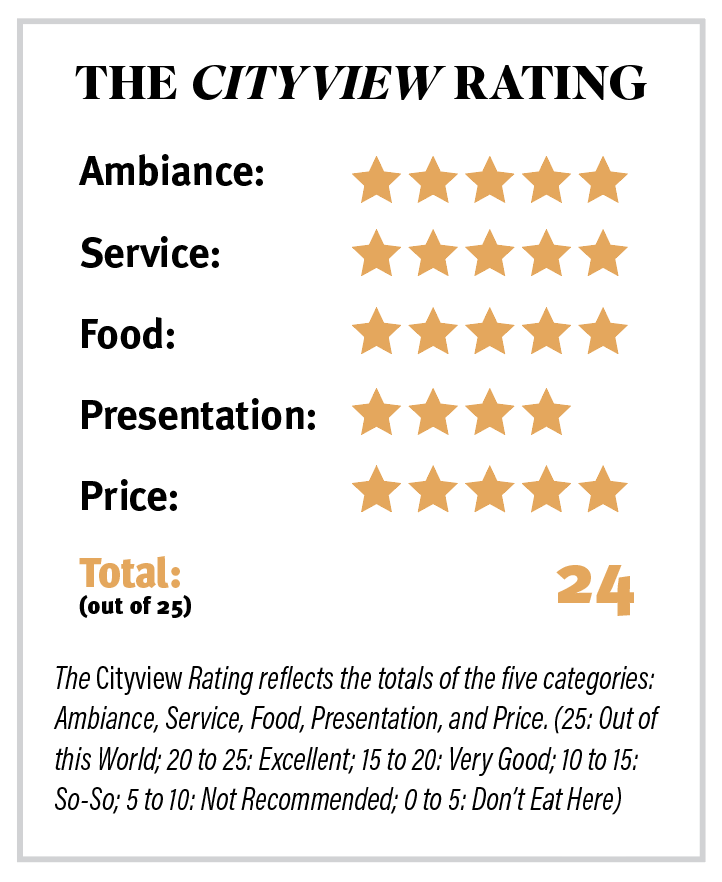
Emilia is a restaurant that doesn’t demand your attention but earns your affection. It feels, already, like a place with stories. Go often enough, and you’ll be part of the story, too.
→ Swipe for Next Story
JurisprudenceSEPTEMBER OCTOBER 2025
Down to You
When football glory meets small-town camaraderie, the stories are as good as the game
Although I am still catching on to writing a column every two months for the viewing pleasure of both of my regular readers, I do like to indulge myself with a baseball story in the spring and, in the fall, offer a tip of the hat to our orange clad Volunteer football heroes.
This story begins with recently retired Knoxville attorney Bill Petty, who served as a resident counselor at the athletic dormitory from the mid-1950s until his graduation from law school in the early 1960s. Working under the tutelage of the legendary Gus Manning and long-time UT Sports Information Director Haywood Harris in the Coach Bowden Wyatt era at Tennessee, Bill eventually became the Vols’ official statistician at home games, a position he proudly held for some 40 years.
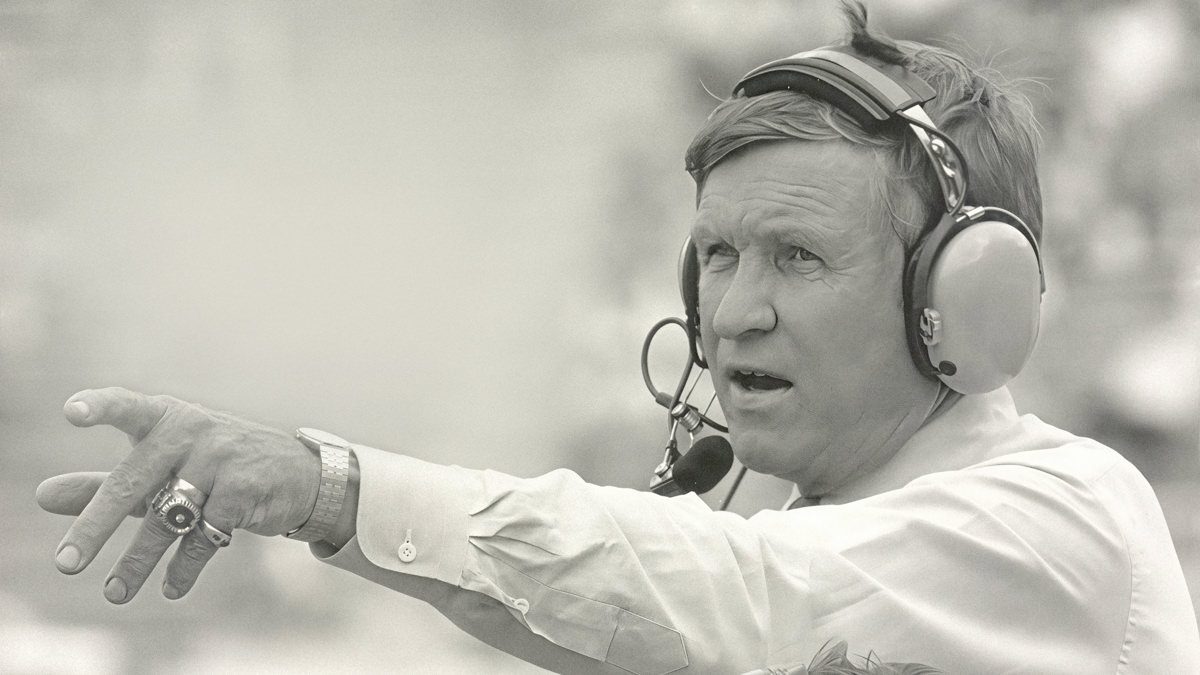
Among Bill’s favorite memories was when tailback Johnny “Drum” Majors led the team to an undefeated regular season, finished runner-up in voting for the Heisman Trophy, and then, eschewing pro football opportunities, entered the ranks of college coaching. Bill, of course, and so many others were delighted when, after winning a national championship at Pittsburgh, Johnny “came marching home” to coach the Vols.
Johnny, who had a successful 15 years coaching the Big Orange, never forgot his old friends, teammates, and fans, even after he lost his job at the end of the 1992 season. After a couple of years as head coach back at Pitt, he returned to Knoxville, maintained a high profile, and periodically hosted a luncheon at Buddy’s Barbecue’s banquet hall on Kingston Pike, always arranging for regionally or nationally known sports figures to speak and take questions. Bill, as a friend and admirer, never missed. When he discovered that I was a huge fan of old number 45 during his playing days, he added me to the invitation list, and much to my delight, included me from time to time when Bill and Johnny enjoyed a mid-day meal at the Lunch House on Magnolia Avenue, Bill’s favorite place to eat.
I like to think that I became a pal of sorts, mostly because I listened so carefully and laughed often when the old coach regaled us with glory days of the past. Our
conversations were often spiced with a few humorous jabs, and he was especially candid in subjects ranging from personal relationships to world affairs. For those who are not familiar with the Lunch House, it is a small restaurant, the tables are close, and when Johnny spoke, most customers were within earshot. At all our gatherings, those sitting at other tables, excited by the presence of a celebrity, would make it a point to visit the old coach, shake his hand, and express their admiration.
A couple of years before his death, Johnny had planned one of his luncheons at Buddy’s. Bill planned to attend, notified me, and I excitedly promised to be there. On the night before the event, Johnny called me on my home phone. He explained that he had scheduled a “really great speaker” for the event, but that he had become ill and would not be able to drive from Nashville the next day. Obviously disappointed, Johnny informed me of his speaker’s impressive background in sports and how popular he would have been with those attending the luncheon. He provided me with details of the grand introduction he had planned and how let down he was about the last-minute cancellation.
“Judge,” he exclaimed, “I have been calling all day to find a replacement and had no luck at all. I started with UT’s new head coach and athletic director, but both were out of town, and I called the basketball coach and even the track coach, but even they had conflicts.”
He rambled on, “Then I called one of my old teammates, several of my assistant coaches who still lived nearby, and even one of the state troopers who used to escort me at games. Shoot, I even asked that sportswriter that nobody likes!” After pausing for a breath, he continued, “I can’t find anybody, I’m desperate, I’m pretty much down to you!”
There was enough of a pause in our conversation for him to realize how I might be a bit sensitive to be placed so far down the list, but he recovered magnificently. “Judge,” he remarked after catching his breath, “This reminds me of my 1985 season. You remember, we were leading the SEC and had this great quarterback, Tony Robinson, who went down with a knee injury in the Alabama game at Legion Field. We held on to win 16 to 14, do you remember?”
“Sure do,” I answered, “I was watching on TV.”
“Well,” he continued, “we had to put in a fifth-year senior, a walk-on named Daryl Dickey, who had never played before. But he came on strong. The team didn’t lose another game, won the conference championship, and ended up in the Sugar Bowl facing the Miami Hurricanes – led by Heisman winner Vinny Testaverde at quarterback. They were playing for a national championship!”
“I remember,” I said, reliving the excitement in New Orleans, “What a game!”
“We win 35-7,” he exclaimed, “And our walk-on quarterback was named the Most Valuable Player. That was one of the biggest wins in Vol football history!”
Of course, I was overwhelmed by the comparison, strained as it was. “Well, what do you say?” he asked. “Can you speak tomorrow?”
“I would be honored,” I heard myself say.
“Well, what can you talk about?” he inquired.
“This phone conversation,” I replied. “I can’t think of a better story.”
Not completely satisfied, Johnny asked what my topic might be so that he could include that in his introduction. “That’s easy,” I said, “Just say it’s pretty much ‘Down to You.’”
→ Swipe for Next Story
FeatureSEPTEMBER OCTOBER 2025
Fields of Flight
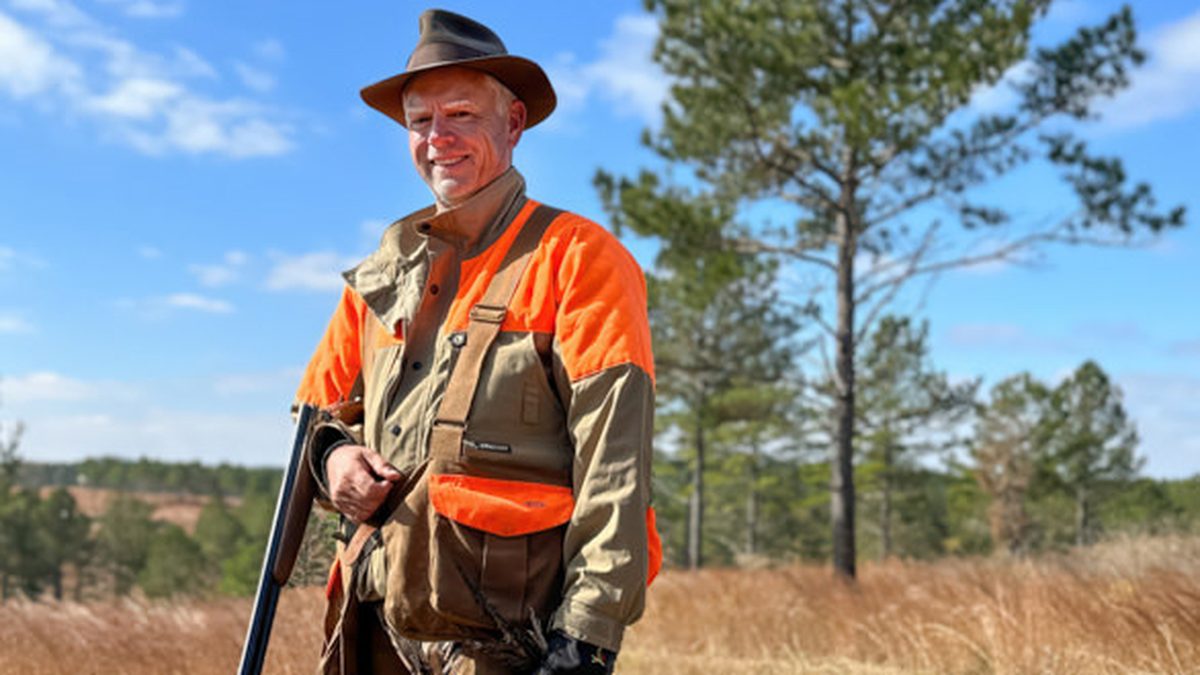
In the rolling hills of North Georgia, the gentleman’s hunt is more than a pursuit—it’s a tradition. At the Beretta Shooting Grounds, precision meets adventure, camaraderie meets refinement, and every moment in the field carries a spark of thrill.
There’s a certain kind of quiet you find only in the Georgia hills just before the hunt begins. The wind carries the faint scent of pine, the crunch of gravel under boots, and somewhere out of sight, the low, excited whine of bird dogs ready to work.
Late last fall, I found myself back at Barnsley Resort’s Beretta Shooting Grounds, the famed sporting venue operated by John Burrell’s High Adventure Company. I’ve hunted all over the country, but there’s something about this place — Barnsley Resort is a perfect blend of Southern hospitality, fine dining, extrodinary lodging, and world-class upland bird shooting — that keeps drawing me back year after year.
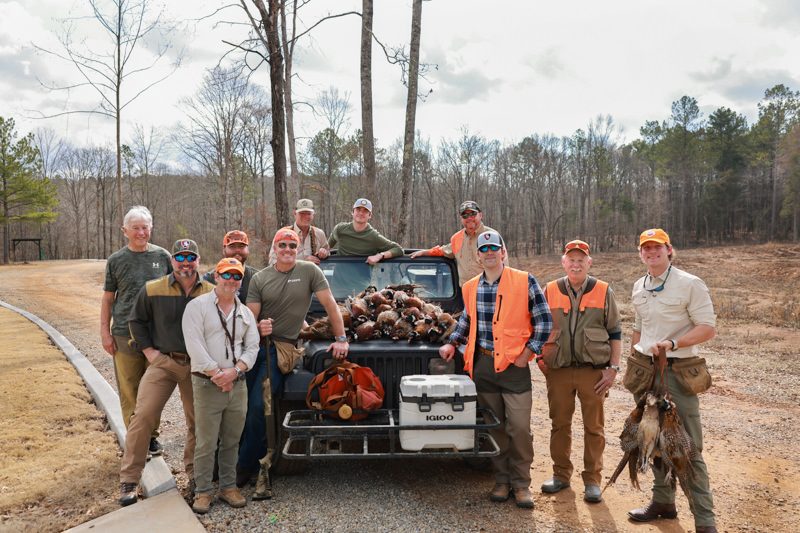
This trip was a little different. We had a brand-new lodge to break in and our three-day agenda promised great sport, awesome food, and even better stories. And with the crew of friends I brought along, there was no doubt the stories would go well into the night.
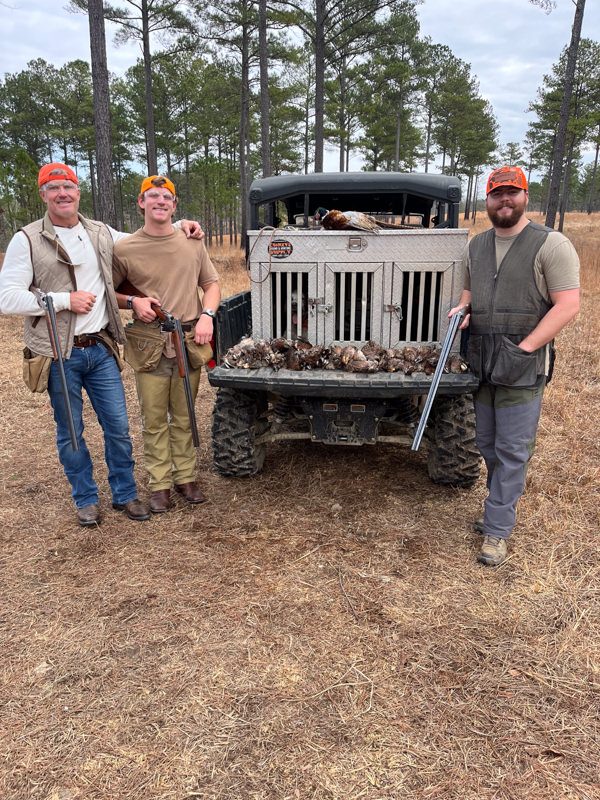
•Edwin Spencer– Orthopeadic surgeon specializing in shoulders (handy to have around when you’re throwing a shotgun to your cheek a few hundred times a day).
•Tripp Spencer– Edwin’s son, wrapping up college and heading into the insurance business, here to log some memories before trading textbooks for policies.
•Chip Seigler– One of East Tennessee’s top residential contractors, known for building exquisite homes north of a million dollars.
•Hudson Seigler– Chip’s son is a recent college grad, working with his dad and learning the family business.
•Terry Lewis– Of Real-Time Construction, a philanthropist and board member of the Tennessee Wildlife Federation, also the sponsor of the annual Wounded Warrior Turkey Hunt for 26 years.
•Bruce Fox– Attorney from Clinton, avid sportsman, and board member of the Tennessee Wildlife Federation •Terry Turner– Owner of All Occasions Party Rentals and a pretty fair wing shooter (see opener).
•Nicolas Summers– Regional sales rep for Pilot Oil. I think Nicolas would rather hunt than eat most days.
•Chris Lowe– Works in the chemistry industry. Should come in handy for making the perfect old fashioned or if we need to make some gunpowder.
•Jackson Queen– Works in real estate development in Charlotte, NC., friend of the Lowe family.
And of course, me —Nathan Sparks— joined by my little black Cocker Spaniel, Chota, whose boundless energy and nose for birds has made her the best hunting companion I could ask for.The Lodge Experience
We arrived on a Friday evening and rolled straight up to High Adventure’s new hunting lodge, located just outside the Beretta Shooting Grounds. One of the best features of this setup? Once you pull in and unpack, your truck keys might as well go in the safe — everything from your hunts to your meals is right here.
The lodge sleeps up to 12, though we found eight to be the sweet spot for comfort and elbow room. Those upper bunks are great for the younger crowd, not so much for me. The interior is a blend of rustic timber and refined comfort, with a great room built for storytelling, a long dining table for lingering meals, and a well-stocked bar perfect for winding down after a day afield.
And that first night, winding down wasn’t hard, thanks to Chef Sean Finley and his team.Finley’s Table
Sean Finley is a man whose reputation precedes him. Well-known for his lavish spreads, he’s not just a chef — he’s part of the High Adventure experience. He moves like a culinary nomad, from the pheasant fields of South Dakota to the duck blinds of Nebraska to the trout waters of North Georgia’s Soque River. Wherever you find him, count yourself lucky; You can bet the menu will be as memorable as the hunt. Sean is much more than just the Chef. He is a master of organization, and when he is around everything runs perfectly smooth.
Our Friday night dinner was, as always, a feast. I’ll have to consult my photos to recall exactly what was on the plates (that’s the hazard of good bourbon and better conversation), but I remember this: every dish was flawless. After dinner, the bar filled with laughter, the glow of TV screens, and stories traded across glasses of bourbon until the fire burned low.
Saturday morning, we woke to the smell of Sean’s breakfast — a spread hearty enough to fuel the kind of shooting we had ahead. By 9:00 a.m., the guides were lined up outside in a string of side-by-sides, shotguns at the ready, dogs shifting in their kennel boxes.
The Beretta Shooting Grounds can host up to 10 groups at once, but that morning, we all stayed together to the same field for a pheasant tower shoot. The setup is classic: hunters arranged in a circle, like hours on a clock, around a tower at the hill’s center. From within the tower, pheasants are launched high into the air, catching the wind and darting in unpredictable lines.
Every 20 birds or so, a horn sounds, and each shooter rotates to the next station — a gentleman’s way to keep things fair.
Pheasant shooting here is no casual warm-up. These birds are fast, high, and require a keen sense of how much to lead the bird. Of the several hundred birds that morning, I’d guess we accounted for about half, leaving plenty in the fields for the afternoon’s walk-up hunt.
And through it all, Chota worked the field with enthusiasm, retrieving when needed—and I am sure from her perspective, living her best life. With all the birds picked up, we headed back to the lodge for lunch.Afternoon in the Fields
After a well-earned lunch back at the lodge, we regrouped for the afternoon hunt. I paired up with my favorite guide, Stephen Farmer, whose German Shorthaired Pointers (GSPs) are some of the best bird dogs you’ll find anywhere. Today he has Sweetie with him, and she and Chota work well together. Chota is a flushing dog. For those of you that don’t hunt, the pointer roams the fields until the birds are located, then after the guide carefully positions the hunters, the flushers are sent to do their job. Safety is paramount on these trips for all involved, and High Adventure runs a tight ship. Only two can shoot at any one time and safety instruction is given even to the most seasoned of hunters.
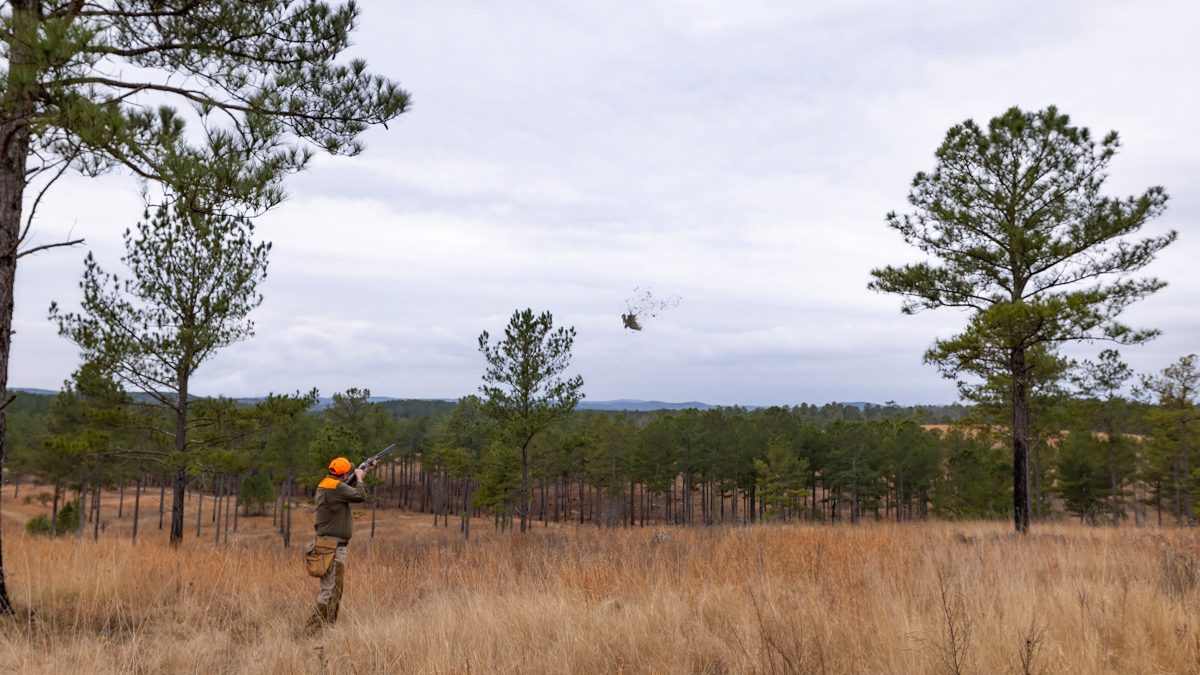
Unlike big-running English pointers or setters, GSPs generally work close, their points coming within easy walking distance. Chota fell in alongside us, well-mannered and steady at heel until her flushing job was called for. I really like funning around with Stephen, and I was anxious to get a good photo for the story of my friends. So as we walked up the hill toward the side by side, I jokingly said to Stephen, “What I need for you to do is have Sweetie point a covey of birds on top of the hill where I have a really nice background for the photo. “After she points, move the shooters into position but wait for my signal. Then we can send Chota in and I can get the perfect picture for the story.” He laughed alongside me and asked if that was all I needed. We were still chuckling as we came to the top of the hill to find Sweetie on point in the perfect spot, just as I had imagined. Terry Lewis came up to the left and Bruce Fox to the right. Chota did her job perfectly and birds were everywhere. I lined up on Terry for the awesome shot on the opening spread of this story.
The rest of that afternoon was a perfect blend — a nice walk through mixed cover, the dogs locking up on pheasants and quail, the snap of wings and the sharp bark of the gun. The bag grew steadily heavier, and the camaraderie grew right along with it.
Dinner that night was another long-table affair, the room buzzing with laughter and the satisfied fatigue that comes after a full day outside. As I’d hoped, John Burrell joined us for the evening. Sean served us an enormous perfectly prepared prime rib with all the trimmings.
John is not only the owner of High Adventure Company but also one of the finest storytellers you’ll ever meet. Over glasses of bourbon, he spun tales from across the hunting world — from the plains of Africa to the highlands of Scotland — each one delivered with the ease of a man who’s lived it all. It’s in moments like these, surrounded by friends old and new, that you realize why bird hunting is called a gentleman’s sport.The High Adventure Difference
What keeps me coming back isn’t just the birds or the scenery. It’s the all-inclusive nature of the experience: the fine food, the attentive guides, the well-trained dogs, and the sense that every detail has been thought through. That is one of the things High Adventure is known for — perfect planning of every detail, you don’t have to think about a thing.
From the moment you arrive to the moment you leave, it’s seamless — the kind of trip where you can just focus on the sport and the fellowship.Why We Hunt
In the end, this trip was about more than the shots fired or the birds bagged. It was about spending time with good friends and creating a special level of camaraderie — the kind that’s forged in shared blinds, over long dinners, and during walks through crisp cover. It’s about the dogs, the guides, the stories, and the traditions that make hunting a heritage worth preserving.
As the trucks rolled away from the lodge on Sunday afternoon, I couldn’t help but think about the next time. Because with High Adventure and Barnsley, there’s always a next time.
→ Swipe for Next Story
FeatureSEPTEMBER OCTOBER 2025
That Old Cape Magic
A captivating place, unspoiled by time
The mention of Cape Cod sends me into a reverie: As you cross the Sagamore Bridge spanning the Cape Cod Canal, you lower the window and smell the salt air. You notice that your shoulders are lower and checking your phone doesn’t seem that important anymore. You drive down the gravel lane to the house, and the crunch of tires on crushed oyster shells in the driveway is the best sound you’ve heard in months. You’ve arrived at 5:30 p.m., so friends and family are gathered on the sun porch and lawn for a crisp gin‑and‑tonic with just the right amount of lime. No one asks about your work. Instead, the conversation revolves around sailing races, the latest book on the Vichy government, or children and grandchildren, second and third cousins. Dinner is local corn and tomatoes, cod from today’s catch, and blueberry pie from Marion’s Pie Shop. After dinner, you walk down to the beach with a plastic cup of white wine, bemused at piping plovers darting in and out from incoming waves, just as Thoreau described them inCape Cod160 years ago. The gentle crashing of the waves feels like a hug. You sleep deeply as the wind wafts over you—we call it the Cape Cod coma—lulled by the faint moan of a foghorn miles out in Nantucket Sound. In Brooks’s young years, when it was his grandmother’s house, he would awaken before anyone else and hear the call of a bobwhite in the backyard. For Brooks and his siblings, there was never any TV, and they never missed it.
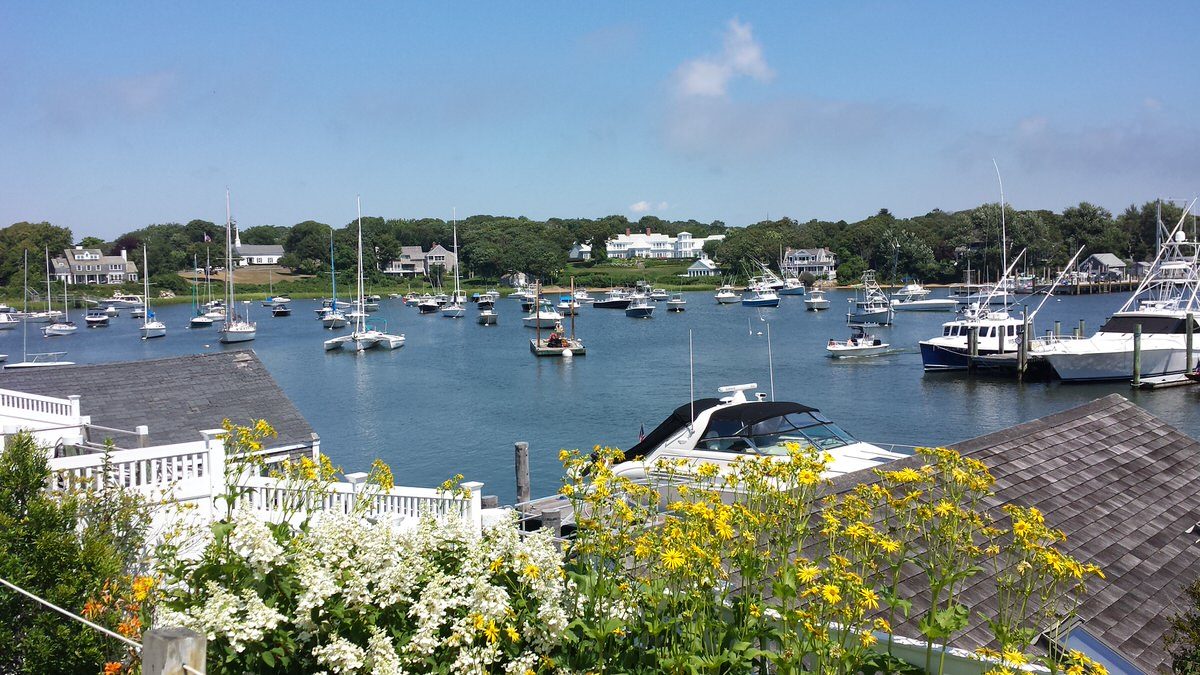
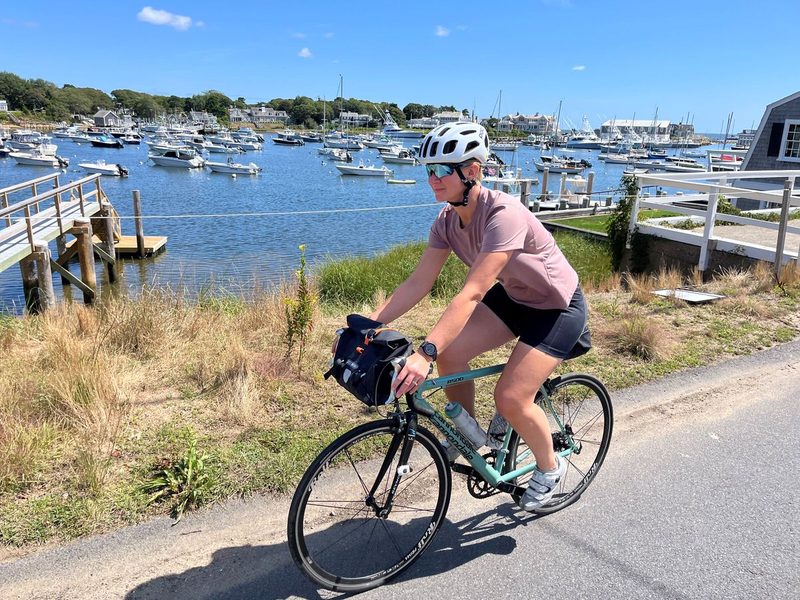
Our Knoxville friends Maxi and Seth Frank got plenty of Cape magic on a four‑day trip on the Cape Cod Rail Trail recently, biking past pristine ponds left by ice blocks in melting glaciers. In the village of Harwich Center, the Franks took a side trip two miles to Harwich Port for a lunch of leek soup and sandwiches with members of Brooks’s extended family and Knoxvillians Jeff and Lyn Johnson. Brooks took Maxi and Seth through his family’s house, built in 1891. He showed them paintings and lithographs by his mother, Charlotte. We walked down a path between wooden fences to a view from atop our bluff of Nantucket Sound, then walked down Snow Inn Road past Wychmere Harbor, a perfect circle filled with all manners of boats. Until the late 1800s, it was a pond, with no outlet to the Sound. Its circular shape made it ideal for horse racing, to the dismay of pious ladies of the town. This was one incentive for legions of men to dig out a channel, creating a home to fishing boats, the one‑sailed cat boats, broad at the beam and seaworthy.
Maxi and Seth then pedaled back to the Rail Trail. “Per your recommendation,” said Maxi, “we stopped for a dip in the clear water of Hinckley’s Pond.” They went on to Eastham, where they stayed at The Inn at the Oaks and walked to dinner at Arnold’s Lobster & Clam Bar. Eastham is home to the First Encounter Beach, where the Pilgrims first landed and stole some corn. During Todd Helton’s summer in the Cape Cod League, he stayed with a family on that beach. For UT players from Helton to Jordan Beck, the Cape Cod League is a throwback to a world gone by—living with a family, swinging wooden bats, playing in tiny hometown fields as flocks of kids chase fly balls into the woods, and selling raffle tickets in the stands.
Seth and Maxi pedaled to the tall dunes and dramatic ocean views of the Cape Cod National Seashore, then on to the arts haven of Provincetown, on the tip—the hand if you will—of the Cape’s arm. “I discovered Provincetown in 2002,” says former Knoxvillian Gary Belis. “It was a magical week in this quirky community where fishermen, drag queens, leather men, lesbians, painters, writers, and just plain ordinary folk mingle freely. It was true love, and I fell hard. I have returned every summer. The arts scene was first established over a century ago by the painters who were attracted to P‑town’s exquisite light—said to rival that of Provence or Venice—and then the playwrights and other writers followed.”
Eugene O’Neill’s first play,Anna Christie, debuted in P‑Town 110 years ago. In 1947, a young Marlon Brando hitchhiked with a girlfriend from New York City to Tennessee Williams’ rustic P‑Town dune house to read for the part of Stanley Kowalski. He arrived to find the kitchen floor flooded, the toilets blocked, and the light fuse blown. After fixing the lights and unblocking the toilets, Brando did Stanley. “A new value came out of Brando’s reading,” wrote Williams. “He seemed to have already created a dimensional character.”
“Today there is a thriving art gallery section in the East End of town,” says Belis, “and the theatrical tradition of O’Neill and Williams continues with new works at the Provincetown Playhouse.” You can also hop on a boat and go whale watching.
Families fortunate enough to inherit beloved vacation homes tend to have origin stories. We love to tell ours: In the late 1920s, Brooks’s grandmother caught pneumonia while ice skating near her home in Exeter, New Hampshire. To help with her recovery, his grandfather, an English teacher at Phillips Exeter Academy, wanted to find a warm summer destination. He recalled a student’s essay about swimming in the warm waters off Chatham, on the elbow of Cape Cod. Visiting Chatham, they found it “too fast”—that is, too expensive—and headed west on Route 28, the old Wampanoag trail that winds along the southern shore of the Cape, to the next town over, Harwich Port. As it happened, Brooks’s grandmother’s uncle George Ichabod Rockwood, at 60 with no heirs, was selling his ceiling‑sprinkler business in Worcester and looking for a spot to retire. He bought an estate with a gatehouse, tennis court, and beach, and in 1930, he bought a house across the dirt lane and pretty much gave it to Brooks’s grandparents. (“A check for $5,000 that was never cashed,” said his father.)
Brooks’s mother remembered hopping into the rumble seat of Uncle George’s Rolls-Royce to go to the Cape Playhouse, where they saw a young Bette Davis, Jimmy Stewart, and others. Founded in 1927 in an old church to give actors work when Broadway closed for the summer, the Playhouse still oozes the charm of a bygone era.
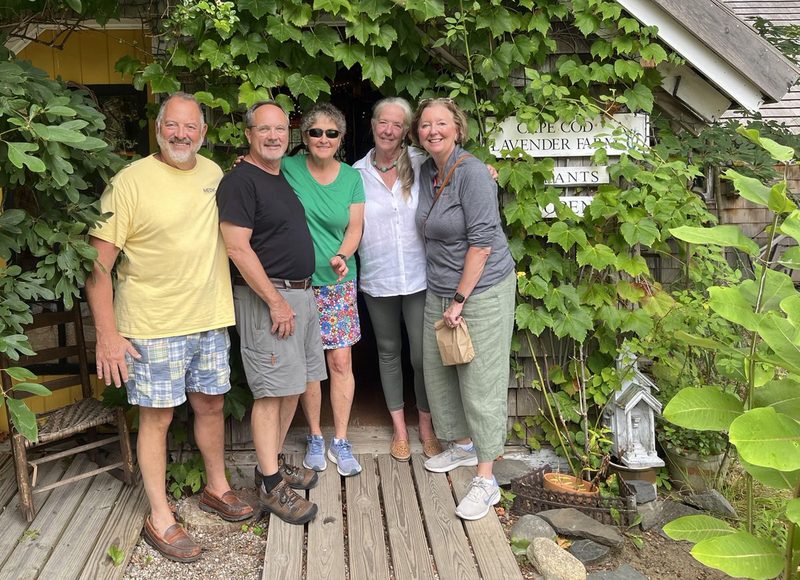
Uncle George helped found a yacht club that still hosts sailing school and sailboat races. He liked to sit on a bench atop a bluff and watch the races, especially when the colorful spinnakers popped up on the final leeward legs. Brooks’s parents met at a 1940 wedding reception at the yacht club. Now more than ever, the Cape is a magical place for weddings. Down our dirt lane and toward the beach, a wedding venue hosts as many as three a day. (Adam Sandler filmed a wedding there for his 2012 movieThat’s My Boy.) Many of our nieces and nephews, and our daughter Olivia, have been married at the grove and arbor among the pine trees of the Cape Cod Lavender Farm, which Brooks’s brother Rocky, a landscape designer, created a few decades ago. Last summer, Knoxvillians Lucy and Doug Tyler enjoyed visiting the Lavender Farm and owner Cynthia Sutphin.
Large family dinners are a longstanding tradition. Our Knoxville friends Chip and Tesa Finn came for dinner during a Cape vacation a few years ago and loved the family feeling. The next day at a local gallery, Chip bought Brooks’s mother’s paintings of a pier near our house. “It hangs in our bedroom and makes me reminisce about that wonderful evening every day,” he says.
Families blessed with beloved vacation homes often like to talk about how they manage to keep them, despite property taxes, upkeep, and family rifts. At a certain point, Brooks’s parents put the house in a trust, and he and his five siblings are doing their darnedest to pass it on to their 13 children and their families. Each year around July Fourth, they convene for a cousins’ reunion with many of their 27 children.
Sailing in the protected waters of the Sound can make you feel like a Kennedy. Last summer, our friend Michael Hershey took our Knoxville friends Lyn and Jeff Johnson and Lee and Bitsy Ingram out on the Sea Bird, a 26-foot wooden yawl that he built himself. In a stiff breeze, the boat heeled like the one in Winslow Homer’sBreezing Up. “That was my best day of the year,” said Lee.
→ Swipe for Next Story
FeatureSEPTEMBER OCTOBER 2025
The Belief Effect
Science shows our expectations can shape real health outcomes—proof that belief, mindset, and even faith can change the body.
In 2013, my colleagues and I at the Multicenter Orthopaedic Outcomes Network Shoulder Group published a research paper as part of a longitudinal study on rotator cuff tears. This was a multi-center trial that involved around 12 centers at that time, and during the study we randomized patients to operative or nonoperative treatment of non-traumatic tears. The nonoperative group could decide at any point that they would rather have an operation to fix their cuff tear and thus cross over to the operative group. The interesting finding in this study was that the biggest predictor of failure of nonoperative treatment was the patient’s expectation. If the patient believed that nonoperative treatment was not going to work, then it did not. This was irrespective of anatomic parameters like tear size and pattern, BMI, etc. It was the patient’s belief in the treatment that mattered most.
I found this result fascinating. And I began to wonder: Is this belief effect found in other areas? We know that there is a placebo effect in which a patient demonstrates a change in symptoms based on a sham intervention, but this is a little different. In our case, the belief is an expectation that comes to fruition.
So, I decided to do some research on, what I’m calling,the belief effectin medicine. What I found was so interesting, that it not only changed the way I communicated therapeutic interventions with my patients, but also what I believed myself.The Belief Effect in Action
One of the more intriguing studies that demonstrates just how impactful a belief can be in medicine was performed with Parkinson’s Disease (PD) patients. In general, PD patients have lower levels of dopamine in a certain part of their brain that causes the typical tremor, rigidity, and balance issues. In this study, the PD patients were randomized to various groups. One group was told that they had a 25 percent chance of improvement with a pill, another was told that they had a 50 percent chance of improvement, and yet another group was informed that they had a 75 percent chance of improvement. However, all the patients were given the same sham pill. Via special PET (positron emission tomography), the researchers could determine if the patient actually had an increase in dopamine in the brain area that was deficient. Judging by the tenor of this article, you probably guessed that the group that was told that they had a 75 percent chance of improvement actually had a demonstrable production of dopamine in the appropriate brain area. This was also associated with clinical improvement in rigidity and movement. The patient’s expectation had true physiologic ramifications and, in this case, they were positive. This goes beyond a patient simply saying, “Yep. I feel better now after taking a pill.” This is true cognitive control over physiology.
Dr. Alia Crum, a well-know psychologist and Stanford professor, has done a lot of research in this area. Recently in her podcast, she discussed her milkshake experiment, one in which participants were told different descriptors about the shakes, but were all given the same shake. One group was told that it was a sensible low-calorie shake and the other group that it was a high-calorie indulgent shake. Ghrelin response was measured in each group after consumption. Ghrelin is a hormone secreted by the stomach and brain that stimulates hunger; and lower levels indicate satiety.
The group that was informed that they were consuming a high-calorie shake had significantly lower ghrelin levels compared to the sensible group that had a relatively flat-line response. Thus, the expectation/belief of the participant had a measurable physiologic effect, despite an equivalent stimulus.
Here we see that the mind has effects on the body just as we have seen in previous articles how the body has effects on the mind. Our frontal cortex in our brain can be used to change our physiologic response to stimuli. But can this go further with a response to stress? Additionally, can our belief system impact our response to injury or surgery?The Truth about Stress
Stress definitely has a negative connotation, but it isn’t all bad. Acute stressors like training transiently increase cortisol levels in the moment, but in the long run, it can actually decrease chronic stress and allow the body to handle cortisol better. However, chronic stress is this invidious, almost ineffable, feeling inextricably wound into our thoughts that can have an unmitigated effect on our reactions. Or is it?
Shouldn’t we expect stress and suffering? In Buddhism, the presence of suffering is the first of the noble truths. Jesus said in John 16:33, “in this world you will have trouble, but take heart, I have overcome the world.”
Some of the troubling aspects of stress and suffering are the loss of control and unpredictability. We are no longer the determiners of our destination and we wistfully adjure resolution. But is that really the case? Do we have more control than we think? Can we use our minds and beliefs to alter our physiologic response to stress?
Research would suggest that a positive mindset regarding stress does in fact decrease cortisol levels, lower blood pressure and heart rate. This involves accepting the stress and then not trying to defeat it, but rather understand that, in the midst of adversity, there is opportunity. The way that we perceive a stressful situation alters our physiologic response and thus our physical response in measurable ways.Faith as a Model
So does your positive mindset actually give you more control or render the situation more predictable? It really depends. Take our spiritual belief systems, for example. Personally, I believe that we have God not only as our creator, but our comforter and healer. In control of all things with a plan for all things, our God loves us and demonstrated that love by allowing his only son, Jesus, to be sacrificed for us so that at the end of our days, we can spend eternity with Him. I can submit to God and know that He has complete control and that He will plan my days. That gives me peace, and it is truly a peace that transcends all understanding. Believe me, that has physiologic ramifications on every health metric and my view of others.
Now that I have exposed my furry underbelly, does faith have an effect on health in the literature? In fact, it does. A 1995 study on heart transplant patients stratified them into three self-described groups. Group one described themselves as deeply religious, group two was involved in community groups, and group three was uninvolved in religion or community. The researchers evaluated the six-month survivorship of all three groups which were otherwise equivalent in other co-morbid metrics. At six months after surgery, 14 percent of the uninvolved group had died, 4 percent of the community-involved group had passed while none of the deeply religious group had died. Other studies have demonstrated that religious people (regularly attending services and praying) have lower blood pressure, lower incidence of cardiovascular disease, and greater levels of happiness and satisfaction. This does not mean that going to church will cure all your ills, but it does mean that those who frame their stressors in a religious manner seem to have better health metrics and even survive major surgery better. This seems to be an extension of the belief effect.Changing the Way We Serve
This data has changed how I approach patients and their expectations. This was a means not to obfuscate medicine, supplements, or surgery but rather to augment their application. One step further is the real meat and potatoes of personal application to stress and life. The literature is replete with the positive effects of gratitude and meditation on health metrics such as blood pressure and heart rate. For example, if we give gratitude to God for all of His provisions, we acknowledge a higher power. This takes the focus off of self and onto God, which has an exceptional impact on recovery.
We as humans have a special ability to alter our physiology by the way we think and perceive situations. This gives us an even greater degree of control of our physical and mental health than we probably know. It might not be as powerful as Obi Wan Kenobi saying, “these are not the droids you are looking for,” but it does come close. I encourage you to explore this belief effect in your own lives to harness the potential benefits.
→ Swipe for Next Story
FeatureSEPTEMBER OCTOBER 2025
All About the Culture
In Coach Josh Heupel’s fifth season, the Vols are banking on a productive team ethos.
On UT Media Day Offensive Coordinator and Quarterbacks Coach Joey Halzle described the competition among quarterbacks Joey Aguilar, Jake Merklinger, and George MacIntyre by harking back to the 2021 competition between Hendon Hooker and Joe Milton III, when Milton won the starting spot, Hooker accepted his role, then excelled when Milton was injured. In 2022, when the roles were reversed, Milton accepted his role as backup and worked to get better. “Today,” said Halzle, “they’re still best friends and both playing in the NFL. That’s the culture that we want on this team.”
Head Coach Josh Heupel, Halzle, Defensive Coordinator Tim Banks, and their players talk a lot about team culture. This year’s QB competition, said Heupel, will be won, “Not in one throw. Not one day. Consistency is important. It’s important that the staff sees that. But most importantly, the players need to see that. It’s transparent. It’s real, and the whole team can see it.” Echoed Halzle, “Someone’s gotta step up and take it.”
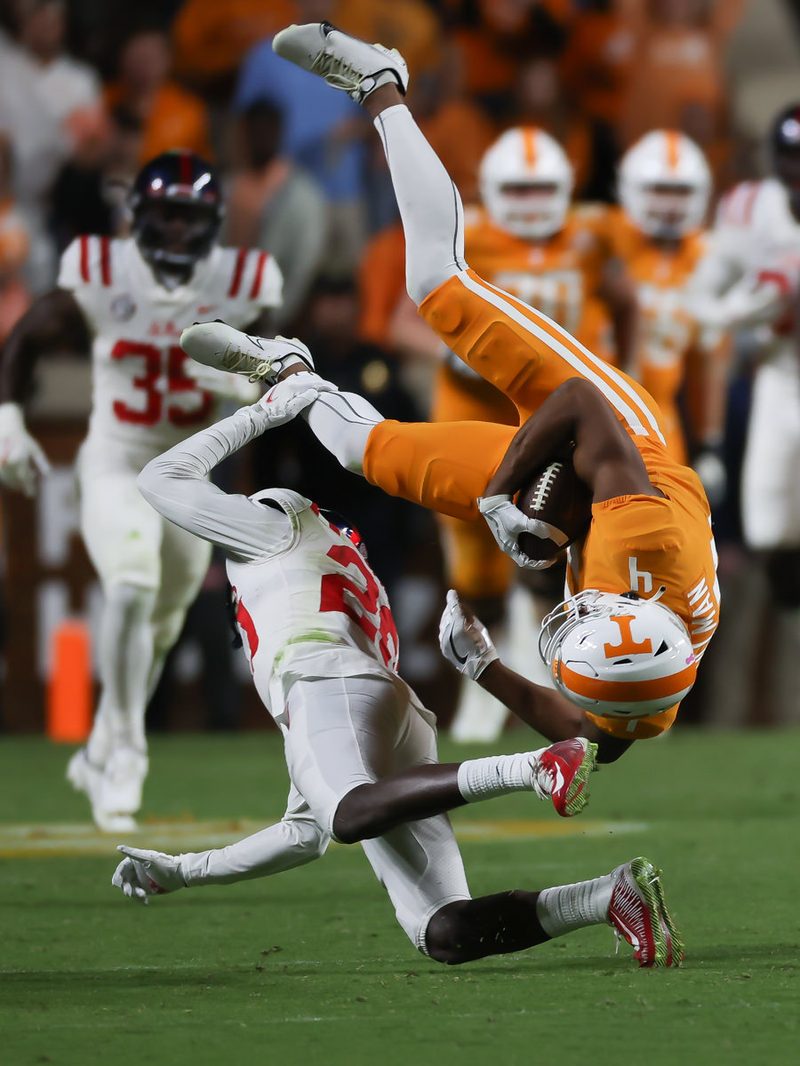
In this, Heupel’s fifth season, the team culture is baked into its DNA or it’s not. The culture was tested when the explosive and dynamic Boo Carter missed a few voluntary workouts in the summer. “A guy like that, in my opinion,” said tight end Miles Kitselman at SEC Media Days, “is a Swiss Army Knife. He’s so good in all three phases of the game,” that is, as a defensive back, possible Deion Sanders-type receiver, and one of the top punt returners in the SEC. The team’s leadership council dealt with his absences. “Boo has to accomplish some things to get back on the field,” said Heupel at Media Day. “Nobody is bigger than the Power T.”
We all know how the team culture prevailed during Nico Iamaleava’s Shakespearean downfall. Or was it Greek tragedy, illustrating too clearly the meaning of the word hubris? (Translated into East Tennessean, “gettin’ too big for yer britches.”) The Athletic generously described Nico as having been “a good quarterback, not a great one.” The less generous among us think back to that last play against Arkansas, when Nico inexplicably ended the game by running the ball out of bounds rather than heaving it up for a chance of a score and a victory. We also remember the expression on Nico’s face before the playoff game at Ohio State. He looked frightened. This was understandable considering the Buckeye tsunami that was about to wash the Vols out of the tournament. But Nico also looked like didn’t want to be there. And what do you know? He didn’t. As the Greek chorus might have predicted, his audacity in asking to double his NIL money on the heels of that loss will echo in the annals of college football lore forever. It might end up on his gravestone.
“The Ohio State game really left a sour taste in our mouths,” said defensive tackle Jaxson Moi at Media Day. “Looking back, we were close, but we know we could do more.” Of Aguilar—who moved like a chess piece from UCLA after Nico arrived there—Moi said, “Joey is a calm, cool dude. He’s a Cali guy, just like me.”
Carlos Lopez, who this season is broadcasting Vols games in Spanish across a few nations, asked Aguilar whether he is a role model for young Latinos. (Aguilar’s dad is a first-generation Mexican American; his mom is Puerto Rican.) “It’s a blessing for me to go out there and represent and spread joy,” Aguilar replied. Lopez then asked if Joey knew how to say, “Let’s Go Vols” in Spanish, then quickly offered, “Vamos Vols!”
Aguilar has the refreshing aura of an underdog committed to proving himself. As he reminded reporters at UT Media Day, he had no scholarship offers coming out of Freedom High School in Oakley, California, despite throwing for 3,074 yards and 32 touchdowns as a senior. He walked on at City College of San Francisco and redshirted. He took the 2020 season off because of COVID, then played two seasons for Diablo Valley Community College in central California. He threw for almost 3,000 yards in two seasons, enough to get a scholarship to Appalachian State. There, he admitted, “’23 was better than ‘24. Life can go here,” he said, angling his flat palm upward—3,757 passing yards and 32 TD passes, “and life can go here,” angling his palm downward—3,003 yards and 23 touchdowns. Still, he was recruited by UCLA and worked out with the Bruins in the spring, dutifully learning the offense. When Nico arrived in Westwood, Joey put out feelers. On a phone call, Heupel felt Aguilar fit into “the culture piece.” Arriving in Knoxville in May, he dug into the playbook and installed the offenses on his own, exactly as the rest of the team had done in spring practice. “That’s how I go about my day,” he said at Media Day. “I put my head down and grind. I wanted to get that playbook down.” He also watched the film of every offensive play from last year and spring practice. Aguilar has the extra year of eligibility thanks to a court’s ruling on behalf of Vanderbilt’s Bama-slaying QB Diego Pavia that the NCAA was violating anti-trust laws in counting junior college years in calculating eligibility.
Speaking of underdogs, running back DeSean Bishop takes over for SEC Player of the Year Dylan Sampson. (Peyton Lewis will be in the backfield with him, along with Duke transfer Star Thomas.) Bishop walked on at UT from Karns High. “They doubted me back at Karns,” he told reporters. He had to prove himself at UT and earned a scholarship in 2025. “The glory of proving people wrong is so satisfying. There’s no greater feeling. I’m still trying to prove it.” Bishop has worked hard in the weight room. “That dude is ripped,” confirmed left tackle Lance Heard, the lone returnee on the offensive line, who has shed some 38 pounds, down to 315, to make himself quicker with his footwork.
Almost half the UT roster is made up of talented freshmen and redshirt freshmen. They will either respond to the culture and contribute, or not. This is the way successful programs are built. As Heupel and his coaches often say, “Young guys don’t have time to be young.” Five-star freshman right tackle David Sanders, for example, came to spring training with a 6-foot-six, 270-pound high schooler’s body. He hit the weight room and added 38 pounds since spring practice. Next to him, redshirt freshman Jesse Perry is the likely starter at right guard. Wendell Moe, an All-Pac-12 transfer from Arizona is at left guard. Redshirt freshman William Satterwhite and Notre Dame transfer Sam Pendleton are vying for the key starting spot at center. Asked about the identity of the offensive line, Heard said, “Whenever we step on the field, we want people to say, ‘Damn, those boys play hard as hell.’”
With a surfeit of talent at tight end—Ethan Davis, and veteran transfers Miles Kitselman (from Bama in 2024), McCallan Castles (UC Davis), and Holden Staes (Notre Dame)—Aguilar can get key completions by looking their way. Talented receivers Mike Matthews, Chris Brazzell, redshirt freshmen Braylon Staley and Bama transfer Amari Jefferson need to figure out how to get open.
The defensive backfield is also overflowing with talent, starting with Boo Carter at nickelback, All-America Oregon State-transfer cornerback Jermod McCoy (rehabbing from a torn ACL), Colorado transfer Colton Hood, Temple transfer Jalen McMurry, and safeties Andre Turrentine, Edrees Farooq, Kaleb Beasley, Rickey Gibson III, who says he has grown in his awareness of the game. “Sometimes I was, like, air-headed,” he said of last year.
Middle linebacker Jeremiah Telander, with his cocky grin and cheery demeanor, resembles a young Dennis Quaid, especially as he talks about his fellow charismatic leader at weakside linebacker, Arion Carter. “That’s my guy,” said a Telander on media day. “We were roommates when we first got here. I can’t tell you how proud of each other we are. It’s so great to have A.C. by my side.” Telander, another underdog of sorts, said, “We took leaps in our mentality. I can’t wait to see what happens.”
In front of them, are tackle Bryson Eason, edge rushers Joshua Josephs, Caleb Herring, and Jordan Ross, and defensive end Dominic Bailey, who echoed the goal of making it further than last year, “Past the first round of the playoffs,” said Bailey. “Losing that game gave everybody a fire. In terms of preparation, we learned how much preparation was needed.”
Said Jaxson Moi, “I feel that I can showcase my pass rush more this year. The three core values of the defense are “smart, tough, relentless. It all starts with the culture.”
→ Swipe for Next Story
FeatureSEPTEMBER OCTOBER 2025
Into the Looking Glass
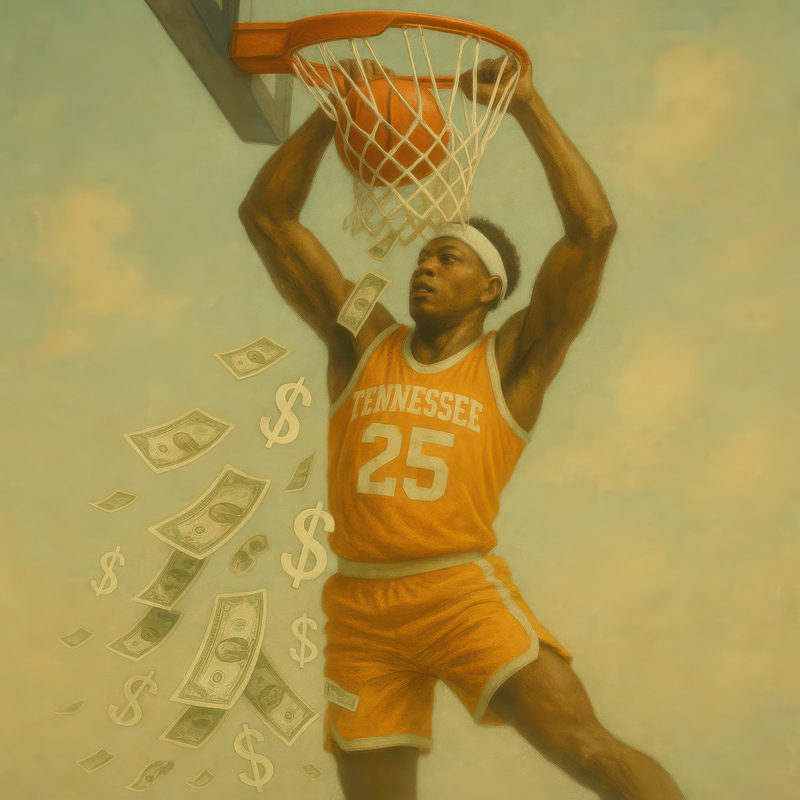
There is nothing that I like more than to see Nick Saban wailing and gnashing his teeth begging at the foot of the President of the United States to preserve the caste system that earned him a net worth in excess of $80 million dollars and the Alabama football team nearly two decades of dominance. Of course, he does not want the system to change. He makes the argument with a straight face: college sports was better the way that it was and a lot of fans agree. Here is the problem: college sports the way it was, was an illegal cartel that was artificially suppressing wages and earnings of college athletes in violation of the antitrust laws of the United States of America. It still is.
There was genuine hope when the attorneys settled the House v. NCAA case that there would be peace, the lawsuits would slow, and the threat to the NCAA’s existence would cease. Honestly, I had to laugh at the victory lap that the NCAA and the plaintiffs’ attorneys made when they came to an agreement. The reality was that the thinly veiled shroud that hid the inner-workings of big-time college football and basketball was ripped down. For those who were paying attention, you could see that this was just the beginning.
Jefferey Kessler, one of the lead class action attorneys who brought the suit bragged that the agreement was similar to a collective bargaining agreement in the NFL and the NBA. But it’s not a collective bargaining agreement. It was a group of attorneys, who were not hired by the players, negotiating on behalf of a decade of past players and a decade of future players.
When I say that the players had no input, I mean they had no input. Grant House, the named plaintiff in the lawsuit didn’t even know that the suit was filed. He never reviewed the complaint and he was never asked his opinion on what a settlement ought to look like. That might be usual in the world of antitrust lawsuits, it is not usual in collective bargaining, where those who are being represented vote for their own leaders and hire their own attorneys.
We are now left with a settlement that is still in violation of the antitrust laws and has attorneys representing women athletes calling foul. Why? Depending on who you listen to, the potential damages against the NCAA for violating antitrust laws was as much a $15 billion. Whether that would have been the proverbial nail in the coffin, we will never know. The House case was strong enough to make the NCAA do an about-face and agree to change the landscape of college sports forever but the case left us with more questions than answers.
The settlement clarified three things:
1) Some former players will be compensated collectively to the tune of $2.8 billion over 10 years by the NCAA and what was known as the Power Five conferences to atone for their lost earning opportunities due to NCAA regulations. However, these payments are on hold until outstanding appeals are resolved, including Title IX challenges.
2) University athletic departments can now engage in revenue sharing with the players (i.e. the talent) of the sports programs for as much as 22% of revenue.
3) Legitimate third-party NIL deals for current and future players are alive and well.
How will all of this shake out? To quote Churchill, “it’s a riddle wrapped in a mystery inside an enigma.”
Every future freshman class will have the opportunity to object to the settlement. There are hotly debated issues regarding Title IX and sex discrimination. There is the looming enforcement structure known as the College Sports Commission (CSC), and the employment status of college athletes. All of this while the President and Congress scramble to piece together legislation to codify the changes agreed to by the NCAA and the class action attorneys.
On July 1, 2025, universities and athletic directors walked through a looking glass and into a labyrinth impossible to predict and perhaps more difficult to prepare for.Why Do We Have to Pay College Players?
The reality is the system that has been in place since college sport became big business was inevitably going to collapse. Some argue that the NCAA brought this on themselves for its heavy handedness and a variety of nonsensical rules that left fans, coaches, and athletic directors shaking their collective heads. While that certainly did not aid in the image and support of the NCAA, it was the fact that the NCAA and the Power Five conferences turned college sports into big business that resulted in the current circumstances. Money changes everything.
The average fan was generally unaware of the amounts of money that college sports generated until relatively recently. Past generations of players were satisfied with a college scholarship, the amenities of the athletic department, and the prestige of being a student athlete. But the business was growing and the revenue was rolling in.
The canary in the coal mine was coaches’ salaries. Johnny Majors was the head coach at the University of Tennessee when I arrived on campus. In 1982, he made an estimated salary of $128,500. That is approximately $430,000 in 2025.
It didn’t take long for the old ball coach to find himself rolling in the dough. In 1997, the University of Florida agreed to pay Steve Spurrier $2 million per season to keep him from bolting to the NFL. By 2017, Nick Saban was earning $11.1 million per season after failing miserably in the NFL as the Miami Dolphins head coach. The following year, my draw dropped when Texas A&M gave Jimbo Fisher a fully guaranteed contract worth $75 million. That is generational wealth. Meanwhile, players received what they had always received, and if they dared to earn even the smallest amounts of money, they jeopardized their future in sports, their teams, and their universities.
Arian Foster is the second all-time leading rusher for the University of Tennessee playing from 2004-2007. In 2013, he confessed to the travails of being a college football player at a major land grant university. He spoke of getting home after a game with 107,000 people in the crowd cheering, rushing for 100 yards, having no groceries in the refrigerator and no money in his pocket. Meanwhile, everyone but the players seemed to be cashing in.
Foster was not a highly sought after recruit. At the end of his playing career, he went undrafted, so it is not surprising that the sketchy underworld of player payola didn’t reach him in the early 2000’s. In the end, during his senior year at Tennessee, Foster asserts someone offered him cash, and he took it. This is not a bombshell by any means. From the SMU death penalty case to the NCAA’s Reggie Bush investigation, anyone paying attention knew there was money swirling around college athletes in various forms but in the shadows.
Whatever players were getting from boosters, agents, and the like paled in comparison to the behemoth the NCAA and the Power 5 Conferences had become. In the 2022-2023 college year, ESPN reported the NCAA earned $1.3 billion in revenue and still stood resolute that the players on the field should get no part of the windfall.
Quoting from the House v. NCAA complaint:
“The hard work of college athletes has translated into billion-dollar television deals, multi-million dollar coaching salaries, extravagant facilities, and lucrative commercial licensing and sponsorship agreements that greatly benefit the NCAA and its member conferences and schools. For those in positions of power, the college sports industry has become immensely profitable. The median salary for an athletic director at a Division I institution is now over $500,000 a year. More than 100 coaches at Division I schools earn over $1 million per year, with the top 25 football coaches earning an average of $5.2 million annually, and the top 25 basketball coaches earning an average of $3.2 million annually. Although student-athletes produce the product that fuels this industry, and they are the individuals whose athleticism, hard work, and character make college sports so popular, these same young men and women receive only a tiny fraction of the revenues they generate, while continuing to face severe penalties for failing to abide by a labyrinth of rules that restrict any meaningful participation in the industry.”
Nowhere else in America does a billion-dollar industry exist that is legally allowed to engage in fixing the wages and compensation of those who ultimately produce the product. In this case, the product on the field would not exist but for the players.Future Payments
This year is a year of cataclysmic change in the NCAA. Athletic departments now have a cap of approximately $20.5 million to pay athletes directly. Prior to the settlement payments such as these were prohibited. Each individual institution is allowed to distribute the $20.5 million as they see fit. Most estimates are that the schools will distribute 75% to football players, 15% to basketball players, and the rest scattered across the board with women’s basketball being likely the third highest paid beneficiaries at most institutions.
There are real legal challenges to this plan of action due to Title IX. In the House v. NCAA order from the judge, she acknowledged that this issue is left open. She also stated that institutions could choose to distribute the funds equally according to strict interpretation of Title IX and how it has been enforced in the past. For both future payments and the payments for past damages, much remains to be argued. When Title IX was written, there certainly was no contemplation of a damages award such as this, nor a revenue sharing model such as was agreed to in this case.Back Pay
The National Collegiate Athletic Association (NCAA), the Pac-12 Conference, Big Ten Conference, Big 12 Conference, Southeastern Conference, and Atlantic Coast Conference have agreed to pay approximately $2.8 billion in total to compensate student athletes who participated all student-athletes who compete on a Division I athletic team and who have been declared initially eligible for competition in Division I at anytime from June 15, 2016 through September 15, 2024.
The payments will be paid yearly over the course of 10 years and are intended to compensate student athletes for opportunities that NCAA rules prohibited them from being paid for using their NIL rights in broadcasts, video games, merchandise, their athletic services, and the restraint of scholarship caps. These payments are on hold pending appeal of the settlement.Donald J. Trump Saves College Sports
When I read the White House press release that headlined “Donald J. Trump Saves College Sports,” I could hear the great Lee Corso’s famous words, “not so fast my friend.” The enforceability of executive orders depends on their compliance with constitutional principles, including the separation of powers. For example, an executive order cannot override congressional authority or violate constitutional rights.
In this case, the executive order for the time being is largely ceremonial. It signals the administration’s support for legislation that is in line with the order. It is also likely a response to calls from United States Senator Tommy Tuberville, former coach of the Auburn football team and Nick Saban for some action to restore order in big time college sports.
One of the strangest points made by the White House was that they stated “bidding wars amongst university boosters, with some universities and their outside supporters reportedly spending more than $50 million per year on fielding rosters, mostly for the revenue-generating sports like football. Football players on one team will receive $35-40 million in 2025 alone,” seems to support the argument that the entire structure of college sports is an illegal cartel.
While the order may sway some of the legislators and some of the public, an executive order does little to stop the juggernaut of professionalizing college sports. That will take, quite literally an act of Congress.Score Legislation
For many years the NCAA has been urging Congress to exempt them and the Power 5 (now the Power 4) conferences from the Sherman Antitrust Act. This has largely fallen on deaf ears as the issues facing Congress like inflation and the economy, partisan cooperation and legislative gridlock, and healthcare costs and access have taken precedence over college sports.
In the wake of the House v. NCAA settlement, for the first time, a bill will get to the floor of the House this fall in response to the NCAA’s pleadings. The bill is called the SCORE Act, which is the Student Compensation and Opportunity through Rights and Endorsements Act.
Critics of the bill say that this, along with the Executive order signed by the President, amount to a wish list of the NCAA and the Power 4 conferences. The bill includes a broad antitrust exemption, language that prohibits classification of student athletes as employees, and preempting all state laws in contradiction of the language in the bill.
Inherent in the desire to be exempt from the antitrust laws is that the NCAA wants to forever, and in perpetuity, be allowed to operate outside of the laws that govern nearly every other industry in the United States. In short, they want to be allowed to collude to fix wages without the players ever getting a chance to negotiate.
What happens with this bill is anyone’s best guess. There is the possibility that the sides get together and compromise on something that has a possibility of being passed into law. At this stage, most critics and legislators are in agreement with one thing: the chances of the bill passing the Senate as it is written today are very low.Roster Limits & Caps On Scholarships
The average fan may not notice the change to roster limits for teams and the removal of the cap on scholarships but the student athletes sure will. One of the more arbitrary and capricious NCAA rules were its caps on scholarships. For instance, each Division 1 NCAA member baseball team was allowed 11.7 scholarships per team. Now, every player on the team can receive a scholarship for baseball. This year, college baseball teams who intend on competing for a national championship will certainly be offering the maximum number of scholarships allowed, now 34.
This is balanced by new roster limitations. For instance, in football, the roster is now limited to 105 players per team. However, last year there was a maximum of 85 scholarships an institution could award. Now, every student on the roster may be awarded a scholarship if the member institution opts to do so. Hundreds of students previously not on scholarship will have their lives changed as a result of this new rule.
However, there will be a trade off. With fewer roster spots, there are fewer opportunities for high school athletes to compete at the D1 level. Proponents of the change point out that opportunities still exist at the D2 and D3 levels and perhaps those athletes will have a better chance to play at those schools. Football teams like Nebraska might disagree. They have a tradition of carrying dozens of walk-on players not on scholarship. Those days are gone. The Nebraska roster that boasted more than 150 players last season will be reduced to 105, like every other D1 football program.
Not every university will be able to offer scholarships for every student athlete on campus but the fact that they can and that each case is at the university’s discretion is a quantum leap forward for providing access to a college education for student athletes.Title IX
Perhaps the largest issue facing the House settlement is how it interacts with Title IX legislation that is designed to prohibit sex discrimination by any educational institution that receives federal funds. Title IX expands beyond sports but it requires roughly equal treatment of male and female athletes on college campuses.
There are schools who have already announced how they plan to distribute their allotted $20.5 million dollars this season. Men’s football and basketball programs are expected to receive approximately 90% of the funds next year (75%-85% for football, 10%-15% for basketball). At those universities, it will be interesting to see how they argue that approximately $18 million is being paid out to male athletes off of the top, not leaving much for female athletes and how that is “equivalent” treatment under the law.
There have been two notices of appeal filed in the case challenging the settlement on Title IX grounds. This has put on hold payments to former players pending the appeal. However, the payments to current players begins now. The outcome of these appeals and possible future litigation directly against the universities will dictate how the money flows in the future.The Future
So here we are. It’s a mess. But there are some solutions. For instance, the NCAA could just stop engaging in violations of the antitrust laws of the United States. We could all agree to treat college athletes just like anyone else, with the same rights as any other person. We could allow the free market to work in this business like it does everywhere else. Will that happen? Not likely. But why?
Everybody thinks they know better than the market. Saban and Tuberville think Trump and Congress know better. The NCAA and the Plaintiffs class action attorneys think they know better. Just about every armchair quarterback in America thinks they know better. Even a market solution is racked with challenges, not least of which is a solution that complies with Title IX. But money and power are the biggest challenges. Those that have it will fight to keep it, those that don’t will fight to take it.
Lurking in shadows are private equity and unions who seek to wrest their pound of flesh from this wounded giant. Players have just begun to receive their recompense and no doubt they will continue to fight. And while battles will rage in the courtrooms and boardrooms, there is one thing that rises above it all: the competition.
When 102,000 people cram into Neyland Stadium clad in orange and white, when the band plays Rocky Top, when the ball is in the air and time stands still, no one will care about any of this. On occasion during a game, the competition transcends everything but the moment. If you are a college sports fan, those are moments you never forget, shared with friends, shared with family, at home or in the arena, in triumph and in defeat, those are the moments we pay to see.
→ Swipe for Next Story
FeatureSEPTEMBER OCTOBER 2025
A Home in Harmony
With sweeping views of the Tennessee River and the Smoky Mountains, custom builder Schmid and Rhodes has crafted a home for the Connors that blends modern style with warmth and family tradition.
It’s been less than a year since Carol and Mike Connor moved into their new house, but their stunningly beautiful three acres have felt like home to these native Knoxvillians from the start, when they broke ground on their sanctuary in late 2022.
The 7,000-square-foot modern, mountain-style home sits on land they bought in 2016 at Arcadia Peninsula in the heart of west Knoxville. Daily views begin with a sunrise, Mt. LeConte peaks, and the Tennessee River, which flows below their home that sits higher on the peninsula.
The 350-acre Arcadia Peninsula community was once a large farm—one of its original buildings still exists on the property. Arcadia was originally a Cherokee hunting ground, as noted on the community’s website, and is surrounded on three sides by the Tennessee River, set against the backdrop of the Great Smoky Mountains. It offers a canvas of sweeping views of both meadows and woodlands, elements Carol and Mike Connor love.
“I loved the community the first time I saw it in 2016. It’s the beauty of Tennessee all around us,” says Carol. The couple was then still in their home of 35 years, where they raised their four children in the Sheffield subdivision. Mike says that with their children being grown and married, they wanted to lock in a piece of property for their next chapter.
With many business travels through the years and a move to Dallas, Knoxville has always remained the place they wanted to be. When Mike founded Connor Concepts in 1992, the idea turned into a first restaurant—The Chop House.
Today, the success is phenomenal, with Connor Concepts boasting 18 restaurants in six states. Connor Concepts remains the parent company of The Chop House today, as well as that of local favorite, Connors Steak & Seafood. And Mike remains the largest shareholder, still working several days a week and attending all openings.
Are there secrets to such success in the restaurant industry? “People first. Always,” says Mike. “Manage for profit and you lose every time. You take care of your people. We hire people who are friendly and vivacious, and then we take care of them. Our restaurants are a place where our employees love to come to work.”
Along the way, Mike often traveled with work, and Carol worked in dentistry for 10 years. She then worked at home with their children as Mike started businesses.
“Today, all our kids, grown now with their own families, are within just several miles from us,” says Carol.
Back in 2016, the couple took a look at a special part of East Tennessee: the Arcadia Peninsula community. “This place was so accessible to Knoxville,” Carol remembers. There was no real vision yet for what could be, but what there was were gorgeous views of water and mountains. “So when this land opened up we decided to do this,” says Mike. “There was a mystique to this place, and we wanted to take advantage of this beauty.”
Carol was struck by such peacefulness, while being so close to the city. “It’s hard to turn back and say no to this place.”
Nature would be the very center of their vision for a home when they first began to work with their architect William Andrews. They all agreed that East Tennessee is about mountains, water, and greenery.
“We didn’t have a plan yet, but we knew the view was everything,” says Carol. “This was how we began, and it was during the COVID pandemic. So, our architect went to our home and wanted to know what we liked and what we wanted different. We brought ideas from our other home like our pool and kitchen and made them new.”
The three started “from scratch,” putting pen to paper, with a big question at the forefront—what can we do with this property?
As their vision came together, it included a very open floor plan with a large living space, formal dining room, study at the front of the home, a super functional kitchen, five bedrooms, four full and three half baths, an infinity pool, hot tub, outdoor dining, and more.
Builder John Rhodes, of Schmid and Rhodes Construction, calls the Connor property unique because it combines stunning views of both the river and the mountains.
“The architect drew something and let the land do the talking,” John says. “That is special when you’re sitting on the back porch.”
John, whose father David Rhodes started their 35-year-old business, loved working with the Connors. “They each had their own wishes, and they were in new seasons in their lives. Raising children versus having grown children requires a different vision. How is my grown-up family part of this new home? How do I see my grandchildren coming here?”
As builder for the project, he says that the Connors and the architect did such thorough planning that there were no surprises. “They trusted us. They let us do our thing,” John says. “It is a culture of service for us.” The primary goal is to get it right because a builder has one shot to build someone’s dream home, so that “we’re all rowing the boat in the same direction. We love serving people in this way.”
Designer Ingelein Myers describes the Connor home as warm, with stone, slate, and soft curves, both inside and out. “When you drive up to this house, it’s like arms welcoming you into the home.”
She credits the couple’s vision for the home and the architect’s commitment to it. And uniquely, the driveway is the beginning of it. The architect designed a soft curve from the road to the house. It includes a porte-cochère (covered entrance) at the left of the house and a welcoming roundabout.
“Thanks to architect Bill Andrews for knowing what Carol and Mike wanted with that,” Ingelein says. “Nothing was supposed to stop the eye, and the focus is kept on the outside. This was part of Mike’s inspiration for the property,” she says. “The whole outside feel is feng shui,” the Eastern practice of harmonizing life, work, and environment.
William drew in the mix of stone, slate, and copper gutters to ensure the feel of nature when approaching the home. That feeling is inside as well. Hired before the builders broke ground, Ingelein listened and understood from Carol that the focus of their home was to be a haven for the family, while also wanting something very different. “Carol was our beacon in the night.”
From doorknobs to floors, paint color to fireplaces, the design team looked at every detail. “For example, Carol found a magazine photo of stone that she loved. We tracked that picture and found the Indiana stone and ordered it.”
Carol shared Ingelein’s love of working with wallpapers. Finding the right wallpaper might mean going through many wallpaper samples before finding the perfect one. “Carol had fun with this and wanted to put it on unexpected places.” Wallpapers found a home in an open concept closet and in a guest suite bath, and master bath. The team even used a metallic, champagne leaf wallpaper in the water closet.
For the kitchen they chose Finishpoint Trim and Millwork for custom cabinetry and all millwork. Other cabinets throughout the home were custom built by Tom Blue and Mark Blair. Broadway Carpets in Knoxville provided the home’s flooring.
Kitchen choices included a Wolf oven and stove top, and a Hestan outdoor grill. The couple, and especially Mike, do a lot of grilling and sautéing of fresh vegetables, fish and meats. Says Mike, “Any chef would love this equipment.” Other appliances included a Sub-Zero refrigerator and Sub-Zero freezer.
The home’s dark clad gray windows that have the look of steel, and a glass and steel front door allow for an endless view driving up to the house. “You literally see through the door and through the great room window all the way to the infinity pool, the river and the mountains,” Ingelein says. “This was critical to Mike,” she says. Even the chairs inside are not too high to obstruct views.
This harmony with the natural world is not by accident. The vision was in the couple’s thinking long before there was any plan. Ingelein calls the homeowners, builder, and architect “a fantastic dream team,” one which she was honored to work with. The end result? A transitional, modern home with warmth, a family-centered design, and harmony with the natural landscape.
Ingelein and William blended their very different styles as they took their time to appreciate each other’s eye for the space. “I tend to mix everything up,” Ingelein says, smiling. In the end, it became a perfect collaboration, a sophisticated marriage of traditional and modern, rooted in elegance, function, and serenity.Finding Their Sense of Place
For Carol and Mike Connor, their new home in the Arcadia Peninsula community sparks a great sense of place and a vibe of everything they love about Tennessee. This always includes their family.
“Sunday has always been family day—in our first home and now here. We always keep it open for us, for our kids and for our grandchildren,” says Mike.
As they consider their lives so far in the very center of East Tennessee’s natural wonder, this just may be the best of it all for Carol and Mike Connor.
→ Swipe for Next Story
Non-ProfitSEPTEMBER OCTOBER 2025
Guardians of the Foothills
Foothills Land Conservancy celebrates 40 years of helping property owners save and enhance their land
The Foothills Land Conservancy has its roots in helping the peaceful side of the Great Smoky Mountain National Park to stay that way.
Sometime in the 1970s there was a move afoot to bring a theme park, Smokyworld, to the Townsend area. “I remember sitting at my kitchen table reading about this proposed monstrosity and thinking ‘This is not going to happen without a fight,’” recounts local landowner Gail Harris. A meeting was called to organize Alternatives for Blount County (ABC), a nonprofit with a mission to advocate for growth management. Smokyworld went away, in part because of the public opposition. But what didn’t end was the desire to protect the county from indiscriminate development.
Over time, ABC evolved into Foothills Land Conservancy (FLC), and Gail served as its first president. Land was donated by local residents and resold with conservation easements to protect them from development. Eventually the nonprofit hired an executive director, Randy Brown.
Again, from Gail: “Randy was an expert in raising funds. Under his leadership, millions of dollars were raised to purchase large tracts of undeveloped land around the Smokies and elsewhere. He organized huge gatherings of FLC members and friends and enlisted the support of people like Lamar Alexander. It was with Randy’s leadership that the FLC came to be known and respected in the greater community as a powerful conservation organization, leading the way in preserving dwindling areas of fragile beauty, wilderness and farmland.”Establishing Easements
Twenty years ago, Bill Clabough followed Randy as executive director and, as property prices skyrocketed, FLC shifted its focus from purchasing land to protecting it, helping property owners establish conservation easements on their deeds that prevent future owners from developing it. When he was hired, FLC had 18 conservation easements in place. Today, Bill says, there are 540 in seven states throughout the Southeast. In all, more than 200,000 acres are protected.
The largest conservation easement they’ve arranged covers 3,700 acres of former coal mining territory in Campbell County. Another big one is the Fourman Tract, 1,000 acres in Roane County that is managed by Tennessee Wildlife Resources Agency as part of the Mt. Roosevelt Wildlife Management Area. The smallest tract covers two acres of Knox County managed by Legacy Parks Association. And the farthest away is 678 acres in Chesterfield County, Virginia, near Richmond.
In addition to determining land use, conservation easements can also offer significant federal income tax benefits, Bill says. The primary tax incentive is an income tax deduction, based on the appraised value of the easement. In some cases, easements may also result in reduced property assessments at the state or local level, but their main tax benefit is income tax deduction. However, because some groups were over-inflating property values in the past, tax attorneys have become more cautious, and the pace of establishing new easements has slowed, he says.
An FLC staff member — there are four full-time employees — or a biologist contracted by FLC for some out-of-state properties — visits each property with a conservation easement at least once a year. They monitor the properties to ensure there are no stewardship issues, such as trespassing, no unauthorized forestry activities nor environmental concerns.
Betty and Paul Smith of Clinton were two such owners with an easement. They purchased 110 acres of land in Anderson County between Clinton and Rocky Top (then Lake City) in the 1960s and raised cattle on it for years. After Paul died in 2018 without making his wishes known about the land (the Smiths did not live on the property and there is no house on it), Betty’s daughter Barbara learned about FLC. Though the land is leased to another cattle farmer, it is also under a conservation easement. The easement states that only one single-family house can ever be built on the property and no trees can be cut unless they are dying or diseased.
“I couldn’t stand to see the trees cut down and the land broken up into subdivisions of great big houses. To me that wasn’t the thing to do,” Betty says. “It has lots of wildflowers, lots of trees: hickory, walnut, buckeye. We enjoyed farming it and taking care of it. To me it’s very special, and I hope it stays that way.”
Joel and Kathy Zachry in Kingston share that sentiment. Longtime environmental educators and outdoors enthusiasts, they created a conservation easement on their 17 acres about 10 years ago. They think of their land as an important corridor between residential developments for wildlife to move to and from the Tennessee River. They enjoy seeing deer, small game, turkeys and turtles on their property. “It’s a protected oasis amidst all the development,” Joel says.
They arranged their easement so they can build another home on the property if they decide to, but that stipulation goes away upon their deaths. “The house can be replaced on the same footprint as our current home, but beyond that the land can never be developed. What’s great about the easements is you can craft them the way you want them,” he says.
Some property owners, especially those without heirs, opt to bequeath their property to FLC upon their passing. Protected by conservation easements, the land can be sold to benefit the work of the Conservancy, but never developed.Land Management and Environmental Protection
In addition to showing landowners how to protect their land, FLC’s director of natural resources Shelby Lyn Sanders also helps them manage it in environmentally conscious ways. When she visits for one of those monitoring visits, she walks the property with the owner and tries to ensure they appreciate what they have.
“We talk about native plants and supporting pollinators, which lots of people are interested in learning about,” she says. “We may talk about creating wildflower meadows or removing invasive species.”
FLC also partners with other environmental groups on special projects. MTM Environmental Consulting LLC has a project to provide nest boxes for American kestrels near farmland and open fields to support nesting success. Shelby Lynn encourages FLC members to get involved and has placed about 10 nest boxes around the area. The project will eventually contribute to scientific knowledge about the species, and landowners will have the advantage of kestrels hunting the mice around their farm.
Working with the Xerces Society, a leading authority on pollinator studies, FLC tracks the pollinator population on the land where its offices are located. Three times during the summer, volunteers gather on a Saturday to capture the pollinators visiting the property’s meadows. They capture about 100 bees in plastic test tubes and then put them on ice. While the bees are dormant, they identify the species and record the types of plants that attracted them. In June they found four species of bees that were drawn mostly to native species of bee balm and coneflowers. Shelby Lyn says all the bees captured also warmed up and flew away.40 Years and the Future
Foothills Land Conservancy is celebrating 40 years of existence this year, refocusing much of its work right here in East Tennessee, Bill says. “We want to become more involved in conservation and environment projects here. In addition to protecting property, we are working with owners to enhance it: clean up streams and address invasive species, protect our wetlands and our native species. We have a great board of directors who are very supportive of our staff and our initiatives. We’re very solid financially. And I’ve been very fortunate to have a great staff to work with.”
FLC’s offices are located in the old farmhouse on Gail Harris’s property, bringing its present full circle with its past, with the mission that began with protecting our mountain serenity.
“I am so proud of what the Foothills Land Conservancy has accomplished over the years, somewhat astonished at its success (who knew?) and very grateful to the many, many people who have worked to further its mission,” Gail says.
To learn more about the Foothills Land Conservancy and follow along as they celebrate their 40th year, visitfoothillsland.org.
→ Swipe for Next Story
FeatureSEPTEMBER OCTOBER 2025
Soldier at Heart, Servant at Home
Air Force veteran Rick Kuhlman seeks to make his beloved Knoxville a better place
Story by Phil Newman Photography by Nathan Sparks
On a visit to Rick Kuhlman’s home a few miles west of downtown Knoxville, it quickly becomes evident that the house started as a tidy bungalow and has been gradually, lovingly expanded over the years, with several added rooms, including a sun porch, along with a large deck featuring ample areas for social gatherings.
After an hour of talking with Kuhlman on the porch, learning about his pursuits in the military, business, community engagement, and more, it becomes equally evident that his life is a lot like his home: Both began with a solid foundation and modest space, and both have grown and seen new rooms, walls, and ceilings added over the decades.
Kuhlman’s life is sprawling—in the best ways possible. His bio reads like a summary of five people’s highlights, not just those of one man who has doggedly poured himself into excelling in commerce, leading scouts and military personnel, mentoring future leaders, overseeing disaster-relief teams, and, along the way, helping to make his hometown strong and vibrant—the kind of place that lifelong residents, newcomers, and visiting students all find appealing.
In Uniform From an Early Age
Born in 1950 in Knoxville, Kuhlman underwent his first major expansion when he joined the Cub Scouts. “I liked the uniform, earning the merit badges—all of that,” he recalls while sipping ice water on the sun porch. “From early on I liked being part of a group all working in the same direction.”
After continuing on to Boy Scouts and graduating from West High in 1968, Kuhlman enrolled at UT-Knoxville as an engineering major and pledged Pi Kappa Alpha. Later in his freshman year, one of his fraternity brothers persuaded Kuhlman to add ROTC to his schedule.
Doing so led him to reflect on his family’s storied history in Knoxville and in the military. An uncle, Hodges Briscoe, who retired as a two-star general, was the first manager of McGhee Tyson Airport, then located on Sutherland Avenue, prior to World War II. When the war began, Briscoe was called back to active duty with the Army Air Corps. (He had been trained as a pilot as a teen during World War I.) Today, Briscoe Drive at McGhee Tyson is named for him.
In another marker of Kuhlman’s deep roots, his grandfather Nathan helped make Kerns Bread a Knoxville staple in the late 1920s. That business acumen would be passed along to the next generations, including Rick himself.
Well before that, though, in early 1969, Kuhlman, then a UT sophomore in ROTC, worked at the Arnold Air Force Base auxiliary unit, where he would later become a manpower management engineer—helping with the Air Force’s drawdown as the Vietnam War wound toward its end. (Kuhlman had a high draft number and was not selected before President Nixon stopped sending troops to Southeast Asia.)
In March 1973, Kuhlman was commissioned into the Air Force to Myrtle Beach AFB in South Carolina. He was trained as a new lieutenant “who didn’t know anything,” he says with a smile. His roles included honor guard commander and volunteer scoutmaster for servicemen’s sons.
Married to Beverly in August 1974—she is from Franklin; they met at UT—Kuhlman moved on to Columbus AFB in Mississippi. He was not destined to become a pilot, but his military career would continue in the reserves, including a stint at Georgia’s Dobbins ARB in personnel.
It was there that he became an adjutant to Brig. Gen. William W. Basnett, the 94th Tactical Airlift Wing commander, and those five years shaped his life and career. “Gen. Basnett was like a best friend,” Kuhlman recalls. “He had a wonderful family, with two sons and three daughters, and he taught me a lot.”
Later, in a stint at Wright-Patterson AFB in Dayton, Ohio, Kuhlman would work as an Individual Mobilization Augmentee (IMA), in which a reservist is assigned to an active-duty unit or agency. As a reserve colonel, he supported ten bases across the country in materiel, and would travel extensively from coast to coast to check on them.
Beer, Pizza, and Desert Shield
Even as his role in the reserves expanded, Kuhlman also grew as a businessman. In 1977, he was working as assistant sales manager for his family’s Knoxville-area beer distributorship, Kuhlman-Murphy Co. In 1979, the business was sold to a competitor, Pinnacle Sales, and Kuhlman went to work for them. Among other accomplishments, he developed and executed the idea for World’s Fair Beer, which became a successful part of that landmark event’s run in 1982.
In 1984, he and his brother purchased Stefano’s Pizza, which they knew as a Pinnacle beer customer. Kuhlman ran Stefano’s from 1986 until its sale in 2003. Along the way, he expanded from two locations—UT campus and Bearden—to four, adding Cedar Bluff and Farragut. (Today, under new ownership, the one Stefano’s is in Hardin Valley.)
Meanwhile, his reserves career continued, and in August 1990, Kuhlman was activated and deployed early in Operation Desert Shield to “reopen a base that had been mothballed” in preparation for troops to roll in, he says. As a major, his key duties focused on safety and security.
A decade later, after September 11, 2001, Kuhlman wanted to play a part in the war on terror. Having developed a network of key relationships in his various reserve roles, he “knew all the commanders and could talk with them.” Many reservists were activated, and “there was some friction. I had to remind the actives that these reservists were like them now. I would go to all of the bases and check on them.”
In 2003, Kuhlman faced a dilemma. His maximum 30 years were almost up, but the US was about to go to war in Iraq, and he wanted in. He was able to have his status changed to active and serve another year beyond his September 30, 2003, retirement. He reported to Wright-Patterson and worked as a liaison to the reservists who were activated and deployed to war. It was a fitting capstone to his three decades of service.
Shaping Tomorrow’s Knoxville Leaders
With his Air Force tenure complete, Kuhlman turned his attention to his hometown and community leadership—for example, relief work after Hurricane Katrina in August 2005. Via the East Tennessee presbytery, “We took big teams of college students down to the Gulf,” Kuhlman says. “We took 250 that fall break to Biloxi, Mississippi, and mucked out houses.”
“God has shaped Rick into one who is very influential and passionate about mentoring young people. He has made a big positive difference in so many lives. Our Knoxville community is much better, and will be down the road, because of his dedication to build up future leaders.”
Other student trips followed, typically during Spring Break, from 2005 to 2009. The work landed squarely in Kuhlman’s sweet spots: working toward a larger cause and helping young people receive invaluable life experiences.
As another expression of that, Kuhlman directs The Knoxville Fellows, a faith-based program he helped launch in 2006. “A group of Knoxville leaders felt like we weren’t attracting or keeping new, young professionals,” he says, “and we wanted to provide an opportunity for Christian leadership development.”
Based in Market Square, the Fellows are post-graduate men and women who live above Café 4 from August to May, work in local jobs, absorb lessons from key civic and business leaders, lead and attend Bible studies, and take part in service projects. To date, 236 have completed the program, with 65 percent of them staying in town.
A Legacy of Service and Influence
Kuhlman was connecting with young people even as he operated Stefano’s Pizza in the 1980s. “Rick was a generous mentor and friend during the years I lived in Knoxville,” recalls Eric Hogue, one of many UT students who credit Kuhlman’s positive impact. “As the owner of Stefano’s, he bought ads in the Daily Beacon from me and provided many opportunities to hone my craft as a marketer. I have been forever grateful for his influence and how he lived his faith in Christ.”
Likewise, the skills Kuhlman built as a scout, in the military, and in business and community leadership are not lost on those who have served alongside him—people like lifelong Knoxvillian Mark Granger.
“Rick is a soldier at heart, and that has been evident in many of his endeavors,” says Granger, who first worked with Kuhlman as a high school student in Boy Scout Troop 6 out of Second Presbyterian, when Kuhlman was assistant scoutmaster.
Granger smiles as he recalls Kuhlman’s leadership on scouting adventures. “He was energetic, outgoing, highly competitive; he wanted the young men he led to win, in scouting and in life, and he instilled discipline in them. They loved it. I was glad to be on his team.”
Kuhlman himself reflects, “I was honored to serve in the Air Force, and I’ve always been very interested in helping others who want to succeed, whether it’s in the military, business, or any other field. I’m excited about this next generation. I see a hunger for excellence and for doing the right thing, and I just love that.”
Kuhlman also appreciates Knoxville’s favorable view toward those who have served in the armed forces, and reminds folks that they’re always welcome to express it.
“When you see a veteran, you can thank them for their service, and we appreciate that. We’re no different from anybody else; we all have our callings, and this was what many of us were honored to do, to defend a way of life. When we hear the anthem play or recite the pledge of allegiance, we have the privilege of saluting the flag, and I’m very glad to be a part of that.”
→ Swipe for Next Story
FeatureSEPTEMBER OCTOBER 2025
The Centurion Milestones & Memories
World War II veteran Bob Luttrell reflects on nearly drowning in the Pacific and the work of art his life became
Bob Luttrell didn’t want to let his mom down. Only minutes after breakfast aboard his patrol gunboat in the Pacific Theater of World War II, an explosion rocked the vessel, and it started to list. The 19-year-old US Navy seaman’s first thought was, “My mother used to say, ‘Don’t go in the water until an hour after you eat.’ I said, ‘Mom, this time I can’t wait an hour!’” His second thought was the shortest, most desperate prayer he would ever utter: “‘Lord, help me!’ That’s the quickest I ever got an answer to a prayer,” he recalls. “The next thing I heard was JUMP!” Within three minutes, the ship was sunk.“I dream of painting and then I paint my dream.” ~ Van Gogh
On a steamy summer afternoon, Bob Luttrell stands on the porch of his modest one-story home at the end of a cul-de-sac in northeast Knoxville, offering a smile and a friendly wave. Signs of improvements he has made to the house since paying $8,500 for it in 1954 include the carport to the right of the front door, under which rests a sedan that Luttrell only stopped driving a year ago.
After a few pleasantries, as it becomes uncomfortably obvious that the blistering temperature and humidity are only a few degrees lower than Luttrell’s age—he turned 100 on July 5—he deftly maneuvers his walker inside and sits down in a favorite chair in the corner of his living room.
The first impression of the room, and later of the entire house, is how crowded its walls are with art, mostly oil paintings created by Luttrell himself—primarily scenes depicting elements of his devout Christian faith, but also of war battles and heroes along with framed photos of family members. There are also stacks of printed art, articles, cards, books, and mementos around the room.
As Luttrell begins pointing to items on the walls and on the table beside his chair and explaining their significance, it’s quickly apparent how sharp his mind is, how vivid the recollections remain, how fluidly the stories and names and seasons of his life begin to flow like a stream over eon-smoothed Smoky Mountain stones.
He flips through a book of his paintings that are on display at The Crown College over in Powell and pauses on one that clearly moves him: a depiction of Abraham preparing to sacrifice his son Isaac, right before the Lord stayed his hand. “I could never imagine what it would take to do that,” Luttrell says, shaking his head.
He then tells of his upbringing, his earliest memories, and his school years at Central High—it takes a moment to process the fact that this man was a teenager in the 1930s.
He speaks of enlisting in the Navy at 17, of protecting minesweepers and cheating death in the Pacific Ocean, of earning an electrical engineering degree from the University of Tennessee, of his 41-year career in ad sales at theKnoxville JournalandNews-Sentinel, of the joy of portraying Ronald McDonald for local franchises—and the fistfight between two moms over a place in line for their children to meet him—of his longtime love of painting and baking cakes, and especially of the family he adores, including his three sons, five grandchildren, and three great-grandchildren.
A love of blackberries and a family tradition of picking them on Independence Day meant that the baby due to Kittie Luttrell almost arrived in a patch. His mother did leave the field in time to make it to old Knoxville General Hospital, where Robert Lewis Luttrell entered the world on July 5, 1925, sharing a middle name with his father, Walter.
From his earliest days, Luttrell was precocious and curious. “My life has been filled with excitement. I’ve been on the ‘front line’ ever since I was born, I believe,” he says with a chuckle. It wasn’t long before he was building and flying model airplanes. (That hobby later took flight when he became an actual pilot.)
After an idyllic East Tennessee upbringing, Luttrell enlisted in the Navy at 17 and, after some training statewide, was transferred to the Pacific as the war raged there.
Enter what is perhaps his most vivid memory, and certainly the most harrowing: the morning of Sunday, April 8, 1945, when his 173-foot gunboat, PGM 18, was blasted by the Japanese, and he and many of his crewmates leapt overboard, scrambled into life rafts, and clung, quite literally, to hope that they might avoid a watery grave.
PGMs (patrol gunboats with a motor) served a dual role in the war: they protected minesweeper ships and, after an underwater mine had been located, cut loose, and floated to the surface, the PGM would blow it up.
The attack on April 8 opened a hole in the craft’s starboard side, which quickly began filling with water. Of 65 men on board, 14 were lost that day. Luttrell was able to throw a raft into the water before leaping overboard. Even in the raft, danger remained: a rope line was tethered to the doomed vessel as it sank. Luttrell pulled out a knife he had made from scrap metal, and an officer used it to cut the rope just in time.
Luttrell looked around. “There was fire everywhere, and that water was full of sharks,” he says. The raft held 10 men. When they started to pull an 11th into the raft, they discovered only his torso remained. They removed his dog tags before dropping him back into the water.
Six long hours later, a small sub chaser attempted to pick the men up, but it was blown up mid-rescue. Finally, a whale boat picked them up, and the group made their way out, eventually riding on an almost-sunk war boat back to San Francisco Bay.
Luttrell was later assigned to another vessel to continue protecting minesweepers, but the war ended while he was en route. By the skin of his teeth, he was headed home.
After returning to Knoxville, Luttrell was offered a job making $35 a week, but that didn’t strike his fancy, so he enrolled at UT on the GI Bill and completed his electrical engineering degree. Yet his career destiny would not involve wires and circuits. Instead, his personality would be given a chance to shine as he worked more directly with customers.
“My dad had a friend at theKnoxville Journal, and he wanted to hire me,” Luttrell recalls. “He said, ‘I’m gonna make an advertising man out of you.’ And he did.”
Boy, did he. Luttrell thrived at theJournal(1948-50) and then theNews-Sentinel(1950-90), developing strong relationships with his ad clients—so much so that when Luttrell developed a flair for oil on canvas, he painted a number of portraits of the leaders of the newspaper’s advertisers. He later served as president of theNews-Sentinel’s retirees for 21 years.
Another way Luttrell thrived was when a businessman friend invited him to don a yellow-and-red costume, apply make-up, and serve locally as Ronald McDonald, the now-iconic clown introduced in 1963 and first portrayed by Willard Scott.
(In a touch of irony, Scott, the longtime NBC weatherman, later visited theNews-Sentinelwhile in town. He shared his red-velvet-cake recipe with Luttrell, who went home, tried it, tweaked it to his liking, and was off and running as a baker.)
The friend first opened a McDonald’s franchise on Broadway, then on Magnolia and Chapman Highway. Over 18 years and the opening of 23 McDonald’s, Luttrell delighted little ones dressed as Ronald. “The feeling I got by doing that, to be with the kids and see how they reacted—it was just wonderful.”“Live not one’s life as though one had a thousand years, but live each day as the last.” ~ Marcus Aurelius
Even with all of that, the highlight that Luttrell beams the most about is the youth class he taught at Central Baptist in Fountain City focused on memorization skills. “A buddy of mine was a bomber veteran, and we taught it together. That’s the best 22 years I ever had,” he says. “I still see those kids today. They’re in their seventies.”
Exactly a century after Luttrell’s birth, family and friends threw a birthday bash for their favorite centenarian. The smile on his face as those in attendance honored him was as wide as the Pacific itself. Reflecting on the party, Luttrell shakes his head. “I sure didn’t think that many people would be there.”
As for the secret to his longevity, Luttrell laughs and then harkens to the fifth of the Ten Commandments in the Old Testament: “‘Honor your mother and your father.’ I loved my parents and I believe they were about the best that anybody could have.”
He also repeats a credo that continues to guide him as he looks ahead to dreams yet unfulfilled and projects yet unfinished—no, he’s not done; he’d like to write a book, and he talks excitedly about a plan for a restaurant he developed—“Stay busy, stay busy, stay busy.”
Luttrell is doing just that. Yet the rich legacy of influence the centenarian embodies is already long solidified.
The difference he has made as a war veteran, a professional, an artist, a community servant, a church teacher, a beloved family member, and much more will remain, painted on the canvasses hanging on the walls of his home and, even more poignantly, etched into the hearts of the countless fortunate souls whose lives he has brightened.
→ Swipe for Next Story
ProfileSEPTEMBER OCTOBER 2025
Garza Law Firm: Facing the System
Story by Michael Bock
2025 Top Attorneys inAdoption, Civil Litigation, Constitutional Law/Civil Rights, Class Action, Consumer Protection, Criminal Defense, DUI Defense, Family Law/Divorce/Child Support, Federal Court Practice, Juvenile Defense, Medical Malpractice, Nursing Home Liability, Personal Injury – General – Auto – Motorcycle, Product Liability, Social Security Disability Law, Workers’ Compensation, and Wrongful Death
Denied benefits. Lost hope. Here’s why it happens—and how you can fight back with confidence with the help of the Garza Law Firm
I
magine this: you’ve worked hard your entire life, consistently showing up day in and day out. But now, after a serious accident or years of living with a chronic condition, your body simply can’t keep up and you can no longer work.
So, you file a claim for the Social Security Disability (SSD) benefits that you’ve paid into over the years and are rightfully entitled to. Then comes the letter in the mail informing you your claim has been denied.
According to the Social Security Administration (SSA), yes, you have some limitations, but not enough. They’ve decided your condition isn’t “severe” enough to prevent you from working and that, based on their assessment, you could adjust to other work. It’s frustrating, disheartening, infuriating even.
In Tennessee, this happens all too often. The SSA recently released their Fiscal Year 2024 Disability Decisions “waterfall” chart. The data presented included approvals, dismissals and denials for the various stages throughout the Social Security Disability Insurance (SSDI) determination process.
The chart illustrates that, nationwide, the majority of claims get denied with an allowance rate of only 38% at the Initial Level and only 16% at Reconsideration. Unfortunately, the statistics in Tennessee are somewhat grimmer. Tennessee’s allowance rate for Social Security and Supplemental Security Income is the third lowest in the nation.
Given these numbers, it is no surprise that one of the most common questions we get is “Why on earth is my claim being denied?”Here are the top three reasons Social Security Disability claims get denied:
1. Lack of Strong Medical Evidence:One of the most common reasons for denial is simply not having enough detailed, consistent medical documentation to prove that your condition is severe and long-lasting enough to prevent you from working.
2. SSA Believes You Can Do Other Work:Even if your condition keeps you from doing your previous job, Social Security may decide you’re still capable of adjusting to other types of work – regardless of whether those jobs are realistically available to you.
3. Errors or Incomplete Applications:Missing paperwork, inconsistent statements, or not responding promptly to SSA requests can quickly lead to a denial, even if you otherwise meet the requirements for benefits.
At Garza Law, we’re here to help you steer clear of these pitfalls. Improving Your Chance of Success
We help you build a solid medical record by working closely with your doctors to gather thorough, detailed medical evidence that clearly supports your disability. We have handled hundreds of cases and know what Social Security is looking for and know how to present it in the strongest possible light.
But we also help you challenge Social Security’s assumptions about your ability to work. If Social Security claims you can adjust to other work, we gather and present vocational evidence, expert opinions and other evidence to demonstrate why that is not realistic or medically feasible in your case.
Our goal is to ensure a complete and error-free application. From the outset, we help you complete every form, meet deadlines and respond promptly to Social Security’s requests for additional information which minimizes the risk of technical denials due to missing or incorrect information.
In today’s climate of reduced Social Security staffing due to DOGE-driven cuts, navigating a disability claim has become more difficult than ever. With longer wait times, increased procedural errors, and shifting SSA policies, having experienced legal representation isn’t just helpful, it’s essential. An attorney can ensure your application is accurate, complete, and strategically presented, significantly improving your chances of success.
At Garza Law Firm, we understand the evolving challenges within the SSA and are committed to guiding clients through every stage of the process, from initial filing to appeal. Don’t face the system alone, let us help you secure the benefits you deserve.
Garza Law Firm 550 W. Main Street, Suite 340 Knoxville, TN 37902 865-830-1843 garzalaw.com
→ Swipe for Next Story
ProfileSEPTEMBER OCTOBER 2025
Providence Builders | The Art of Custom Home Building
Redefining the custom home building experience with openness, precision, and a team-driven philosophy.
Story by Nathan Sparks Photography by Nathan Sparks & Bruce McCamish
In 2005, after a high-flying career in aerospace engineering and corporate leadership, Ron Bills came home—not just to Tennessee, where he and his wife Diane had long planted roots—but to the work that had always called to him: designing and building homes. Not houses. Not transactions. Homes. Places where life unfolds, where families grow, and where dreams become something you can touch, walk through, and live inside. “I’ve run companies with thousands of employees,” Ron says. “So I know something about building a team. With Providence you don’t just get an individual—you get a team of top-quality professionals who are driven to deliver the highest of expectations. Our openness, transparency, and disciplined, process-oriented approach sets us apart. Together, we work hard to make our clients’ dreams come true. We have one rule with our clients: we have to have fun in the process!”
At the end of the day, building a home should be a fun experience. For Providence, nothing compares to the satisfaction of watching a client walk into the home they’ve dreamed about—sometimes for years—and realize that dreams do come true.
Today, Providence Builders is one of East Tennessee’s most respected names in fine custom homebuilding. Their specialty? Taking the concept of “design-build” and elevating it to an art form.
A Philosophy of Transparency
If you ask Ron and Diane what makes Providence different, they won’t list awards or square footage. They’ll talk about people. Process. Trust.
“From the first meeting,” Diane says, “we treat our clients like family. We’re transparent about costs, about timelines, about everything. If it’s your money, you should know where every penny is going, and we manage our clients’ money like it is our own.”
Providence doesn’t offer vague allowances or guesstimates. Instead, they deliver a 450-line-item budget, backed by a four-inch binder of quotes, takeoffs, and plans. It takes over 200 manhours to complete a budget.
Their in-house accounting team provides monthly draw reports and budget reconciliations, so clients always know exactly where things stand.
“We’re not just managing a construction project,” Ron adds. “We’re stewarding someone’s dream—and their investment. That’s a responsibility we take seriously.”
The Providence Experience
From the moment a client says “yes,” the Providence team springs into motion.
Site Evaluation: Ron personally visits each lot to understand topography, drainage, views, and how best to site the home.
Design Phase: Whether working on in-house designs or collaborating with an outside architect, the Providence design process blends client vision with expert insight, collaborative planning, and value engineering to create
a personalized, functional, and timeless living space.
Selections & Interior Design: This is where Diane Bills and Anne White shine. Together, they guide clients through finishes, materials, and color palettes—blending taste with function to ensure each home reflects the owner’s style without sacrificing quality or cohesion.
Construction & Communication: Providence uses BuilderTrend software to keep clients fully informed with daily photo updates, live schedules, and open two-way communication. Project managers are the best in the business—caring deeply about customers, passionate about their work, and disciplined in delivering engineering-level precision. At every step, Ron and Diane remain involved—reviewing plans, walking job sites, answering questions, and making sure the home reflects not just what was drawn, but what was dreamed.
A Culture of Craftsmanship
Providence doesn’t just work with subcontractors. They work with long-time partners—many of whom have collaborated with them for decades. Tile installers. Framers. Electricians. Craftsmen who understand the Providence quality standards and aim higher because they know their work matters. “There are over a thousand people who touch a home by the time it’s finished,” Ron explains. “We make sure every one of them knows how important their role is.”
That mindset carries into every detail—from insulation choices to cabinet hardware, to a waterfall feature once designed to conceal a garage door on a 20,000-square-foot Aspen estate. Yes, Providence has built homes like that. But they bring the same passion, engineering, and care to every square foot—whether it’s
a lakefront estate or a family’s forever home in a quiet neighborhood..
A Lasting Connection
Perhaps what stands out most is what happens after the keys are handed over. Many clients come back to build again. And again. “We have clients we’ve built multiple homes for,” Diane says. “That’s the highest compliment we could get.” She smiles as she talks about delivering gift baskets to neighbors before a build begins—and again when it ends. “It’s not only the fine details but the little things. That’s what people remember. That’s what makes them feel like part of something bigger.”
The Takeaway
Providence Builders may be the most involved, the most meticulous, and the most personally committed custom home builder in East Tennessee. “People don’t choose
a builder based on numbers alone,” Ron Bills says. “Numbers are important, but they choose based on trust. Based on transparency. Based on emotional connection. Based on the team and process. Once they decide you’re the right builder, the numbers just reinforce that choice. We treat every client the same way we would want to be treated if it was us building a home.”
In the end, building a home is an emotional journey—and Providence is there for every step: bringing the plans to life, keeping the process grounded, and delivering homes that aren’t just built… but crafted.