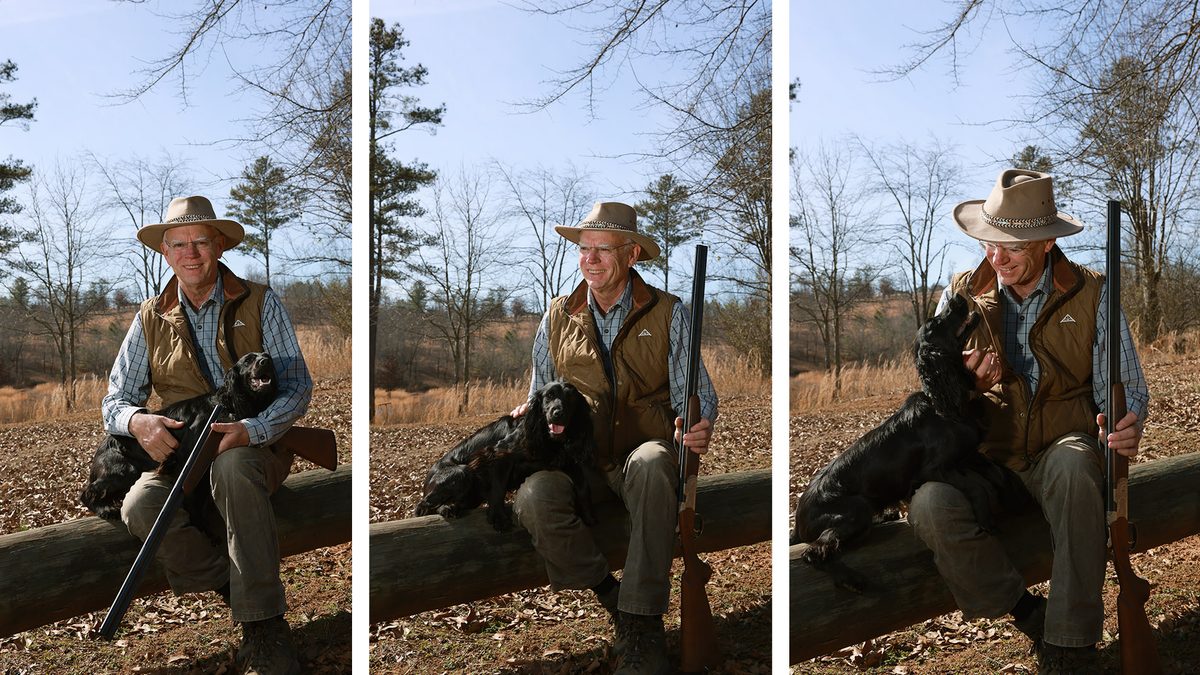
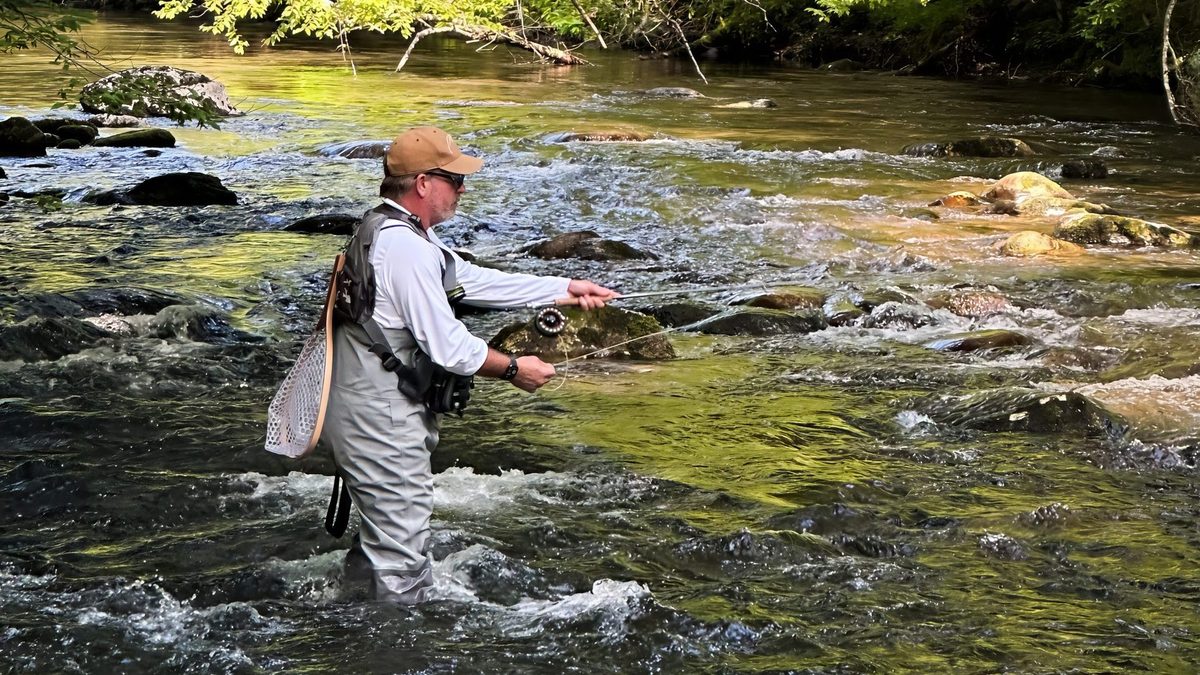
After publishing our recent issue with Heath Shuler on the cover, I found myself back in Loudon County at a place affectionately known as “the farm.” It’s the training facility run by Mike Osteen, and I had come with a simple question: how well-trained was my new dog?
I had recently acquired a young female English Pointer named Josie Belle, and I wanted Mike’s honest assessment—hunt-ready or still a work in progress. When I arrived, the place seemed quiet. I left Josie in her crate and stepped out with Chota, theCityviewmascot, to look around. As I rounded the building, I spotted Mike in the field working a cocker spaniel—I stopped and watched.
Mike sent the dog after a bumper. Mid-run, he blew the whistle. The dog stopped instantly, sat, and turned to face him. A hand signal followed. The dog ran 20 yards in that direction. Another whistle. Another sit. This went on, precision layered upon precision. The dog never hesitated. It was impressive, to say the least.
Up until that moment, I thought my dogs were pretty well-trained. But truthfully, watching Mike work changed that assumption entirely.
Mike asked to run Chota through a few drills. He placed a bumper well beyond a normal throw. Chota marked it cleanly, went straight to it, and delivered it without hesitation. She’s a solid retriever. Then we went back for Josie. We walked the fields, and Mike quietly placed a training bird. Josie pointed well. A little polish needed, but very huntable. That made sense—she’d spent her life as a working dog on a hunting preserve in Jonesboro, Tennessee.
Every time I hunt, I still carry my father’s Browning over-and-under. Picking it up always brings him back to me. We walked countless miles together chasing quail and grouse. Some days we never saw a bird. It didn’t matter though. Watching the dogs work—their focus, instinct, and joy—was always the point.
That afternoon at the farm reminded me how much I enjoy working with dogs. Dogs want structure. They want purpose. A well-trained dog isn’t just more capable—it’s happier. And the relationship between dog and owner is better for it.
Too often, we blame the dog for behavior that’s really the result of neglect or inconsistency. As Mike put it, the old saying that you can’t teach an old dog new tricks couldn’t be more wrong. Dogs can learn at any age. If there’s failure, it usually isn’t theirs.
Growing up, we had bird dogs—Beauregard, an English Pointer, and Bonnie, a Gordon Setter. Beau ranged hard and fearless. Bonnie stayed close, patient and steady. Over the years there were many more—big dogs, small dogs, bird dogs, house dogs. Each one left a mark.
Life, in my experience, is simply better with a dog alongside you. And with that thought in mind, I’m heading out for another walk—with my old friend Chota and my new friend Josie Belle right beside me.
→ Swipe for Next Story
DepartmentsJANUARY FEBRUARY 2026
Country at Heart
A local Knoxville storyteller traces home, loss, and loyalty through song.
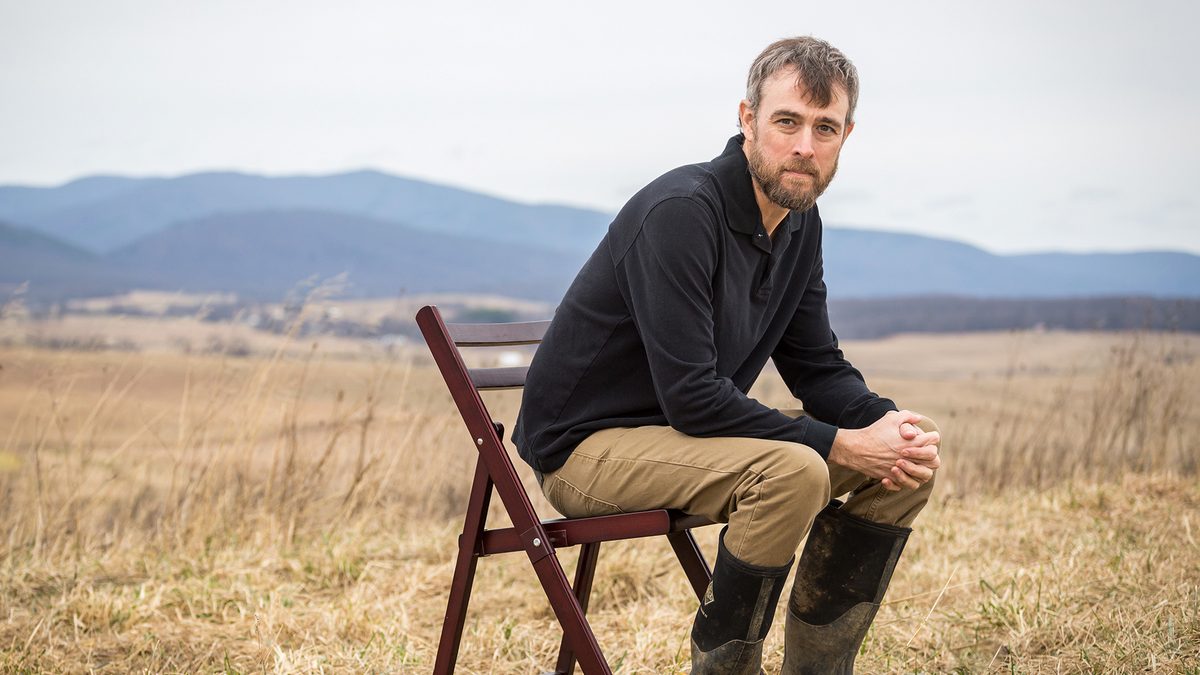
Story by Terry Adams Photography by Ryan Read| Album Art
For years, Terry Glen Adams has been a familiar byline and a trusted voice for Cityview readers—a writer who understands that good storytelling, whether on the page or in a song, comes from paying attention. This January, that voice steps fully into the spotlight with the release of Country Music, a new album available everywhere music is streamed on January 23, 2026.
Country Music is not a loose collection of songs. It’s a record in the old, intentional sense of the word—an album with an arc, a memory, and a spine. Its themes of departure and return, loss and loyalty, inheritance and reinvention echo the same sensibilities Terry brings to his writing: a belief that where you come from matters, even when you leave it behind.
The record opens with “All I Know About Texas,” a song rooted in Terry’s own experience of leaving home for the Navy, stepping into a wider world with equal parts hope and fear. From there, the album moves through love found and doubted, traditions eroded, parents remembered, and towns that shape you whether they lift you up or grind you down. The characters reappear, evolve, and contradict themselves—heartbroken in one moment, lovestruck in the next—just like real people do.
Songs like “Hard Pack of Winstons” and “Dog Bite Town” draw directly from lived experience, honoring parents who carried both discipline and dreams, and the hard truths of a music business that often takes more than it gives. Others, like “Roll Me a Beer Joint,” celebrate the smoky rooms and honest places where music once mattered most. By the time the album closes with “Smiles for Miles,” the journey feels earned—windows down, optimism intact, the road still unfolding.
We’re proud to count Terry Glen Adams as a Cityview contributor, and just as proud to celebrate this milestone. Country Music is thoughtful, grounded, and unafraid of its roots—qualities we recognize, admire, and are honored to share with our readers.
→ Swipe for Next Story
DepartmentsJANUARY FEBRUARY 2026
The Last Honest Voice in the Room
A razor-smart songwriter shaped by Knoxville, history, and hard-earned survival returns home with new music—and a lifetime of stories that still cut straight to the bone.
Story by Terry Adams Photography by Scott Miller
The first time I ever saw Scott Miller, he was onstage in a Knoxville bar singing a song about big-haired girls. The lyrics were sharp, funny, and razor-edged. He reminded me of Shel Silverstein but he could play and sing, I mean really play and sing.
Back then he had a band called The Viceroys, until someone with a cease-and-desist notice forced a name change to The V-Roys. Didn’t matter. The songs were too good, the band too tight, the spark too bright to ignore. But sparks burn out, bands break up, and eventually Miller found his true form as a solo artist.
I caught a lot of the Knoxville shows in those days. He was a street poet, a thunderstorm with an acoustic guitar, and I knew what he was talking about. Hell, I made a mess of this town, too. Bought guitars in Ciderville. And I knew then what I know now: you can’t shake Knoxville, even if you rock and roll.
Now he’s coming back, playing the Bijou on January 23, 2026. He’s got a new album ready, plus a sprawling vinyl retrospective,Farm to Vinyl: The Collected Works of Scott Miller. It’s the sort of release that forces a man to look backward, whether he wants to or not.
When Miller listens to those old songs, which he does only when necessary, he hears “a guy who didn’t know how to sing,” a man still figuring out how to get what was in his heart and mind onto tape. The memories are vivid. “I can remember where I was when I wrote them,” he says. “I liked how they sounded for the most part — especially on vinyl. Then I put them away.”
As for what lights the creative fuse these days, Miller gives the kind of answer only he can: deadpan truth mixed with Appalachian fatalism and humor. “Farming ain’t no way to make a living. Neither is being a singer/songwriter, really. Find me a third job that loses money, and I’d probably do that, too.”
His most recent writing was born out of a brutal year. “My father died, my wife just left, my barn burnt down, and I broke my leg,” he says. “Both my managers passed away that spring, but I didn’t put that in the song. No need to pile on at that point.” After he wrote about all of it in one cathartic blow, the rest of the songs started showing up.
Life at home is no less demanding. Miller splits his days between the road and the family cattle farm, a balancing act that would exhaust most people. Farming, he says, “is like having a house cat, you think you’re in charge but you aren’t.” He’ll start the day planning to fix fences or rehang gates, then walk outside to find “the cattle have busted the waterer, and there’s a foot of mud.”
His loyalty to his mother and to the land that raised him is absolute. “If I’m doing something for my mom, that is first,” he says.
Miller’s parents shaped him deeply. “I was an accident,” he says. “My parents were old when I was born. They were amazing and complex humans.” His stories sound like something out of a southern novel: his mother returning rubber bands to the post office, his father working for a nickel a day during the Depression, a neighbor teasing him, “Yeah, I bet you still got that nickel.”
Ask him about herding cattle versus managing musicians and he waves off the comment, but the job of looking out for you folks, that’s the comparison.
For all his historical insight, Miller studied the American and Russian Revolutions at William & Mary College. He’s cautious talking about modern America, but notes that the country is slouching somewhere he doesn’t like. That’s the thing about smart people, they know what they don’t know. He makes no claim to be a prophet, and he saves his soap box for conversations off the record. “If I was truly smart, would I choose farming and the music biz?”
The reality is that there has been a cataclysmic shift in Miller’s world. Industry studies show songwriter mechanical royalties dropped 80–95% from the CD era. The average professional songwriter today earns less than $5,000 per year from streaming. Even Grammy-winning songwriters often report needing side jobs (touring, merch, sync licensing) to survive. In order to match the amount of income from having a song on a record that sold 1 million copies, you have to have 300 million streams. In this wake, Miller perseveres.
“There are dairy farms fully automated these days,” he says. “When is AI gonna do the dishes? Or the laundry?” But the humor gives way to a more bleak reality. “Every song has a digital fingerprint, but the songwriter gets one-hundredth of a penny. Streaming is a killer.”
Nonetheless, history still whispers to him. “I like history for songs because the story is already there,” he says. If he had to pick one song for every young songwriter to study, he chooses “Tennessee Waltz,” though he quickly adds a list of others: “That’s How I Got to Memphis, Havana Moon, Souvenirs, This Land Is Your Land, America the Beautiful, Louie Louie.”
As for the “rules” of the music business, Miller says: “Can’t break rules when there are none. I’m just trying to survive. The record industry wouldn’t put anything out close to the holidays but it makes sense for me. What a friend we have in Jesus.”
And what’s next? For once, he’s content to let this new record speak for itself. “I feel really good about the new songs,” he says. “I really enjoyed making this record. So right now it feels good to take a breath and let what’s next find me.”
Scott Miller has always lived slightly out of sync with the mainstream. In some ways, the Revolutionary War scholar has been fighting his own revolution, too sharp for Nashville, too honest for the algorithm, too soulful for anything that can be measured in streams. But that is precisely why he matters now more than ever. In a world drowning in noise, he’s one of the few still making music that cuts through it, music that remembers where we came from and hints at where we still might go.
And in 2026, he’s still speaking. Still writing. Still singing. Still needed.
→ Swipe for Next Story
PoliticsJANUARY FEBRUARY 2026
The Final Quarter
After two major setbacks, Mayor Indya Kincannon enters her final term leading without momentum, but not without purpose.
Story by R. Daniel Proctor
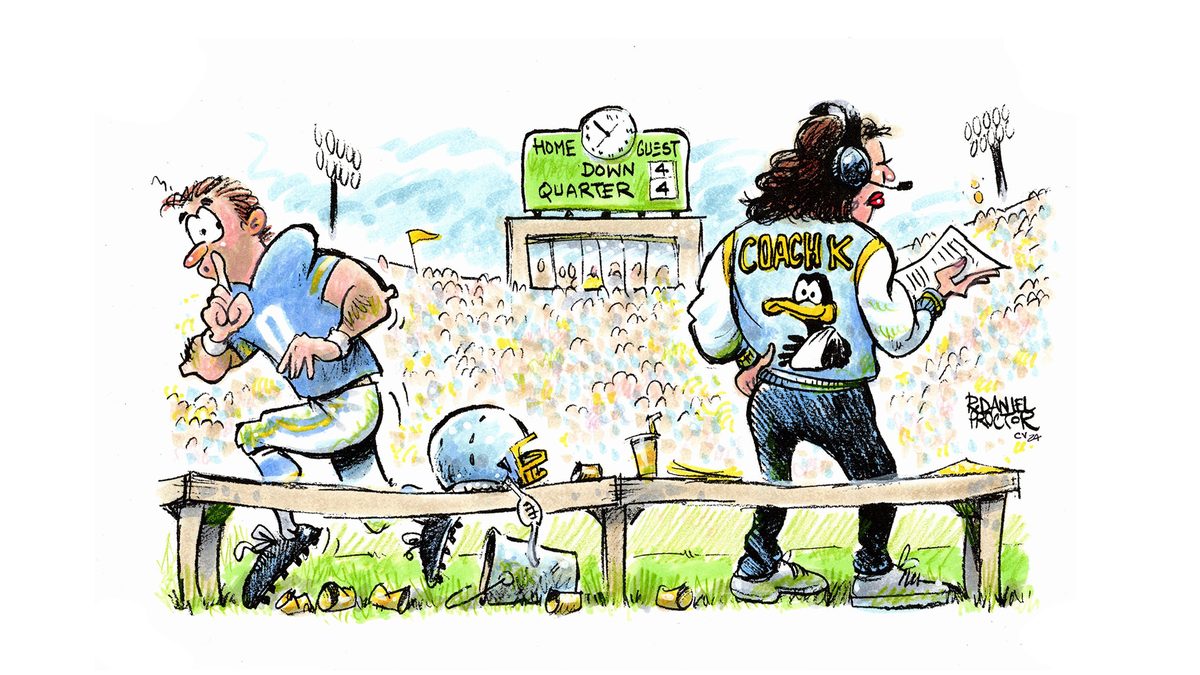
A politician, such as Knoxville Mayor Indya Kincannon, has much in common with a football coach and a shark. Life’s good when a mayor is winning city council votes, cutting ribbons, attending national conferences, and speaking before politely applauding civic groups. But start losing, and the mood turns grim. Some of your friends perhaps become less friendly. As the saying goes, “If you want a friend in politics, buy a dog.”
A mayor’s local political profile makes her or him the biggest shark in a city’s political ocean. Where a mayor swims, others follow, either because they support the mayor – or they don’t want someone unhappy with them who has big, sharp, teeth.. However, if political battles wound the shark, everyone in the local political universe looks for any signs of weakness, wondering what their strategy should be going forward.
Mayor Kincannon, who is a genuinely nice person, is in the last two years of her final term, an unfortunate time for a losing streak. In September and November, she and her team endured a pair of defeats. One was the proposal to sell some Chilhowee Park property to the Emerald Youth Foundation. On its face, the plan had many positives. But for whatever reason, perhaps in part because the Kincannon team assumed it’d get automatic city council support, the proposal lost in a 5-4 vote.
Chilhowee Park was followed by an even bigger setback, the voters’ obliteration at the polls of Kincannon’s proposed half-percent sales tax increase. Touted to put $47 million into the city’s coffers for affordable housing, parks, and other areas, even in Democratic-blue Knoxville the mayor’s ballot measure was crushed by 61.5% of the vote.
It’s in this situation that the coach who’s lost two big games, and the political shark who’s had bites taken out of her, looks forward to her final two years. What might they hold?
It would be remarkable if staff members don’t start looking for their next jobs if they don’t think city service is their career or that the next mayor would ask them to stay. This depends somewhat on relationships, and the degree to which staff members think being tied to Kincannon is a negative or a positive
City council, pretty much a “Whatever you want, mayor,” body earlier in Kincannon’s term, may become more independent unless there’s absolutely, positively, no political danger in what they’re asked to do. Members with political plans are less worried about Kincannon than their own futures. The mayor will likely have to work somewhat harder to get a council majority support. (After the Chilhowee Park proposal failed, I was asked what I’d advise the mayor to do. I said, “Get on the phone to every council member and say, ‘This is on me. I shouldn’t have put you in that position. I apologize, and it won’t happen again. Now, what do you need me to do for you?’” Whether anything like that happened, I don’t know).
The sales tax referendum defeat means Kincannon won’t have a money cushion on which the administration had hoped to sit. Barring a change in the administration’s trajectory – or record-breaking sales tax collections – this portends two years of mostly static budgets, shifting money around, perhaps cutting some things, certainly not big new spending. Kincannon could propose a property tax increase, a tough sell. She won’t have money to do big things, and her bank of political capital is seriously depleted.
In such political situations, mayors can concentrate on the things that can be done. The basics. Constituent service. Don’t shoot for the “legacy” projects that seem the goal of many political figures. As much as possible, stay out of controversy. When people aren’t hearing about bad things, they think everything is going well. And be nice, which Kincannon is.
The city’s term limits mean Kincannon can’t run for mayor again. She is, in political parlance, a lame duck. That’s not necessarily a bad thing, as lame-duck status gives a leader a certain freedom to act, unencumbered by the factors involved in running for reelection. What a mayor does during lame duck status determines to a significant degree how they’re remembered. What will be learned in the next two years is what direction will Kincannon take the city. That will be her legacy.
→ Swipe for Next Story
InsightsJANUARY FEBRUARY 2026
Well I Do or Don’t
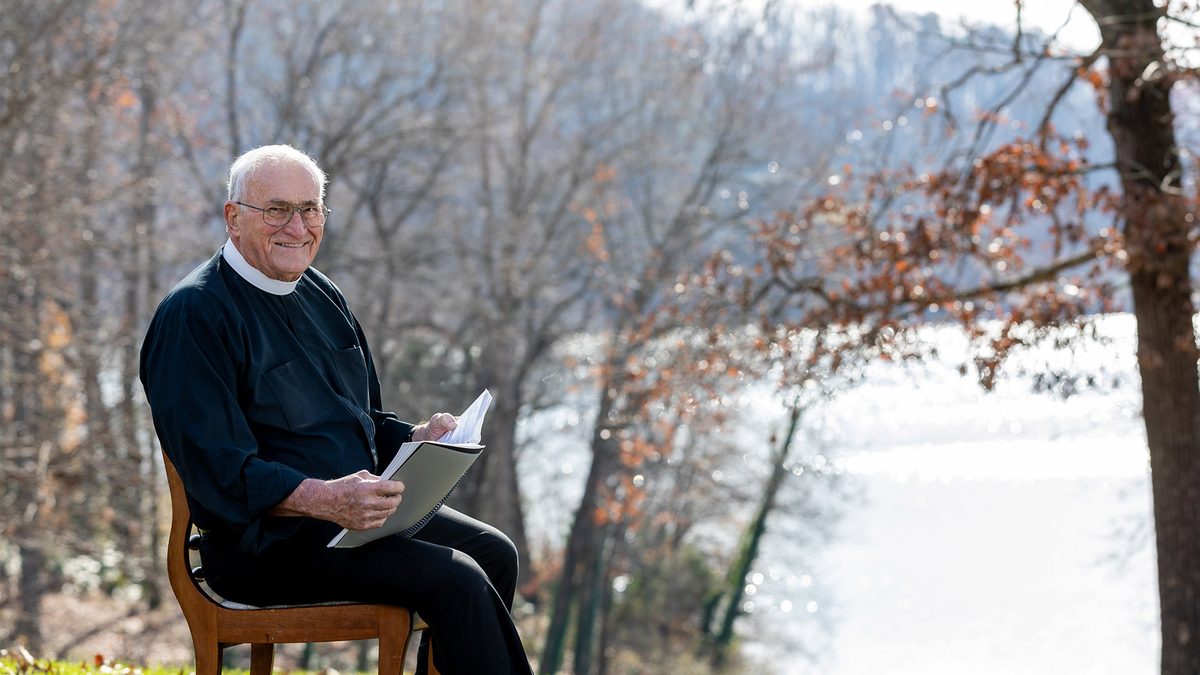
Story by George Korda Photography by Nathan Sparks
Oops—there it goes. Or does it? Is time slipping past us, or are we the ones slipping through time? And while we’re at it, is it time itself we’re thinking about, or the magazine TIME? Either way, you’re here with Cityview now, which means this small piece of my time has crossed paths with yours.
As you read—glancing at the photographs, noticing the work of people in this community—what has been going on in your own life? Have you taken even a second to pause and consider the time someone took to notice this city, to view it? We rush through hours as though they are chores, but they shape us in ways we rarely stop to see. And if we aren’t careful, time becomes a consumer, and we become what it consumes.
Since retiring—since my body started sending subtle hints that its warranties may have expired—I’ve realized how much time is something more than a clock on a wall. I’ve spent my life around clocks, and more since retirement, even the old grandfather kind. (I still wonder why there’s no grandmother clock—another story for another issue.)
All of us have clocks going off inside us every day. The one that wakes us. The one that guides our morning rituals. The one that reminds us to rest, even though most of us don’t rest very well. Slowly, over time, I’ve begun to see how much the shaping of my days is influenced by things I never fully acknowledged.
For twenty years, I worked in mental health and psychiatric hospitals, and people often ask why I spent so much of my life with those who were emotionally troubled. My answer is simple: people struggling with life are, in many ways, just like me. As Pogo once said, “I have met the enemy, and it is us.” The truth is that what I choose to do with my time is ultimately about me—and what you choose to do with yours is about you. But none of us live that time alone.
Some people disturb us. Some lift us. Some meet a need we didn’t know we had. Some we love so deeply they reorder the entire purpose of our lives—our wives, husbands, sons, daughters, grandsons and granddaughters. Our families. The time we give them often means more than the time we give to our work. Difficulties come when work tries to define who we are, or when it starts to consume us, another word our culture has come to use far too easily.
You are giving your own time right now by reading this. And Cityview is unique in that you can feel the time people put into it. I’m grateful you’re still here with me.
In these past few years—now at age 87—I’ve realized how much I still don’t understand about myself or how I use my time. I continue to talk with others about their struggles, though I’ve never cared for the word counseling and what it has come to imply. People come because life is difficult, and I listen because they teach me.
A woman I saw 25 years ago found her way back into my life recently. And just a few weeks ago, a young woman of 20 called to see if I would meet with her. I said I would, though I had no memory of seeing her sister, whom she claimed I’d spoken with recently. After we met, she told her mother she’d seen a counselor. The mother said, “That sounds like the person your father and I saw before we divorced. You were four years old.” As it turned out, she had simply gotten my number by mistake.
Yet here she was, talking through the very same questions her parents wrestled with years ago. Time hadn’t erased anything—it had simply followed her, just as our own pasts follow us.
Time may seem to pass, but we carry every bit of it forward.
May we learn a little more about who we are in this time of our lives wrestled with years ago. Time hadn’t erased anything—it had simply followed her, just as our own pasts follow us.
Time may seem to pass, but we carry every bit of it forward.
May we learn a little more about who we are in this time of our lives
→ Swipe for Next Story
DepartmentsJANUARY FEBRUARY 2026
Latin Fusion On Northshore
Story by N. Brooks Clark Photography by Ethan Smith & Brylan Dickey
Knoxville has quite a few truly amazing restaurants. We have restaurants that have been in Knoxville for decades, we have others that are James Beard Award winners, and we have newcomers to the restaurant scene that delight diners on a daily basis. That being said, it is a rare thing to find a restaurant in town that is truly sui generis.
Bocados means “little bites” in English, and this intamate restaurant on Northshore near Choto Road, delivers on the name, serving choice dishes of rarity and refinement.
Jorge Bernal, originally from Colombia, Jorge Navarro, from Mexico, and Antonio Gutierrez, from Venezuela, have been friends in the Knoxville restaurant scene for 15 years, working at places like Casa Don Gallo and Soccer Taco.
They found a modest storefront, formerly a wine bar, on Northshore Drive near Choto Road, redecorated with sophisticated black walls and ceilings, and started the nine-table Bocados Latino Fusion & Cocktails on September 12, with Chef Maria Felipe Gonzalez creating a special culinary philosophy of notably elegant presentation. It quickly attracted a loyal following, both the after-work and neighborhood crowd, as well as those from other parts of Knoxville. “We have a family that comes in from Kodak,” says Bernal. With seating for 10 at the bar and 25 on the patio, Bocados can accommodate 75 in the warmer months.
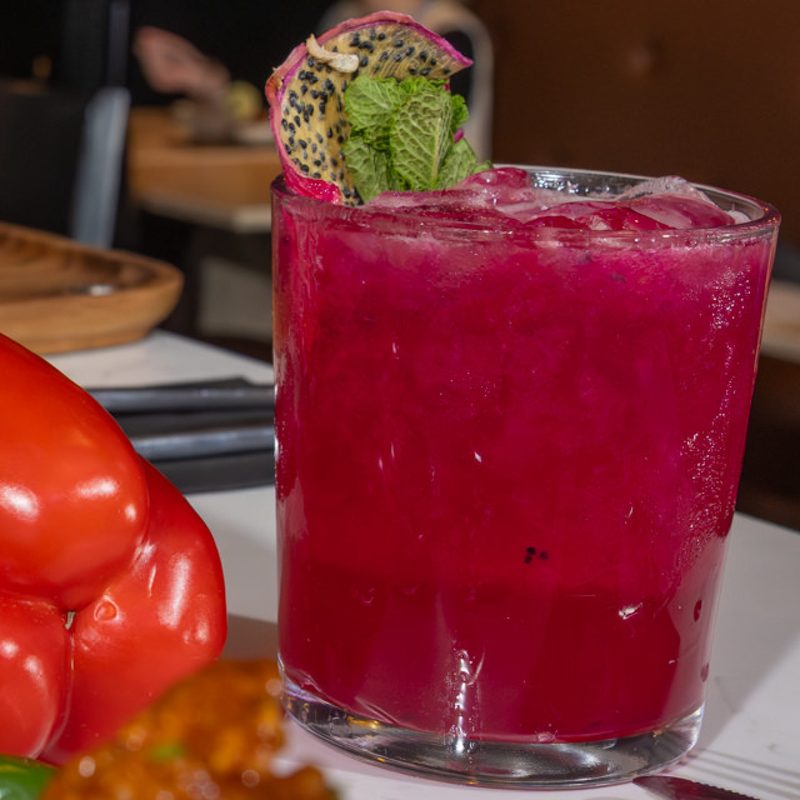
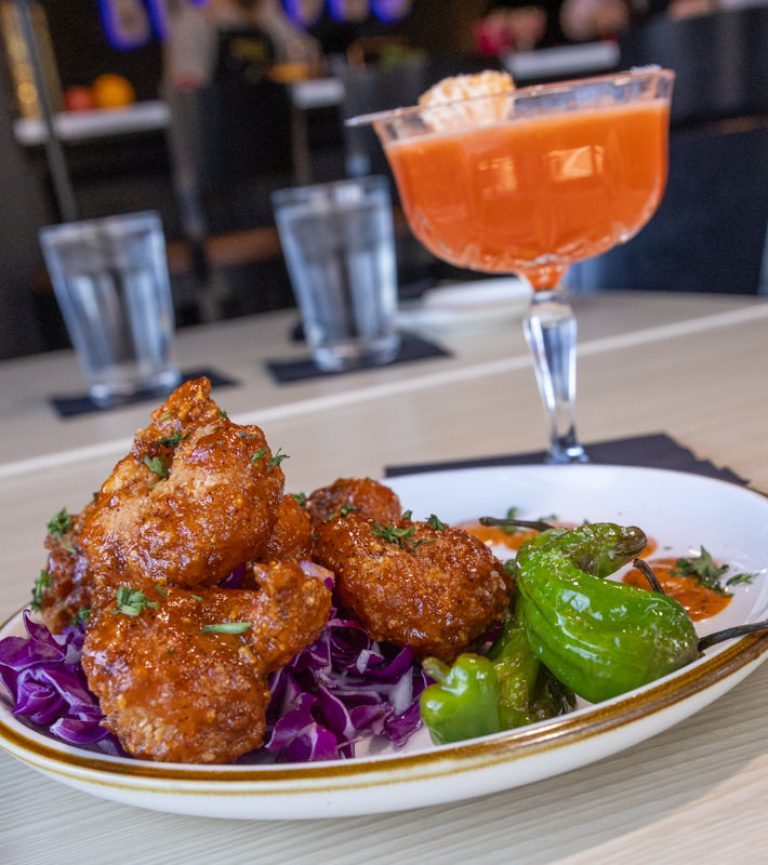
“It’s a little speakeasy-type place you can come and hang out,” says Gutierrez, who is the mixologist behind a popular menu of Cόcteles Originales. The purple Breeze Blossom combines Indigo Gin, St. Germain, lime, cucumber, and a mint sprig. The delightful (and dangerous) orange Guarito is Mil Demonios Aguardiente (a Colombian liqueur) guava syrup, orange soda, and lime. Midnight Passion, also orange, pairs Ketel One vodka with fresh passion fruit, Aperol, lime and agave nectar. Many patrons are ordering the Mezcalita, a concoction of 400 Conejos Mezcal, triple sec, agave nectar, lime, and activated charcoal, giving it a mysterious black hue.
Of course there are also Cόcteles Clássicos, featuring a Mojito, Carajillo, and a special Margarita. Naturally, the menu includes 18 different Tequilas, but we suggest starting with a bottle of Argentinian Quillmes Clásica beer to start the evening off in the right theme.
Take our advice and come to this dinner with a plan to share dishes. The carefully cultivated menu is designed around dishes that complement each other beautifully. Yes, the Bocado Shrimp appetizer is delightful (served with piquant flash-fried shishito peppers), but pair it with the Cevichoto shrimp and tuna ceviche (with mango and cucumber) and you begin to understand how the combination of flavors and textures are designed to be enjoyed together. The playful menu names, (ceviche a la Choto) show that these chefs are having fun. The sense of delight they display in preparing and serving foods native to their respective countries is infectious.
“We all have a passion for food with different flavors and cultures,” says Bernal. “Every time we talked, we thought about when we might have the opportunity to make our vision a reality. When the opportunity came up, we jumped.”
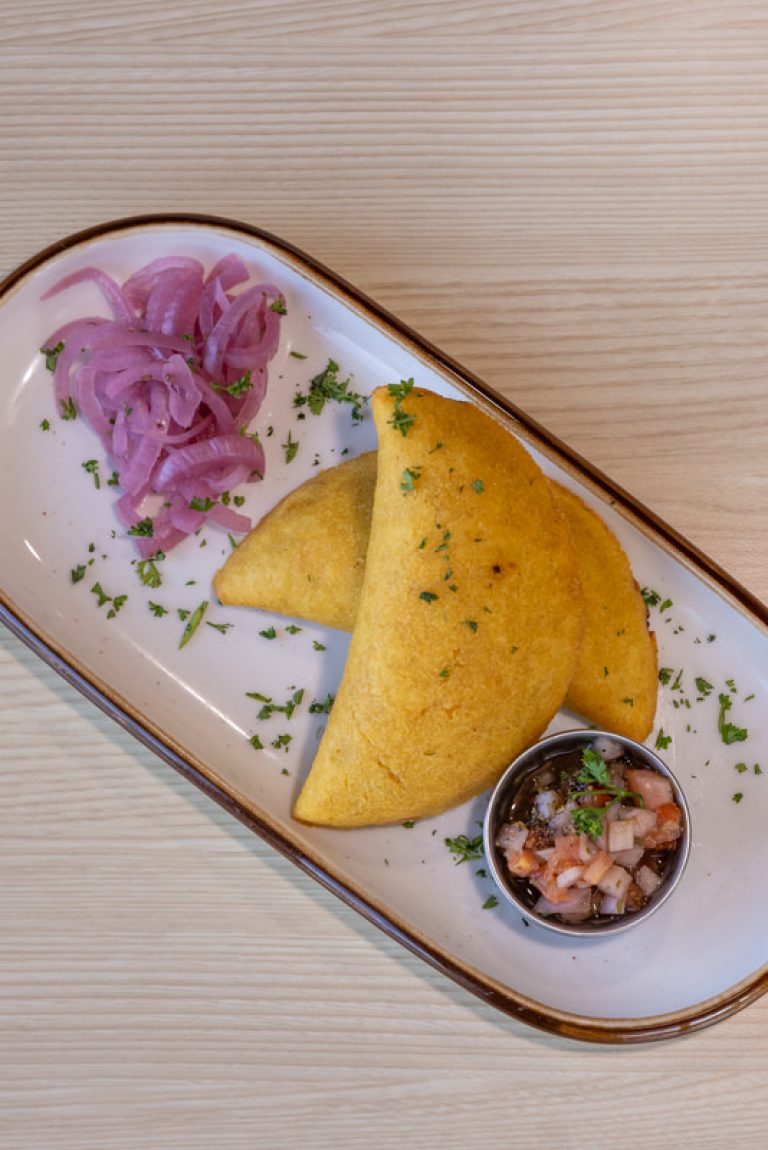
We’ve eaten quite a few empanadas in our time, and love them, but the Lobster Andouille Empanadas (cornmeal turnovers stuffed with lobster and andouille sausage sofrito) take this favorite to the level of haute cuisine. They are the result of a happy accident, when Bernal was at the beach with friends and found himself in the kitchen with lobster meat and a hungry crowd.
A 2014 Top Chefs winner, the Gambas del Pacifico is a do-not-miss main dish. Three Jumbo shrimp, stuffed with salmon and wrapped in Benton’s bacon, are finished with a drizzle of chipotle aioli. Luckily for us, we had three at our table so there was no need to arm wrestle for one of these absolutely delicious “bocados.”
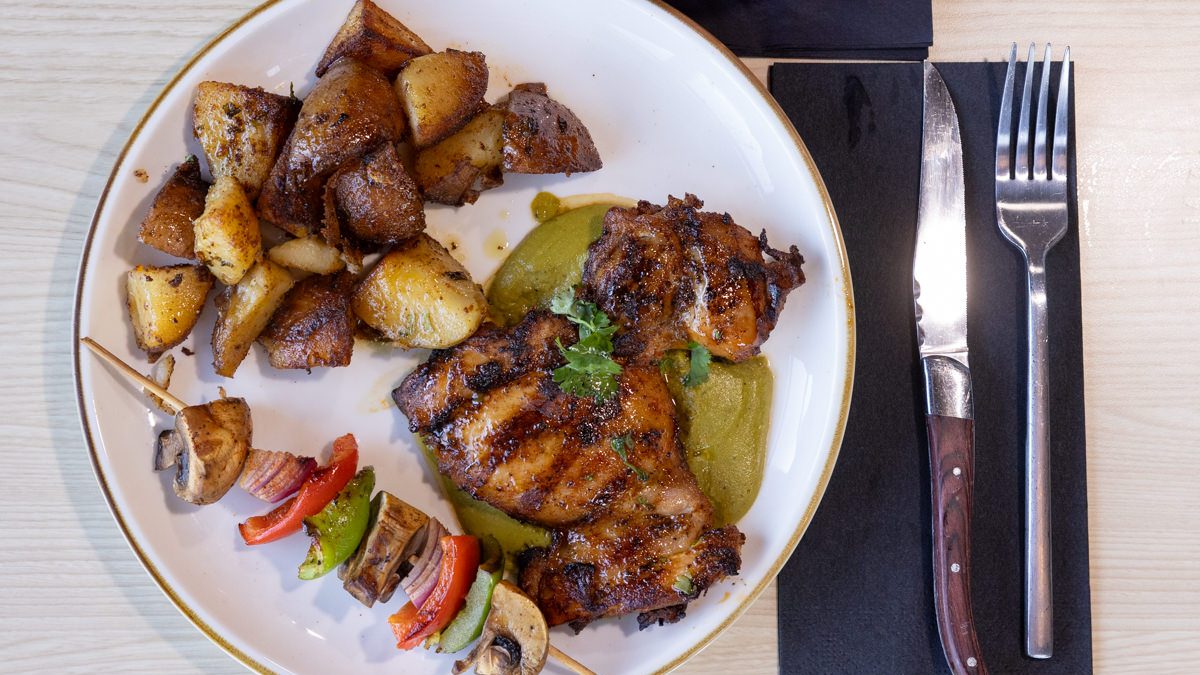
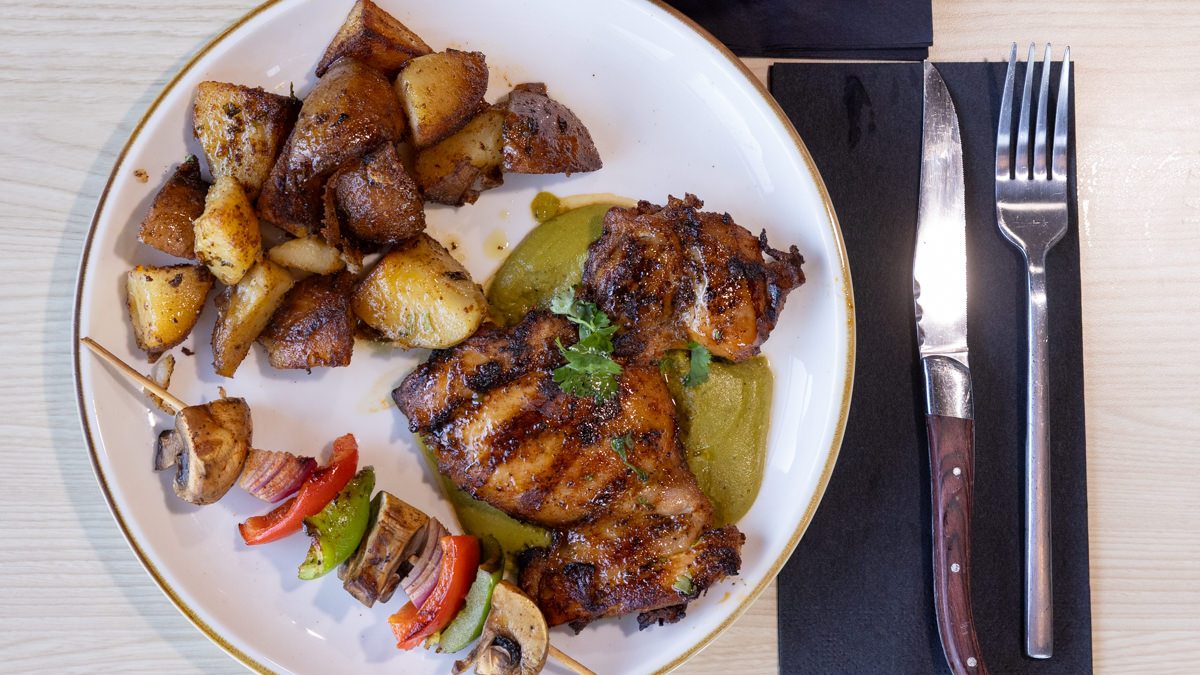
The Pasta Borracha, linguini tossed in a tequila and spicy crema sauce, is fine on its own, or with steak, chicken, salmon, or shrimp. Poblano peppers, with their lower level of capsaicin, are a wonderful choice for certain dishes, balancing richness and depth of flavor with just enough heat. Pollo Poblano presents melt-in-your mouth chicken thighs over creamy poblano sauce accompanied by red potatoes and roasted vegetable skewers.
You’ll find bone-in pork chops on many menus these days, but you would be wise to try the Chuleta a la Parilla. This grilled chop is fork-tender and served with a mouthwatering sweet and spicy glaze. The yucca “fries” on the side are tender, light, and savory.
Speaking of the yucca fries, Bernal notes that, as they developed the menu around traditional (Venezuelan, Colombian, and Mexican) cuisines, they leaned heavily on the use of corn and yucca. “We didn’t think about it at the time,” he notes. “But as we looked at the menu as a whole we realized that we had an almost entirely gluten-free menu.” This means that those who prefer gluten-free food can enjoy almost everything at Bocados.
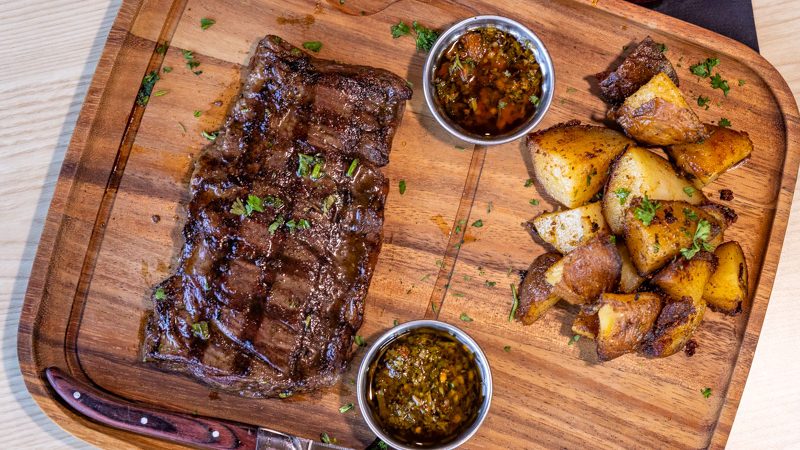
The Churrasco steak is tender and flavorful. We enjoyed this dish along with the Arepa (corn cake) Flight. The three cornmeal patties are a dish native to Venezuela and arrive with three separate fillings: pork belly, beef and “Reina Pepiada” chicken. This is indeed a regal twist on chicken salad, prepared with avocado, and the resulting creamy mouthfeel combined with light and crisp corn cake was wonderful. Again, it was good for group harmony that there were three of these.
The Flan de Queso dessert combines creamy cheesecake, flan, and crème brulee beneath a golden caramelized crust.
Bocados is open for brunch on Sundays, 10 a.m. to 1:30 p.m. For brunch, we suggest the Arepa Flight and the Costa de Tamales— cheese-crusted sweet tamale, egg, and frijoles puercos—or the Chilorio, shredded pork marinated in reddish spicy sauce, with eggs, and potatoes.
In short, get to Bocados lo antes possible —you won’t regret it. Buen provecho!
→ Swipe for Next Story
Dining GuideJANUARY FEBRUARY 2026
Turning Up The Heat
Story and Photography byMicha Haas & Ethan Smith
W
ant to hear the dark, sordid truth? I’ve never been a solo act in these dining guides. I haven’t always had the chance to shout out my dining partners in the past, but I’ve been fortunate to have good friends to accompany me on many of my past culinary adventures. This year, though, we decided to do something a bit different. A meal is about more than just food, and for this dining guide, it’s about time we have a proper conversation over our dinner. For our first dining guide of 2026, I’m hitting the restaurant circuit withCityview’s vice president Ethan Smith in a clash of tastes for the ages, and we’re starting with our Latin neighbors.
Ethan is what some would call a food lover and through his adventures south of the border he has expanded his pallet in Latin cuisine—not only to immerse himself in the wonderful food but inform himself of the culture. For myself, I only have my Texan mother, who raised me on the chips-and-salsa Tex-Mex you find in most taco joints around town. Those who frequent these guides might also know that I’ve been trying to eat green lately, so Ethan and I decided to take our differing tastes a step further and make this a carnivore-versus-herbivore challenge. What Latin places in town offer the best fare for folks of all dietary walks of life? Well, I hope you’re ready to find out.
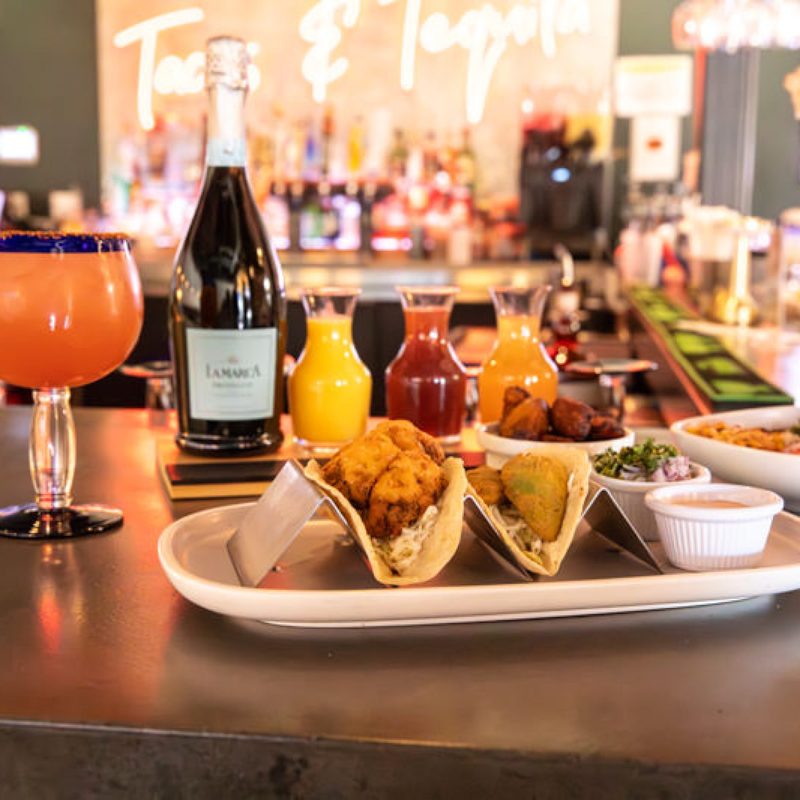
Our first stop was lunch atCelestina Mexican Craftedoff Ebenezer Road. The restaurant has a sleek, modern feel, and Ethan and I find ourselves a seat at the bar to chat with the manager, Patty Anderson. I’ve always thought it best to let the staff lend a hand in picking the best items on the menu, and today was no exception. Once Ethan and I see what’s coming our way, however, we quickly realize it’s time to loosen our belts: this culinary adventure will be no easy feat.
The Celestina Sampler made it clear early: this carnivore-versus-herbivore challenge was no small order.
At the center of our meal is the Celestina Sampler, a big shareable platter of multiple Celestina staples, but it spirals out from there. I try my stomach at a plate of veggie empanadas, with a rich cheesy corn-roast filling, while Ethan tackles a hearty pork quesadilla and the Bacalar Bowl, a versatile dish from Celestina’s brunch menu. Then, since clearly that was not enough to satisfy a pair of growing boys for lunch, we split a pair of street tacos and wheel of bite-size flautas (rolled tacos, for those unfamiliar). Ethan, fresh off an early visit to our Dining Out location, remarked that, “I think after two restaurants, I’ve had 15,000 calories. I was on a diet adventure. I am no longer on that diet adventure.”
I myself quite enjoyed those empanadas, and frankly those cheesy flautas were almost a dessert-like treat for me, though not so sweet that I couldn’t call it savory as well. Ultimately, though, I think I’m going to err on Ethan’s suggestion for my next visit: the Bacalar Bowl. “You’ve got beans, corn, and rice, and you can switch out the protein for anything you want,” he says, which includes, as Anderson notes, vegetarian options. “That’s absolutely a solid lunch right there.”
Our next stop is the only spot on our list where a suit starts to feel mandatory: a downtown dinner atVida. Ethan and I find our seats as the sun sets and take in the upscale yet intimate atmosphere. Manager Jared Stanley, who greets us, describes the restaurant as “pan-Latin with a Japanese flair” – not a combination I would have thought of, but I suppose that’s why I’m not a restauranteur!
Ethan found himself with two of Vida’s most beloved entrees, the first of which was the Bistec A La Parrilla (a 12 oz. flank steak served with a variety of vegetables and corn tortillas). “The flank steak is cooked perfectly, which is impressive because it’s such a thin cut,” remarks Ethan, but the real winner for him was the short rib flatbread. “It’s certainly the prettiest,” he says. “And these sun-dried tomatoes will make somebody that hates tomatoes like tomatoes.”
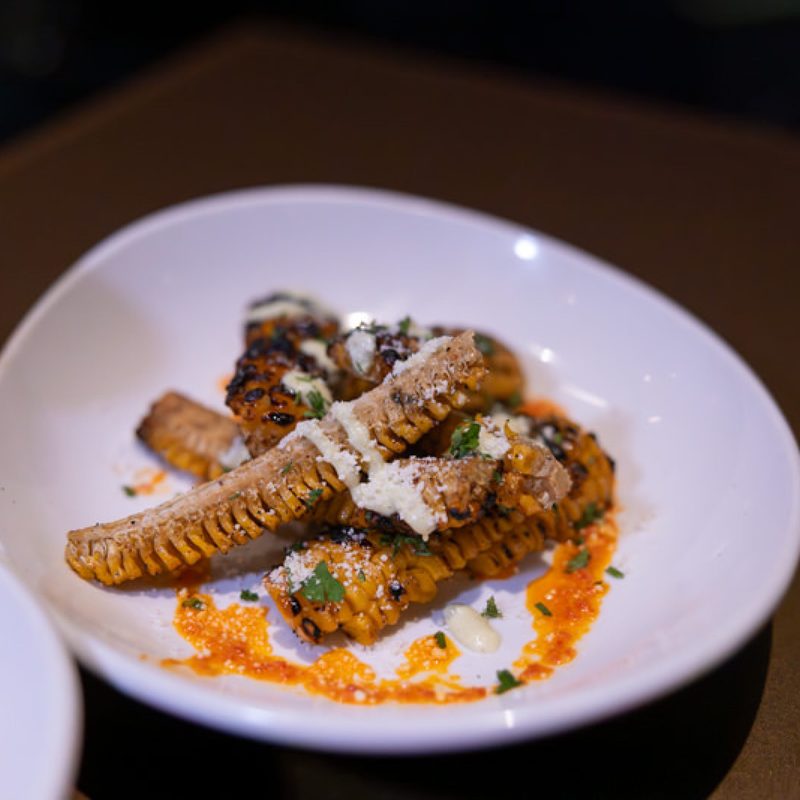
Vida stands out with Ethan’s perfect flank steak and short rib flatbread, plus Micha’s Corn Ribs.
My veggie options at Vida were a bit more limited, mostly restricted to the small plates, but never let it be said that I went hungry. The beans in the veggie quesadilla were cooked just right, so rich and full that I almost felt like I was eating meat, and the elotes-style corn ribs were a delight (once I learned the best way to eat them!).
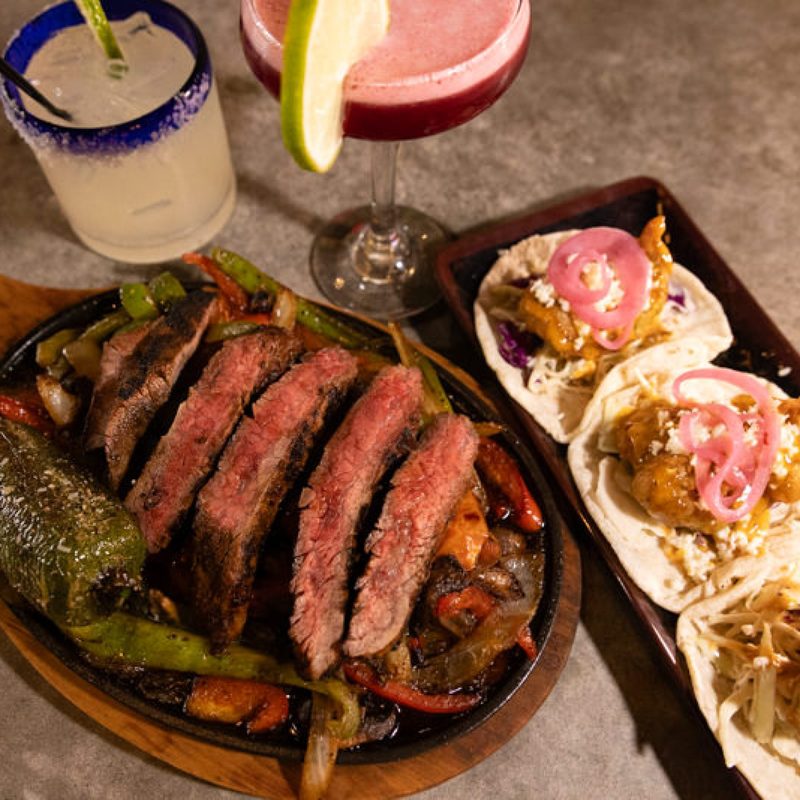
Our next stop was just a quick jaunt down the street toChivo Taqueriaon Gay Street. There we were served by the owner Ben Austin and manager Kadi Caldwell, who directed us to Austin’s favorite: the fajitas, a meal I’m sure we’re all familiar with. That being said, Austin was not wrong to suggest it; Ethan was immediately impressed by the ingredients.
Chivo shines with Ethan’s steak fajitas and Micha’s newfound love for avocado tacos.
“The steak is much higher quality than you will get anywhere else, especially for a fajita,” he says. “Thick cut, fits in the tortilla super well. And the sides are good and fresh.”
For me it was the “No Meat? Guacward!” – a trio of beer-battered avocado tacos. Here’s one of my dark veggie-eating secrets: I do not care for avocado. But I trusted the team’s recommendation, and I was pleasantly surprised to find I quite liked it! The beer-battering added a nice crunch to the avocado, and the aioli really brought the dish together so that even my skeptical self could not help but enjoy.
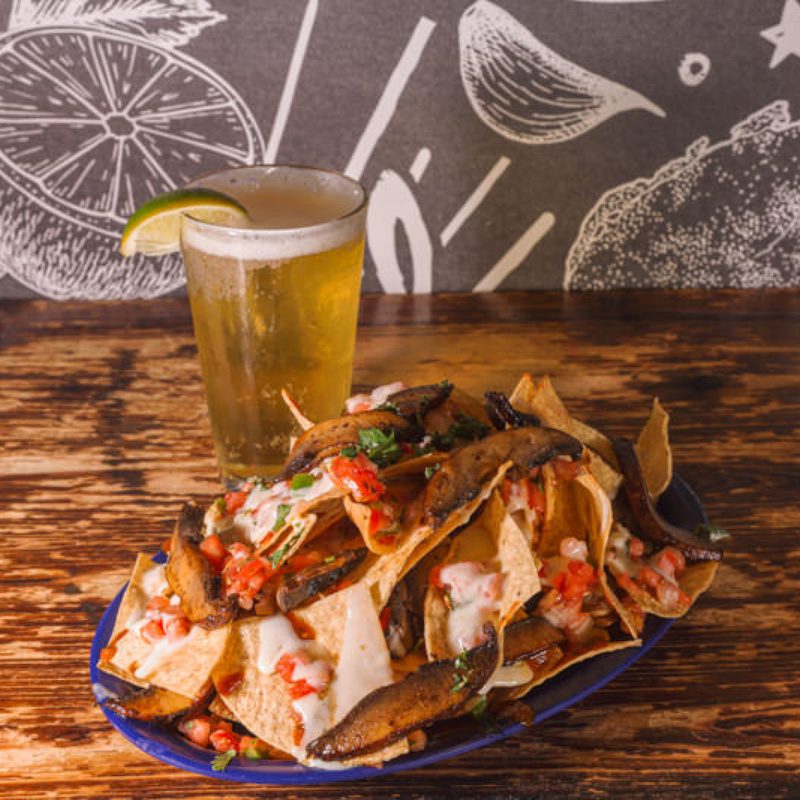
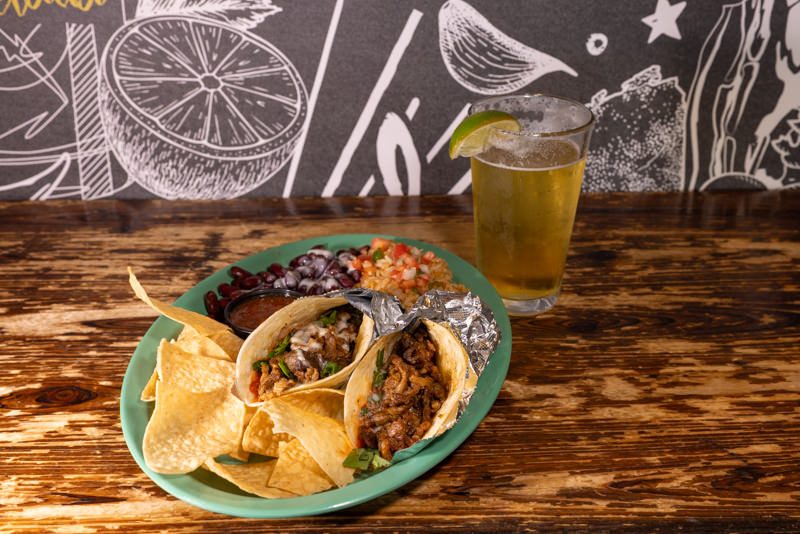
The final stop on our tour wasSoKno Taco Cantina. More than any other, this was a return-to-form for the sort of places I remember from my childhood. We split a plate of Nasty Nachos (owner Howie Howington’s recommendation), and I was delighted to find that they were made with portabella mushrooms rather than meat, so well done that you wouldn’t even miss the meat – even Ethan was impressed!
SoKno Taco wins Ethan and Micha over with a plate of Nasty Nachos From there, we each got our own tacos, and I once again found myself taken aback not only by SoKno’s inclusion of tofu tacos on the menu but by just how well they were fried up. With a splash of a smoky habanero salsa I gulped those tacos down and silently wished for more, while Ethan took on his more classic meaty tacos. And while this was perhaps the least elegant of our meals, I think both of us were already thinking of our next visit before we’d set the first meal down. It was here Ethan said something to me that really stuck: “Do you remember a time when you were a kid that you had something so good, and then you came back as an adult and had it again, and that first visit comes right back?” he remarks. “That’s what food is: you’re chasing nostalgia. Restaurants like these are keys to unlock your memories.” In all my time I’ve spent tasting plates around Knoxville, I’d never managed to put it into words quite like that, but it’s true. Thinking back, this entire Latin adventure has been me chasing the Tex-Mex memories I used to have with my parents as a kid – my dad’s homemade cheese quesadillas and after-school Chili’s dinners. As good as the food was at all these spots we visited, it was the memories it evoked that really warmed my soul, and the new memories we created getting to speak to the staff and other patrons that call us back to these places again. If you’d like to visit these places for yourself, I can wholeheartedly recommend any of these spots— just remember to get a reservation for Vida!
→ Swipe for Next Story
TravelJANUARY FEBRUARY 2026
Knoxvillians Around The World-Morocco
To Morocco With Love
Story by Brooks clark Photography by Brooks clark & Karen clark
Exploring morocco’s timeless wonders
An early scene in the movie Patton takes place after the general’s 1942 landing in Morocco and defeat of the Vichy French. Standing on a reviewing stand with Sultan Mohammed V in the capital city of Rabat, Patton watches a military band march by, followed by infantry battalions in precise formation attired in scarlet, white, and gray, respectively. Then process cavalry units, on white horses and camels. “Tell me, excellency,” asks the sultan. “What do you think of Morocco?”
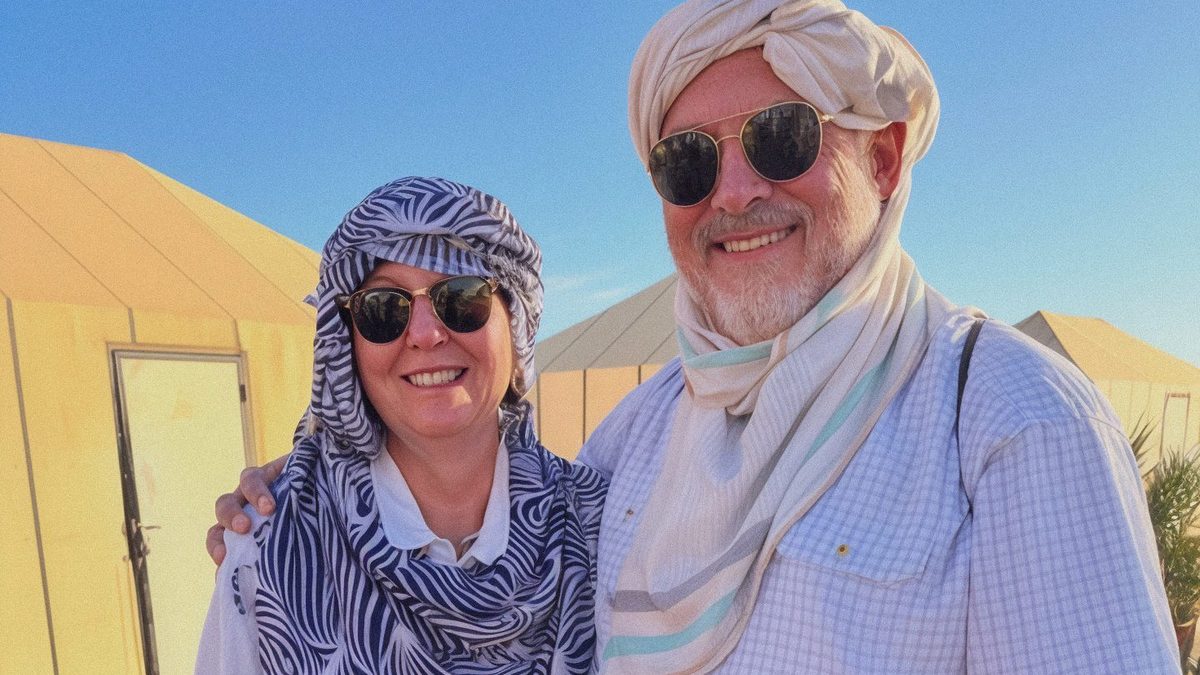
“I love it, excellency” answers Patton with a grin. “It’s a combination of the Bible... and Hollywood.” In a 12-day tour of Morocco with Odysseys Unlimited, Karen and I saw what Patton meant, from donkeys that collect trash each morning from homes on the narrow alleyways of the old city of Fez, to riding camels on the dunes of the Sahara, to a tour of Atlas Studios in the desert city of Ouerzazate, where movies like The Mummy, Gladiator, and Aladdin were filmed.
Our tour began in Rabat, at the ornate mausoleum of Mohammed V. During World War II, he famously refused to turn over Jews to Vichy officials, explaining that he had no Jews in his country, only Moroccans. He then led the nation to independence from France in 1956. His tomb exemplifies the ornate geometrical tilework, carved plaster, and painted woodwork that is everywhere in Morocco. Everything must be beautiful to honor Allah, said our guide.
We toured the ancient walled Kasbah (castle, or citadel) of Chellah, which includes the ruins of the Roman port city of Sala Colonia and a 14th century burial site for sultans. Its tall pillars now house nests of large storks who clack their beaks loudly when tourists draw too close.
We then toured the Kasbah of the Oudayas. A maze of alleyways and residences, it looks out over the Atlantic and the mouth of the Bou Regreg river, whose waters flow from the Atlas Mountains. The Oudayas were Muslim Berbers who were expelled from Spain in 1609. They settled in Morocco and took to preying on merchant ships that sailed by. They became known as the Barbary Pirates.
A recurring theme of our tour was Morocco’s ethnic diversity, including in the indigenous Berbers, more properly called the Amizigh. Many still live the nomadic lives of herders in the Atlas Mountain regions. We met a father and his two children minding their flocks. Near the Sahara are Tuareg Berbers, with more West African roots. We met five of them when their musical group played for us after our camel ride. Jewish populations have lived in Morocco for two millennia. Arabic-speakers date back to the spread of Islam in the seventh century and centuries of camel-caravan trade.
Walk the Medina long enough and the spices will find you drifting through alleys like old stories.
From Rabat, we headed east toward Fez. On the way we toured the archeological site of ruins of Volubilis, which served as Rome’s regional capital until 285 A.D., when it was overrun by Berber tribes. The area was and is a breadbasket for olives, grapes, wheat, and other vegetables. It was inhabited by Berbers, Byzantine Christians, and Muslims until it was leveled by an earthquake in 1755. Among the mosaics still visible on the floors of homes is one depicting the 12 labors of Hercules, which made us think of our workplaces.
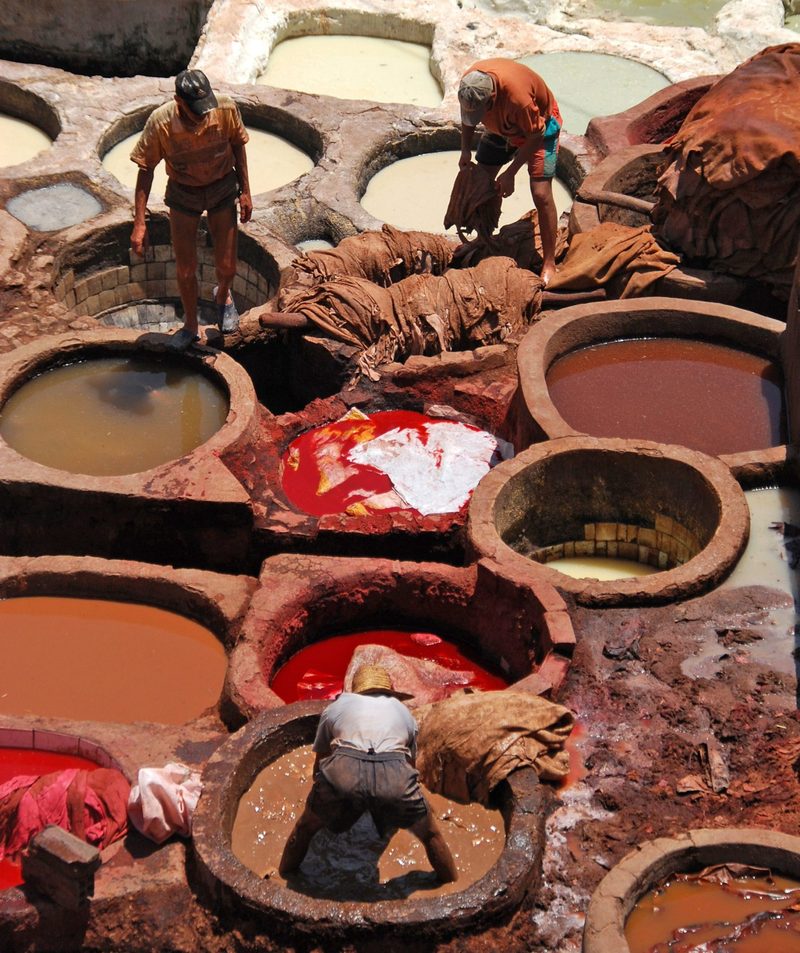
Fez is an ancient city, called the “Athens of Africa” for its wealth of cultural, educational, and religious institutions. We walked through the high adobe walls into the medina, or old city, into a labyrinth of some 9,000 narrow alleyways. We arrived as a team of donkeys began their daily rounds of collecting trash from the medina’s countless homes and businesses. The lively marketplaces include every manner of craft, spice, vegetable, fruit, fish, and meat (except pork). The artisans include rug-makers, potters, silversmiths, and leather workers. Touring a medieval tannery, we were handed sprigs of mint to cut the odor. Looking down, we saw dozens of open vats in which workers were tanning and cutting leather. I bought a very good belt. We visited a medieval Muslim university and a 14th century madrasa. In the Mellah, the 14th century Jewish quarter, we toured a historic cemetery and a 17th century synagogue.
Outside the medina, we toured a pottery, where we saw young men take wet gray clay, slap it into two-square forms, and place it in the sand to dry in the sun. The future tiles are then shaped, fired, painted, then fired again. We watched a potter spin his many wares, then saw the artisans perfectly painting them by hand. Mosaics are made from tiles cut into shapes by a skilled artisan with a sharp hammer.
From Fez, our bus took us into the foothills, through Ifrane, “the Switzerland of Morocco,” looking like the ski town that it is, then through the cedar forest of the Middle Atlas National Park, where a Barbary macaque on the roadside grabbed peanuts from my hands. Ascending into the high plains, we stopped at a nomad camp and chatted with a shepherd and his children.
In Rissani, an ancient caravan trade city, we walked through a medieval fortified village near the tomb of Moulay Ali Cherif, a 17th century emir (and descendant of the prophet). Inside adobe walls, the village alleyways are cool—enough so for a pre-K class, where the delightful children sang us songs in Arabic, French, and English.
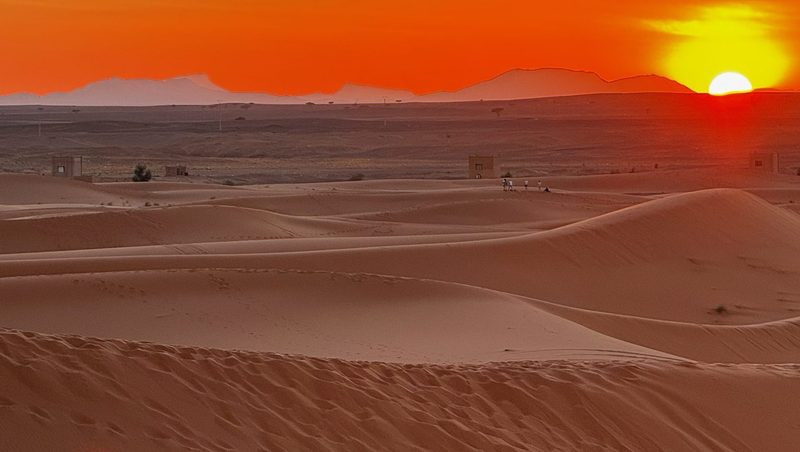
In a Sahara Desert camp at Merzouga, we mounted camels and rode across the dunes, dismounting for sunset, then riding back in the darkness. We were struck by the silence and vastness.
Before the markets operand the alleyways fill the donkeys move through the Medina, gathering the day’s refuse one basket at a time.
Morocco gets little rainfall, but it makes the best of the water that comes each year from the snows in the Atlas Mountains. To move water across the desert, they used the khettara irrigation system of tunnels, with wells dug every 50 meters or so. We descended into one well and tunnel in Fezna.
Some 300 million years ago, when the earth’s land masses collided to form the supercontinent Pangea, the Atlas Mountains were part of the same formation as the Appalachians. We pondered the similarities as we looked up from the bottom of the Camp Todra Gorge and compared it to those we see on I-40 driving to North Carolina, and when we descended from the High Atlas Mountains toward Marrakech on switchbacks much like the Tail of the Dragon.
Marrakech is called the “Red City” because its buildings and ancient ramparts are constructed from reddish, iron-rich sandstone and rammed earth. We rode in horse-drawn carriages to the lively souk (marketplace, or bazaar) and medina. We toured the Medersa Ben Youssef, a masterpiece of 16th century Moroccan Islamic architecture, and the sumptuous Dar El Basha palace from the late 19th century. Along with the beautiful tilework, fine Moroccan homes emphasize beautiful central gardens, or riyads. They are rectangular, divided into four quadrants by two paved paths intersecting at a center fountain.
From above, the tannery looks like a painter’s palette; up close, it’s a world shaped by muscle, dye, and tradition.
We remembered that Knoxville native and West High grad Rachel Williams wrote her book “My Friend Anna” after her stay at La Mamounia, one of the most luxurious resorts anywhere, ostensibly hosted by pseudo heiress/con artist Anna Delvey. So we walked from our hotel, and, escorted through the lobby by a courteous security guard, got a drink at the bar. Visitors are watched so closely that, as we were leaving, a smiling man in a fez noticed that I was not wearing the sun hat I had on when I entered. I had indeed left it in t5the bar.
In Casablanca, we toured the Hassan II mosque, built on a promontory looking out on the Atlantic Ocean. “I want to build this mosque on the water, because God’s throne is on the water,” said King Hassan II in 1980. “Therefore, the faithful who go there to pray, to praise the creator on firm soil, can contemplate God’s sky and ocean.” One of the largest mosques in the Islamic world and one of the few that non-Muslims can enter, it was completed in 1993. It can hold 25,000 worshipers inside and 80,000 more on the plaza outside. The roof is retractable, illuminating the hall with daytime sunlight and allowing worshippers to pray under the stars on clear nights. Its minaret is 690 feet tall.
The cinephiles in our group had been trading favorite lines—e.g., “Round up the usual suspects!”—from the 1942 movie Casablanca. Our guide Nabil surprised us with dinner at Rick’s Café, which was opened in 2004 to honor the fictional Rick’s Café Americain, where Rick (Humphrey Bogart) was shocked to see his old flame Ilsa (Ingrid Bergman) walk in with resistance hero Victor Laslow (Paul Henreid). We would have joined in singing if the band had played La Marseillaise.
→ Swipe for Next Story
FeatureJANUARY FEBRUARY 2026
Quiet intelligence
Artificial intelligence isn’t arriving with fanfare—it’s slipping into everyday life through faster systems, smarter tools, and infrastructure already being built behind the scenes.
Story by Chelsie Hall
Artificial intelligence is everywhere right now. You’ve heard the term, you’ve seen it in the news, and you’ve probably used it without realizing it. What most people haven’t seen is how quickly it’s becoming part of everyday life and how much of the real change is happening behind the scenes.
I grew up in East Tennessee and graduated from the University of Tennessee with a degree in supply chain management. After spending time in the finance world early in my career, I joined Empirix Partners, an advisory firm that works across the data center space. Over the last two years, I’ve had the opportunity to work closely with our CEO Zach Peña and Chief of Staff Ethan Summers, gaining exposure to the systems and infrastructure that make modern AI possible.
AI didn’t suddenly appear out of nowhere. The research behind it has been building for decades, but what changed recently is accessibility. Anyone can open a phone or laptop today and interact with tools that understand language, interpret context, and produce clear, useful responses in seconds. You no longer need a technical background to use AI. You simply talk to it, the same way you would ask a colleague or a friend for help.
Behind the scenes, the growth of AI is being driven by a rapid expansion of the data center space. These facilities house the servers and hardware running millions of AI queries every day. They require enormous amounts of power, cooling, and coordination, and the pace at which they are being built is unlike anything the industry has seen before. My work puts me close to these projects, giving me a direct view into how fast technology is scaling and how quickly new capabilities are being deployed. This acceleration is why AI is showing up in more parts of everyday life.
Here’s the part that actually matters: this is where the changes start to reach you. Not in dramatic, sci-fi ways, but in everyday moments. You’ll feel it when something that used to take effort becomes easier or automatic. You’ll notice it when the apps and services you use start responding faster, predicting what you need, or cutting out steps that used to slow you down. It shows up in the tools that summarize information, in features that help students learn more effectively, and in services that make decisions faster than any person could. Most people are already using AI without thinking about it, and that influence is only going to grow.
One area where the impact will be felt strongly is healthcare. AI will help doctors review medical histories faster, understand large sets of results instantly, and spot patterns that are easy for humans to miss. Instead of long delays, information will be processed quickly, giving doctors more time to focus on patients and reducing the friction people usually feel in the system.
Homes are becoming smarter as well. Appliances, thermostats, and security systems are beginning to make small decisions automatically, improving comfort and reducing waste. Over time, these tools will learn your habits and preferences and begin taking small tasks off your plate without you asking.
Shopping is changing too. You’ll see more personalized recommendations, fewer out-of-stock issues, and checkout experiences that happen faster and with less effort. Retailers are using AI to better understand demand, improve inventory planning, and provide a smoother experience for customers.
Education will look different as well. Students will be able to learn at their own pace with AI tutors that never tire and adjust to their individual strengths and weaknesses. Teachers will have more support and better tools to work with, allowing them to focus on what students need most instead of repetitive administrative work.
Workplaces across every industry are also shifting. AI won’t replace most jobs, but it will change how many jobs are done. People who incorporate AI into their workflow will move faster, make better decisions, and handle more complex tasks. Whether you’re in healthcare, construction, finance, sales, or operations, AI will become a tool that helps you get more done in less time.
Even in my own work, AI functions less like a shortcut and more like a sounding board. I use it to pressure-test ideas, organize thoughts, understand broader market context, and clarify fast-moving news or developments. It helps me think more clearly, not just work more quickly. You can use it in the same way. Treat it like a tool for reflection and exploration. The clearer you are about what you’re trying to understand or refine, the more useful the responses become.
Looking ahead, AI will soon be able to understand not just text, but images, audio, and video in real time. It will take actions for you, whether scheduling, planning, or coordinating tasks. It will be integrated into cars, appliances, public services, and countless other systems. These changes will not feel sudden. They’ll arrive quietly, one small improvement at a time, until the technology feels normal.
What consumers experience is always a few steps behind what is happening in the data center space. As these facilities expand and new capacity becomes available, AI models grow more capable and more responsive. The public will see new features, new tools, and new possibilities, but behind each of those advancements is the infrastructure being built right now.
The goal of this column is to bring clarity to all of this. In each issue, I’ll break down one part of everyday life that AI is shaping, explain what the changes mean, and show you how to use the tools available to you. No jargon, no assumptions, and no hype. Just a straightforward look at the technology that is becoming a part of everyone’s routines.
AI is not something to be intimidated by. It is a tool that, when understood and used correctly, can make life easier, work more efficient, and information more accessible. My hope is that this column gives you the context and confidence to navigate this new landscape as it continues to unfold.
I look forward to exploring it with you.
AI isn’t loud or dramatic—it quietly makes everyday life simpler, faster, and more intuitive.
→ Swipe for Next Story
FeatureJANUARY FEBRUARY 2026
Taliluna Dreams
Story by Kirk Edwards Photography by Tyler Lawson
There’s a moment, every time you slip off Kingston Pike and curve onto Cherokee Boulevard, when Knoxville seems to let out a long breath. Traffic thins, the trees widen overhead, and Sequoyah Hills reveals why it has been one of the city’s most beloved and stable neighborhoods for nearly a century. The Tennessee River glides alongside runners and strollers; golden retrievers tug their owners toward the water; and the homes—majestic, eclectic, irreplaceable—line the boulevard like old guardians.
Sequoyah Hills isn’t just a neighborhood. It’s a place with gravitational pull. Property values hold steady here. Old homes are purchased as often for their lots as for their structure, quietly marked for their next life. People wait years for the right opportunity to build here.
This is where Spike and Monica McCamy chose to plant their story—a story that somehow begins not on a riverfront boulevard but on a downtown Knoxville rooftop.
The Rooftop Moment
Before there was a house on Taliluna, before there was a baby named Wren sprinting in circles through the living room, there was one unexpected shout from above.
“I was living downtown during my master’s program,” Monica recalls. “My roommate and I were walking her brand-new puppy near the Sterchi Lofts when we heard someone yelling.” They looked around at first, confused, until they spotted their friend Matt Barakus waving wildly from a rooftop across the street.
“He shouted, ‘Hey! Come up! My friend Spike is having a rooftop party!’ We were basically yelling back and forth—sidewalk to roof—trying to figure out if this was actually real.” It was ridiculous and spontaneous, the kind of moment you only realize mattered much later. “We finally said, ‘We don’t know who this is… but it’s a rooftop. Let’s go,’” she laughs.
Up they went. Matt made the introductions. “This is my friend Spike. This is his place.” What none of them knew, standing beneath string lights and the downtown skyline, was that Monica and Spike had lived almost directly across the street from one another for nearly a year—without ever meeting. Friendship came first. Then more. And then—COVID.
“We were some of the first in our friend group to get it,” Monica says. “People treated us like we were lepers. They’d drive by and wave from their cars while we waved from the window of Spike’s loft.”
Quarantined together, they grew close quickly. When the world finally opened again, so did the next stage of their life together.
A Builder’s Legacy
“My best friend lives next door. We open the gate between the yards and the dogs just run back and forth. It feels like a dream.” As beginnings go, you couldn’t script it better.
Spike comes from a family where the trades were a way of life. His father, Sam McCamy, and uncle Jeff owned Roden Electric, a Knoxville institution. After selling the company to their employees, Sam pivoted instead of retiring.
“In 2007, Dad got into construction,” Spike says. “He started doing historical renovations in Sequoyah Hills, and that’s how McCamy Construction began.”
Spike’s early career took him to Hilton Head working for a contractor out of Atlanta. But the timing—2008—was terrible. The Great Recession hit, construction faltered, and Spike returned home to enter commercial real estate before eventually rejoining the family business full-time.
Today, McCamy Construction stands firmly in the top tier of custom builders in Knoxville, known for meticulous craftsmanship and a refusal to leave a project until every detail is right.
Much of that success is tied to Spike’s partner and childhood friend, Grant McMahan.
“Our moms worked together. His dad worked with my dad at Roden. He was basically the brother I didn’t have,” Spike says. “Having a partner who feels like family is invaluable.”
Grant has been with McCamy for more than a decade and now runs much of the company’s operations. Together, he and Spike have expanded into large-scale custom builds across Sequoyah Hills, Tennessee National, Rarity Bay, and WindRiver, as well as high-end renovations and spec projects.
Finding the Lot That Didn’t Yet Exist
As Spike and Monica moved from downtown loft living into planning for a family, one priority emerged: Sequoyah Hills. “My mom lives on Cherokee Boulevard,” Spike says. “And I’ve always loved that every house in this neighborhood is different. We knew this was where we wanted to be.” But building in Sequoyah requires patience. They weren’t looking for a perfect home—they were looking for a tear-down on a beautiful lot.
They searched for nearly a year before finding an older home on Taliluna Avenue that had exactly the kind of hidden potential they needed.
Spike and Grant purchased it together with one plan: divide the lot. It wasn’t that simple. The property had stormwater running through it, requiring engineering and rerouting before it could be split. Once approvals were secured, the lot officially became two.
“Grant and I built the spec home next door, and some of our best friends ended up buying it,” Spike says. “They’d been downtown, too. Now they have a little boy.” Monica smiles when she talks about the arrangement.
Designing a Tudor Revival That Belongs
For their own home, Spike and Monica had a clear aesthetic: a modern Tudor Revival that honored the neighborhood’s architecture without feeling nostalgic or heavy.
They partnered with designer Gus Carodine at Stephen Davis Home Designs, using a blend of inspiration images, earlier plan experiences, and site constraints to shape a home that fits beautifully on the lot and within the character of Sequoyah.
The exterior is grounded in stone from Tennessee Stone, installed by the Rector brothers, whose masonry is some of the finest in the region. McCamy Construction had used the same stone on a major renovation on Cherokee Boulevard, and the visual warmth and texture fit perfectly here.
Inside, wide-plank engineered flooring from Cella Flooring and Design offers the sturdiness required for a slab foundation while still giving the elegant tone of old hardwood.
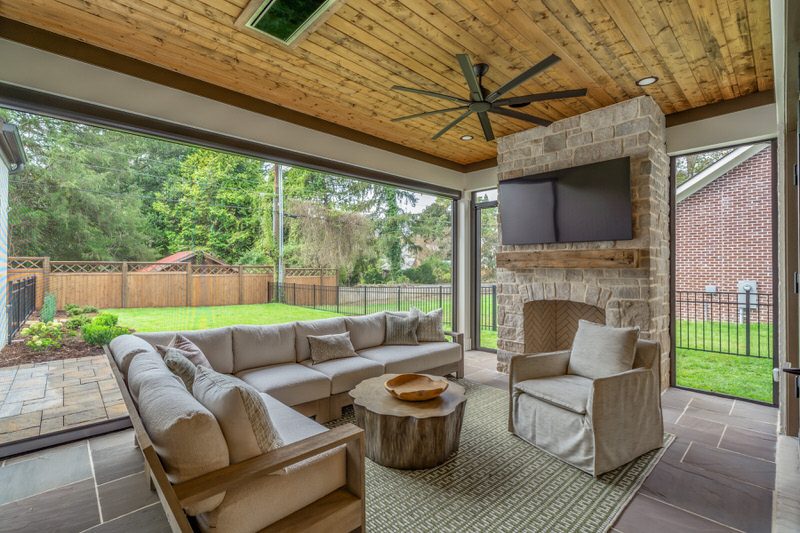
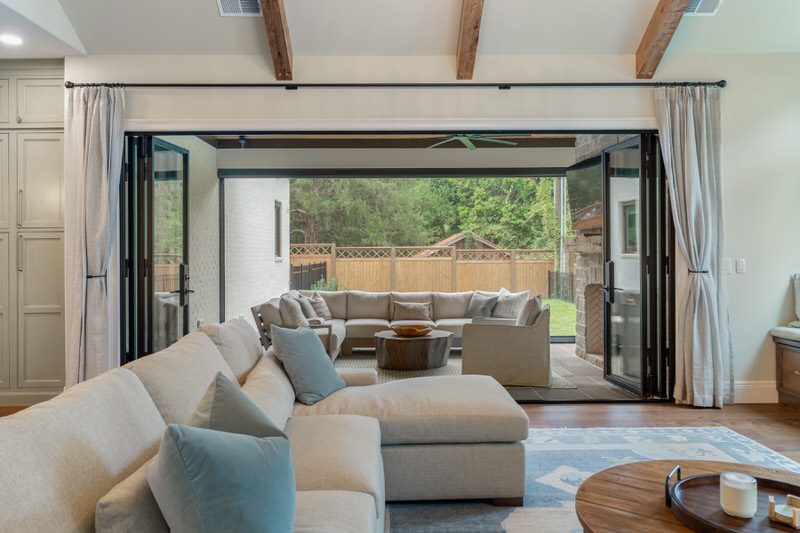
Most of the windows are by Pella, except for one dramatic feature that defines the rear living space: a massive accordion door system that completely opens the great room to the screened outdoor living area.
“When the weather’s right and those doors are open, it transforms the whole house,” Spike says. A recessed ceiling heater extends the usable season well into fall.
Interior Design as a Shared Creation
For Monica, building a custom home meant learning an entirely new language: plumbing packages, lighting schedules, tile selections, paint palettes, wood beam profiles. “Ashley saved me,” she says.
Ashley Jones, McCamy’s in-house selections coordinator, walked her through every decision—from the gorgeous cabinets by Dixie Kitchen, to the tile, beam stains, stone accents, and sweeping mix of lighting.
“She’s incredible,” Spike says. “She helped tie everything together.”
Lighting fixtures—the “jewelry of the house”—were curated with help from Roost, where owner Paula Osborn assisted in choosing the perfect blend of style and warmth.
Monica added her personal touch, too. A creative at heart, she collaborated with a designer friend from South Carolina on Wren’s nursery and playroom, shaping imaginative spaces that feel joyful and comforting.
The circular flow of the floor plan creates a perfect loop for a toddler who is on the move.
“Wren really didn’t fully start walking until about a week after we moved in,” Monica says. “Then suddenly she was racing laps around the loop. It was one of the most special parts of moving into this home.”
The Garage That Became an Escape
Space allowed for one more standout feature: a rear garage with a full in-law suite above it. Originally envisioned as a detached structure, local restrictions led to a lightly attached design, still with a separate entrance to maintain privacy for guests.
Upstairs, family and friends have a comfortable suite of their own. Downstairs, the garage houses Spike’s favorite retreat: a golf simulator that doubles as a theater.
“With work and a toddler, it’s hard to get out to the course,” he says. “Having a simulator at home lets me practice whenever I can—and it’s perfect for watching movies or games.”
In a neighborhood built for walking and river breezes, the simulator is a surprisingly cozy counterpoint, a reminder that homes are meant not just to impress but to be lived in.
Life on Taliluna
Downtown Knoxville has its charm, but Sequoyah Hills has a way of making life feel softer, more spacious.
“It’s just night and day,” Monica says. “The room, the storage, the yard, the park… and our best friends next door. It feels like exactly where we were meant to be.”
Dogs run between yards. Babies grow up together. Friends gather for football as the accordion doors fold away and the outdoor living room becomes part of the house. Little Wren spins in the living room under beams chosen with love and lifted into place with care. This is what Sequoyah Hills offers—beauty, yes, but also belonging.
From a rooftop shout to a two-lot dream to a Tudor Revival filled with light and laughter, the McCamy’s have built not just a house, but a home with roots.
A home that fits this neighborhood.
A home that fits their story.
A home that feels, unmistakably, like the beginning of something lasting.
→ Swipe for Next Story
Non-ProfitJANUARY FEBRUARY 2026
Making Connections
Story by Susan Alexander Photography by Alisha Bube
Is the Appalachian Mountain Bike Club really about mountain biking? Well, that’s debatable.
It is about mountain biking because most of its members love riding their bikes along the trails up and down our east Tennessee hills, through parks and neighborhoods and woods. But also it’s not, because the mission is about the trails themselves and encouraging outdoor recreation whether it’s on a bike or not.
“We revised our mission two years ago to develop, build, and maintain trails. We took mountain biking out of our mission,” says Executive Director Matthew Kellogg. “We want to get more people outside.”
When it was organized in the late 1980s the emphasis was indeed on promoting the sport and organizing races for its members. But in 2007 the club reorganized under the umbrella of SORBA (Southern Off-Road Bicycle Association), a nonprofit with 47 chapters in seven states. “SORBA connects chapters to exchange ideas, and it provides insurance for the landowners who allow us to build trails on their property,” Kellogg says. “So the focus became building trails and encouraging the community to enjoy them.”
Kellogg became the organization’s first paid executive director in January of 2020. Trained as an architect, Kellogg got involved with AMBC while he was at UT. It became his passion project, and now he uses his professional skills to manage projects and build relationships throughout the community.
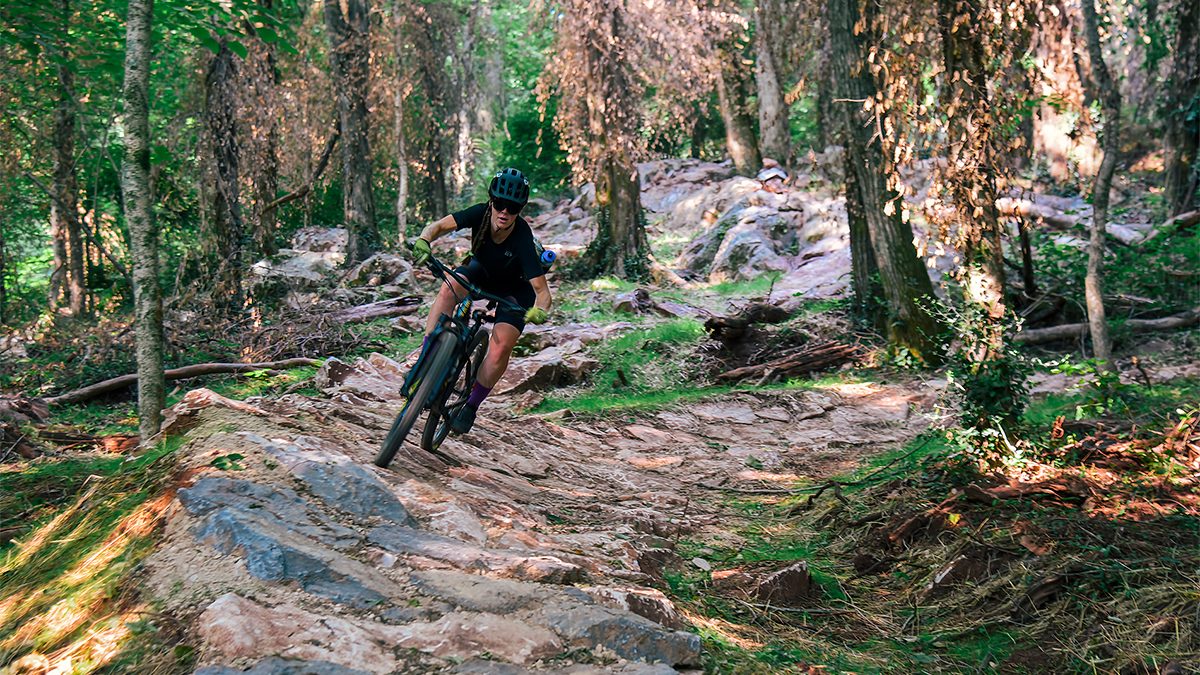
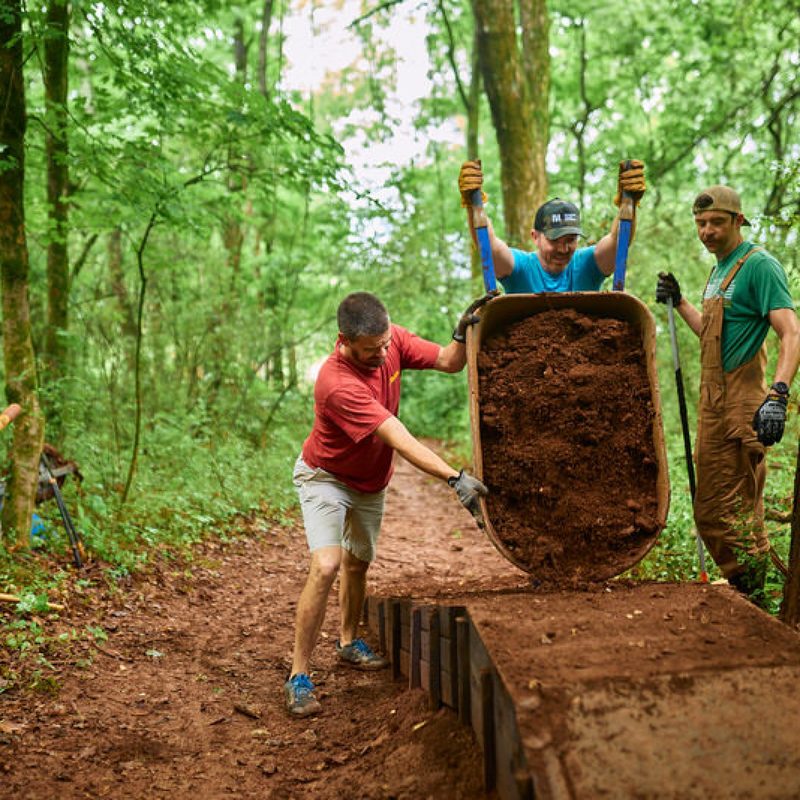
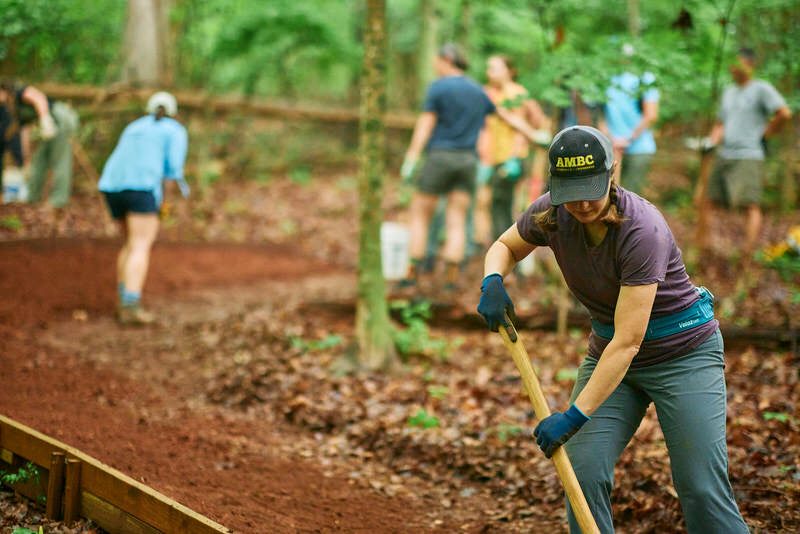
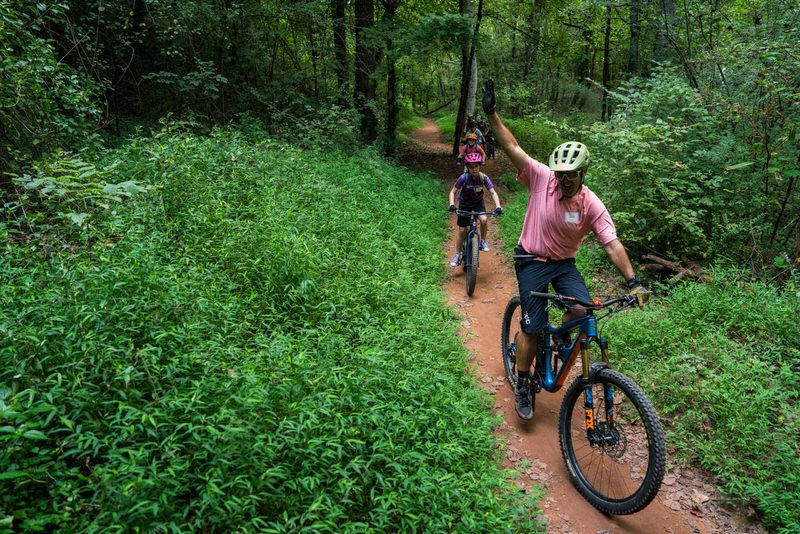
AMBC builds sustainable trails and maintains more than 100 miles of them in and around Knoxville, including the Knoxville Urban Wilderness trail network and I.C. King Park in south Knoxville; Concord Park in west Knoxville; Sharps Ridge Park in north Knoxville; and Loyston Point in Anderson County. (Of those trails, only five percent are for mountain bikers only; the rest are used by hikers and dog walkers and runners and walking or cycling commuters.) They partnered with the Legacy Parks Foundation to connect trails along the Urban Wilderness by convincing landowners to give access to their property. They created a jump track at Baker Creek Preserve to allow bikers to work on their skills. And they contract with Knoxville and Knox County Parks and Recreation to do regular trail maintenance.
Which isn’t as easy as it sounds. In East Tennessee, trail maintenance doesn’t just mean cutting up the occasional tree that falls. It’s also removing leaves and treating kudzu and yanking up privet and other invasive plants. Rain erodes trails, so they add gravel to some trails to harden them and make them more sustainable to heavy use. AND they educate their users by publishing every day on their website,ambcknox.org, a status report for each trail announcing whether it’s open or too muddy to ride. Riding on mud wrecks the trails, the website explains. It leaves ruts and contributes to erosion and wastes money repairing it. If you leave a visible rut, it’s too muddy to ride. The website encourages users to report maintenance issues to AMBC via email.
“But at the end of the day we all just love bikes and getting out in the woods,” he says.
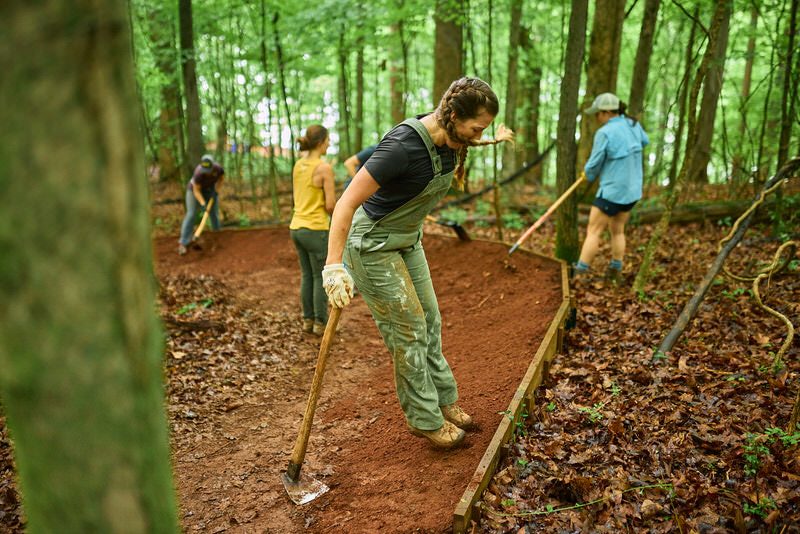
In addition to Kellogg the organization employs four full-time trail maintenance staffers (two are funded by Americorps) and a membership and programming director. And they get some of their 700 members involved in workdays the first Saturday of most months to clear brush and do other chores while building community and having some fun.
The club’s income comes from foundation grants, Kellogg says, as well as the city and county’s maintenance contracts. The club sponsors a big Fall Fest fundraiser every year, which brings thousands to the Baker Creek Preserve at the end of James White Parkway for music and vendors and rides and daredevil demos and auctions and merch and other fun stuff. Another chunk of the budget comes from donations and membership dues. In all, it totals around $600,000 a year, he says.
Joy Ride
Mountain biking is a male-dominated sport; various studies find that women make up anywhere from 15 percent to 28 percent of participants. AMBC hosts monthly Joy Rides to get more women involved.
Madison Taylor Lane moved to Knoxville in 2022 and joined AMBC the following year. She got involved with trail work and volunteering for Fall Fest and eventually became chair of the Joy Ride committee. She’s also membership director for SORBA.
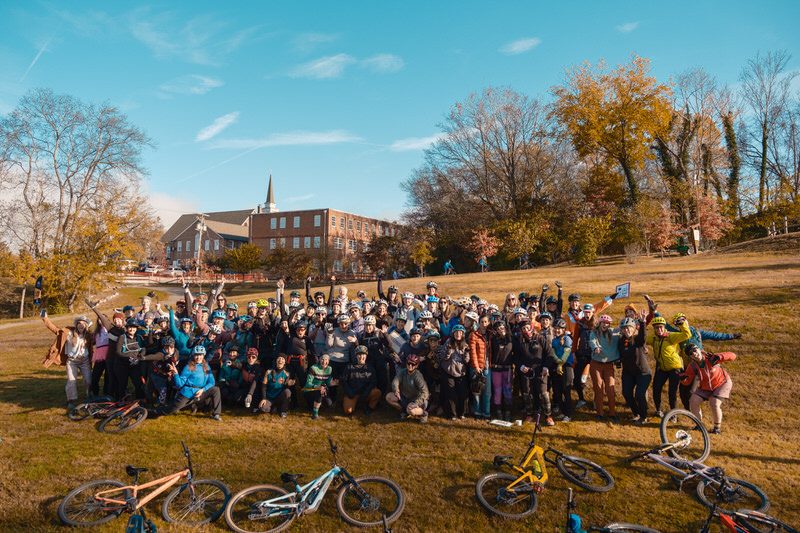
Joy Rides are free opportunities for women to ride and get more comfortable on mountain bikes. “Our focus is on creating a welcoming, non-intimidating experience for riders at all skill levels, though we concentrate most on beginning and intermediate bikers,” Lane says. Most of the Joy Rides are held on Sundays and the length of the rides vary, though most last an hour or two. Participants are asked to register on the website in advance so planners can match a route to their skill level.
Generally the Joy Rides attract 10 to 30 participants, though the one held in conjunction with the Fall Fest is the largest of the year, and the annual Galentine’s ride in February was attended last year by 52 women, Lane says.
“Mountain biking is a male dominated sport,” Lane says. “It’s a different experience learning from other women. We make sure everyone is comfortable with the pace and the trail. It’s an encouraging environment.”
Trail Blazers
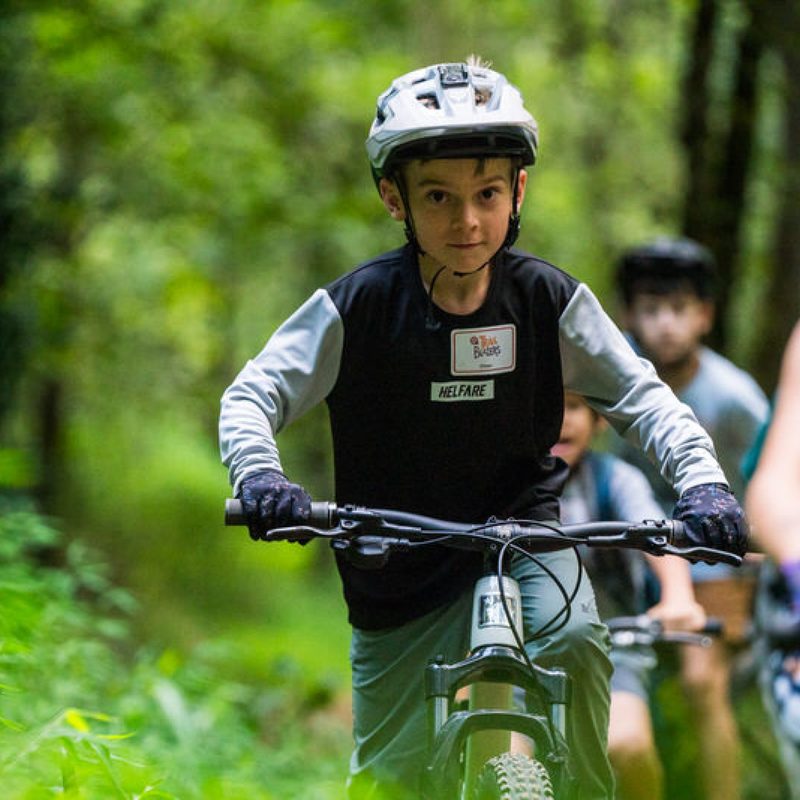
The club launched this fall a program to get young riders involved in mountain biking. Trail Blazers brought third- through fifth-graders to Baker Creek Preserve each Tuesday evening for eight weeks. Organized by Kellogg, the main goal of the program was to get kids playing — on and off bikes.
“I don’t know who had more fun, the Blazers or the volunteers who helped,” Kellogg says. “It was so much fun to get to know them over eight weeks and see how they progress.”
Hope Parks was one of the volunteers who helped with Trail Blazers. She says Kellogg’s leadership allowed her and other volunteers to just show up and be present with the kids. “It was great getting to seem them unfold. They didn’t know each other beforehand, and it was neat seeing natural friendships develop. They learned to take care of each other on the trails.”
Parks is a personal trainer, but says Trail Blazers wasn’t about learning or coaching. “It was really sweet to see the kids get on a bike, not in learning mode but just sensing, feeling, and being in their bodies. I love coaching, but this was not that.
“The other thing that’s celebrated in biking is you’re participating at your own confidence level. They were empowered to say no as much as yes.”
About 20 kids participated in the first Trail Blazers program. Kellogg is planning three sessions for 2026, two fee-based and one aimed to get kids on bikes who don’t usually get to ride.
Improving the city
RJ Justice is the chief of urban design and development for the City of Knoxville. She says her focus is on establishing partnerships in the community to achieve something great for Knoxville.
“Our relationship with AMBC is amazing,” she says. “AMBC doesn’t just do one thing; it is multi-faceted. They build and maintain trails. They establish an advocacy team to promote preserving the outdoors. They create a vibe that’s really fun and that helps the organization and the city move forward.
“The Urban Wilderness is their iconic project. How they partnered to bring that trail system to life has really shaped what South Knoxville and the city can be as a recreation destination and economic driver.”
Kellogg aims to establish AMBC as one of the pillars of the community. “What we are building should last through our lifetimes,” he says. “We’ve helped change Knoxville for the better. We have incredible trails in our own backyard. We can walk or run or ride as far as we want.”
Brian Hann, who was president of the AMBC board for five years, reflects on what the club has accomplished. It built trails. Established relationships that allowed those trails to be connected in South Knoxville. Showed the community an attractive alternative to more roads and development.
→ Swipe for Next Story
Arts & CultureJANUARY FEBRUARY 2026
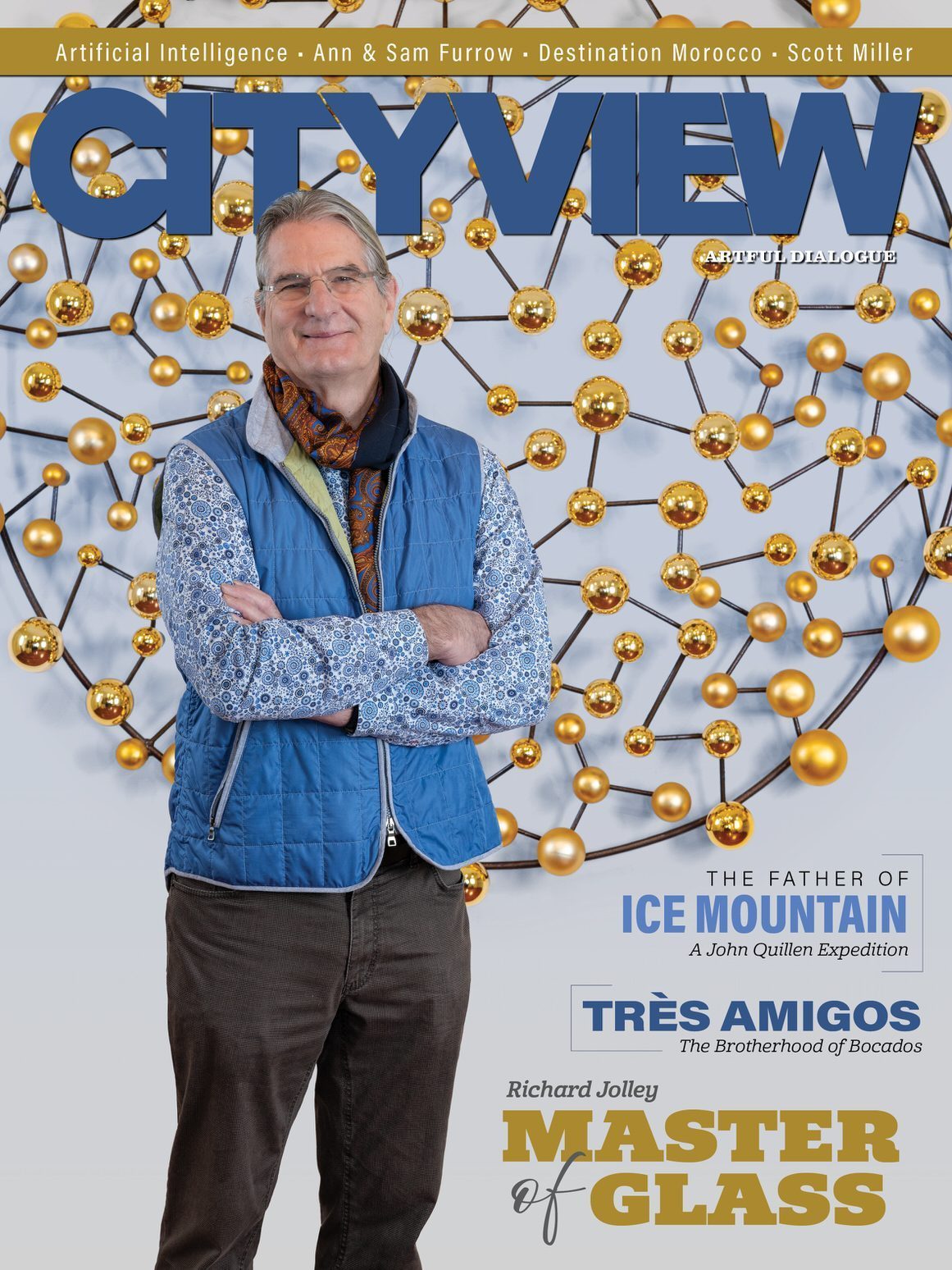
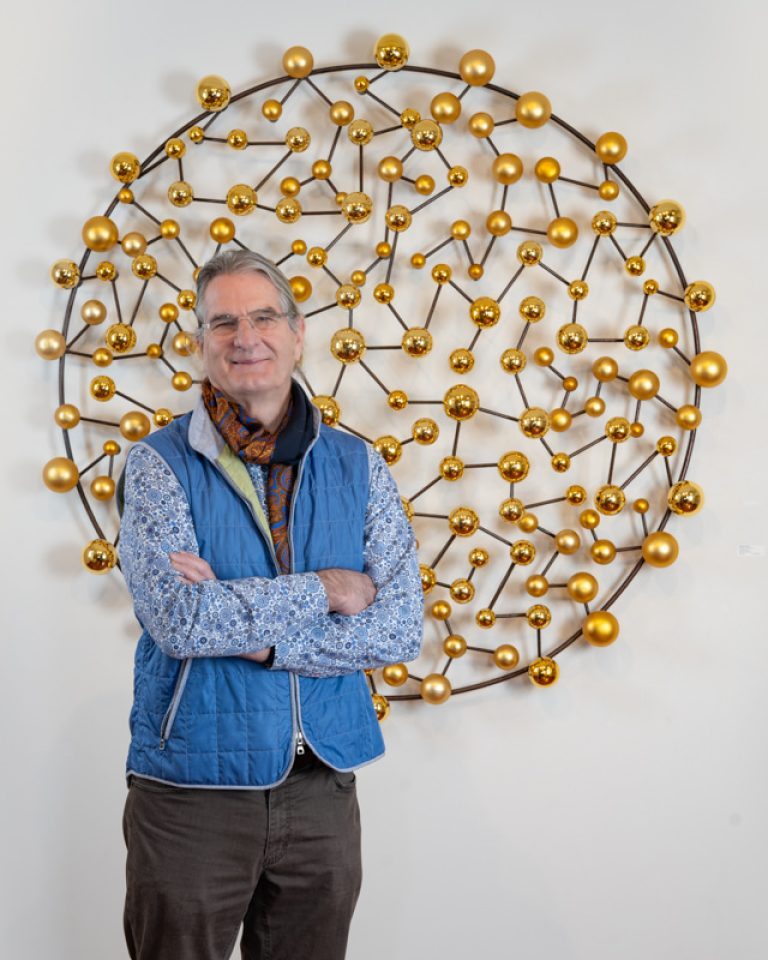
Glass Master
After 50 years in Knoxville, Richard Jolley reflects on a life shaped by fire, glass, and the radical choice to build an exemplary career without ever leaving home.
Story by Nathan SparksI Photography by Molly Herb
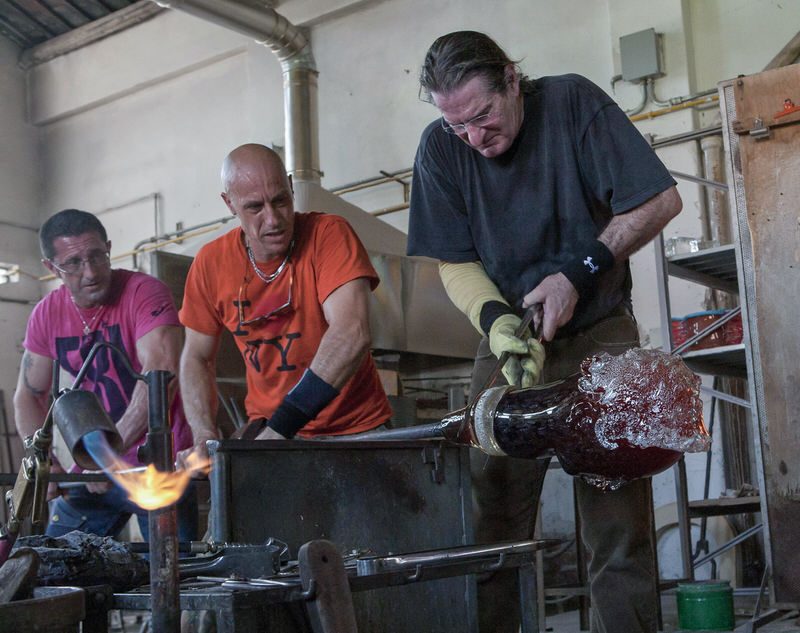
On a gray morning in Knoxville, the front door of an unassuming studio swings open and the temperature jumps. Inside, the air shimmers with heat. Furnaces roar. Pipes turn slowly in practiced hands. At the center of it all, a tall man in a dark T-shirt leans into the glow of molten glass as if he’s listening to it. The first time I saw that image was over 10 years ago.
That was and is Richard Jolley’s world—a place where sand, fire, and breath become birds in flight, contemplative faces, and entire constellations of color. It’s a world he has been building here for fifty years.
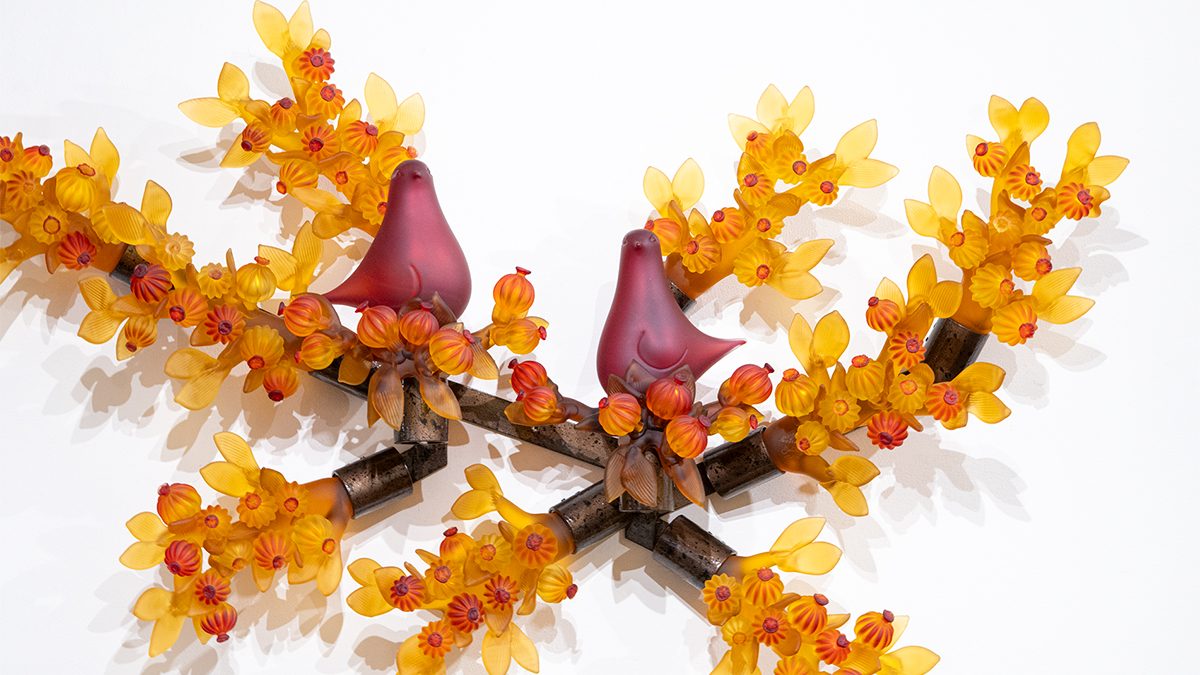
In 1975, when most young artists were told they’d have to leave home and head for New York or the West Coast to succeed, Jolley did something quietly radical: he set up a glass studio in Knoxville and stayed. From that decision came one of the most accomplished careers in contemporary figurative glass. His work has been exhibited and collected around the world. But Jolley’s legacy remains deeply rooted in East Tennessee. And this year marks the 50th anniversary of the studio that made it all possible.
Oak Ridge Roots, a Different Path
Jolley grew up in Oak Ridge, the son of a research scientist. In a town built on physics and engineering, there’s an unspoken script for success.
“Being raised in Oak Ridge, I missed the memo that I was supposed to be a doctor or an engineer or a lawyer,” Jolley says, with his trademark dry humor. In 1970, he arrived at Tusculum College and enrolled in a newly formed glass class—an elective that would quietly redirect his life. Within a year, he decided to try turning that class into a livelihood.
The timing mattered. The early’70s were steeped in counterculture and skepticism toward corporate life. “There was sort of an anti-corporate feel for people trying to be creative,” Jolley recalls. Becoming an artist felt less like a career choice and more like a philosophical one.
He continued his studies at George Peabody College in Nashville and later at Penland School of Crafts, absorbing both technique and discipline. Glass wasn’t just a material; it became a way of thinking.
Choosing Knoxville
Knoxville was not the obvious choice for a young glass artist in the mid-1970s. The studio glass movement was gaining momentum elsewhere. But Jolley was already operating by his own logic. “I was raised close by,” he says. “Knox County’s zoning laws were more flexible, and I still think Knoxville is a good place to live.”
He found a building, installed furnaces, and opened his studio in 1975. What began as a practical decision slowly became a defining one. Over five decades, Jolley has maintained a working hot shop, produced an extraordinary body of work, and built an international reputation—while East Tennessee’s arts community grew and matured around him.
His studio, located in West Knox County, has welcomed museum curators, collectors, students, and schoolchildren alike. And while his work has traveled globally, he has always returned to the same place to make it.
Finding a Voice in Glass
Ask Jolley what drives him, and he doesn’t talk about recognition. He talks about process.
“When you’re young, you worry about finding your voice,” he says. “As you get older, it becomes natural. It’s like breathing.”
Glass suits that evolution. It demands speed and precision but rewards patience and intuition. Jolley describes working with it as a kind of choreography—fire, movement, intellect, and teamwork.
Watching him work does feels like observing a well-rehearsed dance. Assistants move in sync, transferring pieces from furnace to bench to pipe, where a single mistake can end a piece instantly.
“What can go wrong?” he repeats a question he’s heard a thousand times. “This, this, this, and this—and the answer to all of it is yes.” He explains “it’s just like anything else.” Accumulating a creative knowledge through hand and eye skills and mental concentration is the way to minimize these outcomes.
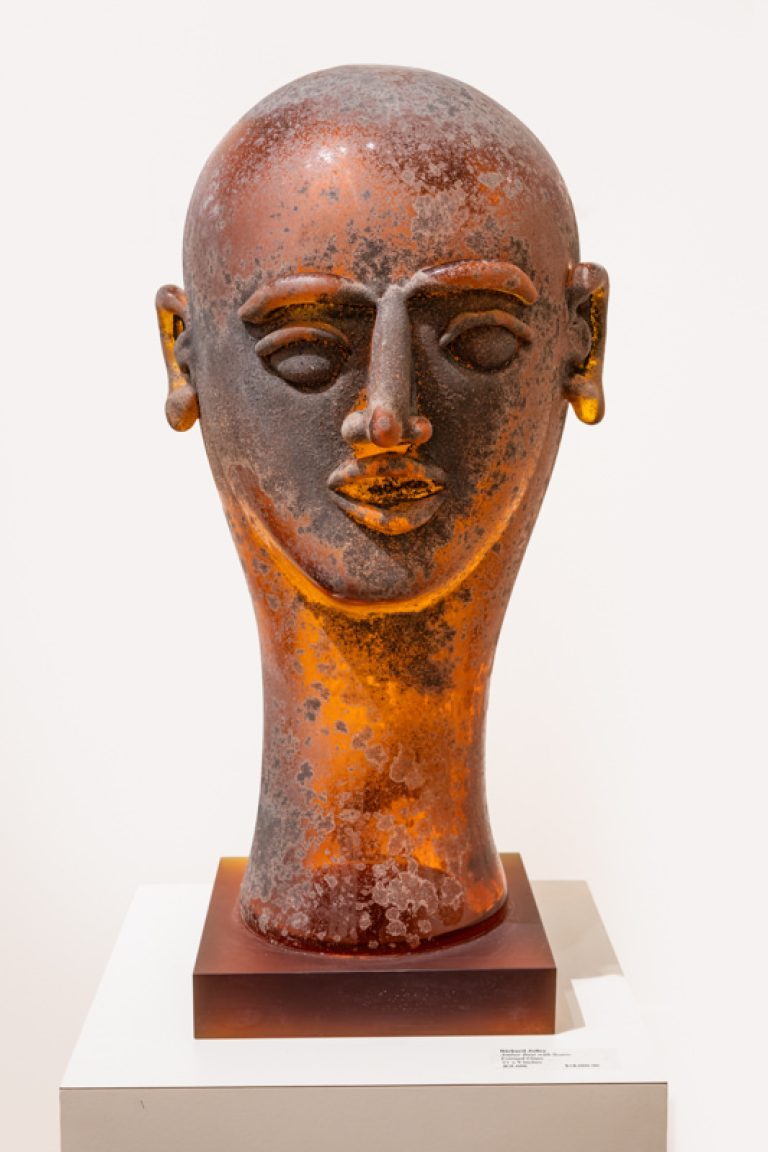
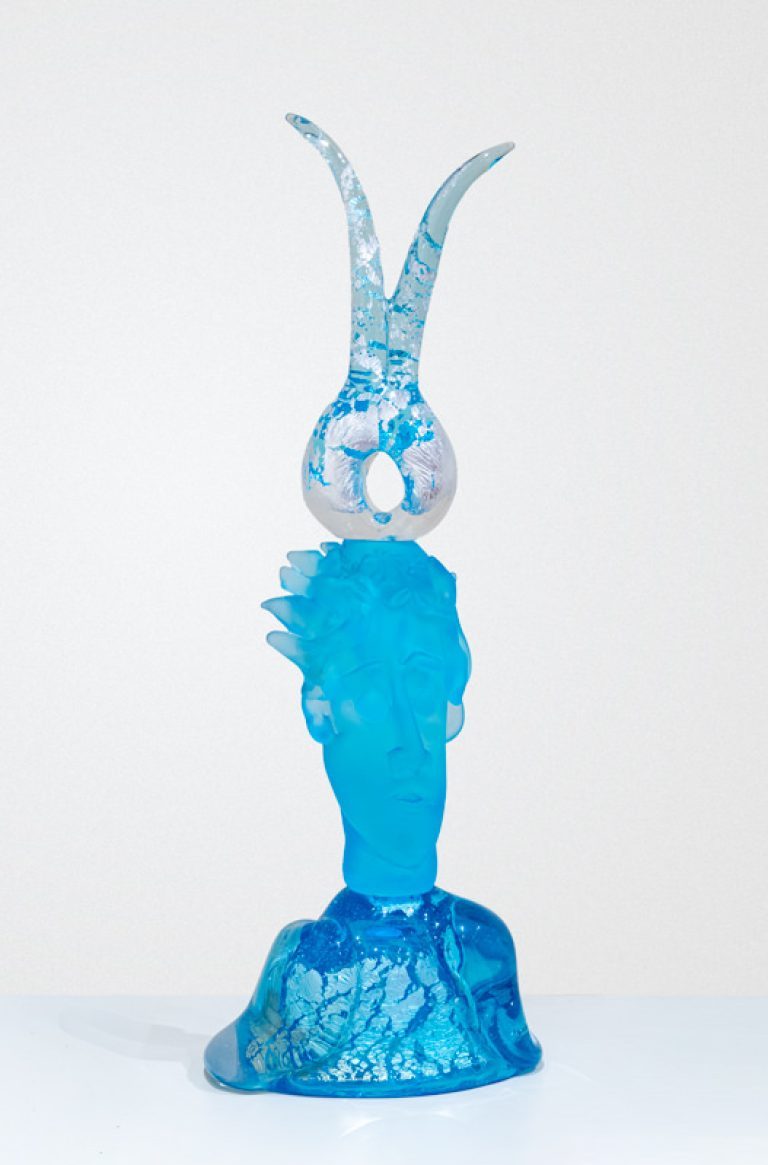
Early in his career, Jolley drew inspiration from Henri Matisse, creating blue-line works in glass that explored how subtle shifts in line could alter expression and mood. Over time, his work became increasingly sculptural and figurative—elongated bodies, stacked forms, and iconic heads that feel both ancient and contemporary.
Asked about his favorite piece, he doesn’t hesitate: “The one I haven’t made yet.” Respecting the past matters, he says, but dwelling there too long can stop you from moving forward.
Birds, Busts, and the Human Narrative
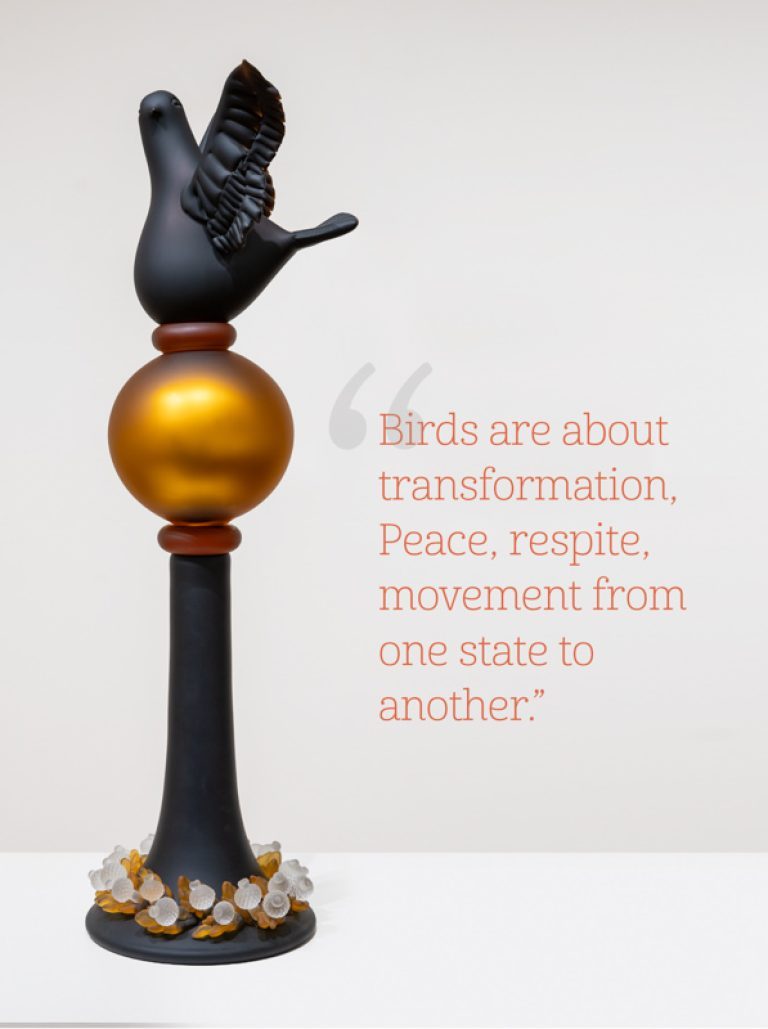
Certain themes repeat themselves in Jolley’s work the way certain chords show up in a songwriter’s catalog. Birds appear again and again—balanced on heads, caught mid-flight, hovering in flocks. “Birds are peace, respite, transformation.”
The human bust is another recurring form. For Jolley, the face is the most psychologically charged part of the body—the place where identity, emotion, and story reside. Working figuratively in glass is difficult, but that challenge keeps him engaged.
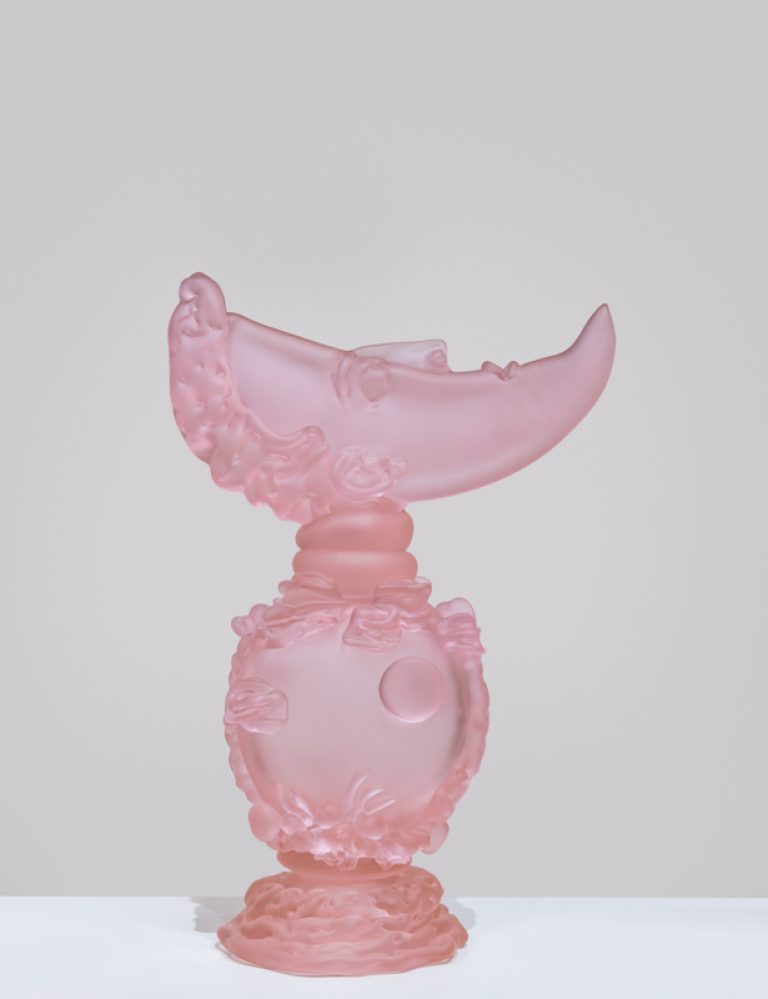
For years, he worked to soften glass’s natural shine, using acid etching to create matte surfaces that read more like stone or bronze. More recently, he’s incorporated gold and silver foils and drawn from Venetian techniques such as scavo, giving pieces a sense of age and depth.
He’s also known for improvisation—some of Jolley’s approaches are inspired by ceramics and even cake decorating. “It’s very spontaneous,” he says, “capturing this one moment of time with this visceral quality of material.”
A Landmark for Knoxville
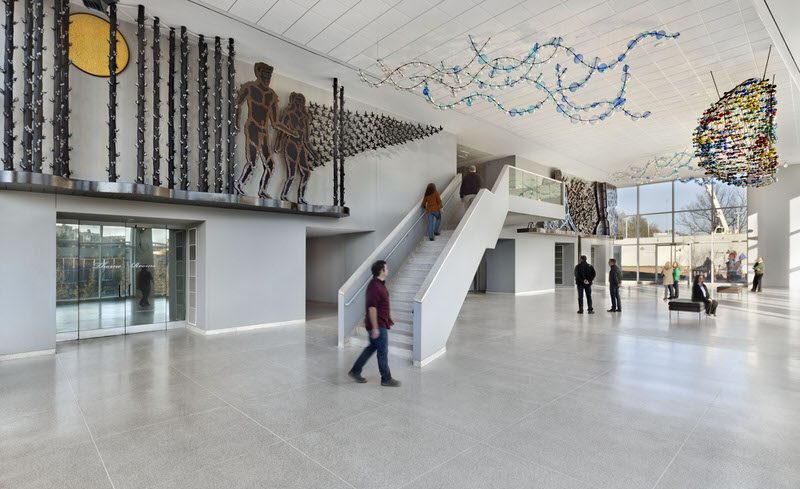
If Jolley has created a single work that defines his relationship with Knoxville, it is Cycle of Life: Within the Power of Dreams and the Wonder of Infinity at the Knoxville Museum of Art.
Suspended in the museum’s great hall, the massive glass-and-steel installation stretches nearly 100 feet and rises 12 feet high. Figures move through stages that suggest birth, discovery, turbulence, and transcendence, surrounded by swirling forms that feel at once atomic and cosmic.
For the museum, the piece became a defining statement. For the city, it stands as a reflection of ambition rooted in place. “The museum project is fabulous because of its scale and scope,” Jolley says. “I think it helped define the institution.” It also quietly affirmed Jolley’s role as one of Knoxville’s most influential cultural figures.
Giving Back and Teaching Forward
Jolley credits mentors and patrons for shaping not only his career but his sense of responsibility to the community. He learned early that success meant participation, not isolation.
That belief has translated into decades of teaching, mentoring, and quiet philanthropy. He’s welcomed groups from Community School of the Arts, worked with students from Beaumont, supported nonprofit organizations, donating work or proceeds when it can make a difference.
During the pandemic, Jolley and his wife, glass artist Tommie Rush, used one of his works as the centerpiece of a fundraising effort to address hunger in Knoxville. Rather than simply donating, they used art as leverage—raising far more than a single check could accomplish. “If you can use what you do as a multiplier, it becomes much more positive,” he says.
For Jolley, exposing kids to the studio isn’t about creating future artists. It’s about widening perspective. “You’re showing them that there’s a bigger world out there,” he says. “If you do it right, you can give them a very good sense of self-worth in a start-to-finish amount of time.”
Partnership and Shared Curiosity
Jolley’s story is inseparable from that of Rush. Trained as a ceramicist and later an accomplished glass artist, Rush brings her own distinct voice to the medium. Together, they share not just a life, but a decades-long conversation about materials, color, and form. Jolley delights in tracing connections across disciplines—from Roman frescoes to modern glass chemistry—seeing all material traditions as part of a shared human impulse to shape meaning from raw elements.
On Fame and the Long Game
When Jolley speaks to younger artists and students, he’s struck by the questions they ask. Referencing a recent lecture “they weren’t asking, ‘How do you do this technically?’ They were asking, ‘When did you become famous and how were you discovered?’”
A mentor once told him that no single show, gallery, or collector would make or break him. The only real requirement was persistence. “If you want to be an artist, you have to continue to work,” Jolley says. “It’s that simple.” And while he understands the realities of sustaining a studio, beneath the logistics is a stubbornly straightforward philosophy: show up, make the next piece, keep learning.
Asked years ago about five- or ten-year plans, his answer never changed. “I don’t know,” he’d say. “But I’ll be there.”
Fifty Years In
Fifty years after opening his studio, Jolley is still at the bench. The equipment is better, the projects larger, the résumé longer—but the essentials remain unchanged. The heat is intense. The risk is real. The reward is opening the annealer and seeing something whole where there was once only molten possibility.
From Oak Ridge to Knoxville, from a freshman elective to international acclaim, Richard Jolley has built a life defined by patience, curiosity, and commitment to place. “I feel lucky,” he says. After fifty years of fire and glass, Knoxville is lucky, too.
→ Swipe for Next Story
FeatureJANUARY FEBRUARY 2026
Sam and the Sweetheart of Phi Delta Theta
Story by Nathan Sparks
In September of 1966, I enrolled at the University of Tennessee. Although fraternity life continues to get mixed reviews, going through rush had become a family tradition years before. Dad joined Kappa Sigma at UT in the 1920s. Big brothers Dwight, Jr. and Ken, had joined Alpha Tau Omega. Brother Sid, still in high school at the time, joined the fraternity I chose.
Along with my roommate, Roy Marshall, a childhood friend and football teammate at Sevier County, I naturally signed on for rush week. Phi Delta Theta, relatively new on campus, was among our last visits. We were greeted warmly by its members who lined both sides of the walkway to the house entrance. We recognized Bill Justus, who both of us had played against when he was the standout quarterback at Fulton High School. The UT president’s son, super friendly Andy “Bud” Holt, was also among our greeters.
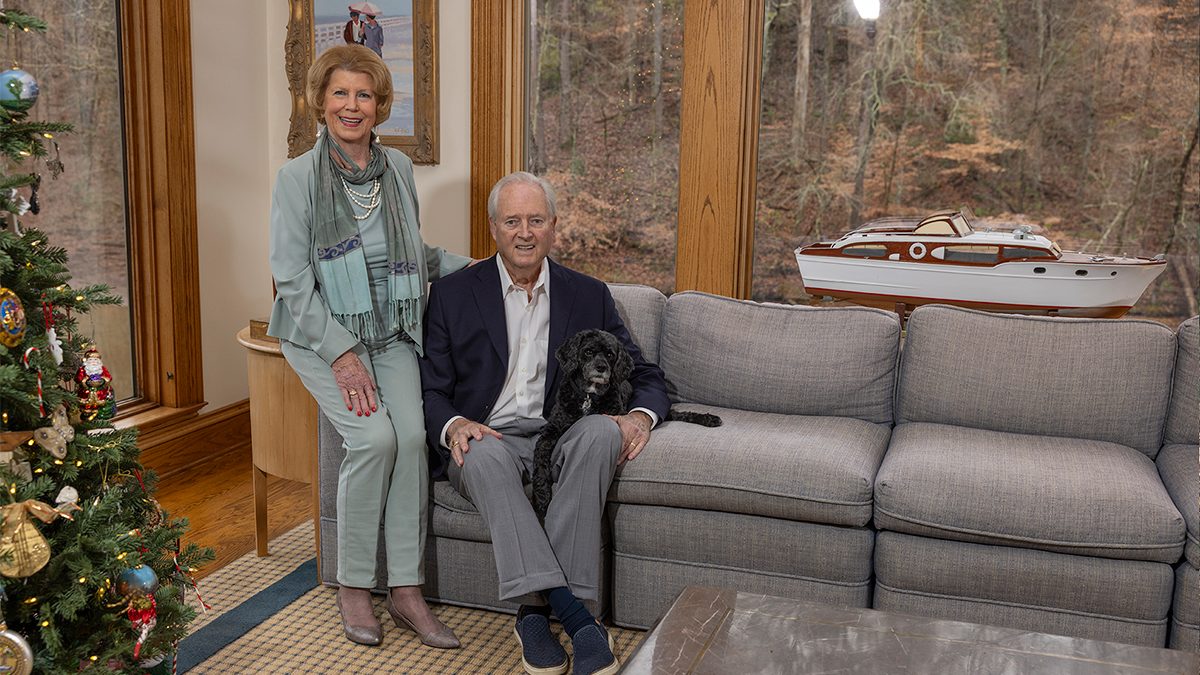
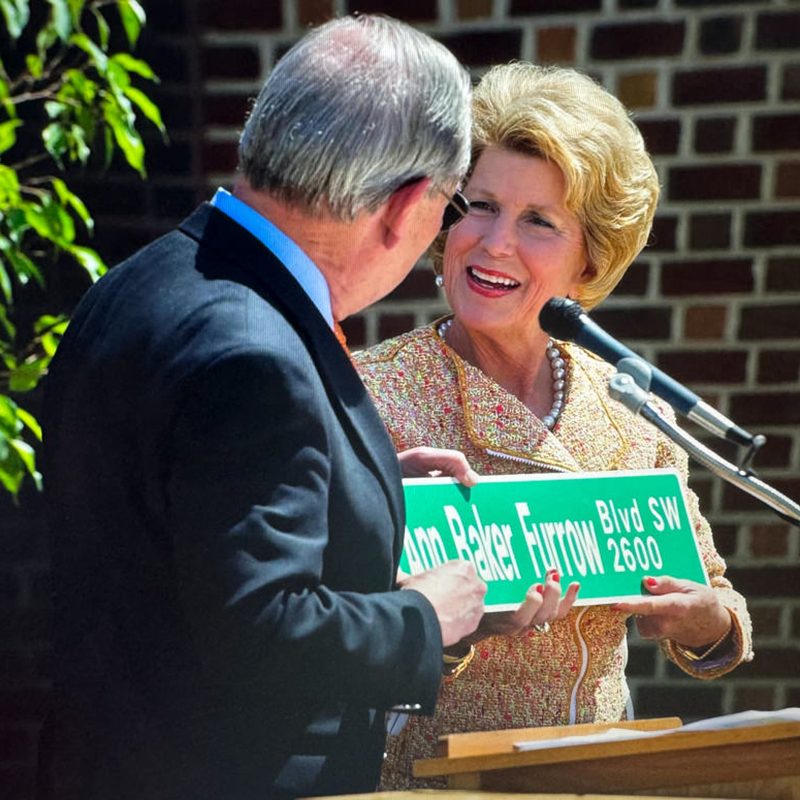
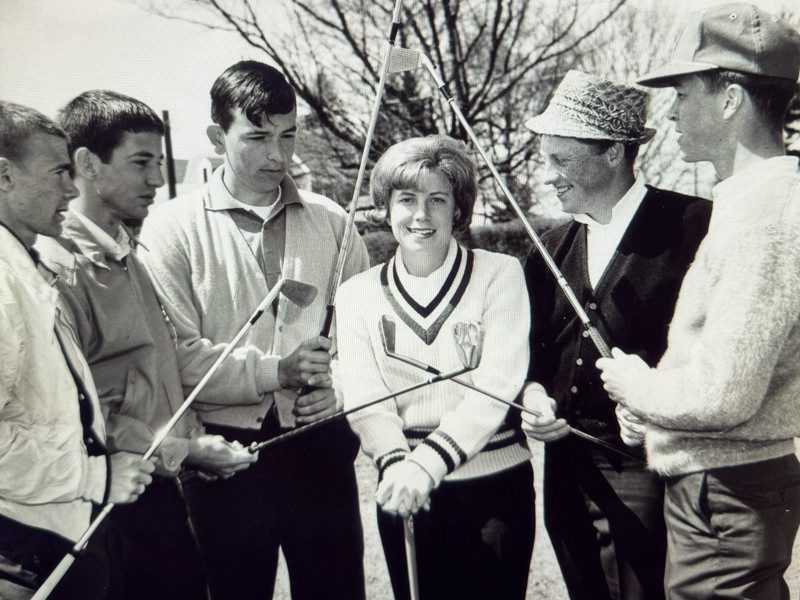
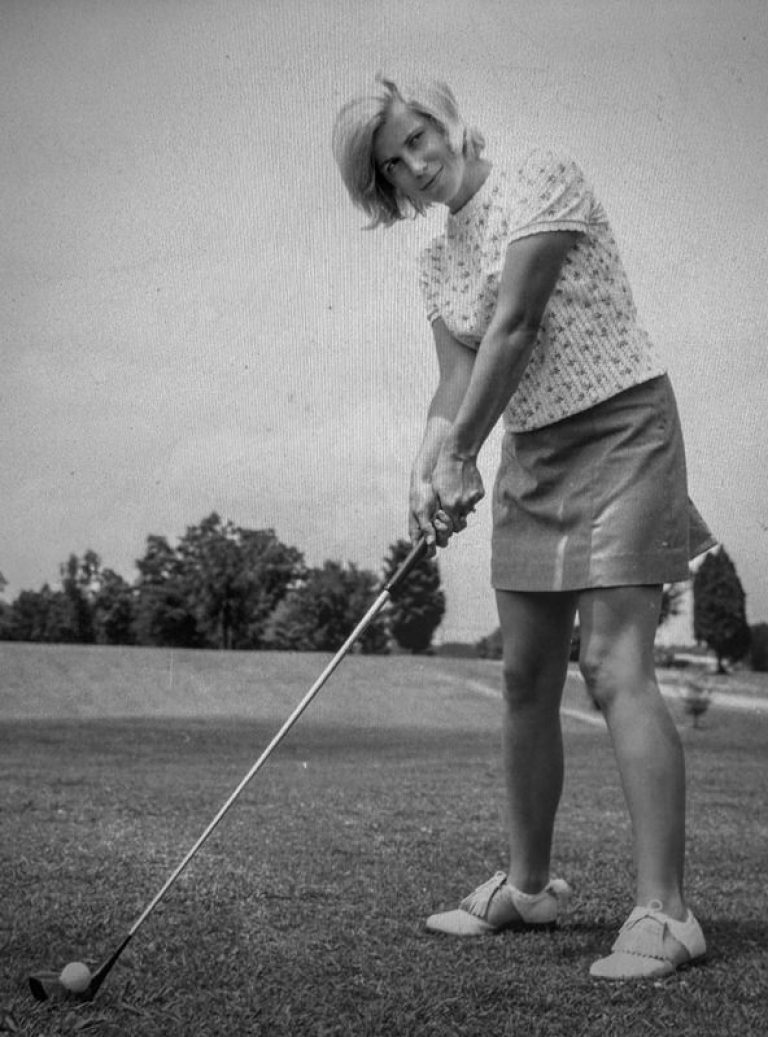
Once inside the small house, I was wowed by Ann Baker and Sam Furrow. I knew of Ann by having religiously read the Knoxville newspaper’s sports pages for years. A Maryville native and outstanding student, Ann had led the state in basketball scoring her senior year in high school – over 35 points per game — and even more impressively, as a teenager, had dominated the Knoxville area women’s golf scene for almost a decade. It was a headliner when UT awarded her a golf scholarship to play for the men’s team– well before there was such a thing as women’s athletics at the school. Recruited as a candidate by her predecessor as sweetheart, Fran Holt (Bud’s sister), the up-and-coming chapter enthusiastically elected Ann as the new “Sweetheart of Phi Delta Theta.”
Later, I learned that tall, handsome Sam, originally from the Paint Rock community in Roane County, had graduated from Knoxville East High School, where he played basketball. After becoming a walk-on at UT in his freshman year, he chose not to join a fraternity, focusing much of his energy on Army ROTC where, by his senior year, he was named the company commander in the program. One of the army officers, Elden Wright, had been a member of Phi Delta Theta at another university, and, by 1961, had persuaded him to help organize a chapter at UT. Even while financing his college expenses by learning the auction business, Sam eagerly took on the challenge and recruited quality students for the fledgling group. Within two years, these young men earned full recognition as a bona fide chapter of Phi Delta Theta. As founder of what had become the Tennessee Gamma Chapter, Sam earned the coveted Bond Number One as the very first initiate of the fraternity on the UT campus. Soon after serving his term as the first president of the chapter, Sam
graduated then served a stint in the United States Army. Once he had completed his military service, he kick-started his auction business. Looking to broaden his career, a year later Sam started law school in Knoxville. Naturally he agreed to serve as his fraternity’s advisor. So, that is the back story which led to our first meeting.
The storybook romance between Sam and Ann, I learned later, was through their respective roles in the fraternity. In the spring of’66, some of the chapter members decided to matchmake arranging for two to attend their annual formal together. To get acquainted before the fraternity’s big event, Sam took Ann to Regas, then the premier restaurant in town, for a Sunday night dinner. While there, they met a young couple celebrating their first anniversary. After pleasant table-to-table conversations, Sam quietly picked up the couple’s check, making a favorable impression on Ann in the process. Afterward, Ann announced to her roommate, “That’s the man I’m going to marry.” And so, she did.
During my undergraduate years, I saw less of Sam and Ann. Sam, when not inundated by law school studies and his auction business, visited our chapter meetings, but that was about it. I did get to caddy for Ann at one of her matches in the several years she won the Knoxville Area Women’s Golf Championship. After graduation, Sam and Ann married of course and then along came LeAnn and Jay. At the age of 26, Ann became not only the first women but the youngest person ever to be named to the UT Board of Trustees. By then, Sam’s business in Knoxville was booming. I was pretty sure that either of them could be governor of the state. As a couple, they regularly renewed their relationships with the chapter members, hosting rush events and generally offering advice and guidance.
To digress, my favorite story about Sam, exaggerated perhaps but based in fact, took place when he was near graduation from law school in 1967. He had a career choice to make. By then he was quite busy with his then fledgling auction company but wanted to explore his opportunities in the law. So, he scheduled an appointment with the UT College of Law Dean Harold Warner, a trusted and beloved educator who had served in his position for several years. “Dean Warner,” Sam confided, “I need to make a decision, what do you think about my taking a job in Knoxville with a local firm?”
“You are a good student, Sam, and I am sure any one of the larger firms would like to hire you,” the dean answered.
“Do you mind telling me how much firms are paying these days,” Sam asked. “About $7,000 per year, I think,” said Dean Warner.
When Sam did not seem satisfied, Dean Warner observed, “You might make a very good professor at a law school. Those jobs could pay as much as $15,000 a year,” explained the dean.
Still a bit perplexed, Sam had a last question, “Dean Warner, you are pretty much at the top of the profession, being the dean at the largest law school in the state, do you mind telling me how much you are paid?”
“Not at all,” he responded, “’It’s a matter of public record that I receive $30,000 annually.” When Sam’s expression did not change, Dean Warner asked, “What do you think, Sam?”
After a few thoughtful moments, Sam rose to his feet, “You know, I made twice that last year in the auction business, so I think I’ll just stick with it!” And that he did, with much success for more than the last half century.
Turning back to Ann, athletically speaking, the sky was the limit. In addition to her local dominance in golf, she had won the women’s state tournament five different times. After an eight-year layoff at the sport while raising a family, she decided to test her skills at the Women’s Southern Amateur Championship in New Orleans. Remarkably, she won, helping to earn a number five ranking in the entire country. The local sports writers – Ben Byrd, Red Bailes, and Tom Siler — were amazed at her remarkable feat and so were golfing enthusiasts throughout the South. Then, at the top of her game, she retired.
Sam and Ann will always be among those I have most admired in my life. Sam has helped open career opportunities, for so many of his friends and especially those of us who were members of “his” fraternity. To illustrate, after I had just graduated from law school, he telephoned to offer a job in his business. I am sure the salary would have been more than the modest amount I was making at the small firm in my hometown, but I stopped him mid-sentence. “Sam, law school was darn difficult for me, but I’ve done okay so far in my practice. Give me a chance to have some success in this profession!” I then recommended George Archer, who had served as president of our fraternity. George, I thought, was a talent untapped in the business world. As it turned out, the hire worked out famously. Sam and George were partners in the real estate business, Archer-Furrow, until George’s untimely death in 2003.
I vividly remember Sam once telling me that he didn’t want to be rich, he just wanted to live like he was. When I think about that statement today, I am pretty certain that he has far exceeded his ambitions! While I marvel at his business acumen and his financial success, his humility, his involvement in worthy causes, and his generosity are his chief qualities. Noted attorney and dear friend Tom Hale commented, “Sam is always committed to a win-win relationship in everything he does.” Sharon Mills, his chief assistant for the last 30 years, says Sam’s promise to always “do the right thing” inspires loyalty among those in his employ.”
A leader in United Way in times past, he has also served as the chair of the Knoxville Zoo, the Charter Commission years ago, and other many other community organizations – a perfect example of a life well lived. The same is true for Ann, an icon in women’s athletics, active in her community, and devout in her faith. Retired UT Women’s Athletic Director Joan Cronan, an ardent goodwill ambassador for the University, is among Ann’s many friends. “She is a woman of firsts! A great mentor, a dedicated Christian, and, along with Pat [Summitt], one of the two most competitive women I have ever known.”
On February 27th of 2026, Sam and Ann, adding to numerous other accolades, were honored as Heroes by the Museum of Appalachia, joining the likes of Howard Baker, Alex Haley, and those few others who have successfully embraced the ideals of East Tennessee. In the fraternity, Sam and I are called brothers. He has truly been like a big brother to all of us who have benefitted from his friendship. So, Sam, this is a tribute to you and the life you have led – a role model to those you have touched along the way. And the same is true for Ann, the Sweetheart of Phi Delta Theta and the lifelong partner of the old auctioneer. Thank you, Ann, for being a leader, a dear friend, and a legendary trailblazer in women’s sports.
→ Swipe for Next Story
VeteranJANUARY FEBRUARY 2026
From TopGun to Trout Streams
The Remarkable Journey of Dr. Trent Douglas
Story by Ethan Smith Photography by Patricia Douglas
On a crisp Tennessee morning, with mist still hanging over the river, Trent Douglas looks far more like a fishing guide than a man who has rebuilt faces shattered by war. Ball cap, waders, fly rod in hand—he and his son are somewhere on the water fly fishing.
By day, though, Douglas is the new head of HKB Cosmetic Surgery—a double–board-certified plastic surgeon whose road to Knoxville ran through Miramar flight lines, a NATO trauma hospital in Kandahar, and a Navy hospital ship plying the Pacific.
Born In The Danger Zone
“Knoxville has just been such a warm welcome,” he says, looking around his new office, the one he purchased from long-time local favorite Dr. David Reath. “For us it’s family, quality of life, and the chance to keep doing what I love—just at a different tempo. Service is the family language. Douglas’s father, now a retired Marine colonel, was in one of the very first Top Gun classes in 1969. He deployed to Vietnam twice; on the second tour he was shot down, ejected, survived on the ground for nearly an hour, and was finally rescued. Years later he would cheat death again—this time in the Pentagon.
On September 11, 2001, Colonel Douglas’s office sat directly above the impact point of American Airlines Flight 77. “The airplane went in right underneath his office,” Trent says. “There’s that famous photo of the big hole in the C ring—his was the one office sitting there untouched.” His father survived only because he had stepped down the hall into a secure communications room to speak with Trent’s sister, then a U.S. Marshal.
“Luckiest man alive,” Douglas says with a half-smile. “Between Vietnam and 9/11, he’s used up a lifetime’s worth of close calls.”
It’s not surprising that Trent grew up with a deep respect for service and aviation, but also with an understanding that life can pivot in an instant.
Choosing the Scalpel and the Wings
Unlike his father, Douglas didn’t head straight to the cockpit. He went to college as a civilian, then joined the Navy through its Health Professions Scholarship Program, which pays for medical school in exchange for years of service.
General surgery residency came next, followed by plastic surgery training. Along the way he became a flight surgeon assigned to a Marine F/A-18 squadron out of Miramar—the “Top Gun” landscape his dad had known a generation earlier.
Deployments followed. One Western Pacific cruise put the squadron through island chains most tourists never see. Later, Douglas embarked on a Navy hospital ship as part of Pacific Partnership, a State Department–sponsored humanitarian mission that brought surgeons from thirteen nations together to treat patients across the Pacific Rim.
“You realize pretty quickly that doctors around the world are exceptionally well-trained,” he says. “The difference is the tools and resources they have.” Operating alongside colleagues from Japan, Korea, India, Indonesia, and beyond broadened his sense of how medicine could change lives far from gleaming American hospitals.
War, Wounds, and a 98 Percent Miracle
When the second Gulf War ramped up, Douglas was a freshly trained plastic surgeon at Naval Medical Center San Diego—the largest military medical facility in the world. It became one of the key destinations for soldiers and Marines wounded by IEDs in Iraq and Afghanistan.
“Everybody knows the term IED now,” he says. “What people don’t always realize is how complex those injuries are. We were working hand-in-hand with orthopedic surgeons on limb salvage, with burn specialists, with neurosurgeons. We saw everything—faces, torsos, hands, legs. It was a very meaningful way to start a career.”
“It was the best and worst part of the day,” he says. “You hate that they’re there. But you’re also incredibly proud of how far they’ve come.”
Because Douglas is double board certified in both general surgery and plastic surgery, he was as comfortable stabilizing a trauma patient’s abdomen as he was reconstructing a shattered jaw. The hospital’s gait and prosthetics lab, he remembers, was both heartbreaking and inspiring: young men and women missing arms or legs, learning to walk and live again with state-of-the-art prostheses.
In 2013–14 he finally deployed into the war zone itself, spending nine months at Kandahar Airfield in Afghanistan. There he served at the multinational NATO Role 3 medical facility, a fully equipped trauma center anchored by U.S. Navy medicine—on landlocked Afghan dust instead of the sea.
“We had a 5,000-unit blood bank, an amazing team of surgeons, and a very well-rehearsed evacuation chain,” Douglas explains. “If you got to us alive, there was better than a 98 percent chance you were going to stay alive.”
From battlefield to Kandahar surgery, then to Landstuhl, Germany, and on to Bethesda or Brooke Army Medical Center in Texas, severely wounded troops could be back in the States within 72 to 96 hours. The Air Force flew modified cargo planes that were essentially flying intensive care units.
“Kandahar felt oddly safe,” he says. “Every once in a while you’d hear a rocket warning on the far side of the base where the airplanes were, but the medical side was probably the safest place you could be. If something happened to us, it was bad for everyone, so they protected us carefully.” Still, the psychological weight of what came through the trauma bay was real. Douglas coped the way he often has—bycreating something.
Christmas Snow in Kandahar
High desert nights in Kandahar get cold. Cold enough, Douglas realized one October night, to make snow. With the help of some re-appropriated plumbing supplies, an air compressor, a pressure washer, and a homemade nozzle, he built a working snow-making machine behind the hospital. On Christmas Eve, as the temperature dropped below freezing, he stayed up all night blowing snow into a space about the size of his office in Knoxville.
By dawn there were eight inches of powder—enough for snowmen, snow angels, and a wild, impromptu snowball fight for the staff far from home. A visiting USO show—country singer Kellie Pickler and her band—joined in.
It’s the kind of story that follows him: the surgeon who can repair a face, rig up a snow machine in the Afghan desert, and quietly lighten the weight of a war zone for a morning.
A Second Act in Knoxville
After 22 years, the relentless pace of complex reconstructive surgery—and twelve- to fourteen-hour operating days—finally began to ask more than he wanted to give. “Reconstruction at that level is a younger person’s game,” he says. “I loved it, but there comes a point where you look at your kids, your spouse, your parents, and you realize you’ve earned the chance at a second chapter.”
Douglas retired from the Navy as a captain in 2017, spent several years in private practice in San Diego and the Bay Area, and then he and his wife Trish—the ICU nurse he met during residency—began looking east. Their son landed at the University of Tennessee. Their daughter is in college in Dallas. Trish’s family is in Indianapolis. Knoxville suddenly looked like the center of gravity.
“The general was…let’s say…curious where all the parts had come from,” Douglas says with a grin. “But once Kellie Pickler was out there throwing snowballs, everybody decided it had been a pretty good idea.”
“We had no family left on the West Coast,” he says. “We wanted to prioritize aging parents and young-adult kids—and I won’t lie, getting rid of California’s state income tax was a nice bonus.” In the spring of 2025, they moved to Knoxville, where Douglas took over the established cosmetic surgery practice on South Northshore. Today HKB Cosmetic Surgery is focused entirely on aesthetic work: facelifts, tummy tucks, breast surgery, liposuction—all the procedures that help people feel better in their own skin.
He hasn’t stepped away from leadership, either. Douglas serves on the executive board of The Aesthetic Society, one of the nation’s premier professional organizations for plastic surgery, and is slated to become its president in 2028.
Trout, Football, and the Long View
Ask what he loves most about Knoxville so far and he doesn’t even try to separate his answers. “Trout fishing and game day,” he says. “It’s a dead heat.”
Weekend schedules revolve around water levels and football schedules. He and his son chase stocked winter rainbows in Pistol Creek, wild fish in Tellico and Gatlinburg streams, and dream about future trips to the South Holston and Watauga. Trish, meanwhile, has turned her photographer’s eye toward the Smokies, the morning fog, the fall color—the seasons they never really saw during their years in coastal California.
They’ve been to the rodeo, to concerts at Thompson-Boling, to Vols games where the stadium feels like the literal heartbeat of East Tennessee. “All things Tennessee,” Douglas says. “We’re all-in.”
In his exam rooms, patients see the photos: the F-18 squadron on the flight line, the Kandahar trauma team, a Navy hospital ship sliding past a green coastline, a snow-covered corner of an Afghan base with grinning sailors pelting each other with snowballs. Then, more recently, a shot of Douglas in waders, fly rod arced against a mountain backdrop.
It’s all the same story, really.
In war zones and on hospital ships, his job was to give wounded men and women a chance at a normal life again. In Knoxville, the stakes are quieter but still deeply human: to help someone feel comfortable with the face in the mirror, or the way they look in a dress, or the body they carry through the world.
“We did good things in the Navy,” he says. “Now I get to do good things here—just in a place with better barbecue and a lot more trout.”
For a town that loves both, that sounds like the perfect landing.