ProfileKnoxville's Open Container Zone Is Here But It Is Important To Know The Risks
Features
VeteranThe Unexpected Mission
Reading Settings
100%
Sept / Oct 2026
Swipe to read →
Vol. 42 · Issue 5 | September October 2026
The PublisherThe Gift of Subtraction
Departments
PoliticsA school truancy solution?
MusicDave Landeo – A Legacy in the Key of Life
SportsGetting Right With The Gods
TravelGrazie Millie
Dining GuideLonesome Dove Western Bistro
OutdoorsOutdoor Mishaps & Tales of Woe
WellnessPeptides Part II
Dining GuideSmoke Signals
Arts & CultureTime travel
InsightsWhere Did It Go?
Features
Featurebuilt on connection
FeatureDogs 101 Part 3 - The Power Of Motivation
Non-ProfitStewards of the Land
FeatureThe Gift of Giving
Business Profiles
ProfileBeyond Cold Bringing Elite Recovery Home
ProfileKnoxville's Open Container Zone Is Here But It Is Important To Know The Risks
Features
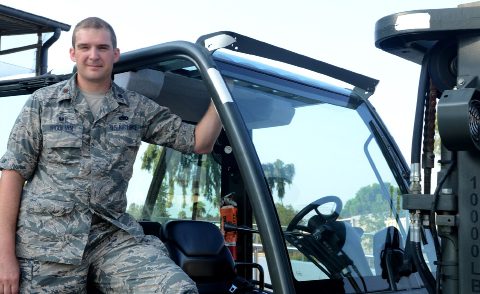
VeteranThe Unexpected Mission
→ Swipe to start reading
The PublisherSEPTEMBER OCTOBER 2026
The Gift of Subtraction
Change is inevitable, what you choose to do with it makes all the difference.
For most of my life, I strongly resisted change. If I felt I’d earned something, whether actually or just emotionally, I decided it was mine, and nobody was going to tell me otherwise. That instinct came from things that happened long ago, things I should have resolved years before they started quietly running my life from the background. So when it was suggested that I cut back on the wine, I heard the words, but I refused to hear what was actually being said underneath them.
Over the past couple of months, I finally listened and stopped drinking. I walked away from processed sugar. I let go of most bread, not because gluten is some modern villain, but because I finally admitted what that bread was actually doing: quietly turning into sugar, quietly turning into weight, quietly turning into excuses.
I started walking, moving, showing up for my own body instead of just my business. On paper, that’s a list of things I gave up. In practice, it’s the opposite. I didn’t lose alcohol, I gained a massive amount of clarity. I didn’t lose sugar and bread, I gained a real relationship with food instead of a dependent one, and in the process lost a lot of weight. I didn’t lose an evening ritual, I gained the version of myself who’s actually present for the people in my life who matter and who count on me. And for all the times I let anyone down, I am profoundly sorry, and I hope they’ll find it in their hearts to forgive me.
Somewhere in there I had an “aha” moment. Deprivation flipped into opportunity, and once I saw it, I couldn’t unsee it anywhere. An eye-opening the likes of which I have never experienced. I’m sharing this with you in the hope that, through my experience, you might see your own change through a different lens.
Here’s the uncomfortable part. It is astonishingly easy to spot what someone else needs to change. Their bad habits. Their broken promises. Their blind spots. We see it instantly, and we get frustrated when the people we love won’t just fix the obvious things. What’s harder, much harder, is turning that same clarity on ourselves. There’s a particular kind of hypocrisy in demanding growth from everyone but the man in the mirror. I’ve been guilty of it, and I suspect many of you have as well.
I want to be precise about something, because precision matters here. This isn’t about removing a person, a relationship, or love itself. It’s about removing the behavior standing between you and the people who deserve your best self. Those are not the same things, and confusing them is how good people talk themselves out of good changes. When someone who loves you has been trying to tell you something, sometimes out loud, sometimes in silence after they’ve stopped saying it, the message underneath is rarely “change or I’m gone.” It’s usually simpler and more generous than that — you matter to me, I want you in my life, but something is getting in the way, and I hope you will fix it.
That’s not an ultimatum. Not at all. Instead it’s an invitation. And invitations deserve a response. The first step is listening, both to the person asking and to the voice inside you that’s probably already screaming the same thing back at you. Mine was — and for the longest time, I simply refused to listen or act, even when I knew it would be best for me and everyone else in my life. That’s fear talking, plain and simple: the fear of losing something that, in truth, was hurting me.
When you remove something that’s been quietly costing you, you don’t just make room for health or discipline. You make room for integrity, for your actions to finally catch up to your words. Anyone can say they will change their behavior, but the proof is in consistency of your actions, and that’s proven only one way: with consecutive days of choosing them, and the version of you they deserve, over the thing that’s been getting in the way. Say your health matters, then eat like it. Say the relationship matters, then behave like it. That’s the whole game. Walk the walk, or stop talking.
→ Swipe for Next Story
PoliticsSEPTEMBER OCTOBER 2026
A school truancy solution?
A former chronic truant argues that accountability and personal motivation—not excuses—are the keys to getting students back in class.
Story by George Korda Photography by R. Daniel Proctor
I was 17, standing in front of my Florida high school dean’s desk. I waited. He said, “You’re being suspended for three days.” My offense: skipping school. I said, “I didn’t come to school, and my punishment is that I can’t come to school?” I smiled. I thought he might come over the desk at me.
What makes me different from today’s Knox County’s chronic truants? Nothing. They, as I did, drill holes in their sinking academic ships while fooling themselves into thinking they’re on a pleasure cruise of not worrying about tests, homework, assignments, or being harassed by irritating teachers. Somehow, the kids think things will be fine. But the kids aren’t all right.
In my case, well-intended adults, wanting to help, showed empathy by saying poverty and family situation meant I was up against daunting negatives. But what I heard was that it wasn’t my fault. And I let them let me off the hook.
In 2026, there are adults - sometimes well-meaning, sometimes pursuing social or educational agendas – who tell kids they face potentially insurmountable obstacles because of race, poverty, gender, ethnicity, ancestry, or home situation. Unknown is how many kids listen and decide, why try? Others don’t care, because to them the future is what they’re going to do on the weekend.
Truancy under Tennessee state law is five unexcused absences in a school year; chronic absenteeism is missing 18 days. Tennessee Dept. of Education data show that between 2021 and 2024, Knox County had a three-year 19.4% chronic absentee rate - more than 11,000 students, on average, every year. Locally and nationally a stupefying number of kids are being disgorged from high schools who have no or few tools to exist in a 21st century economy.
In April 2026, Gov. Bill Lee signed House Bill 1823 into law, which assembles a new battery of truancy-related requirements for Local Education Agencies (LEA). Somehow this idea often takes root in public policy discussions: “if we only pass a law things will get better.” You (perhaps) can force some kids into classrooms, but you can’t make them think. It doesn’t improve education overall to inject into classrooms kids whose contribution is likely to be disrupting things.
When the situation descends to lawyers being involved, the truancy mess becomes even messier. Example: in 2014, the Center for Public Integrity unfairly pounded on Knoxville Juvenile Court Judge Tim Irwin for ordering into juvenile justice detention a girl found to be truant. The article reads as if she was forced into a Russian gulag, and what was needed were more laws, and more lawyers. In such situations the focus becomes the legal process. And nothing much changes for truant kids.
Having had personal experience with chronic truancy, I offer two suggestions as a pathway to a solution. Not the solution, but a solution:
In my case, my motivators were three-fold: ultimately a disgust at failing, a desire to live my religious principles, and a girl who had graduated – and I was still in high school. I graduated after an extra semester. I hadn’t distinguished myself academically and my mother had no money. I joined the Army. I took college classes at nights and on weekends, became a member of an academic honors society, was on the Dean’s List every term, and continued going to school after I was discharged. My Army experience and education have led to an interesting and rewarding career. And I married the girl.
For everyone who wants to do good for kids, don’t give them an excuse for failure. It can destroy them. Ultimately, everyone is responsible for their own decisions. Apply actor Denzel Washington’s words when he warned of such things in the movie “Remember the Titans,” in which he played a high school football coach:” You ain't doing these kids a favor by patronizing them. You’re crippling them. You’re crippling them for life.”
→ Swipe for Next Story
MusicSEPTEMBER OCTOBER 2026
Dave Landeo – A Legacy in the Key of Life
For three decades, Dave Landeo has turned Knoxville bars, weddings, and tailgates into unforgettable nights
Story by Terry Glen Adams Photography by Nathan Sparks
You’ve seen him at bars, tailgates, and private events. You’ve danced and requested your favorite song, he’s played it. But my best guess is you don’t know “Landeo” (rhyme intended). For instance, did you know he is the music director of the Knoxville Marathon since the city first ran the thing in 2005, founder of the Isle of Palms Songwriters Festival, writer and producer of his own Marine Corps rock opera, co-owner of Boogie’s on Cumberland Avenue, leader and founder of the All Vol Band, a United States Marine, a University of Tennessee graduate, a philanthropist, community activist, guitar teacher, father of two, and writer and performer of a dozen or so records of original material? I bet I stumped you on a few of these, even if you know him well.
There was a stretch of years in West Knoxville when Thursday night was Friday night, Saturday night, and Sunday-Fun-Day all rolled up into one because of Dave.
It began at Peloncho's, tacos, a few beers and a man with an acoustic guitar would start playing at a reasonable hour to a reasonable number of people, and every Thursday, it ended at Julio's Between the Buns until late into the night. Many of Knoxville’s luminaries could be found dancing to "Me and Julio Down by the Schoolyard.” Seven hours some nights, same guy, same guitar and hundreds of songs. To be clear, the crowd followed him from bar to bar on the same night, every Thursday, a thing I have seen exactly one human being make happen. It is the reason why the drummer Vic Illagan long ago named him the Pied Piper of Knoxville.
Dave Landeo is a musical Marvel. If you have a room full of people who want a great time. Dave Landeo is your man. I would argue that there is nobody better solo acoustic, one artist and his instrument, to get the crowd moving and having the time of their lives. Kids, drunks, regulars, strangers, hippies, cowboys, professors, he does not care. I’ve never seen him fail. He has played more weddings, private parties, and tailgates than Carter’s has pills (as my grandmother used to say). I have seen big names solo acoustic, people who sell out stadiums, they can’t do what Dave Landeo does.
Our first real conversation happened at a Fourth of July 5K on Neyland Drive. It was the mid 90’s. I recognized him instantly: long black locks flowing, bouncing along ahead of me. I picked it up, pulled alongside, and said “hey, you're Dave Landeo.” He said, “yeah man, I know you.” We ran and talked about music, the military, and running.
Yes, the military. Here is what surprises people about the Pied Piper, bearer of joy and melody and rhythm: straight out of high school he joined the United States Marine Corps and served four years in the Reserve. The most fun man in East Tennessee is, underneath the party, a profoundly disciplined animal.
But before any of that, there was a hill in Bordeaux, north Nashville, in the 1970s. The neighborhood was changing block by block, school integration, new sounds, a new world order, and one afternoon a sound came out of a garage that he had never heard playing in the distance.
I never heard a garage band playing funk. I was like, what the hell is that?
"I never heard a garage band playing funk," he told me. "I was like, what the hell is that?"
That is the origin story of Dave’s newest record and it is something that has driven Dave’s musical journey. No matter what Dave plays, there is a rhythm, a bit of soul and funk.
If you know music, you know that the rhythm, the beat, the meter, the timing is the frame that holds up the whole structure. So perhaps it is not a surprise that Dave started on drums. His first band was the aptly named Fragile. They never played out, but the guitarist in the band taught him chords. The first paying gig at sixteen was with his next band, Gold Rush, where they gave him eight bars of a drum solo in "We're an American Band." Then off to UT where he would join the Woodies. The bass player in that band took one look at the solo in "My Generation" and said “I don't think I can do this,” and Landeo said, “I'll try.” He then sang "Radio Free Europe,” Stipe's part and Mills's part, over a wicked bass line, the drummer had become a frontman. Then there were the Sherlock Homeboys and Graffiti Circus.
In 1994 he quit his a job, and he has not had one since.
Everyone wants to know the secret. The secret is that Dave Landeo is driven and professional. Someone you can absolutely trust to bring the goods. The stage personality is the master of ceremonies, the commissioner of fun, the guy who will not let your wedding reception die. The operating personality is a devil dog. I know this too well, because when we were roommates he was the one who made sure the bills got paid on time, every time.
He built this life, his life, on purpose. "I wanted to give myself options," he says. "Solo Dave. Duo Dave. Trio Dave. Original band Dave. Rock and roll band. Wedding." The wedding gig is not a betrayal of the art. The wedding gig “finances” the art. "That enables me to do the recording projects. Or to buy a new guitar."
I wanted to give myself options. Solo Dave. Duo Dave. Trio Dave. Original band Dave. Rock and roll band. Wedding.
And underneath the professional approach is the other thing every performer has to have and almost nobody actually does: an unshakable belief that the thing can be done and that he can do it.
Which brings us to the All Vol Band. Dave came downstairs one afternoon while I was picking around and asked if I wanted to write a song.
Of course, I said.
Cool, he said, it's about the game this weekend, and Rick Russo has arranged a video, and they're playing it before kickoff.
“When do we need it?”
“About forty-five minutes.”
"It's not perfect. It's perfect for me, the flaws, because that makes it human. I tell myself: just do it."
By now you should be laughing because you cannot write a song and perform it for television in forty-five minutes. Nobody does that. Nobody would do that. But Dave Landeo was going to do it by himself if he had to, they asked, he said yes, end of story. So we did write the first song in forty-five minutes. Then he said: “do you think we should call Tall Paul?” I said yes, I think we should call Tall Paul. Three of us, one deadline, and forty-five minutes later we were on WVLT singing the first-ever song by the All Vol Band.
There was only one year of the original All Vol Band. We did a video for damn near every game. If you are a Vol fan you already know which year it was, because it was the year Tennessee went 13–0 and brought home the National Championship.
At 12–0, Landeo decided it just wouldn’t be right for the All Vol Band not to be in Tempe, Arizona for the National Championship. So he called every guy who had drifted into the band along the way, collected commitments, secured a sponsorship, and got us a room.
I knew it was gonna be hard. And we did it. And I'm glad, because the pocket was there.
One room. There were a lot of guys in that band by then. We played the Vols home anyway, all of us, out of a single hotel room in the desert, and it happened for exactly one reason: the Marine Corps mentality never sees anything as impossible.
Dave is always, unfailingly, on the beat. He pushes tempo live because pushing tempo gets people out of chairs. Others can mimic what he does, play the same songs. It is not the same reaction, a different room temperature entirely.
In the age of AI, Pro Tools, and technology everywhere, his new record was built from the floor up. Bass and drums went down first, together, with nothing but a click to hold them, no scratch guitar, no vocal, no lead track to follow, Landeo calling the changes out loud into the room. “Okay, here comes the chorus.” He has played almost everything a musician can play. He had never done that.
Simplicity gives space to the other instruments. To the lyrics. It gives space to the song itself.
"I knew it was gonna be hard. And we did it. And I'm glad, because the pocket was there."
His producer-avatar is Rick Rubin, whose entire gospel is “take things out.” To keep that inspiration in mind, he took to the internet searching for a Rick Rubin bobblehead. It turns out they don’t sell them. So Landeo went on Amazon and had a custom bobblehead made of Rick Rubin and set it on the console for the final sessions. He would lay down a guitar lick, look over, and the head would wobble: “No. Too much.”
"Simplicity gives space to the other instruments. To the lyrics. It gives space to the song itself."
The record is called Funktasia – streaming everywhere. It came out August 5th. Nine songs: "Chika Wah Wah," "Chill," "Nasty," "Stacks," "Everybody," "Large Time," "Celebration Train Station," "A Life of Happiness," "Say, What?" and every one of them traces back to that garage on the hill in Bordeaux. The lyrics, he says, are "basically written by a teenager," because that is who was standing there. His daughters, Marena and Maya, animated the video for "Chika Wah Wah." He made them invoice him like clients. They did.
Of the album itself: "It's not perfect. It's perfect for me, the flaws, because that makes it human. I tell myself: just do it. Don't think about anything else."
Every fall he comes home on a Friday before a home game, Roger's on Kingston Pike, a party he founded and has thrown more than a dozen times: the Tailgate for Alzheimer's Tennessee, this year is Friday, September 18th, 2026. What can you expect to see? A spectacle like no other, there will be funk, there will be rock, there will be country, there will be local celebrities, there will be guest artists, but above all there will be Dave. He’s still the Pied Piper and he still taking us to where we really wanna go, somewhere fun, where the rhythm moves you, where everything is possible.
→ Swipe for Next Story
SportsSEPTEMBER OCTOBER 2026
Getting Right With The Gods
Ruined by Achilles’ heels at crucial moments last season, this year the Vols have Nike on their side during a tough scheduling odyssey.
Story by Brooks Clark Photography by Bruce McCamish & Carlos Reveiz
Tied 38-38 with Georgia with three seconds to go, kicker Max Gilbert missed a field goal, and the Vols lost in OT. Near the end of the first half against Alabama, UT was on the 1-yard line about to pull within two points, when Joey Aguilar inexplicably threw a pick six to put Bama up 22-7 on its way to 37-20 smackdown. Against Vanderbilt, UT’s defense seemingly ate too many of Calypso’s lotus blossoms in a 45-24 humiliation. Then, in the final minutes of the Music City Bowl, after the Vols went up 28-27 on Illinois on a miraculous bobble-and-scoot 94-yard kickoff return by freshman receiver Joakim Dodson, UT’s defense seemed cursed again, as the Illini marched for a field goal and the 30-28 win.
So—with less trickery by the gods—an 8-5 season could have been 11-2. Or at least 10-3.
Head Coach Josh Heupel fired Defensive Coordinator Tim Banks and hired Jim Knowles, known for unleashing defenses worthy of Ares, especially the impenetrable Ohio State defense from 2022 to ’24 (including the 42-17 Vol stomping in the first round of the CFP) and Penn State in 2025. Knowles also coached at Duke for nine years under former Vols offensive coordinator (and Eli and Peyton Manning’s longtime quarterbacking guru) David Cutcliffe, so he must be a solid guy. He was a freshman defensive end at Cornell the fall after Earthadelic and Toddy’s Backdoor Tavern owner Steve Polte, a defensive back, graduated. “So we never overlapped,” says Polte. But, as the faithful know, Toddy’s is a home field for Dionysus, whose smile can bring good fortune to those he favors.
Knowles, has just four returning starters—safety Edrees Farooq (76 tackles, two interceptions), freshman All-America cornerback Ty Redmond, and middle linebackers Arion Carter and Jeremiah Telander (pronounced TEE-lander). In a refreshing comment about Carter’s two-game suspension by the NCAA, Heupel said, “That ruling, I truly believe, is bullshit.” Of Telander, Heupel said, “The person that he is every single day is exactly who you want as a son. He represents everything that is good about college athletics.”
Said Knowles, “The linebacker room is deep. Linebacker Edwin Spillman had 81 tackles. Amare Campbell had 105 tackles for Penn State last year. He and safety DeJuan Lane and defensive tackle Xavier Gilliam also transferred from State College. “Destiny put us in the same spot,” said Gilliam, who Billy Tucker of espn.com ranked as No. 20 on his list of the 100 best newcomers to college football. “Gilliam emerged this spring with disruptiveness against the run and pass,” wrote Tucker. “He will help retool this thin group right away with his skills and knowledge of the scheme.” Gilliam is guiding redshirt junior defensive end Tyree Weathersby, who had 24 tackles last season, and edge rusher Jordan Norman, a transfer from Tulane.
Safety Farooq noted that Knowles runs “more of a safety-driven defense,” noting that many of his main players in previous defenses were the safeties. “He gets his safeties in a position to make plays,” said senior safety T.J. Metcalf, a Michigan transfer, who Farooq described as “a dog every single play.”
At quarterback, 6’6”, 208-pound redshirt freshman George MacIntyre from Brentwood Academy in Franklin is competing with five-star 6’4”, 225-pound freshman Faizon Brandon from Greensboro, North Carolina, who Tucker of espn.com ranked as No. 22 on his list of the 100 best newcomers. “Brandon uses his solid, balanced base to play under control,” wrote Tucker. “He has the arm strength to make any throw and the accuracy to layer in balls where needed. While Brandon has plenty of arm talent, he’s also athletic and mobile enough to pressure defenses with his legs. Brandon is more advanced than Hendon Hooker at the same stage and more advanced as a passer than Joe Milton.”
No more hexes, no more heartbreak. This year, the mojo’s on Rocky Top’s side.
Hometown hero DeSean Bishop ran for 1,076 yards and 16 TDs last year. After starring at Karns High, he wasn’t offered a grant-in-aid by UT. So he walked on, proved his worth, and won his scholarship. There is experience on the offensive line ----All-SEC senior guard Wendell Moe, center Sam Pendleton, and two Freshman All-Americans, left tackle David Sanders and tackle/guard Jesse Perry.
A corps of talented receivers includes Mike Matthews (53 catches, four TDs), SEC Freshman of the Year Braylon Staley (68 catches, six TDs), sophomores Travis Smith Jr. and Radarious Jackson (nine catches), and the speedy Joakim Dodson. Freshman Tyreek King from Knox Catholic, says Heupel, “is extremely explosive and dynamic with the ball in his hands. He’s working on some punt return stuff too.” Redshirt junior Ethan Davis (21 receptions, two TDs) will start at tight end.
Placekicker Gilbert, tricked by the gods last season, transferred to Arkansas. He is replaced by Josh Turbybville, a fifth-year senior from Knox Catholic who averaged 63.8 yards per kickoff. Perhaps he can enter the Texas game on September 26 dressed as a beggar and prevail against the giant Longhorns.
→ Swipe for Next Story
TravelSEPTEMBER OCTOBER 2026
Grazie Millie
From the Path of the Gods to the streets of Assisi, two weeks tracing Italy’s coast and countryside.
Story by Brooks Clark Photography by Brooks & Karen Clark
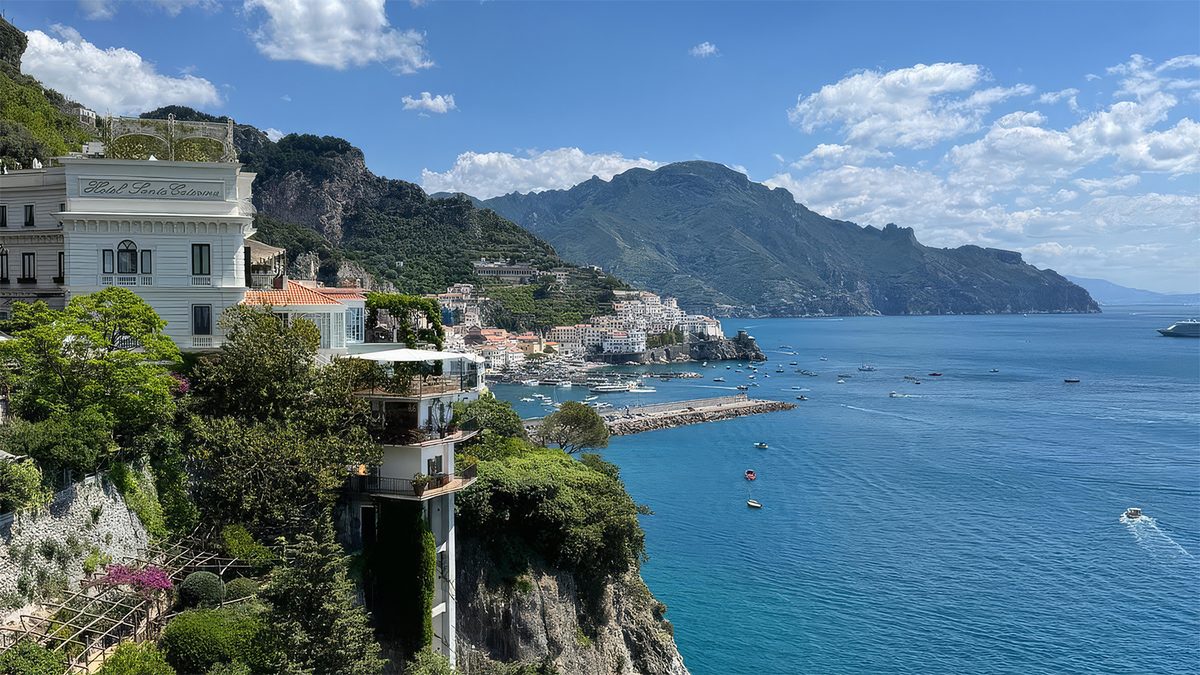
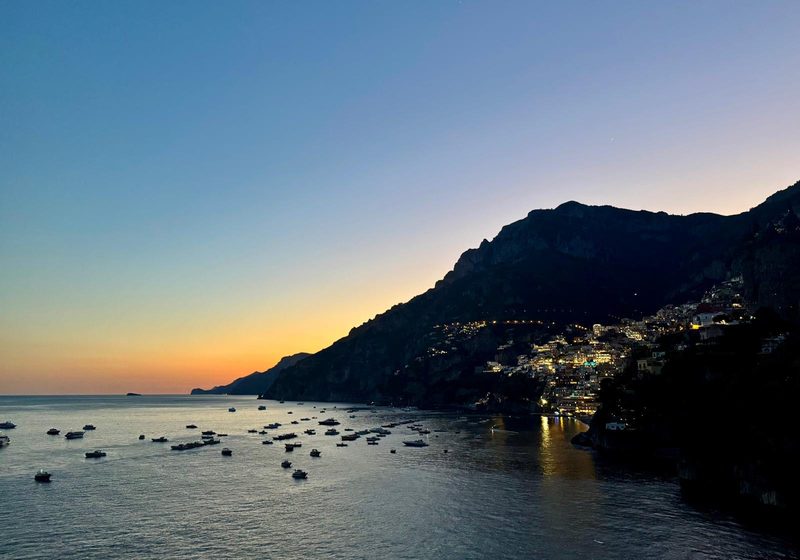
The idea for our Italy trip came with an invitation to a destination wedding on the Amalfi Coast, that picturesque stretch of fishing villages carved into the cliffs stacked high with villas. Six couples went in on a six-bedroom villa built into a seaside cliff in the town of Conca dei Marini (cove of the sailors). We flew to Naples, took a ferry to Amalfi and a taxi up the narrow, winding road to Villa Eris. Guidebooks warn tourists against driving on the Amalfi Coast. “These roads were made for donkeys,” said one of our drivers.
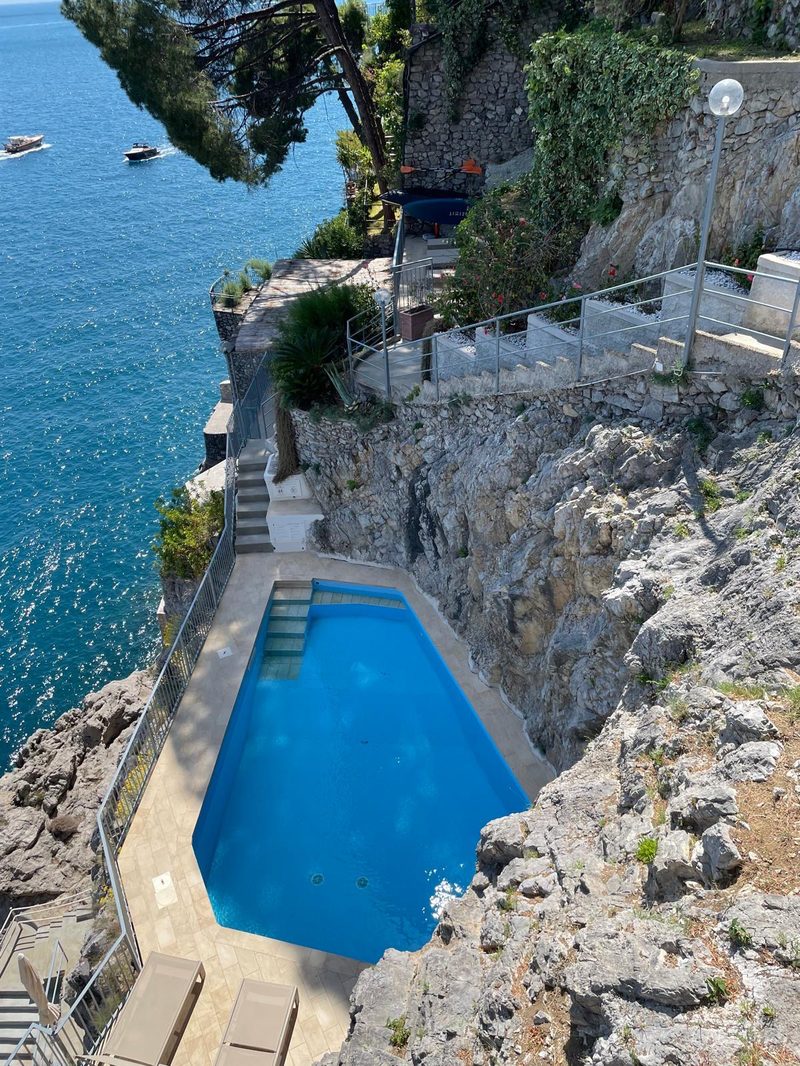
The view from our villa over the Gulf of Salerno never ceased to enchant us in the days before the wedding. We happily descended 150 steps to the pool and another 50 to a seven-rung aluminum ladder into the gentle Tyrrhenian Sea, made wavier by wake from passing yachts.
Our group visited Ravello, known for its lemon trees, colorful pottery, and literary figures like E.M. Forster, Virginia Woolf, and T.S. Eliot who loved it. We toured Villa Rufolo, a 13th century palace combining influences of Moors, Sicilians and Normans—who had all occupied the region. In 1880, Richard Wagner was inspired by Villa Rufolo’s gardens, views, and Moorish architecture to write his opera “Parsifal.” La Torre Maggiore, a 30-meter Moorish tower from 1334 A.D., has a unique flight of steps said to have inspired M.C. Escher.
We hiked Il Sentiero Degli Dei (The Path of the Gods), a rocky five-mile trail high in the mountains. The views over the cerulean sea made us expect to run into Jupiter or Juno at any moment. Returning to our villa, our van was delayed because Matthew McConaughey and Zoe Saldana were filming the Netflix series “Positano.”
The wedding was in the open-air ruins of the Basilica di Sant’ Eustachio, built in 1244 A.D. The dancing at the reception rivaled scenes from “Mamma Mia,” especially when the DJ played “Dancing Queen.”
The next day, our group took a boat ride past the picturesque ports like Maiori and Minori and into several grottos, many the legendary lairs of pirates. In one we swam through a cave. We cruised past Li Galli Islands, the home of the Sirens from “The Odyssey,” then around the Isle of Capri. Landing on Capri, we caught a ferry back to Naples, rented a car, and set out for Umbria and Tuscany. We had consulted Rick Steves’ “Italy,” picked four cities, and booked four recommended hotels for two nights each. We also downloaded his walking tours, which enhanced our experience walking the narrow slate and cobblestone streets of Orvieto, Montepulciano, Siena, and Assisi.
The history of each city includes a golden age of commercial and artistic productivity that was slammed by the Black Death in 1347 and 1353, which wiped out 60% of the population and opened the way for the Renaissance and Baroque artistic explosions.
The town of Orvieto is a former Etruscan city perched atop a hardened pile of volcanic rocks and ash. Hotel Duomo was a short walk from the Piazza del Duomo, the town square built around the Duomo di Orvieto, a masterpiece of Italian gothic architecture with pink and green layers of marble and an ornate façade topped with a fresco of Mary being crowned by Jesus. Inside, the nave is lined with marble sculptures of the apostles. The Chapel of San Brizio is decorated with frescos by Renaissance hotshot Luca Signorelli (1450-1523) showing the antichrist sermonizing to the population, then leading some to their damnation while the good folk ascend to heaven.
Montepulciano is another medieval town of Etruscan origin nestled atop a hill. We wended our way up narrow cobblestone streets, past the town square to the Locanda (Inn) di San Francesco, a four-room B&B attached to a restaurant in a palazzo that dates from the 14th century. Its piazza provided lovely views of Tuscan valleys. We walked down a narrow winding road through an old city gate to the Tempio di San Biagio. It was built starting in 1518 atop a previous church and a 14th century fresco “Madonna del Buon Viaggio” (Our Lady of the Good Voyage) whose eyes were seen by two girls and a farmer to repeatedly open and close. That miracle fresco resides above the altar.
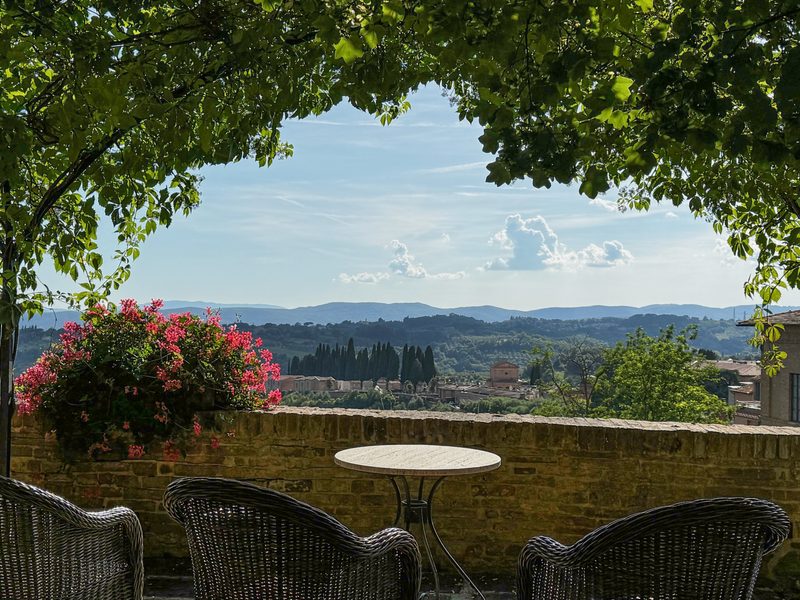
Siena was once a stopover for crusaders and pilgrims from Canterbury on their way to the tomb of St. Peter in Rome. At its peak, it was a commercial city that in 1260 defeated Florence in battle for dominance in Tuscany. The Piazza Del Campo is the secular center of the city, adjoining the city hall and a 330-foot tower, built around 1340. The Piazza is so simple in its gently sloping, amphitheater-shaped elegance that for years UT’s School of Architecture used a line-drawing of Il Campo as its logo.
On a Sunday morning in Il Campo, we witnessed a parade of young male drummers in medieval outfits playing an aggressive military tattoo. They were representing the Contrada (district) of Drago (the Dragon), one of Siena’s 17 rival contrade that compete each July and August in horse races around Il Campo.
The Duomo di Siena, with a striped bell tower and an ornate façade similar to that of Orvieto, is a cornucopia of artwork. Between 1501 and 1504 Michelangelo produced sculptures of saints Peter, Augustine, Paul, and Gregory for an altarpiece along the nave. The circular, ornate Chapel of the Vow (or Chigi Chapel) was designed by Bernini. It contains the Madonna of the Vow painted in 1260 by Dietisalvi di Speme in tempera and gold. We took the Porta del Cielo (Gate of Heaven) tour, ascending 79 steps up a narrow circular staircase (not for claustrophobics) to the dome’s cupola and roof.
The Santa Maria della Scala museum opposite the duomo was for centuries a hospital, where St. Catherine tended to the sick. Fifteenth century frescos in the former main hall tell the story. The museum descends several levels to chapels to Mary in low-ceilinged vaults deep in the earth.
Assisi is perched on the slopes of Mount Subasio. On a side street near the top of the city, a 2,000-year-old Roman aqueduct, still in use, delivers water from the mountains above to a small fountain. Assisi was a thriving commercial city when a young man named Francisco rejected his family wealth, tossed off his clothes, and dedicated himself to living in chastity, poverty, and obedience, with reverence to animals and nature. In the Duomo Di San Rufino, we saw the chapel and 11th century font where St. Francis was baptized, as was his Sunday School pupil St. Chiara (Clare), who followed him into the ascetic life and founded the Order of the Poor Clares.
The Basilica of St. Clare was built over her tomb in 1265. Stairs in the nave lead down to her tomb, where a shrine holds relics: her robes, her hair (in a silver box), and St. Francis’ blood-stained stocking from when he received the stigmata.
St. Francis’ childhood home was a few steps off the Piazza del Comune, where people still hang out by the fountain. From the piazza, we walked down the Via San Francesco, the busy main street, to the Basilica of St. Francis, begun in 1228, a destination for pilgrims from all over the world. You enter on the lower level and descend into the crypt to see Francis’ tomb. The nave of the Upper Basilica is decorated with 21 frescoes of St. Francis’ life. From Assisi we drove back to Naples, returned the car, and flew home, resolving after two weeks of hearing the melodies of Italian, to learn to speak it ourselves. Ciao bene!
→ Swipe for Next Story
Dining GuideSEPTEMBER OCTOBER 2026
Lonesome Dove Western Bistro
Texas swagger, wild game, and a well-traveled chef make for a unique experience in an iconic Old City saloon.
Story by N. Brooks Clark Photography by Ethan Smith
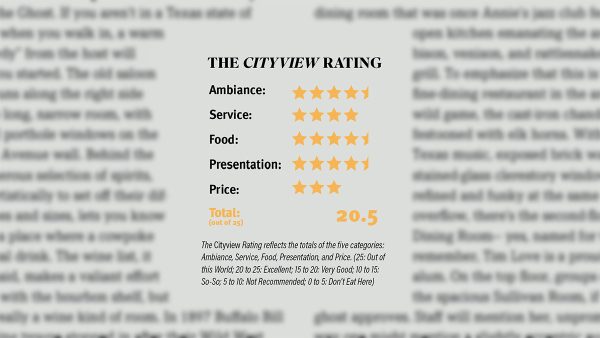
Lonesome Dove Western Bistro occupies the renovated Patrick Sullivan’s Saloon, the red 1888 brick Victorian building with Queen Anne-style gabled roof and turret that once housed a bordello on its third floor and, occupants swear, is haunted by Clara the Ghost. If you aren’t in a Texas state of mind when you walk in, a warm “Howdy” from the host will get you started. The old saloon bar runs along the right side of the long, narrow room, with barred porthole windows on the Jackson Avenue wall. Behind the bar, a generous selection of spirits, arranged artistically to set off their different shapes and sizes, lets you know that this is a place where a cowpoke can get a real drink. The wine list, it should be said, makes a valiant effort to compete with the bourbon shelf, but this is not really a wine kind of room.
In 1897 Buffalo Bill Cody’s touring troupe stopped in after their Wild West Show. A brawl broke out, and Cody fired his six-shooters into the ceilings and walls to restore order. Four years later Kid Curry picked a fight with a patron and shot two deputies who tried to break it up.
Like a western movie set, the balcony level of timber-frame beams runs down the left side of the saloon, giving diners the option of tables looking down on the bar or ones beneath the balcony with the intimacy of a low ceiling.
These and many other details echo the vibe of celebrity chef Tim Love’s famous restaurants in Fort Worth and Austin, Texas. The dining room that was once Annie’s jazz club features an open kitchen emanating the aroma of bison, venison, and rattlesnake on the grill. To emphasize that this is the only fine-dining restaurant in the area offering wild game, the cast-iron chandelier is festooned with elk horns. With twangy Texas music, exposed brick walls, and stained-glass clerestory windows, it’s refined and funky at the same time.
For overflow, there’s the second-floor Fulmer Dining Room— yes, named for the coach; remember, Tim Love is a proud UT alum. On the top floor, groups can rent the spacious Sullivan Room, if Clara the ghost approves. Staff will mention her, unprompted, the way one might mention a slightly eccentric aunt who still comes to Thanksgiving.
We missed good food. We grew our own stuff, cooked our own stuff. Cooking was surviving.
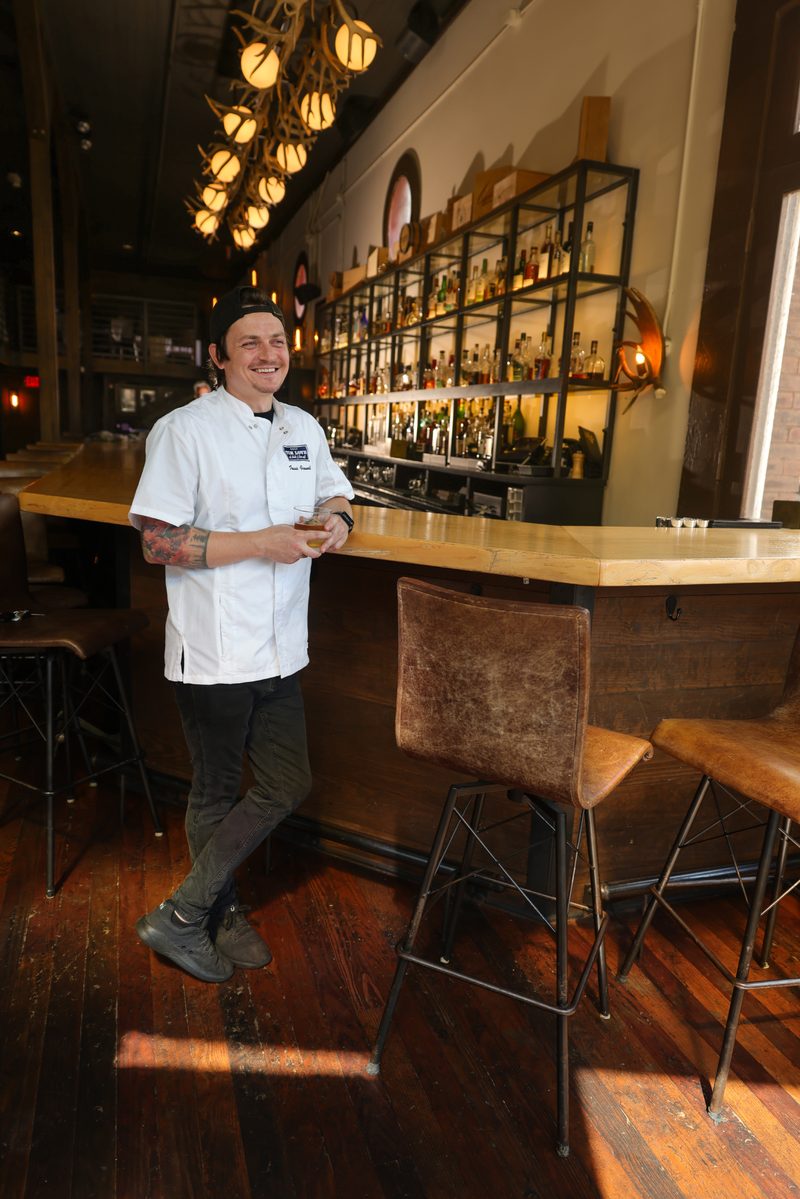
Executive Chef Travis Freundt came to Knoxville from Love’s Amalfi Coast-influenced Gemelle restaurant in Fort Worth. In January, Freundt asked to be transferred to Lonesome Dove, in part to be closer to his adopted family in Franklin, Tennessee. Freundt was born in Russia and raised in a Ukrainian orphanage starting at age 10. In a way, his cooking career began there. “We missed good food,” he says. “We grew our own stuff, cooked our own stuff. Cooking was surviving.”
When he was 12, he was adopted by the Freundt family from Franklin. After attending several Franklin-area schools, he moved to Joshua, Texas, with an older sister and finished at Joshua High. He got his associates degree in Hawaii, surfed for a couple of years, then returned to Nashville and cooked at the Sutler Saloon and Nada.
Out of the blue, he was stunned to find out that a biological father he never knew about lived in Sacramento. “I went to meet him,” said Freundt. “He’s an osteopathic physician. I met a half-brother.” In Sacramento, Freundt cooked at Camden Spit & Larder and at Allora Italian restaurant.
A brawl broke out, and Cody fired his six-shooters into the ceilings and walls to restore order.
After a while, he moved back to Fort Worth and sous-cheffed for Les Margot and the Press Café before catching on at Gemelle. Freundt’s menu reflects not only Tim Love’s adventurous offerings but also the variety of Freundt’s culinary travels.
Generally, the servers lead you through the menu, taking orders for all courses all at once, so that Fruendt and his crew can orchestrate the arrival of different courses. The tour guides are well informed and enthusiastic about their unique dishes, which they are happy to split up for family-style sharing. If you put your trust in them, they will provide a memorable evening.
Ours began with Deviled Gulf Coast Blue Crab Cakes, served in a shell with Lonesome Dove Hot Sauce. These alone are worth a visit.
Then came the Montana Elk Sliders with blueberry jam that are a signature staple, followed quickly by the surprising Wild Boar Ribs, with Lonesome Dove BBQ Sauce and escabeche. Compared with regular pork ribs, wild boar ribs have a sweeter, more nutty taste. These baby back ribs are surprisingly small, even dainty but we still thought of the wild boar we hear about impaling unfortunate Texans with their enormous tusks.
Staff will mention her, unprompted, the way one might mention a slightly eccentric aunt who still comes to Thanksgiving.
The Texas Red Chili with avocado corn salsa, smoked Gouda, crema, and crispy tortilla is another longstanding favorite worth dropping in for. It’s got a unique taste and a kick.
We sampled two salads, the Butter Lettuce with red chili-buttermilk, lardons, goat cheese, chili pepitas, and pickled jalapeño, as well as the locally sourced Baby Gem Lettuce in anchovy-lemon vinaigrette with parmesan cheese and toasted breadcrumbs. This salad is light and the lemony vinaigrette was a nice contract with the course that followed.
Our main dishes included Montana Bison Ribeye with fried, smoked Gouda gnocchi, grilled asparagus, and Hollandaise sauce. A sizeable portion, this ribeye is rich, juicy, and flavorful, perhaps enough for two.
The Ora King Smoked Salmon comes with creamy cucumber salad, beet purée, potato galette and chimichurri. A product of New Zealand, the salmon is fattier than the average and rich in flavor.
We still thought of the wild boar we hear about impaling unfortunate Texans with their enormous tusks.
Freundt offered a new dish, a smoked Chicken Poussin, a baby chicken brined, baked, and smoked and served whole. It is juicy with a delicate smokey taste.
Among a handful of sharable sides, the Burnt Carrots in Texas honey, lemon, and goat cheese along with the Truffle Mac & Cheese topped with fried artichoke hearts stood out.
For dessert, we had the Tuaca Flan, tasting of cappuccino Tuaca liqueur, as well as the dessert that helped Tim Love win Iron Chef America, his Ancho Chile Chocolate Cake with vanilla ice cream and smoked almond brittle.
By the time the check arrives, you’ve eaten things that would have seemed improbable an hour earlier. Boar, bison, rattlesnake, and a chocolate cake that won a man an Iron Chef title. That’s the trick of the place: it could easily lean into novelty and instead just quietly cooks very well, ghost and all.
It could easily lean into novelty and instead just quietly cooks very well, ghost and all.
→ Swipe for Next Story
OutdoorsSEPTEMBER OCTOBER 2026
Outdoor Mishaps & Tales of Woe
Years of outdoor experience don’t prevent spectacular mistakes, but they do make for unforgettable campfire stories.
Story by John Quillen Photography by Molly Herb
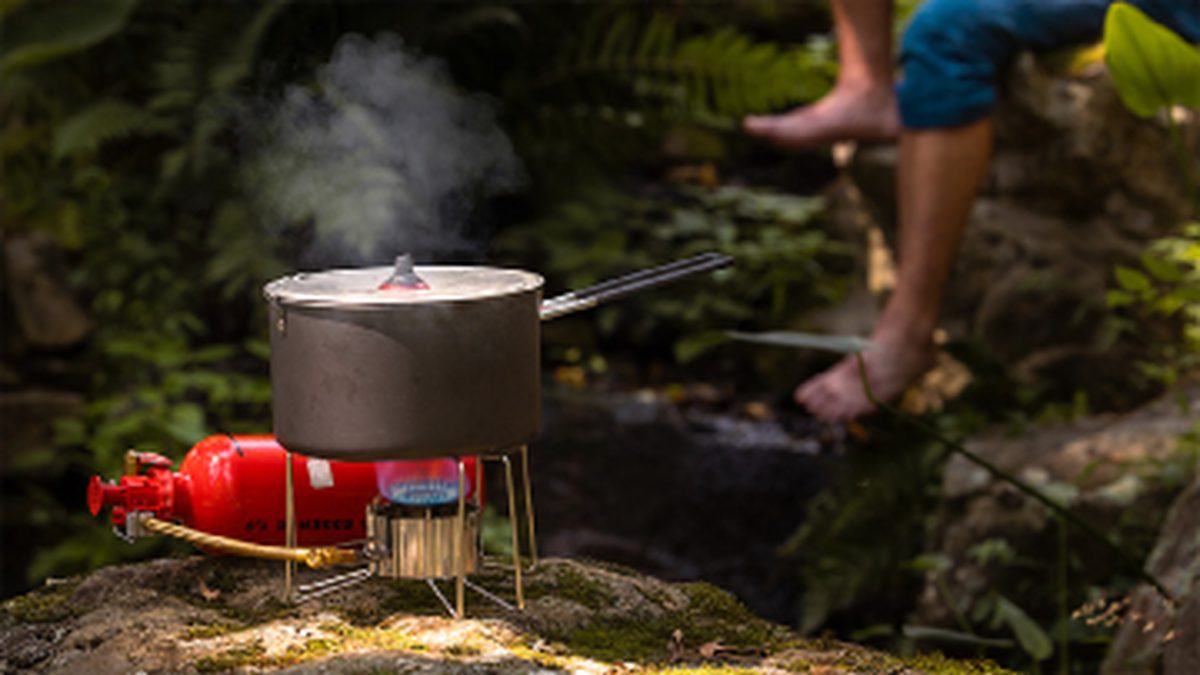
It started as a conversation over breakfast with Cityview publisher Nathan Sparks and editor Kirk Edwards. Somehow, we got into the topic of old school backpacking gear. Nathan was telling me about an antique Svea stove he once had. My friend John Dempsey still uses his. The ignition process is borrowed from NASA. It involves the atomization of whatever liquid fuel you're using and potential loss of eyebrows.
That led me right into my story about an old Whisperlite stove. It borrows the same principle of light and hope. Back in the early nineties, outdoor technology had not quite evolved to the simplistic canister stoves we presently enjoy. The Flaming Tent
One weekend I was doing a backpacking loop which concluded in our final night at campsite twenty-nine on Maddron bald. Accompanying me on this sojourn was a coworker named Philip. The weather was typical Smokies: off and on thundershowers with the occasional respite. The last tent pegs were being hammered into the ground, when a monsoon began in earnest. Philip and I slung waterlogged packs into the tent, falling over one another to escape the deluge.
Starving from the long day's slog, we began to turn our attention towards dinner. This storm had also settled in for the night. I had never cooked in a tent before, but this one was seemingly designed for that purpose. It was a gift from my Aunt Shelby for Christmas to me and my brother Todd. It sported the unique feature of having a zip out area on the floor for cooking. This was critical given the priming delicacy of a whisper light stove. I attached the white gas bottle and began slowly pressurizing the system, Philip decided to take advantage of this opportunity to step outside and visit nature. He must have had some premonition about what was soon to happen.
I unzipped the vestibule to create cross ventilation, cognizant of that danger. When enough Coleman white gas was released into the priming cup, I grabbed my lighter and began the ignition process, as I had done hundreds of times. Everything seemed okay until I noticed that some of the fuel had spilled out onto the actual tent floor. In a matter of seconds, the entire domicile was ablaze. I started throwing our bedding out onto the raining ground as melted nylon dropped like napalm onto my face and hair. Philip reeled in horror as I sat there on my hands and knees, in the midst of a flaming ruin trying to save our gear from vaporizing. I looked like Wile E. coyote after he mistimed a fuse on his ACME trap; crouched inside the bony, dripping remnant of a shelter, with singed hair and eyebrows. We laid that evening beneath charred frame poles, draped with rain jackets as trickling rain cooled my now burned forehead. Runaway Ski "Look out below"
I looked like Wile E. Coyote after he mistimed a fuse on his ACME trap.”
I would like to say that's the only mistake I've made in my outdoor life. However, many years later, on the slopes of beautiful Mount Rainier outside Seattle, we came pulling into Camp Muir after an epic day of ski mountaineering. The mountain held its largest snowpack in decades. So expansive in fact it took us an extra 4 hours to reach our camp from which we were going to attack the summit.
Both Brian Moran and I had summited this peak before. This was merely a side quest en route to our main objective. We were heading to Western China to do this for a month. Rainier was going to be our fitting out ground. Although I'm a fairly good downhill skier I didn't have a lot of experience going uphill on them. With 55 pound packs, the slog into camp ate most of our day. We found ourselves arriving as the waning sun began to drop into the Pacific. Our peak plans came into question.
Were it not for having to catch a flight the next night half way around the world, we would have pushed on, but I think we made the right decision to make high camp our summit on this climb. I was exhausted and for once, didn't care that we weren't going for the top. We dug a camp at 10,000 feet in the shadow of Mount Shasta and Hood, settling into our tent for the night. Our neighbors' headlamps bobbled up toward the summit crater like ants after midnight.
It was a great summit night for them, and we congratulated many of our new friends on their descent as we lounged about sipping coffee. Not in any particular hurry I indulged the second cup. We packed up the tent and all our belongings and I anticipated a beautiful and flawless ski descent back down to Paradise Ranger Station. After all that was why we were here. The rising sun was making those snow conditions just right. I figured it wouldn’t take me more than 20 minutes to float this hard-earned ground from the previous day.
“All these misadventures make for good campfire stories. But the real truth is that we do it just for the pure hell of it.”
Brian took off ahead of me on snowshoes as I started securing the skis to my boots. A day hiker was coming up the glacier and started asking me about my ski plan. That's when I laid the second one down and started to step into it like I just stepped off a gondola. Because they weren’t traditional downhill skis, they were unequipped with brakes. And we both froze in horror as my single ski launched like a projectile down toward a throng of ascending mountaineers.
It's funny now when I think about a queue of hikers approaching this very important marker on their ascent, now having to dodge this missile coming down off the side of Mount Rainier. But it wasn't so funny then when I had to walk down with one ski and a full pack to retrieve it. My ski descent was shot. If there was a positive aspect it is that no one was injured by this ignorance except me, my pride, and calf muscles carrying skis downhill after toting them up for no reason now.
This was truly a harbinger of events for me a couple of weeks later in China . I didn't realize that I would also be coming off a big mountain called Muztagh Ata with one ski but for a different reason as has been mentioned in a previous article. The Making of Great Stories
Someone once dubbed mountaineers as conquistadors of the useless. In this realm we employ tools that seem to have zero real-life application. Be it blowing up a tent or sending an RPG down the slopes of Mount Rainier, these mistakes in no way translate to my daily world. But I know why we put ourselves through this. All these misadventures make for good campfire stories. But the real truth is that we do it just for the pure hell of it. It's kind of like slamming your hand in a car door. It feels so good when you stop, scrape the nylon from your forehead and sling your skis into the rental car at the end of an adventure.
We both froze in horror as my single ski launched like a projectile toward a throng of ascending mountaineers.”
→ Swipe for Next Story
WellnessSEPTEMBER OCTOBER 2026
Peptides Part II
Promise, Hype, and a Regulatory Fog
Story by Dr. Edwin Spencer Photography by Ethan Smith
As an orthopaedic surgeon, one question followed me from exam room to exam room: “Doc, how can I recover from this surgery or this injury faster? Is there something I can take?” For most of my career, the honest answer was “nutrition, sleep and exercise – which I still whole heartedly support.” But over the last few years, another answer has started showing up, whispered in gyms and shouted on podcasts: peptides. Does that something finally exist? Let’s talk about it.
First, let me be upfront: I’ve used peptides during my own recovery from knee surgery, and I’ve watched them help my patients heal. I’m a believer in their potential. But belief isn’t evidence, and medicine gets into trouble when we conflate the two. That’s exactly why we’re launching OPEN — the Orthopaedic Peptide Evaluation Network — a national registry to track how peptides actually perform, in real patients, in the real world. Instead of chasing whatever the internet is excited about this week, we need data that protects people. And the internet is excited: the #Ozempic hashtag alone has passed 690 million views, videos tagged “peptides” top 50 million, and as many as one in six Americans has now tried a GLP-1.
So, what is a peptide? Simply put, it’s a short chain of amino acids — the same building blocks that make up proteins, just smaller. Where big protein chains form the structure of our cells, these little ones act as signals and messengers, telling the body what to do.
I used to think that peptides were simply a gym bro thing. But as it turns out, the story spans a century of serious medicine. Insulin, first used in 1922, opened the era of peptide drugs. Vancomycin, a workhorse antibiotic, is a peptide; so is captopril, a blood-pressure medicine. GLP-1, the hormone behind Ozempic, was discovered in the 1980s; the first GLP-1 drug, exenatide, originally found in the saliva of the Gila monster, was approved in 2005. However, the cultural explosion waited until semaglutide’s 2021 obesity approval. The point: peptides aren’t fringe. They’re proven medicine which is exactly the credibility today’s trendier peptides are leaning on.
Let’s walk through the popular ones in three groups.
The Healing Peptides
The most talked-about is BPC-157 (Body Protection Compound), first described in 1993 by a Croatian group that isolated it from gastric juice. In animal studies the results look genuinely exciting - it boosts the signals that build new blood vessels and tissue and speeds healing of injured ligaments. The catch: almost all of that data is from rodents. Human evidence is mostly anecdotal. We do have a small published report using BPC-157 injected into arthritic and injured knees, with about 90% of patients reporting pain relief - encouraging, but a tiny retrospective review with no control group.
BPC-157 is often paired with thymosin beta-4 (or its fragment, TB-500) in what gym-goers call the “wolverine stack.” Thymosin beta-4 lives throughout the body and promotes cell migration, new blood-vessel growth, and lower inflammation. Unlike BPC-157, it has real human trial data — though mostly in eye and skin conditions, with the heart-repair work still largely in animals.
The performance peptides
The questions I get most, usually at the gym, are about growth-hormone secretagogues. More growth hormone, more muscle, right? The appeal is real, but so is the nuance. As we age, our natural growth hormone falls. Peptides like sermorelin, tesamorelin, and CJC-1295 nudge the body to make more of its own growth hormone while preserving the natural rhythm and the “off switch” that keeps levels from running away - a meaningfully safer design than injecting growth hormone directly. On the regulatory side, tesamorelin is FDA-approved, while sermorelin was approved years ago and is now used mostly in compounded form. The good news: you can raise growth hormone for free through resistance training, consistent sleep (your biggest surge comes in the first hours of deep sleep), and not eating in the 2–3 hours before bed.
The metabolic peptides
By far the most popular are the GLP-1s. Beyond weight loss, they lower inflammation and cut cardiovascular events even independent of the pounds lost. The generations are stacking up: semaglutide (GLP-1 alone) delivers roughly 15% weight loss; tirzepatide adds a second hormone, GIP, for about 20%; and retatrutide adds glucagon on top, pushing toward 25% in early trials.
In practice, I’ve seen injury and post-op protocols that sequence peptides. The healing peptides early, for cell migration and blood flow, then the growth-hormone secretagogues later, for tissue maturation. That’s the protocol I used myself, and so did many of my patients. The results were fantastic - but that phrase, “were fantastic,” is exactly the problem. It’s anecdote, not true data. One caveat for competitive athletes: essentially all these regenerative peptides are banned by the World Anti-Doping Agency, so collegiate and pro athletes can’t touch them. The rest of us can but the ground is shifting under our feet.
“I’m a believer in their potential. But belief isn’t evidence, and medicine gets into trouble when we conflate the two.”
The rules of the road (and why they keep changing)
Most of these peptides are made by compounding pharmacies, which means you need a prescription. To understand the headlines, it helps to know there are really three rungs on a ladder, and the news constantly treats them as one.
Rung one was an interim categorical (three categories) holding pattern the FDA used while it sorted through nominated substances - a “we won’t come after you while we decide” status is Category 1. Rung two is the real, permanent destination: the “503A bulks list,” the official roster of substances compounding pharmacies are actually allowed to use. And rung three is full FDA approval — the gold standard, requiring a New Drug Application and Phase 1, 2, and 3 human trials, at a cost of hundreds of millions of dollars and many years.
Now the saga. Most of these peptides were nominated around 2015, then sat in limbo for years neither blessed by being put category 1 or on the bulks list but also neither banned. Then in September 2023, the FDA dropped roughly 19 peptides into its “do not compound” category 2 list; some sellers pivoted to “research use only,” a loophole that skips the prescription. However independent labs testing those products found wrong doses, poor purity, and contaminants. Then the winds shifted. In early 2026, HHS Secretary Robert F. Kennedy Jr. - a self-described “big fan” who says he’s used peptides on his own injuries - pushed the FDA to reconsider. In April 2026 the agency pulled about a dozen back out of the banned category 2 (not legal, just back to limbo) and scheduled its Pharmacy Compounding Advisory Committee (PCAC) to review seven.
So what happened?
The committee met on July 23 and 24, 2026 — and in a series of close votes, it recommended six of the seven peptides for the 503A bulks list, including BPC-157 and TB-500. Here’s the part that captures the whole strange moment: the committee overruled the FDA’s own scientists, who had already reviewed the evidence and recommended against all seven, saying the safety and effectiveness data simply wasn’t there.
How does that happen? Picture four sets of hands on the same wheel. The FDA’s career scientists said no. The advisory committee just voted yes. The FDA asks that committee for advice, hands it the scientists’ analysis, and then isn’t bound by either one. And above all of it sits Secretary Kennedy, who oversees the FDA, started this reconsideration, and has already announced which answer he wants.
“The landscape, in short, is clear as mud, and patients and providers are stuck in the middle.”
So is it settled? Not remotely. A committee recommendation is just that - a recommendation. For these peptides to actually become legal to compound, the FDA still has to complete formal rulemaking, a process that realistically runs into 2027 and requires the Secretary’s sign-off. Nothing is legal to compound today that wasn’t legal prior to the PCAC vote. And the story isn’t over: a second PCAC meeting to consider five more peptides is expected in February 2027. The honest answer to “are these legal?” remains “ask again in a few months.”
The bottom line
The landscape, in short, is clear as mud, and patients and providers are stuck in the middle. A few peptides are solidly FDA-approved - the GLP-1s, tesamorelin, and sermorelin among them - but many live in the gray. If you’re curious, find a practitioner who actually knows this space and will talk it through with you. And if you find peptides online that are suspiciously cheap, remember the oldest rule there is: when something seems too good to be true, it usually is. Don’t gamble with your health.
Because here’s the real bottom line: there is no magic bullet. Nothing substitutes for proper nutrition, consistent sleep, and regular exercise in all its forms. Even the GLP-1s surrender their gains to weight rebound if the behaviors don’t change, and without strength training they can cost you real muscle. I believe the regenerative peptides can genuinely improve healing - but only once those other boxes are checked. I’m glad we’re seeing a broad push toward better health and real curiosity about how peptides might help. Now we need the data to guide it - and that’s exactly what we hope to build with OPEN.
→ Swipe for Next Story
Dining GuideSEPTEMBER OCTOBER 2026
Smoke Signals
Three Knoxville Barbecue Spots Serving Up Unforgettable Flavor
Story by Caroline Williams Photography by Ethan Smith & Caroline Williams
You smell it before you see it. In East Tennessee, smoke rises like a signal fire, thin and steady, calling you off the highway toward something worth stopping for. Follow it far enough, and it almost always leads somewhere good.
Over the course of several days, I followed that smoke to three very different barbecue restaurants, each with its own philosophy, personality and story. Some were tucked away in small towns. Others have become Knoxville institutions. But every stop had one thing in common: someone had spent the night tending a smoker so lunch would be worth remembering.
My first stop took me to Friendsville and Small Town BBQ, tucked inside a beautifully restored antique store. Owner James Delone started the business as a food truck before putting down roots nearly a decade ago, growing it into a multi-time Best of Blount County winner. Walking through the front door felt less like visiting a restaurant and more like being welcomed into someone's hometown gathering place, where generous portions and friendly conversation are just part of the experience.
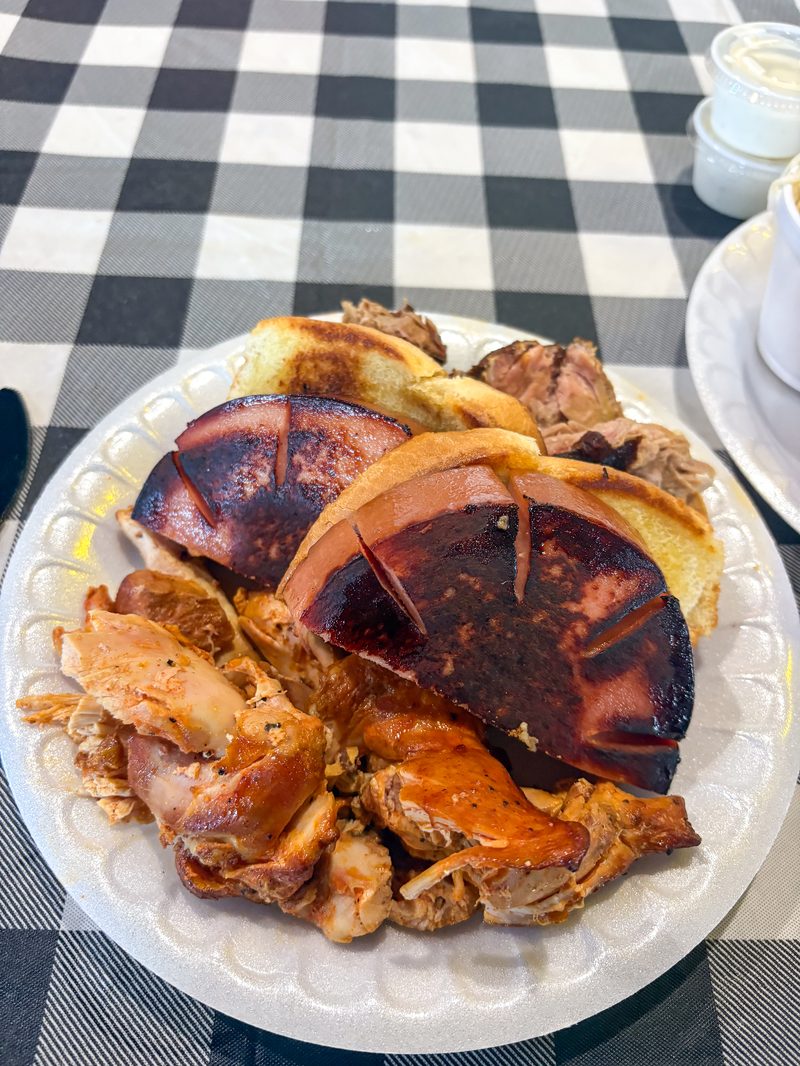
From there, I headed to Dead End BBQ, where trays arrive piled high enough to make you pause before deciding where to begin. The restaurant has earned national recognition, but what struck me most wasn't the accolades—it was the confidence. Every slice of brisket, rack of ribs, smoked bologna and competition-winning chicken seemed to have earned its place on the platter, while inventive sides proved they deserved just as much attention as the barbecue itself.
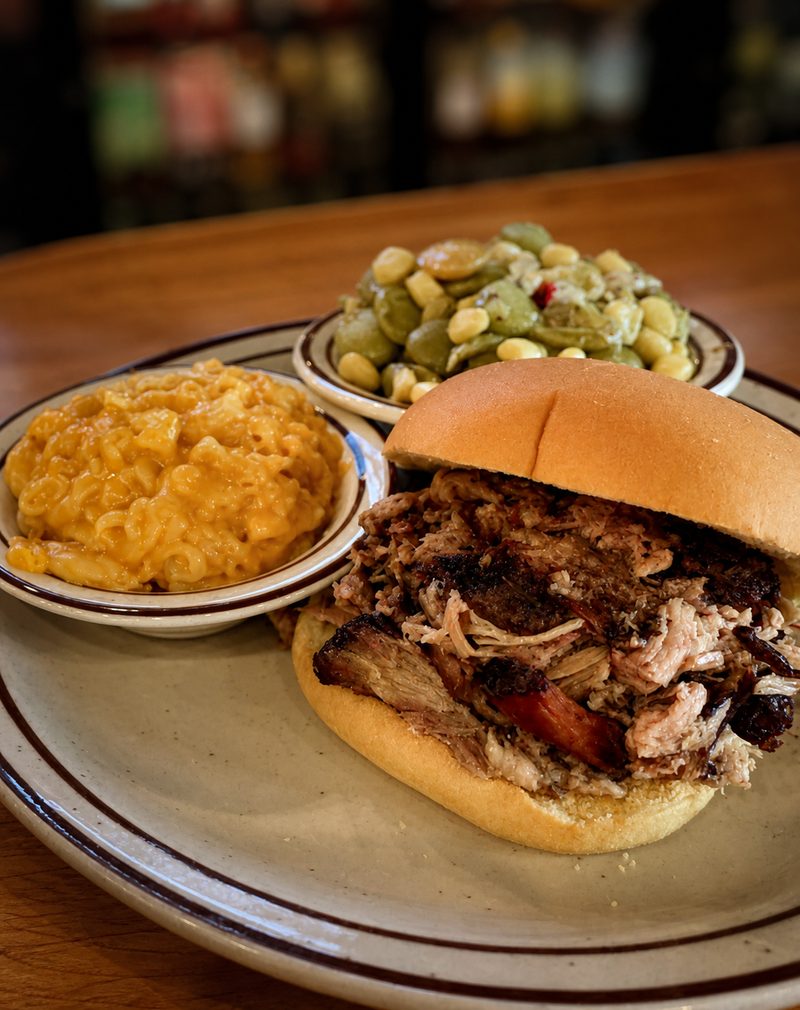
My last stop brought me to Sweet P's BBQ, where two smokers work through the night, low and slow, before the sun ever comes up. Their approach is refreshingly simple: season the meat with a proprietary rub, let the smoke do the work and leave the sauce on the table. It's the kind of quiet confidence that comes from knowing the barbecue can stand on its own.
By the time I wiped the last streak of barbecue sauce from my hands, I'd driven miles, met pitmasters who still lose sleep over getting the smoke just right and eaten enough pulled pork to last me awhile. But what stayed with me wasn't just the food. It was the care behind it. In every smoker, every recipe and every conversation, there was the same quiet belief that great barbecue can't be rushed.
Around Knoxville, the smoke isn't just a sign that lunch is ready. It's a reminder that some of the best meals are still worth waiting for. Dead End BBQ I shared a platter of pulled pork, sliced brisket, ribs, chicken thighs, and smoked bologna, alongside jalapeño cornbread, Texas toast, and the famous Burny Mac. This pimento mac and cheese topped with brisket burnt ends was named one of the Top 10 BBQ dishes in America by Food Network, and it’s easy to see why. The menu’s competition-winning chicken thighs, which took first place at the Jack Daniel’s Invitational, lived up to their reputation with tender meat and a rich smoky flavor. The standout for me, though, was the roasted sweet potatoes, which were drizzled with hot honey and finished with goat cheese. They brought a sweet and savory contrast to the smoky meats. For dessert, the Pond Gap Pie delivered a rich finish with chocolate pudding layered over a housemade Oreo crust and topped with Cool Whip and Oreo crumbs. Sweet P’s BBQ I kept it simple with a pulled pork plate piled onto a potato bun, paired with mac and cheese, lima beans, and a slice of cornbread topped with melting butter. The pork was tender and smoke-forward, letting the seasoning shine without needing much else. But the real star was the mac and cheese. A customer favorite, it was creamy, rich, and so good it disappeared off my plate far too quickly. Sweet P’s also keeps its sauce lineup interesting, offering a thick Tennessee-style tomato-based sauce, a North Carolina-inspired vinegar sauce, and a hot sauce that blends the two with a chipotle kick. True to the restaurant’s philosophy, the sauces stayed on the table, giving diners the choice to add their own finishing touch.
Small Town BBQ
I ordered the Trio, a generous sampler of pulled pork, pulled chicken, and smoked bologna, which was my first time trying the Tennessee barbecue staple. The pork was tender and smoky, the chicken carried a subtle depth from the pit, and the bologna was caramelized around the edges with a savory, almost nostalgic flavor. The plate came with crispy fried okra served with housemade ranch, a honey-Sriracha coleslaw made with a sweet honey base and balanced with just a touch of heat, and a loaded potato salad packed with bacon, cheese, and ranch seasoning. Every bite felt like comfort food done with care. Small Town BBQ has earned Best of Blount County honors several times, including a recent win for Best Ribs, and it’s easy to see why. I’ll have to make a return trip for the Nutter Butter banana pudding, a peanut butter twist on the classic Southern dessert that wasn’t available the day I visited but is already on my list for next time.
→ Swipe for Next Story
Arts & CultureSEPTEMBER OCTOBER 2026
Time travel
Century-old cameras. Cutting-edge tech. Knoxville's Bruce McCamish is proof that the best way forward in photography might be looking back.
Story by Bruce McCamish
Creatively, Bruce McCamish stands with both feet firmly planted in the past. But that doesn’t mean he doesn't also adapt to the future.
A native Knoxvillian and longtime professional real estate photographer, McCamish says he’s photographed more than 8,000 homes. (Some of those homes have been pictured in Cityview over the past 15 years.) “And they each have a story, and those stories touch me. But they don’t feed my passionate side because they don’t say anything about me.”
During the COVID pandemic, when real estate was keeping him (way too) busy, he started searching for what fed him creatively. He reverted from digital to film photography and began collecting cameras from 100-plus years ago. “That pushed my horizons past the comfort level.” He started shooting primarily in black and white and on various size films. He found a photographer with similar interests in Texas to develop his film. “What they produce is a cool, grainy, ethereal image unique to itself,” he says. “That’s what I love.”
Despite that love for the old way of working, McCamish also uses technology to digitize and reproduce his work, and he dabbles with AI to enhance some of his images. He understands the complexities it presents but says "every generation has had something new it’s fighting against.”
Long influenced by the work of the late Jim Thompson, McCamish was approached by Friends of the Smokies to reshoot about 150 images that Thompson took in the mountains 100 years ago. He’s both thrilled and challenged by the project that he expects will take up to two years to complete. “I’m buying the cameras that Thompson and Carlos Campbell and George Massa and Ansel Adams used. Some shoots will be roadside and some will be hiking. And that camera gear is heavy on a hike.”
McCamish says he spends at least one day a week in the Smokies with his cameras. “I have to go early or late when the crowds aren’t so bad, and sometimes I go when the weather’s bad. I like the moody skies.” A forestry major when he was a student at UT, he enjoys getting back to the environment he loves.
His photography career began around age 12 taking photos of birds in his family’s back yard in Chilhowee Hills. As he moved into shooting real estate, he sent his cameras into the air via helium balloon and 50-foot pole to gain fresh perspectives on often-seen subjects. “An elevated perspective makes people want to stop and look at an image,” he says. You can follow McCamish on Facebook and learn about occasional shows of his work there.
But he gives credit for his way of seeing things to spending summers on the Jamestown farm that belonged to his grandparents, Stella and Chester Looper. “When you look through a lens, you see the finite; you see the world through a tube. Growing up on the farm, I learned about the finite parts of nature, how one thing is tied to another. I saw the little things in life and saw the beauty in them.”
→ Swipe for Next Story
InsightsSEPTEMBER OCTOBER 2026
Where Did It Go?
A friend's death, and the philosophy of life he wrote as a teenager, has one writer asking what it really means to run out of time.
Story by George Doebler
Time – is it a part of my life that I can guide, control, enjoy? Or does it (whatever it is) control me? Does it pass so quickly in my life that I am overwhelmed by it?
I am at an age (time) in my life where people I have worked with, played with, and loved are dying, their time coming to its end. Their “warranty has run out”, so to speak. In October of last year, a friend who I admired died of Lou Gehrig’s disease (also known as ALS). He was a vibrant personality. Even in the course of dying and becoming unable to walk or speak, his presence was significant.
At the memorial event in June, his daughter read a letter her dad had written. It was his philosophy of life: how he experienced marriage and friendship, and what he hoped he could do for others. Afterward, she sent me a copy of what he had written. I was amazed at how clear his philosophy and idea of time and goals in life were. He was eighty-three when he died, but the philosophy of life he had written, and that his daughter had read and shared, was written when he was in high school as a writing assignment in English class!
Joseph somehow had learned in his early life, in his family from his mom and dad, what his life (time) was meant to be about. He went on to live a very successful life, and now that he has passed, his words have made me wonder: is it somehow possible when we wonder about “where has the time gone?” that we are asking “how have I lived my life, and what am I doing with life now?”
As it did with Joseph, life starts with the family. For our early years (time) they are our entire lives, and for many of us they remain a substantial part of it throughout our lifetimes. Is it possible that how we have lived and spent our time has something to do with the family we were born into? Is it possible that my being the oldest brother in my nuclear family has something to do with how I live and spend time? Is it possible that how I spend time may have to do with not just my immediate family, but the generations of Doeblers, Stuckings, and Zappas that have gone before me?
Knowing more about grandparents, even great-grandparents, can perhaps teach us about our time here in this place we find ourselves. Not easy for those who do not know about their family histories. It seems we do not want to look much at history today, even if it was an important part of who we are.
The world we seem to live in now focuses on increments – minutes, hours, days, etc., small bits and pieces, some of which are deceiving. The “News Hour” on the major outlets, for instance, is really only 15 minutes; the rest of “the hour” is advertising something. (The stations also work together so that you cannot ‘switch stations’ to better use your time; they all ‘advertise’ at the same time). Media does have a lot to say about how our time is spent, but how much of it we give to media says a lot more about each of us than it does the media.
But Joseph’s Philosophy of Life wasn’t about the media, and I’d like to come back to that now. When he was 16-17 (time), he wrote: “The happiness I am looking for will come to me when I marry the girl I have described. We will work toward similar goals, in compatible ways, accepting each other’s beliefs and ideals as equally valid and valuable as our own. I will comfort her when need is there, not the exception. We will serve each other gladly, physically and spiritually.”
Joseph learned to live – spend time, give time, share time – very early in life. Looking back into the family that each of us grew up in can be a tool into seeing where our ‘time’ has gone and is going. And perhaps that can help us shed the feeling of overwhelm we sometimes feel when we look at our lives and help us look forward to what still lies ahead.
→ Swipe for Next Story
FeatureSEPTEMBER OCTOBER 2026
built on connection
Story by Nathan Sparks Photography by Bruce McCamish
“Sometimes you meet a client and within the first five minutes you just know,” says Ron Bills of Providence Builders. “You realize you’re going to have fun together. You share the same vision, the same values—and you can’t wait to get started. That’s the kind of relationship that produces something truly special.”
Ron has spent two decades building some of East Tennessee’s finest custom homes, and along the way he’s learned to trust that first instinct. I understand exactly what he means, because I felt it too, the moment I met him and his wife Diane, who is also his business partner. That instinct has only deepened with time—what began as a professional relationship has grown into a genuine friendship with both. Ron didn’t set out to build houses; he arrived at it through a winding career that taught him how to lead people, and it shows in everything he does. Diane shares his eye for building as well, but her gift lies in something just as essential: making every client feel like the only one in the room.
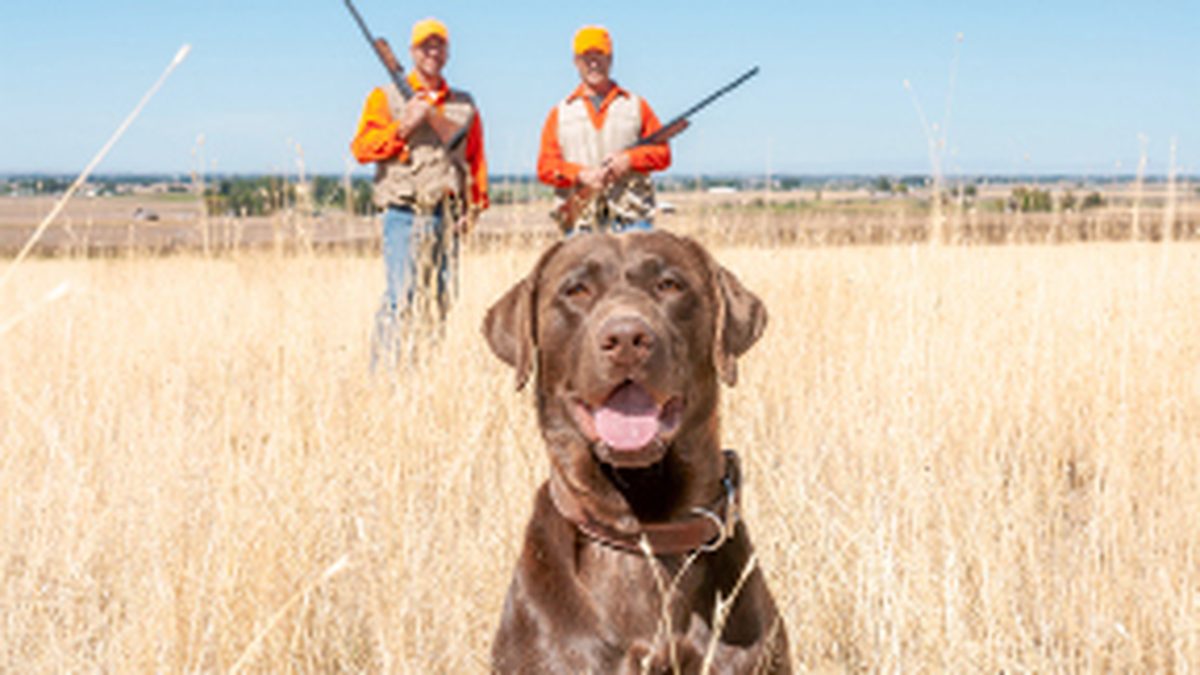
I remember one moment, on an upland bird hunt in North Georgia, having a conversation about what it took to reach his level in homebuilding. He told me it wasn’t enough to build a great house—you had to learn how the homeowner wanted to experience the space. Take the time to get the plan right, and the perfect home follows. Plenty of builders claim the “design-build” label, but with over 500 homes completed, Ron’s proof is in the numbers of satisfied clients. I was still turning that over in my head when Ron showed me another side of himself: a taste of the same intensity that built Providence Builders.
My cocker spaniel, Chota, flushed a covey in the moment of my distraction, and Ron shot a clean double while I came up with nothing but a few spent shells. That same empathy for clients, paired with a competitor’s drive, is what pushes him to deliver a superior building process every time.
Diane Bills is every bit as impressive as Ron, just in her own way—and together, the two of them are what make the Providence customer experience truly outstanding. She’s the anchor that holds the ship steady, the diligent researcher always hunting down the best products and deals for customers. But what makes Diane extraordinary isn’t just what she does—it’s who she is. She’s the epitome of positivity, and I’ve never walked away from a conversation with her without feeling better than when it started. In an often uncertain world, that’s a gem to be treasured.
That connection doesn’t come from a portfolio or a price sheet. It comes from a conversation—the kind where both sides lean in, where a future homeowner starts describing not just square footage but a life they’re trying to build. That’s when the magic starts, Ron says—when they tell you exactly how to design their perfect home. That connection—immediate, personal, and lasting—is at the heart of everything Providence does. It’s exactly what unfolded when Jon and Brenda McGurk first sat down with Ron and Diane.
A Builder Built Differently
Ron didn’t arrive at homebuilding by accident. Before founding Providence Builders in 2005, he spent years in aerospace engineering and corporate leadership, a background that instilled a level of precision and process rare in residential construction. When he and Diane set out on their own, they didn’t just start a company. They built a system.
“With Providence, you don’t just get an individual—you get a team of top-quality professionals driven to deliver at the highest level,” Ron says. “Our openness, our transparency, our disciplined process—that’s what sets us apart. And we have one rule with every client: we have to have fun.”
Today, Providence is one of East Tennessee’s most respected names in fine custom homebuilding, with a design-build model that keeps architecture, construction, and interior design working in concert from day one—no handoffs, no gap between vision and execution. Clients receive a 450-line-item budget backed by a four-inch binder of quotes and plans, an undertaking that takes over 200 man-hours. Diane drives that process to ensure clients are never left wondering, with monthly draw reports and reconciliations throughout the build. “We’re stewarding someone’s dream—and their investment,” she says. “That’s a responsibility we take very seriously.”
The recognition has followed: Providence has earned Cityview Magazine’s Best of the Best Award for Custom Home Builder—Over $1 Million three years running. Ron credits the team—designers, project managers, craftsmen, and trade partners, many with decades alongside Providence. “There are over a thousand people who touch a home by the time it’s finished,” he says. “We make sure every one of them knows how important their role is. Because it is.”
Finding Their Way Back to Tennessee
Jon McGurk is a man who knows how things get built. He spent decades rising through the ranks of a corrugated packaging company, eventually overseeing eleven manufacturing plants across nine states—tilt-wall construction, metal buildings, industrial facilities. But when he and Brenda decided to build their dream home on a two-and-a-half-acre lakefront lot near Loudon, he found himself in genuinely unfamiliar territory. “A house has a lot more detail than anything I’d built before,” Jon says, laughing. “But it was fun. I enjoyed it.”
The McGurks’ path to East Tennessee is a story of homecoming. Jon grew up in North Dakota, went to college in New York, and met Brenda in Rochester in the fall of 1988. They married two years later and moved to Knoxville in 1990 for a job offer, landing in Lenoir City, close enough to Dixie Lee Junction that the area still feels like home. Their children were born there. Their roots ran deep. Then, in January of 1998, Jon was transferred to Ohio. They spent the next two-plus decades in the Midwest—raising a family, building a career, buying a 173-acre hunting property along the Killbuck River—but Tennessee never left them. “We just loved it here,” Jon says. “I remember when they called to say they wanted to transfer me. I was like, damn. We were just getting going.” When Jon retired, the decision was easy: come back to the state they’d always loved and build something permanent.
The Right Piece of Land
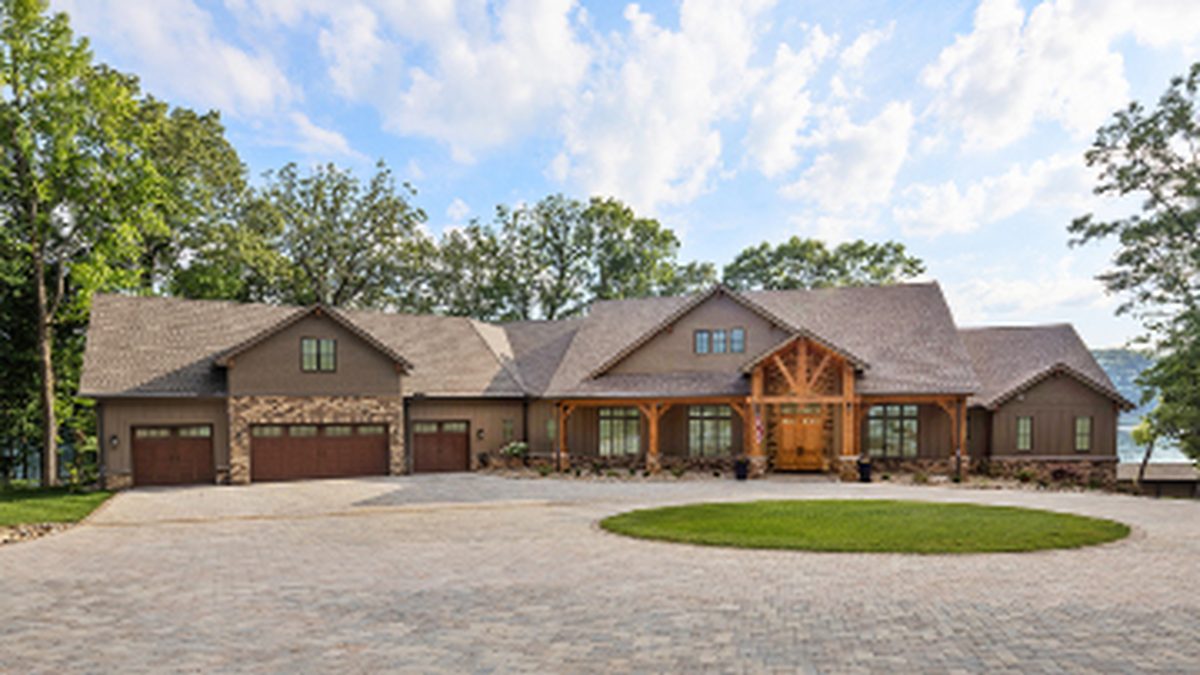
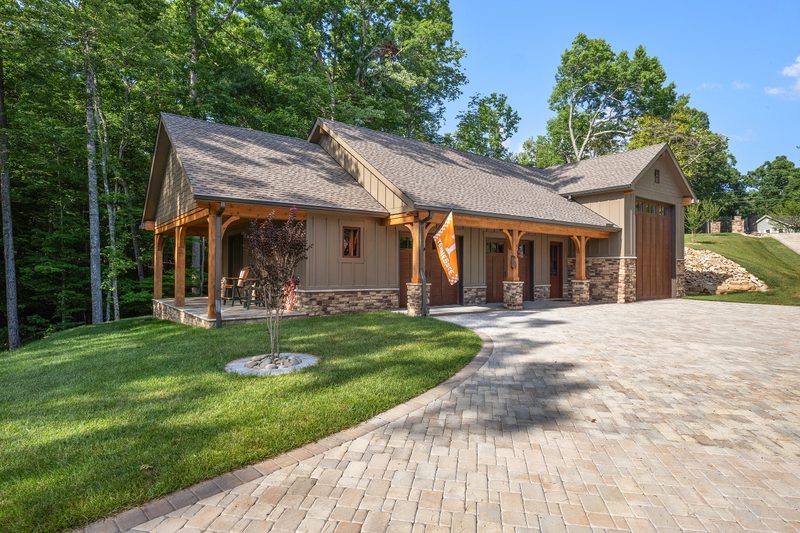
Finding the lot took nearly two years. The McGurks knew what they wanted: lakefront, room enough for what they had in mind, no HOA, no gated community, no stack of rules to live by, and a dock. That combination proved harder to find than expected, especially once Covid-era buying frenzy hit. “We were looking for probably two years,” Jon says. “Everybody was buying everything up.” What they eventually found was tucked into the trees along a quiet stretch of shoreline: a small, wooded two-bedroom cabin on a sloping lot, barely a glimpse of water through the dense growth. You could roll a beer bottle across the cabin floor, the grade was so pronounced. But the size was right—just under two and a half acres—and the dock was already there. “I thought it was flatter than it was,” Jon admits. “But it worked out pretty good.” While hunting for land, Jon had also been scrolling through floor plans for months, eventually settling on a sprawling, single-level ranch that opened to its surroundings rather than closing in on them. Land in hand, plan in hand, he needed a builder.
Finding Providence
Jon met with a couple of Knoxville builders, but when he sat down with Ron and Diane, something clicked. “My uncle is a well-known architect in Minneapolis— calm, collected, sharp as they come. Ron reminded me of him right away. I just liked him. And I liked Diane. That was it. We decided to build with Providence.”
From day one, the collaboration felt easy. Jon brought his plan, Providence brought its process, and together they began turning a concept into a home. Ron visited the site personally to understand the topography, the grade, the views—what the land wanted to be. Then the real conversation began. “We begin by understanding how our clients live,” Diane explains. “How they cook, entertain, relax, and recharge. Then we design a home that supports that lifestyle—not the other way around.” For the McGurks, that meant no interior stairs in their living area, a kitchen designed for cooking and gathering, and a connection to the outdoors that felt seamless, not ceremonial.
Massaging the Vision
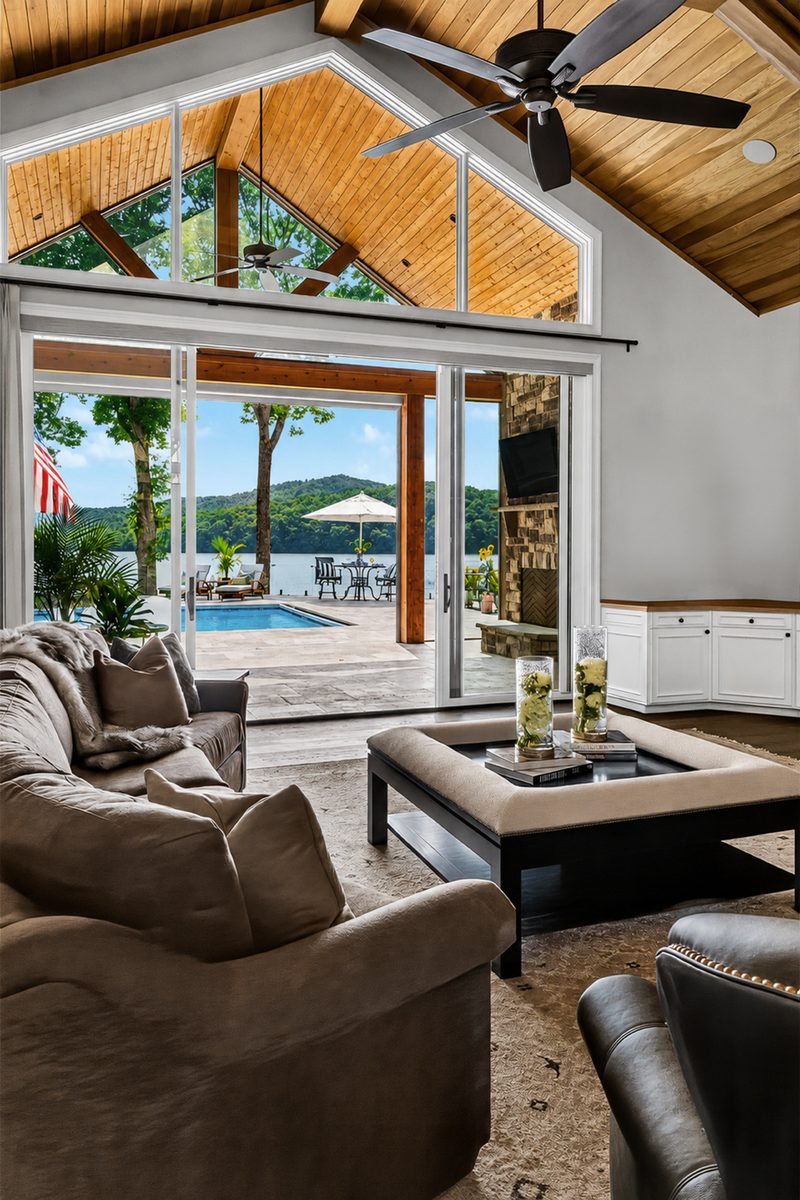
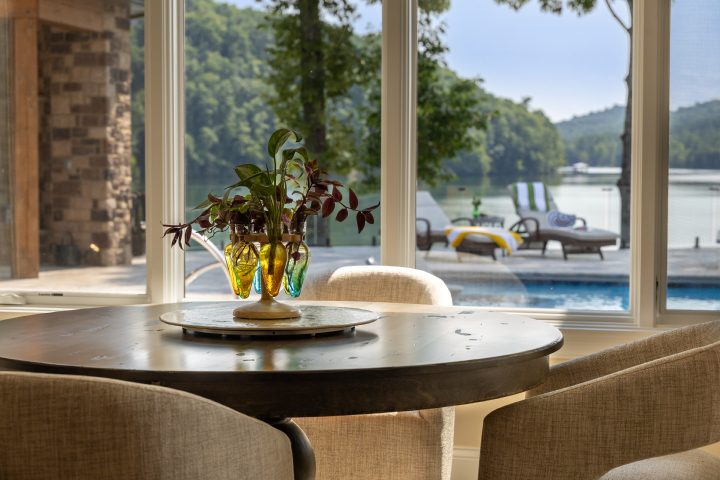
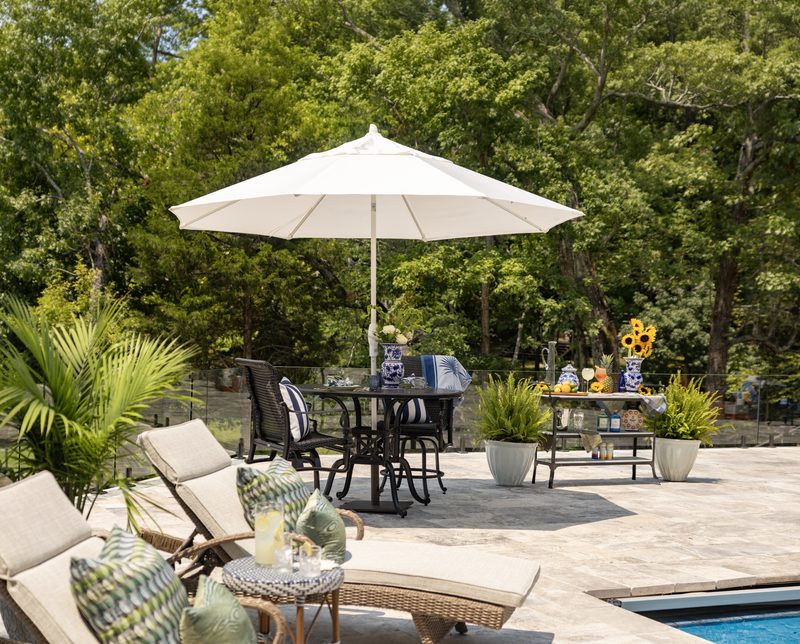
What followed was the kind of creative back-and-forth Providence Builders is built for. One of Ron’s first changes: he flipped the entire roofline orientation so that walking through the front door, your sightline travels straight through the great room and out to the lake—the same vaulted, wood-clad room whose wall of glass now frames the water and the pool beyond. “That was the whole point,” Jon says. “When I come through the front door, I just want to see right through to the water. Ron made that happen.” As the design evolved, so did the program. When the McGurks added a pool, Ron flagged the need for a bathroom nearby so guests wouldn’t have to trail through the house—that bathroom got built. When shade became a concern at the outdoor bar, a covered structure went up, storage tucked in alongside it. “Over time, we just did stuff like that,” Jon says. “Massaged it.”
The interiors came together under the guidance of Diane and Providence’s interior designer Anne White. She is also someone I’m proud to call a close friend, a true expert in her craft, and she goes the extra mile on every project without fail. Anne has a way of walking into a room and making it brighter just by being in it—a rare gift that shows up in her designs as much as it does in person. Her collaborative approach with Diane reflects the same principle driving the architecture: make it beautiful, but make it livable. Warm woods, natural stone, and soft layered finishes echo the landscape beyond the glass and shift character as the light moves through the day. The palette feels grounded and serene without feeling restrained, and every room connects to the ones around it, and to the outdoors beyond. “Our goal is to make every home as perfect as possible,” Anne says. “We design for how people actually live—not just how it photographs.” Comfort doesn’t come from furniture or finishes alone, Diane adds that it comes from balance. “Proportion, light, texture, the way materials meet. That’s what makes a home feel right.”
Building It Right
The build took more than two years, groundbreaking to move-in, with Ron’s team tracking every budget item and posting daily updates through BuilderTrend. “We don’t draw something we can’t build beautifully,” Ron says. “Our plans are detailed to the millimeter.” For Jon, who’d overseen industrial construction across nine states but never built a house, it was its own education. “It wasn’t smooth every single day—with a project like that, it never is,” he says. “But overall, it was a real good experience. Providence is pretty solid. I learned a lot. I’d do it again.” For Ron, that endorsement is the real goal on every project: not just a beautiful home, but a client who felt heard and respected throughout. “Building a home should be fun,” he says. “It’s one of the biggest investments of your life. You deserve to enjoy the process.”
A Home Built by Many Hands
As Ron likes to say, over a thousand people touch a home by the time it’s finished. Atlas Pool Designs built the lakeside pool, its glass-railed deck framing an unbroken view of the water, while Creative Hardscapes laid the stone patios and pool surround that tie the outdoors to the in. Cella Flooring & Design handled the tile and flooring throughout, and Standard Kitchen & Bath, a Knoxville institution since 1956, brought the cabinetry to life around countertops fabricated by Smokey Mountain Tops. Stokes Lighting outfitted the home with fixtures as functional as they are beautiful, including the dining room’s showpiece chandelier. The family’s heirloom dining furniture was recovered with elegant Schumacher fabrics from Wolfgang Interiors to accent the other interior finishes. Ferguson enterprises supplied the plumbing and fixtures throughout the kitchen and baths. Farmer Garage Door, serving East Tennessee since 1963, and HIS Security rounded out the build with quality that goes unnoticed until you need it. No home would be complete without a perfect compliment of windows and doors, Home Choice Windows and Doors came through with windows by Sierra Pacific and a grand entrance door from DSA. Outside, Diversified Enclosures built the screened spaces where the McGurks now spend much of their time. And two artists left the home’s most personal touches: Eugenia Alameda hand-painted its wall mural, and an original painting by celebrated Smoky Mountains painter Robert A. Tino greets guests in the foyer.
Life on the Lake
The McGurks have settled in with the ease of people who’ve finally arrived where they belong. Mornings begin on the porch with coffee and a long view of the water. Jon reads the news and lets the quiet do its work; Brenda gravitates to the great room fireplace, its stone chimney rising into the vaulted ceiling, when the seasons turn. The outdoor bar and pizza oven have already hosted a Fourth of July party so unhurried nobody thought about dinner until after seven. “Everybody makes their plate and goes outside,” Brenda says. “All the mess is out there. It’s perfect.”
Jon’s building a tackle box for crappie runs with his daughter Casey—the lake holds crappie, walleye, bass, and stripers that run big near the dam. He grew up on the water and had a lake place in Ohio; once you’ve lived on the water, you don’t want to live anywhere else. “We just love being on the lake,” he says. “That’s the whole thing. We sit here all day.”
It’s exactly what a home is supposed to do: make you not want to leave. Ron Bills has been building toward that outcome for two decades, one relationship and one carefully considered decision at a time. The McGurk home is the latest expression of that purpose—and by the looks of things on that porch, it got there.
→ Swipe for Next Story
FeatureSEPTEMBER OCTOBER 2026
Dogs 101 Part 3 - The Power Of Motivation
The equipment behind a well-trained dog, from the living room to the field
Story by Nathan Sparks
My setter, Sig, went on point for the first time in a stand of sedge grass so thick I nearly walked past him. He was maybe two years old, and something about the way he froze, tail up, one paw curled, told me this wasn’t an accident. My cocker, Chota, has never held still that long in her life. She hunts the way she does everything else, at full tilt, nose down, tail going like a metronome that’s lost its mind. Two dogs, two different jobs, and somehow both of them ended up understanding what I wanted from them out there. That didn’t happen by accident. It happened because of a truck full of gear, a lot of repetition, and a trainer patient enough to explain why each piece mattered.
There is an old saying that you can’t buy a trained dog in a box. That remains true. But open the truck of a serious trainer today and you might wonder. There are bumpers and launchers, long lines, electronic collars, holding blinds, dog stands and training birds. None of it replaces the trainer. What the equipment does is let a handler communicate clearly, create the same situation over and over, and gradually teach a dog what’s expected of him, whether the goal is a staunch point at eighty yards or simply sitting still at the front door instead of bowling over the mail carrier.
Leads, Long Lines and Control
Not every useful tool needs batteries. Chota’s recall started on a Biothane long line, and I remember how skeptical I was watching her drag thirty feet of it through the yard, snagging on every stick and stem. It seemed like overkill for a dog that size. It wasn’t. A long line offers something invaluable early on: control without requiring the dog to stay glued to your leg. Before you can trust a dog to come when called at a hundred yards, you have to prove the command means something at ten feet. The line creates that bridge. It let me correct Chota gently when a squirrel outranked me in her mind, without ever letting her learn that ignoring me was an option once she got some distance. That lesson, more than any single command, is what separates a dog you can trust off leash from one you can’t.
“Eventually, when it’s gone right, most of the equipment seems to disappear.”
“A collar can reach across a field. A launcher can put a bird in the air at the exact right second. But none of it knows when to use itself.”
→ Swipe for Next Story
Non-ProfitSEPTEMBER OCTOBER 2026
Stewards of the Land
The Nature Conservancy partners with others to protect nature and serve people
Story by ron Jorjorian & Terry Cook
The Nature Conservancy builds bridges, literally and figuratively.
The environmental nonprofit, celebrating its 75th anniversary this year, works in land, water, and climate protection in more than 80 countries and all 50 states. Its Tennessee chapter was established in 1978.
Its work is expansive, from raising funds to acquire land that needs protection to removing dams that both inhibit migration to gating caves where endangered bat species live. But in all of these efforts, one aspect is common: it identifies partners to help.
"Many of Tennessee's most significant conservation successes have been made possible through collaboration with local, state and federal partners and other nonprofits,” says Gabby Lynch, director of land for The Nature Conservancy in Tennessee. “Partnerships are fundamental to…achieving lasting outcomes that benefit both people and nature.”
A look at each of The Nature Conservancy’s priorities helps clarify its activities in Tennessee. Land
From the Mississippi River to the Smoky Mountains, The Nature Conservancy has protected land for conservation while also offering economic opportunities for the surrounding communities.
One of the largest of these properties is the Cumberland Forest Project to Knoxville’s north and northeast. Straddling the Tennessee-Kentucky border, the 100,000-acre Ataya property is made up largely of former coal mines and working forests. A second purchase — of the 153,000-acre Highlands-Lonesome Pine property in southwestern Virginia — was a former coal mining area.
The purchases were possible because of impact investments, which gives private investors an opportunity to support conservation projects that have the potential to earn a profit. In the Cumberland Forest Project, those profits come from sustainable logging and recreational opportunities like the campgrounds and outfitters around Tackett Creek in Campbell County.
Partnering with the Tennessee Wildlife Resources Agency, The Nature Conservancy has permanently protected the property through conservation easements that allow for public recreation — hunting and fishing as well as trail riding for off-highway vehicles.
Wait. What? How can those noisy, gas-guzzling all-terrain vehicles be allowed in an area being conserved for its natural environment?
“Off-highway vehicles and motorcycles are incredibly popular,” acknowledges Lynch. “The key is to know it’s here and it’s not going anywhere, so let’s manage it well. Are the trails sited in the right location so the soil doesn’t erode into the water? Is there as little conflict as possible between hikers and riders? OHVs are an economically important recreational option.”
Ronald Lambert is The Nature Conservancy’s land protection manager in the Tackett Creek area. He makes sure that off-road vehicles aren’t impacting the streams where the endangered blackside dace fish swim. It’s just one of several species the conservancy protects there.
Lambert and his TWRA partners monitor 150 miles of trails at Tackett Creek and flag problems to be addressed, minimizing runoff and sedimentation in the area’s streams and wetlands. That may involve putting in culverts or drainage ditches, grading the road or putting down gravel. “Riders may see a bump in the road, but they don’t know it’s directing water.”
They also direct trails away from animal habitats. “We have a pretty healthy elk population, and we try to limit OHV travel around them, especially during breeding and calving seasons,” Lambert says. Bats like to frequent abandoned mine portals; the trails don’t enter those areas.
“Our overall message is we’re not there to shut the trails down,” Lambert says. “We’re there to manage it and make it safe and enjoyable while protecting the ecological value of the land. We want to show that recreation and conservation can coexist.”
Another land conservation project in East Tennessee is the Doe Mountain Recreation Area in Johnson County, in the very tip of upper East Tennessee near Mountain City. It’s an 8,600-acre forested mountain that offers access to OHVs and motorcyclists as well as mountain bikers and hikers. It has an archery course and a historic fire tower.
“Land and water conservation can serve multiple benefits,” Lynch says. “We like to show it’s good for nature and also good for the bottom line for these communities, with campgrounds, small engine repair shops and other small businesses serving the area.”
Water
Johnson County is also the site of some freshwater protection projects The Nature Conservancy has taken on. Shady Valley, a tiny community there, was home to rare peat wetlands, or bogs, many of which had been drained and converted to farmland in the mid-20th century.
The Nature Conservancy purchased two of those bogs and surrounding acreage in the 1990s and restored several tributaries of Beaverdam Creek to their natural hydrology, supporting rare plants and animals, including the tiny bog turtle. These properties now host conservation-friendly agriculture across the landscape. Shady Valley hosts a Cranberry Festival each October to celebrate the product from those bogs. This year’s festival will be held October 9 and 10, 2026.
Dam removal has been a priority for the conservancy’s freshwater staff. The Lower Citico Creek Dam in the Cherokee National Forest was built in the 1970s to protect a trout fishery on Citico Creek. Over time, “our understanding of fisheries management changed and we learned that trying to keep out native species to protect introduced species wasn’t supported by evidence,” says Rob Bullard, director of water for The Nature Conservancy. The conservancy, the U.S. Forest Service and Trout Unlimited partnered to remove the dam last fall to improve migration of the fish that inhabit the creek. The removal reconnected 76 upstream perennial miles of river.
“A lot of the results were almost immediate,” Bullard says. “The University of Tennessee tagged some redline darters pre- and post-dam removal, and after the dam was removed they found redline darters several hundred yards upstream within just a few weeks.”
The project led to a much larger effort to restore watersheds across East Tennessee, especially in the Cherokee National Forest, Bullard says. The conservancy and its partners are studying and inventorying stream barriers created by road systems and aiming to provide more natural water flow for the species that live there.
What they’re learning has been applied to the recovery effort still underway post-Hurricane Helene. “The scale of Helene recovery is unlike anything this area has seen for a long time,” Bullard says. “Some of the lessons we’ve learned in places like Citico have put us in a good position to work together around Helene recovery. Where it makes sense, we can build things back with more resiliency.”
Climate
Protecting large swaths of forested land goes a long way in combatting climate change while preparing for it at the same time. Three hundred sixty acres of the Cumberland Forest Project — land that was previously mined for coal — are being used to establish solar energy and battery storage projects by private businesses. The surrounding forests store and sequester carbon and support wildlife.
The central Appalachians, in which the Cumberland Forest Project is located, is one of the most biodiverse areas in the eastern U.S., with populations of rare salamanders, freshwater mussels, native fish, elk, and other at-risk species. Scientists have identified the region as critical to the south-to-north movement of species as the climate continues to warm.
It offers a range of microclimates that allow plant species to repopulate farther north or higher in elevation as temperatures rise. And where plants shift, animals follow.
Caves
Twenty percent of known caves in the United States — almost 12,000 of them — are located in Tennessee, according to Cory Holliday, who is the cave and karst program director for the conservancy. In addition to numerous species of bats, these caves harbor hundreds of vulnerable species—mostly crustaceans, insects, and arachnids—that live exclusively in these subterranean habitats.
A lot of the caves are located on private property, and the conservancy doesn’t name their locations in order to protect them. But they work with landowners to develop management plans and to install cave gates, “big, ugly heavy things we don’t like building,” Holliday says, “but signage doesn’t work for everybody.” The gates allow bats, but not people, access to the caves.
The work done by the conservancy and their partners, including the U.S. Fish and Wildlife Service and TVA, has led to significant increases in the number of gray bats in East Tennessee.
“They are making a really strong recovery, largely due to the efforts of protecting their cave roosts,” Holliday says. “And there are more roosts in Tennessee than anywhere else, so that recovery is very significant.”
Saving bats helps control insects and protect forests, Holliday says, which is good for people too. Just like Bullard says, a free-flowing stream protects the small fish that live there, which helps keep water clean. Conservation is about protecting that cycle of interdependence among species and environments. Those connections matter. The Nature Conservancy has been protecting them for 75 years.
→ Swipe for Next Story
FeatureSEPTEMBER OCTOBER 2026
The Gift of Giving
What defines a life of generosity? For Tim Harris, it has never been measured in dollars, but in character, service, and the people whose lives are changed by showing up for others.
Story by Sarah Harris Quillen
When I think about generosity, I don’t picture a check or a gala or a name on a building. I picture my dad.
Long before Knoxville Wholesale Furniture became a household name in East Tennessee, Tim Harris was giving. We didn’t have much when I was growing up — but what my dad lacked in resources, he made up for in heart. He gave his time. He gave his attention. He showed up — for neighbors, for strangers, for anyone who needed a hand. My mom, Robin, was right beside him. In our house, giving wasn’t something you did when you had extra. It was simply who you were.
That’s the man who raised me, and it’s why I wanted to write this story — because watching him taught me that a giving heart doesn’t wait for a big bank account.
As Knoxville Wholesale Furniture grew and success came, my parents never forgot where they started. If anything, those lean years became the compass for their generosity. When they choose an organization to support, they look for the same things they lived by back then: strong morals and ethics, people who give of their time and not just their money, and work that makes a real, lasting difference — not a moment of charity, but a legacy of change.
Dad will tell you the company runs on four principles: Christian values found in the Bible, love of country, love of its employees and community, and a can-do winning attitude. He came by that last one honestly — he coached football at Farragut High School before he ever sold a sofa, and he’ll tell you he never really stopped coaching. But those four principles are more than a business philosophy. They’re a map of his giving.
A few of the organizations he supports tell that story better than I ever could.
Sometimes generosity is born from abundance. Sometimes it is born from heartbreak.
Ryan Christian Knauss grew up in Corryton, in the hills just northeast of Knoxville, playing soldier with his older brother Tyler long before he ever wore a uniform. At Gibbs High School, he threw himself into JROTC with the kind of discipline that turns a dream into a plan, earning Best Cadet of the Year honors in 2016 and enlisting in the United States Army during his senior year. He wanted, in his own words, to be “boots on the ground.”
He became exactly that. Airborne School. The 82nd Airborne Division. A nine-month deployment to Afghanistan as a gunner. Then selection into the Army’s elite Psychological Operations community — a remarkable achievement for a soldier so young. In August 2021, Ryan volunteered to return to Afghanistan to help with the humanitarian evacuation of Kabul. On August 26, at Abbey Gate outside Hamid Karzai International Airport, a suicide bombing took his life along with twelve fellow American service members and more than 170 civilians. Staff Sergeant Ryan Christian Knauss was 23 years old. He was awarded the Purple Heart, the Bronze Star, and the Congressional Gold Medal.
What my dad lacked in resources, he made up for in heart.
Most parents would understandably retreat into grief. His mother, Paula Knauss-Selph, chose purpose.
Through the Respect and Remember Foundation — R2Factor, as it’s known — Paula has dedicated herself to making sure her son’s legacy lives on in the lives of young people who share his calling. The foundation awards the Army SSG Ryan Christian Knauss Merit Scholarship to graduating JROTC cadets, beginning at Ryan’s own Gibbs High School and now expanding into schools far beyond Tennessee. It encourages active-duty service members — including sponsoring the annual TPT 9000 memorial workout held in Ryan’s honor at Fort Bragg — and partners with organizations serving veterans and the families of the fallen. The foundation’s name is its mission: respect all who have committed to serve, and remember those who made the ultimate sacrifice.
It is easy to understand why this kind of person appeals to my dad’s heart. Paula isn’t writing checks from a distance — she is giving of herself, showing up at scholarship presentations and memorial runs, turning the worst day of her life into hope for someone else’s child. Her foundation is built on exactly the things my parents look for: unshakeable character, hands-on commitment, and work that will outlast all of us. A scholarship changes the direction of a young cadet’s life. A mother’s love, carried forward this way, changes a community. Knoxville Wholesale Furniture is proud to stand among the foundation’s top sponsors — but for my dad, it has never been about the sponsorship. It’s about Paula, and Ryan, and the belief that the best way to honor a giving heart is to give alongside it.
That same spirit lives in Sherrie Battle McGhee.
By a heartbreaking coincidence, her son was also named Ryan. Cpl. Ryan C. McGhee was a 21-year-old Army Ranger with the storied 3rd Battalion, 75th Ranger Regiment — a young man who, like so many of his generation, was moved by September 11th to serve. He called his mother from Iraq on Mother’s Day 2009 to wish her a happy birthday — she would turn 50 the next day. Three days later, on his fourth deployment, Ryan was killed by enemy fire. He rests today in Section 60 of Arlington National Cemetery.
Sherrie will tell you she walked in a fog for years. What pulled her out was faith — and other mothers who carried the same wound. “God put the Gold Star Mothers in my path,” she has said. So she threw herself into service, determined that her son — and everyone else’s son — would never be forgotten. Today she serves as chaplain of the American Gold Star Mothers’ Tennessee department, ministering to families in their darkest hours. She led the effort to name a memorial bridge in Ryan’s honor, and she shows up — at memorial ceremonies, veterans’ events, and quiet moments no camera ever sees. What keeps her going is something she came to hear in Ryan’s own voice: “Mother, I did not die for you not to enjoy life. We died for you to be free. Don’t make my sacrifice worthless.”
Sherrie’s generosity cannot be measured in dollars. It is measured in hugs given to grieving mothers, in conversations between families who understand one another’s pain, and in the quiet promise that no one has to carry their burden alone.
This is exactly the kind of giving my dad admires most — not the kind that writes a check and looks away, but the kind that costs something. That’s why he supports the American Gold Star Mothers: an organization whose members give the one thing money can’t buy — their presence. Women like Sherrie are the reason his support goes there, and for a man who built everything he has on showing up — for his family, his employees, his community — standing behind these mothers isn’t charity. It’s kinship.
In our house, giving wasn’t something you did when you had extra. It was simply who you were.
Sometimes it’s giving your time. Sometimes it’s giving your heart. Sometimes it’s simply showing up.
As I reflect on the people who shaped my understanding of generosity, my thoughts always return home. Growing up, I never realized the scope of what my father was doing, because he never talked about it. Looking back now, I understand that I had a front-row seat to a lifetime of servant leadership.
Through our family business, my dad has quietly directed more than $8 million to charitable causes over the past fifteen years — to ministries like Samaritan’s Purse and churches across East Tennessee, to organizations feeding and sheltering our neighbors like KARM and Second Harvest, to Helping Mamas, to veterans and first responders, and to high school athletic programs giving young people the same shot football once gave him. But the number was never the point. Kimberly Glenn of the Knox County Sheriff’s Office puts it better than I could: “Their donations to our officer assistance fund have helped numerous employees during some of their darkest days, including Fallen Officer Tucker Blakely’s widow.”
And what I’ve admired most has happened where no check register could record it. For thirty-four years, I’ve watched my dad invest in people. I’ve seen him help employees through illness, loss, and hardship. I’ve seen him encourage people who had lost confidence in themselves, and quietly meet needs no one else knew existed. He has always believed in second chances — he reminds us that none of us would be where we are if God had given up on us. So he has chosen, again and again, to see potential where others saw failure. Money can meet a need for a season. Believing in someone can change the course of a lifetime.
Money can meet a need for a season. Believing in someone can change the course of a lifetime.
His generosity didn’t begin with him. My grandfather has spent his life preaching the Gospel — at 95, he’s still at it in Franklin, Tennessee — and my grandmother devoted herself to home and family. They taught their children that success is measured not by what we accumulate, but by how faithfully we love God and care for others. My grandparents planted those seeds in my father, and he planted them in me. Now, as a wife and stepmother, I find myself carrying his lessons into my own home — his patience, his giving spirit, the faith he modeled every day. Looking across three generations, I’m reminded that great people are often shaped by great parents. That may be the greatest legacy of all.
When I think about East Tennessee today, I don’t just think about the mountains that surround us. I think about the people. I think about mothers like Paula and Sherrie, who transformed grief into hope. I think about volunteers who serve without applause, and neighbors who quietly step in when someone is hurting. And I think about my dad, who built one of this region’s great businesses and never once forgot the man he was before it.
That is the East Tennessee I know. And that is the East Tennessee I hope we never lose.
Because generosity isn’t measured by the size of a donation or the recognition that follows. It is measured by the willingness to put others before ourselves — to offer a second chance, to open our homes, to give our time, and to leave every person we encounter a little better than we found them.
The greatest wealth we will ever possess isn’t found in what we keep. It’s found in what we give away.
If my childhood in Strawberry Plains taught me anything, it is this: the greatest wealth we will ever possess isn’t found in what we keep. It’s found in what we give away.
And that, to me, is the true gift of giving.
→ Swipe for Next Story
ProfileSEPTEMBER OCTOBER 2026
Beyond Cold Bringing Elite Recovery Home
Beyond Cold co-founder Eric Salage on building American-made chillers that bring elite cold-plunge recovery into everyday homes.
Story by Kirk Edwards
For years, cold plunge therapy lived almost exclusively in professional locker rooms and high-end wellness spas — a tool reserved for elite athletes chasing every recovery edge. Beyond Cold is changing that. The company builds cold plunge tubs with built-in chillers designed for home use, putting a technology once out of reach within arm's length of anyone serious about their health. As more people look for ways to take control of their own recovery and long-term wellness, at-home cold therapy has moved from niche curiosity to mainstream investment.
We sat down with Eric Salage, co-founder of Beyond Cold, to learn what sets the company apart, and why he believes cold therapy deserves a permanent spot in the modern wellness routine.
The name itself carries a message. "Beyond Cold is a play on words," Salage explains. "It's about the experience going beyond just the cold itself." That philosophy extends to the company's roadmap: Beyond Cold plans to expand into red light therapy, sauna, compression, and massage guns, building toward a full recovery ecosystem rather than a single product.
Interestingly, Salage wasn't always a believer. "I wasn't initially a fan of cold therapy," he admits. It was his business partner, who has deep experience building chillers, who convinced him to give it a real try. His first plunge was intense and, by his own account, not exactly enjoyable. His wife, for what it's worth, still prefers the sauna. But the results won him over, and that firsthand journey from skeptic to convert now shapes how he talks to customers who are on the fence.
What separates Beyond Cold from a crowded cold-plunge market is manufacturing. The chillers are designed and built in the United States, a detail Salage says matters more than most people realize. "We know every component," he explains, which means every unit ships with a one-year warranty and can be repaired in-house rather than swapped out or shipped overseas for service.
Functionally, the chiller works much like an air conditioner, pulling heat out of the water instead of the air. For safety, the system locks out at 37 degrees Fahrenheit, cold enough to deliver results without crossing into dangerous territory.
And the results, according to Salage, are real. Regular cold exposure is linked to reduced inflammation, sharper mental clarity, and increased alertness. He also points to less commonly discussed benefits, including stimulation of brown fat and improved metabolic function, both of which play a role in how efficiently the body regulates energy and recovers from physical stress. Despite being the face of a cold plunge company, Salage doesn't preach daily immersion. He uses his own tub a couple of times a week, and says short sessions of just two to three minutes are enough for most people to feel the benefits.
Beyond Cold currently offers three models built for different budgets and spaces: an inflatable, portable option; a sturdier metal-frame unit; and a flagship model, with prices ranging from $2,999 to $6,999. The company sells primarily direct-to-consumer through its website, with a small network of resellers, and every order ships free. Setup is straightforward, though Salage notes buyers will need a dedicated 15-amp circuit to run the chiller.
Maintenance is simpler than people expect. Every model includes a built-in filtration system, with the flagship unit featuring an upgraded paper cone filter. Salage recommends adding a small amount of chlorine to prevent bacterial growth in standing cold water, and suggests draining and refilling the tub every few months to keep it performing at its best.
For Salage, the pitch isn't about extremity or discomfort for its own sake. It's about giving people a reliable, at-home tool to activate what their bodies already know how to do. "You're not chasing pain," he says of the philosophy behind Beyond Cold. "You're activating what you need to activate to make your body healthier."
As recovery culture moves out of professional training rooms and into everyday households, Beyond Cold is betting that American-made reliability, straightforward maintenance, and a founder who understands the skeptic's perspective will be what keeps customers coming back, three minutes at a time.
Beyond Cold tubs are available directly through beyondcold.com, with free shipping and a one-year warranty on every unit.
Knoxville's Open Container Zone Is Here But It Is Important To Know The Risks
Understanding the Law
Story by Marcos Garza Photography by Nathan Sparks
If you've spent any time in downtown Knoxville this summer, you've probably noticed something different about Market Square. People are walking around with drinks in hand legally. That's because the City of Knoxville officially launched its Designated Outdoor Refreshment Area, or DORA, making Market Square one of the most exciting places to enjoy a night out in East Tennessee.
But it’s important to remember that freedom comes with a very specific set of boundaries. As a criminal defense attorney who has represented Knoxville residents for over two decades, I want to make sure you enjoy this new perk without accidentally turning your fun evening into a legal headache.
What Is the Market Square DORA?
The Market Square Designated Outdoor Refreshment Area is a pilot program approved by the Knoxville City Council that allows patrons 21 and older to carry alcoholic beverages purchased from participating businesses throughout the Market Square. The zone is bounded by Wall Avenue, Walnut Street, Strong Alley, and Union Avenue, and is active every day from 10 a.m. to 10 p.m.
The rules inside the DORA are straightforward:
Drinks must be served in a can or clear cup with a special DORA branded sticker.
What Happens When You Step Outside the Zone?
This is where things get real. The moment you walk outside those four streets with an open container, you are no longer protected by the DORA ordinance. And if you've had a few drinks and an officer believes you pose a risk to yourself or others, you could be charged with public intoxication under Tennessee law.
Under the Knoxville City Code, possessing an open container of alcohol in a public place outside of the DORA is a Class C misdemeanor. The ordinance prohibits simply possessing an open container of alcohol on any public street, sidewalk, park, parking lot, or
What If You Have One Too Many?
It is still important to be responsible when drinking inside and out of the DORA zone. Rowdy, irresponsible behavior can get you in trouble when you are drinking downtown.
Under the Tennessee Code, public intoxication is a class C misdemeanor. You do not have to be stumbling or causing a scene to be arrested. The law says you can be charged if:
You are unreasonably annoying people in the vicinity.
A conviction for a Class C misdemeanor can result in up to 30 days in jail and a $50 fine. More importantly, it goes on your record, which can affect your job, housing, and future opportunities.
Why Should You Care?
Because it is easier than you think to cross the line. You’re having a great time at a Market Square bar, you grab a to-go cup, and you decide to walk a few blocks to grab a late-night bite on Gay Street. Or you have one drink too many, sing Rocky Top a little too enthusiastically, and some folks get annoyed. If an officer sees you with a drink outside the DORA zone or believes that you are intoxicated, that’s all it takes.
I've seen good people, people out just having a normal, fun evening face real consequences because they didn't know where the line was. Knowledge is your best protection.
Tips for Enjoying Downtown Knoxville Responsibly
Q: Is it legal to drink in public in Knoxville?
A: Only within the designated DORA zones, currently Market Square and areas around Covenant Health Park. Outside those zones, open containers of alcohol are not permitted.
Q: What is the penalty for public intoxication or possessing an open container of alcohol in Knoxville?
A: These offenses are Class C misdemeanors punishable by up to 30 days in jail and a $50 fine.
Q: Can I just be drunk in public without being charged?
A: Being intoxicated alone isn't a crime in Tennessee. However, if you endanger yourself, others, or property, or unreasonably annoy people around you, you can be charged.
Q: What are the DORA hours for Market Square?
A: The DORA is active daily from 10 a.m. to 10 p.m.
Q: What should I do if I'm charged with a crime?
A: Be respectful and cooperative with law enforcement. Don't plead guilty without speaking to a criminal defense attorney first. Even a Class C misdemeanor can have lasting consequences on your record.
Final Thoughts
Fun and responsibility go hand in hand. Know the rules, know the boundaries, and know that if things go sideways, help is available. If you or someone you know has been charged with public intoxication or any other criminal offense in Knoxville or the surrounding area, our team at Garza Law Firm is here 24/7. Call us at (865) Call-Garza or visit garzalaw.com for a free case review.
Garza Law Firm 550 W Main St #340 Knoxville, TN 37902 (865) 830-1843 | GarzaLaw.com
→ Swipe for Next Story
VeteranSEPTEMBER OCTOBER 2026
The Unexpected Mission
How a missed pilot slot sent Dan Nigolian into 20 years of Air Force leadership
Story by Matt McGarry
Dan Nigolian has moved 17 times, lived on three continents, deployed to Iraq and Afghanistan, commanded one of the Air Force’s most elite logistics squadrons, and now runs one of the fastest-growing Closet Factory franchises in the country.
Long before he understood military ranks, deployments, or the sacrifices that came with serving his country, Dan knew where he belonged. He grew up in an Air Force family, moving from base to base around the world and establishing new roots wherever he called home. Military life wasn’t something he admired from afar; it was home. His father served as an Air Force chaplain, so childhood meant packing boxes, changing schools, and moving wherever the next assignment happened to be. While many children would have found that unsettling, Dan embraced it. “We seemed to move from one continent to the next. We had friends all over the world. Every few years there was another adventure waiting. For most kids that sounds disruptive. For me, it was exciting.”
Some people spend years searching for their calling… their vocation. Dan never had that problem. Ironically, though, that calling came to him after he missed out on the one he thought he’d always wanted.
“I honestly don’t remember a time when I didn’t think I was going to be in the military,” Dan says. “I can remember deciding I wanted to be a pilot, but I can’t remember deciding I wanted to serve. It was just always there. I suppose I was born with it.”
In fact, those years of moving and what Dan saw as “new adventures,” reinforced what he believed even as a child; he fell “even more in love with the military lifestyle,” he says. “It was a new adventure at every turn.”
By the time he enrolled at Colorado State University and Air Force ROTC, his future seemed straightforward. He earned his bachelor’s degree while working toward the goal he’d carried for years; serving as a pilot.
“I had a pilot slot, even before graduation,” he says. “That was a dream come true.” Then an unexpected administrative delay changed everything. Before commissioning, Dan applied for a program that would allow him to remain at Colorado State and earn a second degree. The Air Force sometimes approved those requests when they aligned with operational needs, and Dan expected a decision within weeks. Instead, months passed. And, no word.
“They kept saying, ‘It should be any day now.’” While his paperwork sat somewhere in the system, the Air Force’s fiscal year rolled over. By the time the answer finally arrived, his pilot slot had disappeared. “It was literally an administrative glitch,” Dan says. “One day I had a pilot slot. The next day it had evaporated.”
Terrible Timing
It was October 1, 2001, just weeks after the attacks of September 11. The Air Force needed officers immediately. “They basically said, ‘Congratulations, you’re a transportation officer. Pack your bags. You’re going to Turkey.’”
At the time, Dan was crushed. “I thought I’d lost the career I’d always wanted.” Today, he laughs about it. “It turned out to be one of the best things that ever happened to me.” Over the next several years, three different squadron commanders offered to help him reclaim his pilot slot. He declined each and every one.
Pilots, Dan says, are often the public face of the Air Force. He quickly discovered that support officers were entrusted with something he’d come to value even more than flying.
“If you want to fly airplanes, being a pilot is incredible,” he says. “But if you want to lead people—which is what I quickly learned was my true calling—the support community is quick to offer you those opportunities.”
And those opportunities came very—and unexpectedly—quickly. Before he knew it, Dan found himself on Incirlik Air Base in Turkey, his first assignment, and under circumstances that still make him smile. “I landed in the middle of the night, checked into lodging, and showed up at my unit the next morning.” I find it a bit humorous because, well, they didn’t even know I was coming. It didn’t take them long, though, to hand me the responsibility for 63 people. And here I was a newly minted second lieutenant. I remember thinking, well...this is escalating quickly!”
That first assignment marked the start of over two decades of service. Over the next 20 years, Dan served in Turkey, Japan, Singapore, Alaska, Illinois, Alabama, and Virginia, deployed to Iraq and Afghanistan, and eventually retired as a lieutenant colonel. Along the way, he commanded one of the Air Force’s premier logistics squadrons and discovered that leadership isn’t measured by rank, awards, or titles—it’s measured by the men and women with whom you serve.
“People ask me what I miss most,” he says. “Honestly, I miss the people. I don’t miss wearing the uniform every day or even the airplanes. I miss being around people who share that same commitment to something bigger than themselves. There’s just a different mindset,” Dan says. “Everyone understands the mission. Everyone understands that what they’re doing matters. Everyone shares a sense of purpose.”
That sense of purpose became especially clear during his deployments. His first combat deployment took him to Iraq in 2002, where he worked alongside NATO forces representing 26 different countries. It was an education that extended well beyond logistics. “When you work that closely with other militaries, you start to appreciate what makes the United States military so unique. One of the biggest things I came away with was an incredible appreciation for our noncommissioned officers.”
Many allied militaries rely heavily on commissioned officers to make decisions. The U.S. Air Force, by contrast, entrusts enormous responsibility to its experienced enlisted leaders. “Our NCOs and senior NCOs are phenomenal,” he says. “You don’t fully appreciate how much responsibility they carry until you see how other militaries operate.”
The experience reinforced another lesson that stayed with him throughout his career. “The Air Force empowers people,” he says. “Good leaders don’t have to make every decision. They develop people who can think, solve problems, and lead on their own.”
As Dan advanced through the ranks, his responsibilities expanded dramatically. Instead of supervising dozens of people, he was responsible for hundreds. Instead of solving daily operational issues, he was making decisions that affected entire organizations. Yet the basic principles never changed. “You take care of your people,” he says. “If they know you’re looking out for them, they’ll accomplish amazing things.” Those principles were put to the ultimate test when Dan returned to Turkey as a squadron commander during the early years of the Syrian conflict. If his first assignment had introduced him to military leadership, this one demanded everything he’d learned over nearly two decades.
“We were operating at about 3,500 percent of our normal operations tempo,” he recalls. “Every single day we were breaking records.” The pace was relentless. Sixteen-hour days became routine. Weekends disappeared. Sleep became a luxury. But no one complained. “You never wondered if what you were doing mattered,” he says. Every evening, commanders gathered for classified briefings where they watched footage showing the direct results of the day’s operations. “You’d see exactly what happened because of what your team accomplished that day. Not everybody is fortunate enough to get that kind of feedback in their career. Or, to feel that sense of accomplishment.”
For Dan, those moments captured everything that made military service worthwhile. “I always knew I was making a difference. Whether deployed overseas or serving back home, every mission supported something larger. “I always knew our work mattered,” he says, “which is what I always appreciated about the Air Force… and still do. Even when you’re not deployed, you’re supporting the mission every single day.”
His squadron’s performance reflected that commitment. Under Dan’s leadership, the organization was named the top Logistics Readiness Squadron in the U.S. Air Forces in Europe before earning recognition as the number one Logistics Readiness Squadron in the entire Air Force the following year. “Awards are gratifying,” he says, “but the people matter more. The trophies eventually collect dust. What stays with you are the people with whom you serve.”
Ask Dan what leadership means today, and his answer comes without hesitation. It’s a philosophy he apples to leading employees in his three-and-a-half-year-old business, Knoxville’s Closet Factory. “Hire hard, manage easy,” he says. It’s a philosophy he first developed in uniform.
“The military taught me there are a lot of ways to lead people,” he says. “Popularity isn’t one of them.” He smiles. “If you’re leading correctly, somebody probably isn’t going to be happy with one of your decisions.” That doesn’t bother him. “Your responsibility as a leader is to accomplish the mission while taking care of your people. If you’re trying to make everybody happy, you’re probably not leading. The best leaders I ever worked for didn’t lead that way. Instead, they led through integrity.”
When asked how he’d like people to remember his military service, his answer isn’t about medals, promotions, or deployments. “I hope they remember that I led with integrity.”
He pauses for a moment before adding quietly, “That’s rarer than people think.”