Dogs 101: Part II - The Rules of the House
Dog training insights from Mike & Jon Osteen reveal how structure, consistency, and clear rules turn chaos into calm, well-behaved companions
Years ago, a good friend of mine got a dog. He named him Damn-it.
If you’ve never stood in a neighborhood watching a grown man sprint down the block screaming “Damn-it! Damn-it, come here!” you haven’t truly lived. Neighbors peeking through blinds. Damn-it trotting ahead at a leisurely pace, completely unconcerned. It was, by any measure, magnificent.
I had small children at the time, so that particular approach wasn’t going to fly. I wanted a name they could yell freely in fields, in parks, in front of their teachers without anyone getting called into the principal’s office. So I named my adorable little double dappled dachshund Bravo.
For seventeen years, Bravo was the official mascot of Cityview Magazine. Crate trained. Came when called. Had a particular passion for fish. He once demolished an entire twelve-inch white bass, a fish that was nearly as long as he was, with the focus and efficiency of a dog twice his size. He was, in the best possible way, a genuinely pleasant companion everywhere we went. Take him anywhere, and he was fine, because he knew the rules, and the rules made sense to him.
Which is precisely what brings me to the Osteens. Because while Bravo’s life was a good one, I kept running into other people’s dogs and other people’s chaos. Dogs that owned their front doors. Dogs that turned guests into hostages. Dogs whose owners had clearly lost the argument years ago and were just living with the outcome. Somebody needed to explain this. So here we are.
The Gray Area Is the Problem
In our last issue, Mike Osteen laid the foundation: teaching and training are not the same thing, structure is a form of love, and a dog can only do what you teach it. What there wasn’t room to say, but what this entire installment is built around, is that most dogs aren’t bad. They’re rehearsed. Every time a behavior goes uncorrected, the dog quietly files it away under “acceptable.” Every time a rule applies sometimes but not others, the dog learns there’s a gray area. And gray areas, in Mike’s world, are the root of almost every problem people bring to him.
“You create a gray area,” he told me, “when you let them do something for an extended period and then go, ‘Well, I really don’t like it.’ And now you’re in a fight with a dog that learned something different from you than what you actually want.” The fix isn’t complicated, but it does require honesty about where the gray areas came from. Almost always, they came from us.
Meet Jon
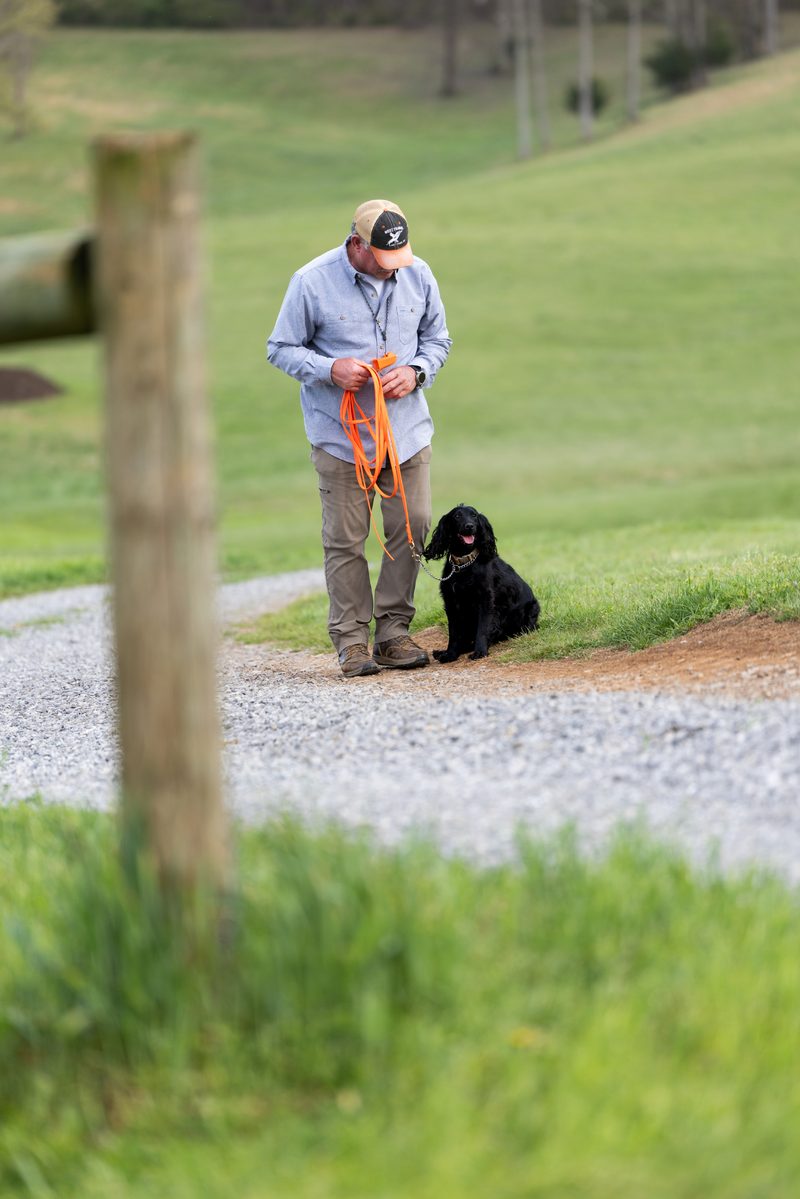
Jon Osteen grew up watching his father work dogs the way most kids watch their parents do their jobs, constantly and skillfully, in the background of everything. By the time he was a teenager, he’d earned the right to be turned loose, not just to observe, but to work. He’s softer in approach than his father, his own word for it, and he has a particular habit when a new dog comes to him. He looks at the leash before he looks at the dog.
“The respect that the dog has for whoever is on the other end of the leash tells me everything I need to know about what that relationship is like,” he said. That single observation reframes a lot. The leash isn’t a control device. It’s a communication line. And if things are going sideways on it, the leash already told you exactly why.
Growing up, Jon said, what he got to see over and over again was proof of what’s possible. “My dad proved time and time again that if you understand a dog’s behavior, almost anything is achievable.” The dogs owners had written off. The ones people brought in carrying labels such as stubborn, dominant, unfixable. Those dogs left rehabilitated. It shapes how he thinks about every dog that comes through the door.
The hardest part of dog training, as Jon has come to understand it, isn’t the dog at all. “The hardest part is owner training,” he said. “I can get the dog to do exactly what I need it to do. Then it goes home, the owner lets it get away with things they know they shouldn’t, and they call me back saying they don’t understand why it isn’t working.” The answer, always, is that the dog adapted to the new reality. Dogs are extraordinarily good at that.
“The leash isn’t a control device. It’s a communication line.”
Place: The House Dog’s Best Friend
If there is one command that separates a dog that’s “pretty good” from a dog that genuinely improves your daily life, it’s Place. The concept is simple: go to that spot and stay there until I release you. Not sit, which is momentary. Not stay, which assumes the dog is already where you need it. Place is an assignment. It gives the dog something to do during the moments that would otherwise produce chaos, and dogs find that deeply settling. They want to know what to do. When they don’t, they invent something, and you usually won’t like what they invent.
Jon starts every dog on an elevated platform, a raised mat, a dog cot, anything with a clear physical edge. The elevation creates an obvious boundary. You’re on it or you’re off it, with no ambiguity. Then he builds in increments so small most people would find them laughable.
“Two seconds, five seconds,” he said. “You reward, and then you build. Five to ten, ten to twenty, twenty to thirty. That’s how you start that process.”
What he doesn’t do is demand the dog hold it for five minutes on day one, get frustrated when it breaks, and conclude the dog “won’t do it.” That’s not a training failure. That’s asking the dog to run a marathon before it’s learned to walk, and then blaming it for falling.
Once Place is solid, it becomes one of the most useful tools any household owner has. Someone coming to the door? Place. Kids running circles at dinner? Place. A plumber walking through who looks, to the dog, like a full-scale emergency? Place. Instead of fighting the dog’s arousal, you give it a job, and the arousal drops. The household exhales.
Door Manners: The Guest Problem Nobody Talks About
Here is a truth that may irritate you. A significant amount of doorbell chaos is the guests’ fault. Your dog has been working at this, and then someone walks in, drops into a crouch, speaks in a high-pitched voice about what a good boy, and rewards every unwanted behavior with the exact thing the dog was trying to get: attention. The dog doesn’t know your guest just dismantled two weeks of effort. The dog knows what happened. It jumped, and it got what it wanted. Filed. Remembered.
Jon’s approach to door manners begins before the bell ever rings. “Have a leash on them any time somebody new comes to the door,” he said, “so you have adequate control and you are not allowing them to offer the behaviors you don’t want.” That’s not punishment. It’s management. It’s setting the dog up to succeed rather than leaving the outcome to whoever happens to be walking in.
For guests, his message is equally plain. “If you want training to transfer over into any environment, to any person, the same principles and standards have to be followed by everyone around that dog.” You can tell guests what to do. Most of them will cooperate once they understand they’re either helping you or undoing you.
This is also where the kennel command earns its keep. Dog is overwhelmed, guests are arriving, and you’d rather not manage a scene. “Kennel up,” and the door doesn’t even need to close. The dog moves to a space already associated with calm. It knows what the command means. When things settle, the dog comes back out on your terms, into an environment it can actually handle.
Leash Work: Start Without the Leash
You’ve seen the videos. Small person, large dog, somewhere between a walk and a kite-flying accident. The dog is not being walked. The dog is walking, and a person is simply attached. What most people don’t know is that Jon addresses this by starting leash training without picking up the leash at all.
“We start all dogs with leash walking by using a tether,” he said, a stationary object the dog is clipped to. “Pulling against that object is not going to get them what they want. They have to learn how to settle with having a leash on before I even begin to walk with them.”
“Every time a behavior goes uncorrected, the dog quietly files it away under ‘acceptable.’”
Once a dog understands that tension doesn’t open doors, doesn’t produce freedom, and doesn’t get them anywhere, everything else becomes teachable. The long line comes next. Extended range, maintained communication. The dog gets to move; you stay connected. And it’s also how you build the recall that actually holds when the dog is thirty feet away with interesting things happening in every direction.
Timeline, for the impatient: Jon says basic obedience and behavior work generally runs about four weeks. Getting a dog truly reliable off-leash, with the same responsiveness and without the safety net, is closer to eight to ten weeks. For a dog you’re going to live with for fifteen years, that’s a remarkably small investment.
Your Dog Is Not Stubborn
I’d like to put this one to rest permanently, and Mike said it in a way that’s hard to improve on. All a young dog knows is how to jump, scratch, bite, climb, dig, chew, or pull. That is not defiance. That is their entire vocabulary.
“What’s aggravating you,” he told me, “is them telling you what they want.”
A dog that won’t come at the dog park isn’t blowing you off. Recall was never properly built. A dog that rushes the front door isn’t dominant. It has rushed that door a hundred times without consequence. A dog that jumps on guests isn’t being disrespectful. Jumping has simply worked, every single time.
The word you’re looking for isn’t stubborn. It’s rehearsed, and rehearsed can be changed.
That’s the entire premise behind what Mike and Jon do. Jon put it this way: “The dog’s behavior will dictate what is needed to get the response you’re looking for. The dog in front of you will tell you what it needs, if you’re paying attention.”
That means your job, before you ever pick up the phone to call a trainer, is not to diagnose your dog. It’s to start watching differently. Stop filing the behavior under character flaw and start asking what’s actually been taught, even accidentally, even without knowing it. Because once you understand the dog isn’t working against you, things get a lot simpler. And the dog you always thought you had starts to show up, right where it’s been all along.
In Part Three, we go deeper into motivation, what drives your dog, how to find it, and how to use it as the engine behind everything else. Because if you build it right, you’ll need very little of what most people think training actually requires.
“Stop filing the behavior under character flaw and start asking what’s actually been taught.”