Everest The Price of Entrance
The summit is only part of the story.
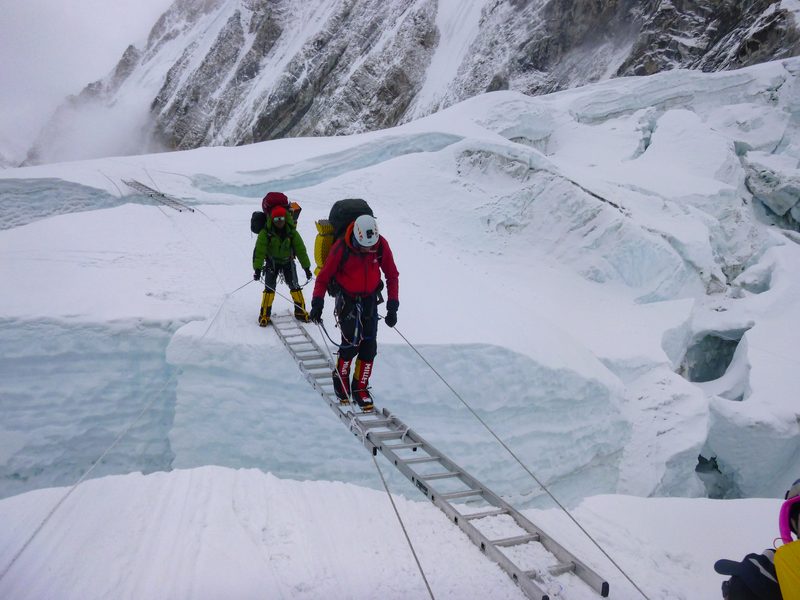
I clipped my carabiner onto a thin piece of static rope. A crampon, carefully positioned, straddled the second rung of a horizontal ladder. That ladder was tied to another ladder, which was tied to another. Together, they formed a precarious bridge across the yawning crevasse beneath me. I took a breath and stepped forward. My breathing was labored—not just because we were at 19,000 feet, but because of what would happen if I made a mistake.
Thirty feet away, on the other side of the icy expanse, stood my personal Sherpa, Ang Dawa. His arms were wrapped around the ropes, keeping tension on them and, in a very real sense, keeping me from a perilous destiny. I stared into his eyes. He was staring directly back at me. I tried not to look down.
One step. Three breaths. Lean forward into Dawa. Don't get your crampon between the ladder rungs. Don't lean backward. Don't lose your balance. Don't fall over the side. Focus. Focus.
These were typical days in the Khumbu. And more than a few of these obstacles had to be negotiated. Such is the price of entrance to Earth's highest peak. The Icefall Sherpa had expertly laid this route, but the mountain changed it every day. Ice melted. Snow shifted. Crevasses opened. I had to trust my team. I had to trust my gear. And I had to trust Ang Dawa.
When the Mountain Gives Way
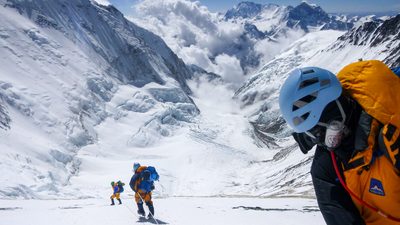
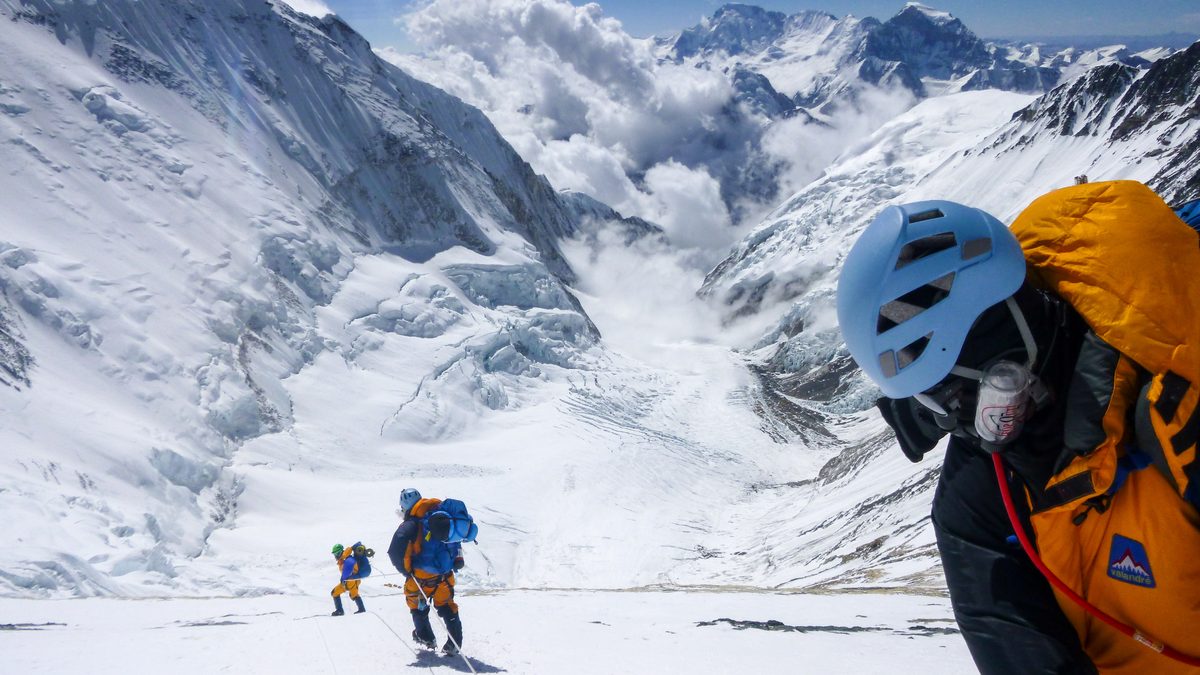
Many weeks later, after several rotations up and down the mountain, we were finally in position to make our summit attempt. Our four-man team consisted of Dawa, Neil Kushwaha, Neil's Sherpa, Sangay, and me. From the relative comfort of Camp Two, above the Icefall and outside the expansive valley of the Western Cwm, we waited for the crowds to thin before approaching the infamous Lhotse Face.
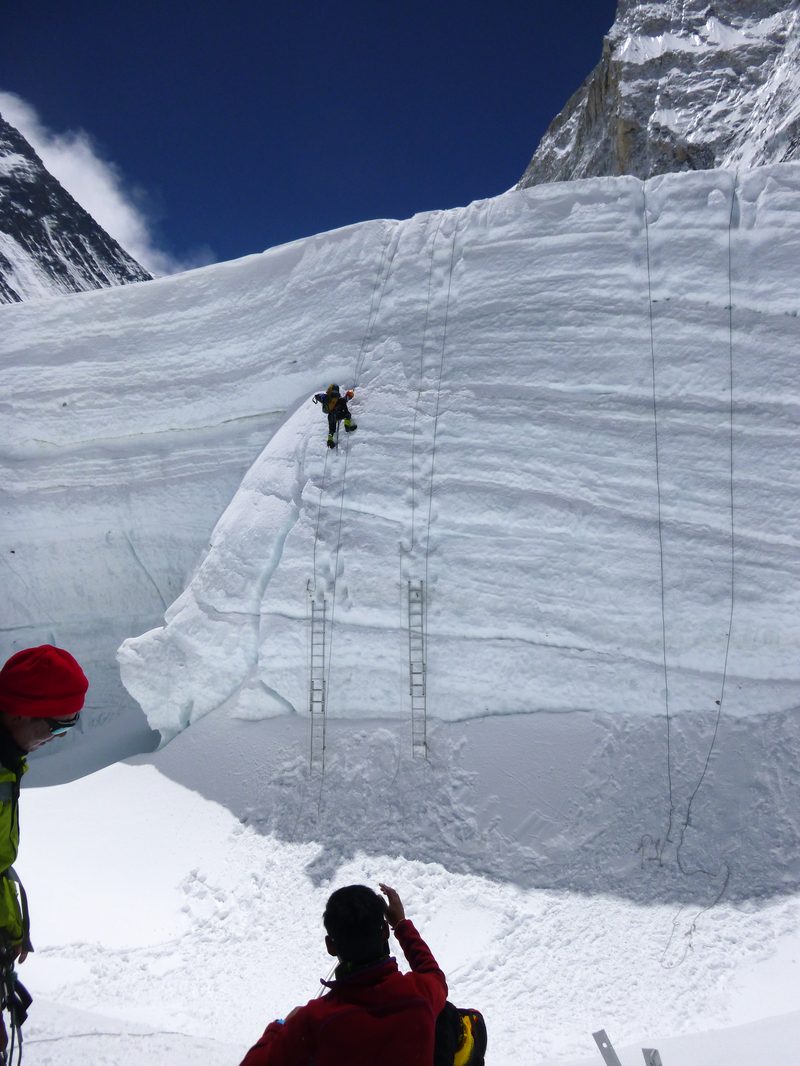
The afternoon sun was loosening the snow. The mountain began to grumble. Resting about thirty yards from the beginning of the fixed lines that climbed the 45-degree ice face, Neil and I looked down through the Valley of Silence toward Camp One. It was a glorious day in Nepal. May 2018. The sun reflected upward from the snow, burning the bottoms of my nose and ears. It seemed there wasn't enough sunscreen on the planet to cover all the exposed skin on my face. Every break was an opportunity to apply more.
And that's when we heard the noise. Rocks had dislodged in the warmth. Snow is the glue that holds mountains together. When that glue begins to disappear, the mountain starts shedding its skin. Little by little. Piece by piece. A low moan moved through the valley. Then we saw them. Two climbers lay crumpled at the bottom of the lines. Neil and I rushed to their side and quickly assessed the situation. They were Sherpa from other teams. There was a lot of blood.
He was my friend, and soon he would feel like my brother.
My mind immediately went back to another mountain, another time, another rescue. Broad Peak. 2013. On that mountain, I rounded a corner to begin a rappel down toward Camp One. About a hundred feet below me was a small dot lying crumpled at the bottom of the rope. It was my climbing partner, Brian Moran.
I lowered him down those slopes by myself, trying to beat the weather. As I worked, I prayed to God for some kind of assistance. Then, through the billowing mist, a tiny dot appeared at the top of the mountain. It was descending in our direction. It was Moktabi Jarahi, one of our fellow teammates. He was the only member of the Iranian portion of our team who held mountain rescue certification. I don't believe in coincidences like that.
It took us hours to get Brian down to Camp One and more than a week to fly him back to safety. When the weather finally broke, my Iranian friends made their summit push. Mojitabi Jarahi, Pooya Keivan and Aidin Bozorgi climbed up through the clouds. They never returned from Broad Peak. That was the end of my climb on that mountain that year. And, I thought, likely the conclusion of my mountaineering career. The hell and trauma of those events brought great pause to this Tennessee boy.
But here I was, a few years later, standing on another mountain, facing another emergency. There were injured people. And there was no one to help. So we did what any other human being would do. We helped.
Neil Kushwaha, my Canadian teammate, essentially carried the injured Sherpa nearly a thousand feet down the mountain. There, we got on the radio and convinced a helicopter to come to his aid. It would become one of the highest-altitude helicopter rescues ever attempted. Twenty thousand feet wasn't simply the upper limit for the machines. It was the upper limit of what was possible. Soon, we would be donning oxygen masks and hauling tanks of precious gas that allowed us to survive in an atmosphere that wanted us dead.
The two Sherpa were whisked away down toward the valley and, eventually, the hospital in Kathmandu. We had to trust that they would survive. There was nothing more we could do. Neil and I turned our attention back toward the mountain. The big task remained: Get up the Lhotse Face. Get to Camp Three.
Everest had just remodeled our bedroom.
Stars were appearing on the horizon when our headlights came bobbing into the upper reaches of the high camp. Exhausted—mentally and physically—I lay my head down on a pillow of ice and placed a mask over my face. The warmth of the oxygen lulled me into a brief slumber.
When my eyes opened early the next morning, I stared at the nylon of our tent as it slowly brightened with the rising sun stretching over from Tibet. I inhaled deeply from the oxygen I had slept with all night. Then a small slit appeared in the dome of our temporary refuge. It was as if someone had opened a skylight. My oxygen-deprived brain couldn't immediately process what had happened. Then I realized it. A small rock had fallen from the top of the mountain and surgically created our new ventilation. Everest had just remodeled our bedroom.
We continued upward. As we moved along the fixed lines over the Yellow Band and Geneva Spur, a strange calm overtook me. We caught up with the remainder of our team and reverently sidestepped onto a small flat spot. They were lowering the body of another climber. He looked like a department-store mannequin, clothed from head to toe in high-quality gear. Except he wasn't moving. He was one of the early casualties of the mountain that year.
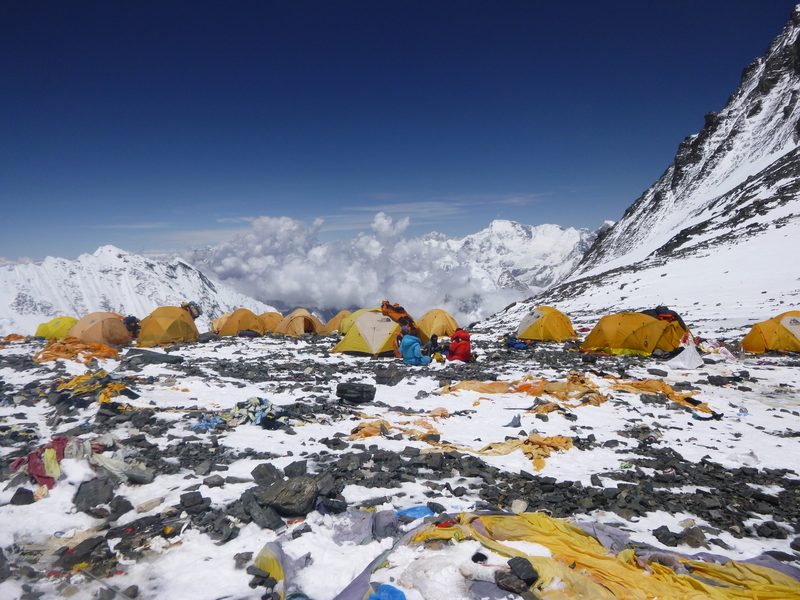
I was the last person to arrive at the South Col that evening. Once again, the sun was setting. Our original plan had been to leave for the summit around that time. But it wasn't to be. Neil had been there for perhaps an hour, but neither of us had the energy to make the attempt that night. So we lay in Earth's highest campsite, listening to the rattling of our tents. We were thankful the mountain had made us wait another day. Wind is the enemy of every summit attempt.
Here in the Death Zone, you don't do very much. You lie down. You drink water. You try to force food into your belly.
Neil and I walked around, knowing it was important to get a little exercise. We looked like refugees from a nursing home, shuffling around with oxygen bottles. But of that gas, there was no shortage. So many climbers were descending that they began offloading their oxygen bottles into our willing hands. Every bottle meant another breath. Another hour. Another chance.
I felt as though I were dragging an anvil uphill.
Into the Night
7:30 p.m. May 22. Ang Dawa crouched in the vestibule of my tent. “We leave in 30 minutes.” Neil rolled over, groaned, and laughed a little. Looks like my Sherpa and I were going to be the first team to hit the Triangular Face out of the South Col that night.
The sun had barely disappeared when I took my first crunching steps onto the mixed rock-and-ice platform that was Camp Four, our home for the past two days. The terrain quickly turned steep as we clipped our jumars onto the fixed line. Biting cold snapped through the small portions of exposed skin protruding from my down suit. I began coordinating the labored breaths behind my oxygen mask with legs that felt as though someone had attached lead weights to them. One foot in front of the other. That's all there was. One foot. Then the other.
It was fully dark now. I could see headlamps approaching from below. Within a couple of hours, it seemed as though the entire population of the South Col was on my tail. Random lightning streaked across the sky toward Cho Oyu, the mountain from which I had first viewed Everest a couple of years before. I felt as though I were dragging an anvil uphill. I was Sisyphus on the mountain.
My friend Heiko had climbed Everest a couple of years earlier. His words hung heavily in what little bit of brain I had working. “On summit day, you're going to have to dig deeper than you've ever dug.” My lungs were digging. My legs were digging. Everything I had was digging.
The Final Climb
12:30 a.m. May 23. We reached a spot known as the Balcony, where we stopped to exchange our oxygen bottles. It was twenty degrees below zero. There was very little room to perform the task, and I was competing with thirty other people for the same precious space. I wasn't sure anymore whether the streaks I could see across Tibet were actually lightning—or simply hallucinations brought on by oxygen deprivation.
Then my body delivered another message. I needed to find a place to relieve myself. I found a little spot and began negotiating the rainbow zipper on the back of my down suit. This involved negotiating my harness, layers of clothing, and everything else between me and the freezing Himalayan air. There is nothing left in my body after this. And very little left in my spirit.
My only thought was that I had summited Earth's highest peak and may not live to tell anyone about it.
I prayed to God and asked what his plans were for me this day. The response I received was a small tug on the rope that I shared with Ang Dawa. My formerly frostbitten feet were losing sensation. The sun would have to cross our horizon at some point. Dawa and I were alone again on what natives called Chomolumgma. He told me to take a break while he looked for the proper route. Dawn was finally piercing the horizon.
8.30 am. The South summit. hordes are descending and high fives are exchanged. Neil and his Sherpa shuffle their bedraggled frames. Sange looked at his watch. We knew what he was implying. Dawa told me we had one hour. I clipped into ropes that straddled the cornice between Nepal and Tibet. A fall on either side meant tumbling thousands of feet. I thought we had the rest of the journey to ourselves until I saw a strange sight. Dangling from the fixed line was a woman who was wriggling about 10 ft below us. Her Sherpa just stood there confused about what to do. But not Dawa. He reached down and grabbed her pack straps and lifted her back up onto the little slice of icy trail. They would have to turn around.
It was just us and Mount Everest now. Nothing stood between me and the velvet rope of mountaineering but this small little section known as the Hillary step. This formerly formidable obstacle in route to the summit didn't register very much with me. I just clipped my ascending device into ropes and pulled myself up. Across a small rise that infamous smoke plume heralded our arrival. I was beginning to see God's plan unfold. For the first time in a month and a half the concept of summiting Earth's highest peak was beginning to be realized.
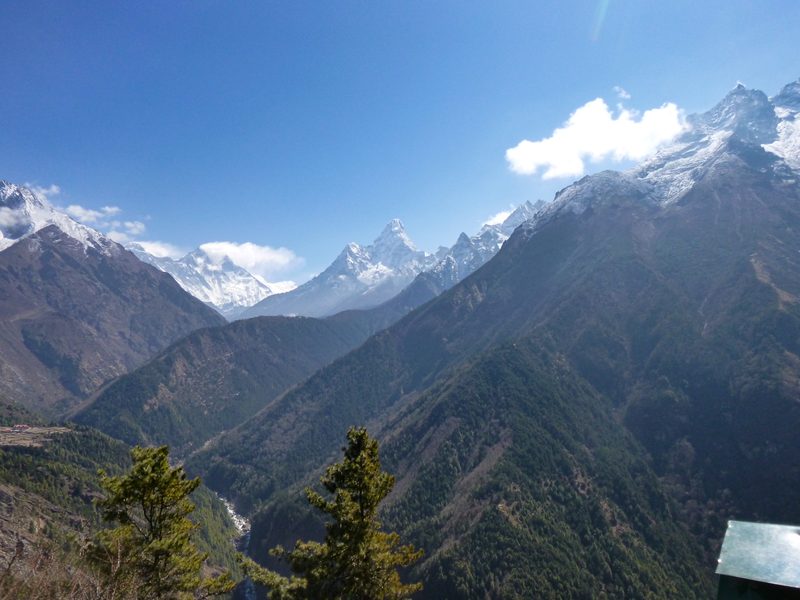
10 am, May 23. I knelt down before a small bell. Prayer flags snapped crisply all around me. In every direction were the highest peaks on the planet. I saw Cho Oyu, Makalu, Lhotse. I sat for the first time in 12 hours and sipped from a frozen bottle. Dawa and I were the highest people on the planet for 45 minutes. We had the place to ourselves. I had a lot of tasks to perform up there that would take more time than this article allows. In our exuberance we lost track of the fleeting minutes. Our weather was splendid. But we had to descend.
Tumbling back down into our camp at the South col, Neil greeted me like I was a ghost. I was the first person to leave for the summit and the last person to return. We were some of the last people to reach Earth's highest peak that year.
After a brief rest it was time relinquish all that hard fought ground. My toes were frostbitten but I fared better than some of my other team members. Tom had broken an ankle coming down somewhere off of Lhotse. Ciera was snow blind. And we had to negotiate that wicked ice fall again.
How can I ever one up that experience?
In camp two I resemble a homeless person, 20 lbs lighter than when we left Kathmandu almost 2 months earlier. Only then was I able to think about the two Sherpa and their fate. As we negotiated those ladders again towards the last days of the season, Everest grumbled some more and creaked in this movable river of ice.
Reverently , our teams stood behind Tom as the Sherpas lifted him up and over these appropriately named ice blocks called penitentes. The day was warming and chunks were falling. My only thought was that I had summited Earth's highest peak and may not live to tell anyone about it.
When we finally got out of danger, a man was there to greet us with a Coca-Cola. It was the brother of Chrring Dorje, the sherpa we had assisted a week prior at the base of the Lhotse face. He was recovering in a hospital in Kathmandu and expected to live. As I turned around to take one final look at this beautiful mountain, clouds enveloped her; our experience concluded. My thoughts about stopping to help these men intertwined with the celestial experience we had on the summit.
People ask me if I would like to go climb Everest again. My retort is a question for them. How can I ever one up that experience? I need to leave some of that for other people.