The Fourth Bond
On carbon, character, and what holds a life together.
Each of us is here for our own reason. How we conduct ourselves over the course of our lives becomes the living record of what we have learned to value and how willing we are to apply it.
Nature keeps a record like that, too. Take a simple piece of carbon, lying deep in the earth, waiting. Then comes a season of immense heat and pressure, forces so vast they rearrange its very structure. The carbon in your pencil and the carbon in the finest diamond are exactly the same material. Nothing is added and nothing is taken away. The difference is in how the atoms hold together. In the pencil, each atom bonds to only three neighbors, so it lies in soft, gray layers that smudge and flake apart. In the diamond, each atom locks onto four neighbors, all at equal strength, and that structure gives it its clarity, its brilliance, and a hardness unmatched by anything else in nature. When a person finds the resolve to endure their own heat and pressure, the result can be just as remarkable. That is the goal, and this is where the journey begins.
I learned early that the systems meant to protect us don’t always do it. From third grade through seventh, I received corporal punishment at school, again and again, from the adults whose job was to teach and nurture me. I was a boy with a big imagination, and the lesson I took from it was simple: take what you’re offered, and stop dreaming. Something in me refused. When someone told me I couldn’t do something, I set out to prove I could, and from the time I was fourteen, I was building businesses. But proving yourself has no finish line. I didn’t just work hard; I worked until I dropped and expected the people around me to keep pace, until some of them had to walk away from the work. I overpromised and overgave, and I often wanted more than the people I loved could give. Whatever I did, I did too much of it. Go big or go home was my motto, and I lived it in every corner of my life.
Looking back, I can see the same pattern running through every important relationship of my adult life, and the common thread was never anyone else. It was me. Eventually it brought me to the darkest stretch I have ever known, a season when I came face to face with losing what matters most to me. I could have run from it, into work or into any other distraction, the way I always had. This time I didn’t. I sat with myself and let the quiet do its work, and slowly I started to see the pattern for what it was: a man who overdid everything and wore out the people he loved most. Nobody wants that. I’m not sure I ever wanted it either, because in all those years I never really rested.

I have come to call that moment the summit of excuses. It is not a place of victory, and it is certainly not a perch from which to judge anyone else. It is the point where the explanations you have been using simply stop persuading you. In the moment, I had what seemed like good reasons for nearly everything I did. Life was demanding, the business needed me, and the people around me would understand. My friend Edwin, who writes in these pages, puts it plainly: the truth doesn’t care whether you like it. Once you have seen it, you cannot unsee it. You can only decide what you are going to do with it.
So what changes us? For most of my life, I would have told you it was the hard seasons themselves, the pressure. But pressure alone has never made a diamond. There is plenty of carbon in the earth that has been squeezed for ages and never became anything more than it was. What makes the difference is what happens inside the material while the pressure is on. For me, that was a choice, and it has become a promise I intend to keep.
It took me decades to see that I had never stopped building walls. As a boy, I built forts out of pine needles to keep danger out. As a man, I built them out of achievement, pride, busyness, and silence. They worked, in a way. They kept a lot of pain outside. But they also kept out the very things I needed most. That is the trouble with walls: they can’t tell the difference between what would hurt you and what would heal you.
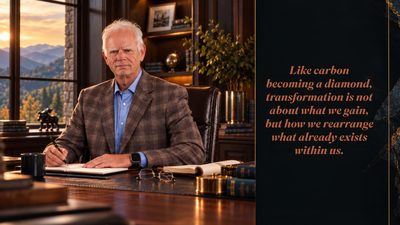
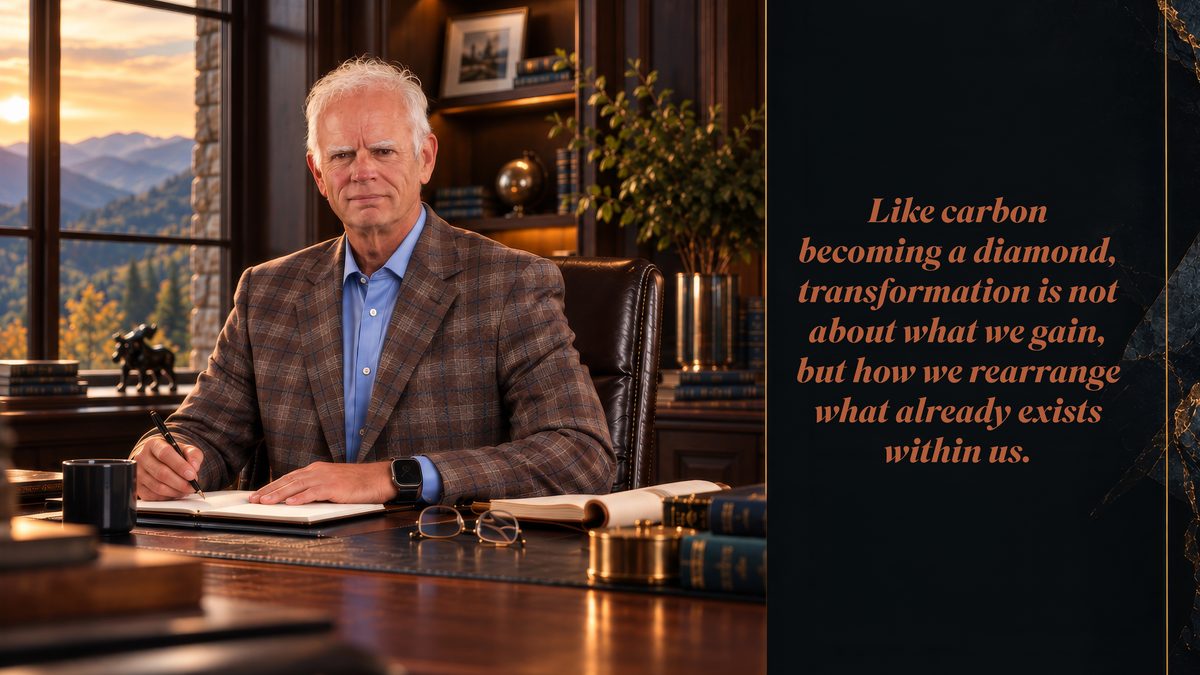
Like carbon becoming a diamond, transformation is not about what we gain, but how we rearrange what already exists within us.
A diamond doesn’t work that way. It isn’t strong because it has walls around it. It’s strong because of what holds it together on the inside. Every atom reaches out and locks onto four neighbors, each bond pulling with equal strength, so no single bond carries the whole load. Take one away and you don’t get a weaker diamond. You get graphite, soft and gray and easy to break.
When I finally stopped defending myself long enough to look honestly, I could see that my life had plenty of strength but lacked balance. I was pouring everything into one or two bonds and starving the others. So I started asking a different question. Not “How do I protect myself?” but “What has to hold me together?” The answer I keep coming back to is four things: faith, love, integrity, and stewardship.
The first bond is faith, and it formed in the heat. For much of my life, I treated God a little like a business partner I called when a deal went sideways. I believed, but I believed the way a busy man believes, in between other things. In the darkest season, I had nothing left to negotiate with. I didn’t pray for a particular outcome so much as for the strength to see what was true and the courage to stay in the room with it. Sitting with that challenged me in a way nothing ever had. Faith reminded me that I am not the center of everything, and that the outcome of my life was never entirely mine to engineer. That was humbling, but it was also a relief. Trust, I have learned, is what you do in the heat. You hold on when you cannot see how things will turn out, and you keep showing up anyway.

The second bond is integrity, which is really a bond with yourself. I used to think of integrity mainly as how I treated the people in my life, my customers, and my partners, and I took that seriously. What I neglected were the promises I made to myself. I would tell myself I’d slow down, take care of my body, and be present at home, and then I would quietly renegotiate the deal the moment it became inconvenient. Marcus Aurelius wrote that the soul becomes dyed the color of its thoughts. I have come to believe it takes on the color of our choices, too. Every time I said one thing and did another, something in me grew a little dimmer. Integrity, for me now, means stopping the negotiation with what I already know. It means letting my inner truth and my outer life become the same thing, so the man people see is the man who actually lives in my house.
Those first two bonds turn inward. The next two reach out. The third bond is love, and it is the one I thought I was best at. I loved hard, and I loved generously. But I have had to admit that loving hard is not the same as loving well. I gave too much where it didn’t help and too little where it mattered most. I poured myself into the people I loved and then often wanted more than they could give back. Love doesn’t overwhelm. It holds steady. It leaves room for the other person to breathe, to be who they are, and to choose freely. Some of the people I love most have seen the worst of my excess. I understand that they may not be ready to trust a promise, but I can become someone whose life keeps it, day after day, for as long as it takes. I still believe in the love that’s worth becoming that man for.
My friend John Quillen taught me something about this, though he would never put it that way. John is one of the finest mountaineers this state has produced, and he is closing in on the Seven Summits. On his way up Everest, falling rock struck a Sherpa guide in the head. Other climbers passed by. John and his partner stopped, called for a helicopter, and got the man to safety, knowing it could cost John the summit he had spent years working toward. He made it to the top anyway. But that’s not the part of the story I remember. The summit was the goal. Stopping was the man. Love is the bond that makes you stop.
I felt as though I were dragging an anvil uphill.
The fourth bond is stewardship, which means caring for what you have been given. That includes a body, a mind, a business, the people who live and work beside you, and the hours in a day. I once built homes for a living, and every builder knows a house isn’t strong because you threw more lumber at it. It’s strong because the load is carried evenly, with every member doing its share. For most of my life, I lived the opposite way.
I thought more was always better: more work, more effort, more giving, more wanting. I treated my body as equipment, my energy as unlimited, and rest as something I could earn later. Stewardship asked me to see that excess is not dedication. It is simply another way of being out of balance. The hardest discipline for me has not been working harder. It has been learning to stop, to rest, and to let some things be enough. When I say I have to be unreasonable with myself now, I don’t mean I punish myself for being human. I mean I keep the promises I’ve made, even when the old habits are calling.
Years ago, I heard Skip Ross give a talk called “You Can Be a Winner.” He said a life has to be balanced across business, home, social, physical, mental, and spiritual. I never forgot it, but I didn’t live it as well as I could have. Today I see those six areas held inside these four bonds. Faith carries the
My only thought was that I had summited Earth's highest peak and may not live to tell anyone about it.
spiritual. Love carries home and friendship. Integrity keeps the mind honest. Stewardship takes care of the body and the work. Balance doesn’t mean every area gets the same hours every week. Some seasons will ask more of one than another. It means no single bond is left carrying the whole load, and when one has pulled too hard, you come back to the others before the imbalance becomes your normal.
That brings me to time, the part of the process nobody can rush. A diamond does not form in a moment. It forms over a span of time long enough that the change is invisible while it happens. I used to think transformation would arrive as a single event, a decision, a turning point, or a dramatic before and after. What I’ve found is quieter and more demanding than that. Transformation happens in the small choices, made every day and, if I am honest, every minute of every day. It’s the extra effort when “good enough” would pass. It’s the negative story about yourself you notice and refuse to keep telling. It’s the moment you catch yourself reaching for more than you need and choose to stop. Most of life is noise. The signal is in those choices.
One more thing about diamonds surprised me. They are the hardest material in nature, but hard is not the same as unbreakable. Strike one at the wrong angle, and it can still crack. That gives me hope rather than fear, because it means strength was never about being invincible. I will not get every day right. What matters is that when I miss a step, I go back to it instead of using the miss as an excuse to quit. I am not writing this from the finish line. I am still on the road, still learning, still being shaped.
How can I ever one up that experience?
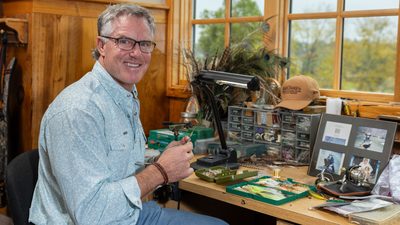
Edwin reminds us that a trout responds to what is presented, not what was intended. People are the same way. The people I love cannot see my intentions. They can only see my days. Trust is not something I can ask for or announce. It is built the way a diamond is built, through steady pressure held over time until the structure proves itself. My job is not to tell anyone I have changed. My job is to keep living in a way that eventually makes the telling unnecessary, and makes me worthy of the trust and love of the people who matter most.
There is one last thing I love about diamonds. For all their brilliance, they don’t make their own light. A diamond takes in the light around it and gives it back, scattered into colors, brighter than it arrived. I think that is the real purpose of the bonds: not to make us impressive, but to make us clear enough to reflect something greater than ourselves.
I don’t know what your pressure looks like. It may be a doctor’s visit, a quiet hour of honesty, or a season you would never choose. Whatever it is, you are not just a lump of carbon waiting to see what happens to you. You get a say in how you hold together. And if any of this sounds familiar, you don’t have to wait for your own jolt to begin.