

After two major setbacks, Mayor Indya Kincannon enters her final term leading without momentum, but not without purpose.
By George Korda | Illustration By R. Daniel Proctor
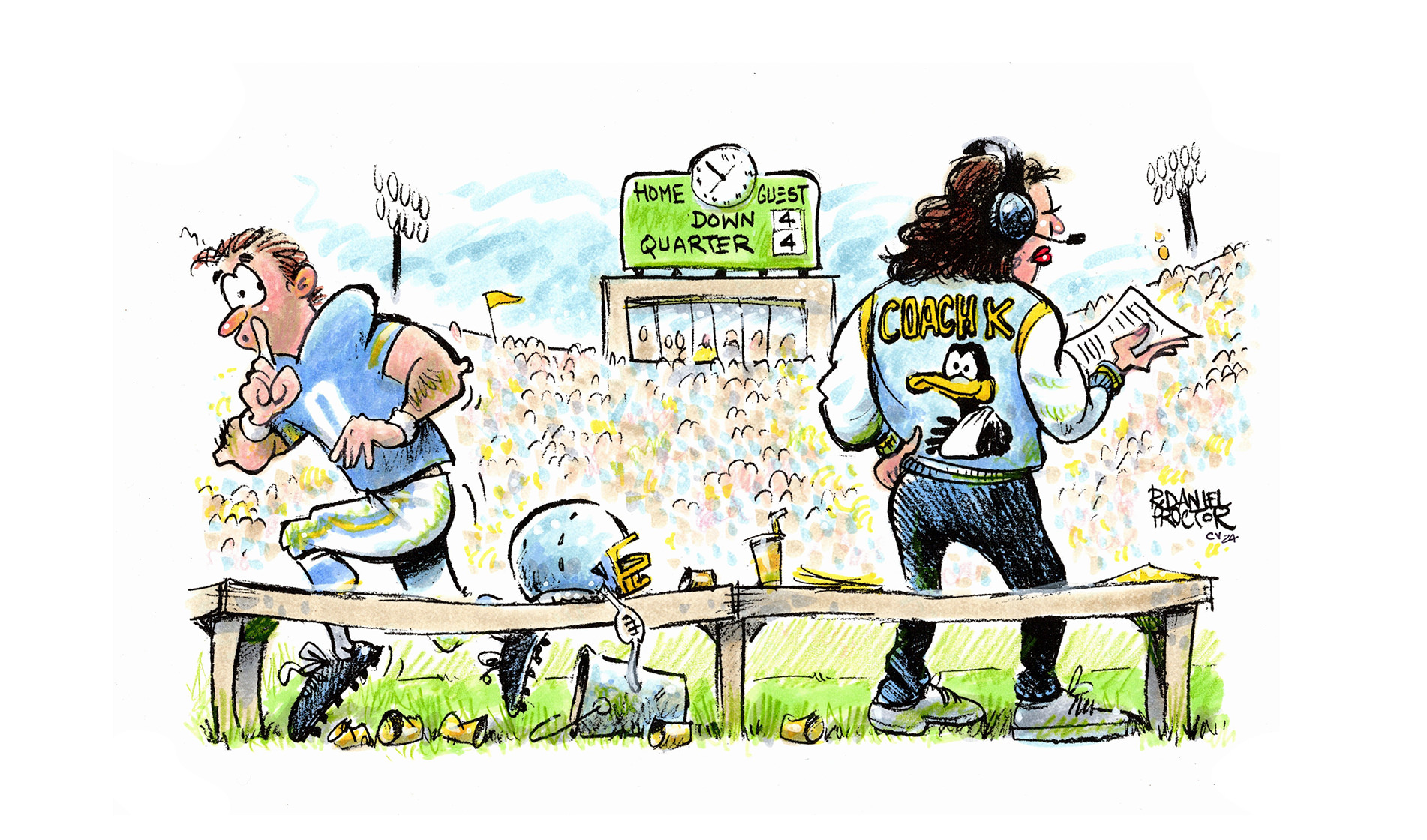
A politician, such as Knoxville Mayor Indya Kincannon, has much in common with a football coach and a shark. Life’s good when a mayor is winning city council votes, cutting ribbons, attending national conferences, and speaking before politely applauding civic groups. But start losing, and the mood turns grim. Some of your friends perhaps become less friendly. As the saying goes, “If you want a friend in politics, buy a dog.”
A mayor’s local political profile makes her or him the biggest shark in a city’s political ocean. Where a mayor swims, others follow, either because they support the mayor – or they don’t want someone unhappy with them who has big, sharp, teeth.. However, if political battles wound the shark, everyone in the local political universe looks for any signs of weakness, wondering what their strategy should be going forward.
Mayor Kincannon, who is a genuinely nice person, is in the last two years of her final term, an unfortunate time for a losing streak. In September and November, she and her team endured a pair of defeats. One was the proposal to sell some Chilhowee Park property to the Emerald Youth Foundation. On its face, the plan had many positives. But for whatever reason, perhaps in part because the Kincannon team assumed it’d get automatic city council support, the proposal lost in a 5-4 vote.
Chilhowee Park was followed by an even bigger setback, the voters’ obliteration at the polls of Kincannon’s proposed half-percent sales tax increase. Touted to put $47 million into the city’s coffers for affordable housing, parks, and other areas, even in Democratic-blue Knoxville the mayor’s ballot measure was crushed by 61.5% of the vote.
It’s in this situation that the coach who’s lost two big games, and the political shark who’s had bites taken out of her, looks forward to her final two years. What might they hold?
It would be remarkable if staff members don’t start looking for their next jobs if they don’t think city service is their career or that the next mayor would ask them to stay. This depends somewhat on relationships, and the degree to which staff members think being tied to Kincannon is a negative or a positive
City council, pretty much a “Whatever you want, mayor,” body earlier in Kincannon’s term, may become more independent unless there’s absolutely, positively, no political danger in what they’re asked to do. Members with political plans are less worried about Kincannon than their own futures. The mayor will likely have to work somewhat harder to get a council majority support. (After the Chilhowee Park proposal failed, I was asked what I’d advise the mayor to do. I said, “Get on the phone to every council member and say, ‘This is on me. I shouldn’t have put you in that position. I apologize, and it won’t happen again. Now, what do you need me to do for you?’” Whether anything like that happened, I don’t know).
The sales tax referendum defeat means Kincannon won’t have a money cushion on which the administration had hoped to sit. Barring a change in the administration’s trajectory – or record-breaking sales tax collections – this portends two years of mostly static budgets, shifting money around, perhaps cutting some things, certainly not big new spending. Kincannon could propose a property tax increase, a tough sell. She won’t have money to do big things, and her bank of political capital is seriously depleted.
In such political situations, mayors can concentrate on the things that can be done. The basics. Constituent service. Don’t shoot for the “legacy” projects that seem the goal of many political figures. As much as possible, stay out of controversy. When people aren’t hearing about bad things, they think everything is going well. And be nice, which Kincannon is.
The city’s term limits mean Kincannon can’t run for mayor again. She is, in political parlance, a lame duck. That’s not necessarily a bad thing, as lame-duck status gives a leader a certain freedom to act, unencumbered by the factors involved in running for reelection. What a mayor does during lame duck status determines to a significant degree how they’re remembered. What will be learned in the next two years is what direction will Kincannon take the city. That will be her legacy.
Comments are closed.