

To Morocco With Love
Exploring morocco’s timeless wonders
by Brooks clark | Photography by Brooks clark & Karen clark
Appeared in Cityview Magazine, Vol. 41
An early scene in the movie Patton takes place after the general’s 1942 landing in Morocco and defeat of the Vichy French. Standing on a reviewing stand with Sultan Mohammed V in the capital city of Rabat, Patton watches a military band march by, followed by infantry battalions in precise formation attired in scarlet, white, and gray, respectively. Then process cavalry units, on white horses and camels. “Tell me, excellency,” asks the sultan. “What do you think of Morocco?”
“I love it, excellency” answers Patton with a grin. “It’s a combination of the Bible . . . and Hollywood.” In a 12-day tour of Morocco with Odysseys Unlimited, Karen and I saw what Patton meant, from donkeys that collect trash each morning from homes on the narrow alleyways of the old city of Fez, to riding camels on the dunes of the Sahara, to a tour of Atlas Studios in the desert city of Ouerzazate, where movies like The Mummy, Gladiator, and Aladdin were filmed.
Our tour began in Rabat, at the ornate mausoleum of Mohammed V. During World War II, he famously refused to turn over Jews to Vichy officials, explaining that he had no Jews in his country, only Moroccans. He then led the nation to independence from France in 1956. His tomb exemplifies the ornate geometrical tilework, carved plaster, and painted woodwork that is everywhere in Morocco. Everything must be beautiful to honor Allah, said our guide.
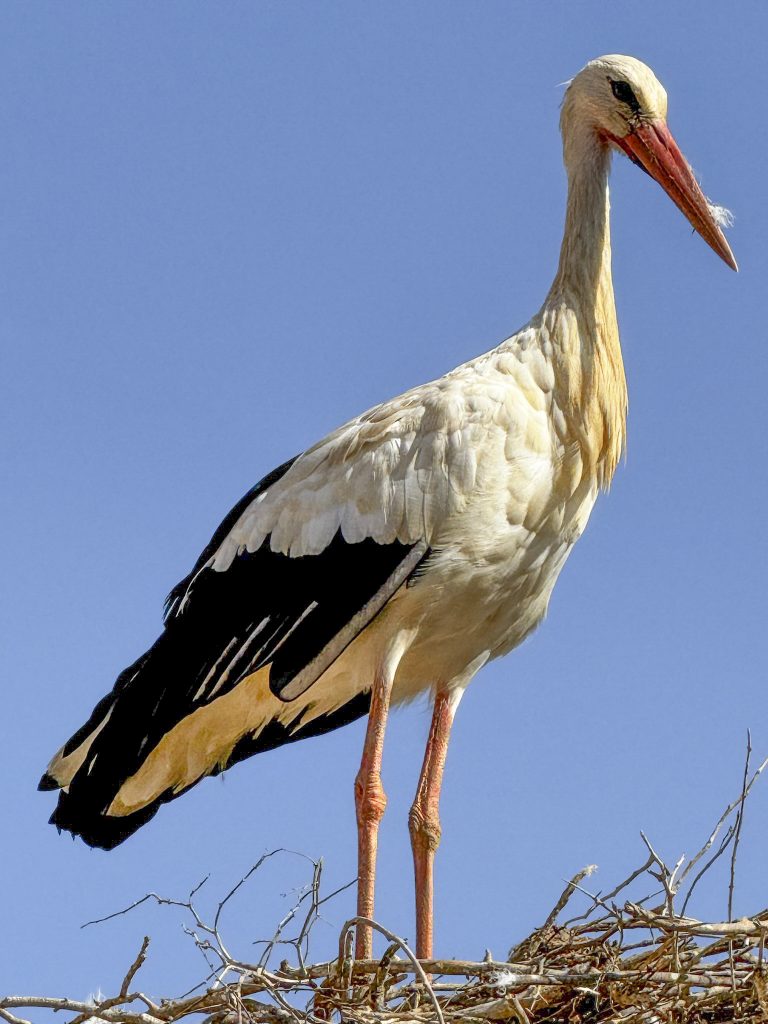
We toured the ancient walled Kasbah (castle, or citadel) of Chellah, which includes the ruins of the Roman port city of Sala Colonia and a 14th century burial site for sultans. Its tall pillars now house nests of large storks who clack their beaks loudly when tourists draw too close.
We then toured the Kasbah of the Oudayas. A maze of alleyways and residences, it looks out over the Atlantic and the mouth of the Bou Regreg river, whose waters flow from the Atlas Mountains. The Oudayas were Muslim Berbers who were expelled from Spain in 1609. They settled in Morocco and took to preying on merchant ships that sailed by. They became known as the Barbary Pirates.
A recurring theme of our tour was Morocco’s ethnic diversity, including in the indigenous Berbers, more properly called the Amizigh. Many still live the nomadic lives of herders in the Atlas Mountain regions. We met a father and his two children minding their flocks. Near the Sahara are Tuareg Berbers, with more West African roots. We met five of them when their musical group played for us after our camel ride. Jewish populations have lived in Morocco for two millennia. Arabic-speakers date back to the spread of Islam in the seventh century and centuries of camel-caravan trade.
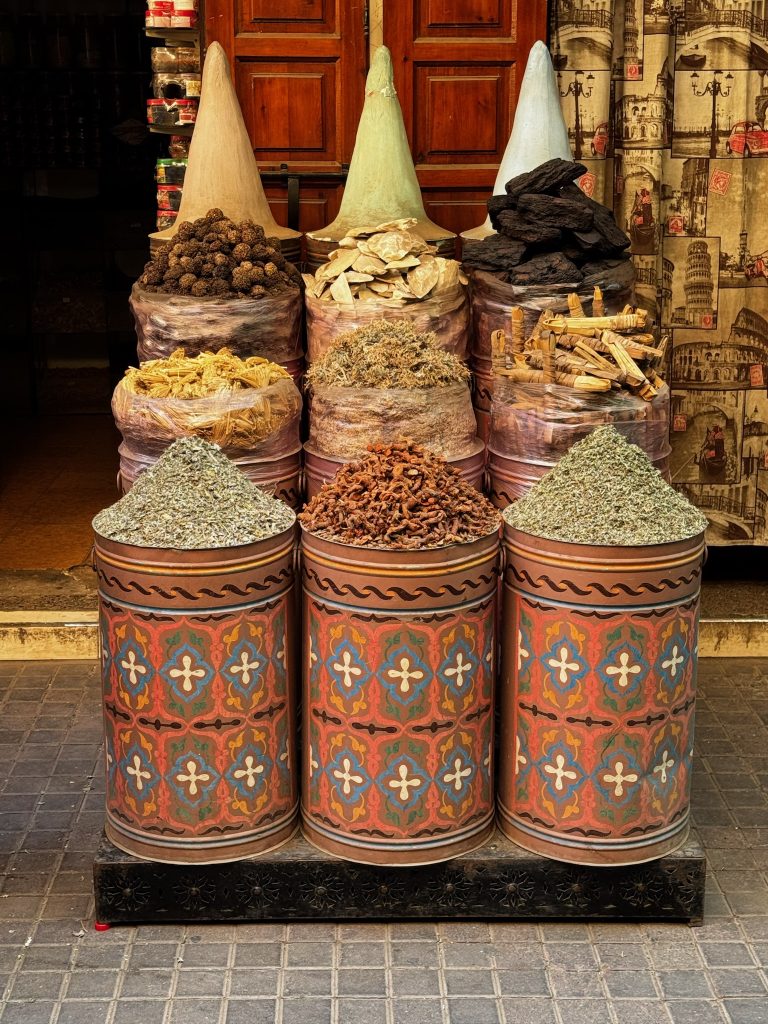
Walk the Medina long enough and the spices will find you drifting through alleys like old stories.
From Rabat, we headed east toward Fez. On the way we toured the archeological site of ruins of Volubilis, which served as Rome’s regional capital until 285 A.D., when it was overrun by Berber tribes. The area was and is a breadbasket for olives, grapes, wheat, and other vegetables. It was inhabited by Berbers, Byzantine Christians, and Muslims until it was leveled by an earthquake in 1755. Among the mosaics still visible on the floors of homes is one depicting the 12 labors of Hercules, which made us think of our workplaces.
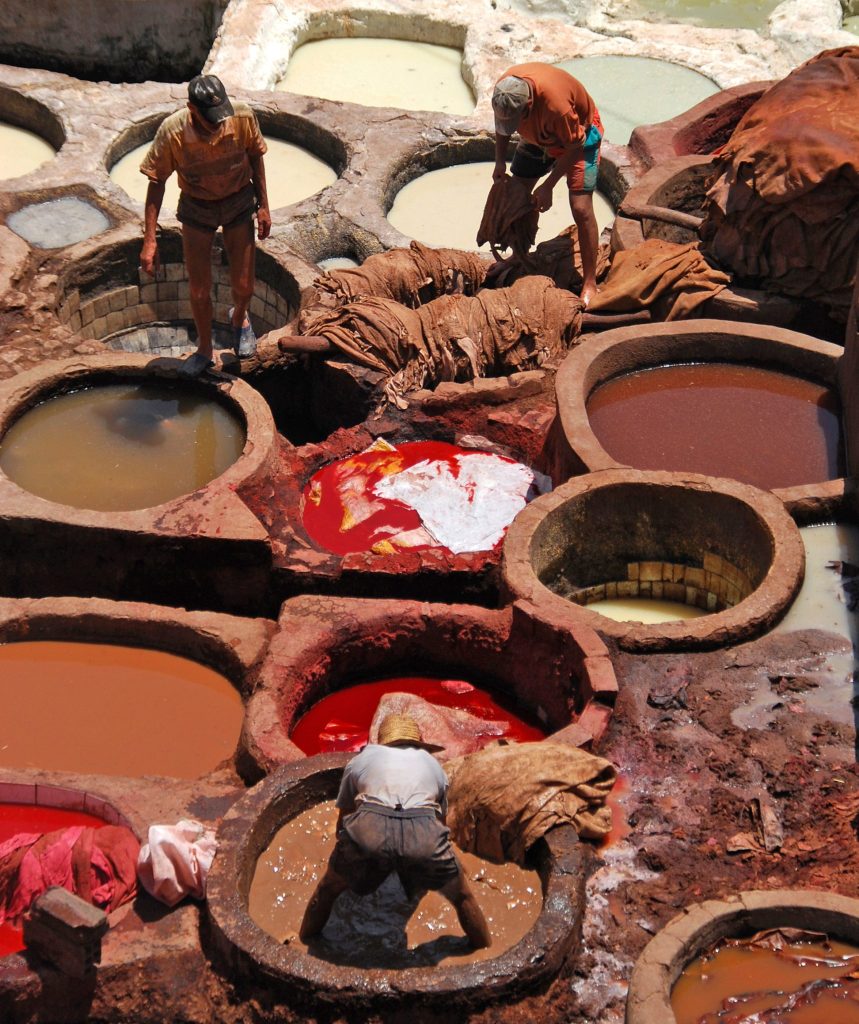
Fez is an ancient city, called the “Athens of Africa” for its wealth of cultural, educational, and religious institutions. We walked through the high adobe walls into the medina, or old city, into a labyrinth of some 9,000 narrow alleyways. We arrived as a team of donkeys began their daily rounds of collecting trash from the medina’s countless homes and businesses. The lively marketplaces include every manner of craft, spice, vegetable, fruit, fish, and meat (except pork). The artisans include rug-makers, potters, silversmiths, and leather workers. Touring a medieval tannery, we were handed sprigs of mint to cut the odor. Looking down, we saw dozens of open vats in which workers were tanning and cutting leather. I bought a very good belt. We visited a medieval Muslim university and a 14th century madrasa. In the Mellah, the 14th century Jewish quarter, we toured a historic cemetery and a 17th century synagogue.
Outside the medina, we toured a pottery, where we saw young men take wet gray clay, slap it into two-square forms, and place it in the sand to dry in the sun. The future tiles are then shaped, fired, painted, then fired again. We watched a potter spin his many wares, then saw the artisans perfectly painting them by hand. Mosaics are made from tiles cut into shapes by a skilled artisan with a sharp hammer.
From Fez, our bus took us into the foothills, through Ifrane, “the Switzerland of Morocco,” looking like the ski town that it is, then through the cedar forest of the Middle Atlas National Park, where a Barbary macaque on the roadside grabbed peanuts from my hands. Ascending into the high plains, we stopped at a nomad camp and chatted with a shepherd and his children.
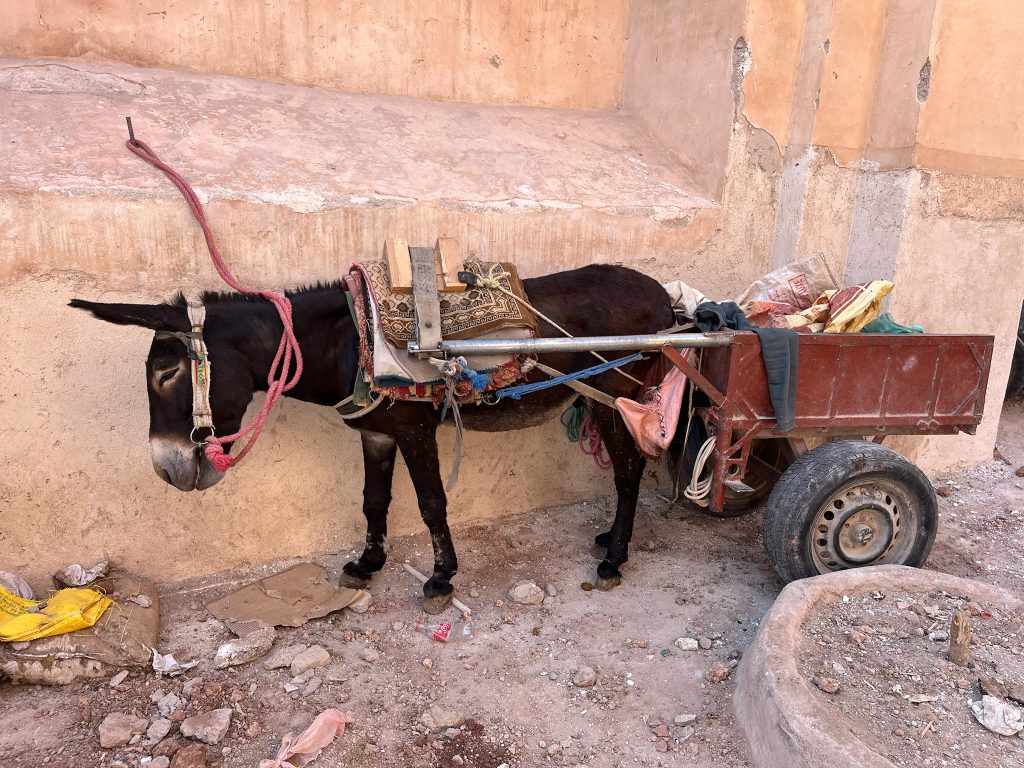
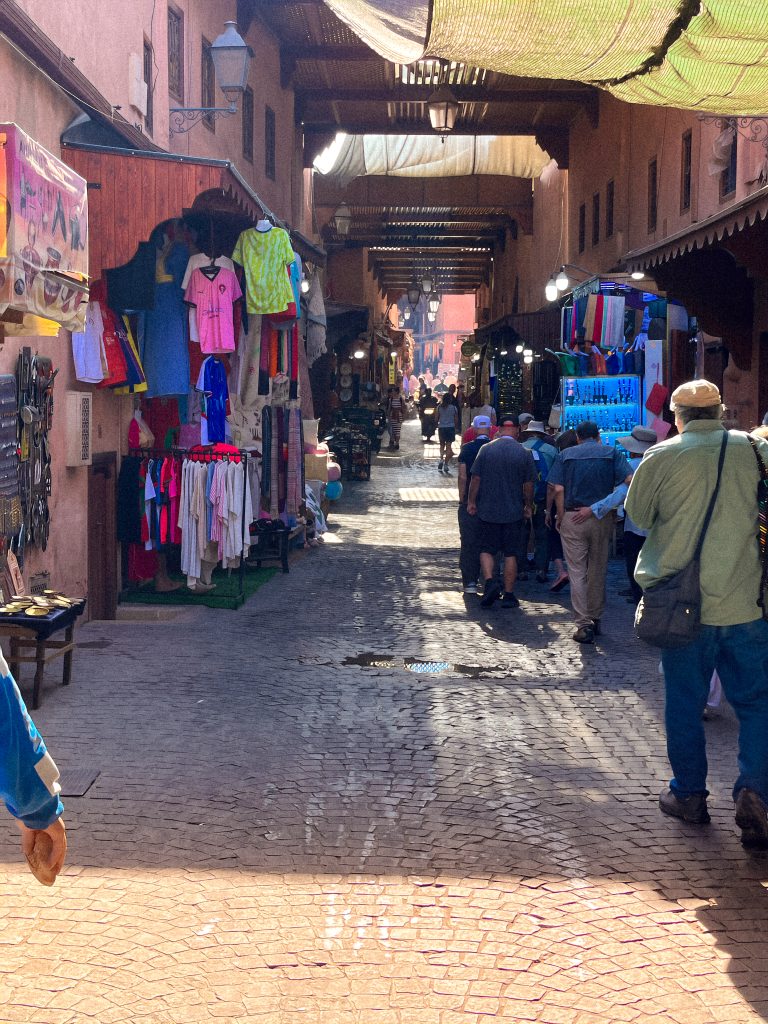
Before the markets operand the alleyways fill the donkeys move through the Medina, gathering the day’s refuse one basket at a time.
In Rissani, an ancient caravan trade city, we walked through a medieval fortified village near the tomb of Moulay Ali Cherif, a 17th century emir (and descendant of the prophet). Inside adobe walls, the village alleyways are cool—enough so for a pre-K class, where the delightful children sang us songs in Arabic, French, and English.
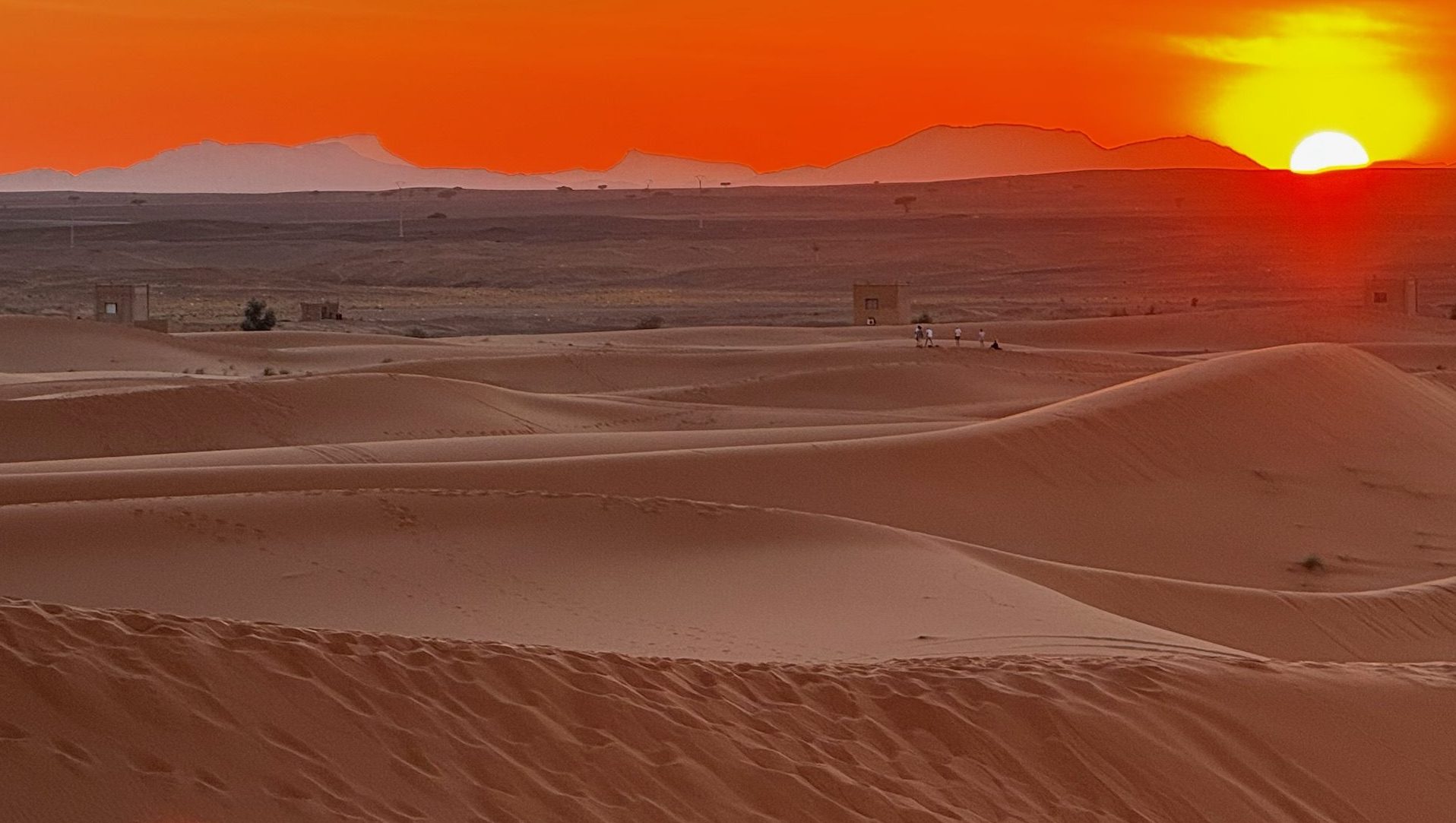
In a Sahara Desert camp at Merzouga, we mounted camels and rode across the dunes, dismounting for sunset, then riding back in the darkness. We were struck by the silence and vastness.
Morocco gets little rainfall, but it makes the best of the water that comes each year from the snows in the Atlas Mountains. To move water across the desert, they used the khettara irrigation system of tunnels, with wells dug every 50 meters or so. We descended into one well and tunnel in Fezna.
Some 300 million years ago, when the earth’s land masses collided to form the supercontinent Pangea, the Atlas Mountains were part of the same formation as the Appalachians. We pondered the similarities as we looked up from the bottom of the Camp Todra Gorge and compared it to those we see on I-40 driving to North Carolina, and when we descended from the High Atlas Mountains toward Marrakech on switchbacks much like the Tail of the Dragon.
Marrakech is called the “Red City” because its buildings and ancient ramparts are constructed from reddish, iron-rich sandstone and rammed earth. We rode in horse-drawn carriages to the lively souk (marketplace, or bazaar) and medina. We toured the Medersa Ben Youssef, a masterpiece of 16th century Moroccan Islamic architecture, and the sumptuous Dar El Basha palace from the late 19th century. Along with the beautiful tilework, fine Moroccan homes emphasize beautiful central gardens, or riyads. They are rectangular, divided into four quadrants by two paved paths intersecting at a center fountain.
We remembered that Knoxville native and West High grad Rachel Williams wrote her book “My Friend Anna” after her stay at La Mamounia, one of the most luxurious resorts anywhere, ostensibly hosted by pseudo
heiress/con artist Anna Delvey. So we walked from our hotel, and, escorted through the lobby by a courteous security guard, got a drink at the bar. Visitors are watched so closely that, as we were leaving, a smiling man in a fez noticed that I was not wearing the sun hat I had on when I entered. I had indeed left it in t5the bar.
From above, the tannery looks like a painter’s palette; up close, it’s a world shaped by muscle, dye, and tradition.
In Casablanca, we toured the Hassan II mosque, built on a promontory looking out on the Atlantic Ocean. “I want to build this mosque on the water, because God’s throne is on the water,” said King Hassan II in 1980. “Therefore, the faithful who go there to pray, to praise the creator on firm soil, can contemplate God’s sky and ocean.” One of the largest mosques in the Islamic world and one of the few that non-Muslims can enter, it was completed in 1993. It can hold 25,000 worshipers inside and 80,000 more on the plaza outside. The roof is retractable, illuminating the hall with daytime sunlight and allowing worshippers to pray under the stars on clear nights. Its minaret is 690 feet tall.
The cinephiles in our group had been trading favorite lines—e.g., “Round up the usual suspects!”—from the 1942 movie Casablanca. Our guide Nabil surprised us with dinner at Rick’s Café, which was opened in 2004 to honor the fictional Rick’s Café Americain, where Rick (Humphrey Bogart) was shocked to see his old flame Ilsa (Ingrid Bergman) walk in with resistance hero Victor Laslow (Paul Henreid). We would have joined in singing if the band had played La Marseillaise.
Comments are closed.