

From Liverpool to legend, the Beatles’ rise traces genius, rivalry, heartbreak, and an enduring musical bond.
Story By Gary Wade | Photography Courtesy of The Library of Congress
Appeared in Cityview Magazine, Vol. 42, Issue 3 (May/June 2026)
On a hot summer day in 1957, St. Peter’s Church in Liverpool, England, hosted an all-day garden party. The entertainment included a teenage rock and roll band led by a sideburned, leather-jacketed John Lennon, almost seventeen years old. They called themselves the Quarry Men. Fifteen-year-old Paul McCartney, a musical devotee of Elvis Presley and Little Richard, stood in awe of John’s performance and was determined to become part of a group as crazy about music as he was. Upon being introduced to each other, Paul, who played piano and guitar, asked John to have a go at his guitar. After re-tuning the instrument to suit his left-handed preference, Paul played “Twenty Flight Rock,” then followed on a nearby piano with “Long Tall Sally,” his voice reverberating through the hall. He had passed the audition. “That was the day,” John observed years later, “that things started moving.”
Later, Paul wrote “I Lost My Little Girl,” a song that inspired both men to begin collaboratively writing Lennon-McCartney originals using only words and chords. Neither could read a note of music. A short time later, Paul, after botching a riff in a performance as the group’s lead guitarist, invited his younger friend George Harrison to join the band, subject to John’s approval as the acknowledged leader. Thus, the Quarry Men became a trio of guitarists. By 1960, John’s close friend Stu Sutcliffe, drawing on Buddy Holly and the Crickets, suggested a new name for the group: not the beetles, but the Beatles, as with a beat. Soon came their first big break from a nightclub owner in Hamburg, Germany, who stipulated that the Beatles find a drummer. Thus, Pete Best, at age eighteen, entered the picture. Playing six days a week and four to six hours a day, the fledgling rock and rollers, who had chosen to include the musically challenged Sutcliffe, began to hone their skills. By the time they returned to England, they had become the most recognized band in the Liverpool rock scene. Sutcliffe stayed in Germany.
After a period of relative inactivity, the Beatles were hired to play at the Cavern in Liverpool, a former jazz club. Inspired by the music of Smokey Robinson and the Everly Brothers, the Beatles began drawing sold-out audiences by playing the popular tunes of others. “One After 909,” written primarily by John, was the only original featured in the lineup. The Lennon-McCartney team continued to write, but with that one exception, they never performed their own work. By popular demand, the boys returned to the Top Ten Club in Hamburg for a successful few months before returning home in 1961.
The Rise of the Beatles
Greasers until then, John and Paul let their hair grow at the suggestion of Sutcliffe’s girlfriend and decided to hire businessman Brian Epstein, only twenty-seven, to serve as their manager. Although Epstein promised they would one day be “bigger than Elvis,” the group flunked a recording audition with Decca, whose staff thought guitar music was on its way out. At Epstein’s suggestion, the band cast off their leather jackets, dressed in tailor-made narrow-legged suits, and promised to cut out smoking and drinking on stage. He persuaded the group to introduce a few of their originals at the Cavern with a cleaner image. In 1962, continuing their back-and-forth travels between England and Germany, they received a lucrative offer to return to Hamburg. Upon their arrival, they learned of Sutcliffe’s death, particularly devastating to his friend John.
Paul’s ballads, like “Till There Was You,” thrilled young girls and appealed to older audiences, but at this stage in their development, John, with his strong preference for rock and roll, was only able to tolerate those songs. This difference in style continued throughout their partnership.
“That was the day,” John said later, “that things started moving.”
During this time, a meeting between Epstein and George Martin, the head of a small subsidiary of EMI Records, proved historic. After listening to the Decca audition and several other Lennon-McCartney originals, Martin, a trained and talented musician himself, was persuaded to offer a recording session scheduled for June 6, 1962.
Impressed as much by their personalities as by their music, Martin approved “Love Me Do” as their first record, with “P.S. I Love You” on the flip side. He insisted, however, that Pete Best be replaced as the drummer. After Epstein was chosen to deliver the bad news to Best, Ringo Starr became the fourth Beatle. This first record was modestly successful in sales, but when they next recorded “Please Please Me,” Martin announced over the intercom, “Gentlemen, you have just made your first number one record.” And so it came to be, hitting the top of the charts in England.
Their sudden popularity was startling. Starting the year as merely the top band in Liverpool, by the middle of 1963 the Beatles, with three more number one hits, including “She Loves You” and “From Me to You,” and two number one albums, had become the biggest pop stars in the history of Great Britain. Meanwhile, Marsha Albert, a fourteen-year-old in Washington, D.C., informed WWDC disc jockey Carroll James of the recording of “I Want to Hold Your Hand,” which had just been released in England. James got a copy, playing and replaying his “exclusive” release, much to the disappointment of EMI’s subsidiary, Capitol Records, which had planned to wait another month or so until the Beatles came to this country. Listeners were hooked. The song soon reached number one on the pop charts.
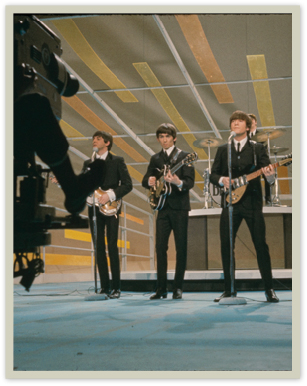
On February 9, 1964, the Beatles appeared on American television as part of the Ed Sullivan Show. Upon their arrival in New York, the group was mobbed by the media. The mop tops displayed their sparkling personalities in a press conference that made national news. By April, the top five songs on the U.S. charts were all by the Beatles, and it was just the beginning. Fans could not get enough of the Fab Four. McCartney’s “Yesterday,” a year later, reached new heights. Not to be outdone, Lennon penned the deeply personal “In My Life,” another classic for the band. Each illustrates the musical growth of the duo while also revealing their competitive spirits. The Rubber Soul and Revolver albums were hugely successful. While their styles complemented each other, there continued to be differences in their preferences. In Paul’s words, “My songs are a bit soppier than John’s.”
Success, Strain, and Separation
Performing live concerts, including those in baseball stadiums in San Francisco and New York, became a chore when the Beatles could not hear their own music over the screams of the crowd. There were travel issues as well. The four were typically confined to their hotel rooms for security reasons. Abandoning live performances in favor of becoming recording artists only offered more personal time and a far less hectic existence. Please Please Me, released in the United States as Meet the Beatles!, had been their first album, and twelve more followed, including the iconic Sgt. Pepper’s Lonely Hearts Club Band, which achieved critical acclaim, and Magical Mystery Tour.
Epstein’s untimely death in 1967 was devastating to the group, personally and otherwise. Their business affairs, especially at Abbey Road, became a mess, but the hit songs kept coming. The evolving sounds of John’s “Strawberry Fields Forever” and Paul’s response, “Penny Lane,” were major hits, each reminiscent of their youth but also signs of decline in their Lennon-McCartney collaboration. Lennon and McCartney, while still partners in name, had become more independent in their creations. A memorable example came when John and his wife Cynthia divorced. Paul, concerned about the effect on their son Julian, wrote “Hey Jude,” a seven-minute ode, extraordinarily long for radio play, yet nevertheless an instant classic. While John loved the song, there was little or no collaboration involved.
“The Ed Sullivan Show introduced them to America—by April 1964, the Beatles owned the top five songs.”
John’s budding relationship with avant-garde artist Yoko Ono, and her presence at the Beatles’ recording sessions, created awkward dynamics. Meanwhile, Paul had married Linda Eastman, the sophisticated daughter of a prominent New York family. By then, Harrison, like Ringo previously excluded from Lennon-McCartney publication royalties, had begun to author major hits for the group. “Something,” “Here Comes the Sun,” and “While My Guitar Gently Weeps” are prominent examples. He learned to play the sitar in India and developed an interest in that country’s music. The release of George’s solo album All Things Must Pass received critical acclaim. McCartney released a solo album bearing his name alone. None of the other three Beatles participated. By the late 1960s, cracks in the relationships within the group were quite apparent. The discord documented on video during the making of their last album, Let It Be, was palpable.
When discussions began about hiring a manager to straighten out their business issues, a major disagreement followed. McCartney wanted Linda’s father and his law firm to represent the group. John, George, and Ringo insisted on Allen Klein, a tough-nosed, sometimes acerbic negotiator. A meeting between the two potential representatives ended badly. By then, John had been to New York to promote the Plastic Ono Band, so all, except maybe Ringo, seemed to be going their separate ways.
On December 31, 1970, Paul’s attorneys filed writs at the High Court in London for the dissolution of Beatles and Company, citing the employment of Klein as unacceptable. Three months later, the court ruled in favor of McCartney on every count. The opinion included a scathing assessment of Klein’s integrity. A receivership ordered by the court ultimately salvaged the band’s control over its music catalog. An appeal by the three other Beatles was later withdrawn. Paul was on his own. When Klein’s contract ended, the remaining Beatles sent him packing. In the interim, John was ruthless in his criticism of his longtime songwriting partner. He wrote, recorded, and released a song directed at Paul titled “How Do You Sleep?” Afterward, Paul lamented, “I was thought to be the guy that broke the Beatles up and the bastard who sued his mates.” Tensions subsided over the next several months. Time began to mend relationships. In December 1971, Paul, encouraged by Linda, met with John and Yoko, who agreed to a truce in their public spat. Two years later, John conceded, “Paul’s suspicions [about Klein] were right, and the timing [of the lawsuit] was right.”
The Last Notes
McCartney chose to interpret Lennon’s “Jealous Guy” as an apology. Ian Leslie, the author of John and Paul: A Love Story in Songs, described Paul as the primary object of John’s jealousy, tied to insecurity about his charisma, his way with women, and his musical abilities. John’s death on October 9, 1980, from gunshots as he approached his home in New York City, ended all hopes of a Beatles reunion. In remembrance of their thirteen years of special friendship, Paul wrote and recorded his personal tribute, “Here Today,” ending with the words, “No more tears, I love you.”
The Beatles Anthology, released in the 1990s before George’s death in 2001, and the 2025 remasters offer sound improvements and some new material. In 2023, Yoko, Ringo, and Paul, using an old demo recording made by John and a guitar part by George, released the last Beatles single, “Now and Then,” with the help of artificial intelligence. Paul had worked for two decades on the final product, a closing tribute to his departed friend. In June, Paul will be eighty-three. Ringo will be eighty-six in July.
Comments are closed.