

Some roads have a way of pulling you back.
By Nathan Sparks | Photography by Bruce McCamish
Appeared in Cityview Magazine, Vol. 42, Issue 3 (May/June 2026)
I hadn’t driven this particular stretch in more than thirty years, but the moment I turned off the main road and felt the land begin to open — fields rolling down toward the water, the horizon spreading wider than you’d expect — something in my chest settled in a way that had nothing to do with directions. I knew this road. I had driven it hundreds of times as a young man, on my way out from the little community of Louisville to visit my friend Gene Taylor, who lived next door on Cactus Island back when this whole stretch of Fort Loudoun Lake was quieter and considerably less discovered. Back then, Louisville was a place you had to mean to find. There was a small boat dock, a handful of houses, and more cattails than cars. You went there because you knew someone, or because you loved the water, or both.
Thirty years have a way of changing things. Louisville has grown into something genuinely fine — a small community that draws from both Knoxville and Maryville without being consumed by either, situated along one of the most beautiful stretches of the Tennessee River system in all of East Tennessee. The fields are still there. The water still defines everything. But the roads are busier now, the neighborhoods filling in, the old boat dock replaced by a thriving marina. The landscape has settled into something more intentional and modern.
And yet, driving out past the Poland Creek recreation area on this particular morning, I spotted what stopped me cold — a loose flock of American white pelicans working the shallows along the embayment. That’s new. Pelicans have only begun appearing here in the last few years, great improbable birds in a landscape you’d never have associated with them, and seeing them there, enormous and unhurried, turned the morning into something else entirely.
By the time I was coming up on my destination, I had traveled thirty years in about twenty minutes. And then I pulled onto Julie Crum’s driveway, her home coming into view, and I came back to the present in a hurry.
Julie Crum grew up in Milan, Tennessee, which is to say she grew up in a part of the state where space and land are assumed rather than sought. She spent more than two decades in Memphis and Millington before a divorce brought her east in 2015. She enrolled at King University for nurse practitioner school, bought a place in Wind River, and began building a new chapter in a part of Tennessee she had chosen for herself. But over time, as Wind River filled in around her, she began to feel that familiar pull — the need for something more open, more unclaimed. “I love pieces of land,” she tells me, simply and without elaboration, and I believe her completely. She was driving roads one afternoon — not looking for anything specific, just riding, the way people do when they’re working something out — when she spotted a sign. She turned in. The property — Lot 3 in what would become her neighborhood, elevated just enough to capture views in every direction — revealed itself the way certain pieces of land do. Quietly. Completely.
“I drove my car right up onto the lot,” she says, “and I looked around and I called the number. It was a Sunday. I asked the man if he’d meet me out here.” The owner came. Julie told him she wanted the property that day.
“I just knew,” she says. “That’s how I am. I go by gut instinct. I know when it’s right.”
She bought Lot 3. Then she came back two days later and bought the adjacent lot as well. She has since sold that one, but the gesture tells you something essential about how Julie Crum moves through the world — decisively, and usually ahead of the moment when most people would still be deliberating.
The same instinct guided what came next. Julie had built before — a lakehouse in Heber Springs, Arkansas, more than 9,000 square feet drawn up on a poster board by a talented local builder after she tore a picture out of Southern Living. But this time she was doing it alone, on her own terms, and she wanted to get it exactly right.
She found her architect through a neighbor who had relocated to the Brevard, North Carolina, area and had worked with Parker Platt. Julie looked at the plans, recognized the sensibility immediately — lots of wood, natural stone, an attention to light and site — and didn’t look further.
“That’s what Parker’s team does,” she says. “Very rustic, lots of natural materials, lots of light. That aligned exactly with my vision.”
She pauses. “Refined rustic, maybe,” she adds with a small smile, making a distinction that matters. This is not a house that borrows the visual vocabulary of rusticity without understanding it. Every element has been considered, every material chosen for continuity rather than effect.
“Present without imposing — a home that settles into the land rather than competing with it.”
Platt made the trip to Louisville and spent time studying the property in a way that surprised even Julie. He looked at the angles of the sun, the orientation of the views, the way the lot sat slightly elevated above the surrounding landscape, and positioned the house to capture all of it, tilting the structure ever so slightly to hold the water views without sacrificing anything else.
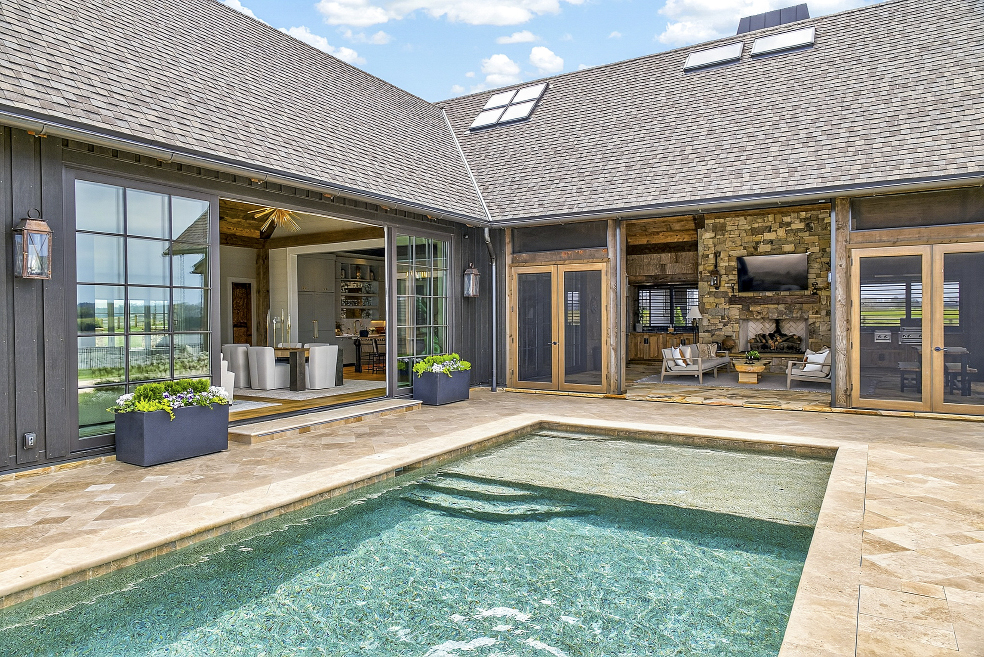
“I told him I wanted everything on one level,” Julie says. “A lap pool. A big outdoor living space, because we spend so much time outside. A kitchen designed for real cooking.” She ticks these off without hesitation, the way someone does when they’ve thought carefully about how they actually live, rather than how they’d like to appear to live.
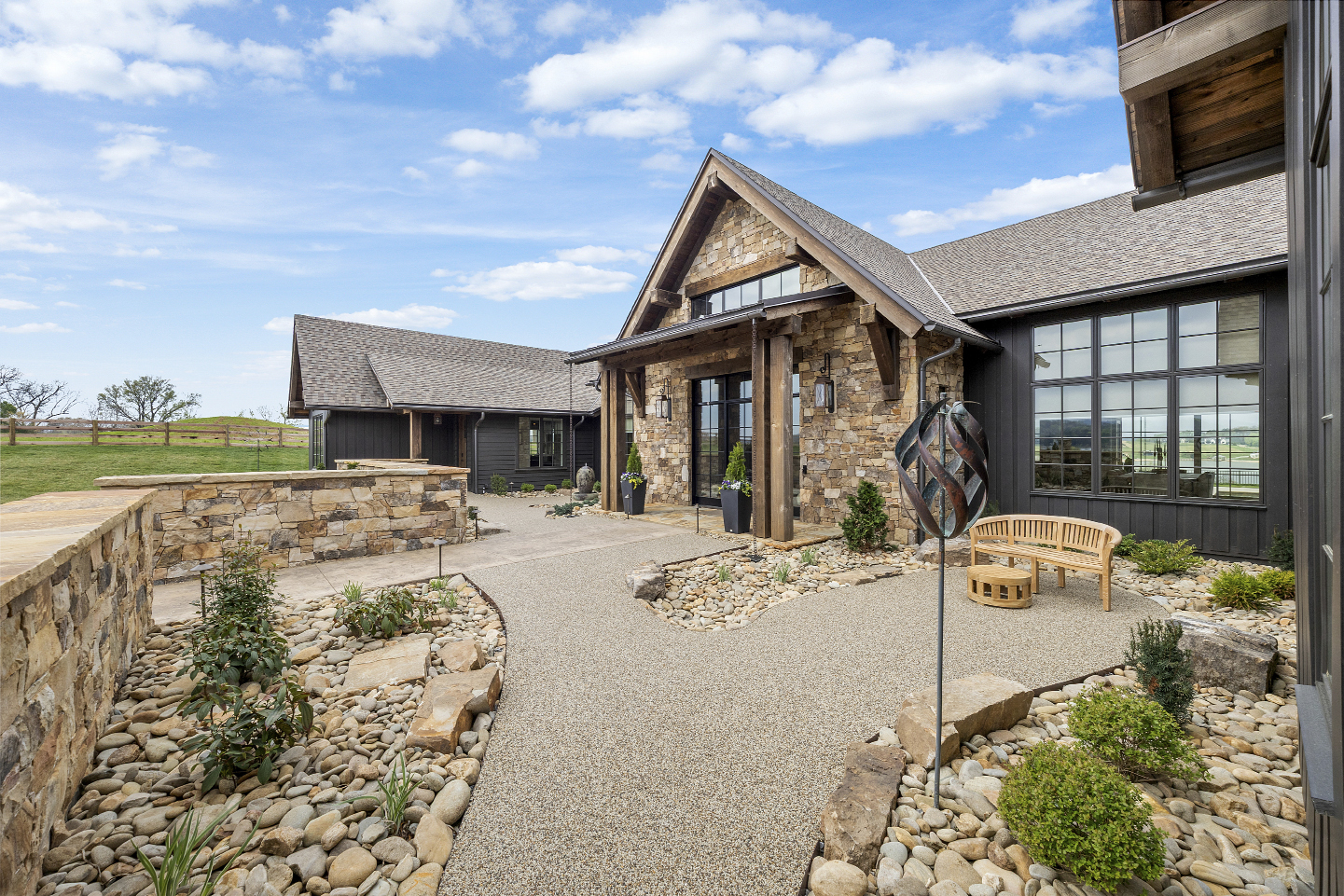
The result is a home that doesn’t announce itself. From the lake, the home reads as a dark, horizontal form stretched across a green hillside — substantial but not aggressive, present without imposing. Up close, the materials speak more clearly: natural Crab Orchard fieldstone from Castone meticulously laid, board-and-batten siding in a custom dark tone, timber accents that carry the same warmth from outside to in. The driveway curves in past a stone-walled courtyard where the landscaping by Proscapes — overseen by Mike Wyrosdick, who had worked with Julie before and who was, by universal agreement, exactly the right person for this property — anchors the approach without overwhelming it.
Walking through the front entry is a moment worth pausing over. Stone walls rise on both sides, and the ceiling opens into rough-hewn timber. There is an immediacy to the scale that is not quite what you expected, even after seeing it from the outside. A large piece of metal art — a Zia sun symbol in warm patinated steel — hangs against the stone like something found rather than placed
The floor is natural stone underfoot. You feel, in a way that is hard to articulate, like you have arrived somewhere specific.
For the build itself, Julie interviewed several of the region’s most respected builders. She is careful to say that “they’re all top notch”, because she means it, and because she wants to be fair. But the truth is, she had known about Mike Stevens for years before she ever sat down with him. Years earlier, she had toured one of his Parade of Homes entries — the house he lives in now, up on North Shore — and that impression had stayed with her. When it came time to interview builders for Osprey Point, Stevens was already on the list before she made the first call. She chose him the way she had chosen the land and the architect: by feel. “He just has a way about him,” she says. “He’s so honest. I just got a good feeling.” Stevens, for his part, had no idea she’d been watching his work that long. “She never really told us that,” he says with a laugh, when I mention it. “She just showed up. And then when we finished, she wrote me a note and told me that when she walked into my office and met me, she knew right then I was her builder.” He pauses. “It’s a great feeling when somebody comes in like that and trusts you.”
Mike Stevens has been building in East Tennessee for more than fifty years, working his way from carpenter to superintendent to builder to developer, and he will tell you that this project stood apart almost from the beginning. “We’re at that point in our lives,” he says, “where we’re just doing very unique houses. Houses that are almost art.” He pauses on that word — art — and means it the way a man means something he has arrived at slowly and honestly, after a long time doing something else.
The amount of wood alone was unlike anything his team had tackled in a single build. The stone, which carried seamlessly from the exterior courtyard walls through the entry and into the interior, required a level of sustained craftsmanship that went well beyond standard masonry. Kent Everett, owner of Castone and a longtime friend and collaborator of Stevens’s, executed the work at a level that Stevens says may be among the finest he’s seen Everett do. The windows bring in the lake in a way that makes every room feel larger than its walls.
The trim work was so extensive and so detailed that Stevens started joking with the carpenters that they’d been on site long enough to put up a mailbox. They stayed. They didn’t complain. They didn’t come back asking for more money. “This is something we’ve never done,” Stevens says. “Something she’s never done. And she had a vision, and she stuck to it.”
The architect — Parker Platt’s firm in Brevard — remained deeply involved throughout the process, making regular site visits and insisting on adjustments whenever something deviated from the original intent. Stevens describes this not as friction but as discipline.
“They agonize over details,” he says. “And you want that. We had a great relationship with them.”
Julie is equally measured about the challenges that came up along the way, the inevitable recalibrations that any build of this complexity requires. “Did we have some ups and downs? Yes,” she says. “But nothing that couldn’t be fixed. And honestly, the team, they become like family. It was enjoyable.”
d fully. Mountain Electric did the wiring, a significant undertaking on a house with this much glass and this many systems, and got it right. Mike Davis’s City Heating and Air installed a geothermal system and later came back at Julie’s request to add a whole-house humidifier, a detail that Stevens had initial reservations about but that turned out beautifully. John DeMartini, the site foreman Stevens brought in specifically for this project, ran the job with a steadiness that the complexity demanded.
“I told him I wanted everything on one level,” Julie says. “A lap pool. A big outdoor living space”
“I think everybody that worked on that house is the best of the best,” Stevens says, and the statement has the weight of someone who has worked with a great many people over a great many years.
What Julie brought to the process beyond vision and decisiveness was her willingness to see opportunity inside the work as it was happening. She noticed the concrete planned for the secondary garage approach and asked, before the pour was finalized, whether a pickleball court could be incorporated. It could. It was. She looked at a set of open shelving and suggested finishing the edges with poplar bark — raw, organic, and exactly right in context. The carpenters made it work.
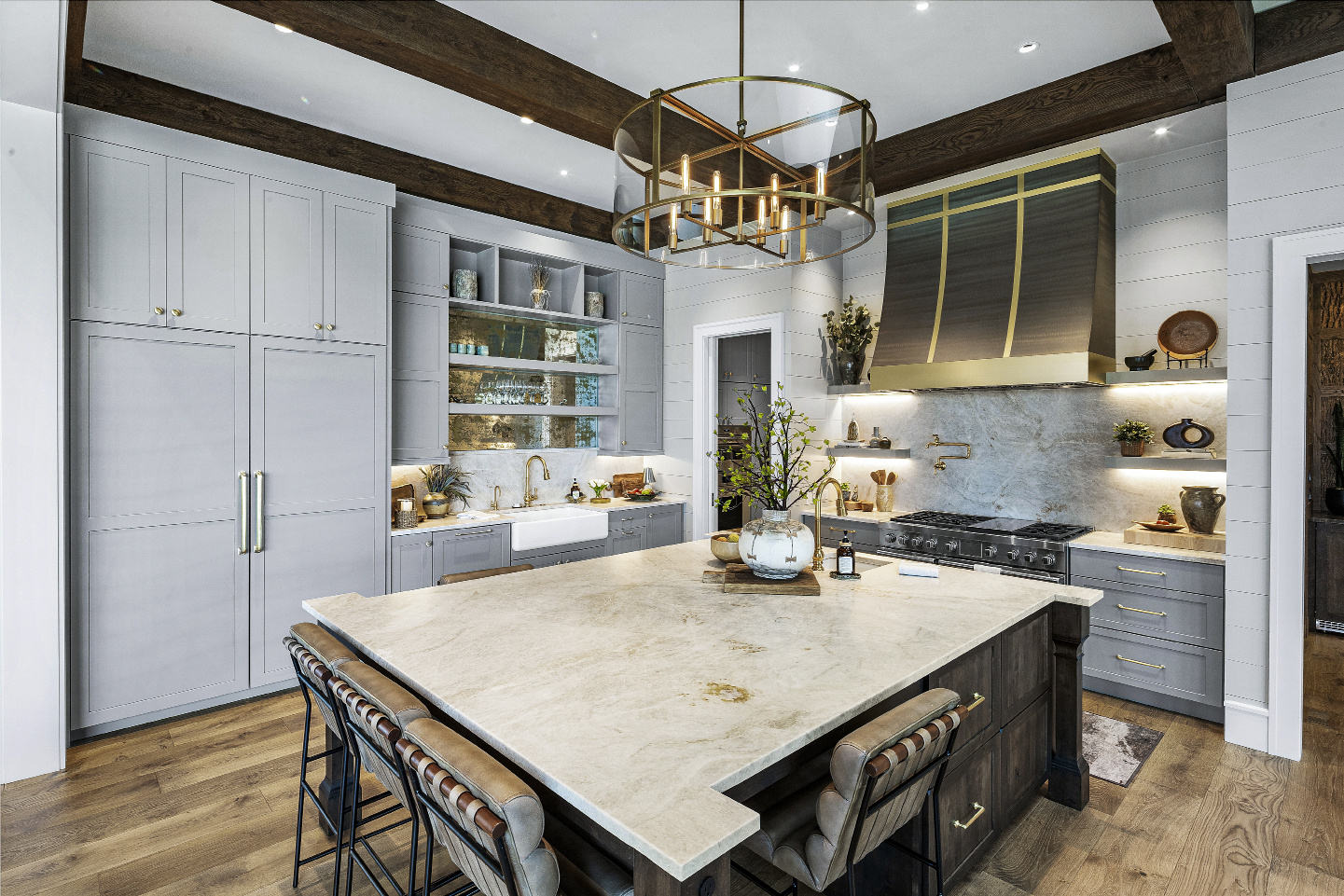
The kitchen, designed as a genuine working space rather than a showpiece, anchors the main living area at one end.
The cabinetry — a soft blue-gray with brushed brass hardware, designed and supplied by Standard Kitchen and Bath under the direction of Scott Findley’s expert team — runs the full perimeter and sets the tone for everything that follows. Standard Kitchen brought both the technical knowledge and the aesthetic sensibility the project demanded, and the result shows in every detail. A large island anchors the center, topped in leathered Taj Mahal quartzite sourced through White’s Marble. A custom range hood draws the eye upward. The hardwood floors, a warm white oak selected by Darrell Galyon from Broadway Carpet’s Asheville Collection, flow throughout the home and into the kitchen and ground the whole space. The appliances, a full Thermador suite from Friedman’s Appliances, are professional-grade and unpretentious about it. This is a kitchen where sourdough gets made — Julie makes her own — where friends gather on the island stools, where the function and the beauty are the same thing.
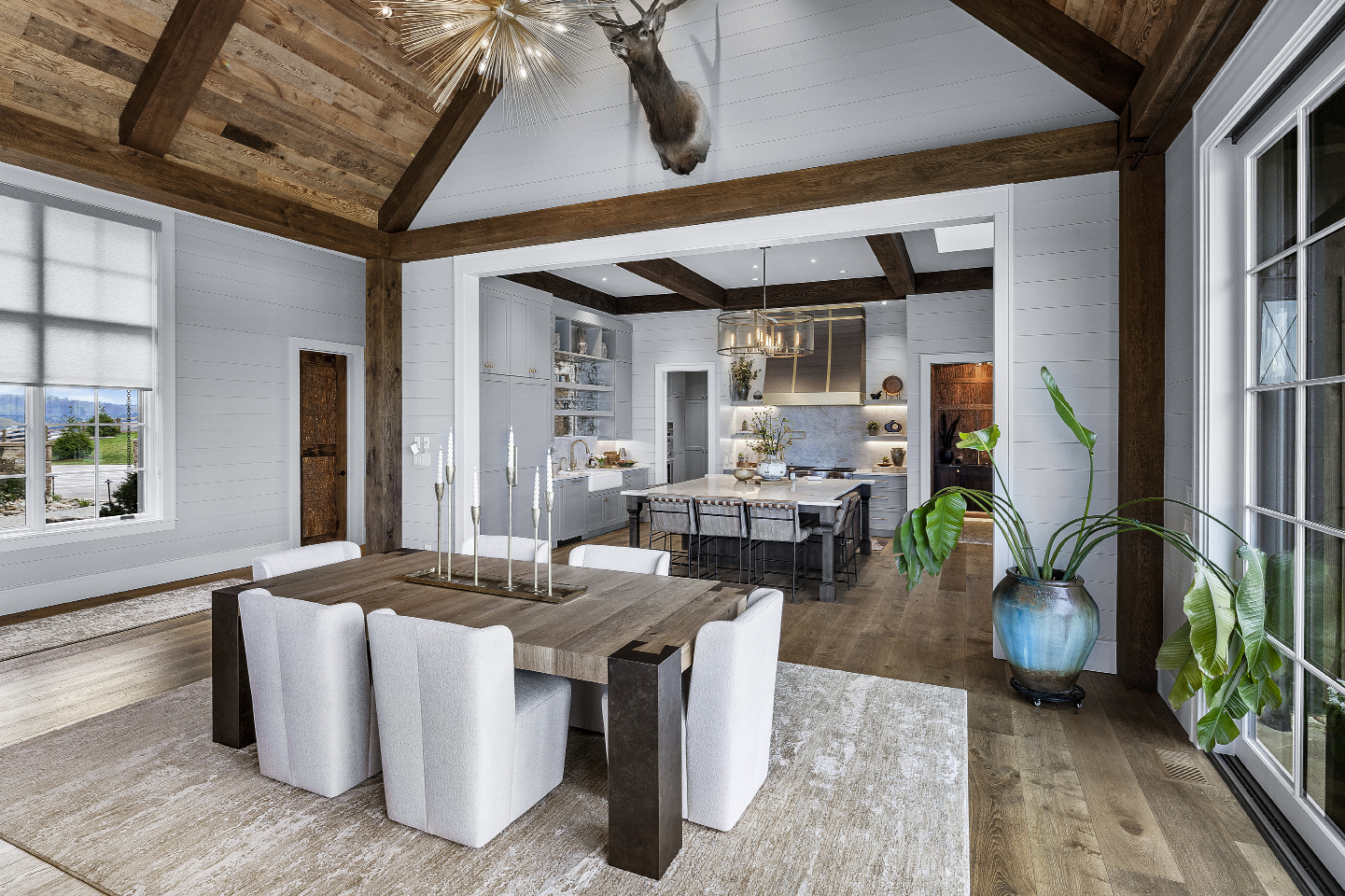
The great room opens beyond it with a vaulted ceiling clad in reclaimed wood, two sputnik-style chandeliers overhead catching the light at different hours, and a full wall of glass along the back face that captures the lake in a way that stops you mid-sentence. The stone fireplace rises floor to peak on the interior wall, and the effect of it all together is exactly what Mike Stevens reached for when he tried to explain it.
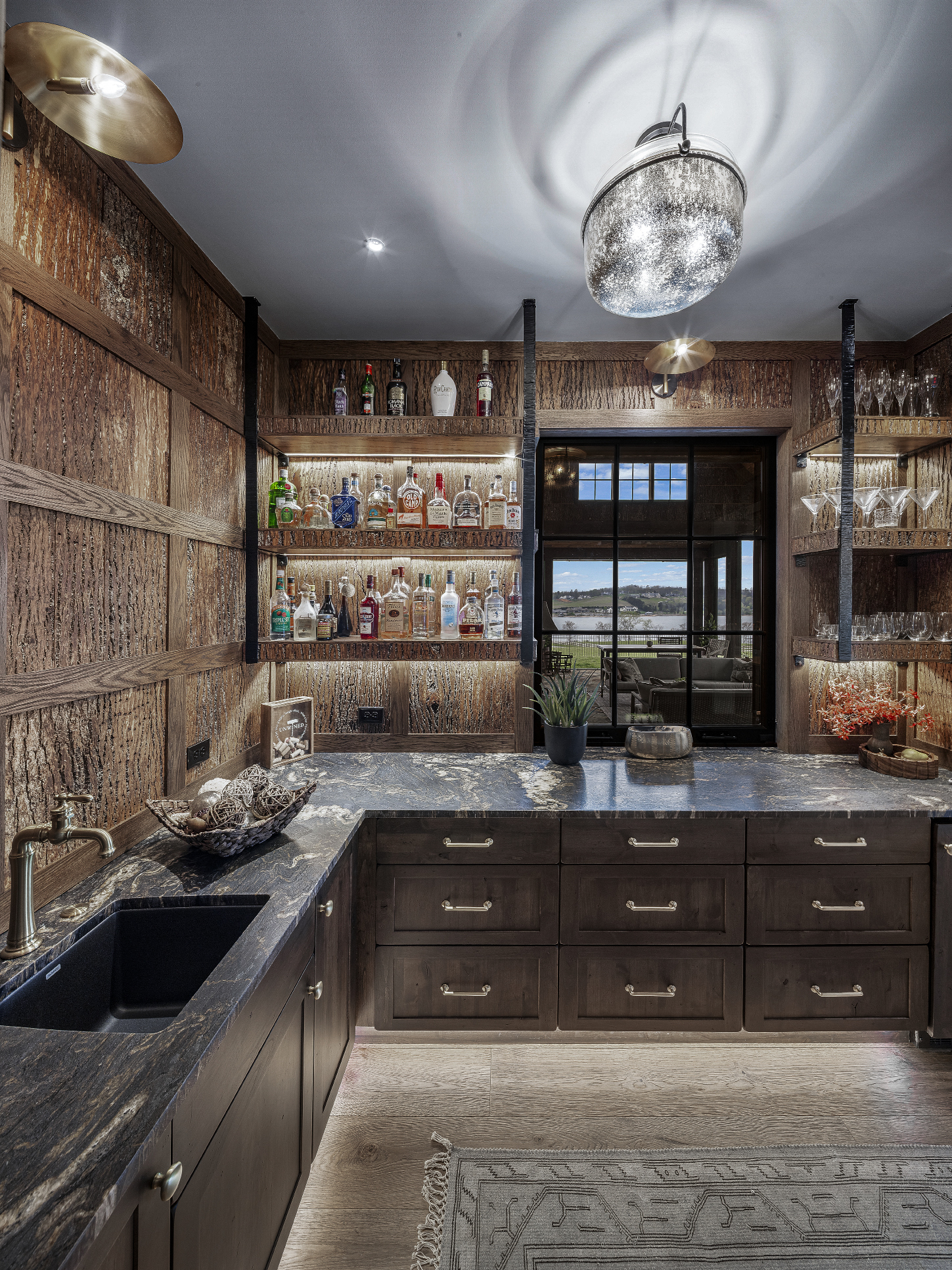
“You ever go into a big house and it just feels cold?” He says. “This is not that kind of house.” He’s right. While this is a substantial home, with multiple guest rooms, a study, a media and recreation room, a wet bar paneled in rich dark wood with Black Cosmic leathered countertops, and a primary suite that opens to a quiet outdoor shower, nothing about it feels formal or stiff. The primary bath has a freestanding soaking tub positioned below a window and a chandelier that belongs in a different room and is perfect here. Those same white oak floors run from room to room without interruption, warm and consistent, tying every space back to the whole.
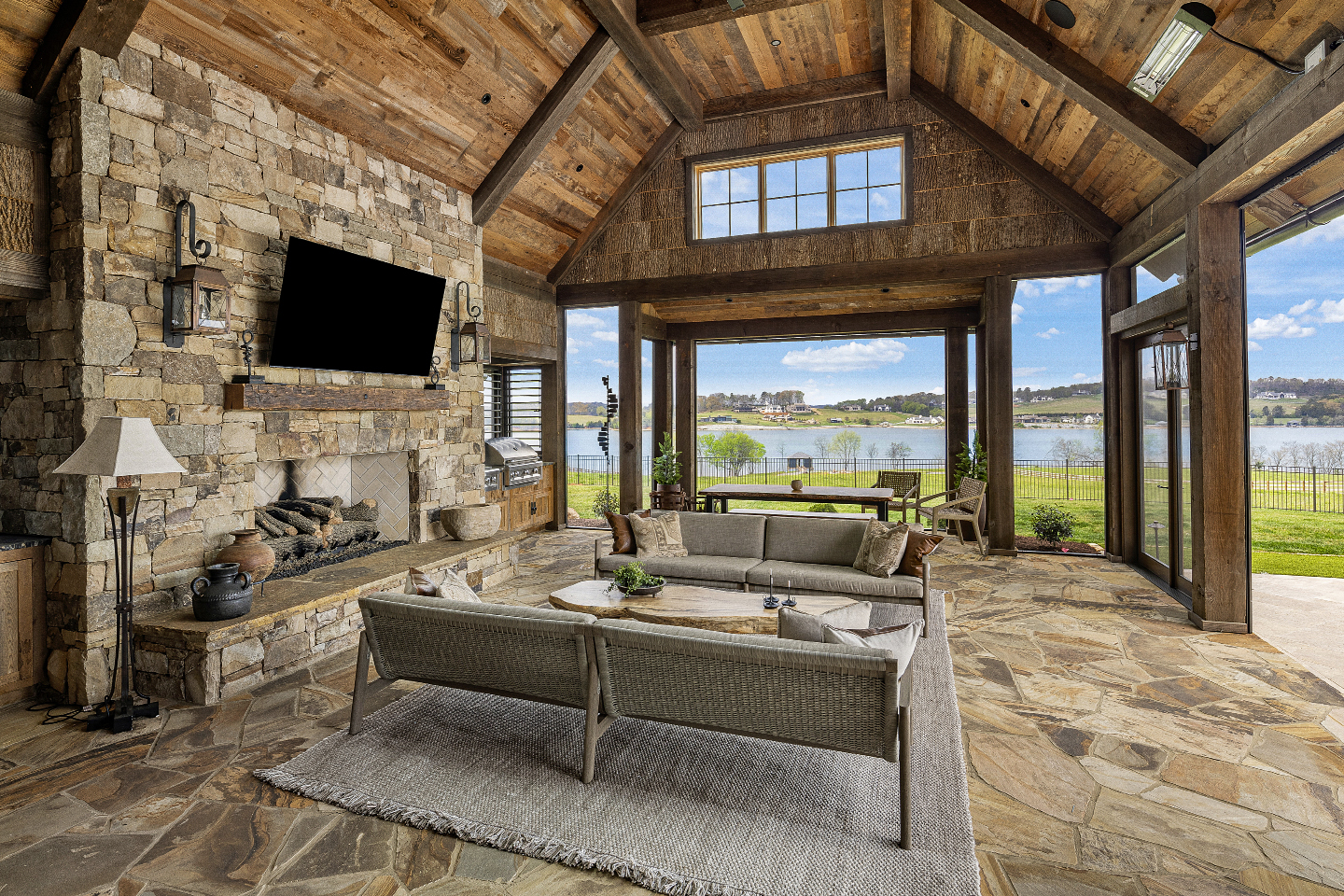
Outside, the covered porch is, by Julie’s own accounting, the heart of the house. Stone floors, a massive outdoor fireplace, a reclaimed wood ceiling that mirrors the interior, and wide open views of Fort Loudoun Lake and the mountains visible on clear days to the north. A live-edge dining table sits near the screened opening, and the whole space is set up for the kind of living that makes the interior feel optional on a good afternoon.

“That’s my favorite place,” Julie says, gesturing out toward the porch and the water beyond. “I sit out there a lot in the afternoons.”
When I tell her that I’ll be looking for her out there when I come through in my bass boat, she laughs and says she might just be there.
As I drove back out the way I’d come — past the pelicans still working the shallows at Poland Creek, past the marina that used to be a little boat dock, past the roads I hadn’t driven in thirty years — I was thinking less about the house and more about the quality of attention that produces a place like that. It begins with someone who knows what she wants and has the instinct to trust it. It continues with an architect willing to study a piece of land until he understands it. It depends on a builder with fifty years of experience and the wisdom to know when a project is something more than a project. And it is sustained by every craftsman and tradesperson who shows up and gives more than the contract requires.
Louisville is not the place it was when I came here as a young man. But occasionally, if you are paying attention, you still come across a place that feels less like a development and more like a discovery. A place where the land is still the point, where the house responds to its setting rather than overriding it, where someone looked at six acres of East Tennessee hillside running down to the water and thought: this is exactly right.
fternoon and knew she had found the location for her new home. Everything that followed made sure she was right.
Comments are closed.