

We expected something splendid. What we experienced was magnificence with the volume knob removed.
By Brooks Clark | Photography by Brooks & Karen Clark
Appeared in Cityview Magazine, Vol. 42, Issue 3 (May/June 2026)
We expected something splendid. What we experienced was magnificence with the volume knob removed.
As many Nat Geo shows as we’ve watched over the years, nothing prepared Karen and me for the impact of seeing wildlife in person and up close. Karen had read Hemingway’s descriptions in Green Hills of Africa of the vastness of the Serengeti Plain and the marvel of the great migration of wildebeest, zebras, giraffes, impalas, and other species, but she was awed to see the plains stretch to the horizons and herds by the thousand moving in their clockwise search for water and better grazing.
In our Toyota Land Cruiser, we moved with the herds and lions, leopards, and cheetahs waiting for their chance to down a newborn wildebeest or gazelle. At one point in the Serengeti, we came upon a sated pride of lions—aging patriarch surrounded by females, with younger males at a distance—sleeping lazily together near a half-creek after gorging themselves on a fresh kill.
None of the animals, predators or prey, are bothered by safari vehicles drawing close to them. “They don’t see you,” explained our tour director, Emmanuel (Emma) Mollel. “If you get out of the truck, that’s another story.”
The animals roam about with an air of professional absorption. Wildebeest move in committees. Zebras appear to have dressed in the dark but are determined to brazen it out. And the lions, stretched beneath the trees, look like country club golfers who have lunched well and see no reason to extend further effort.
When we first arrived in Arusha, Tanzania, Emma (pronounced EE-mah) showed our group a whiteboard of Swahili greetings—jambo (hello), karibu (welcome), asante sana (thank you very much), and hakuna matata (no worries). Of course, that last one we all knew from “The Lion King.”
With white-topped Mt. Kilimanjaro in the distance, our tour started in the Arusha and Tarangire national parks, where we saw our first giraffes, elephants, zebras, and lions, among other fauna, and a saddle-billed stork. Tarangire is famous for having over 550 species of birds. Enormous termite mounds dot the landscape; abandoned ones are often home to the dwarf mongoose, whose noses we saw popping out.
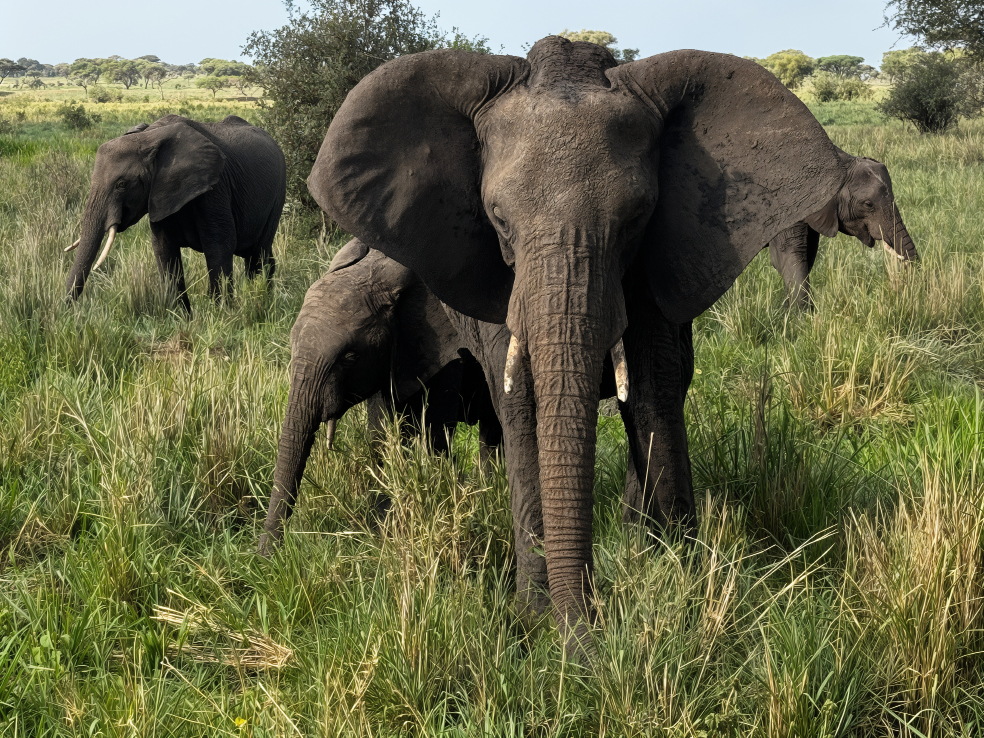
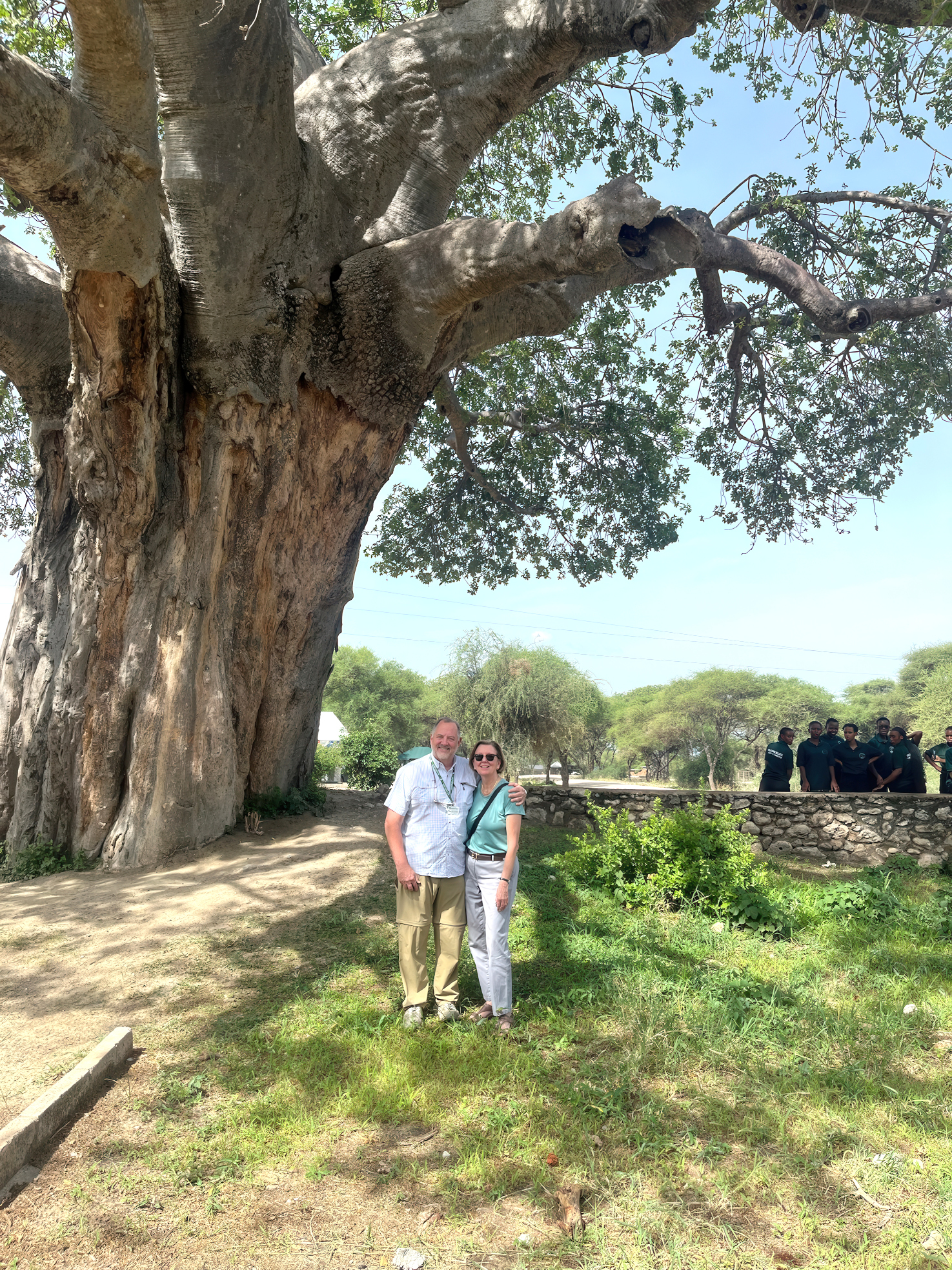
We were awed by the enormous and ancient baobab trees, called the Tree of Life. They absorb and store water in their wide trunks in the rainy season and produce fruit in the dry. Elephants chew the bark and fiber for moisture, but this doesn’t harm the baobab, which can live 5,000 years. (It’s Rafiki’s tree in “The Lion King.” By the way, rafiki means “friend” in Swahili.) We saw many baby elephants being nudged along by their mamas, bringing to mind Henry Mancini’s irresistible “Baby Elephant Walk” from the 1962 John Wayne movie “Hatari!” (“danger” in Swahili), which was filmed in Tanzania (then called Tanganyika).
We stayed in a lodge at an elevation of 7,200 feet on the rim of the Ngorongoro Crater. This is the world’s largest intact, unflooded, and perfectly formed caldera, formed some 2.5 million years ago. The name is believed to be an onomatopoeic word termed by the Maasai people to escribe the sound of a cow bell, “ngor ngor.” The crater floor—some 1,700 feet beneath the rim—holds a 100-square mile conservation area of grassland, swamps, lakes, forests, almost 30,000 large animals, and thousands of birds, including countless flamingos. Here you may see a black rhinoceros, as well as the elusive white rhinoceros. We watched a wildebeest give birth, then over some 15 minutes saw the newborn stumble several times trying to stand up on spindly legs before succeeding.
We were charmed by the secretary bird, so named because its head crest of quill-like feathers resembles the pens court clerks used to carry behind their ears. With an eagle-like body on crane-like legs, it can stand four feet tall. “It kills snakes,” nodded Emma approvingly. Its grey and black plumage, with black feathers on its legs resembling breeches, also suggesting a Dickensian functionary.
Leaving Ngorongoro, we saw a golden jackal trotting across a hillside with a rodent in its mouth. In the other direction, we looked out over vast lands used by the nomadic Maasai to graze their herds of goats, sheep, but mostly cattle. The Maasai are allowed to move their herds all across Tanzania, as they have done for centuries since migrating from South Sudan.
Emma, who is Maasai, took us to a Maasai village, where we met the son of the chief, joined in a welcome dance, and were ushered in as couples to the small, round, thatched-roof mud-and-dung houses. “We live on the meat, the milk, and we drink the blood of the cows,” explained a six-foot-four Maasai man. The Maasai are generally tall. NBA fans might remember the seven-foot-six Dinka tribesman Manute Bol from South Sudan. “Dinka and Maasai are the same,” said Emma.
Our group then met 15 charming three- and four-year-olds in the village classroom. They sang us a welcome song in Maasai. English, Swahili, and Maasai alphabets were at the front of the classroom—the children learn all three. Emma told us that Maasai youngsters showing promise in the classroom go to schools in nearby towns, as he once did. He decided that he wanted to be a guide and went to school to become one. At one point, he returned to find that his village had moved on into the endless wilderness. He didn’t tell us whether he ever found them again.
We stopped at the Olduvai Gorge, the “cradle of humanity,” one of the most important paleoanthropological sites in the world. It is not, at first glance, the sort of place where one expects to find one’s great-great-great-great-great-grandfather, yet it is here in 1959 Mary Leakey famously discovered the 1.8-million-year-old skull of Australopithecus. The gorge takes its name from the Maasai word “oldupai,” the place of the wild sisal plants.
Then it was on to the Serengeti, derived from the Maasai word for “endless plains.” We came upon a cheetah, the fastest animal on earth, looking out over the herds. A few hundred yards away, our driver took us to a clump of bushes and a nest of four cubs, just days old, whose eyes had not yet opened. Not far away, we drew close to a leopard, walking menacingly toward a watering hole. Later, we saw another leopard who had dragged a Thomson’s gazelle into a tree for snacking without the interference of other predators or scavengers.
In Green Hills, Hemingway described fisi, the hyena, as “self-eating devourer of the dead, trailer of calving cows, ham-stringer, potential biter-off of your face at night while you slept, sad yowler, camp-follower, stinking, foul, with jaws that crack the bones the lion leaves, belly dragging, loping away on the brown plain, looking back, mongrel dog-smart in the face.” When we passed a clan of hyenas, they lived up to that unflattering description. Despite their canine appearance, they are not related to dogs.
Warthogs, with their cocksure gait and spindly tails held straight in the air, invite similar attempts at description. The very name of Pumbaa, the Lion King warthog, means “foolish” or “silly” in Swahili. We passed a committee of lappet-faced vultures, storks, and cranes fighting over the carcass of a wildebeest in a scene reminiscent of Filene’s bargain basement.
One morning, we got up early to ascend in a hot-air balloon above the Serengeti. The endlessness of the plains was breathtaking. Hippo tracks crisscrossed the terrain where they rise out of the water at night and roam as far as six miles in their grazing. Driving to the Serengeti airstrip, we passed by a pond filled with two dozen happy hippos, snorting contentedly every now and then.
From the airstrip, we took a 90-minute flight to Zanzibar. Tanzania was formed in 1964, when Tanganyika and Zanzibar united to create the United Republic of Tanganyika and Zanzibar, later renamed Tanzania. Zanzibar gives the impression of having been assembled by a committee of sultans, traders, sea captains, and at least one enthusiast for decorative doors.
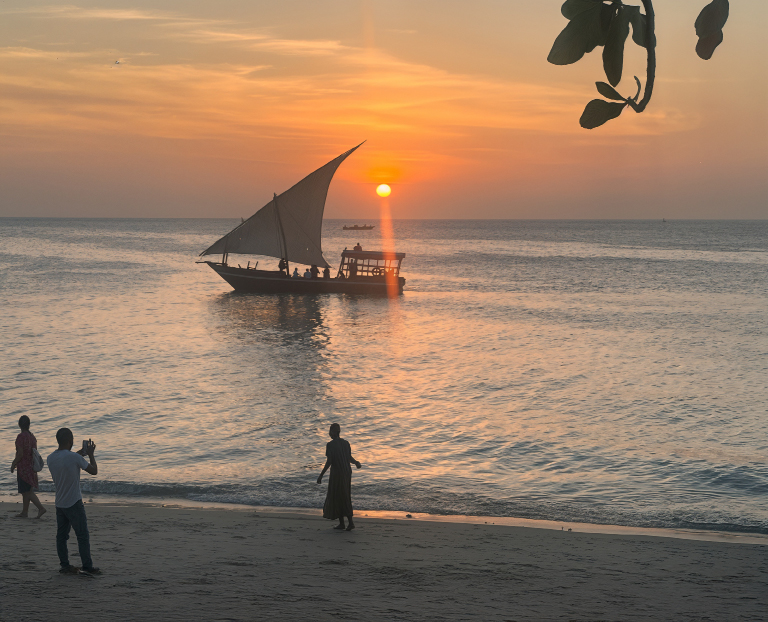
We visited the open fish market in Stone Town, the narrow-alleyed old part of the city. At dawn, wooden dhows unload their catches of yellowfin tuna, red snapper, octopus, and tuna. In the market, vendors bargain with chefs and families. Inland, Zanzibar’s spice farms reveal why it was known as the “Spice Island.” Though it used to send spices all over the world, today it exports only cloves. We walked through groves of cloves, nutmeg, cinnamon, and vanilla. You can buy items scented with Ylang Ylang, one of the distinctive notes of Chanel No. 5.
The former slave market was covered up in the late 1800s by an Anglican cathedral. Underground holding chambers tell the sobering story of the East African slave trade, an essential chapter in understanding Zanzibar’s complex history. Our flight back to the mainland took us to Dar es Salaam (“haven of peace,” in Arabic), a city of eight million, the former capital and still the commercial capital of the country. At our going-away dinner, Emma gave everyone in our group “khangas,” the traditional red or blue checked cloth Maasai wear. He asked us to remember his people and “come back to Tanzania soon.” ◆
Comments are closed.