

Why discipline—not reinvention—will decide Tennessee’s fate
By Tripp Spencer | Photography by Carlos Reveiz & Bruce McCamish
Appeared in Cityview Magazine, Vol. 42, Issue 2 (March/April 2026)
There’s a particular sound inside Thompson-Boling Arena when Tennessee basketball is right. It’s not just noise—it’s emotion. A mix of tension and belief. A crowd that understands defense travels, effort matters, and March doesn’t reward style points nearly as much as it rewards toughness.
As postseason play approaches, that feeling is back again in Knoxville. This year’s Tennessee team isn’t perfect, but it’s real—and in March, real often beats pretty.
A Standard Set Before
The best Tennessee teams I’ve watched all shared something deeper than talent. They played with emotion. They played for each other, for the orange and white, and for something bigger than minutes or stat lines. Those teams would die on the court for one another. Effort wasn’t situational—it was automatic.
That standard matters when looking at where this program has been and where it is now.
The 2022 season helped establish that foundation. That team clarified Tennessee’s identity: pressure defense, physical half-court basketball, and a willingness to turn games into fights. Offense came and went, but the Vols never made anything easy for opponents. It wasn’t always clean, and it wasn’t always pretty—but it was honest basketball.
That season also revealed the margins. Late-game execution. Cold shooting stretches. The reality that defense alone can’t always save you in March. Those lessons didn’t disappear. They became part of the program’s growth.
This Year’s Team: A Wave, Not a Straight Line
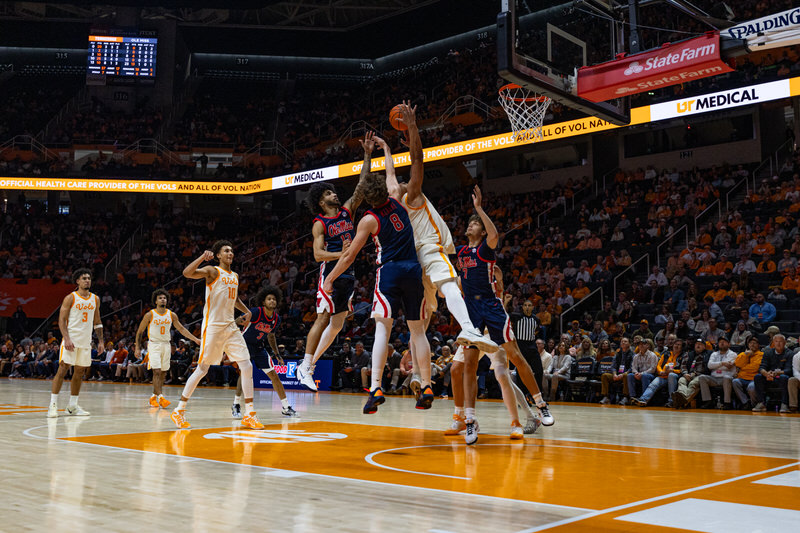
The 2025 Vols feel like a wave—ups and downs, momentum shifts, moments of dominance followed by stretches of frustration. Much of that reality rests on the shoulders of Tennessee’s best player, Ja’Kobi Gillespie. He is asked to be both the primary ball-handler and primary scorer, a burden that becomes heavier every time an opponent decides to trap, double, and force the ball out of his hands.
Statistically and structurally, Tennessee leans on Gillespie more than any defense should allow a single player to carry. He is the only true, confident initiator of offense on the roster. When possessions tighten late, everyone in the building knows where the ball is going—and so do opposing coaches.
That predictability isn’t a criticism of Gillespie. It’s evidence of how narrow Tennessee’s offensive responsibility structure currently is.
The Numbers That Explain the Feeling
The SEC data tells the same story Tennessee fans feel in real time. The Vols rank last in the conference in turnovers per game and near the bottom of the league in free-throw percentage—two flaws that March basketball punishes more than any others. Those mistakes stretch games longer than they need to be and leave the door open late.
And yet, Tennessee continues to compete because it dominates in areas that don’t fluctuate as easily. The Vols rank second in the SEC in rebounds per game, turning missed shots into extra possessions and preventing opponents from getting easy second chances. It’s not clean basketball, but it’s stubborn basketball. Effort and physicality keep Tennessee alive. Execution determines whether it advances.
Defense as the Constant
Conference play has only reinforced what Tennessee basketball has long been built on: elite defense. When comparing full-season team statistics across the SEC, the Vols stand out clearly. Against SEC competition, the Vols hold opponents to just 69 points per game while scoring 82.2 points per game themselves. They also hold opponents to the lowest field-goal percentage in the conference at 39.4%, a number that reflects discipline, physicality, and trust in help-side rotations.
Defense has always been the backbone of a Rick Barnes team, and this group is no different. It’s echoed every night inside Thompson-Boling Arena, where one of the loudest chants remains simple and revealing: feed the floor. Tennessee fans understand that effort on the defensive end is non-negotiable, and this team delivers it consistently.
Those same numbers also clarify why the margins feel so thin. When you defend at this level, possessions become more valuable, not less. Easy points matter more. Protecting the basketball matters more. Free throws matter more.
Tennessee doesn’t just defend shots — it controls the glass. The Vols allow the fewest rebounds per game in the SEC at 30.5, another indicator of discipline, physicality, and positional defense on that end of the floor. But the other side of the ball tells a harder truth. Tennessee ranks at the bottom of the league in turnovers and is blocked and stripped of the ball more often than any other SEC team, issues that go hand in hand with ball pressure and limited offensive initiation. It’s a tale of two sides of the ball: a defense built to win in March, and an offense that too often makes life harder than it needs to be.
Proof in the Losses
The pattern shows up clearly in Tennessee’s close losses. Against Illinois, turnovers and missed free throws erased any chance to build momentum. Against Syracuse, a two-point loss came down to execution, not effort. Against Arkansas, Tennessee shot efficiently from the floor, but the Razorbacks capitalized at the line while Tennessee left points on it.
These weren’t blowouts. They weren’t mismatches. They were games Tennessee had in its hands. And gave back.
A Shared Responsibility
Free throws aren’t a one-player issue for this team. They’re a collective standard problem. In March, free throws are the easiest points you will ever get—and the hardest to replace when you miss them. Leaving them on the floor turns manageable games into stressful ones.
Turnovers follow the same pattern. They aren’t about carelessness—they’re about pressure concentration. When one player carries the initiation load, defensive pressure multiplies. Passing lanes shrink. Decisions speed up. Mistakes follow. The solution isn’t schematic.
It’s shared responsibility
More players must be confident handling the ball. More players must be trusted to initiate offense. More players must be willing to make the first decision instead of the safe one. That’s how pressure disperses. That’s how traps fail. That’s how double teams stop working.
The Bench Factor
Tennessee doesn’t need stars off the bench. It needs reliability. It needs 6–8 points that punish over-help. It needs scoring that forces defenders to stay home. It needs production that prevents defensive schemes from loading entirely toward one player.
Bench scoring in March isn’t about volume—it’s about timing. One bucket during a drought. One finish in transition. One possession that stops a run. Those moments change games.
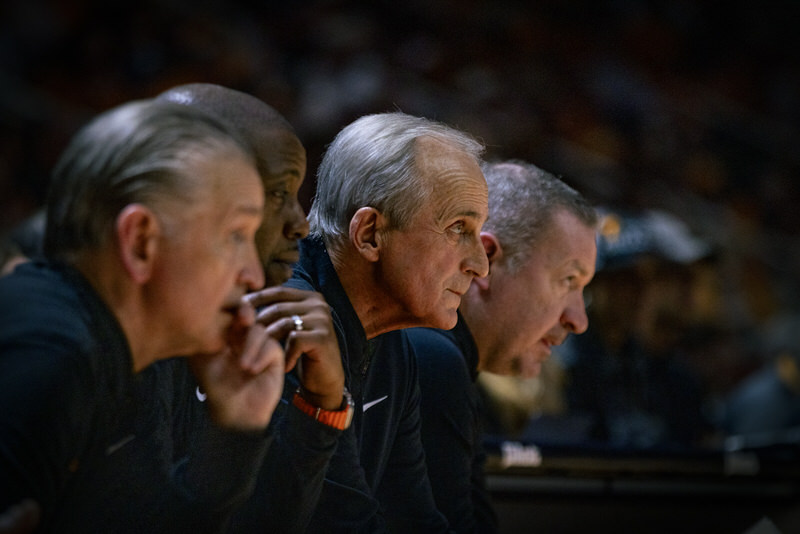
Rick Barnes and the Long View
Tennessee doesn’t need to become something new. It needs to become fully itself. That means spreading responsibility. Tightening execution. Valuing possessions. Treating free throws like the currency they are. Trusting more than one ball-handler. Demanding bench impact.
The foundation is already there: defense, rebounding, effort, physicality, and emotional toughness. What determines March is not identity. It’s discipline.
I believe in this team. Not because it’s flawless—but because it’s tough, connected, and capable of winning ugly. And in March, that’s often enough.
If Tennessee tightens the small things, it won’t need to play perfect basketball. It will just need to play honest basketball. And sometimes, that’s exactly what survives. Trusting more than one ball-handler. Demanding bench impact. The foundation is already there: defense, rebounding, effort, physicality, and emotional toughness. What determines March is not identity—it’s discipline.
I believe in this team. Not because it’s flawless—but because it’s tough, connected, and capable of winning ugly. And in March, that’s often enough. If Tennessee tightens the small things, it won’t need to play perfect basketball. It will just need to play honest basketball.
And sometimes, that’s exactly what survives.
Comments are closed.